qPCR Data Normalization: A Comprehensive Guide to Methods, Validation, and Troubleshooting for Reliable Gene Expression Analysis
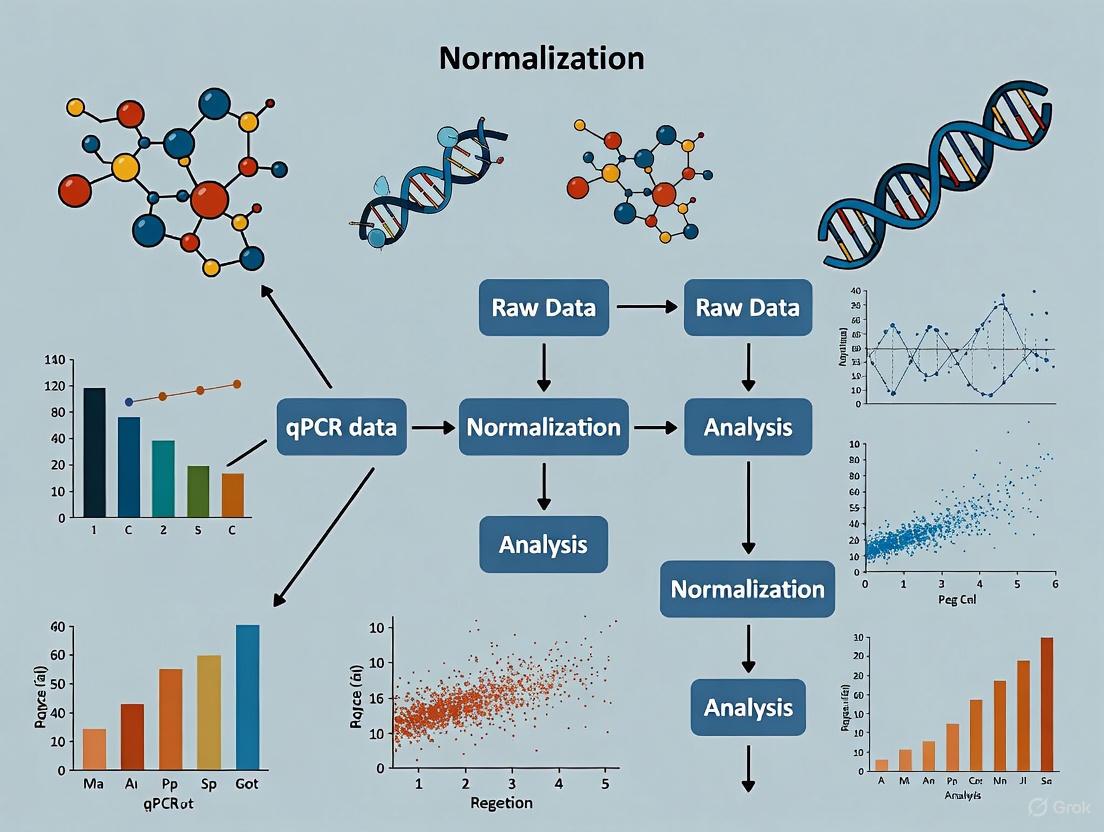
This article provides a comprehensive guide to qPCR data normalization, a critical step for ensuring the accuracy and reproducibility of gene expression results in biomedical research and drug development. It covers foundational principles, from the necessity of normalization to minimize technical variability to the detailed mechanics of the ΔΔCq method. The guide explores established and emerging methodological strategies, including the use of single or multiple reference genes and global mean normalization. It delivers practical troubleshooting advice for common pitfalls and a rigorous framework for validating and comparing normalization approaches, empowering researchers to produce robust, reliable, and publication-ready data.
qPCR Data Normalization: A Comprehensive Guide to Methods, Validation, and Troubleshooting for Reliable Gene Expression Analysis
Abstract
This article provides a comprehensive guide to qPCR data normalization, a critical step for ensuring the accuracy and reproducibility of gene expression results in biomedical research and drug development. It covers foundational principles, from the necessity of normalization to minimize technical variability to the detailed mechanics of the ΔΔCq method. The guide explores established and emerging methodological strategies, including the use of single or multiple reference genes and global mean normalization. It delivers practical troubleshooting advice for common pitfalls and a rigorous framework for validating and comparing normalization approaches, empowering researchers to produce robust, reliable, and publication-ready data.
Why Normalization is Non-Negotiable: The Foundation of Accurate qPCR Data
The Critical Role of Normalization in Minimizing Technical Variability
Frequently Asked Questions
What is the primary goal of normalization in qPCR experiments?
Normalization aims to eliminate technical variation introduced during sampling, RNA extraction, and cDNA synthesis procedures. This ensures your analysis focuses exclusively on biological variation resulting from experimental intervention rather than technical artifacts. Proper normalization is fundamental for accurate data quantification and interpretation [1] [2].
How many reference genes should I use for reliable normalization?
The MIQE guidelines recommend using at least two validated reference genes [3]. However, studies have shown that using three or more stable reference genes can provide even more robust normalization. For example, one study identified HPRT, 36B4, and HMBS as a stable triplet for reliable normalization in adipocyte research [4], while another found RPS5, RPL8, and HMBS formed a stable combination for canine gastrointestinal tissue [1].
Can I use a single reference gene like GAPDH or ACTB?
Using a single reference gene, particularly without validation, is strongly discouraged. Commonly used genes like GAPDH and ACTB have frequently been shown to exhibit variable expression under different experimental conditions. One study concluded that "the widely used putative genes in similar studies—GAPDH and Actb—did not confirm their presumed stability," emphasizing the need for experimental validation of internal controls [4].
What alternative methods exist beyond traditional reference gene approaches?
Several data-driven normalization methods offer alternatives to traditional reference genes, particularly when profiling many genes:
- Global Mean (GM): Uses the average expression of all profiled genes; performs well when profiling >55 genes [1]
- Quantile Normalization: Assumes the overall distribution of gene expression is constant across samples [5]
- Rank-Invariant Set Normalization: Identifies genes with stable rank order across conditions from your dataset [5]
- NORMA-Gene: Uses a least squares regression algorithm to calculate a normalization factor [3]
How do I validate the stability of my reference genes?
Stability should be assessed using specialized algorithms:
- geNorm: Calculates stability measure M; lower M values indicate greater stability [1] [4]
- NormFinder: Evaluates intra- and inter-group variation [1] [3]
- BestKeeper: Uses raw Cq values to determine stability [4]
- RefFinder: Aggregates results from multiple algorithms [3]
Troubleshooting Guides
Problem: High Technical Variation Persists After Normalization
Potential Causes and Solutions:
| Problem Area | Specific Issue | Solution |
|---|---|---|
| Reference Gene Selection | Using unvalidated single reference gene | Validate multiple genes (2-3) using geNorm/NormFinder [1] [4] |
| Sample Quality | Degraded RNA or inconsistent cDNA synthesis | Check RNA integrity, use consistent reverse transcription protocols [6] |
| Amplification Efficiency | Varying efficiency between target/reference genes | Determine efficiency via standard curve, apply corrections [6] |
| Normalization Method | Suboptimal method for your experimental design | Consider switching to global mean for large gene sets (>55 genes) [1] |
Problem: Inconsistent Results Between Technical Replicates
Investigation Protocol:
- Check Amplification Efficiency: Confirm efficiencies between 90-110% for all assays [1]
- Verify Replicate Consistency: Remove replicates differing by >2 PCR cycles [1]
- Assess Reaction Quality: Identify bubbles or irregularities in PCR runs [1]
- Evaluate Specificity: Check for single peaks in melting curves [3]
Problem: Reference Gene Performance Varies Across Experimental Conditions
Solution Strategy:
- Pre-validation: Test candidate reference genes in pilot studies matching your experimental conditions [4]
- Multi-Algorithm Assessment: Use both geNorm and NormFinder for complementary stability assessment [1]
- Functionally Diverse Genes: Select reference genes from different functional pathways to avoid co-regulation [1]
- Alternative Methods: Consider data-driven normalization (NORMA-Gene, quantile) if stable reference genes cannot be identified [5] [3]
Normalization Method Comparison
The table below summarizes the performance characteristics of different normalization approaches based on recent studies:
| Normalization Method | Optimal Use Case | Advantages | Limitations |
|---|---|---|---|
| Multiple Reference Genes (2-3 validated) | Most qPCR studies with limited targets | Well-established, MIQE-compliant | Requires validation, reduces sample for targets [1] [4] |
| Global Mean (GM) | Large gene sets (>55 genes) | Data-driven, no pre-selection | Requires many genes, not for small panels [1] |
| NORMA-Gene | Studies with ≥5 target genes | Reduces variance effectively, fewer resources | Less familiar to reviewers [3] |
| Quantile Normalization | High-throughput qPCR across multiple plates | Corrects plate effects, robust distribution alignment | Complex implementation, assumes same distribution [5] |
| Pairwise/Triplet Normalization | miRNA studies, diagnostic panels | High accuracy, model stability | Computational complexity [7] |
Experimental Protocols
Protocol 1: Reference Gene Validation for qPCR Normalization
Purpose: To identify and validate stable reference genes for specific experimental conditions.
Materials:
- cDNA samples from all experimental conditions
- qPCR reagents and instrument
- Primers for candidate reference genes (minimum 6-8 candidates recommended)
Procedure:
- Select Candidate Genes: Choose 6-8 candidate reference genes from different functional classes [4]
- qPCR Amplification: Run all candidates across all experimental samples (minimum 3 biological replicates per condition)
- Data Quality Control:
- Stability Analysis:
- Final Selection: Choose 2-3 most stable genes with different biological functions [1]
Protocol 2: Global Mean Normalization Implementation
Purpose: To implement global mean normalization when profiling large gene sets.
Materials:
- qPCR data for all genes across all samples
- Statistical software (R, Python, or specialized packages)
Procedure:
- Data Curation:
- Calculate Global Mean:
- Compute average Cq value of all genes for each sample [1]
- Normalize Expression:
- Subtract sample-specific global mean from each gene's Cq value
- Alternatively, use the global mean as denominator in 2^(-ΔΔCq) calculations
- Performance Validation:
Research Reagent Solutions
| Reagent Category | Specific Examples | Function in Normalization |
|---|---|---|
| Reference Gene Assays | RPS5, RPL8, HMBS, HPRT1, HSP90AA1, B2M | Stable endogenous controls for sample-to-sample variation [1] [3] |
| RNA Quality Tools | RNeasy Mini Kits, QIAzol Lysis Reagent, DNase treatment kits | Ensure input RNA quality and genomic DNA removal [3] [4] |
| qPCR Master Mixes | SYBR Green, TaqMan probes, Power SYBR Green chemistry | Consistent amplification chemistry across samples [2] [8] |
| Stability Analysis Software | geNorm, NormFinder, BestKeeper, RefFinder | Algorithmic assessment of reference gene stability [1] [3] [4] |
Workflow Diagram: qPCR Normalization Strategy Selection
Technical Note: Statistical Approaches Beyond 2^(-ΔΔCq)
While the 2^(-ΔΔCq) method remains widely used, recent research suggests alternative statistical approaches can provide enhanced rigor. Analysis of Covariance (ANCOVA) offers greater statistical power and isn't affected by variability in qPCR amplification efficiency. ANCOVA uses raw Cq values as the response variable in a linear model, providing a flexible multivariable approach to differential expression analysis [9].
Quantitative real-time PCR (qPCR) is a powerful technique for quantifying nucleic acids, but its accuracy and reproducibility are heavily influenced by multiple sources of variation. Understanding and controlling these variables is crucial for generating reliable, publication-quality data, especially in the context of normalizing qPCR data for gene expression studies.
Variation in a qPCR experiment can be categorized into three main types: system variation (inherent to the measuring equipment and reagents), biological variation (true variation in target quantity among samples within the same group), and experimental variation (the measured variation which estimates biological variation) [10]. System variation can significantly impact experimental variation, making its minimization a primary goal during experimental design and execution [10].
Pre-Analytical Variation
Pre-analytical variation encompasses all inconsistencies occurring before the qPCR run itself, from sample collection to cDNA synthesis.
Sample Collection and Storage
The initial steps of handling biological material introduce significant variability. Using a dedicated pre-PCR workspace, physically separated from post-PCR areas, is essential to prevent contamination from amplified PCR products [11]. Samples should be stored correctly; DNA is best preserved at -20°C or -70°C under slightly basic conditions to prevent depurination [11].
Nucleic Acid Extraction and Quality Assessment
The quality of the starting template is paramount. Inaccurate quantification of nucleic acid concentration or the presence of inhibitors can severely skew results.
- Purity and Concentration: Use a spectrophotometer or fluorometer to assess sample quality and concentration. A 260/280 nm absorbance ratio within 1.8-2.0 indicates pure DNA [11].
- Inhibitors: Template material containing inhibitors is a common cause of poor amplification efficiency, unusually shaped amplification curves, and irreproducible data [12]. Diluting the input sample can sometimes mitigate this effect [12].
Reverse Transcription and cDNA Synthesis
The reverse transcription step, crucial for gene expression analysis, is a major source of variability.
- gDNA Contamination: Genomic DNA (gDNA) contamination in RNA samples can lead to falsely early Cq values. A recommended corrective step is to treat RNA samples with DNase before reverse transcription [12].
- Reagent Quality: Degraded reagents or inefficient reverse transcription can lead to failed reactions and "no data" outcomes [12]. Using master mixes that include reagents to remove gDNA and inhibit RNase activity is a best practice [11].
Analytical Variation
Analytical variation arises during the setup and execution of the qPCR reaction.
Reagent Quality and Pipetting
- Reagent Integrity: Degraded reagents, such as dNTPs or master mix, can result in a lower-than-expected amplification plateau [12]. Aliquoting reagents prevents degradation from multiple freeze-thaw cycles and reduces contamination risk [11].
- Pipetting Error: This is a primary contributor to system variation and can lead to high variability between technical replicates (Cq differences > 0.5 cycles) [12]. To improve precision, calibrate pipettes regularly, use positive-displacement pipettes with filtered tips, and ensure proper vertical pipetting technique [12] [10].
Reaction Plate Setup and Instrumentation
- Plate Preparation: Bubbles in a well can cause baseline drift and a jagged amplification signal [12]. After sealing the plate, centrifuging it removes bubbles and ensures all liquid is at the bottom of the wells [10].
- Instrument Performance: Regular maintenance, including temperature verification and calibration, is necessary for optimal instrument performance [10].
Assay Design and Optimization
- Primer Design: Poor primer specificity can cause multiple issues, including unexpected data values, earlier-than-anticipated Cq values (due to non-specific amplification or primer-dimer formation), and irreproducible data [12]. Primers should be designed to have similar melting temperatures (within 2-5°C), and their formation of primer-dimers should be checked with melt curve analysis [12] [11].
- Amplification Efficiency: Poor PCR efficiency, potentially caused by an inappropriate annealing temperature or unanticipated variants in the target sequence, leads to unusually shaped amplification curves and later-than-expected Cq values [12]. Assay efficiency should be optimized and tested against carefully quantified controls [12].
The following workflow summarizes the key sources of variation and their impact on the qPCR process:
Frequently Asked Questions (FAQs)
Q1: My No Template Control (NTC) shows exponential amplification. What is wrong? This indicates contamination, likely from laboratory exposure to the target sequence or from the reagents themselves. Corrective steps include cleaning the work area with 10% bleach, preparing the reaction mix in a clean lab space separated from template sources, and ordering new reagent stocks [12].
Q2: The amplification curves for my samples are jagged. What could be the cause? A jagged signal throughout the amplification plot is often due to poor amplification, a weak probe signal, or a mechanical error. Ensure a sufficient amount of probe is used, try a fresh batch of probe, and mix the primer/probe/master solution thoroughly during reaction setup [12].
Q3: My technical replicates are too variable (Cq difference > 0.5 cycles). How can I fix this? High variability between technical replicates is commonly caused by pipetting error or insufficient mixing of solutions. Calibrate your pipettes, use positive-displacement pipettes with filtered tips, and mix all solutions thoroughly during preparation [12].
Q4: I see a much lower plateau phase than expected. What does this mean? A low plateau suggests limiting or degraded reagents (e.g., dNTPs or master mix), an inefficient reaction, or incorrect probe concentration. Check your master mix calculations and repeat the experiment with fresh stock solutions [12].
Q5: What is the difference between technical and biological replicates? Technical replicates are repetitions of the same sample reaction, helping to estimate system precision and identify outliers. Biological replicates are different samples from the same experimental group, accounting for the natural variation within a population. Both are essential for robust statistical analysis [10].
Troubleshooting Guide for Common qPCR Issues
The table below summarizes frequent problems, their potential causes, and recommended solutions based on observed amplification curve anomalies and data outputs.
| Observation | Potential Causes | Corrective Steps |
|---|---|---|
| Exponential amplification in NTC [12] | Contamination from lab environment or reagents. | Clean work area with 10% bleach; use new reagent stocks; prepare mix in a clean lab [12] [11]. |
| High noise in early cycles; data point looping [12] | Baseline set too early; too much template. | Reset baseline; dilute input sample to within linear range [12]. |
| Unusually shaped amplification; late Cq [12] | Poor reaction efficiency; inhibitors; suboptimal annealing temperature. | Optimize primer concentration and annealing temp; redesign primers; dilute sample to reduce inhibitors [12]. |
| Plateau much lower than expected [12] | Limiting or degraded reagents; inefficient reaction. | Check master mix calculations; repeat with fresh stock solutions [12] [11]. |
| Cq much earlier than anticipated [12] | gDNA contamination in RNA; high primer-dimer; poor specificity. | DNase-treat RNA; redesign primers for specificity; optimize annealing temperature [12]. |
| Jagged amplification signal [12] | Poor amplification/weak probe; mechanical error; bubble in well. | Use more probe; try fresh probe; mix solutions thoroughly; centrifuge plate [12] [10]. |
| Variable technical replicates (Cq >0.5 cycles apart) [12] | Pipetting error; insufficient mixing; low expression. | Calibrate pipettes; use filtered tips; mix solutions thoroughly; add more sample [12]. |
| Irreproducible sample comparisons [12] | Low amplification efficiency; RNA degradation; inaccurate dilutions. | Redesign primers; repeat with fresh reagents/sample; check sample dilutions [12]. |
The Scientist's Toolkit: Essential Reagents and Materials
The following table lists key reagents and materials crucial for minimizing variation and ensuring successful qPCR experiments.
| Item | Function | Best Practice / Rationale |
|---|---|---|
| Filtered Pipette Tips [12] [11] | To prevent aerosol contamination from entering the pipette barrel and cross-contaminating samples. | Use consistently for all pre-PCR setup. |
| Master Mix [11] | A pre-mixed solution containing core PCR reagents (e.g., Taq polymerase, dNTPs, buffer). | Reduces pipetting steps, well-to-well variation, and improves reproducibility. |
| Nuclease-Free Water [11] | Used to dilute samples and as a component in reactions. | Should be autoclaved and filtered through a 0.45-micron filter dedicated to pre-PCR use. |
| UNG (Uracil-N-Glycosylase) [11] | Enzyme used in some master mixes to prevent carryover contamination from previous PCR products. | Renders prior dUTP-containing amplicons non-amplifiable. |
| Passive Reference Dye [10] | A dye included in the reaction at a fixed concentration to normalize for non-PCR-related fluorescence variations. | Corrects for differences in well volume and optical anomalies, improving precision. |
| DNase I [12] | Enzyme that degrades genomic DNA. | Critical for RNA work to prevent false positives from gDNA contamination during RT-qPCR. |
| Stable Reference Genes (RGs) [1] [13] | Genes used for data normalization to correct for technical variation. | Must be validated for stability under specific experimental conditions; using a combination of RGs is often best. |
| 3-Methylglutarylcarnitine | 3-Methylglutarylcarnitine, CAS:102673-95-0, MF:C13H23NO6, MW:289.32 g/mol | Chemical Reagent |
| 8-Dehydrocholesterol | 8-Dehydrocholesterol (8-DHC) for SLOS Research |
Normalization Strategies to Minimize Variation
Normalization is a critical process to minimize technical variability and reveal true biological variation [1]. The choice of strategy can significantly impact data interpretation.
Reference Gene (RG) Normalization
This is the most common method, using internal control genes presumed to be stably expressed across all samples.
- Validation is Crucial: So-called "housekeeping" genes (e.g., GAPDH, ACTB) are not always stable. Their expression can vary with tissue type, disease state, and experimental conditions [1] [13]. It is essential to validate RG stability for each specific experimental setup.
- Use Multiple RGs: The MIQE guidelines recommend using more than one verified reference gene [1]. Using a combination of stable genes can balance out minor fluctuations in individual genes. GeNorm and NormFinder are standard algorithms used to rank candidate RGs by their expression stability [1] [13].
Global Mean (GM) Normalization
This method uses the geometric mean of the expression of a large number of genes (often tens to hundreds) as the normalizer.
- When to Use: The GM method can be a superior alternative to RGs, particularly when profiling many genes. One study found GM to be the best-performing method for reducing technical variability when more than 55 genes were profiled [1].
- Advantage: It does not rely on the stability of a small number of pre-selected genes, potentially offering a more robust normalization factor.
The Gene Combination Method
An emerging approach involves finding an optimal combination of a fixed number (k) of genes whose individual expressions balance each other across all conditions of interest, even if the individual genes are not particularly stable [13]. This method can be identified in silico using comprehensive RNA-Seq databases before experimental validation [13].
Core Principles of the 2^(-ΔΔCq) Method for Relative Quantification
The 2-ΔΔCq method (commonly known as the 2-ΔΔCt method) is a foundational strategy in quantitative real-time PCR (qPCR) for determining relative changes in gene expression [14]. This approach calculates the fold change in expression of a target gene between an experimental sample and a reference sample (such as an untreated control), normalized to one or more reference genes used as an internal control [15]. Its widespread adoption is largely due to its convenience, as it directly uses the threshold cycle (Cq or Ct) values generated by the qPCR instrument, eliminating the need for constructing standard curves in every run [16] [17].
Core Principles and Theoretical Foundation
The 2-ΔΔCq method is built upon several key principles and mathematical assumptions that researchers must understand to apply it correctly.
The Mathematical Workflow
The calculation follows a clear, stepwise procedure to arrive at the final fold-change value [17]:
Calculate ΔCq for Each Sample: For every sample (both test and control), subtract the Cq of the reference gene from the Cq of the target gene.
- ΔCq (test) = Cq (target, test) - Cq (ref, test)
- ΔCq (control) = Cq (target, control) - Cq (ref, control)
Calculate ΔΔCq: Subtract the ΔCq of the control sample from the ΔCq of the test sample.
- ΔΔCq = ΔCq (test) - ΔCq (control)
Calculate Fold Change: Use the result as the exponent for base 2.
- Fold Change = 2^(-ΔΔCq)
The final value represents the fold change of your gene of interest in the test condition relative to the control, normalized to the reference gene[s] [17]. A value of 1 indicates no change, a value above 1 indicates upregulation, and a value below 1 indicates downregulation.
Foundational Assumptions
The validity of the 2-ΔΔCq method rests on three critical assumptions [16] [17]:
- Optimal PCR Efficiency: The method assumes that the amplification efficiencies of both the target and reference genes are 100%, meaning the amount of PCR product doubles every cycle (represented by the base of 2 in the formula) [16].
- Equal Efficiencies: It assumes that the amplification efficiencies of the target and reference genes are approximately equal [15].
- Stable Reference Genes: The reference gene(s) must be stably expressed across all experimental conditions and unaffected by the experimental treatment [17].
Comparison of qPCR Quantification Methods
The 2-ΔΔCq method is one of several approaches for analyzing qPCR data. Understanding its position relative to other methods provides context for its appropriate application [15] [18].
| Method | Core Principle | Key Advantages | Key Limitations | Ideal Use Case |
|---|---|---|---|---|
| 2-ΔΔCq (Relative) | Calculates fold change relative to a calibrator sample, normalized to a reference gene [14]. | No standard curve needed; increased throughput; simple calculation [15]. | Relies on strict efficiency and reference gene stability assumptions [16]. | Large number of samples, few genes, when assumptions are validated [17]. |
| Standard Curve (Relative) | Determines relative quantity from a standard curve, normalized to a reference gene [15]. | Less optimization than comparative CT; runs target and control in separate wells [15]. | Requires running a standard curve, uses more wells [15]. | When amplification efficiencies are not equal or are unknown [15]. |
| Standard Curve (Absolute) | Relates Cq to a standard curve with known starting quantities to find absolute copy number [18]. | Provides absolute copy number, not just fold change [18]. | Requires pure, accurately quantified standards; prone to dilution errors [15]. | Determining absolute viral copies, transgene copies [15] [18]. |
| Digital PCR (Absolute) | Partitions sample into many reactions and counts positive vs. negative partitions [15]. | No standards needed; highly precise; tolerant to inhibitors [15]. | Requires specialized instrumentation; limited dynamic range. | Absolute quantification of rare alleles, copy number variation [15]. |
Troubleshooting Guides
FAQ: Validating the 2-ΔΔCq Method
Q1: How do I validate that my primers have near-100% and equal amplification efficiencies? A validation experiment is required before using the 2-ΔΔCq method [15]. Prepare a serial dilution (e.g., 1:10) of your cDNA sample and run it with both your target and reference gene primers. Plot the Cq values against the logarithm of the dilution factor. The slope of the resulting standard curve should be between -3.1 and -3.6, which corresponds to an efficiency between 110% and 90% [19]. The efficiencies for the target and reference genes must be within 5% of each other to use this method reliably [17].
Q2: My reference gene seems to be regulated by the experimental treatment. What should I do? Using an unstable reference gene is a major source of inaccurate results. You should [1]:
- Test multiple reference genes: Identify and use the most stable ones.
- Use a geometric mean of multiple genes: Combining several stable reference genes (e.g., the 2-3 most stable) increases normalization accuracy [1].
- Consider data-driven normalization: For high-throughput qPCR (dozens to hundreds of genes), methods like the Global Mean (GM) or Quantile Normalization can be more robust alternatives, as they use the entire dataset for normalization rather than relying on a few pre-selected genes [5] [1].
Q3: My fold change results seem biologically implausible. What could be wrong? Implausible results often stem from violations of the method's core assumptions [16] [19]:
- Check PCR Efficiencies: Re-run the validation experiment. Even small efficiency differences between target and reference genes can lead to large miscalculations [19].
- Review Cq Values: Check for very high Cq values (e.g., >35), which indicate low template concentration and increased variability. Also, ensure the background fluorescence has been correctly handled, as improper subtraction can distort results [16].
- Re-inspect Raw Data: Always look at the amplification and melt curves for anomalies like primer-dimers or non-specific amplification, which can lead to inaccurate Cq calls [19].
Q4: Can I compare ΔCq or ΔΔCq values directly between different experimental runs or laboratories? No, this is not recommended. Cq values are highly dependent on machine-specific settings, the chosen quantification threshold, and reagent efficiencies, which can vary between runs and laboratories [19]. The 2-ΔΔCq calculation is designed for comparison within a single, optimally calibrated run. For comparisons across runs, the use of an inter-run calibrator sample is advised.
Research Reagent Solutions
The following table outlines essential materials and their critical functions in a typical 2-ΔΔCq experiment.
| Reagent/Material | Function | Key Considerations |
|---|---|---|
| Specific Primers | To amplify the target and reference genes with high specificity. | Must be validated for efficiency and specificity. Amplicon length should be kept similar [18]. |
| qPCR Master Mix | Contains DNA polymerase, dNTPs, buffer, and fluorescent dye (e.g., SYBR Green) for detection. | Choice of dye or probe chemistry affects sensitivity and specificity [19]. |
| RNA/DNA Template | The sample material containing the genetic target to be quantified. | For gene expression, high-quality RNA with a high RIN is crucial. Input amount must be consistent [19]. |
| Reverse Transcriptase | (For gene expression) Converts RNA to cDNA for PCR amplification. | RT efficiency can be a major source of variation and should be kept consistent across samples [15]. |
| Nuclease-Free Water | Serves as a solvent and negative control. | Essential for preventing degradation of reagents and templates. |
| Validated Reference Genes | Used for normalization of technical variations. | Must be confirmed to be stable under your specific experimental conditions (e.g., GAPDH, ACTB, ribosomal genes) [16] [1]. |
Normalization is a critical step in the analysis of quantitative PCR (qPCR) data, serving to minimize technical variability introduced during sample processing so that the analysis focuses on true biological variation. When performed poorly or omitted, normalization can lead to severe data misinterpretation and irreproducible results, undermining research validity. This guide details the consequences of inadequate normalization and provides troubleshooting advice to help researchers avoid these common pitfalls, framed within the broader context of methodological rigor in qPCR research.
Frequently Asked Questions (FAQs)
1. What is the primary purpose of normalizing qPCR data? Normalization aims to eliminate technical variation introduced during sampling, RNA extraction, cDNA synthesis, and loading differences. This ensures that observed gene expression changes result from biological variation due to the experimental intervention and not from technical artifacts [1].
2. Why is using a single reference gene like GAPDH or ACTB often insufficient? Using a single reference gene is problematic because so-called "housekeeping" genes can vary under different physiological or pathological conditions. For example, studies have shown that GAPDH is not stable in models of age-induced neuronal apoptosis, and ACTB varies in ischemic/hypoxic conditions [20]. Relying on a single, unstable gene for normalization can introduce significant bias.
3. What are the minimum information guidelines for publishing qPCR experiments? The MIQE (Minimum Information for Publication of Quantitative Real-Time PCR Experiments) guidelines were established to standardize reporting and avoid misinterpretations. A key recommendation is using multiple, validated reference genes for reliable normalization, not just one [20] [9].
4. When can the global mean (GM) method be a good alternative to reference genes? The global mean of expression of all profiled genes can be a robust normalization strategy, particularly when a large number of genes (e.g., more than 55) are being assayed. One study found GM to be the best-performing method for reducing variability in complex sample sets [1].
5. How can poor normalization affect my final results? Poor normalization can skew normalized data, causing a significant bias. This can lead to both false-positive results (type I errors), where you believe an effect exists when it does not, and false-negative results (type II errors), where you miss genuine biological effects [21].
Troubleshooting Common Normalization Problems
Problem 1: Unstable Reference Genes
- Symptoms: High variability in target gene expression within the same treatment group; reference gene expression shows significant changes across experimental conditions.
- Causes: The chosen reference gene is regulated by the experimental treatment. This is common in processes like ageing or disease states. For instance, in a study of ageing mouse brains, common reference genes like Hmbs, Sdha, and ActinB showed statistically significant variation in structures like the hippocampus and cerebellum [20].
- Solutions:
- Validate Gene Stability: Prior to your main experiment, test candidate reference genes using algorithms like GeNorm or NormFinder to rank their stability in your specific experimental system [20] [1].
- Use Multiple Genes: Never rely on a single gene. Normalize using a normalization factor based on the geometric mean of several (at least two) of the most stable reference genes [20].
- Choose Functionally Diverse Genes: If using multiple reference genes, avoid selecting genes from the same functional pathway (e.g., multiple ribosomal proteins), as they may be co-regulated. Incorporate genes with distinct cellular functions for a more robust baseline [1].
Problem 2: High Technical Variation After Normalization
- Symptoms: Inconsistent results between biological replicates; high coefficient of variation (CV) after normalization.
- Causes: Inconsistency can stem from RNA degradation, minimal starting material, or pipetting errors. Furthermore, the normalization method itself may be ineffective at removing non-biological noise [22].
- Solutions:
- Check RNA Quality: Prior to reverse transcription, check RNA concentration and integrity. A 260/280 ratio outside the ideal 1.9–2.0 range can indicate contamination, and a smeared gel can indicate degradation [22].
- Consider Alternative Methods: For high-throughput qPCR profiling dozens of genes, data-driven normalization methods like Quantile Normalization or the NORMA-Gene algorithm can be more robust than standard housekeeping gene approaches [5] [21].
- Improve Pipetting Technique: Perform technical replicates and ensure proficiency to minimize pipetting errors [23] [22].
Problem 3: Inability to Reproduce Published Findings
- Symptoms: Your qPCR results do not match previously published data, even when using the same reference genes.
- Causes: A widespread reliance on the 2–ΔΔCT method often overlooks critical factors such as variations in amplification efficiency and reference gene stability between different experimental setups [9]. Furthermore, a lack of shared raw data and analysis code prevents proper evaluation [9].
- Solutions:
- Go Beyond 2–ΔΔCT: Consider using statistical methods like ANCOVA (Analysis of Covariance), which can offer greater statistical power and robustness by directly accounting for efficiency variations [9].
- Adhere to FAIR Principles: Share your raw qPCR fluorescence data and detailed analysis scripts. This allows others to evaluate potential biases and reproduce your findings accurately [9].
- Use Automated, Reproducible Tools: Leverage open-source analysis software like Auto-qPCR to create a systematic, error-minimized workflow from raw data to final analysis, reducing "user-dependent" variation [24].
Reference Gene Stability Across Conditions
The table below summarizes quantitative data from a study investigating reference gene stability in different mouse brain structures during ageing, illustrating that a gene stable in one context may be unstable in another [20].
Table 1: Stability of Common Reference Genes in Ageing Mouse Brain Structures P-values from ANOVA test for expression differences across ages; lower p-value indicates less stability.
| Gene | Cortex | Hippocampus | Striatum | Cerebellum |
|---|---|---|---|---|
| Ppib | 0.0407 * | 0.2252 | 0.7391 | 0.5919 |
| Hmbs | 0.5114 | 0.0078 | 0.0344 * | 0.0047 |
| ActinB | 0.4707 | 0.0011 | 0.4552 | <0.0001 * |
| Sdha | 0.0017 | 0.0045 | 0.1322 | <0.0001 * |
| GAPDH | 0.0501 | 0.0279 * | 0.5062 | 0.0593 |
| Significance | p<0.05; * p<0.01; * p<0.001* |
Comparison of Normalization Methods
Different normalization strategies offer varying levels of effectiveness in reducing technical variability. The following table compares several common approaches.
Table 2: Performance Comparison of qPCR Normalization Methods
| Method | Principle | Best Use Case | Key Advantage | Key Limitation |
|---|---|---|---|---|
| Single Reference Gene | Adjusts data based on one stably expressed gene | Quick, low-cost pilot studies; when a gene's stability is thoroughly validated in the specific system | Simplicity and low resource requirement | High risk of bias; many classic housekeeping genes (GAPDH, ACTB) are often unstable [20] [5] |
| Multiple Reference Genes | Uses a normalization factor from several stable genes (e.g., via GeNorm) | Most standard qPCR experiments; MIQE guideline recommendation [20] | More robust than single-gene; reduces impact of co-regulation | Requires upfront validation; consumes samples for extra assays [1] |
| Global Mean (GM) | Normalizes to the average Cq of all profiled genes | High-throughput studies profiling many genes (>55) [1] | Data-driven; no need for pre-selected reference genes | Requires a large number of genes; assumes most genes are not differentially expressed [1] |
| Quantile Normalization | Forces the distribution of expression values to be identical across all samples | High-throughput qPCR where samples are distributed across multiple plates [5] | Effectively removes plate-to-plate technical effects | Makes strong assumptions about the data distribution [5] |
| NORMA-Gene | Data-driven algorithm that estimates and reduces systematic bias per replicate | Studies with a limited number of target genes (as few as 5) [21] | Does not require reference genes; handles missing data well | Less known and adopted; performance depends on number of genes [21] |
Workflow: From Poor to Robust Normalization
The following diagram illustrates a robust workflow for avoiding the consequences of poor normalization, from experimental design to data analysis.
Table 3: Key Research Reagent Solutions and Computational Tools
| Item | Function / Purpose | Example(s) / Notes |
|---|---|---|
| Stable Reference Genes | Genes with invariant expression used as internal controls for normalization. | Genes like RPS5, RPL8, HMBS were identified as stable in canine GI tissue; stability must be validated for your system [1]. |
| qPCR Plates & Seals | Physical consumables for housing reactions. | Ensure plates are properly sealed to prevent evaporation, which causes inconsistent traces and poor replication [23]. |
| RNA Quality Assessment Tools | To verify RNA integrity before cDNA synthesis. | Spectrophotometer (for 260/280 ratio), agarose gel electrophoresis. Degraded RNA is a major source of irreproducible results [22]. |
| Stability Analysis Software | Algorithms to objectively rank candidate reference genes by stability. | GeNorm [1], NormFinder [1]. Integrated into software like QBase+ [20]. |
| Data-Driven Normalization Software | Tools that perform normalization without pre-defined reference genes. | qPCRNorm R package (Quantile Normalization) [5], NORMA-Gene Excel workbook [21], Auto-qPCR web app [24]. |
From Theory to Bench: Implementing Robust qPCR Normalization Strategies
What are housekeeping genes and why are they important for qPCR? Housekeeping genes, also known as reference or endogenous controls, are constitutively expressed genes that regulate basic and ubiquitous cellular functions essential for cellular existence [25] [26]. In quantitative reverse transcription PCR (RT-qPCR), these genes serve as critical internal controls to normalize gene expression data, correcting for variations in sample quantity, RNA quality, and technical efficiency across samples [27]. This normalization is mandatory for accurate interpretation of results, as it ensures that observed expression changes reflect true biological differences rather than technical artifacts [25].
What are the key criteria for an ideal reference gene? An ideal reference gene should demonstrate stable expression under all experimental conditions, cell types, developmental stages, and treatments being studied [26] [27]. While early definitions focused primarily on genes expressed in all tissues, current best practices require that potential reference genes also be expressed at a constant level across the specific conditions of the experiment [28]. The expression of a suitable reference gene cannot be influenced by the experimental conditions [29].
Validating Reference Genes: Experimental Protocols
Step-by-Step Validation Procedure
Before using reference genes in your study, they must be empirically validated. Follow this detailed protocol to test candidate gene stability:
Select Candidate Genes: Choose 3-10 potential reference genes from literature reviews or endogenous control panels. Include genes with different cellular functions to avoid co-regulation [30] [27]. The TaqMan endogenous control plate provides 32 stably expressed human genes for initial screening [27].
Prepare Representative Samples: Collect RNA samples across all experimental conditions, time points, and tissue types relevant to your study. Ensure consistent RNA purification methods across all samples [27].
Conduct Reverse Transcription: Convert equal amounts of RNA to cDNA using consistent methodology. In two-step RT-qPCR, use a mixture of random hexamers and oligo(dT) primers for comprehensive cDNA representation [31].
Perform qPCR Analysis: Amplify candidate genes across all sample types in at least triplicate reactions. Use the same volume of cDNA template for each reaction to maintain consistency [27].
Analyze Expression Stability: Calculate Ct values and assess variability using specialized algorithms. The most suitable candidate genes will show the least variation in Ct values (lowest standard deviation) across all tested conditions [27].
Workflow Diagram for Reference Gene Validation
Troubleshooting Common Issues
How many reference genes should I use for accurate normalization? The MIQE guidelines recommend using multiple reference genes rather than relying on a single gene [29]. The optimal number can be determined using the geNorm algorithm, which calculates a pairwise variation value (V) to determine whether adding another reference gene improves normalization stability [32]. Generally, including three validated reference genes provides significantly more reliable normalization than using one or two genes.
What should I do if my favorite housekeeping gene (GAPDH, ACTB) shows variable expression? Many commonly used housekeeping genes like GAPDH and ACTB show significant variability across different tissue types and experimental conditions [25] [27]. If your initial testing reveals instability in these classic reference genes:
- Expand your candidate panel to include less traditional housekeeping genes such as TBP, RPLP2, YWHAZ, or CYC1 [25].
- Use statistical algorithms like geNorm or NormFinder to identify the most stable genes for your specific experimental system [32] [30].
- Consider alternative genes from different functional pathways that may be more stable in your particular experimental context.
How do I handle tissue-specific or condition-specific reference gene selection? Gene expression stability is highly context-dependent, meaning a gene stable in one tissue or condition may be variable in another [25]. For example, wounded and unwounded tissues show contrasting housekeeping gene expression stability profiles [25]. To address this:
- Always validate reference genes specifically for your experimental conditions.
- Consult databases like NCBI Gene Expression Omnibus to check expression patterns of candidate genes in your tissue of interest [27].
- Consider that genes stably expressed in healthy tissues may show variability in disease states or after experimental manipulations.
What if my reference genes show high variability (Ct value differences >0.5)? High variability in Ct values (standard deviation >0.5 cycles between samples) indicates an inappropriate reference gene [27]. Address this by:
- Verifying RNA quality and cDNA synthesis consistency across samples.
- Testing additional candidate genes to identify more stable alternatives.
- Using statistical methods to identify genes with the lowest M-values (geNorm) or highest equivalence (network-based methods) [25] [30].
Research Reagent Solutions
Table 1: Essential Reagents for Reference Gene Validation
| Reagent Type | Specific Examples | Function & Application Notes |
|---|---|---|
| Reverse Transcriptase Enzymes | Moloney Murine Leukemia Virus (M-MLV) RT, Avian Myeloblastosis Virus (AMV) RT | Converts RNA to cDNA; select enzymes with high thermal stability for RNA with secondary structure [31]. |
| qPCR Master Mixes | SYBR Green, TaqMan assays | Provides fluorescence detection for quantification; TaqMan assays offer higher specificity through dual probes [25]. |
| Reference Gene Assays | TaqMan Endogenous Control Panel (32 human genes) | Pre-optimized assays for screening potential reference genes [27]. |
| Primer Options | Oligo(dT), random hexamers, gene-specific primers | cDNA synthesis priming; mixture of random hexamers and oligo(dT) recommended for comprehensive coverage [31]. |
| RNA Stabilization Reagents | RNAlater | Preserves RNA integrity in tissues prior to extraction [25]. |
Statistical Analysis and Data Interpretation
Several statistical algorithms are available to assess reference gene stability:
- geNorm: Determines the most stable reference genes from a set of candidates and calculates the optimal number of genes needed for accurate normalization [32]. The algorithm computes an M-value representing expression stability, with lower M-values indicating greater stability [25].
- NormFinder: Another popular algorithm that ranks candidate genes by stability, though it may produce different rankings than geNorm [30].
- Network-based equivalence tests: A newer method that uses equivalence tests on expression ratios to select genes proven to be stable with controlled statistical error [30].
Decision Framework for Normalization Strategy
Advanced Applications and Considerations
How do I approach reference gene selection for specialized applications like cancer research or developmental studies? In specialized contexts like cancer biology, where gene expression patterns are significantly altered, the use of multiple controls is essential [27]. Studies classifying tumors into subtypes based on gene expression patterns typically select 2-3 optimal control genes from a larger panel of 11 or more candidates [27]. Similarly, in developmental studies with multiple stages, validate reference genes specifically for each developmental time point.
What are the emerging trends and computational tools for reference gene selection? Recent approaches include:
- Data-driven normalization: Methods like quantile normalization that directly correct for technical variation without presuming specific housekeeping genes, especially useful when standard reference genes are regulated by experimental conditions [5].
- Gini coefficient analysis: A statistical measure quantifying inequality in expression across samples, with lower values indicating more stable expression [26].
- Global mean normalization: Particularly useful for normalizing data from large, unbiased gene sets such as miRNA expression profiles [32].
Table 2: Common Reference Genes and Their Cellular Functions
| Gene Symbol | Gene Name | Primary Cellular Function | Stability Considerations |
|---|---|---|---|
| GAPDH | Glyceraldehyde-3-phosphate dehydrogenase | Glycolysis, dehydrogenase activity | Highly variable across tissues; requires validation [25] [27] |
| ACTB | Actin, beta | Cytoskeleton structure | Commonly used but often variable; shorter introns/exons [25] [28] |
| B2M | Beta-2-microglobulin | Histocompatibility complex antigen | Frequently used but stability varies by condition [25] |
| TBP | TATA box binding protein | Transcription initiation | Often shows high stability in validation studies [25] |
| RPLP2 | Ribosomal protein large P2 | Translation, ribosomal function | Good candidate with stable expression in many systems [25] |
| YWHAZ | Tyrosine 3-monooxygenase activation protein | Signal transduction | Validated as stable in multiple models [25] [28] |
| 18S | 18S ribosomal RNA | Ribosomal RNA component | Highly expressed; may require dilution in reactions [27] |
Accurate normalization is a foundational step in reliable quantitative real-time PCR (qPCR) gene expression analysis. Technical variations introduced during sample collection, RNA extraction, reverse transcription, and PCR amplification can significantly obscure true biological differences [3] [1]. Normalization controls for this technical noise, ensuring that observed expression changes reflect experimental conditions rather than procedural artifacts. The use of internal reference genes (RGs), or housekeeping genes (HKGs), is the most common normalization strategy. These genes, involved in basic cellular maintenance, are presumed to be stably expressed across various tissues and conditions. However, a growing body of evidence confirms that no single reference gene is universally stable; their expression can vary considerably depending on the species, tissue, experimental treatment, and even pathological state [33] [1] [34]. The inappropriate selection of an unstable reference gene can lead to inaccurate data, misleading fold-change calculations, and incorrect biological conclusions [3] [35].
To address this challenge, algorithm-assisted selection methods have been developed to systematically identify the most stable reference genes for a specific experimental setup. This technical support document, framed within a thesis on normalization methods for qPCR data research, provides a detailed guide to utilizing three cornerstone algorithms: geNorm, NormFinder, and BestKeeper. It offers troubleshooting guides and FAQs to help researchers, scientists, and drug development professionals navigate common pitfalls and implement these powerful tools effectively in their experiments.
Understanding the Algorithms: Principles and Workflow
The three algorithms, geNorm, NormFinder, and BestKeeper, employ distinct mathematical approaches to rank candidate reference genes based on their expression stability. Using them in concert provides a robust, consensus-based selection.
Algorithm Comparison and Workflow
The table below summarizes the core principles, outputs, and key considerations for each algorithm.
Table 1: Comparison of geNorm, NormFinder, and BestKeeper Algorithms
| Algorithm | Core Principle | Primary Output | Key Strength | Key Consideration |
|---|---|---|---|---|
| geNorm [36] | Pairwise comparison of variation between all candidate genes. | M-value: Lower M-value indicates higher stability. Pairwise variation (V): Determines optimal number of RGs (V<0.15 is typical cutoff) [33]. | Intuitively identifies the best pair of genes; recommends the optimal number of RGs. | Tends to select co-regulated genes; cannot rank a single best gene [37]. |
| NormFinder [1] | Model-based approach estimating intra- and inter-group variation. | Stability value: Lower value indicates higher stability. | Accounts for sample subgroups within the experiment; less likely to select co-regulated genes. | Requires pre-defined group structure (e.g., control vs. treatment) for best results. |
| BestKeeper [36] | Correlates each candidate gene's Cq values to a synthetic index (geometric mean of all candidates). | Standard Deviation (SD) & Coefficient of Variation (CV): Lower values indicate higher stability. Correlation coefficient (r) with the BestKeeper Index. | Provides direct measures of expression variability (SD/CV) based on raw Cq values. | Relies on raw Cq values and assumes high PCR efficiency; can be sensitive to outliers [37]. |
To integrate the rankings from these algorithms, the tool RefFinder is often used. It employs a geometric mean to aggregate results from geNorm, NormFinder, BestKeeper, and the comparative ΔCt method, providing a comprehensive stability ranking [33] [38].
The following diagram illustrates the typical experimental workflow for algorithm-assisted reference gene selection.
The Scientist's Toolkit: Essential Research Reagents and Software
Successful implementation of algorithm-assisted selection requires careful planning and the right tools. The table below lists essential materials and software used in the featured experiments.
Table 2: Research Reagent Solutions for Reference Gene Validation
| Category / Item | Specific Examples from Literature | Function / Purpose |
|---|---|---|
| RNA Extraction | Trizol reagent [3] [35], RNeasy Plant Mini Kit [33] | Isolation of high-quality, intact total RNA from biological samples. |
| DNase Treatment | RQ1 RNase-Free DNase [3] | Removal of genomic DNA contamination from RNA samples. |
| cDNA Synthesis | Maxima H Minus Double-Stranded cDNA Synthesis Kit [33] | Reverse transcription of RNA into stable complementary DNA (cDNA). |
| qPCR Master Mix | Not specified in results, but essential. | Contains DNA polymerase, dNTPs, buffers, and dyes for efficient amplification. |
| Stability Algorithms | geNorm [36], NormFinder [1], BestKeeper [36] | Excel-based software to calculate gene expression stability. |
| Comprehensive Ranking Tool | RefFinder [33] [38] | Web tool that integrates results from multiple algorithms for a final ranking. |
| (Z)-7-Dodecen-1-ol | (Z)-7-Dodecen-1-ol, CAS:20056-92-2, MF:C12H24O, MW:184.32 g/mol | Chemical Reagent |
| Bombykol | Bombykol | Bombykol, the first characterized insect sex pheromone. For Research Use Only. Not for human or veterinary use. Study olfaction and pest control. |
Troubleshooting Guides and FAQs
Frequently Asked Questions (FAQs)
Q1: Why can't I just use a single, well-known reference gene like GAPDH or ACTB?
A: It is a common misconception that classic HKGs are universally stable. Numerous studies demonstrate that their expression can vary significantly with experimental conditions. For instance, in canine gastrointestinal tissue, ACTB was less stable than ribosomal proteins [1]. In Vigna mungo under stress, TUB was the least stable gene [33]. Using an unvalidated single gene risks introducing substantial bias into your data [3] [34].
Q2: What is the minimum number of candidate genes I should test? A: The MIQE guidelines recommend using at least two validated reference genes [3]. In practice, you should start with a panel of 3 to 10 candidate genes selected from the literature relevant to your species, tissue, and experimental treatment [33] [38]. Testing too few genes may not provide a stable normalization factor.
Q3: My results from geNorm, NormFinder, and BestKeeper are slightly different. Which one should I trust? A: Discrepancies are common and expected due to their different computational principles [34] [37]. The most robust approach is to use an integrated tool like RefFinder, which generates a comprehensive ranking based on all three methods [33] [38]. Alternatively, you can manually compare the outputs and select genes that consistently rank in the top tier across all algorithms.
Q4: I am profiling a large number of genes. Are there alternative normalization methods? A: Yes. When profiling tens to hundreds of genes, the Global Mean (GM) method can be a powerful alternative. This method uses the geometric mean of the expression of all reliably detected genes as the normalization factor. One study in canine tissues found the GM method outperformed traditional reference gene normalization when more than 55 genes were profiled [1]. Another algorithm-based method, NORMA-Gene, which requires data from at least five genes and uses least-squares regression, has been shown to reduce variance effectively and requires fewer resources than traditional reference gene validation [3].
Troubleshooting Common Experimental Issues
Problem: High variation in Cq values for all candidate genes.
- Potential Cause 1: Poor RNA quality or inconsistent cDNA synthesis.
- Solution: Check RNA integrity (e.g., RIN > 8.0) using an instrument like a Bioanalyzer. Standardize RNA quantity and quality input for all reverse transcription reactions [3] [33].
- Potential Cause 2: Inefficient or variable PCR amplification.
- Solution: Check primer efficiencies; they should be between 90-110% and consistent across assays. Optimize qPCR conditions to ensure specific amplification with a single peak in the melt curve [3] [35].
Problem: geNorm recommends too many genes (high V-value).
- Potential Cause: No set of genes in your panel is sufficiently stable, or the experimental conditions profoundly affect cellular physiology.
- Solution: Re-evaluate your candidate gene panel. Include genes from different functional classes (e.g., cytoskeletal, ribosomal, metabolic) to avoid co-regulation. Consider using an alternative normalization strategy like NORMA-Gene or the Global Mean method if applicable [3] [1].
Problem: Discrepancy between algorithm rankings and RefFinder output.
- Potential Cause: RefFinder uses raw Cq values as input and may not account for differences in PCR amplification efficiency, unlike the original software packages. A study demonstrated that when raw data were reanalyzed assuming 100% efficiency, the original software outputs aligned with RefFinder [37].
- Solution: Be aware of this limitation. It is best practice to use the original software with efficiency-corrected Cq values for the most accurate results. Use RefFinder as a convenient tool for a consolidated, but potentially efficiency-biased, overview.
Experimental Protocol: A Step-by-Step Methodology
The following protocol is synthesized from multiple studies validating reference genes [3] [33] [34].
Objective: To identify and validate the most stable reference genes for normalizing qPCR data in a specific experimental system.
Step 1: Candidate Gene Selection
- Action: Select 5-10 candidate reference genes from the scientific literature relevant to your species, tissue, and experimental context.
- Rationale: Genes commonly stable in one system (e.g.,
GAPDHin some plants [38]) may be unstable in another (e.g.,GAPDHin canine intestine [1]). A diverse panel increases the likelihood of finding stable genes.
Step 2: Sample Preparation and qPCR
- Action:
- Subject organisms or cells to all planned experimental conditions (e.g., control, treatment A, treatment B).
- Harvest tissues/cells and extract total RNA using a reliable method (e.g., column-based kits or Trizol). Treat with DNase.
- Quantify RNA and check purity (A260/280 ratio ~2.0). Synthesize cDNA using a high-quality reverse transcriptase kit.
- Run qPCR for all candidate genes on all samples. Include no-template controls. Perform technical replicates.
- Critical Note: Ensure PCR efficiencies are optimized and consistent (90-110%) for all primer pairs, as this is a critical input for geNorm and NormFinder [37].
Step 3: Data Pre-processing and Analysis
- Action:
- Record Cq values. Calculate PCR efficiencies for each gene if not already known.
- Input the Cq values and efficiency data into geNorm, NormFinder, and BestKeeper according to the software manuals.
- Software Note: BestKeeper works with raw Cq values, while geNorm and NormFinder can utilize efficiency-corrected quantities [37].
Step 4: Interpretation and Validation
- Action:
- From geNorm, note the M-values and the point where the pairwise variation (Vn/n+1) falls below 0.15, indicating the sufficient number of reference genes.
- From NormFinder, rank genes by their stability value.
- From BestKeeper, rank genes by their standard deviation (SD) and correlation coefficient (r) with the index.
- Compile a final ranked list. Select the top 2-3 most stable genes for normalization.
- Validation: Test the selected genes by normalizing a target gene with known or expected expression behavior. Compare the results when normalizing with the most versus the least stable gene; a significant difference confirms the importance of proper selection [38].
In quantitative real-time PCR (qPCR) research, normalization is not merely a data processing step; it is a fundamental prerequisite for obtaining biologically accurate and reproducible results. The process aims to eliminate technical variability introduced during sample collection, RNA extraction, and cDNA synthesis, thereby ensuring that the final analysis reflects true biological variation. For researchers and drug development professionals, selecting the optimal normalization strategy is critical for validating RNA sequencing results, quantifying biomarker expression, and making pivotal decisions in the drug development pipeline. While the use of internal reference genes (RGs) has been the traditional cornerstone of qPCR normalization, the Global Mean (GM) normalization method has emerged as a powerful and often superior alternative, particularly in studies profiling a large number of genes. This guide provides a technical deep-dive into implementing GM normalization, complete with troubleshooting FAQs and validated experimental protocols.
What is Global Mean Normalization?
Global Mean (GM) normalization is a method where the expression level of a target gene is normalized against the geometric mean of the expression levels of a large number of genes profiled across all samples in the experiment [1]. Unlike traditional reference gene methods that rely on a few stably expressed "housekeeping" genes, GM normalization uses the bulk expression of the transcriptome as its baseline. This approach is conventionally used in gene expression microarrays and miRNA profiling and has proven to be a valuable alternative for high-throughput qPCR studies [1].
Key Advantages and Considerations
- Reduces Bias from Co-regulated Genes: Using a large number of genes minimizes the risk of bias that can occur when using a small set of reference genes that might be co-regulated under specific experimental conditions [1].
- No Need for Pre-Validation: The method eliminates the resource-intensive process of validating candidate reference genes for every new experimental condition.
- Requires a Sufficient Number of Genes: Its performance is dependent on profiling a sufficient number of genes to accurately represent the global expression baseline.
Frequently Asked Questions (FAQs) & Troubleshooting
FAQ 1: When is GM Normalization the Most Appropriate Method?
Answer: GM normalization is most appropriate and outperforms traditional methods when your qPCR experiment profiles a large number of genes.
- Strong Recommendation: A 2025 study on canine gastrointestinal tissues explicitly advises the implementation of the GM method "when a set greater than 55 genes is profiled" [1]. The study systematically compared six normalization strategies and found GM normalization to be the best-performing method in reducing the coefficient of variation (CV) across samples.
- Weaker Performance with Small Gene Sets: The stability of the global mean is dependent on the number of genes used. With smaller gene sets (e.g., fewer than 10-20 genes), the mean can be easily skewed by the high variation of a few genes, making traditional stable reference genes a more reliable choice [1].
FAQ 2: How Does GM Normalization Compare to Traditional Reference Genes?
Answer: Direct comparative studies have demonstrated that GM normalization can significantly reduce technical variation compared to using even multiple, validated reference genes.
The table below summarizes a quantitative comparison from a study that evaluated different normalization strategies on 81 genes in canine intestinal tissues [1].
Table 1: Performance Comparison of Normalization Methods in a qPCR Study
| Normalization Method | Number of Genes Used for Normalization | Reported Performance (Mean Coefficient of Variation) |
|---|---|---|
| Global Mean (GM) | 81 (all profiled genes) | Lowest observed across all tissues and conditions [1] |
| Most Stable RGs | 5 | Higher variability than GM method |
| Most Stable RGs | 4 | Higher variability than GM method |
| Most Stable RGs | 3 | Higher variability than GM method |
| Most Stable RGs | 2 | Higher variability than GM method |
| Most Stable RGs | 1 | Highest variability among the tested methods |
FAQ 3: My Global Mean is Unstable. What Could Be the Cause?
Answer: An unstable global mean typically indicates an issue with the input data or the experimental design.
- Insufficient Number of Genes: This is the most common cause. Re-evaluate your panel size. If you are profiling fewer than 50 genes, consider switching to a validated panel of reference genes or expanding your gene panel [1].
- Poor RNA Quality or Technical Artifacts: The GM method assumes that the overall transcriptome profile is consistent. Degraded RNA or technical issues during reverse transcription or qPCR (e.g., inhibitors, pipetting errors) can create systematic biases that affect the global mean. Always check RNA integrity numbers (RIN) and inspect amplification curves for anomalies.
- Extreme Biological Outliers: If a sample is an extreme biological outlier (e.g., a severely diseased tissue vs. healthy controls), its global expression profile might be fundamentally different. In such cases, it is crucial to ensure that the gene panel is representative and not biased towards a specific metabolic pathway.
FAQ 4: Are There Algorithmic Alternatives to GM Normalization?
Answer: Yes, other algorithm-based normalization methods exist that also do not require stable reference genes. A prominent example is NORMA-Gene.
- How it works: NORMA-Gene uses a least squares regression model on the expression data of at least five genes to calculate a normalization factor that minimizes variation across samples [3].
- Demonstrated Performance: A 2025 study on sheep liver found that NORMA-Gene was better at reducing the variance in the expression of target genes than normalization using the top three validated reference genes [3].
- Practical Benefit: Like GM normalization, it saves resources by eliminating the need for extensive reference gene validation [3].
Step-by-Step Experimental Protocol for GM Normalization
The following workflow diagram outlines the key steps for implementing GM normalization in a qPCR study, from experimental design to data analysis.
Detailed Protocol
Experimental Design & Gene Profiling:
- Design your qPCR assay to profile a large number of genes. As per recent evidence, a panel of more than 55 genes is recommended for GM normalization to be effective [1].
- Include a diverse set of genes representing various biological functions to ensure the global mean is a robust representation of the transcriptome.
Data Curation (Critical Step):
- Before normalization, rigorously curate your qPCR data. Exclude assays with poor PCR efficiency (e.g., outside 90-110%) or non-specific amplification as judged by melt curve analysis [1].
- Identify and handle any technical outliers. A published study excluded over 15% of initially profiled genes due to poor efficiency or low signal before final analysis [1].
Calculation of Global Mean and Normalization:
- For each sample, calculate the geometric mean of the Cq (or Ct) values for all reliably profiled genes. The geometric mean is used because it is less sensitive to extreme values than the arithmetic mean.
- The normalization factor (NF) for each sample is this global mean value.
NF_sample = geometric_mean(Cq_g1, Cq_g2, ..., Cq_gn) - Calculate the normalized expression for each target gene (ΔCq):
ΔCq_target = Cq_target - NF_sample
Downstream Analysis:
- Proceed with standard relative quantification methods, using the ΔCq values for statistical analysis and calculation of fold-changes (e.g., 2^(-ΔΔCq)) or using more robust statistical models like ANCOVA [9].
The Scientist's Toolkit: Essential Research Reagents & Materials
Successful implementation of GM normalization relies on high-quality starting materials and reagents. The following table lists key solutions required for the featured methodology.
Table 2: Essential Research Reagent Solutions for qPCR with GM Normalization
| Reagent / Material | Function / Description | Key Considerations for GM Normalization |
|---|---|---|
| High-Quality RNA Isolation Kit | To extract intact, pure total RNA from biological samples. | Critical. RNA integrity is paramount, as degradation can skew the global expression profile. Use systems like QIAzol Lysis Reagent [3]. |
| RT-qPCR Master Mix | A ready-to-use mixture containing DNA polymerase, dNTPs, buffer, and salts for amplification. | Choose a robust mix suitable for high-throughput platforms. Verify that it provides consistent efficiency across all assays in your large panel. |
| High-Throughput qPCR Platform | A system capable of profiling 96 or more genes simultaneously. | Essential for efficiently running the large gene panels required for a stable GM. Enables consistent thermal cycling across all reactions [1]. |
| Primer Assays | Sequence-specific primers for each gene in the panel. | Design or select primers with high efficiency and specificity. Validate using melting curves. Plan a panel that exceeds the minimum gene number threshold [1] [3]. |
| Data Analysis Software | Software capable of handling Cq data and performing geometric mean calculations. | Ensure the software (e.g., R, Python scripts, specialized qPCR analysis suites) can efficiently compute the global mean from dozens to hundreds of genes per sample. |
| N-Benzylacetamide | N-Benzylacetamide, CAS:588-46-5, MF:C9H11NO, MW:149.19 g/mol | Chemical Reagent |
| 3,3-Dimethylglutaric acid | 3,3-Dimethylglutaric acid, CAS:4839-46-7, MF:C7H12O4, MW:160.17 g/mol | Chemical Reagent |
Decision Workflow: Choosing Your Normalization Strategy
The flowchart below provides a logical pathway to help researchers decide whether GM normalization is the optimal choice for their specific experimental setup.
NORMA-Gene is a data-driven normalization method for quantitative real-time PCR (qPCR) that eliminates the need for traditional reference genes. This algorithm-only approach uses the expression data of the target genes themselves to calculate a normalization factor for each replicate, effectively reducing technical variance introduced during sample processing. The method is based on a least squares regression applied to log-transformed data to estimate and correct for systematic, between-replicate bias [39].
Key Advantages of NORMA-Gene
| Advantage | Description |
|---|---|
| Eliminates Reference Gene Validation | No need to identify and validate stably expressed reference genes, saving time and resources [39] [3]. |
| Robust Performance | Demonstrated to reduce technical variance more effectively than reference gene normalization in multiple independent studies [39] [3] [1]. |
| Handles Missing Data Efficiently | Can normalize samples even with missing data points, unlike reference gene methods which may lead to the loss of an entire replicate [39]. |
| Applicable to Small Gene Sets | Valid for data-sets containing as few as five target genes [39]. |
Experimental Protocol: Implementing NORMA-Gene
The following workflow outlines the core steps for normalizing qPCR data using the NORMA-Gene method.
Detailed Methodology
The NORMA-Gene algorithm operates on the log-transformed expression data within each experimental treatment group. For a treatment where n genes are measured across m replicates, the key calculation is the normalization factor for each replicate, known as the bias coefficient (aj) [39]:
- Calculate Mean Gene Expression: For each gene
iin the data-set, calculate the mean expression value (Mi) across all replicates within the treatment. - Calculate the Bias Coefficient: The normalization factor for each replicate
jis calculated as: > aj = (1/Nj) * Σ [ logXji - Mi ] Where:- Nj is the number of genes measured for replicate
j. - logXji is the log-transformed expression value for gene
iin replicatej. - Mi is the mean expression value for gene
iacross all replicates.
- Nj is the number of genes measured for replicate
- Apply Normalization: The coefficient aj is used to normalize all gene expression values within the corresponding replicate
j[39].
Performance and Validation
NORMA-Gene's performance has been benchmarked against traditional reference gene normalization in both artificial and real qPCR data-sets. The table below summarizes key quantitative findings from these studies.
Comparative Performance of Normalization Methods
| Study Model | Key Finding | Performance Outcome |
|---|---|---|
| Artificial Data-Sets [39] | Precision of normalization at different bias-to-variation ratios. | NORMA-Gene yielded more precise results under a large range of tested parameters. |
| Sheep Liver [3] | Variance reduction in target genes (CAT, GPX1, etc.). | NORMA-Gene was better at reducing variance than normalization using 3 reference genes (HPRT1, HSP90AA1, B2M). |
| Canine Intestinal Tissue [1] | Coefficient of variation (CV) after normalization with different strategies. | The global mean method (similar principle) showed the lowest mean CV across all tissues and conditions. |
The following diagram illustrates the logical relationship and performance outcome when choosing between normalization methods, as demonstrated in recent research.
Troubleshooting Guide and FAQs
Frequently Asked Questions
What is the minimum number of target genes required for NORMA-Gene? NORMA-Gene is valid for data-sets containing as few as five target genes [39]. The precision of the normalization improves as more genes are included in the data-set.
How does NORMA-Gene handle missing data points? The algorithm is very flexible and can proceed with missing data. It is not required that the same set of genes is available in all replicates within a treatment. Normalization can be performed as long as a minimum number of data points (five or more) is available within a replicate across the genes [39].
Can NORMA-Gene be used in studies with a large number of genes? Yes. While originally demonstrated for smaller sets, the underlying principle—using a global measure of gene expression for normalization—is also applicable and often superior in larger-scale gene profiling studies [1].
What are the main practical advantages for a research setting? The primary advantages are resource efficiency and robustness. NORMA-Gene eliminates the time and cost associated with selecting, validating, and running additional assays for reference genes. It also prevents invalid conclusions that can arise from using unsuitable, unvalidated reference genes [39] [3].
Common Issues and Solutions
| Problem | Potential Cause | Solution |
|---|---|---|
| High variance after normalization. | Underlying technical errors or outliers in the raw qPCR data. | Perform careful quality control (e.g., verify PCR efficiencies, inspect melting curves) prior to normalization, as the least squares method is non-robust to outliers [39]. |
| Limited number of target genes. | Experimental design focuses on a small gene panel. | Ensure you have at least five target genes. If possible, include more genes to improve the precision of the normalization [39]. |
| Uncertainty in results. | Lack of familiarity with data-driven normalization. | Compare normalized results with those from a traditional method if reference gene data is available, to build confidence in the algorithm [3]. |
The Scientist's Toolkit: Essential Research Reagents and Materials
The following table lists key materials required for a typical qPCR experiment where NORMA-Gene normalization can be applied.
| Item | Function / Description |
|---|---|
| NORMA-Gene Excel Workbook | A macro-based workbook (freely available from the original authors) that automates all normalization calculations upon import of raw expression data [39]. |
| qPCR Instrument | Platform for performing real-time quantitative PCR, such as those from Bio-Rad, Thermo Fisher, or Roche. |
| RNA Extraction Kit | For isolating high-quality total RNA from biological samples (e.g., QIAzol Lysis Reagent) [3]. |
| DNase Treatment Kit | To remove genomic DNA contamination from RNA samples prior to reverse transcription (e.g., RQ1 RNase-Free DNase) [3]. |
| Reverse Transcriptase & Reagents | For synthesizing complementary DNA (cDNA) from the purified RNA template. |
| qPCR Master Mix | A pre-mixed solution containing DNA polymerase, dNTPs, salts, and optimized buffer for efficient amplification. |
| Sequence-Specific Primers | Validated primer pairs for each target gene, designed to be intron-spanning and have high amplification efficiency [3]. |
| Syringin pentaacetate | Syringin pentaacetate, MF:C27H34O14, MW:582.5 g/mol |
| Cucumegastigmane I | Cucumegastigmane I, MF:C13H20O4, MW:240.29 g/mol |
Normalization is a critical step in quantitative PCR (qPCR) that minimizes technical variability introduced during sample processing, allowing for accurate analysis of biological variation [1]. The process is essential for rigor and reproducibility in gene expression studies, yet many studies still rely on suboptimal methods like the 2−ΔΔCT approach that often overlooks variability in amplification efficiency and reference gene stability [9]. This technical resource explores tissue-specific and disease-specific normalization strategies through recent case studies, providing troubleshooting guidance and experimental protocols for researchers and drug development professionals.
Tissue and Disease-Specific Case Studies
Canine Gastrointestinal Tissue with Different Pathologies
A 2025 study systematically evaluated normalization strategies for qPCR data obtained from canine gastrointestinal tissues with different pathological conditions, including healthy tissue, chronic inflammatory enteropathy (CIE), and gastrointestinal cancer (GIC) [1] [40].
Experimental Protocol:
- Sample Collection: Used RNA later-preserved intestinal tissue biopsies from 49 dogs across three groups: healthy, CIE, and GIC.
- Gene Profiling: Analyzed 96 genes using a high-throughput qPCR platform, including 11 candidate reference genes.
- Data Curation: Removed replicates differing by more than two PCR cycles, resulting in 37 samples with two cDNA replicates and 12 with single replicates for final analysis.
- Stability Analysis: Evaluated reference gene stability using GeNorm and NormFinder algorithms.
- Normalization Comparison: Tested six normalization strategies: 1-5 most stable reference genes and the global mean (GM) of all 81 well-performing genes.
The study found the global mean method outperformed all reference gene-based strategies when profiling larger gene sets (≥55 genes), while also identifying RPS5, RPL8, and HMBS as the most stable individual reference genes for smaller gene panels [1].
Bone Marrow-Derived Mesenchymal Stem Cells (MSC)
A study focusing on human bone marrow-derived multipotent mesenchymal stromal cells (MSC) validated reference genes suitable for various experimental conditions, including expansion under different oxygen tensions and differentiation studies [41].
Experimental Protocol:
- Cell Sources: Compared heterogeneous commercially available human MSC with homogeneous populations (MIAMI and RS-1 cells).
- Candidate Genes: Tested eight putative housekeeping genes: ACTB, B2M, EF1α, GAPDH, RPL13a, YWHAZ, UBC, and HPRT1.
- Expression Analysis: Determined expression levels and stability using RT-qPCR, calculating average crossing point (CP) standard deviations.
- Stability Validation: Assessed gene stability under varied conditions: different oxygen tensions (3% vs. 21%), differentiation induction, and in vivo animal models.
EF1α and RPL13a demonstrated the highest stability with the lowest average CP standard deviations, while GAPDH showed the highest variability, making it unsuitable for MSC studies despite its common use in the field [41].
Non-Small Cell Lung Cancer (NSCLC) miRNA Biomarkers
A 2025 preprint study compared normalization methods for circulating miRNA RT-qPCR data aimed at developing diagnostic panels for non-small cell lung cancer [42].
Experimental Protocol:
- Sample Preparation: Used plasma extracellular vesicles from 27 healthy donors and 19 NSCLC patients.
- miRNA Analysis: Profiled 17 microRNAs using RT-qPCR with cel-miR-39 as a spike-in control.
- Normalization Methods: Compared seven approaches: pairwise normalization, Tres normalization, Quadro normalization, normalization to arithmetic mean, exclusive mean, and two function-based methods (considering expression level and biological function).
- Evaluation Metrics: Assessed method performance using quality metrics of diagnostic models, including accuracy, stability, and overfitting.
The study found that pairwise, Tres, and Quadro normalization methods provided the most robust results with high accuracy, model stability, and minimal overfitting, making them optimal for developing NSCLC diagnostic panels from circulating miRNA data [42].
Comparative Analysis of Normalization Performance
Table 1: Summary of Optimal Normalization Strategies Across Different Tissues and Conditions
| Tissue/Disease Model | Most Stable Reference Genes | Optimal Normalization Method | Key Findings |
|---|---|---|---|
| Canine Gastrointestinal Tissue (Healthy, CIE, GIC) [1] | RPS5, RPL8, HMBS | Global Mean (for >55 genes) | GM method showed lowest coefficient of variation; 3 reference genes suitable for smaller panels |
| Bone Marrow-Derived Mesenchymal Stem Cells [41] | EF1α, RPL13a | Multiple reference genes (EF1α + RPL13a) | GAPDH showed highest variability; EF1α and RPL13a had lowest CP standard deviations |
| Non-Small Cell Lung Cancer miRNA [42] | Not applicable | Pairwise, Tres, and Quadro normalization | Methods utilizing miRNA pairs, triplets, and quadruplets provided highest accuracy and stability |
Table 2: Advantages and Limitations of Different Normalization Approaches
| Normalization Method | Advantages | Limitations | Ideal Use Cases |
|---|---|---|---|
| Global Mean [1] | Reduces technical variation effectively; No need for stable reference genes | Requires large number of genes (>55); Not suitable for small panels | High-throughput qPCR with >55 genes |
| Multiple Reference Genes [41] | More robust than single-gene approach; Wide acceptance | Requires validation of stability; Candidate genes must be included in design | Small to moderate gene panels; Limited RNA |
| Pairwise/Tres/Quadro Normalization [42] | High accuracy and model stability; Minimal overfitting | Complex computations; Requires specialized scripts | miRNA biomarker discovery; Diagnostic model development |
| ANCOVA [9] | Greater statistical power; Robust to efficiency variability | Requires statistical expertise; Not yet widely adopted | Experiments with efficiency variability; Rigorous statistical analysis |
Normalization Workflow and Decision Framework
Diagram 1: Experimental workflow for selecting qPCR normalization strategies. Researchers should begin by assessing their experimental scale and available reference genes before selecting the optimal normalization approach.
Troubleshooting Guide: Normalization Issues
High Variation Among Biological Replicates
Problem: Inconsistent results between biological replicates after normalization.
Potential Causes:
- RNA degradation or minimal starting material [22]
- PCR inhibitors present in samples [43]
- Instability of chosen reference genes under experimental conditions [1]
Solutions:
- Check RNA quality using spectrophotometry (ideal 260/280 ratio: 1.9-2.0) and agarose gel electrophoresis [22]
- Validate reference gene stability specifically for your experimental conditions using algorithms like GeNorm or NormFinder [1]
- Consider global mean normalization when profiling large gene sets (>55 genes) [1]
Suspected Reference Gene Instability
Problem: Reference gene expression varies across experimental conditions.
Potential Causes:
- Experimental conditions regulate expression of presumed "housekeeping" genes [41]
- Pathological conditions affect reference gene stability [1]
- Tissue-specific variations in gene expression [41]
Solutions:
- Always validate reference gene stability for each specific experimental condition [41]
- Use multiple reference genes (≥2) with different cellular functions [41] [1]
- Consider data-driven normalization methods (quantile, rank-invariant) when stable reference genes are unavailable [5]
- For MSC studies, use EF1α and RPL13a instead of GAPDH [41]
Inefficient Normalization with Small Gene Panels
Problem: Poor normalization performance when studying limited target genes.
Potential Causes:
- Global mean normalization requires larger gene sets (>55 genes) for optimal performance [1]
- Insufficient number of reference genes for reliable normalization [41]
Solutions:
- Use pairwise or triplet-based normalization methods for small miRNA panels [42]
- Include multiple validated reference genes in the experimental design [41]
- For canine gastrointestinal tissues, use RPS5, RPL8, and HMBS as reference genes [1]
Research Reagent Solutions
Table 3: Essential Reagents and Materials for qPCR Normalization Studies
| Reagent/Material | Function | Application Notes |
|---|---|---|
| High-Quality RNA Isolation Kit | Obtain pure, intact RNA for accurate gene expression analysis | Check 260/280 ratio (1.9-2.0); avoid degraded RNA [22] |
| RNA Stabilization Reagent (e.g., RNA later) | Preserve RNA integrity during sample collection and storage | Essential for clinical biopsies and multi-center studies [1] |
| Reverse Transcription Kit with DNase Treatment | Convert RNA to cDNA while eliminating genomic DNA contamination | Prevents false amplification from genomic DNA [12] |
| qPCR Master Mix with Appropriate Detection Chemistry | Amplify and detect target sequences | Ensure consistent performance across plates; verify efficiency [1] |
| Validated Reference Gene Assays | Normalize technical variation between samples | Must validate stability for specific experimental conditions [41] [1] |
| Automated Liquid Handling System | Improve pipetting precision and reproducibility | Reduces Ct value variations and improves consistency [43] |
| Spike-in Controls (e.g., cel-miR-39) | Monitor technical variability in extraction and amplification | Particularly useful for miRNA studies [42] |
Advanced Normalization Methodologies
Data-Driven Normalization Strategies
For high-throughput qPCR experiments, data-driven normalization methods adapted from microarray analysis provide robust alternatives to traditional reference gene approaches:
Quantile Normalization: This method assumes the overall distribution of gene expression remains constant across samples. It forces the quantile distribution of all samples to be identical, effectively removing technical variations. The process involves sorting expression values, calculating average quantile distributions, and replacing individual distributions with this average [5].
Rank-Invariant Set Normalization: This approach identifies genes that maintain their rank order across experimental conditions, using these stable genes to calculate scaling factors for normalization. It eliminates the need for a priori assumptions about housekeeping gene stability [5].
Statistical Approaches: ANCOVA as an Alternative to 2−ΔΔCT
Analysis of Covariance (ANCOVA) provides a flexible multivariate linear modeling approach that offers greater statistical power and robustness compared to the traditional 2−ΔΔCT method. ANCOVA P-values are not affected by variability in qPCR amplification efficiency, addressing a critical limitation of the 2−ΔΔCT approach [9].
Best Practices and Recommendations
Always Validate Reference Genes: Never assume reference gene stability across different tissues, cell types, or experimental conditions. Always validate using algorithms like GeNorm or NormFinder [41] [1].
Use Multiple Reference Genes: Employ at least two validated reference genes with different cellular functions to improve normalization reliability [41] [1].
Select Methods Based on Experimental Scale:
Ensure Reproducibility: Share raw qPCR fluorescence data along with detailed analysis scripts that start from raw input and produce final figures and statistical tests to enhance reproducibility [9].
Leverage Automation: Use automated liquid handling systems to improve pipetting precision, reduce Ct value variations, and minimize technical variability [43].
By implementing these tissue-specific and disease-appropriate normalization strategies, researchers can significantly improve the accuracy, reliability, and reproducibility of their qPCR data analysis across diverse experimental conditions.
Solving the Puzzle: A Troubleshooting Guide for qPCR Normalization
Identifying and Mitigating the Impact of PCR Inhibitors
Frequently Asked Questions (FAQs)
1. What are the most common sources of PCR inhibitors? PCR inhibitors originate from a wide variety of sources encountered during sample collection and processing. Common biological samples like blood contain hemoglobin, immunoglobulin G (IgG), and lactoferrin [44]. Environmental samples such as soil and wastewater are high in humic and fulvic acids, tannins, and complex polysaccharides [44] [45]. Furthermore, reagents used during sample preparation, including ionic detergents (SDS), phenol, EDTA, and ethanol, can also be potent inhibitors if not thoroughly removed [45] [46].
2. How can I confirm that my qPCR reaction is being inhibited? Inhibition can be detected through several tell-tale signs in your qPCR data and controls [47] [48]:
- Delayed Cq Values: A systematic increase in Cq values across samples and controls suggests inhibition.
- Internal Amplification Control (IAC): Spiking a known amount of non-target DNA into your reaction is a robust method. A significantly higher Cq for the IAC in the sample compared to a clean control indicates the presence of inhibitors [48].
- Abnormal Amplification Curves: Flattened curves, a lack of clear exponential phases, or a failure to cross the detection threshold are visual indicators of interference [47].
- Reduced Amplification Efficiency: Calculating PCR efficiency from a standard curve is a quantitative method. Efficiency falling outside the acceptable range of 90-110% (slope between -3.6 and -3.1) can signal inhibition [47] [48].
3. Why is inhibition a critical concern for the normalization of qPCR data? PCR inhibitors directly skew the quantification cycle (Cq) values that are the foundation of qPCR analysis [44]. Since most normalization methods, whether using housekeeping genes or the global mean, rely on the accurate measurement of Cq values, any inhibition-induced distortion will lead to incorrect normalization and erroneous biological conclusions [5] [1]. Properly mitigating inhibition is therefore a prerequisite for any reliable normalization strategy.
4. Are some PCR techniques more resistant to inhibitors than others? Yes, digital PCR (dPCR) has been demonstrated to be more tolerant of inhibitors than quantitative PCR (qPCR) [44]. This is because dPCR relies on end-point measurement and partitioning the sample into thousands of individual reactions, which can reduce the effective concentration of the inhibitor in positive partitions [44] [49]. However, dPCR is not immune, and complete inhibition can still occur at high inhibitor concentrations [44].
5. What is the simplest first step to overcome PCR inhibition? The most straightforward initial approach is to dilute the DNA template [45] [50]. This dilutes the inhibitor to a sub-inhibitory concentration. The major drawback is that it also dilutes the target DNA, which can lead to a loss of sensitivity and is not suitable for samples with low template concentration [45].
Troubleshooting Guide: Strategies to Overcome PCR Inhibition
The following table summarizes the primary strategies for mitigating the impact of PCR inhibitors.
| Strategy | Description | Key Examples & Considerations |
|---|---|---|
| Enhanced Sample Purification | Using purification methods specifically designed to remove inhibitory compounds. | Silica column/bead-based kits (e.g., PowerClean DNA Clean-Up Kit, DNA IQ System) are highly effective for forensic and environmental samples [44] [51]. Phenol-chloroform extraction and Chelex-100 can remove some inhibitors but are less comprehensive [45] [51]. |
| Use of Inhibitor-Tolerant Enzymes | Selecting DNA polymerases engineered or naturally resistant to inhibitors. | Polymerases from Thermus thermophilus (rTth) and Thermus flavus (Tfl) show high resistance to blood components [45]. Many commercial master mixes (e.g., GoTaq Endure, Environmental Master Mix) are explicitly formulated for challenging samples [47] [50]. |
| Chemical & Protein Enhancers | Adding compounds to the PCR that bind to or neutralize inhibitors. | Bovine Serum Albumin (BSA) binds to inhibitors like phenols and humic acids [45] [49]. T4 Gene 32 Protein (gp32) binds single-stranded DNA, preventing inhibitor binding, and is highly effective in wastewater analysis [49]. DMSO and Betaine help destabilize secondary structures [45]. |
| Sample & Reaction Dilution | Reducing the concentration of inhibitors in the reaction. | A simple 10-fold dilution is a common first step [49] [50]. It is a low-cost strategy but reduces assay sensitivity and is ineffective for strong inhibition [45]. |
| Alternative PCR Methods | Utilizing techniques less susceptible to inhibition. | Digital PCR (dPCR) is more robust for quantification in the presence of inhibitors due to its end-point analysis and sample partitioning [44] [49]. |
Experimental Protocol: Evaluating and Overcoming Inhibition Using an Internal Amplification Control (IAC)
This protocol provides a step-by-step method to diagnose inhibition in your samples and validate the effectiveness of mitigation strategies.
1. Principle An Internal Amplification Control (IAC) is a non-target DNA sequence spiked into the qPCR reaction at a known concentration. By comparing the Cq value of the IAC in a test sample to its Cq in a non-inhibited control, you can detect the presence of inhibitors that affect amplification efficiency [48].
2. Materials
- Test DNA samples (potentially inhibited)
- IAC DNA (e.g., a plasmid or synthetic oligonucleotide)
- Primer and probe set specific for the IAC (must not cross-react with the target or sample)
- qPCR master mix (standard or inhibitor-tolerant)
- Nuclease-free water
- qPCR instrument
3. Procedure
- Step 1: Preparation. Dilute the IAC to a concentration that yields a Cq value between 25-30 in a clean reaction.
- Step 2: Plate Setup. For each test sample, set up two reactions:
- Reaction A (Test Sample): qPCR master mix + primers/probes for IAC + test sample DNA + IAC.
- Reaction B (Control): qPCR master mix + primers/probes for IAC + nuclease-free water (instead of sample DNA) + IAC.
- Step 3: qPCR Run. Perform the qPCR run using the standard cycling conditions for your IAC assay.
- Step 4: Data Analysis. Calculate the difference in Cq (ΔCq) for the IAC between the control reaction (B) and the test sample reaction (A). A significant ΔCq (e.g., > 1-2 cycles) indicates the presence of PCR inhibitors in the test sample.
4. Validating Mitigation Repeat the above protocol after applying an inhibition-mitigation strategy (e.g., sample dilution, adding BSA/gp32, or using a clean-up kit). A reduction in the ΔCq value towards zero confirms the strategy is effective.
Workflow Diagram for Identifying and Mitigating PCR Inhibition
The diagram below outlines a logical workflow for diagnosing and addressing PCR inhibition in the laboratory.
The Scientist's Toolkit: Key Reagent Solutions
This table details essential reagents used to prevent and overcome PCR inhibition.
| Item | Function in Mitigating Inhibition |
|---|---|
| Inhibitor-Tolerant DNA Polymerase | Engineered enzymes or enzyme blends that maintain activity in the presence of common inhibitors found in blood, soil, and plant material [44] [47]. |
| Bovine Serum Albumin (BSA) | A protein that acts as a "competitive" target for inhibitors (e.g., humic acid, phenolics, heparin), binding them and preventing their interaction with the DNA polymerase [45] [49] [50]. |
| T4 Gene 32 Protein (gp32) | A single-stranded DNA-binding protein that stabilizes DNA, prevents denaturation, and can improve amplification efficiency in inhibited samples like wastewater [45] [49]. |
| PowerClean DNA Clean-Up Kit | A silica-based purification kit specifically optimized for the removal of potent PCR inhibitors such as humic substances, tannins, and indigo from forensic and environmental samples [51]. |
| DMSO (Dimethyl Sulfoxide) | An organic solvent that enhances PCR amplification by destabilizing DNA secondary structures and improving primer annealing, which can help overcome inhibition [45] [49]. |
| Maltononaose | Maltononaose |
In quantitative PCR (qPCR) research, robust normalization is critical for generating accurate and reproducible gene expression data. However, even the most sophisticated normalization method cannot compensate for poor-quality starting material. The integrity and purity of RNA form the foundational step upon which all subsequent data relies [52]. Degraded or contaminated RNA introduces significant technical variation that can obscure true biological signals and lead to erroneous conclusions, undermining the entire experimental workflow [53]. This guide provides detailed troubleshooting protocols to help researchers safeguard RNA quality, thereby ensuring that their normalization strategies are built upon a solid base.
RNA Quality Control: Assessment Methods and Benchmarks
Rigorous assessment of RNA quality is a non-negotiable prerequisite for reliable qPCR. The following methods are essential components of a robust QC workflow.
Table 1: Key Methods for Assessing RNA Quality and Purity
| Method | Parameter Measured | Optimal Value / Output | Interpretation |
|---|---|---|---|
| Spectrophotometry (NanoDrop) | Purity (A260/A280 ratio) | Approximately 2.0 [53] | Ratios significantly lower than 2.0 suggest protein contamination. |
| Purity (A260/A230 ratio) | >2.0 | Ratios lower than 2.0 suggest contamination by salts or organic compounds. | |
| Fluorometry (Qubit) | RNA Concentration | N/A | Provides a more accurate quantification of RNA concentration than absorbance, as it is specific for RNA and unaffected by contaminants. |
| Automated Electrophoresis (Bioanalyzer/TapeStation) | RNA Integrity Number (RIN) | RIN ≥ 8.5 [1] [53] | A high RIN indicates minimal RNA degradation. The presence of sharp ribosomal RNA bands is a visual indicator of integrity. |
Experimental Protocol: RNA Integrity Analysis Using Automated Electrophoresis
Purpose: To evaluate the integrity of total RNA samples prior to cDNA synthesis for qPCR. Reagents & Equipment: Agilent Bioanalyzer or similar automated electrophoresis system; RNA Nano or Pico chips and associated reagents; RNase-free water. Method:
- Follow the manufacturer's instructions for preparing the gel-dye mix and priming the appropriate chip.
- Dilute a small aliquot of the RNA sample (typically 1 µL) in RNase-free water to meet the concentration range required for the chip (e.g., 25-500 ng/µL for an RNA Nano chip).
- Load the diluted sample onto the designated well of the chip along with an RNA ladder marker.
- Run the chip in the instrument. The software will automatically generate an electropherogram and assign an RNA Integrity Number (RIN).
- Interpretation: Visually inspect the electropherogram for the presence of two sharp peaks corresponding to the 18S and 28S ribosomal RNA subunits. A high-quality sample will show a RIN of 8.5 or higher, with minimal signal in the low molecular weight region (indicative of degradation) [1] [53].
Frequently Asked Questions (FAQs) and Troubleshooting Guide
Q1: My RNA has a low A260/A280 ratio (<1.8). What does this mean, and how can I fix it? A: A low A260/A280 ratio typically indicates contamination by proteins or phenol from the isolation process [53].
- Solution: Repeat the RNA purification. Use a protocol that includes a chloroform extraction step and ensure careful phase separation. If using a silica-membrane column, ensure all wash buffers are completely removed before the final elution.
Q2: My RNA sample appears intact, but my qPCR amplification is inefficient or inconsistent. What could be wrong? A: Inefficient amplification can stem from several issues related to RNA quality and subsequent steps:
- Genomic DNA Contamination: Always include a DNase digestion step during your RNA isolation protocol [3]. Verify the absence of gDNA by running a no-reverse-transcriptase (-RT) control in your qPCR assay.
- PCR Inhibitors: Contaminants like salts or heparin carried over from the isolation can inhibit the polymerase. Re-precipitating the RNA or using a column-based clean-up step can remove these inhibitors [53].
- Inaccurate Quantification: If concentration was measured by absorbance (A260) and the sample had contaminants, the input into the cDNA reaction may be inaccurate. Use fluorometric quantification for critical experiments [53].
Q3: My RNA yields are consistently low. How can I improve them? A: Low yield is often a result of sample handling or inefficient cell lysis.
- Solution: For tissues, ensure they are snap-frozen immediately after collection and stored at -80°C. Use a sufficient volume of a potent lysis buffer containing strong denaturants (e.g., guanidinium thiocyanate) and homogenize the tissue thoroughly using a rotor-stator homogenizer [3]. For small samples, consider carrier RNA to improve recovery during precipitation.
Q4: What is the best way to store RNA for long-term use? A: The most stable long-term storage condition for RNA is in nuclease-free water or TE buffer at -80°C. To prevent degradation from repeated freeze-thaw cycles, aliquot the RNA into single-use volumes [3].
The Scientist's Toolkit: Essential Reagents for Quality RNA
Table 2: Key Research Reagent Solutions for RNA Work
| Reagent / Kit | Function | Key Consideration |
|---|---|---|
| DNase I, RNase-free | Degrades contaminating genomic DNA to prevent false-positive amplification in qPCR. | A dedicated DNase digestion step is recommended over relying on "genomic DNA removal" columns alone [3]. |
| RNA Stabilization Reagents (e.g., RNAlater) | Preserves RNA integrity in tissues and cells immediately after collection by inactivating RNases. | Penetration can be slow for large tissue pieces. For optimal results, dissect tissue into small pieces before immersion [1]. |
| Acid-Phenol:Chloroform | Separates RNA from DNA and protein during extraction. RNA partitions into the aqueous phase. | Essential for TRIzol-type extractions. Requires careful handling and proper disposal [3]. |
| Silica-Membrane Spin Columns | Selectively binds and purifies RNA from complex lysates, removing salts, proteins, and other contaminants. | Choose kits validated for your sample type (e.g., fibrous tissue, blood). Always perform the optional on-column DNase digest step [3]. |
Connecting RNA Quality to Normalization Success
High-quality RNA is the first and most critical variable in a chain of steps that leads to reliable data normalization. The updated MIQE 2.0 guidelines explicitly stress transparent reporting of RNA quality metrics, as these are directly linked to the reproducibility of qPCR results [52] [54]. When RNA is degraded, the expression levels of both target and reference genes can be skewed non-uniformly, as different transcripts have varying half-lives and structures. This makes it impossible for any normalization algorithm—whether using reference genes [1] [3] or global mean approaches [1] [7]—to correctly separate technical noise from biological signal. Consequently, investing time in perfecting RNA isolation and QC is the most effective strategy to ensure that subsequent normalization performs as intended, leading to accurate and biologically meaningful conclusions.
Optimizing Primer Design and Validating Amplification Efficiency
Frequently Asked Questions (FAQs)
1. What is amplification efficiency and why is it critical for qPCR? Amplification efficiency refers to the rate at which a target DNA sequence is duplicated during each cycle of the PCR. An ideal efficiency is 100%, meaning the amount of DNA doubles every cycle. Efficiencies between 90% and 110% are generally acceptable [55] [56]. Accurate efficiency is foundational for reliable data normalization and correct interpretation of gene expression levels, especially in research focused on comparing different biological conditions [1] [3] [9].
2. My qPCR results show efficiencies above 100%. What does this mean? Efficiencies consistently exceeding 110% often indicate the presence of PCR inhibitors in your sample [57]. These inhibitors, such as carryover salts, ethanol, or proteins, can flatten the standard curve, resulting in a lower slope and a calculated efficiency over 100%. Other potential causes include pipetting errors, primer-dimer formation, or an inaccurate dilution series for the standard curve [57].
3. How can I improve the efficiency of my qPCR assay? Focus on two key areas: primer design and reaction optimization.
- Primer Design: Ensure primers are 18-25 nucleotides long with a Tm between 55-65°C and similar for both forward and reverse primers. GC content should be 40-60%, and the 3' end should avoid GC-rich stretches to prevent non-specific binding. Always check for secondary structures [56].
- Reaction Optimization: Perform a gradient PCR to determine the optimal annealing temperature. Systematically optimize the concentrations of MgClâ‚‚, primers, and DNA polymerase. The use of a hot-start polymerase can also prevent non-specific amplification and improve yield [58] [59] [56].
4. Beyond primer design, what other factors can cause non-specific amplification? Non-specific products or multiple bands can result from several factors, including an annealing temperature that is too low, excessive Mg²⺠concentration, contaminated template or reagents, or too high a concentration of primers or DNA template [58] [59]. Using a hot-start DNA polymerase and verifying the specificity of your template concentration are effective countermeasures [59].
Troubleshooting Guide
The table below outlines common issues, their causes, and recommended solutions.
| Observation | Possible Cause | Recommended Solution |
|---|---|---|
| No Product | Poor primer design, suboptimal annealing temperature, insufficient template, or presence of inhibitors [58] [59]. | Verify primer specificity and re-calculate Tm. Perform an annealing temperature gradient. Check template quality/quantity and re-purify if necessary [59] [56]. |
| Multiple Bands / Non-Specific Products | Low annealing temperature, mispriming, excess Mg²âº, or contaminated reagents [58] [59]. | Increase annealing temperature. Optimize Mg²⺠concentration in 0.2-1 mM increments. Use hot-start DNA polymerase. Ensure a clean work area [59]. |
| Low Efficiency (<90%) | Problematic primer design (e.g., secondary structures), non-optimal reagent concentrations, or poor reaction conditions [57] [56]. | Redesign primers to avoid dimers/hairpins. Optimize MgClâ‚‚ and primer concentrations. Validate using a fresh dilution series [55] [56]. |
| High Efficiency (>110%) | Presence of PCR inhibitors in the sample or pipetting errors during standard curve preparation [57]. | Re-purify the DNA template. Use a dilution series that excludes overly concentrated points where inhibition occurs. Check pipetting precision [57]. |
| Poor Reproducibility | Non-homogeneous reagents, inconsistent pipetting, or suboptimal thermal cycler calibration [58]. | Mix all reagent stocks thoroughly before use. Use calibrated pipettes and master mixes. Verify thermal cycler block temperature uniformity [58] [9]. |
| Skewed Abundance Data (Multi-template PCR) | Sequence-specific amplification biases, where certain motifs near priming sites cause inefficient amplification [60]. | For complex assays, consider sequence-based efficiency prediction tools and avoid motifs linked to self-priming [60]. |
Experimental Protocol: Validating Primer Efficiency
This section provides a detailed methodology for determining the amplification efficiency of your qPCR primers, a critical step for rigorous data normalization [55].
1. Template Preparation:
- Begin with a purified PCR product of your target gene. Dilute this product to a very low concentration, approximately 0.01 ng/µL [55].
2. Standard Curve Dilution Series:
- Prepare a 10-fold serial dilution series of the template, spanning at least 5 to 6 orders of magnitude (e.g., from 1:10 to 1:100,000) [55].
3. qPCR Setup:
- Run the qPCR reaction using all dilutions in the series. It is crucial to include at least three technical replicates for each dilution to ensure precision [55].
- Success Criteria: The Ct values for your dilutions should span a dynamic range (ideally between 13-30 cycles). The standard deviation between technical replicates should be below 0.2 for accurate calculations [55].
4. Data Analysis and Calculation:
- Calculate the logarithm (base 10) of the concentration for each dilution point.
- Plot the Mean Ct values (y-axis) against the Log Concentration (x-axis) and generate a linear regression trendline.
- The slope of this line is used to calculate the primer efficiency (E) using the formula: E = -1 + 10^(-1/slope).
- The efficiency is then expressed as a percentage: Percentage Efficiency = (E - 1) * 100%. Your goal is a result between 90% and 110% [55].
The following diagram illustrates the workflow for this validation protocol.
Research Reagent Solutions
The table below lists key reagents and materials essential for successful qPCR experiments, along with their specific functions.
| Item | Function / Application |
|---|---|
| High-Fidelity DNA Polymerase (e.g., Q5, Phusion) | Provides superior accuracy for amplifying template for standards or cloning; suitable for GC-rich targets [59]. |
| Hot-Start DNA Polymerase | Prevents non-specific amplification and primer-dimer formation by remaining inactive until the initial denaturation step [58] [59]. |
| GC Enhancer / PCR Additives | Co-solvents like DMSO help denature GC-rich sequences and resolve secondary structures, improving amplification efficiency [58] [59]. |
| DNA Purification Kits (Magnetic Beads) | Enables high-quality purification of template DNA and efficient cleanup of PCR products, critical for preparing standard curves [61]. |
| qPCR Master Mix | Pre-mixed optimized solutions containing buffer, dNTPs, polymerase, and Mg²⺠to reduce pipetting errors and increase reproducibility [56]. |
| Validated Reference Genes | Stably expressed genes (e.g., RPS5, RPL8, HMBS) used as internal controls for accurate normalization of target gene expression [1]. |
| No-Template Control (NTC) | Water substituted for template DNA to detect contamination or non-specific amplification in reagents [56]. |
In quantitative PCR (qPCR) research, accurate data normalization is the cornerstone of reliable gene expression analysis. A foundational, yet often overlooked, prerequisite for this is effective contamination control. The presence of contaminants, such as amplified products from previous runs or genomic DNA (gDNA), can severely distort Ct (Cycle threshold) values, leading to incorrect calculations of ΔΔCt and ultimately, flawed biological conclusions [9] [62]. This guide addresses two critical contamination sources: amplification in No Template Controls (NTCs), which indicates reagent or environmental contamination, and gDNA contamination, which can masquerade as background expression of your target gene. By implementing these rigorous contamination control practices, researchers ensure the integrity of their data, which is especially critical when employing advanced normalization methods and statistical models like ANCOVA that rely on clean, high-quality input data [9] [63].
Troubleshooting Guides & FAQs
No Template Control (NTC) Amplification
FAQ: What does amplification in my NTC well mean? Amplification in an NTC well signifies that one or more of your qPCR reaction components are contaminated with a DNA template. The NTC contains all reagents except the intentional DNA template, so any signal detected indicates the presence of an unintended source of DNA [62] [64].
FAQ: How can I tell what type of contamination I have? The pattern of amplification in your NTC replicates can help diagnose the source of contamination, as summarized in the table below.
Table 1: Diagnosing NTC Contamination Based on Amplification Patterns
| Amplification Pattern | Likely Cause | Description | Key Evidence |
|---|---|---|---|
| Random NTCs at varying Ct values [64] | Cross-contamination during pipetting or aerosol contamination [62] | Template DNA splashed or aerosolized into NTC wells during plate setup. | Inconsistent amplification across NTC replicates; Ct values differ. |
| All NTCs show similar Ct values [64] | Contaminated reagent(s) [64] | A core reagent (e.g., water, master mix, primers) is contaminated with template DNA. | Consistent, low-Ct amplification in all NTC replicates. |
| Late Ct amplification (e.g., Ct > 35) with SYBR Green [22] [64] | Primer-dimer formation [64] | Primers self-anneal to each other rather than to a specific template, generating a low-level signal. | A dissociation (melt) curve shows a peak at a lower temperature than the specific product [22]. |
Troubleshooting Guide for NTC Amplification
- Establish Physical Separation and Workflow: Create dedicated, physically separated areas for pre-PCR (reaction setup) and post-PCR (product analysis) activities. Use separate equipment (pipettes, centrifuges) and personal protective equipment (PPE) for each area. Maintain a unidirectional workflow, moving from pre- to post-PCR areas without returning [62] [65].
- Implement Rigorous Decontamination: Regularly decontaminate work surfaces and equipment with a 10% bleach solution (sodium hypochlorite), allowing 10-15 minutes of contact time before wiping with deionized water, followed by 70% ethanol [62] [65].
- Use Aerosol-Reduction Techniques: Always use aerosol-resistant filter pipette tips. Open tubes carefully and use a positive-displacement pipette to minimize aerosol formation. Centrifuge tubes and plates briefly before opening to collect contents at the bottom [62] [65].
- Employ UNG/UDG Enzyme Treatment: Use a master mix containing Uracil-N-Glycosylase (UNG) or Uracil-DNA Glycosylase (UDG). This enzyme degrades PCR products from previous reactions that contain uracil (incorporated instead of thymine), preventing their re-amplification. The enzyme is inactivated at high temperatures during the first PCR cycle [62] [65].
- Optimize Primer Design and Concentration: For SYBR Green assays, optimize primer concentrations to minimize primer-dimer formation. Use primer design software to ensure high specificity and run a dissociation curve at the end of the qPCR run to confirm a single, specific product [22] [66] [64].
Genomic DNA Contamination
FAQ: Why is genomic DNA a problem in gene expression studies? In gene expression analysis using RT-qPCR, the goal is to quantify cDNA derived from mRNA. Genomic DNA (gDNA) contamination can be co-amplified with your target, leading to an overestimation of gene expression levels and compromising data normalization [22].
FAQ: How can I prevent genomic DNA contamination? A multi-pronged approach is most effective, as detailed below.
Table 2: Strategies for Preventing and Assessing Genomic DNA Contamination
| Strategy | Methodology | Function |
|---|---|---|
| DNase I Treatment | Treat isolated RNA with DNase I enzyme during or after the RNA purification process. | Degrades any contaminating gDNA in the RNA sample prior to cDNA synthesis [22]. |
| Primer Design Across Exon-Exon Junctions | Design primers such that the forward and reverse binding sites are located on different exons. | Ensures that the primer pair can only amplify cDNA, as the intron-containing genomic DNA template will be too long to amplify efficiently under standard qPCR conditions [22]. |
| No-Reverse Transcription Control (No-RT Control) | For each RNA sample, prepare a control reaction that undergoes the cDNA synthesis process without the reverse transcriptase enzyme. This "No-RT" control is then used as a template in the subsequent qPCR. | Any amplification signal in the No-RT control indicates the presence of gDNA contamination. A Ct value >5 cycles later than the +RT sample is often considered acceptable [22]. |
Troubleshooting Guide for Genomic DNA Contamination
- Always Include No-RT Controls: Incorporate a No-RT control for every RNA sample you analyze. This is a non-negotiable control for any RT-qPCR experiment.
- Validate DNase Treatment Efficiency: Use your No-RT control to confirm that your DNase treatment protocol is effective. If amplification persists in the No-RT control after treatment, consider optimizing or repeating the DNase digestion step.
- Verify Primer Specificity: In silico tools (e.g., BLAST, Primer-BLAST) and running your qPCR products on a gel or performing a melt curve analysis can confirm that your primers are generating a single, specific product of the expected size from cDNA, and not a larger product from gDNA [22].
Essential Research Reagent Solutions
The following reagents and controls are essential for effective contamination management and robust qPCR experiments.
Table 3: Key Reagents and Controls for Contamination Management
| Item | Function | Application in Contamination Control |
|---|---|---|
| Aerosol-Resistant Filter Tips | Prevent aerosol and liquid from entering the pipette shaft. | Reduces cross-contamination between samples and contamination of reagent stocks [62] [65]. |
| UNG/UDG-Containing Master Mix | Contains the enzyme Uracil-N-Glycosylase. | Selectively degrades contaminating uracil-containing PCR products from previous reactions, preventing carryover contamination [62] [65]. |
| DNase I, RNase-free | An enzyme that degrades DNA. | Added to RNA samples to remove contaminating genomic DNA prior to cDNA synthesis [22]. |
| No Template Control (NTC) | A well containing all qPCR reagents except the template DNA. | Monitors for contamination within the qPCR reagents and environment [62] [64]. |
| No-RT Control | A control reaction for cDNA synthesis that lacks the reverse transcriptase enzyme. | Used to detect and quantify the level of genomic DNA contamination in an RNA sample [22]. |
| Bleach (Sodium Hypochlorite) Solution (10%) | A potent nucleic acid degrading agent. | Used for decontaminating work surfaces and equipment. Must be made fresh regularly [62] [67]. |
Experimental Workflow for Comprehensive Contamination Control
The following diagram illustrates a robust laboratory workflow designed to minimize contamination at every stage of the qPCR process, integrating the key concepts discussed in this guide.
Advanced Considerations: Linking Contamination Control to Data Normalization
The impact of poor contamination control extends far beyond a single failed plate; it fundamentally undermines the statistical models used for data normalization and analysis. The widely used 2−ΔΔCT method is highly sensitive to variations in Ct values caused by contamination, as it assumes perfect and equal amplification efficiency for both target and reference genes [63]. Contamination can skew these efficiencies, introducing systematic errors.
More robust analysis methods, such as Analysis of Covariance (ANCOVA) and other multivariable linear models (MLMs), which are increasingly recommended for their greater statistical power and ability to account for efficiency variations, still require high-quality, uncontaminated data as a starting point [9] [63]. Furthermore, the selection of stable reference genes—a critical normalization step—can be severely compromised if gDNA contamination or reagent contamination artificially alters their apparent Ct values. Research has demonstrated that common reference genes like ACTB and GAPDH can be unstable under specific experimental conditions, such as in dormant cancer cells, and contamination can exacerbate this instability, leading to a distorted gene expression profile [68]. Therefore, meticulous contamination control is not just a technical detail but a foundational requirement for generating data that is worthy of rigorous and reproducible statistical analysis.
Beyond Implementation: Validating and Comparing Normalization Methods for Rigor and Reproducibility
Adhering to MIQE Guidelines for Publication-Quality Data
Core Concepts: Understanding MIQE and Normalization
What are the MIQE guidelines and why are they critical for publication?
The Minimum Information for Publication of Quantitative Real-Time PCR Experiments (MIQE) guidelines are a standardized framework designed to ensure the credibility, reproducibility, and transparency of qPCR experiments [69] [70]. Initially published in 2009 and recently updated to MIQE 2.0, these guidelines provide a checklist of essential information that should be reported for every qPCR experiment, covering everything from sample preparation and assay validation to data analysis [54] [70].
Adherence to MIQE is critical for publication because the sensitivity of qPCR means that small variations in protocol can significantly impact results. The guidelines help reviewers and readers judge the scientific validity of your work. Providing this information strengthens your conclusions and makes it more difficult for reviewers to reject your results on methodological grounds [70]. Furthermore, MIQE compliance is increasingly mandated by scientific journals to combat the publication of invalid or conflicting data arising from poorly described qPCR experiments.
Why is normalization of qPCR data so important, and what are the common approaches?
Normalization is a critical data processing step used to minimize technical variability introduced during sample processing, RNA extraction, and/or cDNA synthesis procedures [1]. This ensures that your analysis focuses exclusively on biological variation resulting from your experimental intervention and is not skewed by technical artifacts. Without proper normalization, gene expression can be overestimated or underestimated, leading to incorrect biological interpretations [3].
The most common normalization approaches are:
- Reference Genes (RGs): This method uses the geometric mean of one or more stably expressed endogenous genes as a baseline for accurate comparison [1] [3]. The MIQE guidelines recommend using at least two validated reference genes [54] [3].
- Global Mean (GM): An alternative method that uses the average expression of a large set of genes (often tens to hundreds) profiled in the experiment [1].
- Algorithm-Only Methods: Approaches like NORMA-Gene use a least squares regression on the expression data of at least five genes to calculate a normalization factor, eliminating the need for pre-defined reference genes [3].
Troubleshooting Guides & FAQs
How do I choose between reference genes and the global mean method for normalization?
The choice depends on the number of genes you are profiling and the stability of potential reference genes in your specific experimental system.
The table below summarizes the key considerations for selecting a normalization method, based on recent research:
| Normalization Method | Recommended Use Case | Key Findings from Recent Studies |
|---|---|---|
| Reference Genes (RGs) | Profiling small sets of genes (< 55 genes) [1]. | In canine GI tissue, 3 RGs (RPS5, RPL8, HMBS) were stable for small gene sets. Using multiple RGs is crucial [1]. |
| Global Mean (GM) | Profiling large sets of genes (> 55 genes) [1]. | In the same canine study, GM was the best-performing method for reducing technical variability when profiling 81 genes [1]. |
| Algorithm-Only (e.g., NORMA-Gene) | Situations where validating stable RGs is not feasible or desired [3]. | A sheep liver study found NORMA-Gene reduced variance in target gene expression better than normalization using reference genes [3]. |
Experimental Protocol for Validating Reference Genes:
- Select Candidates: Choose 3 or more candidate reference genes from the literature that belong to different functional pathways to avoid co-regulation [1].
- Profile Samples: Run qPCR for all candidate RGs across all your experimental samples.
- Assess Stability: Use algorithms like geNorm [1] [3] or NormFinder [1] [3] to rank the genes based on their expression stability across samples. geNorm also suggests the optimal number of RGs required for reliable normalization.
- Validate Selection: Confirm that the expression of your chosen stable RGs is unaffected by your experimental conditions.
My qPCR data is highly variable. What are the key MIQE-recommended assay performance metrics I need to check?
High variability often stems from suboptimal assay performance. The MIQE guidelines highlight several key metrics that must be determined and reported to ensure robust data [71]. You should validate these metrics for each of your qPCR assays prior to running your experimental samples.
The following table outlines these critical performance parameters:
| Performance Metric | MIQE-Compliant Target Value | Purpose & Importance |
|---|---|---|
| PCR Efficiency | 90% - 110% [71] | Measures how efficiently the target is amplified each cycle. Low efficiency leads to underestimation of quantity. |
| Dynamic Range | Linear over 3-6 log10 concentrations [71] | The range of template concentrations over which the assay provides accurate quantification. |
| Linearity (R²) | ≥ 0.98 [71] | How well the standard curve data points fit a straight line, indicating consistent efficiency across concentrations. |
| Precision | Replicate Cq values vary by ≤ 1 cycle [71] | A measure of repeatability and technical reproducibility. |
| Limit of Detection (LOD) | The lowest concentration detected with 95% confidence [71] | Defines the lower limit of your assay's sensitivity. |
| Specificity | A single peak in melt curve analysis (for dye-based methods) [71] | Confirms that only the intended target amplicon is being amplified. |
| Signal-to-Noise (ΔCq) | ΔCq (CqNTC - CqLowest Input) ≥ 3 [71] | Distinguishes true amplification in low-input samples from background noise in no-template controls (NTCs). |
Experimental Protocol for Determining PCR Efficiency and Dynamic Range:
- Prepare Standards: Create a dilution series of your target template (e.g., cDNA, gDNA) spanning at least 5 orders of magnitude (e.g., 1:10, 1:100, 1:1,000, etc.).
- Run qPCR: Amplify each dilution in replicate (at least n=3) on the same qPCR plate.
- Generate Standard Curve: Plot the log of the starting template quantity against the mean Cq value for each dilution.
- Calculate Metrics: The slope of the line is used to calculate efficiency: Efficiency = (10^(-1/slope) - 1) * 100%. The R² value is a direct output from the linear regression of the standard curve.
The 2^(-ΔΔCq) method is common, but are there better data analysis approaches for rigor and reproducibility?
While the 2^(-ΔΔCq) method is widely used, it has limitations, particularly when it assumes perfect (100%) amplification efficiency for all assays. Recent analyses strongly recommend Analysis of Covariance (ANCOVA) as a more robust and powerful statistical approach for qPCR data analysis [9].
ANCOVA uses the raw fluorescence data from the qPCR run and models the entire amplification curve, inherently accounting for variations in amplification efficiency between assays. Studies have shown that ANCOVA provides greater statistical power and robustness compared to methods that rely on a single Cq value [9].
Workflow for a Rigorous and Reproducible qPCR Analysis: The diagram below outlines a complete, MIQE-compliant workflow from experiment to publication, highlighting key decision points for rigorous analysis.
How can I comply with MIQE guidelines when using pre-designed assays like TaqMan?
For pre-designed assays, MIQE compliance involves providing specific information that allows for the unambiguous identification of the assay target. Simply stating the assay ID is often insufficient.
- Provide the Assay ID and Source: Clearly state the unique identifier (e.g., TaqMan Assay ID) and the manufacturer.
- Disclose Sequence Information: To fully comply with MIQE 2.0, you must provide either the amplicon context sequence (the full PCR amplicon) or the probe context sequence (the full probe sequence) in addition to the Assay ID [69].
- How to Obtain Context Sequences: For TaqMan assays, this information is found in the Assay Information File (AIF) provided by the manufacturer. It can also be generated using the TaqMan Assay Search Tool and a specific URL formula provided by Thermo Fisher Scientific to retrieve the sequence from the NCBI database [69].
The Scientist's Toolkit
Research Reagent Solutions for MIQE-Compliant qPCR
| Item / Resource | Function / Purpose | Relevance to MIQE & Experimental Rigor |
|---|---|---|
| TaqMan Assays | Pre-designed, validated hydrolysis probes for specific gene targets. | Provides a well-defined assay with a unique ID. Must provide context sequence for full MIQE compliance [69]. |
| Luna qPCR/RT-qPCR Kits | Master mixes for robust and sensitive amplification. | Developed and validated using performance metrics (efficiency, LOD, dynamic range) highlighted by MIQE [71]. |
| Algorithmic Tools (geNorm, NormFinder) | Software to analyze and rank candidate reference genes based on expression stability. | Essential for validating the stability of reference genes as recommended by MIQE, rather than assuming their performance [1] [3]. |
| NORMA-Gene Algorithm | A normalization method that uses a least-squares regression on multiple genes, eliminating the need for pre-defined RGs. | Offers a robust alternative to reference gene normalization, shown to reduce variance effectively [3]. |
| RDML Data Format | A standardized data format for sharing qPCR data. | Facilitates adherence to FAIR (Findable, Accessible, Interoperable, Reproducible) principles and improves data sharing and reproducibility [9]. |
How to Systematically Validate Reference Gene Stability
Accurate normalization is the cornerstone of reliable reverse transcription quantitative PCR (RT-qPCR) data, yet this fundamental step is often overlooked in gene expression studies. Reference genes, frequently called "housekeeping genes," are essential for controlling technical variability introduced during sample processing, RNA extraction, and cDNA synthesis. However, a dangerous assumption persists that these genes maintain constant expression across all experimental conditions—an assumption that has repeatedly been demonstrated as false [72] [73]. The consequences of improper normalization are severe, potentially leading to misinterpretation of biological results and reduced reproducibility. This guide provides a systematic framework for validating reference gene stability, ensuring your qPCR data meets rigorous scientific standards within the broader context of normalization methodology research.
Fundamentals of Reference Gene Validation
Why Systematic Validation is Essential
Many researchers select reference genes based on historical precedent rather than experimental validation, creating a significant source of error in qPCR studies. Studies across diverse biological systems—from grasshoppers to canines—have demonstrated that reference gene stability varies considerably across species, tissues, and experimental conditions [1] [72]. For example, research on four closely related grasshopper species revealed clear differences in stability rankings between tissues and species, highlighting that even phylogenetic proximity doesn't guarantee consistent reference gene performance [72]. This evidence strongly contradicts the practice of blindly adopting reference genes from previous studies without proper validation.
The Minimum Information for Publication of Quantitative Real-Time PCR Experiments (MIQE) guidelines explicitly recommend against using a single reference gene without demonstrating its invariant expression under specific experimental conditions [74] [73] [75]. Despite this, many publications continue this problematic practice, potentially compromising their conclusions. Systematic validation provides an objective method for selecting appropriate reference genes, ultimately enhancing data quality and experimental reproducibility.
Key Algorithms for Stability Assessment
Multiple algorithms have been developed to assess reference gene stability, each employing different statistical approaches. Using multiple methods provides a more robust evaluation than relying on a single algorithm.
Table 1: Reference Gene Stability Assessment Algorithms
| Algorithm | Statistical Approach | Key Output | Strengths | Limitations |
|---|---|---|---|---|
| geNorm [76] | Pairwise comparison | M-value (lower = more stable) | Determines optimal number of reference genes | Tends to select co-regulated genes [74] |
| NormFinder [76] | Model-based approach | Stability value (lower = more stable) | Considers both intra- and inter-group variation; less affected by co-regulation [74] [75] | Requires sample subgroup information |
| BestKeeper [76] | Descriptive statistics | Standard deviation (SD) and coefficient of variation (CV) of Cq values | Provides direct measures of expression variability | May be less reliable with widely varying PCR efficiencies |
| ΔCt method [76] | Relative comparison | Average of pairwise standard deviations | Simple, intuitive approach | Less sophisticated than model-based methods |
| RefFinder [76] | Comprehensive ranking | Aggregate ranking from all major algorithms | Combines multiple approaches for robust assessment | Composite score may obscure algorithm disagreements |
Comparative studies have evaluated the performance of these algorithms. In one assessment using turbot gonad samples, researchers found NormFinder provided the most reliable results, while geNorm results proved less dependable [74] [75]. However, the consensus approach of using multiple algorithms through tools like RefFinder offers the most comprehensive evaluation [76].
Experimental Design and Workflow
A systematic approach to reference gene validation follows a structured workflow from candidate selection to final implementation. The diagram below illustrates this complete process:
Selecting Candidate Reference Genes
The validation process begins with selecting potential reference genes. Ideal candidates are involved in basic cellular maintenance and should theoretically exhibit stable expression. Consider including genes from different functional classes to avoid selecting co-regulated genes:
Table 2: Common Reference Gene Categories and Examples
| Gene Category | Example Genes | Typical Function | Considerations |
|---|---|---|---|
| Cytoskeletal | ACT (actin), TUB (tubulin) [76] | Cellular structure | Often vary across conditions [76] |
| Translation | EF1α, EF2 [76] | Protein synthesis | Generally stable but may vary by cell activity |
| Ribosomal | RPS5, RPL8, ws21 [76] [1] | Protein synthesis | Multiple genes may be co-regulated [1] |
| Ubiquitin | UBC, UBQ [76] [74] | Protein degradation | Often show good stability [74] |
| Metabolic | GAPDH, HMBS [1] [3] | Basic metabolism | May vary with metabolic state |
When designing your validation study, select 6-10 candidate reference genes from diverse functional pathways to minimize the chance of selecting co-regulated genes [73]. In a study on Floccularia luteovirens, researchers tested 13 candidate genes under various abiotic stresses, finding different optimal genes for each condition [77].
Experimental Design Considerations
Proper experimental design is crucial for meaningful validation. Your experimental setup should:
- Include all anticipated experimental conditions (treatments, time points, tissues) in the validation study [76]
- Incorporate appropriate biological replicates (minimum 5-8 per condition) to capture biological variability
- Span the full range of conditions under which the reference genes will be used
For example, in a study validating reference genes for Phytophthora capsici during interaction with Piper nigrum, researchers analyzed seven candidate genes across six infection time points and two developmental stages [76]. This comprehensive approach ensured the selected genes were appropriate for the entire experimental spectrum.
Laboratory Protocols
RNA Quality Assessment and QC
RNA quality fundamentally impacts qPCR results. Implement these quality control measures:
- Quantity and Purity: Measure RNA concentration using a NanoDrop spectrophotometer, accepting 260/280 ratios between 1.9-2.1 as indicators of good purity [76]
- Integrity: Assess RNA integrity through denaturing gel electrophoresis, looking for sharp, distinct bands corresponding to 18S and 28S rRNA [76]
- Additional QC: Consider using the SPUD assay to check for PCR inhibitors or calculating RNA Integrity Number (RIN) values, though note that RIN interpretation may vary by species [73]
cDNA Synthesis and qPCR Setup
- DNase Treatment: Include a DNase treatment step to remove genomic DNA contamination using reagents such as RQ1 RNase-Free DNase [3]
- Reverse Transcription: Use consistent input RNA amounts across all samples (e.g., 1-2 μg total RNA) for cDNA synthesis
- Controls: Always include no-template controls (NTC) to detect contamination and no-reverse transcription controls to assess genomic DNA contamination
qPCR Amplification and Efficiency Determination
- Reaction Setup: Perform qPCR reactions in triplicate with appropriate negative controls
- Specificity Verification: Confirm amplification specificity through melt curve analysis showing a single peak [76] [3] and verify amplicon size by gel electrophoresis [76]
- Efficiency Calculation: Determine amplification efficiency using standard curves or specialized software like LinRegPCR [74] [75]
- Acceptance Criteria:
Data Analysis Framework
Stability Analysis Using Multiple Algorithms
After obtaining Cq values, analyze them using multiple stability assessment algorithms. The comparative analysis approach provides the most robust results:
Follow this step-by-step process for stability analysis:
- Import Cq values into each algorithm software package
- Run all four primary algorithms: ΔCt method, NormFinder, BestKeeper, and geNorm
- Generate comprehensive ranking using RefFinder, which aggregates results from all methods [76]
- Select the most stable genes based on the consensus ranking
In the Phytophthora capsici study, this approach revealed that ef1, ws21, and ubc were the most stable genes during infection stages, while ef1, btub, and ubc were most stable during developmental stages [76].
Determining the Optimal Number of Reference Genes
geNorm calculates a pairwise variation (V) value to determine the optimal number of reference genes. The commonly accepted threshold is Vn/n+1 < 0.15, indicating that adding more reference genes provides negligible benefit [76]. Most studies find that 2-3 reference genes are sufficient for reliable normalization.
Alternative Normalization Strategies
While multiple reference genes represent the current standard, alternative approaches exist:
- Global Mean (GM) Normalization: Uses the average expression of all assayed genes as a normalization factor. One study in canine gastrointestinal tissues found GM normalization outperformed reference gene-based methods when profiling large gene sets (>55 genes) [1]
- Algorithm-Only Approaches: Methods like NORMA-Gene use mathematical modeling rather than reference genes for normalization. A recent study in sheep found NORMA-Gene provided more reliable normalization than reference genes for oxidative stress-related genes [3]
- Pairwise Normalization: Particularly useful for miRNA studies, this approach normalizes using stable pairs, triplets, or quadruplets of genes rather than traditional reference genes [7]
Troubleshooting Common Issues
FAQ: Frequently Asked Questions
Q: Can I use the same reference genes that worked in a related species? A: Generally not. Studies demonstrate that reference gene stability can differ even between closely related species. Always validate in your specific experimental system [72].
Q: My reference genes show different stability rankings across experimental conditions. What should I do? A: This is common. Select different reference gene combinations for different conditions, or use a combination that shows acceptable stability across all conditions [76] [77].
Q: What if none of my candidate reference genes are stable? A: Consider alternative normalization approaches such as global mean normalization (if profiling many genes) [1] or algorithm-only methods like NORMA-Gene [3].
Q: How many biological replicates do I need for proper validation? A: Include at least 5-8 biological replicates per condition to adequately capture biological variability [74].
Troubleshooting Guide
Table 3: Common Problems and Solutions
| Problem | Possible Causes | Solutions |
|---|---|---|
| High variability in Cq values | Poor RNA quality, inconsistent cDNA synthesis, PCR inhibitors | Check RNA integrity, standardize cDNA protocols, include purification steps |
| Discrepant results between algorithms | Genes with different expression patterns, co-regulated genes | Use comprehensive ranking (RefFinder), select genes from different functional classes |
| Reference genes perform differently across conditions | Biological regulation of reference genes | Use condition-specific reference genes or select genes stable across all conditions |
| Efficiencies outside acceptable range | Poor primer design, PCR inhibitors, suboptimal reaction conditions | Redesign primers, purify template, optimize reaction conditions |
Validation and Implementation
Final Validation of Selected Reference Genes
After identifying candidate stable reference genes, confirm their suitability by:
- Normalizing a target gene with known expression patterns across experimental conditions
- Comparing expression patterns obtained with different reference gene combinations
- Verifying expected biological results to ensure the normalization produces biologically plausible data
In the Phytophthora capsici study, researchers validated their reference gene selection by examining the expression of the NPP1 pathogenesis gene, confirming that the selected genes produced expected expression patterns [76].
Implementation in Final Experiments
For your actual experiments:
- Use the optimal number of reference genes determined by geNorm analysis
- Include the validated reference genes in every qPCR run
- Monitor reference gene stability periodically by including a subset of validation samples in routine experiments
- Follow MIQE guidelines for comprehensive reporting of methods and results [73] [9]
Research Reagent Solutions
Table 4: Essential Materials and Reagents for Reference Gene Validation
| Reagent/Category | Specific Examples | Function/Application |
|---|---|---|
| RNA Stabilization | RNAlater [72] | Preserves RNA integrity immediately after collection |
| RNA Extraction | QIAzol Lysis Reagent [3], TissueRuptor [3] | Homogenizes and lyses tissues for RNA isolation |
| DNA Removal | RQ1 RNase-Free DNase [3] | Eliminates genomic DNA contamination |
| qPCR Master Mix | SYBR Green I [74] [73] | Fluorescent dye for qPCR product detection |
| Analysis Software | LinRegPCR [74] [75], NormFinder, geNorm, BestKeeper, RefFinder [76] | Data analysis and reference gene stability assessment |
Systematic validation of reference gene stability is not an optional enhancement but a fundamental requirement for rigorous qPCR experiments. By implementing this comprehensive framework—from careful experimental design through multi-algorithm stability assessment to final validation—researchers can significantly enhance the reliability, reproducibility, and biological relevance of their gene expression data. As normalization methodologies continue to evolve, embracing these systematic approaches ensures your research remains at the forefront of scientific rigor in the evolving landscape of qPCR normalization methods.
Accurate normalization is a fundamental prerequisite for reliable reverse transcription quantitative PCR (qPCR) results, as it eliminates technical variations introduced during sample processing, RNA extraction, and cDNA synthesis to reveal true biological changes [73] [1]. Without proper normalization, the effects of an experimental treatment can be misinterpreted, leading to incorrect biological conclusions [3] [73]. This technical support center provides a comprehensive comparison of the three primary normalization strategies—reference genes, global mean method, and algorithmic approaches—to guide researchers in selecting and implementing the most appropriate method for their experimental conditions. The content is framed within the broader thesis that normalization method selection should be driven by experimental context, resource availability, and the specific biological questions being addressed, rather than adhering to a one-size-fits-all approach.
FAQs: Troubleshooting Normalization Strategies
Q1: My normalized qPCR data shows high variability between biological replicates. What could be causing this and how can I resolve it?
High variability often stems from using inappropriate or unvalidated reference genes. The stability of reference genes can vary significantly across different tissues, cell types, and experimental conditions [73] [78]. To resolve this:
- Validate reference genes: Systematically evaluate candidate reference genes using algorithms like NormFinder or GeNorm specifically for your experimental system [74] [78]. For example, in porcine alveolar macrophages (PAMs), PSAP and GAPDH were identified as the most stable genes, while EEF1A1 and SLA-DQA showed poor stability [78].
- Use multiple reference genes: Normalization against a single reference gene is not recommended unless clear evidence of invariant expression is provided [74] [75]. The geNorm algorithm can calculate the pairwise variation (V) to determine the optimal number of reference genes; a V-value below 0.15 indicates that adding more genes does not significantly improve normalization [78].
- Consider alternative methods: If variability persists, consider algorithmic methods like NORMA-Gene, which has demonstrated better variance reduction compared to reference genes in some studies [3].
Q2: When should I use the global mean method instead of traditional reference genes?
The global mean (GM) method, which uses the average expression of all measured genes as a normalization factor, is particularly advantageous in specific scenarios:
- High-throughput profiling: When profiling tens to hundreds of genes, the GM method outperforms reference gene-based normalization. A 2025 study on canine gastrointestinal tissues found GM was the best-performing method when profiling more than 55 genes [1].
- Lack of stable reference genes: In experiments where no suitable reference genes can be identified across all sample conditions, GM provides a viable alternative [1].
- Resource constraints: GM normalization requires no additional validation experiments, potentially saving time and resources [1].
However, the GM method requires a substantial number of genes (studies suggest >55) to provide stable normalization and is not suitable for small-scale gene expression studies [1].
Q3: How do algorithmic normalization methods like NORMA-Gene differ from traditional approaches, and what are their practical advantages?
Algorithmic methods like NORMA-Gene represent a different approach that doesn't rely on pre-defined reference genes. Instead, NORMA-Gene uses a least squares regression on the expression data of at least five target genes to calculate a normalization factor that minimizes variation across samples [3].
Key advantages include:
- Reduced resource requirements: NORMA-Gene requires fewer resources than reference gene methods because it eliminates the need for additional RT-qPCR runs to validate reference genes [3].
- Proven effectiveness: A 2025 study on sheep liver demonstrated that NORMA-Gene provided more reliable normalization than reference genes for oxidative stress-related genes and was better at reducing variance [3].
- Broad applicability: NORMA-Gene has been successfully used in diverse species including insects, fish, hamsters, and humans [3].
Q4: What are the most common pitfalls in reference gene selection and how can I avoid them?
Common pitfalls and their solutions include:
- Assuming universal stability: A reference gene stable in one tissue or condition may not be stable in another. For example, in turbot gonad samples, UBQ and RPS4 were most stable, while B2M was least stable [74] [75].
- Using too few genes: Normalization against a single reference gene is insufficient. Always validate multiple candidates [74] [75].
- Ignoring coregulation: Avoid using reference genes with closely related functions, as they may be coregulated. In canine intestinal tissue, ribosomal genes RPS5, RPL8, and RPS19 formed a clear cluster with high correlation coefficients [1].
- Inadequate validation: Use multiple algorithms (NormFinder, GeNorm, BestKeeper) to cross-validate gene stability, as they employ different statistical approaches [74] [75].
Comparative Performance Analysis of Normalization Methods
Table 1: Comparative analysis of normalization methods across experimental models
| Method | Experimental Model | Performance Metrics | Key Findings | Citation |
|---|---|---|---|---|
| Reference Genes | Sheep liver (oxidative stress genes) | Variance reduction, reliability | Interpretation of GPX3 effect differed significantly based on reference genes used | [3] |
| Global Mean | Canine gastrointestinal tissues (96 genes) | Coefficient of variation (CV) | GM showed lowest mean CV across tissues and conditions when >55 genes profiled | [1] |
| Algorithmic (NORMA-Gene) | Sheep liver (dietary treatments) | Variance reduction, resource requirements | Better at reducing variance than reference genes; required less resources | [3] |
| Reference Genes | Turbot gonad development | Stability measures (M-value, stability value) | UBQ and RPS4 most stable; B2M least stable; NormFinder recommended | [74] [75] |
| Reference Genes | Porcine alveolar macrophages (PRRSV) | Stability values, pairwise variation | PSAP and GAPDH most stable; two genes sufficient for normalization (V<0.15) | [78] |
Table 2: Method-specific advantages, limitations, and ideal use cases
| Method | Advantages | Limitations | Ideal Use Cases |
|---|---|---|---|
| Reference Genes | Well-established, familiar to researchers, works with small gene sets | Requires extensive validation, stability is context-dependent, prone to misinterpretation if unvalidated | Small-scale studies (<10 genes), well-characterized model systems |
| Global Mean | No validation needed, reduces technical variability effectively | Requires large number of genes (>55), not suitable for small-scale studies | High-throughput gene profiling, RNA-seq validation studies |
| Algorithmic (NORMA-Gene) | Requires fewer resources, effectively reduces variance, no need for stable reference genes | Requires expression data of at least 5 genes, less familiar to researchers | Studies with limited resources, when stable reference genes cannot be identified |
Experimental Protocols for Method Evaluation
Protocol for Reference Gene Validation
Step 1: Candidate Gene Selection
- Select 6-10 candidate reference genes based on literature and preliminary data. Include genes with different functional classes to avoid coregulation [1] [78].
- Example: In the porcine alveolar macrophage study, nine candidates were selected: PSAP, GAPDH, ACTB, HMBS, COX1, B2M, CD74, SLA-DQA, and EEF1A1 [78].
Step 2: RNA Extraction and cDNA Synthesis
- Extract high-quality RNA using standardized methods. Verify RNA integrity and purity (A260/280 ratio of 1.9-2.0) [3] [22].
- Treat samples with DNase to remove genomic DNA contamination [3] [22].
- Perform reverse transcription under controlled conditions using uniform input RNA amounts.
Step 3: qPCR Amplification
- Design primers to span exon-exon junctions, with amplicons of 70-200 base pairs [3].
- Verify primer specificity through melting curve analysis and product sequencing [3] [74].
- Run samples in technical duplicates with consistent cycling conditions.
- Include negative controls (no template controls) to detect contamination [22] [79].
Step 4: Stability Analysis
- Calculate amplification efficiencies using methods such as LinRegPCR [74] [75].
- Analyze expression stability using multiple algorithms:
- GeNorm: Determines the pairwise variation between genes and calculates an M-value (lower M indicates higher stability) [1] [78].
- NormFinder: Evaluates both intra-group and inter-group variation, providing a stability value [74] [75].
- BestKeeper: Uses the standard deviation of Cq values to rank gene stability [74].
- Select the most stable genes based on consensus across algorithms.
Protocol for Global Mean Normalization
Step 1: Gene Panel Design
- Select a sufficiently large gene set (studies recommend >55 genes) representing diverse cellular functions [1].
- Example: The canine gastrointestinal study profiled 96 genes, including 11 candidate reference genes [1].
Step 2: Data Curation
- Remove genes with poor amplification efficiency (<80%) or non-specific amplification [1].
- Exclude samples with significant technical variation (e.g., difference >2 cycles between replicates) [1].
- Ensure all included genes show reliable amplification across samples.
Step 3: Calculation and Application
- Calculate the global mean (GM) as the average Cq value of all qualified genes for each sample.
- Use the GM for normalization: ΔCq = Cq(target gene) - Cq(GM).
- Calculate normalized expression values using the ΔΔCq method [1].
Protocol for NORMA-Gene Implementation
Step 1: Data Requirements
- Obtain expression data for at least five target genes across all experimental samples [3].
- Ensure data quality with minimal missing values.
Step 2: Algorithm Application
- Input expression values into the NORMA-Gene algorithm, which uses a least squares regression to calculate a sample-specific normalization factor [3].
- The algorithm determines the factor that minimizes overall variation in the expression dataset.
Step 3: Normalization
- Apply the calculated normalization factors to the expression values of target genes.
- The normalized data should show reduced technical variation while maintaining biological differences.
Decision Framework and Experimental Workflow
Research Reagent Solutions
Table 3: Essential reagents and resources for implementing different normalization methods
| Category | Specific Items | Function/Application | Considerations |
|---|---|---|---|
| RNA Quality Control | DNase treatment reagents, spectrophotometer/ bioanalyzer | Ensure high-quality RNA input; critical for all methods | A260/280 ratio of 1.9-2.0 indicates pure RNA [22] |
| qPCR Reagents | SYBR Green master mix, ROX reference dye, primer pairs | Amplification and detection of target sequences | Use high-quality master mixes to reduce variability [79] |
| Reference Gene Validation | Primer pairs for multiple candidate genes, standard curve materials | Validate stable reference genes for specific system | Include 6-10 candidates from different functional classes [78] |
| Software Tools | NormFinder, GeNorm, LinRegPCR, NORMA-Gene algorithm | Calculate gene stability, efficiency, normalization factors | NormFinder recommended for reference gene selection [74] [75] |
| Contamination Control | Uracil-DNA Glycosylase (UDG), dUTP mix, aerosol barrier tips | Prevent carryover contamination between runs | Essential for reproducible results [79] |
In quantitative PCR (qPCR) experiments, assessing performance is critical for generating reliable and reproducible data. The Coefficient of Variation (CV) is a fundamental metric for evaluating precision, representing the ratio of the standard deviation to the mean expressed as a percentage. A lower CV indicates higher consistency and precision in your measurements [10]. However, CV is just one component of a comprehensive performance assessment that also includes PCR efficiency, Cq (quantification cycle) values, and proper normalization strategies. Understanding and optimizing these metrics is essential for accurate interpretation of gene expression data, particularly in drug development where subtle biological changes can have significant clinical implications.
Understanding Coefficient of Variation (CV) in qPCR
Definition and Calculation
The Coefficient of Variation (CV) measures the precision of your qPCR data by quantifying the extent of variability in relation to the mean of your measurements. It is calculated as:
CV = (Standard Deviation / Mean) × 100% [10]
This metric is particularly valuable because it standardizes variability, allowing comparison between datasets with different average values. For example, a CV of 5% on a Cq value of 20 represents an absolute variation of 1 cycle, while the same CV on a Cq value of 30 represents 1.5 cycles, yet both demonstrate equivalent relative precision.
Importance of Precision in qPCR
Precision is crucial in qPCR for several reasons. High precision enables researchers to detect smaller fold changes in gene expression with statistical significance, reducing the number of replicates needed to achieve sufficient statistical power. This is particularly important in clinical and drug development settings where sample availability may be limited. Conversely, excessive variability may obscure true biological differences or lead to false positive/negative results [10].
Types of Variation in qPCR Experiments
qPCR experiments contain three primary sources of variation that contribute to the overall CV:
- System variation: Inherent to the measurement system itself, including pipetting variation, instrument noise, and reagent heterogeneity [10].
- Biological variation: True variation in target quantity among samples within the same experimental group [10].
- Experimental variation: The combined variation measured from samples belonging to the same group, influenced by both biological and system variations [10].
Quantitative Comparison of Normalization Methods Using CV
Recent studies have directly compared normalization strategies using CV as a key metric to evaluate their performance in reducing technical variability.
Table 1: Performance Comparison of Normalization Methods Based on Recent Studies
| Normalization Method | Reported CV Performance | Optimal Use Case | Key Findings |
|---|---|---|---|
| Global Mean (GM) | Lowest mean CV across tissues and conditions [1] | Large gene sets (>55 genes) [1] | Outperformed reference gene methods in canine gastrointestinal tissue study |
| Multiple Reference Genes | Variable reduction depends on number and stability of RGs [1] | Small gene sets; requires stability validation [1] | 3 RGs (RPS5, RPL8, HMBS) provided suitable stability for canine gastrointestinal tissue |
| NORMA-Gene Algorithm | Better variance reduction than reference genes [3] | Studies with limited resources for RG validation [3] | Provided more reliable normalization with fewer resources in sheep liver study |
Table 2: Stable Reference Gene Combinations for Different Experimental Models
| Experimental Model | Most Stable Reference Genes | Performance Notes |
|---|---|---|
| Canine Gastrointestinal Tissue (Healthy vs. Diseased) | RPS5, RPL8, HMBS [1] | Ribosomal proteins showed high correlation; GM method superior for large gene sets |
| 3T3-L1 Adipocytes (Postbiotic-treated) | HPRT, HMBS, 36B4 [4] | GAPDH and Actb showed significant variability unsuitable as RGs |
| Sheep Liver (Dietary treatments) | HPRT1, HSP90AA1, B2M [3] | NORMA-Gene algorithm outperformed traditional reference gene methods |
Experimental Protocols for Method Validation
Protocol: Validation of Reference Gene Stability
Purpose: To identify the most stable reference genes for normalization of qPCR data in a specific experimental system.
Materials:
- High-quality RNA samples from all experimental conditions
- cDNA synthesis kit
- qPCR reagents and instrument
- Primers for candidate reference genes
Procedure:
- Select 6-10 candidate reference genes with diverse cellular functions to minimize co-regulation [4].
- Extract RNA and synthesize cDNA following standardized protocols to minimize technical variation.
- Perform qPCR amplification for all candidate genes across all biological replicates.
- Export Cq values and analyze using multiple algorithms:
- Select the 2-3 most stable genes for normalization [1].
Validation: Confirm that the selected reference genes show consistent expression across experimental conditions (CV < 5% is desirable).
Protocol: Implementing Global Mean Normalization
Purpose: To normalize qPCR data using the global mean method when profiling large gene sets.
Materials:
- qPCR data for a large number of genes (≥55 recommended) [1]
- Statistical software (R, Python, or specialized qPCR analysis tools)
Procedure:
- Profile a sufficiently large set of genes (minimum 55 genes recommended) [1].
- Preprocess data to remove genes with poor amplification efficiency or inconsistent replication.
- Calculate the global mean expression value across all qualified genes for each sample.
- Normalize each target gene's expression to this global mean.
- Calculate CV values for each gene across biological replicates to assess precision.
- Compare CV distributions with other normalization methods to validate performance.
Validation: The method is successful if the global mean normalization produces lower average CV values compared to reference gene methods [1].
Troubleshooting Guides and FAQs
Frequently Asked Questions
Q: What is an acceptable CV value for qPCR data? A: While there's no universally defined cutoff, CV values below 5% are generally considered excellent, while values between 5-10% may be acceptable depending on the application. CV values exceeding 10% indicate problematic variability that requires investigation [10].
Q: How can I reduce high CV values in my qPCR data? A: High CV can be addressed by:
- Optimizing pipetting technique and using calibrated pipettes [10]
- Ensuring good instrument performance through regular maintenance [10]
- Increasing the number of technical replicates [10]
- Using multiplexing with a normalizer assay in the same well [10]
- Verifying reaction efficiency (90-110% ideal) and discarding outliers [80]
Q: When should I use global mean normalization versus reference genes? A: Global mean normalization is preferable when profiling large gene sets (>55 genes), while reference genes are more suitable for smaller target panels. Global mean has demonstrated superior performance in reducing technical variability across diverse sample types [1].
Q: Why is PCR efficiency important for data interpretation? A: PCR efficiency directly impacts Cq values and fold change calculations. Small efficiency differences can cause substantial shifts in Cq values. Efficiency between 90-110% (slope of 3.6-3.1) is considered acceptable [80] [19].
Troubleshooting Common Performance Issues
Table 3: Troubleshooting High Variation in qPCR Data
| Problem | Potential Causes | Solutions |
|---|---|---|
| High CV across replicates | Pipetting errors, instrument variation, reagent heterogeneity [10] | Use master mixes, calibrate pipettes, increase technical replicates [10] |
| Inconsistent biological replicates | RNA degradation, minimal starting material [22] | Check RNA quality (260/280 ratio ~1.9-2.0), repeat isolation with appropriate method [22] |
| Poor PCR efficiency | PCR inhibitors, suboptimal primer design, improper thermal cycling [58] | Dilute template to reduce inhibitors, verify primer specificity, optimize annealing temperature [58] [81] |
| Amplification in no template control | Contamination, primer-dimer formation [22] | Decontaminate work area with 70% ethanol or 10% bleach, prepare fresh primer dilutions [22] |
The Scientist's Toolkit: Essential Research Reagents and Materials
Table 4: Essential Research Reagents and Solutions for qPCR Quality Assessment
| Reagent/Solution | Function | Quality Control Application |
|---|---|---|
| RNA Stabilization Solution (e.g., RNAlater) | Preserves RNA integrity in fresh tissues [80] | Ensures high-quality input material for reliable Cq values |
| DNase Treatment Kit | Removes genomic DNA contamination [3] | Prevents false amplification in "no RT" controls |
| Passive Reference Dye | Normalizes for well-to-well volume variation [10] | Improves precision by correcting for pipetting variations |
| qPCR Master Mix with ROX | Provides all reaction components in optimized ratios [80] | Reduces well-to-well variation and improves reproducibility |
| PCR Additives (e.g., GC Enhancers) | Improves amplification of difficult templates [58] | Enhances efficiency for GC-rich targets that may show high variation |
Advanced Concepts: Relationship Between Metrics and Data Quality
Understanding the mathematical relationships between Cq, efficiency, and CV is essential for proper data interpretation.
The fundamental relationship between Cq and target concentration is expressed as:
Cq = log(Nq) - log(Nâ‚€) / log(E) [19]
Where:
- Nq = quantification threshold level
- Nâ‚€ = starting target concentration
- E = PCR efficiency
This equation highlights why efficiency corrections are essential for accurate quantification. When efficiency differs between assays, direct comparison of ΔCq values can lead to incorrect fold-change calculations [19].
Proper assessment of qPCR performance using CV and complementary metrics is fundamental to generating reliable gene expression data. The choice of normalization method significantly impacts data variability, with global mean normalization emerging as a superior approach for large gene sets, while validated reference genes remain valuable for smaller target panels. By implementing rigorous validation protocols, troubleshooting variability sources, and understanding the mathematical foundations of qPCR metrics, researchers can significantly enhance the quality and interpretability of their data, particularly in critical applications like drug development where accurate results inform clinical decisions.
Quantitative PCR (qPCR) remains a cornerstone technique in molecular biology for quantifying gene expression. The choice of statistical method for analyzing qPCR data significantly impacts the reliability and robustness of research conclusions. While the 2−ΔΔCq method has been widely adopted for its simplicity, it relies on assumptions that are frequently violated in experimental settings, potentially compromising data integrity. This article explores the limitations of the traditional 2−ΔΔCq approach and presents advanced statistical alternatives, including Analysis of Covariance (ANCOVA) and the Common Base Method, which offer greater robustness by properly accounting for factors like amplification efficiency. Transitioning to these more rigorous methods ensures higher data quality and reproducibility, which is crucial for researchers and drug development professionals working with qPCR data normalization.
FAQ: Understanding Method Limitations and Selection
Q1: What is the fundamental limitation of the standard 2−ΔΔCq method?
The primary limitation of the 2−ΔΔCq method is its inherent assumption that the amplification efficiency for both the target gene and the reference gene is 100% (a value of 2), meaning the DNA quantity perfectly doubles every cycle [63]. In practice, amplification efficiency is often less than 2 and can differ between the target and reference genes due to factors like primer design, template quality, and reaction conditions [63] [82]. When these efficiency differences are not accounted for, the calculated relative expression values can be inaccurate. Furthermore, the 2−ΔΔCq method assumes that the reference gene perfectly corrects for sample quality with a 1:1 relationship (a coefficient of 1), which may not hold true, potentially reducing the statistical power of the analysis [63].
Q2: When should I consider moving beyond the 2−ΔΔCq method?
You should consider more robust methods in the following scenarios:
- When you have evidence or suspicion that your amplification efficiency is not 100%.
- When your target and reference genes have different amplification efficiencies.
- When you are working with low-template samples or samples of varying quality.
- When your study requires the highest level of statistical rigor and accurate estimation of significance for publication.
Q3: How does ANCOVA address the shortcomings of 2−ΔΔCq?
Analysis of Covariance (ANCOVA) is a type of multivariable linear model that uses the raw Cq values in a single, unified analysis [63]. Instead of simply subtracting the reference gene Cq from the target gene Cq, ANCOVA uses regression to establish the precise level of correction the reference gene should apply for sample quality and other technical variations [63]. This approach automatically accounts for differences in amplification efficiency between genes, making it significantly more robust than 2−ΔΔCq when such differences exist [63]. It also allows for the assessment of significance in a single step, integrating normalization and statistical testing.
Q4: What is the Common Base Method?
The Common Base Method is another robust approach that incorporates well-specific amplification efficiencies directly into the calculations [82]. It works by transforming the Cq values into efficiency-weighted Cq values using the formula log~10~(E) • Cq [82]. All subsequent statistical analyses are then performed on these transformed values in the log scale. This method allows for the use of multiple reference genes and does not require a perfect pairing of samples, offering flexibility and improved accuracy over methods that assume a fixed efficiency [82].
Q5: My amplification plots are abnormal. Could this affect my statistical analysis?
Yes, problematic amplification data directly undermines the validity of any statistical analysis. The table below outlines common qPCR issues and their impact on data quality.
| Problem Observed | Potential Cause | Impact on Data Analysis |
|---|---|---|
| Inconsistent technical replicates [83] | Improper pipetting, poor plate sealing, bubbles in the reaction. | Increases technical variation, reduces statistical power, and can introduce outliers that skew results. |
| Amplification in No Template Control (NTC) [22] | Contamination or primer-dimer formation. | Compromises data integrity, making Cq values from true samples unreliable. |
| Low or no amplification [83] | PCR inhibitors, degraded template, incorrect cycling protocol. | Prevents obtaining a valid Cq value for the sample, leading to missing data. |
| Abnormal amplification curve shape [84] | Sample degradation, low target copy number, instrument detection issues. | Makes accurate Cq determination difficult, introducing measurement error. |
Troubleshooting Guide: From Data Collection to Robust Analysis
Phase 1: Ensuring High-Quality Raw Data
Before selecting a statistical model, it is critical to ensure the quality of the raw Cq data.
- Problem: Inconsistent Replicates.
- Cause & Solution: Inconsistency among technical triplicates is often caused by pipetting errors or evaporation. Ensure proper pipetting technique, mix reagents thoroughly, and confirm the qPCR plate is properly sealed before running [83].
- Problem: Amplification in NTC.
- Problem: Low Amplification Efficiency.
Phase 2: Selecting and Implementing a Robust Statistical Model
Once data quality is confirmed, select an analysis method that fits your data's characteristics. The following table compares the methods discussed.
| Method | Key Principle | Pros | Cons | Best For |
|---|---|---|---|---|
| 2−ΔΔCq [63] | Assumes 100% efficiency (E=2) for all genes. | Simple, widely used, and easy to calculate. | Produces biased results if efficiency differs from 2 or between genes. | Quick, preliminary analyses where high precision is not critical. |
| Pfaffl Method [82] | Incorporates gene-specific average efficiencies into a relative expression ratio. | More accurate than 2−ΔΔCq when efficiencies are known and not equal to 2. | Still relies on averaged efficiencies rather than well-specific data. | Standard analyses where efficiency has been empirically measured. |
| Common Base Method [82] | Uses well-specific efficiencies to create efficiency-weighted Cq values for analysis in the log scale. | Incorporates well-specific efficiency; allows use of multiple reference genes with arithmetic mean. | Requires well-specific efficiency values. | Studies requiring incorporation of precise, well-level efficiency data. |
| ANCOVA/MLM [63] | Uses a linear model with Cq as the response and treatment & reference gene as predictors. | Does not require direct efficiency measurement; controls for variation via regression; provides correct significance estimates. | Less familiar to biologists; requires use of statistical software. | Robust analysis, especially when amplification efficiency differs between genes. |
Experimental Protocol: Implementing an ANCOVA for qPCR Analysis
The following workflow outlines the steps to analyze a typical two-group qPCR experiment (e.g., Treatment vs. Control) using an ANCOVA model.
Detailed Methodology:
Data Preparation: Structure your data in a tabular format. Each row should represent a single biological sample. Required columns include:
Treatment: A categorical variable (e.g., "Control" or "Treated").Target_Gene_Cq: The raw Cq value for the gene of interest.Ref_Gene_Cq: The raw Cq value for the reference gene.
Assumption Checking: Before running the model, it is prudent to check if the reference gene is a suitable covariate. Plot the
Target_Gene_Cqagainst theRef_Gene_Cqand check for a correlation. A significant correlation justifies its use in the model to control for variation [63].Model Specification: The core ANCOVA model is specified as: TargetGeneCq ~ Treatment + RefGeneCq In this model, the target gene's Cq is the dependent variable. The model tests the effect of the
Treatmenton the target gene Cq, while statistically controlling for (or "adjusting for") the variation explained by theRef_Gene_Cq.Model Fitting and Interpretation: Execute the model in your preferred statistical software. The key output to examine is the p-value for the
Treatmentfactor. A significant p-value indicates that the treatment has a statistically significant effect on the expression of the target gene, after accounting for the variability captured by the reference gene.
The Scientist's Toolkit: Essential Reagents and Materials
| Item | Function in qPCR | Key Consideration for Robust Statistics |
|---|---|---|
| High-Quality Master Mix | Provides enzymes, dNTPs, and buffer for amplification. | Consistent performance is critical for achieving uniform amplification efficiencies across all wells and runs [83] [79]. |
| Sequence-Specific Primers | Amplifies the target and reference sequences. | Optimal design (e.g., spanning exon-exon junctions) and concentration are essential for high efficiency and specificity, minimizing variables that affect Cq [22] [79]. |
| Nuclease-Free Water | Serves as a solvent and blank control. | Must be free of contaminants to prevent inhibition of the polymerase and avoid amplification in negative controls [79]. |
| qPCR Instrument with Multiple Channels | Performs thermal cycling and fluorescence detection. | Accurate and sensitive detection across different dyes is required to generate reliable Cq values and efficiency calculations [22] [83]. |
| Uracil-DNA Glycosylase (UDG/UNG) | Enzyme to prevent carryover contamination. | Use of UDG helps maintain data integrity by degrading contaminants from previous PCR products, which is a prerequisite for valid data analysis [83] [79]. |
Conclusion
Successful qPCR data normalization is not a one-size-fits-all process but a deliberate, validated strategy that is foundational to research integrity. This guide synthesizes that the most reliable approach involves using multiple, validated reference genes or, for larger gene sets, the global mean method, as these strategies most effectively reduce technical variation. Adherence to MIQE guidelines, rigorous validation of chosen methods under specific experimental conditions, and a proactive troubleshooting mindset are paramount. Emerging trends, including the adoption of algorithmic normalization and more robust statistical models like ANCOVA, alongside a commitment to FAIR data principles, are shaping the future of the field. By meticulously applying these principles, researchers in drug development and clinical research can ensure their qPCR data is accurate, reproducible, and capable of supporting critical scientific conclusions and therapeutic advancements.
References
- 1. Evaluation of normalisation strategies for qPCR data ... [https://www.nature.com/articles/s41598-025-06657-8]
- 2. Reference Residual Normalization of qPCR Gene ... [https://pmc.ncbi.nlm.nih.gov/articles/PMC4002178/]
- 3. A comparison of normalization methods for the expression of ... [https://pmc.ncbi.nlm.nih.gov/articles/PMC12312509/]
- 4. Comparative Evaluation of Computational Methods for ... [https://www.mdpi.com/2227-9059/13/8/2036]
- 5. Data-driven normalization strategies for high-throughput ... [https://pmc.ncbi.nlm.nih.gov/articles/PMC2680405/]
- 6. How to Properly Normalize Your qPCR Data [https://synapse.patsnap.com/article/how-to-properly-normalize-your-qpcr-data]
- 7. Comparison of Normalization Methods for Selecting a Non ... [https://sciety-discovery.elifesciences.org/articles/by?article_doi=10.20944/preprints202511.1273.v1]
- 8. Recommendations for Method Development and ... [https://link.springer.com/article/10.1208/s12248-023-00880-9]
- 9. Analyzing qPCR data: Better practices to facilitate rigor and ... [https://www.sciencedirect.com/science/article/pii/S2405580825004431]
- 10. Quantitative PCR (qPCR) Data Analysis [https://www.thermofisher.com/us/en/home/life-science/pcr/real-time-pcr/real-time-pcr-learning-center/gene-expression-analysis-real-time-pcr-information/precision-qpcr.html]
- 11. Tips for successful PCR and Troubleshooting PCR-qPCR [https://info.abmgood.com/polymerase-chain-reaction-pcr-qpcr-troubleshooting]
- 12. Troubleshooting qPCR: Interpreting Amplification Curves [https://blog.biosearchtech.com/thebiosearchtechblog/bid/63622/qpcr-troubleshooting]
- 13. A stable combination of non-stable genes outperforms ... [https://pmc.ncbi.nlm.nih.gov/articles/PMC11682138/]
- 14. Analysis of Relative Gene Expression Data Using Real ... [https://www.sciencedirect.com/science/article/pii/S1046202301912629]
- 15. Absolute vs. Relative Quantification for qPCR [https://www.thermofisher.com/us/en/home/life-science/pcr/real-time-pcr/real-time-pcr-learning-center/real-time-pcr-basics/absolute-vs-relative-quantification-real-time-pcr.html]
- 16. An improvement of the 2ˆ(–delta delta CT) method for ... [https://pmc.ncbi.nlm.nih.gov/articles/PMC4280562/]
- 17. qPCR Double Delta Ct Analysis in 4 Easy Steps [https://bitesizebio.com/24894/4-easy-steps-to-analyze-your-qpcr-data-using-double-delta-ct-analysis/]
- 18. Prospect and Competence of Quantitative Methods via ... [https://openbioinformaticsjournal.com/VOLUME/11/PAGE/1/]
- 19. Use and Misuse of Cq in qPCR Data Analysis and Reporting [https://pmc.ncbi.nlm.nih.gov/articles/PMC8229287/]
- 20. Normalization of Reverse Transcription Quantitative PCR ... [https://pmc.ncbi.nlm.nih.gov/articles/PMC5639144/]
- 21. NORMA-Gene: A simple and robust method for qPCR ... [https://bmcbioinformatics.biomedcentral.com/articles/10.1186/1471-2105-12-250]
- 22. qPCR Troubleshooting Guide [https://azurebiosystems.com/qpcr-resources/troubleshooting/]
- 23. Luna® qPCR Troubleshooting Guide [https://www.neb.com/en-us/tools-and-resources/troubleshooting-guides/luna-qpcr-troubleshooting-guide?srsltid=AfmBOopa9usY1F7O65Bw1SHUTDRNp1yG12qdKT5v-Qyuf9uSPuJx-1Gs]
- 24. Auto-qPCR; a python-based web app for automated and ... [https://www.nature.com/articles/s41598-021-99727-6]
- 25. Importance of Housekeeping gene selection for accurate ... [https://pmc.ncbi.nlm.nih.gov/articles/PMC2939911/]
- 26. What are housekeeping genes? - PMC - PubMed Central [https://pmc.ncbi.nlm.nih.gov/articles/PMC9312424/]
- 27. How to Select Endogenous Controls for Real-Time PCR [https://www.thermofisher.com/us/en/home/life-science/pcr/real-time-pcr/real-time-pcr-learning-center/gene-expression-analysis-real-time-pcr-information/choosing-endogenous-control-gene-expression-analysis-real-time-pcr.html]
- 28. Housekeeping Genes [https://www.genomics-online.com/resources/16/5049/housekeeping-genes/]
- 29. How to determine stable reference genes using GeNorm? [https://www.linkedin.com/pulse/how-determine-stable-reference-genes-using-genorm-sadangi-ph-d-]
- 30. Selecting reference genes in RT-qPCR based on ... [https://www.nature.com/articles/s41598-019-52217-2]
- 31. Basic Principles of RT-qPCR [https://www.thermofisher.com/us/en/home/brands/thermo-scientific/molecular-biology/molecular-biology-learning-center/molecular-biology-resource-library/spotlight-articles/basic-principles-rt-qpcr.html]
- 32. geNorm normalization of real-time PCR expression data [https://genorm.cmgg.be/]
- 33. Identification of best housekeeping gene for normalization ... [https://www.nature.com/articles/s41598-025-10295-5]
- 34. Identification of Reliable Housekeeping Genes for qRT- ... [https://brieflands.com/journals/gct/articles/161203]
- 35. Evaluation of Suitable Reference Gene During the ... [https://pmc.ncbi.nlm.nih.gov/articles/PMC12566883/]
- 36. Identification of stable normalization genes for quantitative ... [https://pmc.ncbi.nlm.nih.gov/articles/PMC3503854/]
- 37. Reference Gene Validation for RT-qPCR, a Note on Different ... [https://journals.plos.org/plosone/article?id=10.1371/journal.pone.0122515]
- 38. Validation of Reference Genes for Accurate RT-qPCR ... [https://www.mdpi.com/2073-4395/15/7/1596]
- 39. NORMA-Gene: A simple and robust method for qPCR normalization based on target gene data - PMC [https://pmc.ncbi.nlm.nih.gov/articles/PMC3223928/]
- 40. Evaluation of normalisation strategies for qPCR obtained from... data [https://pubmed.ncbi.nlm.nih.gov/40593152/]
- 41. EF1α and RPL13a represent normalization genes suitable for... [https://bmcmolbiol.biomedcentral.com/articles/10.1186/1471-2199-11-61]
- 42. Comparison of Normalization for Selecting... | Preprints.org Methods [https://www.preprints.org/manuscript/202511.1273]
- 43. qPCR Troubleshooting: How to Ensure Successful ... [https://dispendix.com/blog/qpcr-troubleshooting]
- 44. PCR inhibition in qPCR, dPCR and MPS—mechanisms and ... [https://pmc.ncbi.nlm.nih.gov/articles/PMC7072044/]
- 45. Inhibit inhibition: PCR inhibition and how to prevent it [https://www.bioecho.com/blog/inhibit-inhibition-pcr-inhibition-and-how-to-prevent-it]
- 46. Polymerase Chain Reaction (PCR) - StatPearls - NCBI - NIH [https://www.ncbi.nlm.nih.gov/books/NBK589663/]
- 47. Overcoming qPCR Inhibitors: Strategies for Reliable ... [https://www.promegaconnections.com/overcoming-qpcr-inhibitors-strategies-for-reliable-quantification/]
- 48. Low input or inhibition? Quantitative approaches to detect ... [https://www.bioecho.com/blog/low-input-or-inhibition-quantitative-approaches-to-detect-qpcr-inhibitors]
- 49. Evaluation of PCR-enhancing approaches to reduce ... [https://www.sciencedirect.com/science/article/abs/pii/S0048969724069250]
- 50. Tips for coping with PCR inhibitors [https://www.npdn.org/newsletter/2020/12/article/3]
- 51. A comparison of four methods for PCR inhibitor removal [https://pubmed.ncbi.nlm.nih.gov/25553520/]
- 52. MIQE 2.0 and the Urgent Need to Rethink qPCR Standards [https://pmc.ncbi.nlm.nih.gov/articles/PMC12154065/]
- 53. Optimizing qPCR Performance with Advanced Quality Control ... [https://www.iscaconsortium.org/optimizing-qpcr-performance-with-advanced-quality-control-diagnostics/]
- 54. MIQE 2.0: Revision of the Minimum Information for ... [https://pubmed.ncbi.nlm.nih.gov/40272429/]
- 55. Primer Efficiency qPCR [https://barricklab.org/twiki/bin/view/Lab/PrimerEfficiencyqPCR]
- 56. Improving qPCR Efficiency: Primer Design and Reaction ... [https://synapse.patsnap.com/article/improving-qpcr-efficiency-primer-design-and-reaction-optimization]
- 57. Understanding qPCR Efficiency and Why It Exceeds 100% [https://biosistemika.com/blog/qpcr-efficiency-over-100/]
- 58. PCR Troubleshooting Guide | Thermo Fisher Scientific - US [https://www.thermofisher.com/us/en/home/life-science/cloning/cloning-learning-center/invitrogen-school-of-molecular-biology/pcr-education/pcr-reagents-enzymes/pcr-troubleshooting.html]
- 59. PCR Troubleshooting Guide [https://www.neb.com/en-us/tools-and-resources/troubleshooting-guides/pcr-troubleshooting-guide?srsltid=AfmBOoqs4jCoPkwtHcIEccUvm7Uxsj1PLXDY1q8bTZ9jNY__64eUZIPX]
- 60. Predicting sequence-specific amplification efficiency in ... [https://www.nature.com/articles/s41467-025-64221-4]
- 61. Development and validation of a qPCR assay for the ... [https://pmc.ncbi.nlm.nih.gov/articles/PMC12536431/]
- 62. Avoiding Contamination | Thermo Fisher Scientific - ES [https://www.thermofisher.com/us/en/home/life-science/pcr/real-time-pcr/real-time-pcr-learning-center/real-time-pcr-basics/good-laboratory-practice-avoid-contamination-qpcr-experiments.html]
- 63. Multivariable Linear Models Outperform 2−ΔΔCT for qPCR ... [https://pmc.ncbi.nlm.nih.gov/articles/PMC11844642/]
- 64. Amplification of the No Template Control (NTC) [https://www.thermofisher.com/us/en/home/life-science/pcr/real-time-pcr/real-time-pcr-learning-center/real-time-pcr-basics/real-time-pcr-troubleshooting-tool/gene-expression-quantitation-troubleshooting/amplification-no-template-control.html]
- 65. How to Avoid Contamination in Your qPCR Experiments [https://rheniumbio.co.il/how-to-avoid-contamination-in-your-qpcr-experiments/]
- 66. Insights into qPCR: Protocol, Detection Methods, and Analysis [https://www.the-scientist.com/insights-into-qpcr-protocol-detection-methods-and-analysis-71478]
- 67. Guidelines for preventing and reporting contamination in ... [https://www.nature.com/articles/s41564-025-02035-2]
- 68. Selection and validation of reference genes for RT-qPCR ... [https://www.nature.com/articles/s41598-025-02951-7]
- 69. MIQE Guidelines | Thermo Fisher Scientific - US [https://www.thermofisher.com/us/en/home/life-science/pcr/real-time-pcr/real-time-pcr-assays/why-choose-taqman-assays/publish-real-time-pcr-results.html]
- 70. MIQE Guidelines: Do Your RT-qPCRs Make The Grade? [https://bitesizebio.com/1809/miqe-guidelines-rt-qpcrs-grade/]
- 71. High-Throughput Data Analysis for qPCR [https://www.neb.com/en-us/tools-and-resources/feature-articles/development-of-a-high-throughput-data-analysis-method-for-quantitative-real-time-pcr?srsltid=AfmBOopoqN_51xsfJlDfCt4uq6GGH9wF2qaXPSpyqBwjXdKrZxrdNRKV]
- 72. the importance of testing reference gene stability in RT-qPCR ... [https://pmc.ncbi.nlm.nih.gov/articles/PMC7409783/]
- 73. Reference genes in real-time PCR - PMC [https://pmc.ncbi.nlm.nih.gov/articles/PMC3825189/]
- 74. Analysis of qPCR reference gene stability determination ... [https://pmc.ncbi.nlm.nih.gov/articles/PMC4133071/]
- 75. Analysis of qPCR reference gene stability determination ... [https://bmcgenomics.biomedcentral.com/articles/10.1186/1471-2164-15-648]
- 76. Validation of reference gene stability for normalization ... [https://www.nature.com/articles/s41598-024-58139-y]
- 77. Selection and validation of reference genes for ... [https://www.sciencedirect.com/science/article/pii/S1878614623001368]
- 78. Selection and validation of reference genes for RT-qPCR ... [https://www.nature.com/articles/s41598-023-35873-3]
- 79. QPCR Troubleshooting - Technical Support [https://www.biotechrabbit.com/support/technical-support/qpcr-troubleshooting.html]
- 80. Ten Tips for Successful qPCR - Behind the Bench [https://www.thermofisher.com/blog/behindthebench/ten-tips-for-successful-qpcr/]
- 81. Troubleshooting your PCR [https://www.takarabio.com/learning-centers/pcr/faq/troubleshooting?srsltid=AfmBOorCGGsFkkgwpYzHUrt7Aw4ZCf1ImdLUvYUGO7WFdmPXj2htxLcg]
- 82. A common base method for analysis of qPCR data and the ... [https://bmcbioinformatics.biomedcentral.com/articles/10.1186/s12859-017-1949-5]
- 83. Luna® qPCR Troubleshooting Guide [https://www.neb.com/en-us/tools-and-resources/troubleshooting-guides/luna-qpcr-troubleshooting-guide?srsltid=AfmBOorIjScYn_Tx6If6WNkYttQwhu_BZUWU96s9vgesdjnA_VEOq5SY]
- 84. Troubleshooting Your qPCR Data and Amplification Curves [https://eu.idtdna.com/page/support-and-education/decoded-plus/a-quick-guide-for-troubleshooting-qpcr-data/]