A Comprehensive Guide to Mitigating Batch Effects in Transcriptomics: From Foundational Concepts to Advanced Correction Strategies
This article provides a systematic framework for researchers, scientists, and drug development professionals to understand, address, and validate batch effect correction in transcriptomics studies.
A Comprehensive Guide to Mitigating Batch Effects in Transcriptomics: From Foundational Concepts to Advanced Correction Strategies
Abstract
This article provides a systematic framework for researchers, scientists, and drug development professionals to understand, address, and validate batch effect correction in transcriptomics studies. Covering both bulk and single-cell RNA-seq data, it explores the profound negative impacts of technical variations on data interpretation and reproducibility. The content details established and emerging computational methods like ComBat, Harmony, and STACAS, while offering practical guidance for troubleshooting common pitfalls such as overcorrection and confounded designs. A strong emphasis is placed on rigorous validation using both visual and quantitative metrics to ensure biological signals are preserved, ultimately empowering researchers to produce reliable and reproducible transcriptomic data for biomedical discovery.
Understanding Batch Effects: The Hidden Threat to Transcriptomic Data Integrity
What is a Batch Effect?
In transcriptomics, a batch effect refers to systematic, non-biological variations introduced into gene expression data due to technical inconsistencies during the experimental process [1]. These are technical biases that can confound data analysis and are unrelated to the biological questions being studied [2]. Even biologically identical samples may show significant differences in gene expression due to these technical influences, which can impact both bulk and single-cell RNA-seq data [1].
What Causes Batch Effects?
Batch effects can originate from multiple sources throughout the experimental workflow [1] [3]:
- Sample Preparation Variability: Differences in protocols, technicians, or enzyme efficiency.
- Sequencing Platform Differences: Machine type, calibration, or flow cell variation.
- Library Prep Artifacts: Variations in reverse transcription or amplification cycles.
- Reagent Batch Effects: Different lot numbers or chemical purity variations.
- Environmental Conditions: Temperature, humidity, or handling time.
- Temporal Factors: Experiments conducted on different days or across months.
- Personnel Differences: Different individuals handling samples.
Table 1: Common Sources of Batch Effects in Transcriptomics
| Category | Examples | Applies To |
|---|---|---|
| Sample Preparation | Different protocols, technicians, enzyme efficiency | Bulk & single-cell RNA-seq |
| Sequencing Platform | Machine type, calibration, flow cell variation | Bulk & single-cell RNA-seq |
| Library Prep | Reverse transcription, amplification cycles | Mostly bulk RNA-seq |
| Reagent Batch | Different lot numbers, chemical purity variations | All types |
| Environmental | Temperature, humidity, handling time | All types |
| Single-cell/Spatial Specific | Slide prep, tissue slicing, barcoding methods | scRNA-seq & spatial transcriptomics |
How to Detect Batch Effects in Your Data
Visual Detection Methods
Principal Component Analysis (PCA) Performing PCA on raw data aids in identifying batch effects through analysis of the top principal components. The scatter plot of these top PCs reveals variations induced by the batch effect, showcasing sample separation attributed to distinct batches rather than biological sources [4].
t-SNE/UMAP Plot Examination Visualize cell groups on a t-SNE or UMAP plot, labeling cells based on their sample group and batch number before and after batch correction. In the presence of uncorrected batch effects, cells from different batches tend to cluster together instead of grouping based on biological similarities [1] [4].
Quantitative Metrics
Several quantitative metrics can assess batch effect presence and correction quality [1]:
- Average Silhouette Width (ASW): Measures clustering tightness and separation.
- Adjusted Rand Index (ARI): Assesses similarity between two clusterings.
- Local Inverse Simpson's Index (LISI): Evaluates batch mixing while preserving biological identity.
- k-nearest neighbor Batch Effect Test (kBET): Tests whether batches are well-mixed in the local neighborhood.
Batch Effect Correction Methods
Statistical Correction Approaches
Various statistical techniques have been developed to correct for batch effects in transcriptomic datasets [1] [3]:
Table 2: Common Batch Effect Correction Methods
| Method | Strengths | Limitations | Best For |
|---|---|---|---|
| Combat/ComBat-seq | Simple, widely used; adjusts known batch effects using empirical Bayes; ComBat-seq preserves count data [1] [5] | Requires known batch info; may not handle nonlinear effects [1] | Bulk RNA-seq with known batches [1] |
| SVA | Captures hidden batch effects; suitable when batch labels are unknown [1] | Risk of removing biological signal; requires careful modeling [1] | Complex designs with unknown batches [1] |
| limma removeBatchEffect | Efficient linear modeling; integrates with DE analysis workflows [1] | Assumes known, additive batch effect; less flexible [1] | Bulk RNA-seq with linear models [1] |
| Harmony | Iteratively clusters cells across batches; works well with Seurat workflows [1] [4] | May oversimplify complex biological variation [1] | Single-cell RNA-seq [1] [4] |
| fastMNN | Identifies mutual nearest neighbors across batches [1] [3] | Computationally intensive for large datasets [1] | Complex single-cell structures [1] |
| Scanorama | Performs nonlinear manifold alignment across batches [1] [4] | Python-based (may require workflow adjustment for R users) [1] | Data from different platforms [1] |
Experimental Design Strategies
The best way to manage batch effects is to minimize them during experimental design [1]:
- Randomization: Randomize samples across batches so each condition is represented within each processing batch.
- Balancing: Balance biological groups across time, operators, and sequencing runs.
- Consistency: Use consistent reagents and protocols throughout the study.
- Control Samples: Include pooled quality control samples and technical replicates across batches.
- Avoid Group Processing: Never process all samples of one condition together.
Troubleshooting Guide: Common Batch Effect Issues
FAQ: Frequently Asked Questions
Q1: What's the difference between normalization and batch effect correction? A: Normalization operates on the raw count matrix and mitigates sequencing depth, library size, and amplification bias. Batch effect correction addresses different sequencing platforms, timing, reagents, or different conditions/laboratories [4].
Q2: Can batch correction remove true biological signal? A: Yes. Overcorrection may remove real biological variation if batch effects are correlated with the experimental condition. Always validate correction results using both visual and quantitative methods [1] [6].
Q3: Do I always need batch correction? A: If samples cluster by batch in PCA/UMAP plots or show known batch-driven trends, correction is highly recommended. For single-batch studies with consistent processing, correction may not be necessary [1].
Q4: How many batches or replicates are needed? A: At least two replicates per group per batch is ideal. More batches allow more robust statistical modeling [1].
Q5: What metrics indicate successful correction? A: Visual clustering by biological condition rather than batch, replicate consistency, and quantitative scores like kBET, ARI, or silhouette width approaching ideal values [1].
Signs of Overcorrection
One common issue in batch correction is overcorrection, which can be identified by these signs [4]:
- A significant portion of cluster-specific markers comprising genes with widespread high expression across various cell types.
- Substantial overlap among markers specific to clusters.
- Notable absence of expected cluster-specific markers.
- Scarcity or absence of differential expression hits associated with pathways expected based on sample composition.
Batch Effect Correction Workflow
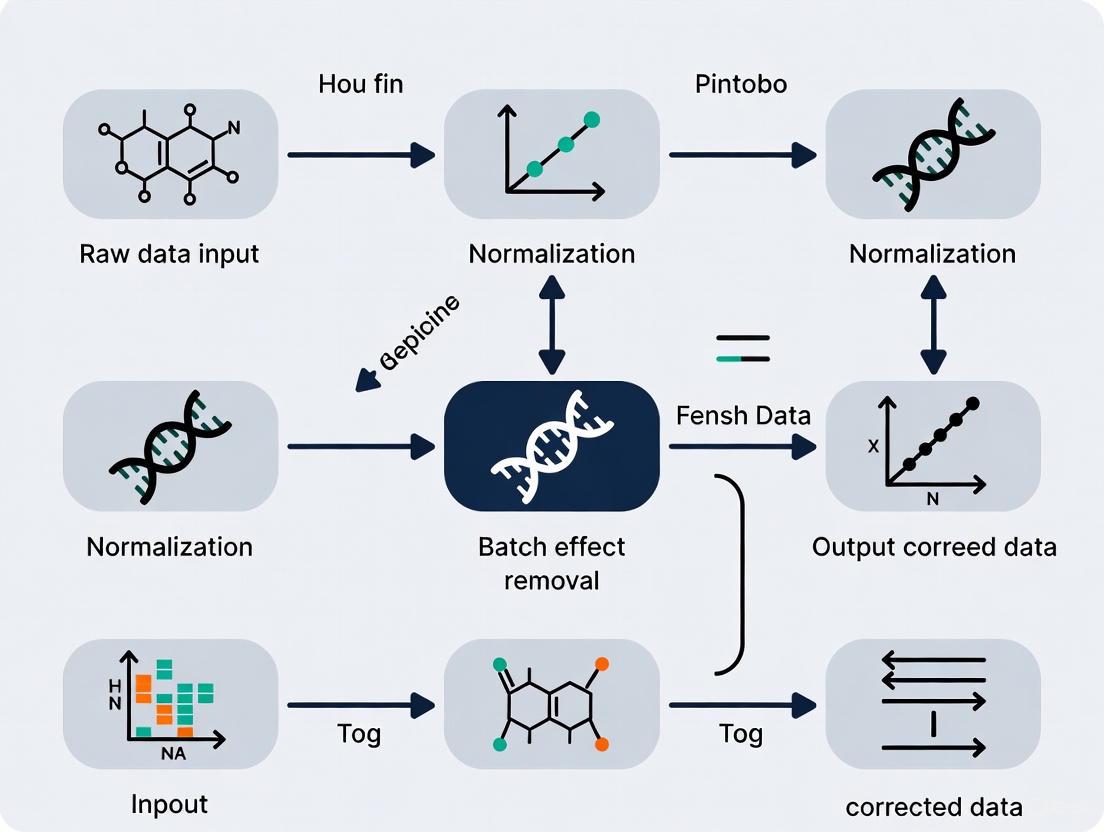
The following diagram illustrates a standard workflow for detecting and correcting batch effects in transcriptomics data:
Research Reagent Solutions
Table 3: Key Materials and Tools for Batch Effect Management
| Item | Function | Application Notes |
|---|---|---|
| Pooled QC Samples | Monitor technical variation across batches [1] | Include in every batch for consistency tracking |
| Technical Replicates | Assess reproducibility [1] | Process identical samples across different batches |
| Standardized Reagent Lots | Minimize lot-to-lot variability [1] [3] | Use same lot for entire study when possible |
| Automated Sample Processing | Reduce personnel-induced variation [3] | Minimize manual handling steps |
| RNA Integrity Tools | Assess sample quality pre-sequencing [7] | Use metrics like TIN score [7] |
| Batch Correction Software | Computational removal of technical variation [1] | Choose method based on data type and design |
Advanced Topics in Batch Effects
Single-cell vs. Bulk RNA-seq Considerations
Batch effects are more complex in single-cell RNA-seq data due to [8] [9]:
- Lower RNA input and higher dropout rates
- Higher proportion of zero counts and low-abundance transcripts
- Increased cell-to-cell variations
- More severe technical variations than bulk RNA-seq
Machine Learning Approaches
Recent advances include machine learning and deep learning methods for batch effect correction [6] [2]:
- Autoencoders: Learn complex nonlinear projections of high-dimensional data
- Quality-aware correction: Uses machine-predicted sample quality for batch detection
- Deep transfer learning: Discovers hidden high-resolution cellular subtypes
Multi-omics Integration Challenges
Batch effects become increasingly complex in multi-omics studies because [8] [9]:
- Different omics types have different distributions and scales
- Data are measured on different platforms
- Integration requires careful handling of technical variations across modalities
Batch effects remain a persistent challenge in transcriptomic research, with potential to lead to incorrect conclusions and irreproducible results if not properly addressed [8] [9]. Through proper experimental design, rigorous detection methods, appropriate correction strategies, and thorough validation, researchers can effectively manage these technical variations. By minimizing technical noise, scientists can ensure the biological accuracy, reproducibility, and impact of their transcriptomic analyses.
FAQs on Batch Effects in Transcriptomics
What are batch effects, and why are they a critical concern in transcriptomics? Batch effects are technical variations introduced during experimental procedures that are unrelated to the biological questions being studied. In transcriptomics, they can dilute true biological signals, reduce the statistical power of an analysis, and, in the worst cases, lead to incorrect scientific conclusions and irreproducible research [8]. Tackling them is essential for ensuring data reliability.
What are the most common stages where batch effects originate in an RNA-seq workflow? Batch effects can arise at virtually every stage of a transcriptomics study. Key sources include the initial study design, sample collection and preservation, RNA extraction, library preparation, and the sequencing run itself [8] [10]. A flaw in the study design, such as processing all control samples in one batch and all treatment samples in another, is a particularly critical source of confounding [8].
Can batch effects be completely avoided through experimental design? While a well-designed experiment is the most effective defense, it is often impossible to eliminate batch effects entirely, especially in large, multi-center, or longitudinal studies [11]. Therefore, a combination of careful experimental planning and subsequent computational correction is typically required to mitigate their impact.
Troubleshooting Guides
Guide 1: Addressing Batch Effects from Sample Preservation and RNA Extraction
Problem: RNA degradation or modification during sample preservation leads to poor data quality and introduces significant technical variation between batches.
Investigation & Solution:
- Check RNA Integrity Number (RIN): Always assess RNA quality using a method like Bioanalyzer. Low RIN values or high degradation are red flags.
- Identify Source: Determine if degradation occurred due to delayed fixation, improper storage, or repeated freeze-thaw cycles.
- Apply Corrective Measures:
- For FFPE samples, which are prone to nucleic acid cross-linking and fragmentation, use optimized RNA extraction protocols and consider higher RNA input for library preparation [10].
- For frozen samples, minimize freeze-thaw cycles and ensure consistent storage conditions across all samples. Use high-quality, consistent reagent lots for RNA extraction, such as the mirVana miRNA isolation kit, which has been reported to produce high-yield, high-quality RNA [10].
Guide 2: Mitigating Library Preparation Biases
Problem: Biases introduced during library construction, such as those from mRNA enrichment, fragmentation, and PCR amplification, create non-biological differences between samples processed in different batches.
Investigation & Solution:
- Identify Bias Type: Common issues include 3'-end capture bias from poly(A) enrichment, non-random RNA fragmentation, and preferential amplification of certain transcripts during PCR.
- Apply Corrective Measures:
- For mRNA enrichment: Consider using rRNA depletion instead of poly(A) selection, especially for non-polyadenylated transcripts or degraded samples [10].
- For fragmentation: Use chemical treatment (e.g., zinc) rather than enzymatic methods (RNase III) for more random fragmentation [10].
- For PCR amplification: Reduce the number of amplification cycles where possible. Use high-fidelity polymerases like Kapa HiFi and consider PCR additives like TMAC or betaine for AT/GC-rich genomes [10]. For ultra-low input samples, evaluate multiple displacement amplification (MDA) as an alternative [10].
Guide 3: Correcting for Sequencing Platform Variations
Problem: Technical variations between different sequencing runs, flow cells, or platforms can manifest as batch effects.
Investigation & Solution:
- Monitor Sequencing Metrics: Check for batch-specific differences in metrics like total reads, mapping rates, GC content, and insert sizes.
- Apply Corrective Measures:
- Wet-lab strategy: Whenever possible, multiplex libraries from different experimental groups and sequence them across the same flow cells to spread out technical variation [11].
- Computational strategy: Apply batch effect correction algorithms (BECAs) such as Harmony, Mutual Nearest Neighbors (MNN), or Seurat's integration method to the final count matrix [11]. These tools aim to align the data from different batches in a shared space, removing technical variation while preserving biology.
Data Presentation
| Stage | Source of Bias | Description of Issue | Suggested Improvement |
|---|---|---|---|
| Sample Preservation | Formalin-fixed, paraffin-embedded (FFPE) tissue | Causes nucleic acid cross-linking, fragmentation, and chemical modifications [10]. | Use non-cross-linking organic fixatives; for FFPE, use high RNA input and random priming in RT [10]. |
| RNA Extraction | TRIzol (phenol-chloroform) method | Can lead to loss of small RNAs, especially at low concentrations [10]. | Use high RNA concentrations or avoid TRIzol; use silica-column-based kits (e.g., mirVana kit) [10]. |
| Library Preparation | mRNA Enrichment (3'-end bias) | Poly(A) selection can introduce 3'-end capture bias [10]. | Use ribosomal RNA (rRNA) depletion kits instead [10]. |
| RNA Fragmentation | Enzymatic fragmentation (e.g., RNase III) is not completely random, reducing library complexity [10]. | Use chemical treatment (e.g., zinc) or fragment cDNA post-reverse transcription [10]. | |
| PCR Amplification | Preferential amplification of cDNA with neutral GC%; biases propagate through cycles [10]. | Use high-fidelity polymerases (e.g., Kapa HiFi); reduce cycle number; use additives (TMAC/betaine) for extreme GC% [10]. | |
| Low Input RNA | Low quantity/quality starting material has strong, harmful effects on downstream analysis [10]. | Use specialized low-input protocols; increase input material if possible. |
Table 2: Key Research Reagent Solutions for Mitigating Batch Effects
| Reagent / Kit | Primary Function | Role in Batch Effect Mitigation |
|---|---|---|
| mirVana miRNA Isolation Kit | RNA extraction and purification | Provides high-yield, high-quality RNA from various sample types, reducing sample-specific variation [10]. |
| NEBNext UltraExpress Library Prep Kits | DNA/RNA library preparation | Streamlines workflow, reduces hands-on time and consumables (fewer tips/tubes), enhancing reproducibility [12]. |
| Sera-Mag SpeedBead Magnetic Beads | Sample clean-up and size selection | Engineered with a core-shell design for high yields and tight size distributions, improving NGS consistency [12]. |
| CRISPR-based Depletion Solutions | Removal of non-informative RNA (e.g., rRNA) | Increases library complexity and informative read depth by highly specific removal of unwanted transcripts [12]. |
| Kapa HiFi Polymerase | PCR amplification during library prep | Reduces PCR bias through high-fidelity amplification, leading to more uniform coverage [10]. |
Experimental Protocols
Protocol 1: Best Practices for a Batch-Effect-Aware RNA-seq Study Design
Objective: To design a transcriptomics experiment that minimizes the introduction of batch effects from the outset.
Methodology:
- Randomization: Randomly assign samples from different biological groups (e.g., control vs. treatment) across all processing batches. Do not process all samples from one group in a single batch.
- Replication: Include technical replicates (the same sample processed multiple times) to help estimate the level of technical noise.
- Balancing: Ensure that potential confounding factors (e.g., age, sex, sample source) are balanced across batches. If a known batch variable exists (e.g., different reagent lots), ensure it is not perfectly correlated with a biological group of interest.
- Blocking: If the number of samples is too large for a single batch, process the samples in smaller, balanced blocks (batches) and record all batch variables meticulously.
Protocol 2: Computational Batch Effect Correction Using Seurat Integration
Objective: To merge multiple single-cell or bulk RNA-seq datasets and remove technical batch effects.
Methodology (as cited in the community resources):
- Data Preprocessing: Independently preprocess each dataset (batch) by normalizing and identifying highly variable features.
- Anchor Identification: Identify "anchors" between pairs of datasets. These are mutual nearest neighbors—cells or samples that are most similar across batches, presumed to represent the same biological state [11].
- Data Integration: Use these anchors to harmonize the datasets, effectively removing the technical batch effects. This results in a corrected gene expression matrix where cells/samples cluster by biological type rather than by batch [11].
- Validation: Visually inspect integrated data using dimensionality reduction plots (e.g., UMAP, t-SNE) to confirm that batches are mixed and biological signals are preserved.
Workflow Visualizations
Batch Effect Sources in Transcriptomics Workflow
Batch Effect Mitigation Strategies
Batch effects are systematic technical variations introduced during the processing of samples in separate groups or at different times. These non-biological variations are notoriously common in transcriptomics and other omics studies and represent a significant threat to the reliability and reproducibility of your research. When uncorrected, they can obscure true biological signals, lead to false discoveries, and render findings irreproducible across laboratories. This technical support guide provides clear methodologies to identify, troubleshoot, and correct for batch effects, ensuring the integrity of your transcriptomics data and conclusions.
FAQ: Understanding the Impact of Batch Effects
Q1: What exactly are batch effects in transcriptomics? Batch effects are systematic, non-biological variations in gene expression data introduced by technical inconsistencies. These can occur at virtually any stage of an experiment, including during sample collection, library preparation, sequencing runs, or data analysis. Common causes include processing samples on different days, using different reagent lots, different sequencing machines, or different personnel [1] [8]. Even biologically identical samples processed in different batches can show significant differences in their expression profiles due to these technical influences.
Q2: What makes batch effects such a high-stakes problem? The stakes are high because batch effects can directly lead to incorrect conclusions and irreproducible research, which can waste resources, invalidate findings, and even impact clinical decisions.
- Misleading Outcomes: Batch effects can cause statistical models to falsely identify genes as differentially expressed (false positives) or mask true biological signals (false negatives) [1] [8]. In one documented clinical trial, a change in RNA-extraction solution caused a shift in gene-based risk calculations, leading to incorrect treatment classifications for 162 patients [8] [13].
- The Reproducibility Crisis: A survey in Nature found that 90% of researchers believe there is a reproducibility crisis. Batch effects from reagent variability and experimental bias are paramount factors contributing to this problem, resulting in retracted papers and discredited research [8]. For example, a high-profile study on a serotonin biosensor had to be retracted when its key results could not be reproduced with a new batch of a common reagent (fetal bovine serum) [8].
Q3: How can I tell if my data has batch effects? Batch effects can be detected through both visual and quantitative means:
- Visual Methods: Use dimensionality reduction plots like PCA, t-SNE, or UMAP. If your samples cluster primarily by processing date, sequencing lane, or other technical factors—rather than by the biological conditions you are comparing—this is a strong indicator of batch effects [1] [14].
- Quantitative Metrics: Several metrics provide a less biased assessment:
- kBET (k-nearest neighbor Batch Effect Test): Measures how well cells from different batches mix among their nearest neighbors.
- ASW (Average Silhouette Width): Evaluates the compactness of batch clusters.
- LISI (Local Inverse Simpson's Index): Assesses the diversity of batches in local neighborhoods [1] [14].
It is recommended to use a combination of visual and quantitative methods for robust validation [1].
Q4: Can correcting for batch effects accidentally remove real biological signals? Yes, this phenomenon, known as over-correction, is a significant risk. It occurs when the correction method is too aggressive or when batch effects are completely confounded with the biological groups of interest (e.g., all control samples were processed in one batch and all treatment samples in another) [14] [13]. Signs of over-correction include:
- Distinct cell types clustering together on a UMAP plot.
- A complete overlap of samples from very different biological conditions.
- Cluster-specific markers being dominated by commonly expressed genes, like ribosomal genes [14].
Q5: What is the single most important step to minimize batch effects? The best strategy is prevention through rigorous experimental design. It is far more effective to minimize batch effects at the source than to rely solely on computational correction later. Key practices include:
- Randomization: Randomly assign samples from all biological groups to each processing batch.
- Balancing: Ensure each batch contains a balanced representation of all biological conditions.
- Consistency: Use the same protocols, reagents, and equipment throughout the study.
- Replication: Include at least two biological replicates per group per batch to allow for robust statistical modeling [1] [8] [15].
Troubleshooting Guide: Detecting and Correcting Batch Effects
How to Detect Batch Effects in Your Dataset
Follow this workflow to systematically assess the presence and severity of batch effects.
Protocol: Visual Detection with Dimensionality Reduction
- Data Input: Start with your raw, uncorrected gene expression count matrix.
- Dimensionality Reduction: Perform Principal Component Analysis (PCA) on the data.
- Visualization: Create a scatter plot of the first two principal components (PC1 vs. PC2).
- Coloration: Color the data points by the known technical batch (e.g., processing date).
- Interpretation: Observe the clustering pattern. If data points group strongly by their batch color, rather than by biological condition, batch effects are present [1] [14].
How to Correct for Batch Effects
A variety of computational methods exist. The choice depends on your data type (bulk vs. single-cell) and the structure of your batch information. The table below summarizes popular tools.
Table 1: Comparison of Common Batch Effect Correction Methods
| Method | Data Type | Strengths | Limitations | Key Reference |
|---|---|---|---|---|
| ComBat | Bulk RNA-seq | Uses empirical Bayes framework; adjusts for known batch variables; simple and widely used. | Requires known batch info; may not handle nonlinear effects well. | [1] |
| SVA | Bulk RNA-seq | Captures hidden batch effects (when batch labels are unknown). | Risk of removing biological signal; requires careful modeling. | [1] |
| limma removeBatchEffect | Bulk RNA-seq | Efficient linear modeling; integrates well with differential expression workflows. | Assumes known, additive batch effects; less flexible. | [1] |
| Harmony | Single-cell RNA-seq | Fast runtime; integrates cells in a shared embedding; good for complex datasets. | Performance may vary with sample imbalance. | [1] [11] [14] |
| Seurat Integration | Single-cell RNA-seq | Popular and well-supported within the Seurat ecosystem; good performance. | Can have low scalability with very large datasets. | [11] [14] |
| Ratio-Based Scaling | Multi-omics | Highly effective when batch and biology are confounded; uses a reference material for scaling. | Requires profiling a common reference material in every batch. | [13] |
Protocol: Executing Batch Correction with Harmony on Single-Cell Data
This protocol outlines the steps for using Harmony, a widely used and effective integration tool.
- Preprocessing: Generate a PCA embedding of your single-cell RNA-seq data using your standard workflow (e.g., in Seurat or Scanpy).
- Input: Provide the PCA matrix and a metadata vector specifying the batch for each cell to the Harmony
RunHarmony()function. - Integration: Harmony will iteratively correct the PCA coordinates to maximize the diversity of batches within local cell neighborhoods.
- Output: The function returns a new, integrated embedding (e.g., "harmony" dimensions).
- Downstream Analysis: Use this corrected Harmony embedding for all downstream analyses, such as UMAP visualization and clustering [11].
Table 2: Key Research Reagent Solutions for Batch Effect Mitigation
| Item | Function | Best Practice Guidance |
|---|---|---|
| Reference Materials | A commercially available or internally standardized sample (e.g., from a cell line) processed in every batch. | Enables ratio-based correction methods, which are powerful in confounded scenarios [13]. |
| Validated Reagent Lots | Consumables like enzymes, kits, and buffers used for RNA extraction and library prep. | Purchase in large, single lots for the entire study to minimize variability [1] [15]. |
| RNA Integrity Number (RIN) Standard | A measure of RNA quality (e.g., via Bioanalyzer). | Only proceed with samples having a RIN > 7 to ensure high-quality input and reduce technical noise [15]. |
| Sample Multiplexing Kits | Kits that allow barcoding and pooling of samples from different biological groups into a single sequencing library. | Dramatically reduces batch effects by ensuring pooled samples are processed together through library prep and sequencing [14]. |
| Internal Spike-In Controls | Exogenous RNAs added to each sample in known quantities. | Helps control for technical variation in RNA capture efficiency and sequencing depth [8]. |
Batch effects are systematic technical variations introduced during different stages of high-throughput experiments, unrelated to the biological questions being studied. In transcriptomics, these effects arise from inconsistencies in sample processing, sequencing platforms, reagent lots, personnel, or environmental conditions [1]. When unaddressed, batch effects can distort gene expression data, leading to incorrect conclusions, irreproducible findings, and misguided clinical decisions [8].
This technical support guide presents real-world case studies demonstrating the profound consequences of batch effects in both clinical and cross-species research. By examining these instances and providing actionable troubleshooting guidance, we aim to equip researchers and drug development professionals with strategies to safeguard their analyses against technical artifacts, thereby enhancing data reliability and translational impact.
Case Study 1: Batch Effects in a Clinical Trial
The Problem: Incorrect Patient Stratification
In a clinical trial for a cancer therapy, researchers used gene expression profiles to calculate a risk score for patients, which was intended to guide chemotherapy decisions. During the trial, a change was made to the RNA-extraction solution used in processing patient samples [8].
- The Batch Effect: The change in reagent introduced a significant technical shift in the resulting gene expression data.
- The Consequence: This batch effect directly altered the gene-based risk calculation. Consequently, 162 patients were misclassified, leading to 28 patients receiving incorrect or unnecessary chemotherapy regimens [8]. This case starkly illustrates how a technical artifact can directly impact patient care and clinical outcomes.
Troubleshooting Guide & FAQ: Clinical Genomics
Q: How can a simple reagent change cause such a major problem? A: Gene expression measurements are highly sensitive. Different reagent lots can have subtle variations in efficiency or purity, which systematically alter the measured intensity of thousands of genes. If this technical variation is confounded with a biological group (e.g., all post-change samples are from a specific patient group), the analysis model cannot distinguish technical from biological effects [1] [8].
Q: What are the best practices to prevent this in our clinical study design? A: Proactive experimental design is the most effective strategy [1] [8].
- Randomization: Process samples from all patient groups in every batch.
- Balancing: Ensure that biological conditions of interest (e.g., treatment vs. control) are equally represented across processing batches, sequencing runs, and personnel.
- Reagent Consistency: Use the same lot of critical reagents (e.g., extraction kits, enzymes) for the entire study whenever possible.
- Quality Control (QC) Samples: Include pooled control samples or technical replicates across all batches to monitor technical variation.
Q: Our clinical trial is already completed, and we suspect a batch effect. How can we diagnose it? A: The following diagnostic workflow can help identify the presence of batch effects:
Experimental Protocol: Diagnosing Batch Effects with PCA
Objective: To visually assess whether technical batches are a major source of variation in your gene expression dataset.
Materials Needed:
- Normalized gene expression matrix (e.g., counts from RNA-seq)
- Metadata file listing the technical batch and biological group for each sample.
- Statistical software (R/Python) with PCA capabilities.
Methodology:
- Data Input: Load your normalized expression matrix and metadata.
- Dimensionality Reduction: Perform Principal Component Analysis (PCA) on the expression matrix. This reduces the high-dimensional gene data into a few key components that explain the most variance.
- Visualization:
- Generate a PCA plot where points are colored by their technical batch (e.g., sequencing run, processing date). If samples from the same batch cluster tightly together and separate from other batches, a batch effect is likely [1].
- Generate a second PCA plot where points are colored by the biological condition (e.g., disease state, treatment). In an ideal, batch-free world, samples should cluster primarily by biology.
- Interpretation: Compare the two plots. If the first plot (colored by batch) shows clearer clustering than the second (colored by biology), you have strong evidence of a batch effect that requires correction before any downstream analysis [1].
Case Study 2: Batch Effects in Cross-Species Analysis
The Problem: Mistaking Technical Bias for Biological Difference
A prominent study initially reported that gene expression differences between humans and mice were greater than the differences between tissues within the same species [8]. This finding suggested profound evolutionary divergence.
- The Batch Effect: A more rigorous re-analysis revealed a critical confounder: the human and mouse data were generated in separate studies, three years apart, using different experimental designs [8].
- The Consequence: The so-called "species-specific" signal was largely driven by technical batch effects related to the time of data generation. After applying appropriate batch-effect correction, the data showed a more biologically plausible pattern: samples clustered by tissue type rather than by species [8]. This case highlights how batch effects can lead to fundamentally incorrect biological interpretations.
Troubleshooting Guide & FAQ: Cross-Species & Multi-Center Studies
Q: How can we differentiate true biological signals from batch effects in integrative studies? A: This is a central challenge. The key is to use both negative and positive controls [8].
- Negative Controls: Use housekeeping genes or other features expected to be stable across your batches. If these show systematic variation by batch, it indicates a technical effect.
- Positive Controls: Ensure known biological differences (e.g., clear cell-type markers) are preserved after any correction.
- Validation: Orthogonal validation of key findings using a different, independent method or dataset is crucial.
Q: What batch correction methods are suitable for complex integrations, like cross-species data? A: Methods that allow for the use of prior biological knowledge can be particularly effective. Semi-supervised methods like STACAS leverage initial cell-type annotations to guide integration, helping to preserve biological variance while removing technical batch effects [16]. Other advanced tools like Harmony and Scanorama are also widely used for integrating diverse datasets [1] [11].
Q: How can we design a multi-center study to minimize batch effects from the start? A: Consortium-level standardization is essential [8].
- Standardized Protocols: All participating centers should use the same, meticulously detailed protocols for sample collection, processing, and sequencing.
- Reference Materials: Circulate a common reference sample to all centers to quantify and later correct for inter-center technical variation.
- Balanced Design: If possible, ensure that each center processes samples from all biological groups being compared.
Quantitative Impact of Batch Effect Correction
The table below summarizes the consequences and corrective outcomes from the featured case studies.
Table 1: Summary of Real-World Batch Effect Case Studies
| Case Study | Source of Batch Effect | Impact of Uncorrected Effect | Outcome After Correction |
|---|---|---|---|
| Clinical Trial [8] | Change in RNA-extraction reagent | 28 patients received incorrect chemotherapy; misclassification of 162 patients | (Case highlighted the problem; correction would prevent misclassification) |
| Cross-Species Study [8] | Data generated 3 years apart in separate studies | False conclusion: species differences > tissue differences | Correct conclusion: clustering by tissue type over species |
The following table lists essential methodological solutions and their specific functions for addressing batch effects.
Table 2: Research Reagent Solutions & Computational Tools
| Tool / Solution Name | Function / Purpose | Applicable Context |
|---|---|---|
| Pooled QC Samples [8] | A control sample included in every batch to monitor and model technical variation across runs. | All omics studies (Transcriptomics, Proteomics) |
| ComBat & ComBat-seq [1] [5] | Empirical Bayes frameworks to adjust for known batch effects in both normalized (ComBat) and raw count (ComBat-seq) data. | Bulk RNA-seq data |
| Harmony [1] [11] | Integrates cells across batches by iteratively correcting a low-dimensional embedding, suitable for complex single-cell data. | Single-cell RNA-seq, scATAC-seq |
| STACAS [16] | A semi-supervised integration method that uses prior cell type knowledge to guide batch correction, preserving biological variance. | Single-cell RNA-seq (especially with imbalanced cell types) |
| RECODE/iRECODE [17] | Reduces technical noise and batch effects in high-dimensional single-cell data while preserving the full dimensionality of the data. | scRNA-seq, scHi-C, Spatial Transcriptomics |
Integrated Workflow: From Experiment to Validated Analysis
A robust transcriptomics study requires vigilance against batch effects at every stage. The following workflow synthesizes the key steps covered in this guide.
Distinguishing Batch Effects in Bulk versus Single-Cell RNA-Seq
Batch effects are systematic technical variations introduced during the processing of samples in separate groups, and they represent a significant challenge in transcriptomics studies [4] [8]. These non-biological variations can arise from differences in sequencing platforms, reagents, personnel, laboratory conditions, or processing times, potentially confounding downstream analyses and leading to irreproducible findings [8]. While batch effects impact both bulk and single-cell RNA sequencing (scRNA-seq) technologies, their characteristics, implications, and correction strategies differ substantially between these approaches. Understanding these distinctions is crucial for researchers, scientists, and drug development professionals aiming to generate reliable and interpretable transcriptomic data. This guide provides a technical framework for distinguishing and addressing batch effects across these two sequencing modalities within the broader context of mitigating technical artifacts in transcriptomics research.
FAQ: Understanding Batch Effects in Transcriptomics
What fundamentally causes batch effects in RNA-seq experiments? Batch effects stem from the inherent inconsistency in the relationship between the true analyte concentration in a sample and the final instrument readout across different experimental conditions [8]. This technical variation can be introduced at virtually every stage of a high-throughput study, from sample collection and preparation to sequencing and data processing [8].
How do the challenges of batch effects differ between bulk and single-cell RNA-seq? The challenges are more pronounced in scRNA-seq due to its higher technical sensitivity. scRNA-seq methods have lower RNA input, higher dropout rates (where nearly 80% of gene expression values can be zero), and greater cell-to-cell variation compared to bulk RNA-seq [4] [8]. These factors make single-cell data more susceptible to technical variations, and the data's sparsity complicates correction efforts [4].
Can I use the same method to correct batch effects in both bulk and single-cell data? While the purpose of batch correction is the same—to mitigate technical variations—the algorithms are often not directly interchangeable [4]. Techniques developed for bulk RNA-seq may be insufficient for single-cell data due to the latter's large size (thousands of cells versus a dozen samples) and significant sparsity [4]. Conversely, single-cell specific methods might be excessive for the simpler structure of bulk RNA-seq experiments [4].
What are the signs of overcorrection in batch effect removal? Overcorrection occurs when batch effect removal also strips away genuine biological signal. Key signs include [4]:
- Cluster-specific markers comprising genes with widespread high expression (e.g., ribosomal genes).
- Substantial overlap among markers for different clusters.
- Absence of expected canonical cell-type markers.
- Scarcity of differential expression hits in pathways expected based on the sample composition.
How can I assess the effectiveness of a batch correction method? Effectiveness can be evaluated visually and quantitatively. Visual assessment involves examining PCA, t-SNE, or UMAP plots before and after correction to see if cells group by biological condition rather than batch [4]. Quantitative metrics include [4]:
- k-nearest neighbor batch effect test (kBET)
- Graph-based integrated local similarity inference (Graph_iLSI)
- Adjusted Rand Index (ARI)
- Normalized Mutual Information (NMI)
Comparative Analysis: Bulk vs. Single-Cell RNA-Seq Batch Effects
Table 1: Key Differences in Batch Effects Between Bulk and Single-Cell RNA-Seq
| Characteristic | Bulk RNA-Seq | Single-Cell RNA-Seq |
|---|---|---|
| Primary Data Structure | Gene expression matrix (samples × genes) | Gene expression matrix (cells × genes), with extreme sparsity |
| Technical Variation Scale | Moderate, affects entire sample profiles | High, with increased sensitivity to technical noise [8] |
| Data Sparsity | Low | High (approximately 80% zero values) [4] |
| Typical Correction Unit | Entire samples | Individual cells |
| Key Correction Challenge | Preserving inter-sample biological variance while removing technical variation | Distinguishing technical effects from true cellular heterogeneity in sparse data |
Table 2: Commonly Used Batch Effect Correction Methods and Their Applications
| Method Name | Primary Application | Key Algorithmic Approach | Input Data Type |
|---|---|---|---|
| ComBat-seq/ComBat-ref [5] [18] | Bulk RNA-Seq | Empirical Bayes framework with negative binomial model | Raw count matrix |
| Harmony [4] [19] | Single-Cell RNA-Seq | Iterative clustering with soft k-means and linear correction | Normalized count matrix |
| Seurat [4] | Single-Cell RNA-Seq | Canonical Correlation Analysis (CCA) and Mutual Nearest Neighbors (MNN) as anchors | Normalized count matrix |
| MNN Correct [4] [20] | Single-Cell RNA-Seq | Mutual Nearest Neighbors detection and linear correction | Normalized count matrix |
| LIGER [4] | Single-Cell RNA-Seq | Integrative non-negative matrix factorization (NMF) | Normalized count matrix |
| sysVI (cVAE-based) [21] | Single-Cell RNA-Seq (substantial effects) | Conditional Variational Autoencoder with VampPrior and cycle-consistency | Raw count matrix |
Experimental Protocols for Batch Effect Assessment and Correction
Protocol 1: Detecting Batch Effects in Single-Cell RNA-Seq Data
Principle: Visually identify whether systematic technical variations are causing cells to cluster by batch rather than biological origin [4].
Procedure:
- Data Preparation: Begin with a raw count matrix (cells × genes) and corresponding metadata specifying batch labels and biological conditions.
- Quality Control: Filter out low-quality cells and genes. Normalize the data for sequencing depth.
- Dimensionality Reduction: Perform Principal Component Analysis (PCA) on the normalized data.
- Visualization:
- Create a scatter plot of the top two principal components.
- Color cells by their batch of origin.
- Shape or facet cells by their biological condition.
- Interpretation: If cells from the same biological condition but different batches form separate clusters in the PCA plot, a batch effect is likely present.
Protocol 2: Correcting Batch Effects in Bulk RNA-Seq Using ComBat-ref
Principle: Employ a reference batch with the smallest dispersion to guide the adjustment of other batches, preserving statistical power for differential expression analysis [5] [18].
Procedure:
- Input Data Preparation: Compile a raw count matrix (samples × genes) and a design matrix specifying batch and biological conditions.
- Dispersion Estimation: Use the
edgeRpackage in R to estimate a pooled (shrunk) dispersion parameter for each batch. - Reference Batch Selection: Identify and select the batch with the smallest dispersion as the reference.
- Model Fitting: Apply the ComBat-ref algorithm, which uses a negative binomial generalized linear model:
log(μ_ijg) = α_g + γ_ig + β_cjg + log(N_j)- Where
μ_ijgis the expected expression of genegin samplejfrom batchi,α_gis the global expression background,γ_igis the batch effect,β_cjgis the biological condition effect, andN_jis the library size.
- Data Adjustment: Adjust count data from non-reference batches toward the reference batch using cumulative distribution function matching.
- Output: A corrected integer count matrix suitable for downstream differential expression analysis with tools like edgeR or DESeq2.
Workflow Visualization
Diagram 1: Generalized batch effect correction workflow for RNA-seq data.
Diagram 2: Methodological differences in batch correction for bulk versus single-cell RNA-seq.
The Scientist's Toolkit: Essential Research Reagents and Computational Tools
Table 3: Key Research Reagent Solutions for Batch Effect Mitigation
| Reagent/Tool | Function | Considerations for Batch Effect Mitigation |
|---|---|---|
| Sequencing Kits & Reagents | Library preparation and sequencing | Use the same lot numbers across all samples in a study; document all kit versions and lot numbers [11] |
| RNA Extraction Kits | Isolation of high-quality RNA | Consistency in RNA extraction methods and solutions is critical; changes can introduce significant batch effects [8] |
| Enzymes (Reverse Transcriptase) | cDNA synthesis | Enzyme efficiency variations can introduce technical bias; use consistent sources and lots [11] |
| Cell Culture Reagents (e.g., FBS) | Cell growth and maintenance | Reagent batch variability can affect gene expression; document all reagent lots and sources [8] |
| Single-Cell Partitioning Reagents | Cell isolation and barcoding | Critical for scRNA-seq; consistency in partitioning technology and chemistry reduces technical variation [11] |
| Computational Tools (R/Python) | Data analysis and correction | Document software versions; use established batch correction packages like Harmony, ComBat-seq [4] [19] |
Successfully distinguishing and addressing batch effects in bulk versus single-cell RNA-seq requires both rigorous experimental design and appropriate computational correction strategies. For bulk RNA-seq, methods like ComBat-ref that operate directly on count data and preserve statistical power for differential expression are often optimal [5]. For single-cell RNA-seq, integration methods like Harmony that correct embeddings while preserving biological heterogeneity have demonstrated superior performance with minimal introduction of artifacts [19]. When confronting substantial batch effects across systems—such as in cross-species or protocol integration—emerging approaches like sysVI that combine VampPrior with cycle-consistency constraints show promise for maintaining biological fidelity while removing technical variation [21] [22]. By applying these specialized approaches within a framework of careful experimental planning and post-correction validation, researchers can reliably mitigate the confounding influence of batch effects and draw robust biological conclusions from their transcriptomics studies.
A Practical Toolkit: Batch Effect Correction Algorithms and Their Applications
What are the main categories of batch effect correction algorithms (BECAs)?
Batch effect correction methods can be broadly classified into several categories, each with distinct underlying principles and use cases. The table below summarizes the main approaches.
| Method Category | Key Principle | Representative Algorithms | Typical Use Case Scenarios |
|---|---|---|---|
| Model-Based | Uses statistical models to estimate and adjust for batch-specific biases. | ComBat [23] [8] [24], limma [24] | Balanced study designs; when batch and biological factors are not confounded [23]. |
| Ratio-Based | Scales feature values relative to those from a common reference material processed in the same batch. | Ratio-G [23] | Confounded scenarios; multiomics studies; when reference materials are available [23]. |
| Integration (Dimensionality Reduction) | Embeds cells or samples into a common low-dimensional space where batch effects are minimized. | Harmony [23] [25] [4], MNN Correct [4] [11], LIGER [4] [11], Seurat [4] [11] | Single-cell RNA-seq data integration; large-scale atlas projects [4] [21]. |
| Deep Learning | Uses neural networks to learn a batch-invariant representation of the data. | scGen [4], sysVI (cVAE-based) [21] | Complex, non-linear batch effects; integrating datasets with substantial technical or biological differences (e.g., across species) [21]. |
The following diagram illustrates the logical workflow for selecting and applying these major correction approaches.
How do I choose the right method for my experiment?
The choice of batch effect correction method depends heavily on your experimental design, the type of omics data, and the severity of the batch effects.
Key Considerations for Method Selection
- Study Design (Balanced vs. Confounded): This is a critical factor.
- Balanced Design: Samples from different biological groups are evenly distributed across batches. Many BECAs, including ComBat and Harmony, can be effective in this scenario [23].
- Confounded Design: Biological groups are completely processed in separate batches (e.g., all controls in one batch and all treatments in another). In this challenging case, ratio-based methods are often the most effective and sometimes the only viable option, as they can leverage reference materials to disentangle technical noise from biological signal [23].
- Data Type (Bulk vs. Single-Cell):
- Bulk Omics: Model-based (ComBat, limma) and ratio-based methods are commonly used [23] [8].
- Single-Cell RNA-seq: Methods designed for high-dimensional, sparse data are preferred. A 2025 benchmark study found that Harmony was the only method that consistently performed well without introducing detectable artifacts, while other popular methods like MNN, SCVI, and LIGER often altered the data considerably [25]. Seurat is also widely used for scRNA-seq integration [4] [11].
- Data Completeness: For large-scale studies with many missing values (incomplete omic profiles), a 2025 study introduced Batch-Effect Reduction Trees (BERT), which outperforms other imputation-free methods like HarmonizR in both data retention and computational speed [24].
How can I detect if my data has batch effects?
Batch effects can be identified through visualization and quantitative metrics.
| Method | Description | How to Interpret |
|---|---|---|
| Principal Component Analysis (PCA) | A dimensionality reduction technique that projects data onto the directions of maximum variance [4]. | If samples cluster strongly by batch, rather than by biological group, in the first few principal components, a batch effect is likely present [4]. |
| t-SNE/UMAP Plot Examination | Non-linear dimensionality reduction techniques used to visualize high-dimensional data in 2D or 3D [23] [4]. | Before correction, cells from the same batch may cluster together unnaturally. After successful correction, cells should cluster by biological cell type or group, with batches mixed within clusters [4]. |
| Quantitative Metrics | Numerical scores that measure the degree of batch mixing and biological preservation. | Metrics include the k-nearest neighbor batch effect test (kBET), adjusted rand index (ARI), and graph-based integrated local similarity inference (Graph_iLISI) [4]. Values closer to 1 typically indicate better integration. |
What are the signs of overcorrection, and how can I avoid it?
Overcorrection occurs when a batch effect correction algorithm removes not only technical variation but also genuine biological signal. This can lead to misleading conclusions.
- Loss of Biological Markers: Canonical, well-established cell-type-specific markers (e.g., a specific T-cell marker) are absent from the differential expression analysis after correction.
- Non-Specific Markers: The list of identified cluster-specific markers becomes dominated by genes that are universally highly expressed (e.g., ribosomal genes) rather than specific to a cell type.
- Blurred Clusters: There is a substantial overlap in the marker genes between clusters that are known to be biologically distinct.
- Missing Pathways: Differential expression analysis fails to identify pathways that are expected to be active given the known biological conditions and cell types in the experiment.
How to Avoid Overcorrection
- Use Reference Materials: When available, using ratio-based methods with well-characterized reference materials can help preserve biological truth [23].
- Benchmark Methods: Test multiple correction algorithms and compare the results. A method that retains known biological signals while effectively mixing batches is ideal.
- Incremental Correction: Avoid using the strongest possible correction strength. Some methods, like those based on conditional Variational Autoencoders (cVAE), can lose biological information if the regularization forcing integration is too strong [21].
What experimental protocols and reagents are key for mitigating batch effects?
Proactive experimental design is the most effective way to minimize batch effects. The following table lists essential reagents and materials used in the Quartet Project, which provides a framework for quality control in multiomics studies [23].
| Research Reagent / Material | Function in Mitigating Batch Effects |
|---|---|
| Multiomics Reference Materials (RMs) | Commercially available or in-house standardized materials derived from well-characterized cell lines (e.g., B-lymphoblastoid cells). They are processed alongside study samples in every batch to serve as a technical baseline for ratio-based correction [23]. |
| Standardized Nucleic Acid Extraction Kits | Using the same lot of RNA/DNA extraction kits across all batches minimizes variability introduced during sample preparation [26]. |
| RNA Stabilization Reagents | Reagents like DNA/RNA Shield preserve sample integrity at the point of collection, preventing degradation-driven batch effects, especially in multi-center studies [27]. |
| Standardized Library Prep Kits | Using consistent lots of library preparation kits (e.g., NEBNext RNA Library Prep Kits) ensures uniform adapter ligation, fragmentation, and amplification, reducing technical noise between batches [28]. |
Detailed Protocol: Implementing Ratio-Based Correction with Reference Materials
This protocol is adapted from large-scale multiomics studies and is highly effective for confounded batch-group scenarios [23].
Experimental Design:
- Select one or more well-characterized multiomics reference materials (RMs). In the Quartet Project, four reference materials are used [23].
- Design your experiment so that every batch includes multiple replicates (e.g., 3) of the chosen RM(s) alongside your study samples.
Sample Processing:
- Process all samples (study samples and RMs) in the same batch identically, using the same reagents, equipment, and protocols to the greatest extent possible [11].
Data Generation:
- Generate your omics data (e.g., transcriptomics, proteomics) for all samples in the batch.
Data Transformation (Ratio Calculation):
- For each feature (e.g., a gene's expression value) in each study sample, transform the absolute value into a ratio relative to the average value of that feature in the RM replicates from the same batch.
- Formula:
Ratio(Sample) = Absolute_Value(Sample) / Mean(Absolute_Value(RM_Replicates))
Data Integration:
- The resulting ratio-based values for all study samples across all batches can now be integrated for downstream analysis, as the technical variation has been scaled out relative to the common reference.
How do I handle massive datasets or those with many missing values?
For large-scale data integration tasks involving thousands of datasets or data with substantial missing values, a 2025 study introduced Batch-Effect Reduction Trees (BERT) [24].
- Principle: BERT decomposes a large data integration task into a binary tree of smaller, pairwise batch-effect correction steps using established methods like ComBat or limma. This allows for efficient parallel processing [24].
- Advantages over Previous Methods:
- Retains More Data: BERT was shown to retain up to five orders of magnitude more numeric values compared to the previous state-of-the-art method, HarmonizR [24].
- Computational Efficiency: It leverages multi-core systems for up to an 11x runtime improvement [24].
- Handles Covariates: It can account for experimental conditions (covariates) and use reference samples to correct datasets with severely imbalanced designs [24].
ComBat and Empirical Bayes Frameworks for Known Batch Variables
Frequently Asked Questions (FAQs)
Fundamental Concepts
Q1: What is the core principle behind ComBat's Empirical Bayes approach? ComBat uses an Empirical Bayes framework to adjust for batch effects by pooling information across all genes to estimate batch-specific parameters (mean and variance). This approach is particularly powerful for small sample sizes, as it "shrinks" the batch effect estimates towards a common value, making the corrections more stable and reliable [1] [29].
Q2: How does ComBat differ from simply including batch as a covariate in a linear model? While including batch as a covariate in a one-step linear model is a valid approach, ComBat's two-step method offers a richer adjustment. ComBat models and corrects for both additive (location) and multiplicative (scale) batch effects across batches, not just the mean. Furthermore, its Empirical Bayes shrinkage provides more robust performance, especially with many batches or small batch sizes [30] [31].
Q3: When should I use ComBat versus ComBat-seq? The choice depends on your data type:
- ComBat: Use on already normalized and continuous data, such as log-transformed microarray data or normalized RNA-seq data (e.g., log-CPM, TPM) [32] [33].
- ComBat-seq: Use on raw RNA-seq count data. It employs a negative binomial model, which is more appropriate for counts, and outputs a corrected count matrix suitable for downstream differential expression tools like DESeq2 and edgeR [5] [33].
Practical Implementation & Troubleshooting
Q4: I am getting errors regarding my data matrix. What are the input requirements? ComBat expects your data to be a cleaned and normalized genomic measure matrix (e.g., gene expression) with specific dimensions:
- The matrix should be in a "probe x sample" or "gene x sample" format [32].
- Ensure all values are numerical. Check for and remove any non-numeric characters,
NAvalues, or genes with zero variance across all samples. - For standard ComBat, the data should be pre-normalized using appropriate methods (e.g., RMA for microarrays, voom for RNA-seq) to ensure genes have similar overall means and variances [34] [29].
Q5: How do I specify a reference batch, and why would I want to?
You can specify a reference batch using the ref.batch parameter [32]. This is useful when you have a batch you consider a "gold standard" (e.g., a control batch, the largest batch, or a batch from a primary study). All other batches are then adjusted towards this reference, preserving the biological signal in the reference batch. This can be particularly helpful in meta-analyses [5].
Q6: What is the difference between parametric and non-parametric priors in ComBat?
- Parametric (
par.prior=TRUE): Assumes the batch effects follow a specific distribution (a normal distribution). It is faster and is the default, recommended for most use cases [32] [29]. - Non-parametric (
par.prior=FALSE): Does not assume a specific distribution for the batch effects. It is more flexible but computationally slower. Use this if a prior plot (generated withprior.plots=TRUE) shows that the empirical distribution of batch effects does not fit the parametric model well [29].
Q7: After using ComBat, my downstream differential expression analysis shows exaggerated significance or reduced power. Why? This is a known pitfall of two-step batch correction methods like ComBat. The adjustment process introduces a correlation structure between samples within the same batch. If this induced correlation is ignored in the downstream linear model, it can lead to inflated false positive rates (exaggerated significance) or, in some cases, loss of power. The solution is to use a downstream method that accounts for this correlation, such as Generalized Least Squares (GLS) with the estimated correlation matrix [30].
Troubleshooting Guide
| Problem | Potential Cause | Solution |
|---|---|---|
| Convergence errors or model fitting failures. | Highly unbalanced design or very small batch sizes (e.g., n<2). | Check group distribution across batches. If a group is absent from a batch, correction may be impossible. Consider combining small batches if justified. |
| "Missing value" or "NA" errors. | The input data matrix contains NA, NaN, or non-numeric values. |
Perform thorough data cleaning and imputation or removal of genes/samples with excessive missing values before correction [29]. |
| Persistent batch clustering in PCA after correction. | Overly strong batch effects confounded with biological conditions. | Verify that your experimental design is not fully confounded. Validate correction using quantitative metrics (kBET, LISI). Try non-parametric priors [1] [35]. |
| Loss of biological signal after correction (overcorrection). | Batch variable is highly correlated with the biological variable of interest. | Re-specify the mod argument to include a known biological covariate to protect it during correction. Always validate results visually and quantitatively [1] [32]. |
| Corrected data shows different results in R vs. Python. | Slight differences in optimization routines and random number generation between R's sva and Python's pyComBat. |
Differences are typically negligible for downstream analysis. For RNA-seq, ComBat-seq and pyComBat produce identical integer outputs [33]. |
Experimental Protocols & Workflows
Standard Workflow for Bulk RNA-seq Data Using ComBat-seq
This protocol is designed to correct for known batch effects in raw RNA-seq count data.
1. Prerequisite Software and Data Preparation
2. Data Preprocessing and Filtering Filter out lowly expressed genes to reduce noise.
3. Applying ComBat-seq Correction
Apply the batch effect correction directly to the raw counts. The group parameter is used to protect the biological signal of interest.
4. Post-Correction Validation Use Principal Component Analysis (PCA) to visually assess the success of the correction.
- Successful Correction: Samples should no longer cluster primarily by batch and should instead group by biological condition (e.g., treatment vs. control) [36].
Advanced Workflow: Accounting for Induced Correlation in Downstream Analysis
As highlighted in the FAQs, a naive two-step approach can bias inference. This advanced workflow mitigates that risk.
1. Perform ComBat Adjustment Generate the batch-corrected data matrix as usual.
2. Estimate the Induced Sample Correlation Matrix
The ComBat adjustment process introduces a known correlation structure, defined by the formula: Correlation = I - X(X^T X)^{-1} X^T, where X is the batch design matrix [30].
3. Conduct Downstream Analysis with Correlation Adjustment Incorporate the correlation matrix into your differential expression analysis using Generalized Least Squares (GLS).
Method Selection and Comparison Tables
Comparison of ComBat Variants and Related Methods
| Method | Input Data Type | Key Features | Strengths | Limitations |
|---|---|---|---|---|
| ComBat [1] [32] | Normalized, continuous data (Microarray, log-CPM) | Empirical Bayes, adjusts mean and variance. | Powerful for small batches, widely used and validated. | Not designed for raw counts; can introduce non-integer values. |
| ComBat-seq [5] [33] | Raw count data (RNA-seq) | Negative binomial model, outputs integers. | Preserves count structure, ideal for DESeq2/edgeR. | May have lower power than ComBat-ref in some scenarios. |
| ComBat-ref [5] | Raw count data (RNA-seq) | Selects a low-dispersion batch as reference. | High statistical power, controls FDR effectively. | Newer method, requires evaluation in diverse datasets. |
| limma removeBatchEffect [1] [34] | Normalized, continuous data | Linear model-based adjustment. | Fast, integrated into limma workflow. | Only adjusts for additive mean effects. |
| SVA [1] [30] | Normalized or count data | Estimates hidden batch effects (surrogate variables). | Does not require known batch labels. | Risk of overcorrection if surrogate variables capture biology. |
Key Parameters for the ComBat Function
| Parameter | Description | Recommendation |
|---|---|---|
dat |
Input genomic data matrix (genes x samples). | Must be cleaned and normalized for standard ComBat. |
batch |
Factor or vector indicating batch membership. | Required. Ensure at least 2 samples per batch. |
mod |
Model matrix for biological covariates to preserve. | Highly recommended to include to prevent overcorrection. |
par.prior |
Whether to use parametric priors. | TRUE (faster) unless prior plots show poor fit. |
prior.plots |
Whether to produce plots to check prior fit. | Use TRUE to diagnose if parametric prior is suitable. |
ref.batch |
Specifies a batch to which others are adjusted. | Use if a specific batch should serve as a benchmark. |
mean.only |
If TRUE, only corrects mean batch effects. | Set to FALSE to correct for mean and variance. |
Visual Workflows and Diagrams
ComBat Empirical Bayes Workflow
Batch Correction Decision Guide
| Item | Function in Context of Batch Correction |
|---|---|
| Technical Replicates | Samples from the same biological source processed across different batches. Essential for quantifying the magnitude of batch effects and validating correction methods [31]. |
| Pooled Quality Control (QC) Samples | A standardized sample (e.g., a reference RNA) run in every batch. Allows for direct modeling of technical variation and instrument drift across batches [1]. |
| Negative Control Genes | A set of genes assumed not to be influenced by the biological conditions of interest (e.g., housekeeping genes). Used by some methods (e.g., RUV) to estimate the factor of unwanted variation [31]. |
| Reference Batch | A specific batch selected as a benchmark (e.g., the largest batch, or one from the primary study). In ComBat-ref, the batch with the smallest dispersion is chosen to enhance statistical power in downstream analysis [5]. |
| Balanced Experimental Design | The practice of distributing all biological conditions of interest evenly across all batches. This is the single most important preventative measure to minimize confounding and make batch effects correctable [1] [35]. |
Batch effects are systematic, non-biological variations introduced into transcriptomics data due to technical inconsistencies, such as differences in reagent lots, sequencing platforms, operators, or sample processing days. These effects can mask true biological signals and lead to false conclusions in differential expression analysis [1]. The Ratio-based scaling method, also known as Ratio-G, is a powerful batch-effect correction algorithm (BECA) that mitigates these technical variations by scaling the absolute feature values of study samples relative to those of concurrently profiled reference materials [23] [13].
This method is particularly effective in confounded scenarios where biological groups of interest are completely grouped by batch, making it nearly impossible for many other BECAs to distinguish technical variation from true biological difference. By transforming data relative to a stable benchmark, Ratio-G provides a robust mechanism for data integration and cross-batch comparability [23] [13].
Experimental Protocol and Workflow
Prerequisites and Experimental Design
Before implementing Ratio-G, ensure proper experimental design:
- Reference Material Selection: Establish stable, well-characterized reference materials. In the Quartet Project, researchers used immortalized B-lymphoblastoid cell lines (LCLs) from a family quartet as comprehensive reference materials [23] [13].
- Batch Planning: Include the same reference material in every batch of your experiment.
- Replication: Process multiple technical replicates of reference materials within each batch (typically 3 replicates) [13].
- Randomization: Balance biological groups across batches when possible, though Ratio-G remains effective even in completely confounded designs.
Step-by-Step Methodology
Table: Detailed Ratio-G Implementation Steps
| Step | Procedure | Technical Specifications | Quality Control Checkpoints |
|---|---|---|---|
| 1. Reference Material Processing | Process reference samples alongside study samples in each batch | Use identical library preparation protocols; maintain consistent RNA input amounts | Confirm RNA integrity numbers (RIN > 8.0 for reference materials) |
| 2. Data Generation | Generate transcriptomics data using your standard platform | Follow consistent sequencing depth across batches; minimum 30 million reads per sample | Check sequencing quality metrics (Q-score > 30, GC content consistency) |
| 3. Expression Quantification | Generate expression values (FPKM, TPM, or count data) | Use standardized quantification pipelines (e.g., STAR, Kallisto) | Confirm correlation between technical replicates (R² > 0.95) |
| 4. Ratio Transformation | For each feature (gene) in each sample: Calculate ratio = Study sample value / Reference material value | Use median of reference material replicates as denominator; apply log2 transformation post-ratio | Check for division by zero; apply pseudocount if necessary |
| 5. Data Integration | Combine ratio-scaled values from multiple batches | Create unified expression matrix of ratio values | Perform PCA to confirm batch mixing |
Workflow Visualization
Performance Evaluation and Comparison
Quantitative Performance Metrics
Table: Ratio-G Performance Comparison with Other BECAs
| Performance Metric | Ratio-G Method | ComBat | limma removeBatchEffect | SVA |
|---|---|---|---|---|
| Signal-to-Noise Ratio | Superior improvement in confounded scenarios [23] | Moderate | Moderate | Variable |
| False Discovery Rate | Effectively controls FDR in DE analysis [13] | May introduce false positives | May introduce false positives | Risk of overcorrection |
| Data Retention | Retains all numeric values after transformation [13] | May lose features with missing values | May lose features with missing values | Depends on missing data pattern |
| Confounded Scenario Performance | Maintains effectiveness [23] [13] | Limited effectiveness | Limited effectiveness | Limited effectiveness |
| Computational Efficiency | High (simple calculation) [13] | Moderate (empirical Bayes) | High (linear models) | High (surrogate variable estimation) |
| Biological Signal Preservation | High when reference is appropriate [13] | Risk of removing biological signal | Risk of removing biological signal | High risk of removing biological signal |
Validation Methods for Ratio-G Implementation
After applying Ratio-G, confirm successful batch effect correction using:
- Principal Component Analysis (PCA): Visualize pre- and post-correction plots to confirm samples no longer cluster by batch [1].
- Average Silhouette Width (ASW): Quantify batch mixing with target ASWbatch < 0.25 and biological separation with ASWlabel > 0.5 [24].
- Differential Expression Consistency: Confirm consistent DE results across batches for known markers.
- Positive Control Genes: Verify that expression patterns of housekeeping genes align with expectations.
Troubleshooting Guide: Common Issues and Solutions
Reference Material Issues
Problem: High variability in reference material measurements across replicates.
- Potential Cause: Degradation of reference material or inconsistent processing.
- Solution:
- Check RNA quality of reference material (RIN > 8.0)
- Increase number of technical replicates (minimum 3)
- Use median value instead of mean for ratio calculation
- Establish new reference material batch if variability persists
Problem: Reference material shows extreme values for specific genes.
- Potential Cause: Biological differences between reference and study samples.
- Solution:
- Filter out genes with extreme values in reference material
- Use multiple reference materials to identify consistent patterns
- Apply modified ratio using percentile normalization instead of raw values
Data Quality Issues
Problem: Poor batch effect correction after Ratio-G application.
- Potential Cause: Batch effects overwhelming biological signal or inappropriate reference.
- Solution:
- Confirm reference material is processed identically to test samples
- Check for confounding between biological groups and batches
- Combine Ratio-G with other methods (e.g., pre-filtering with Harmony)
- Validate with positive control genes with known expression patterns
Problem: Introduction of missing values after ratio transformation.
- Potential Cause: Low-expression genes in reference material creating division artifacts.
- Solution:
- Apply minimum expression threshold to both numerator and denominator
- Use pseudocount addition before ratio calculation
- Filter genes with consistently low expression across batches
Integration Challenges
Problem: Inconsistent results when integrating more than 5 batches.
- Potential Cause: Drift in reference material performance or experimental conditions.
- Solution:
- Implement quality control charts for reference material performance
- Use cross-batch normalization with subset of samples
- Consider hierarchical Ratio-G application for large-scale studies
Comparison with Other Batch Effect Correction Methods
While Ratio-G demonstrates particular strength in confounded scenarios, understanding its position in the BECA landscape helps researchers select appropriate methods:
Table: Method Selection Guide for Different Experimental Scenarios
| Experimental Scenario | Recommended Method | Rationale | Implementation Considerations |
|---|---|---|---|
| Completely Confounded Design | Ratio-G | Only method that effectively handles batch-group confounding [23] [13] | Requires reference materials; simple implementation |
| Balanced Batch Design | ComBat, limma, or Ratio-G | All methods perform well with balanced designs [13] | Ratio-G provides most conservative correction |
| Single-Cell RNA-seq | Harmony or fastMNN with Ratio-G adaptation | Handles sparsity and cellular heterogeneity [1] [8] | Modified ratio approach needed for sparse data |
| Longitudinal Studies | Ratio-G with time-matched references | Preserves temporal biological signals [8] | Requires reference at each time point |
| Multi-Omics Integration | Ratio-G across platforms | Consistent approach across data types [23] [13] | Platform-specific reference materials ideal |
The Scientist's Toolkit: Essential Research Reagents
Table: Key Research Reagents for Ratio-G Implementation
| Reagent/Material | Function in Ratio-G Protocol | Specifications & Quality Controls |
|---|---|---|
| Reference Material | Serves as denominator in ratio calculation; normalizes technical variations | Stable, well-characterized (e.g., Quartet LCLs [13]); high RNA quality (RIN > 8.0); multiple aliquots |
| RNA Extraction Kit | Isolate high-quality RNA from both reference and test samples | Consistent lot number; validate efficiency with spike-in controls; minimal batch-to-batch variation |
| Library Prep Reagents | Prepare sequencing libraries | Single lot for entire study; validate with QC metrics; include internal standards |
| Sequencing Controls | Monitor technical performance across batches | Spike-in RNA (e.g., ERCC); quantify technical sensitivity and detection limits |
| Quality Control Panels | Assess sample quality pre-sequencing | RNA integrity assessment; contamination checks; quantification accuracy |
Frequently Asked Questions (FAQs)
Q1: Can Ratio-G be applied to single-cell RNA-seq data given the high sparsity? Yes, but with modifications. The high dropout rate in scRNA-seq requires careful implementation. Recommended approach:
- Filter genes expressed in less than 5% of cells in both reference and test samples
- Use aggregate reference profiles (pseudobulk) rather than single cells
- Apply smoothing algorithms to handle technical zeros before ratio calculation
- Validate with known cell-type markers across batches [8]
Q2: How many reference materials are needed for large-scale studies? While one well-characterized reference material can be effective, optimal implementation uses:
- Primary reference: Used for all ratio calculations
- Secondary references: Quality control monitors for drift detection
- Process controls: Monitor specific technical variations The Quartet Project successfully used multiple reference materials from related donors to establish quality metrics [13]
Q3: What if my reference material is biologically different from my study samples? Biological differences are acceptable if:
- Reference material is consistent across batches
- The ratio transformation focuses on technical rather than biological normalization
- You avoid interpreting absolute ratio values, focusing instead on cross-batch comparability For greatest accuracy, select reference materials biologically similar to study samples when possible
Q4: How does Ratio-G performance compare with newer methods like BERT? BERT (Batch-Effect Reduction Trees) is a recent hierarchical framework that shows excellent performance for incomplete omic profiles. Ratio-G remains superior for:
- Studies with severe batch-group confounding
- Applications requiring simple, interpretable normalization
- Multi-omics integration where consistent approach across platforms is valuable Consider BERT for extremely large-scale integration (>100 batches) with complex missing data patterns [24]
Q5: Can I use Ratio-G when I've already collected data without reference materials? Unfortunately, no. Ratio-G requires concurrent profiling of reference materials with test samples in each batch. For existing data without references, consider:
- Using other BECAs like ComBat or Harmony that don't require references
- Identifying potential surrogate reference samples within your dataset
- Planning future studies with reference materials based on this limitation
Advanced Implementation Strategies
Large-Scale Study Optimization
For studies involving 20+ batches, enhance Ratio-G with these advanced strategies:
- Reference Material Monitoring: Implement quality control charts tracking reference material performance across batches
- Hierarchical Application: Apply Ratio-G within sequencing runs, then across platforms
- Multi-Reference Approach: Use weighted ratios from multiple reference materials to increase robustness
- Drift Correction: Implement linear adjustment for temporal drift detected in reference materials
Multi-Omics Integration
Ratio-G effectively integrates multiple omics data types when applied consistently:
- Platform-Specific Implementation: Apply Ratio-G separately to each omics platform (transcriptomics, proteomics, metabolomics)
- Cross-Platform Validation: Confirm biological correlations preserved across platforms
- Reference Material Compatibility: Use matched reference materials across omics types when possible, like the Quartet Project reference materials [23] [13]
The Ratio-G method represents a robust, practical approach to batch effect correction, particularly valuable in real-world research scenarios where complete balancing of biological groups across batches is impossible. By leveraging well-characterized reference materials and simple ratio transformations, this method enables reliable integration of transcriptomics data across batches, platforms, and timepoints.
Troubleshooting Common Integration Issues
Q: My integrated data shows poor mixing of batches in UMAP visualizations. What parameters should I adjust?
A: Poor batch mixing often requires tuning method-specific parameters. For Harmony, increase the theta parameter (diversity penalty) to encourage more diverse clusters—default is 2, but you can increase to 3-4 for stronger integration [37]. For MNN methods, ensure you're using an adequate number of highly variable genes—typically 3,000-5,000—as using too few can limit integration effectiveness [38] [39]. With Seurat, increase the k.anchor parameter (default 5) to find more integration anchors when datasets are large or complex [11].
Q: After integration, my biological signal seems weakened. How can I preserve it?
A: This over-correction can occur when batch effects are confused with biological variation. With Harmony, reduce the lambda parameter (ridge regression penalty) from its default of 1 to 0.5-0.7 to make corrections more conservative [37]. For MNN methods, verify your dataset meets the assumption that at least one cell population is present in both batches [38] [40]. With all methods, ensure you're not including batch-specific cell types in the integration—these should remain separate [41].
Q: Integration fails or produces errors with large datasets (>100,000 cells). How can I optimize performance?
A: Harmony is specifically designed for large datasets and can integrate ~10^6 cells on a personal computer [42]. For MNN methods, use the fastMNN implementation which applies the algorithm in PCA space to significantly reduce computational demands [43]. With Seurat, consider downsampling each batch to equal numbers of cells before finding integration anchors [11]. All methods benefit from preprocessing steps like proper feature selection and scaling [44] [39].
Q: How do I handle datasets with both shared and unique cell populations?
A: Most methods assume a subset of populations is shared between batches. SMNN (Supervised MNN) explicitly uses cell-type information to guide integration, requiring preliminary clustering and marker gene identification [41]. LIGER is specifically designed to separate biological variation from technical batch effects, preserving unique cell populations [43]. For Harmony, examine the cluster compositions after integration—unique populations should form separate clusters rather than being forced to merge [37] [42].
Performance Comparison of Batch Correction Methods
Table 1: Benchmarking results of single-cell batch correction methods across multiple studies
| Method | Strengths | Limitations | Recommended Use Cases | Computational Efficiency |
|---|---|---|---|---|
| Harmony | Fast, preserves biological variation, handles large datasets [45] [42] | May over-correct with small batches [37] | Large datasets (>50k cells), multiple batches [43] | Excellent - fastest method for large datasets [45] |
| MNN | Robust to population composition differences, well-established [40] | Computationally intensive for very large datasets [43] | Datasets with partially shared cell types [38] | Moderate - improved with fastMNN implementation [43] |
| Seurat | Comprehensive toolkit, handles CCA and MNN integration [11] | Complex parameter tuning, moderate computational demands [43] | Integrated analysis workflows [44] | Moderate - suitable for most standard datasets [45] |
| LIGER | Separates biological and technical variation [43] | Steeper learning curve [45] | Datasets with expected biological differences [43] | Good - efficient for large data [45] |
Table 2: Quantitative performance metrics from benchmark studies
| Method | Integration Score (iLISI)* | Biological Preservation (cLISI)* | Runtime (10k cells) | Memory Usage |
|---|---|---|---|---|
| Harmony | 1.59 [42] | 1.00 [42] | 4 minutes [42] | Lowest [42] |
| MNN | 1.27-1.97 [42] | 1.00-1.02 [42] | 30-200x slower than Harmony [42] | Moderate-High [43] |
| Seurat 3 | High [45] | High [45] | Moderate [45] | Moderate [45] |
| LIGER | High [45] | High [45] | Moderate [45] | Moderate [45] |
LISI metrics: Integration LISI (iLISI) measures batch mixing (higher=better), Cell-type LISI (cLISI) measures biological preservation (1.0=perfect separation) [42]
Experimental Protocol for Batch Correction
Workflow Diagram
Figure 1: Batch correction workflow for single-cell RNA-seq data integration.
Detailed Methodology
Data Preparation Steps (Critical Preprocessing):
Common Feature Selection: Subset all batches to the common set of genes present across all datasets. For example, when integrating human PBMC data from multiple sources, identify and retain only the intersection of Ensembl gene IDs [39].
Cross-Batch Normalization: Use
multiBatchNorm()(batchelor package) to rescale size factors between batches, adjusting for systematic differences in sequencing depth. Standard log-normalization only removes biases within batches, not between them [39].Feature Selection: Identify highly variable genes (HVGs) by averaging variance components across batches using
combineVar(). Select more HVGs (e.g., 5,000) than in single-dataset analysis to ensure retention of markers for dataset-specific subpopulations [38] [39].
Integration Execution:
For Harmony in R:
For MNN Correction:
For Seurat Integration:
Table 3: Key computational tools and their functions in batch correction workflows
| Tool/Package | Primary Function | Implementation | Key Parameters |
|---|---|---|---|
| Harmony | Iterative clustering with diversity penalty | R package | theta (diversity), lambda (conservatism), max.iter [37] |
| batchelor | MNN correction and batch normalization | R/Bioconductor | k (neighbors), d (PCA dimensions), subset.row (HVGs) [38] [39] |
| Seurat | CCA and MNN integration | R package | k.anchor (anchors), k.filter (neighbors), dims (components) [11] |
| SCTransform | Normalization and variance stabilization | R/Seurat | variable.features.n (HVGs), ncells (sampling) [44] |
| Scanpy | MNN integration in Python | Python | n_pcs (components), k (neighbors) [43] |
Advanced Technical Considerations
Q: How do I validate successful batch correction beyond visual inspection?
A: Use quantitative metrics: kBET tests local batch mixing by comparing neighborhood composition to expected distribution [43]. LISI (Local Inverse Simpson's Index) measures effective number of datasets or cell types in local neighborhoods [42]. ASW (Average Silhouette Width) assesses separation quality [43]. Biological validation should include checking preservation of known cell-type markers and biological patterns that should persist after integration [41].
Q: What are the key differences between Harmony, MNN, and Seurat underlying algorithms?
A: Harmony uses soft clustering with diversity penalties in PCA space, iteratively computing cell-specific correction factors [37] [42]. MNN identifies mutual nearest neighbors between batches and computes correction vectors to align matched populations [40]. Seurat employs CCA to identify shared correlation structures, then finds MNN "anchors" to guide integration [11] [43].
Q: When should I use regression-based methods versus embedding-based methods?
A: Regression-based methods (ComBat, limma) assume identical cell composition across batches and use linear models to remove batch effects. These are suitable for technical replicates with identical expected composition [39]. Embedding-based methods (Harmony, MNN, Seurat) don't assume composition equality and are preferred for integrating datasets with potentially different cell type distributions [43] [39].
Batch effects, the systematic technical variations introduced during sample processing and sequencing, present a significant challenge in transcriptomics studies, often distorting true biological signals and compromising the integrity of differential expression analyses [1]. While numerous batch effect correction methods exist, many risk overcorrection, inadvertently removing biological variation alongside technical noise [16]. STACAS (Semi-supervised TAgged Cluster Alignment and Similarity) is a batch correction method for single-cell RNA sequencing (scRNA-seq) data that addresses this challenge by leveraging prior cell type knowledge. This semi-supervised approach guides the integration process, enabling the effective removal of technical batch effects while consciously preserving meaningful biological variability [46] [16] [47].
Frequently Asked Questions (FAQs)
1. What is the core principle behind STACAS's semi-supervised approach?
STACAS enhances the standard process of identifying "anchors" (biologically equivalent cells across datasets) by using prior cell type labels. When cell type information is provided, STACAS filters out "inconsistent" anchors composed of cells with different labels. This ensures that batch effect correction is primarily guided by pairs of cells that are biologically similar, thereby protecting cell type-specific variation from being erroneously removed as technical noise [16] [47].
2. How robust is STACAS to incomplete or imprecise cell type labels?
STACAS is designed for real-world scenarios where cell type annotations may be partial or imperfect. The method can handle datasets where:
- Labels are incomplete: Cells with missing labels (e.g., labeled "unknown") are not penalized and can still form anchors.
- Labels are imprecise: Benchmarking studies have demonstrated that STACAS maintains strong performance even when a significant portion (e.g., 20%) of cell type labels are intentionally shuffled, simulating common annotation inaccuracies [16].
3. My data has severe batch effects and major differences in cell type composition between samples. Can STACAS handle this?
Yes, this is a key strength of STACAS. Datasets from different individuals, conditions, or tissues often exhibit cell type imbalance. STACAS uses the weighted scores of consistent integration anchors to construct a guide tree, which determines the optimal order for integrating datasets. This data-driven strategy is particularly beneficial for complex integration tasks with heterogeneous samples [16] [47].
4. After integration with STACAS, how can I validate that batch effects are reduced without losing biological variance?
Validation should combine visual and quantitative metrics:
- Visual Inspection: Use dimensionality reduction plots (UMAP/t-SNE) to check that cells from different batches but the same cell type mix well, while distinct cell types remain separated.
- Quantitative Metrics: It is recommended to use a dual-metric approach [16]:
- Batch Mixing (CiLISI): A cell type-aware metric that scores how well cells of the same type from different batches are mixed. Higher values indicate better batch correction.
- Biological Preservation (Cell-type ASW): The Average Silhouette Width of cell types measures how well cell type clusters are separated. Higher values indicate better preservation of biological variance.
The table below summarizes key metrics for evaluating integration quality.
Table 1: Metrics for Evaluating Batch Effect Correction Quality
| Metric | Full Name | What It Measures | Desired Outcome |
|---|---|---|---|
| CiLISI | Cell-type aware Local Inverse Simpson’s Index (normalized) | Batch mixing within each cell type [16] | Higher score (closer to 1) |
| Cell-type ASW | Cell-type Average Silhouette Width | Separation between different cell types [16] | Higher score (closer to 1) |
| iLISI | Integration LISI | Overall batch mixing (can be misleading with cell type imbalance) [16] | Higher score |
5. How does STACAS performance compare to other popular integration methods?
In a comprehensive benchmark against state-of-the-art unsupervised (Harmony, Seurat, Scanorama) and supervised (scANVI, scGen) methods, semi-supervised STACAS demonstrated superior performance. It effectively balanced the removal of batch effects with the preservation of biological variance, outperforming other methods, especially in scenarios with imperfect prior knowledge [16] [47].
Troubleshooting Guides
Problem: Poor Cell Type Separation After Integration
Symptoms: In UMAP visualizations, distinct cell types appear overlapped or merged into a single cluster after running STACAS.
Potential Causes and Solutions:
- Cause: Overly stringent anchor filtering.
- Solution: Lower the
cluster_rejectthreshold, which controls the probability of rejecting anchors with inconsistent labels. A less strict value allows more anchors to contribute to correction, which can help maintain population structure.
- Solution: Lower the
- Cause: Input cell type labels are too broad or inaccurate.
- Solution: Revisit your cell type annotations. Consider sub-clustering populations that remain poorly separated to see if they contain distinct types. Providing more precise labels will guide STACAS more effectively.
- Cause: The
dimsparameter (number of dimensions used for integration) is set too low.- Solution: Increase the
dimsparameter to allow the algorithm to capture more biological variation present in higher dimensions.
- Solution: Increase the
Problem: Inadequate Batch Mixing
Symptoms: Cells from different batches, even within the same cell type, still form separate clusters in visualizations.
Potential Causes and Solutions:
- Cause: Insufficient anchor filtering.
- Solution: Increase the
cluster_rejectthreshold to more aggressively remove biologically inconsistent anchors, ensuring that only true counterparts guide the correction.
- Solution: Increase the
- Cause: Strong batch effects that overwhelm the default parameters.
- Solution: Ensure that the batch effect is not confounded with a major biological condition. If it is purely technical, you can try increasing the
k.filterparameter to anchor across a broader neighborhood of cells.
- Solution: Ensure that the batch effect is not confounded with a major biological condition. If it is purely technical, you can try increasing the
- Cause: Incorrect specification of the batch variable.
- Solution: Double-check that the
batchmetadata field correctly assigns each cell to its respective batch (e.g., sequencing run, donor, processing date).
- Solution: Double-check that the
Problem: Installation or Runtime Errors in R
Symptoms: Package fails to install or the Run.STACAS() function returns an error.
Potential Causes and Solutions:
- Cause: Missing system dependencies or R packages.
- Solution: STACAS relies on several packages. Ensure all dependencies are installed. The core installation code is:
- Cause: Input data is not in a compatible Seurat object.
- Solution: Follow the standard Seurat workflow for normalization and scaling before integration. Ensure your object is updated to a recent Seurat version [46].
Experimental Protocols & Workflows
Standardized Workflow for Semi-Supervised STACAS Integration
The following diagram illustrates the key steps and decision points in a typical STACAS integration workflow.
Protocol: Benchmarking Integration Performance
Purpose: To quantitatively compare the performance of STACAS against other integration methods using the metrics described in Table 1.
Methodology:
- Data Preparation: Integrate a well-annotated, publicly available dataset (e.g., from the SeuratData package) using STACAS and other methods (e.g., Harmony, Seurat CCA).
- Metric Calculation: For each integrated object, calculate the following using the
scIntegrationMetricsR package (available here):- Normalized CiLISI
- Normalized Cell-type ASW
- Results Compilation: Summarize the results in a table for easy comparison.
Table 2: Example Benchmark Results on a Public Dataset (PBMC)
| Integration Method | Supervision | CiLISI Score (Batch Mixing ↑) | Cell-type ASW (Biology ↑) |
|---|---|---|---|
| STACAS | Semi-supervised | 0.85 | 0.82 |
| Harmony | Unsupervised | 0.78 | 0.75 |
| Seurat (CCA) | Unsupervised | 0.75 | 0.80 |
| No Integration | None | 0.15 | 0.65 |
The Scientist's Toolkit
Research Reagent Solutions
Table 3: Essential Materials and Computational Tools for STACAS Integration
| Item / Resource | Function / Description | Example / Source |
|---|---|---|
| R Statistical Environment | The software platform required to run the STACAS package. | The R Project |
| Seurat R Package | A comprehensive toolkit for single-cell genomics; STACAS is built upon and extends its integration framework. | Seurat |
| STACAS R Package | The core package containing the functions for semi-supervised integration. | GitHub: carmonalab/STACAS [46] |
| Cell Type Annotations | Prior knowledge input, which can come from manual annotation, automated classifiers, or multi-modal reference data. | In-house expertise or cell type atlases |
| High-Performance Computing (HPC) Cluster | For handling large datasets, as STACAS scales well to large integration tasks [16]. | Institutional HPC resources |
| scIntegrationMetrics R Package | A companion package for calculating cell type-aware integration metrics like CiLISI [16]. | GitHub: carmonalab/scIntegrationMetrics |
Validation Framework
The diagram below outlines the recommended process for validating a successful integration, emphasizing the balance between removing technical noise and preserving biology.
Batch effects are a significant challenge in transcriptomics, referring to systematic technical variations introduced during sample processing and sequencing that are unrelated to the biological signals of interest [1]. These non-biological variations can arise from multiple sources, including differences in reagent lots, personnel, sequencing platforms, processing times, and environmental conditions [1] [8]. In transcriptomic studies, batch effects can confound differential expression analysis, potentially leading to both false positives (identifying genes as differentially expressed when they are not) and false negatives (missing truly differentially expressed genes) [1]. The consequences can be severe, including misleading scientific conclusions, reduced reproducibility, and in clinical contexts, incorrect patient classifications that affect treatment decisions [1] [8]. This guide provides a comprehensive technical resource for researchers seeking to understand, identify, and correct batch effects in their transcriptomics studies.
Frequently Asked Questions (FAQs)
Q1: What is the fundamental difference between Combat and SVA for batch effect correction?
ComBat requires known batch labels and uses an empirical Bayes framework to adjust for these known batch effects, making it particularly effective when batch information is clearly defined and documented [1]. In contrast, SVA (Surrogate Variable Analysis) estimates hidden sources of variation that may represent unknown or unmeasured batch effects, making it suitable when batch variables are partially observed or unknown [1]. The key distinction lies in the requirement for prior knowledge of batch structure, with Combat being the preferred choice when batch information is complete, and SVA offering an alternative when this information is incomplete.
Q2: Can batch correction methods accidentally remove genuine biological signal?
Yes, overcorrection is a significant risk, particularly when batch effects are correlated with experimental conditions or when correction methods are applied too aggressively [1] [48]. This can occur in fully confounded experimental designs where biological groups completely separate by batch, making it impossible to distinguish technical artifacts from true biological signals [35]. To minimize this risk, always validate correction outcomes using both visualizations and quantitative metrics to ensure biological variation has been preserved [1].
Q3: How can I determine if my dataset has batch effects that need correction?
Begin with visual inspection of dimensionality reduction plots, such as PCA or UMAP, where samples clustering primarily by batch rather than biological condition suggests substantial batch effects [1]. Follow this with quantitative metrics like the k-nearest neighbor Batch Effect Test (kBET), Average Silhouette Width (ASW), or Local Inverse Simpson's Index (LISI) to statistically confirm the presence of batch effects [1] [49]. If samples clearly group by technical factors rather than biological variables of interest, correction is recommended.
Q4: What are the minimum requirements for batch correction to be effective?
Effective batch correction requires at least some degree of covariate overlap between batches, meaning similar biological conditions should be represented across multiple batches [48]. Ideally, each biological group should have multiple replicates distributed across different batches to enable the statistical models to distinguish technical from biological variation [1] [50]. In cases of severe imbalance or complete confounding, no computational method can reliably separate batch effects from biological signals.
Q5: Are batch effects still a concern with modern sequencing technologies and large datasets?
Yes, batch effects remain relevant even in the age of big data. As data expands in size and complexity, particularly with the rise of single-cell technologies, batch effect correction becomes more important, not less [49]. Single-cell RNA-seq data presents additional challenges due to its increased technical variability, lower RNA input, higher dropout rates, and greater cell-to-cell variation compared to bulk RNA-seq [8]. The increasing complexity of multi-omics integration further magnifies these challenges.
Method Comparison: Strengths and Limitations
Table 1: Comparison of Major Batch Effect Correction Methods for Transcriptomics
| Method | Key Strengths | Major Limitations | Best Suited For |
|---|---|---|---|
| ComBat | Simple, widely used; adjusts known batch effects using empirical Bayes framework; effective for structured bulk RNA-seq data [1] [5] | Requires known batch information; may not handle nonlinear effects well [1] | Bulk RNA-seq with clearly documented batch structure |
| ComBat-ref | Builds on ComBat-seq with reference batch selection; preserves count data; superior statistical power for DE analysis; handles dispersion differences well [5] | Relatively new method with less extensive community testing | RNA-seq count data where preserving statistical power for differential expression is critical |
| SVA | Captures hidden batch effects; suitable when batch labels are unknown or partially observed [1] | Risk of removing biological signal; requires careful modeling [1] | Complex studies with undocumented technical variation |
| limma removeBatchEffect | Efficient linear modeling; integrates well with differential expression analysis workflows [1] | Assumes known, additive batch effects; less flexible for complex batch structures [1] | Bulk RNA-seq with known, additive batch effects |
| Harmony | Effective for single-cell data; uses iterative clustering; preserves biological variation; works well with complex datasets [11] [51] | Originally designed for single-cell data; may be less optimal for traditional bulk RNA-seq | Single-cell RNA-seq and complex dataset integration |
| Seurat Integration | Mutual nearest neighbors approach; handles diverse single-cell data types; actively maintained and updated [11] [51] | Computationally intensive for very large datasets | Single-cell RNA-seq data integration |
Table 2: Performance Comparison of Batch Correction Methods Across Metrics
| Method | Batch Mixing (kBET) | Biological Preservation (ARI) | Computational Efficiency | Ease of Use |
|---|---|---|---|---|
| ComBat | Medium-High | Medium | High | High |
| ComBat-ref | High | High | Medium | Medium |
| SVA | Medium | Medium-Low | Medium | Medium |
| limma | Medium | Medium | High | High |
| Harmony | High | High | Medium-High | Medium |
| Seurat RPCA | High | High | Medium | Medium |
Experimental Design Best Practices
Proper experimental design is the most effective strategy for minimizing batch effects. Below is a workflow for planning batch-resistant transcriptomics studies:
Sample Allocation and Processing
Balance biological groups across batches: Ensure each batch contains samples from all experimental conditions rather than grouping conditions by batch [35] [50]. This design enables statistical methods to distinguish biological signals from technical artifacts.
Randomize processing order: Process samples in random order rather than grouping by experimental condition to avoid confounding technical and biological variation [1].
Include multiple replicates per batch: Allocate at least 2-3 replicates per biological group within each batch to enable estimation of both biological and technical variance [1] [50].
Quality Control and Documentation
Use reference standards and controls: Include technical controls, reference samples, or spike-ins across batches to monitor technical variation [1]. These controls provide benchmarks for assessing batch effect correction efficacy.
Document all technical variables: Record potential batch effect sources, including reagent lot numbers, personnel, processing dates, and instrument calibration information [1] [52]. This metadata is essential for proper batch effect modeling.
Process samples uniformly: When possible, use consistent reagents, protocols, and equipment throughout the study to minimize technical variation [11] [50].
Troubleshooting Common Issues
Problem: Poor Batch Mixing After Correction
Symptoms: Samples continue to cluster by batch in UMAP/PCA plots after correction attempts.
Potential Causes and Solutions:
Insufficient covariate overlap: If biological groups are completely separated by batch, no algorithm can reliably correct this. Solution: Re-design experiment with better balance or acknowledge this fundamental limitation [48] [35].
Incorrect batch labels: Verify that batch labels accurately reflect the true technical grouping of samples. Solution: Double-check metadata and batch assignments [52].
Nonlinear batch effects: Some methods assume linear batch effects. Solution: Try methods that handle nonlinear relationships, such as Harmony or Scanorama [49] [51].
Problem: Loss of Biological Signal After Correction
Symptoms: Biological groups that were distinct before correction become mixed afterward, or differential expression analysis yields unexpectedly few significant genes.
Potential Causes and Solutions:
Overcorrection: The method may be too aggressive. Solution: Try a less aggressive correction approach or adjust method parameters [1] [48].
Fully confounded design: When batch and biological variables are perfectly correlated. Solution: This may be irreparable through computational means; emphasize limitations in interpretation [35].
Inappropriate feature selection: Highly variable genes used for correction may not capture relevant biology. Solution: Re-evaluate feature selection parameters or use a different feature set [52].
Problem: Inconsistent Results Across Correction Methods
Symptoms: Different batch correction methods yield substantially different results.
Potential Causes and Solutions:
Method-specific assumptions: Each method makes different assumptions about data structure. Solution: Test multiple methods and compare outcomes using both visual and quantitative assessments [1] [51].
Data incompatibility: Some methods work better with specific data types (e.g., count vs. normalized data). Solution: Ensure you're using each method with appropriate input data formats [5] [52].
Technical Protocols
Workflow for Comprehensive Batch Effect Management
Step-by-Step Quality Control Protocol
Objective: Assess batch effect presence and severity before correction.
Materials Needed:
- Normalized expression matrix
- Sample metadata with batch and biological group information
- R or Python environment with appropriate packages (Seurat, Scanpy, kBET, etc.)
Procedure:
Dimensionality Reduction:
- Perform PCA on normalized expression data
- Generate UMAP or t-SNE embeddings using top principal components
- Color plots by batch and biological condition separately
Visual Assessment:
- Examine whether samples cluster primarily by batch rather than biological condition
- Note the degree of separation between batches in reduced dimensions
Quantitative Metrics:
Interpretation:
- If batch explains more variance than biological condition in PCA, correction is needed
- High kBET rejection rates indicate significant batch effects requiring correction
- Use these baseline measurements to compare against post-correction results
Batch Correction Implementation Protocol
Objective: Apply and validate batch effect correction using ComBat-ref as an example.
Materials Needed:
- Raw or normalized count matrix
- Batch covariate file
- Biological condition covariate file (if available)
- R with ComBat-ref implementation
Procedure:
Data Preparation:
- Format count data as matrix with genes as rows and samples as columns
- Prepare batch covariate vector matching sample order
- Prepare biological condition vector (if available)
Method Application:
- Follow package-specific instructions for ComBat-ref implementation
- Use default parameters initially, then optimize based on data characteristics
- Ensure appropriate dispersion estimation and reference batch selection
Quality Assessment:
- Repeat dimensionality reduction and visualization from Protocol 6.2
- Recalculate quantitative metrics (kBET, ASW, ARI)
- Compare pre- and post-correction results
Biological Validation:
- Verify that known biological differences are preserved after correction
- Check that negative controls (samples that should be similar) remain similar
- Confirm that expected differential expression patterns are maintained
Essential Research Reagent Solutions
Table 3: Key Reagents and Materials for Batch-Resistant Transcriptomics
| Reagent/Material | Function | Batch Effect Considerations |
|---|---|---|
| RNA Extraction Kits | Isolate RNA from samples | Use the same lot number for all extractions; validate performance between lots [50] |
| Library Preparation Kits | Prepare sequencing libraries | Use consistent kit versions and lot numbers; include controls for technical variation [50] |
| Reference RNA Standards | Quality control and normalization | Use across batches to monitor technical performance; enables cross-batch comparability [1] |
| Spike-in Controls | External RNA controls | Add to samples before processing to monitor technical variation and enable normalization [1] |
| Sequencing Platforms | Generate sequence data | Balance samples across flow cells and lanes; avoid confounding biological groups with sequencing runs [11] [50] |
| Quality Assessment Kits | Assess RNA quality | Use consistent methods and thresholds for all samples; document quality metrics [50] |
Navigating Challenges: Optimizing Correction Strategies and Avoiding Common Pitfalls
Troubleshooting Guides
Guide 1: Diagnosing and Resolving Overcorrection in Your Data
Problem: After batch effect correction, my biological groups of interest no longer separate in dimensionality reduction plots (e.g., PCA, UMAP), or the statistical significance of known differentially expressed genes has dramatically decreased.
Explanation: Overcorrection occurs when the batch effect removal process inadvertently removes genuine biological signal. This is a high risk when batch effects are confounded with your experimental conditions—meaning biological groups are not balanced across batches [35]. For instance, if all control samples were processed in one batch and all treatment samples in another, the correction algorithm cannot distinguish the technical variation from the biological variation [1].
Troubleshooting Steps:
Verify Experimental Design Confounding:
- Action: Create a contingency table of your biological condition (e.g., Healthy vs. Diseased) against your batch variable.
- Diagnosis: If the table shows a strong imbalance or complete separation (e.g., all Healthy samples are in Batch A, all Diseased in Batch B), your study is confounded and at high risk for overcorrection [35].
Perform Pre- and Post-Correction Visualization:
- Action: Generate PCA plots colored by both batch and biological condition before and after correction.
- Diagnosis: A successful correction should show reduced clustering by batch while preserving or enhancing clustering by biological condition. If biological separation disappears after correction, overcorrection is likely [1].
Check Known Biological Signals:
- Action: Examine the expression levels of a few well-established marker genes for your biological condition before and after correction.
- Diagnosis: A significant dampening or loss of differential expression in these positive controls is a strong indicator of overcorrection.
Resolution: If you detect overcorrection, the options are limited due to the fundamental design issue. Consider:
- Using a Milder Correction: If your tool allows, adjust parameters to be less aggressive.
- Including Batch in the Statistical Model: Instead of pre-correcting the data, include the batch variable as a covariate in your downstream differential expression model (e.g., in DESeq2, edgeR, or limma) [34]. This method statistically controls for batch without directly transforming the data, which can sometimes be more robust.
- Acknowledging the Limitation: In severe confounding, it may be impossible to reliably disentangle batch from biology. Any conclusions must be stated with caution.
Guide 2: My Data Still Shows Batch Effects After Correction
Problem: After applying a batch correction method, samples still cluster strongly by batch in visualizations.
Explanation: The chosen correction method might be unsuitable for your data type (e.g., using a method designed for normalized microarray data on raw RNA-seq counts), or there may be unaccounted sources of technical variation [1].
Troubleshooting Steps:
Confirm Data Type Compatibility:
Check for Unaccounted Covariates:
- Action: Correlate principal components (PCs) of your data with all available sample metadata (e.g., sequencing depth, RIN scores, donor age, sample collection date).
- Diagnosis: If strong correlations are found with technical covariates not included in the correction model, these may be the source of the residual batch effect [35].
Validate Correct Software Usage:
- Action: Double-check the function documentation to ensure the batch covariate was correctly specified.
Resolution:
- Switch to a more appropriate correction method for your data type.
- If possible, include additional technical covariates in your correction model.
- For RNA-seq data, try an alternative method like ComBat-ref, which has shown improved performance by using a stable reference batch for adjustment [18].
Frequently Asked Questions (FAQs)
Q1: What is the most common cause of overcorrection, and how can I prevent it during the experimental design phase? The most common cause is a confounded study design, where the biological condition of interest is perfectly or highly correlated with batch [35]. The single most effective prevention strategy is randomization. Ensure that samples from all biological groups are distributed as evenly as possible across all batches [1]. For example, do not process all control samples in one week and all treatment samples the next.
Q2: Are some batch correction methods less prone to overcorrection than others?
Yes, the risk profile varies. Methods like ComBat and ComBat-seq, which use an empirical Bayes framework to shrink batch effects towards a common mean, can be powerful but may be risky in confounded designs [33] [1]. Surrogate Variable Analysis (SVA) can capture unknown batch effects but also carries a risk of removing biological signal if not carefully modeled [1]. Including batch as a covariate in a linear model during differential expression analysis (e.g., with limma or DESeq2) is often a more conservative and statistically rigorous approach [34].
Q3: What quantitative metrics can I use, alongside visualizations, to validate that correction worked without overcorrecting? A good validation strategy uses multiple metrics [1]:
- To confirm batch effect removal: Use the k-nearest neighbor Batch Effect Test (kBET) or Local Inverse Simpson's Index (LISI). kBET measures if batches are well-mixed among nearest neighbors, while LISI quantifies the diversity of batches in a local neighborhood. Higher kBET acceptance rates and higher LISI scores indicate better batch mixing.
- To confirm biological signal preservation: Use the Adjusted Rand Index (ARI) or Average Silhouette Width (ASW) for biological labels. These metrics assess how well samples from the same biological group cluster together. A good correction should improve batch-mixing metrics while maintaining or improving biological clustering metrics.
The table below summarizes key metrics for validation.
| Metric | What It Measures | Interpretation for Successful Correction |
|---|---|---|
| kBET | Whether local neighborhoods of cells/samples contain a mix of batches. | High acceptance rate indicates good batch mixing. |
| LISI | The effective number of batches in a local neighborhood. | Higher LISI score indicates better batch mixing. |
| ARI | The similarity between clustering results and known biological group labels. | Should be preserved or improved after correction. |
| ASW (Biology) | How similar a sample is to its own biological group compared to other groups. | Should be preserved or improved after correction. |
Q4: I have a completely confounded design. Is there any safe way to correct for batch effects? Unfortunately, with a fully confounded design (e.g., all Condition A in Batch 1, all Condition B in Batch 2), it is statistically impossible to guarantee that technical effects have been separated from biological effects [35]. Any correction applied is a gamble. Your options are:
- Acknowledge the limitation and interpret results with extreme caution.
- Use the data for exploratory analysis and hypothesis generation, but not for confirmation.
- If possible, re-run the experiment with a balanced design.
Experimental Workflow & Quality Control
The following diagram illustrates a robust workflow for batch effect correction that integrates checks to minimize the risk of overcorrection.
Batch Effect Correction QC Workflow
Research Reagent Solutions & Essential Materials
The table below lists key computational tools and resources essential for effective batch effect management and correction in transcriptomic studies.
| Tool / Resource | Function / Use Case |
|---|---|
| pyComBat / ComBat | Empirical Bayes method for correcting batch effects in normalized, continuous data (e.g., microarray) [33]. |
| ComBat-seq / ComBat-ref | Extension of ComBat for raw RNA-seq count data, using a negative binomial model. ComBat-ref uses a reference batch for improved stability [33] [18]. |
| limma | An R package for differential expression analysis. Its removeBatchEffect function is used for normalized expression data and is often integrated into the limma-voom workflow [34] [1]. |
| sva (SVA) | An R package containing Surrogate Variable Analysis to identify and adjust for unknown sources of variation, including batch effects [1]. |
| Harmony | An integration tool particularly effective for single-cell RNA-seq data, aligning cells in a shared embedding space [1]. |
| InMoose | An open-source Python environment that provides a unified framework for omics analysis, including pyComBat for batch correction [33] [53] [54]. |
| Omics Playground | A platform that provides access to multiple batch correction methods (e.g., ComBat, limma, SVA) through a user-friendly interface, requiring no coding [35]. |
Frequently Asked Questions
FAQ 1: What makes a batch-effect scenario "confounded" and why is it particularly problematic? A scenario is considered confounded when technical batch factors are perfectly aligned with, or mask, the biological groups of interest. For example, all samples from biological Group A are processed in Batch 1, and all samples from Group B are processed in Batch 2 [13]. In this situation, it becomes nearly impossible to distinguish whether the observed differences in the data are due to the true biology or the technical batch effects. This can lead to misleading conclusions, such as a high number of false positives in differential expression analysis [8] [13].
FAQ 2: Why do standard batch-effect correction algorithms (BECAs) often fail in confounded scenarios? Many popular BECAs, like ComBat, rely on the model of having the same biological groups represented across different batches to estimate and remove the technical variation [13]. In a confounded design, this model breaks down because there is no within-batch biological variation to inform the algorithm. Consequently, these methods can over-correct the data, inadvertently removing the genuine biological signal along with the batch effect [13].
FAQ 3: What is the most effective strategy for correcting batch effects in a confounded study design? The most effective strategy is a proactive one that involves using a reference material [13]. By profiling a well-characterized reference sample (or set of samples) in every experimental batch, you create a technical anchor. The data from your study samples can then be transformed to a ratio-based value relative to the reference material (e.g., Study Sample / Reference Material). This scaling effectively cancels out batch-specific technical variations, preserving the biological differences between study samples, even in completely confounded scenarios [13].
Troubleshooting Guides
Problem: You suspect your biological groups are confounded with batch, and standard correction methods are not applicable.
Solution: Implement a Reference Material-Based Ratio Approach.
Detailed Protocol:
Experimental Design and Reference Selection:
- Select a Reference Material: Choose a stable, well-characterized reference sample. This could be a commercial reference material or a pooled sample created from your own samples that represents the entire biological spectrum of your study [13].
- Concurrent Profiling: In every single experimental batch, include multiple replicates of the selected reference material alongside your study samples. This is a non-negotiable step for the method to work [13].
Data Generation and Processing:
- Process all samples (study and reference) in the same batch using identical protocols.
- Generate raw expression data (e.g., counts for RNA-Seq, peak areas for metabolomics) for all samples [13].
Ratio-Based Calculation:
- For each feature (e.g., gene, protein) in each study sample, calculate a ratio value. The common formula is:
Ratio = Absolute feature value in study sample / Absolute feature value in reference sample - Often, the average of the reference replicates within the same batch is used as the denominator for greater stability [13].
- This transformation converts all your absolute measurements into relative values scaled to your internal reference.
- For each feature (e.g., gene, protein) in each study sample, calculate a ratio value. The common formula is:
Downstream Analysis:
- Use the resulting ratio-scaled data matrix for all subsequent analyses, such as differential expression, clustering, and predictive modeling. This data is now adjusted for the batch effects present in the absolute measurements [13].
Problem: You need to perform survival analysis (a type of outcome prediction) with batched data, where the outcome may be confounded with batch.
Solution: Use a Stratified Method like BatMan instead of Sequential Correction.
Detailed Protocol:
Standard practice often involves using ComBat to correct the data first and then building a survival model. This sequential approach can perform poorly when batch and outcome are linked [55].
- Model Formulation: Use the
BatMan(BATch MitigAtion via stratificatioN) method, which integrates batch adjustment directly into the survival model [55]. - Stratified Cox Regression: Employ a stratified Cox proportional hazards model. In this model, the baseline hazard is allowed to be specific to each batch (the strata), while the effect of the genomic features (the hazard ratio) is assumed to be common across all batches [55].
- High-Dimensional Variable Selection: Combine the stratified model with a variable selection method to handle the high dimensionality of omics data. The
BatManmethod implements this using regularized regression (like lasso or adaptive lasso) to select features most predictive of the survival outcome while accounting for batch strata [55]. - Model Training and Validation: Train the model on your dataset and validate its performance using appropriate cross-validation techniques, ensuring that the prediction is robust across batches [55].
The table below summarizes the performance of different batch-effect management strategies in confounded and balanced scenarios based on large-scale multi-omics studies [13].
Table 1: Performance Comparison of Batch-Effect Management Strategies
| Method | Best-Suited Scenario | Performance in Confounded Scenarios | Key Advantage |
|---|---|---|---|
| Reference Material-Based Ratio | All scenarios, especially confounded | High effectiveness | Objectively removes batch effects without requiring sample group labels; preserves biological signal [13]. |
| BatMan (Batch Stratification) | Survival prediction with batch effects | Superior to ComBat | Integrates batch adjustment directly into the survival model, preventing bias from sequential analysis [55]. |
| ComBat | Balanced designs (groups mixed across batches) | Fails or performs poorly | Relies on having the same biological groups in multiple batches to model batch effects; fails when this is not true [13]. |
| Harmony, SVA, RUV | Balanced or mildly confounded designs | Variable and often poor in confounded scenarios | Performance is highly dependent on the level of confounding and may remove biological signal [13]. |
The Scientist's Toolkit: Key Research Reagent Solutions
Table 2: Essential Materials for Managing Batch Effects
| Item | Function in Batch-Effect Mitigation |
|---|---|
| Certified Reference Materials (CRMs) | Provides a stable, uniform, and well-characterized sample processed in every batch to serve as an anchor for ratio-based correction methods [13]. |
| Common RNA/Protein/ Metabolite Extration Kits | Using the same lot of reagents across all batches minimizes a major source of technical variation [11]. |
| Pooled Study Samples | A sample created by combining small aliquots of all study samples; can act as an in-house reference material when commercial CRMs are not available [13]. |
Workflow and Strategy Diagrams
The following diagrams, created using the specified color palette, illustrate the core concepts and workflows for handling confounded batch effects.
Diagram 1: Strategy for confounded scenarios.
Diagram 2: Ratio-based correction workflow.
Troubleshooting Guides
Guide 1: Troubleshooting Batch Effects from Sample Preparation
Problem: High technical variation in transcriptomics data traced back to sample collection and storage phases.
- Symptom: Significant expression differences correlated with sample collection date or storage duration.
- Investigation Questions:
- Were all samples processed using the same protocol and reagent lots?
- Were sample storage conditions (temperature, duration) uniform?
- Was the time between collection and processing consistent?
- Solutions:
- Immediate Mitigation: Use computational batch effect correction algorithms (BECAs) like Harmony or Seurat Integration to remove technical variation [11].
- Long-Term Fix: Implement standardized, randomized sample collection procedures. Use the same reagent lots for an entire study and document all storage conditions meticulously [9] [11].
Guide 2: Troubleshooting Batch Effects in Single-Cell RNA Sequencing
Problem: Cell type clusters in t-SNE/UMAP plots batch-specific instead of biology-specific.
- Symptom: Replicates from different processing batches form separate clusters.
- Investigation Questions:
- Was the cell viability and concentration consistent across suspensions?
- Were the same single-cell platform and library preparation kit used for all batches?
- Could dissociation protocols have introduced stress-related transcriptional responses?
- Solutions:
- Immediate Mitigation: Apply single-cell-specific BECAs such as Mutual Nearest Neighbors (MNN) or LIGER [11].
- Long-Term Fix: Standardize tissue dissociation protocols. Consider using fixed material or performing digestions on ice to minimize stress-induced artifacts. When planning, use a single cell capture platform consistently [56] [57].
Frequently Asked Questions (FAQs)
Q1: What are the most common sources of batch effects in transcriptomics? Batch effects originate from technical variations at nearly every stage of a high-throughput study. Common sources include flawed or confounded study design, variations in sample preparation and storage conditions, different reagent lots, personnel, protocols, and sequencing runs [9].
Q2: Why are batch effects particularly problematic in single-cell RNA sequencing compared to bulk RNA-seq? scRNA-seq suffers from higher technical variations due to lower RNA input, higher dropout rates, a higher proportion of zero counts, low-abundance transcripts, and significant cell-to-cell variations. These factors make batch effects more severe and complex to correct in single-cell data [9].
Q3: What is the most crucial step in preventing batch effects? Robust experimental design is the most effective and proactive strategy. This includes randomizing sample processing, using the same reagent lots, personnel, and equipment across the study, and multiplexing libraries across sequencing runs to spread out technical variation [11].
Q4: Can batch effects be completely removed computationally after data generation? Not always. Computational correction is a powerful tool, but it has limitations. Over-correction can remove genuine biological signal, and some batch effects are too confounded with biological variables of interest to be disentangled. Therefore, proactive mitigation in the lab is always preferred [9].
Q5: What are the real-world consequences of unaddressed batch effects? The impact can be severe, ranging from increased variability and reduced statistical power to incorrect scientific conclusions and irreproducible findings. In clinical settings, this has led to incorrect patient classifications and unnecessary chemotherapy regimens, resulting in retracted papers and significant economic losses [9].
Data Presentation
| Source | Experimental Stage | Common or Specific Omics Type | Description |
|---|---|---|---|
| Flawed or Confounded Study Design | Study Design | Common | Occurs if samples are not collected randomly or are selected based on a specific characteristic (e.g., age, gender), confounding technical and biological groups [9] |
| Protocol Procedure | Sample Preparation & Storage | Common | Variations in centrifugal force, time, and temperatures prior to centrifugation can cause significant changes in mRNA, proteins, and metabolites [9] |
| Sample Storage Conditions | Sample Preparation & Storage | Common | Variations in storage temperature, duration, and number of freeze-thaw cycles can introduce significant technical variation [9] |
| Degree of Treatment Effect | Study Design | Common | A minor biological treatment effect size is more difficult to distinguish from batch effects compared to a large treatment effect [9] |
| Single-Cell Dissociation | Sample Preparation | Single-Cell Transcriptomics | Enzymatic and mechanical dissociation can introduce transcriptomic stress responses, which vary by protocol and duration [56] [57] |
Table 2: Comparison of Single-Cell RNA Sequencing Platforms
| Commercial Solution | Capture Platform | Throughput (Cells/Run) | Max Cell Size | Live Cell Capture | Fixed Cell Support |
|---|---|---|---|---|---|
| 10× Genomics Chromium | Microfluidic oil partitioning | 500–20,000 | 30 µm | Yes | Yes [57] |
| BD Rhapsody | Microwell partitioning | 100–20,000 | 30 µm | Yes | Yes [57] |
| Singleron SCOPE-seq | Microwell partitioning | 500–30,000 | < 100 µm | Yes | Yes [57] |
| Parse Evercode Biosciences | Multiwell-plate | 1,000–1M | Not specified | No | Yes [57] |
| Fluent/PIPseq (Illumina) | Vortex-based oil partitioning | 1,000–1M | Not specified | Yes | Yes [57] |
Experimental Protocols
Protocol 1: Generating High-Quality Single-Cell Suspensions for RNA Sequencing
Principle: Convert the tissue of interest into a viable, high-quality single-cell or nuclei suspension that accurately represents the in vivo transcriptome while minimizing stress-induced artifacts [56] [57].
Key Considerations before starting:
- Genomic Resource: A reference genome or transcriptome assembly is required for mapping sequencing reads [56] [57].
- Cells vs. Nuclei: Single cells capture cytoplasmic mRNA, providing a richer transcriptome. Single nuclei are better for difficult-to-dissociate tissues (e.g., neurons) and are compatible with multiome assays (e.g., ATAC-seq) [56] [57].
Methodology:
- Tissue Dissociation:
- Combine enzymatic digestion (e.g., collagenase, trypsin) and gentle mechanical trituration to dissociate tissues.
- To minimize stress-induced transcriptional responses, perform digestions on ice or use fixation-based methods like methanol maceration (ACME) or reversible DSP fixation immediately after dissociation [56] [57].
- Debris Removal and Cell Enrichment (Optional):
- Quality Control:
Protocol 2: Proactive Experimental Design to Mitigate Batch Effects
Principle: Minimize the introduction of technical variation through careful planning and standardization, making batch effects less likely and severe [9] [11].
Methodology:
- Randomization and Blinding: Do not process all samples from one biological group on a single day. Randomize sample processing order across all experimental groups.
- Replication and Blocking: Include technical replicates. For a large study, process samples in "blocks" where each block contains a representative from each biological group, making batch effects less confounded with the biology [9].
- Reagent and Protocol Standardization: Use the same lots of critical reagents (e.g., enzymes, kits) for the entire study. Document and standardize every step of the protocol across all personnel [11].
- Sequencing Strategy: If multiple sequencing runs are needed, multiplex libraries from different biological groups across all runs rather than sequencing one group per run [11].
Experimental Workflow and Pathway Visualizations
Proactive vs. Reactive Batch Effect Management
Single-Cell RNA-Seq Experimental Workflow
The Scientist's Toolkit: Research Reagent Solutions
Table 3: Essential Materials for Single-Cell Transcriptomics
| Item | Function | Key Considerations |
|---|---|---|
| Dissociation Enzymes (e.g., Collagenase, Trypsin) | Enzymatically break down extracellular matrix to liberate individual cells. | Activity is often temperature-sensitive. Performing digestions on ice can reduce stress artifacts but may slow the process [56] [57]. |
| Live/Dead Cell Stain | Distinguish viable from non-viable cells for sorting or assessing suspension quality. | Used in Fluorescence-Activated Cell Sorting (FACS) to remove dead cells and debris, which can improve data quality [56] [57]. |
| Fixation Reagents (e.g., Methanol, DSP) | Halt cellular transcriptomic activity instantly, preserving the state at the moment of fixation. | Allows for longer processing windows. Methanol fixation (ACME) and reversible cross-linkers like DSP are compatible with single-cell sequencing [56] [57]. |
| Single-Cell Partitioning Kit | Encapsulate single cells with barcoded beads in droplets or wells for library construction. | Platform-specific (e.g., 10x Genomics, Parse Biosciences). Choice affects throughput, cell size limits, and cost per cell [56] [57]. |
| Poly-DT Primers | Capture mRNA molecules by binding to the poly-A tail for reverse transcription. | A universal starting point for most single-cell RNA-seq protocols, ensuring the capture of protein-coding genes [56]. |
Handling Imperfect and Incomplete Cell Type Annotations in Semi-Supervised Learning
In transcriptomics studies, mitigating batch effects is crucial for ensuring data reliability and reproducible biological insights. Semi-supervised learning (SSL) has emerged as a powerful strategy for single-cell RNA sequencing (scRNA-seq) data integration and cell type annotation, effectively utilizing limited prior knowledge to guide analysis. These methods leverage small sets of labeled cells to inform the processing of much larger unlabeled datasets. However, a common and significant challenge in practical applications is dealing with imperfect and incomplete cell type annotations. These imperfections can arise from various sources, including automated annotation errors, limited marker knowledge, or inter-annotator variability, potentially compromising downstream analysis if not properly addressed.
Troubleshooting Guides
How to Diagnose the Impact of Imperfect Annotations on Integration Quality
Problem: After integrating scRNA-seq datasets using semi-supervised methods, you suspect that incomplete or incorrect cell type labels are adversely affecting the results, such as causing over-correction or poor biological signal preservation.
Diagnostic Steps:
Calculate Complementary Integration Metrics: Relying on a single metric can be misleading. Instead, calculate a suite of metrics that jointly assess:
- Batch Mixing (Cell-type-aware): Use metrics like Cell-type aware Local Inverse Simpson's Index (CiLISI). Unlike standard iLISI, CiLISI measures batch mixing within the same cell type and does not penalize methods for correctly preserving biological separation between different cell types [16].
- Biological Preservation: Use cell type Average Silhouette Width (ASW) or normalized cluster LISI (cLISI) to quantify how well cell type separation is maintained after integration [16]. A well-performing integration will score highly on both CiLISI and cell type ASW.
Visual Inspection of Overcorrection: Generate UMAP plots colored by batch and by cell type. Look for signs of overcorrection, where distinct cell types from different batches are incorrectly mixed together. This is often a result of the model trying to force batch alignment without respecting underlying biological differences, a known risk when using adversarial learning techniques [58].
Benchmark with a Clean Validation Set: Maintain a small, high-confidence, and correctly annotated validation set. The performance of a classifier or clustering on this held-out set after integration is a strong indicator of the integration's success and helps in early stopping to prevent overfitting to noisy training labels [59].
Table 1: Key Metrics for Diagnosing Integration Quality with Imperfect Annotations
| Metric | Purpose | Interpretation | Advantage for Imperfect Annotations |
|---|---|---|---|
| CiLISI [16] | Measures batch mixing within each cell type | Higher score (closer to 1) = better mixing of the same cell type across batches. | Does not unfairly penalize biological separation, giving a truer picture of batch effect removal. |
| Cell-type ASW [16] | Measures preservation of biological (cell type) variance | Higher score (closer to 1) = better separation between different cell types. | Helps identify if biological signals are lost due to overcorrection driven by bad labels. |
| Classifier Accuracy on Clean Validation Set [59] | Measures functional utility of the integrated data for cell typing. | Higher accuracy = better preservation of biologically relevant patterns. | Provides a robust, task-oriented evaluation that is less sensitive to noise in the training labels. |
Systematic Protocol for Testing Method Robustness
Objective: To empirically evaluate the robustness of a semi-supervised integration or annotation method to imperfect labels before applying it to your real dataset.
Experimental Workflow:
Systematic robustness testing workflow
Methodology:
Baseline Establishment: Begin with a dataset that has a high-quality, manually curated ground truth annotation. Perform data integration using your chosen semi-supervised method (e.g., STACAS, scANVI) with these clean labels and record the performance metrics (CiLISI, ASW) as your gold standard baseline [16].
Controlled Corruption: Systematically introduce imperfections into the ground truth labels to simulate real-world conditions:
Re-integration and Evaluation: Re-run the data integration using the same method and parameters, but now with the corrupted labels. Calculate the same performance metrics as in the baseline.
Robustness Analysis: Compare the metrics from the corrupted run to the baseline. A robust method will show minimal degradation in integration quality (e.g., CiLISI and ASW scores remain high). Methods like STACAS have been specifically benchmarked to show resilience under these conditions [16].
How to Select and Prioritize Cells for Annotation to Maximize Impact
Problem: With a limited budget for manual annotation, which cells should be labeled to most improve a semi-supervised model in the presence of imperfection?
Solutions:
Active Learning Strategies: Instead of random selection, use an active learning framework where the model itself suggests the most informative cells to label.
- Uncertainty Sampling: Select cells for which the current classifier is most uncertain, typically those with highest predictive entropy or lowest maximum predicted probability [60].
- This approach efficiently explores the dataset to improve the model's decision boundaries.
Leverage Prior Marker Knowledge: When some cell type markers are known, use this information to seed the initial training set.
- Prioritize labeling cells that highly express known cell type-specific marker genes. This "marker-aware" initialization has been shown to improve the starting point and subsequent performance of active learning [60].
Adaptive Reweighting: To handle severe cell type imbalance, employ heuristic strategies that actively reweight sampling probabilities. This ensures that rare cell types are adequately represented in the training set, preventing the model from being biased toward the majority classes [60].
Frequently Asked Questions (FAQs)
Q1: Can I use semi-supervised methods if I only have labels for a small subset of cell types in my data?
A1: Yes. Many modern semi-supervised methods are designed for this exact scenario. For example, STACAS does not penalize missing labels and uses the available information to guide integration without requiring a complete annotation [16]. Furthermore, pipelines like HiCat are specifically architected to not only accurately annotate known cell types using a reference but also to identify and distinguish between multiple novel cell types that are absent from the reference labels [61].
Q2: What is a practical way to create a "clean validation set" if all my annotations are noisy?
A2: This requires a multi-step, conservative approach:
- Leverage High-Confidence Predictions: Use a pre-trained, well-regarded cell type classifier on your data. Retain only the predictions with very high confidence scores as a provisional validation set.
- Expert Curation: Manually inspect the expression of canonical marker genes for the cells in this high-confidence subset to verify their labels. This creates a small but reliable "gold-standard" set.
- Consensus Clustering: Perform unsupervised clustering on your data. Cells that consistently co-cluster across multiple algorithms and resolutions and show clear, distinct marker expression can be considered as having a reliable "silver-standard" label [60].
Q3: My dataset has major technical differences (e.g., single-cell vs. single-nuclei, different species). Are semi-supervised methods suitable?
A3: Integrating datasets from different "systems" is challenging. Standard cVAE-based methods may fail or remove biological signal. For such substantial batch effects, seek out methods specifically designed for this context. Recent advancements, such as the sysVI model, which uses VampPrior and cycle-consistency constraints, have shown improved performance in integrating across systems like species or different protocols while better preserving biological information [58].
Q4: How does the quality of the validation set impact model training with noisy labels?
A4: The quality of the validation set is critical. A small but correctly annotated validation set is instrumental in preventing the model from overfitting to the noise present in the training annotations. It allows for determining the optimal point to stop training, maximizing performance before the model starts to memorize incorrect labels [59].
The Scientist's Toolkit
Table 2: Essential Computational Tools for Handling Imperfect Annotations
| Tool / Resource | Function | Application Note |
|---|---|---|
| STACAS [16] | Semi-supervised batch correction | Robust to incomplete/imprecise input labels. Uses cell type info to filter "inconsistent" integration anchors. |
| scANVI [16] [62] | Semi-supervised integration & annotation | A cVAE-based model that can leverage cell type labels. Part of the scVI-tools suite. |
| HiCat [61] | Semi-supervised cell annotation | Excels at identifying novel cell types, making it suitable for partially labeled data. |
| CiLISI Metric [16] | Cell-type-aware batch mixing metric | Use instead of standard iLISI to properly evaluate integration without penalizing biological separation. |
| Harmony [61] [17] | Batch effect correction | Often used as a component within larger pipelines (e.g., HiCat, iRECODE) for initial integration. |
| Active Learning Framework [60] | Strategic cell selection for annotation | Implements strategies like uncertainty sampling to maximize annotation efficiency and model robustness. |
FAQs on Batch Effect Correction
What are batch effects and why are they a problem in transcriptomics?
Batch effects are systematic, non-biological variations introduced into gene expression data due to technical inconsistencies. These can arise from differences in sample collection dates, sequencing machines, reagent lots, library preparation protocols, or personnel handling the samples [1] [8].
In transcriptomics, batch effects can severely skew your analysis by:
- Masking true biological signals and reducing statistical power to detect real differences
- Creating false positives where technical variations are mistakenly identified as biologically significant [1]
- Leading to irreproducible results across studies, which can invalidate conclusions and waste downstream validation efforts [8]
- Causing incorrect clustering in dimensionality reduction visualizations (like UMAP/PCA) where samples group by batch rather than biological condition [1]
How can I detect if my dataset has significant batch effects?
Several visualization and quantitative methods can help identify batch effects:
- Visual Inspection: Perform PCA or UMAP visualization and color points by batch. If samples cluster strongly by batch rather than biological condition, batch effects are present [1].
- Quantitative Metrics: Use metrics like Average Silhouette Width (ASW), which measures how similar samples are to their own batch versus other batches, with scores closer to 1 indicating strong batch effects [1] [24].
- Statistical Tests: The k-nearest neighbor Batch Effect Test (kBET) quantitatively assesses whether batch labels are randomly distributed among a cell's neighbors [1].
What's the difference between Combat, SVA, and limma for batch correction?
Table 1: Comparison of Popular Batch Effect Correction Methods
| Method | Strengths | Limitations | Best For |
|---|---|---|---|
| ComBat | Uses empirical Bayes framework; adjusts known batch effects; works well with small sample sizes [63] [1] | Requires known batch information; may not handle nonlinear effects well [1] | Structured bulk RNA-seq data with clearly defined batch variables [1] |
| SVA | Captures hidden batch effects; suitable when batch labels are unknown or partially observed [1] | Risk of removing biological signal if overcorrected; requires careful modeling [1] | Studies where batch variables are unknown or complex |
| limma removeBatchEffect | Efficient linear modeling; integrates well with differential expression analysis workflows [1] | Assumes known, additive batch effects; less flexible for complex designs [1] | Bulk RNA-seq with known batch variables and additive effects |
| Harmony | Aligns cells in shared embedding space; preserves biological variation [1] [64] | Primarily for single-cell data; corrects embeddings rather than raw counts [64] | Single-cell or spatial RNA-seq data integration |
| Crescendo | Corrects batch effects at the gene count level; enables visualization of spatial patterns [64] | Newer method with less extensive benchmarking | Spatial transcriptomics where gene-level correction is critical |
When should I use single-cell specific batch correction methods?
Single-cell RNA-seq data presents unique challenges including higher technical variations, lower RNA input, higher dropout rates, and greater cell-to-cell variability [8]. Use single-cell specific methods when:
- Working with data from multiple technologies (e.g., combining single-cell and single-nuclei RNA-seq) [58]
- Integrating datasets across biological systems (e.g., different species, organoids and primary tissue) [58]
- Preserving subtle biological variations between cell subtypes is critical [58]
- Dealing with complex batch effects that require non-linear correction [58]
Popular single-cell methods include Harmony, mutual nearest neighbors (MNN), and scVI, with newer methods like sysVI showing promise for challenging integration scenarios [58].
How can I handle batch effects in longitudinal studies with incremental data?
For studies where new batches are continuously added over time (common in clinical trials or long-term studies), consider:
- iComBat: An incremental version of ComBat that allows newly added batches to be adjusted without reprocessing previously corrected data [63].
- BERT (Batch-Effect Reduction Trees): A high-performance method for data integration of incomplete omic profiles that uses a tree-based approach to efficiently integrate new data [24].
- Preventive experimental design: Ensure each new batch contains representatives of key biological conditions to maintain balance across the study timeline [50].
What are the best practices for validating batch correction results?
After applying batch correction, always validate using both visual and quantitative approaches:
- Visual Validation: Regenerate PCA/UMAP plots colored by batch and biological condition. Successful correction should show mixing of batches while preserving biological clustering [1].
- Quantitative Metrics:
- Batch Variance Ratio (BVR): Measures reduction in batch-related variance (should be <1 after correction) [64].
- Cell-type Variance Ratio (CVR): Measures preservation of biological variation (should be ≥0.5 after correction) [64].
- ASW Batch: Should decrease after correction, indicating reduced batch separation [24].
- ASW Biological Condition: Should be preserved or improved, indicating maintained biological signal [24].
Can batch correction remove real biological signal?
Yes, overcorrection is a real risk, particularly when:
- Batch effects are correlated with biological conditions in your experimental design [1]
- Using methods with strong alignment like adversarial learning that may mix embeddings of unrelated cell types [58]
- Applying excessive correction strength that removes biologically relevant variation along with technical noise [58]
To minimize this risk:
- Always include positive control genes or samples with known biological differences
- Compare results across multiple correction methods
- Use conservative parameter settings initially and gradually increase correction strength
- Validate findings with orthogonal experimental methods when possible [1]
Method Selection Framework
Diagram 1: Batch effect correction method selection workflow for transcriptomics data.
Experimental Design Strategies to Minimize Batch Effects
Before Wet-Lab Work: Preventive Planning
The most effective approach to batch effects is preventing them during experimental design:
- Replicate Strategy: Include at least 3-4 biological replicates per condition, distributed across batches [50]. Never process all samples of one condition together.
- Randomization: Randomize sample processing order so each batch contains representatives of all experimental conditions [50].
- Balanced Batches: Ensure replicates for each condition are present in each batch, enabling statistical measurement and removal of batch effects [50].
- Reagent Consistency: Use consistent reagent lots throughout the study when possible, and document any lot changes meticulously [65].
- Positive Controls: Include control samples with known expression patterns across batches to monitor technical variation [65].
Protocol Standardization
- Simultaneous Processing: Process RNA extractions and library preparations simultaneously whenever possible [50].
- Documentation: Record all technical variables including processing dates, personnel, equipment IDs, and reagent lot numbers [65].
- QC Integration: Build in quality control checkpoints throughout the workflow to catch technical variations early [65].
Advanced Scenarios & Specialized Methods
Handling Large-Scale or Incomplete Data
For large-scale integration tasks or datasets with substantial missing values:
- BERT (Batch-Effect Reduction Trees): Efficiently handles incomplete omic profiles by decomposing integration tasks into binary trees of batch-effect correction steps, retaining significantly more numeric values than alternative methods [24].
- HarmonizR: An imputation-free framework that employs matrix dissection to integrate arbitrarily incomplete omic data, though with potentially higher data loss than BERT [24].
Cross-Technology Integration
When integrating datasets generated with different technologies (e.g., single-cell vs. single-nuclei, or different sequencing platforms):
- sysVI: A conditional variational autoencoder-based method employing VampPrior and cycle-consistency constraints that effectively handles substantial technical and biological differences between systems [58].
- Conditional VAE models: Perform well for non-linear batch effects and are flexible in handling multiple batch covariates [58].
Research Reagent Solutions
Table 2: Essential Materials and Their Functions in Transcriptomics Studies
| Reagent/Kit | Function | Considerations for Batch Effect Prevention |
|---|---|---|
| RNA Extraction Kits | Isolate high-quality RNA from samples | Use the same lot across all samples; document lot numbers [50] |
| Library Prep Kits | Prepare sequencing libraries from RNA | Consistent lot usage critical; different kits can introduce major batch effects [50] |
| mRNA Capture Beads | Enrich for polyadenylated RNA | Bead lot consistency affects capture efficiency; test performance between lots [65] |
| Reverse Transcriptase | Synthesize cDNA from RNA | Enzyme efficiency varies between lots; use single lot for entire study [65] |
| PCR Polymerases | Amplify cDNA libraries | Different polymerases have varying fidelity and efficiency; consistent use minimizes technical variation [66] |
| Unique Molecular Identifiers (UMIs) | Label individual molecules to correct for PCR duplicates | Essential for single-cell protocols to account for amplification biases [8] |
| Spike-in Controls | Add known quantities of foreign RNA | Monitor technical variation and normalize across batches [65] |
Implementation Protocols
Standard ComBat Protocol for Bulk RNA-seq
Data Preparation: Format your gene expression matrix with genes as rows and samples as columns. Prepare batch information and biological covariates.
Parameter Selection:
- Choose empirical Bayes option for small sample sizes (<10 samples per batch)
- Specify biological covariates to preserve during correction
- Use mean-only version if variance differences between batches are minimal
Application:
Validation:
- Generate pre- and post-correction PCA plots
- Calculate ASW scores for batch separation before and after correction
- Check preservation of known biological differences
Harmony Protocol for Single-Cell Data
Input Preparation: Start with normalized count data and PCA embeddings.
Integration:
Parameter Tuning:
- Adjust
theta(diversity clustering penalty) to control correction strength - Modify
lambda(ridge regression penalty) for ridge regression - Set appropriate
max.iter.harmonyfor convergence
- Adjust
Downstream Analysis: Use Harmony embeddings for UMAP visualization and clustering.
Troubleshooting Common Issues
Poor Correction Performance
- Problem: Batch effects persist after correction.
- Solution:
- Verify batch labels are accurate and comprehensive
- Check for hidden batch effects using SVA
- Increase correction strength parameters gradually
- Consider non-linear methods for complex batch effects [58]
Overcorrection and Biological Signal Loss
- Problem: Biological groups mix excessively after correction.
- Solution:
- Reduce correction strength parameters
- Use a method that allows for covariate preservation
- Verify with positive control genes with known expression patterns
- Try a different correction algorithm [58]
Inconsistent Results Across Methods
- Problem: Different correction methods yield substantially different results.
- Solution:
- Use multiple metrics to evaluate correction quality
- Check for correlation between batch and biological variables
- Consult domain-specific benchmarks for your data type
- Consider consensus approaches or method ensembles [1]
Ensuring Success: Rigorous Validation and Performance Metrics for Batch Correction
Frequently Asked Questions (FAQs)
Q1: What are the primary visual indicators of successful batch mixing in a UMAP plot? Successful batch mixing is indicated by the interleaving of data points (spots or cells) from different batches within the same cluster, rather than forming separate, batch-specific clusters. This suggests that the technical variation between batches has been reduced and that the resulting clusters are likely driven by biological similarity [67] [51].
Q2: When comparing PCA and UMAP for batch effect evaluation, why might UMAP sometimes be preferred? UMAP, a non-linear dimensionality reduction method, is often superior for visualizing complex cluster structures and can more effectively reveal subtle batch effects or biological groupings that linear methods like PCA might obscure. Studies have shown that UMAP is better at differentiating batch effects and identifying pre-defined biological groups in sizable transcriptomic datasets [68].
Q3: After applying a batch correction method, my biological signal seems weakened. What could be the cause? This is a known risk called over-correction, where a batch effect removal method inadvertently removes some biological variance along with the technical variance [9]. This can happen if the batch effect is confounded with a biological variable of interest. It is crucial to use metrics that evaluate both batch mixing and biological preservation. Methods like Harmony and Seurat RPCA have been noted for providing a good balance between these two objectives [51].
Q4: What are some quantitative metrics to supplement visual assessments with PCA and UMAP? Visualization should be complemented with quantitative metrics for a robust evaluation [67]. The table below summarizes key metrics:
| Metric Category | Metric Name | Description | What a Good Score Indicates |
|---|---|---|---|
| Batch Mixing | Local Inverse Simpson's Index (LISI) [67] | Measures the diversity of batches within a local neighborhood. | A high LISI score indicates that cells from multiple batches are well-mixed. |
| Batch Mixing | k-BET [67] | Tests if local cell neighborhoods reflect the overall batch composition. | A high acceptance rate suggests well-mixed batches. |
| Biological Preservation | Batch/Domain Estimate Score [67] | Uses a classifier to predict the batch of origin for each cell. | Low prediction accuracy indicates that batches are well-mixed and batch effect is minimal. |
| Biological Preservation | Cluster-based Metrics | Assessing the preservation of known biological cell types or states after integration [51]. | Clear, distinct clusters of known cell types are maintained. |
Q5: Our data comes from different sequencing platforms (e.g., Stereo-seq and 10x Visium). What should we watch out for? Integrating data across different platforms is particularly challenging as the data may have substantial technical differences and not satisfy the homogeneity of variance assumption. Statistical tests like the Kolmogorov-Smirnov test can confirm that the data distributions are significantly different. In such cases, batch correction methods capable of handling strong technical variations, such as those based on mutual nearest neighbors (MNN) or Seurat's RPCA, may be required [67] [51].
Troubleshooting Guides
Problem 1: Poor Batch Mixing After Integration
Issue: After applying a batch correction method and visualizing with UMAP, points still cluster strongly by batch instead of by biological cell type.
| Possible Cause | Diagnostic Steps | Potential Solutions |
|---|---|---|
| Strong Batch Effect | Check the raw, uncorrected data in UMAP. If batches separate clearly before correction, the effect is strong [67]. | Try a different, potentially stronger, batch correction method. Benchmark several methods (e.g., Harmony, Seurat RPCA, Combat) for your specific data [51]. |
| Incorrect Parameter Tuning | The parameters for the batch correction method (e.g., neighborhood size, number of features) may be suboptimal. | Consult the method's documentation and systematically vary key parameters to assess their impact on integration metrics. |
| Confounded Design | Check if your biological variable of interest (e.g., a treatment) is perfectly correlated with a batch. | If possible, re-design the experiment to break the confounding. Statistically, use methods that can handle confounded designs, though this remains challenging [9]. |
Problem 2: Loss of Biological Variation After Correction
Issue: Batches are well-mixed, but known biological cell types are no longer forming distinct clusters.
| Possible Cause | Diagnostic Steps | Potential Solutions |
|---|---|---|
| Over-Correction | Use biological preservation metrics. Check if a classifier can still predict known cell types after correction. If accuracy drops significantly, biological signal may be lost [67]. | Switch to a less aggressive correction method. Methods like Harmony and Seurat have been shown to better preserve biological variance in benchmarks [51]. |
| Improper Feature Selection | The highly variable genes used for integration may not capture the relevant biological signal. | Re-evaluate your feature selection strategy. Ensure genes defining key biological states are included. |
Problem 3: Inconsistent Results Between PCA and UMAP
Issue: PCA shows decent batch mixing, but UMAP shows clear separation, or vice versa.
| Possible Cause | Diagnostic Steps | Potential Solutions |
|---|---|---|
| Method Linearity vs. Non-Linearity | PCA is a linear method and may fail to capture non-linear batch effects. UMAP is non-linear and can reveal these structures [68]. | Trust UMAP for identifying complex batch effects. Use quantitative metrics (LISI, k-BET) to objectively confirm the visual findings from UMAP. |
| UMAP Parameter Sensitivity | UMAP's appearance can be highly sensitive to parameters like n_neighbors and min_dist. |
Avoid over-interpreting a single UMAP plot. Generate multiple plots with different parameters and focus on consistent patterns. Rely on quantitative metrics for definitive conclusions. |
Experimental Protocol: Benchmarking Batch Effect Correction Methods
This protocol provides a framework for systematically evaluating different batch effect correction methods on your transcriptomic dataset, assessing both batch mixing and biological preservation.
1. Data Preprocessing and Input
- Begin with a normalized (e.g., log-transformed) count matrix from multiple batches.
- Identify and remove low-quality cells or spots through standard QC filters.
- Select a set of Highly Variable Genes (HVGs) to be used as input for the integration methods. Using a common set of HVGs ensures a fair comparison.
2. Application of Batch Correction Methods
- Apply a suite of batch correction methods to the same preprocessed data. The following methods, which represent diverse algorithmic approaches, are recommended for benchmarking based on recent studies [51]:
- Harmony: A mixture-model-based method that is computationally efficient and often a top performer [51] [11].
- Seurat RPCA: A reciprocal PCA-based method that is robust to heterogeneity between datasets [51] [11].
- Combat: A linear model-based method that uses an empirical Bayes framework [67] [51].
- scVI: A deep generative model that learns a non-linear latent representation [51].
- Mutual Nearest Neighbors (MNN): A nearest-neighbor-based method that corrects pairs of batches [51] [11].
3. Evaluation of Results
- Dimensionality Reduction and Visualization: Generate PCA and UMAP embeddings for the raw (uncorrected) data and for the output of each correction method [68].
- Quantitative Assessment: Calculate the following metrics for all conditions (raw and corrected):
- Batch Mixing Metric: Local Inverse Simpson's Index (LISI). Higher scores indicate better mixing [67].
- Biological Preservation Metric: Use a classifier (e.g., a non-linear neural network) to predict the batch of origin for each cell. Lower accuracy indicates better batch mixing. Separately, check the coherence of known biological cell type clusters [67] [51].
4. Interpretation and Method Selection
- Compare the visualizations and metric scores across all methods.
- The optimal method is the one that achieves a high LISI score (good batch mixing) and a low batch prediction accuracy, while maintaining clear separation of known biological cell types.
The following workflow diagram illustrates this benchmarking process:
The following table lists essential computational tools and metrics for evaluating and mitigating batch effects in transcriptomics studies.
| Tool/Resource | Type | Primary Function | Relevant Citation |
|---|---|---|---|
| BatchEval Pipeline | Workflow | A comprehensive workflow that automatically generates an evaluation report for batch effect on integrated datasets, including a recommended correction method. | [67] |
| Harmony | Algorithm | An integration algorithm that uses a mixture model to remove batch effects. Noted for its balance of effectiveness and computational efficiency. | [67] [51] [11] |
| Seurat (RPCA/CCA) | Software Suite | A comprehensive toolkit for single-cell analysis. Its integration functions (RPCA or CCA) are top-performing methods for batch correction. | [51] [11] |
| UMAP | Algorithm | A non-linear dimensionality reduction technique highly effective for visualizing sample heterogeneity and cluster structure, including batch effects. | [68] |
| LISI / k-BET | Metric | Quantitative metrics used to score how well batches are mixed within local neighborhoods after integration. | [67] |
FAQ: Understanding Batch Effect Correction Metrics
What are kBET, LISI, ASW, and ARI used for?
kBET, LISI, ASW, and ARI are quantitative metrics used to evaluate the success of batch effect correction in single-cell genomics and transcriptomics studies. They help researchers determine whether technical batch effects have been effectively removed while preserving meaningful biological variation. These metrics provide objective assessment beyond visual inspection of plots, ensuring that integrated data is reliable for downstream analysis [69] [43] [70].
How do I know if my batch correction was successful?
Successful batch correction demonstrates two key characteristics: good batch mixing and preserved biological structure. This is reflected in specific patterns across multiple metrics:
- Good batch mixing: High kBET acceptance rates, high iLISI scores, and low ASW_batch values indicate batches are well-mixed.
- Biology preserved: High cLISI scores, high ASW_celltype values, and high ARI scores indicate cell type separation remains intact.
Over-correction occurs when biological variation is removed along with technical variation, resulting in distinct cell types being clustered together [14] [70].
Which batch correction methods perform best according to these metrics?
Benchmarking studies have evaluated multiple methods using these metrics. Performance can vary based on data complexity, but several methods consistently perform well:
- Harmony: Shows good performance with significantly shorter runtime [43] [71]
- Scanorama and scVI: Perform well, particularly on complex integration tasks [70]
- scANVI: Excels when cell annotations are available [70]
- Seurat 3 and LIGER: Also recommended as viable alternatives [43] [71]
For datasets with highly imbalanced cell type compositions between batches or when similar cell types exist across batches, SSBER may outperform other algorithms [69].
Metric Specifications and Interpretation
| Metric | Full Name | Primary Function | Interpretation | Ideal Value |
|---|---|---|---|---|
| kBET | k-nearest neighbor batch-effect test | Measures whether batch mixing is uniform by comparing local vs. global batch label distribution | Lower rejection rate = better batch mixing | Closer to 0 [69] |
| LISI | Local Inverse Simpson's Index | Assesses batch mixing (iLISI) and cell type integration (cLISI) | iLISI closer to # of batches = better batch mixing; cLISI closer to 1 = purer cell types | iLISI: near batch count; cLISI: near 1 [69] [70] |
| ASW | Average Silhouette Width | Evaluates both batch integration (ASWbatch) and cell type integration (ASWcelltype) | Lower ASWbatch = better batch mixing; Higher ASWcelltype = higher cell type purity | ASWbatch: near 0; ASWcelltype: higher [69] [70] |
| ARI | Adjusted Rand Index | Measures cell type purity by comparing true vs. predicted cell type labels | Higher value = higher agreement with true labels | Closer to 1 [69] [70] |
Detailed Metric Methodologies
kBET Methodology
- For each cell in the dataset, identify its k-nearest neighbors.
- Compare the local batch label distribution of these neighbors against the global batch label distribution using a chi-squared test.
- Calculate the fraction of cells where the null hypothesis (local distribution matches global) is NOT rejected.
- Following the KBET paper, typically test multiple k values (e.g., 5%, 10%, 15%, 20%, and 25% of sample size) and take the median of all KBET rejection rates [69].
LISI Computation
- For each cell, compute the neighborhood using the Euclidean distance in the principal component space.
- Calculate the inverse Simpson's index for the batch labels (iLISI) or cell type labels (cLISI) within this neighborhood.
- The index represents the effective number of batches or cell types in the neighborhood.
- Compute scores for each cell, then determine median values across the dataset [69].
ASW Calculation
- Calculate the average distance between a cell and all other cells in the same cluster (a).
- Calculate the average distance between a cell and all cells in the nearest neighboring cluster (b).
- Compute the silhouette width for each cell: (b - a)/max(a, b).
- Average all silhouette widths to get overall ASW score.
- Choose either batch labels (ASWbatch) or cell type labels (ASWcelltype) [69].
ARI Formula
- Compare the clustering result with true labels across all pairs of cells.
- Count pairs where both clusterings agree (a) and disagree (b) on grouping cells together.
- Adjust for expected random agreement: ARI = (Index - ExpectedIndex)/(MaxIndex - Expected_Index).
- ARI ranges from -1 to 1, where 1 indicates perfect agreement [70].
Batch Effect Correction Workflow
Experimental Protocol for Metric Evaluation
Sample Benchmarking Procedure
Data Preparation
- Collect multiple scRNA-seq datasets with known batch effects and annotated cell types
- Ensure datasets represent various scenarios: identical cell types with different technologies, non-identical cell types, multiple batches (>2 batches)
- Perform standard preprocessing: normalization, scaling, and highly variable gene (HVG) selection [43]
Batch Correction Application
- Apply multiple batch correction methods to the same preprocessed data
- Include methods such as Harmony, Seurat, Scanorama, LIGER, scVI, and scANVI
- Run each method with and without scaling and HVG selection where applicable [70]
Metric Computation
Results Aggregation
- Compile metric scores for each method-condition combination
- Calculate overall accuracy scores by taking weighted mean of all metrics (suggested: 40% batch removal, 60% biological conservation) [70]
- Compare method performance across different data scenarios
Implementation Considerations
- For kBET, use multiple k values (e.g., 5%, 10%, 15%, 20%, and 25% of sample size) and report median rejection rates [69]
- For LISI, compute both iLISI (batch mixing) and cLISI (cell type purity) using the same neighborhood calculation [69] [70]
- For ASW, calculate separately using batch labels (ASWbatch) and cell type labels (ASWcelltype) [69]
- For ARI, use true cell type labels as reference to evaluate clustering purity after integration [70]
Research Reagent Solutions
| Tool/Method | Function | Implementation |
|---|---|---|
| Harmony | Iterative clustering with linear batch correction | R/Python [43] [11] |
| Seurat | CCA-based alignment with mutual nearest neighbors | R [69] [11] |
| Scanorama | Panoramic stitching of datasets using mutual nearest neighbors | Python [69] [70] |
| LIGER | Integrative non-negative matrix factorization | R [69] [43] |
| scVI | Variational autoencoder for probabilistic modeling | Python [72] [70] |
| ComBat-seq | Empirical Bayes framework for count data | R [5] |
FAQ: Understanding Batch Effects and Metrics
What is a batch effect and why is it a problem in transcriptomics studies? Batch effects are technical variations in data that are unrelated to the biological questions of interest. They can be introduced due to variations in experimental conditions over time, using data from different labs or machines, or different analysis pipelines [8]. In transcriptomics, these effects can introduce noise that dilutes biological signals, reduce statistical power, or lead to misleading and irreproducible results if not properly addressed [8]. In single-cell RNA-seq specifically, batch effects create consistent fluctuations in gene expression patterns and high dropout events, which can impact detection rates and lead to false discoveries [4].
What's the difference between normalization and batch effect correction? These are distinct but complementary preprocessing steps:
- Normalization operates on the raw count matrix and mitigates technical variations like sequencing depth across cells, library size, and amplification bias [4] [73].
- Batch Effect Correction addresses technical variations arising from different sequencing platforms, timing, reagents, or laboratory conditions, typically utilizing dimensionality-reduced data for computation [4].
How do I know if my dataset has batch effects? Common diagnostic approaches include:
- Visualization: Perform PCA, t-SNE, or UMAP and color cells by batch. Separation of batches in these plots indicates batch effects [4].
- Quantitative Metrics: Use metrics like kBET, LISI, or normalized mutual information (NMI) to statistically assess batch mixing [4] [73].
FAQ: The CiLISI Metric
What is CiLISI and how does it differ from traditional LISI? CiLISI (Cell-type aware Local Inverse Simpson's Index) is a cell-type-aware version of the iLISI (Local Inverse Simpson's Index) metric. The key differences are:
| Feature | Traditional iLISI | CiLISI |
|---|---|---|
| Scope | Computed globally across all cells [74] | Computed separately for each cell type or cluster [74] |
| Calculation | Measures effective number of datasets in any local neighborhood [74] | iLISI computed per cell type, normalized (0-1), and averaged [74] |
| Output | Single global value for batch mixing [74] | Can return global mean or mean of per-group means [74] |
Why is CiLISI particularly advantageous for imbalanced datasets? CiLISI excels where cell type composition varies between batches—a common scenario in real-world experiments. Traditional metrics that assume equal cell type composition across batches can generate misleading results. By evaluating batch mixing within each cell type separately, CiLISI provides a more accurate assessment of integration quality when batches contain different proportions of cell types [74] [75].
How is CiLISI calculated and interpreted? The calculation workflow involves:
Calculation Workflow for CiLISI
The metric is normalized between 0 and 1, where higher values indicate better batch mixing within each cell type [74]. The scIntegrationMetrics package calculates CiLISI only for groups with at least 10 cells and 2 distinct batch labels by default, ensuring statistical reliability [74].
What is the evidence that CiLISI performs better than other metrics? An independent benchmarking study (Rautenstrauch & Ohler, bioRxiv 2025) demonstrated that CiLISI is among the top-performing metrics for evaluating batch effect removal, particularly in the presence of nested batch effects [74]. Unlike silhouette-based metrics which often fail in such scenarios, CiLISI showed robust and discriminative performance across both simulated and real-world datasets [74].
Troubleshooting Guide: Implementing and Interpreting CiLISI
My CiLISI score is low even after batch correction. What should I check?
- Verify Cell Type Annotations: Incorrect cell type labels will skew CiLISI calculations. Re-examine your clustering and marker genes.
- Check Minimum Cell Requirements: Ensure each cell type has sufficient cells (default ≥10) and representation across batches (default ≥2 distinct batches) [74].
- Assess Correction Strength: The batch correction method may be under-corrected. Try alternative methods or parameters.
- Examine Batch-Cell Type Confounding: If certain cell types are present in only one batch, CiLISI cannot properly assess mixing for those types. This indicates a fundamental study design limitation.
I'm getting inconsistent results between CiLISI and other metrics. Which should I trust? Different metrics evaluate different aspects of integration. CiLISI specifically assesses batch mixing within cell types, while other metrics like ASW (Average Silhouette Width) focus on cell type separation [74]. For imbalanced datasets, CiLISI often provides a more reliable assessment of batch mixing. Consider this multi-metric approach:
| Metric | Evaluates | Ideal Value | Best For |
|---|---|---|---|
| CiLISI | Batch mixing within cell types [74] | Closer to 1 | Imbalanced datasets [74] |
| iLISI | Overall batch mixing [74] | Closer to 1 | Balanced datasets |
| celltype_ASW | Cell type separation [74] | Closer to 1 | All datasets |
| norm_cLISI | Cell type separation (inverted) [74] | Closer to 1 | All datasets |
My batch correction seems to have worked, but CiLISI is still low. What does this mean? This pattern suggests that:
- Batch effects may persist within specific cell types despite global correction.
- The correction method may have over-corrected and removed biological variation, causing distinct cell types to merge artificially.
- Check for signs of overcorrection: loss of expected cell type markers, overlapping cluster-specific markers, or ribosomal genes becoming dominant markers [4].
Quantitative Metrics Comparison Table
The following table summarizes key metrics available in the scIntegrationMetrics package for comprehensive evaluation of data integration quality:
| Metric Name | Full Name | What It Measures | Interpretation | Ideal Value |
|---|---|---|---|---|
| iLISI | Local Inverse Simpson's Index (batch) [74] | Effective number of datasets in a local neighborhood (batch mixing) [74] | Higher = better batch mixing | Closer to 1 |
| CiLISI | Cell-type aware iLISI [74] | iLISI computed per cell type and averaged [74] | Higher = better batch mixing within cell types | Closer to 1 |
| norm_cLISI | Normalized Cell-type LISI [74] | 1 - normalized cell-type LISI (cell type separation) [74] | Higher = better cell type separation | Closer to 1 |
| celltype_ASW | Average Silhouette Width by celltype [74] | Distances between same vs. different cell types [74] | Higher = better cell type separation | Closer to 1 |
| CiLISI_means | Cell-type aware iLISI (mean of means) [74] | Mean of per-group CiLISI values instead of global mean [74] | Higher = better batch mixing within cell types | Closer to 1 |
Experimental Protocol: Evaluating Batch Correction with CiLISI
Methodology for assessing integration quality using CiLISI:
Data Preparation
- Generate or obtain an integrated single-cell dataset (e.g., after running Harmony, Seurat, or Scanorama).
- Ensure cell type annotations are available and validated.
Environment Setup
- Install the scIntegrationMetrics R package (available from GitHub: carmonalab/scIntegrationMetrics).
- Load the required libraries in R.
Metric Calculation
- Use the package functions to calculate CiLISI and complementary metrics.
- Specify the metadata columns containing batch and cell type information.
- The package will automatically apply default filters (e.g., minimum 10 cells per group, 2 distinct batches).
Interpretation
- Compare CiLISI values before and after batch correction to assess improvement.
- Use multiple metrics (CiLISI, ASW, etc.) for comprehensive evaluation.
- Visualize results with UMAP/t-SNE plots colored by batch and cell type to confirm quantitative findings.
The Scientist's Toolkit
| Tool/Resource | Function | Relevance to CiLISI |
|---|---|---|
| scIntegrationMetrics R Package [74] | Implements CiLISI and other integration metrics | Primary package for calculating CiLISI |
| Harmony [4] [73] [11] | Batch integration algorithm | Common method to correct data before CiLISI evaluation |
| Seurat Integration [4] [73] [11] | Batch integration workflow | Common method to correct data before CiLISI evaluation |
| Scanorama [4] [73] | Batch integration algorithm | Common method to correct data before CiLISI evaluation |
| Polly [4] | Single-cell processing pipeline | Example platform implementing batch correction and quantitative metrics |
| Scanpy [73] | Python-based single-cell analysis | Toolkit for preprocessing data before metric calculation |
Conceptual Framework: Traditional vs. Cell Type-Aware Approach
The diagram below illustrates why CiLISI provides a more accurate assessment for imbalanced datasets compared to traditional global metrics:
Assessment Approaches Compared
For further assistance with implementing CiLISI in your research, consult the scIntegrationMetrics package documentation and consider multiple metrics for comprehensive integration quality assessment [74].
Batch effects are systematic technical variations introduced during high-throughput experiments due to differences in experimental conditions, reagents, labs, or platforms. These non-biological variations can obscure true biological signals, leading to misleading outcomes, reduced statistical power, and irreproducible results [8]. In transcriptomics studies, where researchers aim to identify genuine biological differences, batch effects pose a significant challenge that must be addressed through careful experimental design and computational correction.
The complexity of batch effects is particularly pronounced when considering the study design scenario—specifically, whether biological groups are balanced across batches or completely confounded with batch groups. Understanding how different batch effect correction algorithms (BECAs) perform under these distinct scenarios is crucial for selecting appropriate methodologies and ensuring reliable biological interpretations [13].
This technical support guide provides a comprehensive overview of how major algorithms perform in balanced versus confounded scenarios, offering practical troubleshooting advice and FAQs to help researchers navigate these complex challenges in their transcriptomics studies.
Understanding Balanced vs. Confounded Scenarios
Diagram: Batch Effect Scenarios in Experimental Design
In a balanced scenario, samples from different biological groups are evenly distributed across batches. For example, in a study comparing Group A and Group B, each batch would contain an equal number of samples from both groups. This design allows statistical methods to separate technical variations from biological signals more effectively [13].
In a confounded scenario, biological groups are completely aligned with batch groups. For instance, all samples from Group A are processed in one batch, while all samples from Group B are processed in another batch. This creates a fundamental challenge as it becomes nearly impossible to distinguish whether observed differences are due to true biological variation or technical batch effects [13].
Performance of Batch Effect Correction Algorithms
Table 1: Algorithm Performance Across Different Scenarios
| Algorithm | Balanced Scenario Performance | Confounded Scenario Performance | Key Strengths | Major Limitations |
|---|---|---|---|---|
| Ratio-Based Method | High | High | Effective in both scenarios; uses reference materials; preserves biological signals | Requires reference materials; additional cost [13] |
| ComBat | High | Low | Effective for balanced designs; handles known batch effects | Removes biological signals in confounded scenarios [13] |
| Harmony | High | Low | Good for single-cell data; integrates datasets effectively | Limited effectiveness in confounded scenarios [13] |
| Per Batch Mean-Centering (BMC) | High | Low | Simple implementation; effective for balanced designs | Fails in confounded scenarios [13] |
| SVA | Moderate | Low | Handles unknown batch effects; versatile application | Complex implementation; limited in confounded scenarios [13] |
| RUV Methods | Moderate | Low | Uses control genes; flexible approach | Requires control genes; limited in confounded scenarios [13] |
Single-Cell Clustering Algorithm Performance
Table 2: Single-Cell Clustering Algorithm Benchmarks for Transcriptomic Data
| Algorithm | Clustering Performance (ARI) | Memory Efficiency | Time Efficiency | Recommended Use Cases |
|---|---|---|---|---|
| scDCC | High | High | Moderate | Top performance across omics; memory-sensitive applications [76] [77] |
| scAIDE | High | Moderate | Moderate | Top performance across omics; general applications [76] [77] |
| FlowSOM | High | Moderate | High | Robust performance; time-sensitive applications [76] [77] |
| TSCAN | Moderate | Moderate | High | Time-efficient applications; large datasets [76] |
| SHARP | Moderate | Moderate | High | Time-efficient applications; community detection [76] |
| MarkovHC | Moderate | Moderate | High | Time-efficient applications; hierarchical clustering [76] |
| scDeepCluster | Moderate | High | Moderate | Memory-efficient applications; deep learning approaches [76] |
Experimental Protocols for Batch Effect Assessment
Protocol 1: Systematic Batch Effect Analysis in Transcriptomics
Purpose: To identify, quantify, and mitigate batch effects in transcriptomics studies.
Materials Needed:
- RNA sequencing data from multiple batches
- Sample metadata including batch information
- Reference materials (for ratio-based methods)
- Computational resources for data analysis
Procedure:
Experimental Design Phase
- Implement randomization of biological groups across batches
- Include technical replicates across batches
- Plan for reference material inclusion in each batch [13]
Quality Control Assessment
- Calculate RNA Integrity Numbers (RIN) for all samples
- Assess 260/280 and 260/230 ratios to ensure RNA purity
- Generate electropherograms to visualize RNA integrity [78]
Library Preparation Considerations
- Select appropriate library type (stranded vs. unstranded) based on research questions
- Implement ribosomal RNA depletion if studying non-ribosomal RNAs
- Consider specialized protocols for degraded RNA samples [78]
Data Preprocessing
- Perform standard normalization procedures
- Apply quality filters to remove low-quality cells or genes
- Generate diagnostic plots to visualize batch effects
Batch Effect Assessment
- Perform Principal Component Analysis (PCA) colored by batch
- Calculate batch effect metrics (e.g., PCA-based, kNN-based)
- Visualize data distribution by batch using t-SNE or UMAP
Batch Effect Correction
- Select appropriate BECA based on study design scenario
- Apply chosen correction method
- Validate correction effectiveness using known biological controls
Troubleshooting Tips:
- If biological signals are lost after correction, consider less aggressive correction parameters
- If batch effects persist, consider ratio-based methods with reference materials
- For confounded scenarios, acknowledge limitations in interpretation [13]
The Scientist's Toolkit: Essential Research Reagents and Materials
Table 3: Key Research Reagent Solutions for Batch Effect Mitigation
| Reagent/Material | Function | Application Notes |
|---|---|---|
| Reference Materials | Enables ratio-based batch correction; quality control | Use identical reference samples across all batches; ensures comparability [13] |
| RNA-Stabilizing Reagents | Preserves RNA integrity during sample collection | Essential for blood samples; use PAXgene or similar products [78] |
| Ribosomal Depletion Kits | Removes ribosomal RNA to enrich for mRNA | Choose between precipitating bead vs. RNaseH-based methods [78] |
| Stranded Library Prep Kits | Preserves strand orientation information | Critical for identifying novel RNAs and alternative splicing [78] |
| Quality Control Assays | Assesses RNA quality and quantity | Implement Bioanalyzer/TapeStation; target RIN >7 [78] |
Frequently Asked Questions (FAQs)
Q1: What is the most reliable batch effect correction method for confounded scenarios?
A: The ratio-based method has demonstrated superior performance in confounded scenarios where biological groups are completely aligned with batch groups. This approach involves scaling absolute feature values of study samples relative to those of concurrently profiled reference materials. By transforming expression data to ratio-based values using a common reference sample as denominator, this method effectively mitigates batch effects while preserving biological signals that other methods might remove [13].
Q2: How can I assess whether my study has a balanced or confounded design?
A: Create a contingency table comparing your biological groups against your batch groups. If each biological group is represented in multiple batches with similar sample sizes, you have a balanced design. If each batch contains samples from only one biological group, you have a confounded design. In practice, many studies fall somewhere between these extremes, but those closer to complete confounding present greater challenges for batch effect correction [13].
Q3: What are the practical implications of choosing the wrong batch correction method?
A: Selecting an inappropriate batch correction method can lead to two types of errors: (1) failure to remove technical variations, resulting in false positive findings due to batch effects being misinterpreted as biological signals; or (2) over-correction that removes genuine biological signals along with technical variations, resulting in false negative findings. In clinical research, this has led to incorrect patient classifications and inappropriate treatment decisions [8] [13].
Q4: How do single-cell clustering algorithms perform across different omics data types?
A: Benchmarking studies reveal that some clustering algorithms demonstrate consistent performance across transcriptomic and proteomic data. Specifically, scAIDE, scDCC, and FlowSOM show top performance across both omics types. However, algorithms like CarDEC and PARC that perform well in transcriptomics may show significantly reduced performance in proteomics, highlighting the importance of selecting methods validated for your specific data type [76] [77].
Q5: What strategies can I implement during study design to minimize batch effects?
A: Implement these key strategies during study design: (1) Randomize biological groups across batches rather than processing groups in separate batches; (2) Include technical replicates distributed across different batches; (3) Incorporate reference materials in each batch for future ratio-based correction; (4) Standardize laboratory protocols, reagents, and equipment across batches whenever possible; (5) Document all potential sources of technical variation for use in downstream analysis [8] [13].
Q6: How does RNA quality affect batch effects and data interpretation?
A: RNA quality directly impacts data quality and can introduce batch-like effects if inconsistent across samples. Degraded RNA (typically RIN <7) leads to biases in transcript detection, particularly affecting longer transcripts. This can create systematic variations between samples processed at different times or with different handling protocols. For compromised RNA samples, use random priming and ribosomal depletion methods rather than poly(A) selection, as these approaches are more tolerant of RNA degradation [78].
Workflow Diagram: Batch Effect Mitigation Strategy
The performance of batch effect correction algorithms varies significantly between balanced and confounded scenarios, with most methods failing in completely confounded designs where biological groups align perfectly with batch groups. The ratio-based method using reference materials has emerged as a robust solution applicable to both scenarios, though it requires additional resources for reference material inclusion and profiling.
When designing transcriptomics studies, researchers should prioritize balanced designs whenever possible and incorporate reference materials as a safeguard against confounding. For single-cell clustering applications, algorithm selection should consider both performance across omics types and computational efficiency based on the specific study requirements.
By implementing these evidence-based strategies and selecting appropriate computational methods, researchers can effectively mitigate batch effects while preserving biological signals, ensuring more reliable and reproducible transcriptomics research outcomes.
Establishing a Robust Validation Pipeline for Your Transcriptomics Data
In transcriptomics studies, the presence of batch effects—technical variations unrelated to biological signals—poses a significant threat to data reliability and reproducibility. These systematic errors, introduced during sample processing, sequencing, or analysis, can obscure true biological findings and lead to incorrect conclusions [8] [9]. This guide provides a comprehensive framework for establishing a robust validation pipeline to detect, mitigate, and prevent these issues, ensuring the integrity of your transcriptomics research.
FAQs: Addressing Common Challenges in Transcriptomics Validation
What are the most critical checkpoints in a transcriptomics validation pipeline?
The most critical checkpoints begin even before sequencing and extend through data analysis. Rigorous quality control should be performed at the raw data stage using tools like FastQC to examine base quality scores, GC content, and adapter contamination [79] [80]. After alignment, assess mapping rates and coverage uniformity with tools like SAMtools or Qualimap [80]. Before differential expression analysis, utilize principal component analysis (PCA) to identify batch-driven sample clustering rather than biological group segregation [81]. Finally, after batch correction, validate that technical artifacts have been removed without eliminating biological signal [82] [13].
How can I distinguish between true biological signal and batch effects?
Distinguishing between biological signal and batch effects requires strategic experimental design and analytical vigilance. Batch effects typically manifest as samples clustering by processing date, sequencing lane, or technician rather than by biological group in PCA plots [81]. To objectively identify them, systematically correlate principal components with both technical (batch, date, platform) and biological (disease status, genotype) metadata [83] [8]. If samples from different biological groups were processed in separate batches, the effects are confounded, making separation challenging [8] [9]. Including reference materials or technical replicates across batches provides a benchmark to distinguish technical from biological variation [13].
When should batch effect correction be applied, and when might it be harmful?
Batch effect correction is essential when technical variation systematically confounds your data, but it can be harmful when applied indiscriminately. Correction is warranted when PCA reveals batch-driven clustering, when samples processed at different times/locations show systematic differences, or when integrating multiple datasets [8] [82]. However, correction can remove biological signal if batch effects are completely confounded with biological groups [8] [13]. A study evaluating preprocessing pipelines found that batch correction improved performance when predicting tissue of origin in some test datasets but worsened performance in others [82]. Always validate correction methods using known biological positives and negatives to ensure true signal preservation.
What are the most common pitfalls in transcriptomics data analysis?
Analysis of transcriptomics publications reveals prevalent issues. A survey of 72 microarray studies found that 36% completely omitted quality control reporting, while 49% used only selected genes rather than genome-wide assessments [81]. Statistical errors are also common, with 31% of publications using raw p-values without multiple testing correction, dramatically increasing false discovery rates [81]. Additionally, 49% of studies employed a reductionist approach, analyzing only the most significantly differentially expressed genes while ignoring subtler but biologically important coordinated changes [81]. Finally, improper experimental design, such as processing all samples from one biological group in a single batch, introduces confounding that cannot be resolved computationally [8] [9].
How can I ensure my transcriptomics results are reproducible?
Ensuring reproducibility requires documentation, standardization, and validation. Implement and document standardized protocols for every step, from sample collection through analysis [80]. Use version control for all scripts and analyses [79] [80]. Employ workflow management systems like Nextflow or Snakemake to ensure consistent execution [79]. Crucially, include positive controls and reference materials across batches to monitor technical variability [13]. Perform cross-validation using independent methods (e.g., qPCR validation of RNA-seq results) on key findings [80]. Finally, follow FAIR data principles to make your data Findable, Accessible, Interoperable, and Reusable [80].
Quantitative Data: Understanding the Scope of the Problem
Table 1: Common Pitfalls in Transcriptomics Studies Based on Publication Review [81]
| Issue Category | Specific Problem | Frequency in Publications |
|---|---|---|
| Quality Control | No quality control reported | 36% |
| Quality control using selected genes only | 49% | |
| Appropriate genome-wide quality control | 15% | |
| Statistical Analysis | Use of raw p-value without multiple testing correction | 31% |
| No details on p-value correction provided | 15% | |
| Data Interpretation | Analysis restricted to top differentially expressed genes | 49% |
| Microarray analysis limited to DEG identification only | 21% | |
| Experimental Design | Time-course studies with appropriate temporal analysis | 4% (3/72 studies) |
Table 2: Performance of Batch Effect Correction Methods Across Omics Data Types [13]
| Correction Method | Transcriptomics | Proteomics | Metabolomics | Key Strength |
|---|---|---|---|---|
| Ratio-Based Scaling | High effectiveness | High effectiveness | High effectiveness | Handles confounded designs |
| ComBat | Variable performance | Variable performance | Variable performance | Balanced batch designs |
| Harmony | Moderate effectiveness | Moderate effectiveness | Moderate effectiveness | Dimension reduction |
| SVA | Moderate effectiveness | Limited data | Limited data | Surrogate variable estimation |
| RUVseq | Moderate effectiveness | Not applicable | Not applicable | Using control genes |
| BMC (Per Batch Mean-Centering) | Limited effectiveness | Limited effectiveness | Limited effectiveness | Simple implementation |
Experimental Protocols for Validation
Protocol 1: Systematic Batch Effect Detection Using PCA and Metadata Correlation
This protocol helps identify and characterize batch effects in your transcriptomics data before undertaking correction procedures.
Materials Needed:
- Normalized expression matrix (e.g., TPM, FPKM)
- Sample metadata table including both technical and biological variables
- R or Python statistical environment
Procedure:
- Perform PCA on the normalized expression data using the
prcompfunction in R or equivalent Python implementation. - Generate PCA plots colored by each technical variable (processing date, sequencing lane, extraction batch) and biological variable (treatment, genotype, phenotype).
- Calculate variance explained by each principal component and correlate PC values with metadata variables.
- If samples cluster predominantly by technical factors rather than biological groups, proceed with batch effect correction.
- Document the strength and nature of batch effects to inform correction strategy selection.
Validation: Technical replicates should cluster tightly in PCA space, while biological replicates may show more dispersion but should still group by biological condition [81] [8].
Protocol 2: Reference Material-Based Batch Correction Using Ratio Method
This protocol utilizes reference materials to correct batch effects, particularly effective in confounded designs where biological groups and batches are intertwined.
Materials Needed:
- Processed expression data for both study samples and reference materials
- Reference materials analyzed concurrently with study samples across all batches
- Computing environment with statistical software
Procedure:
- Process all samples (study and reference) using your standard transcriptomics pipeline.
- For each batch, calculate the mean expression value of each feature in the reference material.
- For each study sample, transform absolute expression values to ratios by dividing by the corresponding reference material feature mean.
- Use the ratio-scaled data for all downstream analyses.
- Compare PCA plots before and after correction to verify technical variation reduction while preserving biological signal.
Validation: After correction, samples should cluster by biological group rather than batch, and known biological relationships should be preserved or enhanced [13].
Validation Workflow for Transcriptomics Data: This workflow outlines key checkpoints for ensuring data quality, with critical detection and validation steps highlighted.
Table 3: Key Research Reagent Solutions for Transcriptomics Validation
| Reagent/Resource | Function in Validation Pipeline | Implementation Example |
|---|---|---|
| Reference Materials | Benchmark for technical variation; enables ratio-based correction | Quartet Project reference materials [13] |
| Technical Replicates | Distinguishing technical vs. biological variation | Analyzing the same sample across batches |
| Positive Control RNAs | Monitoring assay sensitivity and reproducibility | External RNA Controls Consortium (ERCC) spikes |
| Negative Controls | Detecting contamination and background signals | Empty well controls, no-template controls |
| Standard Operating Procedures (SOPs) | Ensuring consistent sample processing and data generation | GA4GH standards for genomic data handling [80] |
| Quality Control Tools | Assessing data quality at each pipeline stage | FastQC, MultiQC, Qualimap [79] [80] |
Advanced Troubleshooting Guide
Addressing Confounded Batch Effects When Biological Groups and Batches Are Completely Confounded
When all samples from one biological group are processed in a single batch, standard batch correction methods may remove biological signal along with technical variation [8] [9]. In these challenging scenarios:
Leverage Reference Materials: If reference materials were included across batches, use the ratio-based scaling method, which has demonstrated effectiveness in completely confounded designs [13].
Utilize Positive Controls: Exploit known biological relationships (e.g., housekeeping genes, established differential expression) to verify that correction methods preserve true signal.
Apply Conservative Interpretation: Acknowledge limitations in the experimental design and focus on large-effect-size findings that remain significant across multiple analytical approaches.
Plan Follow-up Validation: Use orthogonal methods (qPCR, nanostring) on key targets in a properly designed validation study to confirm findings.
Optimizing Cross-Study Predictions in Machine Learning Applications
When building predictive models from transcriptomics data, batch effects can severely impact performance on independent datasets [82]. To enhance model generalizability:
Test Multiple Preprocessing Combinations: Evaluate different normalization, batch correction, and scaling combinations to identify the optimal pipeline for your specific prediction task.
Employ Reference-Batch ComBat: When possible, use reference-batch ComBat which corrects test datasets toward the training data distribution, improving performance on unseen data [82].
Validate Across Multiple Independent Datasets: Test model performance on completely independent datasets from different sources (e.g., train on TCGA, test on ICGC/GEO) rather than simple data splits [82].
Monitor Feature Stability: Identify features robust to batch effects for inclusion in final models, as these will likely generalize better to new data.
Batch Effect Impact and Mitigation Strategy: This diagram illustrates the cascading negative effects of uncorrected batch effects alongside the essential strategies for addressing them.
Establishing a robust validation pipeline for transcriptomics data requires integrated strategies spanning experimental design, computational analysis, and biological verification. By implementing systematic quality control, appropriate batch effect detection and correction, and rigorous validation, researchers can significantly enhance the reliability and reproducibility of their findings. The framework presented here, emphasizing reference materials, multiple validation checkpoints, and appropriate statistical methods, provides a pathway to more trustworthy transcriptomics research that advances scientific knowledge and therapeutic development.
Conclusion
Effectively mitigating batch effects is not a one-size-fits-all process but a critical, multi-stage endeavor essential for the integrity of transcriptomics research. A successful strategy begins with proactive experimental design, employs a method—be it ComBat, Harmony, ratio-based scaling, or a semi-supervised approach—appropriate for the specific data structure and confounding level, and culminates in rigorous, multi-metric validation to confirm that technical noise is reduced without sacrificing biological signal. As transcriptomic studies grow in scale and complexity, particularly in multi-optic and clinical contexts, the adoption of standardized reference materials and the development of more robust, validated correction frameworks will be paramount. By systematically addressing batch effects, researchers can unlock the full potential of their data, ensuring findings are both reliable and reproducible, thereby accelerating meaningful discoveries in biomedicine and drug development.
References
- 1. Why You Must Correct Batch Effects in Transcriptomics Data? - MetwareBio [https://www.metwarebio.com/transcriptomics-batch-effect-correction/]
- 2. Are batch effects still relevant in the age of big data? [https://www.sciencedirect.com/science/article/pii/S0167779922000361]
- 3. Batch effect [https://en.wikipedia.org/wiki/Batch_effect]
- 4. Batch Effect in Single-cell RNA-seq: Frequently Asked ... [https://www.elucidata.io/blog/batch-effect-in-single-cell-rna-seq-frequently-asked-questions-and-answers]
- 5. Highly effective batch effect correction method for RNA-seq ... [https://pmc.ncbi.nlm.nih.gov/articles/PMC11718288/]
- 6. Batch effect detection and correction in RNA-seq data using machine-learning-based automated assessment of quality | BMC Bioinformatics | Full Text [https://bmcbioinformatics.biomedcentral.com/articles/10.1186/s12859-022-04775-y]
- 7. Chapter 3 Pre-processing of bulk RNA-seq data [https://liulab-dfci.github.io/RIMA/Preprocessing.html]
- 8. Assessing and mitigating batch effects in large-scale omics ... [https://genomebiology.biomedcentral.com/articles/10.1186/s13059-024-03401-9]
- 9. Assessing and mitigating batch effects in large-scale omics ... [https://pmc.ncbi.nlm.nih.gov/articles/PMC11447944/]
- 10. Bias in RNA-seq Library Preparation: Current Challenges ... [https://pmc.ncbi.nlm.nih.gov/articles/PMC8079181/]
- 11. Batch Effect Correction [https://www.10xgenomics.com/analysis-guides/introduction-batch-effect-correction]
- 12. NGS Sample Preparation Taking the Pain Out of Painstaking [https://www.genengnews.com/topics/omics/ngs-sample-preparation-taking-the-pain-out-of-painstaking/]
- 13. Correcting batch effects in large-scale multiomics studies ... [https://genomebiology.biomedcentral.com/articles/10.1186/s13059-023-03047-z]
- 14. 4 Handy Tips For Correcting Batch Effects | ScRNA-seq ... [https://www.pythiabio.com/post/4-handy-tips-for-correcting-batch-effects-scrna-seq-analysis-101]
- 15. Top Tips for Obtaining Meaningful Transcriptomics Data [https://www.technologynetworks.com/proteomics/how-to-guides/top-tips-for-obtaining-meaningful-transcriptomics-data-405157]
- 16. Semi-supervised integration of single-cell transcriptomics ... [https://www.nature.com/articles/s41467-024-45240-z]
- 17. Comprehensive noise reduction in single-cell data with the ... [https://pmc.ncbi.nlm.nih.gov/articles/PMC12570323/]
- 18. Highly effective batch effect correction method for RNA-seq ... [https://www.sciencedirect.com/science/article/pii/S200103702400432X]
- 19. Batch correction methods used in single-cell RNA sequencing ... [https://pmc.ncbi.nlm.nih.gov/articles/PMC12315870/]
- 20. in Batch - effects -sequencing... | Nature Biotechnology single cell RNA [https://www.nature.com/articles/nbt.4091?error=cookies_not_supported&code=58a993b1-9076-4056-a3ad-83de64ceee8c]
- 21. Integrating single - cell - RNA datasets with substantial seq batch effects [https://bmcgenomics.biomedcentral.com/articles/10.1186/s12864-025-12126-3]
- 22. Integrating single - cell - RNA datasets with substantial seq batch effects [https://pubmed.ncbi.nlm.nih.gov/37961672/]
- 23. Correcting batch effects in large-scale multiomics studies ... [https://pmc.ncbi.nlm.nih.gov/articles/PMC10483871/]
- 24. High performance data integration for large-scale analyses ... [https://www.nature.com/articles/s41467-025-62237-4]
- 25. Batch correction methods used in single-cell RNA sequencing ... [https://genome.cshlp.org/content/early/2025/07/07/gr.279886.124]
- 26. Troubleshooting Guide: RNA Extraction for Sequencing [https://rna.cd-genomics.com/resource/troubleshooting-rna-extraction.html]
- 27. RNA-Seq Technical Documentation [https://plasmidsaurus.com/technical-documentation/rna]
- 28. NEBNext® RNA Library Prep Kit Troubleshooting Guide ... [https://www.neb.com/en-us/tools-and-resources/troubleshooting-guides/nebnext-ultratm-directional-rna-kit-troubleshooting-guide?srsltid=AfmBOoonqZCq4hfVCb8wBYP-VhQ3MRX4CWHXsPgV3Rgv2-f-7gZHEQzr]
- 29. ComBat (v2) [https://www.genepattern.org/modules/docs/ComBat/2/]
- 30. Overcoming the impacts of two-step batch effect correction on ... [https://pmc.ncbi.nlm.nih.gov/articles/PMC10449015/]
- 31. Batch Effect Correction Overview [https://www.emergentmind.com/topics/batch-effect-correction]
- 32. ComBat: Adjust for batch effects using an empirical Bayes ... [https://rdrr.io/bioc/sva/man/ComBat.html]
- 33. pyComBat, a Python tool for batch effects correction in high ... [https://bmcbioinformatics.biomedcentral.com/articles/10.1186/s12859-023-05578-5]
- 34. How to Analyze RNAseq Data for Absolute Beginners 21 [https://ngs101.com/how-to-analyze-rnaseq-data-for-absolute-beginners-21-a-comprehensive-guide-to-batch-effects-covariates-adjustment/]
- 35. What are Batch Effects in Omics Data and How to Correct ... [https://bigomics.ch/blog/the-tricky-problem-of-batch-effects-in-biological-data/]
- 36. Batch Correction Analysis [https://rnabio.org/module-03-expression/0003/06/02/Batch-Correction/]
- 37. Batch effect removal with Harmony [https://giottosuite.com/articles/harmony.html]
- 38. Introduction to single-cell RNA-seq analysis [https://bioinformatics-core-shared-training.github.io/SingleCell_RNASeq_June22/UnivCambridge_ScRnaSeqIntro_Base/Markdowns/07_DatasetIntegration.html]
- 39. Chapter 1 Correcting batch effects | Multi-Sample Single- ... [https://bioconductor.org/books/3.20/OSCA.multisample/integrating-datasets.html]
- 40. Batch effects in single-cell RNA-sequencing data are ... [https://www.nature.com/articles/nbt.4091]
- 41. SMNN: batch effect correction for single-cell RNA-seq data ... [https://pmc.ncbi.nlm.nih.gov/articles/PMC8324985/]
- 42. Fast, sensitive, and accurate integration of single cell data ... [https://pmc.ncbi.nlm.nih.gov/articles/PMC6884693/]
- 43. A benchmark of batch - effect correction methods for single - cell RNA... [https://genomebiology.biomedcentral.com/articles/10.1186/s13059-019-1850-9]
- 44. Normalization and Batch Correction for Data Integration [https://www.10xgenomics.com/support/software/cloud-analysis/latest/tutorials/CA-normalization-batch-correction]
- 45. A benchmark of batch - effect correction methods for single - cell RNA... [https://pubmed.ncbi.nlm.nih.gov/31948481/]
- 46. GitHub - carmonalab/STACAS: R package for semi-supervised single-cell data integration [https://github.com/carmonalab/STACAS]
- 47. STACAS – semi-supervised integration of single-cell transcriptomics data | RNA-Seq Blog [https://www.rna-seqblog.com/stacas-semi-supervised-integration-of-single-cell-transcriptomics-data/]
- 48. A causal perspective on batch effects - PMC - PubMed Central [https://pmc.ncbi.nlm.nih.gov/articles/PMC12319767/]
- 49. Opinion Are batch effects still relevant in the age of big data? [https://www.sciencedirect.com/science/article/abs/pii/S0167779922000361]
- 50. Experimental Design: Best Practices - Bioinformatics [https://bioinformatics.ccr.cancer.gov/ccbr/project-support/experimental-design-best-practices/]
- 51. Evaluating batch correction methods for image-based cell ... [https://www.nature.com/articles/s41467-024-50613-5]
- 52. Best practices on batch effects correction • Canek [https://martinloza.github.io/Canek/articles/Best_practices_thymus.html]
- 53. Bridging the gap between R and Python in bulk ... [https://www.nature.com/articles/s41598-025-03376-y]
- 54. InMoose: the open-source Python tool for omics data ... [https://www.epigenelabs.com/resources/inmoose-open-source-python-bioinformatics-tool/]
- 55. Mitigating Batch Effects Via Stratification for Survival ... [https://pmc.ncbi.nlm.nih.gov/articles/PMC10530623/]
- 56. Establishing single cell RNA transcriptomics: a brief guide [https://frontiersinzoology.biomedcentral.com/articles/10.1186/s12983-025-00579-x]
- 57. Establishing single cell RNA transcriptomics: a brief guide [https://pmc.ncbi.nlm.nih.gov/articles/PMC12403637/]
- 58. Integrating single-cell RNA-seq datasets with substantial ... [https://pmc.ncbi.nlm.nih.gov/articles/PMC12577435/]
- 59. Impact of imperfect annotations on CNN training and ... [https://www.sciencedirect.com/science/article/abs/pii/S0010482524006711]
- 60. The impacts of active and self-supervised learning on ... [https://www.nature.com/articles/s41467-024-45198-y]
- 61. HiCat: a semi-supervised approach for cell type annotation [https://pmc.ncbi.nlm.nih.gov/articles/PMC12365967/]
- 62. scSemiAE: a deep model with semi-supervised learning for ... [https://bmcbioinformatics.biomedcentral.com/articles/10.1186/s12859-022-04703-0]
- 63. An incremental framework for batch effect correction in DNA ... [https://pmc.ncbi.nlm.nih.gov/articles/PMC12495439/]
- 64. Batch correcting single-cell spatial transcriptomics count data ... [https://genomebiology.biomedcentral.com/articles/10.1186/s13059-025-03479-9]
- 65. Valuable lessons-learned in transcriptomics experimentation [https://pmc.ncbi.nlm.nih.gov/articles/PMC4581358/]
- 66. Troubleshooting your PCR [https://www.takarabio.com/learning-centers/pcr/faq/troubleshooting?srsltid=AfmBOorJC1oRVtBQOpuHt9cuNghHthHWBmqPcasLVSCMc20AEWuZnplo]
- 67. BatchEval Pipeline: batch effect evaluation workflow for ... [https://pmc.ncbi.nlm.nih.gov/articles/PMC10905258/]
- 68. Dimensionality reduction by UMAP reinforces sample ... [https://www.sciencedirect.com/science/article/pii/S2211124721008597]
- 69. SSBER: removing batch effect for single-cell RNA ... [https://pmc.ncbi.nlm.nih.gov/articles/PMC8120905/]
- 70. Benchmarking atlas-level data integration in single-cell ... [https://www.nature.com/articles/s41592-021-01336-8]
- 71. A benchmark of batch-effect correction methods for single- ... [https://www.rna-seqblog.com/a-benchmark-of-batch-effect-correction-methods-for-single-cell-rna-sequencing-data/]
- 72. Learning interpretable cellular and gene signature ... [https://www.nature.com/articles/s41467-021-25534-2]
- 73. Batch effect correction and normalization of scRNA-Seq data [https://www.nygen.io/resources/blog/batch-effect-normalization-techniques-scrna-seq]
- 74. GitHub - carmonalab/scIntegrationMetrics: R implementation of... [https://github.com/carmonalab/scIntegrationMetrics]
- 75. Batch effects in single-cell RNA sequencing data are ... [https://pmc.ncbi.nlm.nih.gov/articles/PMC6152897/]
- 76. Comparative benchmarking of single-cell clustering ... [https://pubmed.ncbi.nlm.nih.gov/40903792/]
- 77. Comparative benchmarking of single-cell clustering ... [https://genomebiology.biomedcentral.com/articles/10.1186/s13059-025-03719-y]
- 78. Commentary: a review of technical considerations for ... [https://pmc.ncbi.nlm.nih.gov/articles/PMC12522984/]
- 79. Bioinformatics Pipeline Troubleshooting [https://www.meegle.com/en_us/topics/bioinformatics-pipeline/bioinformatics-pipeline-troubleshooting]
- 80. Garbage In, Garbage Out: Dealing with Data Errors ... [https://blog.omni-inc.com/blog/garbage-in-garbage-out-dealing-with-data-errors-bioinformatics]
- 81. Big data to knowledge: common pitfalls in transcriptomics ... [https://pmc.ncbi.nlm.nih.gov/articles/PMC6779380/]
- 82. A comparison of RNA-Seq data preprocessing pipelines for ... [https://bmcbioinformatics.biomedcentral.com/articles/10.1186/s12859-024-05801-x]
- 83. Understanding and Mitigating Batch Effects in Histopathology [https://www.trillium.de/en/journals/trillium-pathology/archive/2025/tp-1/2025/computational-pathology/image-analysis-understanding-and-mitigating-batch-effects-in-histopathology.html]