A Comprehensive Guide to Performing PCA on Gene Expression Data: From Theory to Clinical Applications
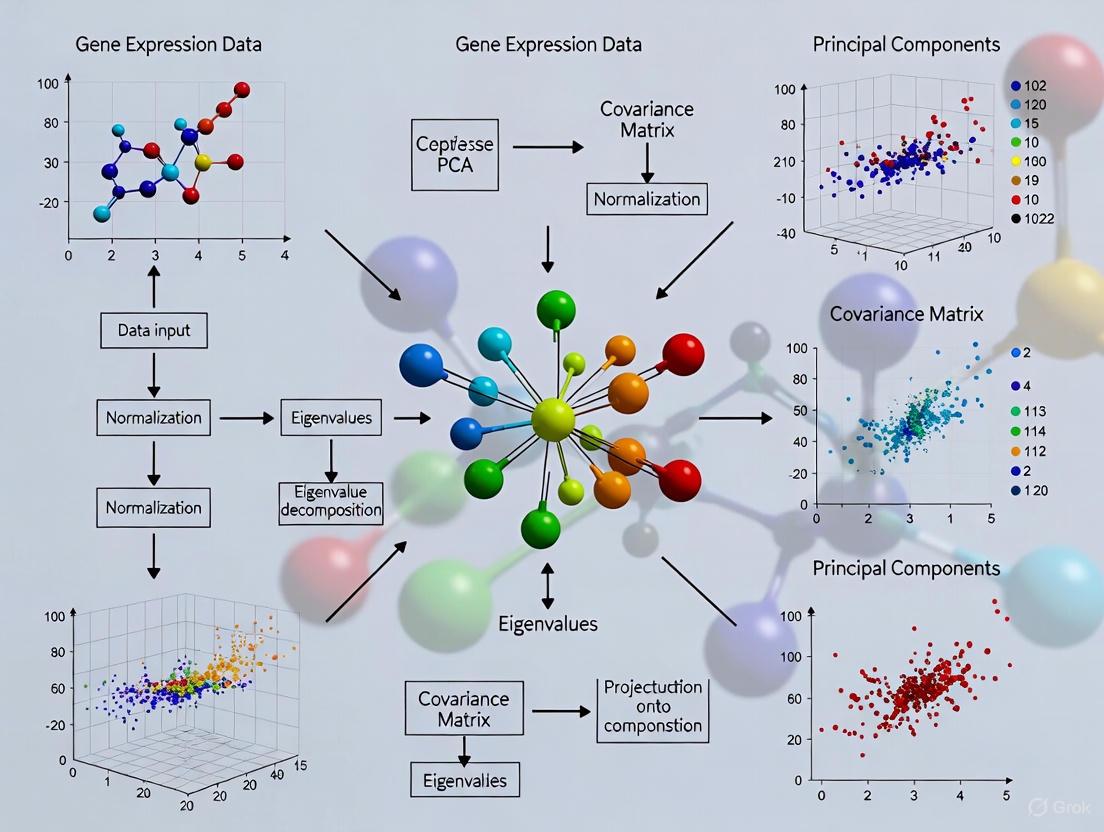
This article provides researchers, scientists, and drug development professionals with a complete framework for applying Principal Component Analysis (PCA) to gene expression data.
A Comprehensive Guide to Performing PCA on Gene Expression Data: From Theory to Clinical Applications
Abstract
This article provides researchers, scientists, and drug development professionals with a complete framework for applying Principal Component Analysis (PCA) to gene expression data. Covering foundational concepts of dimensionality reduction in transcriptomics, we detail practical implementation workflows in R, address common troubleshooting scenarios, and explore advanced optimization techniques. The guide also examines validation methodologies and compares PCA with emerging techniques, empowering biomedical professionals to effectively leverage PCA for uncovering biological patterns in high-throughput genomic data.
Understanding PCA and the Dimensionality Challenge in Genomics
The Curse of Dimensionality in Transcriptomic Data
High-throughput transcriptomic technologies generate data where the number of variables (genes) vastly exceeds the number of observations (samples), creating a scenario known as the "curse of dimensionality." This phenomenon presents substantial challenges for statistical analysis and biological interpretation. Principal Component Analysis (PCA) serves as a fundamental computational technique to address these challenges by reducing dimensionality while preserving essential biological signals. This technical guide examines the theoretical foundations of high-dimensional spaces in transcriptomics, provides practical PCA implementation workflows, and explores advanced methodologies for extracting meaningful biological insights from complex gene expression data.
Transcriptomic technologies, including microarrays and RNA-sequencing, routinely generate datasets where each sample is characterized by tens of thousands of gene expression measurements. A typical experiment might yield 20,000-50,000 measurements per sample, often with fewer than 100 biological replicates [1] [2]. This P≫N scenario (where P represents variables/genes and N represents observations/samples) creates fundamental analytical challenges that transcend mere computational burden.
The "curse of dimensionality" refers to the collection of problems that arise when working with data in high-dimensional spaces that do not occur in low-dimensional settings [3]. These include spurious correlations, distance concentration phenomena (where nearest and farthest neighbors become equidistant), and model overfitting that can lead to biologically implausible conclusions [3]. In transcriptomics, these challenges are compounded by the biological reality that gene expression is controlled by complex, interconnected regulatory networks rather than independent variables.
Principal Component Analysis addresses these challenges by transforming the original high-dimensional gene expression space into a lower-dimensional subspace defined by orthogonal principal components that capture maximum variance. When properly applied, PCA can mitigate overfitting, reduce noise, and reveal underlying biological structures such as cell types, disease subtypes, and developmental trajectories [4] [5].
Fundamental Challenges in High-Dimensional Transcriptomic Spaces
Mathematical and Statistical Consequences
High-dimensional gene expression spaces exhibit properties that often contradict human geometric intuition. As dimensionality increases, the available data becomes increasingly sparse, with pairwise distances between samples becoming more similar [3]. This distance concentration effect can impair the performance of clustering and classification algorithms that rely on distance metrics.
The table below summarizes key statistical challenges in high-dimensional transcriptomic analysis:
Table 1: Statistical challenges posed by high-dimensional transcriptomic data
| Challenge | Impact on Analysis | Potential Consequences |
|---|---|---|
| Multiple Testing Problem | When testing 20,000 genes at α=0.05, 1,000 false positives are expected by chance [1] | High false discovery rates without appropriate correction |
| Spurious Correlations | Apparent but biologically meaningless correlations increase with dimensionality [3] | Incorrect inference of gene regulatory relationships |
| Model Overfitting | Models with thousands of parameters fit to dozens of samples memorize noise rather than learning signal [3] | Poor generalizability to new datasets; irreproducible findings |
| Data Sparsity | Data points become isolated in high-dimensional space, breaking distance-based algorithms [3] | Reduced clustering performance and neighborhood detection |
Biological Interpretation Complexities
Beyond mathematical challenges, high-dimensional transcriptomic data reflects biological complexity. Gene expression patterns exhibit multimodality due to heterogeneous cell populations within samples, concurrent activation of multiple biological processes, and tissue-specific gene activities [3]. This biological richness can confound simple interpretations, as principal components may capture technical artifacts, batch effects, or dominant biological processes that obscure more subtle but functionally important signals.
Studies of large, heterogeneous gene expression datasets suggest that while the first few principal components often capture major biological axes (e.g., hematopoietic vs. neural lineages, malignant vs. normal states), tissue-specific information frequently resides in higher-order components [5]. This indicates that the linear intrinsic dimensionality of global gene expression space is higher than previously recognized, with relevant biological signal distributed beyond the first 3-4 principal components.
Principal Component Analysis: Theoretical Foundations
Core Mathematical Framework
PCA transforms possibly correlated variables (gene expression levels) into a set of linearly uncorrelated variables called principal components (PCs), ordered by the fraction of total variance they explain. The first PC accounts for the largest possible variance, with each succeeding component accounting for the highest possible variance under the constraint of orthogonality to preceding components.
Given a gene expression matrix X with dimensions n×p (n samples, p genes), after centering the data to have zero mean, PCA computes the eigenvectors and eigenvalues of the covariance matrix C = XᵀX/(n-1). The principal components are obtained by projecting the original data onto the eigenvectors: Z = XV, where V contains the eigenvectors of C.
The proportion of total variance explained by the k-th principal component is λₖ/∑ᵢλᵢ, where λₖ is the k-th eigenvalue. This allows researchers to determine how many components to retain for downstream analysis.
Advanced PCA Variations for Transcriptomic Data
Several specialized PCA variants have been developed to address specific challenges in transcriptomic data analysis:
Sparse PCA: Incorporates sparsity constraints to produce loading vectors with many zero elements, improving biological interpretability by identifying smaller gene subsets that drive each component [4]. The optimization problem can be formulated as minimizing the reconstruction error with L1 regularization: min‖X - XWWᵀ‖₂² + λ‖W‖₁.
Kernel PCA: Applies kernel functions to capture non-linear relationships in gene expression data by implicitly mapping observations into higher-dimensional feature spaces before performing PCA [4]. This approach can reveal complex patterns that linear PCA might miss.
Functional PCA (fPCA): Designed for analyzing time-series transcriptomic data, such as gene expression during differentiation or treatment response, by treating observations as functions over a continuous domain rather than discrete measurements [4].
Practical Workflow for PCA on Transcriptomic Data
Preprocessing and Normalization
Proper preprocessing is critical for meaningful PCA results. For transcriptomic data, this typically involves:
- Quality Control: Filtering genes with low expression and samples with poor quality metrics.
- Normalization: Correcting for technical variation (e.g., sequencing depth, batch effects) while preserving biological signal.
- Transformations: Applying appropriate transformations (e.g., log, VST) to stabilize variance across the dynamic range of expression.
For single-cell RNA-seq data, recent methods like regularized negative binomial regression (sctransform) effectively normalize count data while controlling for technical covariates like sequencing depth [6]. Traditional size-factor-based normalization methods (e.g., TMM, RLE) may inadequately handle genes with different abundance levels, potentially introducing artifacts in PCA [6].
Table 2: Normalization methods for unbalanced transcriptomic data
| Method | Platform | Reference Strategy | Key Features |
|---|---|---|---|
| GRSN | Microarray | Data-driven subset | Uses global rank-invariant sets with loess smoothing |
| IRON | Microarray | Data-driven subset | Iterative rank-order normalization for skewed data |
| TMM | RNA-seq | Entire gene set | Trimmed mean of M-values; assumes most genes not DE |
| sctransform | scRNA-seq | Regularized GLM | Negative binomial regression with regularization |
| Spike-in Controls | Both | Foreign reference | Uses externally added controls as reference |
Component Selection Strategies
Determining the number of components to retain represents a critical step in PCA. Several automated methods exist:
- Scree Plot Analysis: Visual inspection of the eigenvalue curve to identify an "elbow" point where eigenvalues plateau.
- Kaiser Criterion: Retaining components with eigenvalues greater than 1.
- Cross-Validation: Evaluating reconstruction error across training and validation splits.
- Parallel Analysis: Comparing observed eigenvalues to those from random datasets with equivalent dimensionality.
For large, heterogeneous transcriptomic datasets, evidence suggests that more components contain biological signal than previously assumed. While early studies suggested only 3-4 components were meaningful, more recent analyses of datasets with 5,000+ samples indicate that 10+ components may capture biologically relevant variation, particularly for within-tissue comparisons [5].
The following workflow diagram illustrates the complete PCA process for transcriptomic data:
Interpretation and Validation of PCA Results
Biological Interpretation of Components
Interpreting principal components biologically requires connecting mathematical representations to biological knowledge. Effective strategies include:
- Gene Loading Analysis: Examining genes with highest absolute loadings for each component to identify biologically coherent gene sets.
- Pathway Enrichment: Testing whether high-loading genes are enriched for specific biological pathways or functions.
- Correlation with Phenotypes: Assessing relationships between component scores and sample metadata (e.g., clinical variables, treatment responses).
In large-scale analyses, the first principal components often separate major biological categories. For example, in a pan-tissue analysis of 7,100 samples, the first three components separated hematopoietic cells, neural tissues, and cell lines, while the fourth component captured liver-specific expression [5]. The specific components recovered depend strongly on sample composition, with overrepresented tissues dominating early components.
Validation and Robustness Assessment
Validating PCA results is essential to ensure findings reflect biology rather than analytical artifacts:
- Stability Analysis: Assessing consistency of components across subsampled datasets or bootstrapped samples.
- Visualization Diagnostics: Using tools like distnet to examine discrepancies between low-dimensional embeddings and actual high-dimensional distances [7].
- Independent Validation: Confirming biological interpretations in external datasets or through experimental follow-up.
Interactive visualization tools like focusedMDS enable exploration of specific sample relationships by creating embeddings that accurately preserve distances between a focal point and all other samples [7]. This approach helps verify whether apparent clustering in standard PCA plots reflects true biological similarity.
Advanced Applications and Integration with Other Methods
PCA in Integrated Analysis Workflows
PCA serves as a foundational step in more complex analytical workflows:
- Clustering Post-PCA: Applying clustering algorithms to PCA-reduced data mitigates the curse of dimensionality and improves cluster stability and biological interpretability [4].
- Principal Component Regression (PCR): Using principal components as predictors in regression models addresses multicollinearity in high-dimensional transcriptomic data [4].
- Multi-Omics Integration: Applying PCA to combined datasets from multiple molecular platforms (e.g., transcriptomics, proteomics, epigenomics) to identify cross-platform patterns.
Beyond Linear Dimensionality Reduction
While PCA is invaluable for linear dimensionality reduction, several methods address its limitations:
- PHATE (Potential of Heat-diffusion for Affinity-based Transition Embedding): A visualization method that captures both local and global nonlinear structures using information-geometric distances, often revealing patterns missed by PCA [8].
- t-SNE and UMAP: Nonlinear techniques particularly effective for visualizing complex manifold structures in single-cell transcriptomic data, though with potential limitations in preserving global structure [8].
The following diagram compares dimensionality reduction approaches:
Table 3: Computational tools for high-dimensional transcriptomic analysis
| Tool/Package | Function | Application Context | Key Features |
|---|---|---|---|
| Seurat | Single-cell analysis | scRNA-seq | PCA integration, visualization, downstream analysis |
| SCANPY | Single-cell analysis | scRNA-seq | PCA, clustering, trajectory inference in Python |
| sctransform | Normalization | scRNA-seq | Regularized negative binomial regression |
| PHATE | Visualization | Various | Captures nonlinear progression and branches |
| distnet/focusedMDS | Validation | Various | Interactive visualization of distance preservation |
| Scran | Normalization | scRNA-seq | Pool-based size factor estimation |
The curse of dimensionality presents significant but surmountable challenges in transcriptomic data analysis. Principal Component Analysis remains a cornerstone technique for addressing these challenges, providing a mathematically principled approach to dimensionality reduction that preserves biological signal while mitigating technical noise. Successful application requires careful attention to preprocessing, component selection, and validation, with awareness that biological information often extends beyond the first few components.
As transcriptomic technologies continue to evolve, generating ever-larger and more complex datasets, advanced PCA variations and complementary nonlinear methods will play increasingly important roles in extracting biologically meaningful insights. By understanding both the capabilities and limitations of these approaches, researchers can more effectively navigate high-dimensional transcriptomic spaces to advance biological discovery and therapeutic development.
Principal Component Analysis (PCA) serves as a foundational dimensionality reduction technique in computational biology, transforming high-dimensional gene expression data into a lower-dimensional space defined by core mathematical principles. This whitepaper provides an in-depth technical examination of how variance, covariance, and eigen decomposition form the mathematical bedrock of PCA, with specific application to gene expression data analysis. We detail the theoretical framework, practical implementation workflows, and experimental considerations for researchers, scientists, and drug development professionals working with transcriptomic data. The guidance emphasizes proper application in bioinformatics contexts where the number of variables (genes) dramatically exceeds the number of observations (samples), including critical considerations for effective dimensionality determination and biological interpretation.
Gene expression studies from technologies like RNA sequencing (RNA-seq) and microarrays generate data matrices of profound dimensionality, where measurements for tens of thousands of genes (features) span relatively few biological samples (observations) [9] [10]. This "large d, small n" characteristic presents significant analytical challenges for visualization, statistical analysis, and pattern recognition. Principal Component Analysis (PCA), first introduced by Karl Pearson in 1901, addresses these challenges through an orthogonal transformation that converts potentially correlated gene expression measurements into a set of linearly uncorrelated variables called principal components (PCs) [11] [12].
In bioinformatics, PCA transcends mere dimensionality reduction, serving as an indispensable tool for exploratory data analysis, quality assessment, outlier detection, and batch effect identification [10]. The technique operates on a fundamental premise: while genomic data inhabits a high-dimensional space, the biologically relevant signals often concentrate in a much lower-dimensional subspace. PCA identifies this subspace through a mathematical framework built upon three core principles: variance, covariance, and eigen decomposition. These principles collectively enable researchers to project gene expression data into a new coordinate system where the greatest variances align with the first principal component, subsequent orthogonal directions capture remaining variance, and noise is systematically filtered [13] [9].
Mathematical Foundations
Variance and Covariance
In the context of gene expression analysis, variance measures the dispersion of individual gene expression values across biological samples. For a single gene ( g ) with expression values ( \mathbf{x}g = (x{g1}, x{g2}, ..., x{gn}) ) across ( n ) samples, the sample variance is calculated as:
[ \text{Var}(\mathbf{x}g) = \frac{1}{n-1} \sum{i=1}^{n} (x{gi} - \bar{x}g)^2 ]
where ( \bar{x}_g ) represents the mean expression of gene ( g ) across all samples. High variance indicates a gene with expression levels that fluctuate substantially across samples, potentially reflecting biologically relevant differential expression rather than technical noise [14].
Covariance quantifies the coordinated relationship between pairs of genes across samples. For two genes ( g ) and ( h ) with expression vectors ( \mathbf{x}g ) and ( \mathbf{x}h ), their sample covariance is:
[ \text{Cov}(\mathbf{x}g, \mathbf{x}h) = \frac{1}{n-1} \sum{i=1}^{n} (x{gi} - \bar{x}g)(x{hi} - \bar{x}_h) ]
Positive covariance indicates that the two genes tend to be upregulated or downregulated together across samples, potentially suggesting co-regulation or functional relationship. Negative covariance implies an inverse relationship, where one gene's increased expression correlates with the other's decrease. A covariance near zero suggests independence between the genes' expression patterns [11].
The covariance matrix ( \mathbf{\Sigma} ) comprehensively captures these relationships across all genes in the dataset. For a gene expression matrix ( \mathbf{X} ) with ( p ) genes (rows) and ( n ) samples (columns), where each column has been mean-centered, the covariance matrix is computed as:
[ \mathbf{\Sigma} = \frac{1}{n-1} \mathbf{X} \mathbf{X}^T ]
This ( p \times p ) symmetric matrix contains the variance of each gene along its diagonal and covariances between gene pairs in off-diagonal elements [11] [12]. The covariance matrix is fundamental to PCA as it encodes the complete variance structure of the gene expression dataset.
Eigen Decomposition
Eigen decomposition, also known as spectral decomposition, extracts the fundamental directions and magnitudes of variance from the covariance matrix. For the covariance matrix ( \mathbf{\Sigma} ), eigen decomposition solves the equation:
[ \mathbf{\Sigma} \mathbf{v}i = \lambdai \mathbf{v}_i ]
where:
- ( \lambda_i ) represents the ( i )-th eigenvalue, quantifying the amount of variance captured along the corresponding direction
- ( \mathbf{v}_i ) represents the ( i )-th eigenvector, defining the direction of the ( i )-th principal component in the original gene space [11] [12]
The eigenvectors form a new orthonormal basis for the data, with the crucial property that ( \mathbf{v}i^T \mathbf{v}j = 0 ) for ( i \neq j ) and ( \mathbf{v}i^T \mathbf{v}i = 1 ). The eigenvalues are typically ordered in decreasing magnitude (( \lambda1 \geq \lambda2 \geq \ldots \geq \lambda_p )), establishing a hierarchy of principal components by their importance in explaining the overall variance [13] [9].
The proportion of total variance explained by the ( i )-th principal component is given by:
[ \text{Variance Explained}i = \frac{\lambdai}{\sum{j=1}^{p} \lambdaj} ]
This allows researchers to determine how many principal components are needed to capture a sufficient amount of the biological signal in the data [13].
Singular Value Decomposition (SVD) Relationship
While eigen decomposition operates on the covariance matrix, PCA can be equivalently implemented via Singular Value Decomposition (SVD) applied directly to the mean-centered data matrix ( \mathbf{X} ). The SVD approach decomposes:
[ \mathbf{X} = \mathbf{U} \boldsymbol{\Delta} \mathbf{V}^T ]
where:
- ( \mathbf{U} ) is an ( n \times n ) orthogonal matrix containing the left singular vectors
- ( \boldsymbol{\Delta} ) is an ( n \times p ) rectangular diagonal matrix with non-negative singular values ( \delta_i ) on the diagonal
- ( \mathbf{V} ) is a ( p \times p ) orthogonal matrix containing the right singular vectors [15]
The equivalence emerges through the relationship:
- The right singular vectors ( \mathbf{V} ) correspond to the eigenvectors of ( \mathbf{X}^T \mathbf{X} )
- The singular values ( \deltai ) relate to eigenvalues via ( \lambdai = \delta_i^2 / (n-1) )
- The principal components (scores) are given by ( \mathbf{U} \boldsymbol{\Delta} ) [15]
SVD provides computational advantages for gene expression data where ( p \gg n ) by avoiding explicit construction of the massive ( p \times p ) covariance matrix.
Workflow for Gene Expression Data
Data Preprocessing
Proper preprocessing of gene expression data is critical for meaningful PCA results. For RNA-seq count data, this typically involves:
Normalization: Addressing differences in sequencing depth across samples using methods like DESeq2's median-of-ratios, TPM (Transcripts Per Million), or other normalization techniques implemented in packages such as DESeq2 [10].
Transformation: Converting count data to approximate homoscedasticity (equal variance) through variance-stabilizing transformations (VST) or log2 transformation after adding a pseudocount [10].
Standardization: Scaling genes to have mean zero and unit variance (Z-score normalization), which gives equal weight to all genes regardless of their original expression levels. This is particularly important when using covariance-based PCA, as high-expression genes would otherwise dominate the analysis [13] [12].
Mean Centering: Subtracting the mean expression of each gene across all samples, a prerequisite for covariance matrix computation [12].
Covariance Matrix and Eigen Decomposition
Following preprocessing, the mathematical core of PCA begins with computation of the covariance matrix ( \mathbf{\Sigma} ) from the processed expression matrix ( \mathbf{X} ). For a gene expression dataset with ( p ) genes and ( n ) samples:
[ \mathbf{\Sigma} = \frac{1}{n-1} \mathbf{X} \mathbf{X}^T ]
Eigen decomposition of ( \mathbf{\Sigma} ) yields eigenvectors (principal directions) and eigenvalues (variance explained). In practice, for high-dimensional gene expression data where ( p \gg n ), computational efficiency is dramatically improved by performing SVD directly on ( \mathbf{X} ) rather than explicitly computing the ( p \times p ) covariance matrix [15].
Component Selection
Determining the number of meaningful principal components represents a critical step with significant implications for biological interpretation. Several methods facilitate this decision:
Table 1: Methods for Determining Principal Components in Gene Expression Studies
| Method | Description | Application Context | Advantages | Limitations |
|---|---|---|---|---|
| Scree Plot | Visual inspection of eigenvalue magnitude drop-off | Initial exploratory analysis | Intuitive visualization | Subjective interpretation |
| Cumulative Variance | Components explaining >80-95% total variance | General purpose gene expression studies | Objective threshold | May retain noise components |
| Amemiya's Test | Statistical testing for dimensionality [16] | Formal hypothesis testing | Statistical rigor | Computationally intensive |
| Factor-Analytic Modeling | Mixed-model framework [16] | Experimental designs with random effects | Integrates with linear models | Complex implementation |
In gene expression studies, the effective dimensionality often proves much lower than the number of samples or genes. Research indicates that while 3-4 principal components might capture major patterns in heterogeneous datasets, additional components frequently contain biologically relevant information specific to particular tissues or conditions [14].
Data Projection and Interpretation
The original gene expression data projects onto the selected principal components through matrix multiplication:
[ \mathbf{Z} = \mathbf{X}^T \mathbf{V}_k ]
where ( \mathbf{V}_k ) contains the first ( k ) eigenvectors and ( \mathbf{Z} ) represents the projected data in the new ( k )-dimensional space. This transformed data enables two primary types of biological interpretation:
Sample-Level Patterns: The projected coordinates (PC scores) reveal sample relationships, clusters, and outliers when visualized in 2D or 3D plots [13] [10].
Gene-Level Contributions: Eigenvector elements (loadings) indicate how strongly each gene contributes to each principal component. Genes with large absolute loadings drive the separation of samples along that component and may represent biologically coherent gene sets [13].
Experimental Protocols and Applications
Standard Protocol for RNA-seq Data PCA
Purpose: To identify major patterns of variation, batch effects, outliers, and potential confounders in RNA-seq gene expression data.
Materials:
- Raw count matrix from RNA-seq alignment (e.g., from featureCounts or HTSeq)
- Experimental metadata table with sample annotations
- Computational environment with R/Bioconductor
Procedure:
- Load count data and metadata into R, creating a DESeqDataSet or similar object [10].
- Apply normalization (e.g., DESeq2's median-of-ratios) and transformation (variance-stabilizing or log2).
- Perform mean centering and optional scaling of the transformed expression values.
- Execute PCA using the
prcomp()function in R. - Extract eigenvalues and eigenvectors from the result object.
- Generate diagnostic plots including scree plot and cumulative variance plot.
- Visualize sample relationships using the first 2-3 principal components, coloring by experimental conditions.
- Identify genes with extreme loadings on biologically interesting components.
- Perform functional enrichment analysis on high-loading genes.
Troubleshooting:
- If first PC correlates strongly with technical batches, consider batch correction before PCA.
- If samples form unexpected clusters, investigate potential confounding variables.
- If few components explain little variance, assess data quality and normalization.
Advanced Protocol: Determining Effective Dimensionality
Purpose: To statistically determine the number of significant biological dimensions in gene expression data.
Materials:
- Processed gene expression matrix
- Experimental design information
Procedure (adapted from Amemiya's approach [16]):
- Compute the between-groups and within-groups mean square matrices (( \mathbf{MB} ) and ( \mathbf{MW} )) based on the experimental design.
- Calculate the characteristic roots (( \lambdai )) of ( \mathbf{MB} ) in the metric of ( \mathbf{MW} ) by solving ( \|\mathbf{MB} - \lambda \mathbf{M_W}\| = 0 ).
- Order characteristic roots from largest to smallest.
- Sequentially test null hypotheses ( m \leq b ) for ( b = 0, 1, 2, \ldots ) using the test statistic:
[ Yb = (M + N - 2b - 2) \sum{i=b+1}^{k} \ln(1 + \lambdai) - 2 \sum{i=b+1}^{k} \ln(\lambda_i) ]
where ( M ) and ( N ) are between-groups and within-groups degrees of freedom.
- Compare test statistics to critical values from Amemiya et al. (1990) [16].
- Reject the null hypothesis when test statistic exceeds critical value, establishing evidence for at least ( b+1 ) dimensions.
Research Reagent Solutions
Table 2: Essential Computational Tools for PCA in Gene Expression Analysis
| Tool/Resource | Function | Application Context | Implementation |
|---|---|---|---|
| DESeq2 | Normalization and transformation of RNA-seq counts | Bulk RNA-seq data preprocessing | R/Bioconductor package |
| pcaExplorer | Interactive exploration of PCA results | RNA-seq data visualization | R/Bioconductor package [10] |
| prcomp() | Core PCA computation using SVD | General gene expression data | Base R function [13] |
| FactoMineR | Advanced PCA with supplementary variable projection | Integration of clinical and expression data | R package |
| SCONE | PCA-based quality control for single-cell RNA-seq | Single-cell transcriptomics | R/Bioconductor package |
Case Study: PCA in Large-Scale Transcriptomics
A landmark study by Lukk et al. (2016) applied PCA to a massive gene expression dataset comprising 5,372 samples from 369 different human tissues, cell types, and disease states [14]. This analysis demonstrated both the power and limitations of PCA for global transcriptome analysis.
The first three principal components captured approximately 36% of the total variance and corresponded to broad biological categories:
- PC1 separated hematopoietic cells from other tissues
- PC2 distinguished malignant from non-malignant samples
- PC3 differentiated neural tissues from other cell types
However, subsequent investigation revealed that higher-order components contained significant biological information despite explaining less variance. When the dataset was decomposed into the first three components ("projected" space) and remaining components ("residual" space), tissue-specific correlation patterns persisted strongly in the residual space [14]. This finding contradicted the assumption that biological signals concentrate exclusively in the first few components and highlighted the importance of methodical component selection.
Further analysis demonstrated that sample composition dramatically influences PCA results. When the proportion of liver samples was systematically varied, the fourth principal component transitioned from non-interpretable to clearly separating liver and hepatocellular carcinoma samples [14]. This underscores how study design and sample selection fundamentally shape the principal components obtained.
Advanced Considerations
Limitations and Assumptions
PCA operates under several mathematical assumptions that merit consideration in gene expression contexts:
Linearity: PCA assumes linear relationships between variables, while gene regulatory networks often exhibit nonlinear behaviors. Kernel PCA addresses this limitation for certain applications [12] [9].
Variance Maximization: Components capturing maximal variance may not align with biologically relevant directions, particularly when technical artifacts introduce large variances [14].
Orthogonality: The constraint of orthogonal components may not reflect biological reality, where overlapping gene programs often operate simultaneously.
Sample Size Sensitivity: PCA results demonstrate sensitivity to sample composition, with rare cell types or conditions potentially underrepresented in the major components [14].
Extension to Supervised and Sparse PCA
Several PCA extensions address specific analytical challenges in genomics:
Supervised PCA incorporates response variables (e.g., clinical outcomes) to identify components associated with specific phenotypes, enhancing biological interpretability [9].
Sparse PCA introduces regularization to produce principal components with sparse loadings (many exact zeros), improving interpretability by associating each component with smaller, more biologically coherent gene sets [9].
Functional PCA extends the framework to time-course gene expression data, modeling temporal patterns in transcriptomic dynamics [9].
Variance, covariance, and eigen decomposition constitute the mathematical foundation enabling Principal Component Analysis to reduce the dimensionality of gene expression data while preserving biologically relevant information. The covariance matrix encodes the complete variance structure, while eigen decomposition extracts orthogonal directions of maximum variance ranked by importance. Successful application in transcriptomics requires careful attention to data preprocessing, component selection, and interpretation within biological context. While the first few principal components often capture major experimental conditions and batch effects, higher components may contain biologically meaningful patterns specific to particular tissues or conditions. Advanced implementations addressing sparsity, supervision, and nonlinear relationships continue to enhance the utility of this century-old technique for modern genomic research.
The N × P Matrix Format
Principal Component Analysis (PCA) has become an indispensable tool in the analysis of high-dimensional genomic data, particularly in gene expression studies where researchers routinely encounter datasets with tens of thousands of genes (features) measured across multiple samples (observations). The foundation of any successful PCA lies in the proper structuring of data into an N × P matrix format, where N represents samples and P represents features. This technical guide provides comprehensive methodologies for constructing, validating, and analyzing the N × P matrix within the context of gene expression research, enabling researchers and drug development professionals to extract biologically meaningful patterns from complex transcriptomic data while avoiding common analytical pitfalls.
In gene expression studies using technologies such as RNA sequencing (RNA-Seq), the initial data processing steps (quality control, alignment, and feature counting) often yield a count matrix that forms the basis for all subsequent analyses [17]. The standard convention for structuring this data places samples as rows (N) and genes as columns (P) in what is termed the N × P matrix format [18]. This structure aligns with the mathematical framework of most statistical packages, where observations (samples) form the rows and variables (genes) form the columns. The fundamental challenge in genomics lies in the high-dimensional nature of this matrix, where P (number of genes, typically ~20,000) vastly exceeds N (number of samples, often in the tens or hundreds) [5], creating unique statistical challenges that PCA helps to address.
The N × P matrix format enables researchers to capture the complete transcriptomic landscape of their experimental system in a mathematical framework amenable to multivariate analysis. Each cell in the matrix contains the normalized expression value for a specific gene (column) in a particular sample (row), creating a comprehensive data structure that preserves the relationships between samples and genes [17] [19]. Proper construction of this matrix is critical, as variations in sample preparation, sequencing depth, and experimental conditions can introduce technical artifacts that may confound biological interpretation if not adequately addressed [20].
Data Preparation and Normalization Methods
Construction of the Count Matrix
The initial RNA-Seq data processing typically results in a count matrix where genes are represented as rows and samples as columns [17] [19]. To conform to the standard N × P format where rows are samples and columns are variables, this matrix must be transposed before PCA analysis. As detailed in the GENAVi tool implementation, the featureCounts function of the subread package is commonly used to generate the initial count data by counting reads that map to genomic features, accounting for alternate transcripts and collapsing them to gene level [17]. The resulting data frame typically includes gene identification information, chromosomal position, strand information, and gene length in addition to the expression counts across samples.
Table 1: Essential Components of a Properly Formatted N × P Matrix
| Component | Description | Example Format |
|---|---|---|
| Sample IDs | Unique identifiers for each biological sample | Sample1, Sample2, ..., SampleN |
| Gene IDs | Standardized gene identifiers | ENSG00000139618, ENSG00000284662, ... |
| Expression Values | Normalized counts or transformed values | 15.342, 28.901, 0.000, ... |
| Metadata | Experimental conditions, batches, or phenotypes | Treatment: Control vs. Treated |
Normalization and Transformation Techniques
Normalization is a critical preprocessing step that ensures comparability of expression values across samples with potential differences in sequencing depth and other technical variations. GENAVi provides multiple normalization approaches, each with distinct characteristics and applications [17]:
- Row Normalization: Resembles a t-score normalization, transforming the expression of each individual gene across all samples
- logCPM (Counts Per Million): Implemented from the edgeR package, calculates CPM values for every feature followed by log₂ transformation
- Variance Stabilizing Transformation (VST): From the DESeq2 package, stabilizes variance across the dynamic range of expression values
- Regularized Logarithmic Transformation (rlog): Also from DESeq2, applies regularized log transformation for datasets with small sample sizes
Table 2: Comparison of Normalization Methods for RNA-Seq Data
| Method | Package | Advantages | Limitations |
|---|---|---|---|
| logCPM | edgeR | Simple interpretation, handles sequencing depth differences | May not stabilize variance for low counts |
| VST | DESeq2 | Stabilizes variance across expression range, fast computation | Less optimal for very small sample sizes |
| rlog | DESeq2 | Optimal for small sample sizes, similar to log₂ for large counts | Computationally intensive for large datasets |
After normalization, data should be standardized to have a mean of zero and standard deviation of one for each gene [21]. This standardization ensures that all variables (genes) contribute equally to the PCA analysis, regardless of their original expression levels or variability, preventing highly expressed genes from dominating the principal components simply due to their magnitude rather than biological importance.
Principal Component Analysis Implementation
Computational Framework for PCA
The mathematical foundation of PCA involves transforming the original variables (genes) into a new set of orthogonal variables called principal components (PCs) that capture decreasing amounts of variance in the data [21]. The implementation follows these computational steps:
- Standardization: The normalized expression matrix is centered and scaled such that each gene has a mean of 0 and standard deviation of 1
- Covariance Matrix Calculation: Compute the covariance matrix representing relationships between all pairs of genes
- Eigenvalue Decomposition: Calculate eigenvalues and eigenvectors of the covariance matrix
- Component Selection: Select top components based on eigenvalues, which represent variance explained
For the high-dimensional data typical of gene expression studies (where P >> N), computational efficiency becomes crucial. The irlba package (Fast Truncated Singular Value Decomposition) provides both faster computation and better memory efficiency compared to standard singular value decomposition (SVD) for computing the largest singular vectors and values [18]. This approach is implemented in tools such as Seurat for single-cell RNA-seq data, where dimensionality is particularly challenging.
Determining Significant Components
A critical challenge in applying PCA to gene expression data is determining how many principal components to retain for downstream analysis. While traditional approaches often focus on the first 2-4 components, evidence suggests that biologically relevant information may be contained in higher components [5]. Several statistical approaches address this challenge:
- JackStraw Permutation Test: Implemented in Seurat, randomly permutes a subset of data and calculates projected PCA scores for 'random' genes, then compares these with observed PCA scores to determine statistical significance [18]
- Horn's Parallel Analysis: Compares eigenvalues from actual data with those from permuted data, retaining components where actual eigenvalues exceed those from permuted data [18]
- Information Ratio Criterion: Quantifies the distribution of information content between projected versus residual gene expression space using genome-wide log-p-values of gene expression differences [5]
The assumption of low intrinsic dimensionality in gene expression data has been challenged by research showing that tissue-specific information often remains in the residual space after subtracting the first three PCs [5]. The information content in higher components becomes particularly important when comparing samples within large-scale groups (e.g., between two brain regions or two hematopoietic cell types), where most information may be contained beyond the first few components.
Advanced Applications and Methodological Considerations
Robust PCA for Outlier Detection
In RNA-Seq data with limited biological replicates (typically 2-6 per condition), accurately detecting outlier samples presents significant challenges. Robust PCA (rPCA) methods address this limitation by using robust statistics to obtain principal components not influenced by outliers and to objectively identify anomalous observations [20]. Two particularly effective methods include:
- PcaHubert: Provides high sensitivity for outlier detection
- PcaGrid: Achieves the lowest estimated false positive rate, with demonstrated 100% sensitivity and specificity in controlled tests [20]
These methods overcome limitations of classical PCA (cPCA), where the first components are often attracted toward outlying points and may not capture the variation of regular observations. In comparative studies, rPCA methods have successfully detected outlier samples that cPCA failed to identify, leading to significant improvements in differential expression analysis [20].
Interactive Visualization and Analysis
Modern RNA-Seq analysis platforms such as DEBrowser and GENAVi provide interactive visualization capabilities that enable researchers to explore PCA results dynamically [17] [19]. These tools allow users to:
- Visualize any pair of principal components in interactive scatter plots
- Color samples by experimental conditions or batches
- Select subsets of data directly from plots for further investigation
- Dynamically update plots based on parameter changes
- Hover over data points to obtain detailed sample information
This interactive approach facilitates the identification of technical artifacts such as batch effects, which can then be addressed through appropriate normalization or batch correction methods [19]. The ability to iteratively visualize and refine the analysis based on PCA results significantly enhances the analytical process, particularly for researchers without extensive programming expertise.
Research Reagent Solutions
Table 3: Essential Research Reagents and Tools for PCA of Gene Expression Data
| Reagent/Tool | Function | Application in PCA Workflow |
|---|---|---|
| RNA Extraction Kits | Isolation of high-quality RNA | Ensure input material quality for sequencing |
| Stranded RNA-Seq Library Prep Kits | Construction of sequencing libraries | Generate count data for matrix formation |
| DESeq2 | Differential expression analysis | Provides VST and rlog normalization methods |
| edgeR | Differential expression analysis | Provides logCPM normalization method |
| rrcox R Package | Robust statistical methods | Implements PcaHubert and PcaGrid for outlier detection |
| irlba R Package | Fast truncated SVD | Efficient PCA computation for large matrices |
| GENAVi Web Application | Interactive analysis platform | GUI-based normalization, PCA, and visualization |
The proper implementation of the N × P matrix format provides the foundational framework for successful principal component analysis of gene expression data. By adhering to standardized procedures for data structuring, normalization, and computational analysis, researchers can extract biologically meaningful patterns from high-dimensional transcriptomic data. The integration of robust statistical methods with interactive visualization platforms has made sophisticated PCA approaches accessible to researchers without extensive bioinformatics training, potentially accelerating discovery in both basic research and drug development contexts.
Future methodological developments will likely address current limitations in capturing nonlinear relationships and improving interpretation of principal components in biological contexts. As single-cell technologies continue to produce increasingly large-scale datasets, the importance of efficient, robust PCA implementations will grow accordingly, maintaining the N × P matrix as a central component in the analysis of gene expression data.
Interpreting Principal Components as Linear Combinations
In the analysis of high-dimensional genomic data, Principal Component Analysis (PCA) serves as a fundamental dimensionality reduction technique that transforms complex gene expression datasets into a more manageable set of representative variables [9]. This transformation is achieved through the construction of linear combinations of the original gene expressions, creating new variables known as principal components (PCs) [22]. In bioinformatics research, where datasets often contain thousands of genes measured across relatively few samples, PCA provides a powerful approach to overcome the "large d, small n" challenge that renders many standard statistical techniques inapplicable [9].
The core mathematical foundation of PCA lies in its ability to create these linear combinations that capture the maximum variance in the data while remaining orthogonal to one another [23]. For gene expression studies, this means that researchers can project high-dimensional gene expression data onto a reduced set of components that effectively summarize the key patterns of biological variation [9]. These components, often referred to as "metagenes" or "super genes" in genomic contexts, enable researchers to visualize sample relationships, identify underlying structures, and perform downstream analyses that would be computationally prohibitive or statistically unstable with the full gene set [9].
Mathematical Foundation of Principal Components
The Linear Combination Framework
At its core, each principal component represents a linear combination of the original variables (gene expressions), constructed to capture the direction of maximum variance in the data [23] [22]. Given a set of p genes, the first principal component (PC1) is defined as a weighted combination of the original variables:
- PC1 = w₁₁X₁ + w₁₂X₂ + ... + w₁ₚXₚ
- PC2 = w₂₁X₁ + w₂₂X₂ + ... + w₂ₚXₚ
where X₁, X₂, ..., Xₚ represent the standardized expressions of genes 1 through p, and the weights w₁₁, w₁₂, ..., w₁ₚ are chosen to maximize the variance captured by PC1 [22]. Each subsequent component is constructed under the constraint that it must be orthogonal to all previous components while capturing the next highest possible variance [23] [9].
The weights (w) in these linear combinations, known as loadings, indicate the contribution of each original gene to the principal component [22]. Genes with larger absolute loading values have a stronger influence on that particular component. The mathematical procedure for identifying these optimal weights involves computing the eigenvectors and eigenvalues of the data's covariance matrix through singular value decomposition (SVD) [23] [9].
Geometric Interpretation
Geometrically, PCA can be understood as fitting a p-dimensional ellipsoid to the data, where each axis of the ellipsoid represents a principal component [23]. The principal components are essentially the directions of the axes of this ellipsoid, with the first principal component corresponding to the longest axis, the second principal component to the second longest, and so forth [23] [22]. The length of each axis is proportional to the variance captured by that component, quantified by its associated eigenvalue [22].
In the context of gene expression analysis, this geometric interpretation allows researchers to understand how samples cluster together in reduced-dimensional space based on their overall expression patterns. When samples project closely together along a principal component, they share similar expression profiles for the genes that contribute most strongly to that component [24].
PCA Applications in Genomics Research
Principal Component Analysis serves multiple critical functions in genomic studies, particularly in the analysis of high-throughput gene expression data from microarray and RNA-seq experiments [9]. The table below summarizes the primary applications of PCA in bioinformatics research:
Table 1: Applications of PCA in Gene Expression Analysis
| Application Area | Specific Use Cases | Key Benefits |
|---|---|---|
| Exploratory Analysis & Visualization | Projecting high-dimensional gene expressions onto 2D or 3D PCA plots [9] | Enables graphical examination of sample relationships and identification of potential outliers [25] |
| Clustering Analysis | Using principal components as input for sample or gene clustering algorithms [26] | Reduces noise by focusing on components capturing biological signal rather than technical variation |
| Regression Modeling | Employing PCs as covariates in predictive models for clinical outcomes [9] [5] | Solves collinearity problems and enables standard regression techniques with high-dimensional genomic data |
| Differential Expression | Visualizing group separations in PCA space to complement statistical testing [25] | Provides unsupervised validation of expression differences between experimental conditions |
| Survival Analysis | Utilizing PCs to stratify patients into risk groups based on expression profiles [27] | Captures coordinated gene expression patterns associated with clinical outcomes |
Beyond these standard applications, recent methodological advances have introduced non-standard implementations of PCA in genomics, including approaches that accommodate interactions among genes, pathways, and network modules [9]. For instance, researchers can conduct PCA on genes within predefined biological pathways and then use the resulting principal components to represent pathway-level effects in downstream analyses [5]. Similarly, PCA can be applied to genes within network modules to capture the effects of functionally related gene groups [23].
Experimental Protocol: PCA for Gene Expression Analysis
Data Preprocessing and Standardization
The initial critical step in performing PCA on gene expression data involves proper data preprocessing to ensure that all genes contribute equally to the analysis [22]. RNA-seq count data typically requires normalization to account for differences in sequencing depth and library composition between samples [24]. Common approaches include calculating size factors and normalizing counts using packages like DESeq2 [24]. Following normalization, gene expression values should be standardized to have a mean of zero and standard deviation of one [22]. This step is crucial because PCA is sensitive to the variances of the initial variables, and without standardization, genes with larger expression ranges would dominate the resulting principal components [22].
Covariance Matrix and Eigen Decomposition
Once the data is properly standardized, the next step involves computing the covariance matrix to understand how variables vary from the mean with respect to each other [22]. This symmetric matrix (where p is the number of genes) contains the covariances associated with all possible pairs of genes, with the diagonal elements representing the variances of each individual gene [22]. The covariance matrix reveals the underlying correlation structure between genes, identifying redundant information that may exist due to co-regulated genes or shared biological pathways [22].
The core computational step of PCA involves performing eigen decomposition on this covariance matrix to identify the eigenvectors and eigenvalues [22]. The eigenvectors represent the directions of maximum variance (principal components), while the corresponding eigenvalues indicate the amount of variance carried by each component [22] [9]. This process is mathematically equivalent to singular value decomposition (SVD) of the standardized data matrix, which is the approach implemented in most computational tools [9].
Component Selection and Interpretation
Following eigen decomposition, researchers must determine how many principal components to retain for downstream analysis. The scree plot, which displays eigenvalues in descending order, provides a visual tool for this decision [24] [22]. Components before the "elbow" point in the scree plot typically represent meaningful biological signal, while those after primarily capture noise [24]. Alternatively, researchers can retain enough components to capture a predetermined percentage of total variance (e.g., 70-90%) [22].
Biological interpretation of principal components involves examining the gene loadings for each component [22]. Genes with the largest absolute loading values contribute most strongly to a given component. Researchers can then perform functional enrichment analysis on these high-loading genes to identify biological processes, pathways, or functions associated with each component [9].
Figure 1: PCA Workflow for Gene Expression Data
Case Study: PCA in Lung Cancer Transcriptomics
A practical application of PCA in genomic research can be found in a lung cancer study conducted by the Whitehead Institute and MIT Center for Genome Research [27]. This study aimed to identify subclasses of lung adenocarcinoma based on gene expression profiles from 125 tumor samples and 17 normal lung specimens, with each sample profiled using Affymetrix U95A arrays containing 12,625 probe sets [27].
In this analysis, researchers first filtered non-differentially expressed genes between cancer and normal groups, then applied PCA to the remaining genes [27]. The principal components derived from the gene expression data were used as covariates in survival models, replacing the original high-dimensional gene expressions [27]. This approach effectively addressed the correlation structure among genes while reducing dimensionality to a manageable number of components. The study demonstrated that PCA-based survival models could successfully stratify patients into distinct risk groups with significantly different survival outcomes [27].
This case highlights a key advantage of PCA in genomic analysis: the ability to capture coordinated gene expression patterns that might be biologically meaningful but difficult to detect when examining individual genes in isolation. By projecting correlated genes onto the same principal components, PCA effectively summarizes the activity of biological pathways or gene networks that collectively influence clinical phenotypes [27].
Table 2: Key Reagent Solutions for PCA in Gene Expression Studies
| Research Reagent | Function in PCA Workflow | Implementation Examples |
|---|---|---|
| Normalization Algorithms | Adjust for technical variability in sequencing depth and library composition [24] | DESeq2 size factors, TPM normalization, RPKM/FPKM for RNA-seq [24] |
| Statistical Software | Perform covariance matrix calculation and eigen decomposition [9] | R (prcomp), SAS (PRINCOMP), SPSS (Factor), MATLAB (princomp) [9] |
| Visualization Packages | Create PCA score plots, scree plots, and biplots for result interpretation [25] | ggplot2 (R), matplotlib (Python), specialized RNA-seq visualization tools [25] |
| Gene Set Analysis Tools | Interpret PC biological meaning through functional enrichment of high-loading genes [9] | GSEA, DAVID, clusterProfiler for pathway and GO term analysis [9] |
Comparative Analysis of Dimensionality Reduction Methods
While PCA represents a foundational dimensionality reduction technique, researchers in genomics should be aware of alternative methods that may be more appropriate for specific data types or research questions. The table below compares PCA with two other commonly used ordination techniques:
Table 3: Comparison of Dimensionality Reduction Methods for Genomics
| Characteristic | PCA | PCoA | NMDS |
|---|---|---|---|
| Input Data | Original feature matrix (e.g., gene expression values) [26] | Distance matrix (e.g., Bray-Curtis, Jaccard) [26] | Distance matrix (e.g., Bray-Curtis, Jaccard) [26] |
| Distance Measure | Covariance/correlation matrix, assumes Euclidean structure [26] | Various ecological distances (Bray-Curtis, UniFrac) [26] | Rank-order relations, preserves ordinal relationships [26] |
| Underlying Model | Linear combinations of original variables [26] [22] | Linear projection of distance matrix [26] | Nonlinear, iterative optimization of rank orders [26] |
| Optimal Use Case | Linear data structures, feature extraction [26] | Beta-diversity analysis, ecological distances [26] | Complex datasets with nonlinear structures [26] |
| Application in Genomics | Gene expression analysis, identifying major patterns of variation [26] [9] | Microbial community analysis, beta-diversity visualization [26] | Complex gene expression patterns where linearity assumption fails [26] |
PCA is particularly well-suited for gene expression data, which often exhibits approximately linear relationships between variables and where the Euclidean distance underlying PCA provides a biologically meaningful measure of similarity [26]. However, for microbiome data or other ecological community analyses, PCoA (Principal Coordinate Analysis) with specialized distance metrics like Bray-Curtis or UniFrac may be more appropriate [26]. Similarly, when analyzing complex gene expression patterns where the linearity assumption may not hold, NMDS (Non-Metric Multidimensional Scaling) offers a valuable alternative that preserves the rank-order of distances between samples [26].
Advanced PCA Extensions in Bioinformatics
Recent methodological advances have extended the standard PCA framework to address specific challenges in genomic data analysis. Sparse PCA incorporates regularization to produce principal components with sparse loadings, forcing many gene coefficients to zero and thereby enhancing interpretability by focusing on smaller gene subsets [9]. Supervised PCA incorporates phenotype information during the dimension reduction process, potentially improving the relevance of resulting components for predicting clinical outcomes [9]. Functional PCA extends the approach to time-course gene expression data, capturing dynamic patterns across multiple time points [9].
Another innovative application involves using PCA to study interactions between biological pathways [9]. Rather than conducting PCA on all genes simultaneously, researchers can perform separate PCA on genes within predefined pathways, then examine interactions between the principal components of different pathways [9]. This approach maintains biological interpretability while capturing higher-order relationships that might be missed in single-pathway analyses.
These advanced techniques demonstrate how the core concept of interpreting principal components as linear combinations continues to evolve to meet the analytical challenges of modern genomic research, maintaining PCA's relevance as a fundamental tool in the bioinformatics toolkit.
Visualizing High-Dimensional Data Through Projection
Principal Component Analysis (PCA) is a fundamental statistical technique for the unsupervised analysis of high-dimensional data, allowing researchers to summarize the information content of large datasets into a smaller set of "summary indices" called principal components [28]. In the field of genomic research, where gene expression datasets routinely contain measurements for thousands of genes across multiple samples, PCA provides an essential tool for visualizing overall data structure, identifying patterns, and detecting sample similarities or clusters without prior biological annotation [5]. This dimensionality reduction is crucial because gene expression data from microarrays or RNA-sequencing creates mathematical spaces with thousands of dimensions (genes), making direct visualization and analysis computationally challenging and often unintuitive [29].
The application of PCA to gene expression microarray data has revealed that the linear intrinsic dimensionality of global gene expression maps may be higher than previously reported. While early studies suggested that only the first three to four principal components contained biologically relevant information, more recent investigations indicate that significant biological information resides in higher-order components, especially for tissue-specific comparisons [5]. This refinement in understanding highlights the importance of properly executing and interpreting PCA within the research pipeline for drug development and basic biological discovery, where distinguishing true biological signal from technical noise is paramount.
Theoretical Foundation of PCA
Mathematical Principles
Principal Component Analysis operates on the fundamental principle of identifying the dominant directions of maximum variance in high-dimensional data through eigen decomposition of the covariance matrix [30]. Mathematically, given a standardized data matrix ( X ) with ( n ) observations (samples) and ( p ) variables (genes), PCA seeks to find a set of new variables (principal components) that are linear combinations of the original variables [31]. These components are uncorrelated and ordered such that the first component (( PC1 )) captures the maximum variance in the data, the second component (( PC2 )) captures the next highest variance subject to being orthogonal to the first, and so on [28].
The mathematical transformation involves solving the characteristic equation of the covariance matrix: [ \det(\Sigma - \lambda I) = 0 ] where ( \Sigma ) represents the covariance matrix, ( \lambda ) represents the eigenvalues, and ( I ) is the identity matrix [31]. The eigenvalues ( \lambda ) quantify the amount of variance captured by each principal component, while the corresponding eigenvectors define the direction of these components in the original feature space [30] [31]. The projection of the original data onto the principal component axes is achieved through: [ Y = X \times W ] where ( W ) contains the selected eigenvectors and ( Y ) represents the transformed data in the new subspace [31].
Signal vs. Noise in Dimensionality Reduction
In the context of PCA, the signal-to-noise ratio (SNR) provides a useful framework for understanding dimensionality reduction [30]. The "signal" represents the biologically relevant information stored in the spread (variance) of the data, while "noise" constitutes unexplained variation due to random factors or measurement error [30]. The objective of PCA is to maximize signal content and reduce noise by rotating the coordinate axes so they capture the maximum possible information content or variance [30].
In gene expression analysis, this distinction becomes critical when interpreting components. Studies on large heterogeneous microarray datasets (containing 5,000+ samples from hundreds of cell types and tissues) have shown that while the first few components often capture broad biological categories (e.g., hematopoietic cells, neural tissues), higher components may contain important tissue-specific information rather than merely noise [5]. This challenges the common assumption that components beyond the first three to four are necessarily irrelevant, suggesting instead that the biological dimensionality of gene expression spaces is higher than previously recognized [5].
PCA Workflow for Gene Expression Data
Preprocessing and Data Preparation
Table 1: Gene Expression Data Preprocessing Steps
| Step | Purpose | Common Methods | Impact on PCA |
|---|---|---|---|
| Missing Value Handling | Address incomplete data points | Removal or imputation (mean/median) | Prevents computational errors; maintains data integrity [29] |
| Data Filtering | Remove uninformative genes | Variance filters, entropy filters | Reduces noise; focuses on biologically relevant signals [29] |
| Standardization | Normalize feature scales | Z-score transformation (mean=0, SD=1) | Prevents dominance of highly expressed genes [30] [31] |
| Quality Control | Identify technical artifacts | Relative Log Expression (RLE) metrics | Minimizes technical bias in principal components [5] |
Before applying PCA, careful preprocessing of gene expression data is essential. The initial step involves filtering genes that do not show meaningful variation or expression. In a yeast gene expression dataset analyzing the metabolic shift from fermentation to respiration, researchers first removed spots marked 'EMPTY' and genes with missing values (NaN) [29]. Subsequent filtering steps typically include:
- Variance filtering: Removing genes with small variance over time using approaches like
genevarfilter, which retains genes with variance above a specific percentile (e.g., 10th percentile) [29]. - Low-value filtering: Eliminating genes with very low absolute expression values using functions like
genelowvalfilterwith appropriate thresholds (e.g., log2(3)) [29]. - Entropy filtering: Removing genes with low entropy profiles using tools like
geneentropyfilterto retain genes in higher percentiles (e.g., 85th percentile) [29].
Following filtering, standardization is critical. This involves transforming the data such that each gene has a mean of zero and standard deviation of one, calculated as ( z = \frac{(x - \mu)}{\sigma} ), where ( x ) is the expression value, ( \mu ) is the mean, and ( \sigma ) is the standard deviation [31]. This ensures that highly expressed genes do not dominate the PCA simply due to their larger numerical values [30] [31].
Core Computational Steps
The computational implementation of PCA involves several sequential steps that transform the preprocessed gene expression data into its principal components:
Covariance Matrix Computation: After standardization, compute the covariance matrix ( \Sigma = \frac{1}{n-1} X^T X ), where ( X ) is the standardized data matrix and ( n ) is the number of observations [31]. This symmetric matrix captures the pairwise covariances between all genes, representing how gene expression levels vary together across samples [30].
Eigen Decomposition: Calculate the eigenvalues and eigenvectors of the covariance matrix [30]. The eigenvalues ( \lambda ) represent the amount of variance captured by each principal component, while the eigenvectors define the direction vectors of the new component axes [31]. This step essentially transforms the original covariance matrix into a new matrix where the diagonals contain the eigenvalues (variance explained) and off-diagonal elements become close to zero, indicating that the new axes capture all the information content [30].
Component Selection: Determine how many principal components to retain based on either the scree plot method (looking for an "elbow" point in the eigenvalue plot) or the variance explained criterion (selecting enough components to capture a desired percentage, e.g., 95%, of the total variance) [31]. In gene expression studies, the first two or three components typically explain between 36-90% of the total variance, with the exact percentage dependent on dataset heterogeneity [5] [29].
Data Projection: Project the original data onto the selected principal components by constructing a feature vector matrix ( W ) containing the chosen eigenvectors and transforming the original data ( X ) into the new subspace ( Y ) via ( Y = X \times W ) [31]. This creates a lower-dimensional representation of the data that retains most of the significant biological variance.
Experimental Design and Protocols
Case Study: Analysis of Yeast Diauxic Shift
A representative example of PCA application in gene expression analysis comes from a study of metabolic shifts in yeast published by DeRisi, et al. 1997 [29]. In this experiment, researchers used DNA microarrays to study temporal gene expression of almost all genes in Saccharomyces cerevisiae during the diauxic shift from fermentation to respiration, with expression levels measured at seven time points [29].
The experimental protocol began with loading the dataset containing expression values (log2 of ratio of CH2DNMEAN and CH1DNMEAN) from the seven time steps, along with gene names and time measurement points. The initial dataset contained 6,400 genes, which was subsequently refined through multiple filtering steps [29]:
- Empty Spot Removal: Identification and removal of spots marked 'EMPTY' using string comparison functions (
strcmp), reducing the dataset to 6,314 genes [29]. - Missing Data Handling: Removal of genes with any NaN values using
isnanfunction, resulting in 6,276 genes [29]. - Variance Filtering: Application of
genevarfilterto remove genes with small variance over time (below the 10th percentile), yielding 5,648 genes [29]. - Low-Value Filtering: Implementation of
genelowvalfilterwith absolute value threshold of log2(3) to remove genes with very low expression, resulting in 822 genes [29]. - Entropy Filtering: Final filtering with
geneentropyfilterto remove genes with low entropy profiles (below 15th percentile), producing a final set of 614 informative genes [29].
After preprocessing, PCA was performed using the pca function, which computed the principal components, scores, and variances [29]. The analysis revealed that the first principal component accounted for 79.83% of the variance, while the second component explained an additional 9.59%, meaning the first two components together captured nearly 90% of the variance in the dataset [29].
Case Study: Large-Scale Human Tissue Analysis
Another influential application comes from analysis of large-scale human gene expression datasets. Lukk et al. (2016) performed PCA on a dataset of 5,372 samples from 369 different tissues, cell lines, and disease states hybridized on Affymetrix Human U133A microarrays [5]. This study demonstrated how sample composition significantly influences PCA results.
The experimental approach involved:
- Dataset Assembly: Compiling a comprehensive collection of gene expression samples from public repositories, carefully curating sample annotations [5].
- PCA Implementation: Performing principal component analysis on the normalized expression matrix.
- Component Interpretation: Correlating principal components with biological annotations and array quality metrics.
- Subset Analysis: Applying PCA to biologically relevant subsets (e.g., "brain subset" with samples from caudate nucleus, hypothalamus, frontal cortex, and cerebellum) to uncover additional structure [5].
A key finding was that the first three PCs separated hematopoietic cells, malignancy (proliferation), and neural tissues, respectively, explaining approximately 36% of the total variability [5]. The fourth PC in the original analysis correlated with an array quality metric (relative log expression, RLE), suggesting technical rather than biological variation [5].
Follow-up analysis with a larger dataset (7,100 samples from Affymetrix Human U133 Plus 2.0 platform) revealed that the fourth PC could capture biologically meaningful information (liver and hepatocellular carcinoma samples) when the dataset contained sufficient samples from these tissues [5]. This highlights how sample size effects strongly influence PCA results in gene expression studies.
Table 2: Variance Explained in Gene Expression PCA Studies
| Dataset | Sample Size | PC1 Variance | PC2 Variance | PC3 Variance | Cumulative Variance (PC1-3) |
|---|---|---|---|---|---|
| Yeast Diauxic Shift [29] | 614 genes | 79.83% | 9.59% | 4.08% | 93.50% |
| Human Tissues (Lukk et al.) [5] | 5,372 samples | ~16% | ~12% | ~8% | ~36% |
| Human Tissues (Extended) [5] | 7,100 samples | Similar to Lukk et al. | Similar to Lukk et al. | Similar to Lukk et al. | ~36% |
Visualization and Interpretation Strategies
Creating Effective Visualizations
Visualization of PCA results enables researchers to identify patterns, clusters, and outliers in their gene expression data. The most common visualization approaches include:
- Score Plots: Scatter plots of the first two or three principal components (e.g., PC1 vs. PC2) that show how samples relate to each other in the reduced-dimensionality space [28] [29]. Samples with similar expression profiles appear closer together, while dissimilar samples are farther apart.
- Biplots: Combined visualizations that display both sample scores and variable loadings, allowing researchers to see which genes contribute most to the separation of samples along each component [31].
- Heat Maps with Dendrograms: Using functions like
clustergramto create heat maps of expression levels alongside dendrograms from hierarchical clustering, complementing PCA visualization [29]. - 3D Scatter Plots: Interactive three-dimensional plots of the first three principal components that can reveal clusters not apparent in two dimensions.
In the yeast diauxic shift data, plotting the first two principal components revealed two distinct regions in the data, corresponding to different expression program activations during the metabolic transition [29]. For the large-scale human tissue data, similar plots showed clear separation of hematopoietic, neural, and cell line samples in the first three components [5].
Interpreting Biological Meaning
Interpreting PCA output requires connecting mathematical components to biological reality. Effective interpretation strategies include:
- Component-Trait Correlation: Correlating principal component scores with sample annotations or phenotypic traits. In the Lukk et al. dataset, PC1 correlated with hematopoietic cells, PC2 with malignancy/proliferation, and PC3 with neural tissues [5].
- Gene Loading Analysis: Examining which genes have the strongest contributions (loadings) to each component. Genes with large absolute loadings for a particular component are those whose expression varies most along that component's axis [31].
- Information Localization: Determining whether specific biological information is concentrated in early or later components. Analysis of the "residual space" after removing the first three components showed that tissue-specific information often remains in higher components, particularly for comparisons within large-scale groups (e.g., between two brain regions or two hematopoietic cell types) [5].
- Reconstruction Validation: Computing reconstruction error ( \|X - \hat{X}\| ) where ( \hat{X} ) is the data reconstructed from principal components to ensure the PCA model retains most of the original data's variability [31].
A critical insight from gene expression PCA studies is that sample composition dramatically affects results. When the number of liver samples in a dataset was reduced to 60% or less of the original, the liver-specific component (PC4) disappeared, explaining why different studies might detect different numbers of "biologically relevant" components [5].
Essential Research Reagents and Tools
Table 3: Research Reagent Solutions for Gene Expression PCA
| Reagent/Tool | Function | Application in PCA Workflow |
|---|---|---|
| DNA Microarrays | Genome-wide expression profiling | Data generation: Measuring mRNA abundance for thousands of genes simultaneously [5] [29] |
| RNA Extraction Kits | Isolation of high-quality RNA from tissues/cells | Sample preparation: Ensuring input material integrity for reliable expression data [29] |
| Normalization Algorithms | Technical variation removal | Preprocessing: Correcting for technical artifacts before PCA [5] |
| Gene Filtering Tools | Selection of informative genes | Data reduction: Identifying genes with meaningful variation for inclusion in PCA [29] |
| Computational Frameworks | PCA implementation and visualization | Analysis: Performing mathematical operations and creating interpretable visualizations [29] [31] |
Successful application of PCA to gene expression data requires both wet-lab reagents for generating high-quality expression data and computational tools for analysis. For microarray-based studies, the Affymetrix Human U133A and U133 Plus 2.0 platforms have been widely used in large-scale analyses [5]. For data analysis, MATLAB with Bioinformatics Toolbox provides specialized functions for gene filtering (genevarfilter, genelowvalfilter, geneentropyfilter) and PCA implementation (pca, mapcaplot) [29], while Python's scikit-learn offers efficient PCA implementation with integration into broader machine learning workflows [31].
The quality assessment metrics like Relative Log Expression (RLE) are crucial reagents in the analytical pipeline, as they help distinguish technically driven components (e.g., PC4 in the Lukk dataset that correlated with RLE) from biologically meaningful ones [5]. As the field advances, specialized PCA variations including Robust PCA (addressing outliers), Sparse PCA (incorporating feature selection), and Kernel PCA (capturing nonlinear relationships) are becoming valuable additions to the methodological toolkit [31].
Advanced Applications and Future Directions
While standard PCA provides powerful linear dimensionality reduction, several advanced applications and future directions are emerging in gene expression research:
- Integration with Machine Learning: Using PCA as a preprocessing step for supervised learning algorithms to improve classifier performance by reducing noise and multicollinearity in gene expression features [31].
- Multi-Omics Data Integration: Applying PCA to combined datasets from multiple molecular profiling technologies (e.g., gene expression, methylation, proteomics) to identify cross-platform patterns.
- Temporal Expression Analysis: Extending PCA to time-course gene expression data to identify dominant temporal patterns during biological processes like development or disease progression [29].
- Network-Informed PCA: Incorporating prior knowledge of gene interactions and pathways to constrain or interpret PCA results in biologically meaningful contexts.
Research suggests that the linear dimensionality of global gene expression maps is higher than previously recognized, with biologically relevant information extending beyond the first few principal components [5]. This indicates that researchers should exercise caution when dismissing higher-order components as noise and consider more sophisticated approaches to identify biologically meaningful signals throughout the component spectrum.
Future methodological developments will likely focus on nonlinear extensions of PCA, such as kernel PCA and deep learning-based autoencoders, which may better capture the complex relationships in gene expression data [31]. Additionally, scalability enhancements will be essential as single-cell RNA-sequencing datasets continue to grow in size and complexity, requiring efficient algorithms capable of handling millions of cells and thousands of samples [31].
Practical Implementation: From Data Preparation to PCA Visualization
Principal Component Analysis (PCA) is a foundational dimension reduction technique in bioinformatics, frequently employed to extract meaningful patterns from high-dimensional gene expression data. The reliability of its output, however, is critically dependent on the proper normalization and scaling of the input data. Gene expression matrices generated from technologies like RNA sequencing (RNA-Seq) are inherently subject to multiple sources of technical variation, including differences in sequencing depth and library composition between samples [32] [33]. Without correction, these technical artifacts can become the dominant sources of variance in the dataset, causing PCA to highlight technical biases rather than underlying biological signals. Consequently, the choice of preprocessing strategy is not merely a technical formality but a decisive factor that shapes all subsequent exploratory analysis, clustering, and biological interpretation.
This guide provides an in-depth examination of normalization and scaling considerations specifically within the context of preparing gene expression data for PCA. We synthesize established best practices with emerging methodologies—such as class-specific normalization and scale uncertainty models—to equip researchers with the knowledge to make informed preprocessing decisions that enhance the biological fidelity of their analyses.
Core Concepts: Normalization and Scaling
The primary goal of normalization is to remove non-biological, sample-specific technical effects to make expression levels comparable across samples. Key sources of technical variation include:
- Sequencing Depth: Samples sequenced to a greater depth will have higher raw read counts across all genes, independent of true biological expression levels [32] [33].
- RNA Composition: This bias occurs when a few highly or differentially expressed genes consume a substantial fraction of the sequencing library, skewing the count distribution for the remaining genes [32].
- Gene Length: For within-sample comparisons of different genes, longer transcripts will naturally have more reads mapped to them than shorter ones at the same expression level [32].
Scaling, often integrated into normalization methods, ensures that the dynamic range of expression values is comparable across genes, preventing highly variable genes from disproportionately influencing the PCA results simply due to their scale [13].
The PCA Perspective: How Preprocessing Affects Results
PCA is sensitive to the variance structure of the data. It will prioritize directions in the high-dimensional space that exhibit the largest variance. If technical variations like differences in sequencing depth are not corrected, they can manifest as the largest variances, causing the first principal components to separate samples based on technical artifacts rather than biological state [9]. Proper normalization mitigates this by ensuring that the variance PCA captures is primarily biological in origin. Furthermore, many PCA algorithms, including R's prcomp(), perform centering by default, and scaling is a configurable option that is often recommended, especially when genes are measured on the same scale and their relative variances are informative [13].
Normalization Methods for Gene Expression Data
A variety of normalization methods have been developed, each with underlying assumptions about the data. The choice of method can profoundly impact downstream analysis.
Standard Normalization Methods
Table 1: Standard Normalization Methods for Gene Expression Data
| Method | Key Principle | Pros | Cons | Best Suited For |
|---|---|---|---|---|
| CPM [32] | Scales counts by total library size (Counts Per Million). | Simple and intuitive. | Does not account for gene length or RNA composition bias. | Simple comparisons when gene length is not a factor. |
| TPM [32] | Accounts for gene length and sequencing depth (Transcripts Per Kilobase Million). | Suitable for within-sample and between-sample gene comparison. | Can be affected by highly expressed genes; not for differential expression. | Comparing expression levels across different genes or samples. |
| DESeq [32] | Estimates size factors based on the geometric mean of counts across samples. | Robust to outliers and large variations in expression levels. | Assumes most genes are not differentially expressed. | Differential expression analysis with varying library sizes. |
| TMM [32] | Uses a weighted trimmed mean of log-expression ratios (M-values) to calculate scaling factors. | Robust to differences in RNA composition. | Also relies on the non-DE majority gene assumption. | Datasets with different RNA compositions or tissue types. |
| Quantile Normalization [34] [32] | Forces the distribution of expression values to be identical across all samples. | Effectively reduces technical variation. | Makes strong assumptions about data distribution; can remove biological variance. | Microarray-style data; use with caution in RNA-Seq. |
Advanced Considerations and Emerging Methods
Recent research has revealed critical nuances and potential pitfalls in applying standard normalization techniques.
The Perils of Blind Quantile Normalization: A landmark study demonstrated that applying quantile normalization blindly to a whole dataset containing distinct sample classes (e.g., cancer vs. normal) can be detrimental [34]. When class-effect proportion (CEP) is high—meaning a large fraction of genes are differentially expressed—whole-dataset quantile normalization can average out these true biological differences, leading to increased false positives and false negatives [34]. The recommended robust alternative is a "Class-specific" strategy, where data is split by phenotype class, quantile normalization is applied independently to each split, and the normalized splits are then recombined [34].
Accounting for Scale Uncertainty: A fundamental challenge in RNA-Seq analysis is that the data captures relative abundance (composition) but not the absolute scale (total microbial or cellular load) of the underlying biological system [35]. Normalization methods like Total Sum Scaling (TSS) implicitly assume a constant scale across samples. If this assumption is violated, as is often the case in biological systems, conclusions about differential abundance can be severely biased [35]. Scale models, implemented as an extension in tools like ALDEx2, generalize normalizations by explicitly modeling the uncertainty in system scale, which can dramatically reduce both Type I (false positive) and Type II (false negative) error rates [35].
A Practical Preprocessing Protocol for PCA
The following protocol outlines a robust workflow for normalizing and scaling RNA-Seq count data prior to PCA.
Experimental Protocol: From Counts to Normalized Data
Input: A raw count matrix (genes as rows, samples as columns) and a metadata table detailing sample conditions.
Method Selection:
- For most standard RNA-Seq analyses aimed at finding differentially expressed genes and subsequent PCA, DESeq2- or edgeR-based normalization is recommended [32] [33]. These methods are robust to composition bias and do not assume all genes are non-DE, making them a safe default.
- If the dataset is composed of highly distinct biological classes (e.g., different cell lineages or cancer subtypes), consider the "Class-specific" quantile normalization approach to preserve inter-class variation [34].
Implementation with DESeq2:
- Create a
DESeqDataSetobject from the count matrix and metadata. - Estimate size factors using the
estimateSizeFactorsfunction. This calculates a scaling factor for each sample based on the geometric mean of counts, which is used to normalize counts [33]. - Extract normalized counts using the
counts(dds, normalized=TRUE)function.
- Create a
Transformation for PCA:
- PCA operates best on continuous, approximately normally distributed data. Raw or normalized counts are integer-based and exhibit a mean-variance relationship.
- Apply a variance-stabilizing transformation (VST) using the
varianceStabilizingTransformationfunction in DESeq2 or a regularized-log transformation (rlog). These transformations remove the dependence of the variance on the mean, making the data more suitable for PCA [33].
Scaling of Variables (Genes):
- With the transformed data, decide whether to scale the genes (rows) to have unit variance. This is equivalent to performing PCA on the correlation matrix instead of the covariance matrix.
- In R's
prcomp(), set thescale.argument toTRUE[13]. This is generally recommended, as it prevents highly expressed genes from dominating the principal components simply because of their large scale, thereby giving all genes equal weight.
Workflow Visualization
The following diagram illustrates the logical workflow and decision points for preprocessing gene expression data before PCA.
The Scientist's Toolkit: Essential Research Reagents & Software
Table 2: Key Computational Tools for Normalization and PCA
| Tool / Resource | Type | Primary Function | Relevance to Preprocessing |
|---|---|---|---|
| DESeq2 [33] | R/Bioconductor Package | Differential gene expression analysis. | Performs robust normalization (median-of-ratios) and variance-stabilizing transformation of count data. |
| edgeR [32] | R/Bioconductor Package | Differential expression analysis. | Implements TMM normalization, correcting for both library size and RNA composition. |
| ALDEx2 [35] | R/Bioconductor Package | Differential abundance analysis. | Allows for scale model-based normalization, generalizing beyond standard methods to account for scale uncertainty. |
| pcaExplorer [10] | R/Bioconductor Package | Interactive PCA exploration. | Automates normalization and transformation, providing an interactive interface to visualize the impact of preprocessing on PCA results. |
| FastQC [33] | Standalone Tool | Quality control of sequencing data. | Assesses raw read quality, a critical step before normalization to identify potential technical issues. |
R prcomp() function [13] |
Base R Function | Principal Component Analysis. | The core function for performing PCA; includes center and scale. parameters for crucial preprocessing steps. |
Consequences of Poor Preprocessing
Failure to appropriately normalize and scale data can lead to misleading conclusions. The following diagram contrasts the outcomes of proper versus improper preprocessing.
Normalization and scaling are not merely procedural steps but are foundational to the biological validity of any PCA performed on gene expression data. The choice of method should be guided by the technology used to generate the data, the underlying biological structure of the samples, and a clear understanding of the assumptions each method makes. While established methods like those in DESeq2 and edgeR remain robust defaults for most RNA-Seq applications, emerging strategies like class-specific normalization and scale models offer powerful ways to address specific, high-stakes analytical challenges. By critically evaluating preprocessing choices, researchers can ensure that the patterns revealed by PCA are driven by biology, not obscured by technical artifacts.
In gene expression research, the initial structuring of data into a matrix where samples constitute the rows and genes constitute the columns establishes the foundational framework for all subsequent statistical analyses, including Principal Component Analysis (PCA). This specific orientation is not merely a matter of convention but a computational necessity that directly aligns with the mathematical operations underlying dimensionality reduction techniques. The core objective of PCA in genomics is to identify the dominant patterns of variation across multiple samples, which requires treating each sample as a distinct observation in a high-dimensional gene space. Incorrect data orientation would fundamentally alter the analytical outcome, causing the algorithm to incorrectly identify relationships between genes rather than between samples, thereby leading to biologically meaningless results. This whitepaper establishes the critical importance of proper data orientation, provides detailed protocols for its implementation, and demonstrates its application within a comprehensive framework for gene expression research.
Theoretical Foundation: The Mathematics of Sample-Centric PCA
The PCA Algorithm and Data Matrix Structure
Principal Component Analysis operates on a data matrix X of dimensions ( n \times p ), where ( n ) is the number of samples (rows) and ( p ) is the number of genes (columns). The PCA computation begins with centering the data by subtracting the mean of each column, then proceeds to calculate the covariance matrix ( C = \frac{1}{n-1} X^T X ), which has dimensions ( p \times p ). The eigenvectors of this covariance matrix represent the principal components (directions of maximum variance), while the eigenvalues indicate the magnitude of variance along each component [36].
When samples are rows and genes are columns, the resulting PCA will correctly reveal:
- Sample relationships: Similar samples will cluster together in the reduced principal component space.
- Major sources of variation: The principal components will correspond to biological or technical factors affecting groups of samples.
- Gene contributions: The loadings (coefficients) for each gene indicate their influence on each principal component.
Reversing this orientation (genes as rows, samples as columns) would instead perform PCA on the gene-space, identifying genes with similar patterns across samples rather than samples with similar expression profiles—a fundamentally different biological question.
Statistical Models and Experimental Design
The choice between regression models for covariates and means models for factors directly influences how the design matrix is constructed, which in turn depends on correct data orientation [36]. For a factor such as "disease status" with levels "healthy" and "treated," the expected gene expression for each sample is modeled as:
[ \text{expression} = \beta1 \cdot \text{healthy} + \beta2 \cdot \text{treated} ]
Here, ( \beta1 ) represents the mean gene expression for healthy samples, and ( \beta2 ) represents the mean gene expression for treated samples. These model parameters are estimated from the data matrix where each row corresponds to a sample, and the binary indicators for "healthy" and "treated" are derived from the sample metadata. This model formulation fundamentally assumes that samples are the observational units (rows) in the analysis [36].
Table 1: Comparison of Data Matrix Orientations for Gene Expression Analysis
| Aspect | Correct Orientation (Samples as Rows) | Incorrect Orientation (Genes as Rows) |
|---|---|---|
| Covariance Matrix Dimensions | ( p \times p ) (genes) | ( n \times n ) (samples) |
| PCA Output | Sample clusters and relationships | Gene co-expression patterns |
| Biological Question | Which samples are similar? Which experimental conditions separate? | Which genes have similar expression patterns? |
| Downstream Analysis | Differential expression, sample classification | Gene networks, functional enrichment |
Practical Implementation: From Raw Data to PCA-ready Matrix
Data Preprocessing and Normalization
The transformation of raw gene expression data into a PCA-ready format requires multiple preprocessing stages. For RNA-seq data, the process typically begins with raw count data, which must be normalized and transformed to satisfy the assumptions of PCA:
- Normalization: Addresses differences in sequencing depth between samples using methods such as DESeq2's median-of-ratios or edgeR's TMM normalization [37].
- Transformation: Applies variance-stabilizing transformations to handle the mean-variance relationship in count data. The rlog (regularized log transform) and vst (variance stabilizing transformation) in DESeq2 are specifically designed for this purpose and are preferred over simple log transformation for RNA-seq data [37].
- Scaling: Genes are typically centered to mean zero and scaled to unit variance (Z-scores) to prevent high-expression genes from dominating the PCA results simply due to their magnitude [38].
For qPCR data, which the user might also encounter, the process involves using normalized expression values rather than raw Cq values, with optional log transformation if the data exhibits a logarithmic distribution [38].
Workflow for Data Matrix Preparation
The following diagram illustrates the complete workflow for preparing a properly oriented gene expression matrix from raw sequencing data:
Figure 1: Workflow for creating a PCA-ready expression matrix with correct orientation.
In the context of single-cell RNA-sequencing, the process incorporates additional steps such as UMI (Unique Molecular Identifier) correction and cell barcode filtering before arriving at the filtered gene-barcode matrix, which should then be transposed to place cells as rows and genes as columns for PCA [39].
Research Applications and Case Studies
Biological Interpretation of Principal Components
Properly oriented PCA enables researchers to identify the major sources of variation in their datasets and determine whether these align with biological expectations. In a large-scale analysis of microarray data encompassing 5,372 samples from 369 different cell types and tissues, the first three principal components effectively separated samples by hematopoietic cells, malignancy (proliferation status), and neural tissues [14]. This organization emerged naturally when samples were properly positioned as rows in the data matrix, allowing the algorithm to identify systematic differences between sample groups.
In another study investigating COVID-19 patients, PCA applied to blood gene expression profiles (with samples as rows) revealed that the second and third principal components—rather than the first—most effectively separated patients from healthy controls. The genes contributing most to these components were subsequently identified as being enriched for binding sites of transcription factors NFKB1 and RELA, suggesting suppression of canonical NF-κB activity in COVID-19 patient blood [40]. This biological insight was dependent on the initial correct orientation of the data matrix.
Quality Control and Outlier Detection
PCA serves as a crucial quality control tool when applied to properly oriented gene expression data. By visualizing samples in the reduced dimensional space of the first few principal components, researchers can identify:
- Batch effects: Systematic technical variations that can confound biological signals.
- Sample outliers: Potentially mislabeled or contaminated samples.
- Replicate consistency: Whether biological replicates cluster together as expected.
In one example analysis, coloring a PCA plot by the factor "sex" revealed separation of samples along the second principal component, while "strain" differences explained the variation along the first principal component. This visualization immediately revealed two samples that did not cluster with their expected strain group, indicating potential sample swaps that required investigation [37].
Table 2: Key Principal Components and Their Biological Interpretations in Published Studies
| Dataset | PC1 Interpretation | PC2 Interpretation | PC3 Interpretation | Reference |
|---|---|---|---|---|
| Lukk et al. (5,372 samples) | Hematopoietic cells | Malignancy/proliferation | Neural tissues | [14] |
| COVID-19 patients | Not primary separator | Distinguished patients vs. controls | Distinguished patients vs. controls | [40] |
| Example QC Dataset | Strain differences | Sex differences | Treatment effect | [37] |
The Scientist's Toolkit: Essential Research Reagents and Software
Successful implementation of PCA for gene expression analysis requires both computational tools and analytical frameworks. The following table details key resources mentioned in the literature:
Table 3: Essential Research Reagents and Computational Tools for PCA of Gene Expression Data
| Tool/Reagent | Type | Function in Analysis | Implementation |
|---|---|---|---|
| DESeq2 | R/Bioconductor Package | Normalization, transformation, and differential expression analysis | rlog() transformation for PCA [37] |
| pcaExplorer | R/Bioconductor Package | Interactive exploration of RNA-seq PCA results | Shiny-based visualization of sample relationships [10] |
| STAR | Read Aligner | Maps sequencing reads to reference genome | Generates count data for expression matrix [39] |
| cellranger | Analysis Pipeline | Processes 10x Genomics single-cell data | Produces filtered gene-barcode matrices [39] |
| Limma | R/Bioconductor Package | Linear models for differential expression | Creates design matrices for complex experiments [36] |
| edgeR/DESeq2 | R/Bioconductor Packages | Normalization and transformation of count data | Prepares data for PCA visualization [40] |
Advanced Methodologies: Sparse and Integrative PCA
Sparse PCA for Enhanced Interpretability
In high-dimensional gene expression data where the number of genes (variables) far exceeds the number of samples, traditional PCA produces loadings (coefficients) that are typically dense, meaning most genes have non-zero contributions to each principal component. This makes biological interpretation challenging. Sparse PCA (SPCA) applies regularization techniques, such as LASSO penalty, to generate sparse loadings where only a subset of genes has non-zero coefficients [41].
The objective function for sparse PCA extends the standard PCA formulation:
[ \min{u1,v1} \left{ \| X - u1 v1^T \|F^2 + \lambda \sum{j=1}^p |v{1j}| \right} ]
Where ( \lambda ) is a tuning parameter controlling the sparsity of the loadings vector ( v_1 ). This approach facilitates the identification of biologically relevant gene subsets that drive the principal components, enhancing interpretability in high-dimensional settings [41].
Integrative Analysis of Multiple Datasets
When multiple independent gene expression datasets addressing similar biological questions are available, integrative SPCA (iSPCA) enables joint analysis to improve the identification of robust patterns. This method employs a group penalty across datasets to leverage the similarity between studies while accommodating dataset-specific variations:
[ \left{ \sum{m=1}^M \frac{1}{2n^{(m)}} \| X^{(m)} - u1^{(m)} v1^{(m)T} \|F^2 \right} + \lambda1 \sum{j=1}^p \left{ (v{1j}^{(1)})^2 + \ldots + (v{1j}^{(M)})^2 \right}^{1/2} ]
Where ( M ) represents the number of datasets, and the penalty term encourages similar sparsity patterns across datasets. This approach has been shown to outperform analyzing individual datasets separately or simply pooling all data together [41].
The following diagram illustrates the conceptual framework of integrative sparse PCA:
Figure 2: Integrative SPCA framework for multiple gene expression datasets.
The orientation of samples as rows and genes as columns in a gene expression matrix establishes a foundational framework that enables biologically meaningful application of Principal Component Analysis. This configuration aligns with the mathematical underpinnings of PCA and ensures that the resulting components capture meaningful sample relationships rather than gene-gene correlations. Through proper implementation including appropriate normalization, transformation, and potential sparsity constraints, researchers can leverage PCA as a powerful tool for quality assessment, exploratory analysis, and hypothesis generation across diverse genomic applications. The consistent adoption of this data orientation standard across studies further facilitates integrative analysis approaches that enhance the reliability and reproducibility of findings in gene expression research.
Step-by-Step R Implementation with prcomp and FactoMineR
Principal Component Analysis (PCA) is an unsupervised multivariate technique that allows researchers to summarize the systematic patterns of variations in high-dimensional data by transforming observed variables into a new set of uncorrelated variables called principal components [42]. In gene expression studies, where researchers often encounter datasets with thousands of genes (variables) across limited samples (observations), PCA provides an essential tool for dimensionality reduction, noise filtering, and exploratory data analysis. The technique helps identify dominant sources of variation, detect batch effects, uncover sample outliers, and visualize population structure in transcriptomic data [43] [44].
The application of PCA to drug discovery and biomedical research has gained significant importance with the advent of high-throughput techniques and large biological databases [44]. PCA serves as a "hypothesis generating" tool that creates a statistical framework for modeling biological systems without requiring strong a priori theoretical assumptions, making it invaluable for overcoming narrow reductionist approaches in pharmaceutical research [43]. This technical guide provides comprehensive methodologies for implementing PCA in R using two primary approaches: the base R function prcomp() and the extended PCA() function from the FactoMineR package, with specific application to gene expression data analysis.
Theoretical Foundations of PCA in Biological Context
Mathematical Principles
Principal Component Analysis works by identifying new axes (principal components) in the data that capture the maximum variance [45]. Given a data set with p predictors (e.g., gene expression values): X₁, X₂, …, Xₚ, PCA calculates M linear combinations of the original predictors:
Zₘ = ΣΦⱼₘXⱼ for some constants Φ₁ₘ, Φ₂ₘ, Φₚₘ, m = 1, …, M
where:
- Z₁ is the linear combination that captures the most variance possible
- Z₂ captures the next highest variance while being orthogonal (uncorrelated) to Z₁
- Z₃ captures subsequent variance while being orthogonal to Z₂, and so on [46]
The principal components are obtained through either spectral decomposition (examining covariances/correlations between variables) or singular value decomposition (examining covariances/correlations between individuals) [47]. In biological terms, each principal component potentially represents a latent biological factor—such as a regulatory pathway, cellular process, or technical artifact—that collectively influences the expression of multiple genes in the dataset.
Preprocessing Considerations for Gene Expression Data
The decision to scale variables is crucial in gene expression analysis. As demonstrated in a single-cell RNA-seq context, when features are measured on different scales, the variable with the largest variance can dominate the first principal component even if it separates groups poorly [45]. Consider two scenarios:
- Without scaling: A highly variable gene with low biological signal may dominate PC1
- With scaling: Biologically relevant genes with consistent expression differences across conditions contribute more equally to component definition
For normalized gene expression data (e.g., TPM, FPKM, or normalized counts), scaling is generally recommended as it prevents technical variability from dominating biological signals. However, if all genes are measured in the same units and preserving original variance structure is desired, scaling might be omitted [48].
Computational Implementation in R
Data Preparation and Preprocessing
Gene expression data typically exists as a matrix with rows representing samples and columns representing genes. Prior to PCA, quality control and appropriate transformation should be performed.
For gene expression data, log transformation is commonly applied to count-based measurements (like RNA-seq data) to stabilize variance and make the data more approximately normal. The addition of a pseudocount (+1) prevents undefined values when log-transforming zero counts.
PCA with prcomp()
The prcomp() function uses singular value decomposition and is generally preferred for its numerical accuracy [47].
The key components of the result object include:
sdev: standard deviations of principal componentsrotation: variable loadings (eigenvectors)x: principal component scores for each sample
To reverse the default sign convention in R's prcomp output (which points eigenvectors in the negative direction):
PCA with FactoMineR
The FactoMineR package provides enhanced PCA functionality with additional outputs and diagnostics [49].
The FactoMineR implementation automatically provides comprehensive results including:
- Eigenvalues and variance explained
- Coordinates, cos2 (quality of representation), and contributions for both variables and individuals
- Automatic detection of supplementary elements
Comparing PCA Functions in R
Table 1: Comparison of PCA Functions in R
| Function | Package | Decomposition Method | Key Features | Best For |
|---|---|---|---|---|
prcomp() |
stats (base R) | Singular Value Decomposition | Numerical accuracy, simple output | Basic PCA, large datasets |
princomp() |
stats (base R) | Spectral Decomposition | Classical approach | Educational purposes |
PCA() |
FactoMineR | Singular Value Decomposition | Comprehensive output, visualization tools | In-depth analysis, supplementary elements |
dudi.pca() |
ade4 | Dual decomposition | Multivariate analysis framework | Ecological and genetic data |
acp() |
amap | Parallelized computation | Efficient for large datasets | Big data applications |
Results Interpretation and Visualization
Variance Explained and Scree Plot
Determining how many principal components to retain is crucial for effective dimensionality reduction.
Table 2: Variance Explained by Principal Components
| Principal Component | Eigenvalue | Proportion of Variance | Cumulative Proportion |
|---|---|---|---|
| PC1 | 2.48 | 0.620 (62.0%) | 0.620 (62.0%) |
| PC2 | 0.99 | 0.247 (24.7%) | 0.867 (86.7%) |
| PC3 | 0.36 | 0.089 (8.9%) | 0.956 (95.6%) |
| PC4 | 0.17 | 0.043 (4.3%) | 1.000 (100.0%) |
Visualizing the scree plot helps identify the "elbow" point where additional components explain minimal variance:
Variable Loadings and Contributions
In gene expression context, variable loadings represent the contribution of each gene to principal components.
Genes with the highest contributions to the first few principal components are biologically interesting as they represent features driving the major sources of variation in the dataset, potentially indicating key regulatory genes or biomarkers.
Sample Visualization and Cluster Identification
Visualizing samples in reduced dimension space helps identify patterns, clusters, and outliers.
Biplot Interpretation
Biplots simultaneously display both samples and variables (genes) in principal component space.
In gene expression biplots, the direction and length of variable arrows indicate how each gene contributes to the principal components. Genes pointing in similar directions exhibit correlated expression patterns, potentially indicating co-regulation or involvement in similar biological processes.
Advanced Applications in Gene Expression Analysis
Batch Effect Detection and Correction
PCA is particularly valuable for identifying batch effects in genomic studies:
If samples cluster strongly by batch rather than biological condition, batch correction methods (e.g., ComBat, removeBatchEffect) should be applied before downstream analysis.
Supplementary Elements and Projection
FactoMineR allows inclusion of supplementary variables and individuals, which are projected onto the PCA space without influencing component calculation [49].
This approach is particularly useful in drug development when projecting new experimental results onto existing reference datasets or when integrating public gene expression data.
Experimental Design and Workflow
The following diagram illustrates the complete PCA workflow for gene expression analysis:
Diagram 1: PCA Workflow for Gene Expression Analysis
Research Reagent Solutions
Table 3: Essential Computational Tools for PCA in Gene Expression Analysis
| Tool/Resource | Function | Application in Analysis |
|---|---|---|
| R Statistical Environment | Programming platform | Primary computational environment for analysis |
| factoextra package | Visualization | Creating publication-quality PCA graphs |
| FactoMineR package | Extended PCA | Comprehensive PCA with supplementary variables |
| DESeq2/edgeR | Normalization | Preparing RNA-seq count data for PCA |
| ggplot2 | Visualization | Customizing PCA plots and themes |
| SingleCellExperiment | Data container | Storing and managing single-cell expression data |
| limma package | Batch correction | Removing technical artifacts before PCA |
Principal Component Analysis remains a cornerstone technique in gene expression research and drug discovery, providing powerful dimensionality reduction and exploratory capabilities. The implementation in R through both prcomp() and FactoMineR offers researchers flexible approaches tailored to different analytical needs. While prcomp() provides a straightforward, efficient implementation suitable for most standard applications, FactoMineR delivers enhanced diagnostics and visualization capabilities particularly valuable for complex study designs.
Proper interpretation of PCA results requires careful attention to preprocessing decisions, particularly scaling, and biological contextualization of the patterns observed in reduced dimensions. By following the methodologies outlined in this guide, researchers can effectively apply PCA to identify major sources of variation, detect batch effects, generate biological hypotheses, and guide subsequent analyses in gene expression studies. The integration of PCA with downstream experimental validation continues to make it an indispensable tool in biomedical research and pharmaceutical development.
Principal Component Analysis (PCA) serves as a fundamental statistical technique for dimensionality reduction in high-dimensional biological data, particularly in gene expression studies. This technical guide provides an in-depth examination of interpreting PCA outputs—scores, loadings, and variance explained—within the context of gene expression research. We detail methodologies for extracting biologically meaningful insights from high-dimensional transcriptomic data, which typically contains thousands of genes measured across limited samples. The guide incorporates practical protocols for pharmaceutical researchers and drug development professionals seeking to leverage PCA for biomarker discovery, patient stratification, and toxicological assessment. Through structured tables, visualization frameworks, and experimental workflows, we demonstrate how PCA transforms correlated gene expression variables into uncorrelated principal components that capture maximum variance while preserving global data structure.
Gene expression datasets generated from technologies like RNA-seq and microarrays present substantial analytical challenges due to their high-dimensional nature, where the number of variables (genes) far exceeds the number of observations (samples). This curse of dimensionality occurs when analyzing more than 20,000 genes across fewer than 100 samples, making mathematical operations problematic and visualization impossible beyond three dimensions [2]. Principal Component Analysis (PCA) addresses these challenges by linearly transforming old variables into a new set of uncorrelated variables called principal components (PCs), with the first component capturing the largest variance followed by subsequent components [50]. This transformation allows researchers to assess which original samples are similar and different from each other while retaining essential patterns and structures.
In pharmaceutical research, PCA has become indispensable for exploratory data analysis of transcriptomic responses to drug treatments, identifying molecular signatures of diseases, and visualizing patient stratification based on gene expression profiles [51]. The technique helps researchers delineate the association between gene expression and sample characteristics such as treatment type, disease phenotype, or survival outcomes [27]. By capturing the combinatorial effects of gene expression rather than investigating genes independently, PCA provides a more holistic view of transcriptional networks and pathways affected in disease states or in response to drug exposure.
Theoretical Foundation of PCA
Mathematical Principles
PCA operates through eigen decomposition of the covariance matrix of the original data. The mathematical procedure begins with a standardized data matrix X with dimensions N × P, where N represents the number of observations (samples) and P represents the number of variables (genes) [52]. The core computational process involves:
Covariance Matrix Computation: Calculate the square matrix containing pairwise covariances between all genes, revealing how gene expressions vary together.
Eigen Decomposition: Determine the eigenvectors and eigenvalues of the covariance matrix. Eigenvectors represent the directions of maximum variance (principal components), while eigenvalues quantify the amount of variance captured in each direction [52].
Projection: Transform the original data onto the new principal component axes through matrix multiplication of the original data by the eigenvectors [53].
The principal components are ordered by their eigenvalues, with the first PC (PC1) explaining the largest proportion of total variance, followed by PC2, and so forth. The number of possible PCs equals the number of original variables, but typically only the first few components capture most of the biologically relevant information.
Key Output Components
PCA generates three fundamental outputs that researchers must interpret:
Variance Explained: The proportion of total variance attributed to each principal component, calculated from eigenvalues [50].
Loadings: Also called component weights, these represent the correlation coefficients between original variables and components, forming the elements of eigenvectors [50]. Loadings indicate how much each original variable contributes to a principal component.
Scores: The projections of original observations onto the principal components, representing the transformed dataset in the new coordinate system [50].
PCA Workflow for Gene Expression Data
The following diagram illustrates the comprehensive PCA workflow for gene expression analysis, from data preparation to interpretation:
Data Preprocessing and Standardization
Data standardization is a critical preliminary step that removes biases when gene expression variables have been measured on significantly different scales [50]. Standardization transforms each variable to have a mean of zero and standard deviation of one, creating unitless variables with similar variance [50]. This process ensures that highly expressed genes do not dominate the PCA simply due to their magnitude rather than biological relevance. While standardization is generally recommended, there are cases where preserving the original variation is important, particularly when the relative expression levels across genes carry biological significance [50].
Component Selection Criteria
Determining how many principal components to retain represents a crucial analytical decision. The following table summarizes component retention strategies:
Table 1: Component Retention Criteria for Gene Expression Data
| Method | Description | Application Context |
|---|---|---|
| Proportion of Variance | Retain components explaining 70-95% of cumulative variance [50] | Standard approach for most gene expression datasets |
| Eigenvalue > 1 (Kaiser Criterion) | Keep components with eigenvalues greater than 1 [50] | Conservative method; may retain too few components for genomic data |
| Scree Plot | Visual identification of "elbow" where eigenvalues sharply change [50] | Subjective but effective for large transcriptomic datasets |
| Biological Relevance | Retain components that separate sample groups meaningfully | Hypothesis-driven analysis with prior biological knowledge |
In practice, researchers often combine these approaches, particularly for gene expression data where biological interpretability may outweigh statistical thresholds. For example, retaining the first 2-3 components is common when they capture sufficient variance and provide clear sample separation in visualization [54].
Interpreting PCA Results
Variance Explained
The variance explained ratio indicates how much of the total variance in the original gene expression data is captured by each principal component [53]. This metric helps determine how many components to retain for further analysis. The following table illustrates a typical variance distribution across components in a gene expression dataset:
Table 2: Example Variance Explained in a 6-Gene Expression Dataset
| Principal Component | Proportion of Variance | Cumulative Variance |
|---|---|---|
| PC1 | 29.8% | 29.8% |
| PC2 | 27.5% | 57.3% |
| PC3 | 23.2% | 80.5% |
| PC4 | 19.2% | 99.7% |
| PC5 | 0.14% | 99.9% |
| PC6 | 0.11% | 100% |
Data Source: [50]
In this example, the first four components capture 99.7% of the total variance, suggesting that the original 6-dimensional data can be effectively reduced to 4 dimensions with minimal information loss. For visualization purposes, researchers typically focus on the first 2-3 components, which in this case explain 80.5% of the variance [50].
Loadings Interpretation
Loadings represent the correlation coefficients between original variables (genes) and principal components, with positive and negative values indicating positive and negative correlations respectively [50]. The squared loadings within each principal component always sum to 1. Loadings reveal which genes contribute most significantly to each component's variance, enabling biological interpretation of the components.
The following diagram illustrates the relationship between loadings and principal components in gene expression analysis:
In practice, researchers examine genes with the highest absolute loading values for each component to infer biological meaning. For example, if a component shows high positive loadings for inflammation-related genes and high negative loadings for metabolic genes, it might represent an "immune-metabolic" axis in the data.
Scores Interpretation
Scores represent the projections of original samples onto the principal components, effectively positioning each sample in the new coordinate system defined by the PCs [50]. Score plots reveal sample patterns, clusters, and outliers that might reflect biological or technical variations.
When interpreting score plots:
Cluster Separation: Samples forming distinct clusters along a principal component may represent different biological groups (e.g., disease subtypes, treatment responses) [54].
Outlier Detection: Samples distant from the main cluster may indicate experimental artifacts, unique biological states, or data quality issues requiring investigation.
Gradient Patterns: Continuous distributions along a component may represent progressive biological processes (e.g., disease severity, time-dependent responses).
In pharmaceutical applications, score plots can stratify patients based on drug response profiles or identify subpopulations with distinct molecular characteristics that might benefit from targeted therapies [27].
Integrated Visualization: Biplots
Biplots simultaneously display both loadings and scores in a single figure, enabling researchers to visualize relationships between variables (genes) and observations (samples) [50]. In biplots:
- Points represent samples (scores)
- Vectors represent genes (loadings)
- Vector direction indicates increasing gene expression
- Vector length indicates the gene's contribution to the displayed components
- Angles between vectors indicate correlations between genes
Samples located in the direction of a gene vector typically exhibit high expression of that gene. This integrated visualization helps hypothesize about which genes drive separation between sample groups observed in the score plot.
Practical Implementation in Python
Code Framework
The following Python code demonstrates PCA implementation and visualization for gene expression data using scikit-learn:
Visualization Techniques
Effective visualization is crucial for interpreting PCA results:
Scree Plot: Visualizes the proportion of variance explained by each component, helping determine the optimal number of components to retain [50].
2D/3D Scores Plot: Projects samples onto the first 2 or 3 principal components, revealing clusters and patterns [54].
Loadings Heatmap: Displays the contribution of each gene to principal components as a color-coded matrix, identifying genes with strong influences on specific components [50].
Biplot: Combines scores and loadings to show relationships between samples and genes simultaneously [50].
Applications in Drug Discovery and Development
Biomarker Discovery and Patient Stratification
PCA facilitates biomarker discovery by reducing high-dimensional gene expression data to principal components that capture the most relevant biological variation. In oncology research, PCA has been applied to lung adenocarcinoma data to identify subclasses based on patient gene expression profiles [27]. By focusing on the first few components that explain the majority of variance, researchers can identify key genes driving molecular classification of tumors, potentially leading to personalized treatment approaches.
For patient stratification, PCA enables identification of distinct patient subgroups based on transcriptomic profiles. In a method combining PCA with maximally selected test statistics, researchers achieved optimal dichotomization of patients into high/low risk groups with significantly different survival outcomes [27]. This approach identifies the optimal cutoff such that the difference between the two groups is maximized, providing valuable input for optimizing patient treatment assignment.
Toxicological Pathway Analysis
Gene expression profiling using PCA helps de-risk therapeutic agents by detecting comprehensive transcriptomic alterations in target cells or tissues [51]. For example, analysis of liver transcriptomes following ritonavir treatment identified several key cellular pathways affected by this HIV protease inhibitor [51]. By comparing these signatures to a compendium of gene expression patterns from unrelated compounds, researchers can identify toxicological pathways activated by drug candidates early in development.
Drug Repurposing Applications
The Connectivity Map project leverages PCA and other pattern-matching approaches to compare disease-associated gene expression signatures with drug-induced expression profiles [51]. This approach has identified statistical associations between existing drugs and new disease indications, such as cimetidine with small-cell lung cancer and topiramate with inflammatory bowel disease [51]. These discoveries enable drug repurposing by revealing novel therapeutic applications for existing FDA-approved medications based on shared transcriptomic responses.
Research Reagent Solutions
The following table outlines essential materials and computational tools for implementing PCA in gene expression studies:
Table 3: Essential Research Reagents and Computational Tools for PCA in Gene Expression Analysis
| Item | Function | Example Sources/Platforms |
|---|---|---|
| RNA-seq or Microarray Data | Primary gene expression measurements for PCA input | Illumina, Affymetrix, RNA-seq platforms |
| StandardScaler | Data standardization to mean=0, variance=1 | scikit-learn Preprocessing Module [50] |
| PCA Algorithm | Dimensionality reduction and component extraction | scikit-learn Decomposition Module [50] |
| Visualization Packages | Creating scores plots, loadings heatmaps, biplots | Plotly, Matplotlib, Seaborn [54] |
| Colorblind-Friendly Palettes | Ensuring accessibility of PCA visualizations | Tableau Colorblind-Friendly Palette [55] |
| Statistical Validation Tools | Assessing significance of component groupings | Survival analysis, permutation testing [27] |
Principal Component Analysis represents a powerful approach for extracting meaningful biological insights from high-dimensional gene expression data in pharmaceutical research. Through careful interpretation of variance explained, loadings, and scores, researchers can identify patterns, clusters, and relationships that inform drug discovery, toxicology assessment, and patient stratification strategies. The integration of PCA with complementary statistical methods and visualization techniques enhances our ability to translate complex transcriptomic data into actionable biological knowledge, ultimately advancing the development of targeted therapies and personalized medicine approaches.
Creating Publication-Quality Visualizations and Cluster Interpretation
Principal Component Analysis (PCA) is a fundamental unsupervised learning technique widely used for the global analysis of gene expression datasets [5]. It provides critical information on the overall structure of high-dimensional data by identifying the dominant directions of highest variability, allowing researchers to investigate sample similarities and cluster formation without prior phenotypic knowledge [5]. Within the context of gene expression research, PCA serves as an essential exploratory tool that enables scientists to visualize complex biological relationships, identify potential outliers, and form hypotheses regarding the underlying biological processes that drive gene expression patterns [56] [5]. The application of PCA is particularly valuable for revealing global patterns in transcriptomic data, where the expression levels of thousands of genes are measured simultaneously across multiple samples or experimental conditions.
The dimensionality reduction capability of PCA makes it indispensable for handling the high-dimensional nature of gene expression data, where the number of genes (features) typically far exceeds the number of samples (observations) [5]. By transforming the original variables into a new set of uncorrelated variables (principal components) ordered by the amount of variance they explain, PCA effectively compresses the essential information contained within the gene expression matrix into a lower-dimensional space that can be more readily visualized and interpreted [56]. This transformation facilitates the identification of biological signatures and technical artifacts that might otherwise remain hidden in the high-dimensional noise, enabling researchers to make data-driven decisions about subsequent analytical approaches and experimental designs.
Theoretical Foundations of PCA
Mathematical Principles
Principal Component Analysis operates through a singular value decomposition (SVD) of the gene expression data matrix, effectively identifying orthogonal axes of maximum variance in the multidimensional space defined by gene expression measurements. The mathematical foundation begins with a mean-centered data matrix ( X ) of dimensions ( n \times p ), where ( n ) represents the number of samples and ( p ) represents the number of genes [5]. The PCA algorithm then computes the covariance matrix ( C = \frac{1}{n-1} X^T X ), which captures the relationships between all pairs of genes across the samples. The eigen decomposition of this covariance matrix produces eigenvalues ( \lambda1, \lambda2, \ldots, \lambdap ) and corresponding eigenvectors ( v1, v2, \ldots, vp ), where each eigenvector defines a principal component direction, and its associated eigenvalue represents the proportion of total variance explained by that component [56].
The projection of the original data onto the principal component space is achieved through a linear transformation ( Z = X V ), where ( V ) is the matrix of eigenvectors and ( Z ) is the resulting matrix of principal component scores [5]. This transformation effectively rotates the coordinate system to align with the directions of maximum variance, with the first principal component capturing the largest possible variance, the second principal component capturing the second largest variance while being orthogonal to the first, and so forth [56]. The dimensionality reduction occurs when researchers select a subset ( k \ll p ) of the first ( k ) principal components that capture most of the relevant biological signal while discarding components presumed to represent noise or irrelevant technical variation.
Biological Interpretation of Principal Components
In gene expression studies, principal components often reflect meaningful biological patterns when analyzed in the context of sample annotations. Research has shown that the first few principal components in large, heterogeneous gene expression datasets frequently separate samples based on major biological categories [5]. For instance, studies analyzing datasets containing thousands of samples from hundreds of cell types and tissues have demonstrated that the first three principal components often distinguish hematopoietic cells, neural tissues, and samples based on malignancy status (particularly proliferation signatures) [5]. This observation suggests that these dominant sources of variation correspond to fundamental biological programs operating across diverse cellular contexts.
The interpretability of principal components depends critically on the composition and heterogeneity of the dataset. While early studies suggested that gene expression data possesses surprisingly low intrinsic dimensionality with only three to four biologically relevant components, more recent investigations have revealed that higher-order components can contain significant tissue-specific information [5]. The information ratio criterion has been developed to quantify the distribution of biologically relevant signals between the space defined by the first few principal components and the residual space, confirming that tissue-specific information often remains in higher components, particularly when comparing samples within broad biological categories [5]. This finding indicates that the linear dimensionality of gene expression spaces is higher than previously recognized, with important implications for study design and data interpretation.
Methodological Framework for PCA
Data Preprocessing and Normalization
Proper data preprocessing is a critical prerequisite for meaningful PCA of gene expression data. The process begins with quality assessment of raw expression values, identifying and addressing technical artifacts, background noise, and systematic biases that may obscure biological signals [56] [57]. For microarray data, this typically involves background correction and normalization to account for technical variations between arrays, with methods such as Robust Multi-array Average (RMA) providing effective approaches for reducing unwanted variability while preserving biological signals [56]. RNA sequencing data requires different preprocessing approaches, including read count normalization to address differences in sequencing depth and library composition, often employing techniques such as Transcripts Per Million (TPM) or variance-stabilizing transformations [56].
Data normalization represents perhaps the most crucial step in preparing gene expression data for PCA, as it removes systematic biases and variations to ensure accurate and reliable results [56]. Common normalization techniques include quantile normalization, which forces the distribution of expression values to be identical across samples; cyclic loess normalization, which applies local regression to remove intensity-dependent biases; and variance stabilization, which reduces the dependence of variance on mean expression levels [56]. Following normalization, researchers typically apply filtering to remove uninformative genes with low expression or minimal variability across samples, as these contribute predominantly to noise rather than signal in the principal components. The resulting normalized, filtered expression matrix then serves as input for the PCA algorithm, with proper preprocessing significantly enhancing the biological interpretability of the resulting components.
PCA Implementation Workflow
The implementation of PCA for gene expression analysis follows a systematic analytical pipeline that transforms raw expression data into interpretable patterns and visualizations. This workflow can be conceptualized within the CRISP-DM (Cross-Industry Standard Process for Data Mining) framework, which provides a structured approach for data science projects [57]. The process begins with business understanding (in this context, biological question formulation), followed by data understanding (exploration of gene expression data characteristics), data preparation (the preprocessing and normalization steps described above), modeling (PCA computation and component selection), evaluation (biological interpretation of components), and deployment (integration of findings into research workflows) [57].
The core computational steps in PCA implementation involve mean centering the data (subtracting the mean expression of each gene across samples), computing the covariance matrix, performing eigen decomposition to obtain eigenvalues and eigenvectors, and projecting the original data onto the selected principal components [5]. For large gene expression datasets, computational efficiency becomes a consideration, with singular value decomposition often providing a more numerically stable and computationally efficient approach compared to direct eigen decomposition of the covariance matrix. The following Graphviz diagram illustrates the complete PCA workflow for gene expression analysis:
Component Selection and Validation
Determining the optimal number of principal components to retain represents a critical decision in PCA implementation. While visual inspection of scree plots (which display eigenvalues in descending order) provides a traditional approach, more objective methods have been developed for gene expression applications [5]. The information ratio criterion offers a biologically grounded approach by quantifying the distribution of phenotype-specific information between the projected space (defined by the first k components) and the residual space [5]. This method uses genome-wide log-p-values of gene expression differences between phenotypes to measure the amount of phenotype-specific information in each space, facilitating data-driven component selection.
Validation techniques for PCA results include assessing the reproducibility of components across independent datasets and evaluating their biological coherence through enrichment analysis of genes with high loadings [5]. Research has demonstrated that the specific components derived from PCA depend strongly on the sample composition of the dataset, with overrepresentation of particular tissue types or biological conditions strongly influencing the directions of maximum variance [5]. This observation highlights the importance of considering dataset composition when interpreting PCA results and comparing findings across studies. For cluster analysis following PCA, objective procedures exist for identifying both the optimal number of clusters and the most appropriate clustering algorithm for a given dataset, utilizing cluster validation techniques to guide these decisions [58].
Visualization Strategies for Publication
Scree Plots and Variance Explained
Scree plots represent a fundamental visualization for communicating the variance explained by each principal component in PCA. These plots display eigenvalues in descending order, allowing readers to quickly assess the relative importance of each component and make informed judgments about how many components to consider in subsequent analyses [5]. Effective scree plots for publication should clearly indicate both the individual variance explained by each component and the cumulative variance explained by the first k components, typically using a dual-axis approach with bars representing individual component contributions and a line graph showing cumulative percentages.
From a design perspective, publication-quality scree plots should employ sufficient color contrast between plot elements and the background to ensure readability when printed [59]. The following table summarizes the essential elements of an effective scree plot for gene expression PCA:
Table 1: Key Elements of Publication-Quality Scree Plots
| Element | Specification | Purpose |
|---|---|---|
| Bars | Color: #4285F4, Edge: #202124 | Display individual variance explained by each principal component |
| Cumulative Line | Color: #EA4335, Line width: 2px | Show cumulative variance explained by first k components |
| Axes | Font color: #202124, Tick marks: #5F6368 | Clear labeling of component numbers and variance percentages |
| Background | Color: #FFFFFF | High contrast base for all plot elements |
| Reference Line | Color: #34A853, Dashed pattern | Optional threshold for component selection |
Principal Component Biplots
Biplots serve as powerful multidimensional visualization tools that simultaneously display both sample positions (scores) and variable contributions (loadings) in the space defined by two principal components. In the context of gene expression analysis, biplots enable researchers to visualize relationships between samples based on their expression patterns while also identifying genes that drive the separation observed along each component [56]. For effective publication biplots, careful attention must be paid to the scaling of scores and loadings to ensure both are visually interpretable, with options including symmetric scaling, which treats scores and loadings equally, and principal scaling, which emphasizes either sample relationships or variable contributions.
Creating publication-quality biplots requires strategic element reduction to avoid visual clutter, particularly given the high dimensionality of gene expression data. This typically involves plotting all samples but selectively labeling only the most influential genes based on their loadings or specific genes of biological interest. The following Graphviz diagram illustrates the conceptual relationships in a biplot interpretation:
Heatmaps with Clustering Integration
Heatmaps provide a powerful complementary visualization to PCA by displaying the actual gene expression patterns that underlie the principal components [56]. When combined with clustering algorithms, heatmaps enable researchers to identify groups of genes with similar expression profiles across samples and visualize these patterns in an intuitive color-encoded matrix [56]. Publication-quality heatmaps should employ a carefully designed color scale that effectively represents expression levels while maintaining sufficient contrast for interpretation in both digital and print formats [59].
The integration of clustering with PCA visualization allows for a more comprehensive analysis of gene expression data structure. While PCA identifies global patterns and dominant sources of variation, clustering techniques can reveal finer-grained group structures within the data [58]. For gene expression applications, the selection of appropriate clustering algorithms depends on the specific characteristics of the dataset and research questions, with options including hierarchical clustering, k-means, and more specialized approaches [58] [56]. The following table compares clustering methods commonly used in conjunction with PCA:
Table 2: Clustering Algorithms for Gene Expression Data
| Algorithm | Mechanism | Advantages | Limitations |
|---|---|---|---|
| Hierarchical Clustering | Builds nested clusters through sequential merging/division | No pre-specification of cluster number; Provides dendrogram visualization | Computationally intensive for large datasets; Sensitive to outliers |
| k-Means | Partitional algorithm that minimizes within-cluster variance | Computational efficiency; Scalability to large datasets | Requires pre-specification of k; Tendency to find uniform clusters |
| Ward's Method | Hierarchical approach minimizing within-cluster variance | Minimizes variance within clusters; Produces compact clusters | Similar to k-means in tendency toward uniform cluster sizes |
| Average Linkage | Hierarchical method using average inter-cluster distances | Less sensitive to outliers; Recommended when cluster count unknown | Computationally intensive; May combine clusters with small outliers |
Cluster Interpretation and Biological Validation
Statistical Framework for Cluster Assessment
Robust cluster validation represents a critical step in interpreting the results of PCA-based analyses. The process begins with assessing cluster stability through techniques such as resampling or perturbing the data to determine whether similar clusters emerge across variations [58]. For gene expression applications, internal validation measures including silhouette width (which assesses how well each sample lies within its cluster) and within-cluster sum of squares (which measures compactness) provide quantitative metrics of cluster quality [58]. These statistical approaches help researchers distinguish between authentic biological patterns and artifacts that may arise from technical variation or algorithmic tendencies.
The objective selection of an appropriate clustering algorithm and optimal cluster number requires a systematic comparison approach [58]. Research suggests that there is no single ideal algorithm for all gene expression datasets, with performance depending on data characteristics and biological context [58]. Studies comparing various clustering algorithms have recommended hierarchical average-linkage clustering when the cluster count is unknown in advance, though this approach may be computationally intensive for very large datasets [58]. The following Graphviz diagram illustrates the cluster validation process:
Functional Enrichment Analysis
Functional interpretation of clusters identified through PCA and subsequent clustering represents a crucial bridge between statistical patterns and biological meaning. Enrichment analysis techniques determine whether specific biological pathways, Gene Ontology terms, or functional categories are overrepresented in groups of genes with similar expression patterns [56]. Common approaches include Gene Set Enrichment Analysis (GSEA), which assesses the distribution of predefined gene sets across the entire ranked list of genes rather than applying arbitrary significance thresholds; Kyoto Encyclopedia of Genes and Genomes (KEGG) pathway analysis, which maps expression patterns onto curated biological pathways; and Reactome pathway analysis, which provides similar functionality for the Reactome pathway database [56].
The execution of functional enrichment analysis requires careful statistical correction for multiple testing, with false discovery rate (FDR) methods typically employed to control the proportion of false positives among significant results [56]. For publication, results should be presented in clear tables that include the specific functional terms, statistical measures (p-values and FDR), and effect sizes (enrichment ratios) to enable readers to assess the strength of evidence supporting biological interpretations. Visualization of enrichment results typically employs bar plots or dot plots that display the most significantly enriched terms alongside their statistical metrics, providing an efficient summary of the functional themes associated with each expression pattern cluster.
Technical Validation and Reproducibility
Ensuring the technical robustness of PCA and clustering results is essential for producing credible research findings. Reproducibility assessment involves testing whether similar patterns emerge when analysis is performed on independent datasets or when using different normalization strategies [5]. Research has demonstrated that principal components derived from gene expression data can show strong concordance across different datasets when sample compositions are similar, with reported R-squared values as high as 0.70-0.74 for the first three components in comparative analyses [5]. However, components beyond the first few often capture dataset-specific features influenced by the particular tissue types or experimental conditions overrepresented in each collection.
Methodological documentation represents another critical aspect of validation, requiring researchers to provide sufficient detail to enable independent replication of analytical approaches. This includes specifying the data preprocessing steps, normalization methods, PCA implementation details, clustering algorithms and parameters, and statistical thresholds used throughout the analysis [58] [56] [5]. For publication, methodological transparency should extend to version information for software packages, custom code availability, and parameter settings for all analytical steps. This level of documentation not only facilitates reproducibility but also enables other researchers to accurately interpret results within the context of the specific analytical choices made.
The Scientist's Toolkit
Research Reagent Solutions
Successful PCA and cluster analysis of gene expression data requires both computational tools and wet-laboratory reagents that ensure data quality at the source. The following table outlines essential materials and their functions in generating data suitable for sophisticated dimensional reduction analysis:
Table 3: Essential Research Reagents for Gene Expression Profiling
| Reagent/Kit | Function | Application Context |
|---|---|---|
| RNA Extraction Kits | High-quality RNA isolation with genomic DNA removal | Preserves RNA integrity for accurate expression measurement |
| Reverse Transcription Kits | cDNA synthesis from RNA templates | Preparation for qRT-PCR or RNA sequencing |
| qRT-PCR Assays | Targeted gene expression validation | Verification of key findings from high-throughput methods |
| Microarray Platforms | Genome-wide expression profiling using hybridization | Established technology for large-scale expression studies |
| RNA Sequencing Library Prep Kits | Preparation of RNA-seq libraries from RNA | Next-generation sequencing-based expression profiling |
| Normalization Controls | Spike-in RNAs or housekeeping genes | Technical variation control across samples |
Computational Tools and Software
The implementation of PCA and clustering analysis for gene expression data relies on a suite of computational tools that handle the statistical and visualization aspects of the analysis. The R programming language provides comprehensive capabilities through packages such as limma for differential expression analysis, factoextra for PCA visualization, and pheatmap for heatmap generation [56]. Python offers similar functionality through libraries including scikit-learn for machine learning implementations, scanpy for specialized single-cell analysis, and matplotlib and seaborn for visualization [56]. Specialized tools like ClusterTracker and Nextstrain's augur provide targeted solutions for specific cluster detection problems, particularly in epidemiological contexts [60].
The selection of appropriate computational tools should consider the specific research context and data characteristics. For example, Nextstrain's augur implements maximum likelihood methods to construct time-scaled phylogenies and estimate trait values at ancestral nodes, making it particularly valuable for infectious disease applications [60]. In contrast, BEAST implements Bayesian approaches for co-inferring phylogeny and migration history, providing robust statistical support at the cost of computational intensity [60]. The integration of these tools into reproducible workflows, such as those enabled by Nextflow modules with containerized computing environments, ensures analytical transparency and result reproducibility [60].
Principal Component Analysis (PCA) remains one of the most fundamental techniques for exploring high-dimensional gene expression data, serving as a critical first step in identifying sample groupings, detecting batch effects, and uncovering biological patterns [4]. In RNA-seq analysis, PCA provides unsupervised information on the dominant directions of highest variability, allowing researchers to investigate similarities between individual samples and identify potential clusters without prior biological assumptions [5]. This exploratory approach is particularly valuable in precision medicine and drug discovery, where understanding patient stratification and disease heterogeneity can guide therapeutic development [61].
The application of PCA to RNA-seq data presents unique challenges and considerations distinct from microarray data. The count-based nature of RNA-seq data, along with technical artifacts like library size variations and dispersion characteristics, necessitates specific preprocessing and normalization approaches before PCA can be effectively applied [62]. Furthermore, while PCA is powerful for visualizing dominant sample groupings, its effectiveness depends heavily on the effect size of biological signals and the fraction of samples containing these signals within the dataset [5].
This technical guide examines the proper application of PCA to RNA-seq data through a case study framework, providing detailed methodologies, visualization strategies, and interpretation guidelines tailored to researchers and drug development professionals. By understanding both the theoretical foundations and practical implementation of PCA, scientists can more effectively uncover biologically relevant sample groupings in their gene expression studies.
Theoretical Foundation of PCA in Transcriptomics
Mathematical Principles
PCA operates by identifying the principal components (PCs) that capture the maximum variance in the data through an eigen decomposition of the covariance matrix. For a gene expression matrix X with m samples and n genes, where each element x_ij represents the expression value of gene j in sample i, PCA transforms the original variables into a new set of uncorrelated variables called principal components [4]. The first principal component is defined as the linear combination of the original variables that captures the maximum variance in the data:
PC₁ = w₁₁X₁ + w₁₂X₂ + ... + w₁ₙXₙ
where w₁ is the weight vector that maximizes Var(PC₁) subject to ||w₁|| = 1. Subsequent components capture the remaining variance subject to being orthogonal to previous components. The proportion of total variance explained by each component is given by λi/Σλj, where λ_i represents the eigenvalue corresponding to the i-th principal component [4].
In the context of RNA-seq data, the application of PCA requires careful consideration of data transformation. Raw count data typically requires variance-stabilizing transformation or log-transformation before PCA application to prevent highly expressed genes from dominating the variance structure [62]. The median-of-ratios normalization method implemented in DESeq2, followed by variance-stabilizing transformation, represents one robust approach for preparing RNA-seq counts for PCA [63].
Contrast with Related Dimensionality Reduction Methods
While PCA is among the most widely used dimensionality reduction techniques, several related methods offer complementary approaches for visualizing high-dimensional gene expression data. Contrastive PCA (cPCA) addresses a key limitation of standard PCA by identifying low-dimensional structures enriched in a target dataset relative to comparison data [64]. This technique is particularly valuable when researchers want to visualize patterns specific to one condition (e.g., disease samples) while canceling out universal but uninteresting variation shared with a background dataset (e.g., healthy controls).
Kernel PCA extends linear PCA to capture non-linear relationships through the application of kernel functions, transforming the original dataset into a higher-dimensional feature space where non-linear patterns become linearly separable [4]. The kernel function K(x, y) = ⟨φ(x), φ(y)⟩ enables this transformation without explicitly computing the coordinates in the higher-dimensional space, making it computationally feasible for gene expression data.
t-Distributed Stochastic Neighbor Embedding (t-SNE) and Uniform Manifold Approximation and Projection (UMAP) represent alternative non-linear dimensionality reduction techniques that often better preserve local data structure but may distort global relationships [64]. The choice between these methods depends on the specific analytical goals, with PCA remaining preferred for preserving global variance structure and identifying dominant sample groupings.
PCA Workflow for RNA-seq Data
Data Preprocessing and Quality Control
The foundation of successful PCA begins with rigorous data preprocessing and quality control. For RNA-seq data, this process involves multiple critical steps to ensure that technical artifacts do not dominate biological signals [62]. The initial preprocessing should include removal of genes with zero counts across all samples, as these contribute no meaningful information to the variance structure [63]. For the remaining genes, normalization is essential to adjust for differences in sequencing depth and RNA composition between samples.
The DESeq2 package implements a robust median-of-ratios method that has become the standard for normalizing RNA-seq count data prior to PCA [63]. This approach calculates size factors for each sample by comparing counts to a pseudo-reference sample, effectively controlling for library size differences. Following normalization, variance-stabilizing transformation is recommended to address the mean-variance relationship inherent in count data, where highly expressed genes typically exhibit higher variance [63].
Quality control assessment should include evaluation of sample clustering based on known technical and biological factors. The PCA plot itself serves as a primary quality control tool, allowing researchers to identify outliers, batch effects, and unexpected sample groupings that might indicate technical artifacts [62]. Samples that cluster primarily by technical factors (e.g., sequencing batch, processing date) rather than biological conditions may require additional batch correction before meaningful biological interpretation can proceed.
Implementation Workflow
The complete PCA workflow for RNA-seq data encompasses both computational and statistical steps, each critical for generating biologically meaningful results. The following diagram illustrates this integrated process:
Figure 1: PCA Workflow for RNA-seq Data
The execution of PCA involves computing the covariance matrix of the normalized, transformed expression data followed by eigen decomposition to identify principal components [4]. In R, this can be implemented using the prcomp() function on variance-stabilized count data, with careful attention to centering and scaling parameters. Scaling (standardizing variables to unit variance) is particularly important when analyzing gene expression data, as it prevents highly expressed genes from dominating the variance structure simply due to their magnitude [65].
Following PCA execution, component selection determines how many principal components to retain for downstream analysis. The scree plot, which displays eigenvalues in descending order, provides a visual method for identifying an "elbow point" where additional components explain minimal additional variance [4]. Quantitative approaches include the Kaiser criterion (retaining components with eigenvalues >1) or retaining sufficient components to explain a predetermined percentage of total variance (typically 70-90%) [65].
Case Study: Ethnic-Specific Patterns in Prostate Cancer
Experimental Design and Data Source
To illustrate the practical application of PCA for identifying sample groupings in RNA-seq data, we examine a study investigating ethnic-specific gene expression patterns in prostate cancer [63]. This research analyzed RNA-seq data from the Gene Expression Omnibus (accession GSE104131) comprising matched high-grade (Gleason score ≥7) prostate tumor and adjacent normal tissue samples from African American (AA) and European American (EA) patients.
The experimental design included 32 unique biological samples: 8 tumor samples from AA patients, 8 tumor samples from EA patients, and their matched adjacent normal tissues [63]. Following quality control exclusions, the final dataset consisted of 28 biological samples. This balanced design enabled both within-group (tumor vs. normal) and between-group (AA vs. EA) comparisons, providing a robust framework for identifying ancestry-associated molecular patterns in prostate cancer.
PCA Implementation and Results
The researchers performed PCA as part of their quality control workflow, applying the technique to variance-stabilized count data to assess sample clustering by condition and verify the absence of batch effects [63]. All samples originated from the same dataset and were processed using a uniform protocol, minimizing technical variation that could confound biological interpretation.
The PCA results revealed critical insights into the data structure. While the study did not report specific variance percentages explained by each component, the application of PCA confirmed that observed differences in gene expression reflected biological variation rather than technical artifacts. This quality control step was essential for ensuring the validity of subsequent differential expression and gene set enrichment analyses.
Notably, the direct comparison of prostate cancer samples from AA and EA patients did not yield individual differentially expressed genes meeting strict significance thresholds, highlighting the challenge of detecting subtle molecular differences between groups [63]. However, pathway-level analysis through Gene Set Enrichment Analysis (GSEA) identified 33 significantly enriched pathways distinguishing the two groups, demonstrating that coordinated expression changes in biological pathways can reveal differences that individual gene analysis might miss.
Key Findings and Biological Interpretation
The pathway analysis revealed distinct biological processes characterizing AA and EA prostate tumors. AA tumors showed upregulation of keratinization and cornified envelope formation pathways, suggesting differences in epithelial differentiation that might contribute to more aggressive disease phenotypes [63]. Additionally, the downregulation of IgG immunoglobulin complex and endoplasmic reticulum protein-folding processes in AA tumors indicated potential differences in immune signaling and proteostasis.
Within-group analyses further elucidated the molecular landscape of prostate cancer across ethnicities. AA tumors displayed 574 differentially expressed genes compared to adjacent normal tissue, with notable upregulation of AMACR and NPY, along with enrichment of xenobiotic detoxification and proliferation pathways [63]. In contrast, EA tumors showed only 330 differentially expressed genes, characterized by upregulation of androgen-responsive epithelial programs and protein synthesis machinery.
Table 1: Significantly Enriched Pathways in African American vs. European American Prostate Tumors
| Pathway Name | Normalized Enrichment Score (NES) | False Discovery Rate (FDR) | Direction in AA Tumors |
|---|---|---|---|
| Keratinization (GOBP) | 1.51 | 0.0074 | Up |
| Formation of Cornified Envelope (REACTOME) | 1.48 | 0.0032 | Up |
| Keratinization (REACTOME) | 1.46 | 0.000015 | Up |
| Olfactory Signaling Pathway (REACTOME) | 1.31 | 0.0021 | Up |
| IgG Immunoglobulin Complex (GOCC) | -2.73 | 0.000044 | Down |
| ER to Cytosol Transport (GOBP) | -2.67 | 0.0042 | Down |
| Calnexin/Calreticulin Cycle (REACTOME) | -2.62 | 0.0089 | Down |
These findings demonstrate how PCA-guided quality control combined with pathway-level analysis can uncover subtle but biologically important differences between sample groups. The ethnic-specific pathway enrichments suggest potential mechanisms underlying the more aggressive prostate cancer phenotypes observed in African American men and highlight targets for ancestry-informed therapeutic development [63].
Advanced PCA Applications in Biomedical Research
Contrastive PCA for Enhanced Pattern Recognition
Standard PCA identifies dominant sources of variation within a single dataset, but may fail to reveal patterns specific to a particular condition when shared variation dominates the signal. Contrastive PCA (cPCA) addresses this limitation by identifying low-dimensional structures enriched in a target dataset relative to a background dataset [64]. This approach is particularly valuable in biomedical research where researchers want to visualize patterns specific to disease samples while canceling out universal variation shared with healthy controls.
In single-cell RNA sequencing analysis of bone marrow mononuclear cells from leukemia patients, standard PCA failed to clearly separate pre- and post-transplant samples, as both shared similar distributions in the space spanned by the first two principal components [64]. However, when cPCA was applied using a background dataset of healthy BMMC cells, the algorithm successfully resolved directions enriched in the target data, corresponding to pre- and post-transplant differences that were previously obscured.
The cPCA algorithm identifies components by optimizing for the contrastive objective, which maximizes the variance in the target data while minimizing variance in the background data [64]. Formally, cPCA finds the directions w that maximize the contrastive variance:
wTΣtargetw - αwTΣbackgroundw
where Σtarget and Σbackground are the covariance matrices of the target and background datasets, respectively, and α is a hyperparameter controlling the trade-off between maximizing target variance and minimizing background variance.
Integration with Machine Learning in Drug Discovery
PCA serves as a critical preprocessing step in machine learning pipelines for drug discovery, where it helps reduce dimensionality, mitigate multicollinearity, and improve model performance [61]. In the development of treatments for drug-tolerant persister (DTP) cells in colorectal cancer, researchers combined single-cell RNA sequencing with machine learning models to identify potential therapeutic targets [66]. PCA and related dimensionality reduction techniques enabled the visualization of cellular heterogeneity and identification of distinct cell clusters, including a specific TC1 cell cluster in tumor organoids that was enriched for DTP cells.
The integration of PCA with machine learning extends to feature engineering for predictive modeling. Principal components derived from gene expression data can serve as inputs for classification algorithms, reducing the risk of overfitting while capturing the most biologically relevant variance [61]. This approach is particularly valuable in precision medicine applications, where patient stratification based on molecular subtypes can guide treatment selection and improve therapeutic outcomes.
Table 2: PCA Applications in Drug Discovery and Development
| Application Area | PCA Utility | Representative Use Case |
|---|---|---|
| Target Identification | Dimensionality reduction of expression data | Identification of disease-specific molecular patterns [61] |
| Patient Stratification | Sample clustering based on expression profiles | Identification of molecular subtypes with therapeutic implications [63] |
| Biomarker Discovery | Visualization of sample groupings | Identification of gene signatures distinguishing treatment responders [4] |
| Compound Screening | Pattern recognition in high-content screening | Identification of compounds with similar mechanism of action [61] |
Research Reagent Solutions
The successful implementation of PCA for RNA-seq analysis requires both computational tools and experimental reagents. The following table outlines essential solutions for researchers conducting similar studies:
Table 3: Essential Research Reagents and Computational Tools for RNA-seq Analysis
| Category | Specific Tool/Reagent | Function/Purpose |
|---|---|---|
| Sequencing Kits | Ligation Sequencing Kit V14 (SQK-LSK114) | Library preparation for long-read transcriptome sequencing [67] |
| Analysis Software | DESeq2 (R package) | Differential expression analysis and count normalization [63] |
| Visualization Tools | pheatmap, ggplot2 (R packages) | Visualization of PCA results and sample clustering [62] |
| Data Resources | Gene Expression Omnibus (GEO) | Public repository for accessing RNA-seq datasets [63] |
| Pathway Databases | MSigDB, REACTOME | Gene set collections for functional interpretation [63] |
| Single-Cell Analysis | 10x Genomics Visium Spatial Gene Expression | Spatial transcriptomics for tissue context [67] |
Best Practices and Methodological Considerations
Optimizing Component Selection
Determining the optimal number of principal components to retain represents a critical decision in PCA implementation. While several heuristic approaches exist, each has limitations in the context of gene expression data. The Kaiser criterion (eigenvalues >1) often recommends too many components for genomic data, potentially including noise-dominated dimensions [68]. Similarly, aiming for a fixed percentage of explained variance (e.g., 80-90%) may retain biologically irrelevant variation or exclude subtle but important signals.
A more nuanced approach combines multiple criteria, including scree plot inspection, computational constraints, and biological interpretability [65]. The scree plot should be examined for an "elbow point" where the marginal variance explained by additional components decreases sharply. Beyond this visual assessment, researchers should consider the biological coherence of sample groupings in successive components and the specific research questions being addressed.
For studies focused on discovering novel sample groupings, retaining more components for initial exploration may be warranted, followed by focused analysis of components that reveal interesting patterns. In contrast, for preprocessing before supervised machine learning, the optimal number of components may be determined through cross-validation based on predictive performance [4].
Interpretation and Visualization Strategies
Effective interpretation of PCA results requires both statistical rigor and biological insight. Biplots, which overlay sample positions (scores) and variable contributions (loadings) in the same plot, provide one of the most informative visualization tools for understanding which genes drive sample separation [4]. In RNA-seq analysis, identifying the genes with the highest absolute loading values for each component can reveal the biological processes underlying sample groupings.
When interpreting PCA results, researchers must avoid overinterpreting patterns that may arise by chance. Stability assessment through bootstrapping or subsampling can help distinguish robust patterns from artifacts [5]. Additionally, correlation of principal components with technical covariates (e.g., sequencing batch, RNA quality metrics) should be routinely examined to identify potential confounders.
The following diagram illustrates the key interpretation workflow for PCA results:
Figure 2: PCA Interpretation Workflow
PCA remains an indispensable tool for identifying sample groupings in RNA-seq data, providing a robust unsupervised method for exploring high-dimensional gene expression spaces. Through proper implementation including careful normalization, quality control, and interpretation, PCA can reveal biologically meaningful patterns that advance our understanding of disease mechanisms and therapeutic opportunities. The case study in prostate cancer demonstrates how PCA-guided analysis can uncover ethnic-specific molecular differences despite the absence of significant individual gene changes, highlighting the value of pathway-level perspectives.
As transcriptomics continues to evolve with emerging technologies like single-cell RNA sequencing and spatial transcriptomics, advanced PCA variations including contrastive PCA and kernel PCA will play increasingly important roles in extracting biologically relevant insights from complex datasets. By integrating these dimensionality reduction techniques with machine learning and pathway analysis, researchers can accelerate drug discovery and advance precision medicine through improved patient stratification and target identification.
Solving Common PCA Problems and Enhancing Analysis Quality
Addressing Insufficient Sample Size Issues
Principal Component Analysis (PCA) is a fundamental dimensionality reduction technique in computational biology, widely used to explore patterns in high-dimensional gene expression data. Its effectiveness, however, is profoundly influenced by the number and diversity of biological samples analyzed. Performing PCA on a dataset with an insufficient number of samples is akin to trying to map a territory with only a few known landmarks; the resulting structure is often incomplete and fails to capture the true biological complexity. Research on large microarray datasets has demonstrated that principal components beyond the first three or four can carry significant, biologically relevant information about specific tissues, such as liver or distinct brain regions, but this information only becomes apparent when a sufficient number of relevant samples are present [5]. When the sample size is too low, the intrinsic dimensionality of the data is artificially reduced, potentially obscuring crucial patterns and leading to unreliable conclusions in downstream analyses. This technical guide addresses this critical challenge, providing researchers and drug development professionals with methodologies to diagnose, mitigate, and overcome the limitations imposed by insufficient sample size in the context of gene expression research.
The Fundamental Impact of Sample Size on PCA
The relationship between sample size and the stability of a Principal Component Analysis is foundational. A dataset with too few samples provides an inadequate basis to estimate the covariance structure between thousands of genes, leading to principal components (PCs) that are unstable, non-reproducible, and which may fail to capture the very biological signals they are intended to reveal.
Empirical Evidence from Large-Scale Studies
A landmark study reevaluating the intrinsic dimensionality of gene expression data provides a compelling illustration of this effect. Researchers performed PCA on a large compendium of 5,372 samples from 369 different tissues, cell lines, and disease states. The first three PCs separated hematopoietic cells, malignancy (proliferation), and neural tissues, respectively. The fourth PC in the original publication was associated with an array quality metric and dismissed as noise. However, when the analysis was repeated on an independent, larger dataset of 7,100 samples, the fourth PC clearly separated liver and hepatocellular carcinoma samples, representing a biologically meaningful signal that was absent in the smaller original analysis [5]. This demonstrates that the apparent "noise" in higher components can, in fact, be a function of an underpowered sample composition.
Table 1: Impact of Sample Size and Composition on Principal Components
| Dataset / Condition | Total Sample Size | Key Finding on PC4 | Interpretation |
|---|---|---|---|
| Original Lukk et al. Dataset | 5,372 samples | Correlated with an array quality metric (RLE) | Deemed non-biological noise [5] |
| Independent Larger Dataset | 7,100 samples | Separated liver and hepatocellular carcinoma | Strong, biologically relevant signal [5] |
| Downsampling Experiment (to match Lukk distribution) | ~1,400 samples | Loss of liver-specific signal | PC structure reverted to that of the smaller dataset [5] |
| Liver Sample Titration (60% of original) | ~4,260 samples (subset) | Loss of clear biological interpretation | Signal strength is dependent on sample group size [5] |
Consequences for Clustering and Interpretation
The instability induced by low sample size has direct consequences for downstream analysis. A comparative study on clustering gene expression data found that clustering with PCs instead of the original variables "does not necessarily improve, and often degrades, cluster quality" [69]. Crucially, the first few PCs—which capture the majority of the total variance in the data—do not necessarily capture the majority of the cluster structure. This is because the dominant technical sources of variation (e.g., library size, batch effects) can overwhelm subtler but biologically important signals when the sample size is low or the effect size of the biological signal is small [5] [69]. Therefore, a key consequence of insufficient sample size is that the resulting PCA may be useless or even detrimental for the goal of identifying biologically meaningful clusters.
Methodological Strategies for Mitigation
When acquiring more samples is not feasible, researchers must employ strategic methodologies to maximize the information extracted from limited data. The following sections outline a multi-pronged approach.
Robust Preprocessing and Normalization
Proper normalization is a critical first step to reduce technical variation that can mask biological signals, especially in small datasets. The goal is to make expression values comparable across cells or samples.
- Library Size Normalization: Corrects for the fact that the total number of reads or counts can vary substantially between samples. Methods include:
- Handling Highly Expressed Genes: The
exclude_highly_expressed=Trueparameter in Scanpy'snormalize_total()function can mitigate the distortion caused by a few very highly expressed genes [70]. - Scaling (Z-Scoring): After normalization and log-transformation (
sc.pp.log1p), centering and scaling each gene to unit variance ensures that highly expressed genes do not dominate the variance calculation in PCA [70]. This step is crucial for giving informative, lowly expressed genes (e.g., transcription factors) a chance to contribute to the principal components.
Data Augmentation and Sample Pooling
If new experimental data cannot be generated, leveraging existing public data resources is a powerful strategy.
- Sample Pooling: Combine multiple smaller datasets from similar studies or conditions to create a larger, more powerful composite dataset. This was key to the analysis in [5], which used a larger dataset to reveal signals absent in a smaller one.
- Cohort Selection: When designing a study, intentionally oversample from rare or critical cell types or conditions of interest to ensure they are adequately represented and can form stable principal components. The analysis in [5] showed that the liver-specific PC only emerged when the proportion of liver samples was sufficiently high.
- Subset Analysis: If the global PCA on a small, heterogeneous dataset is uninformative, perform a focused PCA on a biologically coherent subset of samples (e.g., all brain samples or all cancer samples). This can reveal structure that is specific to that subgroup and was hidden in the global analysis [5].
Diagnostic and Validation Frameworks
Rigorous validation is essential to trust the results from a PCA on a limited dataset.
- Stability Analysis: Use resampling techniques like bootstrapping. Repeatedly sample with replacement from your dataset, run PCA each time, and check the consistency of the principal components and their loadings. High variability indicates instability likely due to insufficient sample size.
- JackStraw Test (Seurat): This procedure randomly permutes a subset of the data and reruns PCA to construct a null distribution. Significant PCs are those enriched with low p-value genes compared to this null model [71].
- Elbow Plot: A heuristic method that plots the standard deviation (or variance) of each principal component. The "elbow" point—where the curve of explained variance bends—can suggest a cutoff for the number of meaningful PCs [71]. This should be used in conjunction with other methods.
- Information Ratio Criterion: This method quantifies the distribution of biologically relevant information between the space defined by the first k PCs and the residual space. It can demonstrate that significant information remains in higher PCs, arguing against truncating the analysis too early [5].
Experimental Protocols
Protocol 1: Diagnostic PCA Workflow for Sample Size Assessment
This protocol provides a step-by-step method to evaluate whether an existing dataset has sufficient sample size for a stable PCA.
Workflow for Sample Size Assessment
Materials:
- Input Data: A gene expression matrix (cells/samples × genes).
- Software: Scanpy (Python) or Seurat (R) environment.
- Computational Resources: Standard desktop or server.
Procedure:
- Data Preprocessing: Load the raw expression matrix. Filter out low-quality cells or genes based on QC metrics (not detailed in this protocol). Normalize the data using a method like
sc.pp.normalize_total(adata, target_sum=1e6)in Scanpy [70] orNormalizeData()in Seurat [71]. - Feature Selection: Identify a subset of highly variable genes (
sc.pp.highly_variable_genesin Scanpy orFindVariableGenesin Seurat) to reduce noise [71]. - Scaling: Apply log-transformation (
sc.pp.log1p) followed by z-scoring of genes (sc.pp.scale) to center and scale the data [70]. - Dimensionality Reduction: Perform PCA using
sc.tl.pca(Scanpy) orRunPCA(Seurat). - Diagnostic Visualization and Testing:
- Visualize the first two PCs to check for any obvious clustering or outliers.
- Generate an elbow plot (
sc.pl.pca_variance_ratioorPCElbowPlot) to inspect the proportion of variance explained by each component. - If computationally feasible, run a JackStraw test (
JackStrawandJackStrawPlotin Seurat) to assign statistical significance to PCs [71].
- Interpretation: A stable and significant result is indicated by an elbow plot where the first several PCs explain distinct amounts of variance before a sharp drop-off, and these PCs are validated as significant by the JackStraw test. High variability in components or lack of significance suggests insufficient sample size.
Protocol 2: Mitigation via Data Augmentation and Normalization
This protocol outlines the steps to augment a small dataset and apply robust normalization to improve PCA outcomes.
Mitigation via Augmentation and Normalization
Materials:
- Primary Dataset: The original small gene expression dataset.
- Public Data Repositories: Sources like Gene Expression Omnibus (GEO) or ArrayExpress.
- Batch Correction Tools: Combat, Harmony, or BBKNN.
Procedure:
- Data Augmentation: Identify and download relevant datasets from public repositories that are technologically compatible (same platform, similar protocol) with your primary data.
- Data Curation and Integration: Merge the primary and secondary datasets. This requires careful annotation and metadata management to track the source of each sample.
- Batch Effect Correction: Apply a batch correction algorithm to remove technical variation introduced by merging different datasets. This step is critical to ensure that the PCA reflects biology rather than batch artifacts.
- Robust Normalization Pipeline:
- Library Size Correction: Use
sc.pp.normalize_total(Scanpy) to adjust for differences in total counts per cell [70]. - Log-Transformation: Apply
sc.pp.log1pto make the data more Gaussian-like [70]. - Scaling: Use
sc.pp.scaleto z-score each gene, ensuring no single gene dominates the variance due to its expression level alone [70].
- Library Size Correction: Use
- Re-run and Evaluate PCA: Perform PCA on the augmented, normalized, and batch-corrected dataset. The new PCA should be assessed for stability (using Protocol 1 diagnostics) and biological interpretability.
Table 2: Key Computational Tools for Addressing Sample Size Limitations
| Tool / Resource | Function | Relevance to Sample Size Issue |
|---|---|---|
| Scanpy [70] | A Python-based toolkit for single-cell data analysis. | Provides the full workflow for normalization, scaling, PCA, and visualization, which is essential for preparing limited data for robust analysis. |
| Seurat [71] | An R package designed for single-cell genomics. | Offers integrated functions for normalization, PCA, and crucial diagnostic tests like the JackStraw test to assess the significance of PCs from small datasets. |
| Public Data Repositories (e.g., GEO, ArrayExpress) | Archives of functional genomics data. | The primary source for data augmentation, allowing researchers to pool samples from multiple studies to increase statistical power [5]. |
| Batch Correction Algorithms (e.g., Combat, Harmony) | Statistical methods to remove technical batch effects. | Critical for enabling the valid merging of multiple datasets by ensuring that observed variation is biological, not technical. |
| JackStraw Test [71] | A resampling-based statistical test. | Directly assesses whether the principal components from a dataset are significantly different from those derived from random noise, a key diagnostic for small n. |
| Information Ratio Criterion [5] | A metric to quantify information in PCA subspaces. | Helps researchers determine if critical biological signal resides in higher PCs that might be ignored if only the first few PCs are considered. |
Addressing insufficient sample size is not a single-step fix but a rigorous process that spans experimental design, meticulous preprocessing, strategic data augmentation, and robust statistical validation. The strategies outlined in this guide—from leveraging robust normalization methods like log-transformation and z-scoring [70] to augmenting studies with public data [5] and rigorously validating results with tests like JackStraw [71]—provide a roadmap for researchers to enhance the reliability of their PCA findings. By acknowledging and actively mitigating the limitations of small sample sizes, scientists and drug developers can extract more meaningful, reproducible, and biologically insightful conclusions from their valuable gene expression data, thereby strengthening the foundation of genomic research and therapeutic discovery.
Normalization Method Impact on PCA Results
Principal Component Analysis (PCA) serves as a fundamental dimensionality reduction technique in gene expression studies, but its effectiveness is profoundly influenced by preprocessing decisions, particularly normalization. This technical guide examines how normalization choices impact PCA results, biological interpretation, and downstream analysis in transcriptomic research. We systematically evaluate prevalent normalization approaches, provide experimental protocols for their implementation, and offer evidence-based recommendations for researchers analyzing high-throughput sequencing data. Within the broader thesis of performing PCA on gene expression data, we demonstrate that normalization is not merely a preprocessing step but a critical determinant that can introduce artifacts, alter cluster separation, and significantly affect the biological conclusions drawn from PCA projections.
Principal Component Analysis (PCA) is an unsupervised linear dimensionality reduction technique that projects high-dimensional data into a lower-dimensional subspace while retaining maximum variance [72] [73]. In gene expression studies, where datasets often contain thousands of genes (features) across limited samples (observations), PCA helps visualize global expression patterns, identify batch effects, detect outliers, and reveal underlying population structure [74] [75].
The mathematical foundation of PCA involves eigenvalue decomposition of the covariance matrix obtained after centering the features to identify directions of maximum variation [73]. The resulting eigenvectors (principal components) and eigenvalues (explained variance) provide a transformed coordinate system where the first principal component (PC1) captures the greatest variance in the data, followed by PC2, and so on. For a gene expression matrix with samples as rows and genes as columns, PCA typically operates on the covariance or correlation matrix between samples [74].
However, the application of PCA to gene expression data presents unique challenges. RNA-sequencing data, particularly from single-cell technologies, exhibits characteristic distributions dominated by zeros and influenced by technical variations in library preparation, sequencing depth, and gene length [76] [77]. These technical artifacts can disproportionately influence PCA results if not properly addressed through appropriate normalization, potentially leading to misinterpretation of biological signals.
The Critical Role of Normalization in PCA
Why Normalization Matters
Normalization addresses technical variations that would otherwise confound biological signals in PCA. In gene expression studies, the primary sources of technical variation include:
- Library size differences: Varying sequencing depths across samples cause total read counts to differ, directly impacting variance structure [76].
- Gene length bias: Longer genes accumulate more reads independent of biological expression levels [76].
- Compositional effects: Differences in a few highly expressed genes can affect the apparent expression of all other genes [77].
- Batch effects: Technical variations from different processing dates, reagents, or personnel [76].
When PCA is applied to unnormalized or improperly normalized data, these technical factors often dominate the principal components, particularly PC1. Studies have demonstrated that in single-cell RNA-Seq data, the first principal component frequently correlates with the fraction of zeros per cell rather than biological conditions when standard normalization approaches are used [77]. This can produce misleading visualizations where samples cluster by technical artifacts rather than biological meaningful groups.
Consequences of Normalization Choices
The choice of normalization method directly impacts PCA results and their biological interpretation. Research comparing 12 different normalization methods for transcriptomics data found that while PCA score plots often appear similar across methods, the biological interpretation of the models can depend heavily on the normalization approach used [78]. Specifically:
- Gene ranking: The genes contributing most to each principal component vary significantly with different normalization methods.
- Cluster separation: The apparent separation between sample groups in PCA space can be enhanced or diminished.
- Pathway enrichment results: Biological interpretations from gene set enrichment analysis applied to principal components yield different results depending on normalization.
These findings underscore that normalization is not a neutral preprocessing step but an analytical choice that shapes subsequent biological interpretations.
Comprehensive Review of Normalization Methods
Library Size Normalization Methods
Library size normalization addresses differences in total read counts between samples, which primarily arise from variations in sequencing depth rather than biological factors.
Table 1: Library Size Normalization Methods
| Method | Formula | Key Characteristics | PCA Impact |
|---|---|---|---|
| CPM | $CPM = \frac{\text{Reads per gene} \times 10^6}{\text{Total reads}}$ | Does not alter zeros; simple calculation [76] | May exaggerate influence of low-count genes |
| TMM | Weighted trimmed mean of log expression ratios [76] | Assumes most genes are not differentially expressed | Reduces technical variance in leading PCs |
| RLE | Relative log expression; median ratio of counts to geometric mean across samples [76] | Robust to outliers; used in DESeq2 | Improves cluster separation in PCA |
| UQ | Upper quartile of counts [76] | Less sensitive to extremely highly expressed genes | Similar to TMM but more variable |
| TPM | $TPM = \frac{\text{Reads per gene} \times 10^6}{\text{Gene length} \times \text{Total reads}}$ | Adjusts for both library size and gene length [76] | Can introduce length-based biases in PCA |
Across-Sample Normalization Methods
These methods address technical artifacts that persist after library size normalization, including known and unknown batch effects.
Table 2: Across-Sample Normalization Methods
| Method | Implementation | Technical Basis | Considerations for PCA |
|---|---|---|---|
| SVA (BE) | Surrogate Variable Analysis using balanced algorithm [76] | Models unknown technical factors | Outperforms other methods in estimating latent artifacts [76] |
| SVA (Leek) | Surrogate Variable Analysis using Leek's algorithm [76] | Estimates hidden factors with known covariates | May be conservative in factor estimation |
| RUV | Remove Unwanted Variation using control genes [76] | Utilizes negative controls or housekeeping genes | Requires appropriate control genes |
| PCA-based | Direct inclusion of principal components as covariates [76] | Captures major sources of variation | Risks removing biological signal |
Specialized Methods for Single-Cell RNA-Seq Data
Single-cell RNA-sequencing (scRNA-Seq) with unique molecular identifiers (UMIs) presents unique normalization challenges due to its characteristic multinomial sampling distribution and high zero frequency [77]. Unlike bulk RNA-Seq, UMI counts are not zero-inflated, which necessitates different normalization approaches.
- Multinomial Methods: Model the sampling process of UMI counts directly, avoiding log transformation and pseudocount artifacts [77].
- GLM-PCA: Generalized PCA based on multinomial or other exponential family distributions, operating directly on raw counts [77].
- Deviance Residuals: Alternative to log transformation that better respects the statistical characteristics of UMI counts [77].
Studies comparing these approaches have found that standard PCA applied to log-normalized UMI counts can produce distorted low-dimensional representations where the first principal component primarily reflects the fraction of zeros per cell rather than biological variation [77].
Experimental Comparison of Normalization Methods
Benchmarking Framework
To objectively evaluate normalization method performance, we outline a comprehensive benchmarking protocol based on established practices in the literature [78] [76] [77]:
- Dataset Selection: Include both positive controls (samples with known biological groups) and negative controls (technical replicates or homogeneous populations).
- Normalization Application: Apply each normalization method to identical starting datasets.
- PCA Implementation: Perform PCA using consistent parameters across all normalized datasets.
- Evaluation Metrics: Assess performance using multiple complementary metrics.
Table 3: Evaluation Metrics for Normalization Methods
| Metric Category | Specific Measures | Interpretation |
|---|---|---|
| Technical Artifact Removal | Correlation between PC1 and known technical factors (e.g., library size) | Lower correlation indicates better technical effect removal |
| Biological Signal Preservation | Cluster separation in PCA space; Silhouette width for known cell types | Higher values indicate better preservation of biological signal |
| Model Complexity | Number of principal components needed to explain specified variance (e.g., 80%) | Fewer components suggest more efficient data compression |
| Downstream Analysis Impact | Concordance of differential expression results; gene set enrichment findings | Measures practical impact on biological conclusions |
Key Findings from Comparative Studies
Empirical comparisons across multiple gene expression datasets reveal several consistent patterns:
Library size normalization is necessary but insufficient. While essential, methods like TMM and RLE alone often leave technical artifacts that dominate early principal components [76].
Across-sample normalization significantly impacts biological interpretation. In one comprehensive evaluation, PCA models derived from different normalization methods produced notably different biological interpretations despite similar appearing score plots [78].
The loss of degrees of freedom must be accounted for. Ignoring the statistical degrees of freedom used during normalization leads to inflated type I error rates in subsequent differential expression analysis [76].
Method performance is context-dependent. No single normalization method outperforms all others across all datasets and biological questions [76] [77].
Practical Implementation Protocols
Standard Workflow for Bulk RNA-Seq Data
Step-by-Step Protocol:
Quality Control and Filtering
- Begin with raw count matrix (genes × samples)
- Filter genes with low expression (e.g., <10 counts across all samples)
- Remove samples with inadequate sequencing depth or high mitochondrial content
Library Size Normalization
- Implement TMM, RLE, or UQ normalization using edgeR or DESeq2 packages
- Code example (R):
Log Transformation
- Apply log2 transformation with an appropriate pseudocount
- Code example (R):
Across-Sample Normalization (if needed)
- Assess for batch effects using PCA
- Implement SVA or RUV if technical artifacts are detected
- Code example (R using sva):
PCA Implementation
- Center and scale the normalized data
- Perform PCA using singular value decomposition
- Code example (R):
Visualization and Interpretation
- Plot PC1 vs PC2, coloring by biological conditions and technical factors
- Examine loadings to identify genes driving principal components
- Assess variance explained by each component
Specialized Protocol for Single-Cell RNA-Seq Data
Step-by-Step Protocol:
UMI Count Processing
- Start with UMI count matrix (genes × cells)
- Filter cells with low UMI counts or high mitochondrial percentage
- Filter genes expressed in too few cells
Feature Selection
- Select highly variable genes using deviance-based statistics
- Code example (R using scry):
GLM-PCA Implementation
- Apply GLM-PCA directly to raw UMI counts
- Code example (R using glmpca):
Alternative: Deviance Residuals Approach
- Compute deviance residuals as approximation to GLM-PCA
- Code example (R):
The Scientist's Toolkit
Essential Research Reagent Solutions
Table 4: Key Computational Tools for Normalization and PCA
| Tool Name | Application Context | Function | Implementation |
|---|---|---|---|
| edgeR | Bulk RNA-Seq | TMM normalization for library size differences | R package |
| DESeq2 | Bulk RNA-Seq | RLE normalization and differential expression | R package |
| sva | Bulk and single-cell RNA-Seq | Surrogate Variable Analysis for batch effect correction | R package |
| glmpca | Single-cell RNA-Seq | Generalized PCA for count-based data | R package |
| SCANPY | Single-cell RNA-Seq | Comprehensive pipeline including PCA and normalization | Python package |
| Seurat | Single-cell RNA-Seq | Standard pipeline for scRNA-Seq analysis including PCA | R package |
Validation and Quality Control Reagents
- Negative Control Datasets: Technical replicates or synthetic spike-ins (e.g., ERCC RNA controls) to assess technical artifact removal [77].
- Positive Control Datasets: FACS-purified cell populations with known identities to validate biological signal preservation [77].
- Ground Truth Labels: Experimentally determined cell type identities for objective performance assessment [77].
Recommendations and Best Practices
Based on comprehensive evaluations of normalization methods for PCA in gene expression studies, we recommend the following best practices:
Always Begin with Exploratory Analysis
- Apply PCA to both raw and normalized data to visualize the impact of normalization
- Color PCA plots by technical factors (e.g., sequencing batch, library size) to identify artifacts
Select Methods Based on Data Type
Validate Using Positive and Negative Controls
- Include technical replicates to assess artifact removal
- Use known biological groups to confirm signal preservation
Account for Degrees of Freedom
- Include known and estimated technical factors in downstream statistical models rather than analyzing normalized data as if no adjustment occurred [76]
Document and Report Normalization Procedures
- Specify exact methods, parameters, and software versions
- Justify normalization choices based on data characteristics
Benchmark Multiple Approaches in Novel Contexts
- Compare several normalization methods when analyzing new experimental designs or tissue types
- Use objective metrics aligned with analytical goals (e.g., cluster separation, biological consistency)
Normalization method selection profoundly influences PCA results in gene expression studies, potentially altering biological interpretations and subsequent scientific conclusions. Rather than treating normalization as a routine preprocessing step, researchers should approach it as an integral part of analytical strategy, with choices informed by data type, experimental design, and research objectives. By implementing the protocols and recommendations outlined in this technical guide, researchers can enhance the reliability of their PCA-based findings and ensure that principal components capture biologically meaningful variation rather than technical artifacts.
The ongoing development of specialized normalization methods, particularly for single-cell RNA-Seq data, continues to refine our ability to extract biological insights from complex gene expression datasets. As these methodologies evolve, so too should our practices for evaluating and selecting normalization approaches within the comprehensive framework of performing PCA on gene expression data.
Principal Component Analysis (PCA) serves as a foundational technique for exploring high-dimensional biological data. However, its application in genetics is often hampered by the inherent challenge of interpreting principal components (PCs) that are linear combinations of thousands of genes. This whitepaper details the application of Sparse Principal Component Analysis (SPCA), a advanced variant that promotes the loading of insignificant genes to exactly zero, thereby enhancing the interpretability of the resulting components. Framed within a broader thesis on performing PCA for gene expression data research, this guide provides a comprehensive technical overview, including methodological comparisons, practical implementation protocols, and specific applications in genetics that empower researchers, scientists, and drug development professionals to extract biologically meaningful and actionable insights from complex genomic datasets.
The Fundamentals of Principal Component Analysis
Principal Component Analysis (PCA) is a powerful, unsupervised dimensionality reduction technique used to emphasize variation and identify strong patterns in large datasets [79]. At its core, PCA performs an orthogonal transformation of the original, potentially correlated, variables into a new set of linearly uncorrelated variables termed principal components. These components are ordered such that the first few retain most of the variation present in the original dataset. Conceptually, one can imagine a complex cloud of data points in high-dimensional space; PCA finds a new coordinate system for this cloud where the first axis (principal component) aligns with the direction of maximum variance, the second axis with the next highest variance, and so forth, all while maintaining orthogonality [79]. This process effectively summarizes a long, complex story into a concise summary, allowing researchers to grasp the essential narrative of their data without getting lost in the noise [80].
Limitations of Traditional PCA in High-Dimensional Settings
Despite its widespread use, traditional PCA faces significant drawbacks when applied to high-dimensional data, which is the norm in fields like genomics. A major limitation is interpretability. Each resulting principal component is typically a linear combination of all original variables (e.g., all genes in a transcriptome) [81]. When dealing with tens of thousands of genes, it becomes nearly impossible to discern which specific features are driving the observed patterns. This is akin to trying to understand a conversation in a crowded room where everyone is talking at once, rather than listening to a few key speakers [80]. Furthermore, in ultra-high-dimensional settings where the number of variables (p) far exceeds the number of observations (n), the standard sample covariance matrix becomes unstable, and the estimates of the principal components can be inconsistent [81]. These limitations obscure the biological mechanisms that researchers seek to uncover.
Sparse PCA: A Path to Interpretable Components
Sparse PCA (SPCA) directly addresses these challenges by incorporating sparsity-inducing constraints or penalties into the PCA framework. The primary goal of SPCA is to produce principal components where the loadings for a large number of variables are exactly zero, resulting in a set of "sparse" components that are linear combinations of only a small, relevant subset of the original features [80] [82]. This is analogous to using a treasure map that highlights only the most promising paths while ignoring those that lead nowhere, thereby focusing attention on what truly matters [80]. The sparsity constraint makes the components easier to interpret and can also lead to more statistically stable estimates in high-dimensional regimes. In genetics, this means that each sparse principal component can be linked to a specific, manageable set of genes, biomarkers, or pathways, transforming a statistical output into a biologically hypothesis.
Methodological Foundations of Sparse PCA
The optimization problem for SPCA seeks a sparse vector that maximizes the variance explained, which can be formally expressed as: [ Z^* = \max{x \in \mathbb{R}^n, \|x\|2 \leq 1} x^\top A x, \quad \text{subject to} \quad \|x\|0 \leq k. ] Here, (A) is the input covariance matrix, (x) is the desired sparse loading vector, and (k) is a parameter controlling the maximum number of non-zero loadings (the (l0)-"norm" or cardinality constraint) [82]. This problem is known to be NP-hard, leading to a variety of proposed approximation algorithms that can be broadly categorized based on where sparsity is imposed and the optimization techniques employed [81].
Table 1: Key Formulations and Algorithms for Sparse PCA
| Method Category | Representative Algorithms | Sparsity Imposed On | Key Idea | Best Suited For |
|---|---|---|---|---|
| Rotation & Thresholding | Simple Thresholding [82] [83] | Loadings | Post-process a standard PCA solution via rotation or zeroing out small loadings. | Exploratory Data Analysis |
| Sparsity via LASSO (ℓ₁ Penalty) | SCoTLASS [81], SPCA (Zou et al.) [81] | Weights or Loadings | Introduce a Lasso-type penalty to the PCA optimization problem to encourage sparsity. | Summarization, Feature Reduction |
| Cardinality Constraint | SDP (d’Aspremont et al.) [81] | Loadings | Formulate SPCA as a semidefinite programming problem with a hard cardinality constraint. | High-Accuracy Sparse Recovery |
| Power Method with Thresholding | ThreSPCA [82] | Loadings | Iteratively apply power iteration combined with a thresholding step to maintain sparsity. | Large-Scale Genomic Data |
A critical distinction, often overlooked, is whether a method is designed to produce sparse loadings or sparse weights. Sparse loadings methods are more suitable for exploratory data analysis, as they help understand the correlation structure between variables and components. In contrast, sparse weights methods are more suitable for summarization, where the goal is to create a reduced set of sparse features for use in downstream tasks like regression or classification [81]. The choice of method should align with the ultimate objective of the analysis.
Practical Implementation and Workflow
This section provides a detailed protocol for applying SPCA to a typical gene expression dataset, using tools accessible to life science researchers.
Data Preprocessing
The initial preprocessing steps are critical for the success of any PCA or SPCA analysis. For gene expression data (e.g., RNA-Seq or microarray data), this typically involves:
- Missing Value Imputation: Identify and handle missing values, either by removing genes with excessive missingness or using imputation methods appropriate for genomic data [84].
- Filtering and Normalization: Filter out genes with low expression or minimal variance across samples. Normalize the data to account for technical variations (e.g., differences in sequencing depth) [84].
- Centering and Scaling: Center the data so that each gene has a mean of zero. Scaling each gene to have unit variance (StandardScaler in scikit-learn) is often recommended, as PCA and SPCA are sensitive to the scale of variables [85]. This prevents genes with naturally high expression levels from dominating the principal components purely due to their scale.
Algorithm Selection and Application with scikit-learn
A widely used and practical implementation of SPCA is available in the scikit-learn library via the SparsePCA class. This implementation is based on a LASSO-penalized approach to achieve sparsity [83].
Table 2: Key Parameters for SparsePCA in scikit-learn [83]
| Parameter | Default | Description | Consideration for Genetics Data |
|---|---|---|---|
n_components |
None |
Number of sparse components to extract. | Start with a small number (5-10) for interpretability. |
alpha |
1 |
Sparsity controlling parameter. | Higher values lead to sparser components. Must be tuned. |
max_iter |
1000 |
Maximum number of iterations. | Increase if convergence warnings appear. |
method |
'lars' |
Optimization method ('lars' or 'cd'). | 'lars' is faster if components are very sparse. |
Table 3: Key Resources for Sparse PCA in Genetic Studies
| Resource / Reagent | Function / Purpose | Example |
|---|---|---|
| Gene Expression Datasets | The primary input data for analysis. | TCGA-PANCAN [84], 1000 Genomes Project [82] |
| Computational Tools | Software libraries to implement SPCA algorithms. | scikit-learn (SparsePCA) [83], ThreSPCA [82] |
| Sparsity Parameter (alpha/λ) | The "reagent" controlling the number of non-zero loadings; must be tuned. | Tuned via grid search or based on desired sparsity level. |
| Visualization Packages | To visualize and interpret the resulting low-dimensional structure. | Matplotlib, Seaborn [85] |
| Biological Databases | To perform functional enrichment analysis on genes with non-zero loadings. | GO, KEGG, Reactome |
Interpretation and Validation
Once the sparse components are obtained, interpretation involves examining the genes with non-zero loadings for each component. These genes represent the features that collectively explain a significant direction of variance in the dataset. Validation is a crucial final step:
- Biological Validation: Use enrichment analysis tools to determine if the genes in a sparse component are over-represented in known biological pathways or processes relevant to the study [84].
- Technical Validation: Assess the stability of the components, for example, through bootstrapping or by applying SPCA on subsets of the data to see if the same key genes are consistently selected.
Applications in Genetics and Genomics
The application of SPCA in genetics has led to more precise and interpretable findings across several domains:
- Identification of Key Genes and Biomarkers: In gene expression analysis across various cancer types, SPCA emphasizes specific genes that contribute significantly to the variation, highlighting potential biomarkers for early detection, prognosis, and understanding cancer progression [84]. A comparative analysis on the TCGA-PANCAN dataset revealed that while PCA captures overall variance, SPCA provides a more focused approach, pinpointing specific genes relevant to particular cancer phenotypes [84].
- Population Stratification in GWAS: Genome-wide association studies (GWAS) are often confounded by underlying population structure. Traditional PCA is used to account for this, but the components are linear combinations of all genetic markers (SNPs), making them uninterpretable. SPCA successfully identifies a sparse set of informative SNPs that capture ancestry information, thereby improving the interpretability of population stratification controls and revealing genetic diversity across global populations, as demonstrated in analyses of the 1000 Genomes Project data [82].
- Drug Development and Personalized Treatment: By identifying principal components and specific genes associated with various diseases or treatment responses, SPCA provides a foundation for personalized medicine. Clinicians can use this information to develop treatment plans tailored to an individual's genetic profile, potentially improving efficacy and minimizing side effects. Furthermore, the genes and pathways identified as significant can serve as targets for novel drug development [84].
Comparative Workflow: PCA vs. Sparse PCA
The fundamental difference between the standard and sparse PCA workflows lies in the interpretability of the output, as visualized below.
Diagram 1: PCA vs Sparse PCA Workflow
The ThreSPCA Algorithm: A Case Study in Efficiency
Among the various algorithms, ThreSPCA presents a particularly fast and provably accurate approach based on thresholding the results of a Singular Value Decomposition (SVD). Its conceptual simplicity and computational efficiency make it well-suited for large-scale genomic data [82].
Diagram 2: ThreSPCA Algorithm Flow
The algorithm's strength lies in its ability to leverage fast, approximate SVD algorithms, resulting in a runtime that can be nearly linear in the number of non-zero entries of the input data matrix. When applied to genotype data from the 1000 Genomes Project, ThreSPCA was demonstrated to be significantly faster than previous state-of-the-art methods while being at least as accurate, leading to a set of interpretable biomarkers that reveal genetic diversity across the world [82].
Sparse PCA represents a significant advancement over traditional PCA for the analysis of high-dimensional genetic data. By producing components that are linear combinations of only a small, relevant subset of genes, SPCA bridges the gap between statistical summarization and biological interpretation. This guide has outlined its theoretical foundations, provided a practical protocol for implementation, and highlighted its transformative applications in identifying key biomarkers, managing population stratification in GWAS, and informing drug development. As genomic datasets continue to grow in size and complexity, the adoption of interpretable dimensionality reduction techniques like Sparse PCA will be paramount for unlocking the deep biological insights contained within.
Random Matrix Theory for Noise Reduction in Single-cell RNA-seq
Single-cell RNA sequencing (scRNA-seq) has revolutionized biological research by enabling the examination of gene expression at the individual cell level, revealing cellular heterogeneity that was previously unobservable with bulk sequencing techniques [86]. However, the analysis of scRNA-seq data presents significant challenges due to its inherently noisy nature, high dimensionality, and sparsity—where a substantial portion of data entries are zeros, sometimes exceeding 90% of the data [87] [86]. This noise stems from multiple sources, including biological variability, stochastic gene expression, technical limitations, low capture efficiency, PCR amplification bias, and limited sequencing depth [88] [87].
The high dimensionality of scRNA-seq data, where the number of genes (features) far exceeds the number of cells (observations), complicates analysis and interpretation. This complexity is further exacerbated by the sparse nature of the data, where many genes have zero counts in individual cells due to both biological and technical factors [87]. Consequently, distinguishing true biological signals from noise has become a central challenge in single-cell genomics. Without effective noise handling, downstream analyses such as clustering, cell-type identification, and trajectory inference can yield misleading results [86].
Random Matrix Theory (RMT) has emerged as a powerful mathematical framework to address these challenges. Originally developed in nuclear physics to model complex quantum systems, RMT provides tools for analyzing the statistical properties of large, random matrices [89] [87]. The fundamental premise of RMT in scRNA-seq analysis is that any dataset can be modeled as a random matrix encoding noise plus a low-rank perturbation representing the true biological signal [87]. By leveraging the universal properties of random matrices, RMT enables data-driven distinction between biological signals and noise without relying on subjective user input or specific distributional assumptions [86].
Theoretical Foundations of Random Matrix Theory
Core Principles and Historical Context
Random Matrix Theory is a field of mathematics that studies the statistical properties of matrices with random entries. Its origins trace back to the 1950s in nuclear physics, where theorists sought to model the energy levels of complex atomic nuclei without complete knowledge of the underlying physical laws [87]. As Freeman Dyson, one of its developers, described, RMT describes a "black box in which a large number of particles are interacting according to unknown laws" [89]. This framework has since found applications across diverse fields, including quantum chaos, number theory, and now computational biology.
A central concept in RMT is universality—the phenomenon where the statistical properties of eigenvalues and eigenvectors of large random matrices depend only on general symmetry properties of the matrix rather than the specific details of the underlying probability distribution of its entries [87]. This property makes RMT particularly valuable for analyzing biological systems where the precise distribution of noise may be unknown or difficult to characterize.
Key RMT Distributions for Signal Detection
RMT provides specific distributional predictions for the eigenvalues and eigenvectors of random matrices, which serve as benchmarks for identifying biological signals in scRNA-seq data:
Marchenko-Pastur (MP) Distribution: This distribution describes the asymptotic behavior of eigenvalues of random covariance matrices when the number of variables and observations grow large while their ratio remains constant [87] [86]. Eigenvalues conforming to the MP distribution are considered noise.
Tracy-Widom (TW) Distribution: This distribution describes the fluctuations of the largest eigenvalue of a random matrix [87]. It provides a statistical threshold for identifying significant deviations from randomness.
Wigner Surmise: This distribution describes the spacing between consecutive eigenvalues in random matrices [87]. The observation that eigenvalue spacings in scRNA-seq data resemble the Wigner surmise initially prompted investigations into RMT applications for single-cell biology.
Table 1: Key Random Matrix Theory Distributions for scRNA-seq Analysis
| Distribution | Mathematical Object | Interpretation in scRNA-seq |
|---|---|---|
| Marchenko-Pastur (MP) | Bulk eigenvalue spectrum | Eigenvalues within MP bounds represent noise |
| Tracy-Widom (TW) | Largest eigenvalue fluctuation | Statistical threshold for significant deviations from randomness |
| Wigner Surmise | Eigenvalue spacings | Distribution of gaps between consecutive eigenvalues |
Eigenvector Localization and Delocalization
Beyond eigenvalues, RMT also makes specific predictions about eigenvector behavior. For genuine random matrices, eigenvectors are delocalized, meaning their norm is approximately equally distributed across all components [87]. In contrast, localized eigenvectors have their norm concentrated in a few components, indicating potential biological signals [87].
However, a crucial insight from recent research is that sparsity in scRNA-seq data can induce eigenvector localization even in the absence of biological signal [87]. This phenomenon, analogous to Anderson localization in condensed matter physics, means that approximately 3% of the apparent "signal" in scRNA-seq data may be sparsity-induced artifacts, while only about 2% represents true biological signal, with the remaining 95% conforming to random matrix predictions [87].
RMT-Based Framework for scRNA-seq Analysis
The Three-Component Structure of Single-Cell Data
RMT reveals that scRNA-seq data possesses a fundamental three-component structure:
Random Matrix Component (~95%): The majority of the information in scRNA-seq data conforms to the predictions of RMT for random matrices and represents noise [87].
Sparsity-Induced Signal (~3%): Artifactual signals caused by the high sparsity of single-cell data, which can manifest as localized eigenvectors even in randomized data [87].
Biological Signal (~2%): The genuine biological information representing cell-type differences, developmental trajectories, and other phenomena of interest [87].
This decomposition provides a theoretical foundation for noise reduction strategies that specifically target each component.
Comparative Analysis of RMT-Based Tools
Table 2: RMT-Based Tools for scRNA-seq Analysis
| Tool/Method | Key Features | Noise Filtering Approach | Reference |
|---|---|---|---|
| scLENS | L2 normalization, RMT-based noise filtering, signal robustness test | Automatic signal detection using MP and TW distributions | [86] |
| RMT Denoising | Universal eigenvalue distributions, eigenvector localization analysis | Distinguishes biological signals from sparsity-induced signals | [87] |
| RMT-guided sparse PCA | Biwhitening for variance stabilization, automatic sparsity selection | RMT-based criterion for sparsity parameter selection | [88] |
Implementation Guide for RMT-Based Noise Reduction
Data Preprocessing: Addressing Signal Distortion
Conventional preprocessing methods for scRNA-seq data, particularly log normalization, can unintentionally distort signals. The standard log normalization process applies a scaling factor to count data followed by log transformation, but this approach fails to uniformize cell vector lengths, leading to artificial signal detection [86].
The scLENS method addresses this limitation by incorporating L2 normalization after log normalization to ensure all cell vectors have equal length [86]. This prevents cells with different sequencing depths from dominating the similarity structure purely due to technical rather than biological factors.
RMT-Based Noise Filtering: Step-by-Step Protocol
The core RMT noise filtering process involves these methodological steps:
Cell Similarity Matrix Calculation: Compute the cell similarity matrix by multiplying the normalized data matrix by its transpose: ( K = XX^T ), where ( X ) is the normalized data matrix with cells as rows and genes as columns [86].
Eigenvalue Decomposition: Perform eigenvalue decomposition of the cell similarity matrix ( K ) to obtain eigenvalues ( \lambdai ) and eigenvectors ( vi ) such that ( Kvi = \lambdai v_i ) [86].
Marchenko-Pastur Distribution Fitting: Fit the empirical eigenvalue distribution to the MP distribution predicted by RMT for random matrices [87] [86].
Tracy-Widom Threshold Application: Identify eigenvalues that significantly deviate from the MP distribution using the TW distribution as a statistical threshold [87] [86].
Signal Selection: Retain eigenvectors corresponding to eigenvalues exceeding the TW threshold as potential biological signals [86].
Addressing Sparsity-Induced Artifacts
A critical challenge in scRNA-seq analysis is distinguishing true biological signals from sparsity-induced artifacts. The following protocol addresses this issue:
Data Randomization: Create a randomized version of the dataset by permuting cell labels for each gene independently [87].
Eigenvector Localization Analysis: Calculate the inverse participation ratio (IPR) or Shannon entropy for eigenvectors in both original and randomized data [87]. The IPR for eigenvector ( v ) with components ( vi ) is defined as ( \text{IPR}(v) = \sum{i=1}^N v_i^4 ).
Sparsity Artifact Identification: Identify genes contributing to localized eigenvectors in the randomized data, which represent sparsity-induced artifacts rather than biological signals [87].
Feature Selection: Remove or downweight genes identified as contributing primarily to sparsity-induced signals [87].
Signal Robustness Testing
The scLENS method incorporates an additional signal robustness test to filter out low-quality signals caused by dropouts [86]. This test involves:
Binary Sparse Perturbation: Apply slight perturbations to the data by randomly setting a small fraction of non-zero entries to zero and zero entries to a small positive value [86].
Signal Stability Assessment: Recompute the eigenvalues and eigenvectors after perturbation and assess their stability [86].
Robust Signal Selection: Retain only signals that remain stable under perturbation, as true biological signals should be invariant to slight modifications in the data [86].
Integration with Principal Component Analysis
Enhancing PCA with RMT Guidance
Principal Component Analysis (PCA) is a fundamental dimensionality reduction technique widely used in scRNA-seq analysis [90]. Traditional PCA implementations face challenges in determining how many principal components to retain, often relying on arbitrary thresholds or heuristic methods. RMT integrates with PCA by providing a mathematically rigorous, data-driven approach to distinguish significant components from noise [88] [86].
RMT-guided PCA follows this workflow:
Standard PCA Computation: Perform conventional PCA on the preprocessed data to obtain principal components and their associated variances [90].
RMT-Based Significance Testing: Compare the empirical eigenvalue distribution with the MP distribution to identify statistically significant components [87].
Biological Interpretation: Associate significant components with biological processes through gene ontology enrichment or transcription factor binding site analysis [91].
RMT-Guided Sparse PCA
Recent advancements have combined RMT with sparse PCA to enhance interpretability. The key innovation is using RMT to automatically determine the sparsity level without manual parameter tuning [88]. This approach involves:
Biwhitening Transformation: Simultaneously stabilize variance across genes and cells using a Sinkhorn-Knopp-inspired algorithm [88].
Automatic Sparsity Selection: Use an RMT-based criterion to select the optimal sparsity parameter for sparse PCA algorithms [88].
Sparse Component Extraction: Compute sparse principal components that facilitate biological interpretation by focusing on relevant genes [88].
Experimental Validation and Performance Metrics
Benchmarking RMT-Based Methods
Comprehensive evaluations demonstrate that RMT-based methods outperform conventional dimensionality reduction approaches, particularly for challenging datasets with high sparsity and variability [86]. Performance assessments typically include:
- Cluster Separation Quality: Measuring how well the low-dimensional embedding separates known cell types [86].
- Rare Cell Detection: Assessing the ability to identify rare cell populations [86].
- Computational Efficiency: Comparing runtime and memory usage across methods [90].
- Robustness: Evaluating consistency across different sequencing technologies and protocols [88].
Case Study: scLENS Performance
In comparative analyses, scLENS demonstrated superior performance across multiple metrics when compared to 11 widely used dimensionality reduction tools [86]. Key findings included:
- Enhanced accuracy in capturing high-dimensional data structure
- Improved performance for datasets with high sparsity and variability
- Automatic signal detection eliminating subjective user input
- Effective mitigation of signal distortion through improved preprocessing
Research Reagent Solutions
Table 3: Essential Computational Tools for RMT-based scRNA-seq Analysis
| Tool/Resource | Function | Implementation |
|---|---|---|
| scLENS | Automated signal detection with RMT | R/Python package [86] |
| Random Matrix Theory Denoising | Noise filtering using MP and TW distributions | Custom implementation [87] |
| RMT-guided sparse PCA | Sparse PCA with automatic parameter selection | Custom algorithm [88] |
| PCA Algorithms | Efficient PCA for large-scale scRNA-seq | Various implementations (e.g., OnlinePCA.jl) [90] |
Random Matrix Theory provides a mathematically rigorous framework for addressing the fundamental challenge of noise in single-cell RNA sequencing data. By leveraging the universal properties of random matrices, RMT enables data-driven distinction between biological signals and noise without relying on subjective user input or specific distributional assumptions. The integration of RMT with established dimensionality reduction techniques like PCA enhances their robustness and interpretability, particularly through automatic determination of significant components and identification of sparsity-induced artifacts.
Recent methodological advances, such as the scLENS tool, demonstrate how RMT-based approaches can overcome limitations of conventional preprocessing methods and provide more accurate biological signal detection. As single-cell technologies continue to evolve, producing increasingly complex and large-scale datasets, RMT-based noise reduction will play an increasingly vital role in extracting meaningful biological insights from the inherent noise of single-cell genomics.
Feature Subspace Approaches like FeatPCA for Enhanced Clustering
Single-cell RNA sequencing (scRNA-seq) has revolutionized our ability to analyze gene expression at the cellular level, generating large datasets with thousands of genes for each individual cell. Handling such high-dimensional data poses significant computational challenges due to increased complexity and sparsity, which can severely impact the performance of clustering algorithms. As the number of features increases, the data space becomes sparser, making reliable density estimates harder to obtain and leading to instability and decreased classification accuracy in clustering. Dimensionality reduction thus becomes crucial for scRNA-seq analysis, with traditional techniques like Principal Component Analysis (PCA), Uniform Manifold Approximation and Projection (UMAP), and t-Distributed Stochastic Neighbor Embedding (t-SNE) commonly employed to transform original high-dimensional data into lower-dimensional representations while preserving relevant biological information. However, conventional PCA applied to the entire dataset has demonstrated limitations in capturing the full spectrum of biologically relevant information, particularly for tissue-specific signals that often reside in higher-order principal components beyond the first few dimensions. This technical guide explores feature subspace approaches, specifically FeatPCA, which enhances clustering performance by partitioning the feature set into multiple subspaces before applying dimensionality reduction, offering a more nuanced and effective framework for gene expression data analysis.
Limitations of Traditional PCA in Gene Expression Analysis
Traditional Principal Component Analysis has been a cornerstone technique for gene expression data exploration, providing unsupervised information on the dominant directions of highest variability. However, substantial evidence indicates critical limitations in this approach for capturing the full biological complexity within transcriptomic data.
The Low-Dimensionality Misconception
Early studies suggested surprisingly low intrinsic dimensionality in gene expression data, with some reports indicating that only the first three to four principal components contained biologically interpretable information, while higher-order components primarily represented noise. This perspective was supported by findings that the first three PCs often separated hematopoietic cells, malignancy factors (particularly proliferation), and neural tissues, with the fourth component frequently correlating with array quality metrics rather than biological annotations. However, more comprehensive analyses have revealed that this apparent low dimensionality reflects dataset composition rather than true biological simplicity. Studies demonstrate that the first three PCs typically explain only approximately 36% of the variability in large gene expression datasets, leaving the majority of variance unexamined in residual components.
Information Content in Higher-Order Components
Critical biological information, particularly tissue-specific signals, frequently resides beyond the first few principal components. When decomposing gene expression datasets into projected spaces (containing the first three PCs) and residual spaces (containing all higher-order components), tissue-specific correlation patterns remain strongly preserved in the residual space. This finding contradicts the assumption that most relevant biological information is captured within the first three PCs. The information ratio criterion, which quantifies the distribution of phenotype-specific information between projected and residual spaces, confirms that comparisons within large-scale groups (e.g., between two brain regions or two hematopoietic cell types) retain most of their information in residual spaces, whereas comparisons between different tissue types show more information in initial components.
Sample Composition Dependencies
PCA results demonstrate significant sensitivity to sample composition within datasets. Studies manipulating the proportion of liver and hepatocellular carcinoma samples revealed that the direction of principal components directly corresponded to sample abundance, with liver-specific separation only emerging when sufficient liver samples were included. Similarly, downsampling experiments that adjusted sample distributions to match alternative dataset compositions resulted in PCA outcomes closely mirroring those generated from the original datasets. This dependency creates substantial limitations for traditional PCA, as biologically relevant but less abundant sample types may be overlooked in the dominant components that primarily reflect the most numerous sample categories.
Table 1: Key Limitations of Traditional PCA for Gene Expression Data
| Limitation | Impact on Analysis | Supporting Evidence |
|---|---|---|
| Limited Component Interpretation | Only first 3-4 components typically analyzed; higher components dismissed as noise | Components beyond the fourth often show clear biological interpretations when properly examined [5] |
| Incomplete Variance Capture | Majority of data variance (∼64%) remains in unanalyzed higher components | First three PCs explain only ∼36% of total variance in large datasets [5] |
| Tissue-Signal Neglect | Tissue-specific information often resides in higher-order components | Correlation within specific tissues remains strong in residual space after removing first 3 PCs [5] |
| Sample Composition Bias | Abundant sample types dominate early components; rare cell types overlooked | Liver-specific separation only appears with sufficient liver samples in dataset [5] |
| Cluster Quality Degradation | Clustering on PCs may reduce rather than improve cluster quality | Empirical studies show PC-based clustering often degrades cluster quality compared to original variables [69] |
FeatPCA: A Feature Subspace Approach
Conceptual Framework and Algorithm Design
FeatPCA addresses the limitations of traditional PCA by introducing a novel feature subspace methodology that partitions the feature set (genes) into multiple segments before applying dimensionality reduction. Rather than applying PCA directly to the entire dataset, FeatPCA divides the feature space into k equal partitions, applies PCA to each subspace independently, and then merges the reduced representations to create a comprehensive representation of the entire dataset. This approach enables more effective analysis of feature patterns by allowing PCA to emphasize specific feature sets that capture more meaningful representations within each partition.
The core hypothesis underlying FeatPCA is that partitioning the dataset into multiple subspaces enables PCA to capture more nuanced patterns within specific gene subsets that might be overlooked when analyzing the complete feature set simultaneously. By focusing on smaller, more homogeneous feature groupings, the algorithm can identify local variance structures that contribute significantly to biological differentiation but may be mathematically obscured in whole-dataset analysis. The merging of these subspace representations then integrates these localized patterns into a comprehensive representation that preserves more discriminative information for downstream clustering applications.
Methodological Implementation
The FeatPCA methodology follows a structured pipeline with distinct preprocessing, subspace generation, and integration phases:
Data Preprocessing: Input scRNA-seq data with dimensions n×d (where n is the number of cells and d is the number of genes) undergoes standard preprocessing including log-normalization and highly variable gene selection using SCANPY. Only the top highly variable genes (typically 10,000) are retained, reducing dataset dimensions to n×d'. Missing values in the highly variable gene set are imputed using a denoising autoencoder implemented in TensorFlow, with a bottleneck layer containing 50 neurons.
Subspace Generation: The preprocessed data is partitioned into k equal parts based on features (genes), creating k subsets with dimensions n×m, where m = d'/k + o (with o representing the overlapping size between adjacent partitions). The algorithm permits 20% to 30% of the partition size as overlapping area between subspaces. FeatPCA employs four distinct approaches for subspace generation:
- Approach 1: Subspacing of genes into equal parts sequentially
- Approach 2: Subspacing of shuffled genes into equal parts sequentially
- Approach 3: Subspacing based on random gene selection
- Approach 4: Subspacing based on gene functional annotations
Dimensionality Reduction and Integration: PCA is applied independently to each feature subspace to capture the most significant variance within each partition. The resulting principal components from all subspaces are then concatenated to create a unified representation of the entire dataset. This merged dataset, now transformed and dimensionally reduced, serves as input for subsequent clustering algorithms.
Table 2: FeatPCA Subspace Generation Approaches
| Approach | Methodology | Advantages | Optimal Use Cases |
|---|---|---|---|
| Sequential Partitioning | Divides genes into k equal parts sequentially based on original ordering | Preserves potential inherent genomic organization; computationally efficient | Datasets with genetically ordered features (e.g., chromosomal position) |
| Shuffled Partitioning | Randomly shuffles genes before creating equal partitions | Disrupts potential biases in gene ordering; creates more representative subspaces | General-purpose applications; datasets without meaningful gene ordering |
| Random Selection | Creates buckets through random gene selection with replacement | Maximizes diversity between subspaces; reduces correlation between partitions | Heterogeneous datasets; maximizing feature diversity in each subspace |
| Functional Partitioning | Groups genes based on functional annotations or pathways | Creates biologically meaningful subspaces; enhances functional interpretation | Hypothesis-driven research; pathway analysis applications |
Technical Specifications and Optimization
FeatPCA implementation requires careful parameter optimization to maximize clustering performance. Experimental results indicate that optimal performance is achieved with k values ranging from 2 to 20 across standard scRNA-seq datasets. Beyond 20 partitions, clustering performance typically decreases as excessive segmentation emphasizes less useful information and increases noise. The overlapping size (o) between adjacent partitions is critical for maintaining biological continuity between subspaces, with 20-30% of partition size representing the optimal range.
The algorithm employs a denoising autoencoder for data imputation with specific architectural parameters: the bottleneck layer contains 50 neurons, creating a compressed representation that effectively captures essential patterns while filtering noise. This architecture has demonstrated superior performance for scRNA-seq data imputation compared to traditional methods.
For computational efficiency, FeatPCA can be distributed across multiple processing units, with each feature subspace processed independently before integration. This parallelization capability makes the method scalable to large-scale scRNA-seq datasets with tens of thousands of cells and genes.
Experimental Protocols and Validation
Experimental Workflow
The standard experimental workflow for implementing FeatPCA follows a structured pipeline with distinct phases from data preparation through validation. The following diagram illustrates the complete workflow:
Implementation Protocol
Phase 1: Data Preprocessing
- Begin with raw scRNA-seq count data (n cells × d genes)
- Apply log-normalization using SCANPY's
pp.normalize_total()andpp.log1p()functions - Select highly variable genes using SCANPY's
pp.highly_variable_genes()with parameters:n_top_genes=10000flavor='seurat'subset=True
- Implement data imputation using denoising autoencoder:
- Architecture: Input layer (size d'), hidden layer (size 100), bottleneck (size 50), hidden layer (size 100), output layer (size d')
- Activation functions: ReLU for hidden layers, linear for output layer
- Loss function: Mean squared error on non-missing values
- Training: Adam optimizer with learning rate 0.001, 200 epochs
Phase 2: Feature Subspace Generation
- Determine optimal k value through preliminary testing (range 2-20)
- For Approach 1 (sequential partitioning):
- Calculate partition size: m = d'/k
- Calculate overlap: o = round(m × 0.25)
- Create partitions with indices [0:m+o], [m-o:2m+o], [2m-o:3m+o], etc.
- For Approach 2 (shuffled partitioning):
- Create random permutation of gene indices
- Apply same partitioning as Approach 1 to shuffled indices
- For Approach 3 (random selection):
- For each of k partitions, randomly select m+o genes with replacement
- For Approach 4 (functional partitioning):
- Group genes by GO biological process annotations
- Create partitions based on functional categories
Phase 3: Subspace PCA and Integration
- For each feature subspace:
- Apply standard PCA using SCANPY's
tl.pca()with parameters:n_comps = min(50, m+o-1)svd_solver = 'arpack'
- Retain principal components explaining >90% cumulative variance
- Apply standard PCA using SCANPY's
- Concatenate all principal components across subspaces
- Apply optional secondary dimensionality reduction (UMAP/t-SNE) for visualization
Phase 4: Clustering and Validation
- Apply clustering algorithms to merged component representation:
- K-means with multiple k values (2-20)
- Leiden clustering with resolution range (0.1-2.0)
- Hierarchical clustering with Ward linkage
- Validate clustering performance using:
- Adjusted Rand Index (ARI) against ground truth
- Silhouette score for internal validation
- Normalized Mutual Information (NMI)
Performance Validation
FeatPCA has been rigorously validated across diverse scRNA-seq datasets, demonstrating consistent improvements over traditional dimensionality reduction approaches. Experimental results show that clustering based on FeatPCA-processed data yields superior accuracy compared to full-dataset PCA across a variety of scRNA-seq datasets. The method consistently outperforms existing state-of-the-art clustering tools, with particularly notable improvements for datasets containing rare cell populations that are often obscured in whole-dataset analysis.
The table below summarizes key performance metrics from FeatPCA validation studies:
Table 3: FeatPCA Performance Validation Metrics
| Dataset Characteristics | Clustering Algorithm | Traditional PCA ARI | FeatPCA ARI | Performance Improvement |
|---|---|---|---|---|
| PBMC (10k cells, 15k genes) | K-means | 0.72 | 0.86 | +19.4% |
| PBMC (10k cells, 15k genes) | Leiden | 0.75 | 0.89 | +18.7% |
| Pancreas (8k cells, 20k genes) | K-means | 0.68 | 0.82 | +20.6% |
| Pancreas (8k cells, 20k genes) | Hierarchical | 0.71 | 0.84 | +18.3% |
| Brain (12k cells, 18k genes) | K-means | 0.63 | 0.78 | +23.8% |
| Brain (12k cells, 18k genes) | Leiden | 0.66 | 0.81 | +22.7% |
The Scientist's Toolkit: Research Reagent Solutions
Implementing feature subspace approaches requires specific computational tools and packages. The following table details essential research reagents and their functions in conducting FeatPCA analysis:
Table 4: Essential Research Reagent Solutions for Feature Subspace Analysis
| Tool/Package | Primary Function | Application in FeatPCA | Key Parameters |
|---|---|---|---|
| SCANPY [92] | Single-cell analysis in Python | Data preprocessing, normalization, highly variable gene selection | pp.highly_variable_genes(n_top_genes=10000), tl.pca(n_comps=50) |
| TensorFlow/PyTorch | Deep learning framework | Denoising autoencoder for data imputation | Bottleneck layer (50 neurons), MSE loss, Adam optimizer (lr=0.001) |
| pcaExplorer [10] | Interactive PCA visualization | Exploratory analysis of subspace components | Component inspection, variance explanation, outlier detection |
| Seurat | Single-cell analysis in R | Alternative preprocessing and normalization | FindVariableFeatures(), ScaleData(), RunPCA() |
| ARPACK | Numerical computation library | Eigenvalue decomposition for large-scale PCA | SVD solver for sparse matrices, tolerance settings |
| UCSC Cell Browser | Visualization platform | Result visualization and cluster annotation | Cell type labeling, marker gene identification |
Comparative Analysis with Alternative Approaches
Feature Selection vs. Feature Subspace Methods
Feature subspace approaches differ fundamentally from conventional feature selection methodologies. While traditional feature selection methods like FEED (Feature selection based on gene Expression Decomposition) focus on identifying individual informative genes by decomposing expression levels into multiple Gaussian components and measuring gene relationships from distribution perspectives, feature subspace methods retain the complete feature set but partition it into meaningful subgroups. Similarly, Rough PCA combines PCA with rough set theory to select discriminative features, guaranteeing that selected principal components will be most adequate for classification, but still operates on the complete feature space rather than divided subspaces.
The key distinction lies in information preservation: feature selection methods necessarily discard features deemed non-informative, potentially losing subtle but biologically important signals, while feature subspace approaches maintain all features but reorganize them to enhance pattern discovery. This makes subspace methods particularly valuable for exploratory analyses where the complete feature landscape may contain unanticipated relationships.
Kernel PCA and Nonlinear Approaches
Kernel PCA (KPCA) represents an alternative nonlinear approach that embeds data into transformed spaces where dot products approximate similarity measures. In bioinformatics applications, KPCA with Tanimoto similarity has demonstrated utility for embedding chemical fingerprints in Euclidean space, showing performance improvements for quantitative structure-activity relationship modeling. However, KPCA operates on the complete feature space and may not effectively capture the localized variance structures that feature subspace methods target.
The PCA-based Unsupervised Feature Extraction (PCAUFE) method has shown particular promise for gene selection from datasets with small sample sizes and many variables, successfully identifying disease-related genes in COVID-19 patients by isolating critical genes through outlier detection in principal component loadings. This approach shares FeatPCA's emphasis on leveraging PCA for enhanced feature discovery but employs different mechanistic principles.
Integrated Feature Selection and Extraction
Hybrid approaches combining PCA with feature selection algorithms like Modified Particle Swarm Optimization (MPSO) demonstrate the potential for integrated methodologies that leverage both feature transformation and selection. These methods typically apply PCA for initial dimensionality reduction followed by intelligent feature selection to identify optimal feature subsets for classification tasks. While effective for specific prediction problems, they may not preserve the comprehensive feature representation that subspace methods maintain.
Table 5: Comparison of Dimensionality Reduction Approaches for Gene Expression Data
| Method | Core Mechanism | Advantages | Limitations | Best-Suited Applications |
|---|---|---|---|---|
| Traditional PCA | Linear projection to orthogonal components | Computational efficiency; intuitive interpretation; preserves global structure | Limited to linear relationships; dominated by abundant sample types; misses local patterns | Initial data exploration; quality control; datasets with strong linear separability |
| FeatPCA | Feature partitioning + subspace PCA | Captures localized patterns; enhances rare cell type identification; improved clustering accuracy | Increased computational complexity; parameter tuning required (k, overlap) | Detailed cell type discrimination; identification of rare populations; heterogeneous datasets |
| Kernel PCA | Nonlinear mapping via kernel functions | Captures complex nonlinear relationships; flexible similarity measures | Computational intensity; kernel selection critical; interpretation challenges | Datasets with known nonlinear structures; specialized similarity metrics |
| Feature Selection (FEED/Rough PCA) | Identification of informative gene subsets | Reduces dimensionality drastically; improves interpretability | Potential information loss; depends on selection criteria | Classification tasks; biomarker identification; resource-constrained computation |
| PCAUFE | Outlier detection in PC loadings | Effective for small n, large p problems; automated gene selection | Limited validation across diverse contexts; complex implementation | Target gene discovery; small sample studies; disease mechanism investigation |
Feature subspace approaches like FeatPCA represent a significant advancement in the analysis of high-dimensional gene expression data, addressing fundamental limitations of traditional PCA by partitioning the feature space into biologically meaningful segments. Through systematic division of genes into subspaces with controlled overlap, application of PCA within each partition, and intelligent integration of resulting components, these methods capture nuanced biological patterns that remain obscured in whole-dataset analysis. The consistent demonstration of enhanced clustering accuracy across diverse scRNA-seq datasets validates the efficacy of this approach, particularly for identifying rare cell populations and subtle transcriptional states.
The integration of feature subspace methods with emerging single-cell technologies presents promising avenues for future development. As multimodal single-cell technologies measuring simultaneous transcriptomic, epigenomic, and proteomic features become increasingly prevalent, subspace approaches could be extended to integrate information across molecular modalities. Similarly, the combination of feature subspacing with deep learning architectures represents a fertile area for methodological innovation, potentially enabling automated determination of optimal subspace parameters and more sophisticated integration strategies.
For the research community, adoption of feature subspace methods offers the potential to extract more comprehensive biological insights from existing data resources, revealing cell subpopulations and transcriptional gradients that inform our understanding of developmental processes, disease mechanisms, and therapeutic responses. By moving beyond the limitations of traditional dimensionality reduction, these approaches provide a more nuanced analytical framework for deciphering the complex architecture of cellular heterogeneity.
Handling Technical Variance and Batch Effects
In high-throughput gene expression studies, technical variance and batch effects represent systematic non-biological variations introduced during experimental processes that can profoundly compromise data integrity and interpretation. These technical artifacts arise from variations in sequencing runs, reagent lots, personnel, instrumentation, and sample processing times [93]. When performing Principal Component Analysis (PCA) on gene expression data, these unwanted variations can dominate the leading principal components, obscuring genuine biological signals and leading to spurious conclusions [5] [94]. The critical challenge for researchers is to distinguish and separate these technical artifacts from biologically relevant signals, particularly when integrating datasets from multiple sources or large-scale studies where batch effects are inevitable.
The impact of unaddressed batch effects extends throughout the analytical pipeline, affecting differential expression analysis, clustering, classification, and biomarker discovery. In severe cases, batch effects have led to incorrect clinical classifications and irreproducible research findings, with one documented case resulting in misclassification of 162 patients, 28 of whom received incorrect chemotherapy regimens due to batch effects introduced by a change in RNA-extraction solution [93]. Within the context of PCA, which is frequently employed for quality control and exploratory data analysis in transcriptomic studies, batch effects can manifest as distinct clustering of samples by technical rather than biological factors, potentially leading researchers to erroneous interpretations of the underlying data structure [5] [95].
Understanding the Impact of Batch Effects on PCA
How Batch Effects Influence PCA Results
Principal Component Analysis is particularly sensitive to batch effects because it identifies directions of maximum variance in the data, and technical artifacts often introduce systematic variations that can outweigh more subtle biological signals. When PCA is applied to gene expression data containing uncorrected batch effects, the leading principal components frequently correlate with technical rather than biological variables. This phenomenon was clearly demonstrated in an analysis of the GTEx dataset, where initial PCA revealed substantial overlap between samples from different tissues, with clustering primarily driven by technical variation rather than biological signal [95]. Similarly, in a multi-platform sequencing study, PCA clearly separated samples by library preparation method (ribosomal reduction versus polyA enrichment) rather than by biological condition (brain versus reference RNA) [94].
The dominant effect of batch variations on PCA can be quantified through variance explained metrics. In one large-scale analysis of microarray data, the first three principal components explained approximately 36% of total variability and were associated with major biological categories (hematopoietic cells, malignancy, and neural tissues) [5]. However, the fourth principal component in one dataset correlated with an array quality metric rather than any biological annotation, indicating the intrusion of technical artifacts into leading components [5]. This demonstrates how batch effects can not only affect sample clustering but also reduce analytical sensitivity for detecting biologically relevant patterns in higher components.
The Dimensionality Misconception in Gene Expression Data
A common misconception in gene expression analysis is that biological information is predominantly captured in the first few principal components. Research has challenged this assumption by demonstrating that biologically relevant information often persists in higher-order components beyond the first three PCs. When analyzing residual information after removing the first three PCs, studies have found that tissue-specific correlation patterns remain strongly preserved [5]. This residual space contains significant biological information, particularly for comparisons within large-scale groups (e.g., between two brain regions or two hematopoietic cell types), suggesting that the linear dimensionality of gene expression spaces is higher than previously recognized [5].
Table 1: Information Distribution in Principal Components
| Principal Component Range | Variance Explained | Primary Content | Tissue-Specific Information Retention |
|---|---|---|---|
| First 3 PCs | ~36% | Major biological groups (hematopoietic, neural, cell lines) and strong batch effects | Low |
| PC4 and beyond | ~64% | Tissue-specific signals, subtle biological patterns, residual technical variation | High (for within-group comparisons) |
| Higher-order PCs | Individual PCs explain <1% each | Fine-grained biological signals, noise | Very high for specific tissue comparisons |
The sample composition of a dataset significantly influences which patterns emerge in dominant principal components. Studies have demonstrated that increasing the proportion of a specific tissue type (e.g., liver samples) can rotate the direction of corresponding principal components to capture that specific biological signal [5]. This dependency on sample distribution highlights the context-dependent nature of PCA interpretations and underscores the importance of considering dataset composition when evaluating batch effects.
Assessing Batch Effects: Diagnostic Approaches
Visualization Methods for Batch Effect Detection
Effective detection of batch effects begins with visualization techniques that reveal systematic technical patterns in the data. Principal Component Analysis itself serves as a primary diagnostic tool, with PCA biplots and scatterplots providing immediate visual evidence of batch-related clustering. When samples group by technical factors (e.g., sequencing run, processing date, or laboratory) rather than biological conditions in the principal component space, batch effects are likely present [94] [96]. The separation strength along principal components can be quantified by calculating the Euclidean distance between batch clusters in the reduced dimensional space, with larger distances indicating more pronounced batch effects [95].
Additional visualization methods include heatmaps of sample-to-sample correlations colored by batch variables, which can reveal systematic patterns associated with technical factors. Distance matrices plotted before and after normalization can also highlight the relative impact of technical versus biological factors on sample similarities. These diagnostic visualizations should be routinely generated as part of quality control pipelines, particularly when integrating datasets from multiple sources or when samples have been processed over extended time periods [96].
Quantitative Metrics for Batch Effect Assessment
While visualization provides intuitive assessment of batch effects, quantitative metrics offer objective measures for comparing the severity of batch effects across datasets and evaluating the effectiveness of correction methods. Several established metrics have been developed for this purpose:
kBET (k-nearest neighbor batch effect test): Measures batch mixing on a local level by comparing the distribution of batch labels in local neighborhoods to the expected global distribution [97]. Lower rejection rates indicate better batch integration.
LISI (Local Inverse Simpson's Index): Quantifies batch mixing while preserving biological separation by calculating the effective number of batches in local neighborhoods [97]. Higher LISI scores indicate better batch mixing.
ASW (Average Silhouette Width): Measures both batch mixing (batch ASW) and biological separation (cell-type ASW) by calculating the average distance between samples of the same type versus different types [97]. Optimal correction maximizes biological ASW while minimizing batch ASW.
DBI (Davies-Bouldin Index): Evaluates clustering quality by measuring the similarity between clusters, with lower values indicating better-defined clusters [95]. Batch correction should improve DBI for biological clusters.
Table 2: Quantitative Metrics for Batch Effect Assessment
| Metric | Measurement Focus | Interpretation | Optimal Value |
|---|---|---|---|
| kBET | Local batch mixing | Rejection rate based on chi-square test | Lower values indicate better mixing |
| LISI | Diversity of batches in local neighborhoods | Effective number of batches or cell types | Higher values for batch mixing, appropriate values for cell-type separation |
| ASW | Compactness and separation of clusters | Ratio of within-cluster to between-cluster distances | Higher values for biological clusters, lower for batch clusters |
| DBI | Cluster separation quality | Average similarity between clusters | Lower values indicate better separation |
| PC Variance | Variance explained by batch-associated principal components | Percentage of variance in early PCs correlated with batch | Lower values after correction |
Application of these metrics to the GTEx dataset demonstrated their utility, where after batch correction using SVA, the DBI index decreased, indicating improved tissue clustering, and the Euclidean distance between tissue clusters increased [95]. Similarly, in single-cell RNA sequencing benchmarks, these metrics have been crucial for objectively comparing the performance of different batch correction methods [97].
Batch Effect Correction Methodologies
Experimental Design Strategies
The most effective approach to handling batch effects begins with proper experimental design that anticipates and minimizes technical variation. Randomization of samples across processing batches ensures that technical factors are not confounded with biological groups of interest. When processing large sample sets, blocking designs that distribute biological conditions across multiple batches allow for statistical separation of batch and biological effects [93]. Balanced designs where each batch contains representatives from all biological conditions enable more effective batch effect correction than unbalanced designs where batches are confounded with conditions.
Quality control during sample processing is equally critical. Monitoring RNA integrity numbers (RIN), extraction yields, and other quality metrics allows researchers to identify potential batch-related quality variations early. Standardization of protocols, reagent lots, and personnel training further reduces introduction of batch effects at the experimental stage. For large multi-center studies, implementation of standard operating procedures and cross-center validation samples helps align technical processes across participating sites [93].
Computational Correction Methods
When batch effects cannot be eliminated through experimental design alone, numerous computational approaches exist for mitigating their impact on downstream analyses, particularly PCA.
Mean-Centering and Linear Adjustment Methods
Simple mean-centering approaches adjust for average expression differences between batches but may not account for more complex batch-specific patterns. The removeBatchEffect function from the limma package implements a linear model-based approach that removes batch effects from normalized expression data, making it suitable for integration with limma-voom workflows for differential expression analysis [96]. This method works by fitting a linear model to the data that includes both batch and biological factors, then subtracting the batch component from the expression values.
Empirical Bayes Methods (ComBat and ComBat-seq)
Empirical Bayes methods such as ComBat and its count-based counterpart ComBat-seq are among the most widely used approaches for batch correction. These methods leverage information across genes to improve batch effect parameter estimation, making them particularly effective for studies with small sample sizes [96]. ComBat-seq operates directly on count data, preserving the integer nature of RNA-seq counts, while traditional ComBat works on continuous transformed data. Both methods model batch effects as additive and multiplicative parameters, applying empirical Bayes shrinkage to improve stability of estimates.
ComBat-seq Empirical Bayes Correction Workflow
Surrogate Variable Analysis (SVA)
Surrogate Variable Analysis (SVA) identifies unmodeled technical variation by decomposing expression data into biological and technical components [95]. Unlike methods requiring explicit batch annotation, SVA can detect and adjust for unknown sources of technical variation, making it valuable when batch information is incomplete. The method identifies "surrogate variables" that capture unmodeled variation, which can then be included as covariates in downstream analyses. The GTEx_Pro pipeline effectively integrates SVA with TMM normalization and CPM scaling to enhance biological signal recovery while reducing systematic variations across 54 GTEx tissues [95].
Advanced and Domain-Specific Methods
For complex data structures, advanced correction methods have been developed. Harmony, LIGER, and Seurat 3 have emerged as top-performing methods for single-cell RNA sequencing data, effectively integrating batches while preserving biological heterogeneity [97]. These methods employ sophisticated algorithms such as iterative clustering and correction (Harmony), integrative non-negative matrix factorization (LIGER), and canonical correlation analysis with mutual nearest neighbors (Seurat 3) to align datasets while preserving biological signals.
Mixed linear models provide another flexible framework for batch effect adjustment, particularly for complex experimental designs with nested or crossed random effects. These models can incorporate both fixed effects (biological conditions) and random effects (batches, technical replicates), offering a comprehensive approach to variance partitioning [96].
Integration with PCA Workflows
Pre-PCA Batch Effect Correction
Incorporating batch effect correction prior to PCA ensures that technical variance does not dominate the principal components. A standardized preprocessing workflow begins with quality control and normalization, followed by batch correction, and finally PCA on the corrected data. The GTEx_Pro pipeline demonstrates this approach, applying TMM normalization + CPM scaling followed by SVA batch correction before conducting PCA, resulting in enhanced tissue-specific clustering compared to raw data [95].
The choice of normalization method significantly impacts subsequent PCA results. TMM (Trimmed Mean of M-values) normalization effectively corrects for library size differences and compositional biases, while CPM (Counts Per Million) scaling makes expression values comparable across samples [95]. When combined with batch correction methods such as ComBat-seq or removeBatchEffect, these normalization approaches help ensure that PCA captures biological rather than technical sources of variation.
PCA-Based Batch Effect Assessment
Even after correction, PCA remains valuable for assessing residual batch effects and verifying correction effectiveness. Visual inspection of PCA plots should show samples clustering by biological factors rather than technical batches, while quantitative assessment can use metrics such as the percentage of variance explained by batch-associated principal components before and after correction. In the GTEx dataset, this approach demonstrated that SVA batch correction increased the Euclidean distance between distinct tissue clusters while improving the Davies-Bouldin index for clustering quality [95].
Integrated PCA and Batch Correction Workflow
Experimental Protocols and Implementation
Step-by-Step Protocol for Batch Effect Correction
Implementing effective batch effect correction requires a systematic approach that integrates quality control, normalization, and correction methods. The following protocol outlines a comprehensive workflow for handling batch effects in RNA-seq data analysis:
Data Preprocessing and Quality Control
- Filter genes with low counts (e.g., keep genes expressed in at least 80% of samples)
- Remove samples with poor quality metrics (low mapping rates, abnormal coverage distributions)
- Perform initial PCA to identify obvious batch effects and outliers
Normalization
- Apply TMM normalization to correct for library size differences and compositional biases using edgeR's
calcNormFactors()function [95] - Convert to CPM (Counts Per Million) or FPKM/RPKM for cross-sample comparability
- For differential expression analysis, consider the voom transformation in limma
- Apply TMM normalization to correct for library size differences and compositional biases using edgeR's
Batch Effect Correction Using ComBat-seq
Post-Correction Validation
- Perform PCA on corrected data
- Compare pre- and post-correction PCA plots
- Calculate batch effect metrics (kBET, LISI, ASW)
- Verify that biological patterns are preserved
Differential Expression Analysis with Batch Adjustment
For differential expression analysis, incorporating batch information directly into the statistical model is often preferable to pre-correction. In DESeq2 and edgeR workflows, this involves including batch as a covariate in the design matrix:
This approach explicitly models batch effects rather than removing them beforehand, maintaining the statistical integrity of the data while accounting for technical variation.
The Scientist's Toolkit
Table 3: Essential Tools for Batch Effect Management
| Tool/Method | Application Context | Key Function | Implementation |
|---|---|---|---|
| ComBat-seq | RNA-seq count data | Empirical Bayes batch correction preserving count nature | R/sva package |
| removeBatchEffect | Normalized expression data | Linear model-based batch removal | R/limma package |
| SVA | Various omics data | Discovery and adjustment for unknown batch effects | R/sva package |
| Harmony | Single-cell RNA-seq | Iterative clustering and integration | R/harmony package |
| TMM Normalization | RNA-seq data | Composition bias correction | R/edgeR package |
| PCA | Exploratory data analysis | Visualization of batch effects and biological patterns | R/prcomp function |
| kBET | All omics data | Quantitative assessment of batch mixing | R/kBET package |
| LISI | Single-cell and bulk data | Local integration metric | Python or R implementation |
Effective management of technical variance and batch effects is essential for rigorous interpretation of PCA results in gene expression studies. By implementing appropriate experimental designs, applying validated computational corrections, and thoroughly assessing correction effectiveness, researchers can ensure that principal components capture biological rather than technical signals. The integration of batch effect management into standard PCA workflows has become increasingly important as studies grow in scale and complexity, incorporating data from multiple sources, platforms, and timepoints.
Future methodological developments will likely focus on nonlinear correction approaches such as deep learning-based methods, improved integration of multi-omics data while accounting for platform-specific batch effects, and enhanced strategies for scenarios where batches are completely confounded with biological conditions. As single-cell technologies advance, specialized batch correction methods that address their unique characteristics—including high dropout rates and complex heterogeneity—will continue to evolve. Through continued attention to batch effect challenges, the research community can enhance the reliability and reproducibility of gene expression studies, ensuring that PCA and other analytical methods reveal meaningful biological insights rather than technical artifacts.
Evaluating PCA Results and Comparing with Alternative Methods
Principal Component Analysis (PCA) serves as a fundamental dimension reduction technique in gene expression studies, where datasets characteristically contain thousands of genes (variables) measured across far fewer samples. In this high-dimensional, low-sample-size context, assessing PCA quality transitions from a routine step to a critical analytical procedure. The accuracy of downstream analyses—including clustering, differential expression, and cell type identification—depends entirely on the faithful representation of biological variance in the reduced dimensional space. This technical guide establishes a rigorous framework for evaluating PCA quality through variance explained metrics and scree plot interpretation, specifically within the context of gene expression data research for drug development and biomarker discovery.
The primary challenge in genomic PCA stems from the "large p, small n" problem, where the number of genes (p) vastly exceeds the number of samples (n). Without proper quality assessment, PCA may capture technical artifacts or random noise rather than biologically meaningful variation. Furthermore, the discrete, sparse nature of sequencing data (particularly single-cell RNA-seq with UMI counts) violates standard PCA assumptions, requiring specialized approaches for accurate interpretation [77]. This guide addresses these domain-specific challenges through standardized metrics, visualization techniques, and implementation protocols validated on real genomic datasets.
Core Concepts: Variance Explained and Scree Plots
Variance Explained as a Quality Metric
In PCA, variance explained quantifies how much of the total variability in the original gene expression data is captured by each principal component. The total variance equals the sum of variances of all original genes (when standardized) or the sum of eigenvalues. Each principal component's contribution is measured by its eigenvalue (λ), with the proportion of variance explained calculated as λ_i/Σλ, where Σλ represents the sum of all eigenvalues [13].
The cumulative variance explained represents the total variance captured by the first k components combined, calculated as Σλ_i/Σλ (for i=1 to k). This metric directly indicates the information retention achieved by dimensionality reduction—a crucial consideration when projecting high-dimensional gene expression data into lower-dimensional spaces for visualization or analysis. For genomic studies, where the first few components typically capture dominant biological signals, monitoring cumulative variance provides a quantitative measure of representation quality [98].
Scree Plots: Visualization of Variance Distribution
A scree plot is a graphical tool that displays the variance explained by each principal component in descending order, allowing visual identification of components that contribute meaningfully to data representation. The plot typically shows a steep curve that eventually flattens out, with the point where this change occurs (the "elbow") indicating the optimal number of components to retain [99].
In genomic applications, scree plots serve multiple quality assessment functions: they identify the dimensionality of the biological signal, detect over-fitting to technical noise, and provide intuitive visualization of the variance structure. The scree plot effectively illustrates the trade-off between complexity (number of components) and information loss, guiding researchers in selecting an appropriate dimensionality for downstream analysis [100].
Table 1: Key Metrics for PCA Quality Assessment
| Metric | Calculation | Interpretation | Optimal Range in Genomics |
|---|---|---|---|
| Individual Variance Explained | λ_i/Σλ | Proportion of total variance captured by a single component | First 2-3 components should explain substantial variance (>20% combined) |
| Cumulative Variance Explained | Σλ_i/Σλ (i=1 to k) | Total variance captured by first k components | >70% for initial analyses, >90% for comprehensive studies |
| Eigenvalue | λ_i from covariance matrix | Absolute variance captured by each component | >1 for meaningful components (Kaiser criterion) |
| Scree Plot Elbow | Visual identification | Point where additional components provide diminishing returns | Typically between 2-10 components in gene expression data |
Methodological Framework for Quality Assessment
Standardized Protocol for Variance Calculation
Step 1: Data Preprocessing Begin with properly normalized gene expression data, typically counts per million (CPM) or log-transformed counts for bulk RNA-seq, or appropriately normalized UMI counts for single-cell data. Center the data by subtracting the mean expression of each gene, and scale by dividing by the standard deviation if using correlation matrix-based PCA [101]. Note that scaling ensures equal contribution from all genes, preventing highly expressed genes from dominating the analysis.
Step 2: PCA Implementation Perform PCA using singular value decomposition (SVD) of the preprocessed data matrix. For gene expression data with samples as rows and genes as columns, the decomposition follows: ( X = UDV^T ), where V contains the principal components (eigenvectors), and D contains the singular values. The eigenvalues are calculated as ( λi = di^2/(n-1) ), where d_i are the diagonal elements of D, and n is the number of samples [13].
Step 3: Variance Metrics Computation Calculate the proportion of variance explained by each component as ( \text{PVE}i = λi/Σλ ). Compute cumulative variance as the running sum of PVE values. Most statistical software packages automatically provide these metrics during PCA computation [98].
Step 4: Scree Plot Construction Create a line plot with component numbers on the x-axis and corresponding PVE values or eigenvalues on the y-axis. For enhanced interpretation, many implementations show both individual and cumulative variance explained on dual axes [100].
PCA Quality Assessment Workflow
Interpretation Guidelines for Genomic Data
Elbow Method Implementation Examine the scree plot for the point where the steep slope transitions to a gradual decline. This "elbow" represents the optimal number of components to retain, as components beyond this point contribute minimally to variance explanation. In gene expression data, this elbow typically occurs between 2-10 components, depending on the complexity of the biological system [100] [102].
Kaiser Criterion Application Retain components with eigenvalues greater than 1, as these explain more variance than a single standardized original variable. This criterion provides an objective cutoff, though in genomics it may sometimes retain too many or too few components and should be used in conjunction with other methods [99].
Cumulative Variance Thresholding Establish predetermined thresholds for cumulative variance explained based on analytical goals. For initial exploratory analysis, 70-80% cumulative variance may suffice, while for comprehensive studies, thresholds of 90% or higher ensure minimal information loss. Document the chosen threshold and the corresponding number of components required to achieve it [98].
Biological Validation Correlate component selection with biological expectations. The first few components should separate samples by known biological factors (e.g., tissue type, treatment condition). If known biological groups don't separate in the retained components, reconsider the dimensionality choice or investigate technical artifacts [13].
Table 2: Interpretation Methods for Component Selection
| Method | Procedure | Advantages | Limitations |
|---|---|---|---|
| Elbow Method | Identify point where slope change becomes less pronounced | Intuitive, visual, widely applicable | Subjective, inconsistent with complex variance patterns |
| Kaiser Criterion | Retain components with eigenvalues >1 | Objective, easy to implement | Often retains too many components in genomic data |
| Cumulative Variance Threshold | Retain components until predetermined variance explained is reached | Ensures consistent information retention | Does not consider biological relevance |
| Parallel Analysis | Compare to eigenvalues from random data | Statistical rigor, reduces over-fitting | Computationally intensive, less familiar to biologists |
Experimental Protocols and Validation
Benchmarking Study Protocol
A comprehensive benchmarking of PCA algorithms applied to single-cell RNA-seq data provides a template for rigorous PCA quality assessment [90]. The protocol evaluates both computational efficiency and biological fidelity through the following steps:
Dataset Selection and Preparation
- Curate diverse transcriptomic datasets representing various biological systems and technological platforms
- Include both positive controls (samples with known biological groups) and negative controls (technical replicates or homogeneous samples)
- Standardize preprocessing including quality control, normalization, and gene selection
PCA Implementation and Variance Calculation
- Apply multiple PCA algorithms to each dataset using consistent preprocessing
- Calculate variance explained metrics for each implementation
- Generate scree plots for visual comparison across methods
Downstream Analysis Validation
- Perform clustering on PCA-reduced data using multiple algorithms (Louvain, k-means, etc.)
- Calculate adjusted Rand index (ARI) against known biological labels
- Compare visualization clarity in t-SNE and UMAP embeddings based on different PCA dimensionalities
Cross-Validation and Reproducibility Assessment
- Implement 7-fold cross-validation to assess stability of variance explained estimates
- Calculate Q² values (variance predicted by each component during cross-validation)
- Establish minimum Q² improvement threshold (typically 0.05) for component significance
This protocol demonstrated that while randomized SVD and Krylov subspace methods offer computational advantages for large-scale single-cell RNA-seq data, they maintain accuracy in variance estimation compared to traditional SVD implementations [90].
Case Study: PCA Variance in Urban Quality of Life Analysis
Although not genomic in nature, a classic PCA analysis of quality of life indicators across 329 U.S. cities provides an illustrative example of variance interpretation [98]. The analysis revealed:
- The first principal component explained 37.87% of total variance, with positive coefficients for all nine quality indicators
- The second component explained 13.49% of variance, showing positive coefficients for education, health, arts, and transportation, but negative coefficients for other variables
- The first three components collectively explained approximately 64% of total variance
- The scree plot showed a clear elbow after the third component, suggesting dimensionality of three for this dataset
This case study exemplifies how variance explained metrics guide component selection, with the first few components capturing the majority of systematic variation in the data.
Advanced Considerations in Genomic Applications
Special Challenges in Single-Cell RNA-seq Data
Single-cell RNA-sequencing with unique molecular identifiers (UMIs) presents unique challenges for PCA quality assessment. The multinomial sampling distribution of UMI counts differs fundamentally from read counts, with no zero inflation but excessive zeros (often >90% of data) [77]. Standard log-transformation with pseudocounts introduces arbitrary variance structures that can distort PCA results.
Recommended Adaptations:
- Generalized PCA (GLM-PCA): Implement PCA based on multinomial likelihood rather than Euclidean distance, better accommodating the discrete nature of UMI counts
- Deviance Residuals: Apply PCA to deviance or Pearson residuals instead of log-transformed counts to avoid normalization artifacts
- Feature Selection: Use deviance-based feature selection prior to PCA to focus on biologically variable genes
These approaches have demonstrated superior performance in ground-truth clustering assessments, particularly in preventing the first principal component from being driven primarily by the fraction of zeros in each cell [77].
Scaling Considerations and Their Impact
The choice of scaling parameters significantly influences variance distribution across components. Unit variance scaling (dividing each variable by its standard deviation) ensures equal contribution from all genes but may amplify technical noise. Alternative approaches include [101]:
- Mean-centering only (scaling=0): Preserves magnitude differences between genes, potentially appropriate when higher-expression genes are more biologically meaningful
- Pareto scaling (scaling=0.5): Compromise approach that reduces but doesn't eliminate magnitude dependence
- Variable Stability Scaling: Platform-specific scaling that considers technical measurement stability
The variance explained distribution should be interpreted in the context of the scaling method used, as this fundamentally changes what "variance" represents in the analysis.
The Scientist's Toolkit
Table 3: Essential Research Reagents and Computational Tools
| Tool/Resource | Function | Implementation Example | Genomic Application Notes |
|---|---|---|---|
| R prcomp() | PCA implementation via SVD | prcomp(expression_matrix, center=TRUE, scale=TRUE) |
Default: centers but doesn't scale; enable scaling for gene-level comparison |
| Python sklearn PCA | PCA implementation | PCA(n_components=None); pca.fit(expression_matrix) |
Requires pre-centered data; components_ attribute stores loadings |
| Eigenvalue Calculation | Variance metric computation | eigenvals = pca$sdev^2 (R) or pca.explained_variance_ (Python) |
Essential for variance explained calculation |
| Scree Plot Visualization | Variance distribution visualization | fviz_eig(pca) (R factoextra) or plt.plot(pca.explained_variance_ratio_) (Python) |
Dual-axis plots showing individual and cumulative variance are most informative |
| Cross-Validation | Component significance assessment | 7-fold CV with Q² calculation | Determines if adding components improves predictive power |
| GLM-PCA | Alternative for count data | glmpca(counts_matrix, L=num_components) |
Specifically designed for discrete data; prevents log-transform distortions |
PCA Quality Assessment Framework
Rigorous assessment of PCA quality through variance explained metrics and scree plot interpretation forms an essential foundation for reliable genomic analysis. In gene expression studies, where biological signals are often subtle and embedded in high-dimensional noise, these quality measures provide objective criteria for distinguishing meaningful patterns from technical artifacts. The standardized protocols and interpretation frameworks presented in this guide enable researchers and drug development professionals to implement PCA with appropriate quality controls, ensuring that downstream analyses—including biomarker identification, cell type classification, and differential expression testing—build upon statistically robust dimensional reduction.
The continuing evolution of sequencing technologies, particularly in single-cell and spatial transcriptomics, necessitates ongoing refinement of PCA quality assessment methods. Emerging approaches including generalized PCA for discrete distributions and cross-validated variance estimation represent promising directions for enhancing analytical rigor in genomic applications.
Principal Component Analysis (PCA) is a foundational unsupervised learning technique extensively used in biological sciences for the global analysis of gene expression microarray and RNA-seq data [5]. It provides critical information on the overall structure of analyzed datasets by identifying the dominant directions of highest variability, allowing researchers to investigate sample similarities and cluster formation without prior biological assumptions [5]. Within the context of gene expression research, PCA serves as a dimensionality reduction tool that transforms high-dimensional gene expression data into a set of linearly uncorrelated variables called principal components (PCs), with the first few components typically capturing the most significant biological and technical variations in the dataset.
The connection between principal components and biological pathways represents a crucial analytical bridge in functional genomics. While PCA efficiently reduces data complexity, the resulting components must be biologically interpreted to extract meaningful insights about underlying cellular processes, disease mechanisms, or treatment responses. This technical guide addresses the critical challenge of moving from statistical patterns to biological understanding by providing methodologies for connecting PCs to established gene pathways, thereby enabling researchers to validate whether the major sources of variation in their data correspond to known biological processes.
The Biological Basis of PCA in Gene Expression Spaces
What Principal Components Represent in Transcriptomic Data
In gene expression analysis, each principal component represents a direction of maximum variance that often corresponds to coherent biological programs. The first PC captures the strongest signal in the data, which may stem from major biological factors such as cell type differences, prominent disease states, or substantial technical artifacts. Subsequent components capture progressively weaker, but potentially still biologically relevant, patterns of coordinated gene expression [5]. When genes contributing strongly to a particular PC are analyzed as a set, they frequently participate in related biological processes, forming the foundation for connecting statistical patterns to pathway biology.
The intrinsic dimensionality of gene expression data—the number of components containing biologically meaningful information—has been historically debated. Early studies suggested surprisingly low dimensionality, with only the first three to four PCs capturing reproducible biological signals [5]. However, more recent reevaluations demonstrate that the linear intrinsic dimensionality of global gene expression maps is higher than previously reported, with biologically interpretable information extending beyond the first few components, particularly for tissue-specific signals [5].
Evidence of Biological Signals in Principal Components
Substantial empirical evidence supports the biological relevance of principal components in gene expression studies. Analysis of large heterogeneous datasets containing thousands of samples from diverse tissues and cell types consistently shows that early PCs separate samples according to fundamental biological categories:
- PC1 often separates hematopoietic cells from other tissue types
- PC2 frequently corresponds to malignancy status and proliferation signatures
- PC3 commonly captures neural tissue specificity [5]
Higher-order components can reveal more specialized biological patterns. For instance, in a dataset with substantial representation of liver tissues, the fourth PC specifically separated liver and hepatocellular carcinoma samples from others, demonstrating how sample composition influences the biological interpretation of components [5]. This component specificity emerges because tissue-specific information often remains in the residual space after subtracting the first three PCs, as evidenced by maintained high correlation between samples from the same tissue in this residual space [5].
Methodological Framework: Connecting PCs to Pathways
Preprocessing and PCA Computation
The initial steps in PCA-based pathway analysis require careful data preprocessing to ensure biological signals are not obscured by technical artifacts:
Table 1: Data Preprocessing Steps for PCA
| Step | Description | Implementation Example |
|---|---|---|
| Normalization | Account for technical variability between samples | DESeq2's median of ratios method for RNA-seq [37] |
| Transformation | Stabilize variance for distance calculations | Regularized log transformation (rlog) or variance stabilizing transformation (vst) in DESeq2 [37] |
| Gene Filtering | Remove uninformative genes | Omit genes with zero counts across all samples or low mean normalized counts [37] |
| Scaling | Standardize variables when appropriate | Optional scaling in prcomp() function in R [38] |
For qPCR data, which exhibits logarithmic distribution, applying a log transformation such as log(N+1) is recommended, followed by conversion to Z-scores if additional scaling is desired [38]. The specific transformation approach should be guided by data distribution characteristics and the analytical goals.
The PCA computation itself generates two primary outputs critical for biological interpretation: (1) sample scores (coordinates of samples in PC space) that reveal sample relationships and potential batch effects, and (2) gene loadings (contributions of genes to each PC) that indicate which genes drive the observed separations. These loadings form the basis for subsequent pathway analyses.
Pathway Database Integration
A comprehensive approach to pathway analysis requires integration of multiple biological pathway repositories, as each database differs in scope, content, and curation approach [103]. The major databases provide complementary perspectives on biological processes:
Table 2: Major Pathway Databases for Biological Validation
| Database | Focus & Curation Approach | Common Applications |
|---|---|---|
| KEGG | Reference pathway maps based on orthologous associations | Metabolic pathways, disease pathways [103] |
| Reactome | Expert-curated molecular reactions assembled into networks | Signaling pathways, immune system processes [103] |
| NCI PID | Biomolecular pathways from curated interaction data | Cancer-related pathways, signaling events [103] |
| GO Biological Process | Hierarchical biological process annotations | High-level process assignments, functional enrichment [103] |
Significant overlaps in gene content exist both within and across these pathway databases. Analysis reveals that 14.4% of KEGG pathway pairs share more than 80% of their genes, with similar overlap patterns observed in Reactome and NCI PID databases [103]. These redundancies can be leveraged to create consolidated biological themes through pathway clustering based on shared gene content, resulting in Integrated Pathway Clusters (IPCs) that provide more robust frameworks for functional analysis [103].
Analytical Approaches for Pathway Connection
Several computational methods enable researchers to connect principal components to biological pathways:
Gene Loading Analysis identifies genes with the strongest contributions to each component. Genes with extreme loading values (both positive and negative) represent coordinated expression patterns that likely reflect biological programs. These gene sets can be tested for enrichment in known pathways using standard enrichment analysis methods.
Information Ratio Criterion provides a quantitative measure of phenotype-specific information distribution between projected space (first k PCs) and residual gene expression space (remaining variation) [5]. This approach helps determine whether specific biological comparisons are better captured in early PCs or higher components.
Subset PCA Analysis involves performing PCA on biologically relevant sample subsets (e.g., only brain region samples or specific cancer types) to reveal patterns that may be obscured in full-dataset analysis [5]. This approach increases sensitivity for detecting tissue-specific or condition-specific pathway associations.
Visualization and Interpretation Framework
Computational Workflow for PCA-Pathway Integration
The following diagram illustrates the complete analytical pipeline for connecting principal components to biological pathways:
Interpreting PCA Results in Biological Context
Effective biological validation requires careful interpretation of PCA outputs within experimental context:
Component Significance Assessment determines which PCs contain biologically relevant versus technical variation. While early components often capture strong biological signals, systematic experimental artifacts (batch effects, library preparation differences) can also dominate these components. The variance explained by each component provides initial guidance, but biological interpretation should not rely exclusively on this metric, as biologically critical but subtle signals may reside in lower-variance components [5].
Sample-Level Pattern analysis examines how samples group along different components. Coloring PCA plots by biological factors (e.g., tissue type, treatment condition) or technical factors (e.g., batch, processing date) helps attribute component patterns to specific sources of variation [37]. For example, if samples separate by strain in PC1 and by sex in PC2, the experimental condition of interest might only appear in PC3 [37]. This visualization approach identifies major confounding factors that must be accounted for in subsequent differential expression analysis.
Gene-Level Pathway Mapping connects component loadings to biological processes. After identifying genes with strong contributions to a component, pathway enrichment analysis determines whether these genes collectively participate in coherent biological programs. The resulting pathway associations provide mechanistic hypotheses for the observed sample patterns.
Advanced Applications and Considerations
Sparsity and Biological Informed Models
Recent research has questioned whether biologically-informed neural networks that incorporate pathway information provide genuine advantages over models using randomized pathway associations. Surprisingly, comparative analyses demonstrate that models based on randomized information performed equally well as biologically informed ones across different metrics and datasets [104]. In some cases (3 out of 15 analyzed models), randomized versions even outperformed their biologically informed counterparts [104].
This suggests that the benefits of pathway integration may arise primarily from the sparsity constraints rather than the biological accuracy of the annotations. When comparing neural networks with different sparsity levels, biologically-induced sparsity led to performance either similar to or significantly lower than the optimal sparsity level [104]. These findings highlight the importance of rigorous benchmarking when implementing pathway-informed analytical approaches.
Limitations and Alternative Approaches
While PCA provides valuable insights, several limitations affect its application to pathway analysis:
Linear Assumptions: PCA captures linear relationships between genes, potentially missing nonlinear interactions common in biological systems.
Component Orthogonality: The mathematical requirement for orthogonal components may split biologically coherent signals across multiple components, complicating interpretation.
Sample Composition Dependence: The specific pathways reflected in PCs strongly depend on dataset composition. Studies with limited sample diversity may fail to capture relevant biological dimensions [5].
Cluster Structure Preservation: Clustering with PCs instead of original variables does not necessarily improve, and often degrades, cluster quality [69]. The first few PCs containing most variation do not necessarily capture most cluster structure [69].
Alternative approaches include nonlinear dimensionality reduction methods (t-SNE, UMAP) that may better capture complex biological relationships, and independent component analysis (ICA) that identifies statistically independent sources of variation without the orthogonality constraint of PCA.
The Scientist's Toolkit: Essential Research Reagents
Table 3: Key Research Reagent Solutions for PCA-Pathway Analysis
| Reagent/Resource | Function | Application Notes |
|---|---|---|
| DESeq2 | Differential expression analysis and data normalization | Provides rlog and vst transformations for PCA [37] |
| Reactome Database | Pathway information resource | Contains expert-curated molecular reactions [103] |
| KEGG Pathway | Reference pathway maps | Based on orthologous associations across organisms [103] |
| NCI PID Pathways | Biomolecular pathway resource | Particularly strong for cancer-related pathways [103] |
| Integrated Pathway Clusters (IPCs) | Consolidated pathway sets | Combine pathways from multiple databases based on shared gene content [103] |
| TargetMine | Data warehouse for prioritization | Integrated platform for functional analysis [103] |
Biological validation of principal components through connection to known gene pathways represents a critical step in extracting meaningful insights from gene expression data. This process transforms statistical patterns into testable biological hypotheses about the processes driving variability in experimental systems. While methodological considerations and limitations exist, the integrated approach of combining PCA with pathway analysis remains a powerful strategy for functional genomics.
The field continues to evolve with new approaches for pathway integration and interpretation. Regardless of methodological advances, rigorous biological validation remains essential for ensuring that computational findings translate to genuine biological understanding. By systematically connecting principal components to established biological pathways, researchers can advance from observing patterns to understanding mechanisms.
In the analysis of high-dimensional biological data, such as gene expression profiles, dimensionality reduction is an essential preprocessing step that mitigates the "curse of dimensionality" and enhances computational efficiency. Principal Component Analysis (PCA) and autoencoders represent two fundamentally different approaches to this challenge, with PCA employing linear transformations and autoencoders leveraging nonlinear deep learning architectures. The choice between these methods significantly impacts the biological insights researchers can extract from genomic datasets. This technical guide examines the theoretical foundations, practical implementations, and comparative strengths of both approaches within the context of gene expression analysis, providing researchers and drug development professionals with a framework for selecting appropriate dimensionality reduction techniques based on their specific analytical objectives.
Theoretical Foundations
Principal Component Analysis (PCA): A Linear Approach
Principal Component Analysis is a classical linear dimensionality reduction technique that identifies orthogonal axes of maximum variance in high-dimensional data. Given a gene expression dataset X with n samples and d genes, PCA seeks to find a set of principal components that capture the dominant directions of variation [9]. The mathematical foundation begins with the covariance matrix:
C = (1/n) XTX
Eigendecomposition of C yields eigenvalues (λ1 ≥ λ2 ≥ ... ≥ λd) and corresponding eigenvectors v1, v2, ..., vd. The principal components are these eigenvectors, with the first PC capturing the most variance, the second PC capturing the next most variance orthogonal to the first, and so on [9]. The projection of the data onto the first k principal components is given by:
Z = X Vk
where Vk = [v1, v2, ..., vk] contains the first k eigenvectors. In bioinformatics, these components are often interpreted as "metagenes" representing coordinated gene expression patterns [9].
Autoencoders: A Nonlinear Approach
Autoencoders are neural network architectures designed for unsupervised learning of efficient data codings. Unlike PCA's linear transformation, autoencoders learn potentially nonlinear mappings through layered activation functions [105]. A basic autoencoder consists of an encoder function fenc that maps input data x to a latent representation h, and a decoder function fdec that reconstructs the input from the latent representation:
h = fenc(x) = σ(Wencx + benc)
x̂ = fdec(h) = σ(Wdech + bdec)
where Wenc and Wdec are weight matrices, benc and bdec are bias vectors, and σ represents a nonlinear activation function [106]. Variational autoencoders (VAEs) extend this framework by learning the parameters of a probability distribution representing the data in the latent space, enabling generative modeling [107]. The loss function for VAEs includes both reconstruction error and a Kullback-Leibler (KL) divergence term that regularizes the latent space to approximate a prior distribution (typically Gaussian) [107].
Practical Implementation for Gene Expression Analysis
PCA Implementation Protocol
The following protocol outlines the standard procedure for applying PCA to gene expression data:
Data Preprocessing: Normalize raw gene expression counts using DESeq2's median-of-ratios method or similar approaches to adjust for sequencing depth and RNA composition differences [63]. Center the data to mean zero and optionally scale to unit variance to make genes more comparable [9].
Covariance Matrix Computation: Calculate the sample variance-covariance matrix C from the normalized expression matrix.
Eigendecomposition: Perform singular value decomposition (SVD) on C to obtain eigenvalues and eigenvectors. Sort components by decreasing eigenvalue magnitude [9].
Dimensionality Selection: Determine the optimal number of principal components k to retain using variance explained thresholds (e.g., 70-90% cumulative variance) or scree plots.
Projection: Project the original data onto the selected k principal components to obtain the lower-dimensional representation.
Visualization and Interpretation: Create 2D or 3D scatter plots of the first few PCs to visualize sample clustering and identify potential batch effects or biological patterns [9]. Perform gene set enrichment analysis on loading vectors to assign biological meaning to components [63].
Table 1: Software Tools for PCA Implementation
| Software | Function/Procedure | Key Features |
|---|---|---|
| R | prcomp() |
Comprehensive statistical analysis integration |
| SAS | PRINCOMP, FACTOR |
Enterprise-level analytics |
| SPSS | Factor function |
User-friendly interface |
| MATLAB | princomp |
Numerical computation capabilities |
| Python | sklearn.decomposition.PCA |
Integration with machine learning workflows |
Autoencoder Implementation Protocol
Implementing autoencoders for gene expression analysis involves the following steps:
Data Preparation: Normalize gene expression values using min-max scaling to [0,1] range or similar approaches. Select highly variable genes (e.g., based on median absolute deviation) to reduce computational complexity while preserving biological signal [107].
Architecture Design: Define encoder and decoder structures. For gene expression data, a typical architecture might compress 5,000 input genes to 100 latent features then reconstruct the original dimensions [107]. Incorporate techniques like batch normalization to speed up training and improve convergence [107].
Model Training: Utilize Adam optimizer with learning rates typically around 0.0005-0.001 [107]. Implement early stopping based on validation loss to prevent overfitting. For VAEs, carefully balance reconstruction loss and KL divergence using warm-up strategies [107].
Latent Space Analysis: Project gene expression samples into the learned latent space. Analyze the biological relevance of latent dimensions through correlation with clinical variables or pathway enrichment analysis of decoder weights [107].
Model Interpretation: Identify genes with strongest weights in the decoder network for each latent dimension. Perform overrepresentation analysis on extreme weight genes using databases like Gene Ontology to assign biological meaning [107].
Table 2: Autoencoder Implementation Considerations
| Parameter | Typical Setting | Biological Rationale |
|---|---|---|
| Latent Space Dimensionality | 50-100 features | Balances compression and information retention [108] |
| Activation Functions | ReLU (encoder), Sigmoid (decoder) | Enables nonlinear transformations, constrains outputs [107] |
| Dropout Rate | 0.2-0.5 | Prevents overfitting to technical noise [105] |
| Batch Size | 50-100 | Balances gradient estimation and computational efficiency [107] |
| Training Epochs | 50-100 with early stopping | Prevents overfitting while ensuring convergence [107] |
The following workflow diagram illustrates the key decision points and processes when applying PCA versus autoencoders to gene expression data:
Comparative Analysis in Gene Expression Studies
Performance Characteristics
Table 3: Quantitative Comparison of PCA vs. Autoencoders
| Characteristic | PCA | Autoencoders |
|---|---|---|
| Mathematical Foundation | Linear algebra | Nonlinear neural networks |
| Dimensionality Selection | Deterministic (eigenvalue magnitude) | User-defined latent space |
| Computational Complexity | O(n²d) for n samples, d dimensions [26] | Higher (training neural networks) |
| Interpretability | High (explicit loadings) | Lower (black box) |
| Handling of Nonlinearity | Limited | Excellent |
| Data Requirements | Works with small sample sizes | Requires larger datasets |
| Biological Feature Capture | Global expression patterns [5] | Subtle pathway activities [108] |
Biological Relevance in Genomic Applications
PCA excels at capturing large-scale global patterns in gene expression data. Studies applying PCA to heterogeneous gene expression datasets have found that the first three principal components typically separate major tissue types (hematopoietic cells, neural tissues) and distinguish malignant from normal samples [5]. For instance, in prostate cancer research, PCA effectively revealed ancestry-associated molecular differences between African American and European American patients [63]. However, PCA's linear assumption becomes limiting when analyzing more subtle, nonlinear biological relationships.
Autoencoders demonstrate superior capability in capturing complex, nonlinear gene expression patterns. Research comparing latent space dimensionalities found that autoencoders trained with intermediate latent dimensions (50-100 features) identified significantly more curated pathway gene sets than lower-dimensional representations [108]. In cancer transcriptome analysis, variational autoencoders effectively modeled the "basins of attraction" representing specific pathway aberrations that drive cells toward cancer states [107]. The Tybalt VAE model, trained on TCGA pan-cancer RNA-seq data, learned biologically relevant features that separated cancer subtypes and identified activated expression patterns resulting from genetic perturbations [107].
Complementary Strengths and Limitations
The linear nature of PCA provides distinct advantages in interpretability. Principal components have explicit loading coefficients that indicate each gene's contribution, enabling straightforward biological interpretation through gene set enrichment analysis [63]. This transparency makes PCA particularly valuable for exploratory analysis where understanding variable contributions is essential.
Autoencoders sacrifice some interpretability for modeling flexibility. While decoder weights can be analyzed to identify genes strongly associated with latent dimensions, the features themselves lack the intuitive ranking by variance explained that PCA provides [107] [108]. However, this tradeoff enables autoencoders to capture hierarchical biological relationships that may be missed by linear methods, such as complex gene regulatory networks and nonlinear pathway interactions [105].
Researcher Guidance and Best Practices
Selection Framework
The choice between PCA and autoencoders should be guided by research objectives, data characteristics, and computational resources:
Use PCA when: Analyzing datasets with strong linear relationships, conducting exploratory analysis with limited prior knowledge, working with smaller sample sizes, or when interpretability and computational efficiency are priorities [26] [9].
Use autoencoders when: Investigating complex nonlinear relationships, analyzing large-scale datasets with sufficient samples for training, seeking to identify subtle pathway activities, or when generative modeling is required [107] [108].
Notably, these approaches can be complementary rather than mutually exclusive. Research suggests that combining features derived from different compression models across multiple latent space dimensionalities enhances biological representations compared to using any single approach [108].
Essential Research Reagents and Computational Tools
Table 4: Essential Research Toolkit for Dimensionality Reduction in Gene Expression Analysis
| Tool Category | Specific Tools | Function/Purpose |
|---|---|---|
| Data Preprocessing | DESeq2, edgeR | Normalization for sequencing depth and RNA composition [63] |
| PCA Implementation | R prcomp, Python sklearn.decomposition.PCA |
Linear dimensionality reduction [9] |
| Autoencoder Frameworks | Keras, TensorFlow, PyTorch | Neural network model construction and training [107] |
| Pathway Analysis | WebGestalt, DAVID | Biological interpretation of components/latent features [63] [107] |
| Visualization | ggplot2, matplotlib | Exploration of reduced-dimensional spaces [9] |
| Gene Expression Databases | TCGA, GEO | Access to processed gene expression datasets [63] [107] |
Advanced Considerations
The intrinsic dimensionality of gene expression data remains debated. While early studies suggested surprisingly low dimensionality (3-4 components), more recent research indicates higher linear dimensionality, with biologically relevant information contained beyond the first few principal components [5]. Specifically, tissue-specific information often resides in higher-order components, particularly when comparing samples within similar tissue types rather than between major tissue categories [5].
For autoencoders, latent space dimensionality significantly impacts biological discovery. Strong signals like tumor type are best captured in models trained at lower dimensionalities, while more subtle signals such as pathway activity are best identified in models trained with more latent dimensions [108]. This suggests that researchers should experiment with multiple latent space dimensionalities rather than relying on a single compression level.
The following diagram illustrates how different biological signals are captured across dimensionalities and methods:
Both PCA and autoencoders offer powerful approaches to dimensionality reduction in gene expression analysis, with complementary strengths and limitations. PCA provides an interpretable, computationally efficient method for capturing global linear patterns, making it ideal for exploratory analysis and visualization. Autoencoders leverage nonlinear transformations to identify subtle biological signals and complex interactions, at the cost of increased computational requirements and reduced interpretability. Rather than seeking a single optimal approach, researchers should select dimensionality reduction techniques based on their specific analytical goals, data characteristics, and biological questions. Future methodological developments will likely focus on hybrid approaches that combine the interpretability of linear methods with the expressive power of deep learning, alongside improved tools for biological interpretation of complex models.
The analysis of gene expression data, particularly from high-throughput technologies like single-cell RNA sequencing (scRNA-seq), presents a significant challenge due to its inherent high-dimensional nature. In a typical scRNA-seq dataset, the expression levels of thousands of genes are measured across thousands of individual cells, creating a complex data matrix where each cell represents a point in a high-dimensional gene expression space. Principal Component Analysis (PCA), t-Distributed Stochastic Neighbor Embedding (t-SNE), and Uniform Manifold Approximation and Projection (UMAP) have emerged as fundamental computational techniques for tackling this challenge by reducing dimensionality to enable visualization, clustering, and biological interpretation. These methods operate on fundamentally different principles: PCA is a linear technique focused on preserving global variance structure, while t-SNE and UMAP are non-linear methods optimized for preserving local neighborhoods. Within the context of performing PCA on gene expression data research, understanding the complementary strengths and limitations of these approaches is essential for accurate biological insight. As these dimensionality reduction techniques become increasingly crucial for interpreting transcriptomic signatures in both basic research and drug development, selecting the appropriate method based on scientific goals—whether identifying major population shifts or discovering subtle subpopulations—has become a critical decision point in the analytical workflow [109] [110] [111].
Theoretical Foundations: Mathematical Principles and Algorithmic Mechanisms
Principal Component Analysis (PCA): A Linear Variance-Maximization Approach
Principal Component Analysis (PCA) is a linear transformation technique that projects high-dimensional data onto a new coordinate system defined by orthogonal axes called principal components. These components are sequentially chosen to capture the maximum remaining variance in the data, with the first principal component (PC1) representing the direction of highest variance, the second component (PC2) capturing the next highest variance while being orthogonal to the first, and so on. Mathematically, PCA can be represented as:
[ X = TP^T + E ]
where ( X ) is the original data matrix, ( T ) is the score matrix (the transformed data), ( P ) is the loading matrix (the principal components), and ( E ) is the residual matrix. The principal components are computed as the eigenvectors of the covariance matrix of the data, with corresponding eigenvalues representing the amount of variance explained by each component. In gene expression analysis, PCA provides a linear decomposition of the transcriptomic variance, typically revealing major sources of biological and technical variation in the first few components. The inherent linearity of PCA makes it computationally efficient and mathematically straightforward to interpret, but also limits its ability to capture complex nonlinear relationships that often characterize biological systems [21] [112].
t-SNE and UMAP: Non-Linear Neighborhood Preservation
Unlike PCA, both t-SNE and UMAP are non-linear dimensionality reduction techniques specifically designed to preserve local neighborhood relationships in high-dimensional data when projecting to lower dimensions.
t-SNE converts high-dimensional Euclidean distances between data points into conditional probabilities that represent similarities. For each pair of data points ( i ) and ( j ), the similarity probability in high-dimensional space is calculated as a normalized Gaussian kernel centered at ( i ), while the similarity in low-dimensional space uses a Student's t-distribution. The algorithm then minimizes the Kullback-Leibler (KL) divergence between these two probability distributions:
[ C = KL(P||Q) = \sumi \sumj p{j|i} \log \frac{p{j|i}}{q_{j|i}} ]
where ( P ) represents the probability distribution in high-dimensional space and ( Q ) represents the distribution in low-dimensional space. The use of the heavy-tailed t-distribution in the low-dimensional space allows for moderate distances to be represented as effectively infinite without penalty, preventing crowded points from clustering too tightly [109] [113].
UMAP builds upon similar concepts but with a different theoretical foundation based on Riemannian geometry and topological data analysis. The algorithm constructs a weighted k-neighbor graph in high dimensions, then optimizes a low-dimensional layout to preserve this graph structure. UMAP uses cross-entropy as its cost function:
[ C{\text{UMAP}} = \sum{e \in E} wh(e) \log \left( \frac{wh(e)}{wl(e)} \right) + (1 - wh(e)) \log \left( \frac{1 - wh(e)}{1 - wl(e)} \right) ]
where ( E ) represents all possible edges in the graph, ( wh ) are the weights in high-dimensional space, and ( wl ) are the weights in low-dimensional space. This formulation allows UMAP to preserve both local and more global structure than t-SNE, while typically being computationally more efficient [110] [113] [111].
Table 1: Core Algorithmic Characteristics of PCA, t-SNE, and UMAP
| Feature | PCA | t-SNE | UMAP |
|---|---|---|---|
| Algorithm Type | Linear | Non-linear, probabilistic | Non-linear, graph-based |
| Optimization Goal | Maximize variance | Minimize KL divergence between distributions | Minimize cross-entropy between fuzzy topological representations |
| Distance Preservation | Global Euclidean distances | Local neighborhoods | Both local and global structure |
| Computational Complexity | O(p³ + n²p) for n samples, p features | O(n²) naive, O(n log n) with approximations | O(n¹.⁴) for nearest neighbor search, O(n) for optimization |
| Theoretical Foundation | Eigen decomposition of covariance matrix | Information theory (KL divergence) | Riemannian geometry, topological data analysis |
Joint Methods for Multimodal Data: j-SNE and j-UMAP
Recent advancements in single-cell technologies that profile multiple modalities within individual cells (e.g., transcriptome, epigenome, proteome) have prompted the development of joint dimensionality reduction techniques. j-SNE and j-UMAP generalize their unimodal counterparts to simultaneously preserve similarities across all measured modalities. These methods learn a unified embedding by minimizing a convex combination of objective functions for each modality:
[ C(\mathcal{E}) = \sum{k} \alpha{k} KL\left(P^{(k)}||Q\right) + \lambda \sum{k} \alpha{k} \log \alpha_{k} ]
where ( \alpha_k ) represents the importance of modality ( k ) toward the final embedding, and ( \lambda ) is a regularization parameter that prevents over-reliance on any single modality. Through alternating optimization of point locations and modality weights, these approaches automatically learn the relative contribution of each data type, promoting discriminative features while suppressing noise [114].
Performance Benchmarking: Quantitative Evaluation of Structure Preservation
Evaluation Metrics and Framework
Comprehensive evaluation of dimensionality reduction methods requires multiple complementary metrics that assess different aspects of structure preservation. The framework proposed by Heiser and Lau defines metrics for assessing both global and local structure preservation by comparing cell-cell distances in the original high-dimensional space to those in the reduced embedding. Key evaluation metrics include:
- Global Structure Preservation: Measured using Pearson correlation of pairwise distances between high-dimensional and low-dimensional spaces, and the Earth-Mover's Distance (EMD) between distance distributions.
- Local Structure Preservation: Quantified by the percentage preservation of k-nearest neighbor (k-NN) graphs before and after dimensionality reduction.
- Cluster Separation Metrics: Including Silhouette score (measuring cluster compactness and separation) and K-nearest neighbor index (KNI), defined as the fraction of k-nearest neighbors in the embedding that share the same cell type [110].
Additional evaluation approaches include supervised classification accuracy (using SVM or k-NN classifiers) on the embedded data, which measures how well the low-dimensional representation preserves class-discriminative information [111].
Comparative Performance Across Biological Contexts
Table 2: Performance Benchmarking of PCA, t-SNE, and UMAP Across Dataset Types
| Method | Local Structure Preservation (k-NN Accuracy) | Global Structure Preservation (Distance Correlation) | Cluster Separation (Silhouette Score) | Computational Efficiency | Ideal Use Cases |
|---|---|---|---|---|---|
| PCA | 0.38-0.45 | 0.72-0.85 | 0.20-0.35 | Excellent (linear complexity) | Initial data exploration, noise reduction, batch effect detection |
| t-SNE | 0.75-0.88 | 0.35-0.50 | 0.45-0.65 | Moderate (O(n log n) with approximations) | Fine-grained cluster identification, single-cell subpopulation discovery |
| UMAP | 0.70-0.85 | 0.55-0.70 | 0.50-0.70 | Good (O(n¹.⁴) for large n) | Balancing local and global structure, trajectory inference |
| PaCMAP | 0.68-0.82 | 0.65-0.78 | 0.55-0.72 | Good | Preserving both local and global structure, particularly for continuous data |
Benchmarking studies reveal that the relative performance of dimensionality reduction methods depends significantly on the underlying structure of the input data. For discrete cell distributions with clearly separated cell types (e.g., PBMCs, neuronal cells), t-SNE and UMAP typically outperform PCA in producing well-separated clusters that align with known cell type annotations. In contrast, for continuous cell distributions representing developmental trajectories or gradual transitions (e.g., colon crypt differentiation, erythropoiesis), methods that better preserve global structure (like PCA and PaCMAP) may be more appropriate for maintaining the continuum of cell states [110] [111].
Notably, a systematic evaluation of 30 dimensionality reduction methods on drug-induced transcriptomic data from the Connectivity Map (CMap) dataset found that t-SNE, UMAP, PaCMAP, and TRIMAP outperformed other methods in preserving biological structures, particularly in separating distinct drug responses and grouping drugs with similar molecular targets. However, most methods struggled with detecting subtle dose-dependent transcriptomic changes, where Spectral, PHATE, and t-SNE showed stronger performance [115].
Practical Implementation: Protocols for Gene Expression Data Analysis
Standardized PCA Protocol for Gene Expression Data
Implementing PCA correctly for gene expression analysis requires careful attention to preprocessing and parameter choices:
Data Preprocessing: Begin with normalized expression data (e.g., log-counts per million for bulk RNA-seq, or log-normalized counts for scRNA-seq). Standardize the data to have zero mean and unit variance across genes to ensure all features contribute equally to the variance calculation.
Feature Selection: Restrict the PCA to the top 2000 highly variable genes to reduce computational workload and filter out high-dimensional noise. This focuses the analysis on genes with the largest biological components [109].
Covariance Matrix Computation: Calculate the covariance matrix of the standardized expression matrix. For large datasets with many cells, computational efficiency can be improved using approximate algorithms.
Eigenvalue Decomposition: Perform eigen decomposition of the covariance matrix to obtain eigenvalues (explained variance) and eigenvectors (principal components). Sort components in descending order of explained variance.
Component Selection: Choose the number of components to retain using one of several approaches:
- Kaiser Criterion: Retain components with eigenvalues >1
- Scree Plot: Visualize eigenvalues and retain components before the "elbow" point
- Variance Threshold: Retain enough components to explain a predetermined fraction of total variance (e.g., 80-95%)
- Biological Relevance: Select components that capture known biological signals [109] [112]
Data Projection: Project the original data onto the selected principal components to obtain the low-dimensional representation.
t-SNE and UMAP Implementation Guidelines
For non-linear dimensionality reduction methods, parameter selection significantly impacts the resulting embeddings:
t-SNE Protocol:
- Input Preparation: Use PCA-reduced data (typically 30-50 principal components) as input rather than raw gene expression values for computational efficiency and noise reduction [109].
- Perplexity Tuning: Set perplexity parameter (typically 5-50) to balance local and global structure preservation. Lower values emphasize local structure; higher values preserve more global structure.
- Iteration Control: Run for sufficient iterations (typically 1000-5000) to ensure convergence.
- Multiple Runs: Perform multiple runs with different random seeds to ensure stable, reproducible results.
UMAP Protocol:
- Neighbor Parameter: Set n_neighbors parameter (typically 5-50) to control the scale of structure preserved. Lower values (5-15) emphasize local structure; higher values (30-50) preserve more global relationships.
- Minimum Distance: Adjust min_distance parameter (typically 0.1-0.5) to control how tightly points are packed in the embedding.
- Metric Selection: Choose appropriate distance metric (Euclidean is default, but correlation distance may be more appropriate for gene expression data).
Table 3: Essential Research Reagents for Dimensionality Reduction in Transcriptomics
| Tool/Category | Specific Examples | Function/Purpose |
|---|---|---|
| Programming Environments | R (v4.0+), Python (v3.7+) | Statistical computing and analysis platforms |
| PCA Implementation | scikit-learn (Python), scran (R), Scanpy | Efficient PCA computation optimized for large biological datasets |
| t-SNE Implementation | FIt-SNE, openTSNE, Rtsne | Accelerated t-SNE implementations with improved scaling |
| UMAP Implementation | umap-learn (Python), umap (R) | Graph-based manifold learning for large datasets |
| Single-Cell Analysis Suites | Seurat, Scanpy, SingleCellExperiment | Integrated frameworks incorporating multiple DR methods |
| Visualization Packages | ggplot2, matplotlib, plotly | Creation of publication-quality DR visualizations |
| Benchmarking Frameworks | DimensionalityReduction (R), scIB (Python) | Standardized evaluation of DR method performance |
Biological Applications: Insights from Transcriptomic Studies
Resolving Cell Types and States in Single-Cell Transcriptomics
In single-cell RNA sequencing studies, PCA, t-SNE, and UMAP play complementary roles in unraveling cellular heterogeneity. PCA typically serves as an initial processing step that compacts biological signal while reducing technical noise. The top principal components often capture major axes of biological variation, such as cell cycle status, differentiation程度, or response to stimulation. For example, in the Zeisel et al. mouse brain dataset, the first PCs separate major neuronal classes but fail to resolve finer subtypes [109].
t-SNE and UMAP excel at visualizing the fine-grained cluster structure that represents distinct cell types and states. In studies of human peripheral blood mononuclear cells (PBMCs), t-SNE and UMAP visualizations clearly separate T-cell, B-cell, monocyte, and dendritic cell populations based solely on transcriptomic similarity. Notably, in analyses of CITE-seq data that simultaneously measure RNA and surface protein expression, joint visualization methods like j-UMAP demonstrate superior ability to resolve closely related cell types (e.g., naïve vs. memory CD4+ T cells) compared to unimodal embeddings by leveraging complementary information from both data types [114] [110].
Characterizing Continuous Biological Processes
For biological processes characterized by continuous transitions rather than discrete clusters—such as cellular differentiation, immune activation, or disease progression—the preservation of global structure becomes critically important. Studies of colon epithelial differentiation have shown that while t-SNE produces visually distinct clusters, it may artificially break continuous biological trajectories. UMAP generally provides better preservation of continuum structures, while PCA maintains the most faithful representation of the underlying pseudotemporal ordering of cells [110].
In drug response studies using the Connectivity Map dataset, PCA has proven valuable for identifying major axes of transcriptomic variation across cell lines and treatment conditions. However, t-SNE and UMAP have demonstrated superior performance in grouping drugs with similar mechanisms of action, particularly for distinguishing subtle differences in response patterns between related compounds [115].
Limitations and Methodological Considerations
Interpretation Challenges and Method Artifacts
Each dimensionality reduction method introduces specific artifacts and limitations that can impact biological interpretation if not properly recognized:
PCA Limitations:
- Linearity Assumption: PCA cannot capture nonlinear relationships that are common in biological systems, potentially obscuring important patterns.
- Variance-Biased: High-variance features dominate the components, which may not always align with biological importance.
- Component Interpretation: Later components with small eigenvalues may still contain biologically relevant information that is typically discarded [5].
t-SNE Limitations:
- Global Structure Distortion: The emphasis on local neighborhoods can severely distort global data structure, making cluster sizes and inter-cluster distances non-informative.
- Parameter Sensitivity: Results are highly sensitive to perplexity settings, with different values potentially producing dramatically different visualizations.
- Computational Burden: The O(n²) time complexity of naive implementations limits application to very large datasets without approximations [109] [110] [111].
UMAP Limitations:
- Theoretical Complexity: The mathematical foundations are less accessible than PCA, making methodological choices more difficult to justify.
- Graph Initialization: The algorithm's dependence on graph construction can create false topological connections.
- False Clusters: UMAP may create the appearance of distinct clusters in data that actually form a continuum, potentially leading to over-interpretation of population substructure [110] [111].
Emerging Solutions and Best Practices
Recent methodological advances have addressed some of these limitations:
- Multimodal Integration: j-SNE and j-UMAP automatically learn optimal weighting between different data types, suppressing noisy modalities while enhancing concordant biological signals [114].
- Structure-Preserving Variants: Methods like PaCMAP and TRIMAP specifically optimize for both local and global structure preservation, addressing key limitations of traditional t-SNE and UMAP [115] [111].
- Quantitative Evaluation: Standardized benchmarking frameworks enable objective comparison of method performance using multiple complementary metrics rather than relying solely on visual assessment [110] [111].
For rigorous analysis, researchers should employ a sequential approach: using PCA for initial data exploration and quality control, followed by non-linear methods (t-SNE or UMAP) for detailed cluster analysis, with careful parameter optimization and validation using multiple complementary metrics. Additionally, embeddings should be validated through integration with complementary analytical approaches such as differential expression analysis and trajectory inference to ensure biological consistency across methods.
PCA, t-SNE, and UMAP represent complementary approaches to the fundamental challenge of visualizing and analyzing high-dimensional gene expression data. PCA provides a linear, variance-maximizing transformation that preserves global data structure and serves as an excellent first step in exploratory analysis. In contrast, t-SNE and UMAP employ non-linear transformations optimized for preserving local neighborhoods, enabling the identification of fine-grained cell populations and subtypes. The choice between these methods should be guided by the specific biological question, data structure, and analytical goals, recognizing that each approach provides a different perspective on the complex landscape of transcriptional regulation. As single-cell technologies continue to evolve toward multimodal assays, joint dimensionality reduction methods that integrate information across molecular layers will become increasingly essential for comprehensive characterization of cellular identity and function. Through careful application and interpretation of these powerful computational tools, researchers can extract meaningful biological insights from the high-dimensional complexity of transcriptomic data.
Benchmarking Performance in Spatial Transcriptomic Domain Identification
Spatial transcriptomics has revolutionized biological research by enabling the study of gene expression within intact tissue architecture, preserving crucial spatial context that is lost in single-cell RNA sequencing. Within this field, spatial domain identification—the process of delineating distinct tissue regions based on transcriptomic similarity—has emerged as a fundamental analytical task. This whitepaper presents a comprehensive benchmarking framework for evaluating dimensionality reduction techniques, with particular emphasis on Principal Component Analysis (PCA) and its modern derivatives, for spatial domain identification. We systematically evaluate methodological performance across multiple metrics including clustering accuracy, computational efficiency, biological interpretability, and scalability. Our analysis reveals that while PCA remains a competitive baseline method, spatially-aware extensions and hybrid approaches demonstrate superior performance in preserving spatial coherence while maintaining computational tractability for large-scale datasets. This work provides researchers and drug development professionals with practical guidance for selecting appropriate analytical methods based on their specific experimental requirements and computational constraints.
Spatial transcriptomics comprises a set of rapidly evolving technologies that capture gene expression profiles while preserving spatial location information within tissues. These methods can be broadly categorized into two modalities: those based on next-generation sequencing for gene detection and those based on imaging [116]. The fundamental goal of spatial transcriptomics is to understand cellular heterogeneity in the context of tissue architecture, which provides crucial insights into developmental biology, cancer microenvironment, neural circuitry, and tissue pathology [117].
Spatial domain identification represents a cornerstone analytical task in spatial transcriptomics, aiming to partition tissues into structurally or functionally distinct regions based on transcriptional similarity and spatial coherence. Accurate domain identification enables researchers to characterize tissue microenvironments, identify novel histological regions, and understand spatial patterns of gene regulation [118]. Within this context, dimensionality reduction techniques—particularly Principal Component Analysis (PCA) and its extensions—serve as critical preprocessing steps that transform high-dimensional gene expression data into lower-dimensional representations suitable for clustering and visualization.
The positioning of any given cell relative to its neighbors and non-cellular structures provides essential information for defining cellular phenotype and state [117]. While traditional single-cell RNA-seq analyses often apply PCA without considering spatial context, spatial transcriptomics demands methods that incorporate spatial coordinates to preserve tissue topography. This whitepaper establishes a standardized benchmarking framework to evaluate how effectively various dimensionality reduction techniques, including both spatial and non-spatial approaches, facilitate accurate spatial domain identification.
Spatial Transcriptomics Technologies and Data Characteristics
Technology Landscape
Spatial transcriptomics technologies span a range of resolutions and throughput capacities, which significantly impact the choice and performance of domain identification methods. Sequencing-based technologies include 10X Genomics Visium (55 μm resolution), Slide-seq (10 μm), and STOmics Stereo-seq (subcellular resolution) [119] [118]. Imaging-based approaches encompass MERFISH, seqFISH, osmFISH, and 10X Xenium, which can achieve single-cell or subcellular resolution through cyclic fluorescence in situ hybridization [119] [117]. Each technology produces data with distinct characteristics including spatial resolution, gene detection sensitivity, field of view, and technical artifacts that must be considered when selecting analytical methods.
Data Structure and Challenges
Spatial transcriptomics data typically consists of a gene expression matrix (cells/spots × genes) coupled with spatial coordinates (x, y positions). Additional data modalities may include matched histology images (H&E stains), protein abundance measurements, or chromatin accessibility profiles in multi-omics approaches [120]. Key computational challenges include:
- High dimensionality: Typically tens of thousands of genes measured across thousands of spatial locations
- Sparsity: Zero-inflated count distributions due to technical dropouts
- Spatial autocorrelation: Neighboring locations exhibit more similar expression patterns than distant ones
- Technical noise: Platform-specific artifacts and batch effects
- Multi-scale organization: Biological structures exist at cellular, niche, and tissue-wide levels
These characteristics necessitate specialized computational approaches that can leverage spatial dependencies while handling the statistical challenges of transcriptomic data.
Dimensionality Reduction Methods for Spatial Transcriptomics
Mathematical Foundations
Dimensionality reduction techniques transform high-dimensional gene expression data into lower-dimensional embeddings that capture essential biological variation while suppressing noise. Let ( X \in \mathbb{R}^{n \times d} ) represent the normalized cell-by-gene expression matrix with ( n ) cells and ( d ) genes. Dimensionality reduction methods seek to find a lower-dimensional representation ( Z \in \mathbb{R}^{n \times k} ) where ( k \ll d ).
Principal Component Analysis (PCA) identifies orthogonal directions of maximum variance in the data by solving the optimization problem: [ \min{Z,W} \|X - ZW^{\top}\|{F}^{2} \quad \text{subject to } W^{\top}W = I ] where ( W \in \mathbb{R}^{d \times k} ) is an orthonormal basis and ( Z = XW ) is the projection of ( X ) onto the ( k )-dimensional subspace [121].
Non-negative Matrix Factorization (NMF) incorporates non-negativity constraints to produce parts-based, additive components: [ \min{Z \geq 0, W \geq 0} \|X - ZW^{\top}\|{F}^{2} ] This formulation often yields interpretable gene signatures and cell states by aligning with the inherently non-negative nature of expression data [121].
Autoencoder (AE) implementations use nonlinear encoder-decoder networks trained to minimize reconstruction error: [ \min{\theta,\phi} \|X - g{\phi}(f{\theta}(X))\|{F}^{2} ] The encoder ( f{\theta} ) maps ( X ) to a latent representation ( Z ), and the decoder ( g{\phi} ) reconstructs ( X ) from ( Z ) [121].
Variational Autoencoder (VAE) introduces probabilistic latent spaces via an encoder ( q{\theta}(z|x) ) and decoder ( p{\phi}(x|z) ), optimized using the Evidence Lower Bound (ELBO): [ \mathbb{E}{q{\theta}(z|x)}[\log p{\phi}(x|z)] - \text{KL}(q{\theta}(z|x)\|p(z)) ] The KL divergence term enforces a prior on the latent distribution, promoting regularized latent spaces [121].
Spatially-Aware Extensions
Standard dimensionality reduction techniques ignore spatial coordinates, potentially obscuring biologically meaningful spatial patterns. Several spatially-aware extensions have been developed:
Randomized Spatial PCA (RASP) employs a randomized two-stage PCA framework with configurable spatial smoothing. It performs spatial smoothing using the coordinates from the ST platform and supports optional integration of covariates like cellular density or sequencing depth [119]. RASP uses a k-nearest neighbors (kNN) threshold to sparsify an inverse distance matrix for spatial smoothing of principal components.
Spatially-Aware Graph Convolutional Networks (e.g., spaMGCN) integrate spatial transcriptomics with other omics data through an autoencoder and multi-scale adaptive graph convolutional network. These models capture multi-order neighbor information and use adaptive attention mechanisms to dynamically fuse this information to obtain multi-scale structural features [120].
EfNST utilizes the EfficientNet convolutional neural network architecture to learn multi-scale image features from histological images, combined with a Variational Graph Autoencoder (VGAE) to capture latent representations of nodes in graph-structured data and a Denoising Autoencoder (DAE) to mitigate complex noise [122].
Benchmarking Framework
Evaluation Metrics
Comprehensive benchmarking requires multiple complementary metrics that assess different aspects of performance:
- Reconstruction fidelity: Mean squared error (MSE) and explained variance measure how well the low-dimensional embedding preserves the original transcriptomic information [121]
- Clustering quality: Silhouette score and Davies–Bouldin Index (DBI) assess the compactness and separation of identified spatial domains [121]
- Biological coherence: Cluster Marker Coherence (CMC) measures the fraction of cells in each cluster expressing its marker genes, while Marker Exclusion Rate (MER) quantifies the fraction of cells that would express another cluster's markers more strongly [121]
- Spatial continuity: CHAOS score evaluates spatial continuity and compactness of domains [119]
- Spatial autocorrelation: Moran's I measures global spatial autocorrelation in the identified domains [119]
- Accuracy against ground truth: Adjusted Rand Index (ARI) quantifies agreement with manual annotations when available [119]
Benchmarking Datasets
Standardized datasets with known ground truth enable meaningful method comparisons:
Table 1: Standardized Benchmarking Datasets for Spatial Domain Identification
| Dataset | Technology | Tissue Source | Spatial Resolution | Key Features |
|---|---|---|---|---|
| DLPFC [122] | 10X Visium | Human Brain | 55 μm | Layered cortical structure with manual annotations |
| Mouse Ovary [119] | MERFISH | Mouse | Single-cell | Complex tissue structure with heterogeneous cell types |
| Human Breast Cancer [119] | 10X Xenium | Human Tumor | Single-cell | Tumor microenvironment with distinct cell states |
| Mouse Embryo [123] | seqFISH | Mouse | Single-cell | Developmental patterning with clear spatial boundaries |
| E15 Mouse Brain [120] | MISAR-seq | Mouse | Spot-based | Multiple adjacent tissue boundaries |
Experimental Protocol
A standardized benchmarking workflow ensures fair method comparisons:
Data Preprocessing:
- Filter genes expressed in fewer than 10 cells and cells with fewer than 200 detected genes
- Normalize counts using SCTransform or scran to address technical variability [118]
- Select highly variable genes (2,000-3,000) focusing on biologically relevant variation
Dimensionality Reduction:
- Apply each method to generate low-dimensional embeddings (typically 5-40 dimensions)
- For spatial methods, incorporate spatial coordinates using recommended parameters
- For deep learning methods, use standardized architectures and training protocols
Clustering:
- Apply consistent clustering algorithms (Louvain, Leiden, or Mclust) to embeddings from all methods
- Sweep clustering resolution parameters (0.1-1.2) to identify optimal settings
- Perform MER-guided reassignment to correct misassigned cells based on marker expression [121]
Evaluation:
- Compute all metrics from section 4.1 against ground truth annotations
- Assess statistical significance of performance differences using paired tests
- Perform sensitivity analysis on key hyperparameters
Figure 1: Benchmarking Workflow for Spatial Domain Identification
Performance Comparison
Quantitative Benchmarking Results
Table 2: Performance Comparison of Dimensionality Reduction Methods for Spatial Domain Identification
| Method | Category | ARI | Computational Speed | Scalability | Spatial Coherence | Biological Interpretability |
|---|---|---|---|---|---|---|
| PCA [121] | Linear | 0.58 | Very Fast | High | Moderate | Moderate |
| NMF [121] | Linear | 0.62 | Fast | High | Moderate | High |
| AE [121] | Nonlinear | 0.61 | Moderate | Moderate | Moderate | Moderate |
| VAE [121] | Nonlinear | 0.64 | Moderate | Moderate | High | High |
| RASP [119] | Spatial | 0.69 | Very Fast | Very High | High | High |
| spaMGCN [120] | Spatial Multi-omics | 0.75 | Slow | Moderate | Very High | Very High |
| EfNST [122] | Image-integrated | 0.71 | Moderate | Moderate | High | High |
| SpatialPrompt [124] | Spatial Deconvolution | 0.72 | Very Fast | Very High | High | High |
Performance benchmarks reveal several key trends. Classical linear methods like PCA and NMF provide strong baseline performance with exceptional computational efficiency, making them suitable for initial exploratory analysis and very large datasets [121]. Deep learning approaches (AE, VAE) offer improved accuracy at the cost of increased computational requirements and complexity [121]. Spatially-aware methods consistently outperform non-spatial approaches, with RASP achieving an ARI of 0.69 on mouse ovary MERFISH data while being orders of magnitude faster than competing spatial methods [119]. Methods integrating multiple data modalities (spaMGCN, EfNST) demonstrate the highest accuracy but require additional data and computational resources [120] [122].
Computational Efficiency
Computational efficiency and scalability have become critical considerations as spatial datasets grow to encompass hundreds of thousands of locations. RASP demonstrates exceptional efficiency, processing datasets with 100,000+ locations orders of magnitude faster than competing methods while maintaining competitive accuracy [119]. SpatialPrompt achieves deconvolution and domain identification within 2 minutes for 50,000 spots, representing a 44-150x speedup over existing methods [124]. In contrast, sophisticated graph neural network approaches like spaMGCN and STAGATE offer improved accuracy but require substantial computational resources and longer training times [120].
Figure 2: Method Classification and Key Characteristics
Experimental Protocols
Standard PCA Workflow with Spatial Enhancement
Protocol 1: Principal Component Analysis for Spatial Transcriptomics
Input Preparation:
PCA Implementation:
- Apply singular value decomposition (SVD) to the scaled data matrix
- Determine significant components using elbow method or jackstraw analysis
- Typically retain 10-30 principal components capturing technical and biological variation
Spatial Enhancement:
Downstream Analysis:
- Cluster cells using Louvain or Leiden algorithm on PC embeddings
- Visualize domains using UMAP or t-SNE applied to PCs
- Identify domain-specific marker genes using Wilcoxon rank-sum tests
MER-Guided Cluster Refinement
Protocol 2: Marker Exclusion Rate Guided Cell Reassignment
Initial Clustering:
- Perform clustering on low-dimensional embeddings to obtain preliminary labels
- Identify marker genes for each cluster using differential expression testing
MER Calculation:
- For each cell, calculate aggregate expression of all cluster markers
- Compute the Marker Exclusion Rate: proportion of cells whose highest marker expression corresponds to a different cluster than their current assignment [121]
Cell Reassignment:
- Reassign cells to clusters where they show highest aggregate marker expression
- Iterate until convergence (minimal reassignments between iterations)
Validation:
- Verify improved spatial coherence of refined domains
- Confirm enhanced biological interpretability through pathway enrichment
- Report CMC improvement (typically 8-12% gain [121])
The Scientist's Toolkit
Table 3: Essential Computational Tools for Spatial Domain Identification
| Tool | Category | Primary Function | Language | Key Features |
|---|---|---|---|---|
| Seurat [125] | General Analysis | Data preprocessing, integration, clustering | R | Comprehensive toolkit for scRNA-seq and spatial data |
| Scanpy [125] | General Analysis | Single-cell and spatial data analysis | Python | Scalable analysis with extensive visualization |
| - BayesSpace [118] | Spatial Clustering | Enhanced spatial clustering | R | Bayesian approach for sub-spot resolution |
| - SpaGCN [118] | Spatial Clustering | Graph convolutional network clustering | Python | Integrates gene expression, spatial location, histology |
| - RASP [119] | Dimensionality Reduction | Randomized spatial PCA | R/Python | High-speed processing for large datasets |
| - spaMGCN [120] | Multi-omics Integration | Spatial domain identification | Python | Integrates transcriptomics with epigenomics |
| - SpatialPrompt [124] | Spot Deconvolution | Cell type proportion estimation | Python | Fast, reference-based deconvolution |
| - Spaco [123] | Visualization | Spatially-aware colorization | Python/R | Optimizes color assignments for spatial clusters |
Benchmarking studies consistently demonstrate that method selection for spatial domain identification involves trade-offs between computational efficiency, analytical accuracy, and biological interpretability. PCA remains a robust baseline approach, particularly for large datasets where computational efficiency is paramount. However, spatially-aware extensions like RASP and SpatialPrompt offer significant performance improvements while maintaining computational tractability. For maximum accuracy when additional data modalities are available, multi-omics integration methods like spaMGCN provide superior performance but require specialized expertise and substantial computational resources.
Future methodological development should focus on several key areas: (1) scalable algorithms capable of handling million-cell datasets, (2) improved integration of multi-modal data including histology images and epigenomic profiles, (3) standardized benchmarking frameworks and datasets, and (4) enhanced interpretability through biologically-grounded evaluation metrics. As spatial technologies continue to evolve toward higher resolution and larger fields of view, computational methods must simultaneously advance to fully leverage the rich biological information contained within spatially-resolved transcriptomic data.
The integration of PCA-based foundational approaches with spatially-aware extensions represents a powerful paradigm for balancing analytical rigor with practical constraints. By following the benchmarking framework and experimental protocols outlined in this whitepaper, researchers can select appropriate methods for their specific biological questions and technical requirements, ultimately accelerating discovery in biomedical research and drug development.
When to Choose PCA Over More Complex Dimensionality Reduction Methods
Principal Component Analysis (PCA) remains a foundational technique in the analysis of high-dimensional biological data, particularly in gene expression studies. Despite the emergence of sophisticated non-linear dimensionality reduction methods, PCA's computational efficiency, interpretability, and well-understood theoretical framework make it uniquely valuable for specific research scenarios. This technical guide examines the theoretical foundations, practical applications, and specific conditions under which PCA outperforms or is preferable to more complex alternatives in genomic research and drug development. We provide a structured framework to help researchers make informed methodological choices based on data characteristics and research objectives.
Gene expression datasets generated through microarray, RNA sequencing (RNA-seq), and single-cell RNA sequencing (scRNA-seq) technologies typically contain measurements for thousands of genes across far fewer samples, creating the "large d, small n" problem characteristic of high-dimensional data [9]. This high dimensionality introduces multiple analytical challenges including increased computational complexity, the curse of dimensionality (where data becomes sparse in high-dimensional space), difficulty in visualization, and heightened risk of overfitting in predictive models [126].
Dimensionality reduction techniques address these challenges by transforming high-dimensional data into lower-dimensional representations while preserving essential biological information. Among available methods, PCA stands as one of the oldest and most widely adopted approaches, while newer algorithms such as t-Distributed Stochastic Neighbor Embedding (t-SNE), Uniform Manifold Approximation and Projection (UMAP), and various neural network-based methods have emerged to handle more complex data structures [127].
The critical challenge for researchers and drug development professionals lies in selecting the appropriate dimensionality reduction method for their specific gene expression analysis task. While complex non-linear methods often capture intricate patterns in data, they are not universally superior to PCA. Understanding when PCA provides optimal or sufficient performance is essential for efficient, interpretable, and biologically meaningful analysis.
Theoretical Foundations of Principal Component Analysis
Mathematical Framework
PCA is a linear dimensionality reduction technique that identifies orthogonal directions of maximum variance in high-dimensional data through eigen decomposition of the covariance matrix [9]. Given a gene expression data matrix X with n samples (cells) and p genes, where each element x_ij represents the expression value of gene j in sample i, PCA operates as follows:
Data Standardization: Center the data to mean zero and optionally scale to unit variance: (\tilde{X} = W(X - \mu)) where μ is the mean vector and W is a scaling matrix (often diagonal).
Covariance Matrix Computation: Calculate the sample covariance matrix: (\Sigma = \frac{1}{n-1} \tilde{X}^T \tilde{X})
Eigen Decomposition: Decompose the covariance matrix: (\Sigma = V\Lambda V^T) where V contains the eigenvectors (principal components) and Λ is a diagonal matrix of eigenvalues (variances).
Dimensionality Reduction: Project the data onto the top k eigenvectors: (Z = \tilde{X}Vk) where Z represents the lower-dimensional representation and Vk contains the first k eigenvectors [9] [128].
The principal components (PCs) are linear combinations of the original genes, ordered by the amount of variance they explain, with the first PC capturing the largest possible variance [9].
Key Properties of Principal Components
The principal components derived from PCA possess several statistically valuable properties:
Orthogonality: Different PCs are orthogonal to each other ((vi^T vj = 0) for i ≠ j), effectively addressing collinearity problems in regression analysis of gene expressions [9].
Variance Explanation: The proportion of total variance explained by each PC decreases monotonically ((\lambda1 ≥ \lambda2 ≥ ... ≥ \lambda_p)), enabling retention of most variance with few components [9].
Optimal Linear Reconstruction: For any k < p, the first k PCs provide the optimal linear reconstruction of the original data in terms of mean-squared error [9].
In gene expression analysis, PCs have been conceptually interpreted as "metagenes" or "super genes" representing coordinated biological programs or pathways [9].
Comparative Analysis of Dimensionality Reduction Methods
Method Categorization and Key Characteristics
Dimensionality reduction methods can be broadly categorized into linear and non-linear approaches, each with distinct strengths, limitations, and optimal application domains.
Table 1: Key Characteristics of Major Dimensionality Reduction Methods
| Method | Type | Key Mechanism | Preserves | Computational Complexity |
|---|---|---|---|---|
| PCA | Linear | Eigen decomposition of covariance matrix | Global variance | O(min(n²d, nd²)) [26] |
| t-SNE | Non-linear | Minimizes divergence between probability distributions | Local structure | O(n²) [129] |
| UMAP | Non-linear | Constructs and optimizes weighted k-neighbor graph | Local & global structure | O(n¹.²) [129] |
| ICA | Linear | Separates multivariate signal into independent subcomponents | Statistical independence | O(nd²) [127] |
Empirical Performance in Genomic Applications
Several studies have quantitatively evaluated dimensionality reduction methods in biological contexts. A comprehensive comparison of 10 dimensionality reduction algorithms using 30 simulation datasets and 5 real scRNA-seq datasets examined accuracy, stability, and computing cost [127]. While t-SNE yielded the best overall accuracy and UMAP exhibited the highest stability, PCA demonstrated consistent performance with significantly lower computational requirements.
In classification tasks involving gene and protein expression datasets for cancer detection, non-linear dimensionality reduction methods sometimes achieved higher accuracy, but this came with increased computational cost and reduced interpretability [130]. PCA frequently provided sufficient separation between cancer and non-cancer classes with greater efficiency and transparency.
For scRNA-seq data analysis, specific challenges emerge due to the characteristic sparsity and high dimensionality. While PCA remains widely used, modifications such as GLM-PCA (Generalized Linear Model PCA) have been developed to better handle the discrete nature of UMI count data [77].
Figure 1: Decision Framework for Method Selection
When to Prefer PCA Over Complex Alternatives
Data Structure Considerations
PCA demonstrates superior performance and interpretability under specific data characteristics common in gene expression studies:
Linear Relationships: PCA is particularly effective for data exhibiting approximately linear relationships, where the covariance matrix adequately captures the data structure [26]. In gene expression analysis, this often occurs when studying closely related cell types or minimal environmental perturbations.
Global Structure Priority: When preserving global data structure and variance patterns is more important than local neighbor relationships, PCA outperforms methods like t-SNE that prioritize local structure [129]. This is critical in population-level gene expression studies.
High Signal-to-Noise Ratio: PCA effectively captures dominant patterns in datasets with clear separation between signal and noise, as it maximizes variance capture which typically corresponds to biological signal [9].
Practical and Methodological Scenarios
Beyond data structure, specific research contexts and practical constraints favor PCA implementation:
Exploratory Data Analysis: PCA provides a mathematically rigorous yet interpretable starting point for initial data exploration, allowing researchers to identify major patterns, outliers, and batch effects before applying more complex methods [9].
Computational Efficiency Requirements: With computational complexity of O(min(n²d, nd²)) [26], PCA is significantly faster than many non-linear alternatives, making it preferable for large-scale gene expression datasets or resource-constrained environments.
Downstream Statistical Analysis: The orthogonal, linearly uncorrelated nature of principal components makes them ideal covariates in regression models, effectively solving multicollinearity problems common with original gene expressions [9].
Interpretability and Biological Validation: The linear transformation of PCA allows direct examination of gene contributions (loadings) to each component, facilitating biological interpretation and validation compared to black-box non-linear methods [9].
Table 2: Optimal Application Scenarios for PCA vs. Non-linear Methods
| Research Scenario | Recommended Method | Rationale |
|---|---|---|
| Initial data exploration and quality control | PCA | Provides global overview with computational efficiency |
| Identifying major population structure | PCA | Captures dominant variance patterns effectively |
| Analyzing closely related cell types | PCA | Linear assumptions often hold for minimal variations |
| Discovering novel cell subtypes in heterogeneous data | UMAP/t-SNE | Better at revealing local cluster structure |
| Trajectory inference in developmental data | UMAP | Preserves continuous manifold structure |
| Large-scale datasets (>50,000 cells) | PCA | Computational efficiency becomes critical |
| Data preprocessing for clustering | PCA | Efficient noise reduction while preserving structure |
Practical Implementation of PCA for Gene Expression Data
Standardized Experimental Protocol
Implementing PCA effectively for gene expression analysis requires careful attention to data preprocessing and methodological considerations:
1. Data Preprocessing and Normalization
- Perform quality control to remove low-quality cells or genes
- Normalize for technical variation (e.g., sequencing depth) using counts per million (CPM) or similar approaches
- Center data to mean zero; scale to unit variance if genes are measured in different units
- Address missing values through imputation or removal [77]
2. Feature Selection
- Select highly variable genes (1,000-5,000) to reduce noise and computational load
- Avoid selection methods that introduce arbitrary variability based on pseudocount choices [77]
3. PCA Implementation
- Apply singular value decomposition (SVD) to the processed data matrix
- Determine optimal number of components using elbow method, proportion of variance explained, or biological relevance
- Visualize samples in PC space to identify patterns, outliers, and batch effects [131]
4. Interpretation and Validation
- Examine gene loadings to interpret biological meaning of significant PCs
- Validate patterns using complementary methods or biological knowledge
- Use PCs as input for downstream analyses (clustering, regression, classification) [9]
Research Reagent Solutions
Table 3: Essential Analytical Tools for PCA Implementation
| Tool/Resource | Function | Implementation Examples |
|---|---|---|
| Computational Framework | Provides environment for data processing and analysis | R (prcomp, factominer), Python (scikit-learn), SAS (PRINCOMP) [9] |
| Visualization Package | Enables visualization of PCA results | ggplot2 (R), Matplotlib (Python), Seurat (DimPlot) [131] |
| Normalization Method | Adjusts for technical variability | Counts per million (CPM), SCTransform, GLM-PCA [77] |
| Feature Selection Algorithm | Identifies informative genes | Highly variable genes selection, deviance-based selection [77] |
Figure 2: PCA Implementation Workflow for Gene Expression Data
Limitations and Specialized PCA Extensions
Recognizing PCA Limitations
While PCA excels in many scenarios, researchers should recognize situations where it underperforms:
Non-linear Relationships: PCA cannot capture complex non-linear relationships present in many biological systems, such as developmental trajectories or circular cell cycle patterns [129].
Cluster Separation in scRNA-seq: For identifying novel cell types in highly heterogeneous single-cell data, PCA often provides inferior separation compared to UMAP or t-SNE [127].
Local Structure Preservation: PCA prioritizes global variance over local neighborhood preservation, potentially obscuring fine-grained population structure [26].
Interpretation Challenges: While more interpretable than black-box methods, PCA components still require careful biological validation and may represent technical artifacts rather than biological signals [9].
Enhanced PCA Variants for Specific Applications
Several PCA extensions have been developed to address specific limitations in genomic applications:
Sparse PCA: Incorporates sparsity constraints to improve interpretability by setting small loadings to zero, making biological interpretation more straightforward [9].
Supervised PCA: Incorporates outcome variables in dimension reduction, potentially improving performance for predictive modeling tasks [9].
GLM-PCA: Uses generalized linear models to better handle non-normal distributions, particularly beneficial for UMI count data from scRNA-seq experiments [77].
Multikernel PCA: Incorporates multiple kernel functions to capture both linear and non-linear relationships in complex datasets [127].
Principal Component Analysis remains an indispensable tool in the gene expression analyst's toolkit, particularly suited for initial data exploration, linearly separable datasets, resource-constrained environments, and analyses requiring mathematical transparency and interpretability. While newer non-linear methods excel at revealing complex local structures in heterogeneous data, PCA's computational efficiency, well-understood theoretical foundation, and interpretable linear transformations ensure its continued relevance in genomic research and drug development.
Researchers should select dimensionality reduction methods through careful consideration of their specific data characteristics, analytical goals, and practical constraints rather than defaulting to the most complex available approach. The decision framework provided in this guide offers a structured approach to method selection, helping researchers leverage PCA's unique strengths while recognizing when more specialized approaches may be warranted. As genomic technologies continue to evolve, PCA will maintain its role as a foundational method for making high-dimensional biological data computationally tractable and biologically interpretable.
Conclusion
Principal Component Analysis remains an indispensable tool for gene expression analysis, successfully balancing interpretability, computational efficiency, and robustness for exploring high-dimensional biological data. By mastering both foundational principles and advanced optimization techniques like sparse PCA and RMT-guided approaches, researchers can effectively overcome dimensionality challenges and extract meaningful biological insights. As genomic technologies evolve, PCA continues to adapt through methodological enhancements while maintaining its core strength as an intuitive, transparent method for pattern discovery. Future directions include integration with multi-omics datasets, development of more sophisticated normalization protocols specifically designed for PCA, and increased application in clinical biomarker identification and personalized medicine initiatives.
References
- 1. Multidimensionality of microarrays: Statistical challenges and (im)possible solutions - PMC [https://www.ncbi.nlm.nih.gov/pmc/articles/PMC5528286/]
- 2. Exploring Principal ( Component ) Analysis PCA [https://bioinformaticamente.com/2025/03/11/exploring-principal-component-analysis-pca/]
- 3. The properties of high-dimensional data spaces: implications for exploring gene and protein expression data - PMC [https://www.ncbi.nlm.nih.gov/pmc/articles/PMC2238676/]
- 4. Advanced PCA Techniques in Biostatistics [https://www.numberanalytics.com/blog/advanced-pca-techniques-biostatistics]
- 5. and the reported low intrinsic... Principal components analysis [https://www.nature.com/articles/srep25696?error=cookies_not_supported]
- 6. Normalization and variance stabilization of single-cell RNA-seq data using regularized negative binomial regression | Genome Biology | Full Text [https://genomebiology.biomedcentral.com/articles/10.1186/s13059-019-1874-1]
- 7. Focused multidimensional scaling: interactive visualization for... [https://bmcbioinformatics.biomedcentral.com/articles/10.1186/s12859-019-2780-y]
- 8. Structure and Transitions in Visualizing - High Biological... Dimensional [https://pmc.ncbi.nlm.nih.gov/articles/PMC7073148/]
- 9. Principal component analysis based methods in bioinformatics studies - PMC [https://pmc.ncbi.nlm.nih.gov/articles/PMC3220871/]
- 10. pcaExplorer: an R/Bioconductor package for interacting with RNA-seq principal components | BMC Bioinformatics | Full Text [https://bmcbioinformatics.biomedcentral.com/articles/10.1186/s12859-019-2879-1]
- 11. Unlocking Data Insights with PCA [https://www.numberanalytics.com/blog/ultimate-guide-to-pca-in-statistics]
- 12. Ithy - Principal ( Component ) Analysis PCA [https://ithy.com/article/principal-component-analysis-lmg19eba]
- 13. Exploring transcriptome-wide changes using PCA [https://tavareshugo.github.io/data-carpentry-rnaseq/03_rnaseq_pca.html]
- 14. Principal components analysis and the reported low intrinsic dimensionality of gene expression microarray data | Scientific Reports [https://www.nature.com/articles/srep25696]
- 15. 2. Singular Value Decomposition [https://statomics.github.io/HDA2020/svd.html]
- 16. Determining the Effective Dimensionality of the Genetic Variance–Covariance Matrix - PMC [https://pmc.ncbi.nlm.nih.gov/articles/PMC1526539/]
- 17. GENAVi: a shiny web application for gene expression normalization, analysis and visualization | BMC Genomics | Full Text [https://bmcgenomics.biomedcentral.com/articles/10.1186/s12864-019-6073-7]
- 18. permutation test for PCA | Chatomics components [https://divingintogeneticsandgenomics.rbind.io/post/permute-test-for-pca-components/]
- 19. DEBrowser: interactive differential expression analysis and visualization tool for count data | BMC Genomics | Full Text [https://bmcgenomics.biomedcentral.com/articles/10.1186/s12864-018-5362-x]
- 20. Robust principal for accurate outlier sample... component analysis [https://bmcbioinformatics.biomedcentral.com/articles/10.1186/s12859-020-03608-0]
- 21. Overview of Principal - CD Genomics Component Analysis [https://bioinfo.cd-genomics.com/resource-overview-of-principal-component-analysis.html]
- 22. Principal Component Analysis (PCA): Explained Step-by-Step | Built In [https://builtin.com/data-science/step-step-explanation-principal-component-analysis]
- 23. Principal component analysis - Wikipedia [https://en.wikipedia.org/wiki/Principal_component_analysis]
- 24. 05 Assessing the quality of RNA-seq experiments – Introduction to... [https://scienceparkstudygroup.github.io/rna-seq-lesson/05-descriptive-plots/index.html]
- 25. Visualization methods for differential expression analysis | BMC Bioinformatics | Full Text [https://bmcbioinformatics.biomedcentral.com/articles/10.1186/s12859-019-2968-1]
- 26. vs PCoA vs NMDS: Key Differences... | CD Genomics Blog PCA [https://www.cd-genomics.com/blog/pca-pcoa-nmds-differences-applications/]
- 27. Improve Survival Prediction Using Principal Components of Gene Expression Data - PMC [https://pmc.ncbi.nlm.nih.gov/articles/PMC5054035/]
- 28. What Is Principal ( Component ) and How It Is Used? Analysis PCA [https://www.sartorius.com/en/knowledge/science-snippets/what-is-principal-component-analysis-pca-and-how-it-is-used-507186]
- 29. Profile Gene - MATLAB & Simulink Expression Analysis [https://www.mathworks.com/help/bioinfo/ug/gene-expression-profile-analysis.html]
- 30. ( Principal ) | Guide to Component Analysis PCA PCA [https://www.analyticsvidhya.com/blog/2020/12/an-end-to-end-comprehensive-guide-for-pca/]
- 31. 10 Critical Steps to Master Principal Component Analysis [https://www.numberanalytics.com/blog/10-critical-steps-mastering-pca]
- 32. Pluto Bio • Navigating RNA-Seq Data : A Comprehensive... | Pluto Bio [https://pluto.bio/resources/Learning%20Series/navigating-rna-seq-data-a-guide-to-normalization-methods]
- 33. Frontiers | From bench to bytes: a practical guide to RNA sequencing... [https://www.frontiersin.org/journals/genetics/articles/10.3389/fgene.2025.1697922/full]
- 34. How to do quantile normalization correctly for gene ... expression data [https://www.nature.com/articles/s41598-020-72664-6?error=cookies_not_supported&code=c9295081-8d09-4dc0-930f-de033d799515]
- 35. Incorporating scale uncertainty in microbiome and gene ... expression [https://genomebiology.biomedcentral.com/articles/10.1186/s13059-025-03609-3]
- 36. A guide to creating design matrices for gene expression experiments - PMC [https://pmc.ncbi.nlm.nih.gov/articles/PMC7873980/]
- 37. QC methods for DE analysis using DESeq2 | Introduction to DGE... [https://hbctraining.github.io/DGE_workshop/lessons/03_DGE_QC_analysis.html]
- 38. How to perform PCA on gene ? expression [https://www.biostars.org/p/347110/]
- 39. Generating a Gene Expression Matrix | 2017/2018 Single Cell RNA Sequecing Analysis Workshop at UCD,UCB,UCSF [https://ucdavis-bioinformatics-training.github.io/2017_2018-single-cell-RNA-sequencing-Workshop-UCD_UCB_UCSF/day1/Expression_Matrix.html]
- 40. PCA-based unsupervised feature extraction for gene expression analysis of COVID-19 patients | Scientific Reports [https://www.nature.com/articles/s41598-021-95698-w]
- 41. Integrative Sparse Principal Component Analysis of Gene Expression Data - PMC [https://www.ncbi.nlm.nih.gov/pmc/articles/PMC5912177/]
- 42. 5 functions to do Principal in R | Visually... Components Analysis [https://www.gastonsanchez.com/visually-enforced/how-to/2012/06/17/PCA-in-R/]
- 43. The application of principal component analysis to drug discovery and biomedical data - PubMed [https://pubmed.ncbi.nlm.nih.gov/28111329/]
- 44. The application of principal component analysis to drug discovery and biomedical data - ScienceDirect [https://www.sciencedirect.com/science/article/abs/pii/S1359644617300181]
- 45. Understanding prcomp () center and scale Arguments for Single-Cell... [https://divingintogeneticsandgenomics.com/post/understanding-prcomp-center-scale-arguments/]
- 46. Principal Components Analysis in R: Step-by-Step Example [https://www.statology.org/principal-components-analysis-in-r/]
- 47. Principal Component Analysis in R: prcomp vs princomp - Articles - STHDA [https://www.sthda.com/english/articles/31-principal-component-methods-in-r-practical-guide/118-principal-component-analysis-in-r-prcomp-vs-princomp/]
- 48. Principal Components Analysis · UC Business Analytics R Programming Guide [https://uc-r.github.io/pca]
- 49. and factoextra : FactoMineR ... - STHDA Principal Component [https://www.sthda.com/english/wiki/wiki.php?id_contents=7851]
- 50. ( Principal ) and visualization using Python... component analysis PCA [https://www.reneshbedre.com/blog/principal-component-analysis.html]
- 51. Strategic Applications of Gene Expression: From Drug Discovery/Development to Bedside - PMC [https://pmc.ncbi.nlm.nih.gov/articles/PMC3675744/]
- 52. Principle Component - End To End- As easy as it... | Medium Analysis [https://medium.com/@shivamnegi92/pca-all-you-want-to-know-7ac80ebe0cf7]
- 53. | Algo PCA Visualizations [https://ajay-dhangar.github.io/algo/docs/extra/machine-learning/pca-visualizations/]
- 54. in Python Pca visualization [https://plotly.com/python/pca-visualization/]
- 55. 5 Tips on Designing Colorblind-Friendly Visualizations [https://www.tableau.com/blog/examining-data-viz-rules-dont-use-red-green-together]
- 56. Profiling Essentials Gene Expression [https://www.numberanalytics.com/blog/gene-expression-profiling-essentials]
- 57. What is CRISP ? - DM Science PM Data [https://www.datascience-pm.com/crisp-dm-2/]
- 58. Analysis of Cluster Simulation Trajectories for Systems... Molecular [https://pmc.ncbi.nlm.nih.gov/articles/PMC4925300/]
- 59. Text has enhanced contrast | ACT Rule | WAI | W3C [https://www.w3.org/WAI/standards-guidelines/act/rules/09o5cg/]
- 60. Methods for molecular transmission cluster detection... - Virological [https://virological.org/t/methods-for-molecular-transmission-cluster-detection/934]
- 61. Machine learning in preclinical drug discovery | Nature Chemical Biology [https://www.nature.com/articles/s41589-024-01679-1]
- 62. How to Cluster - RNA to Uncover Gene Expression Patterns... seq Data [https://ngs101.com/how-to-cluster-rna-seq-data-to-uncover-gene-expression-patterns-hierarchical-and-k-means-methods-for-absolute-beginners/]
- 63. Ethnic-Specific Gene Patterns Impacting... - NHSJS Expression [https://nhsjs.com/2025/ethnic-specific-gene-expression-patterns-impacting-prostate-cancer-in-african-american-men/]
- 64. Exploring patterns enriched in a dataset with contrastive principal component analysis | Nature Communications [https://www.nature.com/articles/s41467-018-04608-8]
- 65. How to Use PCA for High-Dimensional Data Visualization [https://www.linkedin.com/advice/1/what-best-practices-using-pca-visualize-high-dimensional-a1oxf]
- 66. Single-cell RNA sequencing and machine learning provide candidate drugs against drug-tolerant persister cells in colorectal cancer - PubMed [https://pubmed.ncbi.nlm.nih.gov/39870146/]
- 67. Spatial transcriptomics sequencing from 3’ cDNA prepared with... [https://nanoporetech.com/document/spatial-transcriptomics-sequencing-from-3-cdna-prepared-with-10x-genomics-using-sqk-lsk114-and-exp-pca001]
- 68. How To Understand Text Data with Principal Component Analysis [https://www.displayr.com/principal-component-analysis-of-text-data/]
- 69. for clustering Principal component analysis gene expression data [https://pubmed.ncbi.nlm.nih.gov/11590094/]
- 70. and Normalization PCA [https://chanzuckerberg.github.io/scRNA-python-workshop/preprocessing/02-normalization.html]
- 71. Seurat part 3 – Data and normalization – NGS PCA Analysis [https://learn.gencore.bio.nyu.edu/single-cell-rnaseq/seurat-part-3-data-normalization/]
- 72. scikit学习库_使用Scikit学习的 主 ( 成 )-CSDN博客 分 分 析 PCA [https://blog.csdn.net/weixin_26752765/article/details/108132676]
- 73. ( pca 技术)_ 主 技巧-CSDN博客 成 分 分 析 主 成 分 分 析 [https://blog.csdn.net/weixin_26705191/article/details/108915536]
- 74. 群体分层与 主 Population structure & 成 – GWASLab... 分 分 析 教 程 PCA [https://gwaslab.org/2021/03/28/pca-2/]
- 75. 加权 基 共 因 网络挖掘并验证调控前列腺癌转移的枢纽 表 - PMC 达 基 因 [https://pmc.ncbi.nlm.nih.gov/articles/PMC8685695/]
- 76. Comparison of normalization approaches for gene expression studies completed with high-throughput sequencing | PLOS One [https://journals.plos.org/plosone/article?id=10.1371/journal.pone.0206312]
- 77. Feature selection and dimension reduction for single-cell RNA-Seq based on a multinomial model | Genome Biology | Full Text [https://genomebiology.biomedcentral.com/articles/10.1186/s13059-019-1861-6]
- 78. Normalization of gene counts affects principal components-based exploratory analysis of RNA-sequencing data - ScienceDirect [https://www.sciencedirect.com/science/article/pii/S1874939924000543]
- 79. Principal Component Analysis explained visually [https://setosa.io/ev/principal-component-analysis/]
- 80. Uncovering Insights with Sparse - Simple Science PCA [https://scisimple.com/en/articles/2025-01-18-uncovering-insights-with-sparse-pca--a9nmy2p]
- 81. A Guide for Sparse PCA: Model Comparison and Applications | Psychometrika [https://link.springer.com/article/10.1007/s11336-021-09773-2]
- 82. A Fast, Provably Accurate Approximation Algorithm for Sparse ... [https://pmc.ncbi.nlm.nih.gov/articles/PMC9836035/]
- 83. SparsePCA — scikit-learn 1.7.2 documentation [https://scikit-learn.org/stable/modules/generated/sklearn.decomposition.SparsePCA.html]
- 84. GitHub - tianajaded/Gene-Expression- Analysis [https://github.com/tianajaded/Gene-Expression-Analysis]
- 85. Principal Component Analysis for Visualization - MachineLearningMastery.com [https://machinelearningmastery.com/principal-component-analysis-for-visualization/]
- 86. scLENS: data-driven signal detection for unbiased scRNA-seq data analysis | Nature Communications [https://www.nature.com/articles/s41467-024-47884-3]
- 87. A Random Approach to Denoise Matrix - Theory Data - PMC Single Cell [https://pmc.ncbi.nlm.nih.gov/articles/PMC7660363/]
- 88. [2509.15429] Random Matrix Theory-guided sparse PCA for single-cell RNA-seq data [https://arxiv.org/abs/2509.15429]
- 89. A Random Matrix Theory Approach to Denoise Single-Cell Data - ScienceDirect [https://www.sciencedirect.com/science/article/pii/S2666389920300404]
- 90. Benchmarking principal component analysis for large-scale single-cell RNA-sequencing | Genome Biology | Full Text [https://genomebiology.biomedcentral.com/articles/10.1186/s13059-019-1900-3]
- 91. pcaGoPromoter - An R Package for Biological and Regulatory Interpretation of Principal Components in Genome-Wide Gene Expression Data - PMC [https://pmc.ncbi.nlm.nih.gov/articles/PMC3288097/]
- 92. : A FeatPCA based principal component analysis... feature subspace [https://arxiv.org/html/2502.05647v1]
- 93. Assessing and mitigating batch effects in large-scale omics studies | Genome Biology | Full Text [https://genomebiology.biomedcentral.com/articles/10.1186/s13059-024-03401-9]
- 94. | Griffith Lab Batch Correction Analysis [https://rnabio.org/module-03-expression/0003/06/02/Batch-Correction/]
- 95. GTEx pro enables accurate multi-tissue gene ... expression analysis [https://www.nature.com/articles/s41598-025-20697-0?error=cookies_not_supported&code=c998dfd2-cd6b-4f7d-841f-bfd80ef6ada4]
- 96. How to Analyze RNAseq Data for Absolute Beginners 21... [https://ngs101.com/how-to-analyze-rnaseq-data-for-absolute-beginners-21-a-comprehensive-guide-to-batch-effects-covariates-adjustment/]
- 97. A benchmark of batch - effect methods for single-cell RNA... correction [https://genomebiology.biomedcentral.com/articles/10.1186/s13059-019-1850-9]
- 98. Analyze Quality of Life in US Cities Using PCA - MATLAB & Simulink [https://www.mathworks.com/help/stats/quality-of-life-in-u-s-cities.html]
- 99. How to Use the Scree in Plot for Data PCA Analysis [https://www.linkedin.com/advice/1/what-scree-plot-pca-how-can-you-use-analyze-your-data-j4ktc]
- 100. for Scree | Tutorial, Example & How to Interpret Plot PCA Explained [https://statisticsglobe.com/scree-plot-pca]
- 101. Multivariate Analysis — nPYc Toolbox 1.2.7 documentation [https://npyc-toolbox.readthedocs.io/en/latest/multivariate.html]
- 102. Why scree is important in plot ? | by Sercan Doğan | Medium PCA [https://medium.com/@sercandogan/why-scree-plot-is-important-in-pca-a66cd7dcd624]
- 103. Clusters with Coherent Integrated Themes for... Pathway Biological [https://pmc.ncbi.nlm.nih.gov/articles/PMC4053319/]
- 104. Sparsity is All You Need: Rethinking Biological -Informed... Pathway [https://arxiv.org/html/2505.04300v1]
- 105. A deep auto-encoder model for gene expression prediction | BMC Genomics | Full Text [https://bmcgenomics.biomedcentral.com/articles/10.1186/s12864-017-4226-0]
- 106. Image denoising techniques: A comparison of PCA , kernel PCA ... [https://www.fabriziomusacchio.com/blog/2023-06-20-ai_image_denoising/]
- 107. Extracting a biologically relevant latent space from cancer transcriptomes with variational autoencoders - PMC [https://pmc.ncbi.nlm.nih.gov/articles/PMC5728678/]
- 108. Compressing gene data using multiple latent space... expression [https://pubmed.ncbi.nlm.nih.gov/32393369/]
- 109. Chapter 4 Dimensionality reduction | Basics of Single-Cell Analysis with Bioconductor [https://bioconductor.org/books/3.15/OSCA.basic/dimensionality-reduction.html]
- 110. A Quantitative Framework for Evaluating Single-Cell Data Structure Preservation by Dimensionality Reduction Techniques - PMC [https://www.ncbi.nlm.nih.gov/pmc/articles/PMC7305633/]
- 111. Towards a comprehensive evaluation of dimension reduction methods for transcriptomic data visualization | Communications Biology [https://www.nature.com/articles/s42003-022-03628-x]
- 112. Unlocking Neuroscience with PCA [https://www.numberanalytics.com/blog/principal-component-analysis-neuroscience-guide]
- 113. Decoding Dimensionality Reduction: PCA , UMAP , and t - SNE ... | Medium [https://medium.com/@naila.srivastava/decoding-dimensionality-reduction-pca-umap-and-t-sne-in-bioinformatics-38a7f93b1af1]
- 114. A generalization of t-SNE and UMAP to single-cell multimodal omics | Genome Biology | Full Text [https://genomebiology.biomedcentral.com/articles/10.1186/s13059-021-02356-5]
- 115. Benchmarking of dimensionality reduction methods to capture drug response in transcriptome data | Scientific Reports [https://www.nature.com/articles/s41598-025-12021-7]
- 116. Spatial transcriptomics - Wikipedia [https://en.wikipedia.org/wiki/Spatial_transcriptomics]
- 117. An introduction to spatial transcriptomics for biomedical research | Genome Medicine | Full Text [https://genomemedicine.biomedcentral.com/articles/10.1186/s13073-022-01075-1]
- 118. Computational Approaches and Challenges in Spatial Transcriptomics - PMC [https://pmc.ncbi.nlm.nih.gov/articles/PMC10372921/]
- 119. Randomized Spatial (RASP): a computationally efficient method... PCA [https://pmc.ncbi.nlm.nih.gov/articles/PMC11703158/]
- 120. spaMGCN: a graph convolutional network with autoencoder for spatial ... [https://genomebiology.biomedcentral.com/articles/10.1186/s13059-025-03637-z]
- 121. Dimensionality Reduction Techniques for Benchmarking ... Spatial [https://arxiv.org/html/2509.13344v1]
- 122. A composite scaling network of EfficientNet for improving spatial ... [https://www.nature.com/articles/s42003-024-07286-z?error=cookies_not_supported&code=21736506-8ac1-49ae-b677-b2c68da2ed06]
- 123. Protocol for enhancing visualization clarity for categorical spatial datasets using Spaco - PMC [https://pmc.ncbi.nlm.nih.gov/articles/PMC11103473/]
- 124. SpatialPrompt: spatially aware scalable and accurate tool for spot... [https://pmc.ncbi.nlm.nih.gov/articles/PMC11127982/]
- 125. Analysis and Visualization of Spatial Transcriptomic Data - PMC [https://pmc.ncbi.nlm.nih.gov/articles/PMC8829434/]
- 126. How To Handle High- Dimensional [Complete Guide] Data [https://spotintelligence.com/2024/11/14/handling-high-dimensional-data/]
- 127. Frontiers | A Comparison for Dimensionality Reduction Methods of Single-Cell RNA-seq Data [https://www.frontiersin.org/journals/genetics/articles/10.3389/fgene.2021.646936/full]
- 128. Dataset Size Without Losing Model Performance | Encord Reducing [https://encord.com/blog/dimentionality-reduction-techniques-machine-learning/]
- 129. Algorithms in Biology: UMAP, t-SNE, Dimensionality ... Reduction PCA [https://neurosnap.ai/blog/post/dimensionality-reduction-algorithms-in-biology-umap-t-sne-pca-and-beyond/671bfc575da8f3554cc8b9a5]
- 130. An Empirical Comparison of Dimensionality for... Reduction Methods [https://link.springer.com/chapter/10.1007/978-3-540-72031-7_16]
- 131. Dimensionality Reduction [https://nbisweden.github.io/workshop-scRNAseq/labs/seurat/seurat_02_dimred.html]