A Comprehensive Guide to RNA-seq Exploratory Analysis with DESeq2: From Raw Data to Biological Insight
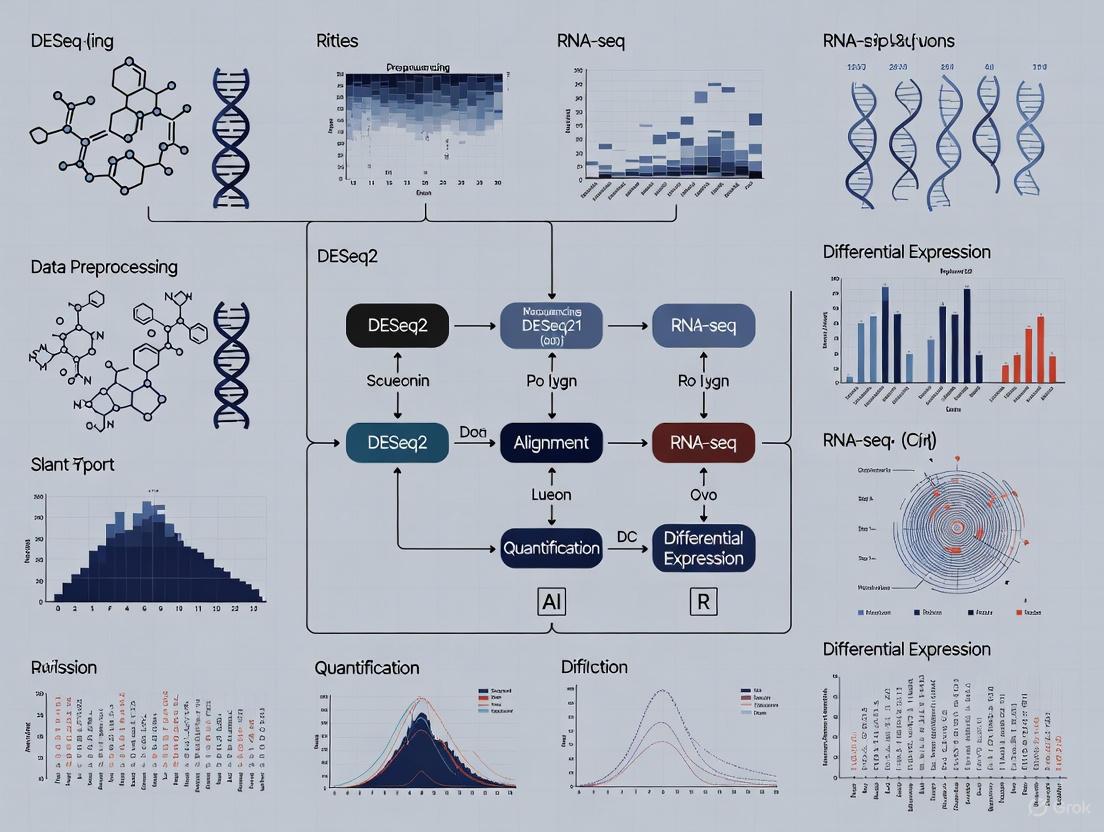
This article provides a complete workflow for performing gene-level exploratory and differential expression analysis of RNA-seq data using the DESeq2 package in R/Bioconductor.
A Comprehensive Guide to RNA-seq Exploratory Analysis with DESeq2: From Raw Data to Biological Insight
Abstract
This article provides a complete workflow for performing gene-level exploratory and differential expression analysis of RNA-seq data using the DESeq2 package in R/Bioconductor. Tailored for researchers, scientists, and drug development professionals, the guide covers the foundational principles of count-based models, a step-by-step methodological pipeline from data import to result visualization, practical troubleshooting for common issues, and a comparative overview of alternative tools. By integrating foundational knowledge with practical application, this resource empowers users to conduct robust, reproducible transcriptomic analyses and confidently interpret results in the context of biomedical and clinical research.
Laying the Groundwork: Core Principles and Data Preparation for RNA-seq Analysis
RNA sequencing (RNA-seq) has revolutionized transcriptome studies by providing a comprehensive method for profiling gene expression across the entire genome. This high-throughput technology enables researchers to not only quantify expression levels but also discover novel transcripts, identify alternative splicing events, and detect post-transcriptional modifications [1]. The fundamental objective of most RNA-seq experiments is to identify differentially expressed genes between biological conditions—such as treated versus untreated samples or mutant versus wild-type organisms—which provides crucial insights into cellular responses and disease mechanisms [2].
The typical RNA-seq workflow begins with RNA extraction from biological samples, followed by library preparation where RNA is fragmented and converted to cDNA with adapters ligated for sequencing. Libraries are then sequenced using platforms such as Illumina, producing millions of short reads [3]. These raw sequences undergo several computational steps including quality control, alignment to a reference genome, and quantification of reads mapping to genomic features, ultimately generating a count matrix where rows represent genes and columns represent samples [4] [5].
Fundamentals of Differential Expression Analysis
Differential expression analysis identifies genes whose expression levels change significantly between experimental conditions. This analysis must account for several unique characteristics of RNA-seq data: count-based output, dependence of variance on mean expression levels, and technical variability from sequencing depth and sample preparation [2]. The core statistical challenge involves distinguishing biological signal from technical noise when working with typically small numbers of replicates (often 3-6 per condition).
DESeq2 has emerged as one of the most widely used tools for this analysis, employing a negative binomial generalized linear model (GLM) to account for over-dispersion common in count data [6]. The method is cited thousands of times in the literature and remains actively maintained through Bioconductor, ensuring ongoing improvements and support [1] [2].
DESeq2 Workflow: From Count Data to Results
The DESeq2 analysis pipeline incorporates multiple steps that handle normalization, dispersion estimation, and statistical testing in an integrated framework.
Input Data Preparation
DESeq2 requires two primary inputs:
- Count matrix: A table of raw, non-normalized integer counts where rows correspond to genes and columns to samples
- Sample metadata: A table describing the experimental conditions for each sample, with row names matching column names in the count matrix [6]
Proper experimental design is crucial, with replication being particularly important. As noted in training materials, "RNA-seq experiments are performed with an aim to comprehend transcriptomic changes in organisms in response to a certain treatment" [5]. The design formula specification is critical, as it informs DESeq2 how to model counts based on the metadata variables.
Key Computational Steps
The DESeq2 workflow involves several automated steps when calling the DESeq() function:
- Estimation of size factors to control for differences in library depth using the median of ratios method [2]
- Estimation of gene-wise dispersions to model the relationship between mean expression and variance
- Fitting of a curve to the gene-wise dispersion estimates
- Shrinkage of dispersion estimates toward the fitted curve to improve accuracy for genes with low counts
- Fitting of the negative binomial GLM and performing statistical testing using the Wald test or likelihood ratio test [2]
Table 1: Key Steps in the DESeq2 Analysis Workflow
| Step | Purpose | Key Function |
|---|---|---|
| Size Factor Estimation | Normalizes for library depth | estimateSizeFactors() |
| Dispersion Estimation | Models mean-variance relationship | estimateDispersions() |
| Model Fitting | Fits negative binomial GLM | nbinomWaldTest() |
| Results Extraction | Generates DE genes table | results() |
Visualization of the DESeq2 Workflow
The following diagram illustrates the complete DESeq2 analytical process from raw data to results interpretation:
Detailed Protocol: Differential Expression Analysis with DESeq2
Data Input and Pre-processing
Begin by installing and loading required packages:
Import count data and sample metadata. Critical attention must be paid to ensuring sample names consistency:
Pre-filtering is recommended to remove genes with minimal expression, reducing memory usage and improving performance:
Creating the DESeqDataSet and Specifying Design
Construct the DESeqDataSet object, which stores all experiment information:
The design formula is a critical component that specifies how counts depend on experimental variables. For basic two-group comparisons, the formula ~ condition is sufficient. For more complex designs with confounding variables, these should be included: ~ sex + age + treatment [2].
Running DESeq2 and Extracting Results
Execute the comprehensive DESeq2 analysis with a single command:
This function performs all analysis steps sequentially: size factor estimation, dispersion estimation, and statistical testing. Extract results using:
The results table includes base mean expression, log2 fold changes, standard errors, test statistics, p-values, and adjusted p-values.
Quality Control and Visualization
DESeq2 provides multiple visualization methods for quality assessment:
Statistical Framework of DESeq2
Normalization: Median of Ratios Method
DESeq2 employs a size factor normalization approach that accounts for differences in sequencing depth between samples. This method calculates for each sample a size factor as the median of the ratios of its counts relative to the geometric mean across all samples [2]. The approach is robust to large numbers of differentially expressed genes.
Dispersion Estimation and Shrinkage
The dispersion parameter (α) in DESeq2 models the relationship between mean expression and variance, addressing the mean-variance dependence in count data. DESeq2 uses shrinkage estimation to borrow information across genes, providing more reliable dispersion estimates, particularly for genes with low counts [2].
Hypothesis Testing
For standard pairwise comparisons, DESeq2 uses the Wald test to assess whether log2 fold changes are significantly different from zero. For more complex experimental designs, the likelihood ratio test (LRT) can be employed to test multiple factors simultaneously [2].
Advanced Experimental Designs
DESeq2 supports complex experimental designs beyond simple group comparisons:
Multi-factor Designs
When multiple variables may influence gene expression, these can be incorporated into the design formula:
This controls for batch effects while testing for condition-specific effects.
Interaction Terms
To test whether the effect of treatment differs between groups, interaction terms can be included:
Alternatively, a combined factor approach may be more interpretable:
Case Study: RNA-seq in Colorectal Cancer Research
A practical application of DESeq2 can be illustrated through a published dataset (E-GEOD-50760) investigating gene expression in colorectal cancer [6]. This study analyzed 54 samples from 18 individuals, with each contributor providing three tissue types: normal colon epithelium, primary colorectal cancer, and metastatic liver tumor.
The analysis followed this protocol:
This design appropriately accounts for paired samples from the same individuals while identifying tissue-specific expression patterns. The analysis revealed numerous differentially expressed genes involved in cancer progression and metastasis.
Table 2: Key Research Reagents and Computational Tools for RNA-seq Analysis
| Resource Category | Specific Tools/Resources | Purpose and Function |
|---|---|---|
| Alignment Tools | HISAT2, STAR | Splice-aware alignment of RNA-seq reads to reference genomes |
| Quantification Tools | featureCounts, HTSeq | Generate count matrices from aligned reads |
| Differential Expression | DESeq2, edgeR | Statistical analysis of expression differences |
| Functional Analysis | g:Profiler, Gene Ontology | Biological interpretation of DE genes |
| Data Repositories | ENA, GEO, SRA | Public access to raw and processed data |
| Quality Control | FastQC, MultiQC | Assessment of read quality and preparation of reports |
| Reference Annotations | Ensembl, RefSeq, GENCODE | Genome annotations for read assignment |
Interpretation of Results and Biological Validation
Understanding DESeq2 Output
The results table from DESeq2 contains several key columns:
- baseMean: Average normalized counts across all samples
- log2FoldChange: Effect size estimate (log2 scale)
- lfcSE: Standard error of the log2 fold change
- stat: Wald test statistic
- pvalue: Raw p-value
- padj: Multiple testing adjusted p-value (Benjamini-Hochberg)
Genes with adjusted p-values below a threshold (typically padj < 0.05) are considered significantly differentially expressed.
Functional Interpretation
Following differential expression analysis, functional interpretation tools like g:Profiler and the Expression Atlas can identify enriched biological processes, molecular functions, and pathways among significant genes [7]. This step translates statistical findings into biological insights by connecting gene lists with known functions and pathways.
Methodological Considerations and Best Practices
Experimental Design Recommendations
- Include sufficient biological replicates (minimum 3, preferably more) to increase statistical power
- Randomize processing order to avoid batch effects
- Balance experimental groups across sequencing batches when possible
- Record all relevant metadata for potential inclusion in statistical models
Quality Control Metrics
Rigorous QC should be performed throughout the analysis pipeline:
- Sequence quality: Assess base quality scores, GC content, and adapter contamination
- Alignment metrics: Monitor mapping rates, ribosomal RNA alignment, and strand specificity
- Sample relationships: Verify that replicates cluster together in PCA plots
- Count distributions: Check for outliers and ensure appropriate dispersion estimates
The following diagram illustrates the relationship between key statistical concepts in DESeq2:
DESeq2 provides a comprehensive, statistically rigorous framework for differential expression analysis of RNA-seq data. Its careful handling of count distribution characteristics, incorporation of sophisticated normalization methods, and flexibility for complex experimental designs have established it as a cornerstone tool in computational biology. When applied following established best practices for experimental design and quality control, DESeq2 enables researchers to reliably identify transcriptomic changes underlying biological processes and disease states, forming a critical component of modern genomics research.
The integration of DESeq2 into broader analysis workflows—from raw data processing to biological interpretation—empowers researchers to extract meaningful insights from transcriptomic data, accelerating discovery in fields ranging from basic biology to drug development.
Within the context of a broader thesis on using DESeq2 for RNA-seq exploratory analysis research, mastering the DESeqDataSet (DDS) is a fundamental step. This object serves as the central container for your RNA-seq dataset, holding the raw input data, intermediate calculations, and final results of a differential expression analysis [8] [9]. For researchers and drug development professionals, a thorough understanding of its structure and components is critical for conducting a robust and reproducible analysis. This document details the essential elements of the DESeqDataSet, provides protocols for its creation, and visualizes its role in the analytical workflow.
The Essential Components of a DESeqDataSet
The DESeqDataSet is an S4 class object that extends the SummarizedExperiment class from Bioconductor. It is designed to store all the necessary information for a differential expression analysis [8]. The table below summarizes its core components.
Table 1: Core Components of a DESeqDataSet Object
| Component | Description | Data Type | Key Function |
|---|---|---|---|
| Count Matrix | The matrix of raw, un-normalized read counts [10]. | Integer matrix |
Primary input data; genes as rows, samples as columns. |
| Column Data | Metadata describing the experimental conditions of each sample [11]. | DataFrame |
Links samples to experimental groups (e.g., treatment, control). |
| Design Formula | A symbolic representation of the experimental design for statistical modeling [9]. | Formula |
Defines how counts depend on variables in colData (e.g., ~ condition). |
| Normalization Factors | Internal size factors for correcting library size and composition [10]. | Numeric matrix |
Used by DESeq2's internal normalization via the median-of-ratios method. |
| Dispersion Estimates | Gene-wise estimates of the dispersion, measuring the variance relative to the mean [10]. | Numeric vector |
Key parameter for the Negative Binomial model used in testing. |
| Model Results | Results of the differential expression testing, including log2 fold changes and p-values [8]. | DataFrame |
Stored in the rowData slot after running results(). |
Protocol: Constructing a DESeqDataSet from a Count Matrix
This protocol details the creation of a DESeqDataSet from a count matrix and sample metadata, a common starting point for many analyses.
Research Reagent Solutions
Table 2: Essential Materials and Software for DESeq2 Analysis
| Item | Function / Description |
|---|---|
| R Environment | The programming language and console for executing analysis. |
| RStudio | An integrated development environment (IDE) for R. |
| DESeq2 Package | The Bioconductor package that performs differential expression analysis [8] [9]. |
| Count Quantification Tool | Software like featureCounts, HTSeq, or Salmon (with tximport) to generate the raw count matrix from sequence files [12]. |
| Sample Metadata File | A CSV or TSV file specifying the experimental group for each sample in the count matrix. |
Step-by-Step Methodology
Step 1: Load Packages and Data
Step 2: Verify Data Integrity Ensure the column names of the count matrix exactly match the row names of the metadata table.
Step 3: Create the DESeqDataSet
Use DESeqDataSetFromMatrix to construct the object.
Step 4: Pre-Filter Low-Count Genes This optional step removes genes with very few reads, reducing memory usage and improving performance.
Visualizing the DESeq2 Workflow and Data Object Structure
The following diagram illustrates the lifecycle of the DESeqDataSet object throughout a standard DESeq2 analysis, from creation to the extraction of results.
DESeq2 Analysis Workflow
The internal structure of the DESeqDataSet and its relationship to input files can be visualized as follows.
DESeqDataSet Object Structure
Critical Considerations for Experimental Design
The Design Formula
The design formula is a critical component that defines the statistical model. A simple formula like ~ condition tests for the effect of 'condition' while accounting for other factors. More complex designs, such as ~ batch + condition, can account for batch effects [9].
Pre-Filtering
Pre-filtering genes with low counts is recommended to reduce the object's memory size and increase the speed of downstream transformations and testing functions [9].
Factor Level Reference
By default, R orders factor levels alphabetically. To ensure the correct comparison (e.g., "control" vs. "treatment"), explicitly set the reference level.
Troubleshooting Common Data Object Issues
Table 3: Common Issues and Solutions When Creating a DESeqDataSet
| Problem | Possible Cause | Solution |
|---|---|---|
Error: countData must be a matrix |
The count data is likely a data frame. | Use countdata <- as.matrix(countdata) to convert. |
Column names of countData do not match row names of colData |
Mismatch between sample names in the count matrix and metadata. | Use colnames(countdata) and rownames(metadata) to check and correct. |
| Model fails to converge | A problem with the design formula or too few replicates. | Simplify the design formula or check for complete separation in groups. |
results() returns all NA values |
The comparison specified does not match the factor levels in the design. | Verify factor levels with levels(dds$condition) and use the contrast argument in results(). |
The DESeqDataSet is the foundational data structure for any differential expression analysis with DESeq2. It seamlessly integrates raw data, sample metadata, and statistical parameters into a single, manageable object. A correct initial setup, with special attention to the count matrix, column data, and design formula, is paramount for the validity of all subsequent analytical steps. By following the protocols and guidelines outlined in this document, researchers can ensure their analysis is built upon a solid and reliable foundation.
Within the comprehensive framework of RNA-sequencing (RNA-seq) research, differential gene expression (DGE) analysis stands as a fundamental objective for researchers and drug development professionals. The accuracy of this analysis hinges on the proper preparation and normalization of input data. Historically, workflows relied on read alignment and count assignment using alignment-based methods. However, the advent of fast, alignment-free quantification tools such as Salmon and Kallisto has revolutionized this initial step by providing transcript-level abundance estimates without generating large BAM files [13] [14]. These methods offer significant advantages in speed and reduced disk usage but present a new challenge: their output consists of estimated counts and abundances that require careful handling to be used effectively with count-based DGE tools like DESeq2 [13] [11].
The tximport and tximeta Bioconductor packages serve as the critical bridge between these modern quantification tools and downstream DGE analysis in R. Using these packages correctly is paramount because it ensures that the statistical models underlying DESeq2 are supplied with data that accounts for technical biases, such as changes in gene length across samples due to differential isoform usage [15] [16]. This guide provides detailed application notes and protocols for importing Salmon and Kallisto outputs, facilitating a robust and accurate exploratory analysis and differential expression testing within the broader context of an RNA-seq research thesis.
The Role of tximport and tximeta
The primary function of tximport is to import transcript-level abundance estimates from various software and summarize them to the gene-level, producing count matrices and normalizing offsets for use with DGE packages like DESeq2, edgeR, and limma-voom [15] [16]. This process offers several key benefits:
- Corrects for Gene Length Changes: It adjusts for potential changes in effective gene length across samples that can arise from differential isoform usage, ensuring that expression changes are not confounded by length variations [15] [16].
- Increases Sensitivity: By working at the transcript level initially, it avoids discarding fragments that can align to multiple genes with homologous sequence, thereby increasing the sensitivity of the analysis [15] [16].
- Computational Efficiency: It leverages the speed and computational efficiency of alignment-free quantifiers like Salmon and Kallisto, which skip the generation of large BAM files [13] [14].
The tximeta package extends the functionality of tximport by automatically adding rich annotation metadata (e.g., from GENCODE, Ensembl) to the created object, provided a commonly used transcriptome was employed [16]. This reduces manual error and enhances reproducibility.
Workflow Logic
The following diagram illustrates the logical workflow for incorporating tximport or tximeta into an RNA-seq analysis pipeline, from raw data to a DESeq2 object ready for exploratory analysis and differential expression.
Materials and Reagents: The Scientist's Toolkit
The following table details the essential computational tools and data files required to execute the import and analysis protocol.
Table 1: Essential Research Reagent Solutions for RNA-seq Import and Analysis
| Item Name | Type | Primary Function | Key Features |
|---|---|---|---|
| Salmon [13] | Software | Transcript-level quantification from RNA-seq data. | Fast, alignment-free, accuracy via bias correction models. |
| Kallisto [13] [11] | Software | Transcript-level quantification from RNA-seq data. | Pseudo-alignment, extremely fast, lightweight. |
| tximport [15] [16] | R/Bioconductor Package | Imports and summarizes transcript-level estimates. | Generates gene-level count matrices & offsets for DGE tools. |
| tximeta [16] | R/Bioconductor Package | Imports and annotates transcript-level data. | Automatic genomic annotation addition to summarized data. |
| DESeq2 [17] [18] | R/Bioconductor Package | Differential gene expression analysis. | Models count data using a negative binomial distribution. |
| Transcriptome [19] | Reference Data | A collection of all known transcript sequences for an organism. | Serves as the reference for Salmon/Kallisto (e.g., GENCODE, Ensembl). |
| Annotation File (.GTF/.GFF) [19] | Reference Data | Describes the coordinates and relationships of transcripts and genes. | Required for genome indexing and creating the tx2gene table. |
| tx2gene Table [15] [16] | Lookup Table | Maps transcript identifiers to their corresponding gene identifiers. | Crucial for tximport to summarize transcript-level data to the gene-level. |
Detailed Methodologies
Preparing thetx2geneLookup Table
A critical prerequisite for gene-level summarization is a two-column lookup table that associates transcript identifiers with parent gene identifiers. This tx2gene data frame must have the transcript ID as the first column and the gene ID as the second [15] [16].
Protocol:
- Obtain Annotation File: Download a gene transfer format (.GTF) file from a source like ENSEMBL or UCSC that corresponds to the reference transcriptome used for quantification [19].
- Generate the Table in R: Use Bioconductor annotation packages to create the table programmatically. For an Ensembl transcriptome, the
ensembldbpackages are recommended. The following code provides an example using aTxDbobject: - Verify the Table: Inspect the first few rows of the
tx2genedata frame to ensure it is correctly formatted.
Importing Quantification Data withtximport
The core import functionality is handled by the tximport() function. The protocol differs slightly between Salmon and Kallisto, primarily in the type argument and the file paths.
Protocol for Salmon Output:
- Set Up File Paths: Create a named vector of file paths pointing to the
quant.sffiles for each sample. - Run
tximport: Execute the import function with the correct arguments.
Protocol for Kallisto Output:
- Set Up File Paths: Point the vector to the Kallisto
abundance.h5files. - Run
tximport: Specifytype = "kallisto".
The resulting txi object is a list containing several matrices at the gene level: abundance (TPM), counts (estimated counts), length (effective gene lengths), etc. [15] [16].
Integrating with DESeq2 for Exploratory Analysis
With the txi object created, you can now construct a DESeqDataSet, which is the central data structure for analysis with DESeq2 [17].
Protocol:
- Prepare Sample Metadata: Load a table (
colData) that describes the experimental conditions of each sample. The row names of this table must match the names of thefilesvector used intximport. - Create DESeqDataSet: Use the
DESeqDataSetFromTximport()function, which automatically uses thetxi$countsmatrix and incorporates the gene length information as normalization offsets to correct for potential gene length biases [17] [15]. - Proceed with Standard DESeq2 Workflow: The
ddsobject is now ready for the standard DGE analysis workflow, which includes exploratory analysis such as data transformation and visualization.
Data Presentation and Interpretation
Comparison of Import Methods
The following table summarizes the key parameters and outputs for the different import strategies, providing a clear guide for researchers to choose the appropriate method.
Table 2: Comparison of tximport/tximeta Functionality for Salmon and Kallisto
| Aspect | tximport | tximeta |
|---|---|---|
| Primary Use Case | General import, custom transcriptomes. | Automated annotation for common transcriptomes (GENCODE, Ensembl). |
Input type for Salmon |
type = "salmon" |
type = "salmon" |
Input type for Kallisto |
type = "kallisto" |
type = "kallisto" |
| Required Lookup Table | tx2gene (must be supplied by user). |
tx2gene (can be inferred automatically). |
| Output Object | Simple list of matrices. | SummarizedExperiment with rich rowRanges annotation. |
| Downstream DESeq2 Input | DESeqDataSetFromTximport(txi, ...) |
DESeqDataSetFromTximport(se, ...) or makeDGEList(se) for edgeR. |
| Key Advantage | Flexibility with any transcriptome. | Enhanced reproducibility and automated metadata attachment. |
Advanced Configuration Options
The tximport function provides advanced arguments to handle specific analytical scenarios.
Table 3: Key Advanced Arguments in tximport
| Argument | Default | Alternative Options | Effect and Use Case |
|---|---|---|---|
countsFromAbundance |
"no" |
"scaledTPM", "lengthScaledTPM", "dtuScaledTPM" |
Generates counts from abundances. Use "no" for standard DGE with an offset; "scaledTPM" or "lengthScaledTPM" produce length-corrected counts where an offset is not needed [15] [16]. |
txOut |
FALSE |
TRUE |
When TRUE, skips gene-level summarization and returns transcript-level matrices. Essential for differential transcript usage (DTU) analysis [17] [16]. |
ignoreTxVersion |
FALSE |
TRUE |
Ignores the version suffix (e.g., .1) on transcript identifiers. Useful if versions differ between quantification and annotation. |
ignoreAfterBar |
FALSE |
TRUE |
Ignores part of the identifier after a | bar, a common feature in GENCODE FASTA headers. |
The tximport and tximeta packages are indispensable tools for modern RNA-seq analysis pipelines that utilize fast quantification software like Salmon and Kallisto. By correctly following the protocols outlined in this guide—preparing the tx2gene lookup table, importing data with the appropriate type argument, and leveraging the DESeqDataSetFromTximport function—researchers can ensure their data is properly structured and normalized for all subsequent analysis. This workflow not only capitalizes on the speed of alignment-free quantification but also robustly accounts for technical factors like gene length and composition bias, laying a solid foundation for statistically sound exploratory analysis and differential gene expression discovery within a DESeq2 framework. This rigorous approach to data import is a critical first step in a reproducible RNA-seq research project, directly contributing to the reliability and integrity of the biological insights generated.
In differential expression (DE) analysis with DESeq2, the statistical testing of whether gene expression differs between experimental conditions relies not only on the count data but fundamentally on the accompanying sample metadata [20]. The sample table and the design formula form the critical link between the raw quantitative data and the biological conclusions, formally defining the experimental groups and covariates for statistical modeling [21]. Proper construction of these elements is a prerequisite for a statistically sound and biologically interpretable analysis. Errors in metadata specification are a common source of failure in RNA-seq studies, as they can lead to incomplete or incorrect models, producing misleading results [22]. This protocol details the creation of effective sample tables and design formulas, framed within the context of a DESeq2 workflow for exploratory RNA-seq research.
Constructing a Comprehensive Sample Table
The sample table is a data frame that uniquely identifies each sequencing library and describes all relevant experimental conditions and batch variables.
Essential Components and Structure
A sample table must contain a unique identifier for each sample and all known factors that could systematically affect gene expression. The following table outlines the core columns required in a minimal sample table for DESeq2.
Table 1: Essential Columns for a DESeq2 Sample Table
| Column Name | Description | Data Type | Example Entry |
|---|---|---|---|
sampleName |
Unique identifier for the sample. | character |
"SRR479052", "Patient_1" |
fileName |
Path to the corresponding count or BAM file. | character |
"SRR479052.bam" |
condition |
The primary biological condition of interest. | factor |
"Control", "DPN" |
treatment |
Another major experimental factor (if applicable). | factor |
"Control", "OHT" |
time |
Time point of sample collection. | factor or numeric |
"24h", "48h" |
batch |
Technical batch factor (e.g., sequencing lane). | factor |
"Batch1", "Batch2" |
A properly constructed sample table, as derived from the parathyroidSE package, should resemble the following [23]:
Key Considerations for Sample Table Design
- Replication: The number of biological replicates is a crucial design factor. Power analysis should be performed before sequencing to determine the number of replicates needed to detect effect sizes of biological interest with sufficient statistical power [22].
- Randomization: To avoid confounding technical biases with biological effects, the processing of samples (e.g., RNA extraction, library preparation) should be randomized across experimental groups [22].
- Factor Levels: In R, the base level for any factor is set to the first level in alphabetical order by default. Since the results in DESeq2 will compare other groups against this base level, it is critical to set it intentionally. For example, to set "Uninfected" as the baseline for a "Status" factor, you would use
mutate(Status = fct_relevel(Status, "Uninfected"))[21].
Defining the Design Formula
The design formula specifies the linear model that DESeq2 will use to analyze the data. It tells DESeq2 which variables from the sample table should be used to model the counts.
Formula Syntax and Principles
The design formula uses standard R formula syntax and is provided to DESeq2 during data object construction [21]. The formula always starts with a tilde (~), followed by the model variables.
- Simple Design: For an experiment with only one condition, the formula is
~ condition[21]. - Multifactor Design: For multiple variables, for example, condition and batch, the formula would be
~ batch + condition. The order can matter if the variables are not independent; including batch effects in the model helps to control for their influence and increases the sensitivity for detecting the primary biological effect [20]. - Interaction Terms: To test if the effect of one factor depends on another level of a second factor, an interaction term can be included:
~ genotype + treatment + genotype:treatment.
Practical Application: Building the DESeqDataSet
The sample table and design formula are integrated when creating the DESeqDataSet object, the core data structure for DESeq2. This can be done from a count matrix or directly from tximport output [21].
A Protocol for Experimental Design and Metadata Setup
This section provides a step-by-step workflow for researchers to define their experimental model and initialize a DESeq2 analysis.
Step-by-Step Protocol
Step 1: Pre-Sequencing Planning. Before preparing libraries, define all biological and technical factors. Ensure adequate biological replication and plan for randomization of sample processing to prevent batch effects from confounding the primary condition [22].
Step 2: Construct the Sample Table. After sequencing and quantification, compile all metadata into a data frame in R, as detailed in Section 2.1. Verify that the sampleName and fileName columns accurately link each sample to its corresponding quantitative data file [23].
Step 3: Define the Statistical Model. Formulate the design formula based on the experimental question. Start with a simple model containing the primary condition of interest. Only add other variables (like batch) if they are known to account for significant variation [20] [21].
Step 4: Set Factor Levels. Explicitly set the reference (base) level for all categorical factors in the sample table to ensure that the resulting log2 fold changes are biologically intuitive (e.g., "Control" vs. "Treated") [21].
Step 5: Create and Validate the DESeqDataSet. Use the DESeqDataSetFromTximport() or DESeqDataSetFromMatrix() function to create the DDS object. Crucially, check that the order of the samples in the colData (sample table) matches the order of the columns in the count matrix [21].
Step 6: Run the DESeq2 Pipeline. After creating and checking the DDS object, perform the standard DESeq2 analysis: estimation of size factors, dispersion estimation, and model fitting using the DESeq() wrapper function [21].
Workflow Visualization
The following diagram illustrates the key steps and decision points in the process of designing an experiment and setting up metadata for DESeq2.
The Scientist's Toolkit: Research Reagent Solutions
Table 2: Key Software and Packages for RNA-seq Differential Expression Analysis
| Tool/Package | Primary Function | Application in Workflow |
|---|---|---|
| DESeq2 [23] [20] | Differential expression analysis | Statistical modeling of count data, hypothesis testing, and results generation. |
| tximport [21] | Import transcript-level quantifications | Streamlines the import of abundance estimates from tools like Salmon into DESeq2. |
| GenomicAlignments [23] | Read counting | The summarizeOverlaps function generates count matrices from BAM files. |
| GenomicFeatures [23] | Gene model management | Used to create transcript databases from GTF files for read counting. |
| STAR [24] | Read alignment | A splice-aware aligner for mapping RNA-seq reads to a reference genome. |
| Salmon [24] | Expression quantification | Provides fast and accurate transcript-level quantification with bias correction. |
| nf-core/rnaseq [24] | Automated pipeline | A portable, community-maintained workflow for comprehensive RNA-seq data processing. |
Within the broader context of employing DESeq2 for RNA-seq exploratory analysis research, the initial quality assessment (QA) of raw count data represents a critical first step in ensuring analytically sound and biologically valid conclusions. This initial QA phase focuses on evaluating two fundamental properties of the dataset: raw count distributions across features and overall library sizes per sample. These metrics provide crucial insights into technical variability, potential biases, and overall data quality before proceeding with sophisticated statistical modeling in DESeq2.
RNA sequencing (RNA-seq) has revolutionized transcriptomics by enabling genome-wide quantification of RNA abundance with high sensitivity and accuracy [25] [26]. Unlike earlier methods such as microarrays, RNA-seq provides more comprehensive transcriptome coverage, finer resolution of dynamic expression changes, and improved signal-to-noise ratios [25]. The reliability of downstream differential expression analysis, including those performed with DESeq2, depends strongly on thoughtful experimental design and rigorous quality assessment at every processing stage [25] [27].
This protocol outlines a systematic approach for evaluating raw count distributions and library sizes, incorporating visualization techniques and quantitative metrics that serve as prerequisites for robust differential expression analysis using DESeq2.
Theoretical Foundations
Understanding Raw Count Data
RNA-seq data analysis begins with converting sequenced reads into a count matrix where rows typically represent genes or transcripts and columns represent samples [25] [28]. Each value in this matrix indicates the number of sequencing reads (for single-end sequencing) or fragments (for paired-end sequencing) that have been unambiguously assigned to a particular genomic feature in a specific sample [28].
The raw count matrix generated through alignment and quantification steps serves as the fundamental input for DESeq2 analysis [6] [28]. It is crucial that these values represent actual counts rather than normalized values, as DESeq2's statistical model relies on the count-based nature of the data to properly assess measurement precision and account for library size differences internally [28].
Importance of Library Size Assessment
Library size, defined as the total number of sequenced reads or fragments per sample after alignment, varies across samples due to technical rather than biological reasons [25]. These differences arise from variations in sequencing depth, RNA input quality, and efficiency of library preparation steps [25] [29]. During initial QA, researchers must evaluate whether library sizes are sufficiently large and comparable across samples, as insufficient sequencing depth can reduce sensitivity for detecting differentially expressed genes, particularly those with low expression [25] [30].
Characteristics of Raw Count Distributions
RNA-seq count data typically exhibits a highly skewed distribution with a majority of genes showing low counts and a minority with very high counts [25]. This distribution pattern reflects biological reality but must be assessed for technical artifacts that could compromise downstream analysis. Understanding the expected distribution helps identify potential issues such as dominance by highly expressed genes, batch effects, or failed libraries that might require additional normalization or sample exclusion [25] [31].
The following diagram illustrates the conceptual relationship between key components of RNA-seq initial quality assessment:
Materials and Equipment
Research Reagent Solutions
Table 1: Essential computational tools for RNA-seq quality assessment
| Tool Name | Primary Function | Application in QA |
|---|---|---|
| DESeq2 [6] [28] | Differential expression analysis | Create DESeqDataSet object for QA, calculate size factors, and assess library sizes |
| FastQC [27] | Sequence quality control | Evaluate raw read quality before alignment |
| R/Bioconductor [28] | Statistical computing environment | Provide infrastructure for count data manipulation and visualization |
| HISAT2 [32] | Read alignment | Map reads to reference genome/transcriptome |
| featureCounts [32] | Read quantification | Generate raw count matrix from aligned reads |
| SAMtools [25] | Alignment processing | Process and quality check aligned reads |
Data Requirements
The initial QA process requires two primary data components:
Raw Count Matrix: A table containing non-normalized integer counts of sequencing reads/fragments assigned to genomic features (genes or transcripts) for each sample [28]. These values must not be pre-normalized for sequencing depth or library size to maintain the count-based properties required by DESeq2's statistical model [28].
Sample Metadata: A data frame linking sample identifiers to experimental variables (e.g., treatment conditions, batch information, replicate groups) [6]. This metadata is essential for interpreting patterns observed during QA in the context of the experimental design.
Methodology
Data Import and Preprocessing
Begin by importing the raw count matrix and sample metadata into R, then creating a DESeqDataSet object, which serves as the primary container for the count data and intermediate calculations in DESeq2 [6]:
Basic pre-filtering is recommended to remove genes with minimal expression, which reduces dataset size and improves computational efficiency without compromising biological information [6]:
Library Size Calculation and Evaluation
Library sizes are calculated as the sum of all counts for each sample. These values should be evaluated for consistency across the experiment:
Table 2: Recommended library size guidelines for different RNA-seq applications
| Experiment Type | Recommended Reads per Sample | Key Considerations |
|---|---|---|
| Gene expression profiling | 5-25 million | Sufficient for highly expressed genes; enables high multiplexing [30] |
| Standard differential expression | 30-60 million | Captures global expression patterns and some splicing information [30] |
| Comprehensive transcriptome analysis | 100-200 million | Required for novel transcript assembly and in-depth analysis [30] |
| Targeted RNA sequencing | ~3 million | Appropriate for focused gene panels [30] |
| Small RNA analysis | 1-5 million | Varies by tissue type [30] |
Assessment of Count Distributions
Evaluate the distribution of counts across genes for each sample using summary statistics and visualization:
The distribution of raw counts typically follows a negative binomial distribution, which accounts for the over-dispersion common in count data compared to a Poisson distribution [27] [6].
Data Analysis and Visualization
Library Size Visualization
Create visualizations to assess library size distribution across samples:
Significant variations in library sizes (e.g., greater than 3-fold differences) may indicate technical issues that require attention before proceeding with differential expression analysis [25].
Count Distribution Visualization
Visualize the distribution of counts using boxplots or violin plots:
This visualization helps identify samples with unusual distributions that might indicate technical problems.
Sample Similarity Assessment
Examine overall similarity between samples based on count distributions:
The following workflow diagram illustrates the complete process for initial quality assessment of RNA-seq data:
Troubleshooting and Quality Flags
Identifying Common Issues
During initial QA, several common issues may emerge that require attention before proceeding with DESeq2 analysis:
- Extreme library size variations: Samples with library sizes less than 50% of the median may indicate failed libraries and should be investigated further [25] [32].
- Excessive zero counts: An unusually high proportion of genes with zero counts in specific samples may indicate technical problems with those samples [25].
- Batch effects: Systematic differences in count distributions correlated with processing batches rather than biological conditions may require batch correction approaches [31].
- Outlier samples: Samples that cluster separately from their experimental groups in distance metrics may need to be excluded or investigated further [18].
Quality Thresholds and Decision Points
Table 3: Quality assessment thresholds and recommended actions
| Quality Metric | Acceptable Range | Concerning Range | Recommended Action |
|---|---|---|---|
| Library size variation | < 3-fold difference | > 3-fold difference | Investigate technical causes; consider additional normalization [25] |
| Percentage of zero counts | < 50% of genes | > 50% of genes | Check RNA quality and library preparation [25] |
| Sample clustering | Groups by experimental condition | Groups by batch or other non-biological factors | Consider batch correction or covariate adjustment [31] |
| Alignment rate | > 70% | < 50% | Exclude sample from analysis [32] |
Rigorous initial quality assessment of raw count distributions and library sizes establishes a crucial foundation for all subsequent RNA-seq analyses using DESeq2. By systematically evaluating these fundamental data properties, researchers can identify technical artifacts, ensure data quality, and make informed decisions about appropriate normalization strategies and analytical approaches. This protocol provides a comprehensive framework for conducting these essential QA checks, supporting the generation of robust and reproducible results in transcriptomic studies.
The insights gained from this initial assessment directly inform the next steps in the DESeq2 workflow, including data normalization, dispersion estimation, and statistical testing for differential expression. Through careful implementation of these QA procedures, researchers can maximize the reliability of their biological interpretations while minimizing the risk of technical confounders influencing their conclusions.
RNA-sequencing (RNA-seq) has become the predominant technology for profiling transcriptome-wide gene expression, generating vast amounts of count-based data that present unique statistical challenges. The analysis of this data requires specialized methods that properly account for its distinct characteristics: inherent discreteness, non-normality, and a dependence between variance and mean expression levels [33] [34]. Early approaches to differential expression analysis often relied on statistical models assuming a Poisson distribution. However, this assumption proves problematic for biological data because the Poisson model requires that the variance equals the mean, an condition rarely met in practice due to both technical variability and genuine biological heterogeneity between replicates [34] [35]. This phenomenon, where the observed variance exceeds the mean, is termed "overdispersion" and must be properly accounted for to avoid inflated false discovery rates and unreliable statistical inference.
DESeq2 addresses these challenges through a comprehensive statistical framework built upon the negative binomial distribution, which incorporates a dispersion parameter to model the variance as a function of the mean [33]. This approach enables more accurate modeling of count data by explicitly accommodating the overdispersion typical of RNA-seq experiments. The methodology further employs sophisticated shrinkage estimation techniques that stabilize both dispersion and fold-change estimates by borrowing information across genes, thereby improving the reliability of differential expression calls, particularly in studies with limited sample sizes [33]. This combination of robust statistical modeling and information sharing across features makes DESeq2 particularly powerful for the small sample sizes common in genomic research, where typical experiments may include as few as three to six replicates per condition [2] [33].
The Negative Binomial Distribution as a Model for RNA-seq Counts
Mathematical Foundation
The negative binomial distribution serves as the cornerstone of DESeq2's statistical framework, providing a flexible model for count data that adequately captures the overdispersion observed in RNA-seq experiments. The distribution is parameterized by two values for each gene: the mean expression level (μ) and the dispersion parameter (α), which quantifies the extent to which the variance exceeds the mean [33]. The relationship between these parameters is defined by the variance function: Var(K) = μ + αμ², where K represents the observed count data [33]. This quadratic relationship between variance and mean effectively addresses the limitation of the Poisson distribution, which assumes Var(K) = μ, a condition rarely satisfied in biological data due to both technical variability and genuine biological heterogeneity between replicates [34].
The dispersion parameter (α) plays a crucial role in the model, with its magnitude directly influencing the variance of the distribution. When α = 0, the negative binomial model reduces to the Poisson distribution, but with α > 0, the variance increases proportionally to the square of the mean [33] [35]. This relationship accurately reflects the behavior of RNA-seq data, where highly expressed genes typically demonstrate greater absolute variability than lowly expressed genes, while maintaining a lower coefficient of variation (the ratio of standard deviation to mean) [2]. The coefficient of variation for a gene's counts is given by √α, meaning that a dispersion value of 0.01 corresponds to 10% variation around the mean expected across biological replicates [2].
Comparative Advantages Over Alternative Distributions
The selection of an appropriate statistical distribution is critical for accurate differential expression analysis. The table below compares the negative binomial distribution with other potential models for count data:
Table 1: Comparison of Statistical Distributions for RNA-seq Count Data
| Distribution | Parameters | Variance-Mean Relationship | Suitability for RNA-seq |
|---|---|---|---|
| Poisson | λ (mean) | Var = μ | Poor - assumes no biological variability |
| Binomial | n (trials), p (success probability) | Var = np(1-p) | Poor - assumes fixed number of trials |
| Geometric | p (success probability) | Var = (1-p)/p² | Limited - special case of NB |
| Negative Binomial | μ (mean), α (dispersion) | Var = μ + αμ² | Excellent - accounts for overdispersion |
The Poisson distribution's fundamental limitation for RNA-seq data analysis stems from its inability to account for the biological variability that persists even between technical replicates of the same sample [34]. While the binomial distribution models discrete outcomes, it assumes a fixed number of trials, making it inappropriate for count data without a theoretical upper bound. The negative binomial distribution effectively generalizes both the Poisson and geometric distributions, offering the flexibility needed to model the overdispersed nature of genomic count data while maintaining mathematical tractability for statistical inference [34] [35].
The DESeq2 Workflow: From Raw Counts to Differential Expression
Comprehensive Analysis Pipeline
The DESeq2 package implements a sophisticated multi-step workflow that transforms raw count data into robust differential expression results. The complete process integrates normalization, parameter estimation, and statistical testing into a cohesive analytical framework, with each step addressing specific challenges in RNA-seq data analysis. The following diagram illustrates the key stages of the DESeq2 workflow:
Normalization: Accounting for Sequencing Depth and Composition
The initial step in the DESeq2 workflow addresses the critical issue of library size normalization, which ensures that count comparisons between samples are not confounded by differences in sequencing depth or RNA composition [36]. DESeq2 employs the median-of-ratios method, which calculates sample-specific size factors without relying on a reference sample [36] [33]. This method operates under the assumption that most genes are not differentially expressed, making it robust to situations where a small subset of genes shows extreme expression differences [36].
The normalization process involves three key steps. First, DESeq2 creates a pseudo-reference sample for each gene by calculating the geometric mean across all samples [36]. Second, it computes the ratio of each sample to this pseudo-reference, generating a distribution of ratios for each sample. Third, the size factor for each sample is derived as the median of these ratios, excluding genes with zero counts in any sample [36]. The mathematical representation of this process for a count K_ij of gene i in sample j is:
Normalized Count = Kij / sj
where s_j represents the size factor for sample j [36] [33]. This normalization approach effectively accounts for both differences in sequencing depth and RNA composition, addressing the limitation of simple counts-per-million normalization methods that can be skewed by highly expressed genes [36].
Table 2: Comparison of Normalization Methods for RNA-seq Data
| Method | Accounted Factors | Recommended Use | Limitations |
|---|---|---|---|
| CPM | Sequencing depth | Between replicates of same group | Not for DE analysis |
| TPM | Sequencing depth, Gene length | Within sample comparisons | Not for between-sample DE |
| RPKM/FPKM | Sequencing depth, Gene length | Within sample comparisons | Not comparable between samples |
| DESeq2 Median-of-Ratios | Sequencing depth, RNA composition | DE analysis, between samples | Not for within sample comparisons |
| edgeR TMM | Sequencing depth, RNA composition, Gene length | DE analysis, within and between | More complex computation |
Dispersion Estimation and Shrinkage
The accurate estimation of dispersion parameters represents one of DESeq2's most significant methodological advances. In RNA-seq experiments with small sample sizes, gene-wise dispersion estimates derived solely from a handful of replicates are inherently unreliable due to high stochastic variability [33] [35]. DESeq2 addresses this challenge through a sophisticated shrinkage approach that leverages information across the entire dataset to produce more stable and accurate estimates [33].
The dispersion estimation process follows a three-step procedure. First, gene-wise dispersion estimates are calculated for each gene using maximum likelihood estimation [2] [33]. Second, DESeq2 fits a smooth curve to model the relationship between dispersion and mean expression across all genes, capturing the overall trend where dispersion typically decreases with increasing expression levels [33]. Third, the gene-wise estimates are shrunk toward the curve using an empirical Bayes approach, with the strength of shrinkage determined by both the variability of gene-wise estimates around the curve and the number of replicates available [33]. This approach effectively balances gene-specific information with the overall trend observed across all genes, resulting in more reliable dispersion estimates particularly for genes with low counts or few replicates [33].
The shrinkage process incorporates an important safeguard: when a gene's dispersion estimate lies more than two residual standard deviations above the curve, DESeq2 uses the gene-wise estimate rather than the shrunken value [33]. This prevents excessive shrinkage for genes that genuinely exhibit unusually high variability, ensuring that biological heterogeneity is not artificially suppressed in the statistical model.
Experimental Protocols for Differential Expression Analysis
Comprehensive DESeq2 Analysis Workflow
Implementing a robust differential expression analysis requires careful attention to both computational procedures and experimental design considerations. The following protocol outlines the complete workflow for analyzing RNA-seq count data using DESeq2, from data preparation through interpretation of results:
1. Input Data Preparation
- Obtain a count matrix where rows represent genes, columns represent samples, and values contain raw (un-normalized) read counts [9] [37].
- Prepare a metadata table with sample information including experimental conditions, batch effects, and other relevant covariates [6] [37].
- Ensure that column names in the count matrix exactly match row names in the metadata table [9].
2. DESeqDataSet Creation
- Create a DESeqDataSet object using the
DESeqDataSetFromMatrix()function, specifying the count data, metadata, and design formula [9] [37]. - Define the design formula to include all major sources of biological variation, with the factor of interest specified last [2]. For example:
design = ~ batch + condition. - Perform pre-filtering to remove genes with very low counts (e.g.,
rowSums(counts(dds)) > 5) to reduce memory usage and improve computational efficiency [6] [9].
3. Differential Expression Analysis
- Execute the core analysis with a single call to
DESeq():dds <- DESeq(dds)[2] [38]. - This function automatically performs estimation of size factors, dispersion estimation, fitting of generalized linear models, and Wald statistics [2].
- For large datasets, enable parallel processing using the BiocParallel package to reduce computation time [6].
4. Results Extraction and Interpretation
- Extract results using
results()function, specifying the contrast of interest for multi-factor designs [38] [6]. - Apply independent filtering to automatically remove low-count genes, improving multiple testing correction [33].
- Sort results by adjusted p-value and filter based on both statistical significance (e.g., padj < 0.05) and biological relevance (e.g., |log2FoldChange| > 1) [38] [37].
Successful implementation of DESeq2 analysis requires both biological and computational resources. The following table details key components of the research toolkit:
Table 3: Essential Research Reagents and Computational Resources for DESeq2 Analysis
| Category | Item | Specification | Function/Purpose |
|---|---|---|---|
| Biological Materials | RNA samples | High-quality (RIN > 8) | Source of transcriptomic data |
| Library preparation kit | Poly-A selection or rRNA depletion | cDNA library construction | |
| Sequencing platform | Illumina recommended | Generation of raw sequence data | |
| Computational Resources | R environment | Version 4.0 or higher | Statistical computing platform |
| Bioconductor | Version 3.18 or higher | Genomic analysis repository | |
| DESeq2 package | Version 1.44.0 or higher | Differential expression analysis | |
| Supporting packages | tidyverse, pheatmap, ggplot2 | Data manipulation and visualization | |
| Computational Hardware | Memory | 8-64 GB depending on sample size | Handling large count matrices |
| CPU cores | 1-16 cores for parallel processing | Speeding up computation | |
| Storage | SSD recommended | Fast data access and processing |
Advanced Considerations in Experimental Design
Design Formula Specification
The design formula represents a critical component of DESeq2 analysis, specifying how samples should be grouped and compared. Proper specification of the design formula ensures that the statistical model accurately captures the experimental structure and appropriately controls for sources of variation beyond the condition of interest [2]. For basic two-group comparisons (e.g., treated vs. control), the design formula is straightforward: ~ condition. However, more complex experimental designs require additional considerations:
For studies with multiple factors (e.g., batch effects, sex, age), the design formula should include these as additive terms: ~ batch + sex + condition [2]. When investigating interaction effects between variables (e.g., whether the treatment effect differs by sex), an interaction term can be included: ~ age + treatment + sex:treatment [2]. Alternatively, a combined factor approach can be used by creating a new variable that represents the interaction and including it in the design: ~ age + treat_sex [2].
The order of factors in the design formula matters for the default comparisons made by DESeq2, though specific contrasts can always be explicitly specified in the results() function [2] [6]. The factor of interest for differential expression should typically be placed last in the formula when using default settings [2].
Dispersion Shrinkage: Technical Implementation
The dispersion shrinkage methodology in DESeq2 represents a sophisticated empirical Bayes approach that stabilizes parameter estimates by sharing information across genes with similar expression levels [33]. The technical implementation involves:
1. Gene-wise Dispersion Estimates: Initial estimates are obtained using the method of moments, providing a gene-specific measure of variability [35]. These estimates are calculated solely from the data for each individual gene without borrowing information from other genes [33].
2. Curve Fitting: A smooth curve is fit to the gene-wise estimates as a function of the mean normalized counts, capturing the overall trend where dispersion typically decreases with increasing expression strength [33]. This curve represents a prior expectation for the dispersion of a gene with a given expression level.
3. Shrinkage Toward the Prior: The final dispersion values are calculated by shrinking the gene-wise estimates toward the fitted curve, with the strength of shrinkage determined by the precision of the gene-wise estimate and the variance of the dispersion estimates around the curve [33]. The mathematical formulation can be represented as:
αi^final = wi · αi^gene-wise + (1 - wi) · α_i^fitted
where w_i represents a gene-specific weight that depends on the residual variance and the number of replicates [33]. This approach results in more stable estimates, particularly for genes with low counts or few replicates, while preserving the biological reality that some genes may genuinely exhibit higher-than-expected variability [33].
Interpretation of Results and Biological Validation
Key Output Metrics and Their Interpretation
The DESeq2 analysis pipeline generates several important metrics for each gene, which must be properly interpreted to draw meaningful biological conclusions. The primary results table includes:
- baseMean: The average of the normalized counts across all samples, providing a measure of overall expression level [38].
- log2FoldChange: The estimated logarithmic fold change between experimental conditions, representing the effect size [38] [9].
- lfcSE: The standard error of the log2 fold change estimate, indicating the precision of the effect size measurement [38].
- stat: The Wald statistic, calculated as log2FoldChange / lfcSE, used for significance testing [38].
- pvalue: The nominal p-value from the Wald test assessing the null hypothesis that the log2 fold change equals zero [38] [9].
- padj: The p-value adjusted for multiple testing using the Benjamini-Hochberg procedure, controlling the false discovery rate (FDR) [38] [9].
When interpreting results, researchers should consider both statistical significance (padj < 0.05 or another appropriate threshold) and biological significance (magnitude of log2FoldChange) [37]. The independent filtering automatically applied by DESeq2 removes genes with very low counts from multiple testing considerations, as these genes have little power to detect differential expression regardless of effect size [33].
Visualization and Downstream Analysis
Effective visualization of results facilitates biological interpretation and quality assessment. DESeq2 supports several diagnostic plots that aid in result evaluation:
- MA-plots: Display log2 fold changes versus mean expression, helping to visualize the distribution of differential expression across expression levels [38] [6].
- Dispersion plot: Shows the relationship between dispersion estimates and mean normalized counts, allowing assessment of the shrinkage procedure [2].
- PCA plots: Generated from regularized log-transformed or variance-stabilized counts, revealing sample-to-sample distances and potential batch effects [37].
- Heatmaps: Visualize expression patterns of differentially expressed genes across samples, facilitating identification of co-regulated genes or sample clusters [37].
For downstream analysis, gene set enrichment analysis (GSEA) or pathway analysis tools can identify biological processes, pathways, or functions enriched among differentially expressed genes. The integration of these approaches with careful statistical modeling provided by DESeq2 enables comprehensive biological interpretation of transcriptomic data.
The DESeq2 Workflow in Action: A Step-by-Step Analytical Pipeline
In RNA sequencing (RNA-seq) analysis, the initial count of reads mapped to a gene is not only proportional to the actual RNA expression but is also influenced by multiple technical factors [36]. Normalization is the crucial process of scaling raw count values to account for these "uninteresting" factors, making gene expression levels more comparable between and within samples [36]. Library depth, or sequencing depth, is a primary factor that must be corrected for during between-sample comparisons. Without this correction, a sample with a higher total number of reads might falsely appear to have higher expression for all genes compared to a sample with fewer reads [36] [39].
The DESeq2 package implements a robust normalization method known as the median of ratios method, which simultaneously accounts for sequencing depth and RNA composition [36] [33] [40]. This method is a critical first step in the differential expression workflow, ensuring that the statistical model, which operates on raw counts, is provided with data where technical biases have been minimized [40].
The Principles Behind DESeq2's Median of Ratios Method
Comparison with Other Normalization Methods
Several normalization methods exist for RNA-seq data, each with different strengths, weaknesses, and appropriate use cases. The table below summarizes common methods.
Table 1: Common RNA-Seq Count Normalization Methods
| Normalization Method | Description | Accounted Factors | Recommendations for Use |
|---|---|---|---|
| CPM (Counts Per Million) | Counts scaled by the total number of reads | Sequencing depth | Gene count comparisons between replicates of the same sample group; NOT for within-sample comparisons or DE analysis. |
| TPM (Transcripts per Kilobase Million) | Counts per length of transcript (kb) per million reads mapped | Sequencing depth and gene length | Gene count comparisons within a sample or between samples of the same group; NOT for DE analysis. |
| RPKM/FPKM | Similar to TPM | Sequencing depth and gene length | Gene count comparisons between genes within a sample; NOT for between-sample comparisons or DE analysis. |
| DESeq2's Median of Ratios [36] | Counts divided by sample-specific size factors determined by the median ratio of gene counts relative to geometric mean per gene | Sequencing depth and RNA composition | Gene count comparisons between samples and for DE analysis; NOT for within-sample comparisons. |
| EdgeR's TMM [36] | Uses a weighted trimmed mean of the log expression ratios between samples | Sequencing depth, RNA composition, and gene length | Gene count comparisons between and within samples and for DE analysis. |
DESeq2's method is particularly suited for differential expression analysis because it is robust to the presence of a large number of differentially expressed (DE) genes or a few extreme outlier genes, which can skew other methods like those based on total count [36] [39]. A key reason for avoiding methods like RPKM/FPKM for between-sample comparisons is that the total normalized counts can differ between samples, preventing a direct comparison of expression levels for the same gene across samples [36].
Theoretical Foundation and Assumptions
The median of ratios method relies on a fundamental assumption: the majority of genes in an experiment are not differentially expressed [36] [33]. This allows for the distribution of expression ratios between a sample and a pseudo-reference to be centered around a value that represents the technical bias factor, rather than biological differences.
This method specifically corrects for:
- Sequencing depth: The total number of reads obtained per sample.
- RNA composition: A situation where a few highly expressed genes in one sample consume a large share of the sequencing counts, making all other genes appear less expressed in that sample relative to others, even if their true biological expression is unchanged [36] [39].
The mathematical goal is to find, for each sample ( j ), a size factor ( s_j ) such that:
[ \hat{K}{ij} = \frac{K{ij}}{s_j} ]
where ( K{ij} ) is the raw count for gene ( i ) in sample ( j ), and ( \hat{K}{ij} ) is the normalized count. These size factors ( s_j ) are then incorporated directly into DESeq2's generalized linear model [33].
Step-by-Step Protocol for Size Factor Estimation
The following diagram illustrates the logical workflow for estimating size factors in DESeq2.
Diagram 1: Workflow for DESeq2 Size Factor Estimation
Detailed Computational Steps
The workflow can be broken down into the following detailed steps:
Create a pseudo-reference sample: For each gene ( i ), a pseudo-reference count is computed as the geometric mean across all samples ( j ) in the experiment. [ \text{pseudo-reference}i = \sqrt[n]{\prod{j=1}^n K_{ij}} ] In practice, this is calculated as the exponentiated mean of the natural logarithms of the counts [36].
Calculate the ratio of each sample to the reference: For every gene in every sample, the ratio of its count to the pseudo-reference count is calculated. [ \text{ratio}{ij} = \frac{K{ij}}{\text{pseudo-reference}_i} ] This step generates a table of ratios for all genes across all samples [36].
Calculate the normalization factor (size factor) for each sample: The size factor for sample ( j ) is the median of all gene ratios for that sample, excluding genes where the count is zero in any sample. [ sj = \text{median}({\text{ratio}{ij} \; | \; i=1,\dots,M}) ] The use of the median is what provides robustness against genes that are extremely differentially expressed, as they will not disproportionately influence the central tendency [36].
Calculate normalized count values: The final normalized counts for each gene in each sample are obtained by dividing the raw counts by the estimated size factor for that sample. [ \hat{K}{ij} = \frac{K{ij}}{s_j} ]
Table 2: Example Calculation of Size Factors
| Gene | Sample A | Sample B | Pseudo-Reference | Ratio A | Ratio B |
|---|---|---|---|---|---|
| EF2A | 1489 | 906 | ( \sqrt{1489 \times 906} \approx 1161.5 ) | ( 1489/1161.5 \approx 1.28 ) | ( 906/1161.5 \approx 0.78 ) |
| ABCD1 | 22 | 13 | ( \sqrt{22 \times 13} \approx 16.9 ) | ( 22/16.9 \approx 1.30 ) | ( 13/16.9 \approx 0.77 ) |
| MEFV | 793 | 410 | ( \sqrt{793 \times 410} \approx 570.2 ) | ( 793/570.2 \approx 1.39 ) | ( 410/570.2 \approx 0.72 ) |
| BAG1 | 76 | 42 | ( \sqrt{76 \times 42} \approx 56.5 ) | ( 76/56.5 \approx 1.35 ) | ( 42/56.5 \approx 0.74 ) |
| MOV10 | 521 | 1196 | ( \sqrt{521 \times 1196} \approx 883.7 ) | ( 521/883.7 \approx 0.59 ) | ( 1196/883.7 \approx 1.35 ) |
| Size Factor (( s_j )) | median(1.28, 1.30, 1.39, 1.35, 0.59) = 1.30 | median(0.78, 0.77, 0.72, 0.74, 1.35) = 0.77 |
Practical Implementation in R
The following code demonstrates how to perform size factor estimation and count normalization using DESeq2 in R. It assumes you have a count matrix countData and a sample information dataframe colData with matching row and column names.
In this code, the estimateSizeFactors() function performs all the steps outlined in the protocol above. The DESeqDataSet object (dds) stores both the raw counts and the calculated size factors, which are then used internally by the counts(dds, normalized=TRUE) function to output the normalized counts [41] [40].
Validation and Troubleshooting
Assessing Size Factor Quality
After estimation, it is good practice to examine the size factors.
- Size factors typically center around 1. Large deviations from 1 (e.g., 0.1 or 10) indicate substantial differences in sequencing depth between samples [36].
- A strong linear relationship between size factors and total library size (column sums of raw counts) is generally expected. A scatter plot of size factors against total counts can reveal any anomalies [41].
Common Issues and Solutions
- Extreme Size Factors: If a sample has a very large or small size factor, inspect the raw counts for that sample. It may have an unusual number of zeros or an extremely high count for a single gene, potentially indicating a technical issue.
- Assumption Violations: The median-of-ratios method may perform poorly in experiments with widespread, asymmetric differential expression (e.g., global transcriptional shutdown). In such cases, using spike-in controls or alternative normalization methods as implemented in other packages may be necessary [39].
- Data Integrity: Ensure that the count matrix does not contain normalized values (e.g., RPKM, FPKM) as input, as this will violate the statistical assumptions of DESeq2's model [40].
Integration with Downstream Analysis
The estimated size factors are seamlessly integrated into subsequent stages of the DESeq2 workflow.
- Dispersion Estimation: The normalized counts are used to estimate the dispersion of each gene, which quantifies the within-group variability [33].
- Statistical Testing: During the testing for differential expression, the size factors are incorporated as offsets in the negative binomial generalized linear model. This ensures that comparisons of counts between samples are adjusted for differences in library depth [33] [40].
- Exploratory Data Analysis: For visualization methods like Principal Component Analysis (PCA), it is recommended to use transformations of the normalized data that stabilize variance across the mean, such as the variance stabilizing transformation (VST) or the regularized logarithm (rlog) available in DESeq2, rather than the normalized counts directly [41] [40].
The Scientist's Toolkit
Table 3: Essential Research Reagent Solutions for DESeq2 Normalization
| Item | Function/Description | Example/Note |
|---|---|---|
| Raw Count Matrix | Integer matrix of unambiguously mapped reads per gene per sample. Essential input for DESeq2. | Can be generated from BAM files using summarizeOverlaps [23] or from abundance estimators via tximport [40]. |
| DESeq2 R Package | Primary software package implementing the median of ratios normalization and differential expression analysis. | Available via Bioconductor. Replaces and extends the original DESeq package [33] [40]. |
| Annotation Database | Provides genomic ranges information linking count matrix rows to genes. | e.g., GenomicFeatures package to create a TranscriptDb object from a GTF file [23]. |
| tximport / tximeta | R packages to import and summarize transcript-level abundance estimates (e.g., from Salmon, kallisto) to the gene-level. | Corrects for potential changes in gene length across samples; recommended over direct read counting [40]. |
| Variance Stabilizing Transformation (VST) | A transformation applied to normalized counts to stabilize variance across the dynamic range of expression. | Used for downstream visualizations (e.g., PCA, heatmaps) to prevent highly variable genes from dominating the analysis [41] [40]. |
In the analysis of RNA-seq data, accurately estimating the variability of gene expression counts is a critical step for robust identification of differentially expressed genes. The challenge arises from the typical structure of RNA-seq datasets: they measure thousands of genes, yet often include only a small number of biological replicates (e.g., 3-6 per condition) [33]. With so few replicates, traditional methods that treat each gene independently produce highly unreliable variance estimates. DESeq2 addresses this fundamental limitation through a sophisticated two-step process for modeling dispersion, which involves initial gene-wise estimation followed by shrinkage towards a consensus trend [2] [33]. This protocol details the theoretical framework and practical implementation of dispersion estimation and shrinkage within the context of a comprehensive RNA-seq exploratory analysis using DESeq2, providing researchers and drug development professionals with essential methodology for accurate variance estimation.
Theoretical Foundation
The Negative Binomial Model and Dispersion Parameter
DESeq2 models RNA-seq count data using the negative binomial distribution, which effectively captures overdispersion (where variance exceeds the mean) commonly observed in sequencing data [42] [10]. For a count measurement ( K{ij} ) (representing reads for gene i in sample j), the negative binomial distribution is parameterized with mean ( μ{ij} ) and dispersion ( α_i ), with the variance expressed as:
[ Var(K{ij}) = μ{ij} + αi \cdot μ{ij}^2 ]
The dispersion parameter ( α_i ) quantifies the extra variance in gene expression beyond what would be expected from Poisson sampling noise [10]. Biologically, this extra variance stems from both technical artifacts and natural biological variation between replicates. The square root of dispersion approximates the coefficient of variation for more highly expressed genes, meaning a dispersion value of 0.01 indicates approximately 10% variation around the mean across biological replicates [2].
The Dispersion-Mean Relationship
A fundamental characteristic of RNA-seq data is the inverse relationship between dispersion and mean expression level: genes with lower counts demonstrate substantially higher dispersion than highly expressed genes [2] [10]. This relationship forms the biological and statistical rationale for sharing information across genes during dispersion estimation, enabling more reliable inference particularly for genes with low counts.
Table 1: Key Characteristics of RNA-Seq Dispersion
| Feature | Mathematical Representation | Biological Interpretation |
|---|---|---|
| Overdispersion | ( Var(K{ij}) > μ{ij} ) | Biological variability exceeds technical sampling noise |
| Mean-Dispersion Relationship | ( αi ∝ 1/μi ) | Low-count genes show higher relative variability |
| Coefficient of Variation | ( CV ≈ \sqrt{α_i} ) | Dispersion relates directly to expression variability |
Workflow and Implementation
DESeq2 implements a sophisticated workflow for dispersion estimation that combines gene-specific information with shared information across genes. The complete process involves three sequential steps that transform raw count data into stable dispersion estimates suitable for robust hypothesis testing.
Diagram 1: DESeq2 dispersion estimation workflow with three key steps.
Step 1: Gene-wise Dispersion Estimates
The process begins with initial dispersion estimates calculated independently for each gene using maximum likelihood estimation [2] [10]. Given the observed count values for a gene across replicates, this method determines the most statistically likely value of the dispersion parameter that would generate the observed data under the negative binomial model.
Practical Implementation:
In DESeq2, this step is automatically executed when calling the estimateDispersions() function on a DESeqDataSet object:
At this stage, each gene receives an initial dispersion estimate represented by black dots in the dispersion plot, showing substantial scatter, particularly for genes with low counts [42].
Step 2: Fitting a Smooth Curve
DESeq2 next fits a smooth curve (typically using local regression or similar techniques) to the gene-wise dispersion estimates as a function of the mean normalized counts [33] [10]. This curve represents the expected dispersion value for genes with a given expression strength, capturing the overall trend of the mean-dispersion relationship.
The underlying assumption is that genes with similar expression levels should exhibit similar dispersion values due to shared statistical properties, though biological factors can cause individual genes to deviate from this trend [2].
Step 3: Shrinkage Toward the Fitted Curve
The final step applies empirical Bayes shrinkage to moderate the initial gene-wise dispersion estimates toward the values predicted by the fitted curve [33]. This approach uses a probabilistic framework where the fitted curve represents a prior expectation, and the strength of shrinkage depends on:
- The precision of the gene-wise estimate (influenced by the number of replicates and the gene's expression level)
- The distance between the gene-wise estimate and the fitted trend
Mathematical Framework: The shrinkage approach can be conceptualized as:
[ \alphai^{final} = wi \cdot \alphai^{gene-wise} + (1 - wi) \cdot \alpha_i^{fitted} ]
where ( w_i ) represents a gene-specific weight that decreases when the gene-wise estimate is imprecise (e.g., with low counts or few replicates) [33]. Genes with more reliable estimates (higher counts, more replicates) experience less shrinkage, while noisy estimates are shrunk more strongly toward the fitted trend.
DESeq2 includes a safety mechanism: when a gene's dispersion is exceptionally high (more than two residual standard deviations above the curve), the original gene-wise estimate is typically retained to avoid false positives from biologically hyper-variable genes [33].
Experimental Protocol
Complete DESeq2 Differential Expression Analysis
The dispersion estimation process is embedded within the comprehensive DESeq2 analysis workflow. Below is the complete experimental protocol for differential expression analysis:
Step 1: Data Preparation and DESeqDataSet Creation
Step 2: Run Comprehensive DESeq2 Analysis
This single function call performs sequential steps: size factor estimation, dispersion estimation (all three steps), and negative binomial generalized linear model fitting [42].
Step 3: Extract Results
Visualization and Quality Assessment
Visual examination of dispersion estimates is crucial for quality assessment:
This generates a diagnostic plot showing:
- Gene-wise estimates (black dots)
- Fitted curve (red line)
- Final shrunken estimates (blue dots) [42]
Interpretation guidelines:
- A well-behaved dataset shows most final estimates clustered near the fitted curve
- Excessive scatter may indicate problems with sample quality or experimental design
- Systematic deviations from the curve may suggest insufficient normalization
Table 2: Troubleshooting Dispersion Estimation
| Observation | Potential Interpretation | Recommended Action |
|---|---|---|
| Widespread scatter above curve | Possible batch effects or hidden confounding | Check PCA plots for hidden covariates |
| Systematic elevation across all means | Possible insufficient replicates | Increase biological replicates if feasible |
| Extreme outliers above curve | Biologically hyper-variable genes | DESeq2 automatically handles these cases |
The Scientist's Toolkit
Research Reagent Solutions
Table 3: Essential Computational Tools for DESeq2 Dispersion Analysis
| Tool/Resource | Function | Application Context |
|---|---|---|
| DESeq2 R Package | Implements negative binomial model with dispersion shrinkage | Primary tool for differential expression analysis |
| HTSeq/featureCounts | Generate raw count matrix from aligned reads | Preprocessing before DESeq2 analysis |
| STAR/HISAT2 Aligners | Map sequencing reads to reference genome | Read alignment prior to counting |
| FastQC/MultiQC | Quality control assessment | Verify data quality before statistical analysis |
| ggplot2/ComplexHeatmap | Visualization of results | Exploratory data analysis and result presentation |
| tximport | Import transcript-level estimates | Alternative to count matrices for complex annotations |
Mathematical Foundation
The statistical foundation of DESeq2's approach relies on empirical Bayes methods, which combine individual gene information with group-level trends. The dispersion shrinkage specifically uses a prior distribution that is estimated from the data itself, with the central tendency defined by the fitted curve and the spread determined by the variability of gene-wise estimates around this curve [33].
The strength of shrinkage is determined by:
- The variance of the log dispersion estimates around the fitted curve - tighter clustering yields stronger shrinkage
- The degrees of freedom - more replicates reduce shrinkage influence
- The precision of individual gene estimates - low-count genes experience stronger shrinkage
This approach ensures that with increasing sample sizes, the influence of shrinkage naturally diminishes, allowing gene-specific patterns to emerge when sufficient data exists to support them [33].
DESeq2's method for modeling gene-wise dispersion with shrinkage represents a statistically sophisticated solution to the fundamental challenge of limited replicates in RNA-seq experiments. By sharing information across genes while respecting gene-specific signals when supported by sufficient data, this approach enables biologically meaningful differential expression analysis even with typical sample sizes of 3-6 replicates. The implementation described in this protocol provides researchers with a robust framework for accurate variance estimation, forming a critical component in the pipeline from raw sequencing data to biologically interpretable results in both basic research and drug development applications.
In the context of a broader thesis on using DESeq2 for RNA-seq exploratory research, this document details the critical step of fitting the Negative Binomial (NB) model and performing hypothesis testing. After completing initial steps of count matrix input, data preprocessing, and normalization, this phase involves the statistical core of the differential expression analysis [20] [43]. The process entails modeling the overdispersed count data, estimating robust dispersion estimates, and finally testing for genes that exhibit significant expression changes between experimental conditions. This step transforms normalized count data into statistically rigorous evidence for differential expression, forming the basis for all subsequent biological interpretation and validation in drug development and basic research.
Theoretical Foundation: The DESeq2 Model
The Negative Binomial Model
RNA-seq count data are characterized by their overdispersion, meaning the variance exceeds the mean. DESeq2 employs a Negative Binomial distribution to model count data for each gene i and sample j, which accounts for this overdispersion via a dispersion parameter αᵢ [20] [40]. The model is formalized as follows:
- Variance Structure:
Var(Y_{ij}) = μ_{ij} + α_i * μ_{ij}^2where:Y_{ij}is the count for gene i in sample j.μ_{ij}is the mean expression level for gene i in sample j.α_iis the dispersion parameter for gene i, quantifying the gene-specific extra-Poisson variation [43].
The model fitting involves estimating coefficients that represent the log2 fold changes (LFC) between sample groups. These initial estimates are subsequently adjusted for greater accuracy and robustness [20].
Shrunken Log2 Fold Changes
DESeq2 incorporates a Bayesian approach to shrink noisier LFC estimates toward zero. This shrinkage is particularly beneficial for genes with low counts or high dispersion, as it prevents over-interpretation of large but unreliable fold changes [20]. The shrinkage process uses information from all genes to generate more accurate LFC estimates, acting as a prior in the estimation. This results in more biologically meaningful fold changes for downstream analyses like Gene Set Enrichment Analysis (GSEA) without altering the number of genes identified as significant [20]. The figure below illustrates the flow of information from raw counts to shrunken LFC estimates.
Experimental Protocol & Workflow
Complete DESeq2 Analysis Workflow
The following diagram outlines the end-to-end DESeq2 workflow, highlighting the key stages of model fitting and hypothesis testing within the broader analytical process.
Step-by-Step Protocol for Model Fitting and Testing
This protocol assumes a DESeqDataSet object (dds) has been created and the design formula is set.
Execute the DESeq2 Pipeline
Run the core analysis with a single command, which performs all steps from dispersion estimation to hypothesis testing [43].
During execution, the console will display the following steps [43]:
estimating size factorsestimating dispersionsgene-wise dispersion estimatesmean-dispersion relationshipfinal dispersion estimatesfitting model and testing
Dispersion Estimation
DESeq2 automatically performs a three-step process for dispersion estimation [43]:
- Gene-wise estimate: A maximum likelihood estimate (MLE) of dispersion is calculated for each gene.
- Curve fitting: A smooth curve is fitted to the gene-wise dispersions as a function of the mean normalized count.
- Shrinkage: Gene-wise estimates are shrunk towards the curve-fitted values, borrowing information from genes with similar expression levels to produce more robust, final dispersion estimates. Genes with extremely high dispersion are not shrunk, as they may represent true biological variability or outliers [43].
Specify Contrasts and Extract Results
To build a results table for a specific comparison, use the results() function with a contrast. The contrast defines the two groups to be compared, with the last level being the base or reference group [20].
Generate Shrunken Log2 Fold Changes
To obtain more accurate LFC estimates for visualization and functional analysis, apply the lfcShrink function [20].
Visualize Results with an MA Plot
An MA plot displays the mean of normalized counts versus the log2 fold change, helping to visualize the results of the differential expression analysis [20].
The Scientist's Toolkit
Table 1: Key Research Reagent Solutions for DESeq2 Analysis
| Item/Resource | Function/Role in Analysis |
|---|---|
| DESeq2 R Package [40] | Primary software package implementing the Negative Binomial GLM, dispersion estimation, shrinkage, and Wald test for RNA-seq differential expression. |
| Count Matrix (Integer) [40] | Input data of un-normalized counts of sequencing reads/fragments assigned to each gene. Essential for the NB model to correctly assess measurement precision. |
| High-Quality Sample Metadata | Tabular data (e.g., .csv) describing experimental conditions, batches, and other covariates. Critical for defining the design formula and contrasts. |
| tximport / tximeta [40] | R packages to import transcript-level abundance estimates from tools like Salmon or kallisto, summarizing to gene-level and correcting for changes in transcript length. |
| Contrast Specification [20] | The precise definition of the two sample groups for comparison (e.g., c("condition", "treatment", "control")), directing the hypothesis test. |
Results Interpretation and Output
The Results Table
The primary output of this step is the results table, a DESeqResults object containing statistical metrics for every gene. The table can be examined using mcols() to understand column definitions [20].
Table 2: Key Columns in the DESeq2 Results Table
| Column Name | Description | Interpretation Guide |
|---|---|---|
| baseMean | numeric |
The mean of normalized counts for all samples, a measure of average expression level. |
| log2FoldChange | numeric |
The estimated log2 fold change between comparison groups. Can be shrunken or unshrunken. |
| lfcSE | numeric |
The standard error of the log2 fold change estimate. |
| stat | numeric |
The Wald statistic, computed as log2FoldChange / lfcSE. |
| pvalue | numeric |
The p-value of the Wald test for the null hypothesis (LFC == 0). |
| padj | numeric |
The Benjamini-Hochberg (BH) adjusted p-value to control the False Discovery Rate (FDR). |
Hypothesis Testing: The Wald Test
The Wald test is the default method in DESeq2 for pairwise comparisons. The procedure is as follows [20]:
- Null Hypothesis (H₀): For each gene, the null hypothesis states there is no differential expression across the two sample groups, i.e., the true log2 fold change (LFC) is equal to zero.
- Test Statistic: A Wald test statistic is computed as the ratio of the estimated LFC to its standard error.
- P-value: The probability of observing a test statistic as extreme as, or more extreme than, the one computed, assuming the null hypothesis is true. A small p-value provides evidence against the null hypothesis.
- Decision: If the p-value (or more commonly, the adjusted p-value,
padj) falls below a predefined significance threshold (e.g.,alpha = 0.05), the null hypothesis is rejected, and the gene is declared differentially expressed.
Within the framework of a thesis exploring RNA-seq for exploratory analysis, the step of extracting and interpreting results from the DESeq2 package is paramount. This phase transforms normalized count data into biologically meaningful insights, identifying genes whose expression changes are statistically significant between experimental conditions. The core outputs of this process are the log2 fold change (LFC), which quantifies the magnitude of expression change, the p-value, which assesses the statistical significance of that change, and the adjusted p-value, which accounts for the multiple testing problem inherent in genomic studies [20] [44]. This protocol details the methodologies for extracting these results from a DESeq2 analysis, correctly interpreting them, and applying appropriate thresholds to generate a robust list of differentially expressed genes (DEGs) for downstream functional analysis.
Key Concepts and Statistical Foundations
The Nature of RNA-seq Count Data
RNA-seq data is characterized as high-dimensional count data, typically featuring a large number of genes (features) and a relatively small number of biological replicates (samples). This data exhibits overdispersion, meaning the variance exceeds the mean, and it is modeled in DESeq2 using a negative binomial distribution [44] [45]. A fundamental task is to analyze this count data to identify systematic changes across experimental conditions, such as treated versus control samples [44].
Hypothesis Testing in DESeq2
The primary null hypothesis (H0) tested for each gene is that there is no differential expression between the sample groups (i.e., the true log2 fold change is zero) [20]. DESeq2 employs the Wald test as a default method to test this hypothesis. The test computes a Wald statistic by comparing the estimated LFC to its standard error, resulting in a p-value [20] [45]. A small p-value provides evidence against the null hypothesis, suggesting the gene is differentially expressed.
The Challenge of Multiple Testing
In a typical RNA-seq experiment, expression levels for thousands of genes are tested simultaneously. If a standard significance threshold (e.g., α = 0.05) is applied to each test, the chance of obtaining false positives (Type I errors) increases dramatically. For instance, testing 20,000 genes at α=0.05 could yield 1,000 false positives by chance alone [46]. To control for this, DESeq2 applies the Benjamini-Hochberg (BH) procedure to calculate adjusted p-values, which control the False Discovery Rate (FDR) [45] [46]. The FDR is the expected proportion of false discoveries among all genes declared significant.
Experimental Protocol: Results Extraction and Interpretation
Prerequisites and Input Data
Before beginning, ensure you have a DESeqDataSet object (dds) that has been processed through the DESeq() function, which performs estimation of size factors, dispersion, and model fitting [47] [48].
dds: A DESeqDataSet object after runningDESeq(dds).- Experimental Design: A clear understanding of the factors and levels in your design formula (e.g.,
~ condition).
Step-by-Step Procedure
Step 1: Specify Contrasts and Extract Preliminary Results
To compare specific groups, use the results() function with a contrast argument. The order of levels in the contrast determines the direction of the reported LFC.
The alpha parameter (set to 0.05 here) specifies the FDR cutoff for independent filtering, an automatic procedure that optimizes the number of genes returned by filtering out low-count genes [49] [46].
Step 2: Apply Log2 Fold Change Shrinkage
For genes with low counts or high dispersion, LFC estimates can be noisy and overly influenced by the high variance. Shrinkage methods stabilize these estimates by moderating them towards zero, improving stability and interpretability without changing the significance testing [20] [44]. The apeglm method is recommended for its performance.
Thesis Context Note: For exploratory research, shrunken LFCs are crucial for accurate gene ranking and visualization, providing a more reliable basis for generating biological hypotheses [20] [45].
Step 3: Annotate and Explore Results
Annotate the results with gene symbols and descriptions for easier interpretation.
Use the summary() function for a quick overview of the number of up- and down-regulated genes at the specified alpha threshold.
Step 4: Filter for Significant Differentially Expressed Genes
Subset the results table to isolate genes passing significance thresholds. A common approach is to use the adjusted p-value and a minimum LFC threshold.
Critical Interpretation Point: Using
lfcThresholdin theresults()function changes the underlying hypothesis test from "LFC = 0" to "|LFC| > threshold" and is different from simply filtering the results table post-hoc [49]. For standard analysis, post-hoc filtering as shown above is often sufficient.
Troubleshooting and Optimization
- Low Number of DEGs: Consider relaxing the
alphaor LFC threshold. Re-examine the experimental design and sample quality. - Unexpected LFC Direction: Verify the order of levels in your contrast and the reference level of your condition factor. By default, R sets the reference level alphabetically.
- Inconsistent Results: Ensure that the column names of the count matrix perfectly match the row names of the sample information (metadata) table [47] [1].
Data Presentation and Visualization
The following table summarizes the key columns in a typical DESeq2 results object obtained via results(dds) [20] [46].
Table 1: Key Columns in the DESeq2 Results Table
| Column Name | Data Type | Description |
|---|---|---|
baseMean |
numeric |
The mean of normalized counts for all samples, acting as a measure of average expression level. |
log2FoldChange |
numeric |
The shrunken (or unshrunken) log2 fold change between the compared groups. A positive value indicates up-regulation. |
lfcSE |
numeric |
The standard error of the log2 fold change estimate. |
stat |
numeric |
The Wald statistic value used for testing. |
pvalue |
numeric |
The nominal p-value from the Wald test against the null hypothesis (LFC == 0). |
padj |
numeric |
The Benjamini-Hochberg adjusted p-value (FDR) to account for multiple testing. |
Workflow Diagram for Results Extraction
The diagram below outlines the logical flow and key decision points in the DESeq2 results extraction and interpretation process.
Multiple Testing Correction Methods
Different methods for correcting p-values offer varying balances between stringency and statistical power.
Table 2: Common Multiple Testing Correction Methods
| Method | Full Name | Controlling For | Best Use Case |
|---|---|---|---|
| Benjamini-Hochberg (BH) | Benjamini-Hochberg | False Discovery Rate (FDR) | Default for exploratory analysis; balances discovery power with a manageable level of false positives [45] [46]. |
| Bonferroni | Bonferroni | Family-Wise Error Rate (FWER) | Confirmatory analysis; highly conservative, suitable when testing a small, pre-selected set of genes [45]. |
| BY | Benjamini-Yekutieli | False Discovery Rate (FDR) | Use when tests are not independent or positively dependent; more conservative than BH. |
The Scientist's Toolkit
Research Reagent Solutions
This table lists the essential computational tools and their roles in the DESeq2 results analysis workflow.
Table 3: Essential Tools for DESeq2 Differential Expression Analysis
| Item | Function & Purpose |
|---|---|
| DESeq2 R/Bioconductor Package | The core statistical environment for normalization, dispersion estimation, model fitting, and hypothesis testing of RNA-seq count data [44] [47]. |
| Raw Count Matrix | The primary input, typically generated by tools like HTSeq-count or featureCounts. Must contain integer counts for genes across all samples [47] [45]. |
| Annotation Database (e.g., org.Hs.eg.db) | An R package used to map stable gene identifiers (e.g., Ensembl ID) to biologically interpretable information like gene symbols and names [46]. |
| apeglm R Package | Provides a fast and effective method for shrinking log2 fold change estimates, improving accuracy for downstream ranking and visualization [47] [45]. |
| Metadata Table (colData) | A data frame describing the experimental design, linking sample IDs to conditions and other covariates (e.g., batch, sex). Critical for defining the statistical model [47] [1]. |
Statistical Testing and Interpretation Diagram
This diagram illustrates the conceptual process of hypothesis testing and the role of LFC shrinkage in DESeq2.
Within the framework of a broader thesis on utilizing DESeq2 for RNA-seq exploratory analysis, the step of data transformation is a critical prerequisite for robust visualization and quality assessment. RNA-seq data are characterized by raw read counts that exhibit a mean-dependent variance, where genes with low expression levels have vastly different variances compared to highly expressed genes [33]. This property violates the assumptions of many common statistical techniques used in exploratory data analysis, such as Principal Component Analysis (PCA) and clustering algorithms, which assume homoscedasticity (constant variance across the range of measured values) [48].
DESeq2 offers two specialized transformations to address this issue: the Variance Stabilizing Transformation (VST) and the Regularized Log (rlog) transformation [40] [50]. Both methods are designed to remove the dependence of the variance on the mean, creating transformed data on a log2 scale which is suitable for downstream visualization and examination. The choice between them depends on factors such as dataset size and the range of library sizes, and understanding their properties is fundamental for generating biologically meaningful insights during the exploratory phase of RNA-seq research.
Theoretical Foundations of Variance Stabilization
The core challenge in analyzing RNA-seq count data stems from its distribution. The data is typically modeled using a negative binomial distribution, which accounts for overdispersion—a phenomenon where the variance exceeds the mean [33]. In this distribution, the variance (σ²) is a function of the mean (μ) and the dispersion (α), expressed as Var(Kᵢⱼ) = μᵢⱼ + αᵢμᵢⱼ² [33]. This mean-variance relationship means that without transformation, results from PCA and other multivariate techniques are dominated by the most highly expressed genes, or by genes with high variance that is an artifact of their low count size [40].
Both VST and rlog apply a "blind" transformation, meaning they do not take into account the experimental design or sample groups during the dispersion calculation [50]. This is intentional for quality control and visualization purposes, as it allows for an unbiased assessment of sample-to-sample distances and overall data structure. The transformed data yields normalized and stabilized expression values, which are corrected for library size differences and whose variances are approximately constant across the dynamic range of expression levels [48] [40].
Comparative Analysis of VST and rlog
While VST and rlog share the same goal, their underlying algorithms and performance characteristics differ. The table below provides a structured, quantitative comparison to guide researchers in selecting the appropriate method.
Table 1: Comparative characteristics of VST and rlog transformations in DESeq2.
| Feature | Variance Stabilizing Transformation (VST) | Regularized Log (rlog) |
|---|---|---|
| Core Function | Uses a fitted dispersion-mean relationship to transform the data [33]. | Transforms the data based on a prior distribution for the dispersion [40]. |
| Computational Speed | Faster [51] [50]. | Slower [51] [50]. |
| Recommended Dataset Size | Larger datasets (dozens of samples) [40]. | Smaller datasets [40]. |
| Handling of Wide Library Size Ranges | Less optimal for samples with widely varying size factors [50]. | Better suited for samples with widely varying size factors [50]. |
| Output | log2-like scale with stabilized variances [40]. | log2-like scale with stabilized variances [40]. |
Workflow and Decision Pathway
The following diagram illustrates the logical decision process for integrating data transformation into an RNA-seq exploratory analysis workflow and for choosing between VST and rlog.
Experimental Protocols
This section provides detailed, step-by-step methodologies for applying VST and rlog transformations within an R-based analysis pipeline.
Protocol A: Applying the Variance Stabilizing Transformation (VST)
The following protocol describes how to perform VST on a DESeq2 dataset [40] [37].
Prerequisite: Ensure you have a
DESeqDataSetobject (here nameddds) that has already been processed by theDESeq()function. TheDESeq()function estimates size factors, dispersion, and fits negative binomial models, which are necessary for the transformation.Execute the Transformation: Use the
vst()function. For quality control purposes, it is recommended to setblind = TRUEto perform a blind transformation independent of the experimental design.Extract Transformed Matrix: The transformed count matrix is stored within the
vsdobject and can be accessed with theassay()function.Utilize for Downstream Analysis: The
vsdobject can now be used directly in DESeq2's plotting functions, such asplotPCA(vsd, intgroup="condition").
Protocol B: Applying the Regularized Log Transformation (rlog)
The following protocol describes how to perform rlog transformation on a DESeq2 dataset [40] [50].
Prerequisite: As with VST, ensure your
DESeqDataSetobject (dds) has been processed by theDESeq()function.Execute the Transformation: Use the
rlog()function. For quality control, setblind = TRUE.Extract Transformed Matrix: Retrieve the transformed data matrix using the
assay()function.Utilize for Downstream Analysis: The
rldobject is used for visualization, for example:plotPCA(rld, intgroup="condition").
Protocol C: Visualization and Quality Control Post-Transformation
After applying either transformation, use the transformed data for key exploratory analyses [51] [37].
Principal Component Analysis (PCA): PCA reduces the dimensionality of the data to visualize major patterns of variation and to check for batch effects or outliers.
Sample-to-Sample Distance Heatmap: This visualization shows the pairwise dissimilarities between samples, confirming which replicates cluster together and identifying any potential sample swaps.
The Scientist's Toolkit: Research Reagent Solutions
The following table details the essential software, packages, and data structures required to perform the data transformations and visualizations described in this protocol.
Table 2: Essential materials and computational tools for RNA-seq data transformation with DESeq2.
| Item Name | Function/Description |
|---|---|
| DESeq2 R Package | The core Bioconductor package that provides the statistical framework for differential expression analysis and the vst()/rlog() transformation functions [33] [40]. |
| DESeqDataSet (dds) | The central data object in DESeq2. It stores the raw count matrix, sample metadata, and the design formula, and is the required input for the transformation functions [40]. |
| Raw Count Matrix | A matrix of un-normalized integer counts, where rows represent genes and columns represent samples. This is the fundamental input for creating the DESeqDataSet [40] [6]. |
| Annotation Metadata (colData) | A data frame that describes the experimental design, linking each sample to its experimental conditions (e.g., treatment, batch). This is critical for interpreting PCA and clustering results [52] [37]. |
| ggplot2 & pheatmap R Packages | Visualization libraries used to create publication-quality PCA plots and heatmaps from the transformed data [37]. |
Within the framework of RNA-seq research using DESeq2, Exploratory Data Analysis (EDA) is a critical first step that enables researchers to assess data quality, identify patterns, and detect potential outliers before performing formal statistical testing for differential expression. Principal Component Analysis (PCA) and Sample-to-Sample Distance Plots serve as foundational visualization techniques that provide an overview of the global expression profile similarities and differences between samples. These methods allow investigators to verify that biological replicates cluster together, check for the presence of batch effects, and determine whether the experimental conditions separate as expected in the reduced-dimensionality space. The application of these techniques using DESeq2-integrated workflows ensures that downstream differential expression analysis is biologically meaningful and statistically robust [52] [53] [54].
This protocol details the implementation of PCA and sample-to-sample distance analysis within the DESeq2 framework, utilizing the widely referenced airway dataset for demonstration purposes. The dataset comprises RNA-seq data from airway smooth muscle cells treated with dexamethasone, a synthetic glucocorticoid, with four biological replicates each for treated and untreated conditions [52] [55]. The methodology outlined below provides a standardized approach for researchers to visualize and interpret key relationships in their transcriptomic data.
Experimental Data and Preprocessing
Dataset Description and Metadata Preparation
The exemplary dataset is accessible through the airway2 Bioconductor package and includes quantification files from the Salmon alignment-free tool [52]. The experimental design involves four primary human airway smooth muscle cell lines, each with paired treated (1 micromolar dexamethasone for 18 hours) and untreated samples, resulting in a total of eight samples [52] [54].
To begin, researchers must prepare a metadata table (coldata) that links sample identifiers to experimental conditions. For DESeq2 compatibility, this table must contain a files column specifying paths to quantification files and a names column with unique sample identifiers [52].
Count Matrix Import and DESeq2 Object Creation
DESeq2 operates on raw count data rather than normalized values, as its statistical model relies on the fundamental properties of count distributions to assess measurement precision accurately [55] [54]. The tximport or tximeta packages can facilitate the import of transcript-level quantifications from alignment-free tools like Salmon and summarize them to the gene level while accounting for transcript length variations [52].
Methodology: Visualization Protocols
Variance-Stabilizing Transformation
Prior to visualization, RNA-seq count data requires transformation to stabilize the variance across the mean. DESeq2 provides the variance-stabilizing transformation (VST) or regularized-log transformation for this purpose, which removes the dependence of the variance on the mean, particularly for low-count genes [53].
Principal Component Analysis (PCA)
PCA is a mathematical technique that reduces the dimensionality of high-dimensional gene expression data by identifying new variables (principal components) that capture the greatest variance in the dataset [56] [57]. DESeq2 includes functionality to compute PCA based on the top 500 most variable genes by default, as this focuses on the key drivers of sample differences while reducing noise [57].
The resulting PCA plot visualizes samples in two-dimensional space, where proximity between points indicates similarity in gene expression profiles. Researchers should look for clustering of biological replicates and separation between experimental conditions along the principal components [56] [58].
Sample-to-Sample Distance Matrix and Heatmap
The sample-to-sample distance plot provides a complementary visualization that directly represents dissimilarities between samples based on Euclidean distance calculated from transformed expression values [53].
In this visualization, darker blue shades indicate greater similarity (smaller distances) between samples, while lighter shades represent greater dissimilarity. The hierarchical clustering dendrogram reveals natural groupings within the data [53].
Workflow Diagram
The following diagram illustrates the complete workflow from raw data to EDA visualizations:
Research Reagent Solutions
Table 1: Essential computational tools and packages for RNA-seq EDA with DESeq2.
| Tool/Package | Function | Application in EDA |
|---|---|---|
| DESeq2 [52] [53] | Differential expression analysis | Data transformation, PCA computation, and statistical modeling |
| tximport/tximeta [52] | Data import | Import and summarize transcript-level quantifications to gene level |
| ggplot2 [56] [53] | Data visualization | Create customizable PCA and other EDA plots |
| pheatmap [53] | Heatmap creation | Visualize sample-to-sample distance matrices |
| airway2 dataset [52] | Example data | Provide standardized dataset for protocol development and testing |
Interpretation Guidelines
PCA Plot Analysis
When interpreting PCA plots, researchers should examine the percentage of variance explained by each principal component, which indicates how much of the total data structure is captured in the visualization [56]. Biological replicates should cluster closely together, while samples from different experimental conditions should separate along one or more principal components. The presence of batch effects may manifest as separation along a principal component that does not correspond to experimental conditions, necessitating additional correction [22] [58].
Distance Heatmap Analysis
The sample-to-sample distance heatmap provides a symmetrical matrix of dissimilarities between all sample pairs. Researchers should verify that replicate samples show the smallest distances (darkest blue) and that expected biological groups form distinct clusters through hierarchical clustering [53]. Outliers appearing with unexpectedly light coloring may indicate problematic samples requiring further investigation before differential expression analysis.
Troubleshooting and Quality Assessment
Potential issues in EDA may include poor separation between conditions, which could indicate weak experimental effects or insufficient statistical power. Alternatively, unexpected clustering patterns might reveal sample mislabeling, batch effects, or RNA-quality issues [58]. DESeq2's default use of the top 500 most variable genes for PCA computation helps emphasize the key drivers of sample differences, but researchers may adjust this parameter if needed [57]. To assess RNA quality specifically, researchers can complement gene expression PCA with additional quality metrics such as Transcript Integrity Number (TIN) scores [58].
By implementing these PCA and sample-to-sample distance visualization protocols within the DESeq2 framework, researchers can ensure their RNA-seq datasets meet quality standards before proceeding to differential expression analysis, thereby increasing the reliability and interpretability of their findings in drug development and basic research applications.
Within the framework of a broader thesis on utilizing DESeq2 for RNA-seq exploratory analysis, this document establishes detailed application notes and protocols for the essential visualizations that bridge statistical results and biological interpretation. Following the identification of differentially expressed (DE) genes using a pipeline that typically includes tools like HISAT2 for alignment and featureCounts for quantification, researchers employ DESeq2 for rigorous statistical testing of count data [59] [45]. The subsequent challenge lies in effectively visualizing and interpreting the voluminous results generated by this high-throughput process. This protocol focuses on three cornerstone visualizations: the MA-plot, which assesses the relationship between expression intensity and fold change; the volcano plot, which combines statistical significance with magnitude of change; and the gene expression heatmap, which reveals patterns across samples and genes [60] [20]. These figures are indispensable for quality control, hypothesis generation, and communicating findings in scientific publications and to stakeholders in drug development.
The following workflow diagram illustrates the logical progression from a DESeq2 results object to the three primary visualizations covered in this protocol.
The Scientist's Toolkit: Essential Research Reagents & Computational Tools
Successful execution of the visualization protocols outlined herein requires a specific set of computational tools and software packages. The following table details the essential components of the analysis environment.
Table 1: Key Research Reagent Solutions for RNA-seq Visualization with DESeq2
| Item Name | Function/Application | Critical Features & Notes |
|---|---|---|
| R Statistical Environment [59] [1] | The core computing platform for executing analysis and generating plots. | Provides the foundational language and interpreter for all operations. Must be installed first. |
| DESeq2 R Package [1] [20] | Performs differential gene expression analysis and generates the results objects for visualization. | Provides core functions like results(), lfcShrink(), and plotMA(). Available via Bioconductor. |
| pheatmap R Package [59] [61] | Generates clustered heatmaps of gene expression. | Creates publication-quality heatmaps with row and column dendrograms. Preferred for its customization options. |
| ggplot2 R Package [59] [61] | Creates versatile and customizable static graphics, including volcano plots. | Used for constructing the scatter plot for volcano plots when more customization is needed than base R offers. |
| RColorBrewer Package [1] | Provides color palettes for plots that are perceptually uniform and colorblind-safe. | Essential for selecting appropriate color schemes for heatmaps and other figures to improve interpretability. |
| Normalized Count Matrix | The transformed expression data used as input for heatmaps and other visualizations. | Often generated from the DESeq2 object using the vst() or rlog() transformation to stabilize variance [61]. |
Protocol 1: Generating and Interpreting MA-Plots
Background and Purpose
The MA-plot is a fundamental diagnostic tool in differential expression analysis. Its name derives from microarrays, where "M" stands for "minus" (log ratio) and "A" for "average" (mean intensity) [61]. In the context of RNA-seq with DESeq2, the plot displays the log2 fold change (LFC) for all genes against their mean normalized expression across all samples. The primary purpose of the MA-plot is to visualize the distribution of fold changes and to assess the effect of log fold change (LFC) shrinkage, a critical step that corrects for the high variance of LFC estimates in lowly expressed genes [20]. This allows researchers to evaluate the model's fit and the reliability of the reported fold changes.
Detailed Step-by-Step Protocol
- Obtain DESeq2 Results: Execute the differential expression analysis in DESeq2 to create a results object. This typically involves running the
DESeq()function followed by theresults()function [20]. - Generate Pre-shrinkage MA-plot: Create an MA-plot from the unshrunken results to visualize the data before correction.
- Apply LFC Shrinkage: Use the
lfcShrinkfunction with a specific method (e.g.,apeglm) to generate more accurate LFC estimates [20] [45]. - Generate Post-shrinkage MA-plot: Create a second MA-plot from the shrunken results object to visualize the effect of the correction.
- Interpretation: In the resulting plots, genes with an adjusted p-value below the threshold (e.g.,
alpha=0.05) are colored in red. The plot after shrinkage should show that the spread of LFC estimates for low-count genes (left side of the plot) is narrowed, pulling them toward zero, which provides a more biologically realistic estimate [20] [61].
Visual Guide to the MA-Plot Process
The diagram below outlines the logical process and key interpretation points for MA-plots in the DESeq2 workflow.
Protocol 2: Generating and Interpreting Volcano Plots
Background and Purpose
Volcano plots provide a compact overview of the differential expression results by simultaneously displaying statistical significance and the magnitude of change [60]. The x-axis represents the log2 fold change, indicating the effect size, while the y-axis represents the -log10 of the p-value (or adjusted p-value), indicating the statistical significance [60]. This visualization allows researchers to quickly identify genes with large fold changes that are also statistically significant, which are typically found in the upper-left (significantly down-regulated) and upper-right (significantly up-regulated) regions of the plot. It is exceptionally useful for prioritizing candidate genes for further validation in drug development pipelines.
Detailed Step-by-Step Protocol
- Prepare Data: Extract the necessary columns (log2 fold change and adjusted p-value) from the DESeq2 results object. It is crucial to handle
NAvalues. - Calculate -log10(p-value): Transform the adjusted p-values for plotting.
- Create Basic Volcano Plot with ggplot2: Use ggplot2 to create a scatter plot, setting the appropriate aesthetics.
- Enhance Plot with Thresholds and Colors: Add vertical lines for fold change thresholds and a horizontal line for the significance threshold. Color significant genes meeting both criteria.
- (Optional) Label Top Genes: Use the
ggrepelpackage to add labels to the top most significant genes to avoid overplotting of text [59].
Table 2: Key Elements for Volcano Plot Interpretation
| Plot Region | Log2FC | P-value | Biological Interpretation |
|---|---|---|---|
| Upper-Right | > 0 (Positive) | Significant (High -log10(padj)) | Strong candidate for up-regulated genes under the experimental condition. |
| Upper-Left | < 0 (Negative) | Significant (High -log10(padj)) | Strong candidate for down-regulated genes under the experimental condition. |
| Bottom-Center | ~0 | Not Significant | Genes not differentially expressed; biological noise under the tested condition. |
| Upper-Center | ~0 | Significant | Genes with significant change but low effect size; warrants careful inspection. |
Protocol 3: Generating and Interpreting Clustered Heatmaps
Background and Purpose
A heatmap is a graphical representation of data where individual values in a matrix are represented as colors [62]. In RNA-seq analysis, heatmaps are used to visualize the expression levels of genes (rows) across multiple samples (columns) [62]. They are often drawn after performing hierarchical clustering, which groups genes with similar expression patterns together and groups samples with similar expression profiles together [62] [63]. This visualization is powerful for identifying co-expressed gene clusters, verifying experimental replicates, detecting sample outliers, and visualizing the overarching patterns that distinguish biological conditions, such as treatment responses in drug studies.
Detailed Step-by-Step Protocol
- Select Genes of Interest: Typically, the most significant differentially expressed genes are selected for visualization to reduce complexity and highlight key trends.
- Transform the Count Data: Extract and transform the normalized counts from the DESeqDataSet object to stabilize variance across the dynamic range of counts. The
vst()(variance stabilizing transformation) orrlog()(regularized log transformation) functions are used for this purpose [63] [61]. - Extract and Subset the Matrix: Obtain the transformed data matrix and subset it to include only the significant genes.
- Scale the Data (Gene-wise Z-scores): To better visualize patterns, it is common to scale the data by calculating Z-scores for each gene (row). This centers the expression of each gene around zero and scales by its standard deviation, making expression levels comparable across genes [64].
- Generate the Clustered Heatmap: Use the
pheatmappackage to create the final figure, which includes automatic clustering and dendrogram drawing.
Visual Guide to the Heatmap Generation Process
The following diagram outlines the key stages in creating a clustered gene expression heatmap.
Table 3: Troubleshooting Common Issues in Differential Expression Visualization
| Problem | Potential Cause | Solution |
|---|---|---|
| MA-plot shows no red points. | The adjusted p-value threshold (alpha) is too strict, or there are very few DE genes. |
Adjust the alpha argument in plotMA() to a higher value (e.g., 0.1) or re-evaluate the experimental design and statistical power. |
| Volcano plot points are overcrowded. | The dataset contains thousands of genes, making individual points hard to distinguish. | Use the alpha aesthetic in geom_point() for transparency, and consider interactive plotting packages (e.g., plotly) for exploration. |
| Heatmap colors are dominated by a few genes. | A few genes have extreme Z-scores, compressing the color range for all others. | Consider winsorizing the Z-scores (capping extreme values) or using a different color scale to improve contrast for the majority of genes. |
| Sample clustering in heatmap does not match expected groups. | Technical batch effects or strong biological covariates are influencing the expression profiles more than the primary condition. | Investigate the inclusion of known batch effects in the DESeq2 design formula or use tools like limma::removeBatchEffect() prior to visualization. |
Overcoming Common Hurdles: Troubleshooting and Optimizing Your DESeq2 Analysis
Addressing Installation and Version Compatibility Issues with Bioconductor
For researchers conducting RNA-seq exploratory analysis, the Bioconductor project provides an essential ecosystem of open-source software packages, including the widely used DESeq2 for differential gene expression analysis [52] [65]. However, installation and version compatibility issues frequently present significant barriers to establishing a functional analysis environment. These challenges stem primarily from Bioconductor's structured release cycle, which coordinates numerous packages to work in harmony every six months [66]. This protocol addresses the critical installation, version management, and troubleshooting procedures necessary for robust RNA-seq research, with specific application to workflows utilizing DESeq2. Proper implementation of these guidelines ensures reproducible computational environments that form the foundation for reliable transcriptomic analysis in drug development and basic research.
Understanding Bioconductor Versioning
Release Compatibility Framework
Bioconductor maintains a strict version compatibility policy with R, where each Bioconductor release is designed expressly for a specific version of the R programming language [67] [68]. The current release version as of 2025 is Bioconductor 3.22, which requires R version 4.5.0 [67] [68]. A development version (Bioconductor 3.23) is also available for users requiring access to the latest features and is compatible with R version 4.6.0 [68].
Table 1: Bioconductor and R Version Compatibility
| Bioconductor Version | Compatible R Version | Release Status |
|---|---|---|
| 3.22 | 4.5.0 | Current Release |
| 3.23 | 4.6.0 | Development |
The BiocManager package serves as the primary interface for managing this relationship, ensuring that installed packages correspond to the appropriate Bioconductor release for the R version in use [66]. This coordination is particularly crucial for RNA-seq workflows where packages including DESeq2, tximport, and others must interact seamlessly [52].
Installation of Core Components
The standard procedure for establishing a Bioconductor analysis environment begins with installation of the BiocManager package, followed by installation of core Bioconductor packages [68] [66]:
For researchers focusing on RNA-seq analysis, additional specialized packages may be required depending on the specific experimental design and analysis approach [52].
Version Management Strategies
Validating Installation Integrity
Bioconductor packages function most reliably when all components originate from the same release. The valid() function provides critical diagnostic capabilities to identify packages that are out-of-date or from unexpected versions [66]:
When inconsistencies are detected, the output includes specific guidance for creating a valid installation, typically through updating identified packages [66].
Managing Multiple Versions
Research environments sometimes require maintenance of multiple Bioconductor versions for different projects or reproducibility purposes. This can be achieved through library path management [66]:
Within the R session, confirm the appropriate library path is active using .libPaths() [66]. This approach isolates package versions specific to research projects, preventing conflicts between different analyses.
Troubleshooting Common Installation Issues
Dependency Resolution
Installation failures often originate from unresolved dependencies, including missing system libraries or unavailable packages [69] [70]. The following diagnostic approach is recommended:
Common dependency issues in RNA-seq workflows may involve packages such as GO.db, which is required for enrichment analyses [70]. When packages are unavailable from standard repositories, the CRANhaven archive provides temporary access to recently archived CRAN packages [66].
Platform-Specific Considerations
Installation challenges vary significantly across operating systems, with Linux systems often requiring development tools and libraries [69]:
Windows users may encounter path length limitations or permission restrictions, particularly when installing to system directories [71]. The Bioconductor Docker containers provide a consistent environment that bypasses many platform-specific issues [67].
Integration with RNA-seq Workflows
Experimental Design Considerations
Robust RNA-seq analysis requires appropriate experimental design prior to computational analysis. Key considerations include:
- Biological Replicates: A minimum of three replicates per condition is standard, though more may be required when biological variability is high [25]
- Sequencing Depth: Typically 20-30 million reads per sample provides sufficient sensitivity for most differential expression analyses [25]
- Controlled Conditions: Proper randomization and controlling for batch effects are critical for valid statistical comparisons [52]
These design principles directly influence the successful application of DESeq2 and interpretation of results.
Data Import and Normalization
The initial phase of RNA-seq analysis involves importing quantification data and applying appropriate normalization procedures. The tximeta package provides a streamlined interface for this process [52]:
Normalization methods must be selected based on the specific analysis goals. For differential expression analysis, the median-of-ratios method (DESeq2) or TMM (edgeR) are appropriate, while TPM or FPKM may be suitable for visualisation and cross-sample comparisons [25].
Table 2: RNA-seq Normalization Methods
| Method | Depth Correction | Composition Correction | Suitable for DE | Key Characteristics |
|---|---|---|---|---|
| CPM | Yes | No | No | Simple scaling by total reads |
| FPKM/RPKM | Yes | No | No | Adjusts for gene length |
| TPM | Yes | Partial | No | Reduces composition bias |
| Median-of-Ratios (DESeq2) | Yes | Yes | Yes | Robust to expression shifts |
| TMM (edgeR) | Yes | Yes | Yes | Resistant to outlier genes |
Workflow Visualization
Bioconductor Installation and RNA-seq Workflow
The Scientist's Toolkit
Table 3: Essential Research Reagent Solutions for RNA-seq Analysis
| Tool/Category | Representative Examples | Primary Function |
|---|---|---|
| R/Bioconductor Infrastructure | BiocManager, BiocVersion | Version management and package installation |
| Data Import | tximeta, tximport | Import and summarize transcript abundances |
| Differential Expression | DESeq2, edgeR, limma | Statistical analysis of expression changes |
| Quality Control | FastQC, MultiQC, Qualimap | Assessment of data quality |
| Genomic Ranges | GenomicRanges, IRanges | Representation and manipulation of genomic intervals |
| Annotation Resources | AnnotationDbi, org.Hs.eg.db | Gene identifier mapping and functional annotation |
| Visualization | ggplot2, plotgardener, pheatmap | Data visualization and figure generation |
| Workflow Packages | airway2, marinerData | Example datasets and reproducible workflows |
Advanced Configuration Scenarios
Non-Standard Version Configuration
In exceptional circumstances, researchers may require specific Bioconductor versions with non-compatible R installations. This can be achieved through environment variable configuration, though such setups are unsupported [66]:
This approach should be used sparingly and only when maintaining legacy analyses, as package compatibility is not guaranteed.
Build Report Troubleshooting
Package compilation failures may result from changes in R or system dependencies. Common issues include [69]:
- S3 Method Registration: Undeclared S3 methods in NAMESPACE files
- Conditional Length: Conditional statements with length > 1 now produce warnings
- Class Checking: Prefer
is()orinherits()overclass() ==comparisons - Partial Argument Matching: Strict checking of argument names in function calls
Resolution typically involves package updates or modifications to comply with current best practices [69].
Successful application of DESeq2 for RNA-seq exploratory analysis research requires careful attention to Bioconductor installation and version compatibility. By implementing the protocols outlined in this document, researchers can establish stable computational environments that support reproducible analysis of transcriptomic data. The integration of proper version management with established RNA-seq workflow principles creates a foundation for robust scientific discovery in genomics and drug development.
Within the broader thesis on using DESeq2 for RNA-seq exploratory analysis research, maintaining data integrity throughout the analytical pipeline is paramount. The 'different number of rows' error represents a critical bottleneck that researchers frequently encounter during the initial data preparation phase, specifically when creating their DESeqDataSet object. This error fundamentally stems from inconsistencies between the dimensions of the count matrix and the gene annotation data, potentially arising from various sources including identifier mismatches, version control issues, or data processing artifacts. For researchers, scientists, and drug development professionals, resolving this error efficiently is essential for progressing from raw sequencing data to biologically meaningful differential expression results. This protocol provides comprehensive solutions for diagnosing and rectifying this common but disruptive issue, ensuring robust and reproducible RNA-seq analysis.
Understanding the Error and Its Origins
The 'different number of rows' error typically manifests when attempting to create a DESeqDataSet using the DESeqDataSetFromMatrix() function, indicating a dimensional mismatch between the input count data and associated gene annotations. This discrepancy prevents DESeq2 from properly aligning expression values with their corresponding genomic features, thereby halting the analysis pipeline.
Several common scenarios can generate this error:
- Identifier inconsistencies: The row names (gene identifiers) in the count matrix do not perfectly match those in the annotation data frame. This may occur when using different genomic annotation sources (ENSEMBL, NCBI, UCSC) that employ distinct naming conventions.
- Data filtering discrepancies: Preliminary filtering operations may have been applied inconsistently between the count data and annotation files, resulting in divergent numbers of retained features.
- Version control issues: The reference genomes or annotation databases used for read alignment and quantification may originate from different builds or versions, leading to incompatible identifier systems.
- Data import artifacts: Improper parameter settings during file import (e.g.,
header=,row.names=,check.names=) can inadvertently alter the structure or interpretation of the input data.
Understanding these root causes is essential for implementing targeted solutions that restore consistency between these foundational data components.
Experimental Protocols and Workflows
Comprehensive Diagnostic Protocol
When encountering the 'different number of rows' error, systematically implement the following diagnostic procedure to identify the specific source of inconsistency:
Step 1: Dimensional Assessment
Execute the dim() function on both data objects to confirm the dimensional discrepancy:
Step 2: Row Name Comparison Assess the consistency of row identifiers between datasets:
Step 3: Identifier Format Inspection Examine the structure and format of gene identifiers in both datasets:
Step 4: Data Type Verification Confirm that both objects are properly formatted as matrices and data frames:
This systematic diagnostic approach efficiently pinpoints the nature and extent of the inconsistency, guiding appropriate corrective measures.
Data Reconciliation and DESeqDataSet Creation
Once the source of inconsistency is identified, implement the following reconciliation protocol to create a valid DESeqDataSet object:
Protocol for Identifier Harmonization
Protocol for Identifier Conversion When identifiers require systematic conversion between nomenclature systems:
Complete DESeq2 Analysis Workflow After resolving annotation inconsistencies, proceed with the standard DESeq2 analysis pipeline [20] [6]:
Visualization of the Diagnostic and Reconciliation Workflow
The following diagram illustrates the comprehensive workflow for diagnosing and resolving the 'different number of rows' error, integrating both diagnostic procedures and reconciliation pathways:
Diagram 1: Comprehensive workflow for diagnosing and resolving gene annotation inconsistencies in DESeq2.
Troubleshooting Guide and Solution Matrix
For efficient problem-solving, the following table summarizes common scenarios, their diagnostic signatures, and recommended resolution protocols:
Table 1: Troubleshooting Guide for 'Different Number of Rows' Error
| Scenario | Diagnostic Signature | Recommended Protocol | Code Implementation |
|---|---|---|---|
| Partial Identifier Overlap | intersect() returns subset of rows; setdiff() shows non-overlapping genes |
Subset to common identifiers | common <- intersect(rownames(counts), rownames(annot)); counts_sub <- counts[common,]; annot_sub <- annot[common,] |
| Complete Identifier Mismatch | intersect() returns empty character; no common identifiers |
Systematic identifier conversion | Use biomaRt or AnnotationDbi for ID mapping between systems |
| Format Variations | Similar identifiers with different formats (e.g., "ENSG000001" vs "ENSG000001.1") | Identifier standardization | rownames(counts) <- sub("\\..*", "", rownames(counts)) (remove version numbers) |
| Different Filtering Applied | Consistent identifier system but different quantities | Reapply uniform filtering criteria | Apply identical pre-filtering threshold to both datasets before DESeq2 creation |
| Metadata Misalignment | Row names match but order differs | Row reordering | annot <- annot[rownames(counts), ] (align annotation to count matrix order) |
Successful resolution of annotation inconsistencies requires both computational tools and biological reference resources. The following table details essential components for managing gene annotation challenges in RNA-seq analysis:
Table 2: Essential Research Reagents and Computational Resources for Annotation Management
| Resource Category | Specific Tool/Database | Primary Function | Application Context |
|---|---|---|---|
| Reference Annotations | ENSEMBL, GENCODE, RefSeq | Provide comprehensive gene models and stable identifiers | Foundation for read alignment and quantification |
| Identifier Mapping | biomaRt, AnnotationDbi | Facilitate conversion between identifier systems | Resolving nomenclature inconsistencies between data sources |
| Quality Control | FASTQC, MultiQC | Assess sequence quality and alignment metrics | Verify data quality prior to differential expression analysis |
| Data Objects | SummarizedExperiment, DESeqDataSet | Containerized representation of count data and annotations | Ensuring dimensional consistency through formal data structures |
| Count Quantification | HTSeq, featureCounts, Salmon | Generate count matrices from aligned reads | Producing standardized input for DESeq2 with consistent identifiers |
The 'different number of rows' error represents a fundamental data integrity challenge in RNA-seq analysis that can substantially impede research progress. Through systematic implementation of the diagnostic and reconciliation protocols outlined in this application note, researchers can efficiently resolve annotation inconsistencies and proceed with robust differential expression analysis. The integration of comprehensive troubleshooting guides, visual workflows, and essential resource identification provides a complete framework for addressing this common analytical challenge. Proper resolution of these issues ensures the reliability of subsequent biological interpretations and maintains the analytical rigor required for high-impact research and drug development applications.
The Critical Importance of Biological Replicates and Strategies for Small Sample Sizes
In RNA-sequencing studies, the ability to distinguish true biological signals from random noise is paramount. Biological replicates—the analysis of multiple, independent biological samples per condition—form the very foundation of this discriminative ability. Within the context of DESeq2 analysis, which relies on a negative binomial generalized linear model, replicates are not a luxury but a statistical necessity [72]. They provide the only reliable means to estimate the within-group variation for each gene, a parameter known as dispersion. Without accurate dispersion estimates, measures of statistical significance, such as p-values and false discovery rates (FDR), become meaningless, leading to irreproducible results and wasted resources. This article delineates the critical role of biological replicates and provides a structured framework for researchers, particularly in drug development, to design robust RNA-seq experiments even when facing constraints on sample size.
The Critical Role of Replicates in Statistical Power
Why Replicates Are Non-Negotiable
The primary purpose of biological replicates is to capture the natural biological variation inherent in a system, whether it be cell cultures, model organisms, or human subjects. Analytical variation, stemming from the measurement procedure itself, can often be minimized with advanced technologies [73]. However, biological variation is an inseparable aspect of all living systems and serves as the cornerstone of personalized medicine [73]. Without replication, it is impossible to determine if an observed difference in gene expression between a treated and control group is a consistent, biologically relevant effect or merely a chance occurrence specific to a few samples.
In the specific case of DESeq2, the statistical model uses the data from replicates to estimate gene-wise dispersion, which quantifies how much a gene's count varies between samples of the same condition. This estimate is crucial for stabilizing the variances across the genome, allowing for accurate testing of differential expression. If replicates are absent, DESeq2 cannot estimate this variability and will be unable to reliably identify differentially expressed genes.
Quantitative Insights from Power Analysis
Statistical power is the probability that a test will correctly reject a false null hypothesis (i.e., detect a truly differentially expressed gene). Power analysis simulations based on realistic RNA-seq data parameters reveal clear trends that should guide experimental design [74].
Table 1: Impact of Experimental Parameters on RNA-seq Statistical Power
| Parameter | Effect on Statistical Power | Key Finding | Practical Implication |
|---|---|---|---|
| Sample Size | Increases with more biological replicates. | Increasing sample size is more potent for increasing power than increasing sequencing depth, especially beyond 20 million reads [74]. | For a fixed budget, prioritizing more replicates over deeper sequencing is generally more effective. |
| Sequencing Depth | Increases, but with diminishing returns. | Deep sequencing improves quantification, but power gains plateau. Saturation curves can assess needed depth [22]. | For standard gene-level expression, 10-30 million reads per sample is often sufficient; extreme depth may capture transcriptional "noise" [22]. |
| Effect Size (LFC) | Higher power to detect larger fold changes. | Power is lower for genes with low expression levels and small fold changes [74]. | The required sample size depends on the biological effect of interest; detecting subtle regulation requires more replicates. |
| Paired Designs | Significantly enhances power [74]. | Controlling for inter-individual variation increases the sensitivity to detect treatment effects. | When possible, use paired/matched samples (e.g., pre- and post-treatment from the same patient). |
| Transcript Type | Varies by RNA biotype. | Long intergenic noncoding RNAs (lincRNAs) yield lower power than protein-coding mRNAs due to their lower expression levels [74]. | Studies focusing on lowly expressed RNA classes require greater sequencing depth and/or more replicates. |
A key finding from comprehensive evaluations is that for a given budget, a local optimal power exists, and the dominant contributing factor is sample size rather than sequencing depth [74]. This underscores the supreme importance of replication in experimental design.
Navigating the Challenge of Small Sample Sizes
Inevitable constraints in clinical research or work with precious samples often limit the number of available biological replicates. When sample sizes are small, specific strategies must be employed to maximize the validity of findings.
Method Selection for Small-n Studies
The choice of differential expression analysis software is critical when replicates are scarce. A systematic evaluation of eight popular methods revealed that their performance varies significantly with sample size [75].
- For sample sizes as small as n=3 per group: The EBSeq method is recommended, as it demonstrated better control of the False Discovery Rate (FDR), power, and stability compared to other methods under this constraint [75].
- For sample sizes of n=6 or higher per group: DESeq2 is recommended, as it performs slightly better than other methods for data following a negative binomial distribution, which is typical for RNA-seq counts [75]. DESeq2's use of data-driven prior distributions to moderate the estimates of dispersion and log2 fold changes (LFC) is particularly beneficial when information from replicates is limited [72].
Optimizing Experimental Design and Analysis
Beyond software choice, several design and analytical strategies can bolster confidence in results from small studies:
- Incorporate Batch Effects Proactively: For samples processed in multiple batches, include the batch factor in the design formula during the initial DESeq2 analysis. If full integration is not possible, consider using batch correction tools like the
MultiBatch()function, which can adjust normalized counts for visualization and PCA, though corrected data should not be re-used for differential testing with DESeq2 [76]. - Utilize Paired Designs: If the research question allows, a paired-sample design (e.g., measuring the same subjects before and after treatment) dramatically increases statistical power by accounting for baseline variability [74].
- Employ Robust Normalization: DESeq2's internal normalization process, which corrects for library size using the median-of-ratios method, is robust to the composition of highly expressed genes and is suitable for studies with small sample sizes [72].
- Leverage Prior Information: DESeq2's core strength in small-sample settings comes from its use of empirical Bayes shrinkage, which borrows information across the entire dataset to produce stable dispersion and LFC estimates, preventing extreme values that can arise from limited data [72].
A Practical DESeq2 Protocol for Studies with Limited Replicates
The following protocol is designed for a typical case-control RNA-seq study with a small number of replicates (e.g., n=4-6 per condition).
The Scientist's Toolkit
Table 2: Essential Research Reagents and Computational Tools
| Item | Function / Description | Example / Note |
|---|---|---|
| High-Quality RNA | Starting material for library preparation. | Integrity (RIN) > 8 is recommended for poly(A) selection protocols [22]. |
| Strand-Specific Library Prep Kit | Preserves information on the transcribed DNA strand. | Crucial for accurately quantifying antisense or overlapping transcripts (e.g., dUTP method) [22]. |
| Sequence Alignment Software | Aligns sequencing reads to a reference genome/transcriptome. | STAR, HISAT2, or Salmon (for alignment-free quantification) [22] [72]. |
| DESeq2 R/Bioconductor Package | Primary tool for differential expression analysis. | Uses negative binomial generalized linear models and shrinkage estimation [72]. |
| tximport/tximeta R Packages | Import transcript abundance for gene-level analysis. | Recommended pipeline for use with quantifiers like Salmon, correcting for gene length changes [72]. |
| Functional Analysis Tools | Interprete biological meaning of gene lists. | Tools for Gene Ontology (GO), KEGG pathway, or GSEA analysis. |
Step-by-Step Workflow with DESeq2
Step 1: Data Import and DESeqDataSet Creation
Import un-normalized count data. We strongly recommend using tximport or tximeta to bring in transcript abundance estimates from tools like Salmon, which corrects for potential changes in gene length across samples [72].
Note: The design formula should always include the condition of interest. Add other factors like batch if they are known.
Step 2: Running DESeq and Accessing Results
The single DESeq() function performs estimation of size factors, dispersion, and model fitting.
Note: The alpha parameter sets the FDR threshold for independent filtering.
Step 3: Interpretation and Visualization Generate diagnostic plots and export results.
Workflow and Logical Decision Diagram
The following diagram outlines the key experimental and analytical steps, highlighting critical decision points for studies with limited sample sizes.
Diagram 1: A streamlined RNA-seq workflow highlighting strategic decisions (red) and key analytical steps (blue) for studies with a limited number of biological replicates.
In RNA-seq analysis, biological replicates are the bedrock of statistical rigor and biological validity. While small sample sizes present a significant challenge, they are not an insurmountable obstacle. A strategic approach combining prudent experimental design—prioritizing replication over excessive sequencing depth—with the judicious application of specialized analytical methods like DESeq2 or EBSeq, can yield reliable and interpretable results. By adhering to the protocols and principles outlined herein, researchers in drug development and biomedical science can navigate the constraints of small-n studies while maintaining the integrity of their exploratory RNA-seq research.
In the analysis of RNA-seq data, a critical preprocessing step involves addressing genes with low expression levels. Pre-filtering—the removal of these low-count genes from the dataset prior to formal differential expression analysis—serves dual objectives: enhancing computational efficiency and refining statistical power. Within the DESeq2 framework, a package integral to the Bioconductor project for analyzing RNA-seq data using a negative binomial generalized linear model, pre-filtering is not strictly mandatory but is widely recommended for robust results [40] [45]. This practice is particularly salient for research in drug development, where the reliable identification of true biomarker signatures is paramount.
The core challenge lies in balancing the removal of uninformative genes, which can inflate p-value adjustments during multiple testing, against the risk of discarding potentially biologically relevant features, such as transcription factors that are often expressed at low levels [77]. This document outlines structured protocols and provides empirical guidance for making informed pre-filtering decisions within the context of a comprehensive RNA-seq exploratory analysis thesis.
Theoretical Foundations and Rationale
The Nature and Impact of Low-Count Genes
RNA-seq data is characterized by a count matrix where each entry represents the number of sequencing reads assigned to a particular gene in a specific sample. A substantial proportion of this matrix can be comprised of low-count transcripts [77]. These genes, often defined by their low relative abundance, present inherent analytical challenges:
- Increased Variability: Low-count genes exhibit inherently noisier behavior and greater variability in log fold change (LFC) estimates, which can destabilize statistical models [77].
- Multiple Testing Burden: In a standard RNA-seq experiment, tens of thousands of genes are tested simultaneously. Retaining genes with no realistic chance of being differentially expressed unnecessarily increases the severity of multiple testing corrections (e.g., the Benjamini-Hochberg False Discovery Rate (FDR) procedure), thereby reducing power to detect true differences in other genes [45].
- Computational Overhead: Large matrices demand more memory and processing time. Pre-filtering streamlines the analysis by reducing the object size, increasing the speed of transformation and testing functions within DESeq2 [9].
DESeq2's Internal Handling and the Case for Pre-Filtering
DESeq2 employs sophisticated statistical techniques to manage data variability. It uses a negative binomial distribution to model counts and incorporates data-driven prior distributions to stabilize dispersion and LFC estimates across the dataset [40]. For genes with limited information—either due to low counts or high dispersion—DESeq2's LFC shrinkage pulls estimates toward zero, providing a more stable and interpretable result [40] [77].
While DESeq2 performs its own independent filtering during the results step to increase power, user-initiated pre-filtering serves a complementary yet distinct purpose. It focuses on removing genes that are so lowly expressed they are statistically intractable, thereby optimizing the data substrate upon which DESeq2's internal algorithms operate.
Comparative Analysis of Pre-Filtering Strategies
The choice of a pre-filtering threshold is context-dependent. The table below summarizes the performance characteristics of two common strategies.
Table 1: Comparative Analysis of Pre-Filtering Strategies for RNA-seq Data
| Filtering Strategy | Mechanism | Advantages | Limitations | Ideal Use Case |
|---|---|---|---|---|
| Total Count Filter [9] [78] | Retains genes with a total sum of counts across all samples ≥ a threshold (e.g., 10). | Simple to implement and computationally fast; less restrictive. | May retain genes with counts scattered sparsely across samples (e.g., 1 count in 10 samples), which are of limited biological meaning. | Exploratory analyses where group structure is irrelevant; single-group studies. |
| Group-Aware Filter [78] | Retains genes with a minimum count (e.g., 10) in a minimum number of samples, defined by the smallest group size. | Ensures retained genes have consistent expression within experimental groups; more biologically meaningful for group comparisons. | More stringent; can exclude more genes, potentially including some low-abundance signals of interest. | The gold standard for most case-control or treatment-control experimental designs. |
Beyond the binary choice of strategy, the selection of threshold values is crucial. A common and effective approach is to use the group-aware filter with a count threshold of 10 and a sample number equal to the size of the smallest experimental group [78]. This ensures that a gene has a reasonable chance of providing enough information for a reliable statistical test within each condition. For datasets with very small group sizes (e.g., n=2), this filter may become overly strict, requiring careful consideration of the biological context and the trade-off between noise reduction and signal loss.
Detailed Experimental Protocols
Protocol 1: Implementing a Group-Aware Pre-Filter in DESeq2
This protocol details the recommended pre-filtering workflow for a standard differential expression analysis comparing two or more sample groups.
Research Reagent Solutions & Essential Materials
- R/Bioconductor Environment: The computational foundation for all analyses.
- DESeq2 Package: Provides the core functions for data import, modeling, and testing [40].
- Raw Count Matrix: A table of integer counts, derived from alignment tools (e.g., STAR/HTSeq) [45] or quantification tools (e.g., Salmon/tximport) [52] [40]. Do not use normalized counts like CPM or FPKM as input. [40] [45]
- Sample Metadata Table: A data frame containing sample identifiers and group assignments (e.g., 'condition').
Step-by-Step Methodology
Data Import and DESeqDataSet Creation: Begin by loading your raw count matrix and sample metadata into R. Use the
DESeqDataSetFromMatrix()function to create a DESeqDataSet object (dds), specifying the experimental design with thedesignargument (e.g.,~ condition) [9].Apply Group-Aware Pre-Filter: Identify and retain genes that have a baseline level of expression within the experimental groups. The following code implements a group-aware filter, which retains genes that have at least 10 counts in a number of samples equal to the size of the smallest group [78].
Proceed with Standard DESeq2 Workflow: The filtered object
dds_filteredis now ready for the standard DESeq2 analysis pipeline, which involves estimating size factors, dispersions, and fitting the negative binomial model [40].
Protocol 2: Assessment of Pre-Filtering Efficacy
After performing the differential expression analysis, it is essential to evaluate the impact of pre-filtering.
Principal Component Analysis (PCA): Perform PCA on the transformed count data (e.g., using the
rlogorvsttransformation) of the filtered dataset. A clear separation of sample groups in the PCA plot (especially PC1 vs PC2) is an indicator of successful noise reduction and biological signal retention [18].Analysis of Results: Compare the number of differentially expressed genes (DEGs) and the distribution of adjusted p-values before and after filtering. Effective pre-filtering should not drastically reduce the number of high-confidence DEGs but should lead to a tighter distribution of p-values for the remaining genes.
Diagram 1: Pre-filtering workflow in DESeq2.
Data Presentation and Interpretation
The following table synthesizes key quantitative considerations from empirical studies to guide decision-making.
Table 2: Quantitative Guidelines and Empirical Observations for Pre-Filtering
| Aspect | Empirical Observation | Practical Guideline |
|---|---|---|
| Minimum Read Count | Genes with very few reads (e.g., <10) provide insufficient evidence for reliable statistical inference and can be a major source of noise [9]. | A common and effective threshold is to require a minimum of 10 counts in a sufficient number of samples [9] [78]. |
| Sample Coverage | A gene expressed in only one sample of a group is unlikely to yield a statistically robust group-level conclusion. | Use a group-aware threshold (e.g., counts must be present in at least 'k' samples, where 'k' is the size of the smallest group) [78]. |
| Impact on Low-Count DEGs | DESeq2 and edgeR robust can control Type I error even on low-count transcripts, with performance varying in power, precision, and accuracy [77]. | Pre-filtering does not preclude the analysis of genuine low-count DEGs; it removes the noisiest, least informative genes, thereby improving overall analysis quality [77]. |
| Conservatism in Filtering | Overly strict filtering (e.g., at an arbitrarily high count threshold) can lead to a loss of biological signal, particularly for key regulators like transcription factors [77]. | Avoid arbitrary, high-count thresholds. The goal is to remove the "long tail" of uninformative genes, not to impose a high expression floor. |
Integration with Downstream Exploratory Analysis
Pre-filtering is not an isolated step but a critical preparation for downstream exploratory techniques. A well-filtered dataset leads to clearer and more interpretable results in:
- Principal Component Analysis (PCA): Pre-filtering removes genes that contribute mostly to technical variance, allowing the principal components to better capture biologically meaningful variation. The
plotPCA()function in DESeq2 can then more effectively reveal sample clustering and outliers [18]. - Hierarchical Clustering: Heatmaps of sample-to-sample distances based on transformed counts are sharper and more informative when constructed from a filtered dataset, as the distance metrics are not dominated by noise from low-count genes [18].
Diagram 2: Downstream impact of pre-filtering.
Pre-filtering of low-count genes is a vital pre-processing step that strikes a necessary balance in RNA-seq analysis. By systematically removing genes that contribute disproportionately to noise and multiple testing burdens, researchers can significantly enhance the computational efficiency and statistical power of their DESeq2 workflow. The recommended group-aware strategy ensures that this process is biologically informed, preserving the integrity of group comparisons while cleaning the data. When integrated into a full exploratory analysis pipeline, prudent pre-filtering leads to more reliable differential expression results, clearer visualizations, and ultimately, more robust biological insights, which is especially critical in fields like drug development.
Diagnosing and Correcting for Batch Effects and Other Unwanted Variation
Batch effects are systematic technical variations introduced during the experimental process that are not related to the biological signal of interest. In RNA sequencing (RNA-seq) experiments, these non-biological variations can arise from multiple sources, including different sequencing technologies, reagent lots, handling personnel, library preparation times, and sequencing platforms [79] [80]. Such technical artifacts can confound biological interpretations, leading to both false positive and false negative findings if not properly addressed. The integration of newly generated datasets with publicly available data has become increasingly common as sequencing costs decrease, making effective batch effect correction essential for robust differential expression analysis [79].
Within the context of DESeq2-based RNA-seq exploratory analysis, recognizing and mitigating batch effects is particularly crucial because DESeq2 operates on un-normalized count data and relies on specific statistical assumptions about the distribution of this data [81]. When batch effects are present but unaccounted for, they can distort the mean-variance relationship that underpins DESeq2's negative binomial generalized linear model, potentially compromising the validity of differential expression results. This protocol provides comprehensive guidance for diagnosing, correcting, and validating the removal of batch effects specifically within DESeq2 workflows, enabling researchers to maintain the integrity of their biological conclusions while leveraging the full analytical power of this widely-used tool.
Classification of Batch Effects
Batch effects in RNA-seq data can be categorized based on their characteristics and sources. Technical batch effects stem from variations in experimental procedures, including differences in sequencing depth, library preparation protocols, RNA extraction methods, and sequencing platforms. For instance, significant systematic variations exist among scRNA-seq protocols regarding mRNA capture efficiency, transcript coverage, strand specificity, and UMI inclusion [79]. Biological batch effects arise from non-study-related biological variations, such as samples processed on different days, by different personnel, or from subjects with unrecognized confounding characteristics.
Batch effects can manifest in various forms within RNA-seq data. Location shifts affect the mean expression values across batches, while scale changes alter the variance structure. More complex non-linear batch effects may involve interactions between technical factors and biological variables. The impact of these effects depends on their magnitude relative to the biological signal and their correlation with the variables of interest. When batch effects are orthogonal to biological groups, they primarily reduce statistical power; when confounded with experimental conditions, they can produce spurious associations.
Impact on Differential Expression Analysis
In differential expression analysis with DESeq2, uncorrected batch effects can severely distort results. DESeq2 employs a negative binomial generalized linear model that incorporates normalization factors as offsets and uses shrinkage estimation for dispersion and fold changes [81] [6]. Batch effects can inflate variance estimates, reduce the accuracy of dispersion estimates, and introduce bias in log2 fold change calculations. This may lead to both increased false positive rates (when batch effects are confounded with experimental conditions) and reduced sensitivity (when batches are balanced across conditions but introduce noise).
The specialized nature of DESeq2's input requirements necessitates particular attention to batch effect correction strategies. Since DESeq2 requires un-normalized count data as input and internally corrects for library size [81], certain batch correction approaches that operate on normalized expression values may not be directly compatible. Therefore, understanding how to appropriately incorporate batch effect adjustment within the DESeq2 framework is essential for obtaining reliable differential expression results.
Diagnostic Approaches for Batch Effect Detection
Exploratory Data Analysis Techniques
Before applying formal statistical tests, exploratory data analysis provides crucial insights into potential batch effects in RNA-seq data. Principal Component Analysis (PCA) represents one of the most valuable initial diagnostic tools. When visualizing the first few principal components, samples should cluster primarily by biological groups rather than by batch. Strong separation of samples according to processing batch, especially along the first principal component, often indicates substantial batch effects. In DESeq2 workflows, the rlog or vst (variance stabilizing transformation) transformed data should be used for PCA visualization, as these transformations stabilize the variance across the dynamic range of count data, making patterns more interpretable.
Hierarchical clustering dendrograms provide another visual assessment method. When samples from the same batch cluster together more strongly than samples from the same biological condition, batch effects are likely present. Similarly, heatmaps of sample-to-sample distances can reveal batch-driven patterns, particularly when the matrix exhibits block-like structures corresponding to batches.
Quantitative Assessment Metrics
Formal metrics provide objective measures of batch effect severity and the effectiveness of correction methods:
Table 1: Quantitative Metrics for Batch Effect Assessment
| Metric | Calculation Method | Interpretation | Ideal Value |
|---|---|---|---|
| Principal Component Regression | R² of batch vs. biological variable in PCA space | Lower R² for batch indicates less batch effect | R²batch < 0.1 |
| Average Silhouette Width (ASW) | Mean of silhouette widths comparing within- vs between-group distances | Higher values indicate better separation of biological groups | ASW > 0.5 |
| kBET (k-nearest neighbor batch effect test) | Local χ²-test for batch label distribution in kNN graph | Lower rejection rate indicates better batch mixing | rejection rate < 0.1 |
| PC1: Batch Signal | Percentage variance explained by batch in PC1 | Lower values indicate reduced batch effect | <10% variance |
These metrics can be applied both before and after correction to quantify improvement. The k-nearest neighbor batch-effect test (kBET) [80] measures batch mixing at a local level by comparing the observed batch distribution in nearest-neighbor graphs to the expected distribution based on the overall dataset. The local inverse Simpson's index (LISI) [80] quantifies batch diversity within local neighborhoods, with higher values indicating better integration. For DESeq2 analyses, these metrics are best applied to transformed count data (rlog or vst) rather than raw counts, as the transformation helps stabilize variance for meaningful distance calculations.
Batch Correction Methods Compatible with DESeq2 Workflows
Pre-processing and Normalization Strategies
Proper normalization represents the first defense against batch effects in DESeq2 analyses. DESeq2 employs a median-of-ratios method for normalization [82], which calculates size factors for each sample by comparing counts to a pseudo-reference sample. This approach effectively corrects for differences in sequencing depth and library composition. However, when additional known batch variables exist, incorporating them during the modeling stage provides more robust protection against batch effects.
For studies with complex batch structures, preprocessing with alternative normalization methods may be beneficial before DESeq2 analysis. The Trimmed Mean of M-values (TMM) method, implemented in edgeR, calculates normalization factors by assuming most genes are not differentially expressed [82]. These factors can be incorporated into DESeq2 as normalization offsets, providing additional flexibility for handling challenging datasets with pronounced composition biases.
Table 2: Batch Effect Correction Methods Compatible with DESeq2
| Method | Operating Space | DESeq2 Integration Approach | Strengths | Limitations |
|---|---|---|---|---|
| ComBat | Expression matrix | Apply to counts, then use adjusted counts in DESeq2 | Handles multiple batches, empirical Bayes shrinkage | May over-correct biological signal |
| limma | Expression matrix | Use removeBatchEffect() then input to DESeq2 |
Preserves biological variance, fast computation | Requires careful parameter tuning |
| Harmony | Low-dimensional embedding | Integrate before DESeq2, use original counts in DESeq2 | Fast, handles large datasets, preserves biology | Output not directly usable in DESeq2 |
| DESeq2 with covariate | Model integration | Include batch in design formula | Direct integration, maintains statistical integrity | Assumes linear batch effects |
Direct Integration of Batch Factors in DESeq2
The most straightforward approach for handling batch effects in DESeq2 involves including batch as a covariate in the design formula. This method leverages DESeq2's inherent capability to account for known batch variables while testing for differences attributable to biological conditions of interest. The implementation requires careful construction of the design matrix:
This approach effectively adjusts for batch effects while estimating the condition effect, assuming the batch effects are additive and linear on the log2 scale of counts. The model estimates separate batch coefficients for each batch, effectively centering all samples to a common reference batch. This method maintains the integrity of DESeq2's statistical framework and properly accounts for uncertainty in both batch and condition effect estimation.
Advanced Correction Approaches
For complex batch structures or when batch effects interact with biological variables, more sophisticated approaches may be necessary. Harmony [79] [80] represents a particularly effective method that operates on a low-dimensional embedding of the data (typically PCA space). Harmony iteratively clusters cells from different batches while maximizing batch diversity within clusters, then calculates correction factors for each cell. While Harmony's output cannot be directly used as input to DESeq2 (as it produces corrected embeddings rather than count matrices), it can inform sample-level weights or be used to identify outliers before DESeq2 analysis.
ComBat [80], part of the sva package, uses empirical Bayes methods to adjust for batch effects in normalized expression data. When using ComBat with DESeq2, researchers should apply ComBat to normalized counts (e.g., using the vst or rlog transformation), then use the adjusted values for exploratory analysis, while using the original counts with appropriate batch adjustment in the DESeq2 model for formal differential expression testing.
Experimental Protocol for Batch Effect Diagnosis and Correction
Comprehensive Diagnostic Workflow
The following step-by-step protocol enables systematic diagnosis and correction of batch effects in DESeq2-based RNA-seq analysis:
Step 1: Data Preparation and Pre-filtering
- Begin with un-normalized count data, as required by DESeq2 [81]
- Perform minimal pre-filtering to remove genes with extremely low counts
Step 2: Initial Visualization and Exploration
- Apply variance stabilizing transformation (vst) or regularized log transformation (rlog)
- Generate PCA plots colored by both biological condition and batch variables
- Create heatmaps of sample-to-sample distances using the
plotDistancesfunction - Examine hierarchical clustering dendrograms for batch-driven patterns
Step 3: Quantitative Assessment
- Calculate PCA-based metrics (variance explained by batch vs. biological variables)
- Apply kBET or LISI metrics to transformed count data
- Compute average silhouette widths for biological groups and batches
- Document effect sizes and significance of batch variables in preliminary models
Step 4: Selection of Correction Strategy
- For simple batch structures (few batches, balanced design): Include batch in DESeq2 design formula
- For complex batch structures or multiple confounding factors: Consider pre-correction with Harmony or ComBat
- When batch effects are mild and orthogonal to conditions: Compare results with and without batch adjustment
Step 5: Implementation of Chosen Correction Method
- For design formula approach: Specify appropriate design (~ batch + condition)
- For pre-correction methods: Apply correction to transformed data, retain original counts for DESeq2
- For complex scenarios: Consider weighted DESeq2 analysis based on Harmony integration scores
Step 6: Validation of Correction Effectiveness
- Recompute diagnostic visualizations (PCA, heatmaps) on corrected data
- Recalculate quantitative metrics to verify improvement
- Compare results across correction methods when uncertain
- Perform sensitivity analyses to ensure biological findings are robust
Workflow Visualization
The following diagram illustrates the complete diagnostic and correction workflow:
Batch Effect Diagnosis and Correction Workflow
Computational Tools and Software Packages
Effective management of batch effects requires a curated collection of specialized tools. The following table summarizes essential computational resources compatible with DESeq2 workflows:
Table 3: Research Reagent Solutions for Batch Effect Management
| Tool/Package | Function | DESeq2 Integration | Key Parameters |
|---|---|---|---|
| DESeq2 | Differential expression analysis | Core framework | design formula, betaPrior, fitType |
| sva | Surrogate variable analysis | ComBat for pre-processing | n.sv, model matrices |
| Harmony | Dataset integration | Pre-processing only | theta, lambda, sigma |
| limma | Batch effect removal | removeBatchEffect() function | design, batch parameters |
| kBET | Batch effect quantification | Application to vst/rlog data | k0, knn calculation |
| scater | Quality control metrics | Companion for visualization | runPCA, plotPCA |
| ggplot2 | Visualization | Plotting diagnostic results | aes, geom_point, themes |
Experimental Design Considerations for Batch Effect Minimization
Proactive experimental design represents the most effective strategy for managing batch effects. Randomization of samples across sequencing batches and library preparation dates ensures that technical variability is not confounded with biological conditions of interest. When complete randomization is impossible, blocking designs that evenly distribute biological conditions within each batch provide the next best alternative.
Sample tracking and comprehensive metadata collection are crucial for identifying potential batch variables that might otherwise go unrecognized. Documenting details such as RNA extraction dates, personnel, reagent lot numbers, and sequencing lane assignments creates opportunities for post hoc statistical adjustment when batch effects are detected. Quality control metrics should be monitored across batches to identify technical trends that might signal emerging batch effects.
For large studies conducted over extended timeframes, incorporating technical replicates across batches and including control samples in each batch enables direct estimation of batch effects and facilitates more effective correction. These reference samples provide anchors for alignment algorithms and benchmarks for assessing correction efficacy.
Validation and Quality Control of Corrected Data
Assessment of Correction Efficacy
After applying batch correction methods, rigorous validation ensures that technical artifacts have been reduced without compromising biological signal. The reproducibility of known biological relationships should be maintained or improved following correction. For example, housekeeping genes should exhibit stable expression across samples post-correction, while established marker genes for biological conditions should maintain appropriate expression patterns.
Negative controls provide valuable benchmarks for assessing correction quality. Genes known a priori not to be associated with biological conditions should show reduced differential expression signals after proper batch correction. Similarly, positive control genes with well-established differential expression patterns should maintain their expected fold changes.
Visual inspection remains an essential component of validation. PCA plots should show improved mixing of batches while maintaining separation of legitimate biological groups. Heatmaps of expression patterns for key gene sets should reveal biologically meaningful clustering rather than batch-driven patterns. Quantitative metrics including kBET rejection rates and LISI scores should show measurable improvement following correction [80].
Sensitivity Analysis for Robust Results
Given the variety of batch correction approaches available, conducting sensitivity analyses strengthens confidence in differential expression results. Comparing findings across multiple correction methods (e.g., DESeq2 with batch covariate vs. Harmony pre-processing vs. ComBat adjustment) helps identify robust biological signals that persist regardless of technical approach.
When results vary substantially across correction methods, careful investigation is warranted. Genes with inconsistent behavior may represent false positives driven by residual batch effects, or conversely, genuine biological signals that are inadvertently diminished by over-aggressive correction. Domain knowledge and orthogonal validation become particularly important in these borderline cases.
For critical findings, independent validation using alternative methodologies (e.g., qPCR, nanostring) provides the strongest confirmation of biological relevance. When validation is not feasible, functional enrichment analysis of results can assess biological plausibility, with coherent pathway-level findings lending credibility to individual gene-level results.
Case Study: Batch Correction in a Multi-Center Transcriptomics Study
Experimental Context and Challenges
A collaborative study investigating host response patterns in colorectal cancer generated RNA-seq data across three institutions, each employing slightly different library preparation protocols and sequencing platforms. The initial DESeq2 analysis revealed strong institution-specific clustering in PCA plots, with the first principal component primarily capturing technical rather than biological variance. Differential expression analysis between tumor and normal tissues identified numerous genes with institution-specific patterns rather than consistent cancer-associated expression changes.
Application of Correction Methods
The research team implemented a three-tiered correction approach. First, they applied the standard DESeq2 batch adjustment by including institution as a covariate in the design formula (~ institution + tissueType). Second, they used Harmony integration on vst-transformed counts to compute sample weights. Third, they applied ComBat to normalized counts and compared results across all approaches.
Following correction, quantitative assessment showed substantial improvement in batch mixing metrics. The kBET rejection rate decreased from 0.89 to 0.21, while the LISI score for batches improved from 1.4 to 2.6. Biological separation between tissue types became more pronounced in visualizations, with the variance explained by tissue type increasing from 18% to 42% in PC1.
Biological Interpretation and Validation
The consensus differential expression results across correction methods revealed a robust set of 347 consistently differentially expressed genes. Pathway analysis of these genes identified expected colorectal cancer-associated processes including Wnt signaling, epithelial-mesenchymal transition, and metabolic reprogramming. The institution-specific false positive genes largely disappeared from the consensus results.
Selected findings were validated using qPCR on independent samples, confirming 22 of 25 tested genes (88% concordance). This case illustrates how systematic batch effect management enables biologically meaningful conclusions from complex, multi-center transcriptomics datasets while maintaining the statistical rigor of DESeq2-based analysis.
Through careful implementation of the diagnostic and correction strategies outlined in this protocol, researchers can confidently address batch effects in their RNA-seq data, ensuring that biological discoveries reflect genuine biological phenomena rather than technical artifacts.
Within the broader context of RNA-seq exploratory analysis research, diagnostic plots serve as critical tools for validating statistical assumptions and assessing data quality. DESeq2, a widely used method for differential expression analysis of count-based data, employs specialized diagnostic visualizations that enable researchers to evaluate the reliability of their findings [44]. Two particularly important diagnostic approaches include dispersion estimation plots, which assess the variability in the data relative to the mean expression, and principal component analysis (PCA) plots, which reveal sample-level relationships and potential outliers. Proper interpretation of these diagnostics is essential for researchers and drug development professionals who rely on accurate identification of differentially expressed genes for downstream validation and experimental decision-making.
Understanding Dispersion Estimation in DESeq2
The Biological and Statistical Significance of Dispersion
Dispersion in RNA-seq data represents the variance between biological replicates after accounting for sequencing depth, quantifying the degree of inter-sample variability for each gene [44]. DESeq2 models count data using a negative binomial distribution, which accurately captures the overdispersion characteristic of sequencing data where variance typically exceeds the mean [40]. The dispersion parameter (αi) describes this variance through the relationship Var(Kij) = μij + αiμij², where Kij represents the count for gene i in sample j, and μij is the mean count [44]. Accurate dispersion estimation is particularly challenging in studies with small sample sizes, where limited replication leads to highly variable gene-wise estimates that can compromise differential expression testing.
The DESeq2 Dispersion Estimation Workflow
DESeq2 implements a sophisticated three-step estimation process that balances gene-specific information with shared information across all genes:
- Gene-wise estimation: Initial dispersion values are calculated for each gene using maximum likelihood estimation based solely on the data from that individual gene [44].
- Trend fitting: A smooth curve is fitted to the gene-wise dispersions as a function of the mean normalized counts, representing the expected dispersion value for genes with a given expression strength [44].
- Shrinkage: Gene-wise estimates are shrunk toward the trended values using an empirical Bayes approach, with the strength of shrinkage dependent on the variance of the gene-wise estimates around the fitted curve and the number of samples available [44].
This shrinkage approach provides more stable and reliable dispersion estimates, particularly for genes with low counts or few replicates, thereby reducing the risk of false positives in differential expression testing [44].
Interpreting the Dispersion Plot
The dispersion plot visualizes the relationship between dispersion and mean normalized counts, displaying three key elements:
- Gene-wise estimates: Black dots representing the initial dispersion estimates for each gene
- Fitted curve: A red line showing the expected dispersion trend across expression levels
- Final estimates: Blue points indicating the shrunken dispersion values after empirical Bayes moderation [44]
A well-behaved dispersion plot should show the majority of final estimates closely following the fitted trend, with decreased dispersion at higher expression levels. Genes with exceptionally high dispersion that fall more than two residual standard deviations above the curve may represent true biological variability or violations of model assumptions and are typically not shrunk toward the trend [44].
Table 1: Key Features of DESeq2 Dispersion Plots and Their Interpretation
| Plot Feature | Description | Interpretation Guidelines |
|---|---|---|
| Gene-wise estimates (black dots) | Initial dispersion values for each gene | High scatter indicates need for information sharing across genes |
| Fitted trend (red line) | Expected dispersion for given expression strength | Steep decline at low counts is normal; flat line may indicate problems |
| Final estimates (blue points) | Shrunken dispersion values after empirical Bayes | Should generally follow the trend line; increased stability for low-count genes |
| Outlying points | Genes with unusually high dispersion | May represent true biological variability or model violations |
PCA Outliers in RNA-seq Analysis
The Role of PCA in Quality Assessment
Principal Component Analysis (PCA) serves as a fundamental dimensionality reduction technique that compresses the information from thousands of genes into a lower-dimensional space, typically visualizing the largest sources of variation in the dataset [83]. In DESeq2 analysis, PCA is particularly valuable for assessing sample-level relationships, identifying batch effects, and detecting outliers that might distort differential expression results. The regularized logarithm (rlog) or variance-stabilizing transformation (VST) are typically applied to the count data before PCA to minimize the influence of low-count genes and mean-variance relationships [40].
Identifying and Addressing PCA Outliers
Outliers in PCA plots manifest as samples that cluster separately from their expected experimental groups, potentially indicating technical artifacts, sample mislabeling, or unexpected biological variation. The presence of outliers can significantly impact differential expression analysis by inflating variance estimates and potentially masking true biological effects. When examining PCA plots, researchers should assess whether samples cluster primarily by experimental condition rather than by other potential covariates such as sequencing batch, processing date, or individual donor effects [83].
When outliers are detected, several investigative steps are recommended:
- Technical assessment: Examine RNA quality metrics, sequencing statistics, and alignment rates for the potential outlier samples
- Biological review: Verify sample metadata and experimental conditions for any anomalies
- Covariate analysis: Determine whether the outlier pattern correlates with known technical covariates
- Sensitivity analysis: Compare differential expression results with and without the outlier samples to assess their impact
Table 2: Interpretation of PCA Plot Patterns and Potential Implications
| PCA Pattern | Potential Interpretation | Recommended Actions |
|---|---|---|
| Clear separation by experimental condition | Expected biological signal | Proceed with analysis |
| Separation by batch or processing date | Batch effects | Include batch in design formula |
| Single sample distant from its group | Potential outlier | Investigate technical metrics and consider sensitivity analysis |
| Group with unusually high spread | Heterogeneous responses | Consider subsetting or interaction terms in model |
| No clear grouping pattern | Weak treatment effect or excessive technical variation | Assess statistical power and consider additional replicates |
Experimental Protocols
Protocol 1: Generating and Interpreting DESeq2 Dispersion Plots
Purpose: To create and properly interpret dispersion plots for assessing the fit of DESeq2's statistical model to RNA-seq count data.
Materials:
- Normalized count data in a DESeqDataSet object
- R statistical environment with DESeq2 package installed
Procedure:
Data Preparation: Begin with a DESeqDataSet object that has been processed through the DESeq() function, which calculates size factors, estimates dispersions, and fits negative binomial models [84] [40].
Model Fitting: Execute the DESeq() function to perform dispersion estimation and model fitting.
Plot Generation: Generate the dispersion plot using the plotDispEsts() function.
Interpretation: Assess the resulting plot using the following criteria:
- The fitted curve (red line) should smoothly decrease with increasing mean expression
- Most final estimates (blue points) should fall near the fitted curve
- Genes with extremely high dispersion that don't follow the trend may require special attention
- The degree of shrinkage should be appropriate for the sample size
Troubleshooting:
- If the fitted trend line appears flat or irregular, check for insufficient replication or extreme outliers
- If final estimates show excessive shrinkage, consider the possibility of overly conservative dispersion estimation
- Consistently high dispersion across all genes may indicate problems with experimental design or data quality
Protocol 2: PCA Visualization and Outlier Detection
Purpose: To perform PCA analysis on RNA-seq data and identify potential outliers that may affect differential expression results.
Materials:
- DESeqDataSet object with normalized counts
- R with DESeq2 and ggplot2 packages
Procedure:
Data Transformation: Apply a variance-stabilizing transformation to the count data to minimize the influence of mean-variance relationships.
PCA Calculation: Perform PCA analysis on the transformed data.
Visualization: Create a PCA plot highlighting experimental groups and identifying potential outliers.
Outlier Assessment: Systematically evaluate the PCA plot:
- Identify samples that cluster separately from their designated experimental groups
- Determine whether the primary separation corresponds to the experimental condition of interest
- Check for patterns that might indicate batch effects or other confounding variables
- Calculate distances between samples within and between groups
Troubleshooting:
- If technical batches rather than experimental conditions drive separation, include batch as a covariate in the design formula
- If a single sample appears as a severe outlier, examine its quality metrics and consider exclusion with appropriate documentation
- If within-group variation exceeds between-group variation, consider whether additional replicates are needed
The Scientist's Toolkit: Essential Research Reagents and Computational Tools
Table 3: Key Research Reagent Solutions for DESeq2 RNA-seq Analysis
| Tool/Reagent | Function | Application Notes |
|---|---|---|
| DESeq2 R Package | Differential expression analysis | Implements negative binomial GLMs with shrinkage estimation; requires count data as input [40] |
| R or RStudio | Statistical computing environment | Provides the platform for executing DESeq2 functions and generating diagnostic plots |
| HTSeq or featureCounts | Read counting | Generates count matrices from aligned BAM files by assigning reads to genomic features [84] |
| TopHat2 or STAR | Read alignment | Aligns RNA-seq reads to reference genome, producing BAM files for downstream counting [85] |
| FastQC | Quality control | Assesses raw sequence data quality before alignment and analysis [85] |
| tximport/tximeta | Transcript abundance import | Facilitates the use of transcript-level quantifications from tools like Salmon and kallisto [40] |
- Implementation Considerations: DESeq2 strictly requires R version 3.0 or above and works best with un-normalized count data rather than normalized values such as FPKM or TPM, as the statistical model internally corrects for library size [84] [40]. For studies with complex experimental designs involving multiple factors, DESeq2 supports factorial designs that can account for additional sources of variation such as individual donor effects or batch processing dates [84].
Proper interpretation of DESeq2 diagnostic plots represents a critical competency within RNA-seq exploratory analysis research. Dispersion plots provide essential insights into the reliability of variance estimates and the appropriateness of the statistical model, while PCA visualizations enable researchers to assess data quality, identify outliers, and verify that biological conditions represent the primary source of variation. Through the systematic application of the protocols and interpretation guidelines presented herein, researchers and drug development professionals can enhance the rigor of their differential expression analyses, leading to more robust and reproducible findings in transcriptomics research.
This protocol details the integration of BiocParallel to accelerate computational workflows in RNA-seq analysis, with specific application to the DESeq2 pipeline. In the context of a thesis exploring RNA-seq for exploratory research, handling large-scale genomic datasets efficiently is paramount. This document provides a structured methodology for implementing parallel processing, enabling researchers to significantly reduce computation time while maintaining analytical rigor. The guidelines cover backend configuration, practical DESeq2 integration, and validation procedures, forming an essential resource for scientists and drug development professionals engaged in high-throughput genomic data analysis.
In bioinformatics, particularly in RNA-seq differential expression analysis, computational tasks are notoriously resource-intensive. The DESeq2 package implements statistical models based on the negative binomial distribution for identifying differentially expressed genes [72]. These calculations, when performed serially on large gene expression matrices, can require substantial time, potentially slowing research progress and discovery.
The BiocParallel package provides a unified, high-level interface for parallel computing across multiple environments, including multi-core machines and compute clusters [86] [87]. Its integration with core Bioconductor packages like DESeq2 creates a powerful framework for accelerating analyses without requiring extensive low-level parallel programming knowledge. By distributing computational workload across available CPU cores, BiocParallel can dramatically decrease runtime for procedures like dispersion estimation and Wald statistics in DESeq2 [88].
This protocol specifically addresses the optimization of DESeq2 workflows within a thesis research context, providing application notes and methodologies validated through established bioinformatics practices. The subsequent sections deliver comprehensive implementation details, from fundamental concepts to advanced configuration, enabling researchers to effectively leverage modern computing resources for genomic discovery.
# 2 Key Concepts and Terminology
BiocParallel Architecture
BiocParallel introduces abstraction through the BiocParallelParam class, which defines the parallel execution environment and resources [87]. This architecture allows the same analytical code to run across different computing infrastructures without modification, enhancing code portability and reproducibility. Key implementations include:
SerialParam: Executes code serially (no parallelization), useful for debugging and validation [87].MulticoreParam: Uses forked processes on a single machine (Unix/Mac only), efficient for multi-core systems with shared memory [87].SnowParam: Utilizes socket clusters across multiple machines, compatible with all operating systems including Windows [87].BatchtoolsParam: Interfaces with cluster schedulers (SLURM, SGE) for high-performance computing environments [87].
DESeq2 Parallelization Points
The DESeq2 analysis pipeline involves several computationally demanding stages that benefit from parallelization [88]:
- Dispersion Estimation: Gene-wise dispersion estimates across thousands of genes represent an embarrassingly parallel problem.
- Model Fitting: Negative Binomial GLM fitting for each gene.
- Wald Statistics: Calculation of Wald test statistics for hypothesis testing.
The DESeq() function incorporates a parallel parameter which, when set to TRUE, distributes these intensive calculations across available workers using the registered BiocParallelParam backend [88].
# 3 Research Reagent Solutions
Table 1: Essential computational tools for parallel RNA-seq analysis
| Tool Name | Type | Primary Function | Usage Context |
|---|---|---|---|
| BiocParallel | R/Bioconductor Package | Unified interface for parallel evaluation | Distributes computations across cores [86] |
| DESeq2 | R/Bioconductor Package | Differential expression analysis | Identifies differentially expressed genes [72] |
| MulticoreParam | Parallel Backend | Forked process parallelization | Single-machine, multi-core (Unix/Mac) [87] |
| SnowParam | Parallel Backend | Socket cluster parallelization | Cross-platform, multi-machine [87] |
| tximport/tximeta | R/Bioconductor Package | Import transcript abundance | Prepares count data from quantification tools [72] |
# 4 Experimental Protocols
Basic Backend Configuration and Registration
This protocol establishes the fundamental parallel computing environment within R.
Procedure:
Installation: Ensure BiocParallel is installed via BiocManager.
System Assessment: Determine available computational resources.
Backend Selection: Choose and instantiate an appropriate
BiocParallelParamobject. Reserve 1-2 cores for system operations.Backend Registration: Register the parameter as the default backend.
Verification: Confirm the registration was successful.
DESeq2 Integration for Differential Expression Analysis
This protocol specifically addresses parallel execution within the DESeq2 workflow.
Procedure:
Data Preparation: Create a
DESeqDataSetobject using standard construction methods (e.g.,DESeqDataSetFromMatrix(),DESeqDataSetFromHTSeq(), or viatximport()[72]).Parallel Execution: Invoke the main
DESeq()function with parallelization enabled.Results Extraction: Proceed with results generation as in standard workflow.
Advanced Configuration for HPC Clusters (SLURM)
For researchers operating in scheduled high-performance computing environments.
Procedure:
SLURM Header Configuration: In your job submission script, request appropriate resources.
R Script Configuration: Within your R script, use
BatchtoolsParamorMulticoreParam.
# 5 Data Analysis and Interpretation
Performance Validation
Table 2: Expected performance improvements with parallel processing
| Number of Cores | Dataset Size (Genes × Samples) | Serial Runtime | Parallel Runtime | Efficiency Gain |
|---|---|---|---|---|
| 1 | 25,000 × 12 | 45 minutes | 45 minutes (baseline) | 1.0× |
| 4 | 25,000 × 12 | 45 minutes | ~14 minutes | ~3.2× |
| 8 | 25,000 × 12 | 45 minutes | ~7 minutes | ~6.4× |
| 1 | 60,000 × 1,000 | ~48 hours | ~48 hours (baseline) | 1.0× |
| 16 | 60,000 × 1,000 | ~48 hours | ~4 hours | ~12× |
Validation Protocol:
Execute your DESeq2 analysis with
SerialParam()and record runtime.Execute the identical analysis with your parallel configuration.
Compare results to ensure analytical equivalence.
Calculate speedup factor: Speedup = Serial Time / Parallel Time.
Troubleshooting Common Issues
- Unexpected Serial Execution: Confirm that the
parallel = TRUEargument is explicitly set inDESeq(), as the default isFALSE[88]. - Memory Exhaustion: Each worker process may load a copy of data. For large datasets, reduce the number of workers (
workersparameter) to avoid memory limits [89]. - Hanging Processes in RStudio: The
MulticoreParambackend uses forking, which can sometimes conflict with RStudio. In such cases, useSnowParam(type = "SOCK")as an alternative [87]. - Incorrect Core Allocation: In SLURM environments, ensure
--cpus-per-taskin your job script matches theworkersparameter in yourBiocParallelParamobject [89].
# 6 Workflow Visualization
Diagram 1: Parallel DESeq2 analysis workflow with BiocParallel integration, showing key decision points and execution flow.
Implementation of BiocParallel within RNA-seq analytical workflows, particularly for DESeq2, delivers substantial reductions in computational time while maintaining identical analytical outcomes. The methodology presented enables researchers to efficiently utilize available computing resources, from multi-core workstations to high-performance computing clusters. For thesis research involving multiple RNA-seq dataset analyses, this optimization can accelerate the entire discovery pipeline, from raw data processing to biological interpretation. The principles extend beyond DESeq2 to various other Bioconductor packages, establishing a versatile approach to computational efficiency in genomic research.
Ensuring Robustness: Validation, Interpretation, and Tool Comparison
Within the framework of a broader thesis on employing DESeq2 for exploratory RNA-seq research, this application note provides a detailed benchmark of its performance against two other established open-source tools—edgeR and limma-voom—and the commercial solution CLC Genomics Workbench. Differential expression (DE) analysis is a cornerstone of transcriptomics, and the choice of tool can significantly influence biological interpretations [90]. Selecting appropriate software is crucial for research reliability. DESeq2 and edgeR are foundational in the Bioconductor ecosystem, while limma-voom adapts a robust linear modeling framework for RNA-seq data. Commercial platforms like CLC Genomics Workbench offer integrated, user-friendly alternatives. This document synthesizes current benchmarking evidence to guide researchers and drug development professionals in their analytical choices, providing structured protocols for implementation.
Performance Benchmarking and Comparative Analysis
Table 1: Overview of Core Differential Expression Tools
| Tool | Core Statistical Approach | Primary Normalization Method | Key Strengths | Ideal Research Scenarios |
|---|---|---|---|---|
| DESeq2 | Negative binomial model with empirical Bayes shrinkage for dispersion and fold changes [91]. | Relative Log Expression (RLE) [92]. | Stable estimates with modest sample sizes; robust normalization; strong false discovery rate control [91] [93]. | Moderate-to-large sample sizes; experiments with high biological variability; studies requiring conservative fold-change estimates [91]. |
| edgeR | Negative binomial model with flexible dispersion estimation [91]. | Trimmed Mean of M-values (TMM) [92]. | High flexibility and performance with well-replicated experiments; efficient for large datasets; handles very small sample sizes effectively [93] [91]. | Well-replicated studies; large-scale projects; analyses involving technical replicates or low-abundance transcripts [91]. |
| limma-voom | Linear modeling with empirical Bayes moderation on voom-transformed counts (log-CPM with precision weights) [91] [93]. | Typically uses TMM normalization from edgeR prior to transformation [91]. | High computational efficiency; excels with complex designs (e.g., multi-factor, time-series); integrates well with other omics data [91] [93]. | Large cohorts; complex experimental designs; multi-factorial studies; projects with limited computational resources [93] [91]. |
| CLC Genomics Workbench | Proprietary methods within a commercial GUI-driven platform. | Integrated, user-defined workflows within the software. | Ease of use through a graphical interface; vendor support and validated pipelines; reduces bioinformatics training burden [93] [94]. | Regulated environments; labs with limited bioinformatics expertise; workflows requiring graphical reproducibility and technical support [93]. |
Quantitative Performance Insights from Benchmarking Studies
Table 2: Comparative Performance Metrics from Real-World and Controlled Studies
| Benchmark Context | DESeq2 | edgeR | limma-voom | Notes and Key Findings |
|---|---|---|---|---|
| Large Multi-Center Study (Quartet Project) | Part of 140 tested pipelines; performance influenced by upstream choices [95]. | Part of 140 tested pipelines; performance influenced by upstream choices [95]. | Part of 140 tested pipelines; performance influenced by upstream choices [95]. | A real-world study of 45 labs highlighted that experimental factors and bioinformatics pipelines cause significant variation. DESeq2, edgeR, and limma were among the primary DE tools assessed [95]. |
| Simple Two-Condition Design | Robust performance, conservative fold changes. | Strong performance, particularly with low-expression genes [91]. | High computational efficiency and versatility [91]. | A benchmark on a real dataset showed marked differences between tools, with limma being computationally efficient and edgeR excelling with low-count genes [91] [90]. |
| Long-Read RNA-Seq (Isoform Level) | Identified as a top performer for differential transcript expression (DTE) [96]. | Identified as a top performer for differential transcript expression (DTE) [96]. | Identified as a top performer for differential transcript expression (DTE) [96]. | In a benchmark using spike-in controls and in silico mixtures, DESeq2, edgeR, and limma-voom were the best-performing tools for DTE analysis from long-read data [96]. |
| Fungal RNA-Seq Data | Performance can vary by species; optimization of the entire pipeline is critical [27]. | Performance can vary by species; optimization of the entire pipeline is critical [27]. | Performance can vary by species; optimization of the entire pipeline is critical [27]. | A 2024 study emphasized that tool performance is species-dependent. Optimizing the entire workflow, not just the DE tool, is essential for accurate biological insights [27]. |
Logical Workflow for Tool Selection
The following diagram outlines a decision pathway for selecting an appropriate differential expression analysis tool based on experimental design and research priorities.
Experimental Protocols
Core DESeq2 Analysis Protocol
This protocol details a standard differential expression analysis using DESeq2 in R, from data input to the generation of a results table.
1. Package Installation and Data Input
2. Create DESeqDataSet and Specify Design
3. Run Differential Expression Analysis
4. Summarize and Export Results
Protocol for edgeR Analysis
This protocol provides a complementary workflow for analysis using edgeR, which may be preferable for studies with very small sample sizes or a focus on low-abundance transcripts [91].
1. Data Preparation and Normalization
2. Model Fitting and Hypothesis Testing
3. Extract and Interpret Results
Protocol for limma-voom Analysis
The limma-voom approach is highly recommended for complex experimental designs or large cohorts due to its use of the linear modeling framework [93] [91].
1. Data Transformation and Weighting
2. Linear Model Fitting and Empirical Bayes Moderation
The Scientist's Toolkit: Essential Reagents and Software
Table 3: Key Research Reagent Solutions for RNA-seq Workflows
| Item | Function/Description | Example Products / Tools |
|---|---|---|
| RNA Library Prep Kits | Convert RNA into sequenceable cDNA libraries. Performance varies with input quality. | SMARTer Stranded RNA-Seq Kit (Takara Bio) [97], TruSeq Stranded Total RNA Kit (Illumina) [97]. |
| Reference RNA Controls | Spike-in controls for assessing technical performance and accuracy. | External RNA Controls Consortium (ERCC) synthetic RNAs [95] [97], Microarray Quality Control (MAQC) reference RNAs [95] [97]. |
| Quality Control Tools | Assess raw sequence read quality and generate aggregated reports. | FastQC [93] [98] [27], MultiQC [93]. |
| Read Trimming & Filtering | Remove adapter sequences and low-quality bases. | fastp [27], Trimmomatic [98], Trim Galore [27]. |
| Alignment / Quasi-Mapping | Map reads to a reference genome/transcriptome for quantification. | STAR (splice-aware aligner) [93], HISAT2 (splice-aware, low memory) [93], Salmon (lightweight quasi-mapper) [93] [98] [96]. |
| Integrated Workbench | Commercial GUI platform for end-to-end analysis without coding. | QIAGEN CLC Genomics Workbench [93] [94]. |
Benchmarking studies consistently demonstrate that DESeq2, edgeR, and limma-voom are top-performing tools for differential expression analysis, each with distinct strengths. DESeq2 is renowned for its stability and robust statistical approach, edgeR for its flexibility and sensitivity with low-count genes, and limma-voom for its superior efficiency in handling complex designs and large datasets. The choice among them should be guided by specific experimental parameters, such as sample size, design complexity, and computational resources. For exploratory research central to our thesis, DESeq2 provides an excellent balance of reliability and user-friendliness within the R/Bioconductor framework. However, researchers are encouraged to validate key findings with a second method, such as edgeR or limma-voom, to ensure the robustness of their biological conclusions, as the performance of any tool can be influenced by specific data characteristics and upstream analysis choices [95] [27].
Differential expression analysis of RNA-seq data presents significant challenges when studying biologically relevant but subtle transcriptional changes. Such changes are often obscured by technical variability and low statistical power, particularly in studies with small sample sizes. DESeq2 addresses these challenges through sophisticated statistical regularization techniques that stabilize estimates of both dispersion and fold change. This application note details the specific methodologies and experimental protocols that leverage DESeq2's empirical Bayes shrinkage approaches to enhance detection of subtle expression changes, providing researchers with a powerful framework for exploratory RNA-seq analysis in drug development and basic research.
DESeq2 employs a negative binomial generalized linear model (GLM) to account for overdispersion in RNA-seq count data, where the variance typically exceeds the mean [33] [20]. The model parameterizes read counts Kij for gene i and sample j with mean μij and dispersion αi, relating the mean to a quantity qij (proportional to cDNA concentration) scaled by a normalization factor sij: μij = sij qij [33]. The core model uses a logarithmic link function: log₂(qij) = ∑xjr βir, where xjr represents design matrix elements and β_ir denotes coefficients indicating expression strength and log₂ fold changes between conditions [33].
The key innovation in DESeq2 for handling subtle expression changes lies in its dual shrinkage approach – applying empirical Bayes regularization to both dispersion estimates and log₂ fold changes. This approach effectively mitigates the high variability of gene-specific estimates that occurs with limited replicate samples, a common scenario in exploratory research [33]. By borrowing information across the entire dataset, DESeq2 produces more stable and reliable estimates, enabling researchers to distinguish biologically meaningful subtle changes from technical noise.
Key Methodological Advantages for Subtle Changes
Empirical Bayes Shrinkage for Dispersion Estimation
Accurate dispersion estimation is critical for detecting subtle expression differences, as underestimated dispersion can lead to false positives, while overestimated dispersion reduces statistical power [33]. DESeq2's approach includes:
- Gene-wise dispersion estimates: Initial estimates calculated using maximum likelihood for each gene individually [33]
- Mean-dispersion trend fitting: A smooth curve capturing the relationship between dispersion and mean expression across all genes [33]
- Shrinkage toward the trend: Final dispersion values derived by shrinking gene-wise estimates toward the fitted curve using empirical Bayes principles [33]
- Adaptive shrinkage strength: The degree of shrinkage depends on both the proximity of true dispersion values to the trend and the available degrees of freedom (sample size) [33]
This methodology automatically controls the amount of shrinkage based on observed data properties, unlike methods requiring user-adjustable parameters [33]. For genes with extraordinarily high dispersion that may violate modeling assumptions, DESeq2 employs a safeguard: it uses the gene-wise estimate when it exceeds two residual standard deviations above the curve, preventing undesirable false positives from underestimation [33].
Shrunken Log₂ Fold Changes for Enhanced Stability
Fold change estimates for low-count genes exhibit substantial variance in RNA-seq data, creating a heteroskedasticity problem where LFC variance depends on mean count level [33]. DESeq2 addresses this through:
- Information sharing across genes: Using the distribution of LFC estimates for all genes as a prior to shrink estimates for genes with limited information [20]
- Differential shrinkage: The degree of LFC shrinkage depends on the amount of information for each gene, with stronger shrinkage applied to genes with low counts or high dispersion [20]
- Biological significance thresholding: Enabling hypothesis testing against user-defined LFC thresholds rather than testing against zero [33]
This shrinkage approach does not change the number of significant genes but provides more accurate effect size estimates for downstream analyses like gene set enrichment analysis (GSEA) or ranking genes by biological impact [20].
Table 1: DESeq2 Features for Detecting Subtle Expression Changes
| Feature | Statistical Approach | Benefit for Subtle Changes |
|---|---|---|
| Dispersion Shrinkage | Empirical Bayes moderation toward mean-dispersion trend | Reduces false positives from dispersion underestimation; improves power |
| LFC Shrinkage | Information sharing across genes using distribution of all LFCs as prior | Stabilizes estimates for low-count genes; minimizes technical variance |
| Negative Binomial GLM | Models count data with overdispersion | Properly accounts for mean-variance relationship in RNA-seq data |
| Wald Test with Thresholds | Hypothesis testing against user-defined LFC values | Focuses on biologically relevant changes rather than statistical significance alone |
| Adaptive Shrinkage Strength | Shrinkage intensity based on sample size and data properties | Automatically adjusts to available information; optimal for small-n studies |
Experimental Protocols for Optimal Performance
Input Data Preparation and Pre-filtering
DESeq2 requires a count matrix as input, with genes as rows and samples as columns [12] [6]. Raw read counts from quantification tools (e.g., HTseq, featureCounts) must be used rather than normalized values like FPKM or TPM [12]. The accompanying sample metadata (colData) must have row names matching the column names of the count matrix [6] [99].
Pre-filtering is recommended to reduce dataset size and improve runtime:
This code removes genes with fewer than 5 total reads across all samples [6]. While not strictly necessary, this step improves computational efficiency without compromising results.
DESeq2 Analysis Workflow Protocol
The core DESeq2 protocol involves these sequential steps:
DESeqDataSet Creation:
Factor Level Ordering:
Differential Expression Analysis:
Results Extraction with LFC Shrinkage:
For studies with multiple conditions, specify contrasts explicitly in the results() function [6] [20]. The alpha parameter sets the false discovery rate threshold for independent filtering optimization [20].
Experimental Design Considerations for Subtle Changes
Optimal detection of subtle expression changes requires careful experimental design:
- Biological replicates: Essential for estimating biological variance; DESeq2 requires biological replicates within each condition to calculate dispersion [100]
- Sample size planning: While DESeq2 performs well with small sample sizes, additional replicates increase power to detect subtle changes
- Blocking designs: For known sources of variation (e.g., batch effects, individual differences), include these in the design formula: This approach controls for unwanted variation while testing for condition effects [6]
- Multi-factor designs: DESeq2 supports complex experimental designs through its model formula interface [33] [100]
Visualization and Interpretation
Diagnostic Plots for Quality Assessment
MA plots provide essential diagnostics for assessing differential expression results:
The shrunken MA plot typically shows reduced variance in LFC estimates for low-count genes, facilitating better visualization of true differential expression patterns [20]. For subtle changes, the shrunken plot helps distinguish genuine effects from noise.
Results Exploration and Significance Thresholding
DESeq2 enables flexible results exploration through multiple testing correction and independent filtering:
To test against specific biological significance thresholds rather than zero:
This approach identifies genes with changes exceeding a predefined biological relevance threshold [33].
Table 2: Research Reagent Solutions for RNA-seq with DESeq2
| Reagent/Tool | Function | Application Notes |
|---|---|---|
| HTseq/featureCounts | Generate raw count matrices from aligned reads | Essential input for DESeq2; avoid normalized values like FPKM/TPM |
| Trimmomatic | Read trimming and adapter removal | Improves mapping quality; critical for accurate quantification |
| STAR/HISAT2 | Spliced alignment of RNA-seq reads | Provides accurate read mapping, especially for junction spans |
| FastQC | Quality control of raw sequencing data | Identifies adapter contamination, quality scores, GC content |
| MultiQC | Aggregate multiple QC reports | Comprehensive quality assessment across all samples |
| Salmon/Kallisto | Alignment-free quantification | Faster alternative for generating count estimates |
Workflow Integration and Advanced Applications
Integration with Upstream Quantification Tools
DESeq2 seamlessly integrates with various quantification approaches:
- Alignment-based methods: Use STAR or HISAT2 for alignment followed by HTseq or featureCounts for counting [6] [101]
- Pseudoalignment methods: Process Salmon or Kallisto output through txImport to generate count-compatible data [99]
- Quality control integration: Incorporate MultiQC reports to identify potential outliers or technical artifacts before DESeq2 analysis [101]
Downstream Analysis Pathways
DESeq2 results enable numerous downstream biological interpretations:
- Gene set enrichment analysis: Use shrunken LFC values as input for GSEA to identify affected pathways [100]
- Gene ontology analysis: Identify overrepresented biological processes among significantly changed genes [12]
- Heatmap visualization: Cluster samples and genes based on regularized log-transformed counts:
- Volcano plots: Visualize relationship between statistical significance (-log10 p-value) and effect size (LFC) [12]
Comparative Performance and Alternative Tools
While DESeq2 excels particularly for studies with small sample sizes and subtle changes, other tools may be preferable in specific scenarios:
- edgeR: Offers similar negative binomial models with flexibility for complex experimental designs [100] [101]
- Limma + voom: Applies linear models to RNA-seq data, potentially advantageous for very large sample sizes [100]
- NOISeq: Focuses on technical noise removal, potentially useful for single-cell RNA-seq data [100]
DESeq2's automatic control of shrinkage parameters based on data properties provides a balanced approach that minimizes user decision points while maintaining statistical robustness [33].
DESeq2 provides a statistically rigorous framework for identifying subtle expression changes in RNA-seq data through its dual shrinkage approach. By stabilizing both dispersion and fold change estimates, it enables researchers to focus on biologically meaningful effects rather than technical artifacts. The methodologies and protocols outlined in this application note offer researchers a comprehensive guide to leveraging DESeq2's capabilities for exploratory analysis, particularly in contexts where subtle transcriptional regulation is of interest, such as drug mechanism studies or characterization of modest phenotypic effects.
DESeq2 Workflow for Subtle Expression Analysis
Dual Shrinkage Stabilizes Estimates
Within the framework of a broader thesis on utilizing DESeq2 for RNA-seq exploratory analysis, the critical step of validating computational findings with orthogonal methods cannot be overstated. RNA sequencing provides a powerful, genome-wide view of the transcriptome, enabling the identification of differentially expressed genes (DEGs), novel isoforms, and gene fusions through sophisticated statistical models in DESeq2 [52] [11] [14]. However, the complexity of RNA-seq workflows, which involve multiple steps from sequencing read alignment to count-based statistical testing, introduces potential technical artifacts and false positives [102] [27]. Consequently, validation using independent methodological approaches is essential to confirm biological conclusions and ensure research rigor, particularly in translational and drug development contexts where findings may inform clinical decisions [103] [104]. This application note provides detailed protocols for two fundamental orthogonal validation methods—RT-qPCR for differential gene expression and RNA-seq coupled with exome sequencing for structural variant detection—integrating them seamlessly into a DESeq2-based research workflow.
RT-qPCR Validation of Differential Gene Expression
Principles and Experimental Design
Quantitative reverse transcription PCR (RT-qPCR) serves as the gold standard for validating gene expression changes identified by RNA-seq due to its superior sensitivity, wide dynamic range, and precision [102] [104]. The core principle involves converting RNA into complementary DNA (cDNA) followed by targeted amplification and quantification of specific transcripts of interest. A well-designed RT-qPCR validation experiment confirms whether the expression changes observed in the DESeq2 analysis—typically presented as log2 fold changes with associated adjusted p-values—reflect true biological signals rather than computational artifacts.
Critical design considerations include biological replication, RNA quality, and normalization strategy. Studies demonstrate that RNA-seq and RT-qPCR show high correlation (R² > 0.85) when properly validated, though the magnitude of fold-change may vary between platforms due to differences in dynamic range and normalization approaches [102]. The selection of genes for validation should include candidates across a spectrum of expression changes (high, medium, and low fold-change) and statistical significance levels to thoroughly assess the RNA-seq results.
Detailed Protocol
RNA Isolation and Quality Control
- Input Material: Use the same biological samples employed for RNA-seq or independently prepared replicates from the same experimental conditions. For cell cultures, directly lyse cells in TRIzol or similar reagents. For tissues, homogenize samples prior to RNA extraction [104].
- Extraction Method: Utilize column-based purification systems (e.g., Qiagen RNeasy kits) that effectively remove genomic DNA contamination. For difficult samples or low input amounts (e.g., sorted cells), employ specialized kits such as the PicoPure RNA Isolation Kit [104].
- Quality Assessment: Determine RNA integrity using systems such as Agilent TapeStation or Bioanalyzer. Accept only samples with RNA Integrity Number (RIN) > 7.0 for downstream applications. Verify RNA concentration and purity using spectrophotometry (A260/280 ratio ~2.0, A260/230 ratio > 1.8) [104].
Reverse Transcription
- Reaction Setup: Use 100 ng–1 μg of total RNA as template in a 20 μL reaction volume with high-efficiency reverse transcriptase (e.g., SuperScript IV).
- Priming Strategy: Employ oligo(dT) primers for mRNA-specific conversion or random hexamers for comprehensive transcript coverage including non-polyadenylated RNAs.
- Thermal Cycling Conditions: 25°C for 5 min (primer annealing), 50°C for 20–30 min (cDNA synthesis), 80°C for 10 min (enzyme inactivation) [104].
qPCR Amplification and Quantification
- Reaction Composition: Prepare 10–20 μL reactions containing 1X SYBR Green Master Mix, 200 nM forward and reverse primers, and 1–10 ng cDNA template.
- Primer Design: Design amplicons of 80–150 bp spanning exon-exon junctions to avoid genomic DNA amplification. Verify primer specificity using BLAST and confirm amplicon size with agarose gel electrophoresis.
- Thermal Cycling Parameters: Initial denaturation at 95°C for 3 min; 40 cycles of 95°C for 15 sec (denaturation) and 60°C for 1 min (annealing/extension); followed by melt curve analysis from 65°C to 95°C in 0.5°C increments to confirm reaction specificity [102].
- Technical Replication: Perform all reactions in duplicate or triplicate to account for technical variability.
Data Analysis and Normalization
- Ct Value Determination: Set threshold consistently across all plates during exponential amplification phase.
- Normalization Methods:
- Global Median Normalization: Calculate normalization factor using median Ct value of all expressed genes with Ct < 35 in each sample [102].
- Reference Gene Normalization: Use the geometric mean of multiple validated reference genes (e.g., ECHS1) identified using stability algorithms like NormFinder or GeNorm [102].
- Fold Change Calculation: Apply the 2^(-ΔΔCt) method to calculate relative expression changes between experimental conditions [102] [104].
Table 1: Critical Parameters for RT-qPCR Validation of RNA-seq Results
| Parameter | Optimal Specification | Quality Control Checkpoint |
|---|---|---|
| RNA Quality | RIN > 7.0 | Agilent Bioanalyzer/TapeStation |
| Primer Efficiency | 90–110% | Standard curve with 5-point dilution series |
| Amplicon Specificity | Single peak in melt curve | Melt curve analysis 65–95°C |
| Technical Variability | CV < 5% between replicates | Review Ct value differences in replicates |
| Dynamic Range | Linear over 5–6 log orders | Standard curve R² > 0.98 |
Integration with DESeq2 Workflow
To directly connect RT-qPCR validation with DESeq2 analysis:
- Candidate Gene Selection: Export the DESeq2 results table containing baseMean, log2FoldChange, lfcSE, stat, pvalue, and padj columns [52] [11].
- Priority Categorization: Select 10–20 genes representing significant DEGs (padj < 0.05) with varying fold-change magnitudes, non-significant genes as negative controls, and key candidates from functional enrichment analysis.
- Result Correlation: Calculate correlation between RNA-seq log2 fold changes and RT-qPCR ΔΔCt values. Expect R² > 0.80 for confident validation.
Orthogonal Validation of Gene Fusions and Structural Variants
Principles and Experimental Design
While RT-qPCR validates differential expression, many RNA-seq applications extend to detecting structural variants including gene fusions, alternative splicing, and mutation-associated transcription changes. Orthogonal validation of these events requires complementary molecular approaches, with integrated RNA-seq and whole exome sequencing (WES) emerging as a comprehensive solution [103]. This combined approach enables direct correlation of somatic alterations with gene expression patterns, recovery of variants missed by DNA-only testing, and improved detection of gene fusions.
The integrated DNA-RNA sequencing approach is particularly valuable in clinical oncology contexts where fusion genes serve as therapeutic targets or biomarkers. Studies implementing this methodology have demonstrated its ability to uncover complex genomic rearrangements and clinically actionable alterations in >98% of cases, substantially outperforming DNA-only approaches [103].
Detailed Protocol for Integrated RNA-seq and Exome Sequencing
Nucleic Acid Co-isolation
- Sample Requirements: Process matched tumor and normal samples from fresh frozen (FF) or formalin-fixed paraffin-embedded (FFPE) tissues.
- Extraction Method: Use co-extraction kits (e.g., AllPrep DNA/RNA Mini Kit) that simultaneously purify both nucleic acids from a single sample aliquot to preserve molecular relationships.
- Quality Thresholds: DNA: concentration > 10 ng/μL, total yield > 200 ng; RNA: RIN > 7.0 (FF) or DV200 > 50% (FFPE) [103].
Library Preparation and Sequencing
- RNA Library: Construct stranded mRNA libraries using TruSeq stranded mRNA kit (Illumina) with 10–200 ng input RNA. For FFPE samples, employ capture-based methods (e.g., SureSelect XTHS2 RNA kit) [103].
- Exome Library: Prepare WES libraries using exome capture kits (e.g., SureSelect Human All Exon V7) with 50–200 ng input DNA.
- Sequencing Parameters: Sequence on Illumina NovaSeq 6000 with 100–150 bp paired-end reads. Target depth: RNA-seq ~50 million reads per sample; WES ~100x coverage [103].
Bioinformatics Analysis
- RNA-seq Alignment: Map reads to reference genome (hg38) using STAR aligner with default parameters. For gene expression quantification, align to transcriptome using kallisto [103].
- WES Alignment: Map DNA reads using BWA aligner. Process with GATK for duplicate marking and base quality recalibration [103].
- Variant Calling: Detect somatic SNVs/INDELs using Strelka2 with paired tumor-normal analysis. Call gene fusions from RNA-seq data using specialized tools (e.g., Pisces) [103].
- Quality Metrics: RNA-seq: >70% unique mapping rate, >80% exonic reads. WES: >80% on-target reads, mean coverage >100x, Q30 > 90% [103].
Table 2: Integrated DNA-RNA Sequencing Quality Control Metrics
| Quality Metric | RNA-seq Threshold | WES Threshold | Assessment Tool |
|---|---|---|---|
| Mapping Rate | > 70% unique | > 95% overall | STAR/BWA metrics |
| On-target Rate | > 60% exonic | > 80% target | Picard/RSeQC |
| Uniformity | N/A | > 80% 20x coverage | mosdepth/picard |
| Duplicate Rate | < 20% | < 10% | Picard MarkDuplicates |
| Fusion Validation | Orthogonal confirmation | N/A | RT-qPCR or Sanger |
Integration with DESeq2 Workflow
The combined DNA-RNA approach complements DESeq2 findings by:
- Validating Expression-Altering Mutations: Correlate DESeq2-identified DEGs with allele-specific expression changes detected through integrated variant analysis.
- Confirming Fusion Genes: Validate fusion transcripts identified through RNA-seq analysis by examining genomic breakpoints in WES data.
- Contextualizing Expression Changes: Distinguish expression alterations driven by cis-regulatory mutations from trans-acting effects through combined variant and expression analysis.
Visualization of Validation Workflows
Orthogonal Validation Strategy Diagram
Integrated DNA-RNA Sequencing Workflow
The Scientist's Toolkit: Essential Research Reagents
Table 3: Key Research Reagent Solutions for RNA-seq Validation
| Reagent/Category | Specific Examples | Function in Validation Workflow |
|---|---|---|
| RNA Extraction Kits | Qiagen RNeasy, AllPrep DNA/RNA, PicoPure RNA | High-quality nucleic acid isolation preserving RNA integrity |
| Reverse Transcriptase | SuperScript IV, LunaScript | Efficient cDNA synthesis from RNA templates |
| qPCR Master Mixes | SYBR Green, TaqMan assays | Sensitive detection and quantification of specific targets |
| Library Prep Kits | TruSeq stranded mRNA, SureSelect XTHS2 | Preparation of sequencing libraries for RNA and DNA |
| Target Capture Panels | SureSelect Human All Exon | Enrichment of exonic regions for comprehensive variant detection |
| Reference Standards | Somatic mutation controls, ERCC RNA spikes | Analytical validation and quality control assurance |
Orthogonal validation represents the critical bridge between computational findings from DESeq2-based RNA-seq analysis and biologically meaningful conclusions. The protocols detailed herein for RT-qPCR validation of differential expression and integrated DNA-RNA sequencing for structural variant confirmation provide robust, reproducible methodologies that enhance research credibility. By implementing these validation strategies, researchers can confidently translate transcriptomic discoveries into mechanistic insights and potential therapeutic applications, ultimately strengthening the scientific foundation for drug development and clinical translation.
Differential gene expression analysis of RNA-seq data using tools like DESeq2 identifies lists of genes that are statistically significant between conditions [84] [100]. While this is a crucial first step, these gene lists alone offer limited biological understanding. Pathway and functional enrichment analysis provides the critical bridge, translating these often-lengthy gene lists into meaningful biological narratives by identifying over-represented biological themes, pathways, and functions [105] [106]. This process is indispensable for researchers and drug development professionals seeking to generate testable hypotheses from high-throughput transcriptomic data, revealing the mechanistic underpinnings of the biological response being studied.
Key Concepts and Analytical Foundations
The "Why" of Enrichment Analysis
Gene set enrichment methods assign functional or mechanistic significance to results from high-throughput assays like RNA-sequencing [105]. The core principle is that weak but coordinated changes in a set of biologically related genes can be more significant than a large change in a single gene. This approach increases statistical power and biological interpretability by focusing on gene sets rather than individual genes.
Core Methodologies
Two primary methodologies dominate the field:
- Over-Representation Analysis (ORA): Tests whether genes from a pre-defined set (e.g., a pathway) appear more frequently in a list of differentially expressed genes (DEGs) than expected by chance. It typically uses a hypergeometric test.
- Gene Set Enrichment Analysis (GSEA): Uses a ranked list of all genes (often by log2 fold change or p-value) to determine whether members of a gene set are randomly distributed or found primarily at the top or bottom of the ranked list [106]. This method can detect subtle but coordinated expression changes.
Essential Reagents and Computational Tools
Table 1: Key Research Reagent Solutions for RNA-seq Downstream Analysis
| Tool/Resource Name | Type | Primary Function |
|---|---|---|
| DESeq2 [1] [84] [100] | R Package | Differential gene expression analysis from read count data. |
| clusterProfiler [107] [106] | R Package | Functional profile analysis of gene clusters; supports ORA and GSEA. |
| biomaRt [84] | R Package | Retrieves gene annotations and mappings (e.g., Ensembl ID to gene symbol). |
| Gene Ontology (GO) [106] | Database | Provides structured terms for Biological Process, Cellular Component, and Molecular Function. |
| KEGG Pathway [106] | Database | Repository of canonical pathways and functional hierarchies. |
| MSigDB Hallmark [106] | Gene Set Collection | Curated, refined gene sets representing specific, well-defined biological states. |
Detailed Protocols
Protocol 1: Standard Differential Expression Analysis with DESeq2
This protocol begins with a count matrix and sample information, the typical outputs from upstream processing tools like featureCounts or HTSeq-count [107] [84].
Step-by-Step Methodology:
- Data Import and Pre-filtering: Construct a
DESeqDataSetfrom the count matrix, sample information, and a specified design formula. It is good practice to perform minimal pre-filtering to remove genes with very low counts (e.g., fewer than 10 reads total) to reduce memory usage and increase speed [1].
Specifying Factor Levels: Explicitly set the reference level for the condition factor to ensure log2 fold changes are calculated in the desired direction (e.g., treatment vs. control).
Running DESeq2: Execute the core analysis, which performs normalization, dispersion estimation, and statistical testing.
Extracting Results: Retrieve the results table, which includes log2 fold changes, p-values, and adjusted p-values.
Filtering Significant Genes: Create a list of significant differentially expressed genes (DEGs) based on an adjusted p-value (FDR) and log2 fold change threshold.
Protocol 2: Functional Enrichment Analysis with clusterProfiler
This protocol uses the significant gene list from Protocol 1. It requires a mapping between the gene identifiers in the results and the identifiers used in the annotation databases.
Step-by-Step Methodology:
- Gene Identifier Conversion (if necessary): Use
biomaRtto map Ensembl IDs to Entrez IDs or gene symbols, which are commonly required for enrichment tools [84].
Over-Representation Analysis (ORA): Test for enrichment of Gene Ontology terms or KEGG pathways within the list of significant genes.
Gene Set Enrichment Analysis (GSEA): Perform GSEA using a ranked list of all genes. The ranking is typically based on a statistic that combines the sign of the fold change and the statistical significance [106].
Visualization and Interpretation: Generate dotplots, enrichment maps, or pathway graphs to visualize the most significantly enriched terms and pathways.
Data Presentation and Visualization
Table 2: Comparison of Primary Gene Set and Pathway Databases
| Database/Resource | Scope | Strengths | Common Use Cases |
|---|---|---|---|
| Gene Ontology (GO) [106] | Three ontologies: Biological Process (BP), Molecular Function (MF), Cellular Component (CC). | Comprehensive, hierarchical, widely used. | Initial broad-strokes functional characterization of a gene list. |
| KEGG Pathway [106] | Canonical pathways and functional networks. | Well-curated, easy-to-interpret pathway maps. | Placing DEGs into known metabolic, signaling, and disease pathways. |
| MSigDB Hallmark [106] | 50 refined, non-redundant gene sets. | Reduces noise and redundancy; represents specific biological states. | Summarizing complex expression patterns into coherent biological themes. |
Visualizing the Analytical Workflow
The following diagram, generated using DOT, outlines the complete workflow from raw data to biological insight, integrating DESeq2 and enrichment analysis.
Advanced Applications and Integration
Accounting for Batch Effects
When a batch effect is identified during quality control, the DESeq2 model can be adjusted to account for it as a covariate, improving the robustness of the identified DEGs and subsequent enrichment results [106].
Single-Sample GSEA (ssGSEA)
Unlike standard GSEA, which requires phenotypic groups, ssGSEA calculates a separate enrichment score for each sample in a dataset. This allows for the investigation of pathway activity in individual samples, which can be useful for identifying outliers or comparing activity across a cohort without clear group labels [106].
Pathway and functional enrichment analysis is the cornerstone of deriving biological meaning from RNA-seq experiments. By integrating robust differential expression analysis with DESeq2 and sophisticated enrichment tools like clusterProfiler, researchers can systematically move from a simple list of significant genes to a deep, mechanistic understanding of the underlying biology, thereby accelerating the pace of discovery and drug development.
A fundamental challenge in RNA-seq research, particularly in exploratory analysis for drug development, is ensuring that differential expression (DE) results are consistent and reproducible. The high-dimensional and heterogeneous nature of transcriptomics data poses significant challenges for routine downstream analysis. Furthermore, due to substantial financial and practical constraints, RNA-seq experiments are frequently limited to a small number of biological replicates. Recent investigations into the replicability of preclinical cancer research reveal that as many as half of all studies may have replication problems, with one large-scale project achieving only a 46% success rate when attempting to replicate published effects [108]. This article provides application notes and protocols, framed within the context of a broader thesis on using DESeq2 for RNA-seq exploratory analysis, to help researchers assess and improve the consistency of their findings across replicates and independent datasets.
Quantitative Framework for Reproducibility Assessment
Core Metrics and Definitions
Systematic assessment of reproducibility begins with understanding and calculating key metrics that quantify agreement between experimental results. The table below outlines essential metrics for evaluating differential expression consistency.
Table 1: Key Metrics for Assessing Reproducibility in Differential Expression Analysis
| Metric | Calculation | Interpretation | Optimal Range |
|---|---|---|---|
| Precision | TP / (TP + FP) | Proportion of identified DEGs that are true positives | High (close to 1.0) |
| Recall (Sensitivity) | TP / (TP + FN) | Proportion of true DEGs successfully identified | Context-dependent |
| F1 Score | 2 × (Precision × Recall) / (Precision + Recall) | Harmonic mean of precision and recall | High (close to 1.0) |
| Jaccard Similarity Index | ∣A∩B∣ / ∣A∪B∣ | Overlap of DEGs between replicates | High (close to 1.0) |
Impact of Replicate Numbers on Reproducibility
Statistical power in RNA-seq experiments increases significantly with the number of biological replicates. Schurch et al. estimated that at least six biological replicates per condition are necessary for robust detection of differentially expressed genes (DEGs), increasing to at least twelve replicates when identifying the majority of DEGs is essential [108]. Despite these recommendations, surveys indicate approximately 50% of human RNA-seq studies and 90% of non-human studies use six or fewer replicates per condition due to financial and practical constraints [108].
Analysis of 18,000 subsampled RNA-seq experiments revealed that underpowered experiments with few replicates produce results unlikely to replicate well [108]. However, low replicability does not necessarily imply low precision; in fact, 10 out of 18 datasets achieved high median precision despite low recall and replicability for cohorts with more than five replicates [108]. This distinction between precision and recall is critical for proper interpretation of results from studies with limited sample sizes.
Experimental Protocols for Consistency Assessment
Standard DESeq2 Differential Expression Protocol
The following protocol establishes a standardized approach for differential expression analysis using DESeq2, which implements statistical methods using shrinkage estimation for dispersions and fold changes to improve stability and interpretability of estimates [33].
Table 2: Essential Research Reagent Solutions for RNA-seq Reproducibility Analysis
| Reagent/Tool | Function | Implementation Notes |
|---|---|---|
| DESeq2 | Differential expression analysis | Uses shrinkage estimators for dispersion and LFC [33] |
| tximport/tximeta | Importing transcript abundances | Corrects for gene length changes; avoids discarding multi-mapping fragments [109] [110] |
| Kallisto | Pseudo-alignment for quantification | Fast quantification without generating large alignment files [109] |
| Bootstrapping | Generating artificial replicates | Assesses reproducibility; FB approach recommended [111] |
| GENCODE Annotations | Transcript-to-gene mapping | Provides comprehensive gene models for accurate quantification [110] |
Protocol 1: Basic DESeq2 Analysis Workflow
Data Import: Use
tximetaortximportto import transcript abundance files from quantification tools like Kallisto, Salmon, or RSEM. This approach corrects for potential changes in gene length across samples and avoids discarding fragments that align to multiple genes with homologous sequence [109] [110].DESeqDataSet Creation: Create a DESeqDataSet object from the summarized experiment object, specifying the experimental design.
Differential Expression Analysis: Run the comprehensive DESeq2 analysis pipeline, which performs estimation of size factors, dispersion estimation, and hypothesis testing using a negative binomial generalized linear model [33].
Results Extraction and Shrinkage: Apply shrinkage to fold change estimates to improve interpretability and reduce false positive rates, particularly for low-count genes.
Bootstrapping Protocol for Reproducibility Estimation
For researchers constrained by small cohort sizes, a bootstrapping procedure can estimate the expected performance regime of their datasets. This approach correlates strongly with observed replicability and precision metrics [108].
Protocol 2: Bootstrapping for Reproducibility Assessment
Subsampling Approach: Repeatedly subsample small cohorts from large datasets to determine the level of agreement between analysis results from these subsamples. In the referenced study, researchers conducted 18,000 subsampled RNA-seq experiments based on real gene expression data from 18 different datasets [108].
FASTQ Bootstrapping (FB): Generate artificial technical replicates by bootstrapping reads from original FASTQ files, as this method produces p-values and fold changes closest to those obtained from true replicates [111].
- Draw π·k reads from the FASTQ-file with replacement, where k denotes the number of reads in the original file
- Set π=100% to maintain equivalent read depth
- Remap bootstrapped reads to the reference genome and regenerate count matrices
Consistency Evaluation: Perform differential expression and gene set enrichment analysis on each bootstrapped dataset, then calculate overlap metrics (Jaccard index, precision, recall) between results.
The following workflow diagram illustrates the complete process for assessing reproducibility, from experimental design through consistency evaluation:
Cross-Dataset Validation Protocol
Protocol 3: Independent Dataset Validation
Dataset Selection: Identify independent datasets examining similar biological conditions from public repositories such as GEO or TCGA.
Data Harmonization: Process external datasets using identical bioinformatic pipelines (alignment, quantification, and analysis parameters) as applied to the original dataset.
Consistency Assessment: Compare significance directions and effect sizes of DEGs between original and validation datasets, focusing on the overlap of top-ranked genes rather than complete gene lists.
Effect Size Correlation: Calculate correlation coefficients between log fold changes of common differentially expressed genes across datasets.
Advanced Considerations for Robust Results
Methodological Robustness
Different differential expression methods demonstrate varying levels of robustness to sequencing alterations and analytical variations. One rigorous appraisal comparing five DGE models (DESeq2, voom + limma, edgeR, EBSeq, NOISeq) found patterns of relative robustness were dataset-agnostic when sample sizes were sufficiently large [112]. Overall, the non-parametric method NOISeq was most robust, followed by edgeR, voom, EBSeq, and DESeq2 [112].
When using DESeq2, researchers should be aware that the method uses an empirical Bayes approach to shrink noisy dispersion estimates toward a fitted trend, with the strength of shrinkage depending on both the closeness of true dispersion values to the fit and the degrees of freedom (sample size) [33]. This approach helps prevent false positives from dispersion underestimation while maintaining sensitivity.
Artificial Replication Strategies
When additional wet-lab replication is infeasible, computational approaches can generate artificial replicates. A comparison of three strategies found:
- FASTQ Bootstrapping (FB): Draws bootstrap samples from sequencing reads in FASTQ files; produces results most similar to true technical replicates [111]
- Column Bootstrapping (CB): Bootstraps columns from the expression matrix; produces less similar results to true replicates [111]
- Mixing Observations (MO): Uses weighted means of expression matrix columns; shows the least similarity to true replicates [111]
Although the FB approach is computationally more expensive, it is better suited for studying the reproducibility of differential expression and gene set enrichment analysis [111].
The following diagram illustrates the bootstrapping process for assessing technical variability:
Practical Recommendations for Research Applications
Based on current evidence, we recommend the following practices for researchers and drug development professionals:
Minimum Replicate Requirements: Aim for at least six biological replicates per condition for robust DEG detection, and twelve or more when comprehensive DEG identification is crucial [108]. Never merge replicates before analysis; the DESeq2 tool expects replication and will fail if replicates are not provided as individual inputs [113].
Reproducibility Assessment: Implement the bootstrapping protocol to estimate expected reproducibility metrics for your specific dataset, particularly when small sample sizes are unavoidable [108].
Method Selection Considerations: While DESeq2 provides excellent sensitivity and precision, consider comparing results with other robust methods like edgeR or NOISeq when analyzing highly variable datasets [112].
Stable Gene Ranking: Utilize DESeq2's shrinkage estimation for fold changes, which provides more stable effect size estimates for gene ranking, particularly beneficial for genes with low counts [33].
Cross-Dataset Validation: Whenever possible, validate findings in independent datasets using the harmonized processing pipeline outlined in Protocol 3.
Transparent Reporting: Clearly document the number of biological replicates, all analytical parameters, and reproducibility assessments in publications and regulatory submissions.
By implementing these protocols and recommendations, researchers can significantly enhance the reliability and interpretability of their RNA-seq exploratory analyses, leading to more robust conclusions in basic research and more confident decisions in drug development pipelines.
In the realm of RNA-sequencing (RNA-Seq) analysis, the accurate identification of differentially expressed genes (DEGs) hinges upon effective data normalization. Normalization corrects for technical variations, enabling meaningful biological comparisons between samples [25]. Among the various strategies proposed, two methods have emerged as benchmarks for differential gene expression analysis: the Trimmed Mean of M-values (TMM) from the edgeR package and the Median of Ratios method from the DESeq2 package [92] [114] [115]. While both are widely used and often yield comparable results, understanding their underlying assumptions, computational mechanisms, and performance characteristics is crucial for researchers, especially in exploratory research and drug development contexts [116]. This article provides a comparative analysis of these two methods, offering practical guidance for their application within a broader research framework utilizing DESeq2 for RNA-seq exploratory analysis.
Core Principles and Methodological Comparison
Underlying Biases in RNA-Seq Data
RNA-Seq count data is influenced by several "uninteresting" technical factors that must be accounted for during normalization [115]:
- Sequencing Depth: Samples with a higher total number of reads will have higher counts, independent of true gene expression levels.
- RNA Composition: A few highly expressed genes or differences in the number of expressed genes between samples can skew count distributions. This is particularly critical when a small subset of genes is dramatically upregulated in one condition, which can make all other genes appear down-regulated [115].
- Gene Length: While essential for within-sample comparisons of different genes, this factor is less relevant for differential expression analysis between samples for the same gene, as the gene length remains constant [115].
Both TMM and the Median of Ratios method are scaling normalization techniques designed to correct for sequencing depth and RNA composition.
The Median of Ratios Method (DESeq2)
The median of ratios method operates under the assumption that the majority of genes are not differentially expressed [115]. Its workflow, implemented in DESeq2, involves the following steps:
- Create a Pseudo-Reference Sample: For each gene, a reference value is calculated as the geometric mean of its counts across all samples.
- Calculate Ratios: For every gene in each sample, the ratio of its count to the pseudo-reference count is computed.
- Compute the Size Factor: The median of these ratios for each sample is taken as the normalization factor (size factor) for that sample. The use of the median makes the procedure robust to imbalances in up-/down-regulation and large numbers of differentially expressed genes.
- Normalize Counts: The raw counts for each sample are divided by its respective size factor.
A key feature of DESeq2 is that it uses raw counts to model expression within a Generalized Linear Model (GLM) of the negative binomial family, building the normalization directly into the model [117].
The Trimmed Mean of M-values (TMM - edgeR)
The TMM method also assumes that most genes are not differentially expressed [92] [114]. It normalizes data based on the relative RNA production of two samples. The process is as follows:
- Select a Reference Sample: One sample is chosen as the reference (often the one with the median library size).
- Calculate M- and A-Values: For each gene, the fold change (M-value) and average expression level (A-value) are computed relative to the reference sample.
M = log2((gene_count_sampleA / lib_size_sampleA) / (gene_count_ref / lib_size_ref))A = 1/2 * log2((gene_count_sampleA / lib_size_sampleA) * (gene_count_ref / lib_size_ref))
- Trim and Weight: The genes with the most extreme M-values (fold changes) and A-values (expression levels) are trimmed. A weighted mean of the M-values is then calculated, with weights derived from the inverse of the approximate asymptotic variances.
- Compute the Scaling Factor: This weighted mean is used as the log2-scale scaling factor for the sample, which is then converted to a linear-scale normalization factor.
EdgeR uses these TMM factors to normalize data and then employs an exact test based on a negative binomial distribution to assess differential expression [117].
Table 1: Core Methodological Differences Between Median of Ratios and TMM
| Feature | DESeq2 (Median of Ratios) | edgeR (TMM) |
|---|---|---|
| Core Assumption | Most genes are not DE [115] | Most genes are not DE [114] |
| Normalization Factor Calculation | Median of gene ratios to a geometric mean | Weighted trimmed mean of log-expression ratios (M-values) |
| Handling of DE Genes | Robust; median is resistant to outliers | Robust; trimming removes extremes |
| Accounted Factors | Sequencing depth, RNA composition [115] | Sequencing depth, RNA composition [115] |
| Gene Length Correction | No (assumed constant for the same gene) [117] | No (assumed constant for the same gene) [115] |
| Typical Use Case | Differential expression analysis [115] | Differential expression analysis [115] |
Performance and Practical Considerations
Comparative Performance
Studies have shown that TMM and the RLE (Relative Log Expression, closely related to the median of ratios) method yield highly similar results with both real and simulated datasets [114]. One study on tomato fruit set data demonstrated that while the normalization factors produced by RLE and TMM are not identical, they are often correlated. A key observed difference is that TMM normalization factors show little to no correlation with library size, whereas RLE factors tend to share a positive correlation with it [92] [114].
For simple experimental designs, such as two conditions without replicates, the choice of normalization method has minimal impact on the results. However, for more complex designs, the specific properties of each method become more consequential [92]. A comprehensive study on patient-derived xenograft (PDX) models found that normalized counts from methods like those in DESeq2 and edgeR provided better reproducibility between replicate samples compared to other measures like TPM and FPKM, as evidenced by lower coefficients of variation and higher intraclass correlation coefficients [116].
Decision Workflow and Guidelines
The following diagram outlines a decision workflow for choosing and applying a normalization method in an RNA-Seq analysis.
Diagram 1: A workflow for selecting a normalization strategy based on the primary analysis goal.
Table 2: Suitability of Normalization Methods for Different Analytical Tasks
| Analytical Task | Recommended Method(s) | Notes and Rationale |
|---|---|---|
| Differential Gene Expression | DESeq2's Median of Ratios or edgeR's TMM | Both are specifically designed to handle library size and composition effects for DE analysis [115]. |
| Within-sample Gene Comparison | TPM | Corrects for both sequencing depth and gene length, allowing comparison of expression levels between different genes within the same sample [115]. |
| Between-sample Comparison (for visualization) | DESeq2's VST/rlog | Variance-stabilizing transformations (VST) or the regularized logarithm (rlog) are suitable for clustering and visualization as they stabilize variance across the mean's dynamic range [117]. |
| Cross-sample Comparison (non-DE) | Avoid RPKM/FPKM | RPKM/FPKM normalized counts are not comparable between samples because the total normalized counts per sample can differ [115]. |
Experimental Protocols
Protocol 1: Normalization with DESeq2
This protocol details the steps for normalizing an RNA-Seq count matrix using DESeq2's median of ratios method within the R/Bioconductor environment.
Research Reagent Solutions:
- DESeq2 Package: An R/Bioconductor package for differential analysis of count data. It performs normalization internally using the median of ratios method [118].
- R/Bioconductor: The computational environment required to run the analysis.
Procedure:
- Data Preparation: Ensure the column names of the raw count matrix exactly match the row names of the sample metadata (colData). The samples must be in the same order in both files.
- Create a DESeqDataSet Object: Construct the DESeqDataSet object, which stores the input data, intermediate calculations, and results.
- Perform Differential Expression Analysis: The
DESeq()function runs a comprehensive analysis, which includes estimation of size factors (normalization), dispersion, and model fitting. - Extract Normalized Counts: Retrieve the normalized counts for use in downstream analyses like visualization.
Protocol 2: Normalization with edgeR's TMM
This protocol outlines the steps for normalizing an RNA-Seq count matrix using the TMM method in edgeR.
Research Reagent Solutions:
- edgeR Package: An R/Bioconductor package for differential expression analysis. It implements the TMM normalization method [92].
- R/Bioconductor: The computational environment required to run the analysis.
Procedure:
- Create a DGEList Object: Load the raw count data into a DGEList object, the core data structure for edgeR.
- Calculate Normalization Factors: Apply the TMM method to calculate normalization factors for each sample.
- Inspect Normalization Factors: The normalization factors can be viewed to check for large variations between samples.
- Proceed with Downstream Analysis: The normalized data is now ready for further steps such as dispersion estimation and differential expression testing using edgeR's exact test or GLM functions.
The Scientist's Toolkit
Table 3: Essential Tools and Reagents for RNA-Seq Normalization Analysis
| Item | Function/Description | Example/Note |
|---|---|---|
| DESeq2 | R package for differential analysis; uses median of ratios normalization. | Preferred for its robust statistical model integrating normalization and testing [118]. |
| edgeR | R package for differential analysis; uses TMM normalization. | A widely adopted and powerful alternative to DESeq2 [92]. |
| R/Bioconductor | Open-source software environment for statistical computing and genomics. | The standard platform for running DESeq2 and edgeR analyses. |
| Raw Count Matrix | Input data; a table of read counts mapped to each gene for each sample. | Typically generated by tools like HTSeq-count or featureCounts [25]. |
| Sample Metadata | Experimental design information linking samples to conditions. | Critical for defining the model during DESeqDataSet creation. |
| High-Performance Computing (HPC) Resources | Access to computing clusters or servers. | Necessary for processing large datasets in a reasonable time. |
DESeq2's median of ratios and edgeR's TMM normalization methods represent state-of-the-art approaches for preparing RNA-Seq count data for differential expression analysis. Both are robust, well-validated, and account for critical technical biases like sequencing depth and RNA composition. While their results are often concordant, the choice between them can be guided by the researcher's familiarity with the respective packages and the specific nuances of their dataset. For researchers employing DESeq2 for exploratory analysis, leveraging its integrated median of ratios method provides a streamlined and statistically rigorous workflow from raw counts to a list of candidate differentially expressed genes, forming a solid foundation for subsequent validation and functional interpretation in drug development research.
In the evolving landscape of "One World, One Health" research approaches, transparency and reproducibility have become critical pillars for scientific integrity, especially in data-intensive fields like transcriptomics [119]. For researchers utilizing RNA-sequencing (RNA-seq) and tools like DESeq2 for exploratory analysis, adhering to reproducible research standards is not merely a technical formality but a fundamental scientific responsibility. The pervasive adoption of RNA-seq has spread well beyond the genomics community and has become a standard part of the toolkit used by the life sciences research community [22]. However, with mounting concerns over the reliability of scientific outputs and the rising number of retractions, ensuring the integrity of data has become a matter of urgency [119].
The principle of reproducibility ensures that research findings can be replicated by independent researchers under the same conditions, offering a safeguard against errors, biases, and fraud [119]. Unfortunately, lack of transparency in research methodologies, data sharing, and documentation has contributed to a reproducibility crisis, with some studies proving difficult, if not impossible, to replicate [119]. This guide provides a comprehensive framework for implementing transparency and reproducibility standards specifically within the context of RNA-seq analysis using DESeq2, addressing both the technical execution and reporting standards required for rigorous, verifiable science in drug development and basic research.
Transparency Framework: Implementing the TOP Guidelines for RNA-Seq Studies
The Transparency and Openness Promotion (TOP) Guidelines provide a policy framework for advancing open science practices, specifically intended to increase the verifiability of empirical research claims [120]. Updated in 2025, TOP includes seven Research Practices, two Verification Practices, and four Verification Study types that provide concrete recommendations for both researchers and policymakers [120]. For researchers conducting RNA-seq analyses with DESeq2, implementing these guidelines ensures that their work meets current community standards for transparency.
Table 1: TOP Guidelines Implementation Levels for RNA-Seq Research
| Research Practice | Level 1: Disclosed | Level 2: Shared and Cited | Level 3: Certified |
|---|---|---|---|
| Study Registration | Authors state whether study was registered | Researchers register study and cite registration | Independent party certifies registration was timely and complete |
| Study Protocol | Authors state if protocol is available | Researchers publicly share and cite protocol | Independent party certifies protocol was shared timely and completely |
| Analysis Plan | Authors state if analysis plan is available | Researchers publicly share and cite analysis plan | Independent party certifies analysis plan was shared timely and completely |
| Materials Transparency | Authors state if materials are available | Researchers cite materials in trusted repository | Independent party certifies materials deposited per best-practice |
| Data Transparency | Authors state if data are available | Researchers cite data in trusted repository | Independent party certifies data deposited with metadata per best-practice |
| Analytic Code Transparency | Authors state if code is available | Researchers cite code in trusted repository | Independent party certifies code deposited and documented properly |
| Reporting Transparency | Authors state if reporting guideline used | Authors share completed checklist and cite guideline | Independent party certifies adherence to appropriate reporting guideline |
For RNA-seq studies, specifically, the TOP Guidelines translate into several critical practices. Under Study Registration, researchers should preregister their experimental design, including hypotheses, sample size calculations (number of biological replicates), and primary outcome measures (e.g., differential gene expression) before data collection begins [120]. Materials Transparency requires detailed documentation of RNA sources, extraction methods, library preparation kits, and sequencing platforms [101]. Data Transparency mandates deposition of raw FASTQ files, processed count matrices, and sample metadata in recognized repositories such as GEO or SRA [121]. Analytic Code Transparency necessitates sharing all analysis code, including DESeq2 scripts with parameters and version information, in platforms like GitHub or Zenodo [120].
The framework also emphasizes two Verification Practices particularly relevant to computational biology: Results Transparency, where an independent party verifies that results have not been reported selectively based on the nature of the findings; and Computational Reproducibility, where an independent party verifies that reported results reproduce using the same data and following the same computational procedures [120].
Experimental Design and Wet-Lab Protocols for Reproducible RNA-Seq
Sample Preparation and RNA Quality Control
Good RNA samples are fundamental for RNA-seq success, as poor preparation can compromise all downstream analyses [101]. The following protocols establish best practices for sample preparation:
Rapid RNA Extraction and Stabilization: RNA breaks down quickly, so extraction and stabilization should occur immediately after collection. Stabilize using liquid nitrogen, dry-ice ethanol baths, -80°C freezer, or commercial stabilization reagents [101]. As emphasized by experts, researchers should "Get the RNA out and stabilized as quickly as possible (ideally at the time of collection)" [101].
Appropriate Isolation Method Selection: Choose RNA isolation methods matched to your sample type, target RNA, and downstream applications. For mRNA sequencing, decide between poly(A) selection (which requires high RNA integrity) or ribosomal depletion (essential for degraded samples or bacterial RNA) [22].
RNase Contamination Prevention: Use RNase-free reagents and equipment, work in clean dedicated RNA spaces, and use RNase decontamination solutions to prevent RNA degradation [101].
Comprehensive Quality Control: Assess RNA quality before proceeding with library preparation. Check purity using NanoDrop (aim for 260/280 ratio ≈2.0 and 260/230 ratio of 2.0-2.2), integrity using Agilent TapeStation or Bioanalyzer for RNA Integrity Number (RIN) (RIN 7-10 indicates high quality), and quantity (typically requiring at least 500 ng of total RNA) [101] [22].
Library Preparation and Sequencing
Library preparation can significantly impact RNA-seq data quality and must be meticulously documented for reproducibility [101]:
Library Kit Selection: Choose kits appropriate for your RNA quantity and experimental goals. For abundant RNA, Illumina TruSeq stranded mRNA kit is suitable; for low inputs, consider Takara Bio SMART-Seq v4 Ultra Low Input RNA kit; for both low input and strand specificity, SMARTer Stranded Total RNA-Seq Kit v2 - Pico Input Mammalian is recommended [101].
rRNA Depletion: Remove ribosomal RNA contamination using methods like QIAseq FastSelect, which can remove >95% of rRNA in approximately 14 minutes [101].
Low-Input Adaptations: For limited RNA samples, use specialized kits like QIAseq UPXome RNA Library Kit (works with as little as 500 pg RNA) and consider S1 endonuclease treatment to boost yields 4-6 times [101].
Library QC: Verify library quality before sequencing using Nanodrop, Qubit, and Bioanalyzer. Aim for 260/280 ratio above 1.8 on Nanodrop and use qPCR for accurate library concentration quantification [101].
Sequencing Configuration: Choose between single-end (sufficient for gene expression studies in well-annotated organisms) or paired-end sequencing (preferable for de novo transcript discovery or isoform expression analysis) with appropriate sequencing depth (typically 20-30 million reads per sample for standard differential expression analysis) [22] [25].
Computational Analysis Protocol: From Raw Data to Differential Expression
Quality Control and Preprocessing Workflow
The computational analysis of RNA-seq data requires multiple quality control checkpoints to ensure reliable results [22] [25]. The following workflow outlines the standard pipeline for processing raw sequencing data into a count matrix suitable for DESeq2 analysis:
Raw Read Quality Control: Begin with quality assessment of raw FASTQ files using FastQC to evaluate Phred quality scores, adapter contamination, GC content, and duplication rates [101] [25]. This identifies potential technical errors, such as leftover adapter sequences, unusual base composition, or duplicated reads [25].
Read Trimming and Filtering: Clean the data by removing low-quality bases and adapter sequences using tools like Trimmomatic or Cutadapt [101] [25]. Implement a light trim approach with Q threshold of 10, trimming from the 3' end, and remove short reads post-trimming [101].
Read Alignment: Map cleaned reads to an appropriate reference genome using splice-aware aligners such as STAR or HISAT2 [101] [25]. Select the most recent reference genome (e.g., GRCh38 for humans) and use unmasked genomes for alignment, filtering after mapping to retain all relevant information [101].
Post-Alignment QC: Assess mapping quality using tools like Qualimap, SAMtools, or Picard to evaluate mapping percentages (aim for >80%), genomic origin of reads (exonic, intronic, intergenic), and coverage uniformity [101] [25]. Identify potential rRNA contamination by checking if rRNA genes dominate the top expressed genes [101].
Read Quantification: Generate count data using featureCounts or HTSeq-count to count the number of reads mapped to each gene, producing a raw count matrix where higher counts indicate greater gene expression [25].
DESeq2 Differential Expression Analysis Protocol
The following protocol outlines the specific steps for conducting differential expression analysis using DESeq2, incorporating appropriate normalization and statistical testing:
Importing Count Data: Begin with a count matrix where rows represent genes and columns represent samples. Create a DESeqDataSet object, specifying the experimental design formula that reflects your experimental conditions [25].
Normalization with DESeq2's Median-of-Ratios Method: DESeq2 corrects for differences in sequencing depth and library composition using its size factor estimation [25]. This method calculates a reference expression level for each gene (average across all samples), then computes the ratio of each sample's counts to this reference, with the median of these ratios used as the size factor for that sample [25]. This approach is robust to differences in library composition that affect simpler methods like CPM or FPKM.
Model Fitting and Dispersion Estimation: DESeq2 models count data using a negative binomial distribution to account for overdispersion common in RNA-seq data [25]. The pipeline estimates gene-wise dispersions, then fits a curve to these estimates, and finally shrinks dispersion estimates toward the fitted curve to improve stability [25].
Statistical Testing for Differential Expression: Conduct hypothesis testing using either the Wald test (for standard comparisons between conditions) or Likelihood Ratio Test (for more complex experimental designs) [25]. DESeq2 provides log2 fold changes, standard errors, p-values, and multiple testing correction using the Benjamini-Hochberg procedure to control false discovery rates.
Results Extraction and Interpretation: Extract results with options for independent filtering (automatically removing low-count genes to improve power) and log2 fold change shrinkage for more accurate effect size estimation (using the apeglm or ashr methods) [25].
Research Reagent Solutions for RNA-Seq Experiments
Table 2: Essential Research Reagents and Tools for RNA-Seq Analysis
| Category | Item | Function/Application |
|---|---|---|
| RNA Extraction & QC | RNA Stabilization Reagents | Preserve RNA integrity immediately post-collection [101] |
| RNA Extraction Kits | Isolate high-quality RNA matched to sample type [101] | |
| Agilent TapeStation/Bioanalyzer | Assess RNA Integrity Number (RIN) for quality control [101] | |
| Library Preparation | Illumina TruSeq Stranded mRNA Kit | mRNA sequencing for samples with abundant, high-quality RNA [101] |
| Takara Bio SMART-Seq v4 Ultra Low Input | Library preparation for limited RNA samples [101] | |
| QIAseq FastSelect | Remove ribosomal RNA contamination [101] | |
| Computational Tools | FastQC | Initial quality control of raw sequencing reads [101] [25] |
| Trimmomatic/Cutadapt | Remove adapter sequences and low-quality bases [101] [25] | |
| STAR/HISAT2 | Splice-aware alignment to reference genome [101] [25] | |
| Qualimap | Post-alignment quality assessment [101] | |
| featureCounts/HTSeq | Generate count matrices from aligned reads [25] | |
| DESeq2 | Differential expression analysis with normalization [101] [25] | |
| MultiQC | Aggregate QC reports from multiple tools and samples [101] |
Data Visualization and Reporting Standards
Effective Figure Design for RNA-Seq Results
Creating effective visualizations is crucial for communicating RNA-seq results clearly and accurately. Follow these principles for optimal figure design:
Actionable Design Approach: Design figures with a specific purpose in mind, such as revealing key findings or serving as reference maps. Maximize impact by approaching design from the user's perspective, avoiding the ineffective "show my work" approach [122].
Clarify Core Message: Focus on (1) your takeaway message and (2) the evidence needed to support that message before beginning visualization. This prevents unnecessary complexity and ensures the visual effectively communicates the intended insight [122].
Maximize Signal-to-Noise Ratio: Remove all potential distractions and enhance your message by being selective in the amount of data presented, minimizing non-critical text and effects, using colors and accents selectively only on important elements, and labeling visuals clearly and directly [122].
Accessible Color Practices: Ensure sufficient color contrast in all visual elements. For normal text in figures, WCAG AAA requires a contrast ratio of at least 7:1, while large text (14 point and bold or larger, or 18 point or larger) requires at least 4.5:1 [123] [124]. Use color palettes accessible to people with color vision deficiencies and consider using tools like Coblis color blindness simulator to verify accessibility [125].
Computational Reproducibility Documentation
To enable verification and reuse of your RNA-seq analysis, comprehensive documentation is essential:
Version Control: Maintain all analysis code in version control systems (e.g., Git) with clear commit messages documenting the rationale for changes.
Containerization: Use container platforms (Docker, Singularity) to capture the complete computational environment, including specific versions of DESeq2, R, and all dependencies.
Workflow Management: Implement reproducible analysis pipelines using workflow management systems (Nextflow, Snakemake) that document all processing steps from raw data to final results.
Code Annotation: Provide extensive comments in R scripts and Markdown documents explaining each analytical decision, parameter choice, and interpretation approach.
Implementing robust transparency and reproducibility standards throughout the RNA-seq analysis pipeline—from experimental design through computational analysis to final reporting—is essential for producing credible, impactful research. By adopting the TOP Guidelines framework, following standardized wet-lab and computational protocols, utilizing appropriate research reagents, and creating clear visualizations, researchers can ensure their DESeq2-based RNA-seq analyses meet the highest standards of scientific rigor.
The practices outlined in this document not only safeguard against errors and biases but also enhance the value of research by enabling collaboration, verification, and knowledge accumulation [119] [121]. As the field of transcriptomics continues to evolve, maintaining these standards will be crucial for advancing our understanding of gene expression and translating discoveries into meaningful applications in drug development and clinical practice.
Conclusion
Mastering RNA-seq exploratory analysis with DESeq2 provides a powerful framework for uncovering biologically significant insights from transcriptomic data. The foundational principles of count-based modeling ensure statistical rigor, while the comprehensive workflow—from meticulous data import and quality control to advanced visualization and functional interpretation—guides users from raw data to actionable conclusions. Effective troubleshooting and an understanding of DESeq2's performance characteristics relative to other tools are crucial for robust and reliable outcomes. As RNA-seq technologies continue to evolve and find new applications in personalized medicine and drug discovery, proficiency in these analytical techniques will remain a cornerstone of modern biomedical research, enabling the translation of complex genomic data into meaningful clinical advances.
References
- 1. DEseq2 Tutorial - Intro - Read the Docs [https://introtogenomics.readthedocs.io/en/latest/2021.11.11.DeseqTutorial.html]
- 2. Gene-level differential expression analysis with DESeq2 [https://hbctraining.github.io/DGE_workshop/lessons/04_DGE_DESeq2_analysis.html]
- 3. Introduction to RNA Sequencing [https://www.illumina.com/content/illumina-marketing/en/events/webinar/2025/introduction-to-rna-sequencing.html]
- 4. DESEQ2 R Tutorial [https://lashlock.github.io/compbio/R_presentation.html]
- 5. Introduction to RNA-seq Analysis - SCINet - USDA [https://scinet.usda.gov/events/2025-05-13-rna-seq]
- 6. Differential expression with DEseq2 | Griffith Lab [https://genviz.org/module-04-expression/0004/02/01/DifferentialExpression/]
- 7. Introduction to RNA-seq and functional interpretation [https://www.ebi.ac.uk/training/events/introduction-rna-seq-and-functional-interpretation-2025]
- 8. TH3-2025 [https://rstudio-pubs-static.s3.amazonaws.com/1306353_d35e3d27d7b54e4da35e22d421cd4960.html]
- 9. From Gene Counts to Differential Expression - DESeq2 ... [https://ashleyschwartz.com/posts/2023/05/deseq2-tutorial]
- 10. Chapter 4 Differential expression analysis - GitHub Pages [https://uclouvain-cbio.github.io/WSBIM2122/sec-rnaseq.html]
- 11. 12 Count-Based Differential Expression Analysis of RNA-seq ... [https://bdsr.stephenturner.us/rnaseq.html]
- 12. DESeq2: A Tutorial for Differential Expression Analysis in ... [https://olvtools.com/en/documents/deseq2]
- 13. RNA-seq workflow: gene-level exploratory analysis and ... [https://www.bioconductor.org/help/course-materials/2019/CSAMA/materials/labs/lab-03-rnaseq/rnaseqGene_CSAMA2019.html]
- 14. RNA-Seq workflow: gene-level exploratory analysis... [https://f1000research.com/articles/4-1070]
- 15. Importing transcript abundance datasets with tximport [https://bioconductor.statistik.tu-dortmund.de/packages/3.6/bioc/vignettes/tximport/inst/doc/tximport.html]
- 16. Importing transcript abundance with tximport [https://bioconductor-source.r-universe.dev/tximport/doc/tximport.html]
- 17. DTE analysis with Salmon/Kallisto input | Guide to RNA- ... [https://ycl6.gitbook.io/guide-to-rna-seq-analysis/differential-expression-analysis/differential-transcript-expression/dte-analysis-with-salmon-input]
- 18. Exploratory analysis with DESeq2 [https://hds-sandbox.github.io/bulk_RNAseq_course/develop/06_exploratory_analysis.html]
- 19. RNASeq Data Analysis - CRCD User Manual - Pitt CRC [https://crc-pages.pitt.edu/user-manual/advanced-genomics-support/RNASeq-data-analysis/]
- 20. Gene-level differential expression analysis with DESeq2 [https://hbctraining.github.io/DGE_workshop/lessons/05_DGE_DESeq2_analysis2.html]
- 21. the DESeq2 session - RNA-seq analysis in R [https://bioinformatics-core-shared-training.github.io/Bulk_RNAseq_Course_2021/Markdowns/10_DE_analysis_with_DESeq2.html]
- 22. A survey of best practices for RNA-seq data analysis [https://genomebiology.biomedcentral.com/articles/10.1186/s13059-016-0881-8]
- 23. RNA-Seq differential expression work flow using DESeq2 [https://www.sthda.com/english/wiki/rna-seq-differential-expression-work-flow-using-deseq2]
- 24. [Tutorial] Bulk RNA-seq DE analysis [https://informatics.fas.harvard.edu/resources/tutorials/differential-expression-analysis/]
- 25. a practical guide to RNA sequencing data analysis [https://pmc.ncbi.nlm.nih.gov/articles/PMC12599993/]
- 26. Exploring RNA-Seq Data Analysis Through Visualization ... [https://www.mdpi.com/2306-5354/12/1/56]
- 27. A comprehensive workflow for optimizing RNA-seq data analysis [https://bmcgenomics.biomedcentral.com/articles/10.1186/s12864-024-10414-y]
- 28. RNA-seq workflow - gene-level exploratory analysis and ... [https://www.bioconductor.org/help/course-materials/2016/CSAMA/lab-3-rnaseq/rnaseq_gene_CSAMA2016.html]
- 29. Protocol for RNA-seq library preparation from low-volume ... [https://pmc.ncbi.nlm.nih.gov/articles/PMC12630345/]
- 30. Considerations for RNA Seq read length and coverage [https://knowledge.illumina.com/library-preparation/rna-library-prep/library-preparation-rna-library-prep-reference_material-list/000001243]
- 31. A benchmark of RNA-seq data normalization methods for ... [https://www.nature.com/articles/s41540-024-00448-z]
- 32. NCBI-generated RNA-seq count dataBETA - GEO - NIH [https://www.ncbi.nlm.nih.gov/geo/info/rnaseqcounts.html]
- 33. Moderated estimation of fold change and dispersion for RNA ... [https://genomebiology.biomedcentral.com/articles/10.1186/s13059-014-0550-8]
- 34. Understanding the negative binomial distribution in ... [https://medium.com/@nourine/understanding-the-negative-binomial-distribution-in-differential-expression-analysis-77e72f519ffe]
- 35. Shrinkage estimation of dispersion in Negative Binomial ... [https://pmc.ncbi.nlm.nih.gov/articles/PMC3654711/]
- 36. Count normalization with DESeq2 | Introduction to DGE [https://hbctraining.github.io/DGE_workshop/lessons/02_DGE_count_normalization.html]
- 37. A Beginner's Guide to Differential Expression Analysis with ... [https://rtguides.it.tufts.edu/bio/tutorials/de-seq2-in-r-ood.html]
- 38. Analysis of RNA-seq data in R [https://sbc.shef.ac.uk/rnaseq-r-online/session2.nb.html]
- 39. Selecting between-sample RNA-Seq normalization ... [https://pmc.ncbi.nlm.nih.gov/articles/PMC6171491/]
- 40. Analyzing RNA-seq data with DESeq2 [http://bioconductor.unipi.it/packages/3.19/bioc/vignettes/DESeq2/inst/doc/DESeq2.html]
- 41. RNA sequencing data analysis - Counting, normalization ... [https://www.sthda.com/english/wiki/rna-sequencing-data-analysis-counting-normalization-and-differential-expression]
- 42. Differential expression analysis - The Carpentries Incubator [https://carpentries-incubator.github.io/bioc-rnaseq/instructor/05-differential-expression.html]
- 43. Chapter 4 Differential expression analysis with DESeq2 [https://bookdown.org/ggiaever/2025_RNA-Seq-Analysis/differential-expression-analysis-with-deseq2.html]
- 44. Moderated estimation of fold change and dispersion for RNA ... [https://pmc.ncbi.nlm.nih.gov/articles/PMC4302049/]
- 45. Bulk RNAseq Methodology and Analysis Guide [https://www.cores.emory.edu/eicc/_includes/documents/sections/resources/RNAseq_Methodology.html]
- 46. DESeq2 results | R [https://campus.datacamp.com/courses/rna-seq-with-bioconductor-in-r/differential-expression-analysis-with-deseq2?ex=9]
- 47. Differential Expression with DESeq2 [https://rnabio.org/module-03-expression/0003/03/03/Differential_Expression-DESeq2/]
- 48. rnaseq: Usage [https://nf-co.re/rnaseq/latest/docs/usage/differential_expression_analysis/theory]
- 49. Question on how to filter DESeq2 results correctly and use ... [https://www.biostars.org/p/9551104/]
- 50. Transform read counts - Chipster [https://chipster.csc.fi/manual/deseq2-transform.html]
- 51. Hands-on Tutorial – RNA-seq | From Counts 2 Biological ... [https://instructr.github.io/rnaseq_counts2bio/tutorial.html]
- 52. gene-level exploratory analysis and differential expression [https://csama2025.bioconductor.eu/lab/4_bulk-rnaseq/rnaseqGene_CSAMA2025.html]
- 53. RNASequencing Data Analysis : A Comprehensive Guide [https://medium.com/@biodiversityfirst/rnasequencing-data-analysis-a-comprehensive-guide-cacda8068ef1]
- 54. RNA-Seq workflow: gene-level exploratory analysis and ... [https://pmc.ncbi.nlm.nih.gov/articles/PMC4670015/]
- 55. RNA-Seq workflow: gene-level exploratory analysis and ... [https://www.bioconductor.org/help/course-materials/2015/LearnBioconductorFeb2015/B02.1.1_RNASeqLab.html]
- 56. PCA Visualization - RNA-seq - GitHub Pages [https://alexslemonade.github.io/refinebio-examples/03-rnaseq/dimension-reduction_rnaseq_01_pca.html]
- 57. Understanding PCA in RNA-seq: A Key EDA Technique [https://www.linkedin.com/posts/%F0%9F%8E%AF-ming-tommy-tang-40650014_1-exploratory-data-analysis-eda-is-the-activity-7358130884803215362-_e2S]
- 58. A Simple Guideline to Assess the Characteristics of RNA- ... [https://pmc.ncbi.nlm.nih.gov/articles/PMC6241233/]
- 59. A Guide to Basic RNA Sequencing Data Processing and ... [https://pmc.ncbi.nlm.nih.gov/articles/PMC12067304/]
- 60. Accessing DESeq2 plots from an RNA-Seq assembly [https://www.dnastar.com/manuals/seqman-ngen/17.6/en/topic/accessing-volcano-and-pca-plots-from-an-rna-seq-assembly]
- 61. DE Visualization with DESeq2 [https://rnabio.org/module-03-expression/0003/04/02/DE_Visualization-DESeq2/]
- 62. Heatmap in RNA-Seq Analysis [https://olvtools.com/en/rnaseq/help/heatmap]
- 63. RNA-Seq data analysis, clustering and visualisation tutorial [https://training.galaxyproject.org/training-material/topics/transcriptomics/tutorials/rna-seq-analysis-clustering-viz/tutorial.html]
- 64. RNA-seq analysis: Gene signal heatmaps [https://bio-protocol.org/exchange/minidetail?id=10340182&type=30]
- 65. A Bioconductor/R Workflow for the Detection and ... [https://pmc.ncbi.nlm.nih.gov/articles/PMC11809633/]
- 66. Installing and Managing _Bioconductor_ Packages • BiocManager [https://bioconductor.github.io/BiocManager/articles/BiocManager.html]
- 67. Bioconductor 3.22 Released [https://bioconductor.org/news/bioc_3_22_release/]
- 68. Bioconductor - Install [https://www.bioconductor.org/install/]
- 69. Troubleshooting Build Report [https://bioconductor.org/developers/how-to/troubleshootBuildReport/]
- 70. Installation problem in Bioconductor packages ... [https://github.com/Bioconductor/BiocManager/issues/148]
- 71. ubuntu - Error: Bioconductor version '3.13' requires R version '4.1' (R version 4.0.2) - Stack Overflow [https://stackoverflow.com/questions/66437825/error-bioconductor-version-3-13-requires-r-version-4-1-r-version-4-0-2]
- 72. - Analyzing data with RNA seq DESeq 2 [https://bioconductor.statistik.tu-dortmund.de/packages/3.18/bioc/vignettes/DESeq2/inst/doc/DESeq2.html]
- 73. Are Your Laboratory Data Reproducible? The Critical Role ... [https://pubmed.ncbi.nlm.nih.gov/40114656/]
- 74. Power analysis and sample size estimation for RNA-Seq ... [https://pmc.ncbi.nlm.nih.gov/articles/PMC4201821/]
- 75. An evaluation of RNA-seq differential analysis methods [https://journals.plos.org/plosone/article?id=10.1371/journal.pone.0264246]
- 76. GitHub - julienroyulaval/ DESeq -MultiBatch: Batch Correction and... 2 [https://github.com/julienroyulaval/DESeq2-MultiBatch]
- 77. Inferential considerations for low-count RNA-seq transcripts [https://pmc.ncbi.nlm.nih.gov/articles/PMC4769568/]
- 78. Pre-Filtering in DESeq2: What to choose? [https://medium.com/@davidguardaminoojeda/pre-filtering-in-deseq2-what-to-choose-b55ba09b2fc7]
- 79. Flexible comparison of batch correction methods for single ... [https://pmc.ncbi.nlm.nih.gov/articles/PMC8053088/]
- 80. A benchmark of batch-effect correction methods for single-cell ... [https://genomebiology.biomedcentral.com/articles/10.1186/s13059-019-1850-9]
- 81. deseq2 — InMoose 0.6.0 documentation [https://inmoose.readthedocs.io/en/v0.6.0/deseq.html]
- 82. Differential gene expression analysis pipelines and ... [https://pmc.ncbi.nlm.nih.gov/articles/PMC10951429/]
- 83. Dispersion estimation using DESeq2 [https://www.biostars.org/p/489048/]
- 84. Differential expression analysis of RNA-seq data using DEseq2 [https://scilifelab.github.io/courses/rnaseq/labs/DEseq2]
- 85. Data analysis pipeline for RNA-seq experiments [https://pmc.ncbi.nlm.nih.gov/articles/PMC6373869/]
- 86. Bioconductor - BiocParallel [https://bioconductor.org/packages/release/bioc/html/BiocParallel.html]
- 87. 1. Introduction to BiocParallel [https://www.bioconductor.org/packages//release/bioc/vignettes/BiocParallel/inst/doc/Introduction_To_BiocParallel.html]
- 88. : DESeq – R documentation – Quantargo 2 DESeq [https://www.quantargo.com/help/r/latest/packages/DESeq2/1.30.1/DESeq]
- 89. Parallel Computing in R for Bioinformatics [https://rtguides.it.tufts.edu/bio/tutorials/parallel-computing-in-r.html]
- 90. Comparison of software packages for detecting differential ... [https://pmc.ncbi.nlm.nih.gov/articles/PMC4293378/]
- 91. How to Analyze RNAseq Data for Absolute Beginners Part 20 [https://ngs101.com/how-to-analyze-rnaseq-data-for-absolute-beginners-part-20-comparing-limma-deseq2-and-edger-in-differential-expression-analysis/]
- 92. Comparison of TMM (edgeR), RLE (DESeq2), and MRN ... [https://www.rna-seqblog.com/comparison-of-tmm-edger-rle-deseq2-and-mrn-normalization-methods/]
- 93. Top Bioinformatics Tools for RNA Sequencing Data Analysis [https://riveraxe.com/top-bioinformatics-tools-for-rna-sequencing-data-analysis-best-value-for-your-research/]
- 94. Latest improvements for QIAGEN CLC Genomics Workbench [https://digitalinsights.qiagen.com/products/qiagen-clc-genomics-workbench/latest-improvements/current-line/]
- 95. A real-world multi-center RNA-seq benchmarking study ... [https://www.nature.com/articles/s41467-024-50420-y]
- 96. Benchmarking long-read RNA-sequencing analysis tools ... [https://www.rna-seqblog.com/benchmarking-long-read-rna-sequencing-analysis-tools-using-in-silico-mixtures/]
- 97. Comparing the performance of RNA-seq kits for inputs ... [https://www.takarabio.com/learning-centers/next-generation-sequencing/rna-seq/technotes/stranded-rna-seq-competitor-kit-comparison?srsltid=AfmBOopgzAvTqUeT8WXQaZepPrMpRnKjWKx9FA66SoCghv9JjZPA5_ul]
- 98. A robust pipeline for RNA-seq data and a benchmark ... [https://www.sciencedirect.com/science/article/pii/S2950433325002034]
- 99. Count-Based Differential Expression Analysis of RNA-seq Data [https://4va.github.io/biodatasci/r-rnaseq-airway.html]
- 100. DESeq2: An Overview of a Popular RNA-Seq Analy... [https://pluto.bio/resources/Learning%20Series/deseq2-an-overview-of-popular-rna-seq-analysis-package]
- 101. 10 Best Practices for Effective RNA-Seq Data Analysis - Focal [https://www.getfocal.co/post/10-best-practices-for-effective-rna-seq-data-analysis]
- 102. Systematic comparison and assessment of RNA-seq ... [https://www.nature.com/articles/s41598-020-76881-x]
- 103. Clinical and analytical validation of a combined RNA ... [https://pmc.ncbi.nlm.nih.gov/articles/PMC12170858/]
- 104. A Beginner's Guide to Analysis of RNA Sequencing Data [https://pmc.ncbi.nlm.nih.gov/articles/PMC6096346/]
- 105. Statistics of Enrichment Analysis Methods [https://gladstone.org/events/statistics-enrichment-analysis-methods-3]
- 106. Chapter 4 Differential gene analysis | Tutorial of RNA-seq ... [https://liulab-dfci.github.io/RIMA/Differential.html]
- 107. Automating RNA-Seq Downstream Analysis with DESeq2 and ... [https://cyrillemesue.medium.com/automating-rna-seq-downstream-analysis-with-deseq2-and-clusterprofiler-ad28e4bd450c]
- 108. Replicability of bulk RNA-Seq differential expression and ... [https://pmc.ncbi.nlm.nih.gov/articles/PMC12077797/]
- 109. RNA-seq data analysis with DESeq2 - MBP Tech Talks [https://mbp-tech-talks.github.io/2018-2019/intro-differential-expression/]
- 110. Introduction to differential gene expression analysis with ... [http://larionov.co.uk/ebi-2024/DESeq2_analysis.html]
- 111. A comparison of strategies for generating artificial ... [https://www.nature.com/articles/s41598-022-11302-9]
- 112. Robustness of differential gene expression analysis ... [https://www.sciencedirect.com/science/article/pii/S200103702100221X]
- 113. Biological Replicates on galaxy/ DeSeq analysis [https://biostar.galaxyproject.org/p/29923/index.html]
- 114. In Papyro Comparison of TMM (edgeR), RLE (DESeq2) ... [https://pmc.ncbi.nlm.nih.gov/articles/PMC5025571/]
- 115. Count normalization with DESeq2 | Introduction to DGE [https://hbctraining.github.io/Intro-to-DGE/lessons/02_DGE_count_normalization.html]
- 116. TPM, FPKM, or Normalized Counts? A Comparative Study of ... [https://translational-medicine.biomedcentral.com/articles/10.1186/s12967-021-02936-w]
- 117. DESeq2 and edgeR [https://www.dnastar.com/ArrayStar_Help/Documents/deseq2andedger.htm]
- 118. DESeq2 – moderated estimation of fold change and ... [https://www.rna-seqblog.com/deseq2-moderated-estimation-of-fold-change-and-dispersion-for-rna-seq-data/]
- 119. Data transparency and reproducibility in health research [https://pmc.ncbi.nlm.nih.gov/articles/PMC12070399/]
- 120. TOP Guidelines [https://www.cos.io/initiatives/top-guidelines]
- 121. CEGA Research Transparency Policy [https://cega.berkeley.edu/research-transparency-and-reproducibility/]
- 122. Figure Design [https://mitcommlab.mit.edu/nse/commkit/figure-design/]
- 123. Text has enhanced contrast | ACT Rule | WAI [https://www.w3.org/WAI/standards-guidelines/act/rules/09o5cg/]
- 124. Contrast Checker [https://webaim.org/resources/contrastchecker/]
- 125. Building color palettes in your data visualization style guides [https://pmc.ncbi.nlm.nih.gov/articles/PMC10797256/]