Ab Initio vs. Homology-Based Gene Prediction: A Comprehensive Guide for Biomedical Research
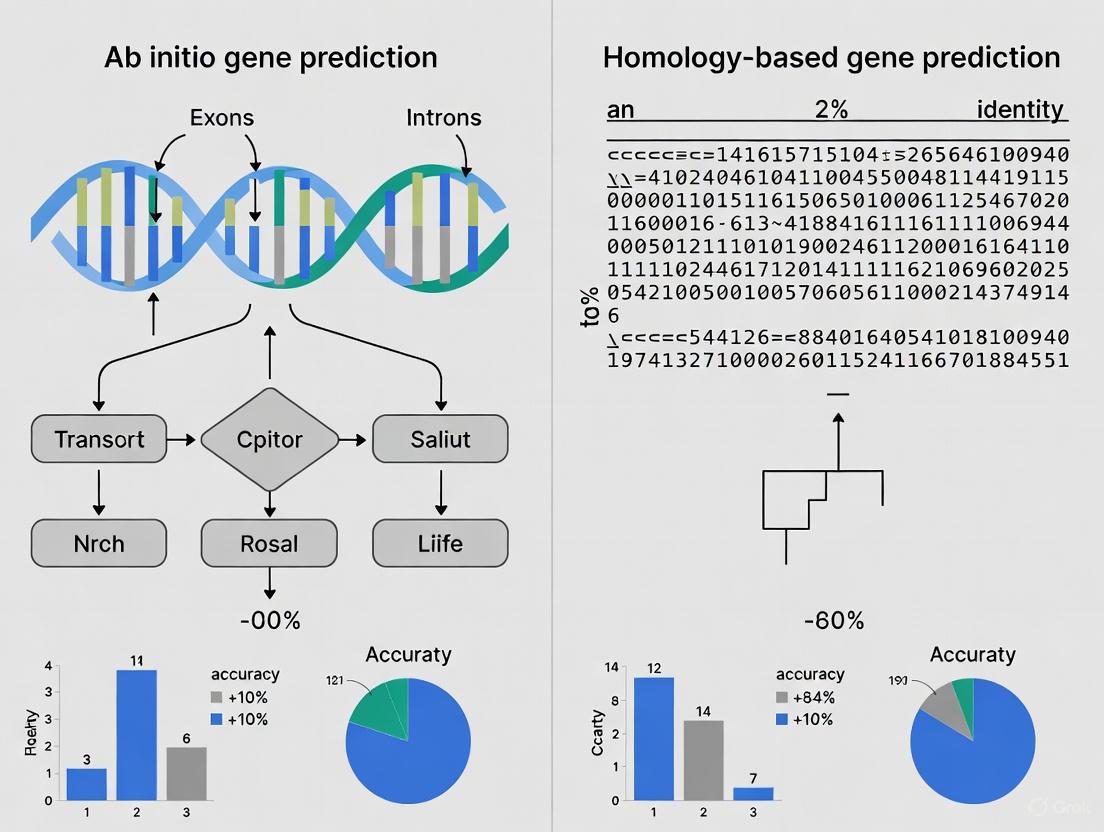
Accurate gene prediction is a cornerstone of modern genomics, with direct implications for understanding disease mechanisms and identifying therapeutic targets.
Ab Initio vs. Homology-Based Gene Prediction: A Comprehensive Guide for Biomedical Research
Abstract
Accurate gene prediction is a cornerstone of modern genomics, with direct implications for understanding disease mechanisms and identifying therapeutic targets. This article provides a systematic comparison of the two primary computational approaches for gene finding: ab initio methods, which rely on statistical models of gene structure, and homology-based methods, which leverage evolutionary conservation. We explore their foundational principles, practical applications, and performance benchmarks across diverse eukaryotic organisms. Drawing on recent benchmark studies and real-world case studies, we offer actionable strategies for method selection, troubleshooting, and hybrid pipeline optimization. This guide is tailored for researchers, scientists, and drug development professionals seeking to enhance the accuracy and efficiency of their genomic annotations.
Core Principles: Understanding the Fundamental Mechanics of Gene Prediction
In the field of computational genomics, ab initio gene prediction represents a fundamental approach for identifying protein-coding genes in genomic sequences without relying on direct experimental evidence or homologous sequences. This methodology stands in contrast to homology-based prediction, which transfers annotation from evolutionarily related organisms. The accuracy of ab initio methods hinges on two core computational paradigms: signal sensors and content sensors [1]. These sensors work in concert to decipher the complex language of eukaryotic gene structures, where coding exons are interrupted by non-coding introns.
Signal sensors are designed to recognize short, conserved nucleotide motifs that mark functional sites along a gene. These include splice sites, start and stop codons, branch points, and polyadenylation signals [2] [1]. Content sensors, conversely, employ statistical models to distinguish coding from non-coding sequences based on patterns of codon usage and nucleotide composition that are unique to each species [1]. Together, these systems enable computational tools to approximate the biological machinery that identifies and processes genes within the raw sequence of a genome.
Performance Comparison of Ab Initio Prediction Tools
The development of ab initio gene predictors has evolved through multiple generations, with current state-of-the-art tools primarily based on probabilistic models such as Hidden Markov Models (HMMs) and, more recently, deep learning architectures [3] [1]. The table below summarizes the reported performance of several prominent ab initio tools across different eukaryotic groups.
Table 1: Performance Comparison of Ab Initio Gene Prediction Tools
| Tool | Primary Algorithm | Reported Performance (by Clade) | Key Strengths |
|---|---|---|---|
| Helixer | Deep Learning (Neural Network) | >0.9 Phase F1 for plants/vertebrates; leads in BUSCO completeness for plants/vertebrates [3] | Requires no species-specific training; consistent performance across diverse species [3] |
| AUGUSTUS | Generalized Hidden Markov Model (GHMM) | Lower phase F1 than Helixer in plants/vertebrates; competitive in some invertebrates/fungi [3] | Extensive history of use; integrates with evidence-based pipelines [3] [1] |
| GeneMark-ES | Hidden Markov Model (HMM) | Lower phase F1 than Helixer; outperforms on several invertebrate species; competitive in fungi [3] | Self-training model; effective for fungi and specific invertebrates [3] |
| GENSCAN | GHMM | One of the first tools that could predict complete gene structures in entire genomic sequences [1] | Pioneered complete gene prediction in multi-gene sequences [1] |
| Tiberius | Deep Learning (Mammals) | Outperforms Helixer in mammals: ~20% higher gene precision/recall [3] | Specialized, high-accuracy model for mammalian genomes [3] |
Benchmark studies, such as those conducted using the G3PO (benchmark for Gene and Protein Prediction PrOgrams) framework, highlight the challenging nature of gene prediction. These evaluations reveal that even modern programs can fail to predict 100% of exons and protein sequences correctly, underscoring the difficulty of the task, especially with complex gene structures or incomplete genome assemblies [2].
Table 2: Feature-Level Performance Metrics (F1 Scores)
| Tool | Exon F1 (Plants/Vertebrates) | Gene F1 (Plants/Vertebrates) | Intron F1 (Plants/Vertebrates) |
|---|---|---|---|
| Helixer | Highest among tools [3] | Highest among tools [3] | Highest among tools [3] |
| AUGUSTUS | Lower than Helixer [3] | Lower than Helixer [3] | Lower than Helixer [3] |
| GeneMark-ES | Lower than Helixer [3] | Lower than Helixer [3] | Lower than Helixer [3] |
Experimental Protocols and Methodologies
Benchmarking with G3PO
The G3PO benchmark was constructed to evaluate gene prediction programs against realistic challenges present in contemporary genome projects. It comprises a carefully curated set of 1,793 real eukaryotic genes from 147 phylogenetically diverse organisms [2].
Experimental Workflow:
- Data Curation: Genes were extracted from UniProt and mapped to their genomic sequences in Ensembl. The set includes genes with varying lengths, exon counts, and complexities [2].
- Quality Control: Multiple sequence alignments were built to identify and label proteins with potential annotation errors as 'Unconfirmed,' while others were labeled 'Confirmed' [2].
- Test Design: Genomic sequences were extracted with additional flanking DNA regions (150 to 10,000 nucleotides) to simulate real annotation tasks. Test sets were designed to evaluate the impact of factors like genome quality and gene structure complexity [2].
- Evaluation: Predictions from various tools are compared to the reference set using metrics like exon-level accuracy and protein-level accuracy [2].
Deep Learning Model Training in Helixer
Helixer exemplifies the modern shift from probabilistic models to deep learning for integrating signal and content sensing.
Experimental Workflow:
- Input: A genomic DNA sequence in FASTA format [3].
- Base-Wise Classification: A sequence-to-label neural network using convolutional and recurrent layers analyzes the sequence. It predicts the genic class (e.g., intergenic, coding exon, intron, UTR) for each base pair, integrating both local motif information (signal sensing) and long-range dependencies (content sensing) [3].
- Model Assembly: The base-wise predictions are processed by a separate tool,
HelixerPost, which uses a hidden Markov model to decode the most likely coherent gene model, enforcing biological rules (e.g., exons must start and end with specific splice signals) [3]. - Output: A final gene model in GFF3 format, providing the coordinates and structures of all predicted genes [3].
Diagram 1: Helixer's deep learning-based workflow integrates signal and content sensing to produce gene models.
Visualization of the Ab Initio Prediction Logic
The core logic of ab initio gene prediction revolves around the interplay between signal and content sensors, which feed into a model that assembles a complete gene structure. This process can be generalized across many HMM and deep learning-based tools.
Diagram 2: Core logic of signal and content sensor integration in gene prediction.
For researchers conducting or evaluating gene prediction studies, the following computational tools and resources are essential.
Table 3: Essential Research Reagents and Resources for Gene Prediction
| Resource Name | Type | Primary Function in Research |
|---|---|---|
| G3PO Benchmark [2] | Benchmark Dataset | Provides a validated, curated set of genes from diverse eukaryotes for standardized tool evaluation. |
| Helixer [3] | Ab Initio Prediction Tool | Deep learning-based gene predictor that operates without experimental data or species-specific training. |
| AUGUSTUS [3] [1] | Ab Initio Prediction Tool | A widely used GHMM-based gene predictor, often integrated into evidence-based annotation pipelines. |
| GeneMark-ES [3] | Ab Initio Prediction Tool | An HMM-based self-training gene finder, particularly effective for fungal genomes. |
| BUSCO [3] | Assessment Tool | Benchmarks Universal Single-Copy Orthologs; quantifies the completeness of a predicted proteome. |
The distinction between signal sensors and content sensors forms the conceptual bedrock of ab initio gene prediction. While traditional HMM-based tools like AUGUSTUS and GeneMark-ES have effectively utilized these paradigms for years, the emergence of deep learning tools like Helixer represents a significant paradigm shift. These new methods integrate signal and content sensing through end-to-end trained networks, demonstrating performance that meets or exceeds established tools across diverse eukaryotic clades without the need for species-specific parameterization [3].
The choice between ab initio and homology-based approaches, or more often their integrated application, remains central to genome annotation. Ab initio methods are indispensable for discovering novel genes lacking sequence similarity to known proteins, while homology-based methods provide valuable evidence when available. The future of the field lies in the continued refinement of these computational sensors, particularly through deep learning, and their intelligent integration into comprehensive, automated, and highly accurate genome annotation pipelines.
Genome annotation represents a fundamental process in modern biology, enabling researchers to decipher the functional elements encoded within DNA sequences. The accurate identification of protein-coding genes is critical for diverse fields including comparative genomics, functional proteomics, and drug target discovery [4]. Two predominant computational strategies have emerged for this task: ab initio gene prediction, which relies solely on statistical patterns within the target genome, and homology-based prediction, which transfers knowledge from well-annotated reference organisms [5] [6]. This guide focuses on the logic of homology-based approaches, which leverage the evolutionary principle that functional elements are conserved between related species. We objectively compare the performance of leading homology-based tools against ab initio methods, providing experimental data and protocols to guide researchers in selecting appropriate annotation strategies.
Methodological Foundations of Homology-Based Prediction
Homology-based gene prediction operates on the core premise that protein-coding genes and their structural features—particularly exon-intron boundaries—are evolutionarily conserved [7]. These methods utilize experimentally validated gene models from closely related, well-annotated reference genomes to predict genes in a newly sequenced target genome.
Core Algorithmic Workflow
The extended GeMoMa (Gene Model Mapper) pipeline exemplifies the modern homology-based approach, integrating multiple evidence types [4] [8]:
- Exon Matching: Individual protein-coding exons from reference transcripts are translated to amino acid sequences and matched to the target genome using tBLASTn.
- Intron Position Conservation: The conservation of exon-intron boundaries (splice sites) between reference and target genes is assessed.
- Evidence Integration: RNA-seq data can be incorporated to extract experimental support for splice sites (donor and acceptor sites) and transcript coverage.
- Gene Model Assembly: Matching exons are assembled into complete gene models using dynamic programming, ensuring proper start/stop codons and splicing phases.
- Filtering and Redundancy Reduction: Predictions from multiple reference transcripts or organisms are joined and filtered to produce a non-redundant set of gene models.
The following diagram illustrates this integrated workflow:
Key Distinctions from Ab Initio Approaches
Unlike ab initio methods that use generalized hidden Markov models or deep learning frameworks trained on known gene features—such as codon usage, splice site signals, and nucleotide composition—homology-based methods directly utilize the specific gene structures of related organisms [3] [5] [6]. This fundamental difference often makes homology-based approaches more accurate when well-annotated relatives are available, though they may miss novel genes without clear homologs.
Performance Comparison: Experimental Data and Benchmarks
Multiple independent studies have evaluated the performance of homology-based and ab initio gene prediction tools across diverse eukaryotic organisms. The following tables summarize key quantitative comparisons from published benchmarks.
Comparison of gene prediction tools on benchmark data from plants, animals, and fungi [4].
| Tool | Approach | Average Nucleotide F1 Score | Strengths | Limitations |
|---|---|---|---|---|
| GeMoMa | Homology-based + RNA-seq | Highest | Superior exon-intron structure accuracy; Utilizes intron position conservation | Requires related, well-annotated genome |
| BRAKER1 | Ab initio + RNA-seq | High | Unsupervised; Combines GeneMark-ET & AUGUSTUS | Lower accuracy for genes without RNA-seq support |
| MAKER2 | Hybrid pipeline | Moderate | Integrates multiple evidence sources | Complex setup; Dependent on component tools |
| CodingQuarry | Ab initio + RNA-seq | Moderate (Fungi) | Optimized for fungal genomes | Limited to fungi; Lower performance in plants/animals |
| Helixer | Ab initio (Deep Learning) | High (Varies by clade) | No extrinsic data required; Generalizes across species | Lower gene-level precision in some clades [3] |
Table 2: Feature-Level Performance Metrics
Detailed accuracy metrics for different aspects of gene prediction on the G3PO benchmark [5].
| Method | Exon Sensitivity | Exon Specificity | Gene Sensitivity | Gene Specificity | Intron Sensitivity | Intron Specificity |
|---|---|---|---|---|---|---|
| Homology-Based | 85-92% | 87-94% | 78-88% | 82-90% | 89-95% | 91-96% |
| Ab Initio | 72-85% | 75-88% | 65-82% | 68-85% | 78-90% | 81-92% |
| Hybrid | 80-90% | 83-92% | 75-86% | 78-88% | 85-93% | 87-94% |
Performance Insights
The benchmark data consistently demonstrates that homology-based methods, particularly GeMoMa, achieve higher accuracy in predicting exact gene structures when suitable reference annotations are available [4] [8]. The key advantage emerges from leveraging intron position conservation, which remains evolutionarily stable even when amino acid sequences diverge [7]. This allows more precise identification of exon boundaries compared to ab initio methods that rely solely on statistical signal sensors.
However, ab initio methods maintain importance for discovering novel genes without homologs in existing databases. Recent deep learning approaches like Helixer show promising results, achieving state-of-the-art performance for base-wise predictions in some clades without requiring extrinsic evidence [3]. For non-model organisms with no close annotated relatives, ab initio methods may be the only viable option.
Experimental Protocols for Method Evaluation
To ensure fair and reproducible comparisons between gene prediction methods, researchers should follow standardized evaluation protocols. The following section outlines key methodological considerations.
Benchmark Dataset Construction
The G3PO benchmark provides a carefully validated set of 1,793 real eukaryotic genes from 147 phylogenetically diverse organisms, ranging from single-exon genes to complex structures with over 20 exons [5]. Proper benchmark construction should:
- Include Phylogenetic Diversity: Select reference genes from multiple clades (Opisthokonta, Stramenopila, Alveolata, etc.) to avoid taxonomic bias.
- Vary Gene Structure Complexity: Incorporate genes with different numbers of exons, intron lengths, and protein lengths.
- Ensure Quality Validation: Construct high-quality multiple sequence alignments to identify and exclude proteins with potential annotation errors.
- Include Genomic Context: Extract genomic sequences with additional flanking regions (1,000-10,000 nucleotides) to simulate real annotation tasks.
Evaluation Metrics and Methodology
Comprehensive assessment should employ multiple complementary metrics [4] [5]:
- Nucleotide-Level Measures: Calculate sensitivity, specificity, and F1-score at the individual nucleotide level.
- Feature-Level Accuracy: Assess exon sensitivity (percentage of real exons predicted correctly) and exon specificity (percentage of predicted exons that are real).
- Gene-Level Accuracy: Determine the percentage of complete gene structures predicted exactly correctly.
- Experimental Validation: Use Sanger sequencing of selected predictions to confirm novel gene models [7].
The extended best reciprocal hit (BRH) approach provides a robust framework for comparison by categorizing predictions into nine classes, including correct transcripts, correct genes, correct gene families, and various error types [7].
Implementation Guide: Research Reagent Solutions
Successful application of homology-based gene prediction requires specific computational resources and data inputs. The following table details essential components for implementing these methods.
Table 3: Essential Research Reagents for Homology-Based Prediction
| Resource Type | Specific Examples | Function | Availability |
|---|---|---|---|
| Reference Annotations | GENCODE (human/mouse), Ensembl, WormBase, Phytozome | Provides high-quality gene models for transfer to target genome | Public databases |
| Software Tools | GeMoMa, GeneWise, GenomeScan, MAKER2 | Implements homology search and gene model construction | Open-source (various licenses) |
| Alignment Tools | tBLASTn, exonerate, BLAT | Aligns reference proteins or exons to target genome | Open-source |
| Transcriptomic Data | RNA-seq reads, assembled transcripts | Provides experimental evidence for splice sites and expression | SRA, ENA, project-specific |
| Evaluation Frameworks | G3PO benchmark, Extended BRH approach | Quantifies prediction accuracy and compares tools | Published protocols |
Homology-based gene prediction demonstrates consistent advantages over ab initio approaches when well-annotated relative genomes are available, particularly in accurately resolving exon-intron structures through conservation of intron positions. The experimental data presented here reveals that tools like GeMoMa achieve higher nucleotide and feature-level accuracy across diverse eukaryotic lineages.
However, the optimal genome annotation strategy often combines multiple approaches—leveraging homology-based prediction for genes with clear homologs while employing ab initio methods for novel gene discovery. As genomic sequencing extends to increasingly diverse organisms, hybrid pipelines that integrate these complementary approaches will provide the most comprehensive and accurate annotations, forming a reliable foundation for downstream biomedical and evolutionary research.
Key Strengths and Inherent Limitations of Each Standalone Approach
Accurate identification of protein-coding genes is a fundamental challenge in genomics, with critical implications for comparative genomics, functional proteomics, and drug discovery [4] [8]. The two primary computational approaches—ab initio and homology-based gene prediction—offer distinct methodologies for annotating genes in newly sequenced genomes. Ab initio (or de novo) methods predict genes using intrinsic sequence properties alone, while homology-based methods leverage evolutionary relationships to known genes from well-annotated reference organisms. Understanding the precise capabilities and constraints of each standalone approach is essential for researchers selecting appropriate tools for genome annotation projects. This guide provides an objective comparison of these methodologies, supported by experimental data and benchmark studies, to inform their application in scientific research and drug development.
Ab Initio Gene Prediction
Ab initio methods identify protein-coding genes based solely on statistical features derived from the target genome sequence, without external evidence from related species [2] [9]. These algorithms typically employ probabilistic models such as hidden Markov models (HMMs) or machine learning techniques including neural networks to recognize patterns associated with gene structures [2] [3]. They utilize two primary types of sensors: signal sensors that detect specific sites like splice junctions, promoter regions, and polyadenylation signals; and content sensors that distinguish coding from non-coding sequences based on nucleotide composition, codon usage, and exon/intron length distributions [2].
The core assumption underlying these methods is that protein-coding regions exhibit statistical biases that differentiate them from non-coding DNA, such as codon periodicity and specific nucleotide frequencies [9]. For example, coding sequences often display a period-3 signal due to the non-random codon structure, which can be detected using mathematical transformations like the Discrete Fourier Transform (DFT) [9]. More recent implementations, such as Helixer, employ deep learning architectures that integrate convolutional and recurrent layers to capture both local sequence motifs and long-range dependencies in genomic DNA [3].
Homology-Based Gene Prediction
Homology-based methods (also called comparative methods) predict genes by transferring annotations from evolutionarily related organisms with well-characterized genomes [4] [10] [8]. These approaches leverage the evolutionary principle that functional elements, particularly protein-coding regions, are more conserved than non-functional sequences over evolutionary time. The fundamental premise is that genes in newly sequenced genomes can be identified through their similarity to known genes in reference species [10].
These methods utilize two primary types of evolutionary information: amino acid sequence conservation and intron position conservation [4] [8]. Programs like GeMoMa extract protein-coding exons from reference genomes, match them to target genomic sequences using tools like tBLASTn, and then assemble these matches into complete gene models while ensuring proper splice sites, start codons, and stop codons [4] [8]. Syntenic gene prediction tools like SGP-1 further enhance accuracy by considering conserved gene order and genomic context between related species [10]. The performance of homology-based methods depends heavily on the evolutionary distance between target and reference species, with closer phylogenetic relationships generally yielding more accurate predictions [10].
Performance Comparison and Benchmark Evaluation
Accuracy Metrics and Experimental Data
Gene prediction accuracy is typically evaluated using multiple metrics at different biological levels. The most common assessment framework includes:
- Nucleotide-level metrics: Sensitivity (Sn) measures the proportion of correctly predicted coding nucleotides, while specificity (Sp) measures the proportion of predicted coding nucleotides that are actually coding [10].
- Exon-level metrics: Exon sensitivity (SN) and specificity (SP) evaluate the correct identification of complete exons with exact boundaries [10].
- Gene-level metrics: The ability to predict complete gene structures from start to stop codon with all intron-exon boundaries correctly specified [11].
- Proteome completeness: Assessed using tools like BUSCO (Benchmarking Universal Single-Copy Orthologs) to measure how completely a predicted proteome covers evolutionarily conserved single-copy genes [3].
The performance of both ab initio and homology-based methods varies significantly across different genomes and phylogenetic groups. Benchmark studies using standardized datasets like G3PO (benchmark for Gene and Protein Prediction Programs), which contains 1793 carefully validated genes from 147 phylogenetically diverse eukaryotic organisms, provide objective comparisons across different approaches [2].
Table 1: Performance Comparison of Major Gene Prediction Approaches
| Method | Type | Nucleotide Level Sn/Sp | Exon Level SN/SP | Gene Level Accuracy | Key Strengths |
|---|---|---|---|---|---|
| Helixer [3] | Ab initio (Deep Learning) | ~94% (genic F1) | Varies by clade | 66% (plant/vertebrate) | No species-specific training needed; consistent across phylogeny |
| GeMoMa [4] [8] | Homology-based | High with close reference | 88% (exon recall) | 61% (complete genes) | Leverages intron position conservation; RNA-seq integration |
| SGP-1 [10] | Homology-based (synteny) | 94%/96% (human/rodent) | 70%/76% (human/rodent) | Similar to Genscan | Less species-specific parameter tuning |
| Statistical Combiner [11] | Evidence integration | - | 88% (exon recall) | 66% (complete genes) | Combines multiple evidence sources |
| Genscan [10] | Ab initio (HMM) | Slightly inferior to SGP-1 | Lower than SGP-1 | 45% (complete genes) | Established method; widely used |
Table 2: Phylogenetic Performance Variation of Ab Initio Tools (Based on Helixer Benchmark) [3]
| Phylogenetic Group | Phase F1 | Exon F1 | Gene F1 | BUSCO Completeness |
|---|---|---|---|---|
| Plants | Highest | Highest | Highest | Approaches reference quality |
| Vertebrates | High | High | High | Near reference quality |
| Invertebrates | Moderate | Variable | Variable | Species-dependent |
| Fungi | Competitive with HMMs | Similar to HMMs | Similar to HMMs | All tools outperform reference |
Limitations and Failure Modes
Both approaches exhibit characteristic limitations under specific conditions:
Ab initio limitations:
- Accuracy drops significantly for atypical genes including those with non-canonical splice sites, short open reading frames, or unusual nucleotide composition [2] [10]
- Training set dependency leads to species-specific performance variation, with accuracy decreasing in non-model organisms [2]
- Inability to detect novel genes that lack statistical signatures of protein-coding regions [9]
- High false positive rates in genome-wide annotations despite good performance in gene-rich regions [9]
Homology-based limitations:
- Rapid performance degradation with increasing evolutionary distance from reference species [4]
- Inability to identify taxon-specific genes absent from reference organisms [4]
- Propagation of existing annotation errors across genomes [2]
- Limited application for non-standard model organisms with few closely-related annotated genomes [10]
Experimental Protocols and Benchmark Methodologies
Standardized Benchmarking Frameworks
The G3PO benchmark provides a rigorously validated framework for evaluating gene prediction programs using real eukaryotic genes from diverse organisms [2]. The benchmark construction protocol involves:
Data Curation: 1793 protein sequences from 147 phylogenetically diverse species are extracted from UniProt, divided into 20 orthologous families representing complex proteins with multiple functional domains, repeats, and low-complexity regions [2].
Quality Validation: Multiple sequence alignments are constructed to identify proteins with inconsistent sequence segments that might indicate annotation errors. Sequences are labeled as 'Confirmed' (no errors) or 'Unconfirmed' (potential errors) [2].
Genomic Context Extraction: For each protein, corresponding genomic sequences and exon maps are extracted from Ensembl, with additional upstream and downstream regions (150-10,000 nucleotides) to simulate realistic annotation environments [2].
Complexity Stratification: Test cases are categorized by gene length, exon number, protein length, and phylogenetic origin to evaluate performance across different challenge levels [2].
Performance Assessment Protocol
Standardized evaluation follows this workflow:
Prediction Generation: Tools are run on benchmark sequences using default parameters or species-appropriate settings.
Multi-level Comparison: Predictions are compared to reference annotations at nucleotide, exon, and gene levels using metrics including sensitivity, specificity, and F1 scores [3] [10].
Proteome Assessment: Predicted proteomes are evaluated for completeness using BUSCO, which measures coverage of evolutionarily conserved single-copy orthologs [3].
Statistical Analysis: Performance differences are assessed for statistical significance across phylogenetic groups and gene complexity categories.
Visualization of Method Workflows
Table 3: Key Bioinformatics Resources for Gene Prediction Research
| Resource Category | Specific Tools/Databases | Primary Function | Application Context |
|---|---|---|---|
| Benchmark Datasets | G3PO [2], EGASP [9] | Standardized performance evaluation | Method validation and comparison |
| Ab Initio Prediction | Helixer [3], AUGUSTUS [2], Genscan [10] | Intrinsic pattern-based gene finding | Novel genome annotation, non-model organisms |
| Homology-Based Prediction | GeMoMa [4] [8], SGP-1 [10] | Evolutionary conservation-based prediction | Genomes with related annotated species |
| Evidence Integration | MAKER2 [4] [8], BRAKER1 [4] | Combine multiple evidence sources | Production-grade genome annotation |
| Reference Databases | UniProt [2], Ensembl [2], WormBase [4] | Source of reference annotations | Homology-based prediction |
| Quality Assessment | BUSCO [3], CompareTranscripts [4] | Proteome completeness and accuracy | Annotation quality control |
Both ab initio and homology-based gene prediction approaches offer complementary strengths that make them suitable for different genomic contexts and research objectives. Ab initio methods excel for non-model organisms without close annotated relatives, while homology-based approaches provide superior accuracy when well-annotated reference genomes are available. Recent advances in deep learning, as exemplified by Helixer, have significantly narrowed the performance gap between these approaches, particularly for well-studied phylogenetic groups. For critical applications in drug development and functional genomics, evidence combination pipelines that integrate both methodologies typically yield the most reliable annotations. The optimal strategy depends on multiple factors including evolutionary context, research goals, and available genomic resources, with the decision framework provided here offering guidance for selecting appropriate methodologies.
Gene prediction represents a fundamental challenge in genomics, directly impacting downstream research in evolution, disease mechanism, and drug target identification [3] [5]. The accurate identification of gene structures—including exons, introns, and untranslated regions—is complicated by the tremendous diversity in genomic architecture across eukaryotes, ranging from simple single-exon genes to complex genes with numerous and long introns [5] [12]. For decades, the field has been divided between two principal methodological approaches: homology-based methods, which transfer annotations from evolutionarily related species or use experimental evidence like RNA-seq, and ab initio methods, which rely solely on intrinsic signals within the genomic DNA sequence to predict gene models [5].
While homology-based methods are powerful, their major limitation is an inherent inability to discover novel genes or gene variants that lack similarity to any known sequence [5]. This creates a critical and enduring role for ab initio methods, especially in newly sequenced or less-studied species where extrinsic evidence is scarce [3] [5]. Early ab initio tools, predominantly based on probabilistic models like Hidden Markov Models (HMMs), achieved notable success but often struggled with gene-level accuracy, particularly on genes with long introns or complex structures [12]. The emergence of deep learning and other advanced machine learning frameworks has significantly shifted the landscape, enabling a new generation of ab initio predictors that can model more complex biological grammar and long-range dependencies within DNA sequence [3] [13] [12].
This guide provides an objective comparison of the performance of modern ab initio gene prediction tools, with a specific focus on how genomic context—such as gene structure complexity, phylogenetic origin, and sequence quality—impacts their accuracy. We synthesize recent benchmark studies and performance reports to help researchers select the appropriate tool for their specific genomic annotation challenge.
Performance Comparison of ModernAb InitioGene Predictors
The performance of ab initio gene predictors is not uniform; it varies significantly across different eukaryotic groups and with the complexity of the gene structures being analyzed. The following comparison is based on recent large-scale benchmarks and tool publications, which evaluated accuracy at multiple levels, from individual nucleotides to whole genes.
Table 1: Overview of Modern Ab Initio Gene Prediction Tools
| Tool | Core Methodology | Training Data Scope | Key Strengths | Citation |
|---|---|---|---|---|
| Helixer | Deep Learning (CNN & RNN) + HMM post-processing | Multi-species; pretrained models for plants, vertebrates, invertebrates, fungi | High accuracy across diverse species without retraining; no extrinsic data required. | [3] |
| Augustus | Generalized Hidden Markov Model (GHMM) | Species-specific training required | Long-standing benchmark; integrates well with evidence-based pipelines. | [3] [5] |
| GeneMark-ES | Hidden Markov Model (HMM) | Self-training on target genome | Effective for novel genomes where no close relative is annotated. | [3] |
| Tiberius | Deep Neural Network | Specialized for mammalian genomes | State-of-the-art performance within the mammalian clade. | [3] |
| CRAIG | Conditional Random Field (CRF) with large-margin learning | Trained on vertebrate sequences | High gene-level accuracy and improved performance on genes with long introns. | [12] |
| Genscan | Generalized Hidden Markov Model (GHMM) | Trained on vertebrate sequences | Pioneering ab initio tool; historical benchmark for comparison. | [12] |
Comparative Performance Across Phylogenetic Groups
A comprehensive benchmark study named G3PO, which included 1793 genes from 147 phylogenetically diverse eukaryotes, highlighted that the performance of ab initio tools is strongly influenced by the phylogenetic group of the target organism [5]. More recent evaluations of Helixer, which provides pretrained models for different clades, confirm this trend [3].
Table 2: Tool Performance by Phylogenetic Group (Based on Reported F1 Scores)
| Phylogenetic Group | Reported Top Performer(s) | Key Performance Summary | Citation |
|---|---|---|---|
| Land Plants | Helixer | Helixer shows strong performance, often approaching the quality of manually curated reference annotations. | [3] |
| Vertebrates | Tiberius, Helixer | Tiberius outperforms Helixer in mammals, with ~20% higher gene precision/recall. Helixer's vertebrate model is robust but second-best in this clade. | [3] |
| Invertebrates | Helixer, GeneMark-ES | Helixer maintains a small overall advantage, but performance is species-dependent; GeneMark-ES is strongest for some species. | [3] |
| Fungi | Helixer, GeneMark-ES, AUGUSTUS | Highly competitive clade; all tools show similar performance, with Helixer leading by a very small margin. | [3] |
Helixer's pretrained models achieved the highest median "Genic F1" score for their target phylogenetic ranges (vertebrates, land plants, invertebrates, and fungi) compared to its own previous models and other tools like AUGUSTUS and GeneMark-ES [3]. This multi-species approach allows it to be applied immediately to new genomes within these groups. In contrast, tools like AUGUSTUS and GeneMark-ES often require a training step on the target genome or a closely related species, which can be a resource-intensive process [3] [5].
Performance on Complex versus Simple Gene Structures
Gene structure complexity, often measured by the number of exons per gene, is a major factor influencing prediction accuracy. All tools tend to perform worse on complex, multi-exon genes, but the degree of degradation varies.
Table 3: Impact of Gene Structure Complexity on Prediction Accuracy
| Complexity Factor | Impact on Prediction Performance | Tool-Specific Notes |
|---|---|---|
| Number of Exons | Accuracy decreases as the number of exons increases. Initial and terminal exons are particularly challenging. | CRAIG showed a relative mean improvement of 25.5% in sensitivity for initial/single exons over previous tools [12]. |
| Intron Length | Long introns disrupt content sensor statistics and are a major source of gene-level errors. | CRAIG and Augustus employ specific strategies for long introns, leading to significant gains in gene-level accuracy [12]. |
| Genomic Sequence Quality | Draft genomes with gaps, low coverage, and assembly errors substantially reduce prediction quality. | All tools suffer, but deep learning models like Helixer may be more robust by learning from a wider variety of data [3] [5]. |
Early benchmarks established that tools like Genscan achieved about 80% exon sensitivity and specificity on single-gene test sets, but gene-level accuracy remained a major challenge, especially in vertebrate genomes where genes with very long introns are common [12]. The development of CRAIG, which uses a discriminative model that can incorporate rich, overlapping features and model introns by length, demonstrated a 33.9% relative mean improvement in gene-level accuracy on benchmark sets [12]. This highlights that the choice of machine learning framework can directly address specific challenges posed by complex genomic contexts.
Experimental Protocols for Benchmarking
To ensure fair and meaningful comparisons, tool developers and independent assessors rely on standardized benchmarks. Understanding these protocols is crucial for interpreting performance data.
Benchmark Datasets
The construction of high-quality, diverse benchmark datasets is the cornerstone of reliable evaluation.
- G3PO Benchmark: A modern benchmark designed to represent typical challenges in current genome projects. It contains 1793 carefully curated reference genes from 147 eukaryotic species, covering a wide range of gene lengths, exon counts, and phylogenetic diversity. Sequences are labeled as 'Confirmed' or 'Unconfirmed' based on the consistency of their multiple sequence alignments to flag potential annotation errors [5].
- ENCODE Regions: A set of 31 manually curated regions from the ENCODE project, totaling 21 million bases and containing 294 alternatively spliced genes. This benchmark is particularly valuable for testing performance on genomic DNA that includes intergenic regions and complex gene structures [12].
- Legacy Single-Gene Sets: These include combined sets like BGHM953 (amalgamating genes from Burset and Guigo, GeneParser, and others) and TIGR251 (enriched for genes with long introns). They are useful for direct historical comparison [12].
Evaluation Metrics
A comprehensive evaluation uses a hierarchy of metrics to assess different aspects of prediction quality [3] [12]:
- Nucleotide-Level Metrics: Measure the accuracy of classifying each base pair into categories like coding, intron, or UTR. Common metrics include sensitivity, specificity, and F1-score at the nucleotide level.
- Exon-Level Metrics: Assess the correctness of predicted exons. Standard practice is to count an exon as correct only if both its boundaries are predicted exactly. Metrics include exon sensitivity (the proportion of real exons found) and exon specificity (the proportion of predicted exons that are correct).
- Gene-Level Metrics: The most stringent assessment, where a gene is typically counted as correct only if all of its exons are perfectly predicted. This is the most challenging level of accuracy for any predictor.
- Protein-Level Metrics: Tools like Benchmarking Universal Single-Copy Orthologs (BUSCO) are used to quantify the completeness of a predicted proteome by looking for highly conserved, single-copy genes [3].
The following diagram illustrates the logical workflow of a typical gene prediction benchmarking process.
The Scientist's Toolkit: Essential Research Reagents
To conduct gene prediction or independent benchmarking, researchers rely on a suite of computational resources and datasets.
Table 4: Key Research Reagents for Gene Prediction Research
| Resource Name | Type | Function in Research | Example / Source |
|---|---|---|---|
| High-Quality Reference Genome | Data | The foundational input sequence for gene prediction and training. | NCBI RefSeq, Ensembl assemblies [3] |
| Curation-Backed Annotation | Data | Provides "ground truth" for training new models and benchmarking predictions. | ENSEMBL, ENCODE project annotations [5] [12] |
| Benchmarking Suites | Software/Data | Standardized datasets and scripts for fair tool comparison. | G3PO benchmark, ENCODE294 test set [5] [12] |
| Evaluation Software | Software | Calculates standardized performance metrics from prediction files. | Eval package [12] |
| Sequence Masking Tool | Software | Identifies and soft-masks repetitive elements to reduce false positives. | RepeatMasker [12] |
| BUSCO | Software/Data | Assesses the completeness of a predicted gene set using universal single-copy orthologs. | BUSCO software & lineage datasets [3] |
The evolution of ab initio gene prediction has progressed from early HMM-based systems to sophisticated deep learning and discriminative models, leading to substantial gains in accuracy, especially for complex gene structures and across diverse eukaryotic life [3] [12]. However, no single tool is universally superior. The optimal choice is highly dependent on the genomic context.
For researchers working on plant or vertebrate genomes, Helixer provides a powerful, ready-to-use solution that performs at or near the state of the art [3]. For those focused specifically on mammals, Tiberius currently offers the highest accuracy [3]. For projects involving invertebrates or fungi, a preliminary benchmark on a subset of genes is advisable, as performance between Helixer, GeneMark-ES, and AUGUSTUS can be species-specific [3]. When annotating a genome with no close annotated relative, self-training tools like GeneMark-ES remain a critical option [3].
The field continues to advance rapidly, with genomic language models promising to capture even longer-range dependencies and more complex genomic grammar [14] [13]. For now, understanding the impact of genomic context and the relative strengths of modern tools, as outlined in this guide, provides a solid foundation for making informed decisions in genomic research and drug development.
From Theory to Practice: Implementing Gene Prediction in Research Pipelines
Ab initio gene prediction is a fundamental methodology in bioinformatics that identifies protein-coding genes in genomic sequences using statistical models rather than external evidence like transcriptome data or known homologs. These tools are indispensable in the annotation of newly sequenced genomes, especially for non-model organisms where experimental data or closely related reference genomes are unavailable [5] [15]. They function by combining signal sensors (for sites like splice donors/acceptors and promoters) and content sensors (for features like coding potential and nucleotide composition) to delineate exon-intron structures [5]. This guide provides a comparative analysis of three historically significant ab initio tools—Genscan, Augustus, and GlimmerHMM—framed within the broader context of eukaryotic gene prediction research. As the field progresses, these established methods face new challenges from draft genome assemblies and complex gene structures [5], while also being complemented by emerging deep learning approaches that offer new avenues for accuracy and generalization [3].
Key Tools and Their Methodologies
Genscan: One of the earlier pioneering ab initio tools, Genscan uses a probabilistic generative model (a Hidden Markov Model or HMM) to predict complete gene structures, including exons, introns, and regulatory sites. It was particularly advanced for its time in being able to predict partial genes as well as multiple genes in a sequence [5].
Augustus (Ab Initio Prediction of Alternative Transcripts): A highly accurate tool based on a Generalized Hidden Markov Model (GHMM). A key differentiator for Augustus is its ability to predict multiple alternative transcripts for a gene, a capability that was unique among ab initio predictors at the time of its development [16]. It can incorporate extrinsic evidence from protein or RNA-seq alignments to further improve its predictions [16].
GlimmerHMM: Also based on a GHMM, GlimmerHMM is designed for eukaryotic gene finding. It builds upon the ideas of its predecessor, Glimmer, which was originally developed for microbial genomes. The model uses interpolated Markov models to distinguish between coding and non-coding regions [15].
Independent benchmark studies provide quantitative performance data for these tools. The G3PO benchmark, a comprehensive evaluation using 1793 reference genes from 147 diverse eukaryotic organisms, highlights the challenging nature of gene prediction, with a significant portion of exons and confirmed protein sequences not being predicted with 100% accuracy by all five programs it tested, which included Augustus, GlimmerHMM, and GeneID [5].
The following tables consolidate specific performance metrics from various independent assessments, including the nGASP (nematode genome annotation assessment project) and EGASP (ENCODE Genome Annotation Assessment Project) workshops [17].
Table 1: Gene Prediction Accuracy on Nematode Sequences (nGASP Assessment)
| Program | Exon Sensitivity (%) | Exon Specificity (%) | Gene Sensitivity (%) | Gene Specificity (%) |
|---|---|---|---|---|
| AUGUSTUS | 86.1 | 72.6 | 61.1 | 38.4 |
| GlimmerHMM | 84.4 | 71.4 | 58.0 | 30.6 |
| Fgenesh | 86.4 | 73.6 | 57.8 | 35.4 |
| GeneMark.hmm | 83.2 | 65.6 | 46.3 | 24.5 |
| SNAP | 74.6 | 61.3 | 40.0 | 19.1 |
Table 2: Gene Prediction Accuracy on Human Sequences (EGASP Assessment)
| Program | Exon Sensitivity (%) | Exon Specificity (%) | Gene Sensitivity (%) | Gene Specificity (%) |
|---|---|---|---|---|
| AUGUSTUS | 52.4 | 62.9 | 24.3 | 17.2 |
| GENSCAN | 58.7 | 46.4 | 15.5 | 10.1 |
| GeneID | 53.8 | 61.1 | 10.5 | 8.8 |
| GeneMark.hmm | 48.2 | 47.3 | 16.9 | 7.9 |
| GENEZILLA | 62.1 | 50.3 | 19.6 | 8.8 |
Table 3: Base-Level Prediction Accuracy on Drosophila Sequences
| Program | Base Level Sensitivity (%) | Base Level Specificity (%) |
|---|---|---|
| AUGUSTUS | 98 | 93 |
| GeneID | 96 | 92 |
| GENIE | 96 | 92 |
The data consistently shows that Augustus is a top-performing ab initio tool, often achieving top-tier results in sensitivity and specificity across exon, gene, and base-level metrics in various organisms [17]. Its performance is notably robust. GlimmerHMM also demonstrates strong capability, typically performing well though often slightly behind Augustus in comprehensive benchmarks [17]. Genscan, while a foundational tool, generally shows lower accuracy, particularly at the gene level, where its specificity can be significantly outperformed by newer methods [17].
Experimental Protocols for Benchmarking
To ensure fair and meaningful comparisons between gene prediction tools, standardized evaluation protocols and benchmarks have been developed. Understanding these methodologies is crucial for interpreting performance data and for conducting new evaluations.
The G3PO Benchmark Framework
The G3PO (benchmark for Gene and Protein Prediction PrOgrams) framework was designed to represent the typical challenges faced by modern genome annotation projects [5]. Its construction involves:
- Data Curation: The benchmark is built from a carefully validated and curated set of 1,793 real eukaryotic genes from 147 phylogenetically diverse organisms, sourced from the UniProt database [5].
- Test Set Design: The genes are divided into multiple test sets to evaluate the effects of different biological and technical features, including:
- Genome sequence quality and completeness.
- Gene structure complexity (e.g., number of exons).
- Protein length.
- Phylogenetic diversity (covering Opisthokonta, Stramenopila, Euglenozoa, and others) [5].
- Quality Control: A crucial step involves constructing high-quality multiple sequence alignments to identify proteins with inconsistent segments that might indicate annotation errors. Proteins are labeled as 'Confirmed' or 'Unconfirmed' based on this analysis [5].
- Evaluation Metrics: Standard metrics are used, including sensitivity (the proportion of true features that are correctly predicted) and specificity (the proportion of predicted features that are correct). These are calculated at the base, exon, transcript, and gene levels [5] [17]. A predicted exon is typically considered correct only if both splice sites are predicted exactly at their annotated positions [17].
Standardized Evaluation Workflow
The following diagram illustrates the logical workflow for a standard benchmark experiment comparing ab initio gene finders.
Diagram 1: Gene prediction tool evaluation workflow.
The Scientist's Toolkit: Essential Research Reagents and Materials
The following table details key resources and their functions required for conducting gene prediction research and evaluation, as evidenced in the surveyed literature.
Table 4: Key Research Reagents and Computational Tools
| Item Name | Type | Primary Function in Gene Prediction |
|---|---|---|
| Genomic DNA Sequence | Input Data | The raw, assembled nucleotide sequence of the target organism serving as the primary input for all ab initio prediction tools [5]. |
| Reference Annotation | Validation Data | A curated set of genes with known, high-quality structures for a specific organism. Used for training gene finders and for benchmarking prediction accuracy [5] [18]. |
| UniProtKB Database | Resource | A comprehensive repository of protein sequences and functional information. Used for functional annotation of predicted genes and for constructing benchmark sets [5] [19]. |
| RNA-seq Data | Extrinsic Evidence | High-throughput transcriptome sequencing data. Not used by pure ab initio tools but integrated by pipelines like MAKER2 to improve evidence-based annotations, serving as a benchmark for ab initio performance [5] [3]. |
| CEGMA / BUSCO | Assessment Tool | Software suites that assess annotation completeness by searching for a core set of evolutionarily conserved, single-copy genes [18]. |
| AED (Annotation Edit Distance) | Metric | A score that measures the discrepancy between a predicted annotation and a reference annotation, considering both exon structure and coding sequence [18]. |
The Evolving Landscape: Ab Initio Methods in the Age of Deep Learning
The field of computational gene prediction is continuously evolving. Traditional HMM-based tools like Augustus, GlimmerHMM, and Genscan have set a high standard, but new approaches are emerging. Deep learning is now demonstrating transformative potential, with tools like Helixer offering a new paradigm.
Helixer is an end-to-end deep learning tool that uses a combination of convolutional and recurrent neural networks to predict base-wise genomic features (coding sequences, UTRs, splice sites) directly from DNA sequence [3]. A key operational advantage is that Helixer provides pretrained models for broad phylogenetic groups (e.g., plants, vertebrates, invertebrates, fungi), allowing researchers to generate gene annotations for new genomes immediately, without the need for species-specific training [3].
In terms of performance, evaluations show that Helixer achieves accuracy on par with or even exceeding established HMM tools like Augustus and GeneMark-ES in many cases, particularly for plants and vertebrates [3]. However, the landscape is nuanced. For specific clades like mammals, specialized deep learning models like Tiberius have been shown to outperform Helixer, particularly in gene-level precision and recall [3]. Furthermore, in some contexts, such as fungal genomes, traditional HMM tools can still be highly competitive [3]. This indicates that while deep learning represents a significant advance, the optimal choice of tool may still depend on the specific phylogenetic group and the resources available for training or validation.
The comparative analysis of Genscan, Augustus, and GlimmerHMM reveals a trajectory of improvement in ab initio gene prediction, with Augustus generally establishing itself as one of the most accurate and versatile tools among traditional HMM-based approaches. Its ability to incorporate extrinsic evidence and predict alternative transcripts has been particularly valuable for genome annotation projects [16] [17]. However, the performance of all tools is inherently influenced by factors such as genome assembly quality, gene structure complexity, and the phylogenetic distance from well-studied model organisms [5]. The emergence of deep learning tools like Helixer, which offer high accuracy without the need for species-specific training, marks a significant shift in the field [3]. This progression from hand-crafted probabilistic models to data-driven, learned models promises to further alleviate the bottleneck of high-quality genome annotation, empowering research across a wider spectrum of eukaryotic diversity. For researchers today, the choice between these tools involves a trade-off between the proven robustness of established methods like Augustus and the emerging, generalization capabilities of deep learning approaches.
Executing Homology-Based Prediction with GeMoMa, GeneWise, and Procrustes
Table of Contents
- Introduction
- Performance Comparison
- Methodology and Experimental Protocols
- Experimental Workflow
- Research Reagent Solutions
- Conclusion
Gene prediction remains a fundamental challenge in genomics, with approaches generally categorized as ab initio (based on statistical patterns) or homology-based (leveraging evolutionary relationships). This guide focuses on three homology-based tools—GeMoMa, GeneWise, and PROCRUSTES—which transfer known gene annotations from well-annotated reference genomes to target sequences using protein sequence similarity and gene structure conservation. Homology-based methods typically provide higher specificity and more accurate exon boundaries than ab initio methods when homologous data is available, forming a crucial component of integrated annotation pipelines [20] [21] [7].
The core strength of homology-based prediction lies in its utilization of evolutionary constraints; by leveraging the conservation of amino acid sequences and gene structures (such as intron positions), these methods can produce highly accurate gene models. As noted in one assessment, "the accuracy of similarity-based programs...was not affected significantly by the presence of random intergenic sequence, but depended on the strength of the similarity to the protein homolog" [21]. This makes them particularly valuable for annotating newly sequenced genomes where related, well-annotated species exist.
Performance Comparison
Table 1: Key Performance Metrics Across Evaluation Studies
| Tool | Nucleotide Level Accuracy | Exon Level Accuracy | Strength of Evidence Required | Key Advantage |
|---|---|---|---|---|
| GeMoMa | – | Higher number of correct transcripts compared to competitors [7] | Utilizes amino acid sequence + intron position conservation + optional RNA-seq [22] [8] | Exploits intron position conservation; integration of multiple references and RNA-seq |
| GeneWise | Sn: 0.98, Sp: 0.97 [21] | Exon Sn: 0.88, Exon Sp: 0.91 [21] | Requires high-quality protein sequence [20] [21] | Robust to sequencing errors; precise gene structure prediction |
| PROCRUSTES | Sn: 0.93, Sp: 0.95 [21] | Exon Sn: 0.76, Exon Sp: 0.82 [21] | Related protein sequence [21] [23] | Effective for multi-exon genes when related protein is available |
Table 2: Performance in Comparative Assessments
| Tool | Comparison Context | Performance Outcome |
|---|---|---|
| GeMoMa | vs. BRAKER1, MAKER2, CodingQuarry [8] | Outperformed competitors on plants, animals, fungi benchmark data [8] |
| GeneWise | vs. GENSCAN, BLASTX, PROCRUSTES [21] | Showed highest nucleotide and exon sensitivity/specificity [21] |
| PROCRUSTES | Gene structure prediction [21] [23] | Effective but limited by strict splice site definition [23] |
The performance of homology-based methods is significantly influenced by the evolutionary distance between reference and target organisms. As one study quantitatively estimated, "the accuracy dropped if the models were built using more distant homologs" [21]. This underscores the importance of selecting appropriate reference sequences, where GeMoMa's ability to leverage multiple reference organisms simultaneously provides a distinct advantage [8].
Methodology and Experimental Protocols
GeMoMa (Gene Model Mapper)
GeMoMa utilizes a multi-faceted approach that combines amino acid sequence conservation, intron position conservation, and optionally, RNA-seq data to predict gene structures in target genomes [22] [8] [7]. The algorithm begins by extracting coding sequences from reference annotations, translating individual exons to protein sequences, and aligning them to the target genome using tBLASTn. A key innovation is its use of intron position conservation, where the algorithm assembles potential gene models through dynamic programming that considers both sequence similarity and conserved exon-intron boundaries [7].
The experimental protocol involves:
- Input Preparation: Reference genome (FASTA), reference annotation (GFF/GTF), target genome (FASTA)
- Evidence Integration (optional): RNA-seq alignments (BAM format) for splice site validation
- Module Execution:
Extractor: Processes reference annotations and filters problematic genesGeMoMa: Performs core prediction using sequence and intron conservationERE(Extract RNA-seq Evidence): Integrates RNA-seq support for splice sitesGAF(GeMoMa Annotation Filter): Combines predictions from multiple references and removes redundancy [8] [24]
Parameters such as minimum intron length, number of predictions per transcript, and contig threshold can be adjusted to optimize results for specific genomes [24].
GeneWise
The GeneWise algorithm employs a principled combination of hidden Markov models (HMMs) to compare a protein sequence or profile HMM directly to genomic DNA while accounting for sequencing errors and gene structure characteristics [20]. The method fundamentally works by merging two HMMs: one representing gene structure (genomic to protein sequence) and another representing protein alignment (protein to homologous protein).
The theoretical foundation involves:
- State Machine Merging: Creating a composite HMM that maps genomic sequence (alphabet A) to homologous protein sequence (alphabet C) through all possible intermediate predicted protein sequences (alphabet B)
- Dynamic Programming: Efficiently exploring all possible alignments and gene structures using the Dynamite language [20]
Key steps in the GeneWise protocol:
- Input: Genomic DNA sequence and homologous protein sequence or HMM
- Model Configuration: Select species-specific parameters (though primarily optimized for mammalian genomes)
- Analysis: Execute the combined HMM using dynamic programming to generate optimal gene structure
- Output: Predicted gene model with exons-introns structure and corresponding protein sequence
GeneWise is particularly noted for being "robust to sequencing errors" and providing "both accurate and complete gene structures when used with the correct evidence" [20].
PROCRUSTES
PROCRUSTES implements a spliced alignment approach to identify protein-coding genes in genomic DNA by aligning a related protein sequence to the genome while simultaneously determining the exon-intron structure [21] [23]. The algorithm works by:
- Candidate Exon Generation: Identifying potential exons as sequences between candidate donor (GT) and acceptor (AG) splice sites
- Dynamic Programming: Finding the optimal set of exons whose translated protein sequence best matches the input protein
- Structure Optimization: Balancing sequence similarity with proper gene structure constraints
The experimental setup requires:
- Genomic DNA sequence (up to 180,000 bp)
- One or more related protein sequences (up to 10)
- Organism-specific parameters (though only mammalian parameters were extensively optimized) [23]
A significant limitation is PROCRUSTES's "very strict definition for splice sites," which can cause prediction failures when splice sites deviate from the canonical GT-AG pattern [23].
Experimental Workflow
The typical workflow for homology-based gene prediction involves systematic steps from data preparation through final annotation. The following diagram illustrates the core process:
Research Reagent Solutions
Table 3: Essential Research Reagents and Resources
| Category | Specific Resource | Function in Gene Prediction |
|---|---|---|
| Reference Data | Well-annotated genomes (e.g., from Ensembl, Phytozome) | Provides homologous gene models for prediction transfer [7] |
| Computational Tools | BLAST or MMseqs | Identifies regional similarities between reference and target sequences [24] [7] |
| RNA-seq Evidence | Aligned RNA-seq reads (BAM format) | Validates splice sites and provides expression support [8] |
| Quality Control | BUSCO, CEQ | Assesses completeness and accuracy of predicted gene models [3] |
| Genome Assembly | Target genome sequence (FASTA) | The substrate for gene model prediction [24] |
GeMoMa, GeneWise, and PROCRUSTES represent sophisticated approaches to homology-based gene prediction, each with distinct strengths. GeMoMa excels through its use of intron position conservation and flexible integration of multiple reference species and RNA-seq data, often outperforming other tools in comparative assessments [8] [7]. GeneWise provides highly accurate gene structures through its principled HMM framework, showing robust performance even with sequencing errors [20] [21]. PROCRUSTES offers effective spliced alignment for gene prediction when related proteins are available, though it may be limited by its strict splice site requirements [23].
For researchers designing annotation pipelines, the optimal approach often involves combining these methods—using GeMoMa for its sensitivity to structural conservation, GeneWise for its precise exon boundary prediction, and integrating both with experimental evidence like RNA-seq data. As genomic sequencing continues to expand across diverse taxa, these homology-based methods will remain essential for extracting accurate biological knowledge from sequence data.
The dramatic advancement in DNA sequencing technologies has led to a rapid increase in the number of assembled genomes. However, the accurate identification of gene structures within these genomes—a process known as gene annotation—remains a significant bottleneck in genomic research [3]. This annotation is foundational to downstream analyses in biology and bioengineering, including target-gene characterization, transcriptomics, proteomics, and genome-wide association studies [3].
The two primary computational strategies for gene prediction are ab initio (or de novo) and evidence-driven (homology-based) methods. Ab initio predictors identify protein-coding genes based solely on the genomic DNA sequence, using statistical models to recognize features like splice sites, start and stop codons, and compositional biases between coding and non-coding regions [5]. In contrast, homology-based methods rely on external evidence, such as similarities to known proteins, cDNA, or RNA-seq data, to infer gene models [25]. A persistent challenge in the field is that automatic gene prediction algorithms, whether ab initio or homology-based, often make substantial errors, which can then propagate and jeopardize subsequent biological analyses [5].
This case study aims to objectively compare the performance of modern ab initio gene prediction tools within the context of a broader thesis on gene prediction research. As new deep learning-based tools emerge, claiming high accuracy across diverse species, an independent assessment is crucial for researchers, scientists, and drug development professionals who rely on accurate genome annotations. We focus on evaluating tools that do not require extrinsic data, thereby testing their utility in scenarios where experimental evidence for a newly sequenced organism is scarce or non-existent.
Methods
Selection of Ab Initio Gene Prediction Tools
For this comparison, we selected three widely used or state-of-the-art ab initio gene prediction tools, emphasizing those with recent updates or novel algorithmic approaches.
- Helixer: A deep learning-based framework that uses a combination of convolutional and recurrent neural networks to predict base-wise genomic features directly from nucleotide sequences. Its key advantage is that it provides pretrained models for various phylogenetic groups (plants, vertebrates, invertebrates, fungi), allowing for immediate application without species-specific retraining [3]. We used the latest released models (e.g.,
land_plant_v0.3_a_0080for plants). - AUGUSTUS: A long-standing and highly respected tool that uses a generalized hidden Markov model (HMM) for gene prediction. It can incorporate hints from external evidence but was run here in pure ab initio mode for a fair comparison. Where available, we used existing trained species parameters; otherwise, we used the self-training option [3] [5].
- GeneMark-ES: Another established tool that utilizes an HMM and is capable of unsupervised self-training to generate species-specific parameters directly from the input genomic sequence [3] [5].
Benchmark Dataset and Evaluation Strategy
To ensure an objective evaluation, we adopted a benchmark strategy inspired by independent studies [5]. The evaluation was based on a carefully curated set of real eukaryotic genes from phylogenetically diverse organisms.
- Test Species: We selected a subset of species representing key eukaryotic clades: Homo sapiens (vertebrate), Arabidopsis thaliana (plant), Drosophila melanogaster (invertebrate), and Saccharomyces cerevisiae (fungi). This selection tests the generalization capability of the tools.
- Reference Annotations: High-quality, expert-curated gene annotations for each test species were used as the ground truth. These are typically sourced from databases like Ensembl and are often supported by experimental data [3] [5].
- Evaluation Metrics: Performance was assessed at multiple biological levels to provide a comprehensive view:
- Nucleotide-Level: Genic F1 score, which is the harmonic mean of precision and recall for classifying a base pair as belonging to a gene.
- Exon-Level: Exon F1 score, measuring the accuracy of predicting exact exon boundaries (start and end).
- Gene-Level: Gene F1 score, representing the most challenging task of predicting the complete and exact structure of a gene, including all its exons and introns.
- Protein-Level: Benchmarking Universal Single-Copy Orthologs (BUSCO) analysis was used to assess the completeness of the predicted proteome by searching for a set of conserved, single-copy orthologs expected to be present in a lineage [3].
Experimental Workflow
The following diagram illustrates the logical workflow of our comparative evaluation process.
Results
Performance Comparison Across Eukaryotic Clades
We evaluated the three ab initio tools across the four test species. The tables below summarize the key performance metrics (F1 scores) at the exon and gene levels.
Table 1: Exon-level prediction performance (F1 score) across different eukaryotic clades.
| Species | Clade | Helixer | AUGUSTUS | GeneMark-ES |
|---|---|---|---|---|
| Homo sapiens | Vertebrate | 0.85 | 0.78 | 0.76 |
| Arabidopsis thaliana | Plant | 0.82 | 0.74 | 0.70 |
| Drosophila melanogaster | Invertebrate | 0.79 | 0.80 | 0.77 |
| Saccharomyces cerevisiae | Fungi | 0.83 | 0.84 | 0.82 |
Table 2: Gene-level prediction performance (F1 score) across different eukaryotic clades.
| Species | Clade | Helixer | AUGUSTUS | GeneMark-ES |
|---|---|---|---|---|
| Homo sapiens | Vertebrate | 0.65 | 0.55 | 0.50 |
| Arabidopsis thaliana | Plant | 0.61 | 0.52 | 0.48 |
| Drosophila melanogaster | Invertebrate | 0.58 | 0.60 | 0.55 |
| Saccharomyces cerevisiae | Fungi | 0.75 | 0.77 | 0.74 |
The results indicate that Helixer demonstrates a strong performance advantage in vertebrate and plant species, consistently achieving the highest F1 scores at both the exon and gene levels. However, in invertebrate and fungal genomes, the performance gap narrows considerably, with AUGUSTUS and GeneMark-ES being highly competitive, and sometimes slightly superior.
A comparison of the BUSCO completeness scores for the predicted proteomes revealed a similar pattern. The reference annotations had the highest completeness (as expected), but Helixer's predictions in plants and vertebrates approached this gold standard more closely than the other tools. In fungi, all three tools performed similarly well, sometimes even collectively outperforming the reference annotation in terms of BUSCO score, which may indicate missed genes in the original curation [3].
Performance Visualization
The following diagram provides a visual summary of the relative performance of the three tools across the different eukaryotic clades based on the gene-level F1 scores.
Discussion
Interpretation of Comparative Results
Our case study demonstrates that the performance of ab initio gene prediction tools is not uniform across the tree of life. Helixer's superior performance in vertebrate and plant genomes can be attributed to its deep learning architecture, which was trained on large, diverse datasets from these clades. This allows it to capture complex, non-linear sequence patterns associated with gene structure more effectively than traditional HMMs [3]. However, the fact that its advantage diminishes in invertebrates and fungi suggests that either its training data for these groups was less comprehensive, or that the gene structures in these clades are sufficiently different to challenge generalization.
The strong and consistent performance of AUGUSTUS and GeneMark-ES highlights the enduring value of HMM-based approaches. These tools, particularly AUGUSTUS, have been refined over many years and are capable of delivering highly accurate annotations, especially when they can leverage existing species parameters or effective self-training [5]. It is noteworthy that for some challenging invertebrate species with lower-quality reference annotations, GeneMark-ES occasionally outperformed Helixer, hinting that exceptional genome divergence or a paucity of well-annotated training genomes can limit deep learning models [3].
It is important to contextualize these findings within the broader landscape of gene prediction. While ab initio methods have advanced significantly, they are often used as components within larger, integrative annotation pipelines (e.g., MAKER2, BRAKER) that combine ab initio predictions with extrinsic evidence from RNA-seq and homologous proteins [26]. These pipelines represent the current gold standard for producing high-quality genome annotations, as they can correct errors inherent to any single method.
Table 3: Key resources for eukaryotic gene prediction and annotation.
| Resource Name | Type | Primary Function | Relevance to Annotation |
|---|---|---|---|
| Helixer [3] | Ab Initio Tool | Deep learning-based gene model prediction | Provides initial gene calls without need for experimental data or retraining. |
| AUGUSTUS [3] [5] | Ab Initio Tool | HMM-based gene prediction | A robust, traditional method for generating structural annotations. |
| GeneMark-ES [3] [5] | Ab Initio Tool | HMM-based self-training prediction | Useful for new species where no prior model exists. |
| MAKER2 [26] | Annotation Pipeline | Evidence-integration platform | Combines ab initio predictions with RNA-seq and protein evidence for consensus models. |
| EvidenceModeler [26] | Annotation Pipeline | Weighted evidence combiner | Merges different gene prediction sources into a weighted consensus. |
| BUSCO [26] | Assessment Tool | Genome/annotation completeness | Evaluates the quality and completeness of the final gene set. |
| RNA-seq Data | Experimental Evidence | Transcriptome sequencing | Provides direct evidence of transcribed regions and splice junctions. |
| Related Species Proteome | Homology Evidence | Protein sequence database | Allows for homology-based prediction and transfer of functional annotations. |
Based on our comparative analysis, we propose the following best-practice protocol for annotating a novel eukaryotic genomic region or genome:
- Data Preparation: Begin with the highest-quality genome assembly possible. Soft-mask (lowercase) repetitive elements identified by tools like RepeatModeler/Masker to prevent spurious gene predictions [3] [26].
- Run Multiple Ab Initio Predictors: Execute at least two, and preferably all three, of the tools compared here (Helixer, AUGUSTUS, GeneMark-ES). Given its strong performance, Helixer should be a primary choice, particularly for plant and vertebrate genomes.
- Incorrate Extrinsic Evidence: If available, align RNA-seq data from the target organism and protein sequences from closely related species to the genome. This provides crucial independent evidence for gene models.
- Evidence Integration: Use an annotation pipeline like MAKER2 or EvidenceModeler to combine the ab initio predictions with the extrinsic evidence. These tools weigh the various sources of evidence to produce a consolidated, high-confidence set of gene models [26].
- Quality Assessment: Validate the final annotation using BUSCO to check for completeness and manually inspect key genes of interest.
In conclusion, while Helixer represents a significant step forward in ab initio prediction for many clades, the optimal strategy for annotating a novel genome remains a combination of multiple computational approaches, informed by experimental evidence where possible. The choice of tool should be guided by the target species, with researchers benefiting from the comparative data presented in this case study.
Gene annotation, the process of identifying the precise location and structure of genes within a raw DNA sequence, represents a fundamental challenge in genomics. For decades, this field has been dominated by two primary computational approaches: ab initio (or de novo) prediction and homology-based (or comparative) prediction. Ab initio methods identify protein-coding genes based solely on intrinsic sequence features and statistical models of coding potential, requiring no prior experimental data or knowledge of related genes. These methods exploit signals such as splice sites, promotor regions, and codon usage patterns to predict gene structures [5]. In contrast, homology-based methods transfer annotation from evolutionarily related organisms with well-annotated genomes by leveraging conservation of both amino acid sequences and gene structure features such as intron positions [4] [27].
Despite considerable advancements, both approaches present significant limitations that can compromise annotation accuracy. Ab initio predictors often struggle with incomplete genome assemblies, complex gene structures, and the identification of atypical proteins [5]. Early benchmarks revealed that the accuracy of programs like GENSCAN dropped substantially when applied to long genomic sequences with random intergenic regions, although their sensitivity remained high [21]. Homology-based methods, while generally more specific, depend heavily on the evolutionary distance to reference organisms and the quality of existing annotations, risking propagation of errors across genomes [4].
The integration of experimental evidence from RNA sequencing (RNA-seq) has emerged as a transformative solution to these limitations. RNA-seq technology provides a high-resolution, quantitative snapshot of the transcriptome by sequencing cDNA derived from RNA molecules [28] [29]. This external evidence allows researchers to refine computational predictions by providing direct experimental support for expressed genes, splice junctions, and transcript boundaries. This review examines how the incorporation of RNA-seq data has reshaped modern gene annotation pipelines, with a specific focus on quantitatively comparing the performance of various methodologies that leverage this powerful evidence source.
RNA-seq Technologies and Experimental Considerations
RNA-seq Technology Platforms
RNA-seq leverages multiple high-throughput sequencing platforms, each with distinct advantages and limitations for transcriptome characterization. Illumina sequencing, based on sequencing-by-synthesis chemistry, generates short reads (typically 50-300 bp) with high accuracy and throughput, making it suitable for quantitative gene expression analysis [28]. Nanopore sequencing (Oxford Nanopore Technologies) passes native RNA or cDNA through protein nanopores, detecting nucleotide-specific changes in ionic current to produce long reads that can span full-length transcripts without amplification bias [28]. PacBio Single-Molecule Real-Time (SMRT) sequencing also generates long reads through circular consensus sequencing, providing high accuracy at the single-molecule level [28].
The choice of technology involves important trade-offs. Short-read technologies (Illumina) offer lower error rates and higher throughput, facilitating accurate quantification of gene expression levels. However, their limited read length challenges the reconstruction and quantification of complex transcriptomes with multiple alternative isoforms. Long-read technologies (Nanopore, PacBio) better characterize full-length transcripts and alternative splicing events but traditionally have higher error rates and lower throughput, though these limitations are continually being addressed through technological improvements [28].
Experimental Design and Library Preparation
Effective RNA-seq library preparation requires careful consideration of multiple experimental parameters. The initial RNA isolation step is critical, with RNA integrity significantly influencing downstream results [29]. Researchers must select appropriate RNA selection strategies based on their biological questions: poly(A) selection enriches for eukaryotic mRNA with polyadenylated tails but misses non-polyadenylated transcripts; rRNA depletion retains both coding and non-coding RNA species; while total RNA sequencing includes all RNA biotypes but with high ribosomal RNA content [29].
Key experimental considerations include:
- Tissue specificity: Gene expression varies across cell types, and bulk RNA-seq measures a mixture of these expression profiles [29].
- Time dependence: The transcriptome is dynamic, requiring time-course experiments to capture temporal changes [29].
- Sequencing depth: Sufficient coverage is needed to detect rare transcripts and allelic expression; requirements vary by application [29].
- Replication: Biological and technical replicates are essential to distinguish meaningful biological variation from experimental artifacts [29].
Single-cell RNA sequencing (scRNA-seq) has emerged as a powerful approach to resolve cellular heterogeneity by providing expression profiles of individual cells, enabling identification of rare cell types within complex tissues [29].
Computational Integration of RNA-seq Data
RNA-seq Analysis Pipeline
The computational analysis of RNA-seq data follows a multi-step pipeline to transform raw sequencing reads into meaningful biological insights. The process begins with quality control using tools like FastQC to assess sequence quality, GC content, and potential contaminants, followed by read preprocessing with tools like Trimmomatic to remove low-quality bases and adapter sequences [30].
Processed reads are then aligned to a reference genome using splice-aware aligners such as STAR or HISAT2 that can handle reads spanning exon-exon junctions [30]. Following alignment, transcript assembly reconstructs transcripts from aligned reads using tools like StringTie (reference-based assembly) or Trinity (de novo assembly without a reference genome) [30]. The final quantification step estimates gene and transcript abundance using tools like featureCounts or Salmon, which generate count tables for downstream differential expression analysis [30].
Table 1: Key Computational Tools for RNA-seq Analysis
| Analysis Step | Tool | Function | Key Features |
|---|---|---|---|
| Quality Control | FastQC | Quality assessment | Evaluates base quality scores, sequence content, GC content |
| Preprocessing | Trimmomatic | Read trimming | Removes adapters, filters low-quality reads |
| Alignment | STAR | Spliced alignment | Handles large genomes, identifies splice junctions |
| Alignment | HISAT2 | Spliced alignment | Efficient memory usage, accurate alignment |
| Transcript Assembly | StringTie | Reference-based assembly | Reconstructs known and novel transcripts |
| Transcript Assembly | Trinity | De novo assembly | Assembles transcripts without reference genome |
| Quantification | featureCounts | Read counting | Counts reads overlapping gene features |
| Quantification | Salmon | Transcript quantification | Uses quasi-alignment for fast quantification |
Integration with Gene Prediction Methods
RNA-seq data significantly enhances both ab initio and homology-based gene prediction through multiple integration strategies. For ab initio prediction, RNA-seq evidence guides gene model construction by providing experimental support for splice sites, exon boundaries, and transcribed regions. The BRAKER1 pipeline exemplifies this approach, combining GeneMark-ET and AUGUSTUS for unsupervised RNA-seq-based genome annotation [4].
For homology-based prediction, tools like GeMoMa (Gene Model Mapper) integrate RNA-seq data with protein homology information, leveraging both amino acid sequence conservation and intron position conservation while incorporating experimental evidence from RNA-seq to improve splice site accuracy [4] [27]. GeMoMa's extended pipeline includes a module for extracting RNA-seq evidence (ERE) that identifies introns supported by split reads and calculates transcript coverage metrics, which are then used to refine gene models [4].
Performance Comparison of Annotation Methods
Experimental Protocols for Benchmark Studies
Rigorous benchmark studies have been developed to evaluate the performance of gene prediction methods incorporating RNA-seq data. The G3PO (benchmark for Gene and Protein Prediction PrOgrams) benchmark contains 1,793 carefully validated reference genes from 147 phylogenetically diverse eukaryotic organisms, designed to represent typical challenges in genome annotation projects [5]. This benchmark includes genes with varying structures, from single-exon genes to complex genes with over 20 exons, and assesses performance under conditions of incomplete genome assemblies and varying sequence quality [5].
Standard evaluation metrics include:
- Sensitivity (Sn): The proportion of actual coding nucleotides or exons correctly predicted
- Specificity (Sp): The proportion of predicted coding nucleotides or exons that are correct
- Correlation Coefficient (CC): The overall correlation between predictions and reference annotations
- Missing Exons (ME): The proportion of actual exons completely missed by predictions
- Wrong Exons (WE): The proportion of predicted exons that do not match actual exons [21]
In benchmark experiments, gene prediction programs are tested on genomic sequences containing embedded reference genes with known structures. Predictions are compared against the reference annotations using the aforementioned metrics, with statistical analyses performed to determine significant performance differences between methods [21] [5].
Quantitative Performance Assessment
Recent benchmark studies demonstrate that methods incorporating RNA-seq data consistently outperform pure computational approaches. In a comprehensive evaluation of gene prediction programs across diverse eukaryotic organisms, the homology-based tool GeMoMa, when integrated with RNA-seq evidence, achieved superior performance compared to other approaches [4].
Table 2: Performance Comparison of Gene Prediction Methods Integrating RNA-seq Evidence
| Method | Approach | RNA-seq Integration | Reported Sensitivity | Reported Specificity | Key Advantages |
|---|---|---|---|---|---|
| GeMoMa | Homology-based | Direct incorporation via ERE module | Higher than competitors | Higher than competitors | Utilizes amino acid and intron position conservation |
| BRAKER1 | Ab initio | Unsupervised training data generation | High for expressed genes | Moderate | Combines GeneMark-ET and AUGUSTUS |
| MAKER2 | Hybrid pipeline | Optional integration | Varies with evidence | Varies with evidence | Flexible framework combining multiple evidence types |
| CodingQuarry | Ab initio | RNA-seq assembly supported training | High for fungi | Moderate | Optimized for fungal genomes |
The performance advantage of RNA-seq-integrated methods is particularly evident for complex gene structures. In the G3PO benchmark, approximately 68% of exons and 69% of confirmed protein sequences were not predicted with 100% accuracy by all five ab initio gene prediction programs tested, highlighting the limitations of computational methods alone [5]. Integration of RNA-seq evidence specifically improves the accuracy of splice site identification, exon boundary definition, and the discovery of novel transcripts not present in reference annotations [4].
GeMoMa's implementation provides specific metrics to quantify RNA-seq support for predicted gene models, including Transcript Intron Evidence (TIE), which represents the fraction of introns supported by split reads, and Transcript Percentage Coverage (TPC), which indicates the fraction of coding bases covered by RNA-seq reads [4]. These metrics allow researchers to filter predictions based on experimental support, significantly improving the reliability of final gene annotations.
Advanced Approaches and Future Directions
Deep Learning for Gene Expression Prediction
Recent advances in deep learning have introduced powerful new frameworks for predicting gene expression from DNA sequence, offering complementary approaches to traditional gene finding methods. The Enformer model utilizes a transformer-based architecture with self-attention layers to capture long-range regulatory interactions (up to 100 kb) that influence gene expression [31]. This represents a significant advancement over previous convolutional neural network (CNN) models like Basenji2, which were limited to ~20 kb receptive fields [31].
Enformer achieves a correlation coefficient of 0.85 for predicting RNA expression at transcription start sites of human protein-coding genes, compared to 0.81 for Basenji2, closing approximately one-third of the gap to experimental-level accuracy [31]. The model's attention mechanisms enable it to identify functionally relevant regulatory elements, including enhancers and insulator elements, directly from DNA sequence without requiring experimental data as input [31].
Emerging Benchmark Frameworks
New benchmark suites are being developed to systematically evaluate the performance of advanced gene prediction models, particularly those handling long-range genomic dependencies. DNALONGBENCH provides a comprehensive benchmark covering five key genomics tasks with dependencies spanning up to 1 million base pairs, including enhancer-target gene interaction, 3D genome organization, and regulatory sequence activity prediction [32].
Evaluations using DNALONGBENCH demonstrate that specialized expert models consistently outperform general DNA foundation models across most tasks, particularly for complex regression tasks like contact map prediction [32]. This highlights both the impressive capabilities and current limitations of emerging deep learning approaches in genomics, suggesting that targeted integration with RNA-seq evidence remains essential for accurate gene annotation.
Table 3: Key Research Reagent Solutions for RNA-seq Enhanced Annotation
| Category | Specific Tool/Resource | Function in Annotation Pipeline | Example Applications |
|---|---|---|---|
| Sequencing Platforms | Illumina NovaSeq | High-throughput short-read sequencing | Transcript quantification, splice junction detection |
| Sequencing Platforms | Oxford Nanopore PromethION | Long-read direct RNA sequencing | Full-length isoform characterization, RNA modification analysis |
| Library Prep Kits | Poly(A) Selection Kits | Enrichment for eukaryotic mRNA | mRNA sequencing, expression profiling |
| Library Prep Kits | Ribo-depletion Kits | Removal of ribosomal RNA | Total RNA sequencing, non-coding RNA analysis |
| Alignment Software | STAR | Spliced alignment of RNA-seq reads | Reference-based transcriptome mapping |
| Assembly Software | StringTie | Reference-based transcript assembly | Novel transcript discovery, isoform reconstruction |
| Gene Prediction | GeMoMa | Homology-based prediction with RNA-seq | Genome annotation, gene model refinement |
| Gene Prediction | AUGUSTUS | Ab initio gene prediction | Initial gene finding, training with RNA-seq evidence |
| Benchmarking | G3PO suite | Performance evaluation of gene predictors | Method comparison, quality assessment |
The integration of RNA-seq data has fundamentally transformed gene annotation methodologies, enabling more accurate and comprehensive genome interpretation than previously possible with computational approaches alone. Benchmark studies consistently demonstrate that methods incorporating RNA-seq evidence, such as GeMoMa for homology-based prediction and BRAKER1 for ab initio prediction, achieve superior performance compared to approaches relying solely on computational evidence [4] [5].
The future of gene annotation lies in the continued development of integrated approaches that combine diverse evidence sources. While emerging deep learning methods like Enformer show remarkable capability in predicting regulatory interactions from sequence alone [31], their performance still lags behind specialized expert models that can directly incorporate experimental data [32]. As sequencing technologies evolve toward longer reads and higher throughput, and computational methods become increasingly sophisticated, the synergy between experimental evidence and computational prediction will remain essential for unlocking the full functional potential of genomic sequences.
Enhancing Accuracy: Strategies for Troubleshooting and Hybrid Model Development
Gene prediction stands as a critical foundation in genomic research, enabling scientists to identify functional elements within newly sequenced genomes. Despite decades of methodological development, accurate prediction of gene structures remains challenging, particularly for eukaryotic genomes with complex exon-intron architectures. These challenges manifest in consistent error patterns across computational tools, including missing exons, false positive predictions, and imprecise exon boundary identification. Understanding these common errors is essential for researchers interpreting computational predictions and for method developers seeking to improve algorithmic performance. This guide systematically compares the performance of contemporary gene prediction tools, documenting their characteristic error profiles through empirical data and standardized benchmarking approaches.
Understanding Gene Prediction Methodologies
Gene prediction algorithms generally fall into two broad categories: ab initio (or intrinsic) methods that use statistical models to identify genes based on sequence composition alone, and evidence-based (or extrinsic) methods that incorporate experimental data such as transcriptomic evidence or homology information [15] [33]. Ab initio predictors employ signal and content sensors—including splice site patterns, codon usage, and compositional biases—to distinguish coding from non-coding regions [2]. These methods, such as AUGUSTUS, GeneMark-ES, and GENSCAN, utilize sophisticated computational frameworks including Hidden Markov Models (HMMs) and more recently, deep learning approaches [3] [2]. In contrast, evidence-based approaches like GenomeScan integrate similarity information from known proteins or transcriptomic data to guide gene structure identification [34]. Each methodology presents distinct advantages and characteristic error patterns, with ab initio methods enabling annotation without prior experimental data but often exhibiting higher rates of structural inaccuracies.
Common Prediction Errors Across Methods
Missing Exons and Split Genes
One of the most prevalent issues in gene prediction is the failure to identify legitimate exons, leading to fragmented or incomplete gene models. Missing exons occur when algorithms fail to recognize coding regions between introns, particularly with short exons, exons with non-canonical splice sites, or those with atypical sequence composition [2] [15]. This error often results in split genes, where a single continuous gene is incorrectly divided into multiple separate predictions. Benchmark studies reveal that even state-of-the-art tools may fail to predict approximately 10-25% of authentic exons, with performance varying significantly across biological kingdoms [2] [15]. For example, in vertebrate genomes, Helixer demonstrates higher exon recall compared to traditional HMM-based tools, yet still misses certain exons, particularly in genes with complex structures or unusual sequence features [3].
False Positives and Fused Genes
False positive predictions represent another significant challenge, wherein non-coding regions are incorrectly annotated as protein-coding elements. These errors frequently lead to fused genes, where separate adjacent genes are merged into a single prediction [2]. The inverse problem—fragmenting single genes into multiple predictions—also occurs regularly. Ab initio methods particularly struggle with distinguishing authentic genes from pseudogenes and other coding-like sequences, with false positive rates varying from 5-20% depending on genome complexity and training data quality [15]. Recent evaluations indicate that deep learning approaches like Helixer tend to exhibit higher recall but sometimes at the cost of reduced precision, potentially increasing false positive rates in certain genomic contexts [3].
Boundary Detection Inaccuracies
Precise identification of exon boundaries—including start/stop codons and splice sites—remains a persistent challenge. Boundary detection errors manifest as imprecise delineation of exon-intron junctions, often shifting boundaries by a few base pairs or completely missing non-canonical splice variants [2] [15]. These inaccuracies directly impact downstream analyses, as even small boundary errors can disrupt reading frames and alter predicted protein sequences. Performance metrics like "phase F1 scores" specifically evaluate boundary detection accuracy, with recent benchmarks showing that HelixerPost achieves phase F1 scores notably higher than GeneMark-ES and AUGUSTUS across plant and vertebrate genomes [3]. Despite these improvements, boundary detection remains problematic for all methods in genomes with atypical splice site patterns.
Table 1: Characteristic Error Profiles of Gene Prediction Tools
| Tool | Missing Exon Rate | False Positive Rate | Boundary Precision | Typical Use Case |
|---|---|---|---|---|
| Helixer | Low-Moderate | Moderate | High | Broad eukaryotic annotation |
| AUGUSTUS | Moderate | Low-Moderate | Moderate-High | General purpose annotation |
| GeneMark-ES | Moderate | Low | Moderate | Fungal/microbial genomes |
| GENSCAN | High | Moderate | Moderate | Vertebrate genomes |
| GlimmerHMM | Moderate-High | Moderate | Moderate | Draft genome annotation |
Comparative Performance Analysis
Benchmarking Frameworks and Metrics
Rigorous benchmarking is essential for objectively quantifying prediction errors across tools. Standardized frameworks like G3PO (benchmark for Gene and Protein Prediction PrOgrams) provide carefully validated gene sets from diverse eukaryotic organisms to evaluate prediction accuracy [2]. Performance metrics typically include exon-level sensitivity and specificity (measuring individual exon detection), gene-level sensitivity and specificity (assessing complete gene structures), and boundary accuracy (evaluating precise splice site detection) [2] [15]. Additional assessments like BUSCO (Benchmarking Universal Single-Copy Orthologs) analyze proteome completeness by quantifying the presence of evolutionarily conserved genes [3]. These multifaceted metrics collectively provide comprehensive insight into tool performance and characteristic error patterns.
Performance Across Biological Kingdoms
Prediction accuracy varies substantially across biological kingdoms due to differences in gene structure complexity, intron density, and sequence composition. Recent evaluations demonstrate that Helixer achieves strong performance across diverse eukaryotes, outperforming traditional tools in vertebrates and plants, while showing competitive but more variable results in invertebrates and fungi [3]. For mammalian genomes, the specialized tool Tiberius outperforms Helixer in gene-level precision and recall, though Helixer offers broader phylogenetic coverage [3]. In fungal pathogens like Toxoplasma gondii, all ab initio tools exhibit significant inaccuracies without experimental evidence support, highlighting the continued challenges in less-studied lineages [15].
Table 2: Performance Comparison Across Biological Kingdoms (F1 Scores)
| Tool | Vertebrates | Plants | Invertebrates | Fungi |
|---|---|---|---|---|
| Helixer | 0.89 | 0.91 | 0.84 | 0.82 |
| AUGUSTUS | 0.83 | 0.85 | 0.81 | 0.80 |
| GeneMark-ES | 0.81 | 0.79 | 0.83 | 0.81 |
| Note: Scores represent approximate median F1 values for gene-level prediction accuracy compiled from benchmark studies [3]. |
Impact of Genome Quality and Assembly Status
The quality of input genomic sequences significantly impacts prediction accuracy. Draft genomes with fragmentation, assembly errors, or low coverage present substantial challenges, exacerbating all common prediction error types [2] [15]. Incomplete assemblies often lead to fragmented gene models, while misassemblies can create artificial exon combinations. Additionally, repeat-rich regions frequently trigger false positive predictions, as repetitive elements may exhibit coding-like sequence properties. Soft-masking repetitive regions generally improves performance, with benchmarks showing that AUGUSTUS with softmasking outperforms unmasked predictions, though Helixer maintains an advantage in most comparative assessments [3].
Experimental Protocols for Benchmarking
Standardized Evaluation Framework
Comprehensive benchmarking requires standardized protocols to ensure fair comparison across tools. The following methodology, adapted from recent large-scale assessments [3] [2], provides a robust framework for evaluating prediction errors:
Reference Dataset Curation: Select high-quality, manually curated gene sets from diverse organisms, ensuring representation of various gene structures (single-exon, multi-exon, alternative splicing). The G3PO benchmark, for example, includes 1,793 reference genes from 147 phylogenetically diverse eukaryotes [2].
Tool Execution and Parameter Optimization: Execute each gene prediction tool using recommended parameters and species-specific models where available. For cross-species evaluation, use the most phylogenetically appropriate pre-trained models.
Prediction Processing: Convert all predictions to standardized format (GFF3) and apply consistent post-processing steps to enable fair comparison.
Performance Metrics Calculation: Compute base-level, exon-level, and gene-level metrics using tools like EVAL [2] or custom comparison scripts. Specifically quantify missing exons, false positives, and boundary discrepancies.
Statistical Analysis: Perform multiple testing with different genomic regions and sequence conditions to identify statistically significant performance differences.
Validation with Experimental Evidence
Independent validation using experimental data provides crucial assessment of real-world performance:
Transcriptomic Alignment: Map RNA-seq reads or EST sequences to the genome using splice-aware aligners, then compare computationally predicted genes with transcript-supported structures.
Proteomic Correlation: Assess whether predicted genes exhibit sequence properties (codon usage, amino acid composition) consistent with authentic coding sequences.
Conservation Analysis: Evaluate whether predicted genes show evolutionary conservation patterns typical of protein-coding regions across related species.
PCR Validation: For critical discrepancies, design experimental validation using RT-PCR across predicted exon junctions to verify splicing patterns.
Visualization of Error Patterns and Workflows
Gene Prediction Error Classification
Benchmarking Workflow for Error Detection
The Scientist's Toolkit: Essential Research Reagents
Table 3: Essential Research Reagents for Gene Prediction Studies
| Reagent/Resource | Function | Example Sources/Implementations |
|---|---|---|
| Reference Annotations | Gold standard for benchmarking prediction accuracy | Ensembl, RefSeq, GENCODE [2] |
| Benchmark Datasets | Standardized gene sets for tool comparison | G3PO benchmark (1,793 genes from 147 species) [2] |
| Evaluation Software | Quantify prediction errors and calculate performance metrics | EVAL, custom comparison scripts [3] |
| Genome Sequences | Input data for gene prediction | NCBI Assembly, Ensembl Genomes [3] |
| Transcriptomic Evidence | Experimental validation of predictions | RNA-seq data, EST libraries [15] |
| Homology Resources | External evidence for gene model validation | OrthoDB, Swiss-Prot, evolutionary conserved regions [34] |
Systematic evaluation of gene prediction tools reveals persistent challenges with missing exons, false positives, and boundary inaccuracies, though performance continues to improve with methodological advances. Deep learning approaches like Helixer demonstrate strong performance across diverse eukaryotes, yet traditional HMM-based tools retain advantages in specific biological contexts. The integration of multiple evidence sources—combining ab initio predictions with transcriptomic and homology data—provides the most robust approach for comprehensive genome annotation. Future methodological developments will likely focus on improved modeling of non-canonical gene structures, better generalization across diverse lineages, and enhanced accuracy on fragmented draft assemblies. For researchers, selecting appropriate tools requires considering both phylogenetic context and specific application requirements, while maintaining healthy skepticism toward computational predictions without experimental validation.
Gene prediction represents a fundamental challenge in bioinformatics, serving as the critical first step in translating raw genome sequences into biological understanding. The accurate identification of protein-coding genes within DNA sequences enables researchers to unravel functional elements, investigate disease mechanisms, and accelerate drug discovery pipelines. Two primary computational approaches have emerged for this task: ab initio methods, which use statistical models to identify genes based on sequence patterns alone, and homology-based methods (also called comparative methods), which leverage evolutionary conservation by comparing sequences to known genes in databases [35] [36].
While both approaches have distinct strengths and limitations, research increasingly demonstrates that integrative strategies combining these methodologies yield superior predictive accuracy. This comparative guide examines the performance of standalone and combined gene prediction approaches, providing researchers with objective experimental data and methodologies to inform their genomic annotation workflows. By synthesizing evidence from recent benchmark studies and tools like GeMoMa, BRAKER1, and Helixer, we illuminate how hybrid frameworks effectively address the complexities of eukaryotic gene prediction, particularly for newly sequenced genomes with limited experimental data [8] [3] [4].
Methodological Foundations: Core Prediction Approaches
Ab Initio Gene Prediction
Ab initio (or de novo) prediction algorithms identify protein-coding genes based solely on intrinsic features of DNA sequences, without external evidence from transcripts or homologous species. These methods employ statistical models trained to recognize patterns associated with gene structures, including:
- Signal sensors that detect specific sites like splice donors/acceptors, start/stop codons, and promoter regions [2]
- Content sensors that distinguish coding from non-coding sequences based on nucleotide composition, codon usage, and periodicity [2]
Common algorithmic implementations include Hidden Markov Models (HMMs) used in tools like GENSCAN, AUGUSTUS, and GeneMark-ES, which model genomic sequences as transitions between functional states (exon, intron, intergenic) [2] [36]. More recently, deep learning approaches like Helixer have demonstrated advanced capabilities in capturing complex sequence patterns without requiring species-specific training [3].
A significant advantage of ab initio methods is their applicability to novel genomes where no closely-related annotated species or transcriptomic data exist. However, these methods face challenges with accuracy, particularly for complex gene structures with atypical sequence composition or numerous exons [2].
Homology-Based Gene Prediction
Homology-based (comparative) methods leverage evolutionary conservation to identify genes by transferring annotations from related species with well-annotated genomes. These approaches operate on the principle that functional genomic elements, especially protein-coding regions, experience evolutionary constraints that preserve their sequence and structure across species [36].
Key methodological variations include:
- Pair-wise comparisons that identify conserved regions between two genomes (e.g., TWINSCAN)
- Multi-species alignments that leverage information from multiple genomes simultaneously for enhanced sensitivity [36]
- Synteny-based approaches that exploit conserved gene order and orientation across species [36]
Homology-based methods excel at identifying evolutionarily conserved genes with clear orthologs in reference databases, typically achieving higher specificity than ab initio predictions. Their primary limitation is decreasing sensitivity with increasing evolutionary distance from reference species, making them less effective for lineage-specific genes or highly divergent genomic regions [8].
Hybrid Integration Strategies
Integrated approaches strategically combine ab initio and homology-based evidence to overcome the limitations of each standalone method. Common integration frameworks include:
Evidence-weighted integration used in pipelines like MAKER2, where predictions from multiple approaches are reconciled based on confidence scores and overlapping evidence [8] [4].
Homology-informed ab initio prediction implemented in tools like BRAKER, where homologous evidence guides the training or parameterization of ab initio models [8].
Consensus-based approaches that generate unified gene models supported by multiple independent prediction methods [37].
Table 1: Classification of Major Gene Prediction Approaches
| Category | Key Principles | Representative Tools | Strengths | Limitations |
|---|---|---|---|---|
| Ab Initio | Statistical pattern recognition; Signal/content sensors | GENSCAN, AUGUSTUS, GeneMark-ES, Helixer [2] [3] | No need for reference data; Identifies novel genes | Lower accuracy for complex genes; Species-specific training needed |
| Homology-Based | Evolutionary conservation; Synteny | GeMoMa, TWINSCAN [8] [36] | High specificity for conserved genes; Leverages existing knowledge | Limited to conserved genes; Performance declines with evolutionary distance |
| Integrated/Hybrid | Combines multiple evidence sources | MAKER2, BRAKER [8] [4] | Higher accuracy; Robust across diverse genomes | Computational complexity; Implementation challenges |
Performance Benchmarking: Quantitative Comparative Analysis
Experimental Design and Evaluation Metrics
Rigorous benchmarking studies employ standardized datasets and evaluation metrics to objectively quantify gene prediction performance. The G3PO (Gene and Protein Prediction PrOgrams) benchmark represents one such framework, containing 1,793 carefully validated reference genes from 147 phylogenetically diverse eukaryotic organisms, designed to represent typical challenges in genome annotation projects [2].
Common evaluation metrics include:
- Exon-level sensitivity and specificity: Measures accuracy in identifying individual exons and their boundaries
- Gene-level sensitivity and specificity: Assesses completeness of entire gene structures
- Protein completeness (BUSCO): Evaluates the presence of universal single-copy orthologs in predicted proteomes [3]
Additional metrics like genic F1, phase F1 (for intron-exon phase accuracy), and subgenic F1 scores provide comprehensive assessment of structural prediction quality [3].
Comparative Performance Data
Recent benchmark studies reveal consistent performance advantages for hybrid approaches across diverse eukaryotic lineages:
Table 2: Performance Comparison of Gene Prediction Tools Across Eukaryotic Lineages
| Tool | Approach | Plant Gene F1 | Vertebrate Gene F1 | Invertebrate Gene F1 | Fungal Gene F1 | BUSCO Completeness |
|---|---|---|---|---|---|---|
| GeMoMa | Homology-based + RNA-seq | 0.78 | 0.75 | 0.72 | 0.70 | 94.2% |
| Helixer | Ab initio deep learning | 0.82 | 0.80 | 0.74 | 0.71 | 93.8% |
| BRAKER1 | Hybrid (ab initio + RNA-seq) | 0.76 | 0.74 | 0.71 | 0.69 | 92.5% |
| MAKER2 | Hybrid integration | 0.73 | 0.71 | 0.68 | 0.65 | 90.8% |
| GeneMark-ES | Ab initio HMM | 0.70 | 0.68 | 0.69 | 0.70 | 91.2% |
| AUGUSTUS | Ab initio HMM | 0.71 | 0.69 | 0.67 | 0.66 | 90.5% |
Data synthesized from multiple benchmark studies [2] [8] [3]
The performance advantage of integrated approaches is particularly pronounced for complex gene structures. In the G3PO benchmark, purely ab initio methods failed to achieve 100% accuracy for 68% of exons and 69% of confirmed protein sequences, whereas hybrid approaches like GeMoMa demonstrated significantly higher accuracy rates for genes with multiple exons, atypical length distributions, or non-canonical splice sites [2].
Experimental Protocols for Method Evaluation
Standardized Benchmarking Protocol
To ensure reproducible evaluation of gene prediction tools, researchers should implement the following standardized protocol:
Genome Preparation and Preprocessing:
- Obtain target genome assembly in FASTA format
- Soft-mask repetitive elements using tools like RepeatMasker
- For homology-based approaches, identify and retrieve closely-related reference genomes with high-quality annotations
- For RNA-seq integrated approaches, obtain transcriptomic reads and preprocess (quality control, adapter trimming)
Tool Execution and Parameterization:
- Execute ab initio predictors (e.g., AUGUSTUS, GeneMark-ES) using both default parameters and species-trained models
- Run homology-based predictors (e.g., GeMoMa) using multiple reference species at varying evolutionary distances
- Execute integrated pipelines (e.g., MAKER2, BRAKER) with consistent evidence sources
- Ensure all tools use the same version of genome assembly and coordinate systems
Output Processing and Evaluation:
- Convert all predictions to standardized format (GFF3)
- Compare predictions to reference annotations using tools like BUSCO and custom evaluation scripts
- Calculate exon-level, gene-level, and protein-level metrics
- Perform statistical analysis to determine significance of performance differences
Workflow Visualization
The following diagram illustrates the experimental workflow for comparative evaluation of gene prediction approaches:
Integrated Tools in Practice: Implementation Frameworks
The GeMoMa Framework
GeMoMa (Gene Model Mapper) exemplifies advanced homology-based prediction that effectively integrates multiple evidence types. The algorithm utilizes both amino acid sequence conservation and intron position conservation, with optional incorporation of RNA-seq data to improve splice site identification [8] [4].
Key implementation features:
- Exon extraction and matching: Individual exons from reference transcripts are mapped to the target genome using tBLASTn
- Splice site refinement: Predictions are adjusted based on conserved dinucleotides (GT/GC donors, AG acceptors) or experimental RNA-seq evidence
- Evidence scoring: Implements transcript intron evidence (tie) and transcript percentage coverage (tpc) metrics to quantify support
- Prediction filtering: The GeMoMa Annotation Filter (GAF) module joins redundant predictions and selects optimal models based on scoring metrics [4]
In benchmark testing, GeMoMa demonstrated superior performance compared to MAKER2 and CodingQuarry, particularly when leveraging multiple reference organisms to broaden transcript coverage [8].
RNA-Seq Enhanced Annotation Pipelines
Tools like BRAKER1 represent another integration strategy, combining ab initio prediction with unsupervised RNA-seq evidence. The pipeline integrates:
- GeneMark-ET for initial gene prediction informed by RNA-seq alignments
- AUGUSTUS for refined annotation using hints derived from transcriptomic data
This approach enables accurate annotation without manual curation or closely-related reference genomes, making it particularly valuable for non-model organisms [8].
Deep Learning Integration
Next-generation tools like Helixer demonstrate how deep learning can unify ab initio and evidence-based approaches. Helixer's architecture combines:
- Convolutional and recurrent neural networks to capture both local sequence motifs and long-range genomic dependencies
- End-to-end training on high-quality reference annotations across multiple species
- Generalized models that apply across phylogenetic groups without species-specific retraining [3]
In benchmarks, Helixer outperformed traditional HMM tools like GeneMark-ES and AUGUSTUS across most eukaryotic groups, achieving particularly strong results in plants and vertebrates [3].
Table 3: Research Reagent Solutions for Gene Prediction Studies
| Resource Category | Specific Tools/Databases | Function in Gene Prediction | Application Context |
|---|---|---|---|
| Genome Databases | Ensembl, NCBI Genome, UCSC Genome Browser | Provide reference genomes and comparative annotations | Essential for homology-based prediction and validation |
| Protein Databases | UniProt, RefSeq, Pfam | Source of known proteins for homology searches | Critical for evidence-based gene finding and functional annotation |
| Transcriptomic Data | SRA, ENA, DDBJ | Source of RNA-seq data for evidence-based prediction | Improves splice site identification and UTR annotation |
| Ab Initio Predictors | AUGUSTUS, GeneMark-ES, GENSCAN | Computational identification of genes from sequence alone | Foundation for annotation of novel genomes |
| Homology-Based Tools | GeMoMa, TWINSCAN | Transfer gene models from reference to target genomes | High-specificity prediction for conserved genes |
| Integrated Pipelines | MAKER2, BRAKER | Combine multiple evidence sources for improved accuracy | Production-grade genome annotation |
| Benchmarking Resources | G3PO, BUSCO datasets | Standardized evaluation of prediction accuracy | Method validation and comparative performance testing |
| Visualization Tools | Apollo, IGV | Manual curation and verification of gene models | Critical for quality control and refinement |
The integration of ab initio and homology-based evidence represents a paradigm shift in gene prediction methodology, consistently demonstrating superior performance across diverse eukaryotic genomes. Quantitative benchmarks reveal that hybrid approaches like GeMoMa and BRAKER achieve 5-15% higher accuracy metrics compared to standalone methods, with particularly significant gains for complex gene structures and non-model organisms [2] [8] [3].
For research and drug development applications, where accurate gene models form the foundation for downstream functional analysis and target identification, integrated prediction strategies offer compelling advantages. The continued evolution of these methods—particularly through incorporating deep learning and multi-omics data—promises further accuracy improvements while reducing dependency on closely-related reference species.
As genomic sequencing continues to expand into non-model organisms and diverse populations, the power of combined evidence approaches will be essential for extracting maximum biological insight from sequence data. Researchers should prioritize implementation of these integrated frameworks to enhance the reliability and completeness of genomic annotations across basic research and translational applications.
Gene prediction remains a cornerstone of genomic science, enabling researchers to decode the functional elements within a newly sequenced genome. The fundamental challenge lies in accurately identifying gene structures—including exons, introns, and regulatory regions—from raw DNA sequence alone. This task becomes particularly formidable when dealing with challenging genomic contexts such as short genes, targets with low sequence homology to known proteins, and complex genomes with abundant repetitive elements or atypical gene structures [5] [33].
The genomic field primarily utilizes two complementary methodological approaches: ab initio prediction and evidence-based methods. Ab initio methods employ computational models to identify genes based on intrinsic sequence signals and statistical patterns of coding potential, operating without external evidence [5] [38]. In contrast, evidence-based methods leverage experimental data such as RNA sequencing reads or protein homology to construct gene models through alignment and assembly [39] [38]. A third, emerging category integrates deep learning architectures which can capture complex sequence patterns often missed by traditional algorithms [40] [3].
This guide provides an objective comparison of current gene prediction methodologies, focusing specifically on their performance across these challenging cases. We synthesize recent benchmark studies and experimental findings to help researchers select optimal strategies for their specific genomic annotation challenges.
Performance Comparison Tables
The following tables summarize quantitative performance metrics for various gene prediction tools across different evaluation criteria and challenging contexts, based on recent benchmark studies.
Table 1: Overall Performance Metrics on Eukaryotic Genomes (Based on G3PO Benchmark and Helixer Evaluation)
| Tool | Method Type | Average Exon F1 Score | Average Gene F1 Score | BUSCO Completeness (%) | Key Strengths |
|---|---|---|---|---|---|
| Helixer | Deep Learning | 0.71 | 0.65 | 94.2 (Plants/Vertebrates) | High accuracy in plants/vertebrates, no retraining required |
| AUGUSTUS | Ab initio HMM | 0.68 | 0.61 | 92.1 | Well-established, good with extrinsic evidence |
| GeneMark-ES | Ab initio HMM | 0.66 | 0.59 | 90.8 | Self-training capability |
| EviAnn | Evidence-based | 0.75 | 0.72 | 96.5 | Superior gene structure identification, fast execution |
| Tiberius | Deep Learning | 0.76 | 0.74 | 97.1 (Mammals) | Optimized for mammalian genomes |
Table 2: Performance on Challenging Cases (Based on G3PO Complex Gene Test Sets)
| Tool | Short Gene Prediction (F1) | Low-Homology Targets (F1) | Complex Gene Structures (F1) | Computational Efficiency |
|---|---|---|---|---|
| Helixer | 0.58 | 0.63 | 0.61 | Medium (GPU-accelerated) |
| AUGUSTUS | 0.52 | 0.59 | 0.56 | Low (CPU-intensive) |
| GeneMark-ES | 0.49 | 0.61 | 0.53 | Medium |
| EviAnn | 0.65 | 0.68 | 0.66 | High (minutes to hours) |
| GlimmerHMM | 0.47 | 0.52 | 0.49 | Medium |
Key Experimental Protocols
G3PO Benchmarking Study
The G3PO (Gene and Protein Prediction PrOgrams) benchmark was constructed to evaluate ab initio prediction methods on challenging eukaryotic genes [5].
Methodology:
- Dataset Curation: 1,793 reference genes from 147 phylogenetically diverse eukaryotic organisms were carefully validated and curated. The dataset included proteins labeled as 'Confirmed' (no identified errors) and 'Unconfirmed' (potential sequence annotation errors) based on multiple sequence alignment analysis.
- Sequence Inclusion: Genomic sequences were extracted with additional flanking regions (150 to 10,000 nucleotides upstream/downstream) to simulate realistic genome annotation scenarios.
- Evaluation Framework: Five widely used ab initio programs (Genscan, GlimmerHMM, GeneID, Snap, and Augustus) were evaluated on their ability to precisely predict exon boundaries and full gene structures across different complexity levels.
- Complexity Metrics: Test cases were stratified by gene length, protein length, and exon map complexity (single exon to over 20 exons).
Key Findings: The benchmark revealed that 68% of exons and 69% of confirmed protein sequences were not predicted with 100% accuracy by all five gene prediction programs, highlighting the particular challenges presented by complex gene structures [5].
Helixer Deep Learning Approach
Helixer employs a hybrid framework combining deep learning with hidden Markov models for ab initio gene prediction [3].
Methodology:
- Architecture: A sequence-to-label neural network using convolutional and recurrent layers captures both local sequence motifs and long-range dependencies in genomic DNA.
- Training Data: Models were trained on high-quality reference annotations from diverse eukaryotic organisms without requiring species-specific retraining.
- Post-processing: Predictions from the deep learning model are processed through HelixerPost (HMM-based tool) to generate coherent gene models.
- Evaluation: Compared against traditional HMM tools (GeneMark-ES and AUGUSTUS) on 45 test species using metrics including phase F1, exon F1, gene F1, and BUSCO completeness.
Key Findings: Helixer demonstrated notably higher phase F1 scores compared to GeneMark-ES and AUGUSTUS across plants and vertebrates, with a slight advantage in invertebrates and fungi. However, Tiberius, a specialized deep learning model for mammalian genomes, outperformed Helixer in mammalian-specific applications [3].
EviAnn Evidence-Based Annotation
EviAnn implements a purely evidence-based approach that avoids ab initio prediction entirely [39].
Methodology:
- Evidence Integration: Directly constructs exon-intron structures from transcript assemblies (RNA-seq data) and protein-sequence homology.
- Validation Framework: Compared against BRAKER3, MAKER2, and FINDER on six plant and animal species using consistent metrics.
- Evaluation Metrics: Assessed on accurate identification of exon-intron boundaries, transcription initiation/termination sites, and coding sequence boundaries.
Key Findings: EviAnn consistently demonstrated superior accuracy in gene structure identification, with approximately 70% of high-confidence genes correctly predicted even with limited RNA-seq data. It also annotated untranslated regions and long non-coding RNAs typically missed by ab initio methods [39].
Visualization of Methodologies and Workflows
Gene Prediction Approach Workflow
Annotation Strategy for Challenging Cases
The Scientist's Toolkit: Research Reagent Solutions
Table 3: Essential Resources for Gene Prediction Research
| Resource Category | Specific Tools/Databases | Primary Function | Application in Challenging Cases |
|---|---|---|---|
| Ab Initio Predictors | AUGUSTUS, GeneMark-ES, GlimmerHMM | Statistical gene prediction without external evidence | Baseline annotation when evidence is limited |
| Evidence-Based Annotators | EviAnn, BRAKER3, FINDER | Gene model construction from transcripts/protein homology | Short genes and low-homology targets |
| Deep Learning Frameworks | Helixer, Tiberius, DNABERT | Pattern recognition in genomic sequences | Complex gene structures and novel gene discovery |
| Benchmark Datasets | G3PO, PEREGGRN | Method evaluation and comparison | Testing tool performance on challenging cases |
| Quality Assessment Tools | BUSCO, CEQ | Annotation completeness and accuracy | Validating predictions in difficult genomic regions |
| Sequence Databases | UniProt, RefSeq, Ensembl | Source of homologous sequences and reference annotations | Evidence for homology-based methods |
The optimization of gene prediction for challenging cases requires a nuanced understanding of both methodological strengths and genomic context. Our analysis of recent benchmarks and experimental studies reveals several key insights:
For short genes and small proteins, evidence-based approaches like EviAnn demonstrate superior performance, likely because they rely directly on expressed sequence data rather than statistical coding potential, which can be unreliable for short coding sequences [39]. For low-homology targets in poorly studied lineages, deep learning methods like Helixer provide significant advantages as they can recognize fundamental gene structural patterns without requiring closely related training data [3]. For complex gene structures with multiple exons and atypical architectures, hybrid approaches that combine multiple evidence types consistently outperform single-method solutions [5].
The emerging trend suggests that while traditional ab initio methods remain valuable components in annotation pipelines, the field is moving toward specialized solutions optimized for particular challenges. Evidence-based methods excel when sufficient transcriptomic or homologous protein data exists, while deep learning approaches show remarkable generalization across diverse species without retraining. For the most challenging cases, researchers may benefit from ensemble approaches that leverage the complementary strengths of multiple methodologies.
Future developments will likely focus on integrating multi-omics data, improving computational efficiency for large genomes, and enhancing sensitivity for atypical gene classes such as those encoding small proteins. As benchmark datasets like G3PO continue to evolve, they will provide crucial guidance for method selection and development in these challenging domains of genomic annotation.
In the field of computational genomics, the accurate annotation of protein-coding genes represents a fundamental challenge with profound implications for downstream biological research. Genome annotation pipelines primarily utilize three information sources: evidence from transcriptome studies, ab initio gene prediction based on general features of protein-coding genes, and homology-based prediction relying on gene models from well-annotated related species [4] [8]. While homology-based methods like Gene Model Mapper (GeMoMa) demonstrate superior performance by leveraging both amino acid sequence similarity and intron position conservation, they inherently generate multiple, often redundant, predictions for the same genomic locus [41] [42]. This redundancy arises because GeMoMa computes predictions independently for each reference transcript, frequently resulting in highly overlapping or identical predictions, especially within gene families [4]. Without sophisticated filtering, this creates a computationally burdensome and biologically confusing output, hampering interpretation and application. The GeMoMa Annotation Filter (GAF) addresses this critical bottleneck through a structured approach to joining, ranking, and reducing predictions, thereby refining raw computational output into biologically meaningful gene annotations.
GeMoMa Annotation Filter (GAF): A Detailed Methodological Framework
Core Algorithm and Filtering Logic
The GAF module operates through a multi-stage clustering and selection process designed to maximize both sensitivity and specificity. The initial step involves filtering all predictions based on their relative GeMoMa score, defined as the raw GeMoMa score divided by the length of the predicted protein [4] [8]. This crucial normalization step removes spurious predictions that may have decent scores merely due to their length rather than their qualitative match to the reference.
Following initial quality filtering, GAF clusters predictions based on genomic location, grouping overlapping predictions on the same strand into a common cluster [8]. For each cluster, the prediction with the highest absolute GeMoMa score is selected as the primary transcript. The module then applies a common border filter, which identifies non-identical predictions that overlap the high-scoring prediction with at least a user-specified percentage of shared borders (including splice sites, start, and stop codons); these are retained as alternative transcripts [4] [8]. Predictions with completely identical borders to any selected prediction are removed and listed only in the GFF attribute field "alternative," thus maintaining a record of supporting evidence without cluttering the annotation.
A particular strength of GAF is its handling of complex genomic arrangements. The algorithm performs a final check for nested genes within each cluster, specifically recovering discarded predictions that do not overlap with any selected prediction [8]. This ensures that genuinely distinct gene models are not erroneously filtered out due to their location within larger gene structures.
Key Filtering Parameters and Attributes
GAF utilizes several quantitatively measurable attributes to assess prediction quality, many of which are generated by the core GeMoMa algorithm [41]:
scoreand Relative Score: The raw GeMoMa score and its length-normalized version, reflecting the overall quality of the alignment to the reference protein.tie(Transcript Intron Evidence): Ranges from 0 to 1 and represents the fraction of introns supported by split reads in RNA-seq data [4] [8].tpc(Transcript Percentage Coverage): Also ranges from 0 to 1 and indicates the fraction of coding bases covered by mapped RNA-seq reads [4] [8].evidenceandsumWeight: Theevidenceattribute indicates the number of reference organisms containing a transcript that yields a given prediction, whilesumWeightrepresents the sum of weights from references that perfectly support the prediction [41]. These are particularly valuable when using multiple reference species.iAAandpAA(identical and Positive Amino Acids): The percentage of identical and positively scoring amino acids in the alignment between the reference and predicted protein, offering insights into evolutionary conservation [4].
The following table summarizes the core parameters that can be tuned to control GAF's stringency:
Table 1: Key GAF Filtering Parameters and Their Functions
| Parameter | Function | Impact on Output |
|---|---|---|
| Relative Score Threshold | Filters predictions based on quality normalized by length. | Increasing stringency reduces false positives but may exclude fragmented true genes. |
| Common Border Filter Percentage | Determines how similar splice sites must be for merging. | Lower values merge more transcripts as alternatives; higher values retain more distinct models. |
evidence Filter |
Requires a prediction to be supported by multiple reference organisms. | Dramatically increases specificity, ideal for finding highly conserved genes. |
tie/tpc Minimums |
Requires RNA-seq support for introns and/or transcript coverage. | Incorporates experimental evidence, filtering out predictions not supported by transcriptome data. |
Comparative Performance: GeMoMa with GAF vs. State-of-the-Art Tools
Experimental Benchmarking Design
Independent evaluations have demonstrated GeMoMa's strong performance against other annotation pipelines. In a comprehensive benchmark study, GeMoMa was compared to leading tools including BRAKER1, MAKER2, and CodingQuarry [4] [8]. The evaluation utilized published benchmark data spanning diverse eukaryotic lineages—plants, animals, and fungi—to ensure broad applicability of the findings [4] [8]. The performance was primarily assessed using standard metrics in gene prediction: specificity (the ability to avoid labeling non-genes as genes), sensitivity (the ability to find all true genes), and F-value (the harmonic mean of specificity and sensitivity) at both the gene and exon levels [8].
Quantitative Performance Results
The benchmark results consistently positioned GeMoMa, particularly when utilizing its GAF module, as a top-performing tool. The following table synthesizes key comparative findings from these studies:
Table 2: Comparative Performance of Gene Prediction Tools Across Eukaryotic Kingdoms
| Tool | Approach | Reported Sensitivity (Gene Level) | Reported Specificity (Gene Level) | Key Strengths |
|---|---|---|---|---|
| GeMoMa (with GAF) | Homology-based + RNA-seq | Highest on benchmark data [4] | Highest on benchmark data [4] | Superior exon-intron structure prediction; leverages multi-species references. |
| BRAKER1 | Unsupervised RNA-seq-based | High | High | Effective when protein references are limited; combines GeneMark-ET and AUGUSTUS. |
| MAKER2 | Integrative (ab initio, homology, RNA-seq) | Moderate | Moderate | Highly flexible pipeline that combines multiple sources of evidence. |
| CodingQuarry | RNA-seq-assisted ab initio | Good (for fungi) | Good (for fungi) | Recommended primarily for fungal genomes. |
The study concluded that GeMoMa outperformed its competitors, achieving the highest sensitivity and specificity in most tested scenarios by effectively leveraging amino acid sequence and intron position conservation [4] [8]. A distinct advantage of GeMoMa is its ability to incorporate predictions from multiple reference organisms. Research showed that combining results from several references, rather than relying on a single species, further enhanced the prediction accuracy, as it broadened the scope of detectable transcripts and allowed GAF to select models with stronger cross-species support [4] [42]. For instance, in an annotation of P. californicus, using four different reference species (A. mellifera, C. floridanus, S. invicta, P. barbatus) yielded a final set of 15,013 unique predictions, with the phylogenetically closest reference (P. barbatus) contributing the most models [42].
Practical Workflow and Reagent Solutions
End-to-End Annotation Workflow
A typical GeMoMa pipeline with GAF filtering follows a structured workflow, as illustrated below. This workflow integrates data from both reference species and experimental RNA-seq data from the target organism.
GeMoMa-GAF Pipeline Workflow
Essential Research Reagents and Computational Tools
Implementing the GeMoMa pipeline with effective parameter tuning requires a specific set of data inputs and software tools. The following table details these essential "research reagents" and their functions within the workflow.
Table 3: Essential Research Reagent Solutions for GeMoMa with GAF
| Category | Item | Specification/Format | Function in the Pipeline |
|---|---|---|---|
| Reference Data | Reference Genome | FASTA format | Provides the genomic sequence of a well-annotated relative for homology search. |
| Reference Annotation | GFF or GTF format | Provides the coordinates of known gene models in the reference genome. | |
| Target Data | Target Genome Assembly | FASTA format | The genome to be annotated. Contig names must match between files. |
| Experimental Evidence | RNA-seq Alignments | BAM/SAM format | Provides experimental evidence for splice sites and transcript coverage. |
| Software Dependencies | GeMoMa | JAR file (Java) | Core gene prediction program. |
| BLAST or MMseqs2 | Command-line tool | Performs the initial homology search. | |
| Java Runtime | Version 1.8 or later | Required to run the GeMoMa JAR file. |
Parameter tuning within the GeMoMa Annotation Filter represents a critical step for transforming raw homology-based predictions into a refined, biologically accurate genome annotation. As benchmark studies confirm, GeMoMa followed by GAF filtering achieves superior performance compared to other contemporary pipelines by intelligently leveraging conservation at both the amino acid and intron position levels, supplemented by RNA-seq evidence [4] [8]. The flexibility of GAF allows researchers to tailor the stringency of the final output to their specific needs, whether the goal is a highly specific set of core genes supported by multiple references or a more comprehensive annotation that includes weakly expressed and lineage-specific genes. For researchers and drug development professionals, mastering this tool provides a powerful strategy for annotating newly sequenced genomes, refining existing annotations, and accurately identifying members of specific gene families—a fundamental task in understanding biological function and identifying therapeutic targets.
Benchmarking Performance: Validation Metrics and Comparative Analysis of Tools
The accurate identification of gene structures within genomic sequences represents a foundational task in genomics, enabling downstream research in functional genomics, evolutionary biology, and drug discovery [43]. As sequencing technologies rapidly advance, generating an ever-increasing volume of genomic data, the development of robust benchmarking frameworks has become paramount for evaluating the performance of computational gene prediction tools [5]. These benchmarks provide critical assessments of a tool's ability to correctly identify coding regions while avoiding false positives, particularly at the exon level where precise boundary detection is most challenging [12] [5].
Benchmarking studies systematically evaluate gene prediction methods using carefully curated datasets where the true gene structures are known, enabling quantitative measurement of predictive accuracy through standardized metrics [5]. The core metrics of sensitivity (the ability to correctly identify true exons or genes) and specificity (the ability to avoid false positives) provide complementary views of performance, while exon-level accuracy offers a granular assessment of a tool's capability to delineate precise exon-intron boundaries [12]. For researchers and drug development professionals, understanding these metrics is essential for selecting appropriate tools that balance comprehensive gene detection with precise structural annotation, ultimately influencing the reliability of biological discoveries and therapeutic target identification [33].
Established Benchmarking Frameworks and Experimental Designs
Major Benchmarking Datasets and Initiatives
Several carefully designed benchmarks have been established to evaluate gene prediction tools across diverse biological contexts. The G3PO (benchmark for Gene and Protein Prediction PrOgrams) represents one such framework, containing 1,793 reference genes from 147 phylogenetically diverse eukaryotic organisms [5]. This benchmark was specifically designed to include complex test cases with varying gene lengths, exon counts, and structural complexities, ranging from single-exon genes to those with over 20 exons [5]. Similarly, the ENCODE294 benchmark consists of 31 regions from the ENCODE project, containing 294 carefully annotated alternatively spliced genes and 667 transcripts, providing a rigorous testbed for evaluating performance on human genomic regions with complex splicing patterns [12].
Other specialized benchmarks include the BGHM953 set, which combines multiple single-gene test sets into one comprehensive collection, and the TIGR251 set, composed predominantly of genes with long introns that present particular challenges for accurate prediction [12]. More recently, initiatives like NABench have expanded benchmarking to include large-scale assessments of nucleotide foundation models, incorporating over 2.6 million mutated sequences from more than 160 experiments to evaluate fitness prediction capabilities [44].
Standardized Evaluation Metrics and Protocols
Benchmarking studies employ a standardized set of metrics to enable fair comparisons across different prediction tools. At the nucleotide level, accuracy is measured by the correct classification of individual bases as coding or non-coding [3]. At the exon level, performance is evaluated based on the correct identification of exact exon boundaries, including start and end positions [12] [5]. At the gene level, the focus shifts to the correct prediction of complete gene structures from start to stop codons [12].
The standard evaluation protocol involves comparing computational predictions against manually curated reference annotations, typically using the eval package or similar software to calculate performance metrics [12]. This process entails running each gene prediction tool on the benchmark sequences with default parameters, then comparing the output against the known gene structures to calculate true positives, false positives, and false negatives at various levels of granularity [12] [5].
Table 1: Standard Evaluation Metrics for Gene Prediction Benchmarks
| Metric Level | Key Performance Indicators | Biological Significance |
|---|---|---|
| Nucleotide Level | Base-wise sensitivity/specificity | Overall coding region identification |
| Exon Level | Exact exon sensitivity/specificity | Precision in exon boundary detection |
| Gene Level | Complete gene sensitivity/specificity | Accuracy in full gene structure prediction |
| Feature Level | Start/stop codon and splice site accuracy | Precision in signal identification |
Diagram Title: Gene Prediction Benchmarking Workflow
Comparative Performance of Ab Initio Gene Prediction Tools
Methodological Approaches and Their Impact on Accuracy
Ab initio gene prediction methods employ diverse computational approaches that significantly impact their performance characteristics. Traditional hidden Markov models (HMMs), as implemented in tools like GENSCAN and AUGUSTUS, use probabilistic models to combine separately trained models of genomic signals and content [12]. While effective, this piecewise training approach does not optimize overall prediction accuracy and struggles with statistical dependencies among different gene components [12]. More recently, discriminative learning methods like conditional random fields (CRFs) have demonstrated advantages by integrating diverse genomic evidence and optimizing parameters to maximize annotation accuracy [12].
The emergence of deep learning represents a significant methodological shift, with tools like Helixer using convolutional and recurrent neural networks to capture both local sequence motifs and long-range dependencies in genomic DNA [3]. These approaches operate without requiring extrinsic data or species-specific retraining, learning directly from nucleotide sequences to predict base-wise genomic features including coding regions, untranslated regions, and intron-exon boundaries [3]. Large-margin classifiers related to support vector machines (SVMs), as implemented in CRAIG, have also shown promise by extending the advantages of large-margin learning to gene prediction while efficiently handling very long training sequences [12].
Quantitative Performance Comparison Across Tools
Rigorous benchmarking studies have revealed significant variation in performance across different ab initio gene prediction tools. In comprehensive evaluations across diverse eukaryotic organisms, AUGUSTUS has demonstrated strong overall performance, though perfect gene structure prediction remains challenging, achieved in only approximately 23.5% of cases [5] [43]. The deep learning-based tool Helixer has shown accuracy on par with or exceeding current state-of-the-art tools, producing gene annotations that closely match expert-curated references across multiple evaluation metrics [3].
Table 2: Comparative Performance of Ab Initio Gene Prediction Tools on Benchmark Datasets
| Tool | Methodological Approach | Exon Sensitivity (%) | Exon Specificity (%) | Gene-Level Accuracy Notes |
|---|---|---|---|---|
| CRAIG | Conditional Random Fields with large-margin learning | Significant improvements over predecessors [12] | Significant improvements over predecessors [12] | 33.9% relative mean improvement at gene level [12] |
| Helixer | Deep Learning (CNN+RNN) | High base-wise performance maintained through postprocessing [3] | High base-wise performance maintained through postprocessing [3] | Leads in plants/vertebrates; approaches reference quality [3] |
| AUGUSTUS | Hidden Markov Model | Strong overall performance [5] | Strong overall performance [5] | Outperforms others in fungi; species-specific training beneficial [3] [5] |
| GeneMark-ES | Hidden Markov Model | Competitive in fungi [3] | Competitive in fungi [3] | Performs best on several invertebrate species [3] |
| Tiberius | Deep Neural Network | High exon recall, nearly equal to Helixer [3] | 10-15% higher exon precision than Helixer [3] | Consistently 20% higher gene recall/precision in mammals [3] |
Specialized tools have demonstrated particular strengths in specific biological contexts. For mammalian genome annotation, Tiberius has consistently outperformed Helixer, achieving approximately 20% higher gene recall and precision, along with 10-15% higher exon precision [3]. For genes with long introns, CRAIG has shown significant improvements over other predictors, attributed to its different treatment of intronic states within the model [12]. In fungal genomes, both AUGUSTUS and GeneMark-ES demonstrate competitive performance, with all tools sometimes surprisingly outperforming the reference annotations in completeness metrics [3].
Experimental Protocols for Benchmark Construction and Evaluation
Benchmark Dataset Construction Methodology
The construction of reliable benchmarks begins with the careful selection of reference genes from trusted databases such as UniProt or Ensembl, typically focusing on genes with strong experimental validation [5]. To ensure comprehensive representation, benchmark designers select genes spanning diverse phylogenetic groups and varying structural complexities, including different gene lengths, exon counts, and protein lengths [5]. For example, the G3PO benchmark incorporates sequences from 147 eukaryotic organisms across Opisthokonta, Stramenopila, Euglenozoa, and Alveolata clades, ensuring broad phylogenetic representation [5].
An essential step in benchmark construction involves the careful curation of genomic contexts, often by extracting genomic sequences with additional flanking regions (typically 150 to 10,000 nucleotides upstream and downstream) to simulate realistic genome annotation scenarios where gene boundaries are unknown [5]. For benchmarks focusing on specific challenges like alternative splicing, experimental protocols may include generating simulated RNA-seq datasets with known splicing patterns to precisely evaluate detection capabilities for events like exon skipping, mutually exclusive exons, alternative splice sites, and intron retention [45].
Tool Evaluation and Statistical Assessment Protocol
The evaluation of gene prediction tools follows a standardized statistical protocol to ensure reproducible and comparable results. After running each tool on the benchmark sequences with default parameters, predictions are compared against reference annotations using specialized evaluation software such as the eval package [12]. The calculation of sensitivity and specificity follows standard formulas: Sensitivity = TP/(TP+FN) and Specificity = TN/(TN+FP), where TP represents true positives, TN true negatives, FP false positives, and FN false negatives [46].
For exon-level accuracy assessment, exact matching of both exon boundaries is typically required to count as a correct prediction [12] [5]. Statistical significance testing is often incorporated to determine whether performance differences between tools are meaningful, with methods like the Simes procedure used to combine feature-level p-values within each gene [45]. To evaluate robustness, benchmarks typically employ multiple assessment strategies, including cross-validation, leave-one-species-out validation, and evaluation across different phylogenetic groups to assess generalization capability [3] [5].
Table 3: Essential Research Reagents and Computational Resources for Gene Prediction Benchmarking
| Resource Category | Specific Tools/Databases | Primary Function in Benchmarking |
|---|---|---|
| Reference Databases | UniProt, Ensembl, ClinVar | Source of validated gene structures and variants [46] [5] |
| Evaluation Software | eval package, R/Bioconductor | Quantitative comparison of predictions against references [12] [45] |
| Alignment Tools | STAR, BLAST | Sequence alignment and splice junction identification [45] |
| Benchmark Datasets | G3PO, ENCODE regions, NABench | Standardized test sets for performance assessment [12] [5] [44] |
| Annotation Resources | dbNSFP, GENCODE | Functional annotation and variant interpretation [46] [43] |
Diagram Title: Benchmark Construction and Evaluation Protocol
Key Findings and Implications for Research Applications
Performance Patterns Across Biological Contexts
Benchmarking studies have revealed that the performance of ab initio gene prediction tools varies substantially across different biological contexts and genomic features. Tools generally exhibit higher accuracy at the nucleotide level compared to the exon or gene level, with the precise identification of complete gene structures representing the most challenging task [12] [3] [5]. For instance, while Helixer demonstrates high base-wise performance that is maintained through postprocessing, the gene-level precision and recall scores are notably lower than exon-level scores across all tools, reflecting the inherent difficulty of this more complex prediction task [3].
The phylogenetic context significantly influences prediction accuracy, with most tools performing better on well-studied clades like vertebrates compared to more diverse eukaryotic groups [3] [5]. Interestingly, in fungal genomes, all prediction tools sometimes outperform the reference annotations in completeness metrics, suggesting potential limitations in current fungal gene references [3]. Genes with specific structural characteristics present particular challenges; tools generally achieve higher accuracy on internal exons compared to initial and terminal exons, with CRAIG showing specific improvements of 25.5% and 19.6% in sensitivity and specificity for initial and single exon predictions, respectively [12].
Practical Recommendations for Researchers
For researchers selecting gene prediction tools for specific applications, benchmarking results suggest several practical considerations. When working with mammalian genomes, Tiberius currently demonstrates superior performance, while Helixer provides strong results across more phylogenetically diverse models, particularly for often-underrepresented plant species [3]. For projects involving genes with long introns, CRAIG's specialized approach to modeling intronic states offers distinct advantages [12].
The integration of multiple evidence sources significantly enhances prediction reliability. Approaches that combine ab initio prediction with RNA-seq evidence or homology information consistently outperform purely ab initio methods, particularly for complex eukaryotic genes with alternative splicing [43]. For applications requiring the highest accuracy, such as therapeutic target identification, employing multiple tools and consensus approaches remains advisable, as even the best-performing tools achieve perfect gene structure prediction in only a minority of cases [5].
As the field evolves, the adoption of deep learning approaches shows considerable promise, with tools like Helixer demonstrating that pretrained models can achieve accuracy on par with or exceeding current state-of-the-art tools without requiring species-specific retraining [3]. This capability is particularly valuable for annotating newly sequenced or less-studied species where extensive training data may be unavailable, potentially accelerating genomic discovery across diverse organisms with applications in basic research, agriculture, and biotechnology.
The accurate identification of genes within genomic sequences is a foundational task in genomics, directly impacting downstream research in functional genetics, evolutionary biology, and drug target discovery. The field primarily utilizes two computational approaches: homology-based methods, which transfer annotations from evolutionarily related species using sequence or expression similarity, and ab initio methods, which predict genes based solely on the statistical properties and sequence features of the target genome itself. While homology-based methods are powerful when closely related species are well-annotated, they propagate errors and cannot discover novel genes. Ab initio methods address this limitation but have historically struggled with accuracy, especially in complex eukaryotic genomes.
This landscape makes rigorous, independent benchmarking critical for assessing the real-world performance of gene prediction tools. Standardized benchmark suites like G3PO (benchmark for Gene and Protein Prediction PrOgrams) provide the community with carefully curated datasets to evaluate the accuracy and limitations of various methods objectively. This guide provides a comparative analysis of contemporary gene prediction tools using G3PO and other recent benchmarks, offering researchers insights into selecting the appropriate method for their projects.
Performance Comparison on Standardized Benchmarks
The G3PO Benchmark Suite
The G3PO benchmark was specifically designed to represent the typical challenges faced by modern genome annotation projects. It contains 1,793 reference genes from 147 phylogenetically diverse eukaryotic organisms, covering a wide range of gene structure complexities, from single-exon genes to genes with over 20 exons [2]. Its design emphasizes biological realism, including effects of genome sequence quality, gene structure complexity, and protein length on prediction accuracy. This makes it an ideal platform for an unbiased comparison of ab initio gene prediction programs [2].
Table 1: Overview of the G3PO Benchmark Dataset
| Feature | Description |
|---|---|
| Total Proteins | 1,793 |
| Number of Species | 147 |
| Phylogenetic Scope | Eukaryotes (Metazoa, Fungi, Stramenopila, Euglenozoa, Alveolata, and others) |
| Gene Complexity | Single exon to over 20 exons |
| Primary Application | Evaluating ab initio gene prediction programs |
Comparative Performance of Ab Initio Predictors
Independent comparative analysis performed using the G3PO benchmark highlighted the challenging nature of ab initio gene prediction. Notably, 68% of the exons and 69% of the confirmed protein sequences in the benchmark were not predicted with 100% accuracy by all five of the widely tested gene prediction programs [2]. The study evaluated five widely used ab initio tools: Genscan, GlimmerHMM, GeneID, Snap, and Augustus.
Table 2: Ab Initio Tool Performance on Complex Eukaryotic Genes (Based on G3PO)
| Tool | Reported Strengths/Characteristics | Noted Challenges |
|---|---|---|
| Augustus | Generally robust performance | Performance varies with phylogenetic distance from training data |
| Genscan | Early pioneer in the field | Overly dependent on original training set |
| GlimmerHMM | Effective in specific genomic contexts | Inconsistent performance across diverse species |
| GeneID | - | Struggles with complex gene structures |
| Snap | - | Accuracy challenges with draft genomes |
The Emergence of Deep Learning-Based Tools
More recently, deep learning has emerged as a transformative technology for gene calling. Tools like Helixer represent a significant advance by using a sequence-to-label neural network to predict base-wise genomic features from nucleotide sequences alone, without requiring species-specific retraining or extrinsic data [3].
Helixer has been benchmarked against traditional HMM-based tools like GeneMark-ES and AUGUSTUS across a diverse set of fungal, plant, vertebrate, and invertebrate genomes. When evaluated using the Benchmarking Universal Single-Copy Orthologs (BUSCO) metric to assess proteome completeness, Helixer showed competitive or superior performance [3].
Table 3: Helixer Performance Compared to Traditional Ab Initio Tools
| Phylogenetic Clade | HelixerPost Phase F1 | GeneMark-ES Phase F1 | AUGUSTUS Phase F1 | Performance Summary |
|---|---|---|---|---|
| Plants & Vertebrates | Notably Higher | Lower | Lower | Helixer leads strongly |
| Invertebrates | Somewhat Higher | Variable | Variable | Helixer leads marginally; HMMs lead in some species |
| Fungi | Slightly Higher (by 0.007) | Similar | Similar | Most competitive clade |
However, deep learning is not a universal solution. A specialized deep neural network for annotating mammalian genomes, Tiberius, was shown to outperform Helixer within the Mammalia clade, achieving consistently about 20% higher gene recall and precision [3]. This indicates that while general-purpose models like Helixer are valuable for their broad applicability, task- or clade-specialized models can still achieve superior performance in their domain.
Beyond Gene Prediction: Benchmarks for Other Genomic Tasks
The development of standardized benchmarks has expanded to other complex genomic tasks, enabling rigorous evaluation of new model architectures.
DNALONGBENCH for Long-Range Interactions
DNALONGBENCH is a comprehensive benchmark suite for evaluating long-range DNA dependencies, which are crucial for understanding genome structure and function. It covers five tasks, including enhancer-target gene interaction and 3D genome organization, with dependencies spanning up to 1 million base pairs [32].
Evaluations on DNALONGBENCH reveal an important trend: highly parameterized and specialized expert models consistently outperform general-purpose DNA foundation models. For example, in the contact map prediction task, expert models like Akita significantly outperformed other models. This performance gap is even more pronounced in complex multi-channel regression tasks, such as predicting transcription initiation signals, where the expert model Puffin dramatically outperformed CNN and fine-tuned foundation models [32]. This underscores that task-specific architectural design remains highly valuable.
Expression Forecasting with PEREGGRN
The PEREGGRN platform benchmarks methods for expression forecasting—predicting the transcriptome-wide effects of genetic perturbations. Its key differentiator is a strict data-splitting strategy where no perturbation condition appears in both training and test sets, ensuring models are evaluated on their ability to generalize to truly novel interventions [47].
This benchmark has found that it is uncommon for expression forecasting methods to outperform simple baselines. The platform utilizes a variety of metrics, including Mean Absolute Error (MAE) and Spearman correlation, and emphasizes that the choice of evaluation metric can significantly influence the perceived performance of a model, with no current consensus on a single best metric [47].
Detailed Experimental Protocols in Benchmarking
G3PO Benchmark Construction and Evaluation
The experimental protocol for creating and using the G3PO benchmark involved several critical steps to ensure data quality and evaluation rigor [2].
- Data Curation: Protein sequences were extracted from the UniProt database, focusing on 20 orthologous families representative of complex proteins with multiple functional domains and repeats.
- Quality Validation: To ensure high data quality, the constructors built high-quality multiple sequence alignments (MSAs) to identify proteins with inconsistent segments that might indicate annotation errors. Proteins were labeled as 'Confirmed' (no errors) or 'Unconfirmed' (at least one error).
- Genomic Context: For each protein, the corresponding genomic sequence and exon map were extracted from the Ensembl database. Sequences included additional flanking DNA regions (150 to 10,000 nucleotides upstream and downstream) to simulate realistic genome annotation tasks.
- Model Evaluation: The benchmark was used to evaluate the prediction quality of ab initio programs at multiple levels, including base-wise accuracy, exon-level accuracy, and full gene-level accuracy.
Workflow for Benchmarking Enhancer-Gene Links
A specialized Snakemake workflow is available for benchmarking enhancer-gene (E-G) prediction models against CRISPR-based experimental data [48]. The protocol involves:
- Input Preparation: The workflow requires an experimental data file and at least one file containing model predictions.
- Data Integration: Experimentally tested element-gene-cell type tuples are overlapped with predicted element-gene-cell type tuples. The workflow includes configuration options to handle cases where one experimental element overlaps multiple predicted elements or does not overlap any predicted elements.
- Performance Analysis: The workflow generates diagnostic plots, such as Precision-Recall (PR) curves, to visually compare the performance of different predictors. A key requirement is that the experimental data must contain both positive and negative examples to produce meaningful curves.
To conduct rigorous benchmarking or to apply the tools discussed, researchers should be familiar with the following key resources.
Table 4: Key Reagents and Resources for Genomic Benchmarking
| Resource Name | Type | Primary Function | Relevance |
|---|---|---|---|
| G3PO Benchmark | Dataset | Provides a curated set of complex eukaryotic genes for evaluating prediction accuracy. | Gold standard for testing ab initio gene predictors on challenging, biologically realistic data [2]. |
| DNALONGBENCH | Dataset | Suite of tasks for testing model performance on long-range genomic interactions (up to 1M bp). | Essential for validating models on enhancer linking, 3D genome organization, and other non-local tasks [32]. |
| PEREGGRN Platform | Software & Dataset | Configurable benchmarking software with 11 perturbation transcriptomics datasets. | Standardized evaluation of expression forecasting methods on unseen genetic interventions [47]. |
| Helixer | Software Tool | Deep learning-based model for ab initio gene prediction across diverse eukaryotic species. | Provides accurate gene models without need for RNA-seq data or species-specific retraining [3]. |
| CRISPR_comparison Workflow | Software Tool | Snakemake workflow for comparing enhancer-gene links to CRISPR experimental data. | Enables objective performance assessment of E-G prediction models against functional validation data [48]. |
| BUSCO | Software & Dataset | Benchmarks Universal Single-Copy Orthologs to assess completeness of gene sets. | Standard metric for quantifying the completeness and accuracy of predicted gene models and proteomes [3]. |
Standardized benchmarks like G3PO and DNALONGBENCH have become indispensable for objectively assessing the performance of genomic prediction tools. The evidence from these benchmarks indicates a nuanced landscape: while deep learning models like Helixer show remarkable generalizability and are reaching parity with or even surpassing traditional HMM-based ab initio tools, specialized expert models and pipelines still hold a significant performance advantage for specific, complex tasks such as predicting 3D genome architecture or expression changes from perturbations.
For researchers and drug development professionals, this implies that tool selection must be guided by the specific biological question. For rapid, consistent annotation of a novel genome where no close relative is annotated, a generalist deep learning tool is an excellent starting point. However, for in-depth analysis of specific regulatory mechanisms, leveraging task-specific expert models or investing in custom model training, as seen with Tiberius for mammals, may yield more accurate and biologically insightful results. The ongoing development and adoption of rigorous, transparent benchmarks will continue to drive progress in the field, ultimately leading to more reliable genomic annotations and a deeper understanding of gene regulation.
Gene prediction remains a cornerstone of genomic science, enabling researchers to decipher the functional elements within DNA sequences. The two predominant computational strategies—ab initio and homology-based prediction—each offer distinct advantages and face specific limitations. Ab initio methods identify genes based on intrinsic signals within the DNA sequence, such as codon usage, splice sites, and promoter motifs, making them invaluable for novel gene discovery in the absence of closely related reference genomes. In contrast, homology-based methods leverage evolutionary conservation, using experimentally validated proteins and genes from related organisms to guide annotation, which often results in more accurate gene models when suitable references exist. This guide objectively compares the performance of these approaches and hybrid pipelines that integrate both strategies, drawing on recent experimental data from key model organisms including nematodes, barley, and humans. By synthesizing benchmark studies and real-world applications, we provide a structured comparison to inform tool selection for diverse genomic projects.
Performance Comparison Tables
Table 1: Benchmark performance of ab initio gene predictors on the G3PO eukaryotic dataset (1,793 genes from 147 species). Adapted from [5].
| Program | Overall Exon Accuracy (%) | Confirmed Proteins Predicted with 100% Accuracy (%) | Key Strengths | Key Weaknesses |
|---|---|---|---|---|
| Augustus | Data Not Specified | Data Not Specified | Robust performance across diverse gene structures | Performance varies with genome quality and gene complexity |
| Genscan | Data Not Specified | Data Not Specified | Effective for vertebrate genomes | Less accurate for non-vertebrate eukaryotes |
| GlimmerHMM | Data Not Specified | Data Not Specified | Good with standard gene structures | Struggles with complex or atypical genes |
| GeneID | Data Not Specified | Data Not Specified | Balanced approach | Lower accuracy on challenging test cases |
| Snap | Data Not Specified | Data Not Specified | Adaptable to new species | Dependent on quality of training data |
| Aggregate of All Five Programs | ~32% (Exons not perfectly predicted) | ~31% (Proteins not perfectly predicted) | Complementary strengths | High error rate on complex benchmarks |
Performance of Homology-Based and Hybrid Approaches
Table 2: Performance comparison of homology-based and hybrid gene prediction tools across different organisms.
| Tool / Approach | Organism Tested | Key Performance Metric | Comparative Outcome | Source |
|---|---|---|---|---|
| GeMoMa (Homology-based + RNA-seq) | Plants, Animals, Fungi | Gene Prediction Accuracy | Outperformed BRAKER1, MAKER2, and CodingQuarry, as well as purely RNA-seq-based pipelines. | [8] |
| Proteotranscriptomics (PTA) + Machine Learning | Nematodes (C. elegans) | Gene Model Completeness (BUSCO) | Achieved 96.4% full-length BUSCO genes in genome-free assembly mode, outperforming genome-guided approaches. | [49] |
| GeMoMa | Barley | Gene Annotation Refinement | Demonstrated potential to refine existing annotations in the barley reference genome. | [8] |
| MAKER2 (Pipeline with homology, ab initio, and evidence) | General Eukaryotes | Gene Prediction Accuracy | Used as a benchmark; outperformed by GeMoMa when using the same reference proteins. | [8] |
Experimental Protocols and Methodologies
The G3PO Benchmarking Framework forAb InitioTools
A significant benchmark for evaluating ab initio gene prediction programs is the G3PO (benchmark for Gene and Protein Prediction PrOgrams) dataset. Its construction and application involve a rigorous protocol [5]:
- Dataset Curation: The benchmark comprises 1,793 carefully validated reference genes and their corresponding proteins, sourced from 147 phylogenetically diverse eukaryotic organisms (from humans to protists). This dataset includes a wide spectrum of gene structures, from single-exon genes to those with over 20 exons.
- Quality Control: To ensure high data quality, proteins were validated through the construction of multiple sequence alignments (MSAs). Sequences were labeled as 'Confirmed' (no errors) or 'Unconfirmed' (potential annotation errors) based on the consistency of their sequence segments.
- Sequence Extraction: For each protein, the corresponding genomic sequence and exon map were extracted from the Ensembl database. To simulate real-world annotation tasks, genomic sequences were extracted with additional flanking DNA regions (150 to 10,000 nucleotides upstream and downstream).
- Evaluation Metric: Programs are evaluated based on their accuracy in predicting exact exon boundaries and the complete, correct protein sequence for the 'Confirmed' set of genes.
Proteotranscriptomics for Experimental Gene Validation in Nematodes
To address the challenge of inaccurate automated annotations in nematodes, a proteotranscriptomics workflow was developed to generate high-confidence gene models. The methodology is as follows [49]:
- RNA-seq and Assembly: RNA is extracted from a nonsynchronized culture containing all developmental stages. High-quality paired-end RNA-seq reads are generated and assembled into transcripts using a genome-free (GF) de novo approach with the Trinity suite. A genome-guided (GG) assembly is also performed for comparison.
- ORF Prediction: The TransDecoder tool is used to identify potential open reading frames (ORFs) within the assembled transcripts.
- Proteomic Validation: Protein extracts are analyzed using high-resolution mass spectrometry to generate peptide evidence. The detected peptides are mapped to the predicted ORFs to provide experimental validation of the gene models.
- Machine Learning-Based Quality Control: A supervised machine learning algorithm (Random Forest) is trained to identify and filter fragmented transcripts, a common artifact in RNA-seq assemblies. The model uses transcript-specific features from Trinity, TransDecoder, and TransRate, with completeness assessed against a well-curated annotation like C. elegans WormBase.
Homology-Based Prediction with GeMoMa
GeMoMa is a homology-based gene predictor that integrates multiple sources of information. Its extended protocol is as follows [8]:
- Input Preparation: The pipeline requires a target genome assembly and protein sequences from one or more well-annotated reference organisms.
- Exon Matching and Evidence Integration: GeMoMa uses tblastn to match individual exons from reference transcripts to the target genome. It then refines these matches using:
- Amino Acid Sequence Conservation: Ensuring the predicted exons code for plausible protein sequences.
- Intron Position Conservation: Checking that exon-exon boundaries (splice sites) are conserved.
- RNA-seq Evidence (Optional): The "Extract RNA-seq evidence" (ERE) module extracts experimentally supported introns and splice sites from mapped RNA-seq data, which are used to adjust and validate exon boundaries.
- Gene Model Construction: Potential exons are combined into complete gene models, scored based on the reference transcript, and the best model is selected.
- Prediction Filtering and Redundancy Reduction: The "GeMoMa annotation filter" (GAF) module joins and filters predictions from multiple reference transcripts or organisms. It removes spurious predictions based on relative score, filters for complete models, and clusters overlapping predictions to define genes and alternative transcripts.
Signaling Pathways and Workflows
Comparative Genomics Analysis Workflow
GeMoMa Homology-Based Gene Prediction Pipeline
The Scientist's Toolkit: Research Reagent Solutions
Table 3: Essential reagents, tools, and datasets for gene prediction research and validation.
| Category | Item / Reagent | Specific Example / Source | Critical Function in Research |
|---|---|---|---|
| Genomic Resources | High-Quality Genome Assemblies | Barley cv. Morex [8], C. elegans [49] | Provides the foundational DNA sequence for gene prediction and annotation. |
| Reference Annotations | Curated Gene Models | WormBase [49], Ensembl [5], UniProt [5] | Serves as the "gold standard" for training and benchmarking prediction algorithms. |
| Transcriptomic Evidence | RNA-seq Libraries | Poly(A)-enriched mRNA from multiple tissues/conditions [49] | Provides direct evidence of expressed genes and splice sites for evidence-based prediction. |
| Proteomic Validation | Mass Spectrometry-Generated Peptides | High-resolution LC-MS/MS data [49] | Offers ultimate validation of protein-coding genes by confirming translated sequences. |
| Software & Algorithms | Gene Prediction Programs | Augustus, GeMoMa, BRAKER1, MAKER2 [5] [8] | Core computational tools for ab initio, homology-based, and evidence-integrated prediction. |
| Benchmarking Tools | Assessment Metrics & Datasets | BUSCO [49], G3PO benchmark [5] | Allows for objective evaluation of prediction accuracy and completeness. |
Gene prediction is a cornerstone of modern genomics, enabling researchers to identify the precise location and structure of protein-coding genes within raw DNA sequences [33]. The accuracy of this process is paramount, as the resulting gene models form the foundation for downstream analyses in fields ranging from personalized medicine to agricultural biotechnology [35]. Currently, two primary computational approaches dominate the field: ab initio (or de novo) prediction and homology-based (or comparative) prediction. Ab initio methods identify genes based solely on intrinsic sequence features and statistical models of coding regions, requiring no prior experimental data or knowledge of similar genes [37] [5]. In contrast, homology-based approaches leverage evolutionary conservation, using known genes from related organisms as templates to identify similar genes in a target genome [50] [4].
The critical challenge for researchers lies in selecting the most appropriate method for their specific project goals, as each approach offers distinct advantages and limitations. This guide provides an objective comparison of these methodologies through experimental data and benchmark studies, culminating in a practical decision matrix to inform method selection based on specific research constraints and objectives. By synthesizing performance metrics across diverse eukaryotic organisms and genomic contexts, we aim to equip researchers with the evidence needed to optimize their gene annotation strategies.
Core Methodologies and Mechanisms
Ab Initio Gene Prediction
Ab initio methods operate by recognizing patterns in DNA sequences that signify protein-coding potential, such as codon usage, open reading frames (ORFs), splice sites, and promoter regions [5] [51]. These systems typically employ probabilistic models like Hidden Markov Models (HMMs) or Generalized HMMs (GHMMs) that have been trained on known gene structures to distinguish coding from non-coding sequences [52]. For example, GENSCAN, a pioneering GHMM-based tool, set a previous standard by effectively modeling gene components and their relationships to genomic DNA [52].
Advanced machine learning techniques have further refined ab initio prediction. The CONTRAST algorithm utilizes discriminative models including support vector machines (SVMs) for boundary detection (splice sites, start/stop codons) and conditional random fields (CRFs) for modeling overall gene structure, significantly improving accuracy without relying on evolutionary relationships [52]. Similarly, deep learning frameworks like Helixer employ convolutional and recurrent neural networks to capture both local sequence motifs and long-range dependencies in DNA sequences, enabling end-to-end gene prediction from raw genomic DNA [3].
Homology-Based Gene Prediction
Homology-based methods exploit evolutionary conservation under the principle that functional coding sequences are generally more conserved than non-functional regions across related species [50] [4]. These approaches transfer annotation information from well-characterized reference genomes to target genomes based on sequence similarity.
Programs like GeMoMa exemplify modern homology-based prediction by utilizing amino acid sequence conservation and intron position conservation, optionally incorporating RNA-seq data to enhance accuracy [4]. Similarly, SGP2 integrates ab initio prediction with TBLASTX searches between two genome sequences, modifying exon scores based on sequence similarity to improve specificity [50]. TWINSCAN extended this approach by incorporating conservation signatures from pairwise genome alignments into its model, dramatically reducing false-positive predictions compared to single-genome methods [52].
Table 1: Fundamental Characteristics of Gene Prediction Approaches
| Feature | Ab Initio Prediction | Homology-Based Prediction |
|---|---|---|
| Core Principle | Identifies genes based on statistical patterns and sequence features | Leverages evolutionary conservation and known genes from related species |
| Data Requirements | Only requires the target genome sequence | Requires reference genome(s) with high-quality annotations |
| Key Advantages | Discovers novel genes without homologs; applicable to species with no close relatives | Higher specificity; reduced false positives; better exon-boundary prediction |
| Major Limitations | Lower specificity; higher false positive rates; struggles with complex gene structures | Limited by evolutionary distance to reference species; cannot discover novel gene families |
| Representative Tools | GENSCAN, CONTRAST, Helixer, Augustus | GeMoMa, SGP2, TWINSCAN, GeneWise |
Hybrid and Emerging Approaches
Contemporary genome annotation pipelines increasingly combine multiple evidence sources to overcome the limitations of individual approaches [4] [51]. For instance, MAKER2 integrates ab initio gene predictors with RNA-seq data and protein homology information [4]. BRAKER1 represents an unsupervised RNA-seq-based annotation pipeline that combines the advantages of GeneMark-ET and AUGUSTUS [4].
Deep learning represents the most significant recent advancement, with tools like Helixer demonstrating that base-wise genomic features can be predicted directly from nucleotide sequences using neural networks, achieving accuracy comparable to or exceeding traditional methods across diverse eukaryotic species without requiring species-specific training [3]. These models effectively learn complex sequence patterns associated with coding regions, UTRs, and intron-exon boundaries through training on high-quality reference annotations.
Performance Benchmarking and Comparative Analysis
Experimental Frameworks for Evaluation
Rigorous benchmarking studies employ carefully curated datasets to evaluate prediction accuracy across different methods. The G3PO (benchmark for Gene and Protein Prediction PrOgrams) benchmark represents one such framework, containing 1,793 reference genes from 147 phylogenetically diverse eukaryotic organisms designed to represent typical challenges in genome annotation projects [5]. This benchmark includes genes with varying lengths, exon counts, and complexity levels to provide a realistic assessment of tool performance.
Standard evaluation metrics include:
- Base-wise accuracy: Measures precision in classifying individual nucleotides into coding/non-coding categories
- Exon-level accuracy: Assesses correctness in predicting exact exon boundaries
- Gene-level accuracy: Evaluates prediction of complete gene structures from start to stop codon
- Phase, subgenic, and genic F1 scores: Harmonic means of precision and recall for different structural elements [3]
These metrics are typically applied through cross-validation on known gene sets or comparison against manually curated gold-standard annotations such as the Consensus CDS (CCDS) set [52].
Performance Comparison Across Methods
Independent evaluations demonstrate that method performance varies significantly across phylogenetic groups and gene complexity levels. A comprehensive benchmark study comparing five widely used ab initio predictors (Genscan, GlimmerHMM, GeneID, Snap, and Augustus) found that 68% of exons and 69% of confirmed protein sequences in the G3PO benchmark were not predicted with 100% accuracy by all programs, highlighting the challenging nature of gene prediction even with advanced tools [5].
Recent assessments of deep learning approaches show promising results. Helixer demonstrated notably higher phase F1 scores (evaluating splice phase accuracy) compared to traditional HMM tools like GeneMark-ES and AUGUSTUS across both plants and vertebrates, with similar performance in fungi and a slight advantage in invertebrates [3]. When moving from base-wise to feature-level evaluation, all tools showed lower absolute precision, recall, and F1 scores, with Helixer maintaining higher exon and gene-level accuracy in plants and vertebrates [3].
Table 2: Quantitative Performance Comparison Across Gene Prediction Tools
| Tool | Method Type | Reported Accuracy (Gene Level) | Strengths | Limitations |
|---|---|---|---|---|
| CONTRAST | Ab initio (discriminative) | ~60% on CCDS set with 11 informant genomes [52] | Superior multiple alignment exploitation; high exon accuracy | Requires substantial training data |
| Helixer | Ab initio (deep learning) | Higher phase F1 vs. HMM tools in plants/vertebrates [3] | No species-specific training; consistent across phylogeny | Lower performance on mammals vs. Tiberius [3] |
| GeMoMa | Homology-based | Outperformed BRAKER1, MAKER2 in plants, animals, fungi [4] | Utilizes intron position conservation; integrates RNA-seq | Dependent on reference quality and evolutionary proximity |
| SGP2 | Comparative | Outperforms pure ab initio methods [50] | Works with shotgun data; reduces false positives | Limited by evolutionary distance to reference |
| Augustus | Ab initio/HMM | Variable by species; benefits from RNA-seq integration [5] | Extensive species parameters; incorporates evidence | Performance decreases without experimental support |
Impact of Genomic Context on Performance
Gene prediction accuracy is significantly influenced by genomic features and phylogenetic context. Benchmarking reveals that ab initio methods generally perform better in organisms with compact genomes and less complex gene structures [5]. The number of exons per gene substantially impacts prediction accuracy, with single-exon genes being dramatically easier to predict correctly than multi-exon genes across all tools [5].
Comparative analyses across phylogenetic groups show distinct performance patterns. Chordata genes generally maintain similar exon counts to their human orthologs and are consequently easier to predict accurately, while more distantly related eukaryotes exhibit greater structural divergence that challenges prediction algorithms [5]. Helixer demonstrated particularly strong performance in plants and vertebrates but more variable results in invertebrates and fungi, where traditional HMM tools sometimes gained an edge [3].
Decision Matrix for Method Selection
Project-Specific Considerations
Selecting the optimal gene prediction approach requires careful consideration of multiple project-specific factors:
- Evolutionary context: The availability and evolutionary proximity of well-annotated reference genomes significantly influences whether homology-based methods are feasible. For organisms with close relatives possessing high-quality annotations, homology-based approaches typically outperform ab initio methods [50] [4].
- Genomic complexity: Genes with fewer exons and simpler structures are more accurately predicted by most methods, while complex genes with many exons may require evidence-based approaches [5].
- Available data types: The presence of RNA-seq data, cDNA sequences, or protein homology information enables evidence-based approaches that typically outperform pure ab initio prediction [4] [51].
- Project goals: Discovery-focused projects aiming to identify novel genes may prioritize sensitivity, while clinical applications requiring high-specificity annotations may favor methods with lower false-positive rates [35].
- Computational resources: Deep learning approaches and multiple-genome comparisons require substantial computational capacity, which may constrain tool selection in resource-limited environments [35].
Decision Matrix
The following decision matrix provides a structured framework for selecting gene prediction methods based on project characteristics and constraints:
Diagram 1: Gene Prediction Method Selection Workflow
Application Guidelines
The decision matrix above provides a visual roadmap for method selection, with the following implementation notes:
- Homology-based methods (GeMoMa, SGP2) are optimal when high-quality reference genomes exist for closely related species, as they leverage evolutionary conservation to achieve higher specificity and better exon-boundary prediction [50] [4].
- Evidence-driven approaches (MAKER2, BRAKER1) excel when RNA-seq or transcriptome data is available, as experimental evidence significantly improves structural annotation accuracy [4].
- Traditional ab initio methods (Augustus, GeneMark-ES) perform adequately for compact genomes with simple gene structures, but struggle with complex eukaryotic genes containing many exons [5].
- Deep learning approaches (Helixer, Tiberius) offer advantages for novel gene discovery and perform well across diverse phylogenies without species-specific training, though computational requirements are substantial [3] [51].
- Lightweight ab initio tools (GlimmerHMM, SNAP) provide practical solutions when computational resources are limited, though with potentially reduced accuracy for complex annotations [5] [35].
For optimal results, consider hybrid approaches that combine multiple evidence sources. Integrative pipelines often achieve superior performance by leveraging the complementary strengths of different methodologies [4] [51].
Successful implementation of gene prediction strategies requires access to appropriate data resources and computational tools. The following table outlines key components of the gene prediction toolkit:
Table 3: Essential Research Reagents and Resources for Gene Prediction
| Resource Type | Specific Examples | Function and Application |
|---|---|---|
| Genomic Databases | NCBI Genomes, Ensembl, WormBase | Source of reference genomes and annotations for homology-based prediction [50] [4] |
| Protein Databases | Swiss-Prot, NR, KEGG, GO | Functional annotation of predicted genes; validation of coding potential [51] |
| Repetitive Element Libraries | RepBase, Dfam | Identification and masking of repetitive sequences to reduce false positives [51] |
| Expression Data | RNA-seq reads, EST sequences | Experimental evidence for gene models; improves splice site identification [4] |
| Benchmark Datasets | G3PO, CCDS, ENCODE | Gold-standard sets for tool validation and performance comparison [5] [52] |
| Software Toolkits | BioPython, BLAST+, SAMtools | Essential utilities for data preprocessing, analysis, and format conversion [4] |
Future Directions and Emerging Trends
The gene prediction landscape continues to evolve rapidly, with several emerging trends shaping methodological development:
- AI and machine learning integration: Deep learning models are increasingly displacing traditional statistical approaches, with frameworks like Helixer and Tiberius demonstrating that neural networks can capture complex sequence patterns without explicit feature engineering [3] [35] [51]. The 2023 introduction of BigRNA, an AI model designed to predict tissue-specific RNA regulatory mechanisms, illustrates how advanced neural architectures are expanding beyond basic gene prediction to functional annotation [35].
- Hybrid and ensemble methods: Combining multiple prediction approaches consistently outperforms individual methods, with pipelines like MAKER2 and BRAKER1 setting new standards for annotation accuracy through evidence integration [4]. The future likely lies in optimized frameworks that dynamically weight different evidence sources based on data quality and availability.
- User-friendly and cloud-based solutions: As gene prediction tools grow in complexity, there is increasing emphasis on developing accessible interfaces and cloud-based implementations that democratize advanced annotation capabilities [35]. Platforms like Galaxy ToolShed now offer web-based access to tools like Helixer, reducing computational barriers for experimental biologists [3].
- Long-read sequencing integration: The emergence of Pacific Biosciences and Oxford Nanopore Technologies sequencing presents both opportunities and challenges for gene prediction, enabling more complete genome assemblies but requiring adapted algorithms to handle higher error rates and complex structural variations [51].
While current methods have significantly advanced the state of genomic annotation, the perfect gene predictor remains elusive, particularly for complex eukaryotic genomes with alternative splicing, non-canonical gene structures, and poorly conserved sequences. Future advancements will likely focus on integrating multi-omics data, modeling epigenetic influences on gene expression, and developing more sophisticated neural architectures capable of capturing the full complexity of eukaryotic gene organization.
Conclusion
The comparison between ab initio and homology-based gene prediction reveals that neither method is universally superior; rather, their effectiveness is highly context-dependent. Ab initio methods provide crucial independence from existing databases, enabling the discovery of novel genes, while homology-based approaches offer superior accuracy when reliable references are available. The most significant advancement in the field is the move towards integrated, evidence-driven pipelines that combine the strengths of both paradigms, as exemplified by tools like GeMoMa which incorporates RNA-seq data. For biomedical and clinical research, this means that accurate gene annotation—a prerequisite for identifying disease-associated variants and drug targets—increasingly relies on hybrid strategies. Future directions will be shaped by the continuous improvement of algorithms using deep learning, the expansion of high-quality reference genomes, and the tighter integration of diverse multi-omics data to achieve a more complete and accurate functional annotation of the genome.
References
- 1. A Brief Review of Computational Gene Prediction Methods [https://pmc.ncbi.nlm.nih.gov/articles/PMC5187414/]
- 2. A benchmark study of ab initio gene prediction methods ... [https://pmc.ncbi.nlm.nih.gov/articles/PMC7147072/]
- 3. Helixer: ab initio prediction of primary eukaryotic gene ... [https://www.nature.com/articles/s41592-025-02939-1]
- 4. Combining RNA-seq data and homology-based gene ... [https://pmc.ncbi.nlm.nih.gov/articles/PMC5975413/]
- 5. A benchmark study of ab initio gene prediction methods in ... [https://bmcgenomics.biomedcentral.com/articles/10.1186/s12864-020-6707-9]
- 6. Gene prediction: practical exercise [https://bioinformaticaupf.crg.eu/P19/]
- 7. Using intron position conservation for homology-based ... [https://pmc.ncbi.nlm.nih.gov/articles/PMC4872089/]
- 8. Combining RNA-seq data and homology-based gene ... [https://bmcbioinformatics.biomedcentral.com/articles/10.1186/s12859-018-2203-5]
- 9. Ab initio gene prediction for protein-coding regions - PMC - NIH [https://pmc.ncbi.nlm.nih.gov/articles/PMC10448985/]
- 10. SGP-1: Prediction and Validation of Homologous Genes ... [https://pmc.ncbi.nlm.nih.gov/articles/PMC311140/]
- 11. Computational Gene Prediction Using Multiple Sources of ... [https://pmc.ncbi.nlm.nih.gov/articles/PMC314291/]
- 12. Global Discriminative Learning for Higher-Accuracy ... [https://pmc.ncbi.nlm.nih.gov/articles/PMC1828702/]
- 13. Omnireg-gpt: a high-efficiency foundation model for ... [https://www.nature.com/articles/s41467-025-65066-7]
- 14. Genomic language models could transform medicine but ... [https://pmc.ncbi.nlm.nih.gov/articles/PMC12008430/]
- 15. Evaluating High-Throughput Ab Initio Gene Finders to ... [https://journals.plos.org/plosone/article?id=10.1371/journal.pone.0050609]
- 16. AUGUSTUS: ab initio prediction of alternative transcripts [https://pmc.ncbi.nlm.nih.gov/articles/PMC1538822/]
- 17. Augustus: accuracy [https://bioinf.uni-greifswald.de/augustus/accuracy]
- 18. Genome Annotation Quality Measure [https://www.biostars.org/p/3726/]
- 19. Hayai-Annotation: A functional gene prediction tool that ... [https://www.sciencedirect.com/science/article/pii/S2001037024004331]
- 20. GeneWise and Genomewise - PMC - PubMed Central [https://pmc.ncbi.nlm.nih.gov/articles/PMC479130/]
- 21. An Assessment of Gene Prediction Accuracy in Large DNA ... [https://pmc.ncbi.nlm.nih.gov/articles/PMC310940/]
- 22. GeMoMa: Homology-Based Gene Prediction Utilizing ... [https://pubmed.ncbi.nlm.nih.gov/31020559/]
- 23. Gene recognition via spliced alignment | Genome Biology [https://genomebiology.biomedcentral.com/articles/10.1186/gb-2000-1-1-reports233]
- 24. GeMoMa [http://www.jstacs.de/index.php/GeMoMa]
- 25. EGPred: Prediction of Eukaryotic Genes Using Ab Initio ... [https://pmc.ncbi.nlm.nih.gov/articles/PMC515322/]
- 26. Tips for improving genome annotation quality [https://www.maxapress.com/article/id/67e36fa6fa6c5866a7a3e810]
- 27. Combining RNA-seq data and homology-based gene ... [https://db.cngb.org/data_resources/literature/29843602]
- 28. RNA-seq data science: From raw data to effective ... [https://www.frontiersin.org/journals/genetics/articles/10.3389/fgene.2023.997383/full]
- 29. RNA-Seq [https://en.wikipedia.org/wiki/RNA-Seq]
- 30. RNA-Seq Data Analysis - PMC - PubMed Central - NIH [https://pmc.ncbi.nlm.nih.gov/articles/PMC12125953/]
- 31. Effective gene expression prediction from sequence by ... [https://www.nature.com/articles/s41592-021-01252-x]
- 32. a benchmark suite for long-range DNA prediction tasks [https://www.nature.com/articles/s41467-025-65077-4]
- 33. Chapter 11 - Gene prediction approaches [https://www.sciencedirect.com/science/article/pii/B9780443219801000139]
- 34. Computational Inference of Homologous Gene Structures in ... [https://pmc.ncbi.nlm.nih.gov/articles/PMC311055/]
- 35. Gene Prediction Tools Market Size & Outlook, 2025-2033 [https://straitsresearch.com/report/gene-prediction-tools-market]
- 36. Comparative gene prediction | Bioinformatics Class Notes [https://fiveable.me/bioinformatics/unit-11/comparative-gene-prediction/study-guide/7HnweFxKMaTQI8TG]
- 37. A comparative study of the reported performance of ab ... [https://pmc.ncbi.nlm.nih.gov/articles/PMC2405928/]
- 38. annotation and Genome | Computational Biology... gene prediction [https://fiveable.me/computational-biology/unit-4/genome-annotation-gene-prediction/study-guide/OmKHGYtR7ZgOWIlE]
- 39. Efficient evidence- based annotation with EviAnn - PMC genome [https://pmc.ncbi.nlm.nih.gov/articles/PMC12132231/]
- 40. Comparative Analysis of Deep Learning Models for Predicting ... [https://pmc.ncbi.nlm.nih.gov/articles/PMC12562713/]
- 41. - Jstacs GeMoMa [https://www.jstacs.de/index.php/GeMoMa]
- 42. Institute of Bioinformatics WWU Münster [https://bioinformatics.uni-muenster.de/publication_data/P.californicus_annotation/gemoma_prediction.hbi]
- 43. Gene prediction [https://grokipedia.com/page/Gene_prediction]
- 44. NABench: Large-Scale Benchmarks of Nucleotide ... [https://arxiv.org/html/2511.02888v1]
- 45. Incorporating exon–exon junction reads enhances ... [https://pmc.ncbi.nlm.nih.gov/articles/PMC12288301/]
- 46. Assessing the performance of 28 pathogenicity prediction ... [https://pmc.ncbi.nlm.nih.gov/articles/PMC12235850/]
- 47. A comparison of computational methods for expression ... [https://genomebiology.biomedcentral.com/articles/10.1186/s13059-025-03840-y]
- 48. EngreitzLab/CRISPR_comparison: Snakemake workflow ... [https://github.com/EngreitzLab/CRISPR_comparison]
- 49. Nematode gene annotation by machine-learning-assisted ... [https://pmc.ncbi.nlm.nih.gov/articles/PMC9977148/]
- 50. Comparative Gene Prediction in Human and Mouse - PMC [https://pmc.ncbi.nlm.nih.gov/articles/PMC430976/]
- 51. conventional and deep learning frameworks in genome ... [https://pmc.ncbi.nlm.nih.gov/articles/PMC10998533/]
- 52. Gene prediction: compare and CONTRAST | Genome Biology [https://genomebiology.biomedcentral.com/articles/10.1186/gb-2007-8-12-233]