Beyond Noise: A Strategic Guide to Handling Outliers in Gene Expression PCA Analysis
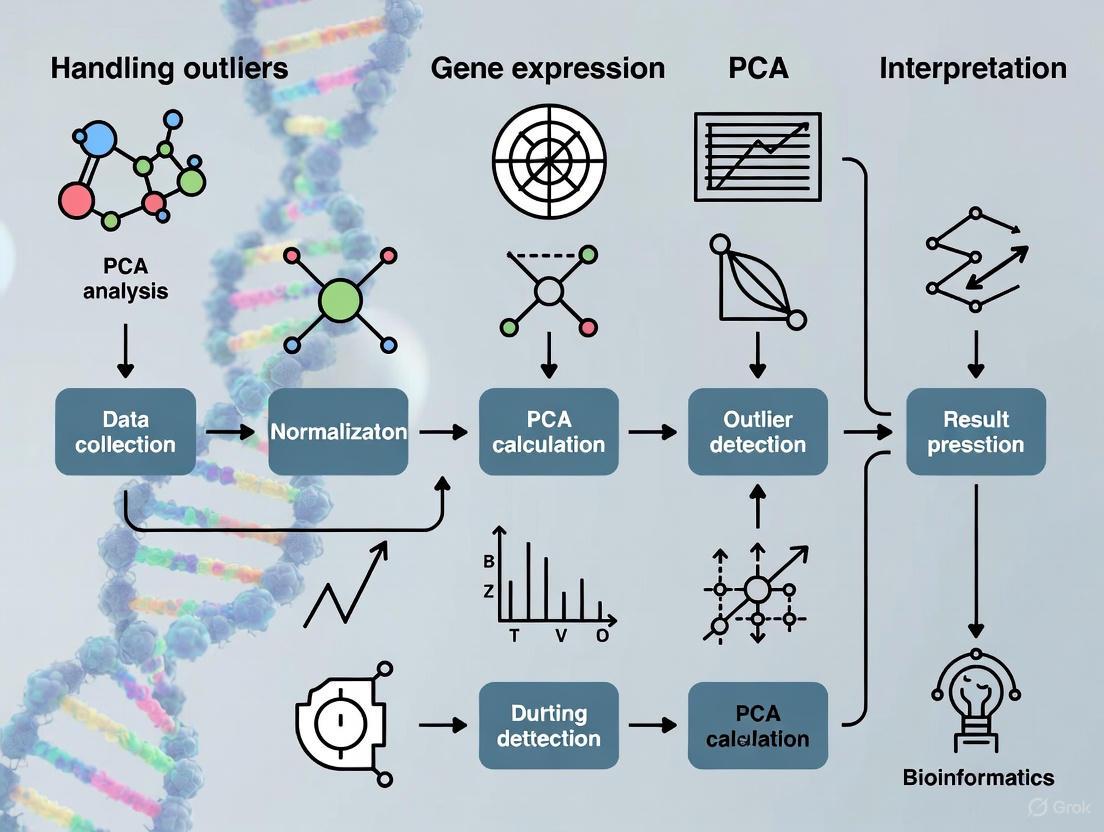
Principal Component Analysis (PCA) is a cornerstone of gene expression data exploration, but outliers can severely skew results and lead to flawed biological interpretations.
Beyond Noise: A Strategic Guide to Handling Outliers in Gene Expression PCA Analysis
Abstract
Principal Component Analysis (PCA) is a cornerstone of gene expression data exploration, but outliers can severely skew results and lead to flawed biological interpretations. This article provides a comprehensive framework for researchers and drug development professionals to understand, identify, and handle outliers in transcriptomic PCA. Moving beyond the standard practice of automatic removal, we explore the foundational theory behind outlier expression, demonstrate robust methodological applications for accurate detection, offer troubleshooting strategies for common pitfalls, and present validation techniques to compare analysis outcomes. By integrating the latest research, this guide empowers scientists to make informed decisions that enhance the reliability and biological relevance of their RNA-seq analyses.
Understanding Outliers in Transcriptomic Data: Biological Signal vs. Technical Noise
Technical Support Center
Frequently Asked Questions (FAQs)
Q1: My RNA-seq data has samples that look like outliers in PCA plots. Should I automatically remove them? No, removal is not automatic. Initial outlier detection via Robust PCA (rPCA) methods like PcaGrid is highly recommended for objectivity [1]. However, an outlier's potential biological significance must be investigated before exclusion. A growing body of evidence suggests that extreme expression values are a biological reality and may provide insights into regulatory networks or rare genetic effects [2]. The decision to remove a sample should be based on follow-up investigations into its technical or biological origin.
Q2: What is the difference between classical PCA (cPCA) and robust PCA (rPCA) for outlier detection? Classical PCA (cPCA) is highly sensitive to outlying observations. The first principal components can be artificially attracted toward outliers, potentially obscuring the true variation of the regular observations and making outlier detection unreliable [1]. Robust PCA (rPCA) uses statistical techniques to obtain principal components that are not substantially influenced by outliers. It is specifically designed to first fit the majority of the data and then accurately flag deviating data points, providing a more objective and reliable method for outlier detection [1].
Q3: Are there specific thresholds for defining "extreme" expression outliers?
Yes, multiple statistical thresholds can be used. A very conservative method uses Tukey’s fences with a high k-value. For example, defining extreme over-expression outliers (OO) as values above Q3 + 5 × IQR and extreme under-expression outliers (UO) as values below Q1 - 5 × IQR is highly stringent [2]. This threshold corresponds to approximately 7.4 standard deviations from the mean in a normal distribution (P ≈ 1.4 × 10⁻¹³). Less stringent values like k=1.5 or k=3 can also be applied depending on the desired sensitivity [2].
Q4: Can outlier expression be biologically relevant and reproducible? Yes. Studies have shown that outlier expression patterns are reproducible in independent sequencing experiments and are a universal biological phenomenon across tissues and species, including mice, humans, and Drosophila [2]. In fact, some outlier expressions have been linked to nearby rare genetic variants [3] and can occur as part of co-regulatory modules, some of which correspond to known biological pathways [2].
Q5: What tools can I use for accurate outlier sample detection?
For high-dimensional data with small sample sizes, like RNA-seq, the rPCA method implemented in the PcaGrid function (available in the rrcov R package) has demonstrated high accuracy [1]. Another modern tool is OutSingle, which uses a log-normal approach and singular value decomposition (SVD) for rapid outlier detection [4].
Troubleshooting Guides
Problem: Inconsistent outlier detection between analysts based on visual PCA inspection.
- Cause: Classical PCA biplots (PC1 vs. PC2) are subjective; visual inspection lacks statistical rigor and can be influenced by unconscious biases [1].
- Solution: Implement objective statistical methods for outlier detection. Use rPCA (e.g.,
PcaGridorPcaHubertfrom therrcovR package) to obtain a statistically justified outlier flag for each sample [1].
Problem: Suspected technical outlier due to RNA-seq protocol variation.
- Cause: Complex, multi-step RNA-seq protocols (mRNA isolation, reverse transcription, adapter ligation, etc.) are susceptible to technical variations and failures, leading to extreme sample deviation [1].
- Solution:
- Confirm with rPCA: Use rPCA to objectively identify the outlying sample(s).
- Review QC Metrics: Scrutinize raw sequence quality metrics, alignment rates, and gene body coverage for the suspected sample.
- Correlate with Processing Data: Check if the outlier correlates with specific reagent batches, library preparation dates, or sequencing runs.
- Decision: If a clear technical artifact is confirmed, removal is justified.
Problem: Detected outlier may have a biological cause.
- Cause: The outlier could stem from true biological differences, such as a rare genetic variant with a major effect on gene regulation [3] or sporadic, non-inherited activation of transcriptional networks [2].
- Solution:
- Validate Genetically: If data is available, check for rare variants near genes that are driving the outlier signal and look for evidence of allele-specific expression (ASE) [3].
- Assess Biological Consistency: Evaluate if the extreme expression affects genes in a coherent pathway or module, which would support a biological cause [2].
- Informed Decision: If biological significance is plausible, consider analyzing your data both with and without the outlier and reporting the differential findings. Its removal may not always be warranted.
Table 1: Performance Comparison of Outlier Detection Methods
| Method | Key Principle | Reported Sensitivity & Specificity | Best Use-Case |
|---|---|---|---|
| PcaGrid (rPCA) [1] | Robust statistics to fit majority of data first | 100% Sensitivity, 100% Specificity (in tested simulations) [1] | High-dimensional data (e.g., RNA-seq) with small sample sizes [1] |
| PcaHubert (rPCA) [1] | Robust PCA, high sensitivity | High Sensitivity [1] | Situations where high outlier detection sensitivity is prioritized [1] |
| OutSingle [4] | Log-normal z-scores with SVD/OHT denoising | Outperformed OUTRIDER on benchmark datasets [4] | Rapid, confounder-controlled outlier detection |
Table 2: Characterization of Expression Outliers from Multi-Tissue Studies
| Metric | Value / Finding | Context / Implication |
|---|---|---|
| Nearby Rare Variants | 58% of underexpression outliers; 28% of overexpression outliers [3] | Strongly suggests a genetic basis for many extreme expression events [3]. |
| Outliers per Individual | Median of 10 genes were multi-tissue outliers per individual (GTEx data) [3] | Extreme expression is a widespread phenomenon across individuals. |
| Inheritance of Over-expression | Most extreme over-expression is not inherited [2] | Suggests a sporadic, non-genetic origin for many over-expression outliers. |
Detailed Experimental Protocols
Protocol 1: Outlier Sample Detection using Robust PCA
This protocol is adapted from the methodology described in the study applying rPCA to RNA-seq data [1].
1. Prerequisites and Software Setup
- Software: Install R.
- R Package: Install the
rrcovpackage, which contains the necessary rPCA functions. - Input Data: A normalized gene expression matrix (e.g., TPM, FPKM, or variance-stabilized counts) with genes as rows and samples as columns.
2. Execution Steps
- Step 1: Data Preparation. Prepare your gene expression matrix, ensuring it is properly normalized to account for library size and other technical biases. Highly variable genes are often used as input for PCA.
- Step 2: Compute Robust PCA. Run the
PcaGrid()function from therrcovpackage on your prepared expression matrix. This function implements a grid-based algorithm for robust PCA. - Step 3: Extract Outlier Flags. The
PcaGridfunction output includes statistical flags for outliers. Samples identified as outliers based on their robust distance can be directly obtained from the result object. - Step 4: Visualization and Verification. Generate a PCA biplot using the output of
PcaGrid. The outliers will be automatically marked. Compare this plot to one generated using classical PCA (prcomp()) to visually confirm the differences in sensitivity.
3. Key Considerations
- Sample Size: rPCA methods like
PcaGridare well-suited for high-dimensional data with small sample sizes, a common scenario in RNA-seq studies [1]. - Validation: The study reported that
PcaGridachieved 100% sensitivity and specificity in tests with positive control outliers [1].
Protocol 2: Identification and Analysis of Extreme Expression Outliers
This protocol is based on the analysis of outlier patterns across multiple datasets [2].
1. Data Normalization and Input
- Use normalized transcript count data (e.g., TPM, CPM). Do not log-transform the data for this specific analysis, as the goal is to identify extreme absolute values [2].
2. Defining Extreme Outliers
- For each gene, calculate the first quartile (Q1), the third quartile (Q3), and the Interquartile Range (IQR = Q3 - Q1).
- Apply Tukey's fences to identify outliers:
- Over Outliers (OO): Expression value >
Q3 + k × IQR - Under Outliers (UO): Expression value <
Q1 - k × IQR
- Over Outliers (OO): Expression value >
- The choice of
kdetermines stringency. Usek = 5for a very conservative, high-confidence set of "extreme" outliers [2].
3. Biological Interpretation
- Co-regulation Analysis: Perform enrichment analysis (e.g., Gene Ontology, pathway analysis) on the set of genes that are frequent outliers to see if they belong to common regulatory modules or pathways [2].
- Genetic Validation: If genotype data is available, check for an enrichment of rare genetic variants (single-nucleotide variants, indels, or structural variants) near the transcription start sites of outlier genes, as this provides a potential mechanistic explanation [3].
Mandatory Visualizations
Diagram 1: Outlier Analysis Decision Workflow
Diagram 2: Biological Interpretation Framework for Outliers
The Scientist's Toolkit: Research Reagent Solutions
| Item / Resource | Function in Analysis | Example / Note |
|---|---|---|
rrcov R Package [1] |
Provides functions for robust statistical methods, including PcaGrid and PcaHubert for objective outlier sample detection. |
Essential for implementing the rPCA-based outlier detection protocol. |
| OutSingle Software [4] | Provides an almost instantaneous method for detecting outliers in RNA-Seq data using a log-normal approach and SVD for confounder control. | Available at: https://github.com/esalkovic/outsingle |
| GTEx Portal [3] [2] | A public resource with RNA-seq data from multiple tissues of many individuals. Used as a reference for studying population-level expression variation and outliers. | Helps contextualize whether extreme expression in a sample is truly unusual. |
| RIVER (R) [3] | An R package (RNA-informed variant effect on regulation) that uses a Bayesian model to predict the regulatory impact of rare variants by incorporating expression data. | Useful for prioritizing which rare variants near outlier genes are likely to be functional. |
| Tukey's Fences Method [2] | A statistical technique for defining outliers based on interquartile ranges (IQR). | A simple, non-parametric method to systematically flag extreme expression values for individual genes across samples. |
Principal Component Analysis (PCA) is a fundamental statistical technique used for dimensionality reduction and exploratory data analysis in high-dimensional biological research, particularly in gene expression studies. While powerful, standard PCA is highly sensitive to outliers, which can disproportionately influence the results and lead to misleading biological interpretations. This technical guide explores how extreme values skew PCA outcomes and provides robust methodologies for accurate outlier detection and handling within gene expression analysis.
Troubleshooting Guides
FAQ 1: How do I know if my PCA results are being skewed by outliers?
Answer: Outliers can significantly distort your principal components, making biological interpretation difficult. Several key indicators suggest your PCA results are being skewed by outliers [1] [5] [6]:
- Component Attraction: The first principal components are artificially attracted toward outlying points rather than capturing the true variation pattern of regular observations [1].
- Masking Effects: The presence of outliers distorts the model so severely that based on the principal components, no outliers can be detected, creating a false sense of data quality [6].
- Variance Inflation: The principal components account for variance primarily driven by quality differences rather than biological signals, reducing analytical effectiveness [7].
- Cluster Artifacts: Distinct clusters form that are driven by technical artifacts or data quality issues rather than genuine biological subpopulations [7].
Table: Indicators of Outlier Distortion in PCA Analysis
| Indicator | Description | Impact on Analysis |
|---|---|---|
| Component Attraction | First PCs drawn toward outlier positions | Misrepresentation of true data structure |
| Masking Effect | Outliers prevent detection of other anomalies | False confidence in data quality |
| Variance Inflation | PCs capture technical rather than biological variance | Reduced power for biological discovery |
| Cluster Artifacts | Formation of technically-driven clusters | Misleading biological interpretation |
FAQ 2: What is the difference between classical PCA and robust PCA for outlier detection?
Answer: Classical PCA (cPCA) and robust PCA (rPCA) differ fundamentally in their approach to and handling of outliers [1]:
Classical PCA (cPCA) utilizes standard covariance matrix estimation, which is highly sensitive to outliers. A single extreme value can substantially distort the principal components, potentially making them reflect the outlier structure rather than the majority of the data.
Robust PCA (rPCA) employs robust statistical methods that first fit the majority of the data and then flag data points that deviate from this pattern. This approach provides an objective, statistical basis for outlier identification rather than relying on visual inspection alone.
Table: Comparison of Classical PCA vs. Robust PCA
| Feature | Classical PCA | Robust PCA |
|---|---|---|
| Sensitivity to Outliers | High - outliers disproportionately influence components | Low - uses robust estimators resistant to outliers |
| Outlier Detection Method | Visual inspection of biplots (subjective) | Statistical flagging of deviations (objective) |
| Covariance Matrix Estimation | Standard sensitive estimation | Robust estimation methods |
| Performance with Small Samples | Poor with few replicates | Effective even with small sample sizes (2-6 replicates) |
| Implementation in RNA-seq | Standard approach but failed to detect known outliers | PcaGrid achieved 100% sensitivity and specificity in tests |
FAQ 3: Which robust PCA methods are most effective for gene expression data?
Answer: Research specifically evaluating rPCA methods on RNA-seq data has identified several effective approaches [1]:
PcaGrid: Demonstrated 100% sensitivity and 100% specificity in tests with positive control outliers across varying degrees of divergence. Performed optimally for high-dimensional data with small sample sizes typical of RNA-seq studies.
PcaHubert (ROBPCA): Shows high sensitivity for outlier detection, though may have a slightly higher estimated false positive rate compared to PcaGrid.
ER Algorithm: Effectively handles data containing both outliers and missing elements, making it suitable for real-world biological datasets where missing values are common [6].
These methods are implemented in the rrcov R package, which provides a common interface for computation and visualization of multiple robust PCA algorithms [1].
FAQ 4: How does outlier removal impact differential expression analysis in RNA-seq studies?
Answer: Strategic outlier removal significantly improves the performance of differential gene expression detection and downstream functional analysis [1]:
Increased Statistical Power: Removal of technical outliers reduces unnecessary variance, leading to more accurate estimation of sample variance and improved detection of truly differentially expressed genes.
Biological Insight: In a real RNA-seq study of conditional SnoN knockout mice, outlier removal enabled discovery of biologically relevant differentially expressed genes that were obscured when outliers were included.
Validation Performance: When validated with qRT-PCR, analysis strategies that included outlier removal (without batch effect modeling) performed best at detecting biologically relevant differentially expressed genes compared to approaches that retained outliers.
Experimental Protocols
Protocol 1: Implementing Robust PCA for Outlier Detection in RNA-seq Data
Principle: Robust PCA methods identify outliers by first fitting the majority of the data and then flagging observations that deviate from this pattern, providing an objective alternative to visual inspection of classical PCA biplots [1].
Workflow:
Methodology:
- Data Preparation: Begin with normalized RNA-seq count data (e.g., TPM, CPM, or normalized counts). Standardize the data to ensure equal variable contribution [1] [8].
Method Selection: Choose an appropriate robust PCA method. For high-dimensional data with small sample sizes (typical in RNA-seq), PcaGrid is recommended based on its demonstrated 100% sensitivity and specificity [1].
Implementation: Use the
rrcovR package which provides a unified interface for multiple robust PCA methods including PcaGrid and PcaHubert.Outlier Identification: Flag samples identified as statistical outliers based on robust distance measures. The algorithm automatically detects observations that deviate from the majority pattern.
Biological Evaluation: Carefully evaluate whether identified outliers represent technical artifacts or genuine biological variation. Consult experimental annotations and quality metrics.
Data Cleaning: Remove confirmed technical outliers while retaining biological variants to preserve natural biological variance.
Protocol 2: Evaluating Outlier Impact on Differential Expression Analysis
Principle: Compare differential expression results before and after outlier removal using validation data (e.g., qRT-PCR) as a reference to quantify improvement in biological relevance [1].
Workflow:
Methodology:
- Parallel Analysis: Conduct differential expression analysis using two parallel approaches: (A) retaining all samples including outliers, and (B) removing identified outliers.
Validation Standard: Perform qRT-PCR validation on a subset of differentially expressed genes identified through each approach to establish a biological relevance benchmark.
Performance Comparison: Compare the concordance between RNA-seq results and qRT-PCR validation for each approach. Research demonstrates that outlier removal typically improves validation rates.
Batch Effect Consideration: Evaluate whether batch effect modeling provides additional benefit beyond outlier removal. Some studies indicate that removing outliers without batch effect modeling may yield optimal results [1].
Strategy Selection: Implement the analysis strategy (outlier removal with or without batch effect correction) that demonstrates superior performance based on validation metrics.
The Scientist's Toolkit: Research Reagent Solutions
Table: Essential Computational Tools for Robust PCA in Gene Expression Analysis
| Tool/Resource | Function | Application Context |
|---|---|---|
| rrcov R Package | Implementation of multiple robust PCA methods (PcaGrid, PcaHubert) | Primary tool for robust outlier detection in high-dimensional data |
| PcaGrid Function | Specific robust PCA algorithm with high sensitivity/specificity | Recommended for RNA-seq data with small sample sizes (2-6 replicates) |
| PcaHubert (ROBPCA) | Alternative robust PCA method with high sensitivity | Effective outlier detection, particularly with potential false positives |
| ER Algorithm | Expectation-Robust approach for data with missing values | Handles datasets with both outliers and missing elements |
| Polyester R Package | RNA-seq data simulation | Generating positive control outliers for method validation |
| SmartPCA (EIGENSOFT) | Classical PCA implementation | Benchmarking against robust methods |
Advanced Technical Considerations
Understanding the Nature of Expression Outliers
When working with gene expression data, it's crucial to distinguish between different types of outliers [1] [2]:
Technical Outliers: Result from experimental artifacts, sample processing errors, or sequencing issues. These should be removed as they introduce non-biological variance.
Biological Outliers: Represent genuine extreme values in the biological response. These may provide important insights and should be retained, though they may require special analytical consideration.
Recent research suggests that some outlier expression patterns may reflect biological "edge of chaos" effects in transcriptional networks rather than technical artifacts [2]. These biological outliers often occur as part of co-regulatory modules and may represent sporadic over-activation of transcription in different individuals.
Statistical Framework for Outlier Identification
For objective outlier identification in gene expression data, consider these statistical approaches:
Tukey's Fences Method: Identifies outliers as values falling below Q1 - k×IQR or above Q3 + k×IQR, where IQR is the interquartile range [2]. For conservative outlier detection in transcriptomic data, k=5 (corresponding to approximately 7.4 standard deviations in a normal distribution) is recommended.
Robust Distance Measures: rPCA methods utilize robust covariance estimation and statistical distance metrics (e.g., Mahalanobis distance) to identify observations that deviate from the multivariate pattern of the majority of data [1] [6].
The appropriate threshold for outlier identification depends on your specific research context, with more conservative thresholds (higher k values) recommended for studies where biological outliers are of interest rather than technical artifacts [2].
Frequently Asked Questions
FAQ 1: Are extreme gene expression outliers just technical noise, or could they be biologically meaningful? Historically, extreme outlier values in RNA-seq data were often treated as technical errors and removed. However, with the advent of highly standardized sequencing protocols, the probability of technical error has become negligible. Recent research demonstrates that these outlier patterns are a biological reality, occurring universally across tissues and species in outbred and inbred mice, humans, and Drosophila. These outliers are fully reproducible in independent experiments and occur as part of co-regulatory modules, some corresponding to known pathways [2].
FAQ 2: What is the "Edge of Chaos" theory in the context of gene regulatory networks? The "Edge of Chaos" theory suggests that complex systems, including gene regulatory networks, can exist in a critical transition zone between highly ordered (predictable) and chaotic (unpredictable) states. New and useful developments are thought to emerge from this boundary. In transcriptomic networks, the spontaneous, non-inherited extreme over-expression observed in different individuals is interpreted as a reflection of these "edge of chaos" effects, expected in systems with non-linear interactions and feedback loops [2] [9].
FAQ 3: How can I accurately detect outlier samples in my RNA-seq dataset before analysis? Classical Principal Component Analysis (cPCA) is commonly used but is highly sensitive to outliers and relies on subjective visual inspection. For a more objective and accurate method, Robust Principal Component Analysis (rPCA), particularly the PcaGrid algorithm, is recommended. This method is designed to be less influenced by outliers when calculating components and has been shown to achieve 100% sensitivity and specificity in detecting outlier samples in RNA-seq data, even with small sample sizes [10].
FAQ 4: Should I always remove outliers from my gene expression dataset? Not necessarily. The decision should be informed by the context. While removing technical outliers can improve statistical power, removing biological outliers may lead to an underestimation of natural biological variance and increase the risk of spurious conclusions [10]. It is strongly advocated to evaluate your classifier's performance both with and without outliers to understand their impact and provide a more diverse picture of the model's robustness [11].
FAQ 5: How do I set a statistical threshold for identifying an extreme expression outlier?
A common and conservative method uses Tukey's fences based on the Interquartile Range (IQR). Outliers are identified as data points falling below Q1 - k × IQR or above Q3 + k × IQR, where Q1 and Q3 are the 1st and 3rd quartiles. For a very conservative threshold to define extreme over-expression, a k-value of 5 is recommended. This corresponds to approximately 7.4 standard deviations above the mean in a normal distribution. Expression values above this threshold are termed "over outliers" (OO) [2].
Troubleshooting Guides
Issue 1: Inconsistent Differential Expression Results Due to Outliers
Problem: Your list of differentially expressed genes (DEGs) changes dramatically depending on whether a few specific samples are included or excluded in the analysis.
Solution:
- Detect Outlier Probabilities: Implement a bootstrap procedure to calculate an outlier probability for each sample.
- Resample your dataset 100 times with replacement.
- For each resampled dataset, perform dimensionality reduction (e.g., using PCA) and use the bagplot algorithm (a bivariate boxplot) on the principal components to flag outliers in each study group.
- The outlier probability for a sample is the frequency with which it is flagged as an outlier across all bootstrap runs where it is present [11].
- Evaluate Models with Two Scenarios:
- Train and validate your classifier (e.g., SVM, Random Forest) using all samples.
- Train and validate the same classifier after removing samples with high outlier probabilities (e.g., >50%).
- Compare performance metrics (accuracy, Brier score) between the two scenarios. Reporting both provides a realistic range of your classifier's performance [11].
Issue 2: PCA Biplot is Dominated by a Few Samples, Obscuring Biological Grouping
Problem: A classical PCA plot shows that one or two samples are far from the rest, making it impossible to see the underlying clustering of your experimental groups.
Solution: Switch from classical PCA (cPCA) to Robust PCA (rPCA).
- Use an rPCA algorithm like
PcaHubertorPcaGrid(available in R packages likerrcovandpcaPP). - Interpret the Output: These methods provide a robust distance measure and orthogonal distance for each sample. Samples with high scores in both are likely outliers. The
PcaGridfunction can automatically flag these samples [10]. - Proceed with Caution: Investigate the metadata of the flagged samples (e.g., clinical details, RNA quality metrics) before deciding to remove them. The rPCA plot will now likely show a clearer separation of the main biological groups, undistorted by the outliers.
Issue 3: Validating Sporadic Over-expression in a Mouse Model
Problem: You need an experimental protocol to confirm that sporadic over-expression of a gene is non-inherited and not a technical artifact.
Solution: A Three-Generation Family Study in Mice [2]:
- Experimental Setup:
- Use outbred mouse stocks to maintain genetic diversity.
- Establish a three-generation pedigree (Grandparents, Parents, Offspring).
- Collect target tissues (e.g., liver, brain, pituitary) from all individuals.
- Perform RNA sequencing on all samples.
- Data Analysis:
- Identify "over outliers" (OO) for your gene of interest using the conservative IQR method (k=5).
- Trace the occurrence of the OO phenotype across the pedigree.
- Interpretation: If the extreme over-expression appears sporadically in an offspring but is absent in the parents (and vice-versa), it provides strong evidence that the effect is spontaneous and not genetically inherited. This supports the "edge of chaos" hypothesis of sporadic activation.
Data and Patterns of Sporadic Over-expression
Table 1: Prevalence of Extreme Outlier Genes Across Species and Tissues
This table summarizes the percentage of genes exhibiting extreme over-expression (using k=5 IQR threshold) in at least one individual within a population sample.
| Species | Strain / Population | Tissue | Sample Size (N) | Approx. % of Outlier Genes |
|---|---|---|---|---|
| Mouse | Outbred (M. m. domesticus) | Liver | 48 | ~3-10% (at k=3 IQR) [2] |
| Mouse | Outbred (M. m. domesticus) | Brain | 48 | ~3-10% (at k=3 IQR) [2] |
| Mouse | Inbred (C57BL/6) | Brain | 24 | Comparable pattern observed [2] |
| Human | GTEx Donors | Pituitary | 40 | Comparable pattern observed [2] |
| Human | GTEx Donors | Brain (snRNA-seq) | N/A | Comparable pattern observed [2] |
| Drosophila | D. melanogaster | Head & Trunk | 27 | Comparable pattern observed [2] |
Table 2: Comparison of PCA Methods for Outlier Detection in RNA-seq Data
This table compares the performance of different PCA methods when applied to RNA-seq data with potential outlier samples.
| Method | Key Principle | Sensitivity to Outliers | Outlier Detection | Best Use Case |
|---|---|---|---|---|
| Classical (cPCA) | Maximizes variance based on sample covariance matrix | High. First components are often attracted toward outliers. | Subjective, via visual inspection of biplots. | Initial, quick data exploration with clean data. |
| Robust (rPCA) - PcaGrid | Uses a grid search to find robust directions that minimize the effect of outliers. | Low. Calculates components based on the data majority. | Objective, automatic flagging of outliers based on robust distances. | Accurate and objective outlier detection in high-dimensional data with small sample sizes [10]. |
| Robust (rPCA) - PcaHubert | Combines cPCA on a robustly selected subset of data. | Low. | Objective, automatic flagging. High sensitivity. | Situations where high detection sensitivity is prioritized [10]. |
Experimental Protocols
Protocol 1: Gene Expression Profiling for Pathway Analysis
This protocol is adapted from a study comparing early-onset and late-onset rectal cancer [12].
- Sample Selection & Preparation:
- Identify cohorts (e.g., patient groups like early-onset <50 yrs vs. late-onset >65 yrs). Match samples by stage, gender, and pathology.
- Obtain Formalin-Fixed Paraffin-Embedded (FFPE) tissue blocks for tumor and matching non-involved tissue.
- Perform deparaffinization by incubating unstained tissue sections in d-limonene and ethanol baths.
- RNA Isolation:
- Macro-dissect tumor tissue from unstained sections using an H&E slide as a guide.
- Collect dissected tissue and isolate total RNA using a standardized kit.
- Gene Expression Profiling:
- Use a targeted gene expression panel (e.g., Nanostring nCounter) covering 770+ cancer-related genes across 13 canonical pathways.
- Hybridize isolated RNA to the panel and run on the digital analyzer.
- Data Analysis:
- Normalize raw count data.
- Compare tumor vs. non-involved tissues within each cohort to find significant gene expression changes (p<0.05).
- Compare the gene lists between cohorts to identify unique differentially expressed genes (>2-fold change, p<0.01).
- Perform pathway enrichment analysis to identify the most deregulated signaling pathways in each cohort (e.g., MAPK signaling in early-onset vs. PI3K-AKT in late-onset).
Protocol 2: Robust PCA for Outlier Sample Detection
This protocol uses the PCA-Grid method for reliable outlier identification [10].
- Data Preprocessing:
- Start with a normalized gene expression matrix (e.g., TPM, CPM).
- Perform feature selection by identifying Highly Variable Genes (HVGs). This reduces noise.
- Scale and center the data so that all genes contribute equally to the PCA.
- Running Robust PCA:
- Use the
PcaGridfunction from therrcovR package. - Input the preprocessed data matrix (samples as rows, HVGs as columns).
- Use the
- Identifying Outliers:
- The function output will include robust distance and orthogonal distance for each sample.
- Samples with high robust distances and high orthogonal distances are classified as outliers.
- Downstream Analysis:
- Proceed with differential expression analysis or classifier training with and without the flagged outliers to assess their impact.
The Scientist's Toolkit: Research Reagent Solutions
| Reagent / Resource | Function / Application | Example / Note |
|---|---|---|
| Targeted Gene Expression Panel | Focused profiling of cancer-related genes and pathways for hypothesis-driven research. | NanoString nCounter Panels (e.g., 770-gene Cancer Panel) [12]. |
| Robust PCA Software Package | Accurate and objective detection of outlier samples in high-dimensional RNA-seq data. | rrcov R package, containing PcaGrid and PcaHubert functions [10]. |
| Outlier Detection & Visualization Package | Identifying and visualizing outliers in multivariate data after dimension reduction. | aplpack R package for creating bagplots [11]. |
| Differential Expression Analysis Tool | Identifying statistically significant changes in gene expression between conditions. | DESeq2, edgeR, or limma packages in R/Bioconductor [2]. |
| Outbred Mouse Stocks | Model for studying sporadic, non-inherited gene expression events due to genetic diversity. | M. m. domesticus (DOM), M. m. musculus (MUS) populations [2]. |
Pathway and Workflow Diagrams
Robust PCA Workflow
Edge of Chaos Concept
Frequently Asked Questions (FAQs)
Q1: What are co-regulated outlier modules in gene expression data? Co-regulated outlier modules are groups of genes that show extreme, outlier expression levels (either extremely high or low) in a coordinated manner within specific individuals or samples. These patterns suggest that the outlier expression is not random but occurs as part of biological regulatory programs, some of which correspond to known pathways such as those involving prolactin and growth hormone [2].
Q2: Are these outlier expression patterns a technical artifact or a biological reality? Evidence from multiple, large-scale studies indicates that these patterns are a biological reality. They have been consistently observed across diverse species (mice, humans, Drosophila), tissues, and independent sequencing experiments, ruling out technical error as the primary cause [2].
Q3: How can I reliably identify outlier samples in my RNA-Seq data before PCA? Using Robust Principal Component Analysis (rPCA) methods, such as PcaGrid, is recommended for accurate outlier sample detection. These methods are specifically designed for high-dimensional data with small sample sizes and outperform classical PCA (cPCA), which can be overly influenced by outliers and fail to detect them [10].
Q4: Can outlier expression be inherited? Analysis of a three-generation family in mice shows that most extreme over-expression is not inherited but appears to be sporadically generated. This suggests a non-genetic, spontaneous origin for the majority of these events [2].
Troubleshooting Guides
Issue: PCA Results Are Skewed by Outlier Samples
Problem: Your Principal Component Analysis (PCA) plot is dominated by one or two extreme samples, making it difficult to observe the true biological variation in your dataset.
Solution: Implement a Robust PCA (rPCA) workflow.
Step-by-Step Protocol:
- Data Normalization: Use standard RNA-seq normalization methods (e.g., TPM, CPM). Do not log-transform the data at this stage if you are specifically hunting for extreme outliers [2].
- Apply Robust PCA: Use an rPCA method like
PcaGridorPcaHubert(available in therrcovR package) to model the majority of your data and objectively flag outlier samples [10]. - Review and Remove: Statistically review the flagged samples. If they are confirmed as technical outliers, remove them before proceeding with differential expression analysis.
- Re-run Analysis: Perform your downstream analysis, including classical PCA and differential expression testing, on the filtered dataset. Studies have shown that this process can significantly improve the detection of biologically relevant genes [10].
Issue: Identifying True Biological Outliers Versus Technical Noise
Problem: You have detected genes with extreme expression values but are unsure if they represent meaningful biological outliers or random technical noise.
Solution: Use a conservative, quantile-based statistical approach to define outliers and then test for co-regulation.
Step-by-Step Protocol:
- Define Outliers Conservatively:
- For each gene, calculate the Interquartile Range (IQR = Q3 - Q1).
- Set a stringent threshold for extreme over-expression outliers (OO), for example, values above
Q3 + 5 * IQR. This corresponds to a P-value of approximately (1.4 \times 10^{-13}) in a normal distribution, minimizing false positives [2].
- Check for Reproducibility: If possible, confirm the outlier expression in an independent experimental replicate to rule out technical noise [2].
- Test for Co-regulation:
Documented Patterns of Co-regulated Outliers
The following tables summarize key evidence from published case studies.
Table 1: Evidence Across Species and Tissues
| Species | Tissue / Organ | Key Finding | Reference |
|---|---|---|---|
| Mouse (Outbred & Inbred) | Brain, Liver, etc. | Different individuals harbor very different numbers of outlier genes; patterns occur as co-regulatory modules. | [2] |
| Human (GTEx data) | Pituitary, etc. | Prolactin and growth hormone genes are among co-regulated genes with extreme outlier expression. | [2] |
| Drosophila melanogaster | Head, Trunk | Comparable general patterns of outlier gene expression, indicating a universal biological effect. | [2] |
| Drosophila simulans | Whole fly | Comprehensive eQTL maps show the network organization of the transcriptome, underlying regulatory patterns. | [14] |
Table 2: Characteristics of Outlier Expression
| Characteristic | Description | Biological Implication | |
|---|---|---|---|
| Prevalence | ~3-10% of genes show extreme outlier expression in at least one individual (at k=3 IQR threshold). | The phenomenon is widespread and not rare. | [2] |
| Inheritance | Most extreme over-expression is not inherited but sporadic. | Suggests a non-Mendelian, potentially stochastic origin. | [2] |
| Sample Size Dependence | Number of detected outlier genes decreases with smaller sample sizes, but about half are detectable with only 8 individuals. | Studies with small n may still observe this phenomenon. | [2] |
Experimental Protocols
Protocol 1: Detecting Co-regulated Outlier Modules from RNA-seq Data
This protocol is adapted from methodologies used in cross-species studies of outlier expression [2].
- Data Collection: Obtain normalized transcript count data (e.g., TPM, CPM) from a population of individuals. Include multiple individuals and, if possible, multiple tissues.
- Outlier Gene Identification:
- For each gene in each tissue, calculate the first quartile (Q1), third quartile (Q3), and Interquartile Range (IQR).
- Identify extreme over-expression outliers (OO) for a gene in a sample if its value is greater than
Q3 + k * IQR. A value ofk=5is recommended for a conservative, high-confidence set [2]. - A gene is considered an "outlier gene" if it has at least one OO in the dataset.
- Co-expression Network Construction:
- Construct a gene co-expression network using all genes and samples (e.g., using WGCNA).
- Identify modules of highly connected, co-expressed genes.
- Integration and Validation:
- Overlap the list of "outlier genes" with the members of each co-expression module.
- A co-regulated outlier module is indicated when a statistically significant number of genes within a single co-expression module are also outlier genes.
- Validate the biological relevance of the identified module through functional enrichment analysis (e.g., Gene Ontology).
Protocol 2: Functional Validation of a Specific Module using Chimeroids
This protocol is based on a study that validated a deep-layer neuron-associated meta-module [15].
- Identify a Key Module: From your co-expression network analysis, select a co-regulated outlier module of interest for functional testing (e.g., "meta-module 20" from the human cortex study).
- Select Hub Genes: Identify the key hub genes (e.g., FEZF2, TSHZ3) within the module that are likely to be drivers of its activity.
- Generate a Human Cortical Chimeroid Model: Use a pluripotent stem cell (iPSC)-based system to create a chimeroid—a combined cortical organoid generated from multiple donor lines that models human cortical development [15].
- Perform Gene Knockdown: Use CRISPR or shRNA to knock down the expression of the identified hub genes (e.g., FEZF2 and TSHZ3) in the chimeroid model.
- Assess Phenotype: Use single-cell RNA sequencing and immunostaining to measure the effect of the knockdown on the activity of the entire module and on the resulting cell type specification (e.g., the generation of deep layer neurons). This validates the module's functional role [15].
Workflow and Pathway Diagrams
Outlier Module Analysis Workflow
Robust PCA Outlier Detection Workflow
The Scientist's Toolkit: Research Reagent Solutions
Table 3: Essential Materials and Resources for Research
| Item / Resource | Function / Application | Example / Source |
|---|---|---|
| GTEx Portal | Provides access to human gene expression data across multiple tissues for identifying and comparing outlier patterns. | https://www.gtexportal.org/ [2] |
| rrcov R Package | Implements robust statistical methods, including the PcaGrid and PcaHubert functions for reliable outlier sample detection. | R Package rrcov [10] |
| International Mouse Phenotyping Consortium (IMPC) | Provides extensive phenotypic data on knockout mice, useful for linking outlier gene modules to complex physiological traits. | https://www.mousephenotype.org/ [16] |
| Drosophila Outbred Synthetic Panel (Dros-OSP) | A resource for complex trait mapping in Drosophila, enabling the study of cis and trans regulation of transcriptional variation. | N/A [14] |
| WGCNA R Package | Used for constructing weighted gene co-expression networks to identify modules of highly correlated genes. | R Package WGCNA [2] [13] |
| Human Cortical Chimeroids | A stem cell-derived model system for functionally validating the role of specific gene modules in human cortical development and disease. | Protocol in [15] |
Robust Detection Methods: From Traditional Filters to Advanced Statistical Frameworks
Troubleshooting Guides and FAQs
Frequently Asked Questions
Q1: What is the proper interpretation of data points flagged outside of Tukey's fences? A1: Points flagged by Tukey's fences should be interpreted as potential outliers worthy further investigation, not as automatic candidates for removal [17]. In the context of gene expression analysis, these points could represent [18]:
- Technical artifacts from complex multi-step RNA-seq protocols
- True biological variation that is rare but meaningful
- Sample contamination or preparation failures The key is to carefully investigate the nature of each flagged sample before deciding on appropriate handling.
Q2: Why am I detecting a high number of outliers in my seemingly normal gene expression dataset? A2: A high detection rate, especially with the default multiplier of k=1.5, can be expected, particularly as sample size increases [19]. This occurs because:
- The IQR method is non-parametric and does not assume a normal distribution. Gene expression data often follows non-normal distributions (e.g., negative binomial), which can naturally produce more values outside the fences [4].
- With larger sample sizes (even n>100), the probability of detecting at least one outlier using k=1.5 becomes very high, even for data from a standard normal distribution [19].
Q3: How do I choose between the 1.5 and 3.0 multipliers for my IQR-based threshold? A3: The choice involves a trade-off between sensitivity and stringency [18]:
- k = 1.5: Identifies "regular" outliers. Use this for initial, exploratory screening where you want to flag any potential anomaly for further review.
- k = 3.0: Identifies "far" outliers. Use this for conservative outlier calling, especially in small datasets or when you have a low tolerance for false positives. Consider starting with k=1.5 for a comprehensive overview and using k=3.0 for defining outliers you are highly confident represent anomalous data points.
Q4: My dataset has a small sample size (n < 10). Is Tukey's Fences method still reliable? A4: The method's effectiveness diminishes with small sample sizes [20]. With fewer data points, the calculated quartiles (Q1 and Q3) become less stable and may not accurately represent the true distribution of your data. This can lead to both missed outliers and false positives. For very small sample sizes, visual inspection and domain knowledge become increasingly important, and you might consider more specialized methods developed for low-N studies [1].
Q5: How does the IQR method compare to Z-score for outlier detection in non-normal gene expression data? A5: The IQR method is generally more robust for gene expression data [18].
- Z-score Method: Relies on the mean and standard deviation, which are highly sensitive to outliers. It works best when data closely follows a normal distribution.
- IQR Method: Uses quartiles, which are less influenced by extreme values. This makes it more reliable for the skewed distributions often encountered with biological data like RNA-seq counts [18] [4].
Q6: After identifying an outlier sample in my PCA, what steps should I take before removing it? A6: Before removal, undertake a careful investigative process [1]:
- Check Technical Quality: Review RNA quality metrics (RIN scores), sequencing depth, alignment rates, and any lab notes for the sample.
- Re-examine Biology: Verify sample identity and phenotype. Could this "outlier" represent a valid but rare biological state?
- Assess Impact: Re-run your downstream analysis (e.g., differential expression) with and without the suspected outlier. Does its removal dramatically change the biological conclusions? If it does, exercise extreme caution.
- Document: Record the identity of the outlier, the reason for its suspected anomaly, and the impact of its removal on your results.
Troubleshooting Common Experimental Issues
Problem: Inconsistent outlier detection results between different analysis software. Solution: Inconsistencies often arise from different algorithms for calculating quartiles.
- Action Plan:
- Verify Calculation Methods: Check if your software uses the "Tukey" method for quartile calculation or another approximation (e.g., "Moore & McCabe").
- Standardize Your Pipeline: Use a single, documented method for all analyses. In R, you can use
boxplot.stats(x, coef = 1.5)$outfor a standardized approach. - Manual Calculation for Verification: For critical datasets, manually calculate the fences using a defined method to confirm software output.
Problem: Outlier detection flags biologically critical samples as anomalies. Solution: This highlights the conflict between statistical outliers and biological significance.
- Action Plan:
- Context is Key: Do not remove samples automatically. A statistically extreme value might be the most biologically interesting one (e.g., a severe disease phenotype or a strong drug responder).
- Leverage Replicates: If you have sufficient biological replicates, the natural biological variance might be better captured, making true biological "outliers" less extreme.
- Report Transparently: Always report the number and identity of samples flagged as outliers and your justification for their handling (inclusion, exclusion, or transformation) in your methods section.
Problem: Weak separation in PCA plot, making visual outlier detection difficult. Solution: Visual inspection of PCA plots is subjective. Implement an objective method like Robust PCA (rPCA).
- Action Plan:
- Use Robust PCA: Methods like
PcaGridorPcaHubert(available in therrcovR package) are designed to be less influenced by outliers when calculating principal components [1]. - Compare with Classical PCA: Run both classical PCA (cPCA) and rPCA. Outliers that strongly influence the principal components in cPCA will be clearly identified by the rPCA algorithm.
- Benchmark Performance: Studies on RNA-seq data have shown that rPCA can accurately detect outlier samples that cPCA misses, leading to improved differential expression analysis downstream [1].
- Use Robust PCA: Methods like
Experimental Protocols & Data Presentation
Quantitative Guide to Outlier Probability
The probability of detecting outliers using Tukey's Fences varies significantly with sample size, the chosen multiplier (k), and the underlying data distribution [19].
Table 1: Probability of observing at least one outlier in a normally distributed dataset
| Sample Size | k = 1.5 | k = 2.0 | k = 3.0 |
|---|---|---|---|
| 20 | ~40% | ~20% | ~5% |
| 50 | ~60% | ~30% | ~7% |
| 100 | ~80% | ~40% | ~8% |
| 500 | ~95% | ~70% | ~12% |
Table 2: Relative outlier detection rate across different distributions (k=1.5, large n)
| Distribution | Detection Rate Characteristic |
|---|---|
| Normal | Baseline |
| Exponential | Very High |
| Gumbel | High |
Protocol: Implementing Conservative Outlier Calling for Gene Expression PCA
This protocol outlines a conservative, two-stage approach to outlier detection, combining Tukey's Fences with Robust PCA for gene expression studies.
1. Materials and Software Requirements
- Input Data: A normalized gene expression matrix (e.g., TPM, FPKM, or variance-stabilized counts).
- Software: R statistical environment.
- Key R Packages:
rrcov(forPcaGrid),stats(forboxplot.stats).
2. Step-by-Step Procedure
- Step 1: Data Preprocessing
- Begin with a high-quality, normalized gene expression matrix. Log-transform the data if working with count-based metrics (e.g., from RNA-seq) to better approximate a normal distribution for distance-based methods.
Step 2: Initial Screening with Tukey's Fences on PCs
- Perform a classical PCA (cPCA) on the preprocessed data.
- Extract the first several principal components (PCs) that explain the majority of the variance.
- Apply Tukey's Fences with a conservative multiplier (k=3.0) to each of the top PCs independently. This helps identify samples that are extreme in any major dimension of variation.
- In R, for one PC:
outliers_pc1 <- boxplot.stats(pc_scores[,1], coef = 3)$out
Step 3: Confirmatory Analysis with Robust PCA
- Run Robust PCA (e.g.,
PcaGridfunction) on the preprocessed data. PcaGridis particularly recommended due to its high specificity and accuracy in high-dimensional data with small sample sizes [1].- The function will output an ordered list of observations based on their robust distance, flagging potential outliers.
- Run Robust PCA (e.g.,
Step 4: Consensus and Validation
- Create a consensus list of outlier samples by taking the union of samples flagged in both Step 2 and Step 3.
- Investigate the nature of each consensus outlier sample as described in the troubleshooting guide (FAQ Q6).
- Validate the impact of outlier removal by re-running the differential expression analysis and checking if the results are more biologically coherent or align better with validation data (e.g., qRT-PCR).
The following workflow diagram illustrates this multi-step protocol:
The Scientist's Toolkit
Research Reagent Solutions for RNA-seq Quality Control
Before applying statistical outlier detection, ensuring high-quality input data is crucial. The following table lists key reagents and tools used in the generation of RNA-seq data, where failures can lead to technical outliers.
Table 3: Essential Materials for RNA-seq QC and Analysis
| Item | Function in Experimental Pipeline |
|---|---|
| RNA Integrity Number (RIN) | A quantitative measure of RNA quality (1-10) from instruments like the Agilent Bioanalyzer. Low RIN (<8) is a primary source of technical outliers. |
| SPRIselect Beads | Used for post-fragmentation size selection to isolate a specific insert size range. Inconsistent performance can cause library prep anomalies. |
| UMIs (Unique Molecular Identifiers) | Short nucleotide barcodes added to each molecule during library prep to correct for PCR amplification bias, reducing technical noise. |
| ERCC RNA Spike-In Mixes | A set of synthetic RNA transcripts at known concentrations used as external controls to assess technical variation and validate outlier calls. |
| rrcov R Package | Provides the PcaGrid and PcaHubert functions for performing Robust Principal Component Analysis, an objective method for outlier sample detection [1]. |
Visualizing the Relationship Between Data Distribution and Outlier Detection
The following diagram illustrates how the underlying distribution of data affects the number of observations flagged as outliers by Tukey's Fences, explaining why non-normal data often yields more outliers.
Welcome to the technical support center for Robust Principal Component Analysis (rPCA). This resource is designed for researchers and scientists working with high-dimensional RNA-seq data, where accurately identifying outlier samples is crucial for ensuring the integrity of downstream analysis. Classical PCA (cPCA) is highly sensitive to outliers, which can distort the principal components and mask the true biological variation [21]. This guide provides a deep dive into two robust methods, PcaGrid and PcaHubert, offering detailed troubleshooting and protocols to help you implement these techniques effectively within your gene expression research.
Frequently Asked Questions (FAQs)
Q1: What are PcaGrid and PcaHubert, and how do they differ from classical PCA?
A: PcaGrid and PcaHubert are two specific algorithms for Robust Principal Component Analysis (rPCA). The core difference from classical PCA (cPCA) lies in their approach to fitting the principal components. While cPCA uses all data points, including outliers, to calculate the components (making it sensitive to corruption), rPCA methods first fit a model to the "typical" majority of the data [22]. They then flag as outliers those points that deviate significantly from this model. In practice, PcaGrid has been shown to achieve 100% sensitivity and specificity in tests with RNA-seq data, accurately identifying outliers that cPCA can miss [22] [23].
Q2: I am using DESeq2. How do I properly format my data for PcaGrid or PcaHubert?
A: This is a common point of confusion. The rlog-transformed data from DESeq2 is an excellent choice for input. However, the functions for PcaGrid and PcaHubert typically expect the data matrix where rows are variables (genes) and columns are observations (samples). The standard output from assay(rlog(dds)) is transposed from this format. You must transpose it before analysis [24].
- Correct Code Example:
Q3: My rPCA plot shows thousands of points instead of one per sample. What went wrong?
A: This occurs when the input data matrix is not transposed. If you provide the matrix with genes as rows and samples as columns, the algorithm will incorrectly treat each gene as an observation and try to find outlier genes. Transposing the matrix so that samples are rows ensures that each point on the plot represents a single sample, allowing for correct outlier sample detection [24].
Q4: Why should I use rPCA over other visualization methods like t-SNE or UMAP for quality assessment?
A: While t-SNE and UMAP are powerful for visualizing complex cluster structures, PCA (and by extension, rPCA) remains superior for initial quality assessment and outlier detection for three key reasons [25]:
- Interpretability: PCA components are linear combinations of original features, allowing you to investigate which genes drive the variation.
- Parameter Stability: PCA is deterministic, while t-SNE and UMAP results can vary significantly based on hyperparameter choices.
- Quantitative Assessment: PCA provides objective metrics like explained variance, enabling statistical outlier detection.
Q5: After identifying an outlier sample, what is the recommended next step?
A: Identifying an outlier is not an automatic reason for removal. The recommended workflow is:
- Investigate Metadata: Correlate the outlier status with available sample metadata (e.g., batch, sequencing depth, sample group).
- Validate Technically: Check for technical issues like RNA degradation, low sequencing quality, or sample mislabeling.
- Evaluate Biologically: Consider if the "outlier" represents a genuine, rare biological state relevant to your research question.
- Perform Downstream Analysis: As demonstrated in the foundational RNA-seq study, a key step is to run your differential expression analysis both with and without the flagged outliers and evaluate the impact on the biological relevance of the results using an independent validation method like qRT-PCR [22].
Troubleshooting Guides
Issue 1: Poor Separation in Outlier Maps
Problem: The resulting outlier map from PcaGrid or PcaHubert does not show clear separation between potential outliers and the main cluster of samples.
Solutions:
- Check Data Preprocessing: Ensure the input data (e.g., rlog-transformed counts) is properly normalized. Inconsistent normalization can mask true outliers.
- Review the
kParameter: Thekparameter inPcaGrid(t(rlog_mat), k=2)defines the number of principal components to use. Using too few components might not capture the full variance structure. Experiment with a slightly higherk(e.g., 3-5). - Confirm Outlier Presence: It is possible your dataset simply does not contain strong outlier samples.
Issue 2: Handling Inherently High-Variance Groups
Problem: Your experiment includes biological groups with inherently different variance structures (e.g., different tissue types). A global rPCA analysis might incorrectly flag entire groups as outliers.
Solutions:
- Group-Specific Analysis: Consider running rPCA separately within each biological group of interest to identify outliers within groups [25].
- Incorporate Design Information: For advanced users, explore methods that can incorporate experimental design into the outlier detection model, though this may not be directly available in standard rPCA functions.
Experimental Protocols & Workflows
Core Protocol: Detecting Outlier Samples in RNA-seq Data
This protocol outlines the steps to identify outlier samples from an RNA-seq dataset using the PcaGrid method in R [22] [24].
1. Research Reagent Solutions
| Item | Function in the Experiment |
|---|---|
| RNA-seq Count Matrix | The primary high-dimensional input data, containing raw or normalized read counts for genes across all samples. |
| DESeq2 R Package | Used for data normalization and stabilization of variance via its rlog or vst transformation. |
| rrcov R Package | Provides the implementation of the PcaGrid and PcaHubert functions used for robust PCA. |
| qRT-PCR Validation Assay | An independent method used to confirm the biological relevance of differential expression results after outlier removal. |
2. Step-by-Step Methodology
Step 1: Data Preprocessing and Transformation
- Begin with a count matrix from your RNA-seq pipeline.
- Use the DESeq2 package to perform a regularized-log (rlog) transformation. This stabilizes variance across the mean and makes the data more suitable for PCA.
dds <- DESeqDataSetFromMatrix(countData = cts, colData = coldata, design = ~ condition)dds <- DESeq(dds)rld <- rlog(dds)
Step 2: Data Matrix Transposition
- Extract the transformed data and transpose it. This critical step ensures samples are rows and genes are columns.
rlog_mat <- assay(rld)transposed_mat <- t(rlog_mat)
Step 3: Execute Robust PCA
- Run the
PcaGridalgorithm on the transposed matrix. pcaG <- PcaGrid(transposed_mat, k=2)
- Run the
Step 4: Visualize and Interpret Results
- Plot the results to view the outlier map.
plot(pcaG)- The outlier map will display a plot of Orthogonal Distance vs. Score Distance. Samples in the upper-right corner (high orthogonal and score distances) are classified as outliers.
Step 5: Extract Outlier Flags
- Programmatically identify which samples were flagged as outliers.
outlier_samples <- which(pcaG@flag == FALSE)print(outlier_samples)
The following workflow diagram summarizes the key steps and decision points in this protocol.
The application of rPCA, particularly PcaGrid, has been quantitatively validated in genomic studies. The table below summarizes key performance metrics from a benchmark study on RNA-seq data [22].
Table 1: Performance of PcaGrid in Outlier Detection on RNA-seq Data
| Dataset Type | Method | Sensitivity | Specificity | Key Finding |
|---|---|---|---|---|
| Simulated Data with Positive Controls | PcaGrid | 100% | 100% | Accurately identified all outliers with varying degrees of divergence. |
| Real Mouse Cerebellum Data | Classical PCA (cPCA) | Failed to detect outliers | - | cPCA was distorted by outliers, missing samples that rPCA found. |
| Real Mouse Cerebellum Data | PcaGrid & PcaHubert | 100% (2/2 outliers) | 100% | Both rPCA methods agreed on the same two outlier samples. |
Technical Diagrams
Conceptual Relationship between PCA Methods
The following diagram illustrates the core conceptual difference between classical PCA and the two robust methods discussed here.
## Frequently Asked Questions (FAQs)
Q1: What is the core advantage of using a Bayesian framework for outlier detection in N-of-1 gene expression studies?
The primary advantage lies in its ability to formally incorporate prior knowledge and handle complex data structures. Unlike methods that treat outliers as mere noise, the Bayesian paradigm allows you to integrate subjective beliefs or external evidence (e.g., from previous studies or established biological pathways) with the experimental data from a single sample through a prior distribution [26]. This results in a posterior probability that quantifies the updated belief about a gene's expression being an outlier, providing a direct probabilistic interpretation of the results [26]. Furthermore, Bayesian models can be flexibly extended to account for specific data characteristics like trend and autocorrelation, which are common in time-series gene expression data [26].
Q2: My outlier detection results are highly sensitive to my choice of the neighborhood parameter (k). How can I make my analysis more robust?
Parameter sensitivity is a common challenge in distance- or density-based methods. To enhance robustness, you can:
- Utilize Tightest Neighbors (TN): Consider algorithms that leverage the concept of "tightest neighbors," which can be less sensitive to the specific choice of
kcompared to standard k-nearest neighbor approaches. The TN relationship focuses on mutual proximity, which can provide a more stable foundation for local density estimation [27]. - Explore Parameter-Insufficient Algorithms: Some modern algorithms, like the TNOF, are designed to be less sensitive to the parameter
k, especially when it is selected within an appropriate range of values. This can provide more stable detection performance across different dataset characteristics [27]. - Benchmark with a Stability Metric: Implement a gene expression stability metric, such as the gene homeostasis Z-index. This method identifies genes that are actively regulated in a small subset of cells by testing for deviation from a negative binomial distribution, offering an alternative to parameter-dependent local density calculations [28].
Q3: When analyzing a single sample (N-of-1), what strategies can I use to dynamically select a valid comparison set for identifying outliers?
For a true N-of-1 scenario, you must construct a reference distribution from external data.
- Leverage Public Repositories: Use large-scale public transcriptome datasets (e.g., GTEx, TCGA) as a source for stable, population-level gene expression distributions for the tissue or cell type of interest [2] [29].
- Apply a Conservative Outlier Threshold: Define outliers using a robust statistic like the Interquartile Range (IQR). A common and conservative threshold is Q3 + 5 × IQR for over-expression outliers, which corresponds to an extremely low p-value under a normal assumption and helps control for false positives [2].
- Incorporate Prior Knowledge via Bayesian Modeling: Use a Bayesian model to formally incorporate the public repository data as an informative prior distribution. When you then update this prior with your N-of-1 sample's data, the resulting posterior distribution provides a principled and dynamic framework for identifying values that are extreme relative to the established baseline [26] [30].
Q4: How should I handle the high computational cost of recalculating outlier scores when new gene expression data arrives sequentially?
For streaming data or when sequentially adding new samples, incremental algorithms are essential.
- Adopt an Efficient Incremental LOF (EILOF) Algorithm: The EILOF algorithm is designed for data streams. Instead of recalculating Local Outlier Factor (LOF) scores for the entire dataset when a new point arrives, it computes scores only for the new data points. This approach significantly reduces computational overhead while maintaining, and in some cases even improving, detection accuracy as more data streams in [31].
## Troubleshooting Guides
### Problem: High False Positive Rate in Outlier Detection
Symptoms: An unreasonably large number of genes are flagged as outliers, many of which are not biologically plausible or are not reproducible in technical replicates.
Diagnosis and Solution:
| Step | Action | Technical Detail |
|---|---|---|
| 1 | Validate Outlier Calls | Check if identified outliers are reproducible in independent experimental replicates [2]. |
| 2 | Adjust Outlier Threshold | Switch from a mild (e.g., k=1.5) to a stringent threshold (e.g., k=5.0 IQR) to reduce false positives [2]. |
| 3 | Inspect Reference Set | Ensure your comparison set or background distribution is derived from a biologically matched and technically comparable cohort [2] [29]. |
| 4 | Model Data Structure | For time-series data, use a Bayesian model that includes terms for trend and autocorrelation to prevent misinterpreting temporal patterns as outlier effects [26]. |
### Problem: Inability to Detect Subtle, Local Outliers
Symptoms: Global outlier detection methods fail to identify anomalies that are only apparent within a specific, local neighborhood of the data space, such as a rare cell subpopulation.
Diagnosis and Solution:
| Step | Action | Technical Detail |
|---|---|---|
| 1 | Shift to Local Methods | Replace global thresholding (e.g., using Z-scores) with local density-based methods like the Local Outlier Factor (LOF) algorithm [27] [31]. |
| 2 | Employ Tightest Neighbors | Implement algorithms that use "tightest neighbors" (TN), which can more effectively reveal local outliers that appear as separate branches in the TN graph [27]. |
| 3 | Leverage Stability Metrics | Apply the gene homeostasis Z-index, which is specifically designed to detect genes with extreme expression in a small proportion of cells by identifying deviations in the "k-proportion" statistic [28]. |
## Experimental Protocols for Key Methodologies
### Protocol 1: Bayesian N-of-1 Model Setup for Gene Expression
This protocol outlines the steps to implement a basic Bayesian model for analyzing a continuous outcome (e.g., normalized gene expression count) in a single-sample trial, incorporating a prior derived from a large external cohort [26] [30].
1. Define the Model Structure: A simple model for the observed expression value ( Yj ) of a specific gene at time ( j ) is: ( Yj = \mu + \epsilonj ) where ( \mu ) is the underlying mean expression level for the individual, and ( \epsilonj \sim N(0, \sigma^2) ) is the random error [26].
2. Specify the Prior Distributions:
- For ( \mu ): Use an informative prior based on your external cohort data. If the cohort mean and standard deviation are ( m{ext} ) and ( sd{ext} ), then ( \mu \sim N(m{ext}, sd{ext}^2) ).
- For ( \sigma^2 ): A common choice is a weakly informative prior, such as an Inverse-Gamma distribution.
3. Compute the Posterior Distribution: Using the N-of-1 sample's data ( y = (y1, \dots, yJ) ), compute the posterior distribution of ( \mu ) given the data, ( p(\mu | y) ), via Bayes' Theorem. This is often accomplished using Markov chain Monte Carlo (MCMC) sampling in software like Stan or JAGS [26].
4. Identify Outliers: A new expression measurement ( Y_{new} ) can be flagged as an outlier if its value falls in the extreme tails (e.g., outside the 95% Posterior Predictive Interval) of the posterior predictive distribution [26].
### Protocol 2: Outlier Detection in PCA Space using Hotelling's T² and SPE
This protocol uses Principal Component Analysis (PCA) to reduce dimensionality and two related metrics to detect outliers in the multivariate space [32].
1. Model Training:
- Collect a reference dataset of gene expression profiles (e.g., from public repositories) that represents a "normal" or "standard" population.
- Fit a PCA model on this reference dataset. Determine the number of principal components ( A ) to retain that capture the majority of the systematic variation.
2. Calculation of Outlier Metrics for a New Sample: For each new sample (your N-of-1 case), project its gene expression vector onto the PCA model from the reference set and calculate two statistics:
- Hotelling's T²: Measures the variation within the PCA model (how far the sample's projection is from the center of the scores). ( T^2 = \sum{a=1}^A \frac{ta^2}{\lambdaa} ), where ( ta ) is the score for component ( a ) and ( \lambda_a ) is the eigenvalue of component ( a ) [32].
- Squared Prediction Error (SPE) or DmodX: Measures the variation not captured by the PCA model (how well the sample fits the model). ( SPE = \sum{i=1}^m (x{i,new} - \hat{x}{i,new})^2 ), where ( x{new} ) is the original data and ( \hat{x}_{new} ) is the data reconstructed from the PCA model [32].
3. Outlier Decision: The new sample is considered an outlier if either its T² or SPE value exceeds a pre-defined control limit, typically derived from the reference distribution (e.g., the 95th percentile).
## Visualization of Workflows
### N-of-1 Bayesian Outlier Analysis
### PCA Multivariate Outlier Detection
## The Scientist's Toolkit: Research Reagent Solutions
The following table details key computational and data resources essential for implementing the outlier detection frameworks described.
| Resource / Solution | Function in Analysis | Key Characteristics |
|---|---|---|
| Public Transcriptome Datasets (e.g., GTEx, TCGA) | Provides a stable, population-derived reference distribution for dynamic comparison set selection in N-of-1 analyses [2] [29]. | Multi-tissue, multi-individual; enables robust baseline establishment. |
| Bayesian Modeling Software (e.g., Stan, JAGS, PyMC) | Enables fitting of complex Bayesian models (e.g., with priors, trend, autocorrelation) and computation of posterior/predictive distributions [26]. | Uses MCMC sampling; flexible model specification. |
| FRASER / FRASER2 Algorithm | Detects aberrant splicing events (splicing outliers) from RNA-seq data, useful for identifying rare spliceopathies in a transcriptome-wide manner [29]. | Focuses on intron retention and other splicing anomalies; used for pattern-based diagnosis. |
| Gene Homeostasis Z-index | A stability metric that identifies genes with significant upregulation in a small subset of cells, based on deviation from a negative binomial distribution ("k-proportion") [28]. | Detects active regulation; complements variance-based metrics. |
| Efficient Incremental LOF (EILOF) | An algorithm for detecting outliers in streaming data; updates outlier scores for new points only, drastically reducing computation time [31]. | Designed for data streams; maintains accuracy with high efficiency. |
Core Workflow: From Raw Data to Count Matrix
This section details the primary steps for converting raw sequencing data into a gene expression count matrix, which serves as the foundation for all subsequent outlier analysis.
FASTQ to Count Matrix: Step-by-Step Methodology
The process of generating a gene expression matrix from raw FASTQ files involves precise preparation and alignment steps. The following workflow outlines this critical pathway.
Step 1: Experimental Library Preparation
Before running alignment pipelines, you must prepare two critical metadata files:
1. library.csv File Structure: This file defines the relationship between your FASTQ files and their assay types [33].
| fastqs | sample | library_type |
|---|---|---|
| path/to/fastqs/directory/ | SampleNameGEX | Gene Expression |
| path/to/fastqs/directory/ | SampleNameHTO | Antibody Capture |
- fastqs: Path to the directory containing FASTQ files. The files must follow CellRanger nomenclature (e.g.,
CTRL1_S1_L001_R1_001.fastq) [33]. - sample: The sample name for the corresponding FASTQ files [33].
- library_type: The assay type, typically "Gene Expression" or "Antibody Capture" for HTO analysis [33].
2. feature_ref.csv File Structure (for HTO/demultiplexing): This file defines the HTOs (Hashtag Oligos) used to demultiplex pooled samples [33].
| id | name | read | pattern | sequence | feature_type |
|---|---|---|---|---|---|
| Hash1 | B0251_TotalSeqB | R2 | 5PNNNNNNNNNN(BC) | GTCAACTCTTTAGCG | Antibody Capture |
- id: Barcode ID for tracking feature counts [33].
- sequence: The nucleotide sequence of the barcode [33].
- feature_type: Must match a
library_typein thelibrary.csvfile [33].
Step 2: Alignment and Quantification
The core processing can be handled by specialized pipelines. Key options include:
- CellRanger Workflow: The 10x Genomics CellRanger
countpipeline is a standardized method for processing single-cell RNA-seq data. It performs alignment, filtering, barcode counting, and UMI counting to generate a filtered feature-barcode matrix [33]. Successful execution is indicated by the "Pipestance completed successfully!" message [33]. - STARsalmon nf-core Workflow: For bulk RNA-seq data, a robust best-practice option is the nf-core RNA-seq workflow. This pipeline uses STAR for splice-aware alignment to the genome and Salmon for alignment-based quantification, effectively handling the uncertainty in read assignment to genes or transcripts [34]. This hybrid approach provides comprehensive quality control metrics from STAR alignments while leveraging Salmon's statistical model for accurate count estimation [34].
Output: The final output of this step is a count matrix, where rows represent genes (features) and columns represent individual cells or samples [33] [34]. The files are typically found in a directory named filtered_feature_bc_matrix [33].
Troubleshooting Guides & FAQs
FAQ 1: My alignment pipeline failed or produced an unexpected count matrix. What should I do?
Problem: A common error is using a bulk RNA-seq aligner like STAR in standard mode for single-cell data, which results in a matrix with very few columns (e.g., 3), as the software interprets the data as a bulk experiment [35].
Solution:
- For single-cell data: Ensure you use a pipeline designed for single-cell data, such as CellRanger or STARsolo, which can properly handle cell barcodes and UMIs [33] [35].
- Check the error logs: If CellRanger fails, check the logs in
~/working_directory/step1/sample/ouput_folder.logfor specific error messages [33]. - Verify file preparation: Double-check that your
library.csvandfeature_ref.csvfiles are correctly formatted and that the paths to the FASTQ files are accurate [33].
FAQ 2: Should I remove outliers from my gene expression data before analysis?
Context: Outliers in gene expression data have traditionally been treated as technical artifacts and removed. However, recent research suggests they may also represent meaningful biological phenomena, described as "extreme outlier gene expression" that can be sporadically generated and not inherited [2].
Recommendation: The decision depends on your research goal.
- For technical artifacts: Use robust outlier detection methods (like rPCA, see below) to identify and remove samples that are extreme deviations due to experimental error. This improves the integrity of downstream differential expression analysis [23].
- For biological discovery: If your research aims to study cell heterogeneity or rare transcriptional events, extreme expression in a small subset of cells may be biologically significant. In such cases, avoid aggressive filtering and consider methods like the gene homeostasis Z-index, which is designed to identify genes under active regulation within specific cell subsets [28].
FAQ 3: How can I objectively identify outlier samples in my dataset before PCA?
Problem: With high-dimensional data and small sample sizes, accurately detecting outlier samples can be challenging.
Solution: Employ Robust Principal Component Analysis (rPCA). Unlike classical PCA (cPCA), which can be skewed by outliers, rPCA first fits the majority of the data and then flags deviating points [23].
Protocol: Accurate Outlier Sample Detection with rPCA
- Input: Use your normalized (but not yet log-transformed) count matrix.
- Method: Apply the PcaGrid function (or PcaHubert), which is highly effective for high-dimensional RNA-seq data [23].
- Outcome: Studies show that
PcaGridcan achieve 100% sensitivity and specificity in detecting positive control outliers. It has been proven to detect outliers that classical PCA misses [23]. - Action: Remove the identified outlier samples from the dataset before proceeding with standard differential expression analysis pipelines. This simple step can significantly improve the detection of biologically relevant genes [23].
The Scientist's Toolkit: Research Reagent Solutions
The following table details key reagents, tools, and software essential for the workflow.
| Item | Function / Purpose |
|---|---|
| CellRanger | A standardized pipeline from 10x Genomics for aligning single-cell RNA-seq data and generating a count matrix. It handles barcode processing, UMI counting, and quality filtering [33]. |
| STAR | A splice-aware aligner for mapping RNA-seq reads to a reference genome. Essential for generating high-quality alignments that inform QC metrics [34]. |
| Salmon | A fast and bias-aware tool for quantifying transcript abundance. It can use alignment files or perform "pseudoalignment" directly from FASTQs, effectively handling uncertainty in read assignment [34]. |
| nf-core/rnaseq | A portable, community-maintained Nextflow pipeline that automates the entire RNA-seq analysis from FASTQ to count matrix, integrating tools like STAR and Salmon [34]. |
| PcaGrid | An implementation of robust PCA (rPCA) designed for accurate outlier sample detection in high-dimensional data like RNA-seq. It is less sensitive to outliers than classical PCA [23]. |
| HTO (Hashtag Oligo) | Antibody-derived tags used to label cells from different samples, allowing them to be pooled and run together in a single lane. This demultiplexing is defined in the feature_ref.csv file [33]. |
| Reference Genome | A species-specific FASTA file and GTF/GFF annotation file required for read alignment and gene quantification [34]. |
Visual Guide: The Complete Analytical Workflow
The following diagram integrates the entire process, from raw data to an outlier-filtered matrix ready for advanced analysis, highlighting the crucial QC and outlier detection loop.
Troubleshooting Common Pitfalls and Optimizing Your Outlier Management Strategy
Troubleshooting Guides & FAQs
FAQ: Core Concepts
Q1: Why is outlier detection particularly challenging in studies with small sample sizes, such as RNA-seq experiments?
In studies with small sample sizes (typically 2-6 biological replicates per condition), outlier detection becomes challenging due to increased variance and reduced statistical power. Unlike large datasets where outliers are more easily distinguishable, small samples make it difficult to determine if a deviating observation represents true biological variation or technical error. Furthermore, classical statistical methods like principal component analysis (cPCA) become highly sensitive to outlying observations, with the first components often being attracted toward outlying points, thus failing to capture the variation of regular observations [1].
Q2: What are the potential consequences of failing to properly handle outliers in gene expression analysis?
Failure to properly handle outliers can lead to:
- Distorted statistics including skewed measures of central tendency and variability [36]
- Reduced model accuracy where outliers disproportionately influence model parameters [36]
- Misleading conclusions that may steer research or policy decisions in wrong directions [36]
- Decreased statistical power in differential expression analysis due to unnecessary variance from technical outliers [1]
- Ethical concerns particularly in social policy or healthcare decisions based on misrepresented data [36]
Q3: How do I determine whether a suspected outlier represents a true biological finding versus a technical artifact?
This requires careful experimental consideration. Technical outliers resulting from protocol variations, reagent issues, or instrumentation errors should be removed, while biological outliers representing genuine rare biological events should be retained. Cross-validation using complementary methods like quantitative RT-PCR can help confirm findings. Additionally, examining whether outliers show different characteristics across multiple measurement dimensions (such as RGB composition in luminosity measurements) can provide clues about their nature [37].
Troubleshooting Guide: Common Scenarios
Scenario 1: Suspected outlier in RNA-seq data with limited replicates
Symptoms: One sample in a treatment group shows extreme deviation from other replicates in PCA plots, or has unusually high/low expression across many genes.
Resolution steps:
- Apply robust PCA (rPCA) methods, specifically PcaGrid or PcaHubert, which are designed for high-dimensional data with small sample sizes [1]
- Calculate modified Z-scores using the formula:
M_i = 0.6745 × (x_i - x̃) / MADwhere x̃ is the median and MAD is the median absolute deviation. Values with absolute modified Z-scores above 3.5 indicate potential outliers [37] - For very small samples (n < 15), use median plus median absolute deviation rather than mean plus standard deviation [38]
- Validate findings using biological knowledge or orthogonal experimental methods when possible
Scenario 2: Need for outlier detection with minimal computational resources
Symptoms: Limited computing capability or need for rapid, real-time outlier detection in streaming data.
Resolution steps:
- Implement iterative Tukey-Pearson Residual (ITPR) methods which integrate Tukey's boxplot with Pearson residuals [39]
- Use proximity-based methods like k-Nearest Neighbour (k-NN) for simplicity and computational efficiency [36]
- Apply the Empirical Rule for normally distributed data: approximately 68% of data points fall within one standard deviation of the mean, 95% within two standard deviations, and 99.7% within three standard deviations [36]
- For extremely small samples (n=4), consider pull-clipping algorithms that use inverse-variance weighted mean of pull-clipped values [40]
Scenario 3: Inconsistent outlier detection across multiple experiments
Symptoms: Different outliers are flagged when analyses are repeated with slightly modified parameters or additional data points.
Resolution steps:
- Implement ensemble approaches that combine multiple outlier detection algorithms to reduce bias and variance [41]
- Use consistent normalization methods, such as linear scaling of outlier scores between zero and one [41]
- Apply the DBSCAN (Density-based spatial clustering) algorithm which works well when expecting series to move in sync over time [42]
- Optimize parameters using any available outlier examples (even 1-10% of available outliers can significantly improve detection) [41]
Experimental Protocols & Methodologies
Protocol 1: Robust PCA for RNA-seq Outlier Detection
Purpose: To objectively identify outlier samples in RNA-seq data with small sample sizes [1]
Materials:
- RNA-seq count data
- R statistical environment
- rrcov R package
Procedure:
- Normalize RNA-seq count data using standard methods (e.g., TPM, FPKM)
- Install and load the rrcov package:
install.packages("rrcov"); library(rrcov) - Apply PcaGrid function to the normalized expression matrix:
result <- PcaGrid(expression_matrix, k=3) - Extract outlier flags:
outliers <- getFlag(result) - Visually inspect results using:
plot(result) - Remove confirmed technical outliers and repeat differential expression analysis
Validation: Compare differential expression results before and after outlier removal using qRT-PCR validation of key genes as reference [1]
Protocol 2: Modified Z-Score Method for Small Samples
Purpose: Robust outlier detection in very small datasets (n < 10) [37]
Procedure:
- Calculate the median (x̃) of the dataset
- Compute the Median Absolute Deviation (MAD):
MAD = median(|x_i - x̃|) - Calculate modified Z-scores for each data point:
M_i = 0.6745 × (x_i - x̃) / MAD - Flag observations with |M_i| > 3.5 as potential outliers
- For weighted measurements, use pull statistic:
p_i = (x_i - x̄_i) / √(σ_i² + σ̄_i²)where x̄i and σ̄i are the inverse-variance weighted average and its error without point i [40] - Iterate until no new outliers are detected
Protocol 3: Ensemble Outlier Detection Optimization
Purpose: To enhance outlier detection reliability by combining multiple algorithms [41]
Procedure:
- Select multiple outlier detection algorithms (e.g., k-NN, LOF)
- Normalize analyzed data to range [0,1] on each feature
- For each detector, compute normalized outlier scores:
g_j^norm(x_i) = [g_j(x_i) - g_j(x_min)] / [g_j(x_max) - g_j(x_min)] - Compute weighted ensemble score:
g(x_i) = Σ[w_j × g_j^norm(x_i)]where w_j are weights assigned to each detector - Determine optimal threshold T for classifying outliers through limited outlier examples (1-10% of available outliers)
- Optimize detector parameters using available outlier examples
Table 1: Performance Comparison of Outlier Detection Methods for Small Samples
| Method | Sample Size | Sensitivity | Specificity | Use Case | Implementation Complexity |
|---|---|---|---|---|---|
| PcaGrid [1] | n=3-12 per group | 100% | 100% | RNA-seq data | Medium (requires R/rrcov) |
| Modified Z-score (M_i) [37] | n≥3 | Varies with α | Varies with α | General small samples | Low |
| Iterative Tukey-Pearson Residual (ITPR) [39] | n≥6 | Highest precision | High reliability | Beta regression | Medium |
| Pull-clipping [40] | n=4 | 10-40% more efficient than median | Similar to robust methods | Very small samples with known errors | High |
| DBSCAN [42] | n≥3 | Configurable sensitivity | Configurable sensitivity | Time-series data | Medium |
| Ensemble KNN+LOF [41] | n≥10 | Improved by combination | Improved by combination | General multivariate data | High |
Table 2: Statistical Guidelines for Small Sample Outlier Detection
| Sample Size | Recommended Method | Threshold | Notes |
|---|---|---|---|
| n < 5 | Pull-clipping [40] | p_max ≈ 2.5-3.0 | Use inverse-variance weighting if errors available |
| 5 ≤ n < 15 | Median+MAD [38] | M_i > 3.5 | Preferred over mean+SD for small populations |
| n ≥ 6 | Iterative Tukey-Pearson Residual [39] | Optimized via simulation | Particularly effective for proportional data |
| Any n ≥ 3 with high dimensions | Robust PCA (PcaGrid) [1] | Statistical cutoff | Optimal for RNA-seq data |
| Time-series data | DBSCAN or MAD [42] | Configurable sensitivity | DBSCAN for trending data, MAD for stable bands |
Signaling Pathways & Workflows
Outlier Detection Decision Pathway
Robust PCA Workflow for RNA-seq Data
Research Reagent Solutions
Table 3: Essential Computational Tools for Outlier Detection
| Tool/Software | Application | Key Function | Implementation |
|---|---|---|---|
| rrcov R Package [1] | Robust PCA | PcaGrid and PcaHubert functions | R statistical environment |
| Grafana AI [42] | Time-series monitoring | DBSCAN and MAD algorithms | Web-based interface |
| Splunk Observability [38] | Infrastructure monitoring | Mean+SD or Median+MAD | Cloud platform |
| Scipy Stats (Python) | General statistics | Modified Z-score calculation | Python environment |
| Astropy Stats [40] | Scientific data | Pull-clipping implementation | Python library |
| Custom Ensemble Framework [41] | Multimethod combination | Weighted score integration | R or Python |
In high-throughput gene expression studies, the presence of outliers—data points with extreme values—presents a critical analytical challenge. The fundamental dilemma lies in determining whether these outliers represent technical artifacts from measurement error or true biological variation with potential scientific significance. Research has demonstrated that outlier expression is a biological reality occurring universally across tissues and species, with patterns suggesting spontaneous, non-inherited over-activation rather than mere technical noise [2]. The misclassification of these outliers can substantially impact downstream analyses, including Principal Component Analysis (PCA), where outliers may disproportionately influence component orientation and obscure true biological patterns. This guide provides a structured framework for systematically differentiating between technical and biological sources of outlier expression data.
Methodological Approaches for Outlier Investigation
Quantitative Outlier Detection Frameworks
Outlier detection methods vary in their approach and application. The table below summarizes key methodologies adapted from growth trajectory analysis and transcriptomics research for gene expression data [43] [2]:
Table 1: Outlier Detection Methods and Their Applications
| Method Category | Specific Methods | Key Characteristics | Best Application Context |
|---|---|---|---|
| Fixed Threshold-Based | Static Biologically Implausible Value (sBIV) | Uses predefined cut-offs (e.g., z-scores) | Detecting extreme global outliers (BIVs) |
| Model-Based | Single-Model Outlier Measurement (SMOM) | Statistical detection based on dataset distribution | Population-adjusted detection of moderate outliers |
| Clustering-Based | Multi-Model Outlier Measurement (MMOM) | Identifies isolates distant from the main data core | Detecting outliers across data sub-groups |
| Distribution-Based | Interquartile Range (IQR) with Tukey's Fences | Uses median and IQR, robust to skewness | Conservative identification of extreme values (e.g., k=5 for P≈1.4×10⁻¹³) |
The performance of these methods varies significantly with error type and intensity. Model-based techniques generally excel for low-to-moderate intensity errors, while fixed cut-offs perform best only for extreme, high-intensity errors [43] [44]. For transcriptome data, using an IQR-based method with a stringent k-value of 5 (corresponding to approximately 7.4 standard deviations in a normal distribution) provides a conservative approach for defining extreme over-expression outliers while controlling for multiple testing [2].
Experimental Protocols for Validation
Protocol 1: Technical Replication for Artifact Identification
- Objective: Determine if an outlier results from technical variability.
- Procedure:
- Re-isolate RNA from the same biological sample aliquot that generated the outlier.
- Process the replicated sample through the entire library preparation and sequencing workflow independently.
- Sequence on the same platform and, if possible, a different platform (e.g., Illumina NovaSeq 6000 and PacBio).
- Compare expression values of the putative outlier genes between technical replicates.
- Interpretation: Consistent outlier expression across technical replicates suggests a technical artifact specific to that sample's processing. Inconsistent expression (outlier appears only in one replicate) indicates a stochastic technical error [2] [45].
Protocol 2: Biological Replication for Variability Assessment
- Objective: Determine the biological reproducibility of outlier expression.
- Procedure:
- Design experiments to include sufficient biological replicates (independent cultures, animals, or individuals). Studies suggest ≥8 individuals detect approximately half of all outlier genes, with increased detection in larger samples [2].
- Process biological replicates in randomized batches to avoid confounding with batch effects.
- Utilize single-cell/nucleus RNA-seq (scRNA-seq/snRNA-seq) where applicable to assess cell-to-cell variability within and between samples.
- Apply variability analysis using coefficients of variation or specialized packages (e.g., SCTransform in Seurat v.5) [45].
- Interpretation: Outliers reproducible across biological replicates from the same condition suggest a consistent biological phenotype. Non-reproducible outliers in otherwise homogeneous samples may indicate stochastic biological variation [45].
Troubleshooting Guide: A Systematic Flowchart
The following diagnostic workflow provides a step-by-step approach for differentiating technical artifacts from biological outliers. The algorithm utilizes the specified color palette, with explicit text coloring for readability.
Diagram 1: Outlier Diagnosis Workflow
Frequently Asked Questions (FAQs)
Q1: What percentage of genes typically show extreme outlier expression in RNA-seq datasets? A1: In population-scale transcriptome datasets, approximately 3-10% of all genes (∼350–1350 genes) exhibit extreme outlier expression above a conservative threshold (Q3 + 5×IQR) in at least one individual. This pattern is consistent across tissues and species, including mice, humans, and Drosophila [2].
Q2: How can I determine if an outlier gene is part of a biologically meaningful co-regulated module? A2: Utilize correlation-based network analysis:
- Calculate pairwise correlations between the outlier gene and all other genes in the dataset.
- Identify genes with significant correlation coefficients (FDR < 0.05).
- Perform pathway enrichment analysis (e.g., GO, KEGG) on the correlated gene set.
- Validate findings in independent datasets when possible. Research shows that outlier gene expression often occurs as part of co-regulatory modules, some corresponding to known pathways like prolactin and growth hormone signaling [2].
Q3: What are the implications of increased gene expression variability in disease contexts? A3: Studies of neurodevelopmental conditions including trisomy 21 (T21) and CHD8 haploinsufficiency have identified significantly increased gene expression variability in brain cell types, uncoupled from changes in mean expression. This increased stochastic variability may contribute to the heterogeneous phenotypic outcomes observed in these conditions [45].
Table 2: Key Research Reagent Solutions for Outlier Investigation
| Reagent/Resource | Function | Example Application | Technical Notes |
|---|---|---|---|
| 10× Genomics Chromium | Single-cell RNA-seq library prep | Partitioning cells into nanoliter-scale droplets for barcoding | Enables assessment of cell-to-cell variability [45] |
| STEMDiff SMADi Neural Induction Kit | iPSC to neural progenitor differentiation | Generating isogenic human neural cell models | Creates controlled systems for variability studies [45] |
| SCTransform (Seurat v.5) | Normalization and variance stabilization | RNA-seq data preprocessing and HVG identification | Uses regularized negative binomial regression [45] |
| DoubletFinder (v.2.0.4) | Doublet detection in scRNA-seq | Identifying technical artifacts from multiple cells | pK parameter set via bimodality coefficient distribution [45] |
| Cell Ranger (v.8.0.1) | scRNA-seq alignment and quantification | Processing FASTQ files to gene count matrices | Aligns to GRCh38 reference genome [45] |
Effectively differentiating technical artifacts from true biological outliers requires a multifaceted approach combining rigorous statistical methods with experimental validation. The impact of proper classification is substantial, as studies demonstrate that outliers can alter pattern detection and group membership in analyses by 58-79% [43] [44]. Rather than automatically discarding all outliers as noise, researchers should employ the systematic framework presented here to investigate their potential biological significance. This approach is particularly crucial in the context of neurodevelopmental disorders and complex diseases, where increased transcriptional variability may itself be a meaningful biological phenomenon contributing to phenotypic diversity [2] [45].
This guide provides technical support for researchers investigating how normalization methods influence the detection and impact of outliers in Principal Component Analysis (PCA) of gene expression data. The following FAQs and troubleshooting guides address common pitfalls and solutions, framed within a broader thesis on handling outliers in gene expression research.
Frequently Asked Questions (FAQs)
Q1: Why does my PCA plot seem to be dominated by technical artifacts rather than biological signal?
This is often a result of inadequate normalization. If your data has not been properly corrected for differences in library size (sequencing depth) and RNA composition, these technical factors can become the largest sources of variation, obscuring the biological signal you're interested in. It is recommended to use between-sample normalization methods like TMM or RLE, which specifically address these issues, rather than within-sample methods like TPM or FPKM for between-sample comparisons [46] [47].
Q2: How can I identify outlier samples in my PCA plot that may be affecting my analysis?
Outliers can be identified through both visual inspection and quantitative methods. In PCA, samples that fall far outside the main cluster of data points are potential outliers. For a more quantitative approach, methods like PCA leverage can be used to identify outlying time points or samples that have an unduly high influence on the principal components themselves [48]. High PCA leverage points are considered "bad" influence points in this context and should be investigated.
Q3: I've normalized my data, but my replicates don't cluster together in the PCA. What could be wrong?
Poor clustering of replicates often indicates the presence of unaccounted batch effects or other confounding technical factors. Normalization methods that only adjust for library size (like basic CPM) may not be sufficient. Consider using advanced normalization approaches like Surrogate Variable Analysis (SVA) or Remove Unwanted Variation (RUV) that explicitly model and correct for these unknown technical artifacts across samples [49] [50]. Always ensure these known and estimated latent artifacts are included in your design matrix for downstream differential expression analysis to correctly account for the loss in degrees of freedom [49].
Q4: Does normalization always improve disease classification with RNA-seq data?
Surprisingly, not always. Some studies have found that raw data can sometimes yield equivalent or even better disease diagnosis results compared to normalized data, as normalization may sometimes remove biologically relevant signal along with technical noise. One study found that RPKM normalization in particular could introduce 'outliers' and decrease sample detectability in diagnosis [51]. It's crucial to validate the impact of your normalization choice on your specific analytical goal.
Troubleshooting Guides
Problem 1: High Variation in Replicate Samples After Normalization
Symptoms: Replicate samples from the same experimental group do not cluster together in PCA plots. High variability in the number of active reactions in personalized metabolic models when using within-sample normalization methods [47].
Diagnosis: Ineffective normalization that fails to account for library composition biases or latent batch effects.
Solutions:
- Switch Normalization Method: Replace within-sample methods (TPM, FPKM) with between-sample methods (TMM, RLE). Between-sample methods like TMM, RLE, and GeTMM have been shown to produce personalized metabolic models with considerably lower variability compared to TPM and FPKM [47].
- Apply Batch Correction: Integrate a batch effect correction method like SVA following normalization. A pipeline combining TMM + CPM normalization with SVA batch correction has been demonstrated to enhance tissue-specific clustering and biological signal recovery in multi-tissue analyses [50].
- Account for Covariates: Adjust for known covariates like age, gender, or post-mortem interval. Covariate adjustment has been shown to reduce variability in model size and increase the accuracy of capturing disease-associated genes [47].
Problem 2: PCA Appears Skewed by a Few Highly Expressed Genes
Symptoms: The first principal component (PC1) is highly correlated with total cell UMI count or total genes expressed, rather than a biological variable of interest.
Diagnosis: Standard log-normalization of CPM values has failed to stabilize the variance, especially in sparse data.
Solutions:
- Use Regularized Models: Apply the
sctransformmethod, which uses a regularized negative binomial model to normalize data and stabilize variance, effectively removing the relationship between total UMI count and expression [52]. - Leverage TMM: The TMM method is robust to this issue as it trims the most extreme log-fold-change genes before calculating scaling factors, reducing the influence of very highly expressed genes [49] [52].
Problem 3: Poor Detection of Biologically Meaningful Outliers
Symptoms: PCA shows a tight cluster of samples with no apparent structure, but biological validation suggests outliers should be present.
Diagnosis: The chosen normalization method may be over-correcting the data, removing biological outliers along with technical noise.
Solutions:
- Compare Raw and Normalized Data: Always compare the PCA of raw counts versus normalized data. In some cases, pathological patterns are more discernible in raw data [51].
- Benchmark Methods: Test multiple normalization approaches (e.g., TMM, RLE, GeTMM) and compare the resulting PCA plots and outlier lists. Between-sample methods (TMM, RLE, GeTMM) are more consistent with each other and can reduce false positive predictions [47].
- Employ Robust Outlier Detection: Use specialized algorithms like Randomized PCA Forest, which utilizes randomized PCA for efficient and generalizable outlier detection, or PCA leverage for identifying influential observations [53] [48].
Reference Tables for Normalization Methods
Table 1: Common Normalization Methods and Their Effect on Outliers
| Method | Core Function | Impact on PCA & Outliers | Recommendation for Use |
|---|---|---|---|
| CPM | Scales counts by total library size | Fails to correct for RNA composition; can be skewed by a few highly expressed genes, creating false outliers [46]. | Gene count comparisons between replicates of the same sample group; NOT for DE analysis or between-sample comparisons [46]. |
| TPM/FPKM | Accounts for sequencing depth and gene length | Normalized counts are not comparable between samples, as total normalized counts per sample differ. Can introduce 'outliers' and decrease diagnostic detectability [46] [51]. | Gene count comparisons within a sample; NOT for between-sample comparisons or DE analysis [46]. |
| TMM | Uses weighted trimmed mean of M-values to correct for library size and composition | Robust to highly expressed genes and compositional bias. Reduces variability in downstream model content, helping to reveal true biological signal [49] [47]. | Recommended for between-sample comparisons and DE analysis [46]. |
| RLE | Uses median of ratios to geometric mean across samples | Similar to TMM, produces models with low variability and good accuracy in capturing disease-associated genes [49] [47]. | Recommended for between-sample comparisons and DE analysis. Default in DESeq2 [46]. |
| SCTRANSFORM | Regularized negative binomial regression on UMIs | Effectively removes the relationship between technical factors and expression, preventing technical artifacts from dominating leading PCs [52]. | Highly effective for sparse single-cell RNA-seq data. |
Table 2: Essential Research Reagent Solutions
| Reagent / Tool | Function | Example Use Case |
|---|---|---|
| edgeR (Bioconductor) | Provides implementation of the TMM normalization method [49]. | Normalizing bulk or single-cell RNA-seq data to correct for library size and composition prior to PCA. |
| DESeq2 (Bioconductor) | Provides the RLE normalization method [47]. | Normalizing count data for differential expression analysis and improving PCA clustering. |
| scran (Bioconductor) | Implements a pooled size-factor normalization specialized for single-cell data [52]. | Calculating deconvoluted size factors for sparse scRNA-seq datasets to improve normalization. |
| SVA Package | Identifies and estimates surrogate variables for unknown technical artifacts [49] [50]. | Correcting for batch effects and other latent confounders after initial normalization to improve PCA results. |
Standard Experimental Protocol for Assessing Normalization Impact
Objective: To systematically evaluate how different normalization methods affect outlier detection and sample clustering in PCA.
Workflow:
- Input: Start with a raw count matrix.
- Normalization: Apply multiple normalization methods (CPM, TPM, TMM, RLE, etc.) in parallel.
- PCA & Visualization: Perform PCA on each normalized dataset and create PCA plots.
- Outlier Detection: Apply quantitative outlier detection methods (e.g., PCA leverage) to each result.
- Evaluation: Compare the PCA plots and outlier lists to determine which method best mitigates technical outliers and reveals biological signal.
The following diagram illustrates this workflow and the key decision points:
Advanced Visualization: The Normalization and Outlier Detection Pathway
The following diagram maps the logical relationship between normalization choices, their impact on data structure, and the subsequent strategies for successful outlier management in gene expression PCA.
Frequently Asked Questions
1. What is an "outlier" in gene expression PCA analysis? In gene expression analysis, an outlier can be a sample or a gene with extreme expression values that deviate significantly from the majority of the data. In the context of PCA, these are often visible as samples that are distant from the main cluster in a scores plot. Current research suggests these are not just technical errors but can represent important biological phenomena, such as the sporadic over-activation of specific transcriptional modules [2].
2. Should I always remove outliers from my dataset before PCA? No, automatic removal is not always advised. While outliers can distort PCA results by disproportionately influencing the principal components, their removal may also discard biologically significant information. The decision should be based on a systematic investigation into the outlier's origin. Evidence shows that extreme expression values are a biological reality occurring across tissues and species and are often part of co-regulatory modules [2].
3. How can I determine if an outlier is a technical artifact or biologically real? A key method is to verify reproducibility in independent experimental replicates. Furthermore, if the outlier expression is part of a co-expressed module of genes corresponding to known biological pathways, it is more likely to be biologically meaningful. In one study, genes showing extreme outlier expression were found to be part of co-regulatory modules, some of which corresponded to known pathways [2].
4. What does it mean to "down-weight" an outlier, and how is it done? Down-weighting reduces the influence of an outlier on the analysis without completely removing it. Statistically, this can be achieved by using robust PCA methods that are less sensitive to extreme values or by applying data transformations (like log-transformation) that compress the dynamic range of the data. It is important to note that standard programs like DESeq2 and edgeR use a negative binomial model with dispersion estimation to adjust for variance, which can help account for over-dispersion [2].
5. When is it crucial to investigate an outlier rather than remove it? Investigation is crucial when the outlier could lead to a novel biological discovery. This is particularly relevant in the study of rare diseases or sporadic biological events. If an outlier sample comes from a specific patient phenotype or a unique experimental condition, it may hold the key to understanding a distinct biological mechanism. Algorithms like OUTRIDER were developed specifically to detect aberrantly expressed genes as potential pathogenic events in rare disorders [54].
Experimental Protocols for Outlier Handling
The following protocols provide a structured methodology for handling outliers in gene expression studies, from detection to decision-making.
Protocol 1: A Framework for Outlier Investigation in RNA-seq Data
This protocol outlines a systematic approach to handle outlier samples, emphasizing investigation over automatic removal [2].
- Data Normalization and Filtering: Begin with standard normalization procedures (e.g., TPM, CPM). Crucially, do not log-transform the data or remove any individuals at this stage to preserve the integrity of potential outlier signals.
- Outlier Identification: Use a conservative statistical method to identify extreme outliers. The recommended approach is to use the Interquartile Range (IQR). Define extreme over-expression outliers (OO) as values above Q3 + 5 * IQR and under-expression outliers (UO) as values below Q1 - 5 * IQR. This corresponds to a very stringent p-value in a normal distribution and controls for multiple testing.
- Biological Validation:
- Reproducibility: If possible, re-sequence the outlier sample to confirm the expression values are technically reproducible.
- Co-expression Analysis: Investigate if the outlier genes are part of a co-regulated module. Pathway enrichment analysis can determine if these genes belong to known biological pathways.
- Heritability Check: In studies with family data, check if the outlier expression is inherited or sporadic. Research in a three-generation mouse family showed that most extreme over-expression is not inherited but sporadically generated.
- Decision Point: Integrate the findings from Step 3.
- If the outlier is not reproducible, consider it a technical artifact and remove it.
- If the outlier is reproducible and forms a coherent biological module, retain it and highlight it as a point of interest for further biological investigation.
Protocol 2: Detecting Aberrant Expression with OUTRIDER
This protocol uses the OUTRIDER algorithm to identify aberrantly expressed genes in RNA-seq data, which is particularly useful for rare disease diagnostics [54].
- Data Input: Provide the OUTRIDER algorithm with a matrix of raw RNA-seq read counts.
- Model Fitting: The algorithm uses an autoencoder to model read-count expectations, accounting for technical and common biological variations (confounders). The read counts are assumed to follow a negative binomial distribution with a gene-specific dispersion parameter.
- Outlier Detection: OUTRIDER identifies genes with read counts that significantly deviate from the modeled distribution. It outputs false-discovery-rate-adjusted p-values for each gene in each sample.
- Result Interpretation: Genes with adjusted p-values below a significance threshold (e.g., 0.05) are considered aberrantly expressed. The result can be used to pinpoint potential pathogenic events in rare disease studies.
Protocol 3: Confounder-controlled Outlier Detection with OutSingle
OutSingle is a novel, rapid method for detecting outliers while controlling for confounding factors [4].
- Data Transformation: Log-transform the RNA-seq count data.
- Z-score Calculation: Calculate gene-specific z-scores from the log-transformed data.
- Confounder Control: Apply Singular Value Decomposition (SVD) combined with the Optimal Hard Threshold (OHT) method to denoise the z-score matrix and remove the effects of confounders.
- Outlier Calling: Identify outliers from the confounder-corrected z-score matrix.
The table below summarizes key characteristics of different outlier detection methods as discussed in the research.
Table 1: Comparison of Outlier Detection Methods for RNA-seq Data
| Method / Tool | Statistical Foundation | Key Feature | Primary Use Case |
|---|---|---|---|
| IQR-Based Method [2] | Interquartile Range (Non-parametric) | Conservative; uses Tukey's fences (e.g., Q3 + 5*IQR) to find extreme values. | General-purpose biological discovery in population transcriptomics. |
| OUTRIDER [54] | Negative Binomial Distribution + Autoencoder | Models and controls for complex confounders; provides significance measures. | Identifying pathogenic aberrant expression in rare disease diagnostics. |
| OutSingle [4] | Log-normal Distribution + SVD | Fast, uses SVD for confounder control; good for under-expressed outliers. | General outlier detection, especially when computational speed is critical. |
| Z-score Approach [4] | Normal Distribution | Simple and fast; calculated on log-transformed data. | A basic first-pass analysis without confounder control. |
Table 2: Empirical Data on Extreme Outlier Genes from Multi-Species Analysis [2]
| Dataset | Species | Approx. % of Genes as Extreme Outliers* | Key Biological Insight |
|---|---|---|---|
| Outbred Mice (5 organs) | M. m. domesticus | 3-10% (at k=3 IQR) | Outlier genes occur in co-regulatory modules. |
| Inbred Mice (Brain) | C57BL/6 | Comparable patterns | Suggests outliers are not solely due to genetic heterogeneity. |
| Human Tissues | H. sapiens (GTEx) | Comparable patterns | Prolactin and growth hormone genes showed outlier expression. |
| Drosophila | D. melanogaster & D. simulans | Comparable patterns | Effect is universal across tissues and species. |
Note: The percentage of outlier genes is highly dependent on the statistical threshold and sample size.
The Scientist's Toolkit
Table 3: Essential Research Reagents and Computational Tools
| Item / Resource | Function in Analysis | Relevant Protocol |
|---|---|---|
| RNA-seq Datasets (e.g., GTEx, inbred/outbred mice populations) | Provide the primary count data (TPM, CPM) for outlier analysis. | Protocol 1 |
| OUTRIDER Algorithm | An end-to-end statistical tool for detecting aberrant gene expression with significance testing and confounder control. | Protocol 2 |
| OutSingle Code | A novel, fast method for outlier detection and injection with built-in confounder control. | Protocol 3 |
| DESeq2 / edgeR | Standard software for differential expression analysis that uses negative binomial models to handle over-dispersion, a related but distinct concept from extreme outliers. | Background Analysis |
| IQR-Based Filtering Script | A custom script (e.g., in R/Python) to implement conservative Tukey's fences for identifying extreme outlier values. | Protocol 1 |
Workflow and Pathway Diagrams
Outlier Handling Decision Tree
This diagram outlines the logical workflow for deciding what to do with an outlier sample in a gene expression study.
Outlier Detection Method Comparison
This diagram visualizes the core operational differences between three main computational approaches for outlier detection.
Validating Outlier Impact and Comparing Analysis Outcomes for Robust Results
Frequently Asked Questions
FAQ 1: What is the biological significance of extreme outlier expression values in RNA-seq data, and should they always be removed?
Historically, extreme outlier expression values were often treated as technical errors and removed. However, recent evidence confirms they are often a biological reality. Studies across multiple species and tissues have shown that these extreme outliers occur as part of co-regulatory modules and can reflect spontaneous, non-inherited biological variation within transcriptomic networks. Removing them by default may strip away meaningful biological signals [2] [55].
FAQ 2: How can I objectively determine if my outlier management strategy has improved my differential expression analysis?
The core of benchmarking is to compare the list of Differentially Expressed Genes (DEGs) identified before and after applying an outlier management method. A robust strategy should not only change the DEG list but should improve its biological plausibility and statistical reliability. Key metrics for comparison are detailed in the section "Quantitative Benchmarks for DEG List Comparison" [56].
FAQ 3: What are the primary methods for detecting outliers in gene expression data?
There are two main computational approaches:
- Expression-Level Outlier Detection: Methods like the Interquartile Range (IQR) are used. A conservative threshold is to define extreme "over outliers" (OO) as values above Q3 + 5 × IQR and "under outliers" (UO) as values below Q1 - 5 × IQR [2].
- Splicing and Isoform Outlier Detection: Tools like the DROP pipeline are used to identify aberrant expression (AE) and aberrant splicing (AS) outliers, which can reveal the functional impact of variants that might be missed at the DNA level [57].
FAQ 4: My PCA plot shows a strong batch effect. How can I correct for this without removing biological outliers?
Batch effects are a major confounder that can be mistaken for—or mask—biological outliers. specialized normalization and batch correction methods are recommended. A pipeline that integrates TMM normalization + Counts Per Million (CPM) scaling + Surrogate Variable Analysis (SVA) has been shown to effectively reduce technical artifacts and enhance tissue-specific clustering in PCA plots, thereby improving the reliability of downstream DEG analysis [50].
Troubleshooting Guides
Issue 1: Inconsistent DEG Lists After Outlier Handling
Problem: The list of significant DEGs changes dramatically after outlier management, leading to uncertainty about which results are reliable.
Investigation and Solutions:
- Action: Benchmark Against Validated Outcomes. Compare your DEG lists to a ground-truth dataset. If available, use a positive control sample with known molecular diagnoses. A validated diagnostic RNA-seq test correctly identified all expected aberrant expression and splicing events in its positive control cohort, providing a benchmark for analytical performance [56].
- Action: Evaluate Biological Coherence. Perform pathway enrichment analysis on the DEGs unique to each list (before vs. after outlier management). The more reliable list should show stronger enrichment for pathways relevant to your experimental condition. Research has found that outlier gene expression often occurs in co-regulated modules corresponding to known biological pathways [2].
- Action: Use a Method Robust to Outliers. Consider using differential expression algorithms that are less sensitive to outliers by design. The RankCompV3 algorithm, for instance, identifies DEGs based on stable Relative Expression Orderings (REOs) of gene pairs within a sample, making it inherently insensitive to batch effects and normalization that can be skewed by outliers [58].
The following workflow outlines a systematic approach for benchmarking outlier management strategies:
Issue 2: High False Positive or False Negative DEGs
Problem: The differential expression analysis yields many implausible DEGs (false positives) or fails to find known ones (false negatives), potentially due to mishandled outliers or batch effects.
Investigation and Solutions:
- Action: Control for Multiple Testing. Ensure you are using an adjusted p-value (e.g., FDR, Benjamini-Hochberg) to account for the thousands of statistical tests performed. A high false positive rate is a common challenge in DEG analysis [58].
- Action: Validate Splicing Outliers. If a genetic basis is suspected, use RNA-seq to confirm whether variants cause aberrant splicing. In a rare disease cohort, RNA-seq provided a 60% diagnostic uplift for variants of uncertain significance (VUS) by confirming their impact on splicing [57].
- Action: Apply Stringent Normalization and Batch Correction. Implement a rigorous preprocessing pipeline. For multi-tissue or multi-batch studies, the GTEx_Pro pipeline, which uses TMM + CPM + SVA, has been shown to improve biological signal recovery and reduce technical artifacts [50].
The conceptual relationship between outlier management and analytical outcomes is summarized below:
Experimental Protocols and Benchmarking Data
Protocol 1: A Framework for Clinical RNA-seq Validation
This protocol, adapted from a clinically validated RNA-seq test, provides a robust framework for benchmarking outlier detection and DEG analysis pipelines [56].
- Sample Collection and Preparation:
- Collect RNA from target tissues (e.g., blood in PAXgene tubes, cultured fibroblasts).
- Extract RNA using a standardized kit (e.g., RNeasy mini kit) with a genomic DNA-removal step.
- Assess RNA integrity and quality (e.g., using Qubit RNA HS assay kit).
- Library Preparation and Sequencing:
- Use stranded mRNA prep kits (e.g., Illumina Stranded mRNA prep kit). For blood, use a globin/rRNA depletion kit (e.g., Illumina Stranded Total RNA Prep with Ribo-Zero Plus).
- Sequence on a platform like Illumina NovaSeqX to a target depth of 150 million paired-end reads per sample.
- Bioinformatic Processing:
- Align reads to the reference genome (e.g., GRCh38) using STAR.
- Quantify gene expression using RNA-SeQC or similar tools.
- Perform isoform-level quantification with RSEM.
- Outlier Detection and Differential Expression:
- Establish Reference Ranges: Use control samples to define the normal distribution of expression for each gene.
- Identify Outliers: Detect aberrant expression (AE) and aberrant splicing (AS) outliers against these reference ranges using a pipeline like DROP [57].
- Run DEG Analysis: Perform differential expression with standard tools (DESeq2, edgeR) or robust methods (RankCompV3) before and after outlier management.
Protocol 2: Quantitative Benchmarks for DEG List Comparison
When comparing DEG lists, use the following metrics to quantify the impact of outlier management. A successful strategy should optimize these benchmarks [56] [58].
Table 1: Key Metrics for Benchmarking DEG Lists
| Metric | Description | Interpretation |
|---|---|---|
| Number of DEGs | Total genes passing significance threshold (e.g., FDR < 0.05). | A large, unstable shift may indicate over-correction or introduced noise. |
| False Positive Rate (FPR) | Proportion of non-DEGs incorrectly identified as significant. | A robust method should have a tightly controlled FPR [58]. |
| Validation Rate | Percentage of DEGs confirmed by orthogonal methods (e.g., qPCR). | A higher rate indicates improved analytical accuracy [56]. |
| Biological Concordance | Enrichment of DEGs in expected biological pathways. | Improved relevance and coherence of pathways after management is a key success indicator [2]. |
The Scientist's Toolkit
Table 2: Essential Research Reagents and Computational Tools
| Item | Function / Explanation |
|---|---|
| PAXgene Blood RNA Tube | Standardizes collection and stabilization of RNA from whole blood, preserving the transcriptome for reliable downstream analysis [57]. |
| RNeasy Mini Kit | Used for high-quality total RNA extraction from cells and tissues, including an on-column genomic DNA-removal step [56]. |
| Illumina Stranded mRNA Prep Kit | A common library preparation kit for enriching poly-A tailed mRNA from total RNA, crucial for generating RNA-seq libraries [56]. |
| DROP Pipeline | A comprehensive bioinformatic pipeline specifically designed for detecting aberrant expression and aberrant splicing outliers in RNA-seq data [57]. |
| GTEx_Pro Pipeline | A Nextflow-based preprocessing pipeline that integrates TMM normalization, CPM scaling, and SVA batch correction to enhance multi-tissue comparability [50]. |
| RankCompV3 Algorithm | A differential expression analysis tool based on relative expression orderings (REOs), which is robust to batch effects and normalization artifacts [58]. |
FAQs: Outlier Detection in Gene Expression Analysis
Q1: What is an orthogonal strategy for validating computational outlier findings? An orthogonal validation strategy involves cross-referencing results from one method with data obtained from a fundamentally different, independent method. In the context of gene expression analysis, this means corroborating findings from computational outlier detection in RNA-Seq data with results from non-sequencing-based methods like qPCR. This approach controls for methodological biases and provides more conclusive evidence of specificity. For instance, after identifying outlier samples via robust Principal Component Analysis (rPCA), you would confirm the aberrant expression of specific genes using qPCR, which relies on different biochemistry and instrumentation [59].
Q2: My RNA-Seq data shows potential outliers. Should I always use qPCR to validate? Not always, but it is highly recommended in specific scenarios. If your entire biological story depends on the expression pattern of just a few genes, especially if those genes have low expression levels or small fold-changes, then orthogonal validation with qPCR is crucial. However, if your conclusions are based on genome-wide patterns with strong statistical support from multiple replicates, the added value of qPCR may be low. It is particularly valuable for confirming findings in additional samples or conditions not originally profiled by RNA-Seq [60].
Q3: Which robust PCA method is best for detecting outlier samples in RNA-Seq data? Research indicates that the PcaGrid method is highly effective for outlier detection in RNA-Seq data. In comparative studies, PcaGrid achieved 100% sensitivity and 100% specificity in identifying outlier samples across multiple simulated and real biological datasets. Another method, PcaHubert, also performs well, demonstrating high sensitivity. These robust PCA methods are objectively superior to classical PCA (cPCA) for this purpose, as cPCA can fail to flag outliers that rPCA methods successfully detect [10].
Q4: Why is my qPCR data variable, and how can I identify outliers in the qPCR process itself? Variable qPCR data can arise from technical issues like suboptimal seals, which cause evaporation and well-to-well contamination, or from true biological differences. To detect samples with aberrant technical performance, you can use Kinetic Outlier Detection (KOD). KOD is a statistical method that compares the PCR efficiency of a test sample to the mean efficiency of a training set of samples. A sample is classified as an outlier if its efficiency differs significantly, helping to identify reactions inhibited by contaminants that could otherwise lead to inaccurate quantification [61].
Troubleshooting Guides
Troubleshooting Guide 1: Computational Outlier Detection in RNA-Seq Data
| Problem | Possible Cause | Recommendation |
|---|---|---|
| Inconsistent outlier detection | Using classical PCA (cPCA), which is sensitive to outliers. | Switch to a robust PCA (rPCA) method like PcaGrid or PcaHubert, which are designed to be less influenced by outliers [10]. |
| Outliers masked by confounders | Technical batch effects or biological covariates hiding true outliers. | Use a confounder-controlled method like OutSingle, which applies Singular Value Decomposition (SVD) and an optimal hard threshold to remove noise before outlier detection [4]. |
| Low sensitivity for under-expressed outliers | Model assumes a normal distribution or lacks proper confounder control. | Employ the OUTRIDER model, which uses a negative binomial distribution and an autoencoder for confounder control and has been shown to perform well on under-expressed outliers [4]. |
Troubleshooting Guide 2: qPCR Experimental Validation
| Problem | Possible Cause | Recommendation |
|---|---|---|
| No or low amplification | Poor fit of PCR plates to the thermal cycler block, leading to inefficient heat transfer. | Use PCR plates and tubes verified for compatibility with your specific thermal cycler model. Ensure well construction has a uniform, thin wall for optimal thermal conductivity [62]. |
| Variable qPCR data | Optical crosstalk between wells or suboptimal sealing. | Select qPCR plates with white wells (instead of clear) to reduce signal crosstalk. Use optically clear sealing films applied firmly to ensure a consistent seal across all wells [62]. |
| Suspected PCR inhibition/outlier reactions | Presence of inhibitors in the sample leading to dissimilar PCR efficiencies. | Apply Kinetic Outlier Detection (KOD) to your qPCR data. Estimate the PCR efficiency of each sample from its amplification curve and statistically compare it to the mean efficiency of other samples in the run [61]. |
| Inaccurate normalization | Using a single, unstable reference gene, leading to biased results. | Validate multiple reference genes for your specific experimental conditions (e.g., tissue, treatment). Use algorithms like NormFinder, geNorm, and BestKeeper to identify the most stable genes. Using fewer than three reference genes is generally not advised [63]. |
Experimental Protocols
Protocol 1: Detecting Sample Outliers in RNA-Seq Data Using Robust PCA
Purpose: To objectively identify outlier samples in a RNA-Seq gene expression dataset before differential expression analysis.
Materials:
- RNA-Seq gene count matrix.
- R statistical software environment.
rrcovR package.
Methodology:
- Data Preparation: Load your gene count data. Normalize the counts (e.g., using TPM, FPKM, or variance-stabilizing transformation) to make samples comparable.
- Dimensionality Reduction: Apply the
PcaGrid()function from therrcovpackage to the normalized gene expression matrix. This function implements a robust PCA algorithm. - Outlier Identification: The
PcaGridfunction will output a list of observations (samples) flagged as outliers based on their robust distance. These samples deviate from the multivariate pattern defined by the majority of the data. - Action: Investigate the flagged outlier samples. If they are determined to be technical outliers (e.g., due to RNA degradation, library prep failure), they should be removed before proceeding with differential gene expression analysis. Studies have shown that removing such outliers can significantly improve the performance of downstream analyses [10].
Protocol 2: Orthogonal Validation of Gene Expression by RT-qPCR
Purpose: To verify the gene expression changes identified by RNA-Seq using an independent method.
Materials:
- RNA samples (from the same samples used for RNA-Seq).
- Reverse transcription kit.
- qPCR instrument and reagents.
- Validated primers for target genes and reference genes.
Methodology:
- Reverse Transcription: Synthesize cDNA from your RNA samples using a reverse transcription kit. To avoid inhibition, ensure the RNA is not too concentrated; a 1:5 dilution with RNase-free water may be necessary [63].
- qPCR Reaction Setup:
- Run qPCR: Perform the qPCR run with the following typical conditions:
- Pre-denaturation: 95°C for 10 min.
- 40-50 cycles of:
- Denaturation: 95°C for 15 sec.
- Annealing/Extension: 60°C for 1 min [63].
- Data Analysis:
- Calculate the Cq values for your genes of interest and reference genes.
- Normalize the Cq values of your target genes to the stable reference genes (e.g., using the 2^(-ΔΔCq) method).
- Compare the fold-change values obtained by qPCR with those from the RNA-Seq analysis to confirm concordance [60].
Data Presentation
Table 1: Performance Comparison of RNA-Seq Outlier Detection Methods
| Method | Key Principle | Key Strength | Key Limitation |
|---|---|---|---|
| PcaGrid (rPCA) [10] | Robust statistics to fit majority of data first. | 100% sensitivity/specificity in tested datasets; low false positive rate. | - |
| OutSingle [4] | Log-normal z-scores with SVD for confounder control. | Fast execution; excellent performance on confounder-masked outliers. | Less effective on data with a very small number of samples. |
| OUTRIDER [4] | Negative binomial model with autoencoder. | State-of-the-art on real biological datasets; good for under-expressed outliers. | Computationally demanding; complex training and parameter initialization. |
Table 2: Stability of Candidate Reference Genes for qPCR Normalization
This table summarizes an example from a study on X-ray irradiated human peripheral blood, demonstrating that optimal reference genes are context-dependent [63].
| Culture Time | 1st Ranked | 2nd Ranked | 3rd Ranked |
|---|---|---|---|
| 2 hours | UBC | HPRT | GAPDH |
| 12 hours | UBC | HPRT | 18S rRNA |
| 24 hours | 18S rRNA | MRPS5 | GAPDH |
Visualization: Experimental Workflow
The diagram below illustrates the integrated workflow for computational outlier detection and orthogonal experimental validation.
The Scientist's Toolkit: Research Reagent Solutions
| Item | Function/Benefit |
|---|---|
| White-Well qPCR Plates | Reduces signal crosstalk between adjacent wells, improving data consistency and reliability during fluorescence detection [62]. |
| Optically Clear Seals | Ensures minimal distortion of the fluorescence signal read by the qPCR instrument, critical for accurate quantification [62]. |
| Nuclease-Free Plastics | Consumables manufactured in a clean-room environment and certified to be free of nucleases and human DNA contaminants, preventing sample degradation and false positives [62]. |
| Validated Reference Genes | Genes (e.g., UBC, HPRT) whose expression is verified to be stable under specific experimental conditions. Essential for accurate normalization of qPCR data; using a panel of at least three is recommended [63]. |
| Inhibitor-Tolerant RT-PCR Kits | Master mixes designed to withstand common inhibitors found in complex biological samples (e.g., pork sausage), improving amplification efficiency and quantification accuracy [64]. |
In the analysis of high-dimensional gene expression data, researchers routinely face the challenge of anomalous observations that can severely distort biological interpretations. Principal Component Analysis (PCA) serves as a fundamental dimensionality reduction technique, but its standard classical implementation (cPCA) is highly sensitive to outlying observations. This technical guide examines three methodological approaches for robust analysis: classical PCA (cPCA), robust PCA (rPCA), and Bayesian methods. When outliers are present in transcriptomic data, cPCA becomes unreliable as the principal components may be attracted toward outlying points rather than capturing the variation of regular observations [1]. The consequences of improperly handled outliers include reduced statistical power for differential expression detection, obscured biological signals, and potential spurious conclusions in downstream analyses. This framework provides a structured comparison and practical guidance for implementing robust analytical methods that maintain accuracy in the presence of outlier samples, whether they stem from technical artifacts or genuine biological variation [2] [1].
Classical PCA (cPCA)
Core Principle and Limitations: Classical PCA is a linear dimensionality reduction technique that identifies orthogonal directions of maximum variance in the data by computing the eigenvectors of the sample covariance matrix. For a data matrix ( X ) with dimensions ( n ) cells (samples) by ( p ) genes, the sample covariance matrix is calculated as:
[ S{kq} = \frac{1}{n-1} \sum{i=1}^{n} (X{ik} - \bar{X}k)(X{iq} - \bar{X}q) ]
where ( \bar{X} ) represents the sample mean expression [65]. The fundamental limitation of cPCA emerges from its sensitivity to outliers, as the covariance estimation is highly susceptible to anomalous values. This often results in principal components that are disproportionately influenced by outlying points, potentially compromising their ability to capture the true biological variation of interest [1].
Robust PCA (rPCA)
Core Principle and Advantages: Robust PCA methods employ statistical techniques that first fit the majority of the data pattern before identifying deviant observations. Unlike cPCA, which processes all data points simultaneously, rPCA algorithms like PcaGrid and PcaHubert are designed to be resistant to the influence of outliers, thereby providing more reliable principal components that accurately represent the regular observations [1]. These methods are particularly valuable for RNA-seq datasets with small sample sizes, where the impact of a single outlier can be substantial. The robust statistical foundation of rPCA enables objective outlier detection rather than relying on subjective visual inspection of PCA biplots, which is the current standard in the field [1].
Bayesian Methods
Core Principle and Flexibility: Bayesian approaches incorporate prior knowledge through specified probability distributions and update these beliefs with observed data to generate posterior distributions. In the context of handling variability and outliers, Bayesian methods can integrate historical information or domain expertise to create more stable parameter estimates that are less influenced by anomalous observations [66] [67]. This iterative process of updating priors with new evidence is particularly valuable for clinical trial designs and personalized medicine approaches, where multiple sources of evidence need to be combined. Bayesian analysis seeks to determine the probability that the population has a certain characteristic given the observed data and prior information, in contrast to frequentist methods that determine the probability of observing the data if the null hypothesis were true [66].
Table 1: Core Methodological Principles and Applications
| Method | Core Principle | Primary Application Context | Outlier Resistance |
|---|---|---|---|
| cPCA | Identifies orthogonal directions of maximum variance via eigenvector decomposition | Standard exploratory data analysis; large datasets with minimal outliers | Low - highly sensitive to outliers |
| rPCA | Fits majority of data first, then flags deviations; uses robust covariance estimation | RNA-seq with small sample sizes; datasets with suspected technical outliers | High - specifically designed for outlier resistance |
| Bayesian | Updates prior distributions with observed data to generate posterior distributions | Personalized randomized trials; contexts with historical data available | Moderate - depends on prior specification |
Comparative Performance Evaluation
Outlier Detection Accuracy
Sensitivity and Specificity Assessment: In systematic evaluations using both simulated and real biological RNA-seq datasets with positive control outliers, the rPCA method PcaGrid demonstrated 100% sensitivity and 100% specificity in detecting outlier samples across tests with varying degrees of divergence [1]. This exceptional performance contrasts with cPCA, which failed to detect any outliers in the same analytical scenarios. The precision of rPCA in accurately flagging anomalous samples without incorrectly identifying regular observations makes it particularly valuable for studies with limited biological replicates where sample preservation is crucial [1].
The robustness of rPCA stems from its mathematical foundation in robust covariance estimation, which prevents outlying points from exerting disproportionate influence on the principal components. This property was consistently demonstrated across multiple analytical contexts, confirming the reliability of rPCA for outlier detection in transcriptomic studies [1].
Impact on Downstream Analysis
Differential Expression and Biological Interpretation: The removal of accurately identified outliers significantly improves downstream differential expression analysis. Studies have validated that after rPCA-based outlier removal, differential gene detection more effectively identifies biologically relevant genes, as confirmed by quantitative reverse transcription PCR validation [1]. Furthermore, the stabilization of expression values for tightly regulated, tissue-specific genes strengthens overall correlations within gene groups, enhancing the reliability of network-based analyses [50].
In single-cell RNA-seq analysis, rPCA-guided outlier management consistently outperforms cPCA-, autoencoder-, and diffusion-based methods in cell-type classification tasks [65]. The improved identification of cell types directly results from more accurate capture of biological variation rather than technical artifacts, demonstrating the critical importance of proper outlier handling for meaningful biological interpretation.
Table 2: Performance Comparison Across Methodological Domains
| Performance Metric | cPCA | rPCA | Bayesian |
|---|---|---|---|
| Outlier Detection Sensitivity | Low | High (100% in controlled tests) | Variable (prior-dependent) |
| Type I Error Control | N/A | Low probability of incorrect separation | Low probability of incorrect separation |
| Cell Type Classification Accuracy | Compromised by outliers | Consistently superior | Context-dependent |
| Differential Expression Detection | Reduced power with outliers | Significantly improved after outlier removal | Similar to frequentist when priors are accurate |
| Required Sample Size | Standard | Effective even with small samples | Varies with prior strength |
Experimental Protocols and Implementation
rPCA Implementation for RNA-seq Data
Step-by-Step Protocol:
Data Preparation: Load normalized count data (e.g., TMM-CPM normalized counts) without log-transformation if specifically investigating outlier patterns [2]. Format as a samples-by-genes matrix.
rPCA Application: Implement using the
rrcovR package. For high-dimensional RNA-seq data, the PcaGrid function is generally recommended:Outlier Identification: Extract outlier flags from the rPCA result object. The PcaGrid method automatically flags observations that deviate significantly from the robust majority pattern.
Visualization and Validation: Generate robust PCA biplots to visually confirm outlier separation. Compare with classical PCA plots to assess differences in component orientation.
Downstream Processing: Remove or downweight identified outliers before proceeding with differential expression analysis using standard tools like DESeq2 or edgeR [1].
Troubleshooting Note: If computational resources are limited for very large datasets, consider Random Matrix Theory-guided sparse PCA as an alternative approach that maintains robustness while improving computational efficiency [65].
Bayesian Implementation for Personalized Trials
Step-by-Step Protocol:
Prior Specification: Define appropriate prior distributions based on historical data or domain expertise. For personalized randomized controlled trials (PRACTical design), use strongly informative normal priors when representative historical data is available [67].
Model Specification: Implement multivariable logistic regression with treatments and patient subgroups as fixed effects using Bayesian framework:
Posterior Sampling: Run Markov Chain Monte Carlo (MCMC) sampling to generate posterior distributions for all parameters of interest.
Treatment Ranking: Calculate posterior probabilities for each treatment being the most effective. Rank treatments based on these probabilities.
Decision Making: Apply decision rules based on posterior probabilities (e.g., ≥85% probability of success) for trial termination or treatment recommendation [66] [67].
The Scientist's Toolkit: Essential Research Reagents
Table 3: Key Computational Tools for Robust Transcriptomic Analysis
| Tool/Resource | Function | Implementation |
|---|---|---|
| rrcov R Package | Implements robust PCA methods (PcaGrid, PcaHubert) | R command: PcaGrid(x) |
| TMM + CPM Normalization | Corrects library size differences and compositional biases | edgeR R package: calcNormFactors() + cpm() |
| Surrogate Variable Analysis (SVA) | Removes batch effects and technical artifacts | R package: sva |
| Random Matrix Theory-guided Sparse PCA | Denoises eigenvectors in high-dimensional data | Custom implementation [65] |
| rstanarm R Package | Implements Bayesian regression models with pre-specified priors | R command: stan_glm() |
Frequently Asked Questions (FAQs)
Q1: When should I use rPCA instead of standard cPCA for my RNA-seq analysis? A: Implement rPCA when working with small sample sizes (typically 2-6 biological replicates), when technical outliers are suspected, or when preliminary cPCA visualization shows samples distant from the main cluster. rPCA is particularly recommended for studies where biological variability must be accurately distinguished from technical artifacts [1].
Q2: Are the outliers detected by rPCA always technical artifacts that should be removed? A: Not necessarily. Recent research indicates that extreme outlier gene expression can reflect biological reality rather than technical errors. Before removing outliers, consider whether they might represent genuine biological phenomena, such as sporadic over-activation of transcriptional modules. We recommend verifying outliers through independent experimental replication when possible [2].
Q3: How do I choose between rPCA and Bayesian methods for handling variability? A: Select rPCA when the primary goal is identifying anomalous samples in high-dimensional data with minimal prior assumptions. Choose Bayesian approaches when you have reliable prior information from historical data or when analyzing complex designs like personalized randomized trials where evidence accumulation across subgroups is valuable [67].
Q4: What is the impact of outlier removal on differential expression analysis? A: When true technical outliers are accurately identified and removed, differential expression analysis typically shows improved detection of biologically relevant genes. Studies have demonstrated that outlier removal without batch effect modeling can outperform more complex modeling approaches in identifying validated differentially expressed genes [1].
Q5: Can I use rPCA for single-cell RNA-seq data? A: Yes, but single-cell data presents additional challenges like excess zeros and substantial technical noise. For single-cell applications, consider RMT-guided sparse PCA, which has been shown to outperform standard cPCA, autoencoder-, and diffusion-based methods in cell-type classification tasks across multiple single-cell technologies [65].
Visual Guide: Method Selection Workflow
The comparative analysis presented in this framework demonstrates that method selection for handling outliers and variability in gene expression data significantly impacts analytical outcomes and biological interpretations. While cPCA remains a valuable tool for initial data exploration in clean datasets, rPCA provides superior outlier detection and resistance for studies with limited replicates or suspected technical artifacts. Bayesian methods offer a flexible alternative for complex experimental designs and when reliable prior information is available.
Future methodological developments will likely focus on integrating robust statistical approaches with machine learning-based batch correction and extending these frameworks to emerging single-cell technologies. As evidence grows regarding the biological significance of extreme expression outliers, the development of methods that distinguish technical artifacts from genuine biological phenomena will remain an active research frontier [2] [50] [65].
Encountering outliers in Principal Component Analysis (PCA) of gene expression data is a common challenge that can obscure true biological signals. In multi-omics research, these outliers are not merely noise; they can be valuable indicators of underlying genetic mechanisms. This guide provides troubleshooting and methodologies to systematically investigate whether genetic variants are the drivers behind the expression outliers observed in your PCA, enabling a shift from viewing them as technical artifacts to treating them as biological discoveries.
Why investigate genetic variants? Unexplained expression outliers in PCA often point to unmodeled factors of variation within your dataset [5]. Genetic variants, both coding and non-coding, are a primary source of such variation, influencing gene regulation and potentially driving disease mechanisms [68]. By integrating genomic data, you can move beyond simply identifying outliers to biologically explaining them.
Frequently Asked Questions (FAQs)
Q1: Why should I investigate genetic variants when I find outliers in my gene expression PCA? Outliers in PCA can signal unmodeled biological or technical variation [5]. Genetic variants are a fundamental source of such variation, as they can directly alter gene function and regulation. Systematic integration of variant data can determine if an outlier cell or sample possesses a unique genotypic profile that explains its aberrant transcriptional state, transforming an analytical artifact into a biologically meaningful insight [68].
Q2: My single-cell RNA-seq PCA shows outlier cells. What is the first step to determine if genetic variants are the cause? The first step is to confirm these are biological outliers and not technical artifacts. Check your per-cell QC metrics (UMI counts, genes detected, mitochondrial read percentage) for the outlier cells. If QC is satisfactory, a powerful next step is to employ a method like SDR-seq (single-cell DNA–RNA sequencing), which enables the simultaneous profiling of genomic DNA loci and transcriptomes in thousands of single cells. This allows you to directly correlate variant zygosity with gene expression changes in the very same cell [68].
Q3: What are the specific WCAG guidelines for color contrast in scientific figures for publications? While not directly related to genetic analysis, ensuring color accessibility in your figures is crucial for communication. The WCAG 2.2 guidelines specify:
- Normal Text: Minimum contrast ratio of 4.5:1 (Level AA) [69].
- Large Text (18pt+): Minimum contrast ratio of 3:1 (Level AA) [69].
- Non-Text Elements (graphs, charts): Minimum contrast ratio of 3:1 for graphical objects and UI components [69]. Always use a contrast checker tool to validate your color palettes before publication.
Q4: Are there established benchmarks for sample size in multi-omics studies to ensure robust outlier detection? Yes, recent research on Multi-Omics Study Design (MOSD) provides evidence-based recommendations. Adhering to these benchmarks improves the reliability of analyses like clustering, which is relevant for identifying outlier populations [70].
Table 1: Benchmarking Guidelines for Multi-Omics Study Design
| Factor | Recommended Benchmark | Impact on Analysis |
|---|---|---|
| Sample Size | ≥ 26 samples per class | Improves clustering performance and robustness [70]. |
| Feature Selection | Select < 10% of omics features | Can improve clustering performance by up to 34% [70]. |
| Class Balance | Sample balance ratio under 3:1 | Prevents bias and ensures minority classes are represented [70]. |
| Noise Level | Keep noise level below 30% | Maintains the integrity of the biological signal [70]. |
Q5: Can PCA itself be used as a tool for outlier detection in my genomic data? Absolutely. PCA is not just for dimensionality reduction; it is also a very effective tool for outlier detection [5] [71]. The transformation of data into principal components can make outliers more apparent by separating points that do not conform to the major patterns of variation. Outliers often appear as extreme values in the higher-order principal components (which capture residual variance) or exhibit high reconstruction error when the data is projected back to the original space using only the main components [71].
Troubleshooting Guides
Issue 1: High-Dimensionality and Noise in Multi-Omic Outlier Detection
Problem: The high dimensionality and inherent noise of multi-omics data (e.g., scRNA-seq plus genotyping) make it difficult to distinguish true biological outliers from technical noise.
Solution:
- Leverage PCA for Dimensionality Reduction and Outlier Detection:
- Use PCA to transform your integrated multi-omics data into a lower-dimensional space of principal components (PCs). This mitigates the "curse of dimensionality" that plagues many multivariate outlier detectors [71].
- In this new space, you can apply simpler, faster univariate tests (like Z-score or IQR) to each component to find outliers, as the PCs are uncorrelated [71]. Alternatively, use standard multivariate detectors like Isolation Forest on the PCA-reduced data.
- Apply Multi-Omics Study Design (MOSD) Benchmarks:
- Feature Selection: Prioritize a focused panel of variants and genes. As shown in Table 1, selecting a smaller percentage of informative features (e.g., <10%) can significantly boost performance [70]. SDR-seq, for example, can be scaled to target 480 genomic DNA loci and RNA targets effectively [68].
- Noise Characterization: Be aware that noise levels above 30% can degrade analysis reliability. Employ robust preprocessing and normalization pipelines to control for technical noise [70].
Issue 2: Linking Genotypes to Expression Outliers at Single-Cell Resolution
Problem: You have identified transcriptomic outlier cells, but lack the technology to confidently link these expression profiles to specific genomic variants in the same cell.
Solution: Implement SDR-seq (single-cell DNA–RNA sequencing). This method is specifically designed to address this challenge by enabling simultaneous measurement of up to 480 genomic DNA loci and the transcriptome in thousands of single cells [68].
Step-by-Step Experimental Protocol:
- Cell Preparation: Dissociate your sample (e.g., primary B cell lymphoma, human iPS cells) into a single-cell suspension.
- Fixation and Permeabilization: Fix cells using glyoxal for superior RNA target detection compared to PFA, followed by permeabilization [68].
- In Situ Reverse Transcription (RT): Perform RT inside the fixed cells using custom primers to add unique molecular identifiers (UMIs) and sample barcodes to cDNA molecules [68].
- Droplet-Based Partitioning and Lysis: Load cells onto a microfluidics platform (e.g., Tapestri) to generate droplets containing single cells, barcoding beads, and PCR reagents. Lyse cells within the droplets.
- Multiplexed Targeted PCR: Amplify both the pre-selected gDNA and RNA targets in a multiplexed PCR. Each amplicon is tagged with a cell-specific barcode.
- Library Preparation and Sequencing: Separate gDNA and RNA libraries for optimized sequencing. Sequence the gDNA library to cover variants fully and the RNA library for transcript, UMI, and barcode information [68].
- Data Integration and Analysis: Confidently determine the zygosity of coding and noncoding variants in each single cell and directly associate these genotypes with the gene expression profile of the same cell, identifying the genetic basis of expression outliers [68].
The following diagram illustrates the core workflow of the SDR-seq protocol:
Issue 3: Interpreting PCA Outliers in a Multi-Omic Context
Problem: After running PCA on your expression data, you have a list of outlier cells/samples, but you are unsure how to interpret them in relation to genetic data.
Solution: A Framework for Categorizing and Investigating Outliers.
Step 1: Characterize the Nature of the Outlier in PCA Space
- Extreme in Early PCs: A sample that is an extreme value in the first principal component (PC1) likely follows the main data pattern but is an amplified version of it (e.g., a sample with a globally higher mutational burden, leading to elevated pathway activity) [68] [5].
- Extreme in Later PCs: A sample that is only an outlier in higher-order components (e.g., PC4, PC5) does not conform to the major patterns of variation. This often indicates a unique, subtype-specific effect, such as a rare noncoding variant impacting the regulation of a specific gene set [5] [71].
Step 2: Correlate with Genetic Data
- For Single-Cell Data: Using SDR-seq or a similar approach, create a genotype-phenotype matrix for each outlier cell. Test for associations between specific variant calls (e.g., a noncoding SNP) and the expression level of nearby genes (cis-effects) or pathway activity (trans-effects) [68].
- For Bulk Data: Perform a genotype-aware PCA. Include the status of a candidate variant (e.g., 0, 1, or 2 alternative alleles) as a covariate and re-run the PCA. If the outlier pattern diminishes or disappears, it suggests the variant explains a significant portion of the expression variance.
The diagram below outlines this logical investigation framework:
The Scientist's Toolkit
Table 2: Essential Research Reagents and Solutions for Multi-Omic Outlier Analysis
| Item Name | Function / Application | Key Considerations |
|---|---|---|
| SDR-seq Wet-Lab Reagents | Enables simultaneous targeted gDNA and RNA sequencing in single cells. | Use glyoxal over PFA for fixation to improve RNA target detection sensitivity [68]. |
| Mission Bio Tapestri Platform | A microfluidics system for generating droplets for single-cell targeted DNA and DNA-RNA sequencing. | The platform is designed for the SDR-seq workflow, handling partitioning, barcoding, and PCR [68]. |
| Custom Primer Panels | Multiplexed PCR primers for amplifying specific genomic DNA loci and RNA transcripts. | Can be scaled to hundreds of targets. Design should include distinct overhangs for separating gDNA and RNA NGS libraries [68]. |
| Cell Ranger | A software pipeline for sample demultiplexing, barcode processing, and single-cell gene counting from 10x Genomics data. | Useful for initial scRNA-seq processing before integrative analysis [72]. |
| Seurat R Toolkit | A comprehensive R package for single-cell genomics data analysis, including QC, normalization, clustering, and differential expression. | Standard for scRNA-seq analysis. Can be extended for integrative analysis with genetic features [72]. |
| PyOD (Python Outlier Detection) | A comprehensive Python library for scalable outlier detection on tabular data. | Contains various detectors (e.g., Isolation Forest, HBOS, ECOD) that can be run on PCA-transformed data [71]. |
Conclusion
The strategic handling of outliers in gene expression PCA is no longer a simple pre-processing step but a critical, interpretative phase of analysis. As research reveals that many outliers represent genuine, sporadic biological events rather than mere noise, a one-size-fits-all removal policy is obsolete. Employing robust statistical methods like rPCA, informed by a clear understanding of the biological context, allows researchers to preserve meaningful biological signals while mitigating technical artifacts. This nuanced approach directly enhances the validity of downstream analyses, including differential expression and biomarker discovery. Future directions will be shaped by the integration of multi-omic data to elucidate the genetic underpinnings of outlier expression and the development of even more adaptive machine learning frameworks, ultimately leading to more precise and personalized clinical insights from transcriptomic data.
References
- 1. Robust principal component analysis for accurate outlier ... [https://pmc.ncbi.nlm.nih.gov/articles/PMC7324992/]
- 2. Patterns of extreme outlier gene expression suggest an edge ... [https://genomebiology.biomedcentral.com/articles/10.1186/s13059-025-03709-0]
- 3. The impact of rare variation on gene expression across tissues | Nature [https://www.nature.com/articles/nature24267?error=cookies_not_supported&code=b82c9779-2d66-405a-94e6-01d596fb0110]
- 4. a novel method of detecting and injecting outliers in RNA ... [https://pmc.ncbi.nlm.nih.gov/articles/PMC10089674/]
- 5. An Introduction to Using PCA for Outlier Detection [https://towardsdatascience.com/using-pca-for-outlier-detection-afecab4d2b78/]
- 6. Principal component analysis for data containing outliers ... [https://www.sciencedirect.com/science/article/abs/pii/S0167947307002241]
- 7. Chapter 1 Quality Control | Basics of Single-Cell Analysis ... [https://bioconductor.org/books/3.16/OSCA.basic/quality-control.html]
- 8. What Is Principal Component Analysis (PCA)? [https://www.ibm.com/think/topics/principal-component-analysis]
- 9. Creative cognition and systems biology on the edge - PMC of chaos [https://pmc.ncbi.nlm.nih.gov/articles/PMC4179729/]
- 10. Robust principal component analysis for accurate outlier ... [https://bmcbioinformatics.biomedcentral.com/articles/10.1186/s12859-020-03608-0]
- 11. Assessing Outlier Probabilities in Transcriptomics Data ... [https://pmc.ncbi.nlm.nih.gov/articles/PMC9956321/]
- 12. Gene Expression Analysis of Sporadic Early-Onset Rectal ... [https://pmc.ncbi.nlm.nih.gov/articles/PMC5321608/]
- 13. Integrative gene and isoform co-expression networks ... [https://www.sciencedirect.com/science/article/pii/S2589004225016037]
- 14. Saturating the eQTL map in Drosophila: Genome-wide ... [https://www.sciencedirect.com/science/article/pii/S2666979X25002897]
- 15. Integrated analysis of molecular atlases unveils modules ... [https://www.nature.com/articles/s41593-025-01933-2]
- 16. ODBAE: a high-performance model identifying complex ... [https://www.nature.com/articles/s42003-025-08817-y]
- 17. Tukey's fences for outlier removal - Cross Validated [https://stats.stackexchange.com/questions/547801/tukeys-fences-for-outlier-removal]
- 18. (IQR Formula) The Interquartile Range Method For Outliers [https://procogia.com/interquartile-range-method-for-reliable-data-analysis/]
- 19. Probability of observing outliers using Tukey's fences [https://aakinshin.net/posts/tukey-outlier-probability/]
- 20. Tukey's Fences: Simple Steps To Spot Data Anomalies [https://aicompetence.org/tukeys-fences-simple-steps-to-spot-data-anomalies/]
- 21. Robust principal component analysis [https://en.wikipedia.org/wiki/Robust_principal_component_analysis]
- 22. Robust principal component analysis for accurate outlier ... [https://pubmed.ncbi.nlm.nih.gov/32600248/]
- 23. Robust principal component analysis for accurate outlier ... [https://profiles.wustl.edu/en/publications/robust-principal-component-analysis-for-accurate-outlier-sample-d/]
- 24. Deseq2 output and robust PCA (PcaGrid and PcaHubert) [https://www.biostars.org/p/9585376/]
- 25. Omics Data PCA | Principal Component Analysis of ... [https://sapient.bio/resources/omics-data-pca-analysis/]
- 26. Bayesian Models for N-of-1 Trials [https://hdsr.mitpress.mit.edu/pub/b6efwlql]
- 27. Study on outlier detection algorithm based on tightest ... [https://www.sciencedirect.com/science/article/abs/pii/S0957417425020044]
- 28. A novel gene expression stability metric to unveil homeostasis ... [https://pmc.ncbi.nlm.nih.gov/articles/PMC12512952/]
- 29. Transcriptome-wide outlier approach identifies individuals ... [https://www.sciencedirect.com/science/article/pii/S0002929725003507]
- 30. An Efficient Approach to Design Bayesian Platform Trials [https://arxiv.org/html/2507.12647v1]
- 31. An Efficient Outlier Detection Algorithm for Data Streaming [https://arxiv.org/html/2501.01061v1]
- 32. Outlier Detection Using Principal Component Analysis with ... [https://medium.com/data-science-collective/outlier-detection-using-principal-component-analysis-with-hotellings-t2-and-spe-dmodx-methods-c9c0c76cc6c7]
- 33. Step 1: FASTQ to expression matrix - scRNAbox [https://neurobioinfo.github.io/scrnabox/site/Step1/]
- 34. [Tutorial] Bulk RNA-seq DE analysis [https://informatics.fas.harvard.edu/resources/tutorials/differential-expression-analysis/]
- 35. Proper fastq pre-processing for extraction of count matrix [https://www.biostars.org/p/445471/]
- 36. What makes Outlier Detection a Crucial Step in Robust ... [https://www.usdsi.org/data-science-insights/what-makes-outlier-detection-a-crucial-step-in-robust-data-analysis]
- 37. Outlier detection in very small sets - Cross Validated [https://stats.stackexchange.com/questions/78609/outlier-detection-in-very-small-sets]
- 38. Outlier Detection [https://help.splunk.com/en/splunk-observability-cloud/create-alerts-detectors-and-service-level-objectives/create-alerts-and-detectors/built-in-alert-conditions/outlier-detection]
- 39. Advanced outlier detection methods for enhancing beta ... [https://www.sciencedirect.com/science/article/pii/S277266222500013X]
- 40. Outlier detection in small samples using pull-clipping [https://inspec.readthedocs.io/en/latest/outliers.html]
- 41. Automatic optimization of outlier detection ensembles ... [https://link.springer.com/article/10.1007/s41060-020-00222-4]
- 42. Outlier detection | Grafana Cloud documentation [https://grafana.com/docs/grafana-cloud/machine-learning/dynamic-alerting/outlier-detection/]
- 43. New approaches and technical considerations in detecting ... [https://pmc.ncbi.nlm.nih.gov/articles/PMC10576311/]
- 44. New approaches and technical considerations in detecting ... [https://bmcmedresmethodol.biomedcentral.com/articles/10.1186/s12874-023-02045-w]
- 45. Single-cell analyses reveal increased gene expression ... [https://pmc.ncbi.nlm.nih.gov/articles/PMC12081229/]
- 46. Differential gene expression (DGE) analysis | Training-modules [https://hbctraining.github.io/Training-modules/planning_successful_rnaseq/lessons/sample_level_QC.html]
- 47. A benchmark of RNA-seq data normalization methods for ... [https://pmc.ncbi.nlm.nih.gov/articles/PMC11502818/]
- 48. PCA leverage: outlier detection for high-dimensional ... [https://pmc.ncbi.nlm.nih.gov/articles/PMC5862350/]
- 49. Comparison of normalization approaches for gene ... [https://pmc.ncbi.nlm.nih.gov/articles/PMC6209231/]
- 50. GTEx pro enables accurate multi-tissue gene expression ... [https://www.nature.com/articles/s41598-025-20697-0]
- 51. How does normalization impact RNA-seq disease diagnosis? [https://www.sciencedirect.com/science/article/pii/S1532046418301424]
- 52. 7 Normalization, confounders and batch correction [https://biocellgen-public.svi.edu.au/mig_2019_scrnaseq-workshop/normalization-confounders-and-batch-correction.html]
- 53. Randomized PCA Forest for Outlier Detection [https://arxiv.org/html/2508.12776v2]
- 54. OUTRIDER: A Statistical Method for Detecting Aberrantly ... [https://www.sciencedirect.com/science/article/pii/S0002929718304014]
- 55. Patterns of extreme outlier gene expression suggest an edge ... [https://pubmed.ncbi.nlm.nih.gov/40926263/]
- 56. Clinical validation of RNA sequencing for Mendelian ... [https://pmc.ncbi.nlm.nih.gov/articles/PMC12081282/]
- 57. Blood RNA-seq in rare disease diagnostics: a comparative ... [https://translational-medicine.biomedcentral.com/articles/10.1186/s12967-025-06609-w]
- 58. RankCompV3: a differential expression analysis algorithm ... [https://bmcbioinformatics.biomedcentral.com/articles/10.1186/s12859-024-05889-1]
- 59. Antibody Validation Essentials: Orthogonal Strategy - CST Blog [https://blog.cellsignal.com/hallmarks-of-validation-orthogonal-strategy]
- 60. Do results obtained with RNA-sequencing require ... [https://pmc.ncbi.nlm.nih.gov/articles/PMC7823214/]
- 61. Kinetic Outlier Detection (KOD) in real-time PCR - PMC [https://pmc.ncbi.nlm.nih.gov/articles/PMC212825/]
- 62. PCR/qPCR Plates and Tubes Troubleshooting Guide [https://www.thermofisher.com/us/en/home/life-science/cloning/cloning-learning-center/invitrogen-school-of-molecular-biology/pcr-education/pcr-qpcr-plastics/pcr-qpcr-plastics-troubleshooting.html]
- 63. Verification of Preferred Reference Genes for RT-qPCR ... [https://pmc.ncbi.nlm.nih.gov/articles/PMC12536175/]
- 64. Validation of an Optimised Method for Quantitative ... [https://link.springer.com/article/10.1007/s12560-025-09645-3]
- 65. Random Matrix Theory-guided sparse PCA for single-cell ... [https://arxiv.org/html/2509.15429v1]
- 66. How does Bayes hold up to the status quo for the analysis ... [https://pmc.ncbi.nlm.nih.gov/articles/PMC4477745/]
- 67. A comparison of frequentist and Bayesian approaches to the ... [https://bmcmedresmethodol.biomedcentral.com/articles/10.1186/s12874-025-02537-x]
- 68. Functional phenotyping of genomic variants using joint ... [https://www.nature.com/articles/s41592-025-02805-0]
- 69. Color Contrast Accessibility: Complete WCAG 2025 Guide ... [https://www.allaccessible.org/blog/color-contrast-accessibility-wcag-guide-2025]
- 70. A review on multi-omics integration for aiding study design ... [https://pmc.ncbi.nlm.nih.gov/articles/PMC12372284/]
- 71. A Simple Example Using PCA for Outlier Detection [https://medium.com/data-science/a-simple-example-using-pca-for-outlier-detection-ab2773b98e4a]
- 72. Bioinformatics workshops - Spring 2025 - Pitt CRC [https://www.crc.pitt.edu/bioinformatics-workshops-spring-2025]