Concordant vs Non-Concordant Genes: A Practical Guide for Validating RNA-Seq with qPCR
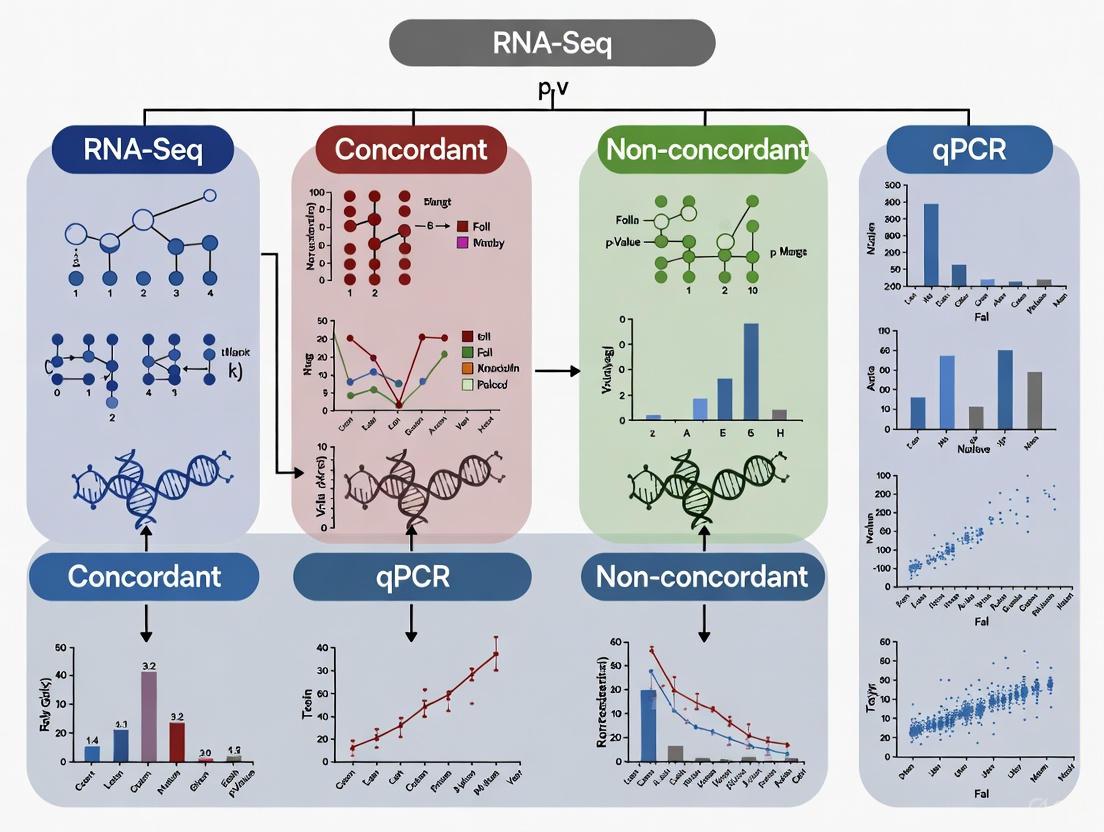
This article provides a comprehensive framework for researchers and drug development professionals to understand, assess, and troubleshoot the concordance between RNA-Seq and qPCR data.
Concordant vs Non-Concordant Genes: A Practical Guide for Validating RNA-Seq with qPCR
Abstract
This article provides a comprehensive framework for researchers and drug development professionals to understand, assess, and troubleshoot the concordance between RNA-Seq and qPCR data. It covers the foundational definition of gene expression concordance, methodologies for comparative analysis, strategies for optimizing workflows to minimize discordance, and guidelines for experimental validation. By synthesizing current benchmarking studies and best practices, this guide aims to empower scientists to make informed decisions on when orthogonal validation is necessary and how to ensure the reliability of their transcriptomic findings in biomedical and clinical research.
Understanding Concordance in Gene Expression Analysis
Defining Concordant and Non-Concordant Genes
In the field of genomics, the terms "concordant" and "non-concordant" are fundamental to assessing the reliability and reproducibility of gene expression data. Concordant genes are those for which different analytical methods or technological platforms yield consistent results, confirming the robustness of the findings. In contrast, non-concordant genes show significant discrepancies between measurement methods, raising questions about their biological validity or highlighting technical limitations. The comparison between RNA-Seq and quantitative PCR (qPCR) has become a critical benchmark for establishing these definitions, as qPCR is widely regarded as a gold standard for validation. This guide provides an objective comparison of RNA-Seq performance against qPCR and other technologies, presenting experimental data and methodologies that define gene concordance in transcriptomic research.
Quantitative Comparison of Platform Concordance
The agreement between RNA-Seq and other technologies for gene expression measurement varies significantly based on the platform compared and the specific genes analyzed. The table below summarizes key concordance metrics from published studies.
Table 1: Concordance Rates Between RNA-Seq and Other Technologies
| Comparison Platforms | Overall Concordance Rate | Key Factors Affecting Concordance | Primary Source of Non-Concordance |
|---|---|---|---|
| RNA-Seq vs qPCR | ~85% of genes show consistent fold changes [1] [2] | Gene expression level, fold change magnitude, gene length, number of exons [1] [2] | Low expression, small fold changes (<1.5), shorter genes [1] |
| RNA-Seq vs Microarrays | Highly variable (25%-60% for DEGs) [3] | Treatment effect size, biological complexity of the mode of action, gene expression abundance [3] | Weakly expressed genes; complexity of the biological endpoint [3] |
| RNA-Seq vs TempO-Seq | 80% of genes (15,480/19,290) had concordant levels [4] | Gene ontology; histone/ribosomal functions (non-concordant) vs. cellular structure (concordant) [4] | Platform-specific protocols (lysates vs purified RNA) and probe design [4] |
| RNA-Seq vs NanoString | Strong correlation (Spearman 0.78-0.88) [5] | Data distribution (Spearman preferred for RNA-Seq count data), specific gene set [5] | RNA-Seq's broader transcriptome coverage may detect additional genes [5] |
Table 2: Characteristics of Concordant vs. Non-Concordant Genes in RNA-Seq/qPCR Studies
| Characteristic | Concordant Genes | Non-Concordant Genes |
|---|---|---|
| Typical Expression Level | Moderate to High [2] | Low [1] [2] |
| Typical Fold Change (FC) | Larger [1] | Small (FC < 2) [1] |
| Gene Structure | Longer, more exons [2] | Shorter, fewer exons [2] |
| Fraction of Total Genes | ~85% [2] | ~15% [1] [2] |
| Validation Need | Low | High |
Experimental Protocols for Concordance Assessment
Benchmarking RNA-Seq against qPCR
Objective: To evaluate the accuracy of RNA-Seq workflows in quantifying differential gene expression by comparing results with whole-transcriptome RT-qPCR data [2].
Key Methodology:
- Reference Samples: Utilize well-established RNA reference samples (e.g., MAQCA and MAQCB from the MAQC consortium) [2].
- RNA-Seq Workflows: Process sequencing reads through multiple bioinformatics pipelines (e.g., Tophat-HTSeq, STAR-HTSeq, Kallisto, Salmon) to generate gene-level expression values (TPM or counts) [2].
- qPCR Benchmark: Use a wet-lab validated qPCR assay that covers all protein-coding genes. Normalized quantification cycle (Cq) values serve as the reference dataset [2].
- Concordance Analysis: Calculate log fold changes between sample groups (e.g., MAQCA vs. MAQCB) for both RNA-Seq and qPCR. Genes are classified as follows:
- Concordant: Both methods agree on differential expression status and direction.
- Non-Concordant: Methods disagree on differential expression status or show fold changes in opposite directions. Researchers often further categorize non-concordant genes based on the magnitude of fold change difference (ΔFC) between the platforms [2].
Cross-Platform Validation with Orthogonal Methods
Objective: To independently verify gene expression findings, particularly when a study's conclusions rely heavily on a small number of genes or when expression changes are subtle [1].
Key Methodology:
- Gene Selection: Focus verification efforts on key genes of interest, especially those with low expression levels or small fold changes, which are prone to non-concordance [1].
- Orthogonal Assays: Use qPCR or reporter gene fusions (e.g., eGFP, lacZ) to measure expression of the selected genes in the same original samples used for RNA-Seq [1].
- Expanded Application: Alternatively, use qPCR to measure the expression of key genes in additional sample sets (e.g., different strains, conditions, or time points) not included in the original RNA-Seq study to confirm the broader validity of the findings [1].
Visualizing Workflows and Relationships
RNA-Seq Concordance Benchmarking Workflow
Decision Framework for Gene Validation
The Scientist's Toolkit: Essential Reagents and Platforms
Table 3: Key Research Reagent Solutions for Concordance Studies
| Reagent / Platform | Primary Function | Role in Concordance Research |
|---|---|---|
| Reference RNA Samples (e.g., MAQCA/MAQCB) | Standardized transcriptome material [2] | Provides a universal benchmark for cross-platform and cross-laboratory comparisons [2]. |
| Stranded RNA Library Prep Kits | Preparation of sequencing libraries [6] | Ensures accurate assignment of reads to genes, reducing ambiguous mappings and improving concordance [6]. |
| Whole-Transcriptome qPCR Assays | Genome-wide expression profiling [2] | Serves as a gold-standard benchmark for validating RNA-Seq findings and defining concordant genes [2]. |
| TempO-Seq Assay | Targeted expression profiling from lysates [4] | Enables high-throughput screening without RNA purification; concordance with RNA-Seq is ~80% [4]. |
| NanoString nCounter Panels | Targeted digital quantification [5] | Provides amplification-free gene expression data; shows strong correlation with RNA-Seq (Spearman ~0.83) [5]. |
Defining concordant and non-concordant genes is not merely an academic exercise but a practical necessity for ensuring the validity of genomic research. The data consistently show that while RNA-Seq exhibits high overall agreement with qPCR and other technologies, a subset of genes—characterized by low expression, small fold changes, and shorter length—is prone to non-concordance. Researchers should adopt a strategic approach to validation, leveraging standardized reagents and protocols. The decision to validate should be guided by the characteristics of the genes in question and their importance to the biological story. As technologies evolve, so too will our understanding of gene concordance, but the principles of rigorous benchmarking and orthogonal verification will remain fundamental to robust scientific discovery.
The Biological and Technical Meaning of Concordance
In the field of genomics, concordance measures the agreement between different experimental methods or data sets. In the specific context of comparing RNA-Seq and qPCR data, a pair of measurements for a gene is considered concordant when both techniques agree on its differential expression status (i.e., both identify it as significantly up-regulated, down-regulated, or not differentially expressed). Conversely, the measurements are non-concordant when the techniques disagree. Understanding the sources and implications of non-concordance is critical for researchers, scientists, and drug development professionals who rely on the accurate interpretation of transcriptome data to inform their work [1] [2].
Defining Concordance: From Genetics to Transcriptomics
The concept of concordance originates in classical genetics, where it describes the probability that a pair of individuals (most often twins) will both have a certain phenotypic trait, given that one of them has it [7]. This measures the similarity in phenotype between a set of individuals and helps disentangle genetic from environmental influences [8].
In the context of modern molecular biology and genotyping studies, the term has been adopted to describe the agreement between different data types. When DNA is directly assayed, concordance reflects the percentage of single nucleotide polymorphisms (SNPs) that are measured as identical across different technical platforms [7]. For transcriptomics, this concept is extended to the agreement between high-throughput RNA-Seq results and the traditional gold standard for gene expression measurement, quantitative real-time PCR (qPCR) [1] [2]. This specific application is the primary focus of this guide.
Benchmarking RNA-Seq Against qPCR: A Performance Comparison
RNA-Seq has become the gold standard for whole-transcriptome gene expression quantification. However, its performance is often benchmarked against qPCR, which is valued for its high sensitivity, specificity, and reproducibility [9]. A landmark study by Everaert et al. (as cited in [1]) comprehensively benchmarked five common RNA-Seq analysis workflows against wet-lab qPCR data for over 18,000 human protein-coding genes.
Key Experimental Findings
The study revealed that, depending on the computational workflow used, approximately 15–20% of genes showed non-concordant results when comparing RNA-Seq to qPCR data [1]. "Non-concordant" here was defined as instances where the two methods yielded differential expression in opposing directions, or where one method indicated significant differential expression while the other did not [1].
However, a deeper analysis of these non-concordant genes is revealing. The vast majority (approximately 93%) exhibited relatively small fold changes (below 2), and about 80% had fold changes below 1.5 [1]. This indicates that most disagreements occur for genes with subtle expression differences. Critically, only a very small fraction (approximately 1.8%) of genes were severely non-concordant, and these were typically characterized by lower expression levels and shorter gene length [1].
A separate, comprehensive benchmarking study published in Scientific Reports compared five RNA-seq workflows (Tophat-HTSeq, Tophat-Cufflinks, STAR-HTSeq, Kallisto, and Salmon) against whole-transcriptome RT-qPCR data for the well-established MAQCA and MAQCB reference samples [2]. The table below summarizes the correlation and concordance results from this study:
Table 1: Performance Comparison of RNA-Seq Analysis Workflows vs. qPCR
| Workflow | Expression Correlation (R² with qPCR) | Fold Change Correlation (R² with qPCR) | Non-Concordant Genes |
|---|---|---|---|
| Salmon | 0.845 | 0.929 | 19.4% |
| Kallisto | 0.839 | 0.930 | 18.5% |
| Tophat-HTSeq | 0.827 | 0.934 | 15.1% |
| STAR-HTSeq | 0.821 | 0.933 | ~15.1% |
| Tophat-Cufflinks | 0.798 | 0.927 | 17.8% |
Data adapted from Everaert et al. and the MAQC benchmarking study [1] [2].
This study also confirmed that a significant proportion of the genes showing inconsistent results were reproducibly identified across independent datasets and were consistently associated with specific gene features [2].
Characteristics of Non-Concordant Genes
Genes that are prone to non-concordant results are not random. Multiple studies have identified common characteristics that make a gene more likely to yield disagreeing results between RNA-Seq and qPCR:
- Low Expression Level: Genes with very low transcript abundance are a major source of discrepancy [1] [2].
- Short Gene Length: Shorter genes provide fewer sequencing reads for accurate quantification, increasing the potential for technical variance [1].
- Fewer Exons: Genes with fewer exons exhibit similar technical challenges as short genes [2].
- Small Fold Changes: As noted, the vast majority of non-concordant results occur when the actual fold change in expression is small (e.g., < 2) [1].
Experimental Protocols for Concordance Analysis
To ensure reliable and reproducible results when comparing RNA-Seq and qPCR data, adherence to standardized protocols is paramount. Below are detailed methodologies for key experiments cited in benchmarking studies.
Protocol 1: Whole-Transcriptome Benchmarking
This protocol is based on the benchmarking study that used MAQCA and MAQCB reference samples [2].
- Sample Preparation: Obtain established reference RNA samples (e.g., MAQCA/UHRR and MAQCB/Brain Reference RNA).
- Library Preparation & Sequencing: Prepare RNA-Seq libraries according to a standardized, high-quality protocol (e.g., Illumina). Sequence on an appropriate platform to achieve sufficient depth (e.g., >30 million reads per sample).
- qPCR Assay Design: Design wet-lab validated qPCR assays that cover all protein-coding genes. Each assay detects a specific subset of transcripts that contribute proportionally to the final gene-level quantification cycle (Cq) value.
- Data Alignment: For transcript-level RNA-Seq workflows (Cufflinks, Kallisto, Salmon), aggregate transcript-level values (e.g., TPM) to the gene level based on the transcripts detected by the corresponding qPCR assay. For gene-level workflows (HTSeq), convert gene counts to TPM.
- Filtering: Apply a minimal expression filter (e.g., >0.1 TPM in all samples) to avoid bias from low-expressed genes.
- Analysis:
- Calculate mean expression across replicates.
- For expression correlation, compute Pearson correlation between normalized qPCR Cq-values and log-transformed RNA-Seq TPM values.
- For fold-change correlation, calculate log fold changes between sample types (e.g., MAQCA vs. MAQCB) for both RNA-Seq and qPCR, then compute correlation.
Protocol 2: Orthogonal Validation with qPCR
This protocol outlines the use of qPCR to validate specific findings from an RNA-Seq experiment [1].
- Candidate Gene Selection: Select genes for validation based on the RNA-Seq results. Priority should be given to genes that are central to the biological story, especially if they have low expression levels and/or small fold changes [1].
- RNA Sample Selection: Use the same RNA samples that were subjected to RNA-Seq.
- Reference Gene Selection: Do not rely on traditionally used housekeeping genes (e.g., Actin, GAPDH) without verification. Use tools like GSV (Gene Selector for Validation) to identify the most stable, highly expressed reference genes from your RNA-Seq dataset specific to your biological conditions [9].
- qPCR Execution: Perform reverse transcription and qPCR following the MIQE guidelines (Minimum Information for Publication of Quantitative Real-Time PCR Experiments) to ensure experimental rigor [1].
- Data Analysis: Use stable reference genes to normalize the qPCR Cq values. Calculate fold changes and compare the direction and magnitude of change to the results obtained from the RNA-Seq analysis.
Visualizing RNA-Seq and qPCR Concordance Analysis
The following workflow diagram outlines the logical process for assessing concordance between RNA-Seq and qPCR, from experimental design to data interpretation.
The Scientist's Toolkit: Essential Reagents and Solutions
The following table details key research reagents and computational tools essential for conducting robust concordance studies between RNA-Seq and qPCR.
Table 2: Essential Research Reagents and Solutions for Concordance Studies
| Item Name | Type | Function / Application |
|---|---|---|
| Reference RNA Samples | Biological Reagent | Well-characterized RNA pools (e.g., MAQCA/UHRR, MAQCB) used as benchmarks for platform and workflow comparisons [2]. |
| Stable Reference Genes | Biological Reagent | Genes with high and stable expression across experimental conditions, used for normalizing qPCR data. Identified from RNA-seq data using tools like GSV [9]. |
| Whole-Transcriptome qPCR Assays | Molecular Biology Reagent | A set of validated qPCR assays designed to quantify the expression of all protein-coding genes, serving as a gold standard for RNA-Seq validation [2]. |
| GSV (Gene Selector for Validation) Software | Computational Tool | Identifies the most stable (reference candidate) and most variable (validation candidate) genes from RNA-seq data, ensuring they are highly expressed enough for qPCR detection [9]. |
| RNA-Seq Analysis Workflows | Computational Tool | Software pipelines (e.g., STAR-HTSeq, Kallisto, Salmon) for processing raw sequencing reads into gene-level expression counts or abundances [2]. |
The biological and technical meaning of concordance in RNA-Seq and qPCR research centers on the reliable agreement of gene expression measurements. Current evidence demonstrates that when best practices are followed, RNA-Seq provides highly reliable data that, for the majority of genes, does not require systematic validation by qPCR [1]. Disagreements are not random but are systematically associated with genes that have low expression, short length, and subtle fold changes. Therefore, orthogonal validation with qPCR remains critical in specific scenarios, particularly when a biological conclusion hinges on the expression pattern of a small number of genes that fall into these problematic categories. By leveraging standardized protocols, understanding the sources of non-concordance, and utilizing modern bioinformatics tools, researchers can make informed decisions on validation strategies, thereby increasing the efficiency and robustness of their transcriptomic studies.
In the fields of genomics and drug development, concordance—the consistency of results across different experimental methods or platforms—is not merely a technical metric but a cornerstone of scientific validity. This guide objectively compares the performance of major gene expression technologies, specifically RNA-Seq and qPCR, by examining experimental data on their concordance. The analysis is framed within a broader thesis on the critical importance of distinguishing between concordant and non-concordant genes, as this distinction directly impacts the reliability of biological interpretations and the success of downstream applications in biomarker discovery and toxicology.
In genetic research, concordance often refers to the agreement between different methodologies measuring the same biological phenomenon. High concordance strengthens confidence in results, while low concordance reveals methodological limitations or biological complexity. For gene expression analysis, a key challenge lies in the transition between established technologies like quantitative PCR (qPCR) and modern high-throughput methods like RNA-Sequencing (RNA-seq). While RNA-seq offers an unbiased, genome-wide view of the transcriptome, qPCR is often considered the "gold standard" for targeted validation due to its sensitivity and precision [10] [2]. Understanding the factors that drive concordance between these platforms, such as gene expression abundance and treatment effect size, is therefore paramount for designing robust research protocols and accurately interpreting data in both basic research and drug development pipelines [2] [3].
Cross-Platform Concordance: A Data-Driven Comparison
The following tables summarize key experimental findings from comparative studies, highlighting the performance of RNA-seq and qPCR across different conditions.
Table 1: Correlation Between RNA-seq and qPCR for Gene Expression Measurement
| Study Focus | Correlation Range (Pearson R²) | Key Influencing Factors |
|---|---|---|
| HLA Class I Genes (A, B, C) [10] | 0.20 - 0.53 | Extreme polymorphism of HLA genes; technical and biological variation. |
| Protein-Coding Genes (MAQC samples) [2] | 0.798 - 0.845 (Expression) 0.927 - 0.934 (Fold-change) | Gene expression level; specific bioinformatic workflow used. |
| Differential Gene Expression [3] | Agreement improves with larger treatment effect | Treatment effect size; biological complexity of the mode of action. |
Table 2: Characteristics of Concordant vs. Non-Concordant Genes
| Feature | Concordant Genes | Non-Concordant Genes |
|---|---|---|
| Expression Level | Higher expressed [2] | Lower expressed [2] [3] |
| Gene Structure | Larger, more exons [2] | Smaller, fewer exons [2] |
| Impact on Analysis | Reliable for downstream analysis | Require careful validation [2] |
| Fraction in DGE | ~80-85% of genes [2] | ~15-20% of genes [2] |
Detailed Experimental Protocols for Concordance Assessment
To ensure the reliability of the data presented in the comparisons, the following standardized protocols are typically employed in concordance studies.
Protocol 1: RNA-seq and qPCR Comparison for HLA Genes
This protocol is designed to address challenges in quantifying expression of highly polymorphic genes [10].
- Sample Preparation: RNA is extracted from freshly isolated peripheral blood mononuclear cells (PBMCs) from healthy donors. The RNA is treated with DNAse to remove genomic DNA contamination.
- RNA-seq Library Preparation and Sequencing: Total RNA is quantified, and RNA-seq libraries are prepared. Sequencing is performed on a high-throughput platform (e.g., Illumina).
- HLA-Tailored Bioinformatic Analysis: RNA-seq reads are processed using a specialized computational pipeline that accounts for extreme HLA polymorphism and minimizes alignment bias against a single reference genome. Expression levels for HLA-A, -B, and -C are estimated.
- qPCR Analysis: For the same set of samples, qPCR assays are run for each HLA class I gene using specific primers and probes.
- Data Correlation: Expression estimates from RNA-seq and qPCR for each HLA gene are compared using statistical correlation measures (e.g., Spearman's correlation coefficient).
Protocol 2: Benchmarking RNA-seq Workflows Against Genome-Wide qPCR
This protocol uses well-characterized reference samples to benchmark multiple RNA-seq analysis workflows [2].
- Reference Samples: The MAQCA (Universal Human Reference RNA) and MAQCB (Human Brain Reference RNA) samples are used as biologically distinct benchmarks.
- Whole-Transcriptome qPCR: A wet-lab validated qPCR assay for 18,080 protein-coding genes is performed to generate a gold-standard expression dataset.
- RNA-seq and Workflow Processing: RNA-seq is performed on the same samples. The sequencing reads are processed using five distinct workflows:
- Alignment-based: Tophat-HTSeq, Tophat-Cufflinks, STAR-HTSeq.
- Pseudoalignment-based: Kallisto, Salmon.
- Data Alignment and Normalization: Transcripts detected by qPCR are aligned with transcripts quantified by RNA-seq. Gene-level expression values are normalized and transformed to TPM (Transcripts Per Million) for cross-platform comparison.
- Concordance Metrics: Correlation of expression intensities and fold-changes (MAQCA vs. MAQCB) between qPCR and each RNA-seq workflow is calculated. Genes are categorized as concordant or non-concordant based on their differential expression status.
Signaling Pathways and Workflow Diagrams
The relationship between experimental factors and concordance, as well as the workflow for a typical study, can be visualized as follows:
Diagram 1: Factors influencing cross-platform concordance in genomics.
Diagram 2: A typical workflow for a cross-platform concordance study.
The Scientist's Toolkit: Essential Research Reagents and Materials
The following table lists key reagents and their functions essential for conducting rigorous gene expression concordance studies.
Table 3: Key Research Reagent Solutions for Concordance Studies
| Reagent / Material | Function in Experiment |
|---|---|
| Reference RNA Samples (e.g., UHRR, Brain RNA) | Provides a stable, well-characterized benchmark for cross-platform and cross-laboratory comparisons [2] [3]. |
| DNAse I Enzyme | Critically removes contaminating genomic DNA during RNA isolation to ensure accurate RNA-only quantification [10]. |
| Poly-A Spike-In Controls | RNA molecules added in known quantities to samples to monitor technical performance and normalization efficiency of RNA-seq [3]. |
| HLA-Tailored Alignment Software | Specialized bioinformatic tools (e.g., specific to HLA genes) are essential for accurate quantification of polymorphic or complex gene families [10]. |
| Stable qPCR Master Mix | A ready-to-use mixture containing polymerase, dNTPs, and buffer, ensuring high sensitivity and reproducibility for qPCR validation [2]. |
| Validated qPCR Assays | Pre-designed primer and probe sets with confirmed specificity and efficiency for target genes, crucial for reliable comparison data [2]. |
The implications of concordance extend directly into the drug development pipeline, where decisions are based on transcriptomic data.
Predictive Toxicology and Biomarker Discovery: In toxicology, the concordance between animal models and human responses is a critical focus. Large-scale analyses have confirmed the general predictivity of animal safety observations for humans, identifying specific predictive toxicities while also highlighting limitations in negative predictivity [11]. Furthermore, cross-platform concordance enables the identification of robust biomarkers. For instance, a machine learning approach identified OAS1 as a key gene signature for Ebola infection using NanoString data; this signature maintained 100% predictive accuracy when applied to RNA-seq data from the same cohort and an independent test set, demonstrating the power of concordant findings [5].
Regulatory Science and Clinical Validity: Regulatory science initiatives like the MAQC/SEQC projects have demonstrated that the agreement between RNA-seq and microarrays in identifying differentially expressed genes and pathways is strongly correlated with treatment effect size [3]. This understanding is crucial for fit-for-purpose application of technologies in regulatory submissions. Similarly, in genetic screening, the clinical validity of expanded carrier screening panels is assessed through variant classification concordance with public databases, ensuring patients receive accurate risk assessments [12].
In conclusion, a rigorous, data-driven understanding of concordance is not an academic exercise but a fundamental requirement. It underpins the selection of appropriate technologies, the validation of novel findings, and the ultimate translation of basic research into safe and effective therapeutics. Acknowledging and systematically investigating the factors that create both concordant and non-concordant genes is what separates reliable, reproducible science from mere data generation.
The transition from microarray technology to RNA sequencing (RNA-seq) represents a pivotal shift in molecular biology, fundamentally altering approaches to gene expression validation. Microarrays, which rely on hybridization-based detection with predefined probes, long served as the workhorse for genome-wide expression profiling [13]. Their dominance, however, was accompanied by persistent concerns regarding reproducibility, bias, and the accuracy of fold-change measurements, which necessitated systematic validation using orthogonal methods like quantitative PCR (qPCR) [14] [1]. This established the historical precedent that genome-scale expression findings required confirmation by alternative techniques.
The emergence of RNA-seq as a sequencing-based alternative promised to overcome many microarray limitations, offering a wider dynamic range, superior sensitivity, and the ability to detect novel transcripts without prior sequence knowledge [15] [13]. A critical question then emerged: does this technologically superior platform inherit the same requirement for extensive validation? This guide objectively compares the performance of these platforms and examines the evolving paradigm of concordance checking in the RNA-seq era, providing researchers and drug development professionals with experimental data and methodologies to inform their validation strategies.
Technological Comparison: Microarrays vs. RNA-Seq
Fundamental Mechanisms and Capabilities
The core distinction between these platforms lies in their fundamental mechanism: microarrays utilize hybridization of labeled cDNA to immobilized probes, whereas RNA-seq directly sequences cDNA molecules using next-generation sequencing platforms [13]. This difference underlies their divergent capabilities and performance characteristics.
Table 1: Core Technological Differences Between Microarrays and RNA-Seq
| Feature | Microarray | RNA-Seq |
|---|---|---|
| Principle | Hybridization-based | Sequencing-based |
| Prior Sequence Knowledge | Required [13] | Not required [13] |
| Dynamic Range | ~10³ [13] | >10⁵ [13] |
| Novel Transcript Detection | No [13] | Yes (splice variants, fusions, novel genes) [13] |
| Background Noise | Higher due to cross-hybridization [16] | Lower [16] |
| Quantification Nature | Analog (fluorescence intensity) | Digital (read counting) |
Performance Benchmarking in Differential Expression Analysis
Multiple studies have systematically compared the abilities of both platforms to detect differentially expressed genes (DEGs), often using qPCR as a reference standard. While both technologies generally show good concordance with qPCR, the specific strengths of RNA-seq are evident.
A comprehensive benchmarking study using the well-characterized MAQC samples compared five RNA-seq workflows against a transcriptome-wide qPCR dataset for 18,080 protein-coding genes [15]. The results demonstrated high fold-change correlation between RNA-seq and qPCR across all workflows (R² ≈ 0.93) [15]. However, a fraction of genes (15-19%) showed non-concordant differential expression status between RNA-seq and qPCR. Crucially, over 93% of these non-concordant genes had fold changes below 2, and the small subset (≈1.8%) with severe discrepancies were typically lower expressed and shorter [1] [15]. This indicates that RNA-seq is highly reliable for genes with substantial expression changes but requires careful interpretation for genes with low expression or subtle fold-changes.
Table 2: Performance Comparison in Predicting Protein Expression and Clinical Endpoints (TCGA Data Analysis)
| Cancer Type | Performance in Predicting Protein Expression (RPPA) | Survival Prediction Model Performance (C-index) |
|---|---|---|
| Lung Squamous Cell Carcinoma (LUSC) | 16 genes showed significant correlation differences; e.g., CCNE1 and CCNB1 [17] | Microarray model superior [17] |
| Colon Adenocarcinoma (COAD) | BAX gene showed recurrent significant correlation differences [17] | Microarray model superior [17] |
| Kidney Renal Clear Cell Carcinoma (KIRC) | BAX and PIK3CA genes showed significant correlation differences [17] | Microarray model superior [17] |
| Ovarian Serous Cystadenocarcinoma (OV) | BAX gene showed significant correlation differences [17] | RNA-seq model superior [17] |
| Uterine Corpus Endometrioid Carcinoma (UCEC) | Not specified in results | RNA-seq model superior [17] |
| Breast Invasive Carcinoma (BRCA) | PIK3CA gene showed significant correlation differences [17] | Not specified in results |
Recent toxicogenomic studies further contextualize this comparison. A 2025 concentration-response study of cannabinoids found that while RNA-seq identified more DEGs with a wider dynamic range, both platforms revealed equivalent functional pathways through gene set enrichment analysis and produced nearly identical transcriptomic points of departure (tPODs) for risk assessment [16]. This suggests that for traditional applications like mechanistic pathway identification, microarrays remain a viable, lower-cost option [16].
The Shifting Validation Paradigm: From Mandatory to Context-Dependent
The Microarray Era: Systematic Validation as a Necessity
The historical need for validating microarray results stemmed from several technological limitations. Hybridization-based detection was susceptible to technical artifacts, including probe-specific biases, cross-hybridization, and signal saturation [14] [1]. These issues prompted calls for microarray results to be validated with other technologies before publication [14].
Methodological research from this period established best practices for global validation. Studies demonstrated that selecting only the most significantly differentially expressed genes for validation was a flawed strategy, as it was susceptible to regression toward the mean and did not generalize to the entire set of DEGs [14]. Instead, random-stratified sampling was recommended to provide a representative subset of genes for validation [14]. Furthermore, the concordance correlation coefficient (CCC) was identified as a superior statistical metric over simple correlation, as it captures both precision (proximity to the regression line) and accuracy (deviation from the identity line) [14].
The RNA-Seq Era: Rethinking the "Validation Rule"
With the advent of RNA-seq, the consensus on mandatory validation has shifted. Unlike microarrays, RNA-seq does not suffer from the same issues of cross-hybridization or limited dynamic range, and multiple studies have demonstrated a high level of concordance with qPCR measurements [1].
A key study concluded that if all experimental steps and data analyses are performed according to state-of-the-art protocols with sufficient biological replicates, the added value of routinely validating RNA-seq data with qPCR is likely to be low [1]. The same analysis noted that while approximately 15-20% of genes might show non-concordant results between RNA-seq and qPCR depending on the workflow, the vast majority of these (93%) involve fold changes lower than 2, and the genuinely problematic discrepancies affect only about 1.8% of genes, typically those with low expression [1].
The contemporary perspective is that validation should be context-dependent. Orthogonal validation (e.g., by qPCR or reporter fusions) remains appropriate when:
- An entire biological story hinges on the differential expression of only a few genes.
- The genes of interest have low expression levels and/or small differences in expression.
- The data will be used to measure the same genes in additional samples, strains, or conditions not profiled by RNA-seq [1].
Diagram Title: The Evolving Paradigm of Transcriptomic Validation
Experimental Protocols for Concordance Assessment
A Framework for Benchmarking RNA-Seq Workflows
The following methodology is adapted from a comprehensive benchmarking study that compared RNA-seq workflows against a gold-standard qPCR dataset [15]. This protocol provides a robust framework for assessing the concordance of any RNA-seq analysis pipeline.
1. Sample Selection and RNA Preparation:
- Use well-characterized reference RNA samples (e.g., MAQCA/Human Brain Reference from the MAQC project).
- Extract total RNA, ensuring high purity (e.g., Nanodrop 260/280 ratio >1.8) and integrity (e.g., RIN >9.0 via Bioanalyzer).
2. Generation of Gold-Standard qPCR Data:
- Design a transcriptome-wide qPCR panel targeting all protein-coding genes.
- Perform qPCR reactions in technical replicates following MIQE guidelines.
- Calculate normalized Cq values for each gene.
3. RNA-Seq Library Preparation and Sequencing:
- Prepare sequencing libraries from the same RNA samples using a standardized kit (e.g., Illumina Stranded mRNA Prep).
- Sequence on an appropriate platform (e.g., Illumina HiSeq/X) to a sufficient depth (e.g., ≥30 million paired-end reads per sample).
4. Data Processing with Multiple Workflows:
- Process raw sequencing reads through several representative workflows:
- Alignment-based (e.g., STAR/HTSeq, Tophat2/Cufflinks)
- Pseudoalignment-based (e.g., Kallisto, Salmon)
- Generate gene-level expression estimates (e.g., TPM, FPKM) for each workflow.
5. Data Alignment and Concordance Analysis:
- Filter genes based on a minimal expression threshold (e.g., >0.1 TPM) in all samples.
- Calculate expression correlation (Pearson R²) between RNA-seq and qPCR expression intensities.
- Calculate fold changes between sample groups (e.g., MAQCA vs. MAQCB) for both platforms.
- Classify genes into five groups based on differential expression status and direction:
- Concordant: Agree on DE status and direction.
- Non-concordant: Disagree on DE status or direction.
- Severely Discordant: Absolute difference in fold change (ΔFC) > 2.
6. Characterization of Discordant Genes:
- Analyze the gene features (e.g., length, exon count, expression level) of the severely discordant subset.
- Perform cross-dataset validation to identify systematic discrepancies.
Diagram Title: Experimental Workflow for Transcriptomic Concordance Study
Protocol for Global Validation of a Transcriptomic Study
This protocol, adapted from methodologies developed for microarray global validation, can be applied to assess the overall quality of any transcriptomic experiment [14].
1. Gene Selection for Validation:
- Do NOT select only the top differentially expressed genes. This strategy fails to provide a global assessment and is biased by regression to the mean.
- Implement Random-Stratified Sampling:
- Stratify all genes based on their fold-change magnitude and direction (e.g., up-regulated high-FC, up-regulated low-FC, down-regulated high-FC, down-regulated low-FC).
- Randomly select a representative number of genes (e.g., 10-20) from each stratum.
2. Orthogonal Measurement:
- Measure the expression of the selected genes using an orthogonal method (e.g., qPCR, Nanostring).
- For qPCR, follow MIQE guidelines: use multiple reference genes for normalization, perform technical replicates, and report Cq values and amplification efficiencies.
3. Statistical Assessment of Agreement:
- Calculate the Concordance Correlation Coefficient (CCC) between the fold-change measurements from the primary platform (microarray/RNA-seq) and the validation platform.
- Interpret the CCC:
- Precision Component (r): How close the data points are to the best-fit line (Pearson correlation).
- Accuracy Component (C_b): How close the best-fit line is to the identity line (slope=1, intercept=0).
- A high CCC (>0.9) indicates that the validation platform reproduces both the magnitude and direction of fold changes measured by the primary platform.
Table 3: Key Research Reagent Solutions for Transcriptomic Concordance Studies
| Reagent / Resource | Function / Application | Example Products / Kits |
|---|---|---|
| Reference RNA Samples | Provides standardized, well-characterized RNA for benchmarking and cross-platform comparisons. | MAQCA (Universal Human Reference RNA), MAQCB (Human Brain Reference RNA) [15] |
| RNA Extraction Kits | Isolate high-quality, intact total RNA from cells or tissues. | Qiagen RNeasy, EZ1 RNA Cell Mini Kit [16] |
| RNA Integrity Assessment | Evaluates RNA quality to ensure only high-quality samples are used. | Agilent 2100 Bioanalyzer with RNA Nano Kit [16] |
| qPCR Reagents & Assays | Provides gold-standard orthogonal validation for gene expression. | TaqMan assays, SYBR Green master mixes [15] |
| RNA-Seq Library Prep Kits | Prepares sequencing libraries from RNA samples. | Illumina Stranded mRNA Prep [16] |
| Microarray Platforms | For hybridization-based whole-transcriptome expression profiling. | Affymetrix GeneChip系列 [16] |
| Feature Selection Algorithms | Identifies the most informative genes from high-dimensional data, reducing complexity. | Elephant Herding Optimization (EHO), Harmonic Search (HS) [18] [19] |
The journey from microarray to RNA-seq has transformed not only the technological landscape of transcriptomics but also the philosophical approach to validation. The historical necessity of systematic orthogonal validation for microarrays has evolved into a more nuanced, context-dependent strategy for RNA-seq. While RNA-seq demonstrates superior technical performance in dynamic range, sensitivity, and novel feature detection, its agreement with gold-standard qPCR is not universal. A small but significant subset of genes—particularly those with low expression or subtle fold-changes—may yield non-concordant results.
For the modern researcher, the decision to validate should be guided by experimental context and biological goals. High-quality RNA-seq data with sufficient replication may not require blanket validation, but targeted confirmation remains crucial when conclusions rest on specific, low-abundance, or subtly changing transcripts. As transcriptomic technologies continue to advance, the principles of rigorous benchmarking and appropriate validation will ensure the reliability of biological insights drawn from these powerful tools.
The translation of RNA-sequencing (RNA-seq) from a research tool into clinical diagnostics hinges on its ability to reliably detect subtle, biologically relevant changes in gene expression. A significant challenge in validating these transcriptomic measurements lies in establishing a trustworthy "ground truth" against which RNA-seq data can be benchmarked. A central thesis in this field explores the distinction between concordant genes, for which expression measurements from RNA-seq and validation methods like RT-qPCR agree, and non-concordant genes, which show inconsistent results between platforms. This guide objectively compares the performance of various RNA-seq analysis workflows, using whole-transcriptome RT-qPCR data as a foundational ground truth, to provide researchers and drug development professionals with evidence-based recommendations for their genomic studies.
Experimental Protocols for Benchmarking
Benchmarking studies require carefully designed experiments and a clear ground truth to evaluate the performance of different RNA-seq workflows.
Reference Materials and Ground Truth
A robust benchmark relies on well-characterized reference samples. Two sets of reference RNAs have been pivotal:
- MAQC Samples: Established by the MicroArray/Sequencing Quality Control (MAQC) Consortium, these include Universal Human Reference RNA (MAQC-A) from ten cancer cell lines and Human Brain Reference RNA (MAQC-B) from brain tissues of 23 donors [20] [2]. These samples exhibit large biological differences.
- Quartet Project Reference Materials: These are derived from immortalized B-lymphoblastoid cell lines from a Chinese quartet family. They feature small, clinically relevant biological differences between samples, making them ideal for assessing the detection of subtle differential expression [20].
The most definitive ground truth for gene expression is provided by whole-transcriptome RT-qPCR assays. This method uses wet-lab validated assays for thousands of protein-coding genes, providing a high-confidence dataset against which RNA-seq derived expression levels and fold-changes can be compared [21] [2].
Benchmarking Methodology
In a typical benchmarking workflow, RNA from reference samples (e.g., MAQC-A and MAQC-B) is sequenced. The resulting reads are then processed through multiple bioinformatics workflows for gene-level quantification [2]. The key steps are as follows:
Parallel to sequencing, the same RNA samples are subjected to whole-transcriptome RT-qPCR to generate the ground truth data. Performance is evaluated by comparing the gene expression values and the fold-changes (e.g., between MAQC-A and MAQC-B) generated by each RNA-seq workflow to those from the RT-qPCR data. Genes are subsequently classified as concordant or non-concordant based on this analysis [2].
Performance Comparison of RNA-Seq Workflows
Workflow Accuracy Against qPCR Ground Truth
Multiple studies have systematically compared popular RNA-seq workflows using whole-transcriptome RT-qPCR data. The table below summarizes the performance of different computational pipelines in quantifying gene expression and fold-changes.
Table 1: Performance of RNA-seq Workflows Benchmarked Against RT-qPCR Data
| Workflow Category | Specific Workflow | Expression Correlation with qPCR (R²) | Fold-Change Correlation with qPCR (R²) | Fraction of Non-Concordant Genes |
|---|---|---|---|---|
| Alignment-based | Tophat-HTSeq | 0.827 | 0.934 | 15.1% |
| Alignment-based | STAR-HTSeq | 0.821 | 0.933 | - |
| Pseudoalignment | Salmon | 0.845 | 0.929 | 19.4% |
| Pseudoalignment | Kallisto | 0.839 | 0.930 | - |
| Transcript-based | Tophat-Cufflinks | 0.798 | 0.927 | - |
Overall, all tested workflows show high correlation with qPCR data for both absolute expression and fold-changes [2]. Alignment-based tools like Tophat-HTSeq showed a slightly lower fraction of non-concordant genes compared to pseudoalignment tools like Salmon [2]. It is noteworthy that a significant proportion of non-concordant genes are consistently identified as outliers across different workflows and datasets, pointing to systematic, technology-specific discrepancies rather than algorithmic errors [2].
Characteristics of Non-Concordant Genes
Non-concordant genes are not random; they share distinct biological and technical features that can alert researchers to potential inaccuracies.
Table 2: Characteristics of Non-Concordant vs. Concordant Genes
| Characteristic | Non-Concordant Genes | Concordant Genes |
|---|---|---|
| Expression Level | Typically lower expressed [2] | Higher expressed [2] |
| Gene Structure | Smaller gene size and fewer exons [2] | Larger gene size and more exons [2] |
| Impact on Analysis | Can lead to inaccurate conclusions if not filtered; require careful validation [2] | Provide reliable results for differential expression analysis [2] |
The Scientist's Toolkit: Essential Reagents and Materials
The following table details key reagents and materials essential for conducting rigorous RNA-seq benchmarking studies.
Table 3: Essential Research Reagents and Materials for RNA-seq Benchmarking
| Item | Function in Benchmarking |
|---|---|
| MAQC Reference RNA (A & B) | Well-characterized RNA samples with large biological differences, used for initial pipeline validation and cross-platform comparisons [20] [2]. |
| Quartet Project Reference RNA | RNA reference materials with small, clinically relevant biological differences, crucial for assessing performance on subtle differential expression [20]. |
| ERCC Spike-In Controls | Synthetic RNA transcripts at known concentrations spiked into samples, used to assess technical accuracy, dynamic range, and detection limits of the workflow [20]. |
| Whole-Transcriptome RT-qPCR Assays | Provides the ground truth for gene expression levels and fold-changes against which RNA-seq data is benchmarked [21] [2]. |
| Stranded mRNA Sequencing Kits | Library preparation kits that preserve the strand orientation of transcripts, identified as a factor influencing data quality and accuracy [20]. |
Benchmarking studies firmly establish that while RNA-seq workflows generally show high agreement with RT-qPCR ground truth, a subset of non-concordant genes exists whose expression is quantified inconsistently. These genes are often lower expressed and have specific structural features. For researchers and drug developers, this underscores the necessity of using well-characterized reference materials and orthogonal validation for critical genes, especially when investigating subtle expression changes relevant to disease subtypes or drug responses. A nuanced understanding of concordant and non-concordant genes is fundamental to establishing a reliable ground truth and advancing RNA-seq into robust clinical diagnostics.
How to Measure and Analyze Gene Expression Concordance
Experimental Design for Concordance Studies
Gene expression analysis is fundamental to biological research and clinical applications. RNA-Sequencing (RNA-seq) has emerged as a powerful tool for whole-transcriptome analysis, but its performance is often validated against quantitative PCR (qPCR), long considered the "gold standard" for targeted gene expression quantification [2]. Concordance studies between these platforms are essential to establish the reliability of RNA-seq data, particularly as it moves toward clinical use. The central thesis of this comparison revolves around understanding which genes show consistent expression measurements between platforms (concordant genes) and which do not (non-concordant genes), and the technical and biological factors driving these differences.
Quantitative Comparison of Platform Performance
Multiple studies have systematically compared gene expression measurements between RNA-seq and qPCR, revealing generally high but imperfect concordance.
Table 1: Summary of RNA-seq and qPCR Concordance Metrics from Key Studies
| Study Reference | Correlation Type | Correlation Coefficient Range | Concordant Genes | Non-Concordant Genes |
|---|---|---|---|---|
| MAQC/Scientific Reports [2] | Fold-change correlation | R² = 0.927 - 0.934 (across 5 workflows) | ~85% | ~15% |
| MAQC/Scientific Reports [2] | Expression correlation | R² = 0.798 - 0.845 (across 5 workflows) | N/A | N/A |
| HLA Expression Study [10] | Expression correlation (HLA genes) | rho = 0.2 - 0.53 (HLA-A, -B, -C) | N/A | N/A |
The MAQC study benchmarking five RNA-seq workflows against whole-transcriptome qPCR data found high fold-change correlations (R² = 0.927-0.934) when comparing two distinct reference RNA samples [2]. Approximately 85% of genes showed consistent differential expression status between RNA-seq and qPCR, while about 15% showed inconsistencies. The alignment-based algorithms (Tophat-HTSeq) showed slightly better performance (15.1% non-concordant genes) compared to pseudoaligners (19.4% for Salmon) [2].
For specific challenging gene families like the highly polymorphic HLA genes, correlation between qPCR and RNA-seq expression estimates was only low to moderate (rho = 0.2-0.53) [10], highlighting the particular difficulties in quantifying certain types of genes.
Characteristics of Non-Concordant Genes
Non-concordant genes—those showing significant differences between RNA-seq and qPCR measurements—typically share distinct characteristics:
- Lower expression levels: Non-concordant genes tend to have significantly lower expression levels as measured by qPCR [2] [3]
- Smaller gene size: These genes are typically smaller and have fewer exons [2]
- Technical artifacts: A small but specific set of genes showed inconsistent expression measurements reproducibly identified across independent datasets [2]
Table 2: Characteristics of Concordant vs. Non-Concordant Genes
| Characteristic | Concordant Genes | Non-Concordant Genes |
|---|---|---|
| Expression Level | Higher | Lower |
| Gene Size | Larger | Smaller |
| Exon Count | More exons | Fewer exons |
| Technical Variance | Lower | Higher |
| Platform Agreement | Consistent across platforms | Method-specific discrepancies |
Experimental Protocols for Concordance Studies
Sample Preparation and Study Design
Robust concordance studies require carefully controlled experimental designs:
- Reference Materials: Well-established reference RNA samples (e.g., MAQCA/Human Reference RNA and MAQCB/Human Brain Reference RNA) should be used to control for biological variability [2]
- Replication: Multiple technical and biological replicates are essential to account for technical noise and biological variation
- RNA Quality: High-quality RNA with minimal degradation is critical; RNA integrity numbers (RIN) >8.0 are typically recommended
- Sample Matching: Ideally, aliquots from the same RNA extraction should be used for both RNA-seq and qPCR analysis to eliminate preparation variability
RNA-Sequencing Methodology
- Library Preparation: Poly-A selection is commonly used for mRNA enrichment, though ribosomal RNA depletion can provide broader transcriptome coverage [4]
- Sequencing Depth: 15-60 million paired-end reads per sample (100bp read length) is generally sufficient for most applications, with diminishing returns at higher depths [3]
- Platform Selection: Illumina platforms remain most common for RNA-seq studies
qPCR Methodology
- Assay Design: Wet-lab validated qPCR assays that detect specific subsets of transcripts contributing proportionally to gene-level Cq-values [2]
- Normalization: Use of multiple reference genes for reliable normalization
- Whole-Transcriptome Coverage: For comprehensive benchmarking, whole-transcriptome qPCR assays covering >18,000 protein-coding genes provide the most complete comparison [2]
Bioinformatic Processing for RNA-Seq
Multiple computational workflows can be employed for RNA-seq data processing:
- Alignment-based workflows: Tophat-HTSeq, Tophat-Cufflinks, STAR-HTSeq [2]
- Pseudoalignment methods: Kallisto, Salmon [2]
- HLA-specific pipelines: For challenging gene families like HLA, specialized pipelines that account for known HLA diversity in the alignment step are recommended over standard approaches relying on a single reference genome [10]
Visualization of Concordance Testing Workflow
The following diagram illustrates the key steps in a comprehensive RNA-seq and qPCR concordance study:
Factors Influencing Concordance Between Platforms
Biological and Technical Factors
Several key factors significantly impact the level of concordance observed between RNA-seq and qPCR:
- Treatment effect size: Concordance between platforms is linearly correlated with treatment effect size—stronger biological signals show better agreement [3]
- Gene expression abundance: Both technologies show higher variance for lowly expressed genes, but RNA-seq demonstrates improved accuracy for these genes compared to microarrays (as a reference point) [3]
- Biological complexity: Concordance is higher for simple, well-defined biological mechanisms compared to complex endpoints with multiple contributing factors [3]
- Sequence properties: Genes with high polymorphism (e.g., HLA genes) or specific structural characteristics show reduced concordance [10]
Analysis and Computational Factors
- Bioinformatic workflows: Different RNA-seq processing workflows show minimal but statistically significant differences in concordance with qPCR [2]
- Filtering strategies: Application of minimal expression filters (e.g., 0.1 TPM) affects concordance metrics, particularly for low-abundance genes [2]
- Differential expression methods: Multiple DEG detection methods (limma, edgeR, DESeq) show high consistency in determining the number of differentially expressed genes [3]
The Scientist's Toolkit: Essential Research Reagents and Materials
Table 3: Key Research Reagent Solutions for Concordance Studies
| Reagent/Material | Function/Application | Examples/Specifications |
|---|---|---|
| Reference RNA Samples | Standardized materials for platform comparison | MAQCA (Universal Human Reference RNA), MAQCB (Human Brain Reference RNA) [2] |
| RNA Extraction Kits | High-quality RNA isolation | RNeasy Universal kit (Qiagen) with DNAse treatment [10] |
| RNA Quality Control Tools | Assessment of RNA integrity | Bioanalyzer with RNA Integrity Number (RIN) assessment |
| Library Preparation Kits | RNA-seq library construction | Poly-A selection kits for mRNA enrichment [4] |
| Whole-Transcriptome qPCR Assays | Comprehensive qPCR validation | Assays covering >18,000 protein-coding genes [2] |
| HLA-Specific Assays | Expression analysis of polymorphic genes | Specialized qPCR assays for HLA-A, -B, -C [10] |
| Normalization Controls | Reference genes for qPCR | Multiple validated reference genes for reliable normalization |
Concordance studies between RNA-seq and qPCR reveal generally high agreement, with approximately 85% of genes showing consistent differential expression patterns between platforms. The remaining 15% of non-concordant genes typically exhibit lower expression levels, smaller size, and fewer exons. Successful experimental design for such studies requires careful attention to sample preparation, adequate sequencing depth, appropriate bioinformatic workflows, and validation using whole-transcriptome qPCR assays. Understanding the factors that influence concordance is essential for proper interpretation of gene expression data, particularly as RNA-seq moves toward clinical applications where reliable quantification is critical for patient care and drug development decisions.
RNA sequencing (RNA-seq) has become the cornerstone of modern transcriptomics, providing an unprecedented detailed view of gene expression landscapes. As the technique has evolved, two distinct computational approaches have emerged for processing the vast amounts of data it generates: traditional alignment-based methods and newer pseudoalignment algorithms. The fundamental distinction between these approaches lies in their initial handling of sequencing reads. Alignment-based tools like STAR map reads directly to a reference genome, determining their precise genomic origins [22]. In contrast, pseudoalignment tools such as Kallisto perform a lightweight matching of reads to transcripts by examining their k-mer content, bypassing the computationally intensive step of exact alignment [22] [2].
This methodological divergence is particularly significant when evaluated against the gold standard for gene expression validation: quantitative PCR (qPCR). Research has revealed that a specific subset of genes consistently shows discrepancies—termed "non-concordant" genes—between RNA-seq and qPCR measurements [1] [2]. Understanding the performance characteristics of different RNA-seq workflows regarding these genes is crucial for researchers, especially in drug development where accurate gene expression quantification can inform critical decisions.
Workflow Comparison: Fundamental Differences and Mechanisms
Core Algorithmic Principles
The distinction between alignment-based and pseudoalignment methods represents a paradigm shift in how RNA-seq data is processed, with each approach employing fundamentally different strategies to quantify gene expression.
Alignment-Based Methods (e.g., STAR): These tools operate by mapping raw sequencing reads directly to a reference genome through a detailed, base-by-base alignment process [22]. This method identifies the exact genomic coordinates from which each read originated, requiring significant computational resources to handle splice junctions and sequence variations. The output is typically a file containing read counts for each gene, which forms the basis for subsequent expression analysis [22]. The alignment process provides comprehensive information about splice variants and genomic mapping but demands substantial computational time and memory.
Pseudoalignment Methods (e.g., Kallisto): Rather than performing exact alignment, these tools employ a probabilistic approach that breaks reads down into k-mers (short subsequences of length k) and matches them to a pre-built index of transcripts [22] [2]. This strategy determines the likelihood of a read originating from particular transcripts without establishing its precise genomic location. Kallisto specifically generates both transcripts per million (TPM) and estimated counts as output, enabling immediate abundance estimation [22]. This approach offers substantial gains in speed and computational efficiency while maintaining accuracy for standard differential expression analyses.
Comparative Workflow Diagrams
The following diagram illustrates the fundamental differences in how these two approaches process RNA-seq data:
Table 1: Technical Comparison of STAR and Kallisto Workflows
| Feature | STAR (Alignment-Based) | Kallisto (Pseudoalignment) |
|---|---|---|
| Primary Approach | Direct genome alignment | K-mer matching to transcriptome |
| Computational Speed | Slower, resource-intensive | Faster, lightweight |
| Memory Requirements | High | Moderate |
| Key Output | Read counts per gene | TPM and estimated counts |
| Splice Junction Detection | Excellent for novel junctions | Limited to annotated transcripts |
| Best Application | Discovery of novel transcripts, splice variants | Rapid quantification of known transcripts |
Performance Benchmarking: Concordance with qPCR Data
Experimental Framework for Validation
Robust benchmarking of RNA-seq workflows requires carefully designed validation frameworks that compare computational results with experimentally verified expression data. One comprehensive study established such a framework using the well-characterized MAQCA and MAQCB reference samples from the MAQC-I consortium, processing RNA-seq data through five distinct workflows (Tophat-HTSeq, Tophat-Cufflinks, STAR-HTSeq, Kallisto, and Salmon) and comparing the results with wet-lab validated qPCR assays for 18,080 protein-coding genes [2].
The validation process involved several critical steps to ensure meaningful comparisons. First, researchers aligned transcripts detected by qPCR with those considered for RNA-seq quantification, applying consistent filtering thresholds to avoid biases from lowly expressed genes [2]. For expression correlation analysis, normalized RT-qPCR Cq-values were compared against log-transformed RNA-seq expression values. More importantly, for fold change correlation—often the most biologically relevant metric—gene expression fold changes between MAQCA and MAQCB samples were calculated and compared between RNA-seq workflows and qPCR results [2].
Quantitative Comparison of Concordance Rates
The following table summarizes the performance of different RNA-seq workflows when compared against qPCR validation data:
Table 2: Workflow Performance Against qPCR Benchmarking Data
| Workflow | Expression Correlation (R² with qPCR) | Fold Change Correlation (R² with qPCR) | Non-Concordant Genes | Severely Non-Concordant Genes (ΔFC >2) |
|---|---|---|---|---|
| STAR-HTSeq | 0.821 | 0.933 | 15.1% | 1.1% |
| Tophat-HTSeq | 0.827 | 0.934 | 15.1% | 1.1% |
| Tophat-Cufflinks | 0.798 | 0.927 | 16.8% | 1.4% |
| Kallisto | 0.839 | 0.930 | 16.5% | 1.3% |
| Salmon | 0.845 | 0.929 | 19.4% | 1.4% |
Data derived from benchmark studies comparing RNA-seq workflows with genome-wide qPCR data [2].
Overall, high concordance was observed between RNA-seq and qPCR data, with approximately 85% of genes showing consistent differential expression results between the two technologies [2]. The alignment-based methods (STAR-HTSeq and Tophat-HTSeq) showed slightly lower rates of non-concordant genes compared to pseudoalignment methods, though the differences were generally modest [2].
Critically, the small percentage of severely non-concordant genes (those with fold change differences >2 between methods) showed consistent characteristics across workflows. These genes were typically shorter, had fewer exons, and were expressed at lower levels compared to genes with consistent measurements [1] [2]. This pattern suggests that molecular features rather than workflow choice primarily drive severe discrepancies.
The Non-Concordant Gene Phenomenon
Characteristics of Problematic Genes
The existence of non-concordant genes represents a significant challenge in RNA-seq analysis, particularly for studies relying on accurate quantification of specific gene targets. Research has revealed that these problematic genes are not randomly distributed but share common characteristics that likely contribute to measurement discrepancies.
A comprehensive analysis by Everaert et al. examined over 18,000 protein-coding genes and found that 15-20% showed non-concordant results when comparing RNA-seq and qPCR data [1]. However, the vast majority of these discrepancies (approximately 93%) involved genes with relatively small fold changes lower than 2, with approximately 80% showing fold changes lower than 1.5 [1]. Only about 1.8% of genes demonstrated severe non-concordance, where the two methods yielded differential expression in opposing directions or one method showed differential expression while the other did not [1].
These severely non-concordant genes display distinct molecular profiles. They tend to be shorter in length and lower in expression levels compared to concordant genes [1] [2]. The combination of these features likely contributes to quantification challenges, as shorter transcripts generate fewer sequencing reads per molecule, potentially reducing quantification accuracy, particularly for low-abundance targets.
Decision Framework for Gene-Specific Validation
The following diagram outlines a systematic approach for determining when orthogonal validation is necessary based on gene characteristics and research context:
Experimental Design Considerations
Impact of Study-Specific Factors on Workflow Performance
The optimal choice between alignment-based and pseudoalignment methods depends significantly on specific experimental parameters and research objectives. Several key factors should guide this decision:
Transcriptome Completeness: For well-annotated transcriptomes, pseudoalignment methods like Kallisto provide rapid and accurate quantification of known transcripts [22]. However, when working with less characterized organisms or when discovering novel splice junctions is a priority, alignment-based tools like STAR offer significant advantages [22].
Computational Resources: Alignment-based methods typically require substantial computational resources, including significant RAM and processing time, which can be prohibitive for large-scale studies or institutions with limited infrastructure [22]. Pseudoalignment methods offer dramatically faster processing times with more modest hardware requirements.
Sample Size and Sequencing Depth: Kallisto's pseudoalignment approach demonstrates less sensitivity to variations in sequencing depth compared to alignment-based methods, potentially making it more suitable for studies with heterogeneous sequencing depths across samples [22]. For projects with exceptionally high sequencing depth, the additional information captured by full alignment may justify the computational costs.
Research Objectives: If the primary goal is differential expression analysis of known genes, pseudoalignment methods generally provide excellent performance with dramatically reduced computational requirements [22] [2]. Conversely, if identifying novel transcripts, splice variants, or fusion genes is essential, alignment-based approaches remain necessary [22].
Table 3: Essential Resources for RNA-seq Workflow Implementation
| Resource Category | Specific Tools | Primary Function | Considerations |
|---|---|---|---|
| Alignment-Based Tools | STAR, Tophat2, HISAT2 | Genome alignment and read mapping | Higher computational demands; superior for novel feature discovery |
| Pseudoalignment Tools | Kallisto, Salmon | Rapid transcript quantification | Fast processing; ideal for well-annotated transcriptomes |
| Quantification Packages | HTSeq, featureCounts | Gene-level read counting | Used with alignment-based workflows |
| Differential Expression | DESeq2, edgeR, limma | Statistical analysis of expression differences | Choice depends on experimental design and sample size |
| Quality Control | FastQC, MultiQC, fastp | Read quality assessment and preprocessing | Essential for detecting technical issues |
| Reference Databases | Ensembl, GENCODE, RefSeq | Genome and transcriptome references | Version control critical for reproducibility |
| Validation Methods | qPCR, reporter fusions | Orthogonal verification of key findings | Especially important for low-expression or critical result genes |
The comparison between alignment-based and pseudoalignment RNA-seq workflows reveals a nuanced landscape where methodological choice should align with specific research goals and practical constraints. Alignment-based methods like STAR provide comprehensive mapping information essential for discovering novel transcriptional events, while pseudoalignment tools like Kallisto offer exceptional efficiency for quantitative analysis of known transcripts.
Benchmarking against qPCR data demonstrates that both approaches show high overall concordance, with approximately 85% of genes showing consistent differential expression patterns between methods [2]. The critical finding that a small subset of genes (approximately 1.8%) shows consistent discrepancies across workflows underscores the importance of understanding gene-specific factors that affect quantification accuracy [1]. These non-concordant genes, characterized by shorter length and lower expression levels, warrant special attention in studies where they feature prominently.
For researchers in drug development and precision medicine, where accurate gene expression quantification directly impacts decision-making, we recommend a hybrid approach: utilizing pseudoalignment methods for initial genome-wide analyses while implementing targeted qPCR validation for key low-abundance genes or those with small but critical fold changes. This strategy balances comprehensive transcriptome assessment with precise quantification of biologically significant targets, ensuring both discovery power and analytical reliability.
Quantitative real-time PCR (qPCR) remains a cornerstone technique for validating gene expression data obtained from high-throughput RNA sequencing (RNA-seq). While RNA-seq provides an unbiased, genome-wide view of the transcriptome, qPCR delivers highly sensitive, specific, and reproducible quantification of selected targets, making it the gold standard for confirmation studies [15] [9]. However, the reliability of qPCR data hinges on stringent methodological rigor. The Minimum Information for Publication of Quantitative Real-Time PCR Experiments (MIQE) guidelines provide a critical framework to ensure this rigor, promoting transparency, reproducibility, and trust in qPCR results [23] [24].
This guide explores qPCR best practices within the context of validating concordant and non-concordant genes from RNA-seq analyses. We outline experimental protocols, present comparative performance data, and provide actionable strategies for implementing MIQE guidelines to strengthen the conclusions drawn from your gene expression studies.
The MIQE Guidelines: Ensuring Data Credibility
The MIQE guidelines, first published in 2009 and recently updated to version 2.0, represent an international consensus on the minimum information required to publish reproducible and reliable qPCR experiments [23] [24]. Their primary purpose is to provide a cohesive framework that standardizes experimental design, execution, data analysis, and reporting. Despite their widespread recognition—with over 17,000 citations to date—compliance remains patchy, leading to a troubling complacency that undermines data quality [23].
Common failures include poorly documented sample handling, unvalidated assays, assumptions about amplification efficiency, and the use of unverified reference genes for normalization [23]. These are not marginal oversights but fundamental methodological flaws that can lead to exaggerated sensitivity claims in diagnostics and overinterpreted fold-changes in gene expression studies [23]. MIQE 2.0 addresses these deficiencies by offering updated, simplified, and coherent guidance for the entire qPCR workflow, from sample handling to data analysis [23].
Adhering to MIQE is not merely an academic exercise; it has real-world consequences. During the COVID-19 pandemic, variable quality in qPCR assay design and data interpretation undermined confidence in diagnostics [23]. Following MIQE guidelines helps to build a foundation of reliable data that can underpin sound decisions in biomedical research, clinical diagnostics, and public health policy.
Key MIQE Checklist Items
The following table summarizes core elements of the MIQE checklist that are crucial for RNA-seq validation workflows.
Table 1: Essential MIQE Checklist Items for RNA-seq Validation
| Category | Requirement | Significance for Validation |
|---|---|---|
| Sample & Nucleic Acid Quality | Detailed RNA quantification, integrity assessment (e.g., RIN), and documentation of DNase treatment [23] [10]. | Prevents bias from degraded samples; ensures template quality for both RNA-seq and qPCR [23]. |
| Reverse Transcription | Complete documentation of kit, priming method (oligo-dT, random hexamers, or gene-specific), and reaction conditions [23] [25]. | The reverse transcription step is a major source of variability; detailed reporting is essential for reproducibility [23] [25]. |
| Assay Validation | Primer sequences, concentrations, and amplicon context sequences. Demonstration of primer specificity and PCR amplification efficiency [23] [25]. | Ensures accurate and specific quantification. Efficiency is critical for correct fold-change calculation [23] [26]. |
| Data Analysis & Normalization | Use of stable, validated reference genes, justification of the number of reference genes, and method for Cq determination [23] [26] [9]. | Inappropriate normalization is a primary source of error. Using unstable reference genes invalidates results [23] [9]. |
| Experimental Transparency | Evidence of repeatability (technical replicates) and biological reproducibility. Raw data (e.g., fluorescence curves) must be available [23] [26]. | Allows for independent evaluation of data quality and re-analysis, which is fundamental to the scientific process [23] [26]. |
Experimental Protocols for RNA-seq Validation
Validating an RNA-seq dataset with qPCR requires a carefully planned experiment targeting specific genes of interest. The selection of these genes and the design of the qPCR assay are critical steps that directly impact the validity of the conclusions.
Selection of Target Genes for Validation
When validating RNA-seq data, genes are typically selected based on their differential expression profiles. These can be divided into two categories:
- Concordant Genes: Genes identified as differentially expressed by RNA-seq that the researcher aims to confirm with an orthogonal method.
- Non-Concordant Genes: A critical set of genes that may show inconsistent results between RNA-seq and qPCR. One benchmarking study found that while ~85% of genes showed consistent fold-changes between RNA-seq and qPCR, a small but specific set of genes (often smaller, with fewer exons, and lower expression) were prone to method-specific discrepancies [15]. Including such genes in a validation study can help define the limitations of both technologies.
Selection and Assessment of Reference Genes
The stability of reference genes (often erroneously called "housekeeping genes") is a cornerstone of reliable qPCR. Traditionally used genes like ACTB and GAPDH are often unstable under various experimental conditions [9]. Instead, reference genes must be empirically validated for stability in the specific biological system under investigation.
Software tools like Gene Selector for Validation (GSV) can leverage RNA-seq data itself to identify the most stable, highly expressed candidate reference genes [9]. GSV applies filters to transcript-per-million (TPM) values across samples to select genes that are consistently expressed at high levels with low variation, thereby avoiding the pitfall of selecting stable but lowly expressed genes that are unsuitable for qPCR [9].
A Protocol for qPCR Assay Validation
The following workflow outlines the key steps for establishing a MIQE-compliant qPCR assay for RNA-seq validation.
Workflow Steps Explained:
- Select Target & Candidate Reference Genes: Choose concordant and non-concordant genes from RNA-seq data. Use tools like GSV on your TPM data to identify stable, high-expression reference gene candidates [9].
- Design & Synthesize Primers/Probes: Design oligonucleotides following best practices (e.g., amplicon length of 50-150 bp, spanning an exon-exon junction for cDNA). Note: "TaqMan" is a trade name; the scientific term is "hydrolysis probe" [25].
- Check Amplicon Specificity: Verify a single amplicon through melt curve analysis (for intercalating dyes) or sequence verification.
- Run Serial Dilutions for Efficiency Curve: Perform qPCR on a serial dilution (e.g., 1:5) of a pooled cDNA sample to generate a standard curve.
- Calculate PCR Efficiency & R²: The slope of the standard curve is used to calculate PCR efficiency (E) using the formula E = 10^(-1/slope) - 1. Ideal efficiency is 90-110%, with a correlation coefficient (R²) > 0.990 [23] [26].
- Validate Assay on Biological Samples: Confirm that the assay performs as expected on a subset of actual experimental samples before running the entire study.
Comparative Performance: qPCR vs. RNA-seq Workflows
Understanding the performance characteristics of different gene expression technologies is key to interpreting validation data. The following table summarizes a comparative benchmark of RNA-seq workflows against qPCR.
Table 2: Benchmarking of RNA-seq Analysis Workflows Against qPCR [15]
| Analysis Workflow | Expression Correlation with qPCR (R²) | Fold-Change Correlation with qPCR (R²) | Non-Concordant Genes* (%) |
|---|---|---|---|
| Salmon | 0.845 | 0.929 | 19.4% |
| Kallisto | 0.839 | 0.930 | 18.2% |
| Tophat-HTSeq | 0.827 | 0.934 | 15.1% |
| STAR-HTSeq | 0.821 | 0.933 | 15.4% |
| Tophat-Cufflinks | 0.798 | 0.927 | 17.0% |
Note: *Non-concordant genes are those for which RNA-seq and qPCR disagree on differential expression status. It is important to note that the majority of these genes show a relatively small difference in fold-change (ΔFC < 1) between the methods [15].
Analysis of Comparative Data
The data in Table 2 reveals several key insights. First, all modern RNA-seq workflows show high overall concordance with qPCR data for both absolute expression and, more importantly, for fold-change comparisons [15]. Second, while the pseudoalignment tools (Salmon, Kallisto) offer speed advantages, alignment-based workflows (Tophat-HTSeq, STAR-HTSeq) showed a slightly lower fraction of non-concordant genes in this particular benchmark [15].
Challenging genes, such as those within the highly polymorphic HLA region, present specific difficulties. One study found only a moderate correlation (0.2 ≤ rho ≤ 0.53) between HLA class I gene expression measured by RNA-seq and qPCR, highlighting the need for specialized bioinformatic pipelines and careful interpretation when working with such complex gene families [10].
The Scientist's Toolkit: Essential Reagent Solutions
Successful implementation of MIQE-compliant qPCR relies on high-quality reagents and materials. The following table details essential components and their functions.
Table 3: Essential Research Reagent Solutions for MIQE-Compliant qPCR
| Reagent / Material | Function | Key Quality Control Considerations |
|---|---|---|
| RNA Isolation Kit | Purifies intact, protein- and DNase-free total RNA from biological samples. | Assess RNA integrity and purity (e.g., RIN > 7, A260/A280 ratio ~2.0) [23] [10]. |
| Reverse Transcriptase & Kit | Synthesizes complementary DNA (cDNA) from RNA templates. | Document the kit, priming strategy (random hexamers, oligo-dT), and reaction conditions [23] [25]. |
| qPCR Master Mix | Provides the optimal buffer, enzymes, dNTPs, and dye for the qPCR reaction. | Confirm compatibility with detection chemistry (e.g., SYBR Green, Hydrolysis Probes). Batch-to-batch consistency is critical. |
| Validated Primers & Probes | Specifically amplify and detect the target sequence. | Must be supplied with sequences, concentrations, and documented validation data (efficiency, specificity) [23] [25]. |
| Nuclease-Free Water | Serves as a pure solvent for preparing reaction mixes. | Must be certified free of nucleases and contaminants that could inhibit the PCR reaction. |
qPCR remains an indispensable tool for validating RNA-seq findings, but its utility is entirely dependent on the rigor with which it is applied. The MIQE guidelines provide a robust framework to combat the pervasive complacency surrounding qPCR methodology. By meticulously documenting the experimental workflow, from sample integrity and reverse transcription to assay validation and data normalization, researchers can ensure their qPCR data are reliable, reproducible, and worthy of trust.
The comparison data shows that while high concordance between RNA-seq and qPCR is achievable, a subset of non-concordant genes exists, necessitating careful selection of validation targets and the use of optimized, MIQE-compliant qPCR protocols. Embracing these best practices is not a bureaucratic hurdle but a scientific imperative to ensure the credibility of gene expression data that underpins research and clinical decisions.
Table of Contents
- Introduction
- Quantitative Metrics for Method Comparison
- Experimental Protocols for Concordance Studies
- Research Reagent Solutions
- Visualization of Concordance Analysis Workflow
- Designing Accessible Data Visualizations
In RNA-Seq and qPCR research, the central challenge is often the identification of concordant versus non-concordant genes—those genes for which different technologies yield consistent versus conflicting results. Ensuring that gene expression data from high-throughput RNA-Seq is reliable and biologically accurate requires rigorous validation against established methods like qPCR. This guide objectively compares the performance of various RNA-Seq analysis workflows against whole-transcriptome qPCR data, providing a framework for evaluating key metrics such as fold changes, correlation coefficients, and statistical significance. This comparison is critical for researchers, scientists, and drug development professionals who need to confidently interpret transcriptomic data, as even widely used workflows can show discordance for specific, often problematic, gene sets [2].
Quantitative Metrics for Method Comparison
Benchmarking studies typically use high-quality, whole-transcriptome qPCR data from well-characterized reference samples like the MAQCA and MAQCB to assess RNA-Seq workflows. The tables below summarize the core performance metrics.
Table 1: Overall Expression and Fold-Change Correlation between RNA-Seq Workflows and qPCR
| RNA-Seq Workflow | Expression Correlation (Pearson R² with qPCR) | Fold-Change Correlation (Pearson R² with qPCR) | Key Reference |
|---|---|---|---|
| Salmon | 0.845 | 0.929 | [2] |
| Kallisto | 0.839 | 0.930 | [2] |
| Tophat-HTSeq | 0.827 | 0.934 | [2] |
| STAR-HTSeq | 0.821 | 0.933 | [2] |
| Tophat-Cufflinks | 0.798 | 0.927 | [2] |
| TempO-Seq (vs RNA-Seq) | 0.77 (Expression) | Not Reported | [4] |
Table 2: Concordance in Differential Expression Calls between RNA-Seq and qPCR
| Metric | Finding | Implication | Key Reference |
|---|---|---|---|
| Overall Concordance | ~85% of genes showed consistent differential expression status (DE or non-DE) between RNA-Seq and qPCR. | Indicates a high level of agreement for most genes. | [2] |
| Non-Concordant Genes | 15-19% of genes had discordant calls between methods (e.g., DE by one method but not the other). | Highlights a substantial subset of genes requiring careful scrutiny. | [2] |
| Workflow Comparison | Alignment-based methods (e.g., Tophat-HTSeq) had a slightly lower non-concordant rate (15.1%) than pseudoaligners (e.g., Salmon, 19.4%). | Suggests workflow choice can impact result reliability. | [2] |
| Characteristics of Non-Concordant Genes | Typically lower expressed, smaller, and had fewer exons compared to concordant genes. | Provides criteria to flag genes that may need validation. | [2] |
Experimental Protocols for Concordance Studies
To generate the comparative data presented above, specific experimental and bioinformatic protocols are essential.
Reference Samples and Study Design:
- Samples: The MicroArray Quality Control (MAQC) project established two reference RNA samples: Universal Human Reference RNA (MAQCA) and Human Brain Reference RNA (MAQCB) [2]. The comparison of these two samples provides a known set of differentially expressed genes.
- qPCR Benchmark: A whole-transcriptome RT-qPCR assay targeting over 18,000 protein-coding genes serves as the validation benchmark. Crucially, RNA-Seq expression values must be aligned to the specific transcripts detected by each qPCR assay for an accurate comparison [2].
RNA-Seq Data Processing Workflows:
- Alignment-Based Workflows:
- Tophat-HTSeq/STAR-HTSeq: Reads are first aligned to the reference genome (e.g., using Tophat or STAR). The aligned reads are then assigned to genes using HTSeq to generate a raw count table [2].
- Alignment-Free/Pseudoalignment Workflows:
- Alignment-Based Workflows:
Differential Expression and Concordance Analysis:
- Differential Expression: Using the raw count tables from alignment-based methods or the inferred counts from pseudoaligners, tools like DESeq2 or edgeR are used to calculate statistically significant fold changes between conditions [27] [28].
- Concordance Assessment: Genes are categorized based on whether their differential expression status (e.g., significant vs. not significant, or direction of change) agrees between RNA-Seq and qPCR. This identifies the sets of concordant and non-concordant genes for further analysis [2].
Research Reagent Solutions
Table 3: Essential Research Reagents and Kits for Transcriptomics Studies
| Item | Function | Example Use Case |
|---|---|---|
| MAQCA & MAQCB RNA | Well-characterized reference RNA samples for benchmarking platform performance. | Serves as the ground truth for comparing qPCR and RNA-Seq results [2]. |
| Stranded mRNA Library Prep Kit | Prepares sequencing libraries by enriching for poly-adenylated mRNA. | Standard RNA-Seq library construction from high-quality RNA [27]. |
| SMARTer Stranded Total RNA-Seq Kit | Prepares libraries from low-input RNA samples while preserving strand information. | Suitable for samples with limited starting material, such as sorted cells [27]. |
| QIAseq FastSelect | Rapidly removes ribosomal RNA (rRNA) from total RNA samples to increase mRNA sequencing depth. | Reduces rRNA contamination in RNA-Seq libraries in under 15 minutes [27]. |
| TempO-Seq hWTv2 Assay | A targeted RNA-Seq method that uses detector oligos on cell lysates, eliminating RNA purification. | High-throughput, reproducible gene expression profiling without RNA extraction [4]. |
Visualization of Concordance Analysis Workflow
The following diagram illustrates the logical workflow for conducting an RNA-Seq and qPCR concordance study, from experimental design to the final identification of concordant genes.
Designing Accessible Data Visualizations
When presenting comparative data, it is vital to ensure visualizations are interpretable by all audiences, including the 8% of men and 0.5% of women with color vision deficiency (CVD) [29].
- Avoid Non-Accessible Color Palettes: The most common forms of CVD make it difficult to distinguish red and green. Using them as the sole means to encode "good/bad" or "up/down" can render a chart meaningless for these users [29] [30]. This also extends to color combinations like green/yellow, blue/purple, and pink/gray [29].
- Adopt Colorblind-Friendly Palettes: Use palettes designed for accessibility, such as blue/orange or blue/red. Tableau offers a built-in colorblind-friendly palette that works well under different CVD simulations [29].
- Leverage Multiple Encoding Channels: Do not rely on color alone.
- Use Light vs. Dark: A very light green and a very dark red can be distinguished based on lightness, even if the hues are confused [29].
- Use Shapes and Patterns: Add icons or different shapes to data points. For line charts, use dashed lines and varying line weights [30].
- Apply Direct Labels: Label lines or bars directly instead of forcing users to rely on a color legend [30].
The Human Leukocyte Antigen (HLA) complex, located on chromosome 6p21.3, represents one of the most polymorphic regions in the human genome, playing a critical role in adaptive immunity, disease susceptibility, and transplantation outcomes [31] [32]. For researchers and drug development professionals, accurately genotyping and quantifying expression of these genes presents substantial technical challenges due to their exceptional sequence diversity and extensive homology among gene family members. The concept of concordance—defined as the probability that multiple measurements or interpretations of a genetic characteristic will yield consistent results—becomes paramount when validating methodologies for HLA research [7]. In genomics, concordance rates measure the percentage of genetic markers, such as SNPs, that are identically classified across different experimental platforms or analyses [7]. When applied to complex gene families like HLA, establishing high concordance between technologies such as RNA sequencing (RNA-Seq) and quantitative PCR (qPCR) is methodologically challenging yet essential for reliable biomarker discovery and clinical application. This case study examines the technical factors affecting concordance in HLA research and provides a comparative analysis of current genomic approaches.
Methodological Challenges in HLA Research
The extreme polymorphism of classical HLA class I (HLA-A, -B, -C) and class II (HLA-DP, -DQ, -DR) genes creates inherent difficulties for sequencing and expression quantification. These challenges directly impact the concordance between different analytical approaches:
Sequence Homology and Mapping Ambiguity: The highly conserved regions between HLA paralogs result in significant cross-mapping of short sequencing reads. Reads may align equally well to multiple HLA genes or alleles, introducing substantial quantification bias in RNA-Seq analyses [10] [33]. This multi-mapping problem is particularly pronounced for the peptide-binding groove-encoding exons (exons 2 and 3 for class I; exon 2 for class II), which contain the majority of polymorphisms but still maintain 87% sequence identity across alleles [34].
Technical Variability Across Platforms: Fundamental differences in how qPCR and RNA-Seq measure gene expression contribute to observed discordance. While qPCR relies on locus-specific primer amplification efficiency, RNA-Seq depends on alignment fidelity to a reference genome that cannot fully represent HLA allelic diversity [10]. This technical disparity is reflected in the only moderate correlation (0.2 ≤ rho ≤ 0.53) observed between qPCR and RNA-Seq expression estimates for HLA-A, -B, and -C genes [10].
Reference Database Limitations: Although the IPD-IMGT/HLA database contains thousands of annotated alleles, the rapid discovery of novel sequences means that even modern bioinformatics pipelines may lack complete references. Recent long-read sequencing studies applying the Immuannot tool to 212 full genome assemblies revealed 2,664 distinct novel HLA and KIR alleles not present in current databases [35].
Table 1: Key Technical Challenges Affecting HLA Analysis Concordance
| Challenge | Impact on Concordance | Potential Mitigation Strategies |
|---|---|---|
| Sequence Polymorphism | Alignment ambiguity in short-read technologies | Long-read sequencing; Sample-specific references |
| Technical Platform Differences | Moderate correlation between qPCR and RNA-Seq | Platform-specific normalization; UMIs |
| Reference Database Gaps | Incomplete allele calling; Novel variants missed | Regular database updates; Pan-genome references |
| PCR Amplification Bias | Overrepresentation of specific alleles | Unique Molecular Identifiers (UMIs) |
| Paralogous Gene Homology | Cross-mapping between HLA genes | Unique k-mer strategies; Graph-based alignments |
Comparative Performance of HLA Genotyping Algorithms
Multiple computational methods have been developed to address the specific challenges of HLA genotyping from next-generation sequencing data. Performance benchmarking against gold-standard Sanger sequencing-based typing (SBT) reveals significant variation in accuracy across algorithms:
Table 2: Benchmarking Accuracy of HLA Typing Algorithms at High Resolution (4-digit)
| Algorithm | HLA-A Accuracy (%) | HLA-B Accuracy (%) | HLA-C Accuracy (%) | Overall Class I Accuracy (%) |
|---|---|---|---|---|
| HLA-HD | 100.0 | 100.0 | 97.7 | 99.2 |
| Polysolver | 95.5 | 97.7 | 95.5 | 96.2 |
| OptiType | 93.1 | 95.5 | 95.5 | 94.7 |
| HLAscan | 93.2 | 93.2 | 95.5 | 93.9 |
| xHLA | 79.6 | 95.5 | 100.0 | 91.7 |
Data sourced from benchmarking studies comparing algorithm performance against Sanger sequence-based typing (SBT) as gold standard [32].
A separate comprehensive evaluation of seven NGS-based HLA algorithms found that HISAT-genotype and HLA-HD showed the highest accuracy at both first-field and second-field resolution, followed by HLAscan [31]. The same study established that a minimum sequencing depth of 100X was required for HISAT-genotype and HLA-HD to achieve >90% accuracy at the third-field level, while the top algorithms demonstrated robustness to variations in read length [31].
Diagram Title: HLA Analysis Workflow: Alignment vs. Assembly Methods
Experimental Protocols for HLA Concordance Studies
RNA-Seq-Based HLA Typing with seq2HLA
The seq2HLA protocol represents a pioneering approach for obtaining HLA class I and II types and expression levels from standard RNA-Seq data without requiring specialized wet-lab protocols [34]:
Input Data Preparation: Process RNA-Seq reads in FASTQ format from whole transcriptome sequencing. The method has been validated with read lengths ranging from 37-nucleotide paired-end to 100-nucleotide paired-end reads.
Reference-Based Mapping: Map reads against a comprehensive reference database of HLA alleles (e.g., IPD-IMGT/HLA) using Bowtie aligner. The reference focuses on exons 2 and 3 for class I and exon 2 for class II, which encode the peptide-binding sites and contain most polymorphisms.
Genotype Determination: Calculate the most likely HLA types based on mapping results, assigning confidence scores (P-values) for each call. The original publication reported 100% specificity and 94% sensitivity at P-value ≤ 0.1 for two-digit HLA types when validated against HapMap samples [34].
Expression Quantification: Determine locus-specific expression levels based on reads uniquely mapping to each HLA gene.
UMI-Enhanced HLA Expression Quantification
Advanced methods incorporating Unique Molecular Identifiers (UMIs) address PCR amplification bias in HLA expression studies [33]:
Library Preparation: Incorporate 10-nucleotide UMIs during reverse transcription to molecularly barcode individual mRNA transcripts, enabling discrimination of PCR duplicates from original molecules.
Target Enrichment: Amplify HLA genes using gene-specific primers for class I (exons 1-8 of HLA-A, -B, -C) and class II (exons 1-5 of HLA-DRA, -DRB1, -DPA1, -DPB1, -DQA1, -DQB1).
Bioinformatic Processing: Count original transcripts by collapsing reads with identical UMIs, then map to a sample-specific HLA reference containing only the known alleles to reduce multi-mapping.
Allele-Specific Quantification: Calculate expression levels for each allele based on UMI counts, revealing allele-specific variability in mRNA expression that may impact transplantation matching and disease susceptibility [33].
Concordance Analysis Between qPCR and RNA-Seq Technologies
Direct comparison of HLA expression measurements between qPCR and RNA-Seq reveals both correlations and discrepancies that researchers must consider in experimental design:
Table 3: Correlation Between qPCR and RNA-Seq for HLA Class I Gene Expression
| HLA Locus | Correlation Coefficient (rho) | Technical Factors Affecting Concordance |
|---|---|---|
| HLA-A | 0.20 - 0.53 | Platform-specific normalization; Alignment parameters |
| HLA-B | 0.20 - 0.53 | Reference database completeness; Primer specificity |
| HLA-C | 0.20 - 0.53 | Read multi-mapping; Amplification efficiency |
Data sourced from direct comparison of expression estimates for HLA class I genes across matched samples [10].
The observed moderate correlation between these technologies highlights the influence of both biological and technical factors. RNA-Seq provides the advantage of genome-wide expression profiling but introduces mapping ambiguities for polymorphic HLA genes. Conversely, qPCR offers targeted quantification but may exhibit varying amplification efficiencies across different HLA loci [10]. Beyond expression concordance, studies evaluating variant classification concordance have shown that consensus-building activities and data sharing can improve classification consistency, with one study reporting an increase from 54% to 84% concordance after collaborative review [36].
Table 4: Key Research Reagent Solutions for HLA Genomics
| Reagent/Resource | Function | Application Notes |
|---|---|---|
| IPD-IMGT/HLA Database | Comprehensive reference for allele sequences | Essential for alignment-based genotyping; Regular updates critical |
| Unique Molecular Identifiers (UMIs) | Molecular barcoding to distinguish PCR duplicates | Reduces amplification bias in expression quantification |
| HLA-Specific Capture Probes | Target enrichment for sequencing | Increases sequencing depth at HLA loci; Improves allele resolution |
| STRT-V3-T30-VN Oligo | Reverse transcription primer for template switching | Used in UMI-based HLA protocol for full-length cDNA |
| RNA-TSO with UMI | Template switch oligo for cDNA synthesis | Incorporates UMI during reverse transcription |
| Gene-Specific HLA Primers | Target amplification for HLA loci | Enables focused sequencing of HLA genes |
Establishing concordance in HLA gene analysis remains challenging yet methodologically manageable with appropriate experimental design and computational tools. The convergence of improved sequencing technologies, enhanced bioinformatics algorithms, and standardized validation frameworks will continue to advance the field. For researchers and drug development professionals, key considerations include:
Algorithm Selection: HLA-HD and HISAT-genotype currently demonstrate superior performance for high-resolution genotyping, though optimal tool choice may depend on specific experimental conditions and HLA loci of interest [31] [32].
Sequencing Requirements: A minimum of 100X sequencing depth with at least 100bp reads provides robust performance for most HLA typing applications, though longer reads improve phasing and allele resolution [31].
Validation Strategies: Implementing orthogonal validation using both RNA-Seq and qPCR approaches, particularly for expression studies, provides the most comprehensive assessment of HLA-related biomarkers.
As HLA research continues to illuminate mechanisms of disease susceptibility, transplantation immunology, and therapeutic response, maintaining rigorous standards for concordance assessment will ensure the reliability and translational impact of genomic findings in both research and clinical applications.
Identifying and Resolving Sources of Discordance
Common Pitfalls Leading to Non-Concordant Results
In the field of genomics, the comparison of gene expression measurements from RNA sequencing (RNA-seq) and quantitative PCR (qPCR) is fundamental to transcriptome analysis. While both techniques aim to quantify gene expression, they can sometimes yield non-concordant results, where the measured expression levels or fold changes for a gene disagree between the two platforms. Understanding the sources of these discrepancies is critical for data interpretation, especially in sensitive applications like drug development and clinical diagnostics. This guide objectively compares the performance of RNA-seq and qPCR, detailing common pitfalls that lead to non-concordance, supported by experimental data and detailed methodologies.
Non-concordance arises from a combination of technical, bioinformatic, and biological factors. The table below summarizes the primary categories and their impacts.
Table 1: Fundamental Sources of Non-Concordant Results Between RNA-seq and qPCR
| Category | Specific Pitfall | Impact on Concordance |
|---|---|---|
| Technical & Analytical | Low Expression Levels | Genes with low expression (TPM < 1) show higher rates of non-concordance and unreliable fold-change measurements [1] [2]. |
| Small Fold Changes | Discrepancies are most frequent when expression fold changes are small (e.g., <1.5), with one method showing significance while the other does not [1]. | |
| PCR Amplification Efficiency | qPCR reactions with efficiency outside the optimal 90–110% range can distort quantification, leading to mismatches with RNA-seq data [37]. | |
| Bioinformatic | RNA-seq Analysis Workflow | The choice of RNA-seq processing tools (e.g., alignment vs. pseudoalignment methods) can introduce workflow-specific biases for a small subset of genes [2]. |
| Biological | Gene Structural Characteristics | Shorter genes and genes with fewer exons are more prone to non-concordant results between technologies [2]. |
| Chromatin Accessibility Dynamics | In single-factor perturbations, many significant gene expression changes can occur without detectable changes in local chromatin accessibility, dissociating expression from regulatory logic inferred by ATAC-seq [38]. |
Quantitative Benchmarks and Concordance Rates
Independent benchmarking studies have quantified the agreement between RNA-seq and qPCR. The following table summarizes key findings from a large-scale study that compared five RNA-seq workflows against whole-transcriptome RT-qPCR data for over 18,000 protein-coding genes [2].
Table 2: Benchmarking Performance of RNA-seq Workflows Against qPCR
| Performance Metric | RNA-seq Workflow | Result / Correlation with qPCR | Notes |
|---|---|---|---|
| Expression Correlation | Salmon | R² = 0.845 | Pseudoaligner |
| Kallisto | R² = 0.839 | Pseudoaligner | |
| Tophat-HTSeq | R² = 0.827 | Alignment-based | |
| Tophat-Cufflinks | R² = 0.798 | Alignment-based | |
| Fold-Change Correlation | All Workflows | R² = 0.927 - 0.934 | High overall agreement on differential expression |
| Non-Concordant Genes | Tophat-HTSeq | 15.1% of genes | Alignment-based methods showed a slightly lower non-concordant fraction. |
| Salmon | 19.4% of genes | ||
| Severely Non-Concordant Genes | All Workflows | 1.4% - 1.6% of genes | Defined as genes with a fold-change difference (ΔFC) > 2 between RNA-seq and qPCR [2]. |
A separate analysis found that while 15-20% of genes can be non-concordant, the vast majority (over 90%) of these have a fold-change difference of less than 2 between methods. Only about 1.8% of genes are "severely non-concordant," and these are typically lower expressed and shorter [1].
Detailed Experimental Protocols
To ensure the highest data quality and facilitate troubleshooting, follow these detailed experimental protocols.
Protocol for RNA-seq Library Preparation and Analysis
This protocol is adapted from bulk RNA-seq studies used in benchmarking and concordance investigations [38] [2].
Key Reagents & Materials:
- RNA Stabilization Reagent: (e.g., RNAlater) to preserve RNA integrity at collection [37].
- Library Prep Kit: A standard Illumina-compatible kit for stranded RNA-seq.
- Sequencing Platform: Illumina sequencers for high-throughput short-read sequencing.
Methodology:
- Sample Collection & RNA Extraction: Snap-freeze tissue or preserve cells immediately in RNAlater. Extract total RNA using a phenol-guanidine based method. Assess RNA integrity (RIN > 8) using an instrument like the Bioanalyzer.
- Library Preparation: Deplete ribosomal RNA or enrich for poly-A containing mRNA from 100 ng - 1 µg of total RNA. Convert RNA to cDNA and ligate with dual-indexed adapters for multiplexing. Amplify the final library with a low cycle number (e.g., 12-15 cycles).
- Sequencing: Pool libraries and sequence on an Illumina platform to a minimum depth of 30 million paired-end 150 bp reads per sample.
- Bioinformatic Analysis:
- Quality Control: Use FastQC to assess read quality. Trim adapters and low-quality bases with Trimmomatic.
- Pseudoalignment/Quantification: For gene-level quantification, use Kallisto (pseudoaligner) with a reference transcriptome index (e.g., GENCODE). This bypasses the full alignment step for speed and efficiency [2].
- Alignment/Quantification (Alternative): For splice-aware analysis, align reads to the reference genome using STAR. Count reads overlapping gene features using HTSeq [2].
- Differential Expression: Import gene counts into R and perform analysis with DESeq2 or edgeR, using a model that accounts for experimental factors. Genes with an adjusted p-value (FDR) < 0.05 and absolute log2 fold change > 1 are considered differentially expressed.
Protocol for qPCR Validation
This protocol is designed to minimize common pitfalls and ensure reliable, reproducible results [1] [37].
Key Reagents & Materials:
- Reverse Transcription Kit: Includes reverse transcriptase, buffers, and random hexamer/oligo-dT primers.
- qPCR Master Mix: A SYBR Green or probe-based mix containing DNA polymerase, dNTPs, and buffer.
- Validated Primers: Primers designed to span an exon-exon junction and validated for efficiency.
- Reference Dye: (e.g., ROX) included in the master mix to correct for well-to-well variation.
Methodology:
- Reverse Transcription: Synthesize cDNA from 500 ng - 1 µg of the same RNA used for RNA-seq. Use a master mix to minimize tube-to-tube variability. Include a "No-Reverse Transcriptase Control" (NAC) for each sample to detect genomic DNA contamination [37].
- Primer Design & Validation:
- Design amplicons of 70-150 bp that span an exon-exon junction.
- Validate primer efficiency using a 5-point, 10-fold serial dilution of a pooled cDNA sample. A slope of -3.1 to -3.6 (90-110% efficiency) is optimal [37].
- qPCR Run:
- Prepare reactions in triplicate using a master mix containing cDNA, primers, qPCR master mix, and reference dye.
- Include a "No Template Control" (NTC) to check for reagent contamination.
- Run on a real-time PCR instrument with the following cycling conditions: 95°C for 10 min, followed by 40 cycles of 95°C for 15 sec and 60°C for 1 min.
- Data Analysis:
- Set the baseline and threshold consistently across all plates, with the threshold in the linear, exponential phase of amplification.
- Use the Comparative Cq (ΔΔCq) method. Normalize target gene Cq values to the average of at least two validated endogenous control genes (e.g., 18S rRNA is less variant than GAPDH or β-actin) [37].
- Calculate fold changes relative to the control group.
Visualizing Experimental and Decision Workflows
The following diagrams illustrate a robust integrated experimental workflow and a logical framework for deciding when orthogonal validation is necessary.
Integrated RNA-seq and qPCR Workflow
When to Validate RNA-seq with qPCR
Essential Research Reagent Solutions
The table below lists key reagents and materials critical for generating reproducible and reliable data in gene expression studies.
Table 3: Essential Research Reagents and Their Functions
| Reagent / Material | Function | Key Considerations |
|---|---|---|
| RNA Stabilization Reagent (e.g., RNAlater) | Preserves RNA integrity in fresh tissues/cells immediately after collection, preventing degradation. | Essential for ensuring that measured transcript levels reflect the in vivo state [37]. |
| Nuclease-Free Water | Serves as a solvent and negative control. | Used in "No Template Controls" (NTCs) to rule out contamination of qPCR reagents [37]. |
| Reverse Transcriptase | Synthesizes complementary DNA (cDNA) from an RNA template. | Critical first step for both qPCR and RNA-seq library preparation. |
| qPCR Master Mix with Reference Dye | Contains enzymes, dNTPs, buffers, and a passive reference dye for quantification. | The reference dye (e.g., ROX) corrects for well-to-well variations, improving reproducibility [37]. |
| Validated Primer Sets | Specifically amplify the gene of interest for qPCR detection. | Must be designed to span exon-exon junctions and be validated for 90-110% amplification efficiency [37]. |
| Authenticated Cell Lines | Provides a consistent and biologically relevant model system. | Use of misidentified or contaminated cell lines is a major contributor to irreproducible results [39]. |
| NMD Inhibitor (e.g., Cycloheximide - CHX) | Inhibits nonsense-mediated decay (NMD) in RNA-seq samples. | Allows for the detection of transcripts with premature termination codons that would otherwise be degraded, preventing false negatives [40]. |
In the field of transcriptomics, RNA sequencing (RNA-seq) has become the gold standard for genome-wide profiling of gene expression [41] [2]. However, a critical question remains: how well do RNA-seq results correlate with those from established validation methods like reverse transcription quantitative PCR (RT-qPCR)? This correlation is defined as concordance—the probability that both techniques will yield consistent expression measurements for the same gene under identical conditions [7]. Understanding the factors affecting this concordance is essential for ensuring accurate biological interpretations.
Research has consistently demonstrated that certain inherent features of genes themselves significantly impact the concordance between RNA-seq and qPCR results. This guide provides a comprehensive comparison of how gene expression level, gene length, and exon count influence measurement consistency, offering experimental data and methodological insights to help researchers optimize their transcriptomic studies.
How Gene Features Affect RNA-seq/qPCR Concordance
Key Gene Features and Their Impact
Extensive benchmarking studies have identified specific gene characteristics that systematically influence the agreement between RNA-seq and qPCR measurements.
Table 1: Gene Features and Their Impact on RNA-seq/qPCR Concordance
| Gene Feature | Impact on Concordance | Evidence from Studies |
|---|---|---|
| Expression Level | Lower expression levels consistently lead to poorer concordance. | Low-expression genes show higher rates of inconsistent fold-change measurements between platforms [2]. |
| Gene Length | Shorter genes are associated with reduced concordance. | Significantly different expression ranks (outliers) were characterized by shorter gene length [2]. |
| Exon Count | Fewer exons correlate with increased measurement discrepancies. | Genes with inconsistent expression measurements between RNA-seq and qPCR typically had fewer exons [2]. |
Biological and Technical Basis
The influence of these gene features stems from both biological and technical aspects of RNA-seq technology:
- Low Expression & Signal-to-Noise: Genes with low transcript abundance generate fewer sequencing reads, making their quantification more susceptible to technical noise and leading to less reliable measurements [2].
- Short Length & Limited Mapping Regions: Shorter genes offer fewer possible positions for sequencing reads to map, reducing statistical power for accurate quantification [2].
- Fewer Exons & Simplified Isoforms: Genes with fewer exons may still produce multiple transcripts through alternative splicing. If RNA-seq analysis uses a flawed gene annotation model that misrepresents these structures, quantification accuracy will suffer [41].
Experimental Data and Benchmarking Studies
Empirical Evidence from the MAQC/SEQC Consortium
Major benchmarking initiatives have provided the most compelling data on concordance. One pivotal study used a benchmark RNA-seq dataset from the SEQC/MAQC III consortium, specifically the well-characterized Universal Human Reference RNA (UHRR) and Human Brain Reference RNA (HBRR) samples [41] [2]. The accuracy of RNA-seq quantification was rigorously assessed against ground truths, including expression data from over 800 real-time PCR validated genes and known titration ratios of gene expression [41].
When comparing gene expression fold changes between samples, approximately 85% of genes showed consistent results between RNA-seq and qPCR data across five different bioinformatics workflows [2]. However, a critical finding was that the remaining 15% of genes with non-concordant results were not randomly distributed. These inconsistent genes were reproducibly identified in independent datasets and were systematically biased toward specific genomic characteristics [2].
Quantitative Analysis of Discordant Genes
Further analysis revealed the distinct profile of genes prone to discordant measurements:
- Systematic Bias: One study defined "rank outlier genes" as those with large differences in expression ranking between RNA-seq and qPCR. These outliers showed significant overlap across different analytical workflows and sample types, pointing to inherent, gene-specific issues rather than methodological randomness [2].
- Feature Profile: These rank outlier genes were typically shorter, had fewer exons, and were lower expressed compared to genes with consistent expression measurements between the two platforms [2].
Table 2: Summary of Gene Features in Concordant vs. Non-Concordant Genes
| Feature | Concordant Genes | Non-Concordant Genes | Statistical Significance |
|---|---|---|---|
| Expression Level | Higher | Lower | Kolmogorov-Smirnov, p < 1.10⁻¹⁰ [2] |
| Gene Length | Longer | Shorter | Significant association observed [2] |
| Exon Count | More exons | Fewer exons | Significant association observed [2] |
Experimental Protocols for Concordance Research
Benchmarking Workflow for Method Validation
The diagram below illustrates a standardized experimental approach for assessing RNA-seq and qPCR concordance, derived from established benchmarking studies [41] [2] [42].
Detailed Methodological Components
Reference Samples and Experimental Design
- Reference Materials: Utilize well-characterized RNA samples such as the Universal Human Reference RNA (UHRR) and Human Brain Reference RNA (HBRR) from the MAQC/SEQC consortium [41] [2]. These provide benchmark expression levels and known titration ratios for controlled comparisons.
- Experimental Replication: Include multiple biological and technical replicates (typically 3-4) to account for technical noise and enable statistical validation of findings [43].
RNA-seq Library Preparation and Sequencing
- Library Construction: Select appropriate library preparation methods based on research goals. For gene expression quantification, 3' mRNA-seq provides an economical option, while whole transcriptome methods with either poly(A) enrichment or ribosomal RNA depletion are necessary for isoform-level analysis [43].
- Sequencing Parameters: Aim for sufficient sequencing depth (typically 20-30 million reads per sample for mammalian transcriptomes) to ensure adequate coverage of expressed transcripts, particularly for low-abundance genes [43].
qPCR Validation Design
- Gene Selection: Include a comprehensive set of genes (≥800) representing the full spectrum of expression levels, gene lengths, and exon counts [41] [2].
- Reference Gene Validation: For plant pathosystems or specialized studies, identify and validate stable reference genes using RNA-seq data prior to qPCR analysis to ensure accurate normalization [42].
- Primer Validation: Confirm primer specificity through melting curve analysis and ensure high amplification efficiencies (90-110%) for accurate quantification [42].
Bioinformatics and Statistical Analysis
- Annotation Considerations: Select appropriate gene annotation databases (e.g., RefSeq, Ensembl) consciously, as the choice significantly impacts quantification accuracy. Studies have shown RefSeq annotations may yield better quantification accuracy despite being less comprehensive [41].
- Quantification Methods: Apply multiple RNA-seq analysis workflows (e.g., STAR-HTSeq, Kallisto, Salmon) to evaluate consistency across methods [2].
- Concordance Metrics: Calculate both expression correlation (Pearson correlation of absolute expression values) and fold-change correlation (consistency of differential expression between conditions) [2].
The Scientist's Toolkit: Essential Research Reagents
Table 3: Key Research Reagents for Concordance Studies
| Reagent/Resource | Function | Examples/Specifications |
|---|---|---|
| Reference RNA Samples | Provides benchmark expression data with known properties for method validation | MAQC/SEQC UHRR & HBRR [41] [2] |
| Gene Annotation Databases | Defines genomic coordinates of exons and genes for read quantification | RefSeq, Ensembl (version selection critical) [41] |
| RNA-seq Library Prep Kits | Prepares RNA samples for high-throughput sequencing | Poly(A) selection, rRNA depletion, or 3' mRNA-seq kits [43] |
| qPCR Assays | Validates gene expression with high sensitivity and accuracy | TaqMan assays or SYBR Green with validated primers [2] [42] |
| Reference Genes | Normalizes technical variation in qPCR experiments | Genes with stable expression identified via RNA-seq [42] |
| Bioinformatics Tools | Processes sequencing data and quantifies gene expression | Rsubread, HTSeq, featureCounts, Kallisto, Salmon [41] [44] |
The evidence consistently demonstrates that gene features significantly impact the concordance between RNA-seq and qPCR measurements. Researchers should apply the following best practices to ensure robust gene expression analysis:
- Pre-assess Gene Features: When designing experiments, consider the expression level, length, and exon count of target genes. Acknowledge that genes with low expression, short length, and few exons are more prone to quantification inaccuracies.
- Validate Critical Findings: For genes with discordance-prone features, always confirm RNA-seq results using orthogonal methods like RT-qPCR, especially when the findings are biologically critical [2].
- Select Appropriate Annotation: Choose gene annotation databases deliberately, understanding that more comprehensive annotations do not necessarily translate to better quantification accuracy [41].
- Implement Multiple Workflows: Apply several RNA-seq analysis workflows to identify consistent patterns and method-specific artifacts [2].
By understanding and accounting for how gene features affect measurement concordance, researchers can design more robust transcriptomic studies, implement appropriate validation strategies, and draw more reliable biological conclusions from their gene expression data.
In the analysis of RNA sequencing (RNA-seq) data, distinguishing genuine biological signal from technical noise remains a fundamental challenge for researchers, particularly in studies investigating discordant gene expression across conditions, cell types, or omics layers. Technical noise, introduced during sample processing, library preparation, sequencing, and data analysis, can obscure true biological variation, leading to both false positives and false negatives in differential expression studies [45] [46]. This problem is especially acute when studying subtle expression differences often encountered in clinically relevant samples, such as different disease subtypes or stages, where biological effects may be modest [20]. The stratification of discordance—determining whether observed expression differences reflect biological reality or technical artifact—requires sophisticated experimental designs and computational tools to ensure accurate biological interpretation.
The distinction becomes even more critical in single-cell RNA-seq (scRNA-seq), where technical noise is substantially magnified due to the minute starting mRNA quantities [47]. In bulk RNA-seq, technical noise primarily affects low-abundance genes, potentially obscuring patterns in downstream analyses like differential expression calling and gene regulatory network inference [45]. Understanding and correcting for these technical variations is therefore essential for any transcriptomic study aiming to draw meaningful biological conclusions, particularly within the broader thesis context of concordant versus non-concordant genes in RNA-seq and qPCR research.
Classifying Noise in Genomic Data
Technical noise in RNA-seq experiments manifests in several forms, each with distinct origins and characteristics:
- Molecular Noise: Arises from upstream laboratory processes including RNA extraction, reverse transcription, and amplification. This includes stochastic RNA loss during cell lysis, inefficiencies in reverse transcription, and amplification biases which particularly affect low-abundance genes [45] [46].
- Machine Noise: Stemming from the sequencing process itself, this includes lane-to-lane variability, cluster generation inconsistencies, and the molecular biology of sequencing [46].
- Analysis Noise: Introduced during bioinformatic processing through steps like quality trimming, alignment parameters, and normalization methods [46].
- Background Noise in Single-Cell Experiments: In droplet-based scRNA-seq, significant background occurs from ambient RNA (cell-free RNA in the suspension) and barcode swapping events (misassignment of reads between cells during library preparation) [48].
In contrast, biological noise originates from the intrinsic stochasticity of biochemical reactions, leading to cell-to-cell variation in mRNA and protein production even in seemingly homogeneous cell populations [49]. This biological variability can be functionally important in processes like development, immune responses, and cellular stress responses, making its accurate quantification essential.
Quantifying the Impact on Data Interpretation
The practical impact of technical noise on data interpretation can be profound. In a real-world multi-center RNA-seq benchmarking study involving 45 laboratories, significant inter-laboratory variations were observed, particularly when detecting subtle differential expression among samples with small biological differences [20]. The study found that experimental factors including mRNA enrichment methods and library strandedness, along with each bioinformatics step, emerged as primary sources of variation in gene expression measurements [20].
In single-cell experiments, background noise has been shown to constitute 3-35% of total counts per cell, with levels directly proportional to the specificity and detectability of marker genes [48]. This noise can reduce cell type separability in clustering analyses and impair the identification of differentially expressed genes. Perhaps most concerningly, technical noise can create the illusion of novel cell populations when marker genes spill over into cell types where they are not genuinely expressed [48].
For allele-specific expression studies in single cells, one analysis predicted that only 17.8% of observed stochastic allele-specific expression patterns were attributable to genuine biological noise, with the remainder explained by technical variation [47]. This highlights the critical importance of proper noise correction, particularly for lowly and moderately expressed genes where technical effects predominate.
Table 1: Sources and Characteristics of Technical Noise in RNA-seq
| Noise Category | Primary Sources | Main Affected Genes | Key Impacts |
|---|---|---|---|
| Molecular Noise | RNA capture efficiency, reverse transcription, amplification bias | Low-abundance genes | Reduced accuracy for low-expression genes |
| Sequencing Noise | Lane effects, cluster generation, base-calling | All genes | Increased variability between technical replicates |
| Background Noise (scRNA-seq) | Ambient RNA, barcode swapping | All cells, especially low-RNA cells | False cell types, reduced marker detection |
| Analysis Noise | Normalization methods, alignment parameters, filtering | Varies by pipeline | Inconsistent results across analytical approaches |
Methodologies for Noise Quantification and Correction
Experimental Designs for Noise Assessment
Well-designed experiments are crucial for characterizing and correcting technical noise:
- Spike-In Controls: Synthetic RNA molecules from the External RNA Control Consortium (ERCC) or similar systems are added in known quantities to cell lysates before library preparation. These controls enable direct modeling of technical noise across the dynamic range of expression, as they experience the same technical variability as endogenous transcripts but lack biological variation [47]. The Quartet project, which provides reference materials for quality control, utilizes such spike-ins to assess technical performance [20].
- Technical Replicates: Repeated processing of the same biological sample assesses variability introduced by the wet-lab and sequencing processes. One study using technical replicates found approximately 25-30% variability induced by the full RNA-seq pipeline [46].
- Cross-Species Mixtures: Mixing cells from different species (e.g., human and mouse) or subspecies (e.g., different mouse strains) allows precise quantification of background noise by identifying cross-genotype contaminating molecules [48]. This approach is particularly powerful in complex cell type mixtures as it provides a realistic experimental standard with overlapping feature spaces.
- Discordant Monozygotic Twin Designs: For studying non-genetic influences on gene expression, MZ twin pairs discordant for phenotypes provide a natural controlled design that accounts for shared genetics, age, and sex [50].
Computational Tools for Noise Removal
Several computational methods have been developed to quantify and remove technical noise:
Figure 1: Workflow of noise removal tools and their data sources. Multiple computational approaches utilize different input information to estimate and remove technical noise from expression data.
- noisyR: A comprehensive noise filtering package that implements a correlation-based approach to assess signal distribution variation and identify consistent signals across replicates. It outputs sample-specific signal/noise thresholds and filtered expression matrices, applicable to both bulk and single-cell sequencing data [45].
- CellBender: Specifically designed for single-cell data, this tool uses empty droplets to estimate the mean and variance of background noise from ambient RNA while explicitly modeling barcode swapping using mixture profiles of 'good' cells. Evaluations show it provides precise estimates of background noise levels and yields the highest improvement for marker gene detection [48].
- SoupX: Estimates contamination fraction per cell using known marker genes and deconvolutes expression profiles using empty droplets as background reference. It effectively removes ambient RNA contamination but relies on accurate marker gene identification [48].
- DecontX: Models background noise fraction by fitting a mixture distribution based on cell clusters, allowing it to operate without empty droplet measurements, though these can be incorporated when available [48].
Table 2: Comparison of Computational Noise Removal Tools
| Tool | Applicability | Methodology | Input Requirements | Key Strengths |
|---|---|---|---|---|
| noisyR | Bulk & single-cell RNA-seq | Correlation-based consistency across replicates | Count matrix or BAM files | Comprehensive approach; sample-specific thresholds |
| CellBender | Single-cell RNA-seq | Probabilistic modeling of ambient RNA & barcode swapping | Empty droplets, cell mixtures | Most precise noise estimates; improves marker detection |
| SoupX | Single-cell RNA-seq | Marker gene-based contamination estimation | Marker genes, empty droplets | Effective ambient RNA removal; intuitive approach |
| DecontX | Single-cell RNA-seq | Cluster-based mixture modeling | Cell clusters (empty droplets optional) | Works without empty droplets; cluster-aware |
Comparative Performance of Noise Handling Approaches
Benchmarking Studies and Performance Metrics
The performance of noise handling methodologies has been systematically evaluated in several benchmarking efforts. A key finding from the multi-center Quartet study was that the signal-to-noise ratio (SNR) based on principal component analysis effectively discriminates data quality, with significantly lower average SNR values for samples with small biological differences (19.8) compared to those with large differences (33.0) [20]. This highlights the particular challenge of technical noise in studies of subtle expression changes.
In single-cell RNA-seq, a systematic evaluation of background removal methods using mouse kidney data from multiple subspecies found that CellBender provided the most precise estimates of background noise levels and yielded the highest improvement for marker gene detection [48]. However, the study also revealed that clustering and cell type classification were fairly robust to background noise, with only small improvements achievable by background removal that might come at the cost of distorting fine biological structure [48].
For bulk RNA-seq, the implementation of noise filtering with noisyR has been shown to improve the convergence of predictions across different analytical approaches, leading to more consistent differential expression calls, enrichment analyses, and inferences of gene regulatory networks [45].
Impact on Detection of Discordant Signals
The accurate identification of discordant expression patterns—where genes show opposite expression directions between datasets or conditions—requires particularly careful noise management. Traditional methods that rely on significance thresholds to identify differentially expressed genes may miss biologically relevant concordant and discordant patterns [51].
The RRHO2 (Rank-Rank Hypergeometric Overlap) package provides a threshold-free approach that compares entire ranked gene lists to identify significant overlaps across continuous significance gradients, offering improved detection of both concordant and discordant transcriptional patterns [51]. This method is especially valuable for detecting discordant enrichment—pathways or gene sets that show opposite expression patterns across different experimental conditions or datasets [52].
In studies of genetically regulated gene expression, discordance between expression quantitative trait loci (eQTLs) and protein quantitative trait loci (pQTLs) has been observed, highlighting the complex relationship between transcriptomic and proteomic layers that can be obscured by technical noise if not properly addressed [53].
Table 3: Key Research Reagent Solutions for Noise Characterization
| Reagent/Resource | Function | Application Context |
|---|---|---|
| ERCC Spike-In Controls | Synthetic RNA mixes with known concentrations | Modeling technical noise across expression range; normalization |
| Quartet Reference Materials | Well-characterized RNA from immortalized B-lymphoblastoid cell lines | Inter-laboratory standardization; subtle differential expression benchmarking |
| MAQC Reference Samples | RNA from cancer cell lines (MAQC A) and brain tissues (MAQC B) | Quality assessment for large biological differences |
| Cross-Species Cell Mixtures | Controlled mixtures of cells from human/mouse or different mouse subspecies | Precise quantification of background noise in complex mixtures |
| Unique Molecular Identifiers (UMIs) | Random barcodes to label individual molecules | Correcting for amplification bias; quantifying absolute molecule counts |
Best Practice Recommendations for Experimental Design
Based on the accumulated evidence from benchmarking studies and methodological evaluations, several best practices emerge for managing technical noise in transcriptomic studies:
- Implement Spike-In Controls: Always include external RNA controls like ERCC spike-ins in both bulk and single-cell experiments to model technical noise across the dynamic range of expression [47]. These should be added early in the protocol—during cell lysis for scRNA-seq—to capture the full spectrum of technical variation.
- Utilize Reference Materials: For clinical or multi-center studies, incorporate well-characterized reference materials like the Quartet samples to assess and control for inter-laboratory variation, particularly when studying subtle expression differences [20].
- Match Tool to Application: Select noise removal methods based on experimental context. For scRNA-seq studies focused on marker gene detection, CellBender provides superior performance, while for studies of subtle population structure, more conservative approaches may be warranted to avoid removing biological signal [48].
- Assess Noise Magnitude: Quantify process noise in your specific experimental pipeline using technical replicates. A well-optimized pipeline should introduce less than 30% variability, ensuring that fold-change thresholds of 3-4x have less than 10% contribution from technical noise [46].
- Employ Threshold-Free Comparisons: When identifying concordant and discordant patterns between datasets, use threshold-free methods like RRHO2 to avoid losing subtle but biologically important signals due to arbitrary significance cutoffs [51].
The stratification of technical noise from biological reality in transcriptomic studies requires a multifaceted approach combining rigorous experimental design with appropriate computational methods. As RNA-seq continues to transition toward clinical applications, where detecting subtle expression differences is paramount, the accurate quantification and removal of technical noise becomes increasingly critical. By implementing the strategies outlined in this guide—utilizing reference materials, spike-in controls, and validated computational tools—researchers can significantly enhance the reliability of their biological conclusions, particularly when studying discordant expression patterns across conditions, platforms, or omics layers. The ongoing development of more sophisticated noise modeling approaches promises to further improve our ability to distinguish biological signal from technical artifact in increasingly complex experimental designs.
Optimizing Bioinformatics Pipelines for Improved Accuracy
In the field of genomics research, the accuracy of bioinformatics pipelines directly determines the reliability of biological insights derived from sequencing data. As high-throughput technologies like RNA sequencing (RNA-Seq) become standard tools for transcriptomic analysis, the choice of bioinformatics workflows and their optimization has emerged as a critical factor in ensuring data integrity. This is particularly crucial in the context of research investigating concordant versus non-concordant genes between RNA-Seq and qPCR data, where methodological consistency directly impacts the validation of gene expression patterns. Pipeline optimization affects not only the detection of true biological signals but also the reproducibility of findings across studies and platforms. The growing complexity of biological questions demands that bioinformatics workflows evolve beyond simple data processing to become sophisticated analytical frameworks capable of distinguishing technical artifacts from biological truth. This comparison guide examines the performance characteristics of various bioinformatics pipelines, their impact on analytical accuracy, and provides experimental frameworks for their evaluation.
Performance Comparison of Bioinformatics Pipelines
Quantitative Pipeline Performance Metrics
Table 1: Comparative Performance of Bioinformatics Pipelines for Different Applications
| Pipeline Name | Primary Application | Key Performance Metrics | Strengths | Limitations |
|---|---|---|---|---|
| DADA2 [54] | Fungal ITS Metabarcoding | Lower richness estimates vs. mothur; Heterogeneous technical replicate results | High-resolution ASVs; Accurate for prokaryote communities | Inflated species count for fungal ITS due to intragenomic variation |
| mothur [54] | Fungal ITS Metabarcoding | Higher richness at 99% similarity; Homogeneous technical replicates | Robust OTU clustering; Reliable for complex fungal communities | Dependent on similarity threshold selection |
| RnaXtract [55] | Bulk RNA-Seq Analysis | MCC: 0.029 (EcoTyper) to 0.762 (Gene Expression) | Integrates expression, variant calling, and cell deconvolution | Primarily optimized for human transcriptomics |
| SmaltAlign & dshiver [56] | Viral Genome Assembly | Robust performance with divergent samples; Order of magnitude faster runtime | User-friendly; Handles non-matching subtypes effectively | Reference dependency for optimal performance |
| V-pipe [56] | Viral Genome Assembly | Broad functionality; Comprehensive variant analysis | Extensive functionalities for viral genomics | Longer runtime compared to alternatives |
Impact of Pipeline Selection on Analytical Outcomes
The choice of bioinformatics pipeline significantly influences research conclusions through several mechanisms. In fungal metabarcoding studies, pipeline selection directly affects richness estimates and technical reproducibility. Research demonstrates that mothur consistently identifies higher fungal richness compared to DADA2 at a 99% OTU similarity threshold, while also generating more homogeneous results across technical replicates [54]. This has led to recommendations for using OTU clustering with 97% similarity as the most appropriate option for processing fungal metabarcoding data, highlighting how parameter optimization within pipelines further affects accuracy [54].
In viral genomics, performance varies substantially based on sample characteristics. When a closely matched reference sequence is available, most pipelines (shiver, SmaltAlign, viral-ngs, and V-pipe) produce consensus genome assemblies with high quality metrics, including excellent genome fraction recovery and minimal mismatch/indel rates [56]. However, with more divergent samples, only shiver and SmaltAlign maintain robust performance, underscoring the importance of matching pipeline capabilities to research contexts [56].
For RNA-Seq analysis, benchmarking against whole-transcriptome RT-qPCR expression data reveals that while most workflows show high gene expression correlations with qPCR data, each method identifies a specific set of non-concordant genes with inconsistent expression measurements [57]. These method-specific inconsistencies are reproducible across independent datasets and typically affect smaller, lower expressed genes with fewer exons, providing crucial guidance for pipeline selection in studies focusing on these gene types [57].
Experimental Protocols for Pipeline Evaluation
Methodology for Cross-Platform Concordance Assessment
The reliability of bioinformatics pipelines can be systematically evaluated through structured experimental designs that compare their outputs against validated benchmarks. The following protocols represent established methodologies for assessing pipeline accuracy:
1. RNA-Seq and qPCR Concordance Testing
- Sample Preparation: Select biological samples representing the experimental conditions of interest. For the benchmarking study conducted by Ghent University, well-established MAQCA and MAQCB reference samples were utilized to ensure standardized comparison [57].
- Data Generation: Process samples using multiple RNA-Seq workflows (Tophat-HTSeq, Tophat-Cufflinks, STAR-HTSeq, Kallisto, Salmon) in parallel with wet-lab validated qPCR assays for all protein-coding genes [57].
- Expression Correlation Analysis: Calculate gene expression correlations between each RNA-Seq workflow and qPCR results. Focus particularly on fold-change comparisons between sample groups.
- Non-Concordant Gene Identification: Identify method-specific inconsistent genes showing ∆FC > 2 or opposite direction effects compared to qPCR. Validate these findings in independent datasets to distinguish systematic errors from random noise [57].
2. Inter-Platform Pipeline Validation
- Experimental Design: Utilize the same physical samples across multiple sequencing platforms (Illumina MiSeq, Ion Torrent PGM, Roche 454 GS FLX+) with standardized library preparation protocols [58].
- Bioinformatics Processing: Apply multiple bioinformatics pipelines (QIIME with de novo/open reference OTU picking, UPARSE with/without chimera depletion, DADA2) to each dataset [58].
- Taxonomic and Diversity Assessment: Compare alpha and beta diversity measures, taxonomic abundance profiles, and treatment effect detection capabilities across platform-pipeline combinations.
- Technical Replicate Analysis: Evaluate consistency across multiple technical replicates (e.g., 18 replicates per sample) to assess pipeline robustness and technical variability [54].
3. Machine Learning-Enhanced Validation
- Data Integration: Implement pipelines like RnaXtract that generate multiple data types (gene expression, variant calls, cell composition) from the same samples [55].
- Predictive Modeling: Train machine learning models (e.g., using BioDiscML) on each data type separately and in combination to assess the biological relevance of pipeline outputs [55].
- Feature Selection Evaluation: Identify the most predictive features from each pipeline output and assess their concordance with established biological knowledge.
- Cross-Platform Validation: Apply models trained on data from one technology (e.g., NanoString) to data from another (e.g., RNA-Seq) to assess transferability of findings [59].
Methodology for Viral Genome Assembly Assessment
1. Simulation-Based Benchmarking
- In Silico Dataset Generation: Utilize tools like SANTA-SIM to generate HIV-1 genomic sequences with known mutation rates, indels, and recombination events, covering diverse subtypes (A1, B, C, CRF01_AE) and group O sequences [56].
- Controlled Variation: Introduce systematic variations including different coverage depths (500x vs 10,000x), laboratory contamination, and varying evolutionary distances.
- Performance Metrics: Evaluate genome fraction recovery, mismatch rates, indel rates, and variant calling F1 scores across pipelines [56].
- Reference Impact Assessment: Test performance with closely matched versus divergent reference sequences to evaluate reference dependence.
2. Empirical Validation Frameworks
- Same-Sample Sequencing: Process identical samples using both Sanger sequencing and NGS platforms to establish ground truth comparisons [56].
- Multi-Pipeline Processing: Analyze empirical datasets through all candidate pipelines (shiver, SmaltAlign, viral-ngs, V-Pipe) using default parameters [56].
- Computational Benchmarking: Record runtime, memory usage, and scalability characteristics alongside accuracy measures.
- Downstream Analysis Impact: Assess how pipeline-induced variations affect subsequent biological interpretations (e.g., drug resistance mutations, transmission clusters) [56].
Workflow and Relationship Visualizations
Bioinformatics Pipeline Evaluation Framework
RNA-Seq and qPCR Concordance Assessment
The Scientist's Toolkit: Essential Research Reagents and Materials
Table 2: Key Research Reagent Solutions for Pipeline Optimization Studies
| Reagent/Resource | Function in Pipeline Evaluation | Application Context | Key Characteristics |
|---|---|---|---|
| MAQCA/MAQCB Reference Samples [57] | Benchmark samples for RNA-Seq and qPCR concordance studies | Transcriptomics pipeline validation | Well-established reference materials with characterized expression profiles |
| E.Z.N.A. Stool DNA Kit [58] | Standardized DNA extraction for microbiome studies | Cross-platform sequencing comparisons | Reproducible yield; effective for complex samples (feces, soil) |
| NucleoSpin Soil Kit [54] | DNA extraction from challenging environmental samples | Fungal metabarcoding studies | Optimized for inhibitor removal; suitable for feces and soil |
| L1Base 2 Database [60] | Curated reference for retrotransposon analysis | Specialized RNA-Seq applications (LINE-1 expression) | Manually curated rc-L1s with accurate genomic annotations |
| HIV-1 Consensus Sequences [56] | Reference genomes for viral assembly benchmarking | Pipeline performance assessment with divergent samples | Comprehensive subtype coverage (A1, B, C, CRF01_AE, group O) |
| Single-Cell RNA-Seq References [55] | Signature matrices for cell deconvolution validation | Bulk RNA-Seq pipeline optimization | Cell-type specific expression profiles for EcoTyper/CIBERSORTx |
| SANTA-SIM [56] | In silico sequence simulation for controlled benchmarking | Viral quasispecies analysis | Configurable mutation rates, indels, and recombination events |
Optimizing bioinformatics pipelines requires a nuanced approach that considers the specific research context, biological system, and analytical goals. The evidence consistently demonstrates that pipeline performance is highly dependent on the application domain, with no single solution universally superior across all scenarios. For fungal metabarcoding, OTU-based approaches like mothur with 97% similarity thresholds provide more reliable and reproducible results compared to ASV-based methods [54]. In viral genomics, SmaltAlign and dshiver offer the best balance of robustness, speed, and user-friendliness, particularly with divergent samples [56]. For comprehensive transcriptomic analyses, integrated pipelines like RnaXtract deliver multi-faceted insights by combining expression quantification, variant calling, and cell deconvolution [55].
The critical importance of pipeline optimization extends beyond technical accuracy to practical research efficiency. Studies indicate that proper optimization can yield time and cost savings ranging from 30% to 75%, while simultaneously enhancing reproducibility and reliability [61]. Furthermore, the consistent observation that each pipeline identifies a unique set of method-specific non-concordant genes underscores the necessity of validating results across multiple analytical approaches, particularly for genes with specific characteristics (smaller size, lower expression, fewer exons) [57].
As bioinformatics continues to evolve, researchers must adopt a strategic framework for pipeline selection and optimization that includes rigorous benchmarking against gold-standard methodologies, systematic evaluation of technical reproducibility, and careful consideration of downstream analytical requirements. Only through such comprehensive approaches can the field ensure that bioinformatics pipelines consistently transform complex sequencing data into biologically meaningful and clinically actionable insights.
When to Trust RNA-Seq Data Without qPCR Validation
RNA sequencing (RNA-seq) has become the cornerstone technology for genome-wide transcriptome studies, largely supplanting microarrays in contemporary research. A persistent question in the field, however, is whether results obtained with RNA-seq require confirmation via quantitative real-time PCR (qPCR). This practice stems largely from historical precedent with microarrays, where validation was often necessary due to concerns about reproducibility and technical biases. However, evidence increasingly suggests that RNA-seq does not suffer from the same limitations as earlier technologies [1]. This guide objectively examines the performance of RNA-seq relative to qPCR validation, presenting experimental data to help researchers make informed decisions about when orthogonal validation is necessary and when RNA-seq results can stand confidently on their own.
The core of this discussion revolves around concordant versus non-concordant genes—those where expression measurements agree or disagree between technologies. Understanding the patterns behind these discrepancies provides a scientific framework for determining when RNA-seq data possesses sufficient reliability for drawing biological conclusions without additional validation [1] [15].
RNA-seq and qPCR: A Quantitative Comparison
Multiple independent studies have systematically benchmarked RNA-seq workflows against wet-lab validated qPCR assays. The table below summarizes key performance metrics from large-scale comparisons:
Table 1: Concordance Rates Between RNA-seq and qPCR
| Metric | Performance Range | Study Details |
|---|---|---|
| Overall Concordance | 80-85% of genes | Based on protein-coding genes in human reference samples [15] |
| Fold Change Correlation | R² = 0.927-0.934 (Pearson) | Comparison of expression fold changes between samples [15] |
| Severe Non-concordance | ~1.8% of genes | Genes with opposing differential expression directions [1] |
| Expression Correlation | R² = 0.798-0.845 (Pearson) | Correlation of expression intensities across workflows [15] |
Characteristics of Non-concordant Genes
Non-concordant genes—those where RNA-seq and qPCR yield conflicting results—are not randomly distributed but exhibit specific technical and biological features:
Table 2: Features of Non-concordant Genes
| Feature | Association with Non-concordance | Experimental Evidence |
|---|---|---|
| Expression Level | Strongly associated with low expression | ~93% of non-concordant genes show fold changes <2 [1] |
| Gene Length | More prevalent in shorter genes | Severe non-concordant genes are typically shorter [1] [15] |
| Exon Count | More prevalent in genes with fewer exons | Identified in benchmarking studies [15] |
| Fold Change Magnitude | Higher discordance with small fold changes | ~80% of non-concordant genes have fold changes <1.5 [1] |
Decision Framework: When is Validation Necessary?
The decision to validate RNA-seq results with qPCR depends on multiple experimental factors. The following diagram illustrates the key decision points and recommended pathways:
Scenarios Where qPCR Validation Adds Value
- Critical Gene Dependency: When an entire biological story hinges on differential expression of only a few genes, particularly if these genes show low expression levels and/or small fold changes [1].
- Limited Replication: When RNA-seq data is based on a small number of biological replicates, potentially limiting statistical power for accurate differential expression detection [62].
- Extended Experimental Conditions: When qPCR is used to confirm key findings in additional strains, conditions, or sample types not included in the original RNA-seq experiment [1].
- Journal Requirements: When publication in certain journals requires orthogonal validation of key results, reflecting the "journal reviewer" mindset [62].
Scenarios Where qPCR Validation May Be Unnecessary
- Hypothesis-Generation Studies: When RNA-seq serves as a discovery tool to generate hypotheses for subsequent functional validation at protein or cellular levels [62].
- Adequate Experimental Design: When experiments include sufficient biological replicates and follow state-of-the-art protocols and analysis pipelines [1].
- Technology Self-Validation: When independent RNA-seq confirmation is planned on new, larger sample sets, effectively using RNA-seq as its own validation [62].
- High-Concordance Genes: When conclusions are based on genes with high expression levels, larger fold changes, and characteristics associated with strong technical concordance.
Experimental Protocols for Assessing Concordance
Benchmarking Study Design
The most comprehensive comparisons of RNA-seq and qPCR have employed carefully designed reference samples and multiple analysis workflows:
- Reference Samples: Well-characterized RNA samples like the MAQC reference samples (Universal Human Reference RNA and Human Brain Reference RNA) provide standardized materials for technology comparisons [15] [63].
- Orthogonal Measurement: Comparing RNA-seq results against wet-lab validated qPCR assays for all protein-coding genes (approximately 18,000 genes) provides comprehensive ground truth data [15].
- Multiple Workflows: Evaluating different RNA-seq processing pipelines (Tophat-HTSeq, Tophat-Cufflinks, STAR-HTSeq, Kallisto, Salmon) identifies method-specific effects [15].
Analysis Framework for Concordance Assessment
The following diagram illustrates the experimental workflow for systematic comparison of RNA-seq and qPCR data:
Key Methodological Considerations
- Expression Thresholds: Apply minimal expression filters (e.g., TPM > 0.1) to avoid bias from lowly expressed genes [15].
- Fold Change Calculations: Compare gene expression fold changes between conditions rather than absolute expression values [15].
- Statistical Framework: Implement methods like the discordance score (disco.score) that consider direction, magnitude, and significance of expression changes [64].
- Gene Feature Analysis: Correlate discordance patterns with gene characteristics including length, exon count, and expression level [1] [15].
Research Reagent Solutions
Table 3: Essential Research Reagents and Tools for RNA-seq Validation Studies
| Reagent/Tool | Function | Application Notes |
|---|---|---|
| Reference RNA Samples | Standardized materials for cross-platform comparison | MAQC reference samples (Universal Human Reference RNA, Human Brain Reference RNA) enable technology benchmarking [15] [63] |
| Spike-in Controls | Technical controls for normalization and quality assessment | ERCC synthetic RNA controls help monitor technical performance [63] |
| RNA-seq Analysis Workflows | Data processing pipelines for expression quantification | Includes alignment-based (STAR-HTSeq) and pseudoalignment (Kallisto, Salmon) methods [15] |
| Reference Gene Selection Tools | Identification of stable reference genes for qPCR | GSV software selects optimal reference genes from RNA-seq data based on expression stability [9] |
| Stability Assessment Algorithms | Evaluation of gene expression stability across conditions | GeNorm, NormFinder, and BestKeeper assess reference gene stability from qPCR data [9] |
RNA-seq technology has matured to the point where it can provide highly reliable gene expression measurements without mandatory qPCR validation across all applications. The decision to validate should be guided by the specific research context, gene characteristics, and experimental design rather than by historical precedent alone. By understanding the patterns of concordance and discordance between RNA-seq and qPCR, researchers can make evidence-based decisions about validation strategies, allocating resources efficiently while maintaining scientific rigor.
Researchers should prioritize validation efforts for genes with low expression levels, small fold changes, and those serving as cornerstones for biological conclusions. For exploratory studies or those with robust experimental designs and high-quality RNA-seq data, confidence in RNA-seq results without qPCR validation is scientifically justified. As RNA-seq methodologies continue to evolve and improve, the need for systematic qPCR validation will likely further diminish, allowing researchers to focus resources on functional validation of biological findings.
Establishing Confidence in Your Transcriptomic Data
When is Orthogonal Validation Necessary? A Decision Framework
Orthogonal validation, the practice of verifying results using methods based on different biological or physical principles, serves as a critical safeguard against methodological artifacts and false discoveries in life sciences research. While high-throughput technologies like RNA-Seq have transformed biological inquiry, concerns about reproducibility necessitate a structured approach to confirmatory experimentation. This guide establishes a decision framework for employing orthogonal validation, particularly within transcriptomics studies involving RNA-Seq and qPCR. By synthesizing evidence from genomic editing, antibody development, and analytical chemistry, we provide researchers with clear criteria, experimental protocols, and practical tools for determining when independent verification is essential for robust scientific conclusions.
The reproducibility crisis in biomedical research has highlighted how methodological-specific artifacts can lead to spurious findings and wasted resources. Orthogonal validation addresses this concern through the synergistic use of different experimental methods to confirm key results, thereby controlling for technique-specific biases and limitations [65]. The term "orthogonal" in this context describes approaches that are statistically independent or rely on fundamentally different physical or biological principles to measure the same attribute [66].
Several high-profile cases demonstrate why orthogonal validation matters. Research on the protein MELK, initially believed vital for cancer growth based on RNA interference (RNAi) data, revealed that cancer cells remained unaffected when the gene was knocked out using CRISPR—demonstrating that previous results likely reflected off-target effects rather than true biological function [67]. Such discrepancies between gene modulation techniques underscore how overreliance on any single method can misdirect scientific conclusions and drug development efforts.
This framework specifically addresses the need for orthogonal validation in transcriptomics research, where researchers must frequently decide whether RNA-Seq findings require confirmation via qPCR or other methods. We provide a structured approach to this decision-making process, supported by experimental data and practical implementation guidelines.
Orthogonal Validation Across Life Sciences
Foundational Principles and Definitions
At its core, orthogonal validation means corroborating experimental results using methods with different underlying mechanisms or analytical principles. In formal terms:
- Orthogonal measurements use different physical or biological principles to measure the same attribute of the same sample, aiming to minimize method-specific biases [68]
- Complementary measurements corroborate each other to support the same decision but may not address the same specific attribute [68]
In practice, orthogonal approaches provide an independent "reality check" on experimental findings. As applied to antibodies, orthogonal validation involves cross-referencing antibody-based results with data obtained using non-antibody-based methods [69]. For gene expression studies, it means verifying results from one analytical platform (e.g., RNA-Seq) with another based on different principles (e.g., qPCR).
Applications Across Disciplines
Gene Modulation Research: Orthogonal validation strengthens gene function studies by combining different loss-of-function methods. RNA interference (RNAi), CRISPR knockout (CRISPRko), and CRISPR interference (CRISPRi) each possess distinct strengths and limitations (Table 1). Using them in parallel reduces the possibility of spurious results from any single approach [65] [67].
Table 1: Comparison of Gene Modulation Technologies for Orthogonal Validation
| Feature | RNAi | CRISPRko | CRISPRi |
|---|---|---|---|
| Mode of action | Degrades mRNA in cytoplasm | Creates permanent DNA breaks and indels | Blocks transcription without DNA damage |
| Effect duration | Temporary (2-7 days with siRNA) | Permanent and heritable | Transient (2-14 days) |
| Efficiency | ~75-95% knockdown | Variable editing (10-95% per allele) | ~60-90% knockdown |
| Off-target concerns | miRNA-like off-targeting | Non-specific genomic editing | Non-specific transcriptional repression |
| Validation use case | Initial screening | Confirmatory knockout studies | Reversible knockdown studies |
Antibody Validation: Orthogonal strategies are essential for confirming antibody specificity. Researchers at Cell Signaling Technology routinely cross-reference antibody-based western blot or IHC results with non-antibody methods such as RNA-seq, qPCR, or mass spectrometry [69] [70]. For example, when validating an antibody targeting Nectin-2/CD112, they first consulted RNA expression data from the Human Protein Atlas to select cell lines with high and low expression, then demonstrated that western blot results mirrored the independent RNA data [69].
Pharmaceutical Development: For drug products containing nanomaterials, orthogonal measurements are recommended to reduce bias and uncertainty in characterizing critical quality attributes. This might involve using different physical principles (e.g., dynamic light scattering, electron microscopy, and analytical ultracentrifugation) to measure the same attribute like particle size distribution [68].
The RNA-Seq and qPCR Concordance Challenge
The Validation Dilemma in Transcriptomics
With RNA-Seq becoming the method of choice for genome-wide expression analysis, researchers often face the decision of whether to validate results using qPCR. This dilemma stems from historical concerns originating from microarray studies, where reproducibility issues and bias necessitated confirmatory experiments [1].
However, evidence suggests RNA-Seq does not suffer from the same fundamental limitations as early microarrays. A comprehensive benchmark study analyzing over 18,000 protein-coding genes found that depending on the analysis pipeline, 15-20% of genes showed non-concordant results when comparing RNA-Seq and qPCR [1]. Importantly, among these non-concordant findings:
- 93% showed fold changes lower than 2
- Approximately 80% showed fold changes lower than 1.5
- Only ~1.8% of genes showed severe non-concordance with higher fold changes
- These severely non-concordant genes were typically lower expressed and shorter [1]
These findings indicate that RNA-Seq methods and analysis pipelines are generally robust, with significant discrepancies primarily affecting low-expression genes with small fold changes.
Experimental Evidence on Method Concordance
Several studies support the general concordance between RNA-Seq and qPCR. Research specifically designed to compare these methods has demonstrated good correlation when experiments follow state-of-the-art protocols and include sufficient biological replicates [1]. The few severely discordant results appear concentrated in technically challenging regions of the transcriptome—genes with very low expression levels or those exhibiting only minimal fold changes between conditions.
These findings suggest that blanket requirements for qPCR validation of all RNA-Seq results may represent an inefficient use of resources. However, targeted validation remains crucial in specific circumstances where the biological interpretation hinges on precise expression measurements of particular genes.
Decision Framework: When Orthogonal Validation is Necessary
Based on evidence from transcriptomics and other fields, we propose a structured framework for determining when orthogonal validation is necessary for RNA-Seq results. The following decision algorithm incorporates both technical considerations and biological importance:
When Validation is Essential
Orthogonal validation becomes necessary when:
1. The entire biological story depends on a few key genes When research conclusions hinge on expression changes of a limited number of genes, independent verification is crucial. This is particularly true when these genes represent potential therapeutic targets or biomarkers [1].
2. Studying genes with low expression levels or small fold changes As benchmark studies revealed, most non-concordant results occur with genes showing fold changes below 2, particularly when expressed at low levels [1]. These technically challenging cases benefit from qPCR confirmation.
3. Investigating novel genes or pathways with limited prior evidence For exploratory research on poorly characterized biological systems, orthogonal validation provides crucial confirmation that observed expression patterns are real rather than artifacts.
4. When prior evidence conflicts with current findings Discrepancies with published literature or between related datasets should trigger validation experiments to resolve contradictions.
When Validation is Optional
Orthogonal validation may be unnecessary when:
1. Working with well-expressed genes showing substantial fold changes Highly expressed genes with large, robust expression changes (typically >2-fold) generally show excellent concordance between RNA-Seq and qPCR [1].
2. Conducting genome-scale analyses When conclusions derive from patterns across hundreds of genes rather than individual candidates, the resource investment in qPCR validation provides diminishing returns [1].
3. Following state-of-the-art protocols with sufficient replication RNA-Seq experiments conducted with rigorous standards, including adequate biological replicates and proper quality controls, generate reliable data that may not require confirmation [1].
Implementation Protocols for Orthogonal Validation
Experimental Design for RNA-Seq/qPCR Validation
When orthogonal validation is deemed necessary, these protocols ensure meaningful results:
Gene Selection Criteria:
- Include both positive hits (differentially expressed genes of interest) and negative controls (genes expected to show no change)
- Select genes spanning a range of expression levels and fold changes
- Consider including genes with known expression patterns as technical controls
Sample Considerations:
- Use the same RNA samples for both RNA-Seq and qPCR validation
- Include additional biological replicates beyond the initial RNA-Seq experiment when possible
- Process all samples simultaneously using the same reverse transcription reaction to minimize technical variation
Experimental Controls:
- Include no-template controls for contamination monitoring
- Incorporate reference genes with stable expression across conditions
- Verify RNA quality and integrity before proceeding with qPCR
qPCR Validation Methodology
RNA Quality Control:
- Assess RNA integrity using appropriate methods (e.g., Bioanalyzer, TapeStation)
- Ensure consistent RNA quality across all samples
- Use the same RNA quality thresholds as applied in RNA-Seq experiments
Reverse Transcription:
- Use consistent reverse transcription conditions across all samples
- Select reverse transcriptase appropriate for the target genes
- Include genomic DNA removal steps when necessary
qPCR Reaction Setup:
- Use validated primer pairs with demonstrated efficiency (90-110%)
- Perform primer optimization before the validation experiment
- Implement technical replicates (minimum of 3 per sample)
- Use appropriate interplate calibration for experiments spanning multiple plates
- Select normalisation genes appropriate for your experimental system [1]
Data Analysis:
- Calculate expression values using established methods (e.g., ΔΔCt)
- Compare fold changes between RNA-Seq and qPCR results
- Establish pre-defined concordance thresholds (e.g., same direction of change, fold change within 2-fold)
Table 2: Acceptance Criteria for Successful Orthogonal Validation
| Parameter | Threshold for Concordance | Action for Non-Concordance |
|---|---|---|
| Direction of change | Consistent between methods | Investigate methodology or sample quality |
| Fold change magnitude | Within 2-fold difference | Consider if low expression affects accuracy |
| Statistical significance | p < 0.05 in both methods | Increase sample size for validation |
| Technical variation | CV < 25% in qPCR replicates | Optimize assay conditions |
Implementing effective orthogonal validation requires appropriate tools and resources. The following table details key solutions for transcriptomics validation studies:
Table 3: Research Reagent Solutions for Orthogonal Validation
| Reagent/Resource | Function in Validation | Implementation Example |
|---|---|---|
| Human Protein Atlas | Provides orthogonal RNA expression data for candidate gene selection | Selecting cell lines with high/low expression for antibody validation [69] |
| siRNA platforms | Gene knockdown for functional validation | Initial screening of gene function before CRISPR confirmation [65] |
| CRISPRko/i/a tools | Complementary gene modulation approaches | Confirmatory experiments following RNAi screening [67] |
| qPCR assay systems | Targeted expression quantification | Validating RNA-Seq results for key candidate genes [1] |
| Mass spectrometry | Antibody-independent protein quantification | Orthogonal verification of protein expression patterns [69] |
| Public data repositories (CCLE, DepMap) | Source of independent expression data | Cross-referencing experimental findings with public datasets [70] |
Orthogonal validation represents a powerful strategy for enhancing research robustness, but its application should be guided by strategic consideration rather than blanket implementation. This decision framework provides researchers with evidence-based criteria for determining when orthogonal validation is necessary for RNA-Seq studies, recognizing that resource allocation should prioritize confirmatory experiments for high-impact, technically challenging, or contradictory findings.
As technological advancements continue to expand our analytical capabilities, the principles of orthogonal validation remain constant: independent verification using methods with different underlying principles provides the strongest defense against methodological artifacts and false discoveries. By applying this structured approach to validation decisions, researchers can maximize both the efficiency and reliability of their scientific conclusions.
The transition from microarray technology to RNA sequencing (RNA-seq) has revolutionized transcriptomics, providing an unprecedented view of the transcriptome with a broader dynamic range and the ability to discover novel transcripts [2] [71]. However, this powerful technology introduces substantial computational complexity through its diverse data processing workflows, raising critical questions about measurement accuracy and reliability. In this context, reverse transcription quantitative PCR (RT-qPCR) maintains its position as the widely accepted gold standard for gene expression quantification due to its well-understood performance characteristics and precision [2] [72]. Large-scale benchmarking studies leveraging RT-qPCR as a validation tool provide essential insights into the performance characteristics of various RNA-seq methodologies, particularly in distinguishing between concordant and non-concordant genes—those showing consistent versus inconsistent expression measurements across technologies [2]. For researchers, clinicians, and drug development professionals, understanding these distinctions is paramount for accurate biological interpretation and clinical application of RNA-seq data.
The MicroArray Quality Control (MAQC) and Sequencing Quality Control (SEQC) projects represent landmark efforts in this validation space, generating comprehensive datasets that enable rigorous benchmarking of transcriptomic technologies [2] [63]. These consortia established well-characterized reference RNA samples (e.g., Universal Human Reference RNA and Human Brain Reference RNA) with built-in controls, creating a foundational resource for objective performance assessment [63]. By analyzing these materials with both RNA-seq and whole-transcriptome RT-qPCR, researchers can quantify the accuracy and reproducibility of RNA-seq measurements against a trusted standard, providing actionable guidelines for the field. This article synthesizes findings from these and other critical studies to guide the effective benchmarking of RNA-seq workflows against gold standards, with particular emphasis on analytical approaches for identifying and interpreting concordant and non-concordant gene sets.
Performance Benchmarking of RNA-Seq Workflows Against RT-qPCR
Experimental Design for Large-Scale Benchmarking
Robust benchmarking requires carefully controlled experimental designs that incorporate "known truths" against which methods can be evaluated. The MAQC/SEQC consortium established a rigorous framework utilizing reference RNA samples (Universal Human Reference RNA as sample A and Human Brain Reference RNA as sample B) with additional spike-in controls from the External RNA Control Consortium (ERCC) [2] [63]. These samples were mixed in known ratios (3:1 and 1:3) to create additional samples C and D, enabling assessment of both absolute and relative quantification accuracy. This design allows researchers to examine how well truths built into the study design can be recovered from RNA-seq measurements [63].
In one comprehensive benchmarking study, RNA-seq data from these reference samples were processed using five representative workflows: Tophat-HTSeq, Tophat-Cufflinks, STAR-HTSeq, Kallisto, and Salmon [2]. These workflows represent both alignment-based methods (Tophat, STAR) and pseudoalignment/pseudocount methods (Kallisto, Salmon), providing broad coverage of contemporary analysis approaches. The resulting gene expression measurements were then compared to expression data generated by wet-lab validated qPCR assays for 18,080 protein-coding genes, creating a substantial foundation for performance assessment [2].
A critical step in such comparisons involves proper alignment of transcripts detected by qPCR with those quantified in RNA-seq analysis. For transcript-based workflows (Cufflinks, Kallisto, Salmon), gene-level TPM values were calculated by aggregating transcript-level TPM values of transcripts detected by the respective qPCR assays. For gene-level count-based workflows (HTSeq), gene-level counts were converted to TPM values [2]. To ensure fair comparison, genes were filtered based on a minimal expression threshold (0.1 TPM in all samples and replicates) to avoid bias from lowly expressed genes, typically resulting in the selection of approximately 13,000-13,500 genes for downstream analysis [2].
Quantitative Performance Comparison Across Methodologies
When benchmarking RNA-seq workflows against RT-qPCR, both expression correlation and fold-change correlation provide complementary insights into performance characteristics. The table below summarizes key performance metrics from a large-scale comparison study:
Table 1: Performance Metrics of RNA-Seq Workflows Compared to RT-qPCR Gold Standard
| Workflow | Methodology Type | Expression Correlation (R² with qPCR) | Fold Change Correlation (R² with qPCR) | Non-concordant Genes |
|---|---|---|---|---|
| Salmon | Pseudoalignment | 0.845 | 0.929 | 19.4% |
| Kallisto | Pseudoalignment | 0.839 | 0.930 | 18.2% |
| Tophat-HTSeq | Alignment-based | 0.827 | 0.934 | 15.1% |
| STAR-HTSeq | Alignment-based | 0.821 | 0.933 | 15.3% |
| Tophat-Cufflinks | Alignment-based | 0.798 | 0.927 | 17.5% |
All methods demonstrated high gene expression correlations with qPCR data, with pseudoalignment methods (Salmon, Kallisto) showing slightly higher expression correlation (R² = 0.839-0.845) compared to most alignment-based methods [2]. More importantly for most biological studies, fold change correlations between samples were exceptionally high across all workflows (R² = 0.927-0.934), indicating strong performance in relative quantification essential for differential expression analysis [2]. The almost identical results between Tophat-HTSeq and STAR-HTSeq (R² = 0.994 for expression, R² = 0.996 for fold changes) suggest limited impact of the mapping algorithm on quantification when using the same counting method [2].
The fraction of non-concordant genes—those with disagreement in differential expression status between RNA-seq and qPCR—ranged from 15.1% to 19.4% across workflows [2]. Alignment-based algorithms (particularly HTSeq-based approaches) demonstrated slightly lower non-concordance rates compared to pseudoaligners. However, it is important to note that the majority of non-concordant genes showed relatively small differences in fold change measurements (ΔFC < 1 for 66% of genes, ΔFC < 2 for 93% of genes) [2]. Only a small subset (7.1-8.0% of non-concordant genes) exhibited large discrepancies (ΔFC > 2), representing approximately 1-1.5% of all analyzed genes [2].
Figure 1: Workflow for Large-Scale RNA-Seq Benchmarking Against qPCR Gold Standard
Understanding and Analyzing Concordant vs. Non-Concordant Genes
Characteristics of Non-Concordant Genes
Systematic analysis reveals that non-concordant genes—those showing inconsistent expression measurements between RNA-seq and qPCR—exhibit distinct biological and technical characteristics. In benchmarking studies, these genes were significantly more likely to be reproducibly identified as inconsistent across independent datasets and analysis workflows, suggesting systematic rather than random discrepancies between quantification technologies [2].
Non-concordant genes typically demonstrate distinct features compared to concordant genes. They tend to be shorter in length, contain fewer exons, and show lower expression levels overall [2]. These characteristics likely contribute to their problematic quantification in RNA-seq data, as shorter genes with fewer exons provide fewer sequencing targets, and low expression levels challenge the statistical power of counting-based methods. Interestingly, a significant proportion of rank outlier genes (those with large expression rank differences between RNA-seq and qPCR) were consistently identified as having higher expression ranks in RNA-seq data compared to qPCR, irrespective of the computational workflow used [2].
The stratification of discordant genes can be further refined using advanced statistical approaches. The Rank-Rank Hypergeometric Overlap (RRHO) method enables threshold-free comparison of gene expression signatures by ranking genes according to their differential expression p-values and effect size direction [51]. This approach identifies significantly overlapping genes across a continuous significance gradient rather than at arbitrary single cut-offs, providing enhanced sensitivity for detecting both concordant and discordant patterns. An updated RRHO2 algorithm improves detection of genes changed in opposite directions between two datasets, offering more intuitive visualization of discordant transcriptional patterns [51].
Statistical Approaches for Identifying Discordant Genes
The improved RRHO2 method provides a more robust framework for identifying both concordant and discordant genes between RNA-seq and qPCR datasets. Unlike conventional approaches that rely on arbitrary significance thresholds, this method ranks all genes by their degree of differential expression (combining p-value and effect size direction) and systematically evaluates overlaps across the entire ranking spectrum [51].
Table 2: Comparison of Gene Expression Analysis Methods for Concordance Detection
| Method | Approach | Key Features | Best Applications |
|---|---|---|---|
| Fixed Threshold | Uses significance cutoffs (e.g., p < 0.05, FDR 5%) | Simple implementation; May miss subtle biological patterns; Highly dependent on cutoff stringency | Initial screening; Studies with clear differential expression |
| Original RRHO | Threshold-free rank-based overlap | Identifies concordant patterns well; Limited utility for discordant genes | Comparing similar experimental conditions |
| RRHO2 (Stratified) | Enhanced threshold-free method | Accurately detects both concordant and discordant genes; Improved visualization | Comprehensive benchmarking; Identifying systematic biases |
The RRHO2 algorithm addresses a critical limitation of the original RRHO implementation, which struggled to effectively identify and visualize discordant genes (those up-regulated in one dataset but down-regulated in the other) [51]. By properly stratifying the analysis, RRHO2 enables researchers to distinguish between technical artifacts and biologically meaningful discordance, a crucial consideration when validating RNA-seq workflows against gold standard technologies.
Figure 2: Stratified RRHO2 Analysis for Concordant/Discordant Gene Identification
Best Practices for Experimental Design and Validation
Recommendations for Benchmarking Studies
Based on lessons from large-scale studies, several best practices emerge for designing robust benchmarking studies:
Utilize Established Reference Materials: The MAQC reference RNA samples (Universal Human Reference RNA and Human Brain Reference RNA) provide well-characterized materials with known expression characteristics [2] [63]. These should be supplemented with synthetic spike-in controls (such as ERCC spikes) at known concentrations to assess absolute quantification accuracy across the dynamic range [63].
Include Mixed Samples at Known Ratios: Creating sample mixtures at predefined ratios (e.g., 3:1 and 1:3) enables rigorous assessment of differential expression detection performance [2]. This approach provides "known truths" for fold change measurements that are essential for validating relative quantification accuracy.
Implement Multiple Replicates and Sites: The SEQC project demonstrated that reproducibility across laboratories is a crucial requirement for any new experimental method in research and clinical applications [63]. Including technical replicates, biological replicates, and multiple sequencing sites allows assessment of technical variability versus biological variability.
Apply Minimal Expression Filters: To avoid bias from lowly expressed genes, establish minimal expression thresholds (e.g., 0.1 TPM in all samples and replicates) before comparative analysis [2]. This prevents artificial inflation of correlation metrics from genes effectively measured as zero by both technologies.
Analytical Validation Guidelines for Clinical Applications
For clinical applications, more stringent validation approaches are necessary. The EU-CardioRNA COST Action consortium has established consensus guidelines for validating qRT-PCR assays in clinical research, creating a framework that can be adapted for RNA-seq benchmarking [72]. These guidelines address the gap between research use only (RUO) and in vitro diagnostics (IVD), defining an intermediate clinical research (CR) assay validation level [72].
Key analytical performance characteristics to assess include:
- Analytical Trueness: Closeness of measured values to true values (assessed using reference materials with known expression levels)
- Analytical Precision: Closeness of repeated measurements to each other (including both repeatability and reproducibility)
- Analytical Sensitivity: Minimum detectable expression level (determined using dilution series)
- Analytical Specificity: Ability to distinguish target from non-target analytes (particularly important for genes with homologous family members) [72]
Validation should adhere to the "fit-for-purpose" (FFP) concept, where the level of validation rigor is sufficient to support the specific context of use [72]. For example, biomarkers intended to support clinical decision-making require more extensive validation than those used for exploratory research.
Essential Research Reagent Solutions for Benchmarking Studies
Table 3: Essential Research Reagents and Resources for RNA-Seq/qPCR Benchmarking
| Reagent/Resource | Function in Benchmarking | Examples/Specifications |
|---|---|---|
| Reference RNA Samples | Provide well-characterized expression standards with known properties | MAQC UHRR (Universal Human Reference RNA), MAQC Brain Reference RNA [2] [63] |
| Spike-in Controls | Assess technical performance and quantification accuracy across dynamic range | ERCC (External RNA Control Consortium) synthetic RNA controls [63] |
| RNA Extraction Kits | Isolate high-quality RNA with minimal bias | AllPrep DNA/RNA Mini Kit (Qiagen), quality metrics: RIN > 8.0, 260/280 ratio 1.8-2.0 [73] |
| Library Preparation Kits | Prepare sequencing libraries with minimal technical bias | TruSeq stranded mRNA kit (Illumina), SureSelect XTHS2 RNA kit (Agilent) [73] |
| qPCR Assays | Provide gold standard measurements for validation | Whole-transcriptome validated assays, TaqMan assays, PrimePCR reactions [2] [63] |
| Alignment & Quantification Tools | Process RNA-seq data using standardized workflows | STAR, Tophat, Kallisto, Salmon, HTSeq [2] |
| Concordance Analysis Tools | Identify concordant/discordant genes between platforms | RRHO2 package (Bioconductor), custom scripts for differential expression comparison [51] |
Large-scale benchmarking studies against RT-qPCR gold standards provide invaluable insights for optimizing RNA-seq workflows and interpreting their results. The consistently high fold-change correlations observed across diverse computational methods (R² > 0.92) reinforce the utility of RNA-seq for differential expression analysis, its most common application [2]. However, the identification of consistent, methodology-specific non-concordant gene sets highlights the need for careful validation when evaluating RNA-seq based expression profiles for specific gene categories [2].
The stratified characterization of non-concordant genes—typically shorter, with fewer exons, and lower expression—provides practical guidance for analytical caution [2]. Researchers should exercise particular care when interpreting results for genes matching this profile, especially when making critical biological conclusions or clinical interpretations. The implementation of improved statistical approaches like RRHO2 enhances our ability to systematically identify these problematic genes and account for them in analytical pipelines [51].
As RNA-seq continues its transition from research tool to clinical application, rigorous benchmarking against gold standards remains essential. The validation frameworks and analytical approaches distilled from large-scale studies provide a roadmap for this process, enabling researchers and clinicians to leverage the full power of RNA-seq while maintaining appropriate caution regarding its limitations. By understanding and accounting for the systematic differences between RNA-seq and gold standard technologies, we can more effectively realize the promise of precision transcriptomics in both basic research and clinical practice.
In the field of transcriptomics, researchers have multiple technologies at their disposal for gene expression analysis, each with distinct strengths and limitations. A critical framework for evaluating these technologies lies in understanding concordant versus non-concordant genes—those for which different methods yield consistent versus conflicting expression measurements. Studies reveal that while a significant majority of genes show concordant results across platforms, a small but important subset (approximately 15-20%) may display non-concordant expression patterns, particularly for genes with low expression levels or small fold changes [1] [2]. This comparison guide objectively evaluates three prominent technologies—RNA-Seq, qPCR, and NanoString—within this context, providing researchers with the experimental data necessary to select the optimal method for their specific applications.
RNA Sequencing (RNA-Seq)
Experimental Protocol: RNA-Seq utilizes next-generation sequencing to quantify RNA molecules. The standard workflow involves: (1) RNA extraction and quality control; (2) library preparation (including poly-A enrichment, ribosomal RNA depletion, or targeted approaches); (3) high-throughput sequencing; and (4) bioinformatics analysis including read alignment, quantification, and differential expression analysis [74] [43]. RNA-Seq provides an unbiased, comprehensive view of the transcriptome, enabling discovery of novel transcripts, splice variants, and non-coding RNAs alongside gene expression quantification [75]. The method offers high sensitivity and a broad dynamic range but requires significant computational resources and bioinformatics expertise [76].
Quantitative PCR (qPCR)
Experimental Protocol: qPCR measures gene expression through fluorescent detection of PCR products in real-time. The standard protocol involves: (1) RNA extraction; (2) reverse transcription to cDNA; (3) amplification with gene-specific primers and fluorescent probes; (4) quantification using cycle threshold (Ct) values; and (5) normalization using reference genes or global methods [2]. Following MIQE guidelines is essential for rigorous experimental design and reporting [1]. qPCR remains the gold standard for targeted gene expression analysis due to its exceptional sensitivity, precision, and reproducibility for small gene sets [75] [77]. However, its scalability is limited, and prior knowledge of target sequences is required.
NanoString nCounter
Experimental Protocol: NanoString employs digital molecular barcodes for direct RNA quantification without enzymatic reactions. The methodology includes: (1) RNA extraction; (2) hybridization with target-specific reporter and capture probes; (3) purification and immobilization on a cartridge; and (4) digital counting of color-coded fluorescent barcodes [77]. This technique preserves the original RNA abundance profile, making it particularly effective for degraded samples like FFPE tissues [75]. While limited to predefined gene sets (up to 800 genes per panel) and unable to discover novel transcripts, NanoString offers robust multiplex capability with minimal bioinformatics requirements [75].
Figure 1: Experimental workflows for the three main RNA analysis technologies, highlighting key methodological differences.
Performance Comparison and Concordance Analysis
Quantitative Performance Metrics
Table 1: Comprehensive comparison of technical specifications and performance characteristics
| Parameter | RNA-Seq | qPCR | NanoString |
|---|---|---|---|
| Throughput | High (entire transcriptome) | Low (1-10 genes typically) | Medium (up to 800 targets) |
| Sensitivity | High (can detect low-abundance transcripts) | Very High (single-copy detection) | High (comparable to qPCR) [77] |
| Dynamic Range | >10⁵-fold [74] | >10⁷-fold | Narrower than RNA-Seq [75] |
| Sample Requirements | High-quality RNA generally required | Varies with RNA quality | Effective with degraded/FFPE RNA [75] |
| Multiplexing Capability | Essentially unlimited | Limited (typically 1-5 targets per reaction) | High (hundreds of targets simultaneously) |
| Technical Variability | Low [74] | Very Low | Low |
| Time to Results | Days to weeks (includes bioanalysis) | 1-3 days [75] | <48 hours [75] |
| Discovery Capability | Yes (novel transcripts, isoforms, fusions) | No (requires prior sequence knowledge) | No (limited to predefined targets) |
| Primary Applications | Discovery research, biomarker identification, transcriptome characterization | Target validation, clinical assays, small-scale studies | Translational research, clinical trials, validation studies |
Concordance Between Platforms
The relationship between RNA-Seq and qPCR demonstrates high overall correlation, with studies reporting Pearson correlation values ranging from R² = 0.798 to 0.845 for expression intensity comparisons [2]. When comparing fold changes between samples, correlations between RNA-Seq and qPCR are even higher (R² = 0.927 to 0.934) [2]. However, a systematic analysis reveals that approximately 15-20% of genes show non-concordant results when comparing RNA-Seq and qPCR data [1] [2].
Critical analysis of non-concordant genes reveals distinct patterns:
- 93% of non-concordant genes show fold changes lower than 2 [1]
- Approximately 80% show fold changes lower than 1.5 [1]
- Non-concordant genes are typically lower expressed, shorter genes [1] [2]
- A very small fraction (approximately 1.8%) of genes show severe non-concordance with fold changes >2 [1]
Table 2: Concordance analysis between RNA-Seq and qPCR based on empirical studies
| Concordance Metric | Findings | Implications |
|---|---|---|
| Overall Concordance Rate | 80-85% of genes show concordant differential expression calls [2] | Majority of results are reproducible across platforms |
| Expression Level Effect | Non-concordant genes are typically lower expressed [1] [2] | Caution warranted when interpreting low-expression genes |
| Fold Change Distribution | Most non-concordant genes have small fold changes (<1.5) [1] | Large effect sizes are more likely to be validated |
| Gene Length Bias | Non-concordant genes tend to be shorter [2] | Technical rather than biological factors may contribute |
| Platform-Specific Patterns | Each method reveals a small, specific gene set with inconsistent measurements [2] | Not random error; systematic methodological differences |
Comparison between qPCR and NanoString reveals more variable concordance. In copy number alteration analysis, Spearman's rank correlation ranged from r = 0.188 to 0.517 across 24 genes, with Cohen's kappa score showing moderate to substantial agreement for some genes but no agreement for others [77]. Notably, survival analysis based on the same samples revealed contradictory prognostic associations for specific genes (e.g., ISG15) between qPCR and NanoString platforms [77], highlighting that methodological differences can translate to significantly different biological interpretations.
Research Reagent Solutions and Essential Materials
Table 3: Key reagents and materials for RNA analysis workflows
| Reagent/Material | Function | Technology Application |
|---|---|---|
| RNA Extraction Kits | Isolation of high-quality RNA from various sample types | All platforms |
| Poly-A Enrichment Beads | Selection of mRNA from total RNA | RNA-Seq (specific protocols) |
| Ribosomal Depletion Kits | Removal of abundant ribosomal RNA | RNA-Seq (whole transcriptome) |
| Reverse Transcriptase | cDNA synthesis from RNA templates | qPCR, some RNA-Seq protocols |
| Gene-Specific Primers/Probes | Target amplification and detection | qPCR |
| Color-Coded Reporter Probes | Multiplexed target hybridization and detection | NanoString |
| Sequence-Specific Barcodes | Sample multiplexing in sequencing | RNA-Seq |
| Spike-in Control RNAs | Normalization and quality assessment | All platforms (e.g., ERCC, SIRVs) [43] |
| Normalization Reference Genes | Data standardization across samples | qPCR primarily |
| Library Preparation Kits | Preparation of sequencing-ready libraries | RNA-Seq |
Application-Based Technology Selection
Figure 2: Decision framework for selecting appropriate RNA analysis technology based on research objectives and sample considerations.
Recommendations for Specific Scenarios
Discovery Research and Novel Biomarker Identification: RNA-Seq is unequivocally superior due to its unbiased nature and ability to detect novel transcripts, splice variants, and non-coding RNAs [75]. The comprehensive transcriptome view facilitates hypothesis generation without prior knowledge of transcriptome content.
Validation of Candidate Biomarkers: When validating a small number of candidate genes identified through discovery approaches, qPCR provides the gold standard for confirmation due to its exceptional sensitivity, precision, and reproducibility [1] [2]. This is particularly important for genes with low expression levels or small fold changes where non-concordance is more likely.
Clinical Research and Translational Studies: NanoString offers significant advantages for analyzing clinical samples, especially formalin-fixed paraffin-embedded (FFPE) tissues, where RNA is often degraded [75]. The platform's robustness, reproducibility, and minimal bioinformatics requirements make it suitable for regulated environments.
Large-Scale Cohort Studies: For projects requiring gene expression profiling of hundreds to thousands of samples, targeted RNA-Seq or NanoString provide more practical solutions than whole transcriptome sequencing, balancing content, cost, and throughput [75].
RNA-Seq, qPCR, and NanoString each occupy distinct positions in the transcriptomics technology landscape, with performance characteristics that make them suitable for complementary applications. The framework of concordant versus non-concordant genes provides crucial context for technology selection and data interpretation. While high overall correlation exists between platforms, the approximately 15-20% of genes that show non-concordant results—particularly those with low expression levels or small fold changes—require special attention in experimental design and interpretation [1] [2].
Orthogonal validation with a second method remains particularly valuable when research conclusions hinge on a small number of genes, especially those with low expression or modest fold changes [1]. By aligning technology selection with research objectives, sample characteristics, and analytical requirements, researchers can optimize their experimental approaches to generate robust, reproducible gene expression data that advances scientific understanding and therapeutic development.
Validation in Additional Samples, Strains, and Conditions
Within the context of RNA-Seq and qPCR research, a central challenge is distinguishing between concordant and non-concordant genes. Concordant genes show consistent expression patterns across different technological validations (e.g., RNA-Seq and qPCR) and biological conditions (e.g., different strains or samples), thereby reinforcing the robustness of findings. Non-concordant genes, which display divergent expression, may arise from technical artifacts, biological specificity, or insufficiently validated transcriptional signatures [51] [78]. The imperative for rigorous validation in additional samples, strains, and conditions stems from the need to ensure that observed expression patterns are not only technologically reproducible but also biologically generalizable, a cornerstone for reliable drug development and scientific discovery.
This guide objectively compares two primary validation approaches: the traditional method of qPCR validation and the emerging paradigm of confirmatory RNA-Seq. It provides experimental data and protocols to help researchers choose the most appropriate strategy for their specific research context.
Experimental Comparison of Validation Strategies
The choice between qPCR and a second RNA-Seq experiment for validation is not trivial and depends on the study's goals, resources, and the required level of evidence. The following table summarizes the core characteristics of each approach.
Table 1: Objective Comparison of qPCR vs. Confirmatory RNA-Seq for Validation
| Feature | qPCR Validation | Confirmatory RNA-Seq Validation |
|---|---|---|
| Primary Use Case | - Validating a limited number of target genes from an initial RNA-Seq study [42] [62].- Meeting requirements for manuscript publication where a second methodology is expected [62]. | - Validating the entire transcriptional profile or discovering novel signatures in a new set of samples [62].- When the initial RNA-Seq dataset is small or under-replicated. |
| Typical Workflow | 1. Design primers for candidate and reference genes.2. Perform reverse transcription (RT).3. Run quantitative PCR (qPCR).4. Analyze data using the ∆∆Cq method with stable reference genes [42]. | 1. Prepare a new, independent set of biological samples.2. Conduct a full RNA-Seq library preparation and sequencing run.3. Perform bioinformatic analysis (e.g., differential expression).4. Compare results with the initial dataset [62]. |
| Key Advantages | - High sensitivity and specificity for known targets.- Mature, widely trusted technology.- Lower per-sample cost for a small number of genes.- Simpler workflow with less risk of technical bias [62]. | - Provides a holistic, untargeted validation of the entire experiment.- Confirms both the biological result and the technological platform.- Generates new data that can be used for further discovery. |
| Key Limitations | - Limited to a pre-selected set of genes.- Requires careful selection and validation of reference genes for accurate normalization [42]. | - Higher overall cost if only a few genes are of interest.- Requires significant bioinformatic expertise and resources. |
| Ideal for Concordance Studies | Excellent for confirming concordant expression of a specific gene set between different samples or strains [42]. | Powerful for identifying both concordant gene sets and previously missed non-concordant genes in a new biological context [62]. |
Supporting Experimental Data
A study on the tomato-Pseudomonas pathosystem exemplifies the rigorous approach to qPCR validation. Researchers leveraged a large RNA-seq dataset (37 different conditions/time-points) to systematically identify novel, stable reference genes (ARD2, VIN3) that outperformed traditional housekeeping genes (EF1α, GADPH) [42]. The validation process involved:
- Primer Specificity and Efficiency: All primers for candidate genes were tested via melting curve analysis (showing a single peak) and had high amplification efficiencies ranging from 89% to 117% [42].
- Expression Stability Analysis: The candidate genes were evaluated using three independent algorithms (geNorm, NormFinder, BestKeeper) across tomato leaves infiltrated with different Pseudomonas strains to activate various immune responses [42].
Table 2: Expression Stability of Candidate Reference Genes in a Tomato-Pseudomonas Model
| Gene Name | Variation Coefficient (from RNA-Seq) | Amplification Efficiency | Key Finding |
|---|---|---|---|
| ARD2 | 12.2% - 14.4% | 89% - 117% | One of the most stably expressed genes; proposed for use in this pathosystem [42]. |
| VIN3 | 12.2% - 14.4% | 89% - 117% | One of the most stably expressed genes; proposed for use in this pathosystem [42]. |
| EF1α | 41.6% | 89% - 117% | Traditional reference gene; showed higher variation and lower stability [42]. |
| GADPH | 52.9% | 89% - 117% | Traditional reference gene; showed the highest variation and lowest stability [42]. |
Detailed Experimental Protocols
Protocol 1: qPCR Validation for Concordant Genes
This protocol is adapted from the methodology used to identify and validate reference genes for the tomato-Pseudomonas pathosystem [42].
- RNA Extraction and Quality Control: Extract total RNA from biological samples (e.g., plant tissue, cell cultures) using a standard method like TRIzol. Assess RNA integrity and purity using an instrument like a Bioanalyzer or via gel electrophoresis.
- Reverse Transcription (RT): Convert 1 µg of total RNA into cDNA using a reverse transcriptase kit with oligo(dT) and/or random hexamer primers.
- Selection of Candidate and Reference Genes: Based on the initial RNA-Seq analysis, select candidate genes of interest and potential reference genes. The reference genes should be chosen for their stable expression across the wide range of conditions being studied, ideally identified from the RNA-Seq data itself [42].
- qPCR Primer Design: Design gene-specific primers with the following criteria:
- Amplicon length: 80-200 base pairs.
- Primer length: 18-22 nucleotides.
- Melting temperature (Tm): 58-62°C.
- Avoid primer-dimer and secondary structure formation.
- qPCR Reaction and Efficiency Calculation: Perform qPCR reactions in triplicate. Use a standard curve with serial dilutions (e.g., 1:5, 1:10, 1:100, 1:1000) of a pooled cDNA sample to calculate the amplification efficiency (E) for each primer pair using the formula: ( E = (10^{-1/slope} - 1) \times 100\% ). Primers with efficiencies between 90% and 110% are typically considered optimal [42].
- Data Normalization and Analysis: Normalize the expression levels (Cq values) of your target genes using one or more of the validated stable reference genes (e.g., ARD2 or VIN3 from the example). The comparative ∆∆Cq method is then used to calculate relative expression fold changes [42].
Protocol 2: Confirmatory RNA-Seq in New Samples
This protocol outlines the strategy of using a subsequent RNA-Seq experiment for robust biological validation [62].
- Independent Sample Collection: Prepare a new, independent set of biological replicates. This cohort should be distinct from the one used in the discovery RNA-Seq phase but should represent the same biological conditions, strains, or treatments.
- RNA-Seq Library Preparation and Sequencing: Following standardized protocols (e.g., Illumina), prepare sequencing libraries from the new samples. It is advisable to use the same library prep and sequencing platform as the initial study to minimize technical variation, though this is not mandatory.
- Bioinformatic Analysis for Concordance: Process the raw sequencing data through the same bioinformatic pipeline used for the initial dataset. This includes quality control, read alignment, and gene expression quantification.
- Statistical Overlap and RRHO2 Analysis: To systematically compare the two datasets (initial and confirmatory) beyond simple gene lists, employ a threshold-free method like the Rank-Rank Hypergeometric Overlap (RRHO2) [51] [78]. This method:
- Ranks all genes from each dataset by their degree of differential expression (using p-value and effect size direction).
- Creates a heatmap that visualizes the significance of gene overlap across the entire continuum of expression levels.
- Identifies areas of significant concordance (genes changed in the same direction in both studies) and discordance (genes changed in opposite directions) [51].
- Interpretation: A successful confirmatory RNA-Seq experiment will show significant overlap (concordance) in the key differential expression signatures from the initial study, thereby validating both the biological finding and the technological approach.
Signaling Pathways and Workflow Visualizations
Figure 1: A workflow for validating RNA-Seq results, comparing the qPCR and confirmatory RNA-Seq pathways.
Figure 2: Conceptual diagram of the RRHO2 method for identifying concordant and discordant genes between two datasets.
The Scientist's Toolkit: Essential Research Reagents and Materials
The following table details key reagents and materials essential for conducting the validation experiments described in this guide.
Table 3: Essential Research Reagents and Materials for Validation Experiments
| Item Name | Function/Description | Example Application/Note |
|---|---|---|
| Stable Reference Genes | Genes with minimal expression variation across experimental conditions; used for normalizing qPCR data. | ARD2 and VIN3 were identified from RNA-Seq data as superior to traditional genes like GADPH in the tomato-Pseudomonas pathosystem [42]. |
| Gene-Specific Primers | Short, single-stranded DNA sequences designed to amplify a specific gene fragment during qPCR. | Must be validated for specificity (single peak in melting curve) and efficiency (90-110%) [42]. |
| Reverse Transcriptase Kit | Enzyme kit for synthesizing complementary DNA (cDNA) from an RNA template. | Typically includes the enzyme, buffer, dNTPs, and primers (oligo(dT) and/or random hexamers). |
| SYBR Green qPCR Master Mix | A ready-to-use solution containing DNA polymerase, dNTPs, SYBR Green dye, and buffer for qPCR. | Simplifies reaction setup; the dye fluoresces when bound to double-stranded DNA, allowing for quantification. |
| RRHO2 R Package | A biostatistical tool for threshold-free comparison of two gene expression datasets [51] [78]. | Used to generate heatmaps that visually identify concordant and discordant gene signatures across entire expression rankings. |
| RNA-Seq Library Prep Kit | A kit containing all necessary reagents to convert purified RNA into a sequencing-ready library. | Examples include Illumina's TruSeq Stranded mRNA kit. Choice depends on the sequencing platform. |
| Bioanalyzer or TapeStation | Instrumentation for assessing RNA integrity (RIN) and quality of final sequencing libraries. | Critical for quality control to ensure only high-quality samples are sequenced, reducing technical noise. |
In the era of high-throughput biology, technologies like RNA sequencing (RNA-seq) and quantitative PCR (qPCR) have become fundamental tools for quantifying gene expression. However, the complexity of these methodologies and the sheer volume of data they generate have created significant challenges in ensuring reproducibility and reliability of research findings. The Minimum Information About a Next-generation Sequencing Experiment (MINSEQE) and Minimum Information for Publication of Quantitative Real-Time PCR Experiments (MIQE) guidelines were established to address these challenges by providing standardized reporting frameworks that enable critical evaluation and replication of experimental results.
The relationship between RNA-seq and qPCR is particularly important in the context of validating transcriptomic findings. While RNA-seq provides an unbiased, genome-wide view of transcript abundance, qPCR remains the gold standard for precise quantification of individual genes. This comparison is central to understanding concordant versus non-concordant genes—those where different quantification methods yield consistent versus inconsistent results. Proper application of MINSEQE and MIQE guidelines ensures that data from both technologies can be meaningfully compared and integrated, thereby enhancing the rigor of conclusions about gene expression patterns in various biological contexts and drug development applications.
MINSEQE Guidelines: Ensuring Reproducibility in Sequencing Experiments
Core Principles and Requirements
The MINSEQE guidelines outline the minimum information required to unambiguously interpret and reproduce high-throughput nucleotide sequencing experiments, analogous to the MIAME standards for microarray data [79]. These standards are particularly crucial for RNA-seq studies, where numerous technical variables can influence results. The guidelines emphasize that compliance is not related to submission format but rather to the informational content provided about the experimental design, execution, and analysis [79].
The five essential elements required for MINSEQE compliance include [80]:
- Biological system and variables: Comprehensive description of the biological system, samples, and experimental variables under investigation (e.g., organism, tissue type, treatments applied).
- Sequence read data: Raw sequence reads and base-level quality scores for each assay, preferably in FASTQ format with quality score interpretation.
- Processed data: The final processed or summary data on which publication conclusions are based, including descriptions of data formats.
- Experiment overview and sample-data relationships: Summary of experimental goals, contact information, associated publications, and tables specifying relationships between samples and data files.
- Experimental and computational protocols: Detailed nucleic acid isolation, purification, processing protocols, library preparation strategies, instrumentation, alignment algorithms, data filtering, and processing methodologies.
Implementation in Practice
For sequencing data submission to repositories like GEO, following the requested submission procedures typically results in MINSEQE-compliant data, as these procedures are designed around the MINSEQE checklist [79]. The six most critical elements for functional genomics studies include raw data (e.g., FASTQ files), final processed data, essential sample annotations, experimental design including sample relationships, adequate annotation of examined features, and laboratory and data processing protocols [79].
As high-throughput sequencing increasingly shifts to specialized core facilities and commercial providers, ensuring MINSEQE compliance requires proactive efforts from researchers. Experts recommend confirming from project onset that facilities will provide detailed methodological information, verifying this information upon data delivery, and preferentially working with providers who consistently report detailed methods [81]. This is crucial because technical details such as the DNA polymerase used and PCR cycle numbers during library amplification can significantly impact sequence representation biases [81].
MIQE Guidelines: Establishing Rigor in qPCR Experiments
Evolution to MIQE 2.0
The MIQE guidelines were originally published in 2009 to establish standards for designing, executing, and reporting qPCR experiments. The recent MIQE 2.0 update reflects advances in qPCR technology and applications, offering updated recommendations for sample handling, assay design, validation, and data analysis [82]. These guidelines emphasize that transparent, comprehensive reporting of experimental details is essential for ensuring repeatability and reproducibility of qPCR results.
A key advancement in MIQE 2.0 is the emphasis on moving beyond the simplistic 2−ΔΔCT method, which often overlooks critical factors such as amplification efficiency variability and reference gene stability [26]. Instead, the guidelines recommend that quantification cycle (Cq) values be converted into efficiency-corrected target quantities reported with prediction intervals, along with detection limits and dynamic ranges for each target [82]. The guidelines also encourage instrument manufacturers to enable raw data export to facilitate thorough analysis and re-evaluation by the scientific community [82].
Essential Reporting Elements
MIQE 2.0 clarifies and streamlines reporting requirements to encourage researchers to provide necessary information without undue burden. Key aspects include [26] [82]:
- Sample handling and storage: Detailed protocols for sample collection, storage, and nucleic acid extraction procedures.
- Assay design and validation: Thorough description of primer/probe sequences, validation data, and specificity testing.
- Experimental protocols: Complete thermal cycling conditions, reagent concentrations, and instrument information.
- Data analysis procedures: Description of normalization methods, including reference gene validation, and statistical approaches.
- Raw data sharing: Provision of raw fluorescence data to enable independent reanalysis.
The guidelines emphasize that sharing raw qPCR fluorescence data with detailed analysis scripts significantly enhances reproducibility, allowing the community to evaluate potential biases and reproduce findings [26]. Analysis of covariance (ANCOVA) is highlighted as a robust alternative to the 2−ΔΔCT method, offering greater statistical power and reduced susceptibility to amplification efficiency variability [26].
Comparative Analysis: MINSEQE vs. MIQE Guidelines
Table 1: Comparative overview of MINSEQE and MIQE guideline elements
| Aspect | MINSEQE | MIQE |
|---|---|---|
| Primary Scope | High-throughput sequencing (e.g., RNA-seq) | Quantitative PCR experiments |
| Raw Data Requirements | Sequence reads (FASTQ), quality scores [80] | Raw fluorescence data, amplification curves [26] |
| Processed Data | Final normalized data used for conclusions [79] | Efficiency-corrected quantities, Cq values [82] |
| Sample Annotation | Tissue type, experimental variables, organism [80] | Sample origin, processing, storage methods [82] |
| Experimental Design | Sample-data relationships, replication structure [79] | Experimental groups, controls, randomization [82] |
| Technical Protocols | Library preparation, sequencing instrumentation [80] | Nucleic acid extraction, reverse transcription [82] |
| Data Processing | Read alignment, quantification methods, normalization [79] | Cq determination, normalization method, stability assessment [26] |
Table 2: Technology-specific considerations for sequencing and qPCR
| Consideration | RNA-seq (MINSEQE) | qPCR (MIQE) |
|---|---|---|
| Strengths | Genome-wide, discovery-oriented, detects novel features [1] | High sensitivity, precise quantification, well-established [1] |
| Limitations | Cost for high depth, computational complexity [2] | Limited to known targets, low throughput [1] |
| Key Quality Metrics | Sequencing depth, alignment rates, duplication levels [80] | Amplification efficiency, precision, dynamic range [82] |
| Normalization Approach | Accounts for transcript length, sequencing depth [2] | Based on reference genes or total RNA quantity [26] |
| Reproducibility Concerns | Batch effects, library preparation artifacts [81] | Reference gene stability, inhibition effects [26] |
Concordant vs. Non-Concordant Genes: Insights from Comparative Studies
Methodological Comparisons and Concordance Rates
The relationship between RNA-seq and qPCR results has been extensively studied through benchmarking experiments that directly compare expression measurements from both platforms. A comprehensive analysis published by Everaert et al. compared five RNA-seq analysis workflows with wet-lab qPCR results for over 18,000 protein-coding genes [1]. This study revealed that depending on the analysis workflow, 15-20% of genes showed 'non-concordant' results when comparing RNA-seq to qPCR data, with non-concordance defined as both methods yielding differential expression in opposing directions, or one method showing differential expression while the other does not [1].
However, the majority of these non-concordant genes (approximately 93%) showed fold changes lower than 2, and about 80% showed fold changes lower than 1.5 [1]. This pattern suggests that most discrepancies occur in genes with relatively small expression differences, which are inherently more challenging to measure consistently across platforms. Only a very small fraction (approximately 1.8%) of genes showed severe non-concordance with fold changes greater than 2, and these were typically lower expressed and shorter genes [1].
Another independent benchmarking study compared RNA-seq data processed using five different workflows (Tophat-HTSeq, Tophat-Cufflinks, STAR-HTSeq, Kallisto, and Salmon) with whole-transcriptome qPCR data for reference RNA samples [2]. This research found high fold change correlations between RNA-seq and qPCR for all workflows (Pearson R² values ranging from 0.927 to 0.934), demonstrating strong overall concordance [2]. The fraction of non-concordant genes ranged from 15.1% to 19.4% across workflows, with alignment-based algorithms showing slightly better performance than pseudoalignment methods [2].
Characteristics of Non-Concordant Genes
Systematic analysis has identified distinctive features of genes that show inconsistent expression measurements between RNA-seq and qPCR. Non-concordant genes with larger fold change discrepancies (>2-fold) tend to share specific characteristics [2]:
- Lower expression levels: Poorly expressed genes consistently show higher rates of non-concordance, likely due to the reduced statistical power for detection in both technologies.
- Shorter transcript length: Shorter genes provide fewer sequencing reads for quantification in RNA-seq, potentially reducing accuracy.
- Fewer exons: Genes with simpler exon structures may be quantified differently between the two technologies.
These problematic genes are consistently identified as outliers across different analysis workflows and datasets, suggesting that the discrepancies stem from fundamental technological differences rather than specific analytical approaches [2]. This reproducibility of method-specific inconsistent genes highlights the importance of cautious interpretation when evaluating RNA-seq based expression profiles for this specific gene set.
Diagram 1: Experimental workflow for comparing RNA-seq and qPCR data with guideline compliance
Experimental Design and Protocols for Method Comparison
Benchmarking Study Designs
Robust comparison of RNA-seq and qPCR performance requires carefully designed benchmarking studies that utilize well-characterized reference materials. The MAQC (MicroArray Quality Control) consortium samples, particularly MAQCA (Universal Human Reference RNA) and MAQCB (Human Brain Reference RNA), have been extensively used for this purpose [2]. These standardized RNA samples provide a consistent benchmark for evaluating technical performance across platforms and laboratories.
In a typical benchmarking experiment, RNA samples are divided and analyzed in parallel using both RNA-seq and whole-transcriptome qPCR approaches [2]. The RNA-seq component should include sufficient biological replicates (typically n≥3) and sequencing depth (commonly 30-50 million reads per sample for standard differential expression analysis) to ensure statistical robustness. The qPCR component should encompass a comprehensive set of genes representing the dynamic range of expression levels, with particular attention to including both high- and low-abundance transcripts.
For meaningful comparison, several alignment strategies should be evaluated, including both alignment-based workflows (e.g., STAR-HTSeq, Tophat-HTSeq) and pseudoalignment methods (e.g., Kallisto, Salmon) [2]. Each workflow will generate gene-level counts or transcripts per million (TPM) values that can be compared against normalized qPCR Cq values converted to relative quantities. The comparison should assess both absolute expression correlations and relative fold change concordance between experimental conditions.
Data Alignment and Normalization Methods
Proper data processing is essential for valid cross-platform comparisons. For RNA-seq data, quality control should include assessment of sequencing quality metrics, adapter contamination, duplication rates, and genomic alignment percentages. Reads are typically aligned to a reference genome or transcriptome using splice-aware aligners, and gene-level counts are derived using counting tools that handle multimapping reads appropriately.
For qPCR data, the initial processing involves determining Cq values, preferably using curve-fitting methods rather than fixed threshold approaches [26]. The data should then be normalized using multiple validated reference genes, with their stability properly assessed using algorithms such as geNorm or NormFinder [26]. Efficiency correction should be applied using individually determined amplification efficiencies for each assay rather than assuming perfect (100%) efficiency.
To enable direct comparison between platforms, expression measurements must be transformed to compatible scales. RNA-seq count data is typically converted to TPM (transcripts per million) values, which account for both gene length and sequencing depth. qPCR data is converted to relative quantities using the ΔCq method with efficiency correction, then scaled to represent relative abundance across the transcriptome. Both datasets can then be compared using correlation analysis, Bland-Altman plots, and concordance classification based on fold change differences and statistical significance thresholds.
Table 3: Key reagents and computational tools for guideline-compliant research
| Category | Specific Tools/Reagents | Application in Guidelines |
|---|---|---|
| RNA-seq Alignment | STAR, Tophat2, HISAT2 | Read alignment for MINSEQE compliance [2] |
| RNA-seq Quantification | HTSeq, featureCounts, Kallisto, Salmon | Gene/transcript counting [2] |
| qPCR Analysis Software | qbase+, LinRegPCR, RDML | Cq determination, efficiency correction [26] |
| Reference Genes | ACTB, GAPDH, HPRT1, PPIA | Expression normalization for MIQE [26] |
| Data Repositories | GEO, SRA, MaveDB | Public data deposition [79] [83] |
| Reporting Formats | FASTQ, RDML, MIQE/MINSEQE checklists | Standardized data reporting [26] [80] |
Strategic Implementation in Research and Development
When is qPCR Validation Necessary?
The question of whether RNA-seq results require validation by qPCR has evolved with improvements in sequencing technologies and analysis methodologies. Current evidence suggests that RNA-seq methods and analysis approaches are now robust enough that validation by qPCR is not always necessary, particularly when all experimental steps and data analyses are performed according to state-of-the-art standards with sufficient biological replicates [1]. However, specific scenarios still warrant orthogonal validation:
- Critical findings based on few genes: When an entire biological conclusion rests on differential expression of only a small number of genes, particularly if these genes show low expression levels and/or small fold changes [1].
- Low-expression genes: Genes expressed at very low levels (typically <1 TPM) where sequencing coverage may be insufficient for accurate quantification [2].
- Extension to additional conditions: When RNA-seq identifies differentially expressed genes in initial conditions, and researchers want to confirm these patterns in additional strains, conditions, or time points without performing full RNA-seq [1].
- Clinical or regulatory applications: In contexts where maximum reliability is required for diagnostic, prognostic, or therapeutic decision-making.
The feasibility of comprehensive validation is also a consideration, as validating all genes identified in an RNA-seq experiment by qPCR is impractical in terms of cost and workload, defeating the purpose of performing genome-scale analysis [1]. Similarly, randomly selecting a small number of genes for qPCR confirmation provides limited value, as concordance for those specific genes doesn't guarantee concordance for other genes of interest [1].
Adherence to Standards in Outsourced Research
As genomic research increasingly relies on specialized core facilities and commercial service providers, maintaining adherence to reporting standards requires proactive approaches. Researchers should [81]:
- Confirm during initial contracting that methodological information will be provided
- Verify completeness of methodological information upon data delivery
- Preferentially work with providers demonstrating strong methods reporting
- Establish laboratory policies specifically addressing outsourced data documentation
- Report methodological details from external providers in publications and data deposits
Service providers similarly should generate detailed standard operating procedures, record methodological metadata, and automatically deliver this information with data rather than only upon request [81]. Journals, editors, and peer reviewers play crucial roles in enforcing these standards by insisting on complete methods reporting as a publication requirement [81].
Diagram 2: Decision framework for qPCR validation of RNA-seq findings
Adherence to MINSEQE and MIQE guidelines provides essential foundation for rigorous genomic research, particularly in studies investigating the relationship between RNA-seq and qPCR measurements. These standardized reporting frameworks enable proper evaluation, interpretation, and reproduction of experimental results across technologies and laboratories. The comprehensive comparison of these guidelines presented here offers researchers practical resources for implementing robust practices in gene expression studies.
Evidence from benchmarking studies indicates generally high concordance between RNA-seq and qPCR technologies, with approximately 85% of genes showing consistent differential expression patterns. The remaining 15% of non-concordant genes are characterized by specific features including low expression levels, shorter length, and smaller fold changes. Understanding these patterns enables researchers to make informed decisions about when orthogonal validation is necessary and how to prioritize resources most effectively.
As high-throughput technologies continue to evolve and become increasingly centralized in specialized facilities, maintaining commitment to detailed methods reporting and data sharing becomes ever more crucial. By adhering to established standards and thoughtfully applying validation strategies where most needed, researchers can maximize the reliability and impact of their gene expression studies in both basic research and drug development applications.
Conclusion
The relationship between RNA-Seq and qPCR is not adversarial but complementary. While RNA-Seq is robust and reliable for genome-wide expression profiling, strategic use of qPCR validation remains crucial for confirming key findings, especially for lowly expressed genes, genes with small fold changes, or when a study's conclusions hinge on a small number of genes. Future directions involve the development of even more accurate RNA-seq pipelines, standardized benchmarking protocols, and integrated multi-platform approaches. For biomedical research, embracing this nuanced understanding of concordance is essential for generating reproducible, high-confidence data that can reliably inform drug discovery and clinical development.
References
- 1. Do results obtained with RNA-sequencing require ... [https://pmc.ncbi.nlm.nih.gov/articles/PMC7823214/]
- 2. Benchmarking of RNA-sequencing analysis workflows ... [https://www.nature.com/articles/s41598-017-01617-3]
- 3. A comprehensive study design reveals treatment [https://pmc.ncbi.nlm.nih.gov/articles/PMC4243706/]
- 4. TempO-seq and RNA-seq gene expression levels are highly ... [https://pmc.ncbi.nlm.nih.gov/articles/PMC12064016/]
- 5. Assessing concordance between RNA-Seq and NanoString ... [https://bmcgenomics.biomedcentral.com/articles/10.1186/s12864-025-11553-6]
- 6. Differentially expressed genes from RNA-Seq and functional ... [https://bmcgenomics.biomedcentral.com/articles/10.1186/s12864-017-3797-0]
- 7. Concordance (genetics) [https://en.wikipedia.org/wiki/Concordance_(genetics)]
- 8. Terminology of Molecular Biology for concordance [https://www.genscript.com/biology-glossary/9184/concordance]
- 9. RNA-seq validation: software for selection of reference and ... [https://bmcgenomics.biomedcentral.com/articles/10.1186/s12864-024-10511-y]
- 10. Comparison between qPCR and RNA-seq reveals challenges ... [https://pmc.ncbi.nlm.nih.gov/articles/PMC9883133/]
- 11. A big data approach to the concordance of the toxicity ... [https://www.sciencedirect.com/science/article/pii/S0273230018301272]
- 12. Inter‐lab concordance of variant classifications establishes ... [https://pmc.ncbi.nlm.nih.gov/articles/PMC6852020/]
- 13. Microarray vs. RNA Sequencing [https://www.cd-genomics.com/resource-microarray-vs-rna-sequencing.html]
- 14. A methodology for global validation of microarray experiments [https://pmc.ncbi.nlm.nih.gov/articles/PMC1539027/]
- 15. Benchmarking of RNA-sequencing analysis workflows ... [https://pmc.ncbi.nlm.nih.gov/articles/PMC5431503/]
- 16. An updated comparison of microarray and RNA-seq for ... [https://bmcgenomics.biomedcentral.com/articles/10.1186/s12864-025-11548-3]
- 17. Comparison of RNA-Seq and microarray in the prediction of ... [https://pmc.ncbi.nlm.nih.gov/articles/PMC10920353/]
- 18. A framework for performance enhancement of classifiers in ... [https://www.sciencedirect.com/science/article/pii/S2405844024056615]
- 19. Navigating the microarray landscape: a comprehensive ... [https://www.frontiersin.org/journals/big-data/articles/10.3389/fdata.2025.1624507/full]
- 20. A real-world multi-center RNA-seq benchmarking study ... [https://www.nature.com/articles/s41467-024-50420-y]
- 21. Benchmarking of RNA-sequencing analysis workflows ... [https://pubmed.ncbi.nlm.nih.gov/28484260/]
- 22. Kallisto vs . STAR: Alignment and Quantification of Bulk RNA - seq Data [https://www.elucidata.io/blog/kallisto-vs-star-alignment-and-quantification-of-bulk-rna-seq-data]
- 23. MIQE 2.0 and the Urgent Need to Rethink qPCR Standards [https://pmc.ncbi.nlm.nih.gov/articles/PMC12154065/]
- 24. Improving the quality of quantitative polymerase chain ... [https://www.sciencedirect.com/science/article/pii/S0098299724000086]
- 25. MIQE Guidelines: Do Your RT-qPCRs Make The Grade? [https://bitesizebio.com/1809/miqe-guidelines-rt-qpcrs-grade/]
- 26. Analyzing qPCR data: Better practices to facilitate rigor and ... [https://www.sciencedirect.com/science/article/pii/S2405580825004431]
- 27. 10 Best Practices for Effective RNA-Seq Data Analysis - Focal [https://www.getfocal.co/post/10-best-practices-for-effective-rna-seq-data-analysis]
- 28. A Beginner's Guide to Analysis of RNA Sequencing Data [https://pmc.ncbi.nlm.nih.gov/articles/PMC6096346/]
- 29. 5 Tips on Designing Colorblind-Friendly Visualizations [https://www.tableau.com/blog/examining-data-viz-rules-dont-use-red-green-together]
- 30. The best charts for color blind viewers | Blog [https://www.datylon.com/blog/data-visualization-for-colorblind-readers]
- 31. Benchmarking the Human Leukocyte Antigen Typing ... [https://pmc.ncbi.nlm.nih.gov/articles/PMC8045758/]
- 32. Benchmarking of 5 algorithms for high-resolution genotyping ... [https://atm.amegroups.org/article/view/96535/html]
- 33. Frontiers | HLA RNA Sequencing With Unique Molecular Identifiers Reveals High Allele-Specific Variability in mRNA Expression [https://www.frontiersin.org/journals/immunology/articles/10.3389/fimmu.2021.629059/full]
- 34. HLA typing from RNA-Seq sequence reads | Genome Medicine | Full Text [https://genomemedicine.biomedcentral.com/articles/10.1186/gm403]
- 35. Full resolution HLA and KIR genes annotation for human ... [https://pmc.ncbi.nlm.nih.gov/articles/PMC10849470/]
- 36. Variant Classification Concordance using the ACMG-AMP ... [https://pmc.ncbi.nlm.nih.gov/articles/PMC7675005/]
- 37. Top Ten Most Common Real-Time qRT-PCR Pitfalls [https://www.thermofisher.com/us/en/home/references/ambion-tech-support/rtpcr-analysis/general-articles/ten-most-common-real-time-qrt-pcr-pitfalls.html]
- 38. Changes in chromatin accessibility are not concordant with ... [https://pmc.ncbi.nlm.nih.gov/articles/PMC9450098/]
- 39. Six factors affecting reproducibility in life science research ... [https://www.nature.com/articles/d42473-019-00004-y]
- 40. Cracking rare disorders: a new minimally invasive RNA- ... [https://www.nature.com/articles/s41525-025-00502-7]
- 41. Impact of gene annotation choice on the quantification ... [https://pmc.ncbi.nlm.nih.gov/articles/PMC8969366/]
- 42. Use of RNA-seq data to identify and validate RT-qPCR ... [https://www.nature.com/articles/srep44905]
- 43. Experimental and Data Analysis Planning for RNA-Seq [https://www.lexogen.com/blog/rna-lexicon-experimental-and-data-analysis-planning-for-rna-sequencing/]
- 44. Quantification | Functional genomics II [https://www.ebi.ac.uk/training/online/courses/functional-genomics-ii-common-technologies-and-data-analysis-methods/rna-sequencing/performing-a-rna-seq-experiment/data-analysis/quantification/]
- 45. noisyR: enhancing biological signal in sequencing ... [https://pmc.ncbi.nlm.nih.gov/articles/PMC8373073/]
- 46. How noisy is your RNA-seq process? – An in-depth look at ... [https://cofactorgenomics.com/process-noise-rna-seq/]
- 47. Characterizing noise structure in single-cell RNA-seq ... [https://www.nature.com/articles/ncomms9687]
- 48. The effect of background noise and its removal on the analysis ... [https://genomebiology.biomedcentral.com/articles/10.1186/s13059-023-02978-x]
- 49. Challenges in measuring and understanding biological noise [https://pmc.ncbi.nlm.nih.gov/articles/PMC7611518/]
- 50. Integrated Analysis of Gene Expression Differences in ... [https://pmc.ncbi.nlm.nih.gov/articles/PMC5758574/]
- 51. Improved identification of concordant and discordant gene ... [https://www.nature.com/articles/s41598-018-27903-2]
- 52. Detecting discordance enrichment among a series of two- ... [https://pmc.ncbi.nlm.nih.gov/articles/PMC5310286/]
- 53. Genetically regulated gene expression and proteins revealed ... [https://journals.plos.org/plosone/article?id=10.1371/journal.pone.0268815]
- 54. Comparison of commonly used software pipelines for ... [https://bmcgenomics.biomedcentral.com/articles/10.1186/s12864-024-11001-x]
- 55. RnaXtract, a tool for extracting gene expression, variants ... [https://www.nature.com/articles/s41598-025-16875-9]
- 56. Comparative Evaluation of Open-Source Bioinformatics ... [https://pmc.ncbi.nlm.nih.gov/articles/PMC11680378/]
- 57. Benchmarking of RNA-Seq analysis workflows [https://www.rna-seqblog.com/benchmarking-of-rna-seq-analysis-workflows/]
- 58. A comparison of sequencing platforms and bioinformatics ... [https://pmc.ncbi.nlm.nih.gov/articles/PMC5598039/]
- 59. Assessing concordance between RNA-Seq and ... [https://pubmed.ncbi.nlm.nih.gov/40211167/]
- 60. MORE-RNAseq: a pipeline for quantifying ... [https://pmc.ncbi.nlm.nih.gov/articles/PMC12138260/]
- 61. Workflows: Why It Matters & When to Start Optimizing Bioinformatics [https://ardigen.com/optimizing-bioinformatics-workflows-why-it-matters-and-when-to-start-thinking-about-it/]
- 62. Do I Need to Validate My RNA-Seq Results With qPCR? [https://www.rna-seqblog.com/do-i-need-to-validate-my-rna-seq-results-with-qpcr/]
- 63. A comprehensive assessment of RNA-seq accuracy ... [https://pmc.ncbi.nlm.nih.gov/articles/PMC4321899/]
- 64. Concordant and discordant gene expression patterns in ... [https://www.nature.com/articles/s41598-017-11812-x]
- 65. Orthogonal Validation: A Means To Strengthen Gene ... [https://www.technologynetworks.com/genomics/articles/orthogonal-validation-a-means-to-strengthen-gene-editing-and-gene-modulation-research-377821]
- 66. What is the meaning of orthogonal in validation testing? [https://stats.stackexchange.com/questions/30592/what-is-the-meaning-of-orthogonal-in-validation-testing]
- 67. Parallel lines: why orthogonal validation strengthens gene ... [https://www.nature.com/articles/d42473-021-00353-7]
- 68. Orthogonal and complementary measurements of ... [https://www.sciencedirect.com/science/article/pii/S016836592200863X]
- 69. Antibody Validation Essentials: Orthogonal Strategy - CST Blog [https://blog.cellsignal.com/hallmarks-of-validation-orthogonal-strategy]
- 70. Hallmarks of Antibody Validation: Orthogonal Strategy [https://www.cellsignal.com/about-us/approach-validation-principles/orthogonal-data?srsltid=AfmBOooNr7FBNuhUiRTYSe8xoRXpAKOS1M9UCrtqha2R0vsUOJKaEqmB]
- 71. Exploring RNA-Seq Data Analysis Through Visualization Techniques and Tools: A Systematic Review of Opportunities and Limitations for Clinical Applications - PMC [https://pmc.ncbi.nlm.nih.gov/articles/PMC11760846/]
- 72. Consensus guidelines for the validation of qRT-PCR ... [https://pmc.ncbi.nlm.nih.gov/articles/PMC8792405/]
- 73. Clinical and analytical validation of a combined RNA ... [https://www.nature.com/articles/s43856-025-00934-3]
- 74. A comprehensive comparison of RNA-Seq-based ... [https://pmc.ncbi.nlm.nih.gov/articles/PMC3488244/]
- 75. BLOG: Choosing the Right RNA Analysis Method [https://www.eurofins-viracorbiopharma.com/resource-library/posts/2025/june/blog-choosing-the-right-rna-analysis-method-rna-seq-nanostring-or-qpcr/]
- 76. Systematic comparison and assessment of RNA-seq ... [https://www.nature.com/articles/s41598-020-76881-x]
- 77. Comparison of real-time PCR and nCounter NanoString ... [https://www.nature.com/articles/s41598-025-08036-9]
- 78. Improved identification of concordant and discordant gene ... [https://pubmed.ncbi.nlm.nih.gov/29942049/]
- 79. MIAME and MINSEQE guidelines - GEO - NCBI [https://www.ncbi.nlm.nih.gov/geo/info/MIAME.html]
- 80. MINSEQE [https://www.fged.org/projects/minseqe/]
- 81. Towards ensuring reproducibility of outsourced data generation [https://journals.plos.org/plosbiology/article?id=10.1371/journal.pbio.3002988]
- 82. MIQE 2.0: Revision of the Minimum Information for ... [https://pubmed.ncbi.nlm.nih.gov/40272429/]
- 83. Minimum information and guidelines for reporting a ... [https://genomebiology.biomedcentral.com/articles/10.1186/s13059-024-03223-9]