H3K27ac ChIP-seq: A Comprehensive Guide to Active Enhancer Mapping in Disease and Development
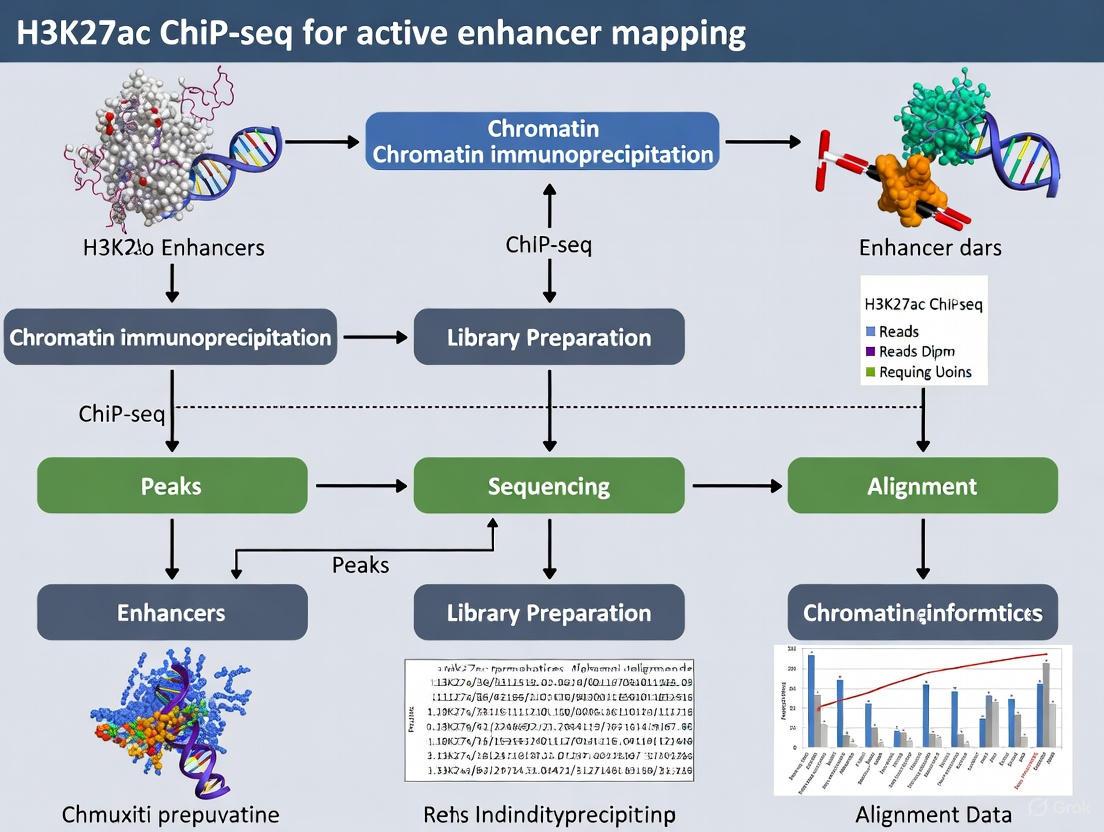
This article provides a comprehensive overview of H3K27ac ChIP-seq as a powerful method for mapping active enhancers and super-enhancers in biological research.
H3K27ac ChIP-seq: A Comprehensive Guide to Active Enhancer Mapping in Disease and Development
Abstract
This article provides a comprehensive overview of H3K27ac ChIP-seq as a powerful method for mapping active enhancers and super-enhancers in biological research. It covers foundational principles of enhancer biology, detailed methodological workflows from experimental design to data analysis, and strategies for troubleshooting and optimization. By integrating recent advances and comparative validation approaches, we demonstrate how H3K27ac profiling enables the identification of cell-type-specific regulatory circuits, reveals disease-associated epigenetic variations, and informs drug discovery efforts. This resource is tailored for researchers, scientists, and drug development professionals seeking to implement or enhance their epigenomic studies.
Understanding H3K27ac: The Epigenetic Keystone of Active Enhancers
H3K27ac as a Definitive Marker for Active Enhancers and Promoters
Biological Foundations of H3K27ac
H3K27ac (Histone 3 Lysine 27 acetylation) represents a fundamental epigenetic mark that distinguishes active regulatory elements within the genome. This specific histone modification occurs through the enzymatic activity of histone acetyltransferases (HATs), particularly the transcriptional coactivators p300 and CBP, which acetylate the lysine 27 residue of histone H3, leading to a more open chromatin state conducive to gene transcription [1].
The primary function of H3K27ac is to demarcate active enhancers and promoters from their poised or inactive counterparts. While the monomethylation of histone H3 lysine 4 (H3K4me1) is often associated with enhancer regions broadly, the presence of H3K27ac provides critical functional discrimination [1]. Genomic regions exhibiting both H3K4me1 and H3K27ac signatures are definitively classified as active enhancers, whereas those containing H3K4me1 alone typically represent poised enhancers that are primed for future activation but not currently driving transcription [1] [2]. This combinatorial chromatin signature enables researchers to distinguish between functionally distinct regulatory states genome-wide.
H3K27ac exhibits a dynamic pattern that reflects cellular identity and response to environmental cues. Research has demonstrated that H3K27ac profiles are highly cell type-specific and can be dynamically altered in response to various stimuli, including environmental factors such as air pollution components [3]. This plasticity makes H3K27ac a valuable marker for studying gene regulatory mechanisms in development, disease, and environmental health contexts.
Experimental Approaches for H3K27ac Mapping
Chromatin Immunoprecipitation Sequencing (ChIP-seq)
Chromatin Immunoprecipitation followed by sequencing (ChIP-seq) remains the gold standard method for genome-wide profiling of H3K27ac enrichment. The fundamental principle involves crosslinking proteins to DNA, shearing chromatin, immunoprecipitating H3K27ac-bound DNA fragments with specific antibodies, and subsequent high-throughput sequencing to map enrichment sites across the genome [3] [4].
The critical steps in H3K27ac ChIP-seq protocol include:
- Cell Preparation and Crosslinking: Cells or tissue samples are fixed with formaldehyde to preserve protein-DNA interactions. For tissues, optimized homogenization using Dounce grinders or mechanical dissociators is essential [4].
- Chromatin Shearing: Sonication of crosslinked chromatin to fragments of 200-600 bp using optimized parameters to ensure appropriate fragment size distribution [3].
- Immunoprecipitation: Incubation with validated H3K27ac-specific antibodies (e.g., Abcam #ab4729) to enrich for target regions [3] [5].
- Library Preparation and Sequencing: Construction of sequencing libraries from immunoprecipitated DNA followed by high-throughput sequencing on platforms such as Illumina HiSeq [3].
For tissue samples, which present challenges due to cellular heterogeneity and complex matrices, refined protocols have been developed that incorporate optimized procedures for tissue preparation, chromatin extraction, immunoprecipitation, and library construction to overcome limitations related to tissue processing [4].
CUT&Tag as an Emerging Alternative
Cleavage Under Targets & Tagmentation (CUT&Tag) has emerged as a promising alternative to ChIP-seq, offering several technical advantages. This enzyme-tethering approach utilizes a protein A-Tn5 transposase fusion protein (pA-Tn5) that is targeted to H3K27ac sites via specific antibodies, enabling simultaneous cleavage and adapter insertion in situ [5].
Recent benchmarking studies demonstrate that CUT&Tag recovers approximately 54% of known ENCODE ChIP-seq peaks for H3K27ac, with the identified peaks representing the strongest ENCODE peaks and showing identical functional and biological enrichments [5]. Key advantages of CUT&Tag include:
- Higher sensitivity with approximately 200-fold reduced cellular input requirements
- Superior signal-to-noise ratio due to direct antibody tethering of pA-Tn5
- Reduced sequencing depth requirements (10-fold lower than ChIP-seq)
- Better adaptability to single-cell applications [5]
Antibody selection critically impacts CUT&Tag performance, with systematic evaluations identifying Abcam-ab4729 (1:100 dilution), the same antibody used in ENCODE ChIP-seq, as optimal for H3K27ac profiling [5].
Table 1: Comparative Analysis of H3K27ac Mapping Technologies
| Parameter | ChIP-seq | CUT&Tag |
|---|---|---|
| Input Cells | 1-10 million | ~50,000 |
| Sequencing Depth | High (20-50 million reads) | Low (2-5 million reads) |
| Signal-to-Noise Ratio | Moderate | High |
| ENCODE Peak Recovery | Reference standard | 54% |
| Single-cell Application | Challenging | Well-suited |
| Crosslinking Required | Yes | No |
| Protocol Duration | 3-5 days | 1-2 days |
Analytical Framework for H3K27ac Data
Peak Calling and Quality Control
Robust bioinformatic analysis is essential for interpreting H3K27ac profiling data. The initial step involves peak calling to identify genomic regions with significant H3K27ac enrichment. Model-based algorithms such as MACS2 are commonly employed, comparing ChIP-seq signals to input controls to define enriched regions [3]. For CUT&Tag data, both MACS2 and SEACR peak callers have demonstrated effectiveness, with parameter optimization critical for maximizing performance [5].
Quality assessment should include evaluation of signal-to-noise ratios, fragment size distribution, and correlation with known positive controls. For H3K27ac, positive control primers targeting genes with strong ENCODE peaks (e.g., ARGHAP22, COX4I2, MTHFR, ZMYND8) provide validation of experimental success [5].
Genomic Annotation and Functional Interpretation
Following peak identification, H3K27ac-enriched regions must be annotated genomically and interpreted functionally:
- Promoter vs. Enhancer Classification: H3K27ac peaks within ±2 kb of transcription start sites (TSS) are annotated as active promoters, while distal peaks (>2 kb from TSS) represent candidate enhancers [1].
- Functional Enrichment Analysis: Tools such as the Genomic Regions Enrichment of Annotations Tool (GREAT) associate H3K27ac peaks with potential target genes and identify enriched biological processes, molecular functions, and pathways [3].
- Integration with GWAS: Overlapping H3K27ac peaks with trait-associated genetic variants from GWAS catalogues helps interpret the functional relevance of non-coding risk variants in disease contexts [3] [5].
The following diagram illustrates the comprehensive analytical workflow for H3K27ac data interpretation:
Research Applications and Findings
Environmental Health and Disease
H3K27ac profiling has provided crucial insights into how environmental exposures trigger gene regulatory changes associated with disease pathogenesis. A landmark study investigating individuals exposed to different levels of PM2.5 (particulate matter with diameters ≤2.5 μm) revealed comprehensive differential H3K27ac landscapes associated with high PM2.5 exposure [3]. The research identified 1,080 H3K27ac loci induced and 158 loci suppressed in high-exposure groups, with these differential epigenetic marks enriched in genes involved in immune cell activation and inflammatory responses [3]. This finding establishes a direct mechanistic link between air pollution exposure and epigenetic reprogramming of immune pathways, potentially explaining inflammatory disease risks associated with environmental pollutants.
Enhancer-Gene Mapping Strategies
A principled strategy for mapping enhancers to their target genes leverages the organizational principle of topologically associating domains (TADs). Since enhancers and their target genes typically reside within the same TAD, this approach narrows the search space from the entire genome to specific regulatory domains [6]. The methodology involves:
- TAD Delineation: Utilizing chromatin conformation capture data to define TAD boundaries, which are largely conserved across cell types [6].
- Candidate Identification: Identifying putative enhancers within the TAD of interest through H3K27ac profiling [6].
- Functional Validation: Employing CRISPR interference (CRISPRi) to demonstrate causal relationships between enhancer inactivation and target gene downregulation [6].
Application of this strategy to the Myrf gene, a master regulator of oligodendrocyte differentiation, successfully identified two H3K27ac-marked enhancers that govern Myrf expression, demonstrating the power of integrated epigenetic and topological analysis [6].
Table 2: H3K27ac-Associated Biological Findings Across Research Contexts
| Research Context | Key Finding | Functional Implication |
|---|---|---|
| Environmental Health | 1,080 differential H3K27ac loci with PM2.5 exposure [3] | Epigenetic mechanism linking air pollution to inflammatory disease |
| Neurodevelopment | Identification of Myrf enhancers in oligodendrocytes [6] | Regulation of oligodendrocyte differentiation and myelination |
| Cancer Epigenetics | Broad H3K27ac domains mark essential cell identity genes [2] | Potential biomarkers for patient stratification and therapeutic targeting |
| Immunology | Dynamic H3K27ac changes at innate immunity enhancers [7] | Regulation of pathogen detection and inflammatory responses |
The Scientist's Toolkit
Essential Research Reagents
Successful H3K27ac profiling requires carefully selected and validated research reagents. The following table details essential components and their functions:
Table 3: Essential Research Reagents for H3K27ac Studies
| Reagent Category | Specific Examples | Function & Application Notes |
|---|---|---|
| Validated Antibodies | Abcam #ab4729 [3] [5], Diagenode C15410196 [5], Cell Signaling Technology #9733 (H3K27me3 control) [5] | Immunoprecipitation of H3K27ac-bound chromatin; critical for both ChIP-seq and CUT&Tag |
| Chromatin Shearing Reagents | PolymorphPrep for nuclei isolation [3], Formaldehyde for crosslinking [4] | Preparation of appropriately fragmented chromatin while preserving protein-DNA interactions |
| Library Preparation Kits | Illumina ChIP-seq kit [3], MGI-specific adaptors [4] | Construction of sequencing libraries compatible with respective platforms |
| Histone Deacetylase Inhibitors | Trichostatin A (TSA), Sodium Butyrate (NaB) [5] | Stabilization of acetyl marks during CUT&Tag procedures (though systematic benefits not consistently observed) |
| Positive Control Primers | ARGHAP22, COX4I2, MTHFR, ZMYND8 [5] | Validation of experimental success through qPCR assessment of known H3K27ac-enriched regions |
Experimental Optimization Guidelines
Optimal H3K27ac profiling requires careful attention to experimental parameters and quality control metrics:
- Antibody Titration: Systematic testing of antibody dilutions (1:50, 1:100, 1:200) is recommended, with 1:100 typically optimal for most H3K27ac antibodies [5].
- PCR Cycle Optimization: Evaluation of PCR cycle numbers (e.g., 12-15 cycles) to minimize duplication rates while maintaining library complexity [5].
- Sequencing Depth: Recommendation of 20-50 million reads for ChIP-seq and 2-5 million reads for CUT&Tag to adequately capture H3K27ac enrichment [5].
- Quality Metrics: Assessment of duplication rates (ideally <50%), FRiP scores, and correlation with positive controls [5].
The following workflow diagram outlines the optimized protocol for tissue H3K27ac ChIP-seq, addressing challenges related to cellular heterogeneity and complex matrices:
Future Perspectives
The evolving landscape of H3K27ac research points toward several promising directions. Single-cell epigenomic technologies enabled by CUT&Tag are poised to resolve cell type-specific regulatory dynamics in complex tissues, particularly relevant for understanding neurodegenerative and neuropsychiatric disorders where H3K27ac variation has been implicated [5]. The integration of H3K27ac profiling with genome engineering through CRISPR-based approaches will facilitate functional validation of enhancer-gene relationships and therapeutic targeting of pathogenic regulatory elements [6]. Furthermore, the development of computational frameworks for multi-omic data integration will enhance our ability to interpret non-coding genetic variation within the context of H3K27ac-marked regulatory elements, advancing both basic science and translational applications in precision medicine.
Super-enhancers (SEs) are large clusters of transcriptional enhancers that drive expression of genes defining cellular identity [8] [9]. These regulatory elements form a specialized class of cis-regulatory elements characterized by unusually high levels of enhancer activity and dense aggregation of transcriptional machinery [10]. While typical enhancers are discrete DNA elements spanning 200-300 base pairs, super-enhancers cover substantially larger genomic regions, typically 8-20 kilobases, and consist of multiple constituent enhancers arranged in series [10].
The discovery of super-enhancers has revolutionized our understanding of gene regulation, particularly in the context of cellular differentiation and disease pathogenesis. Super-enhancers are enriched in master transcription factors, coactivators, and chromatin regulators at key cell identity genes, enabling them to exert exceptionally strong transcriptional control compared to typical enhancers [8] [10]. This enhanced regulatory capacity makes super-enhancers critical determinants of cell fate and function during development, while their dysregulation contributes significantly to various human diseases, including cancer, autoimmune disorders, and neurological conditions [10].
The mapping of active enhancers, including super-enhancers, has been greatly facilitated by chromatin immunoprecipitation followed by sequencing (ChIP-seq) for histone modifications such as H3K27ac, which marks active enhancer elements [11] [12]. This methodological approach has enabled researchers to identify and characterize super-enhancers across diverse cell types and tissues, providing insights into their architectural features and functional properties.
Architectural Features of Super-Enhancers
Structural Organization and Chromatin Environment
Super-enhancers exhibit distinct structural characteristics that differentiate them from typical enhancers. They are predominantly located within super-enhancer domains (SDs) that are embedded in topologically associating domains (TADs) - the fundamental units of chromatin folding and function [10]. Within TADs, DNA-DNA interactions occur at high frequencies, creating a confined structural environment that facilitates enhancer-promoter communication [10]. Approximately 84% of super-enhancers and their associated genes reside within large CTCF-CTCF loops, compared to only 48% of typical enhancers, highlighting the privileged structural organization of super-enhancer domains [10].
The chromatin landscape of super-enhancers is characterized by specific epigenetic modifications that signify their enhanced transcriptional potential. These regions display pronounced enrichment of H3K27ac and H3K4me1 histone modifications, which mark active enhancer elements [12]. Additionally, super-enhancers exhibit an open chromatin configuration evidenced by DNase I hypersensitivity, reflecting their accessibility to transcriptional regulators [12].
Table 1: Key Architectural Features of Super-Enhancers
| Feature | Super-Enhancers | Typical Enhancers |
|---|---|---|
| Genomic size | 8-20 kb | 200-300 bp |
| Transcription factor density | High | Moderate |
| Mediator complex occupancy | High | Low to moderate |
| H3K27ac enrichment | High | Variable |
| Location within TADs | 84% in CTCF-CTCF loops | 48% in CTCF-CTCF loops |
| Chromatin accessibility | High | Variable |
Hierarchical Organization and Hub Enhancers
Recent research has revealed that a significant subset of super-enhancers exhibits hierarchical organization, containing both hub and non-hub enhancers [13]. Hub enhancers represent the major structural and functional constituents within hierarchical super-enhancers and are distinctly associated with cohesin and CTCF binding sites [13]. These hub elements demonstrate higher conservation across cell types and display increased occupancy of lineage-specifying transcription factors compared to non-hub enhancers [13].
The hierarchical organization of super-enhancers has important functional implications. Genetic ablation of hub enhancers results in profound defects in gene activation and local chromatin landscape, underscoring their critical role in maintaining super-enhancer functionality [13]. Interestingly, while hub and non-hub enhancers share similar chromatin modification patterns, hub enhancers are uniquely characterized by elevated binding of architectural proteins like CTCF and cohesin components, which facilitate long-range chromatin interactions [13].
Figure 1: Structural organization of super-enhancers within topologically associating domains, showing hub and non-hub enhancers interacting with target gene promoters.
Functional Roles in Cell Identity and Disease
Regulation of Cell Identity Genes
Super-enhancers play pivotal roles in establishing and maintaining cellular identity by controlling the expression of genes that define cell state and function [8] [9]. In embryonic stem cells (ESCs), super-enhancers are enriched at genes encoding key pluripotency factors such as Oct4, Sox2, and Nanog, forming interconnected autoregulatory loops that maintain the pluripotent state [8]. These super-enhancers serve as platforms that concentrate multiple developmental signaling pathways, including Wnt, TGF-β, and LIF, through terminal transcription factors like TCF3, SMAD3, and STAT3, respectively [8] [14].
The functional importance of super-enhancers in cell identity is evidenced by their cell type-specific distribution and association with lineage-defining genes. A comprehensive catalog of super-enhancers across 86 human cell and tissue types revealed that these elements consistently associate with genes that control and define cellular biology [9]. When cells undergo differentiation, super-enhancer landscapes are extensively reprogrammed, with new super-enhancers forming at genes critical for the differentiated state while pluripotency-associated super-enhancers are dismantled [8] [10].
Involvement in Human Diseases
Dysregulation of super-enhancers constitutes a fundamental mechanism underlying various human diseases. Genome-wide association studies (GWAS) have revealed that disease-associated genetic variation is especially enriched in the super-enhancers of disease-relevant cell types [15] [9]. For example, in colorectal cancer, super-enhancer-driven expression of CLDN1 contributes to radiation resistance, with CLDN1 expression significantly increased in radiation-resistant CRC tissues [11].
Cancer cells frequently acquire super-enhancers at oncogenes and other genes important in tumor pathogenesis [8] [15] [9]. These neomorphic super-enhancers drive elevated expression of oncogenes such as MYC, creating dependencies that can be therapeutically exploited [15]. Beyond cancer, super-enhancer dysregulation has been implicated in autoimmune diseases like rheumatoid arthritis, systemic lupus erythematosus, and multiple sclerosis, as well as neurological conditions including Alzheimer's disease [10].
Table 2: Super-Enhancer Involvement in Human Diseases
| Disease Category | Specific Conditions | Key Super-Enhancer Associations |
|---|---|---|
| Cancer | Colorectal cancer | CLDN1 overexpression driving radiation resistance [11] |
| Lung adenocarcinoma | ERBB2 identified as significant SE-associated gene [16] | |
| Various malignancies | Acquisition of super-enhancers at oncogenes (MYC, etc.) [15] | |
| Autoimmune Diseases | Rheumatoid arthritis | Aberrant super-enhancer activation at inflammatory genes [10] |
| Systemic lupus erythematosus | Dysregulated super-enhancers in immune cells [10] | |
| Multiple sclerosis | Super-enhancer alterations in oligodendrocytes [6] | |
| Neurological Disorders | Alzheimer's disease | Pathogenic super-enhancer activity [10] |
Experimental Approaches for Super-Enhancer Mapping
H3K27ac ChIP-seq for Super-Enhancer Identification
Histone H3 lysine 27 acetylation (H3K27ac) ChIP-seq serves as the cornerstone methodology for identifying active enhancers and super-enhancers [11] [12]. This approach leverages the well-established correlation between H3K27ac enrichment and enhancer activity, providing a robust marker for genome-wide enhancer mapping.
Protocol: H3K27ac ChIP-seq for Super-Enhancer Identification
Cell Crosslinking and Chromatin Preparation
- Crosslink cells with 1% formaldehyde for 10 minutes at room temperature
- Quench crosslinking with 125 mM glycine for 5 minutes
- Harvest cells and wash with cold PBS
- Lyse cells and isolate nuclei using appropriate buffers
- Fragment chromatin by sonication to 200-500 bp fragments
Chromatin Immunoprecipitation
- Incubate fragmented chromatin with anti-H3K27ac antibody overnight at 4°C
- Add protein A/G magnetic beads and incubate for 2 hours
- Wash beads sequentially with low salt, high salt, LiCl, and TE buffers
- Elute chromatin from beads and reverse crosslinks
Library Preparation and Sequencing
- Purify immunoprecipitated DNA
- End-repair, A-tail, and adapter ligate DNA fragments
- Amplify library by PCR with appropriate cycle number
- Quality control check library by bioanalyzer/qPCR
- Sequence using appropriate Illumina platform
Bioinformatic Analysis
- Align sequencing reads to reference genome
- Call significant peaks using MACS2 or similar tools
- Identify super-enhancers using ROSE algorithm or similar approaches
Figure 2: H3K27ac ChIP-seq workflow for super-enhancer identification, from sample preparation to computational analysis.
Computational Identification Using ROSE Algorithm
The Rank Ordering of Super-Enhancers (ROSE) algorithm represents the standard computational approach for super-enhancer identification from ChIP-seq data [16] [13]. This method involves:
Enhancer Definition: Identifying enhancer regions based on significant ChIP-seq peak accumulation, typically using H3K27ac or transcription factor binding data.
Enhancer Stitching: Merging adjacent enhancers within a specified distance (default 12.5 kb) to form candidate super-enhancer regions.
Signal Quantification: Calculating the total ChIP-seq signal within each stitched enhancer region.
Rank Ordering: Ranking all stitched enhancers based on their signal intensity and identifying the inflection point in the rank-signal plot to distinguish super-enhancers from typical enhancers.
The ROSE algorithm effectively identifies genomic regions with unusually high densities of transcriptional coactivators and chromatin features characteristic of super-enhancers [16].
Integration with Multi-Omics Data
Advanced super-enhancer analysis increasingly involves integration of multiple data types to enhance functional interpretation. The SE-to-gene Links approach (implemented in the SEgene platform) correlates super-enhancers with gene expression by integrating ChIP-seq and RNA-seq data [16]. This method:
- Identifies significant correlations between super-enhancer regions and gene expression within ±1 Mb of transcription start sites
- Applies statistical thresholds (FDR < 0.05, correlation coefficient > 0.5) to extract high-confidence super-enhancer-gene pairs
- Constructs interaction networks to elucidate super-enhancer functional relationships
Complementary approaches incorporate chromatin conformation data (Hi-C, ChIA-PET) to validate physical interactions between super-enhancers and their target genes [6] [13].
Table 3: Key Research Reagent Solutions for Super-Enhancer Studies
| Category | Specific Reagents/Resources | Function/Application |
|---|---|---|
| Antibodies | Anti-H3K27ac | Marker for active enhancers in ChIP-seq experiments [11] [12] |
| Anti-Mediator (MED1) | Original super-enhancer identification marker [8] | |
| Anti-BRD4 | Bromodomain protein enriched at super-enhancers [8] | |
| Anti-p300/CBP | Histone acetyltransferases marking active enhancers [8] [12] | |
| Computational Tools | ROSE Algorithm | Standard tool for super-enhancer identification [16] [13] |
| SEgene Platform | Integrates ChIP-seq and RNA-seq for super-enhancer-gene linking [16] | |
| HOMER | Suite for ChIP-seq analysis and motif discovery | |
| Cistrome DB | Repository of publicly available ChIP-seq datasets [11] | |
| Database Resources | SEdb 2.0 | Comprehensive super-enhancer database with tissue annotations [16] |
| eRNAbase | Enhancer RNA database with functional annotations [16] | |
| ENCODE | Encyclopedia of DNA elements with extensive enhancer data [11] | |
| Functional Validation | CRISPRi/a | Epigenome editing for super-enhancer perturbation [6] |
| dCas9-p300 | Targeted activation of enhancer elements | |
| Reporter Assays | Testing enhancer activity in cellular contexts |
Signaling Pathway Integration at Super-Enhancers
Super-enhancers function as integration platforms for multiple developmental and oncogenic signaling pathways [14]. In embryonic stem cells, super-enhancers concentrate terminal transcription factors from key signaling pathways, including TCF3 (Wnt pathway), SMAD3 (TGF-β pathway), and STAT3 (LIF pathway) at pluripotency genes [8] [14]. This convergence enables enhanced responsiveness of super-enhancer-driven genes to environmental cues and signaling inputs.
The mechanism underlying this signaling integration involves the colocalization of signal-responsive transcription factors with lineage-determining master transcription factors at super-enhancer elements [14]. For example, in ESCs, signaling-transduced transcription factors bind to the same super-enhancer constituents occupied by the core pluripotency factors Oct4, Sox2, and Nanog [8]. This architectural arrangement explains why genes controlled by super-enhancers display heightened sensitivity to signaling perturbations compared to typical enhancer-driven genes [14].
In cancer cells, acquired super-enhancers at oncogenes similarly concentrate oncogenic signaling pathways, creating aberrant regulatory hubs that drive tumorigenesis [14]. This phenomenon underscores the therapeutic potential of targeting super-enhancer components and associated signaling molecules in cancer treatment.
Figure 3: Integration of developmental and oncogenic signaling pathways at super-enhancer platforms, showing how external signals and master transcription factors converge to drive expression of cell identity genes.
Concluding Remarks and Future Perspectives
Super-enhancers represent a fundamental architectural motif in eukaryotic gene regulation, serving as specialized hubs that concentrate transcriptional machinery at genes controlling cellular identity. Their large size, high transcription factor density, and ability to integrate multiple signaling pathways enable precise control of critical gene expression programs during development and differentiation.
The implications of super-enhancer biology extend far beyond basic research into therapeutic applications. The enrichment of disease-associated genetic variants in super-enhancers, coupled with the frequent acquisition of super-enhancers at oncogenes in cancer cells, positions these elements as promising biomarkers and therapeutic targets [15] [9]. Small molecule inhibitors targeting super-enhancer components, such as BRD4 inhibitors, have already demonstrated preclinical efficacy in various cancer models, highlighting the translational potential of super-enhancer research.
Future directions in super-enhancer research will likely focus on understanding the dynamics of these regulatory elements during disease progression and therapeutic intervention, developing more sophisticated tools for precise manipulation of super-enhancer activity, and exploring the potential of super-enhancer components as diagnostic and prognostic biomarkers across diverse human diseases. As our knowledge of super-enhancer architecture and function continues to expand, so too will opportunities for leveraging these fundamental regulatory elements for therapeutic benefit.
Integrating H3K27ac with Topologically Associating Domains (TADs) for Principled Enhancer-Gene Mapping
A fundamental challenge in modern genomics is the accurate mapping of enhancers to their target genes. Traditional approaches, which often rely on arbitrary proximity-based criteria, are prone to false positives and functional misinterpretation. This application note details a principled strategy that overcomes these limitations by integrating H3K27ac ChIP-seq, a gold standard for identifying active enhancers and promoters, with the three-dimensional genomic context provided by Topologically Associating Domains (TADs). TADs are megabase-scale structural units of the genome that constrain enhancer activity, meaning that a gene and its regulatory enhancers are typically located within the same TAD [6]. This biological principle allows researchers to narrow the search space for authentic enhancer-gene pairs from the entire genome to a specific, functionally constrained domain, significantly enhancing the precision of regulatory annotation [6]. The protocol outlined herein provides a robust framework for leveraging publicly available Hi-C data and genome-wide H3K27ac profiles to systematically and accurately link enhancers to their target genes, a capability critical for understanding cell identity, differentiation, and disease mechanisms.
Background and Principle
Topologically Associating Domains (TADs) as Functional Units of Gene Regulation
Topologically Associating Domains (TADs) are essential components of the 3D genome organization, appearing as squares of increased interaction frequency along the diagonal of a Hi-C contact map [17]. They are defined as structural domains with enhanced self-interactions, whose boundaries act as insulators to prevent inter-TAD interactions while promoting intra-TAD interactions [17]. A key feature of TADs is that their boundaries are often conserved across different cell types and even species, and are enriched with architectural proteins like CTCF and the cohesin complex, as well as housekeeping genes [17] [18] [6]. This conservation is crucial for the protocol described here, as it means that TADs mapped in one cell type can often be used to inform studies in a related cell type where such data may not be available. Disruption of TAD boundaries by genomic structural variations can lead to ectopic enhancer-promoter contacts and severe diseases, including cancer, underscoring their critical role as stable neighborhoods for gene regulation [17] [18].
H3K27ac as a Marker for Active Regulatory Elements
The histone modification H3K27ac is a well-established epigenetic mark that distinguishes active enhancers (AEs) and active promoters from their inactive or primed counterparts. Active enhancers are characterized by the presence of both H3K4me1 and H3K27ac, while primed enhancers carry only H3K4me1 [19]. The H3K27ac mark indicates that an enhancer is engaged with the transcriptional machinery, and its levels often correlate with the expression levels of nearby genes [20]. During mitosis, H3K27ac is largely lost and then rapidly reacquired upon mitotic exit in a manner that correlates with the reactivation of transcription, suggesting its role in bookmarking active regulatory elements for faithful transcriptional reactivation in daughter cells [19]. This dynamic regulation makes H3K27ac ChIP-seq an powerful tool for creating genome-wide maps of the regulatory landscape that is actively shaping cell identity.
The Integrative Strategy: Constraining Enhancer Search Space with TADs
The core principle of this integrative method is a paradigm shift from distance-based to structure-based mapping. Instead of searching for enhancers within an arbitrarily defined genomic window around a gene of interest, this approach first defines the TAD containing the gene. Since enhancers and their target genes are almost always co-localized within the same TAD, this step narrows the search space in a biologically principled manner [6]. Subsequently, active enhancers within this TAD are identified via H3K27ac ChIP-seq. This produces a manageable list of high-confidence candidate enhancers that are then validated through functional assays such as CRISPRi. This strategy was successfully applied to identify enhancers governing the expression of Myrf, a master regulator of oligodendrocyte differentiation, where the search space was reduced from the entire genome to just six candidate enhancers within the Myrf TAD [6].
The following diagram illustrates the core logical workflow of this integrative strategy.
Computational Protocols for TAD Identification
Over 20 computational methods have been developed to identify TADs from Hi-C data, employing diverse strategies such as calculating linear scores, clustering, network features, structural entropy, and statistical models [18]. A comprehensive benchmarking of 13 tools provides critical guidance for selection. Key considerations include the tool's performance across different data resolutions, sequencing depths, and its ability to handle hierarchical TAD structures (TADs within TADs) [18]. The following table summarizes the characteristics of several widely used or high-performing TAD callers.
Table 1: Benchmarking of Selected TAD Callers
| Method | Underlying Strategy | Key Parameter | Strengths and Usability |
|---|---|---|---|
| Arrowhead [18] | Linear Score | Corner Score | Part of the Juicebox suite; suitable for high-resolution data. |
| OnTAD [17] [18] | Linear Score | Sliding diamond window size | Designed specifically for detecting hierarchical TAD structures. |
| SpectralTAD [18] | Clustering | Number of hierarchical levels | Fast; outputs a multi-level TAD hierarchy. |
| GRiNCH [17] [18] | Network Features / Matrix Factorization | NMF parameters | Simultaneously smoothes sparse matrices and detects domains. |
| TADGATE [17] | Graph Attention Auto-encoder | Model-based | Excels at imputing and denoising sparse Hi-C maps; improves TAD clarity. |
| Armatus [18] | Linear Score | Resolution parameter γ | Robust; identifies consensus domains across parameters. |
| HiCKey [18] | Statistical Model | Generalized likelihood ratio | Identifies TADs and significant interactions simultaneously. |
A Practical Workflow for TAD Delineation
Step 1: Data Acquisition and Preprocessing
- Obtain Hi-C data in a format compatible with your chosen TAD caller (e.g.,
.hic,.cool, or matrix formats). Public repositories like the Gene Expression Omnibus (GEO) are primary sources. For the human GM12878 and K562 cell lines, data is available under GEO accession numberGSE63525[17]. - If necessary, re-process raw sequencing data using standard pipelines (e.g.,
juicer[17] orcooler[17]) which include mapping, pairing reads, and binning the genome at a specific resolution. - Perform Iterative Correction and Eigenvector decomposition (ICE) normalization to account for technical biases [21].
Step 2: TAD Calling in Practice
- Select an appropriate tool based on your data quality and biological question. For a balanced performance, OnTAD or SpectralTAD are recommended for their ability to detect hierarchies [18]. For sparse or low-depth data, TADGATE or GRiNCH are particularly robust as they perform matrix imputation and smoothing [17].
- Execute the TAD caller with parameters tuned for your data resolution. For example, with
OnTAD, adjust theminSizeandmaxSizeparameters to reflect expected TAD sizes (typically ~1Mb). - The output will be a list of genomic intervals (chromosome, start, end) defining TADs and/or TAD hierarchies.
Step 3: Visualization and Validation
- Visualize the called TADs overlaid on the Hi-C contact matrix using a specialized genome browser to confirm they align with visible interaction blocks.
- Recommended Browsers:
- The 3D Genome Browser (
3dgenome.org): Allows simultaneous visualization of Hi-C matrices, predicted TADs, and other omics data like open chromatin (DNase-seq) [21]. - Juicebox [22]: Excellent for exploring Hi-C data at various resolutions.
- MultiVis.js [22]: A specialized tool for visualizing multiway chromatin interaction data from techniques like SPRITE.
- The 3D Genome Browser (
- Validate TAD boundaries by confirming enrichment of known insulator proteins (e.g., CTCF) and other boundary-associated features using public ChIP-seq data.
Experimental Protocols for Enhancer Mapping and Validation
Generating a Genome-wide Map of Active Enhancers with H3K27ac ChIP-seq
This protocol describes how to create a cell type-specific map of active regulatory elements.
Reagents and Equipment:
- Cross-linked chromatin from your cell type of interest.
- Specific antibody against H3K27ac.
- Protein A/G magnetic beads.
- Library preparation kit for high-throughput sequencing.
- Equipment for sonication (e.g., Covaris sonicator), PCR, and next-generation sequencing.
Procedure:
- Cell Fixation and Lysis: Cross-link cells with formaldehyde to preserve protein-DNA interactions. Quench the cross-linking, harvest cells, and lyse them to isolate nuclei.
- Chromatin Shearing: Sonicate the chromatin to fragment DNA into sizes of 200–500 bp. This can be optimized using a Covaris sonicator.
- Immunoprecipitation: Incubate the sheared chromatin with the H3K27ac antibody. Use an isotype-specific IgG as a negative control. Capture the antibody-bound complexes using Protein A/G magnetic beads.
- Washing, Elution, and Reverse Cross-linking: Wash the beads stringently to remove non-specifically bound chromatin. Elute the immunoprecipitated DNA and reverse the cross-links.
- Library Preparation and Sequencing: Purify the DNA and prepare a sequencing library using a standard kit. Sequence the libraries on an appropriate Illumina platform to obtain a minimum of 20 million non-duplicate reads.
Bioinformatic Analysis of H3K27ac Data:
- Mapping: Align sequenced reads to the reference genome (e.g., GRCh38/hg38) using tools like BWA or Bowtie2.
- Peak Calling: Identify significant regions of H3K27ac enrichment (peaks) using peak callers such as MACS2. These peaks represent active promoters and enhancers.
- Enhancer Prediction: To distinguish enhancers from promoters, subtract regions overlapping known transcription start sites (TSSs). The remaining H3K27ac peaks are your candidate active enhancers.
Identifying Enhancer-Gene Candidates by Intersection with TADs
- Define the Gene TAD: Using the results from Section 3, identify the specific TAD that contains your gene of interest.
- Intersect with Enhancer Map: Extract all H3K27ac peaks that fall within the genomic coordinates of this TAD. This list constitutes your high-confidence candidate enhancers for the gene.
- Prioritization (Optional): Prioritize candidates based on the strength of the H3K27ac signal (peak height), proximity to the gene, or the presence of transcription factor binding motifs relevant to your biological context.
Functional Validation with CRISPR Interference (CRISPRi)
A definitive proof of an enhancer-gene relationship is to demonstrate that perturbing the enhancer affects target gene expression. CRISPRi is an ideal method for this.
Reagents and Equipment:
- dCas9-KRAB expression vector (for transcriptional repression).
- sgRNA(s) targeting candidate enhancer region(s).
- Delivery system (e.g., lentivirus, nucleofection).
- Assays for measuring gene expression (e.g., qRT-PCR, RNA-seq).
Procedure:
- sgRNA Design: Design 2-3 sgRNAs targeting the core region of each candidate enhancer. sgRNAs for a non-targeting genomic region serve as controls.
- Cell Transduction/Transfection: Deliver the dCas9-KRAB and sgRNA constructs into your cell type. A stable cell line expressing dCas9-KRAB can be used for streamlined sgRNA delivery.
- Incubation: Allow 72-96 hours for effective repression of the enhancer.
- Molecular Phenotyping:
- Measure Gene Expression: Quantify the mRNA expression of the putative target gene using qRT-PCR. A significant decrease in expression upon targeting the enhancer confirms the regulatory link.
- Confirm Epigenetic Knockdown: Perform H3K27ac ChIP-qPCR on the targeted enhancer to confirm a local reduction of the acetylation mark.
- Data Interpretation: A significant reduction in target gene expression specifically upon perturbation of the candidate enhancer, but not control sgRNAs, provides causal evidence for the enhancer-gene pairing.
Table 2: Key Research Reagent Solutions for Integrated TAD and Enhancer Mapping
| Item | Function/Description | Example Sources/Tools |
|---|---|---|
| H3K27ac Antibody | Immunoprecipitation of active enhancers and promoters for ChIP-seq. | Commercial vendors (e.g., Abcam, Cell Signaling Technology). |
| dCas9-KRAB System | Targeted transcriptional repression for functional validation of enhancers. | Addgene (plasmids). |
| Hi-C Datasets | Publicly available data for TAD calling in the absence of in-house data. | GEO (e.g., GSE63525), 4D Nucleome Data Portal [17]. |
| TAD Calling Software | Computational identification of TADs from Hi-C contact matrices. | OnTAD, SpectralTAD, TADGATE, Arrowhead (Juicebox) [17] [18]. |
| Genome Visualization Browsers | Tools for visualizing Hi-C data, TAD calls, and other genomic annotations. | 3D Genome Browser, Juicebox, WashU Epigenome Browser [22] [21]. |
| ChIP-seq Analysis Pipeline | Software for mapping reads and calling peaks from ChIP-seq data. | BWA/MACS2; Part of the H3K27ac ChIP-seq protocol [6]. |
Workflow Integration and Data Interpretation
The following diagram synthesizes the computational and experimental protocols into a complete, integrated workflow, from initial data collection to final validated enhancer-gene link.
Interpreting Results and Addressing Challenges:
- Conserved vs. Cell-Type-Specific TADs: While TAD boundaries are often conserved, internal TAD structure and enhancer activity are dynamic. Use TAD maps from a closely related cell type if necessary, but be aware that cell-type-specific TAD rearrangements can occur and influence gene regulation [23].
- Sparse Hi-C Data: For Hi-C data with low sequencing depth, employ TAD callers like TADGATE or GRiNCH that are specifically designed to impute and denoise sparse contact maps, thereby improving TAD identification accuracy [17].
- Complex Regulation: A single gene can be regulated by multiple enhancers within its TAD, and a single enhancer may also target multiple genes. CRISPRi perturbation may show partial effects due to this redundancy or complexity.
- Multi-omics Integration: For a deeper understanding, integrate your findings with additional data. The 3D Genome Browser is particularly powerful for this, as it allows simultaneous visualization of Hi-C, TADs, H3K27ac, open chromatin (ATAC-seq/DNase-seq), and gene expression data [21]. This can help correlate enhancer activity and chromatin structure with transcriptional output.
The integration of H3K27ac mapping with TAD analysis represents a powerful and principled shift in how researchers connect distal regulatory elements to their target genes. By moving beyond simple linear proximity to incorporate the fundamental 3D architecture of the genome, this strategy dramatically narrows the search space for authentic enhancers, thereby increasing the efficiency and accuracy of regulatory annotation. The detailed computational and experimental protocols provided here, supported by benchmarks and resources, offer a clear roadmap for researchers to implement this approach. As studies continue to reveal the dynamic interplay between the epigenome and 3D genome structure in development and disease [19] [20], the adoption of such integrative methods will be paramount for unraveling complex transcriptional regulatory networks and for identifying novel therapeutic targets.
Histone H3 lysine 27 acetylation (H3K27ac) has emerged as a definitive chromatin mark for identifying active enhancers and promoters, providing critical insights into gene regulatory mechanisms that underlie complex diseases. This epigenomic mark distinguishes actively transcribed genomic regions from their poised or inactive counterparts, enabling researchers to map the regulatory landscape of cells and tissues with high precision. The dynamic nature of H3K27ac deposition and removal in response to developmental cues, environmental factors, and disease states positions it as an essential readout for understanding transcriptional dysregulation in pathology.
Advanced profiling techniques, particularly chromatin immunoprecipitation followed by sequencing (ChIP-seq), have enabled genome-wide mapping of H3K27ac distributions across diverse biological contexts. When integrated with genetic and transcriptomic data, these epigenomic profiles provide mechanistic links between non-coding genetic variation, regulatory element activity, and disease pathogenesis. This application note details experimental protocols, analytical frameworks, and therapeutic insights derived from multi-tissue H3K27ac profiling, with particular emphasis on its utility in identifying disease-relevant regulatory circuits and potential drug targets.
Key Findings from Large-Scale H3K27ac Profiling Initiatives
The GTEx Epigenomics Expansion
The Enhancing GTEx (eGTEx) project has significantly advanced our understanding of tissue-specific gene regulation by complementing existing transcriptomic data with extensive epigenomic profiles. A recent landmark study profiled H3K27ac across 387 brain, heart, muscle, and lung samples from 256 GTEx participants, creating an unprecedented resource for investigating interindividual epigenomic variation [24].
Table 1: Key Quantitative Findings from Multi-Tissue H3K27ac Profiling of GTEx Samples
| Profiling Metric | Finding | Biological Significance |
|---|---|---|
| Active Regulatory Elements (AREs) | 282,000 identified with tissue-specific patterns | 14% fully shared across tissues; 62% tissue-specific |
| Sex-biased AREs | 2,436 identified | Enriched near previously identified sex-biased genes |
| Genetic Influences (haQTLs) | 130,000 genetic variants associated with 5,397 AREs | Provides mechanistic links between non-coding variants and regulatory function |
| GWAS Integration | 614 GWAS-haQTL-colocalized gAREs identified | Prioritizes functional variants and their regulatory targets for complex diseases |
This large-scale mapping effort revealed that tissue-specific AREs were predominantly enriched in enhancer regions (79-93%), while broadly shared AREs were more frequently associated with promoter elements (54-80%) [24]. The dataset has enabled the development of innovative analytical approaches such as genetics-based ARE-gene linking scores (gLink scores), which have successfully prioritized 228 target genes for 161 GWAS-colocalized regulatory elements across the four surveyed tissues [24].
Disease-Relevant Insights from Epigenomic Integration
Integrating H3K27ac profiles with genetic association data has proven particularly powerful for elucidating the cellular and molecular basis of complex diseases. In multiple sclerosis (MS), this integration revealed significant enrichment of GWAS signals in active enhancer regions (marked by H3K27ac) of specific immune cell types, with B cells and monocytes showing the strongest enrichment [25]. This approach successfully identified 1,247 candidate MS susceptibility genes in B cells, 1,148 in monocytes, and 1,183 in microglia, providing a refined roadmap of cell-specific disease mechanisms [25].
Similar integrative approaches have demonstrated clinical utility in oncology, where H3K27ac profiling of colorectal cancer tissues identified claudin-1 (CLDN1) as an enhancer-driven gene that promotes radiation resistance [11]. Meta-analysis revealed that CLDN1 expression was significantly increased in radiation-resistant CRC tissues, with a standard mean difference of 0.42 and an area under the curve of 0.74 for predicting radiation resistance [11].
Experimental Protocols for H3K27ac Profiling
Standard H3K27ac ChIP-seq Protocol
The fundamental protocol for H3K27ac profiling involves chromatin immunoprecipitation followed by high-throughput sequencing. The standard workflow includes:
- Crosslinking: Cells or tissues are fixed with formaldehyde to preserve protein-DNA interactions.
- Chromatin Shearing: Sonication is used to fragment chromatin to 200-500 bp fragments.
- Immunoprecipitation: Incubation with validated anti-H3K27ac antibodies to enrich for acetylated chromatin.
- Library Preparation and Sequencing: DNA purification, library construction, and high-throughput sequencing.
Quality control metrics should include assessment of fragment size distribution, enrichment at positive control regions, and low background signal at negative control regions.
Advanced Protocol: ChIP-seq with FACS Purification from FFPE Tissues
For precious clinical samples, particularly archived formalin-fixed paraffin-embedded (FFPE) tissues, a refined protocol enables H3K27ac profiling from specific cellular subpopulations. This method is particularly valuable for tumor samples with heterogeneous cellular composition [26].
Table 2: Essential Research Reagent Solutions for H3K27ac Profiling
| Reagent/Category | Specific Examples | Function/Application |
|---|---|---|
| Antibodies | Validated anti-H3K27ac | Target-specific immunoprecipitation |
| Cell Sorting Markers | FITC-labeled PD1, PE-labeled CD79a, anti-CD3 | Isolation of specific cell populations from heterogeneous samples |
| Chromatin Shearing | Sonicator 4000 (Qsonica Misonix) | DNA fragmentation to optimal size |
| Protease Inhibitors | cOmplete Protease Inhibitor Cocktail (Roche) | Preservation of protein integrity and epitopes |
| Sample Storage | Formalin-fixed paraffin-embedded (FFPE) blocks | Long-term preservation of tissue architecture |
The optimized protocol includes these critical steps [26]:
Single-Cell Preparation from FFPE:
- Cut 50μm thick sections from FFPE blocks
- Deparaffinize with xylene and rehydrate through graded ethanol series
- Digest with 0.3% collagenase/dispase to dissociate tissue
- Filter through cell strainers to obtain single-cell suspension
Heat-Enhanced Antigen Retrieval and Fluorescence-Activated Cell Sorting (FACS):
- Resuspend cells in TE buffer and heat at 50°C for 60 minutes
- Incubate with cell type-specific antibodies (e.g., CD3, PD1 for T-cells)
- Sort target population using FACS (e.g., CD3+PD1+ cells for nodal T follicular helper cell lymphoma)
Chromatin Shearing and Immunoprecipitation:
- Lyse sorted cells and digest with Proteinase K (40ng/μl) for 2-3 minutes
- Inactivate protease with AEBSF (2μg/μl)
- Sonicate chromatin to 200-500bp fragments using focused ultrasonication
- Perform immunoprecipitation with H3K27ac antibody
- Purify DNA and prepare sequencing libraries
This refined approach successfully removed confounding H3K27ac signals from non-target cellular components in lymphoma samples, yielding enhancer profiles that more accurately reflected the tumor cell lineage [26].
Figure 1: Experimental workflow for H3K27ac ChIP-seq with FACS purification from FFPE tissues
Quality Control Considerations
For robust H3K27ac profiling, these quality control metrics are essential:
- Sequencing depth: ≥20 million reads per sample for standard ChIP-seq
- Peak concordance with known active regulatory elements
- High signal-to-noise ratio measured by FRiP (Fraction of Reads in Peaks) score
- Correlation with orthogonal assays (e.g., ATAC-seq, DNase-seq) for validation
Analytical Frameworks for Data Integration and Interpretation
Enhancer-Gene Linking Strategies
A critical challenge in epigenomics lies in accurately connecting enhancers to their target genes. Several principled strategies have emerged:
TAD-Based Mapping: Topologically associating domains (TADs) provide a structural framework for enhancer-gene linking, as enhancers and their target genes typically reside within the same TAD [6]. This approach narrows the search space from the entire genome to specific regulatory domains, significantly improving prediction accuracy.
Genetic Linking (gLink Scores: The gLink method leverages quantitative trait locus information to create genetics-based scores that connect active regulatory elements to their target genes, demonstrating particular utility for prioritizing SNP-ARE-gene circuits in complex disease loci [24].
Multi-Omics Integration: Combined analysis of H3K27ac data with transcriptomic, proteomic, and additional epigenomic datasets (e.g., ATAC-seq, DNA methylation) provides orthogonal evidence for regulatory relationships [27].
Temporal Analysis of Enhancer Dynamics
During cellular differentiation, super-enhancers (large clusters of enhancers with exceptionally high H3K27ac signals) emerge through distinct temporal patterns [28]:
- Conserved (Con): Maintained throughout differentiation
- Temporally Hierarchical (TH): Contain both early-established and late-gained elements
- De Novo (DN): Emerge simultaneously at late differentiation stages
Each subtype possesses distinct functional characteristics, with de novo super-enhancers being particularly enriched for cell-type-specific functions [28]. For example, in cardiomyocyte differentiation, de novo super-enhancers are associated with genes involved in "striated muscle cell differentiation" and "cardiac muscle cell development," while conserved super-enhancers regulate more general cellular processes [28].
Figure 2: Analytical framework for integrating H3K27ac data with multi-omics datasets
Therapeutic Applications and Translational Insights
Target Discovery in Oncology
H3K27ac profiling has proven particularly valuable in oncology, where enhancer dysregulation frequently drives oncogene expression. In colorectal cancer, integrated analysis of 58 H3K27ac ChIP-seq datasets identified 13,703 enhancer-regulated genes, with subsequent filtering revealing CLDN1 as a key driver of radiation resistance [11]. This finding was validated through comprehensive meta-analysis showing significantly increased CLDN1 expression in radiation-resistant tumors, positioning it as both a predictive biomarker and potential therapeutic target.
Super-enhancer mapping has also revealed novel therapeutic vulnerabilities in lymphomas, where cell-type-specific H3K27ac profiling isolated from FFPE tissues identified lineage-dependent enhancer signatures that could be targeted with epigenetic therapies [26].
Disease Mechanism Elucidation in Complex Disorders
For complex genetic diseases like multiple sclerosis, H3K27ac profiling has helped resolve the cellular basis of disease susceptibility. Integration with GWAS data demonstrated that MS risk variants are significantly enriched in active enhancers of microglia and peripheral immune cells (particularly B cells and monocytes), highlighting these cell types as central to disease pathogenesis [25]. This approach facilitated the development of cell-type-specific polygenic risk scores that improve prediction accuracy and provide insights into the distinct contributions of various cellular compartments to disease risk.
Multi-tissue H3K27ac profiling represents a powerful approach for linking epigenomic variation to disease mechanisms. The experimental protocols and analytical frameworks detailed in this application note provide a roadmap for researchers seeking to implement these methods in their investigation of disease pathogenesis. As the resolution and scale of epigenomic mapping continue to advance, integration of H3K27ac profiling with other functional genomic datasets will undoubtedly yield further insights into the regulatory basis of human disease and uncover novel therapeutic opportunities.
The strategic application of these methods—particularly when combined with careful experimental design including relevant tissue contexts, sufficient sample sizes for detecting interindividual variation, and robust analytical pipelines—holds significant promise for accelerating the translation of genetic discoveries into mechanistic understanding and ultimately improved human health.
From Bench to Browser: H3K27ac ChIP-seq Workflows and Applications
In the field of epigenomics, mapping protein-DNA interactions is fundamental to understanding gene regulation. For researchers focusing on active enhancer mapping through H3K27ac profiling, selecting the appropriate method is crucial for generating reliable and biologically relevant data. Chromatin Immunoprecipitation followed by sequencing (ChIP-seq) has been the gold standard for decades, but emerging in situ techniques like Cleavage Under Targets and Tagmentation (CUT&Tag) offer compelling alternatives. This application note provides a structured comparison between ChIP-seq and CUT&Tag technologies, focusing on their application in H3K27ac research for enhancer and super-enhancer analysis, to guide researchers in selecting the optimal method for their specific sample type and experimental goals.
Technology Comparison: Core Principles and Characteristics
Fundamental Methodological Differences
ChIP-seq is an in vitro method that relies on crosslinking proteins to DNA, fragmenting chromatin typically by sonication, immunoprecipitating target-protein-DNA complexes, and sequencing the associated DNA fragments. This approach requires chemical cross-linking to preserve protein-DNA interactions, which can introduce nonspecific binding and increase background noise [29].
CUT&Tag represents a paradigm shift as an in situ method that uses antibody-recruited Tn5 transposase to simultaneously cleave and tag target-bound DNA with sequencing adapters. This process occurs in permeabilized nuclei without cross-linking or sonication, maintaining more natural chromatin architecture and significantly reducing background signals [29] [30].
Quantitative Technical Comparison
The table below summarizes the key technical differences between ChIP-seq and CUT&Tag:
Table 1: Technical Comparison Between ChIP-seq and CUT&Tag
| Parameter | ChIP-seq | CUT&Tag |
|---|---|---|
| Assay Type | In vitro | In situ |
| Core Principle | Cross-linking + sonication + immunoprecipitation | Antibody-recruited Tn5 transposase tagmentation |
| Cell Input Requirements | 100,000 - millions of cells [29] [30] | 100 - 100,000 cells [29] |
| Protocol Duration | 2-5 days [29] | ~1 day [29] |
| Signal-to-Noise Ratio | Lower (non-specific binding, off-target sonication) [29] | High (minimal background) [29] |
| Sequencing Depth Required | 20-40 million reads per library [30] | 3-8 million reads per library [30] |
| Cost Per Sample | Higher (more reagents, deep sequencing) [29] | Lower (less reagents, shallow sequencing) [29] |
| Cross-linking | Required (can cause nonspecific interactions) [29] | Optional, typically not used [29] |
| Chromatin Fragmentation | Sonication or enzymatic digestion [29] | Tn5 transposase cleavage [29] |
| Compatibility with FFPE Samples | Established protocols exist [31] | Limited data available |
Workflow Protocols and Methodological Details
ChIP-seq Protocol for H3K27ac Profiling
The standard ChIP-seq protocol involves these critical steps:
- Cell Cross-linking: Add formaldehyde (final concentration ~1%) to cells and incubate for 10-15 minutes at room temperature to cross-link and fix proteins to DNA. Terminate the reaction with glycine [29].
- Cell Lysis and Chromatin Fragmentation: Lyse cells with ice-cold lysis buffer. Shear chromatin into 200-500bp fragments using ultrasonication (e.g., 200-300W, 30 seconds on/off cycles, 5-10 repetitions) [29].
- Chromatin Immunoprecipitation: Incubate sheared chromatin with a specific antibody against H3K27ac (1-10 μg antibody per 25 μg DNA). Add protein A/G magnetic beads and rotate at 4°C overnight to capture antibody-protein-DNA complexes [29].
- Elution and Reverse Cross-linking: Elute DNA from beads, add NaCl and RNase A, then incubate overnight at 65°C. Add proteinase K and incubate at 60°C for 1 hour to remove proteins and purify DNA [29].
- Library Preparation and Sequencing: Construct sequencing libraries from purified DNA fragments. Sequence with sufficient depth (20-40 million reads for histone modifications) [29] [30].
For challenging samples like Formalin-Fixed Paraffin-Embedded (FFPE) tissues, advanced modifications such as fluorescence-activated cell sorting (FACS) can be incorporated to purify target cells before chromatin shearing, significantly improving data quality by removing interference signals from non-target cell components [31].
CUT&Tag Protocol for H3K27ac Profiling
The CUT&Tag workflow for H3K27ac includes these key steps:
- Sample Permeabilization: Permeabilize cells or nuclei to allow antibody access while maintaining nuclear structure [29].
- Antibody Binding: Incubate with primary antibody against H3K27ac, followed by a secondary antibody to enhance signal specificity [29].
- pA/G-Tn5 Transposase Binding: Add protein A/G fused to Tn5 transposase (pA/G-Tn5), which binds to the antibody complex [29].
- Tagmentation: Activate Tn5 with Mg²⁺ to initiate simultaneous cleavage and adapter tagging of DNA near H3K27ac binding sites [29].
- DNA Extraction and Library Amplification: Extract tagged DNA fragments, which already contain sequencing adapters, and amplify via PCR for sequencing [29].
The CUT&Tag protocol is significantly faster than ChIP-seq, can be completed in approximately one day, and is amenable to high-throughput applications [29].
Diagram 1: Workflow comparison between ChIP-seq and CUT&Tag
Performance Comparison for H3K27ac Enhancer Mapping
Data Quality and Genome Coverage
For H3K27ac profiling, both ChIP-seq and CUT&Tag generally identify similar enrichment patterns at genic loci such as promoters [32]. However, significant differences emerge in specific genomic contexts:
- Enhancer and Super-Enhancer Mapping: Both techniques effectively identify H3K27ac marks at enhancers and super-enhancers. CUT&Tag has been successfully used to profile super-enhancers in various tissues, including adipose tissue in pigs, demonstrating its applicability for enhancer mapping studies [33].
- Background Signals: CUT&Tag provides significantly higher signal-to-noise ratios than ChIP-seq, which is particularly beneficial for detecting subtle enhancer activation states [29] [30].
- Bias Patterns: ChIP-seq shows inherent biases toward open chromatin regions, potentially underrepresenting certain heterochromatic regions. CUT&Tag overcomes some of these biases, providing more uniform genome coverage [32].
Sample Requirement Considerations
Table 2: Sample Compatibility Guide
| Sample Type | Recommended Method | Key Considerations |
|---|---|---|
| Abundant Cell Sources (cell lines, fresh tissue) | Either method | ChIP-seq: Well-established protocolsCUT&Tag: Faster, lower cost |
| Rare Cell Populations (FACS-sorted cells, primary cells) | CUT&Tag | Superior for low cell inputs (100-100,000 cells) [29] |
| FFPE Archives | ChIP-seq (with FACS) | Proven protocols with cell sorting to remove non-target cell interference [31] |
| Transcription Factor Studies | CUT&Tag or CUT&RUN | Better for transient interactions without cross-linking artifacts [30] |
| High-Throughput Screening | CUT&Tag | Faster protocol, lower sequencing costs [29] [30] |
Technical and Analytical Considerations
Peak Calling Strategies: For CUT&Tag data, specialized peak callers like GoPeaks have been developed specifically for histone modification data and show improved sensitivity for H3K27ac peak detection compared to algorithms designed for ChIP-seq [34]. Standard ChIP-seq peak callers like MACS2 may not optimally handle the low-background characteristics of CUT&Tag data [34].
Antibody Validation: Both methods require high-quality, validated antibodies against H3K27ac. However, antibody performance can vary between techniques, and antibodies validated for ChIP-seq may require re-validation for CUT&Tag applications [30].
Strategic Selection Guide
Choosing between ChIP-seq and CUT&Tag for H3K27ac profiling depends on multiple experimental factors:
- Sample Availability and Quality: When working with limited or precious samples, CUT&Tag is strongly recommended due to its lower cell input requirements [29] [30].
- Experimental Goals: For standard enhancer mapping with abundant sample material, both methods work well. However, for detecting broad chromatin domains or working with heterochromatic regions, CUT&Tag may provide more comprehensive coverage [32].
- Technical Expertise and Infrastructure: CUT&Tag has a steeper learning curve and requires more practiced technique compared to the well-established ChIP-seq protocols [30].
- Downstream Analysis Needs: If comparing with existing ChIP-seq datasets, methodological consistency should be considered, though comparative analyses between the techniques are feasible [30].
Essential Research Reagent Solutions
Table 3: Key Research Reagents for H3K27ac Profiling
| Reagent/Category | Function | Technical Notes |
|---|---|---|
| H3K27ac Antibodies | Specific recognition of acetylated H3K27 | Validate for specific method (ChIP-seq vs CUT&Tag); quality significantly impacts results [30] |
| Tn5 Transposase (for CUT&Tag) | Antibody-targeted chromatin tagmentation | Core enzyme for CUT&Tag; available as commercial preparations [29] |
| Protein A/G Magnetic Beads (for ChIP-seq) | Capture antibody-protein-DNA complexes | Essential for immunoprecipitation in ChIP-seq [29] |
| Chromatin Shearing Reagents (for ChIP-seq) | Fragment chromatin for immunoprecipitation | Sonicators or enzymatic fragmentation kits [29] |
| Cell Permeabilization Reagents (for CUT&Tag) | Enable antibody and transposase nuclear access | Critical for CUT&Tag efficiency [29] |
| Library Preparation Kits | Prepare sequencing libraries | Method-specific optimizations available [30] |
For H3K27ac profiling in active enhancer research, the choice between ChIP-seq and CUT&Tag involves careful consideration of sample type, experimental goals, and available resources. ChIP-seq remains valuable for FFPE samples and has an extensive history of published data for comparison. In contrast, CUT&Tag offers significant advantages for rare samples, high-throughput applications, and situations requiring superior signal-to-noise ratios. As both technologies continue to evolve, researchers should stay informed about methodological improvements that may further enhance H3K27ac mapping capabilities for their specific sample types and research objectives.
Active enhancers are crucial regulatory elements that drive spatiotemporal gene expression during development and in disease states. These enhancers are characterized by specific histone modifications, with acetylation of histone H3 at lysine 27 (H3K27ac) serving as a definitive marker of their active state [12]. Chromatin Immunoprecipitation followed by sequencing (ChIP-seq) for H3K27ac has emerged as the gold standard method for genome-wide mapping of active enhancers and super-enhancers, providing critical insights into transcriptional regulatory networks [26] [35].
This protocol details an optimized procedure for H3K27ac ChIP-seq, with particular emphasis on applications in complex tissues and disease contexts such as cancer. The method integrates recent technical advances that address challenges related to tissue heterogeneity, sample preparation, and data quality control [4] [26]. When combined with topological associating domain (TAD) information, H3K27ac ChIP-seq enables the principled mapping of enhancers to their target genes, greatly facilitating the interpretation of gene regulatory mechanisms in development and disease [6].
Materials and Reagents
Research Reagent Solutions
Table 1: Essential reagents and materials for H3K27ac ChIP-seq
| Item | Function | Specifications |
|---|---|---|
| Formaldehyde | Cross-linking agent | 1-2% final concentration for protein-DNA cross-linking |
| Protease Inhibitors | Prevent protein degradation | Added to PBS and lysis buffers |
| Anti-H3K27ac Antibody | Immunoprecipitation | Specific for acetylated H3K27 |
| Protein A Agarose Beads | Antibody binding | For immunocomplex precipitation |
| Sonication Buffer | Chromatin shearing | 0.3% SDS, 10 mM EDTA, 50 mM Tris-HCl |
| Dounce Homogenizer | Tissue disruption | 7-ml with pestle A for manual homogenization |
| gentleMACS Dissociator | Tissue disruption | Automated homogenization as alternative |
| MGI-Specific Adaptors | Library construction | For Complete Genomics/MGI sequencing platforms |
| Qubit dsDNA HS Assay Kit | DNA quantification | Fluorometric measurement of sheared chromatin |
| Collagenase/Dispase | Single-cell preparation | For FFPE tissue digestion (0.3% concentration) |
Methodology
The following diagram illustrates the complete H3K27ac ChIP-seq workflow, from sample preparation to sequencing:
Sample Preparation and Cross-Linking
Frozen Tissue Preparation
Begin with frozen tissue samples stored at -80°C. Transfer samples on ice to a biosafety cabinet and place tissue in a Petri dish firmly stabilized on ice. Mince the tissue sample with two sterile scalpel blades until finely diced. Transfer the minced tissue to either a Dounce homogenizer or gentleMACS C-tube for homogenization [4].
Homogenization Options:
- Dounce Homogenization: Add 1 ml of cold 1× PBS with protease inhibitors. Shear tissue with 8-10 even strokes of pestle A. Add 2-3 ml additional PBS and transfer to a 50-ml conical tube. Rinse homogenizer with 2-3 ml PBS and transfer washes to the same tube [4].
- gentleMACS Dissociator: Transfer minced tissue to C-tube with 1 ml cold PBS plus protease inhibitors. Run the preconfigured "htumor03.01" program. Add 2-3 ml PBS and transfer contents to a 50-ml conical tube [4].
Cross-Linking
For fresh tissues or cells: Add formaldehyde directly to the cell suspension to a final concentration of 1-2%. Incubate for 8-15 minutes at room temperature. Quench the cross-linking reaction by adding glycine to a final concentration of 0.125 M. Centrifuge and wash twice with cold PBS [4] [26].
For FFPE tissues: Follow established protocols for formalin fixation, typically involving overnight incubation in 10% buffered formalin solution at room temperature, followed by dehydration through a graded ethanol series and paraffin embedding [26] [35].
Chromatin Extraction and Shearing
Chromatin Preparation from Cross-Linked Samples
Resuspend cell pellets in lysis buffer appropriate for your sample type. For tissues, additional mechanical disruption may be required. Incubate on ice for 10-15 minutes. Centrifuge to collect nuclei [4].
Chromatin Shearing
Resuspend nuclei in shearing buffer (0.3% SDS, 10 mM EDTA, 50 mM Tris-HCl). For FFPE samples after FACS sorting, add Proteinase K to a final concentration of 40 ng/µl and incubate for 2-3 minutes at room temperature. Inactivate with AEBSF (2 µg/µl final concentration) [26].
Sonication Parameters:
- Use a focused ultrasonicator such as Qsonica Misonix Sonicator 4000
- Perform multiple cycles of 30 seconds ON/30 seconds OFF
- Aim for DNA fragment sizes of 200-500 bp
- Keep samples cold throughout the process
Centrifuge sheared chromatin and collect supernatant. Measure DNA concentration using Qubit dsDNA HS Assay Kit and check fragment size distribution by electrophoresis on a 1.5% gel [26].
Chromatin Immunoprecipitation
Use chromatin with at least 300 ng dsDNA for each immunoprecipitation. Dilute sheared chromatin 3-fold with dilution buffer (1.5% Triton X-100, 5 mM Tris-HCl pH 8.0, and 225 mM NaCl) containing 1× protease inhibitor [26].
Immunoprecipitation Steps:
- Preclearing: Add 40 µl of washed Protein A agarose beads to the diluted chromatin. Rotate for 1-2 hours at 4°C. Centrifuge and collect supernatant.
- Antibody Incubation: Add anti-H3K27ac antibody (amount determined by titration) to the precleared chromatin. Rotate overnight at 4°C.
- Bead Incubation: Add washed Protein A agarose beads and rotate for 2-4 hours at 4°C.
- Washing: Pellet beads and wash sequentially with:
- Low-salt wash buffer
- High-salt wash buffer
- LiCl wash buffer
- TE buffer
- Elution: Elute chromatin from beads with elution buffer (1% SDS, 0.1 M NaHCO₃)
- Reverse Cross-linking: Add NaCl to 200 mM and incubate at 65°C for 4-6 hours
- DNA Purification: Treat with Proteinase K, then purify DNA using phenol-chloroform extraction or commercial kits
Library Construction and Sequencing
Library Preparation
Table 2: Library construction steps for MGI sequencing platforms
| Step | Components | Incubation | Purification |
|---|---|---|---|
| End-Repair & A-tailing | End repair mix, dNTPs | 30 min, 20°C | Column-based or bead-based |
| Adaptor Ligation | MGI-specific adaptors, DNA ligase | 15 min, 20°C | Size selection |
| PCR Amplification | Library amplification primer mix, polymerase | 8-12 cycles | Column-based or bead-based |
| Quality Control | Qubit, Bioanalyzer | - | - |
Follow the manufacturer's recommendations for library preparation kits compatible with your sequencing platform. Incorporate MGI-specific adaptors for Complete Genomics/MGI platforms [4].
DNA Nanoballs Preparation and Sequencing
For DNBSEQ-G99RS sequencing platform: Prepare DNA nanoballs (DNBs) according to manufacturer's specifications. Load onto sequencing flow cell and perform sequencing with appropriate cycle numbers for your application [4].
Quality Control and Data Analysis
Experimental QC Metrics
The following diagram outlines the key quality control checkpoints throughout the protocol:
Computational Analysis Pipeline
Process raw sequencing data through the following steps:
- Quality Control: Assess data quality with FastQC and phantompeakqualtools [36]
- Alignment: Map reads to reference genome using BWA-MEM [37]
- Peak Calling: Identify enriched regions using HOMER or MACS2 for broad peaks [37]
- Downstream Analysis: Annotate peaks, identify super-enhancers, and integrate with other genomic data
For automated analysis, web-based platforms like H3NGST provide end-to-end processing from raw data to annotated peaks using BioProject accessions [37].
Applications in Enhancer Research
H3K27ac ChIP-seq enables comprehensive mapping of active enhancers and super-enhancers. When integrated with chromatin conformation data (e.g., Hi-C), this method allows principled mapping of enhancers to their target genes within topologically associating domains (TADs) [6]. This approach has revealed enhancer-driven oncogenes in various cancers, including colorectal cancer, where H3K27ac profiling identified CLDN1 as an enhancer-regulated gene contributing to radiation resistance [11].
The protocol described here, particularly when combined with FACS purification of specific cell populations from FFPE tissues, enables precise epigenetic characterization of tumor cells while minimizing contamination from the tumor microenvironment [26] [35]. This advancement facilitates the study of enhancer dynamics in archived clinical samples, opening new avenues for understanding disease mechanisms and developing targeted therapies.
Formalin-fixed paraffin-embedded (FFPE) samples represent the gold standard for clinical tissue preservation, with an estimated 400 million to 1 billion specimens archived worldwide in hospital pathology departments and research centers [38] [39]. These samples capture critical clinical moments—from initial diagnosis to treatment response, relapse, and metastasis—making them an invaluable resource for retrospective biomedical research. However, until recently, severe DNA damage caused by formalin fixation has rendered these archives largely inaccessible to single-cell chromatin accessibility methods and high-resolution epigenetic profiling [38].
The integration of fluorescence-activated cell sorting (FACS) with advanced chromatin immunoprecipitation sequencing (ChIP-seq) techniques now enables researchers to isolate specific cell populations from FFPE tissues and profile their epigenetic landscapes with unprecedented precision. This approach is particularly powerful for H3K27ac ChIP-seq, which maps active enhancers and super-enhancers—key regulatory elements that drive cell identity and disease-specific gene expression programs [31] [40]. This Application Note details methodologies and experimental workflows that transform FFPE archives into a powerful resource for understanding disease mechanisms, tumour evolution, and therapy resistance.
Technical Background: Epigenetic Profiling in Archived Samples
The Value and Challenge of FFPE Samples
FFPE preservation has been the clinical standard for over 130 years, with more than 99% of patient-derived samples stored in this format [38]. The primary challenge in epigenetic analysis of these samples stems from extensive DNA damage and protein cross-linking caused by formalin fixation, which fragments DNA and obscures protein-DNA interactions essential for chromatin studies.
Recent technological advances have overcome these barriers through specialized biochemical approaches. For chromatin accessibility profiling, the scFFPE-ATAC method combines an FFPE-optimized Tn5 transposase, ultra-high-throughput barcoding (>56 million barcodes per run), T7 promoter-mediated DNA damage rescue, and in vitro transcription to recover chromatin accessibility signals from highly fragmented DNA [38] [39]. Similarly, for histone modification mapping, improved ChIP-seq protocols now incorporate heat-induced antigen retrieval and optimized fragmentation strategies specifically designed for cross-linked chromatin from archived tissues [31].
H3K27ac as a Key Epigenetic Marker
Histone H3 lysine 27 acetylation (H3K27ac) is a well-established epigenetic mark that distinguishes active enhancers from poised or inactive regulatory elements [40]. This modification neutralizes the positive charge on lysine residues, weakening histone-DNA interactions and resulting in chromatin relaxation that facilitates transcription [41]. H3K27ac profiling provides crucial insights into:
- Active enhancer identification: H3K27ac marks both active promoters and enhancers
- Super-enhancer mapping: Large clusters of enhancers with exceptionally high H3K27ac signal
- Cell identity determination: Enhancer landscapes are highly cell-type-specific
- Disease mechanisms: Aberrant enhancer activation is implicated in cancer and other diseases
Super-enhancers, in particular, are large clusters of transcriptionally active enhancers enriched with a high density of transcription factors, cofactors, and H3K27ac marks [42]. These regulatory hubs strongly drive the expression of genes controlling cell identity and are frequently dysregulated in disease states, making them prime therapeutic targets.
Table 1: Key Histone Modifications in Epigenomic Profiling
| Modification | Chromatin State | Biological Function | Forensic/Clinical Utility |
|---|---|---|---|
| H3K27ac | Active enhancer | Chromatin relaxation, transcription activation | Cell identity mapping, super-enhancer analysis |
| H3K4me3 | Active promoter | Transcription initiation | Gene regulation studies |
| H3K4me1 | Poised enhancer | Enhancer identification | Developmental biology |
| H3K27me3 | Facultative heterochromatin | Gene repression | Polycomb target genes |
| H3K9me3 | Constitutive heterochromatin | Permanent gene silencing | - |
| H3K36me3 | Transcription elongation | Co-transcriptional splicing | - |
| γ-H2AX | DNA damage response | Double-strand break marker | Genotoxicity assessment |
Integrated Workflow: FACS Purification and H3K27ac ChIP-seq for FFPE Tissues
The combination of FACS with H3K27ac ChIP-seq enables precise epigenetic profiling of specific cell populations isolated from complex FFPE tissues. This workflow is particularly valuable for studying tumour heterogeneity, immune cell populations, and rare cell types within archived specimens.
Critical Protocol Steps and Optimization
Nuclei Isolation from FFPE Tissues
Conventional density gradient centrifugation approaches optimized for fresh tissues often fail to adequately separate nuclei from cellular debris in FFPE samples due to altered density properties following formalin fixation [38]. An optimized density gradient centrifugation protocol using 25%, 36%, and 48% density gradients successfully separates pure nuclei (collecting at the 25%-36% interface) from cellular debris and extracellular matrix (36%-48% interface) [38].
Key Optimization Steps:
- Fine density gradients: Create precise gradients between 30% and 40% to separate nuclei from debris
- Differential centrifugation: Optimize speed and duration for FFPE-derived nuclei
- Quality assessment: Verify nuclei integrity and purity before proceeding to sorting
Fluorescence-Activated Cell Sorting (FACS) of Fixed Cells
FACS enables purification of specific cell populations from FFPE-derived single-cell suspensions, removing interfering signals from non-target cell components that would otherwise confound epigenetic analysis [31]. The sorting process requires careful optimization of antibody panels and gating strategies for fixed cells where light scatter properties differ significantly from fresh cells.
Staining and Sorting Protocol:
- Prepare single-cell suspension from FFPE tissue using enzymatic digestion or mechanical disruption [43]
- Block with Fc receptor block (e.g., 2.4G2) to reduce non-specific antibody binding [44]
- Stain with fluorophore-conjugated antibodies targeting specific cell surface markers at 0.5-1x typical concentration used for fresh cells [44]
- Resuspend in low-protein sorting buffer (1x PBS with 0.1% BSA or 0.5% FCS) to prevent instrument clogging [44]
- Filter through 70μm mesh immediately before sorting to remove aggregates [44]
- Sort target population into collection tubes containing appropriate buffer for downstream applications
H3K27ac ChIP-seq for FFPE-Derived Cells
Standard ChIP-seq protocols require modification for FFPE-derived chromatin due to extensive cross-linking and DNA fragmentation. A recently developed method incorporates heat treatment to enhance antigen retrieval and labeling specifically for fixed tissues [31].
Modified ChIP-seq Workflow:
- Chromatin shearing: Optimize sonication conditions for cross-linked chromatin
- Immunoprecipitation: Use validated H3K27ac-specific antibodies
- Library preparation: Employ methods compatible with fragmented DNA
- Sequencing: Conduct high-depth sequencing to map enhancer regions
Table 2: Key Research Reagent Solutions for FFPE Tissue Epigenomic Profiling
| Reagent/Category | Specific Examples | Function | Application Notes |
|---|---|---|---|
| Tissue Dissociation | Accutase Enzyme Cell Detachment Medium, Trypsin-EDTA | Single-cell suspension preparation | Optimize incubation time for FFPE tissues; mechanical disruption often required |
| Sorting Buffers | Flow Cytometry Staining Buffer (PBS with 3% calf serum, 0.05% azide) | Maintain cell viability during FACS | Use low-protein buffers (0.1% BSA) during sort to prevent clogging |
| Density Gradient Media | Ficoll Paque, customized 25%-36%-48% gradients | Nuclei purification from debris | FFPE nuclei partition differently than fresh nuclei - optimize gradient |
| ChIP-seq Antibodies | Validated H3K27ac-specific antibodies | Immunoprecipitation of histone-marked chromatin | Verify specificity for FFPE-derived chromatin |
| Chromatin Fragmentation | Micrococcal nuclease, Sonication systems | Chromatin shearing | Cross-linked FFPE chromatin requires optimized fragmentation |
| Library Prep Kits | Low-input sequencing kits | NGS library construction | Select kits compatible with fragmented DNA from FFPE |
Applications and Case Studies
Resolving Tumour Heterogeneity in Archived Cancer Samples
The integration of FACS with H3K27ac profiling has enabled unprecedented insights into tumour biology using archived clinical specimens. In a landmark application, researchers performed H3K27ac ChIP-seq on FACS-purified tumour cells from nodal T follicular helper cell lymphoma, angioimmunoblastic type (nTFHL-AI) FFPE lymph node samples [31]. This approach successfully removed H3K27ac signals from background cell components, revealing super-enhancer mapping specific to the tumour cells that was obscured in bulk tissue analysis.
The sorted tumour cells showed H3K27ac profiles more similar to T follicular helper cells in unsupervised clustering analysis than the primary tissue, demonstrating how cell-type-specific epigenetic characteristics can be masked in heterogeneous samples [31]. This precision enables identification of true driver super-enhancers in tumour cells rather than bystander signals from tumour microenvironment.
Spatial Epigenetic Analysis of Cancer Progression
The scFFPE-ATAC technology, while focused on chromatin accessibility rather than H3K27ac, demonstrates the power of spatial analysis in archived tissues. When applied to human lung cancer FFPE samples from both the tumour centre and invasive edge, this approach revealed distinct regulatory trajectories and transcription factor networks associated with tumour progression [39]. The technology identified two distinct developmental paths from tumour centre to invasive edge, each enriched for unique gene regulatory programs and epigenetic mechanisms.
Tracking Epigenetic Evolution in Lymphoma Transformation
In a longitudinal case study, researchers analyzed paired FFPE clinical tumour samples from a patient with paired primary follicular lymphoma (FL) and relapsed FL with a 2-year interval, and from another patient with FL that had transformed into diffuse large B-cell lymphoma (DLBCL) over a 7-year interval [38]. This analysis identified patient-specific epigenetic regulators driving tumour relapse and transformation, demonstrating how archived samples can reveal dynamic epigenetic changes underlying disease progression.
Data Analysis and Interpretation
Super-Enhancer Identification from H3K27ac Data
Super-enhancers (SEs) are identified from H3K27ac ChIP-seq data through a computational process that recognizes large genomic regions with exceptionally high enrichment of H3K27ac signal and mediator complex components [42]. The typical workflow includes:
- Peak calling: Identify significant H3K27ac enrichment regions
- Stitching: Merge adjacent enhancer elements within 12.5kb
- Ranking: Sort enhancers by H3K27ac signal intensity
- Classification: Identify the point where slope of rank plot changes significantly—regions above this threshold are classified as super-enhancers
Super-enhancers typically span 8-20kb, much larger than typical enhancers which average 200-300bp, and contain a high density of transcription factor binding sites that form a platform integrating developmental and environmental signaling pathways [42].
Comparative Analysis Across Cell Populations
When analyzing FACS-purified populations from FFPE tissues, differential H3K27ac enrichment analysis reveals cell-type-specific regulatory programs. Essential analytical steps include:
- Normalization: Use spike-in controls or other normalization methods for quantitative comparisons between samples
- Differential enrichment: Identify regions with significantly different H3K27ac signals between cell populations
- Pathway enrichment: Link differential enhancers to biological processes and pathways
- Validation: Confirm key findings using orthogonal methods such as RNA-seq or functional assays
Table 3: Quantitative Performance of Advanced FFPE Epigenomic Methods
| Method | Sample Input | Resolution | Key Applications | Limitations |
|---|---|---|---|---|
| FACS-assisted H3K27ac ChIP-seq | 10,000-20,000 sorted cells [31] | Single-enhancer level | Super-enhancer mapping, cell-type-specific enhancer landscapes | Requires viable nuclei after sorting, antibody specificity critical |
| scFFPE-ATAC | Thousands of single cells simultaneously [39] | Single-cell | Chromatin accessibility landscapes, tumour heterogeneity, developmental trajectories | Does not directly profile histone modifications |
| CUT&Tag for FFPE | As few as 10 cells [41] | Single-cell (with scCUT&Tag) | Low-input histone modification profiling, rare cell populations | Complex library preparation, computational intensity |
| Indexing-first ChIP (iChIP) | 10,000-20,000 sorted cells [45] | Bulk population with multiplexing | High-throughput epigenomic screening, multiple conditions | DNA loss during fixed-cell sorting, inefficient adapter ligation |
Troubleshooting and Technical Considerations
Addressing Common Challenges in FFPE Epigenomic Profiling
Low Nuclei Yield from FFPE Tissues
- Optimize deparaffinization and rehydration steps
- Extend antigen retrieval incubation times
- Test multiple enzymatic digestion conditions (proteinase K, pepsin)
High Background in ChIP-seq
- Increase wash stringency during immunoprecipitation
- Titrate antibody concentration to optimize signal-to-noise ratio
- Include appropriate control experiments (IgG control, input DNA)
Poor Fragment Size Distribution
- Optimize sonication conditions for cross-linked chromatin
- Use enzymatic fragmentation (MNase) as an alternative to sonication
- Implement size selection steps to remove very short fragments
Quality Control Metrics
Establish rigorous QC checkpoints throughout the workflow:
- Nuclei quality: Assess integrity and count after extraction
- Sorting efficiency: Verify purity of sorted populations
- Library quality: Check fragment size distribution and adapter contamination
- Sequencing metrics: Monitor read alignment rates and duplicate levels
- Peak quality: Evaluate fraction of reads in peaks (FRiP) and peak number
The integration of FACS with advanced epigenomic profiling techniques like H3K27ac ChIP-seq has transformed archived FFPE tissues from static histological specimens into dynamic resources for understanding gene regulatory biology in human health and disease. These approaches enable retrospective studies linking clinical outcomes to epigenetic mechanisms, potentially uncovering new therapeutic targets and biomarkers.
Emerging technologies including single-cell multi-omics, spatial epigenomics, and computational prediction methods will further enhance the information that can be extracted from these precious clinical archives. As these methods continue to mature and become more accessible, they promise to unlock the full potential of the billions of archived FFPE specimens worldwide, creating unprecedented opportunities for discovery in precision medicine and basic disease mechanisms.
The protocols and applications detailed in this Technical Note provide researchers with robust methodologies to explore active enhancer landscapes in archived tissues, bridging the gap between clinical pathology and modern functional genomics to advance our understanding of disease mechanisms and therapeutic opportunities.
Chromatin Immunoprecipitation followed by sequencing (ChIP-seq) has revolutionized our ability to map protein-DNA interactions and histone modifications genome-wide. Among various epigenetic marks, H3K27ac (histone H3 lysine 27 acetylation) serves as a definitive marker for active enhancers and promoters, distinguishing them from their poised or inactive counterparts. The mapping of H3K27ac-enriched regions provides critical insights into the regulatory landscape that controls cell identity, development, and disease mechanisms. In cancer research, for instance, H3K27ac profiling has revealed super-enhancers that drive oncogenic expression programs, presenting potential therapeutic targets [31].
The bioinformatic analysis of H3K27ac ChIP-seq data presents unique challenges compared to transcription factor ChIP-seq. While transcription factors typically generate punctate, narrow peaks, H3K27ac marks can form both narrow peaks at promoters and broader enrichment domains at enhancer regions. This characteristic necessitates specialized analytical approaches, particularly in peak calling, where algorithms must detect both signal types effectively. The ENCODE and modENCODE consortia have established rigorous guidelines for ChIP-seq experiments, emphasizing antibody validation, experimental replication, appropriate controls, and sequencing depth to ensure data quality [46].
This protocol details a comprehensive bioinformatic pipeline for processing H3K27ac ChIP-seq data from raw sequencing reads to peak calling using MACS2, framed within active enhancer mapping research. We provide detailed methodologies, parameter optimization strategies, and quality control measures specifically tailored for H3K27ac data to enable researchers to reliably identify active regulatory elements across the genome.
Experimental Design and Quality Control
Experimental Considerations for H3K27ac ChIP-seq
Proper experimental design is fundamental to successful H3K27ac ChIP-seq analysis. The ENCODE guidelines recommend biological replicates to account for experimental variability and assess reproducibility. For H3K27ac marking broad domains, sufficient sequencing depth is crucial—typically 20-50 million reads per sample for mammalian genomes—to ensure adequate coverage of enriched regions [46]. The inclusion of matched input control DNA (often called "mock IP" or "genomic input") is essential for controlling technical artifacts and regional biases in sequencing efficiency.
Antibody specificity validation represents a critical component often overlooked in ChIP-seq workflows. For H3K27ac antibodies, both immunoblot analysis and immunofluorescence should demonstrate specific recognition of the target modification without cross-reactivity. The ENCODE consortium recommends that the primary reactive band in immunoblot analyses should contain at least 50% of the total signal observed [46]. Recent advances have extended H3K27ac profiling to challenging samples, including formalin-fixed paraffin-embedded (FFPE) tissues, through protocols incorporating fluorescence-activated cell sorting (FACS) to purify target cell populations before ChIP [31].
Initial Quality Assessment of Raw Sequencing Data
Upon receiving raw sequencing data, initial quality assessment should include:
- Sequencing depth verification: Ensure sufficient total reads for your experimental system
- Base quality scores: Check for degradation in quality scores along read lengths
- Adapter contamination: Identify potential adapter sequences requiring trimming
- GC content: Assess unusual GC distributions that may indicate biases
Tools such as FastQC and MultiQC provide comprehensive quality metrics and visualization of these parameters across multiple samples.
Bioinformatics Workflow: From Raw Data to Aligned Reads
Raw Data Preprocessing
The initial stage of the ChIP-seq pipeline involves processing raw sequencing data to generate high-quality aligned reads suitable for downstream analysis. The workflow consists of quality control, adapter trimming, and alignment to a reference genome.
Figure 1: ChIP-seq Data Preprocessing Workflow. This diagram outlines the key steps in processing raw sequencing data before peak calling.
Read Alignment and Filtering
Following quality control and adapter trimming, reads are aligned to an appropriate reference genome using specialized aligners such as Bowtie2 or BWA. For H3K27ac ChIP-seq data, the alignment rate should typically exceed 70-80% for high-quality datasets. Post-alignment processing includes:
- Duplicate marking: Identification of potential PCR duplicates using tools like Picard or SAMtools
- Quality filtering: Removal of low-quality alignments and multimapping reads
- Format conversion: Generation of sorted, indexed BAM files for downstream analysis
The decision regarding duplicate removal requires careful consideration. While excessive duplicates may indicate PCR artifacts, some level of biological duplicates is expected in ChIP-seq, particularly for factors binding to few genomic sites. MACS2 provides flexible duplicate handling options, with the --keep-dup auto parameter automatically calculating an appropriate threshold based on binomial distribution [47].
Peak Calling with MACS2: Theory and Implementation
MACS2 (Model-based Analysis of ChIP-Seq) employs a sophisticated algorithm to identify significantly enriched regions in ChIP-seq data. The key steps in the MACS2 approach include:
- Redundancy handling: Controls for duplicate tags at the same location
- Shift size modeling: Estimates the average fragment length by analyzing the bimodal distribution of reads around true binding sites
- Peak detection: Slides a window across the genome to identify regions with significant enrichment compared to a dynamic background model [47]
For H3K27ac data, which can exhibit both narrow and broad enrichment patterns, MACS2 offers two primary operational modes: standard peak calling for punctate signals and broad peak calling for extended domains. The algorithm calculates a dynamic λ_local parameter that accounts for local biases, making it more robust than approaches using a uniform background [47].
MACS2 Implementation for H3K27ac Data
The standard command for narrow peak calling with MACS2 is:
For H3K27ac data, which frequently exhibits broad domains, the broad peak calling mode is often appropriate:
Table 1: Essential MACS2 Parameters for H3K27ac ChIP-seq Analysis
| Parameter | Standard Mode | Broad Mode | Explanation |
|---|---|---|---|
-t |
ChIP.bam | ChIP.bam | Treatment file (required) |
-c |
Control.bam | Control.bam | Control file (recommended) |
-f |
BAM | BAM | Input file format |
-g |
hs | hs | Effective genome size |
--broad |
Not set | Used | Enables broad peak calling |
-q |
0.01 | Not used | FDR cutoff for narrow peaks |
--broad-cutoff |
Not used | 0.1 | FDR cutoff for broad peaks |
-B |
Used | Used | Generates bedGraph files |
Parameter Optimization for H3K27ac
Effective Genome Size (-g)
The effective genome size represents the mappable portion of the genome, excluding repetitive regions. MACS2 provides precomputed values for common model organisms:
hsfor human (2.7e9)mmfor mouse (1.87e9)cefor C. elegans (9e7)dmfor fruitfly (1.2e8) [48]
For non-model organisms or specific genome builds, this value should be calculated based on mappability.
Duplicate Handling (--keep-dup)
Duplicate reads pose a particular challenge in ChIP-seq analysis. MACS2 offers several approaches:
--keep-dup 1: Keeps only one read per location (default)--keep-dup auto: Automatically determines threshold based on binomial distribution--keep-dup all: Retains all duplicates
For H3K27ac data, the auto option is generally recommended as it balances removal of PCR artifacts with retention of biological signal [47].
Quality Thresholds (-q vs --broad-cutoff)
The significance thresholds differ between standard and broad modes:
- Standard mode uses
-qto set an FDR threshold (typically 0.05 or 0.01) - Broad mode uses
--broad-cutoffwith a less stringent cutoff (typically 0.1) to accommodate broader, lower-amplitude domains
Advanced MACS2 Applications for Enhancer Analysis
Super-Enhancer Identification
H3K27ac ChIP-seq enables the identification of super-enhancers—large clusters of enhancers with exceptionally high transcription factor occupancy that drive expression of genes defining cell identity. Recent studies have utilized H3K27ac profiling to map super-enhancers in various biological contexts, from pig brain and liver tissues to human lymphoma samples [49] [31]. The typical workflow for super-enhancer identification involves:
- Calling H3K27ac peaks with MACS2 using broad parameters
- Stitching neighboring enriched regions within a specified distance (typically 12.5kb)
- Ranking stitched regions by H3K27ac signal intensity
- Identifying the inflection point in the rank plot to distinguish super-enhancers from typical enhancers
Integration with Complementary Data Types
Enhancer function ultimately depends on their ability to regulate target genes, often over considerable genomic distances. Integrating H3K27ac data with complementary genomic approaches significantly enhances biological interpretation:
- Chromatin Conformation Capture (Hi-C): Links enhancers to their target promoters through physical proximity data
- RNA-seq: Correlates enhancer activity with gene expression changes
- TF ChIP-seq: Identifies transcription factors mediating enhancer function
A principled strategy for mapping enhancers to genes leverages the concept of topologically associating domains (TADs), which constrains enhancer-promoter interactions within defined genomic neighborhoods [6]. This approach has successfully identified enhancers regulating key developmental genes such as Myrf in oligodendrocyte development.
Downstream Analysis and Interpretation
MACS2 Output Files
MACS2 generates multiple output files containing different information about called peaks:
_peaks.narrowPeakor_peaks.broadPeak: BED-formatted files containing peak locations_summits.bed: Precise summit positions for narrow peaks (1 basepair resolution)_peaks.xls: Comprehensive peak information including genomic coordinates, statistics, and fold enrichment.rfile: R script for generating model visualization
For H3K27ac enhancer mapping, the summit files are particularly valuable for identifying precise nucleosome-depleted regions that represent core enhancer elements.
Functional Annotation of H3K27ac Peaks
Following peak calling, H3K27ac regions require biological interpretation through:
- Genomic distribution: Annotation of peaks relative to genes (promoters, introns, intergenic)
- Motif analysis: Identification of transcription factor binding sites enriched in enhancer regions
- Pathway enrichment: Association of target genes with biological processes and pathways
- Variant annotation: Overlap with disease-associated genetic variants from GWAS
Advanced methods are emerging that use deep learning approaches to predict transcription factor binding sites based on DNA sequence and epigenetic features, offering enhanced resolution for functional annotation [50].
Table 2: Key Research Reagent Solutions for H3K27ac ChIP-seq
| Resource Category | Specific Examples | Function/Application |
|---|---|---|
| ChIP-seq Antibodies | H3K27ac (Active Motif, 39133) | Specific immunoprecipitation of acetylated chromatin |
| Chromatin Prep Kits | SimpleChIP Plus Enzymatic Chromatin IP Kit | Chromatin fragmentation and immunoprecipitation |
| Sequencing Platforms | Illumina HiSeq/NovaSeq | High-throughput DNA sequencing |
| Alignment Tools | Bowtie2, BWA, STAR | Mapping reads to reference genome |
| Peak Callers | MACS2 | Identification of significantly enriched regions |
| Quality Assessment | FastQC, deepTools, ChIPQC | Data quality verification and metrics |
| Genome Browsers | UCSC Genome Browser, IGV | Visualization of genomic data |
| Functional Annotation | HOMER, ChIPseeker | Genomic context and motif analysis |
Troubleshooting and Quality Assessment
Common Issues in H3K27ac ChIP-seq Analysis
- Low FRiP (Fraction of Reads in Peaks) scores: Indicates poor enrichment; threshold >1% for H3K27ac
- Excessive duplicates: May require more stringent duplicate removal or library complexity evaluation
- Weak correlation between replicates: Suggests technical or biological variability; should exceed R > 0.8
- Unusual peak distributions: May indicate antibody specificity issues or background contamination
Quality Metrics for H3K27ac Data
The ENCODE consortium recommends several quality metrics for ChIP-seq data:
- NRF (Non-Redundant Fraction): >0.8 indicates good library complexity
- PBC1 (PCR Bottlenecking Coefficient 1): >0.7 indicates acceptable complexity
- PBC2: >1 indicates good complexity
- FRiP: >0.01 for H3K27ac marks [46]
Systematic implementation of these quality controls ensures robust identification of active enhancers and promoters in H3K27ac ChIP-seq experiments.
This comprehensive protocol outlines a complete bioinformatic pipeline for analyzing H3K27ac ChIP-seq data from raw sequencing reads to peak calling with MACS2. The integration of proper experimental design, optimized computational parameters, and rigorous quality control enables researchers to accurately map active enhancers and promoters across the genome. As single-cell epigenomic methods advance and deep learning approaches mature, the principles outlined here will continue to provide a foundation for understanding gene regulatory mechanisms in development, homeostasis, and disease.
Optimizing H3K27ac ChIP-seq: Quality Control and Pitfall Avoidance
Within the framework of a broader thesis on H3K27ac ChIP-seq for active enhancer mapping, the selection of an optimal peak calling algorithm emerges as a critical computational step that directly influences the accuracy and biological validity of research outcomes. Histone H3 lysine 27 acetylation (H3K27ac) marks active enhancers and promoters, serving as a fundamental epigenetic indicator of transcriptional regulatory activity [51] [52]. The precision with which we identify these genomic regions through peak calling dictates the quality of subsequent analyses, from defining enhancer landscapes to inferring gene regulatory networks. For researchers and drug development professionals, inappropriate peak caller selection can introduce significant noise, obscuring genuine biological signals and potentially leading to erroneous conclusions about regulatory mechanisms. This application note provides a structured, evidence-based guide to peak caller selection, synthesizing recent benchmarking studies into practical protocols and recommendations specifically tailored for H3K27ac enrichment profiling.
The challenge in peak calling stems from both technical and biological factors. Technically, H3K27ac typically exhibits a "sharp" peak morphology, distinct from the broad domains of repressive marks like H3K27me3 and the punctate binding patterns of transcription factors [53]. Biologically, the experimental context—whether comparing developmental states, disease conditions, or drug treatments—introduces specific requirements for detecting differential enrichment [53]. Furthermore, the emergence of innovative chromatin profiling techniques like CUT&RUN, which offers higher signal-to-noise ratios than traditional ChIP-seq, necessitates specialized peak callers that can leverage these improved noise characteristics without becoming oversensitive to spurious background [54] [55]. This article systematically addresses these complexities through comparative performance assessment, detailed methodological protocols, and practical implementation guidelines.
Performance Comparison of Peak Calling Tools
Tool Selection and Benchmarking Criteria
The evaluation of peak calling efficacy requires multi-faceted assessment criteria that reflect real-world application needs. Key performance metrics include sensitivity (the ability to detect true positive peaks), specificity (avoiding false positives), reproducibility across biological replicates, and peak accuracy in terms of genomic localization and boundary definition [54] [53]. Benchmarking studies have employed various strategies to quantify these metrics, including comparison against validated "gold standard" datasets from consortia like ENCODE, precision-recall analysis using simulated and sub-sam genuine data, and cross-validation against orthogonal functional genomics data such as expression quantitative trait loci (eQTLs) or chromatin accessibility profiles [54] [55] [53].
The performance of peak callers is strongly influenced by the specific histone mark being investigated and the biological regulation scenario under study. For instance, tools optimized for sharp marks like H3K27ac may underperform when applied to broad domains such as H3K27me3-enriched regions, and vice versa [53]. Similarly, experiments designed to identify differentially enriched regions between biological states (e.g., treated vs. control) present distinct challenges compared to those aimed at comprehensive enhancer cataloging in a single condition [53]. Understanding these context-dependent performance characteristics is essential for appropriate tool selection.
Table 1: Peak Calling Tools for Histone Modifications
| Tool | Primary Design | Strengths | Optimal Use Cases | Citations |
|---|---|---|---|---|
| MACS2 | General ChIP-seq | High recall for sharp marks; extensive community use | Standard H3K27ac profiling in single conditions | [54] [53] |
| SEACR | CUT&RUN specific | High specificity; minimal false positives; robust at low depths | CUT&RUN data; low-input experiments; gold standard validation | [54] [55] |
| GoPeaks | Machine learning | Pattern recognition for characteristic binding | Complex peak morphologies; integrated analysis | [54] |
| LanceOtron | Deep learning | No control sample required; learns peak features | Experiments lacking controls; high-throughput screening | [54] |
| SICER2 | Broad domains | Specialized for broad histone marks | H3K27me3; H3K36me3 | [53] |
Quantitative Performance Metrics
Recent benchmarking studies have provided quantitative insights into peak caller performance across different experimental contexts. For H3K27ac profiling using CUT&RUN technology, assessments of four prominent peak callers revealed substantial variability in peak calling efficacy. When analyzing H3K27ac data, these tools demonstrated distinct behaviors in terms of the number of peaks identified, peak length distribution, and reproducibility across biological replicates [54]. The table below summarizes key quantitative findings from these comparative analyses.
Table 2: Performance Metrics for H3K27ac Peak Calling
| Tool | Average Peaks Called (H3K27ac) | Peak Length Distribution | Signal Enrichment | Reproducibility (Index) |
|---|---|---|---|---|
| MACS2 | ~15,000 | Moderate (1-5 kb) | High | 0.89 |
| SEACR | ~12,500 | Focused (0.5-3 kb) | Very High | 0.92 |
| GoPeaks | ~14,200 | Variable (0.8-4 kb) | High | 0.85 |
| LanceOtron | ~13,800 | Moderate (1-4 kb) | High | 0.87 |
For differential peak calling between biological conditions, performance varies significantly depending on the regulation scenario. Tools like bdgdiff (MACS2), MEDIPS, and PePr have demonstrated superior performance in scenarios where equal fractions of genomic regions show increased and decreased signal [53]. However, in cases of global changes, such as after pharmacological inhibition where most peaks decrease in intensity, the optimal tool choice shifts considerably due to differing normalization approaches and underlying statistical assumptions [53].
Experimental Design and Protocols
H3K27ac ChIP-seq Experimental Workflow
The reliability of peak calling outcomes is fundamentally dependent on proper experimental execution preceding computational analysis. The ENCODE Consortium has established comprehensive guidelines for ChIP-seq experiments, covering critical aspects from antibody validation to sequencing depth [56] [46]. The standard H3K27ac ChIP-seq protocol begins with cell fixation using formaldehyde to cross-link proteins to DNA, followed by chromatin fragmentation through sonication to achieve fragments of 100-300 bp. Immunoprecipitation is then performed using validated anti-H3K27ac antibodies, after which cross-links are reversed and the enriched DNA is purified [46].
A critical quality control metric is the FRiP (Fraction of Reads in Peaks) score, which should typically exceed 1% for transcription factors and 5-30% for histone marks, with higher scores indicating better enrichment [56] [46]. Library complexity, measured by the Non-Redundant Fraction (NRF > 0.9) and PCR Bottlenecking Coefficients (PBC1 > 0.9, PBC2 > 10), must be monitored to ensure data quality [56]. For H3K27ac, the ENCODE Consortium recommends sequencing each biological replicate to a depth of 20 million usable fragments for narrow-peak calling, ensuring sufficient coverage for robust peak identification [56].
Figure 1: H3K27ac ChIP-seq Experimental and Computational Workflow. The diagram outlines key steps from sample preparation through data analysis, highlighting critical quality control checkpoints that ensure peak calling reliability.
Control Samples and Replicate Strategies
The selection of appropriate control samples significantly impacts peak calling accuracy. The most common controls include whole cell extract (WCE or "input") and mock immunoprecipitation with non-specific IgG antibodies [57]. For histone modifications, H3 pull-down has emerged as an alternative control that accounts for background related to histone density, potentially offering advantages in normalization precision, particularly near transcription start sites [57]. While studies have shown that the differences between H3 and WCE controls generally have negligible impact on standard analyses, the H3 pull-down more closely mimics the background characteristics of histone modification ChIP-seq [57].
Biological replication is mandatory for robust peak calling, with the ENCODE guidelines requiring at least two biological replicates for confident peak identification [56] [46]. Replicates should demonstrate high reproducibility, typically measured by metrics such as the Irreproducible Discovery Rate (IDR), with values below 0.05 indicating consistent peaks across replicates [56]. For unreplicated experiments, the ENCODE pipeline employs pseudoreplication strategies, where reads are randomly partitioned to assess peak consistency, though biological replication remains the gold standard [56].
Analysis Protocols and Implementation
Peak Calling with SEACR for CUT&RUN Data
For H3K27ac profiling using CUT&RUN technology, SEACR (Sparse Enrichment Analysis for CUT&RUN) represents a specialized peak caller designed to leverage the technique's characteristically low background [55]. The protocol begins with preprocessing of raw sequencing data: quality assessment with FastQC, adapter trimming using Trim Galore, and alignment to the reference genome with Bowtie2 [54]. Following alignment, duplicate reads are marked and removed, and BAM files are sorted and indexed.
SEACR operates through signal block aggregation, identifying segments of continuous, nonzero read depth and calculating total signal within each block [55]. The core algorithm uses the global distribution of background signal from IgG controls to set an empirical threshold for peak identification, maximizing the percentage of target versus IgG signal blocks retained [55]. SEACR offers two primary modes: "stringent" (default), which applies the threshold that maximizes target versus IgG discrimination, and "relaxed," which uses a threshold halfway between the maximum and the "knee" of the target percentage curve [55]. Benchmarking has demonstrated that SEACR maintains high precision (>85%) across a wide range of sequencing depths, outperforming general-purpose peak callers in avoiding false positives, particularly for transcription factors with restricted expression patterns [55].
Figure 2: SEACR Peak Calling Methodology. The specialized CUT&RUN peak caller uses empirical thresholding based on IgG control distribution to achieve high specificity with minimal false positives.
Differential Enrichment Analysis
Identifying differentially enriched H3K27ac regions between biological conditions requires specialized differential ChIP-seq (DCS) tools. The performance of these tools depends significantly on the biological regulation scenario [53]. For experiments comparing different biological states where approximately equal fractions of regions show increased and decreased signal (e.g., different cell types or developmental stages), tools like bdgdiff (from MACS2), MEDIPS, and PePr have demonstrated superior performance [53]. Conversely, for scenarios with global changes in histone modification levels (e.g., after inhibitor treatment or genetic perturbation), alternative tools with appropriate normalization strategies are required.
The benchmarking of 33 DCS tools revealed that performance is strongly influenced by peak characteristics, with distinct tools optimal for sharp marks like H3K27ac versus broad marks like H3K27me3 [53]. For H3K27ac differential analysis, peak-independent tools (those with internal peak calling) generally showed more consistent performance between simulated and genuine data compared to peak-dependent tools [53]. The implementation protocol should include careful parameter optimization based on the specific experimental design, with particular attention to normalization methods when global changes in modification levels are anticipated.
The Scientist's Toolkit
Research Reagent Solutions
Table 3: Essential Research Reagents for H3K27ac ChIP-seq
| Reagent/Category | Specific Examples | Function and Application Notes |
|---|---|---|
| Validated H3K27ac Antibodies | Abcam ab4729; Diagenode C15410174 | Specific immunoprecipitation of H3K27ac-modified nucleosomes; must undergo ENCODE validation with immunoblot showing single band at expected size [54] [46]. |
| Control Antibodies | IgG control; H3 antibody (AbCam) | Background estimation; H3 control accounts for underlying histone density, potentially superior to input for normalization [57]. |
| Chromatin Shearing Reagents | Covaris sonicator; Micrococcal Nuclease | Chromatin fragmentation to 100-300 bp fragments; sonication standard for ChIP-seq, MNase used in CUT&RUN [57] [54]. |
| Library Prep Kits | NEBNext Ultra II DNA Library Prep; Illumina TruSeq DNA | Sequencing library construction from immunoprecipitated DNA; must be compatible with low-input amounts [54]. |
| Positive Control Cells | K562 cells; patient-derived GSCs | Assay validation; well-characterized H3K27ac patterns for quality control [51] [53]. |
Computational Tools and Pipelines
The ENCODE Consortium has established standardized processing pipelines for histone ChIP-seq data, available through the ENCODE portal and GitHub repository [56]. These pipelines incorporate best practices for read alignment, quality control metric calculation, and peak calling, ensuring consistency and reproducibility across studies. For specialized applications, the nf-core/cutandrun pipeline (v3.2.2) provides an end-to-end solution for CUT&RUN data processing, including adapter trimming with Trim Galore, alignment with Bowtie2, and peak calling with multiple supported algorithms [54].
Quality assessment should incorporate multiple complementary metrics, including library complexity (NRF > 0.9, PBC1 > 0.9, PBC2 > 10), sequencing depth (minimum 20 million usable fragments per replicate for narrow marks), and reproducibility between replicates (IDR < 0.05) [56]. The integration of these quality metrics with biological validation through orthogonal methods, such as correlation with transcriptomic data or functional enhancer assays, provides the most comprehensive assessment of data quality and peak calling performance [51] [58].
Based on comprehensive benchmarking studies and practical implementation experience, we recommend the following context-specific peak caller selections for H3K27ac mapping:
For standard H3K27ac ChIP-seq with input controls and sufficient sequencing depth (≥20 million fragments per replicate), MACS2 provides robust performance with extensive community support and well-established parameters [56] [53].
For CUT&RUN profiling of H3K27ac, SEACR is the specialized tool of choice, offering superior specificity by leveraging the technique's low background characteristics and minimizing false positives [54] [55].
For differential H3K27ac analysis comparing biological states with balanced changes, bdgdiff (MACS2), MEDIPS, and PePr demonstrate optimal performance, while scenarios with global changes require careful tool selection with appropriate normalization methods [53].
For exploratory analyses or when control samples are unavailable, LanceOtron provides a deep learning-based alternative that identifies peaks without control dependencies [54].
The integration of these computational recommendations with rigorous experimental execution, including antibody validation, proper controls, and biological replication, establishes a foundation for reliable H3K27ac enhancer mapping. As single-cell epigenomic methods advance and multi-omic integration becomes standard practice, peak calling algorithms will continue to evolve. Maintaining awareness of benchmarking results and updating analytical protocols accordingly will ensure that H3K27ac profiling remains a powerful tool for elucidating gene regulatory mechanisms in development, disease, and therapeutic intervention.
In the study of active enhancers through H3K27ac ChIP-seq, robust quality control (QC) is not merely a preliminary step but a fundamental component that determines the validity of all subsequent biological interpretations. The complexity of ChIP-seq experiments, combined with the characteristically low signal-to-noise ratio of chromatin immunoprecipitation, necessitates rigorous assessment methods to distinguish true biological signal from technical artifacts [59] [46]. For H3K27ac, a hallmark of active enhancers and promoters, the quality of the data directly influences the accuracy with which we can map these crucial regulatory elements across the genome.
This protocol focuses on three cornerstone QC metrics that provide complementary information about different aspects of data quality: Strand Cross-Correlation for assessing enrichment strength and predicting fragment size; Fraction of Reads in Peaks (FRiP) for measuring the signal-to-noise ratio; and Irreproducible Discovery Rate (IDR) for evaluating reproducibility between replicates [59] [60] [61]. Together, this trio of metrics offers a comprehensive framework for evaluating H3K27ac ChIP-seq data quality, ensuring that downstream analyses of active enhancer landscapes are built upon a foundation of reliable, high-quality data. Their implementation is particularly critical for large-scale studies, such as those conducted by the ENCODE and Roadmap Epigenomics consortia, where standardized quality assessment enables meaningful cross-comparison of datasets generated across different laboratories and platforms [60] [46].
Theoretical Foundations of Key QC Metrics
Strand Cross-Correlation: A Peak Call-Independent Metric
Strand cross-correlation analysis evaluates the clustering of sequenced reads by calculating the Pearson correlation coefficient between the forward and reverse strand read densities at various shift distances [59] [36]. In a successful ChIP-seq experiment, protein-bound DNA fragments produce clusters of reads on both strands, with these clusters separated by a distance corresponding to the average fragment length of the sequenced library. The cross-correlation profile typically exhibits two peaks: a dominant peak at the shift value corresponding to the fragment length, and a secondary "phantom" peak at the shift value corresponding to the read length [36].
The theoretical maximum of the cross-correlation coefficient is directly proportional to the number of total mapped reads and the square of the ratio of signal reads (α²), while being inversely proportional to the number of peaks and the length of read-enriched regions [59]. This relationship has led to the development of Virtual Signal-to-Noise (VSN), a novel peak call-free metric for S/N assessment that derives from the theoretical framework of strand cross-correlation [59]. The mappability-sensitive cross-correlation (MSCC), which calculates correlation only at positions where both forward and corresponding shifted reverse positions are uniquely mappable, has been shown to improve sensitivity by enabling better differentiation of maximum coefficients from the noise level [59] [62].
Table 1: Key Metrics Derived from Strand Cross-Correlation Analysis
| Metric | Description | Interpretation |
|---|---|---|
| Estimated Fragment Length | Shift value at which maximum correlation occurs | Indicates optimal shift for peak calling; should be biologically plausible |
| NSC (Normalized Strand Coefficient) | Ratio of maximum cross-correlation to minimum cross-correlation [36] | NSC > 1.05 indicates enrichment; higher values indicate stronger enrichment |
| RSC (Relative Strand Coefficient) | Ratio of (max correlation - min correlation) to (phantom peak correlation - min correlation) [36] | RSC > 0.8 indicates good enrichment; RSC > 1.0 indicates strong enrichment |
| Phantom Peak | Correlation at shift value equal to read length | Artifactual peak that should be smaller than the fragment length peak |
FRiP Score: Quantifying Signal-to-Noise Ratio
The Fraction of Reads in Peaks (FRiP) score represents the proportion of all mapped reads that fall within identified peak regions, serving as a straightforward measure of the signal-to-noise ratio in a ChIP-seq experiment [60] [63]. The fundamental principle is that in a successful ChIP experiment, a substantial fraction of the sequenced reads should originate from specifically immunoprecipitated regions, rather than being randomly distributed across the genome.
The FRiP score is calculated using the formula:
FRiP = (Number of reads in peaks) / (Total number of mapped reads)
This metric is highly dependent on the total number of mapped reads and the peak calling parameters, which presents challenges for cross-comparison between samples [59]. To address this, the ENCODE consortium recommends normalizing FRiP scores by down-sampling all samples to a fixed number of mapped reads, though the choice of this target number represents a trade-off between comparability and sensitivity [59] [60]. For H3K27ac, which typically exhibits broad domains of enrichment, FRiP scores are generally expected to be higher than those for transcription factors, which show more punctate binding patterns.
IDR Analysis: Assessing Reproducibility
The Irreproducible Discovery Rate (IDR) framework provides a statistical approach for assessing reproducibility between replicates by comparing ranked lists of peaks [61]. The core principle of IDR is that genuine signals should be consistently highly ranked across replicates, while noise should demonstrate poor consistency. This method offers significant advantages over simple overlap-based approaches, as it avoids arbitrary thresholds, is based on ranks rather than absolute scores, and provides a quantitative measure of reproducibility [61].
The IDR method models the joint distribution of peak rankings from two replicates as a mixture of reproducible and irreproducible components, assigning each peak a value that reflects the probability that it represents an irreproducible discovery [61]. An IDR value of 0.05 indicates that a peak has a 5% chance of being irreproducible. The ENCODE consortium has established specific thresholds for IDR analysis in transcription factor ChIP-seq experiments, requiring that both rescue and self-consistency ratios be less than 2 for an experiment to pass quality standards [60] [46].
Experimental Protocols and Implementation
Protocol for Strand Cross-Correlation Analysis
Materials Required:
- Aligned BAM files from H3K27ac ChIP-seq and input control (if available)
- Computing environment with R and phantompeakqualtools installed
Procedure:
Prepare BAM files: Ensure BAM files are sorted and indexed. Filter to include only uniquely mapped reads if this hasn't been done during alignment.
Run cross-correlation analysis: Using phantompeakqualtools, execute the following command:
For samples with input controls, additional parameters can be included to normalize against input.
Interpret results: Extract key metrics from the output file:
- estFragLen: Predominant fragment length (top value)
- corr_estFragLen: Correlation at fragment length peak
- NSC: Normalized Strand Cross-correlation Coefficient (COL4/COL8)
- RSC: Relative Strand Cross-correlation Coefficient ((COL4-COL8)/(COL6-COL8))
- QualityTag: Quality assessment based on RSC (-2:veryLow to 2:veryHigh) [36]
Quality assessment: For H3K27ac data, aim for RSC > 1 and NSC > 1.05, with a clear peak in the cross-correlation plot at a biologically reasonable fragment length (typically 200-400 bp).
Table 2: Quality Thresholds for Strand Cross-Correlation Metrics
| Quality Level | RSC Value | NSC Value | Recommended Action |
|---|---|---|---|
| High Quality | > 1.0 | > 1.1 | Proceed with full analysis |
| Medium Quality | 0.5 - 1.0 | 1.05 - 1.1 | Consider additional replicates |
| Low Quality | < 0.5 | < 1.05 | Troubleshoot experiment; may not be usable |
Protocol for FRiP Score Calculation
Materials Required:
- Aligned BAM files from H3K27ac ChIP-seq
- Peak calls in BED or narrowPeak format
- Computing environment with deepTools or similar package
Procedure:
Generate peak calls: Using your preferred peak caller (e.g., MACS2) with appropriate parameters for broad peaks for H3K27ac, call peaks on the ChIP-seq data.
Calculate reads in peaks: Using deepTools, count the number of reads falling within peak regions:
Calculate total mapped reads: Using pysam or samtools, compute the total number of mapped reads in the BAM file.
Compute FRiP score:
Interpret results: For H3K27ac ChIP-seq, FRiP scores typically range from 0.1 to 0.5, with values > 0.2 generally indicating good enrichment. However, these thresholds should be established based on positive controls within your experimental system [60] [63].
Protocol for IDR Analysis
Materials Required:
- Two or more biological replicates of H3K27ac ChIP-seq
- Computing environment with IDR package installed
- Peak caller (MACS2 recommended)
Procedure:
Call peaks with relaxed threshold: For each replicate, call peaks using less stringent parameters to ensure a sufficient number of peaks for IDR analysis:
Sort peaks by significance: Sort the narrowPeak or broadPeak files by the -log10(p-value) column:
Run IDR on true replicates: Execute IDR analysis comparing biological replicates:
Interpret results: Extract the number of peaks passing IDR threshold (typically IDR < 0.05):
The scaling factor of 540 corresponds to IDR < 0.05, as the score in column 5 is calculated as min(int(log2(-125IDR), 1000) [61].
Quality assessment: Evaluate the consistency between replicates. High-quality H3K27ac data should show strong reproducibility, with thousands of consistent peaks between biological replicates.
The Scientist's Toolkit: Essential Research Reagents and Computational Tools
Successful implementation of H3K27ac ChIP-seq quality control requires both wet-lab reagents and computational tools. The table below outlines essential components of the QC toolkit.
Table 3: Research Reagent Solutions for H3K27ac ChIP-seq QC
| Category | Item | Function/Application | Considerations |
|---|---|---|---|
| Wet-Lab Reagents | Validated H3K27ac antibody | Specific immunoprecipitation of acetylated chromatin | Verify specificity through ENCODE guidelines; use lot-consistent antibodies [46] |
| Input chromatin control | Control for background signal and technical artifacts | Should match experimental sample in cell type, crosslinking, and processing [60] | |
| Library preparation kit | Convert immunoprecipitated DNA to sequencing library | Consider low-input protocols for rare cell types [64] | |
| Computational Tools | phantompeakqualtools | Calculate strand cross-correlation metrics | Provides NSC and RSC scores for quality assessment [36] |
| deepTools | Compute FRiP scores and other quality metrics | Enables efficient processing of multiple BAM files [63] | |
| IDR package | Assess reproducibility between replicates | Requires relaxed peak calling as input [61] | |
| MACS2 | Peak calling for transcription factors and histone marks | Use --broad flag for H3K27ac marks [65] |
Integration of QC Metrics for H3K27ac Enhancer Mapping
When applying these QC metrics specifically to H3K27ac ChIP-seq for active enhancer mapping, several special considerations apply. H3K27ac typically marks both punctate enhancer elements and broader regulatory domains, which affects the interpretation of each metric. The strand cross-correlation profile for high-quality H3K27ac data should show a clear peak at the fragment length, though the correlation values might be slightly lower than those observed for transcription factors due to the broader nature of the signal.
For FRiP scores, H3K27ac datasets generally yield higher values than transcription factors (often in the range of 0.2-0.5) due to the extensive genomic regions marked by this modification [60]. When performing IDR analysis on H3K27ac data, the expected number of reproducible peaks is typically in the tens of thousands, reflecting the widespread distribution of this histone mark across active regulatory elements.
The integration of these three metrics provides a comprehensive picture of data quality. For example, high strand cross-correlation combined with a low FRiP score might indicate good technical quality but poor immunoprecipitation efficiency. Conversely, high FRiP scores with poor IDR values suggest potential over-calling of peaks or poor reproducibility between replicates. Optimal H3K27ac datasets should perform well across all three metrics, enabling confident identification of active enhancers and promoters.
The implementation of robust quality control measures using strand cross-correlation, FRiP scores, and IDR analysis is essential for generating reliable H3K27ac ChIP-seq data for active enhancer mapping. These metrics provide complementary information about different aspects of data quality, from enrichment strength and signal-to-noise ratio to reproducibility. By adhering to the protocols and thresholds outlined in this document, researchers can ensure their H3K27ac datasets meet the standards required for valid biological interpretation, particularly in the context of drug development research where accurate enhancer mapping can illuminate mechanisms of gene regulation in disease and treatment response.
As the field advances, these QC metrics continue to evolve, with newer approaches like VSN (Virtual Signal-to-Noise) offering peak call-independent alternatives for quality assessment [59]. Nevertheless, the triad of cross-correlation, FRiP, and IDR remains the foundation of ChIP-seq quality evaluation, providing a robust framework for assessing data quality before committing to downstream functional analyses of active regulatory elements.
The precise mapping of active enhancers via H3K27ac chromatin immunoprecipitation followed by sequencing (ChIP-seq) represents a cornerstone of modern epigenomic research. Active enhancers, characterized by specific epigenetic signatures including H3K27ac modification, function as crucial regulatory elements that determine spatiotemporal gene expression patterns during development and disease progression [12]. However, the biological complexity of tissue samples and technical limitations of low-input scenarios present substantial challenges for obtaining high-quality data. Sample heterogeneity manifests in two primary forms: cellular heterogeneity within complex tissues containing multiple cell types, and technical heterogeneity arising from limited starting material. Both forms can obscure true biological signals, compromise data interpretation, and limit the translational relevance of findings.
The H3K27ac histone modification serves as a gold-standard marker for active enhancers and promoters, making it particularly valuable for identifying super-enhancers—large clusters of enhancers that drive expression of genes controlling cell identity [42] [31]. In cancer research, neurodegenerative diseases, and immune disorders, understanding enhancer landscapes has tremendous potential for revealing disease mechanisms and therapeutic targets. This application note provides comprehensive strategies and optimized protocols to address sample heterogeneity challenges in H3K27ac ChIP-seq experiments, enabling more accurate enhancer mapping in complex biological systems.
Strategic Approaches for Complex Tissue Analysis
Tissue Processing and Cellular Isolation Methods
Complex tissues present significant challenges for H3K27ac profiling due to their inherent cellular diversity. Different cell types within a tissue contribute distinct enhancer landscapes, and when analyzed together as a bulk sample, these signals become averaged, potentially masking cell-type-specific regulatory elements. To address this limitation, implementing precise tissue dissociation and cell isolation techniques prior to ChIP-seq is essential.
Optimized Tissue Homogenization Protocol: A refined ChIP-seq protocol for solid tissues incorporates standardized steps for tissue preparation that maintain chromatin integrity while enabling efficient dissociation [4]. The process begins with mincing frozen tissue samples on a Petri dish placed on ice using sterile scalpel blades until the tissue is finely diced. The minced tissue is then transferred to a homogenization system. Two effective homogenization options have been optimized:
- Dounce Homogenization: The minced tissue is placed in a 7ml Dounce grinder on ice with 1ml of cold PBS supplemented with protease inhibitors. The tissue is sheared by applying 8-10 even strokes with the A pestle, followed by rinsing with 2-3ml of cold PBS [4].
- GentleMACS Dissociation: For a semi-automated approach, minced tissue is transferred to a C-tube with 1ml of cold PBS with protease inhibitors. The "htumor03.01" predefined program is run on the gentleMACS Dissociator, after which the homogenized sample is rinsed with 2-3ml of cold PBS [4].
Following homogenization, the cell suspension is transferred to a 50ml conical tube through a strainer to remove debris, and centrifugation is performed to pellet cells for subsequent cross-linking steps.
Fluorescence-Activated Cell Sorting (FACS) Integration: For archived clinical formalin-fixed paraffin-embedded (FFPE) tissues, an advanced approach integrates FACS prior to H3K27ac ChIP-seq [31]. This method involves single-cell preparation from FFPE samples, heat treatment for enhanced antigen retrieval and labeling, fluorescence-activated cell sorting to isolate specific cell populations, followed by chromatin shearing, ChIP, and next-generation sequencing. This technique has been successfully applied to nodal T follicular helper cell lymphoma, angioimmunoblastic type (nTFHL-AI), where it enabled precise super-enhancer mapping by removing H3K27ac signals from background cell components [31].
Multi-Omic Integration for Deconvoluting Heterogeneity
When physical separation of cell types is not feasible, computational integration of multiple data types can help deconvolute heterogeneous samples. A comprehensive multi-omic approach combines DNA methylation, RNA-sequencing, H3K27ac, and H3K27me3 profiling across multiple samples or metastatic lesions to understand epigenetic mechanisms underlying phenotypic diversity [66].
In castration-resistant prostate cancer research, integrated analyses have identified DNA methylation-driven gene links based on genomic location (H3K27ac, H3K27me3, promoters, gene bodies) that point to mechanisms underlying dysregulation of genes involved in tumor lineage and therapeutic targets [66]. This approach reveals how specific methylation changes impact gene expression and contribute to phenotypic diversity within heterogeneous samples.
Table 1: Correlation Patterns Between DNA Methylation and Gene Expression in Different Genomic Contexts
| Genomic Context | Correlation with Gene Expression | Biological Interpretation |
|---|---|---|
| H3K27ac-associated regions | Primarily negative (1640/1968 genes) | Methylation suppresses active enhancers |
| H3K27me3-associated regions | Primarily positive (507/745 genes) | Inverse relationship with repressive mark |
| Promoter regions | Primarily negative | Methylation suppresses gene transcription |
| Gene bodies | No consistent pattern | Context-dependent regulation |
Advanced Methodologies for Low-Input Scenarios
DynaTag: A Breakthrough for Transcription Factor Profiling in Limited Samples
For scenarios with limited starting material, innovative alternatives to traditional ChIP-seq have emerged. DynaTag (cleavage under Dynamic targets and Tagmentation) represents a significant technological advancement for robust mapping of transcription factor-DNA interactions using low-input samples and at single-cell resolution [67]. This method addresses a critical limitation of conventional ChIP-seq, which requires substantial input material that is often incompatible with rare cell populations or small tissue biopsies.
The fundamental innovation of DynaTag lies in its use of physiological intracellular salt conditions throughout all nuclei handling steps to preserve TF-DNA interactions in situ [67]. The DynaTag physiological salt buffer contains 110 mM KCl, 10 mM NaCl, and 1 mM MgCl2, based on electrophysiological salt concentration measurements in situ. This buffer composition ensures the retention of specific TF-DNA interactions during sample preparation, which is particularly crucial for dynamic, low-affinity target-DNA interactions that are sensitive to non-physiological, high-salt conditions used in other tagmentation-based technologies [67].
Experimental Workflow: The DynaTag protocol involves several key steps: cell nuclei isolation using the physiological salt buffer, antibody incubation against the target transcription factor or histone modification, targeted tagmentation with protein A-Tn5 fusion protein, DNA purification, and library preparation for sequencing. Compared to CUT&Tag and ChIP-seq, DynaTag demonstrates superior signal-to-background ratio and resolution, particularly for transcription factors like OCT4, NANOG, and MYC in stem cell differentiation models [67].
MrVI: Computational Approach for Heterogeneous Single-Cell Data
Multi-resolution variational inference (MrVI) is a deep generative model designed to analyze sample-level heterogeneity in single-cell genomics studies [68]. This computational approach enables researchers to stratify samples into groups and evaluate cellular and molecular differences between groups without requiring predefined cell states. MrVI is particularly valuable for detecting clinically relevant stratifications of cohorts that are manifested in only certain cellular subsets, enabling new discoveries that would otherwise be overlooked in bulk analyses [68].
The MrVI framework employs a hierarchical Bayesian model that distinguishes between target covariates (e.g., disease status or experimental perturbation) and nuisance covariates (e.g., technical batch effects). Each cell is associated with two low-dimensional latent variables: one capturing variation between cell states independent of sample covariates, and another reflecting variation between cell states including the variation induced by target covariates [68]. This approach allows for both exploratory analysis (de novo grouping of samples) and comparative analysis (evaluating effects of target covariates) at single-cell resolution.
Experimental Protocols and Workflows
Comprehensive ChIP-seq Protocol for Solid Tissues
Basic Protocol 1: Frozen Tissue Preparation [4]
Materials:
- Frozen tissue samples
- 1× phosphate-buffered saline (PBS) supplemented with protease inhibitors, 4°C
- Biosafety cabinet (BSC)
- Ice bucket with ice
- Sterile Petri dishes
- Sterile scalpel blades
- Sterile Dounce tissue grinder or gentleMACS Dissociator with C-tubes
- 50-ml conical tubes
- Refrigerated benchtop centrifuge
Procedure:
- Transfer frozen tissue cryotubes from -80°C directly to ice.
- Perform all subsequent steps in a biosafety cabinet with samples on ice.
- Place a Petri dish in the center of the ice bucket and transfer tissue to the dish using a sterile scalpel.
- Mince the tissue sample with two scalpel blades until finely diced.
- Collect minced tissue and transfer to Dounce grinder or C-tube.
- For Dounce homogenization: Add 1ml cold PBS with protease inhibitors and perform 8-10 strokes with pestle A.
- For gentleMACS dissociation: Add 1ml cold PBS with protease inhibitors and run the "htumor03.01" program.
- Rinse homogenizer with 2-3ml cold PBS with protease inhibitors and transfer to 50ml conical tube.
- Centrifuge at 500×g for 5 minutes at 4°C to pellet cells.
- Proceed to cross-linking for ChIP-seq.
Basic Protocol 2: Chromatin Immunoprecipitation from Tissues [4]
Materials:
- Homogenized tissue cells
- Formaldehyde (1% final concentration)
- Glycine (125mM final concentration)
- ChIP lysis buffer
- Sonicator with microtip
- Antibody against H3K27ac
- Protein A/G magnetic beads
- ChIP wash buffers
Procedure:
- Cross-link cells with 1% formaldehyde for 10 minutes at room temperature.
- Quench cross-linking with 125mM glycine for 5 minutes.
- Wash cells twice with cold PBS.
- Lyse cells in ChIP lysis buffer for 10 minutes on ice.
- Sonicate chromatin to fragment size of 200-500bp.
- Clarify lysate by centrifugation.
- Incubate supernatant with H3K27ac antibody overnight at 4°C.
- Add protein A/G magnetic beads and incubate for 2 hours.
- Wash beads sequentially with low salt, high salt, LiCl, and TE buffers.
- Elute chromatin from beads and reverse cross-links.
- Purify DNA for library preparation.
FACS-Assisted H3K27ac ChIP-seq for FFPE Tissues
For FFPE tissues, the following optimized protocol enables H3K27ac profiling from specific cellular populations [31]:
- Single-Cell Preparation: Generate single-cell suspensions from FFPE tissues using optimized dissociation protocols.
- Heat Treatment: Apply heat-mediated antigen retrieval to enhance antibody accessibility.
- Immunolabeling: Incubate with fluorescently-labeled antibodies against cell surface markers.
- Fluorescence-Activated Cell Sorting: Isolate pure populations of target cells using FACS.
- Chromatin Shearing: Fragment chromatin using optimized sonication conditions.
- Chromatin Immunoprecipitation: Perform H3K27ac immunoprecipitation with validated antibodies.
- Library Construction and Sequencing: Prepare sequencing libraries compatible with available platforms.
This approach has been validated to yield super-enhancer mapping data from sorted cells that differs significantly from entire unsorted tissue samples, with H3K27ac signals from background cell components successfully removed [31].
Diagram 1: FACS-Assisted H3K27ac ChIP-seq Workflow for FFPE Tissues. This workflow enables cell-type-specific enhancer mapping from archived clinical samples [31].
The Scientist's Toolkit: Essential Research Reagents and Platforms
Table 2: Key Research Reagent Solutions for Addressing Sample Heterogeneity
| Reagent/Platform | Function | Application Context |
|---|---|---|
| GentleMACS Dissociator | Tissue homogenization with predefined programs | Complex tissue processing [4] |
| Dounce Tissue Grinder | Manual tissue homogenization | Complex tissue processing [4] |
| H3K27ac-specific Antibodies | Immunoprecipitation of active enhancers | All ChIP-seq applications [31] |
| Protein A/G Magnetic Beads | Antibody binding and complex isolation | Chromatin immunoprecipitation [4] |
| DynaTag Physiological Salt Buffer | Preservation of TF-DNA interactions | Low-input transcription factor mapping [67] |
| Protease Inhibitor Cocktails | Prevention of protein degradation during processing | Tissue homogenization and cell isolation [4] |
| FACS Sorting Buffers | Maintenance of cell viability during sorting | Cell-type isolation from heterogeneous samples [31] |
| Complete Genomics/MGI Platforms | Cost-effective sequencing alternative | Large cohort studies [4] |
Data Analysis and Integration Strategies
Enhanced Super-Enhancer Identification
Super-enhancers (SEs) are large clusters of enhancers that drive expression of cell identity genes and are characterized by exceptionally high levels of H3K27ac modification [42]. These regulatory elements typically span 8-20kb regions, much larger than typical enhancers (200-300bp), and exhibit strong transcriptional activation ability [42]. The identification of super-enhancers from H3K27ac ChIP-seq data involves:
- Peak Calling: Identify significant H3K27ac enrichment regions across the genome.
- Peak Stitching: Merge adjacent enhancer elements within a defined distance (typically 12.5kb).
- Signal Ranking: Rank stitched enhancer regions by H3K27ac signal intensity.
- SE Identification: Plot ranked enhancers and identify the point where the slope of the curve reaches 1, with regions above this threshold designated as super-enhancers [42].
This approach has revealed that super-enhancers form transcriptional condensates through phase separation, are cell type-specific and disease-related, making them crucial targets for understanding disease mechanisms and developing targeted therapies [42].
Multi-Omic Data Integration Framework
Integrating H3K27ac ChIP-seq data with other omics datasets significantly enhances the interpretation of enhancer function in heterogeneous samples. A robust integration framework includes:
- DNA Methylation Correlation: Identify significant correlations between DNA methylation at H3K27ac regions and expression of associated genes [66].
- Histone Modification Integration: Combine H3K27ac with H3K27me3 data to understand the balance between active and repressed chromatin states.
- Chromatin Conformation Analysis: Incorporate Hi-C or related data to understand how enhancer-promoter looping influences gene regulation.
- Transcriptomic Validation: Correlate enhancer activity with gene expression patterns from RNA-seq data.
This integrated approach has been successfully applied to castration-resistant prostate cancer, revealing epigenetic mechanisms driving tumor lineage programs and identifying potential therapeutic targets [66].
Diagram 2: Multi-Omic Data Integration Framework for Enhancer Analysis. This approach combines multiple data types to reveal comprehensive regulatory mechanisms in heterogeneous samples [66].
Addressing sample heterogeneity is paramount for generating biologically meaningful H3K27ac profiling data in complex tissues and low-input scenarios. The strategies outlined in this application note—including optimized tissue processing protocols, advanced sorting technologies, innovative low-input methods, and sophisticated computational approaches—provide researchers with a comprehensive toolkit for overcoming these challenges.
As single-cell technologies continue to advance and multi-omic integration becomes more accessible, the field is moving toward increasingly refined analyses of cellular heterogeneity in health and disease. The ability to precisely map active enhancers in specific cell populations within complex tissues will undoubtedly yield new insights into gene regulatory mechanisms and identify novel therapeutic targets for a wide range of diseases. By implementing these robust methodologies, researchers can maximize the quality and biological relevance of their enhancer mapping studies, ultimately accelerating discoveries in epigenetics and translational medicine.
Mitigating Background Noise and PCR Duplication Artifacts
In the context of H3K27ac ChIP-seq research for active enhancer mapping, background noise and PCR amplification artifacts present significant challenges to data interpretation. H3K27ac is a pivotal histone modification marking active enhancers and promoters, with high cell type-specificity that makes its accurate profiling essential for understanding gene regulation in development and disease [5]. The precision of these datasets directly impacts the ability to link non-coding genetic variants to disease mechanisms, particularly in complex disorders where risk variants are enriched in active regulatory elements marked by H3K27ac [5]. This application note provides detailed protocols and analytical frameworks to mitigate these technical artifacts, ensuring robust identification of bona fide enhancer elements for downstream experimental validation and drug target identification.
Quantitative Impact of Artifacts on Data Quality
Table 1: Characterizing Major Artifacts in H3K27ac ChIP-seq Data
| Artifact Type | Primary Sources | Impact on H3K27ac Data | Typical Metrics |
|---|---|---|---|
| Background Noise | Antibody non-specificity, heterochromatin shearing bias, low signal-to-noise ratio [5] [69] | Reduced precision in enhancer boundary definition, false positive peak calls | NSC<1.05, RSC<0.8 [69]; Low FRiP scores |
| PCR Duplicates | Over-amplification during library preparation, limited starting material [70] [5] | Inflated read counts at dominant sites, under-representation of lower-affinity enhancers | 55-98% duplication rates reported in CUT&Tag benchmarks [5] |
| Fragment Length Bias | Heterochromatin resistance to shearing, suboptimal size selection [71] | Under-sampling of heterochromatic regions, skewed enrichment profiles | Shifted fragment size distributions (200-800bp ideal range) [71] |
| Library Complexity | Over-crosslinking, insufficient immunoprecipitation, excessive PCR cycles [69] | Reduced power to detect cell-type specific enhancers, limited dynamic range | Low non-redundant fraction (<15-30% reported in problematic samples) [70] |
Experimental Design Considerations
The optimization of H3K27ac profiling begins with experimental design. For mammalian transcription factors and histone modifications like H3K27ac, 20 million reads may be adequate, while proteins with more binding sites or broader factors might require up to 60 million reads [69]. Control samples should be sequenced significantly deeper than ChIP samples, particularly for transcription factors and diffused broad-domain chromatin marks [69]. Saturation analysis should be performed to ensure chosen sequencing depth is adequate, which can be built into some peak callers or assessed using tools like preseq to predict library complexity [69].
Wet-Lab Protocols for Artifact Reduction
Iterative Fragmentation Protocol for Enhanced Heterochromatin Shearing
Principle: Inactive chromatin regions are more resistant to shearing, leading to under-representation in sequencing libraries. This protocol modifies standard ChIP-seq procedures to improve recovery of heterochromatic regions while maintaining signal from active regions [71].
Reagents and Equipment:
- Diagenode iDeal ChIP-seq kit for histones (C01010051)
- Qiagen QIAquick PCR Purification Kit (28106)
- Polyclonal antibody for H3K27ac (e.g., Abcam-ab4729, same as ENCODE)
- Bath sonicator (e.g., Bioruptor)
- 100µL capped tubes (crucial for efficiency)
- 2100 Bioanalyzer (Agilent) for fragment sizing
Step-by-Step Procedure:
- Perform standard ChIP protocol through DNA isolation using manufacturer's instructions.
- After DNA purification, resuspend 20µL of immunoprecipitated DNA in elution buffer (EB).
- Transfer to 100µL capped tubes (larger tubes compromise sonication efficiency).
- Perform consecutive rounds of shearing with each round consisting of:
- Five cycles of 30 seconds ON, 30 seconds OFF (5 minutes total per round)
- Centrifuge between rounds to spin down solutions
- Monitor fragment size distribution after each round using Bioanalyzer.
- For H3K27ac, typically two rounds of reshearing (2 × 5 cycles) achieve optimal 200-800bp distribution.
- Proceed to library preparation without size selection to preserve material.
Validation: This approach routinely yields 5×–10× increase in DNA yield while improving coverage of heterochromatic regions marked by H3K27ac [71].
PCR Cycle Optimization for Complexity Preservation
Principle: Excessive PCR amplification creates duplicates that distort quantitative measurements of enhancer strength. The original CUT&Tag protocol recommends 15 PCR cycles, but this can yield 55-98% duplication rates [5].
Optimization Steps:
- Perform pilot library preparation with PCR cycle titration (12, 14, 15, 16, 18 cycles).
- Assess duplication rates via FastQC and library complexity via preseq for each condition.
- Select the lowest cycle number that maintains library diversity while providing sufficient material for sequencing.
- For H3K27ac, often 12-14 cycles suffice when starting with adequate immunoprecipitated DNA.
- Incorporate unique molecular identifiers (UMIs) during adapter ligation to enable post-sequencing duplicate identification [70].
Computational Frameworks for Artifact Mitigation
Quality Control and Preprocessing Pipeline
Table 2: Bioinformatic Tools for Artifact Identification and Removal
| Tool | Primary Function | Key Parameters | Interpretation Guidelines |
|---|---|---|---|
| FastQC | Sequence quality assessment | Per-base sequence quality, sequence duplication levels | High duplication (>50%) warrants investigation; poor base qualities may require trimming |
| Bowtie2 | Read alignment | --local for soft-clipping, -q for FASTQ input | >70% uniquely mapped reads acceptable; <50% indicates problems [65] |
| Sambamba | Read filtering | -F "[XS]==null and not unmapped and not duplicate" | Removes multimappers and duplicates while preserving unique alignments |
| Picard MarkDuplicates | Duplicate identification | SAM flag 1024 for marked duplicates | Marks rather than removes duplicates; considers library origin |
| MACS2 | Peak calling | --keep-dup, -q value threshold, --broad for broad marks | Adjust --keep-dup based on library complexity and experimental goals |
Decision Framework for PCR Duplicate Handling
The question of whether to remove PCR duplicates requires experiment-specific consideration. Research comparing variant calls with and without duplicate removal found approximately 92% of variants were called regardless of duplicate removal method, with no significant differences in transition/transversion ratios, percentage of novel variants, average population frequencies, or percentage of protein-changing variants [72]. However, for H3K27ac peak calling, the approach should be guided by library complexity and biological questions.
Decision Protocol:
- Calculate library complexity metrics (PBC, preseq estimates).
- For high-complexity libraries (>70% non-duplicate reads), consider retaining duplicates to preserve quantitative information from deep sequencing.
- For low-complexity libraries (<50% non-duplicate reads), apply duplicate removal or marking, particularly when comparing enrichment levels across samples.
- When using UMIs, apply deduplication at the molecular level rather than positional level.
- For differential binding analysis, maintain consistent duplicate handling across all samples.
Integrated Workflow for H3K27ac Enhancer Mapping
Complete Experimental and Computational Pipeline
Research Reagent Solutions for H3K27ac Studies
Table 3: Essential Research Reagents and Tools for H3K27ac ChIP-seq
| Reagent/Tool | Specific Function | Application Notes | Validation |
|---|---|---|---|
| Abcam-ab4729 | H3K27ac immunoprecipitation | Same antibody used in ENCODE; 1:100 dilution optimal in benchmarking [5] | High recall of ENCODE peaks (54% in CUT&Tag benchmarks) |
| Diagenode C15410196 | H3K27ac immunoprecipitation | Alternative ChIP-grade antibody; effective at 1:50-1:100 dilutions [5] | Comparable performance to ab4729 in systematic tests |
| Trichostatin A (TSA) | HDAC inhibition | 1µM concentration tested for acetyl mark stabilization; minimal impact on peak detection [5] | No consistent improvement in precision/recall observed |
| MACS2 | Peak calling | Default for narrow peaks; adjust parameters based on duplicate handling strategy | Optimal for H3K27ac compared to other callers in benchmarks |
| Bowtie2 | Read alignment | --local parameter enables soft-clipping for improved alignment | >70% uniquely mapped reads indicates successful experiment |
Validation and Benchmarking Framework
Quality Metrics for Protocol Success
Establishing rigorous quality thresholds is essential for interpreting H3K27ac datasets in enhancer mapping applications. The following metrics should be assessed for each experiment:
Sequencing and Alignment Quality:
- Uniquely mapped reads: >70% for human datasets [65]
- Strand cross-correlation: NSC>1.05 and RSC>0.8 indicate successful experiments [69]
- Library complexity: PBC score >0.8 (non-redundant fraction) indicates high-quality libraries
Enhancer Mapping Specific Metrics:
- Fraction of reads in peaks (FRiP): >1% for transcription factors, >20% for histone marks like H3K27ac
- Peak distribution: Expected enrichment at transcriptional start sites and distal regulatory elements
- Motif enrichment: Presence of known enhancer-associated transcription factor motifs in called peaks
Cross-Platform Validation Approaches
When establishing new H3K27ac profiling protocols, validation against established datasets provides critical benchmarking. Recent systematic comparisons reveal that CUT&Tag recovers approximately 54% of known ENCODE ChIP-seq peaks for H3K27ac, with the identified peaks representing the strongest ENCODE peaks and showing the same functional and biological enrichments [5]. This recovery rate provides a benchmark for protocol optimization, particularly when balancing sensitivity against practical considerations like input material and sequencing depth.
For orthogonal validation, consider:
- Comparison with public ENCODE datasets for the same cell type
- Integration with chromatin accessibility data (ATAC-seq) from the same system
- Functional validation of candidate enhancers through reporter assays
- Correlation with gene expression of putative target genes
By implementing these comprehensive protocols for mitigating background noise and PCR duplication artifacts, researchers can generate more reliable H3K27ac maps for active enhancer identification, ultimately strengthening downstream analyses in gene regulatory studies and drug development pipelines.
Validating and Contextualizing H3K27ac Signals in Biological Systems
In the era of precision biology, a single-omics snapshot is often insufficient to unravel the complex mechanistic pathways underlying cellular identity, disease progression, and drug response. The integration of multi-omics data provides a powerful, synergistic framework to bridge the gap between genetic blueprint, epigenetic regulation, and functional phenotype. This Application Note details standardized protocols for the correlative analysis of H3K27ac ChIP-seq, a gold-standard mark for active enhancers and promoters, with RNA-seq and genetic variants. Framed within a broader thesis on H3K27ac mapping, this guide provides researchers and drug development professionals with actionable methodologies to decipher the functional impact of genomic sequences on gene regulation, thereby identifying novel therapeutic targets and biomarkers.
Core Multi-Omics Integration Scenarios
The correlation between H3K27ac, gene expression, and genetic variation can be investigated through several complementary experimental designs. The table below summarizes three primary scenarios, their key applications, and the technologies that enable them.
Table 1: Core Scenarios for Multi-Omics Data Integration
| Integration Scenario | Key Application & Biological Question | Primary Technologies | Key Quantitative Insights |
|---|---|---|---|
| Bulk Tissue Multi-omics | Identifying master regulators of cell identity and disease-specific enhancer landscapes. | Bulk H3K27ac ChIP-seq, Bulk RNA-seq, Genotyping/WGS [73] | Discovery of hundreds of SMG-enriched genes (e.g., 289 protein-coding, 75 lncRNA) and associated super-enhancers [73]. |
| Single-Cell Multi-omics | Deciphering cellular heterogeneity and linking cis-regulatory variants to transcriptomes in individual cells. | scDNA-RNA Sequencing (SDR-seq), CUT&Tag [74] [75] | Simultaneous profiling of up to 480 genomic DNA loci and RNA in thousands of single cells; identification of persistent H3K27ac changes in immune cells after stress [74] [75]. |
| Spatial & Cell-Type-Specific Multi-omics | Pinpointing cell-type-specific causal genes and their regulatory elements in complex tissues. | FACS-sorting + ChIP-seq, snRNA-seq, scATAC-seq, CUT&Tag [31] [76] | Identification of 28 candidate causal genes for Alzheimer's disease, with 12 uniquely detected at cell-type level (e.g., PABPC1 in astrocytes) [76]. |
Detailed Experimental Protocols
H3K27ac Profiling from Complex Tissues using ChIP-seq
This protocol is optimized for identifying active enhancers and promoters, including super-enhancers, in specific cell populations from heterogeneous clinical samples [73] [31].
Step 1: Tissue Collection and Single-Cell Suspension
- Excise fresh tissue sample (e.g., submandibular gland) and mince with scissors.
- Digest the minced tissue by incubating in 0.25% trypsin in DMEM/F12 supplemented with 0.5 mg/mL collagenase II and 0.5 mg/mL dispase II.
- Rock at 125 rpm for 40-60 minutes at 37°C.
- Inactivate enzymes with cold 10% FBS in DMEM/F12, filter the suspension through a 40-μm nylon filter, and centrifuge to pellet cells [73].
Step 2: Crosslinking and Cell Sorting (for specific cell types)
- Resuspend the single-cell suspension in culture media and crosslink with 1% Formaldehyde for 10 minutes at room temperature. Quench with glycine.
- For archived FFPE tissues, perform deparaffinization, rehydration, and heat-induced antigen retrieval. Generate a single-cell suspension and stain with fluorescently-labeled antibodies for target cell populations [31].
- Use Fluorescence-Activated Cell Sorting (FACS) to isolate the pure population of interest (e.g., tumor cells from lymphoid tissue). This step is critical for removing confounding H3K27ac signals from non-target cells [31].
Step 3: Chromatin Shearing and Immunoprecipitation
- Lyse cells and shear crosslinked chromatin to fragments of 200-400 bp using a focused ultrasonicator (e.g., Bioruptor) with a low-SDS buffer [73].
- Perform the ChIP assay using an automated system or manual protocol. Incubate sheared chromatin with a validated anti-H3K27ac antibody.
- Use protein G magnetic beads to capture the antibody-bound chromatin complexes. Wash beads stringently to remove non-specific binding.
Step 4: Library Preparation and Sequencing
- Reverse crosslinks, treat with Proteinase K, and purify the immunoprecipitated DNA.
- Prepare sequencing libraries using a commercial kit (e.g., VAHTS Universal V8 RNA-seq Library Prep Kit). Amplify and index the libraries for multiplexing.
- Sequence on an Illumina NovaSeq 6000 platform to a recommended depth of 20-50 million reads per sample for robust enhancer detection [77] [73].
Simultaneous Single-Cell Genotype and Transcriptome Sequencing (SDR-seq)
This protocol enables the confident linking of endogenous genetic variants (both coding and noncoding) to gene expression changes in thousands of single cells [74].
Step 1: Cell Fixation and In Situ Reverse Transcription
- Dissociate cells into a single-cell suspension. Fix and permeabilize cells using glyoxal, which provides higher RNA detection sensitivity compared to PFA by reducing nucleic acid crosslinking [74].
- Perform in situ reverse transcription using custom poly(dT) primers containing a Unique Molecular Identifier (UMI), a sample barcode, and a capture sequence.
Step 2: Microfluidic Partitioning and Targeted Amplification
- Load the cells onto a microfluidic platform (e.g., Mission Bio Tapestri).
- The system generates a first droplet for cell lysis (using proteinase K) and mixes the contents with reverse primers for gDNA and RNA targets.
- A second droplet is generated, incorporating forward primers with a capture sequence overhang, PCR reagents, and a barcoding bead with a unique cell barcode.
- A multiplexed PCR amplifies both gDNA and RNA targets within each droplet. Cell barcoding is achieved via complementary overhangs.
Step 3: Library Separation and Sequencing
- Break the emulsions and pool the amplicons.
- Separate gDNA and RNA libraries using distinct overhangs on their reverse primers (e.g., R2N for gDNA, R2 for RNA).
- Perform optimized NGS on each library: full-length sequencing for gDNA variants and standard sequencing for RNA transcripts, UMIs, and barcodes [74].
Computational Integration and Analysis Workflow
The following diagram outlines the core bioinformatic pipeline for integrating data from the aforementioned protocols.
The Scientist's Toolkit: Essential Research Reagents & Solutions
Successful multi-omics integration relies on high-quality, specific reagents and computational tools. The table below catalogues essential solutions for the protocols described.
Table 2: Key Research Reagent Solutions for Multi-Omics Integration
| Category | Item | Function & Application | Example Use Case |
|---|---|---|---|
| Epigenomic Profiling | Anti-H3K27ac Antibody | Immunoprecipitation of chromatin regions with active enhancers/promoters. | ChIP-seq for mapping active regulatory landscapes in any cell or tissue [73] [31]. |
| CUT&Tag Assay Kit (e.g., Hyperactive Universal) | A low-input, high-signal-to-noise alternative to ChIP-seq for profiling histone marks. | H3K27ac profiling in rare cell populations like sorted immune T-cells [77] [75]. | |
| Single-Cell Technologies | Poly(dT) Primers with UMI/Barcode | In-situ reverse transcription and molecular tagging of mRNA for single-cell assays. | SDR-seq for linking genomic DNA variants and RNA expression in single cells [74]. |
| Microfluidic Single-Cell System (e.g., Tapestri) | Automated partitioning of single cells for parallel DNA and RNA amplification. | High-throughput targeted genotyping and transcriptome sequencing [74]. | |
| Cell Isolation | Fluorescence-Activated Cell Sorter (FACS) | High-purity isolation of specific cell types from complex tissues based on surface markers. | Isolation of tumor cells from FFPE samples for pure tumor H3K27ac profiling [31]. |
| Enzymes & Buffers | Collagenase II / Dispase II | Enzymatic digestion of extracellular matrix to generate single-cell suspensions from tissues. | Preparation of human submandibular gland cells for ChIP-seq [73]. |
| Computational Tools | SMR & COLOC Software | Statistical methods for integrating GWAS with QTL data to identify candidate causal genes. | Identifying if an AD-risk variant and an eQTL share a common causal variant [76]. |
| SEACR / ROSE | Peak caller and algorithm for defining super-enhancers from H3K27ac ChIP-seq data. | Identifying key cell-identity gene regulators from chromatin data [77] [73]. |
The structured integration of H3K27ac ChIP-seq, RNA-seq, and genetic variant data moves beyond associative observations to mechanistic insights. The protocols and tools detailed herein—ranging from bulk tissue analysis to sophisticated single-cell and cell-type-specific methods—provide a robust framework for identifying the causal genes and regulatory circuits that drive biological processes and disease. As these methodologies continue to mature, particularly with the aid of AI-driven integration [78], they will undoubtedly accelerate the discovery of novel, druggable targets for therapeutic intervention.
Within the non-coding genome, enhancers are pivotal regulatory elements that control the spatiotemporal expression of genes, playing a critical role in development, cell identity, and disease. A significant challenge in genomics is deciphering the sequence-based "enhancer code" that determines their cell-type-specific activity. Cross-species comparative epigenomics, which leverages evolutionary conservation and variation, provides a powerful strategy to uncover these sequence determinants. This application note details how H3K27ac ChIP-seq serves as a primary tool for actively mapping enhancers across species, framing the methodology within a broader thesis on revealing the fundamental principles of gene regulation. We provide a consolidated workflow, validated experimental protocols, and key analytical frameworks designed for researchers and drug development professionals aiming to link enhancer sequence to function.
Active Enhancer Mapping with H3K27ac ChIP-seq
Rationale and Biological Basis
The histone modification H3 lysine 27 acetylation (H3K27ac) is a well-established epigenetic mark that unequivocally distinguishes active enhancers from their poised or primed counterparts. This mark is deposited by histone acetyltransferases like p300/CBP and is associated with an open chromatin state permissive to transcription. H3K27ac marks are a superior predictor of in vivo enhancer activity; for instance, in vivo mapping of the enhancer-associated protein p300 in mouse embryonic tissue accurately predicted tissue-specific enhancer activity with a success rate of 87%, significantly outperforming predictions based on evolutionary conservation alone [79]. Active enhancers are characterized by a specific chromatin landscape, prominently featuring H3K27ac co-localizing with H3K4me1 (monomethylation of histone H3 lysine 4), which distinguishes them from promoters (enriched for H3K4me3) and primed/poised enhancers (H3K4me1 without H3K27ac) [12] [80].
Core Experimental Workflow
The following diagram illustrates the integrated workflow for cross-species enhancer analysis, from sample preparation to functional validation.
Key Research Reagent Solutions
The following table details essential reagents and their critical functions for a successful H3K27ac ChIP-seq workflow, particularly for complex samples like brain tissue.
Table 1: Essential Research Reagents for H3K27ac ChIP-seq
| Reagent / Material | Function and Importance | Specific Examples / Considerations |
|---|---|---|
| H3K27ac-specific Antibody | Immunoprecipitation of nucleosomes bearing the H3K27ac mark. Critical for specificity and low background. | Validate specificity using peptide arrays or KO cells [81]. Commercial examples: Active Motif (Cat# 39133) [81]. |
| Nuclei Isolation & Sorting Reagents | Enables cell-type-specific epigenomics from heterogeneous tissues (e.g., brain). | Dounce homogenizers, sucrose gradients, NeuN antibody (e.g., MAB377X) for FANS [81]. |
| Micrococcal Nuclease (MNase) | Digests chromatin to mononucleosomes for Native ChIP (NChIP). Preferable for postmortem tissue due to high signal-to-noise ratio [81]. | Sigma-Aldrich (N3755). Must titrate for optimal digestion [81]. |
| Protein A/G Magnetic Beads | Efficient capture of antibody-nucleosome complexes. | Thermo Fisher Scientific (88803) [81]. |
| Library Prep Kit | Preparation of sequencing libraries from immunoprecipitated DNA. | Use kits compatible with low-input DNA for rare cell populations. |
Cross-Species Enhancer Prediction Using Machine Learning
While sequence alignment (e.g., using liftOver) can identify conserved accessible regions, machine learning (ML) models offer a powerful, complementary approach, especially for detecting functional conservation despite sequence divergence.
Methodology and Data Integration
ML models, particularly deep learning convolutional neural networks (CNNs), can be trained on chromatin accessibility (ATAC-seq/DNase-seq) or histone modification (ChIP-seq) data from multiple species to learn the complex sequence features of enhancers. A key study trained the DeepMEL model on ATAC-seq data from 26 melanoma samples across six species (human, mouse, pig, horse, dog, zebrafish) to predict melanoma-specific enhancer activity [82]. This cross-species training allows the model to identify orthologous enhancers even in distantly related species where direct sequence alignment fails, highlighting specific nucleotide substitutions that underlie enhancer turnover [82]. Another study demonstrated the feasibility of cross-species prediction by training models on human and mouse VISTA enhancer data and publicly available ChIP-seq data to identify enhancer-like regions in cattle, pig, and dog genomes [83].
Quantitative Performance of ML Models
The table below summarizes the performance and outcomes of applying ML to cross-species enhancer prediction.
Table 2: Performance of Machine Learning in Cross-Species Enhancer Prediction
| Study / Model | Training Data | Key Outcome and Performance |
|---|---|---|
| DeepMEL [82] | ATAC-seq from 26 melanoma samples across 6 species. | Significantly outperformed existing models in the CAGI5 enhancer prediction challenge. Identified accurate TF binding sites and orthologous enhancers where sequence alignment failed. |
| Cross-Species ML (Livestock) [83] | Human/mouse VISTA enhancers & ChIP-seq data. | Identified 809,399 - 877,278 enhancer-like regions (ELRs) in cattle, pig, and dog, covering ~11.6-13.7% of each genome, a proportion similar to the ~8% of the human genome covered by ELRs. |
| General Workflow [84] | Epigenomic data (e.g., ChIP-seq) from model organisms. | CNNs (e.g., DeepBind, DeepSEA, Basset) have been successfully applied for cross-species enhancer predictions and modeling TF binding. |
Advanced Functional Validation and Application in Disease
Connecting Enhancers to Target Genes and Disease
Identifying an enhancer is only the first step; understanding its function requires mapping its target genes and assessing the phenotypic consequence of its disruption. A powerful integrated approach combines H3K27ac HiChIP (which maps enhancer-promoter interactions) with CRISPR interference (CRISPRi) screening. This workflow was used in glioma to systematically identify "pro-tumour enhancer connectomes" [85]. The study revealed that 85.18% of glioma risk-associated SNPs from GWAS were located in intergenic or intronic regions, and integration with H3K27ac ChIP-seq pinpointed several that directly reside on active enhancers [85]. For example, the risk SNP rs2297440 was located within a glioma-specific enhancer that interacts with and regulates the SOX18 gene, and CRISPRi-mediated silencing of this enhancer suppressed glioma cell growth [85].
Validation Workflow for Enhancer Function
The following diagram outlines the key steps for functionally validating a candidate enhancer, particularly one linked to disease by genetic evidence.
Protocol: H3K27ac Native ChIP-seq from Postmortem Brain Tissue
This protocol, adapted from the Practical Guidelines for High-Resolution Epigenomics [81], is optimized for cell-type-specific analysis from complex tissues.
Nuclei Isolation, Immunotagging, and Fluorescence-Activated Nuclei Sorting (FANS)
- Nuclei Extraction: Homogenize ~300 mg of frozen cortical gray matter by douncing. Isolate nuclei via sucrose gradient ultracentrifugation.
- Immunotagging: Resuspend nuclei and incubate with a mouse monoclonal antibody against the neuronal marker NeuN (e.g., MAB377X), conjugated to AlexaFluor 488.
- FANS: Sort nuclei into NeuN+ (neuronal) and NeuN− (non-neuronal) populations using a cell sorter with gentle sort settings (e.g., 100 μm nozzle, 20 psi). A typical yield is 0.6-0.7 million nuclei per 100 mg of gray matter with a ~1:1 ratio in the dorsolateral PFC. A minimum of 0.4 million nuclei is required per ChIP assay.
Micrococcal Nuclease (MNase) Digestion and Chromatin Preparation
- MNase Titration (Critical): Before processing samples, titrate MNase (e.g., Sigma-Aldrich N3755) on a small aliquot of nuclei to achieve optimal digestion, yielding primarily mononucleosomes (~146 bp DNA). Overshooting leads to di-/trinucleosomes, while undershooting results in large chromatin fragments and poor resolution.
- Chromatin Preparation: Resuspend sorted nuclei in the appropriate buffer and digest with the pre-titrated amount of MNase. Stop the reaction, and then treat with a hypotonic solution and mild detergent to release the chromatin.
Chromatin Immunoprecipitation and Library Preparation
- Immunoprecipitation: Incubate the diluted chromatin with a validated, species-specific anti-H3K27ac antibody (e.g., Active Motif 39133) overnight with rotation.
- Capture and Wash: Recover histone-modification-enriched complexes using Protein A/G magnetic beads (e.g., Thermo Fisher 88803). Wash beads stringently to reduce background noise.
- DNA Elution and Purification: Elute the bound DNA from the beads. Treat with RNase A and Proteinase K, and purify using phenol-chloroform extraction and ethanol precipitation.
- Library Preparation and Sequencing: Prepare sequencing libraries from the purified ChIP DNA using a standard kit compatible with low-input DNA. Sequence on an Illumina platform (e.g., HiSeq 2500) to a minimum depth of 20-30 million non-duplicate reads per sample for robust peak calling.
The identification of active enhancers through H3K27ac ChIP-seq provides a crucial map of the regulatory genome, yet these annotations are inherently correlative. Establishing causal links between enhancers and their target genes requires direct functional interrogation. CRISPR interference (CRISPRi) has emerged as a powerful tool for this purpose, enabling targeted epigenetic perturbation within native chromatin contexts to validate enhancer function and establish causal enhancer-gene relationships [86] [87]. This Application Note details protocols for employing CRISPRi to functionally validate enhancers initially identified via H3K27ac ChIP-seq, providing a framework for deciphering transcriptional networks in development and disease.
Background: From Enhancer Mapping to Functional Validation
Enhancer Characteristics and Identification
Enhancers are non-coding DNA elements that control spatiotemporal gene transcription through long-range DNA looping. Active enhancers are distinguished by specific epigenetic features, making them identifiable through genomic assays [52].
- Epigenetic Signatures: Active enhancers are typically marked by H3K4me1 and H3K27ac histone modifications, with the latter distinguishing them from poised enhancers bearing H3K27me3 [52].
- Chromatin Accessibility: Active enhancers reside in open chromatin regions detectable via DNase I hypersensitivity (DHS) or ATAC-seq [86] [87].
- Enhancer RNAs (eRNAs): Transcription at active enhancers produces non-polyadenylated eRNAs, whose expression correlates with enhancer activity and provides an additional marker for identification [52].
The Need for Causal Validation
While H3K27ac ChIP-seq effectively maps putative enhancer locations, it cannot establish functional enhancer-gene relationships or causality [16]. Enhancers can act over long distances, not necessarily affecting the closest gene, and multiple enhancers may regulate a single gene [86]. CRISPRi addresses this gap by enabling direct functional testing of enhancer elements in their native genomic and chromatin context [86] [87].
CRISPRi Principles for Enhancer Validation
Molecular Mechanism of CRISPRi
CRISPRi utilizes a catalytically dead Cas9 (dCas9) protein fused to repressive effector domains that target genomic loci via guide RNAs (sgRNAs). This system allows precise epigenetic perturbation without altering DNA sequence [86] [87].
- KRAB-dCas9 Mechanism: The Krüppel-associated box (KRAB) domain recruits repressive complexes that promote local heterochromatin formation, mimicking natural silencing mechanisms and reducing enhancer accessibility to transcription factors [86].
- Epigenetic Reprogramming: KRAB recruitment leads to histone deacetylation and methylation changes, effectively silencing enhancer activity and enabling functional assessment of enhancer loss-of-function [87].
Advantages for Enhancer Validation
Compared to genetic knockout or reporter assays, CRISPRi offers several advantages for enhancer validation [87]:
- Native Context Preservation: Manipulates enhancers within their endogenous chromatin environment, maintaining natural chromatin architecture and topological constraints [86].
- Reversible Perturbation: Creates reversible epigenetic changes rather than permanent DNA mutations.
- High Specificity: Programmable sgRNAs enable precise targeting of specific enhancer elements with minimal off-target effects [86].
- Scalability: Pooled sgRNA libraries allow high-throughput screening of megabase-scale genomic regions [86].
Experimental Design and Workflow
The complete workflow from enhancer identification to functional validation integrates genomic and functional approaches, as illustrated below:
Target Selection and sgRNA Design
Effective enhancer validation begins with strategic target selection and optimized sgRNA design based on H3K27ac ChIP-seq data [86].
- Target Prioritization: Focus on H3K27ac-positive regions within the same topologically associated domain (TAD) as genes of interest, as most enhancer-promoter interactions occur within TAD boundaries [52].
- sgRNA Design Parameters:
- Target multiple sites (3-5 sgRNAs) across each enhancer region
- Avoid repetitive regions and sequences with potential off-target matches
- Include controls targeting known essential gene promoters and non-functional regions
Table: Essential Research Reagents for CRISPRi Enhancer Validation
| Reagent/Solution | Function | Example/Specifications |
|---|---|---|
| dCas9-KRAB | Core repressive fusion protein | Catalytically dead Cas9 fused to KRAB repression domain [86] |
| sgRNA Library | Targets dCas9 to specific enhancers | Pooled designs tiling across enhancer regions (e.g., 98,000 sgRNAs covering 1.29 Mb) [86] |
| Lentiviral Vectors | Delivery of CRISPR components | Doxycycline-inducible systems for controlled expression [86] |
| H3K27ac Antibody | Enhancer identification | High-quality ChIP-grade antibody for initial enhancer mapping [52] |
| Cell Line Models | Functional validation context | K562, HEK293T, or other relevant cell models with high transfection efficiency [86] [87] |
Core Protocol: Pooled CRISPRi Enhancer Screening
This protocol enables high-throughput functional validation of enhancers identified through H3K27ac ChIP-seq, based on established methodologies [86].
sgRNA Library Design and Cloning
Objective: Create a comprehensive sgRNA library targeting H3K27ac-identified enhancers.
- Design sgRNAs tiling across all H3K27ac-positive enhancer regions with average spacing of 16 bp between consecutive sgRNAs [86].
- Include control sgRNAs targeting:
- Essential gene promoters (positive controls)
- Non-essential genomic regions (negative controls)
- Intergenic regions without regulatory activity
- Clone sgRNA library into lentiviral backbone with appropriate selection markers (e.g., puromycin resistance).
- Sequence validate the library to ensure representation and diversity.
Cell Line Preparation and Viral Transduction
Objective: Establish stable cell line expressing KRAB-dCas9 and deliver sgRNA library.
Generate stable KRAB-dCas9 cell line:
- Transduce cells with lentivirus expressing doxycycline-inducible KRAB-dCas9
- Select with appropriate antibiotics (e.g., blasticidin) for 7-10 days
- Verify dCas9 expression by Western blot after doxycycline induction
Deliver sgRNA library:
- Transduce KRAB-dCas9 cells with sgRNA library lentivirus at low MOI (0.3-0.5) to ensure single integration
- Select transduced cells with puromycin (1-2 μg/mL) for 5-7 days
- Maintain cell coverage of at least 500x per sgRNA to preserve library complexity
Phenotypic Selection and Sequencing
Objective: Identify enhancers regulating essential genes through phenotypic selection.
- Culture cells with doxycycline (1 μg/mL) to induce KRAB-dCas9 expression for 14+ population doublings [86].
- Harvest cells at multiple time points (e.g., day 0, day 7, day 14) for genomic DNA extraction.
- Amplify sgRNA barcodes from genomic DNA using PCR with indexing primers for multiplexing.
- Sequence amplified sgRNAs using high-throughput sequencing (Illumina).
- Analyze sgRNA depletion using statistical methods like MAGeCK or DESeq2 to identify significantly depleted sgRNAs in enhancer regions.
Data Analysis and Hit Validation
Objective: Analyze screening data and validate candidate enhancer-gene relationships.
- Sliding window analysis: Average scores of consecutive sgRNAs (e.g., 20 sgRNAs spanning ~314 bp) to account for variable sgRNA efficiency [86].
- Calculate false discovery rates (FDR) by comparison to negative control regions.
- Validate hits using individual sgRNAs in secondary assays:
- Quantitative PCR for gene expression changes
- Flow cytometry for protein-level changes
- Cellular proliferation assays for functional impacts
Table: Key Parameters for Pooled CRISPRi Screening
| Parameter | Specification | Purpose |
|---|---|---|
| Library coverage | 500x per sgRNA | Maintain library complexity throughout screen |
| Selection period | 14+ population doublings | Enable depletion of sgRNAs affecting fitness [86] |
| sgRNA spacing | ~16 bp between sgRNAs | Comprehensive coverage of enhancer regions [86] |
| Sliding window | 20 consecutive sgRNAs | Mitigate variable sgRNA efficiency [86] |
| FDR threshold | < 0.05 | Statistical significance for hit calling [86] |
Validation and Follow-up Experiments
Molecular Validation of Enhancer Function
After identifying candidate enhancers, perform targeted validation to confirm enhancer-gene relationships and mechanism of action.
- Gene Expression Analysis: Measure transcript levels of putative target genes via qPCR or RNA-seq following enhancer targeting [86].
- Epigenetic State Assessment: Evaluate changes in H3K27ac levels and chromatin accessibility at targeted enhancers via ChIP-qPCR or ATAC-seq [87].
- Enhancer-Promoter Interaction Analysis: Confirm physical looping using 3C, Hi-C, or ChIA-PET to link validated enhancers with target promoters [86] [52].
Advanced CRISPRi Applications
Recent CRISPRi advancements enable more sophisticated enhancer perturbation studies, as illustrated below:
- Dual-Effector Systems: enCRISPRa combines dCas9-p300 with MCP-VP64 for enhanced activation, demonstrating more robust gene activation (e.g., 32.8-fold MYOD activation) compared to single-effector systems [87].
- In Vivo Modeling: Engineered enCRISPRi mouse models enable in vivo perturbation of lineage-specific enhancers during development [87].
- Allele-Specific Targeting: sgRNAs can be designed to target mutant alleles in super-enhancers, enabling studies of oncogenic enhancer function in cancer models [87].
Data Interpretation and Troubleshooting
Key Considerations for Data Interpretation
- Multiple Target Genes: A single enhancer may regulate multiple genes, as demonstrated by e-GATA1 and e-HDAC6 enhancers affecting both GATA1 and HDAC6 expression [86].
- Competitive Enhancer Usage: Inhibiting one promoter may increase expression of neighboring genes sharing enhancers, suggesting competitive interactions [86].
- Promoter vs. Enhancer Effects: sgRNAs targeting gene bodies may directly interfere with transcription rather than affecting enhancer function; focus on distal elements for clean enhancer validation [86].
Troubleshooting Common Issues
Table: Troubleshooting Guide for CRISPRi Enhancer Validation
| Problem | Potential Cause | Solution |
|---|---|---|
| Poor sgRNA depletion | Inefficient KRAB-dCas9 expression | Verify doxycycline induction and dCas9 expression |
| High false positive rate | Inadequate control sgRNAs | Include more intergenic and non-targeting controls |
| Weak phenotypic effect | Suboptimal enhancer selection | Prioritize H3K27ac-high regions with H3K4me1 |
| Inconsistent validation | Variable sgRNA efficiency | Use multiple sgRNAs per enhancer and sliding window analysis [86] |
| Off-target effects | Non-specific sgRNA binding | Improve sgRNA design and include mismatch tolerance analysis |
CRISPRi provides a robust framework for establishing causal enhancer-gene relationships following H3K27ac ChIP-seq identification. The protocols outlined here enable systematic functional validation of enhancers in their native genomic context, bridging the gap between correlative genomic annotations and causal regulatory mechanisms. As CRISPRi technology continues evolving with more precise epigenetic editors and delivery systems, it will further empower the functional dissection of transcriptional networks in development, physiology, and disease.
A major challenge in modern genomics lies in bridging the gap between statistical associations from genome-wide association studies (GWAS) and causal molecular mechanisms. For complex diseases such as heart failure, the stringent threshold for genome-wide statistical significance means many true biological signals remain buried among sub-threshold variants [88]. Here, we present an integrated framework using H3K27ac chromatin immunoprecipitation followed by sequencing (ChIP-seq) to map active enhancers and identify histone acetylation Quantitative Trait Loci (haQTLs), enabling the prioritization and functional characterization of these sub-threshold GWAS variants.
This Application Note details how active enhancer mapping, via the hallmark H3K27ac mark, can be leveraged to discover haQTLs—genetic variants that influence local histone acetylation. We provide detailed protocols for identifying these driver elements and linking them to disease-associated genes and phenotypes, a methodology that is proving critical for understanding disease pathobiology and identifying novel therapeutic targets [88] [42].
haQTLs Uncover Hidden GWAS Signals
Direct epigenetic profiling of disease-relevant tissues can reveal regulatory mechanisms obscured in bulk analyses. A study on 70 human left ventricles demonstrated that haQTL analysis could prioritize sub-threshold GWAS variants. The research mapped 47,321 putative human heart enhancers and promoters and identified 1,680 haQTLs. Crucially, 62 unique loci were revealed through colocalization of these haQTLs with sub-threshold loci from heart-related GWAS datasets [88]. This underscores haQTL mapping's power to implicate disease and phenotype-association for novel loci.
Chromatin QTLs Enhance GWAS Interpretation
The value of chromatin-focused QTL mapping extends beyond the heart. A unified single-cell ATAC-seq map of ~280,000 peripheral immune cells found that chromatin accessibility QTLs (caQTLs) explained approximately 50% more GWAS loci than expression QTLs (eQTLs) [89]. While this nominates putative causal genes for previously unexplained loci, robust mechanistic insight typically requires integration with gene expression and other functional evidence [89].
Table 1: Key Quantitative Findings from haQTL and Related Studies
| Study System | Primary Finding | Quantitative Result | Implication |
|---|---|---|---|
| Human Heart Left Ventricle [88] | Enhancers and Promoters Mapped | 47,321 elements | Comprehensive catalog of cardiac regulatory elements |
| haQTLs Identified | 1,680 haQTLs (FDR 10%) | Genetic variants influencing cardiac histone acetylation | |
| GWAS Loci Implicated via haQTL Colocalization | 62 unique loci | Prioritization of sub-threshold GWAS variants | |
| Peripheral Immune Cells [89] | GWAS Loci Explained by caQTLs vs. eQTLs | ~50% more | caQTLs/haQTLs provide superior resolution for some GWAS signals |
| Human Lung (scRNA-seq) [90] | Cell-Type-Specific eQTLs | 2,332 unique eQTLs | Context determines the impact of genetic variation |
Experimental Protocols
H3K27ac ChIP-seq for Active Enhancer Mapping
This protocol is designed for snap-frozen human heart tissue but is adaptable to other tissues [88].
Reagents and Equipment
- Snap-frozen tissue: Optimal procurement is critical (e.g., perfused with cold cardioplegia).
- H3K27ac antibody: e.g., Abcam ab4729.
- Cross-linking Solution: 1% Formaldehyde in PBS.
- Quenching Solution: 125mM Glycine.
- Lysis Buffers:
- Cell Lysis Buffer: 50mM HEPES-KOH (pH 7.5), 150mM NaCl, 1mM EDTA, 1% Triton X-100, 0.1% Sodium Deoxycholate, 0.1% SDS, 1x Protease Inhibitors.
- Nuclei Lysis Buffer: 50mM HEPES-KOH (pH 7.5), 150mM NaCl, 1mM EDTA, 1% Triton X-100, 0.1% Sodium Deoxycholate, 1% SDS, 1x Protease Inhibitors.
- Protein G Beads: e.g., Invitrogen.
- Sonication Device: e.g., Bioruptor sonicator.
- Library Prep Kit: e.g., NEB Ultra II DNA Library Prep Kit.
Step-by-Step Procedure
Tissue Preparation:
- Pound 70 mg of snap-frozen tissue into a fine powder in liquid nitrogen.
- Wash powder twice with cold PBS containing protease inhibitors.
Cross-Linking & Quenching:
- Resuspend powder in 1% formaldehyde solution. Incubate for 5 minutes at room temperature to cross-link.
- Quench the cross-linking reaction by adding glycine to a final concentration of 125mM. Incubate for 5 minutes at room temperature.
- Pellet cells and rinse twice with cold PBS.
Nuclei Isolation and Chromatin Shearing:
- Lyse cells in Cell Lysis Buffer using a glass douncer with a tight pestle (10-15 strokes).
- Centrifuge at 4,000 rpm for 10 minutes at 4°C to collect the nuclei pellet.
- Lyse nuclei in Nuclei Lysis Buffer.
- Sonicate chromatin using a Bioruptor sonicator to obtain fragments between 200-500 bp.
Immunoprecipitation:
- Incubate sheared chromatin with 5 μg of H3K27ac antibody and 50 μL of Protein G beads overnight at 4°C with rotation.
- Wash beads thoroughly and elute DNA in 200 μL elution buffer (50mM Tris-HCl pH 7.5, 10mM EDTA).
DNA Purification and Library Prep:
- Reverse cross-links overnight at 65°C.
- Treat with Proteinase K, then purify DNA via phenol/chloroform extraction and ethanol precipitation.
- Construct sequencing libraries using 2 ng of purified ChIP DNA with the NEB Ultra II kit, performing 10-12 PCR cycles.
- Sequence libraries with 100 bp paired-end reads on an Illumina platform.
Figure 1: H3K27ac ChIP-seq Experimental Workflow. This diagram outlines the key steps for mapping active enhancers from tissue samples.
Functional Validation of Candidate Enhancers using CRISPR/Cas9
This protocol validates the functional role of enhancers identified through haQTL colocalization, using iPSC-derived cell types relevant to the disease context [91].
Reagents and Equipment
- sgRNA Design Tool: e.g., CRISPOR (http://crispor.tefor.net/).
- LentiCRISPRv2 Vector: (Addgene #52961).
- Lentiviral Packaging System.
- Human iPSCs.
- Cell Type-Specific Differentiation Media: e.g., for macrophages [91].
- Antibodies for Flow Cytometry: e.g., CD11b and CD14 for macrophage validation.
Step-by-Step Procedure
sgRNA Design and Cloning:
- Design two sgRNAs flanking the candidate enhancer region using CRISPOR.
- Clone sgRNA sequences into the Esp3I-digested LentiCRISPRv2 plasmid backbone.
- Package individual sgRNA constructs into lentivirus.
Cell Line Engineering:
- Transduce human iPSCs with lentivirus carrying the enhancer-targeting sgRNAs and Cas9.
- Include controls with non-targeting control (NTC) sgRNAs.
- Isolve and validate clonal cell lines with homozygous enhancer deletions using PCR, Sanger sequencing, and/or droplet digital PCR (ddPCR).
Differentiation to Relevant Cell Type:
- Differentiate edited iPSC clones and control clones into disease-relevant cell types (e.g., macrophages).
- Validate successful differentiation using flow cytometry for cell-type-specific surface markers (e.g., CD11b and CD14 for macrophages).
Functional Genomic Readouts:
- Perform ATAC-seq to assess changes in chromatin accessibility at the target locus and genome-wide.
- Perform H3K27ac ChIP-seq to evaluate changes in enhancer activity.
- Perform RNA-seq on the edited and control cells to quantify the impact on the expression of putative target genes.
The Scientist's Toolkit: Research Reagent Solutions
Table 2: Essential Reagents for haQTL and Enhancer Functional Studies
| Reagent / Tool | Function / Application | Example Product / Source |
|---|---|---|
| H3K27ac Antibody | Immunoprecipitation of chromatin from active enhancers and promoters during ChIP-seq. | Abcam, catalogue #ab4729 [88] |
| CUTANA CUT&RUN | A sensitive, low-input alternative to ChIP-seq for mapping histone modifications and transcription factor binding in precious samples [92]. | EpiCypher |
| LentiCRISPRv2 Vector | A lentiviral backbone for delivering sgRNA and Cas9 for stable genome editing in hard-to-transfect cells, like iPSCs [88] [91]. | Addgene #52961 [88] |
| NEB Ultra II DNA Library Prep Kit | Preparation of high-quality sequencing libraries from low-input ChIP DNA. | New England Biolabs [88] |
| Non-Targeting Control (NTC) sgRNAs | Critical negative control for CRISPR/Cas9 experiments to account for off-target effects of the transfection and Cas9 activity. | e.g., Scramble sequences [88] |
Integrated Data Analysis and Interpretation
From haQTLs to Causal Genes
Identifying an haQTL is the first step. The subsequent challenge is linking it to a target gene and a phenotypic outcome. This requires multi-omic integration.
- Define Enhancer-Promoter Interactions: Use methods like HiChIP [88], Hi-C, or ChIA-PET to map the physical looping between the haQTL-containing enhancer and its target promoter(s). HiChIP offers a high-yield, focused approach for enhancer-promoter interaction mapping [88].
- Correlate with Expression QTLs (eQTLs): Perform RNA-seq on the same samples and test for association between the haQTL genotype and gene expression. This can reveal cis-eQTLs or, through integrated data, long-range eQTLs [88].
- Colocalization with GWAS Signals: Statistically test for colocalization between the haQTL signal and sub-threshold or significant peaks from relevant disease GWAS. This implicates the haQTL in disease etiology [88].
Figure 2: Integrated Analysis Pipeline. A multi-omic workflow for identifying and validating driver elements from haQTLs.
Interpreting Cell-Type and Context Specificity
Regulatory elements are highly context-dependent. haQTL effects can be:
- Shared: Common across many cell types.
- Cell-Type-Specific: Active only in a specific cell type, often mediated through effects on enhancers rather than promoters [90].
- Disease-Interaction QTLs: The effect of the genetic variant on gene expression or chromatin state changes depending on disease status [90].
Single-cell sequencing technologies are powerful for dissecting this complexity. For example, single-cell RNA-seq of human lung tissue revealed that cell-type-specific eQTLs are more likely to be linked to cellular dysregulation in pulmonary fibrosis [90]. Therefore, performing haQTL mapping in purified cell populations or using single-nucleus assays in disease-relevant tissues maximizes the chance of discovering biologically meaningful driver elements.
Concluding Remarks
The integration of active enhancer maps, haQTL discovery, and GWAS colocalization provides a powerful and validated framework for moving from genetic association to biological mechanism. The detailed protocols outlined here—from robust H3K27ac ChIP-seq in tissue samples to targeted CRISPR/Cas9 validation in physiologically relevant cell models—empower researchers to identify and characterize the driver elements hidden within non-coding genomes. As these approaches are applied across more tissues and disease contexts, they will dramatically accelerate the interpretation of complex disease genetics and the development of novel therapeutics.
Conclusion
H3K27ac ChIP-seq has firmly established itself as an indispensable tool for decoding the active regulome, providing unprecedented insights into the regulatory logic governing cell identity, development, and disease. The integration of robust experimental workflows with advanced bioinformatic analyses allows researchers to precisely map enhancers and super-enhancers, even in challenging sample types like FFPE tissues. Looking forward, the growing ability to link interindividual epigenomic variation, as revealed by haQTLs, with disease-associated genetic variants from GWAS promises to unlock new mechanistic understanding of complex traits. Future directions will likely focus on single-cell H3K27ac profiling to deconvolute cellular heterogeneity, the development of computational tools for predicting gene expression from epigenomic data, and the therapeutic targeting of super-enhancers in oncology and other diseases. As these technologies mature, H3K27ac mapping will continue to be a cornerstone of functional genomics, driving discoveries in basic biology and precision medicine.
References
- 1. Chromatin signatures of active enhancers - PMC [https://pmc.ncbi.nlm.nih.gov/articles/PMC3383566/]
- 2. The dynamic broad epigenetic (H3K4me3, H3K27ac) domain ... [https://clinicalepigeneticsjournal.biomedcentral.com/articles/10.1186/s13148-021-01126-1]
- 3. Characterization of genome-wide H3K27ac profiles reveals ... [https://pmc.ncbi.nlm.nih.gov/articles/PMC4537530/]
- 4. Refined ChIP‐Seq Protocol for High‐Quality Chromatin ... [https://pmc.ncbi.nlm.nih.gov/articles/PMC12628287/]
- 5. CUT&Tag recovers up to half of ENCODE ChIP-seq ... [https://www.nature.com/articles/s41467-025-58137-2]
- 6. A principled strategy for mapping enhancers to genes [https://www.nature.com/articles/s41598-019-47521-w]
- 7. High-Resolution Mapping of Multiway Enhancer-Promoter ... [https://www.sciencedirect.com/science/article/pii/S1097276520306134]
- 8. Transcriptional super-enhancers connected to cell identity ... [https://pmc.ncbi.nlm.nih.gov/articles/PMC3841062/]
- 9. Super-Enhancers in the Control of Cell Identity and Disease [https://www.sciencedirect.com/science/article/pii/S0092867413012270]
- 10. Current progress and future perspective of super-enhancers [https://pmc.ncbi.nlm.nih.gov/articles/PMC12263373/]
- 11. Active Enhancer Assessment by H3K27ac ChIP-seq ... [https://pmc.ncbi.nlm.nih.gov/articles/PMC8669133/]
- 12. Active enhancers: recent research advances and insights into ... [https://biologydirect.biomedcentral.com/articles/10.1186/s13062-024-00559-x]
- 13. Dissecting super-enhancer hierarchy based on chromatin ... [https://www.nature.com/articles/s41467-018-03279-9]
- 14. Convergence of Developmental and Oncogenic Signaling ... [https://www.sciencedirect.com/science/article/pii/S1097276515001288]
- 15. Typical Enhancers, Super-Enhancers, and Cancers - PMC [https://pmc.ncbi.nlm.nih.gov/articles/PMC9496678/]
- 16. SEgene identifies links between super enhancers and ... [https://www.nature.com/articles/s41540-025-00533-x]
- 17. Uncovering topologically associating domains from three ... [https://pmc.ncbi.nlm.nih.gov/articles/PMC11879124/]
- 18. A comprehensive benchmarking with interpretation and ... [https://www.nature.com/articles/s41467-024-48593-7]
- 19. Dynamic regulation of histone modifications and long-range ... [https://genesdev.cshlp.org/content/34/13-14/913.full.html]
- 20. H3K27ac acetylome signatures reveal the epigenomic ... [https://clinicalepigeneticsjournal.biomedcentral.com/articles/10.1186/s13148-020-00895-5]
- 21. a web-based browser for visualizing 3D genome organization ... [https://genomebiology.biomedcentral.com/articles/10.1186/s13059-018-1519-9]
- 22. MultiVis.js: a software tool for the visualization of multiway ... [https://pmc.ncbi.nlm.nih.gov/articles/PMC12131634/]
- 23. Topologically associating domains are disrupted by ... [https://www.sciencedirect.com/science/article/pii/S2211124722005332]
- 24. Multitissue H3K27ac profiling of GTEx samples links ... [https://www.nature.com/articles/s41588-023-01509-5]
- 25. Integration of epigenetic and genetic profiles identifies ... [https://www.nature.com/articles/s42003-023-04713-5]
- 26. Improved ChIP Sequencing for H3K27ac Profiling and ... [https://pmc.ncbi.nlm.nih.gov/articles/PMC11753037/]
- 27. Advancements, Strategies, and Multi-Omics Integration [https://www.cd-genomics.com/resource-epigenomics-research-advancements-strategies-multi-omics.html]
- 28. Mapping the evolving landscape of super-enhancers during ... [https://genomebiology.biomedcentral.com/articles/10.1186/s13059-021-02485-x]
- 29. CUT&Tag vs ChIP-seq: 5 Key Tips for Epigenetics Studies [https://www.cd-genomics.com/epigenetics/resource-cut-tag-chip-seq-comparison.html]
- 30. ChIP-seq vs. CUT&RUN vs. CUT&Tag: Which should you ... [https://www.epicypher.com/resources/blog/chip-seq-vs-cutrun-vs-cuttag-which-should-you-use/]
- 31. Improved ChIP Sequencing for H3K27ac Profiling and ... [https://pubmed.ncbi.nlm.nih.gov/39844037/]
- 32. CUT&Tag overcomes biases of ChIP and establishes ... [https://pmc.ncbi.nlm.nih.gov/articles/PMC12605858/]
- 33. The landscape of super-enhancer regulates remote target ... [https://www.sciencedirect.com/science/article/pii/S2405844024017560;]
- 34. GoPeaks: histone modification peak calling for CUT&Tag [https://genomebiology.biomedcentral.com/articles/10.1186/s13059-022-02707-w]
- 35. Improved ChIP Sequencing for H3K27ac Profiling and Super ... [https://biologicalproceduresonline.biomedcentral.com/articles/10.1186/s12575-025-00262-9]
- 36. ChIP-seq data processing tutorial [https://nbis-workshop-epigenomics.readthedocs.io/en/latest/content/tutorials/chipseqProc/lab-chipseq-processing.html]
- 37. H3NGST: a fully automated, web-based platform for end-to ... [https://bmcbioinformatics.biomedcentral.com/articles/10.1186/s12859-025-06247-5]
- 38. scFFPE-ATAC enables high-throughput single cell chromatin ... [https://pmc.ncbi.nlm.nih.gov/articles/PMC12618699/]
- 39. More advanced analyses of archived patient samples with ... [https://www.uu.se/en/department/immunology-genetics-and-pathology/research/research-news/archive/2025-11-19-more-advanced-analyses-of-archived-patient-samples-with-new-assay]
- 40. Histone modifications for human epigenome analysis [https://www.nature.com/articles/jhg201366]
- 41. Histone Modifications as Individual-Specific Epigenetic ... [https://pmc.ncbi.nlm.nih.gov/articles/PMC12385217/]
- 42. Current progress and future perspective of super-enhancers [https://www.frontiersin.org/journals/genetics/articles/10.3389/fgene.2025.1611905/full]
- 43. BestProtocols: Cell Preparation for Flow Cytometry Protocols [https://www.thermofisher.com/us/en/home/references/protocols/cell-and-tissue-analysis/protocols/cell-preparation-flow-cytometery.html]
- 44. Flow Sorting Protocol - Flow Cytometry [https://wp.uthscsa.edu/flow-cytometry/resource/flow-sorting-protocol/]
- 45. Chromatin immunoprecipitation: Techniques, advances, ... [https://www.abcam.com/en-us/knowledge-center/epigenetics/chromatin-immunoprecipitation-techniques-advances-and-insights]
- 46. ChIP-seq guidelines and practices of the ENCODE and ... [https://pmc.ncbi.nlm.nih.gov/articles/PMC3431496/]
- 47. Peak calling with MACS2 - GitHub Pages [https://hbctraining.github.io/Intro-to-ChIPseq/lessons/05_peak_calling_macs.html]
- 48. macs2_callpeak - Model-based Analysis for ChIP- ... [https://manpages.ubuntu.com/manpages/jammy/man1/macs2_callpeak.1.html]
- 49. A comparative investigation on H3K27ac enhancer activities ... [https://pmc.ncbi.nlm.nih.gov/articles/PMC9423090/]
- 50. Multiview Deep Learning Framework for Precise Prediction ... [https://pubmed.ncbi.nlm.nih.gov/40914877/]
- 51. Machine learning on multiple epigenetic features reveals ... [https://pmc.ncbi.nlm.nih.gov/articles/PMC12352877/]
- 52. Active enhancers: recent research advances and insights into ... [https://pmc.ncbi.nlm.nih.gov/articles/PMC11556110/]
- 53. Comprehensive assessment of differential ChIP-seq tools ... [https://genomebiology.biomedcentral.com/articles/10.1186/s13059-022-02686-y]
- 54. Benchmarking peak calling methods for CUT&RUN - PMC [https://pmc.ncbi.nlm.nih.gov/articles/PMC12255880/]
- 55. Peak calling by Sparse Enrichment Analysis for CUT&RUN ... [https://epigeneticsandchromatin.biomedcentral.com/articles/10.1186/s13072-019-0287-4]
- 56. Histone ChIP-seq Data Standards and Processing Pipeline [https://www.encodeproject.org/chip-seq/histone/]
- 57. A comparison of control samples for ChIP-seq of histone ... [https://pmc.ncbi.nlm.nih.gov/articles/PMC4174756/]
- 58. Evaluating methods for the prediction of cell-type-specific ... [https://www.sciencedirect.com/science/article/pii/S2666979X25001351]
- 59. Theoretical characterisation of strand cross-correlation in ... [https://pmc.ncbi.nlm.nih.gov/articles/PMC7510163/]
- 60. Transcription Factor ChIP-seq Data Standards and ... [https://www.encodeproject.org/chip-seq/transcription_factor/]
- 61. Handling replicates with IDR | Introduction to ChIP-Seq using ... [https://hbctraining.github.io/Intro-to-ChIPseq/lessons/07_handling-replicates-idr.html]
- 62. Theoretical characterisation of strand cross-correlation in ChIP ... [https://bmcbioinformatics.biomedcentral.com/articles/10.1186/s12859-020-03729-6]
- 63. deepTools API example - Read the Docs [https://deeptools.readthedocs.io/en/latest/content/example_api_tutorial.html]
- 64. ChIP sequencing [https://grokipedia.com/page/ChIP_sequencing]
- 65. ChIP-Seq Data Analysis - CRCD User Manual - Pitt CRC [https://crc-pages.pitt.edu/user-manual/advanced-genomics-support/ChipSeq-data-analysis/]
- 66. Intraindividual epigenetic heterogeneity underlying ... [https://pmc.ncbi.nlm.nih.gov/articles/PMC12219151/]
- 67. DynaTag for efficient mapping of transcription factors in low ... [https://www.nature.com/articles/s41467-025-61797-9]
- 68. Deep generative modeling of sample-level heterogeneity ... [https://www.nature.com/articles/s41592-025-02808-x]
- 69. Practical Guidelines for the Comprehensive Analysis of ChIP ... [https://pmc.ncbi.nlm.nih.gov/articles/PMC3828144/]
- 70. The Duplicates Dilemma of ChIP-Seq [https://www.biostars.org/p/9543379/]
- 71. Iterative Fragmentation Improves the Detection of ChIP-seq ... [https://pmc.ncbi.nlm.nih.gov/articles/PMC5081244/]
- 72. Evaluating the necessity of PCR duplicate removal from next ... [https://bmcbioinformatics.biomedcentral.com/articles/10.1186/s12859-016-1097-3]
- 73. Multimodal Exploration Offers Novel Insights into the ... [https://pmc.ncbi.nlm.nih.gov/articles/PMC12524052/]
- 74. Functional phenotyping of genomic variants using joint ... [https://www.nature.com/articles/s41592-025-02805-0]
- 75. Epigenomic profiling of immune cell subtypes reveals ... [https://www.nature.com/articles/s41598-025-17930-1]
- 76. Multi-omics analysis for identifying cell-type-specific and bulk ... [https://translational-medicine.biomedcentral.com/articles/10.1186/s12967-025-06739-1]
- 77. Multiomics profiles of genome-wide alterations in H3K27ac ... [https://www.frontiersin.org/journals/immunology/articles/10.3389/fimmu.2025.1570916/full]
- 78. AI-driven multi-omics integration in precision oncology [https://pmc.ncbi.nlm.nih.gov/articles/PMC12634751/]
- 79. ChIP-seq accurately predicts tissue-specific activity of ... [https://pmc.ncbi.nlm.nih.gov/articles/PMC2745234/]
- 80. How to Identify Gene Promoters and Enhancers by ChIP-Seq [https://rna.cd-genomics.com/resource/how-to-identify-gene-promoters-and-enhancers-by-chip-seq.html]
- 81. Practical Guidelines for High-Resolution Epigenomic ... [https://pmc.ncbi.nlm.nih.gov/articles/PMC5017897/]
- 82. Cross-species analysis of enhancer logic using deep learning [https://pmc.ncbi.nlm.nih.gov/articles/PMC7706731/]
- 83. Cross-species enhancer prediction using machine learning [https://www.sciencedirect.com/science/article/pii/S0888754322001999]
- 84. Methods for ChIP-seq analysis: A practical workflow and ... [https://www.sciencedirect.com/science/article/pii/S1046202320300591]
- 85. Systematic decoding of functional enhancer connectomes ... [https://www.nature.com/articles/s41556-025-01737-3]
- 86. Systematic mapping of functional enhancer-promoter ... [https://pmc.ncbi.nlm.nih.gov/articles/PMC5438575/]
- 87. Interrogation of enhancer function by enhancer-targeting ... [https://www.nature.com/articles/s41467-020-14362-5]
- 88. Epigenomes of Human Hearts Reveal New Genetic ... [https://pmc.ncbi.nlm.nih.gov/articles/PMC10935612/]
- 89. Impact of disease-associated chromatin accessibility QTLs ... [https://www.sciencedirect.com/science/article/pii/S2666979X25003179]
- 90. Cell-type-specific and disease-associated expression ... [https://www.nature.com/articles/s41588-024-01702-0]
- 91. Evidence for enhancer activity in intron 1 of TNFRSF1A ... [https://www.nature.com/articles/s41598-025-18077-9]
- 92. Looking to boost your drug discovery and development ... [https://www.epicypher.com/resources/blog/looking-to-boost-your-drug-discovery-and-development-pipelines-heres-how/]