Integrating Multi-Omics Datasets: A Comprehensive Guide from Foundational Principles to Advanced Clinical Applications
This article provides a comprehensive roadmap for researchers and drug development professionals navigating the complex landscape of multi-omics data integration.
Integrating Multi-Omics Datasets: A Comprehensive Guide from Foundational Principles to Advanced Clinical Applications
Abstract
This article provides a comprehensive roadmap for researchers and drug development professionals navigating the complex landscape of multi-omics data integration. It covers foundational principles, from defining omics layers and their interactions to exploring the latest spatial multi-omics technologies. The guide delves into contemporary methodological approaches, including statistical frameworks like MOFA+ and deep learning models such as Graph Neural Networks, with concrete applications in cancer subtyping and neurodegenerative disease research. It addresses critical troubleshooting challenges like data heterogeneity and missing values, and offers solutions for optimization. Finally, it presents rigorous validation and comparative analysis frameworks to evaluate method performance and ensure biological relevance, empowering scientists to leverage integrated multi-omics for transformative discoveries in precision medicine.
Demystifying Multi-Omics: Core Concepts, Technologies, and Exploratory Data Analysis
The completion of the human genome sequence marked a paradigm shift in biological sciences, enabling the development of technologies that generate massive molecular datasets from a single biological sample [1] [2]. These fields, collectively known as "omics," provide unprecedented resolution for characterizing biological systems at multiple molecular levels. Omics technologies share the suffix "-omics" and study collective sets of biological molecules, or "-omes," such as the genome, proteome, and metabolome [2]. The primary omics fields include genomics, transcriptomics, proteomics, metabolomics, and epigenomics, each focusing on different molecular layers that define cellular function and physiological states [1].
In translational medicine, integrating multiple omics datasets has proven powerful for detecting disease-associated molecular patterns, identifying patient subtypes, improving diagnosis and prognosis, predicting drug response, and understanding regulatory processes [3]. This integrated approach, known as multi-omics, recognizes that biological systems cannot be fully understood by studying any single molecular layer in isolation. The following sections define each omics field, detail their experimental protocols, and demonstrate their integration within a comprehensive research framework.
Defining the Omics Fields: Core Concepts and Technologies
The table below summarizes the key characteristics, molecular targets, and dominant technologies for the five major omics fields.
Table 1: Core Omics Fields: Definitions, Molecular Targets, and Primary Technologies
| Omics Field | Core Definition | Molecule Class Studied | Primary Analytical Technologies |
|---|---|---|---|
| Genomics | The systematic study of an organism's complete DNA sequence [1] [2]. | DNA (genes, non-coding regions, structural variants) [1]. | DNA sequencing (e.g., Next-Generation Sequencing), SNP chips [1]. |
| Epigenomics | The study of reversible, chemical modifications to DNA or DNA-associated proteins that regulate gene expression without changing the DNA sequence [1]. | DNA methylation, histone modifications, chromatin structure [1] [2]. | Bisulfite sequencing, ChIP-seq [1]. |
| Transcriptomics | The study of the complete set of RNA transcripts in a cell or tissue [1]. | mRNA, rRNA, tRNA, miRNA, and other non-coding RNAs [1]. | Microarrays, RNA sequencing (RNA-Seq) [1]. |
| Proteomics | The study of the complete set of proteins expressed by a cell, tissue, or organism, including their structures and functions [1] [2]. | Proteins, including post-translational modifications (e.g., phosphorylation, glycosylation) [1]. | Mass spectrometry, protein microarrays [1]. |
| Metabolomics | The study of the complete set of small-molecule metabolites within a biological sample [1] [2]. | Metabolic intermediates, hormones, signaling molecules, lipids (<1 kDa) [1] [2]. | Mass spectrometry, Nuclear Magnetic Resonance (NMR) spectroscopy [1] [2]. |
Experimental Protocols for Omics Data Generation
Transcriptomics Profiling Workflow
Gene expression profiling identifies and quantifies the mixture of mRNA transcripts in a biological sample, reflecting active genes under specific conditions [2].
Protocol: RNA Sequencing (RNA-Seq)
- Sample Collection & RNA Extraction: Homogenize tissue or lyse cells. Extract total RNA using a guanidinium thiocyanate-phenol-chloroform-based method (e.g., TRIzol). Assess RNA integrity and purity using an Agilent Bioanalyzer (RIN > 8.0 recommended).
- Library Preparation: Deplete ribosomal RNA or enrich for mRNA using poly-A selection. Fragment RNA chemically or enzymatically. Synthesize complementary DNA (cDNA) using reverse transcriptase. Ligate sequencing adapters to cDNA fragments. Amplify the library via PCR.
- Sequencing: Load the library onto a next-generation sequencer (e.g., Illumina NovaSeq). Perform paired-end sequencing (e.g., 2x150 bp) to a minimum depth of 30 million reads per sample.
- Bioinformatic Analysis:
- Quality Control: Use FastQC to assess read quality.
- Alignment: Map reads to a reference genome (e.g., GRCh38) using a splice-aware aligner like STAR.
- Quantification: Generate a count matrix of reads per gene using featureCounts.
- Differential Expression: Identify statistically significant changes in gene expression between experimental groups using R/Bioconductor packages such as DESeq2 or edgeR.
Proteomics and PTM Analysis Workflow
Proteomics provides insights into the functional molecules of the cell, capturing protein expression, interactions, and post-translational modifications (PTMs) that cannot be predicted from mRNA abundance alone [1] [2].
Protocol: Mass Spectrometry-Based Proteomics
- Sample Preparation: Lyse cells or tissue in a denaturing buffer (e.g., 8M Urea). Reduce disulfide bonds with dithiothreitol (DTT) and alkylate with iodoacetamide. Digest proteins into peptides using a sequence-specific protease (typically trypsin).
- Liquid Chromatography (LC): Desalt and separate peptides using reverse-phase C18 LC columns coupled to a high-performance LC system (e.g., NanoLC). Elute peptides with an acetonitrile gradient.
- Mass Spectrometry (MS) Analysis: Analyze eluted peptides using a high-resolution tandem MS instrument (e.g., Thermo Orbitrap Exploris). Operate in Data-Dependent Acquisition (DDA) mode to select the most abundant precursor ions for fragmentation (MS2).
- Data Processing and Protein Identification: Convert raw MS files to a universal format (e.g., .mgf). Search spectra against a protein sequence database (e.g., Swiss-Prot) using search engines (e.g., MaxQuant, Proteome Discoverer) to identify peptides and infer proteins. For PTM analysis, include variable modifications (e.g., oxidation, phosphorylation) in the search parameters. Use label-free (MaxLFQ) or isobaric tagging (TMT) methods for quantification.
Metabolomics Profiling Workflow
Metabolomics studies the dynamic complement of small molecules, providing a snapshot of the physiological state influenced by genetics, environment, and diet [1] [2].
Protocol: Untargeted Metabolomics via LC-MS
- Sample Collection and Quenching: Rapidly collect and freeze biofluids (e.g., plasma) or snap-freeze cell cultures in liquid nitrogen to halt metabolic activity.
- Metabolite Extraction: Thaw samples on ice. For plasma, precipitate proteins by adding cold methanol (1:3 sample:methanol ratio), vortex, and centrifuge. Transfer the metabolite-containing supernatant to a new vial and dry under a nitrogen stream.
- LC-MS Analysis: Reconstitute the dried extract in a solvent compatible with the LC phase (e.g., water or acetonitrile). Separate metabolites using reverse-phase or hydrophilic interaction liquid chromatography (HILIC). Analyze with a high-resolution mass spectrometer in both positive and negative electrospray ionization modes to maximize metabolite coverage.
- Data Processing: Use software (e.g., XCMS, MS-DIAL) for peak picking, alignment, and annotation. Normalize peak intensities to internal standards and sample protein content. Annotate metabolites by matching accurate mass and fragmentation spectra against databases (e.g., HMDB, METLIN).
Integration of Multi-Omics Datasets for Translational Research
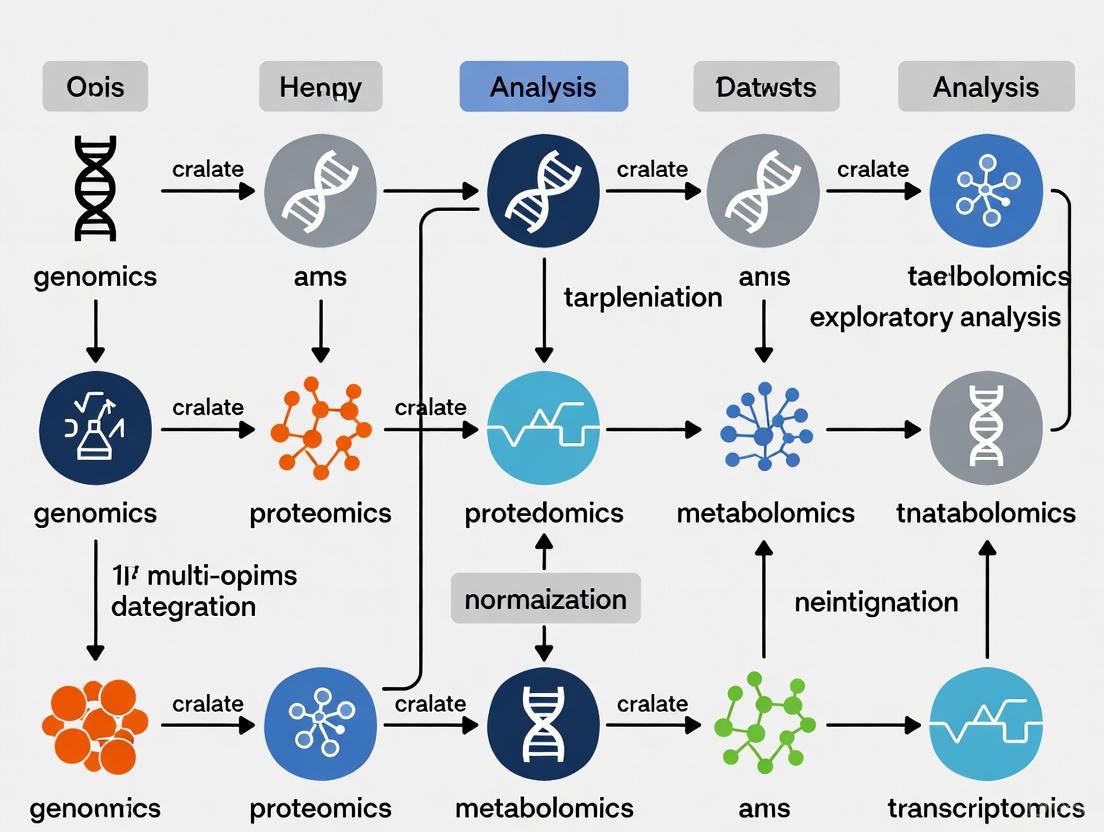
Multi-omics integration leverages complementary information from different molecular layers to build a more comprehensive model of biological systems and disease pathology. A representative framework for this process is illustrated below.
Diagram 1: A generalized multi-omics integration analysis workflow.
Case Study: AI-Driven Multi-Omics Integration for Schizophrenia Biomarker Discovery
A recent study demonstrated a robust framework for integrating plasma proteomics, post-translational modifications (PTMs), and metabolomics data to identify peripheral biomarkers for schizophrenia (SCZ) risk stratification [4]. The protocol below details the key steps.
Protocol: Automated Multi-Omics Integration with Machine Learning
Data Collection and Harmonization:
- Data Source: Utilize a publicly available dataset (e.g., PMC9054664) comprising quantitative profiles from 105 individuals (54 SCZ patients, 51 non-psychiatric controls) [4].
- Data Matrices: Construct standardized expression profile matrices for 742 proteins, 2289 PTMs, and 1535 metabolites.
- Preprocessing: Impute missing values using the
missForestR package. Perform rigorous normalization. Retain only features shared across all three omics datasets to create a harmonized dataset [4].
Model Training and Benchmarking:
- Model Selection: Employ a diverse set of 17 machine learning and deep learning models. Use automated machine learning pipelines (e.g., AutoGluon) for traditional models (Random Forest, XGBoost, LightGBM) [4].
- Deep Learning Architectures: Develop specialized models (CNNBiLSTM, Transformer, SimpleNN) to capture nonlinear dependencies and hierarchical feature representations [4].
- Performance Evaluation: Assess classification performance using Receiver Operating Characteristic (ROC) and Precision-Recall (PR) curves. Calculate the Area Under the Curve (AUC) with 95% confidence intervals [4].
Interpretable Feature Prioritization and Functional Analysis:
- Feature Importance: Apply interpretability frameworks like Shapley Additive Explanations (SHAP) to identify top discriminative molecular features (e.g., specific protein PTMs) [4].
- Functional Enrichment: Perform pathway enrichment analysis (e.g., using KEGG, GO databases) on prioritized features to identify implicated biological processes (e.g., complement activation, platelet signaling) [4].
- Network Analysis: Construct protein-protein interaction networks to reveal central molecular hubs (e.g., coagulation factors F2, F10) [4].
Table 2: Performance of Selected Machine Learning Models in a Multi-Omics Study of Schizophrenia [4]
| Omics Data Type | Best Performing Model | Classification Performance (AUC) | Key Discriminative Features Identified |
|---|---|---|---|
| Multi-Omics (Integrated) | LightGBMXT | 0.9727 (95% CI: 0.8889–1.000) | Carbamylation of IGKCK20 and IGHG1K8; Oxidation of F10_M8 |
| Proteomics Alone | CNNBiLSTM | 0.9636 (95% CI: 0.8636–1.0000) | Proteins involved in immune and coagulation pathways |
| PTMs Alone | CNNBiLSTM | 0.8818 (95% CI: 0.6731–1.000) | Site-specific modifications on immunoglobulins and coagulation factors |
| Metabolomics Alone | Not specified in results | Lower than multi-omics and proteomics | Metabolites linked to gut microbiota-associated metabolism |
Successful multi-omics research relies on a suite of high-quality reagents, analytical platforms, and bioinformatic resources.
Table 3: Essential Research Reagent Solutions for Multi-Omics Studies
| Category / Item | Function / Application | Specific Examples / Notes |
|---|---|---|
| Nucleic Acid Analysis | ||
| RNA Extraction Kit | Isolation of high-integrity total RNA for transcriptomics. | Kits based on guanidinium thiocyanate-phenol (e.g., TRIzol). Assess quality with Bioanalyzer. |
| Poly-A Selection Beads | Enrichment of messenger RNA (mRNA) from total RNA for RNA-Seq. | Magnetic beads coated with oligo(dT) nucleotides. |
| Protein & Metabolite Analysis | ||
| Trypsin, Sequencing Grade | Proteolytic digestion of proteins into peptides for mass spectrometry. | Highly purified to minimize autolysis. |
| Urea, Mass Spec Grade | Protein denaturation in sample lysis buffers. | High-purity grade to avoid carbamylation artifacts. |
| Internal Standards (IS) | Quantification and quality control in metabolomics. | Stable isotope-labeled compounds for LC-MS. |
| Bioinformatic Resources | ||
| SRMAtlas | Public resource for targeted proteomics assay development. | Provides pre-validated mass spectra for peptides [1]. |
| Human Protein Atlas | Tissue-specific expression data for human proteins. | Antibody-based findings for over 12,000 proteins [1]. |
| Metabolomics Databases | Annotation of small molecules from MS data. | Human Metabolome Database (HMDB), METLIN. |
The omics landscape provides a multi-layered view of biology, from genetic blueprint (genomics) to functional endpoints (proteomics, metabolomics). As demonstrated, the integration of these layers through advanced computational frameworks is a cornerstone of modern translational research, enabling the discovery of robust biomarkers and providing deeper insights into complex disease mechanisms like schizophrenia. The standardized protocols and resources outlined herein offer a practical guide for researchers embarking on multi-omics studies aimed at exploratory analysis and therapeutic development.
The integration of multi-omics datasets represents a transformative approach in modern biological research and drug development, enabling a systems-level understanding of health and disease. Exploratory analysis of these combined datasets can uncover complex biological mechanisms that remain invisible when examining a single molecular layer. Next-Generation Sequencing (NGS), Mass Spectrometry (MS), and Nuclear Magnetic Resonance (NMR) spectroscopy form the technological foundation for generating comprehensive genomics, proteomics, and metabolomics data [5] [6]. The convergence of these technologies provides unprecedented insights into the multi-layered regulation of biological systems, from genetic blueprint to functional metabolic activity.
The paradigm has shifted from isolated analysis to integrated multi-omics, where the synergistic interpretation of data from multiple analytical platforms provides a more holistic view of biological systems [7] [5]. This integration faces significant challenges, including the management of massive dataset volumes, the development of specialized computational tools for cross-omics analysis, and the need for standardized protocols to ensure reproducibility [5] [6]. However, the potential rewards are substantial, with applications spanning from the discovery of novel biomarkers and therapeutic targets to the advancement of personalized medicine strategies based on a complete molecular profile of individual patients [5].
Next-Generation Sequencing (NGS) Platforms
Next-Generation Sequencing (NGS) encompasses a suite of high-throughput technologies that have revolutionized genomics by enabling the rapid and cost-effective sequencing of millions to billions of DNA fragments in a single experiment [8] [9]. These technologies represent a fundamental shift from first-generation Sanger sequencing, utilizing massively parallel sequencing strategies to achieve extraordinary throughput and scale [9] [10]. The core principle shared by most NGS platforms involves the amplification of DNA fragments followed by sequential biochemical reactions that detect nucleotide incorporations, generating vast numbers of short or long DNA sequences (reads) that are computationally reconstructed into a complete genomic sequence [8] [10].
The applications of NGS extend far beyond whole genome sequencing to include targeted region sequencing, transcriptomics (RNA-Seq) to quantify gene expression, epigenomic analysis of DNA methylation and DNA-protein interactions, cancer genomics for identifying somatic mutations, microbiome studies, and pathogen discovery [8]. The versatility of NGS has made it an indispensable tool across diverse research areas, from basic biological investigation to clinical diagnostics and therapeutic development [9] [10]. The continuous evolution of NGS technologies has driven dramatic reductions in cost while simultaneously increasing data output and quality, making large-scale genomic studies increasingly accessible [10].
Comparative Analysis of NGS Platforms
Table 1: Comparison of Major NGS Platforms and Their Characteristics
| Platform | Technology Type | Amplification Method | Read Length | Key Applications | Primary Limitations |
|---|---|---|---|---|---|
| Illumina | Sequencing by Synthesis | Bridge Amplification | 36-300 bp (short) | Whole genome sequencing, transcriptomics, epigenomics, targeted sequencing | Signal crowding and overlapping can increase error rate to ~1% [9] |
| Ion Torrent (Thermo Fisher) | Semiconductor sequencing | Emulsion PCR | 200-400 bp (short) | Cancer research, inherited diseases, infectious diseases | Homopolymer sequences can lead to signal strength loss [9] [10] |
| PacBio SMRT | Single-molecule real-time sequencing | Without PCR | 10,000-25,000 bp (long) | Structural variant detection, haplotype phasing, genome assembly | Higher cost per sample compared to short-read platforms [9] |
| Oxford Nanopore | Nanopore sensing | Without PCR | 10,000-30,000 bp (long) | Real-time sequencing, field applications, metagenomics | Error rate can be as high as 15%, requiring computational correction [9] |
| PacBio Onso System | Sequencing by binding | Optional PCR | 100-200 bp (short) | Targeted sequencing, medical genomics | Higher cost compared to other short-read platforms [9] |
Detailed NGS Experimental Protocol
A standard NGS workflow consists of three fundamental steps: library preparation, sequencing, and data analysis [8]. The protocol below outlines a representative workflow for whole genome sequencing using Illumina technology, which dominates the current NGS market [10].
Library Preparation Protocol:
- DNA Fragmentation: Use mechanical shearing (e.g., ultrasonication) or enzymatic digestion to fragment genomic DNA into desired sizes (typically 200-500 bp for short-read sequencing).
- End Repair and A-Tailing: Convert the fragmented DNA into blunt-ended fragments using a combination of polymerase and exonuclease activities, then add a single adenosine nucleotide to the 3' ends to facilitate adapter ligation.
- Adapter Ligation: Ligate platform-specific sequencing adapters to both ends of the DNA fragments. These adapters contain sequences complementary to the flow cell oligos and barcodes for sample multiplexing.
- Size Selection and Purification: Use magnetic bead-based cleanups or gel electrophoresis to select library fragments of the desired size range and remove adapter dimers.
- Library Quantification and Quality Control: Precisely quantify the final library using fluorometric methods (e.g., Qubit) and validate library quality using capillary electrophoresis (e.g., Bioanalyzer or TapeStation).
Sequencing Protocol (Illumina Platform):
- Cluster Generation: Denature the adapter-ligated library into single strands and load onto a flow cell. Through bridge amplification, each fragment is amplified into a clonal cluster containing ~1000 copies.
- Sequencing by Synthesis: Employ reversible dye-terminator chemistry. Fluorescently labeled nucleotides are incorporated one at a time, with imaging after each incorporation to determine the base identity.
- Base Calling: Convert the fluorescence images into nucleotide sequences (base calls) using the instrument's onboard software. Generate sequencing reads in FASTQ format, which contain both the nucleotide sequences and associated quality scores.
Data Analysis Protocol:
- Quality Control: Assess raw read quality using tools like FastQC to identify issues with base quality, adapter contamination, or GC bias.
- Read Alignment: Map sequencing reads to a reference genome using aligners such as BWA (for short reads) or Minimap2 (for long reads).
- Variant Calling: Identify genetic variants (SNPs, indels) relative to the reference using callers like GATK or DeepVariant.
- Annotation and Interpretation: Annotate variants with functional information (gene context, predicted impact, population frequency) using tools like ANNOVAR or SnpEff, then prioritize potentially clinically significant variants.
Mass Spectrometry in Proteomics
Mass spectrometry has emerged as the cornerstone technology for proteomic analysis, enabling the high-throughput identification and quantification of proteins in complex biological samples [11]. Modern MS-based proteomics provides unprecedented insights into protein expression, post-translational modifications, protein-protein interactions, and structural characteristics [11]. The fundamental principle involves ionizing protein or peptide molecules and measuring their mass-to-charge ratio (m/z), generating spectra that can be interpreted to determine molecular identity and abundance [11]. Two primary acquisition strategies dominate contemporary proteomics: Data-Dependent Acquisition (DDA) and Data-Independent Acquisition (DIA), each with distinct advantages for different experimental applications [12].
The integration of MS-based proteomics with other omics technologies, particularly genomics and transcriptomics, is essential for comprehensive multi-omics studies [5] [6]. While genomic data reveals potential molecular capabilities, proteomic analysis reveals the functional executants of cellular processes, providing a more direct understanding of phenotypic manifestations [5]. This integration helps bridge the gap between genotype and phenotype, particularly in complex diseases like cancer where transcript levels often poorly correlate with protein abundance due to post-transcriptional regulation [5] [6]. Advances in MS instrumentation, sample preparation methodologies, and computational analysis have dramatically expanded the scope and precision of proteomic investigations, making MS an indispensable tool for systems biology and drug development [11] [12].
Detailed Mass Spectrometry Experimental Protocol
Sample Preparation Protocol (Based on Palumbos et al., 2025):
- Protein Extraction: Solubilize cell or tissue pellets in 50 μL of extraction buffer containing 5% sodium dodecyl sulfate (SDS), 50mM TEAB (pH 8.5), and protease inhibitor cocktail [11].
- Sample Shearing and Clarification: Sonicate samples for 10 minutes at 20°C in a focused-ultrasonicator (e.g., Covaris R230) to shear DNA and ensure complete solubilization. Centrifuge samples at 3000g for 10 minutes to clarify lysate [11].
- Protein Quantification: Determine protein concentration by intrinsic tryptophan fluorescence excited at 280nm and read at 350nm, using a standard curve on a microplate reader [11].
- In-Solution Digestion: Digest 10 μg of each sample using S-Trap Micro columns. Reduce proteins in 5mM TCEP, alkylate in 20mM iodoacetamide, then acidify with phosphoric acid to a final concentration of 1.2% [11].
- Digestion and Peptide Elution: Add a 1:10 ratio (enzyme:protein) of Trypsin and LysC suspended in 50mM TEAB and digest for 18 hours at 37°C in a humidity chamber. Elute peptides with 50 mM TEAB, followed by 0.1% trifluoroacetic acid (TFA) in water, and finally 50/50 acetonitrile:water in 0.1% TFA [11].
- Peptide Cleanup: Combine eluates, dry via vacuum centrifugation, and desalt using an Oasis HLB μElution plate. Condition wells with acetonitrile, equilibrate with 0.1% TFA, apply samples, wash with 0.1% TFA, and elute with 50:50 acetonitrile:water [11].
- Sample Reconstitution: Dry eluates by vacuum centrifugation and reconstitute in 0.1% TFA containing iRT peptides. Determine peptide concentration at OD280 and adjust to 400 ng/μL for injection [11].
Mass Spectrometry Data Acquisition Protocol (DIA Method):
- Chromatographic Separation: Load 5 μL of sample onto a trap column (e.g., Acclaim PepMap 100 75 μm × 2 cm) at 5 μL/min, then separate by reverse-phase HPLC on a nanocapillary column (e.g., 75 μm id × 50 cm 2 μm PepMap RSLC C18) [11].
- Mobile Phase Gradient: Elute peptides with a 105-minute gradient from 3% mobile phase B (0.1% formic acid/acetonitrile) to 45% B at a flow rate of 300 nL/min [11].
- Mass Spectrometry Settings: Use the following parameters on an Exploris 480 or similar instrument:
- One full MS scan at 120,000 resolution, with a scan range of 350-1200 m/z
- Normalized automatic gain control (AGC) target of 300%
- Variable DIA isolation windows
- MS2 scans at 30,000 resolution
- Normalized AGC target of 1000%
- Default charge state of 3
- Normalized collision energy set at 27 [11]
Data Analysis Protocol:
- Database Searching: Process DIA raw files using Spectronaut 18.7 in direct DIA mode with a species-appropriate database (e.g., UniProt) supplemented with common protein contaminants and iRT peptides [11].
- Search Parameters: Set enzyme specificity to trypsin with allowance for two potential missed cleavages. Specify fixed modification as carbamidomethyl of cysteine, with protein N-terminal acetylation and oxidation of methionine as variable modifications [11].
- Quality Control: Apply a false discovery rate limit of 1% for precursors, peptides, and proteins identification [11].
- Differential Analysis: Conduct statistical analysis in R using MS2 intensity values. Log2 transform and normalize data by subtracting the median value for each sample. Employ a Limma t-test to identify proteins with differential abundance, visualized through volcano plots [11] [12].
Nuclear Magnetic Resonance (NMR) Spectroscopy
Nuclear Magnetic Resonance (NMR) spectroscopy serves as a powerful analytical technique for structural elucidation of organic compounds and biomolecules, with growing applications in metabolomics and integrative multi-omics studies [13] [14]. The fundamental principle of NMR involves exposing atomic nuclei with non-zero spin (such as ^1H, ^13C, ^15N) to a strong external magnetic field, which causes alignment of nuclear spins, followed by application of radiofrequency pulses that perturb this alignment [13]. As nuclei return to equilibrium, they emit radiofrequency signals that provide detailed information about molecular structure, dynamics, and interactions [14]. The chemical shift (measured in ppm), coupling constants, signal intensity, and relaxation parameters collectively offer a comprehensive view of molecular properties and behavior.
Recent technological advances have significantly enhanced the capabilities of NMR in omics research, particularly through the development of high-field NMR spectrometers and cryogenically cooled probe technology [13]. The spectral resolution of NMR increases proportionally with magnetic field strength (B~0~), while the signal-to-noise ratio improves with the field strength raised to the power of three-halves [13]. Cryoprobes dramatically reduce system noise by cooling the coils and preamplifiers with cold helium or nitrogen, substantially improving detection sensitivity [13]. These advancements have made NMR particularly valuable for metabolomic studies, where it enables the simultaneous identification and quantification of numerous metabolites in complex biological samples, providing complementary data to genomic and proteomic analyses for comprehensive multi-omics integration [14].
Key NMR Applications in Multi-Omics Research
NMR spectroscopy contributes several unique capabilities to multi-omics research pipelines. In metabolomics, NMR provides robust, reproducible analysis of biofluids (blood, urine, cerebrospinal fluid) and tissue extracts, enabling the identification of metabolic biomarkers associated with disease states [14]. The technique is particularly valuable for detecting and quantifying small-molecular-weight metabolites (under 1500 Da) and linking these metabolic profiles to clinical data [14]. Unlike mass spectrometry-based metabolomics, NMR requires minimal sample preparation, is non-destructive, and provides exceptional reproducibility, making it ideal for large-scale clinical studies [14].
Structural biology applications include protein-ligand interaction studies using techniques such as Saturation Transfer Difference (STD) and transferred NOEs, which can map binding interfaces and characterize conformational changes upon binding [14]. NMR also plays a crucial role in flux analysis through stable isotope tracing experiments, enabling the tracking of metabolic pathways and quantification of metabolic fluxes in living cells [14]. The quantitative nature of NMR, combined with its ability to simultaneously detect diverse compound classes without separation, makes it particularly powerful for exploring metabolic alterations in disease states and response to therapeutics [14].
The Scientist's Toolkit: Essential Research Reagents and Materials
Table 2: Essential Research Reagents and Materials for Multi-Omics Technologies
| Reagent/Material | Application | Function | Example Products/Suppliers |
|---|---|---|---|
| Trypsin/LysC Mix | Mass Spectrometry | Enzymatic digestion of proteins into peptides for LC-MS/MS analysis | Promega Trypsin, Wako LysC [11] |
| S-Trap Micro Columns | Mass Spectrometry | Efficient digestion and cleanup of protein samples, especially for membrane proteins | Protifi S-Trap Micro [11] |
| iRT Peptides | Mass Spectrometry | Retention time calibration standards for LC-MS systems | Biognosys iRT Kit [11] |
| TCEP | Mass Spectrometry | Reduction of disulfide bonds in proteins | Thermo Scientific TCEP [11] |
| Iodoacetamide | Mass Spectrometry | Alkylation of cysteine residues to prevent reformation of disulfide bonds | Sigma-Aldrich Iodoacetamide [11] |
| NGS Library Prep Kits | Next-Generation Sequencing | Preparation of DNA or RNA libraries for sequencing on various platforms | Illumina DNA Prep, Thermo Fisher Ion Torrent Oncomine [8] |
| NGS Adapters with Barcodes | Next-Generation Sequencing | Sample multiplexing and platform-specific sequence requirements | Illumina TruSeq Adapters, IDT for Illumina [8] |
| Deuterated Solvents | NMR Spectroscopy | Solvent for NMR samples; deuterium provides signal lock | Cambridge Isotope Laboratories deuterated solvents [14] |
| TMS or DSS Reference | NMR Spectroscopy | Chemical shift reference compound for NMR spectra | Sigma-Aldrich TMS, DSS [14] |
Multi-Omics Integration: Approaches and Analytical Frameworks
Data Integration Strategies
The integration of multi-omics datasets presents both unprecedented opportunities and significant computational challenges [6]. Data-driven integration approaches can be broadly categorized into three main strategies: statistical-based methods, multivariate approaches, and machine learning/artificial intelligence techniques [6]. Statistical methods, particularly correlation analysis (Pearson's or Spearman's), represent the most straightforward approach, quantifying relationships between different molecular entities across omics layers [6]. These methods can identify coordinated changes in gene expression, protein abundance, and metabolite levels, revealing potential regulatory relationships and functional connections [6].
Multivariate methods, including Principal Component Analysis (PCA) and Partial Least Squares (PLS) regression, enable the simultaneous analysis of multiple variables across omics datasets, identifying latent structures that explain the greatest covariance between molecular features and phenotypic outcomes [6]. More advanced network-based integration approaches, such as Weighted Gene Correlation Network Analysis (WGCNA), identify modules of highly correlated molecular features across different data types, which can then be related to clinical traits or experimental conditions [6]. Machine learning and AI techniques represent the most sophisticated approach, capable of detecting complex, non-linear patterns in high-dimensional multi-omics data that may elude traditional statistical methods [7] [5]. These computational frameworks enable the construction of predictive models for disease classification, treatment response, and patient stratification based on integrated molecular profiles [5] [6].
Integrated Multi-Omics Analysis Protocol
Data Preprocessing and Quality Control:
- Data Normalization: Apply appropriate normalization methods for each omics data type (e.g., TPM for RNA-Seq, median normalization for proteomics, probabilistic quotient normalization for metabolomics).
- Batch Effect Correction: Use ComBat or similar algorithms to remove technical variability introduced by different processing batches.
- Missing Value Imputation: Apply data-type specific imputation methods (e.g., KNN imputation for proteomics data, minimum value replacement for metabolomics).
Correlation-Based Integration (Statistical Approach):
- Differential Expression Analysis: Identify significantly altered features in each omics dataset separately using appropriate statistical tests (e.g., DESeq2 for RNA-Seq, Limma for proteomics).
- Pairwise Correlation Analysis: Compute correlation coefficients (Pearson or Spearman) between significantly altered features across different omics platforms.
- Network Construction: Build correlation networks using tools like xMWAS, retaining edges that meet specific thresholds for correlation coefficient (e.g., R^2^ > 0.7) and statistical significance (p-value < 0.05) [6].
- Module Detection: Apply community detection algorithms (e.g., multilevel community detection) to identify highly interconnected groups of molecules across omics layers [6].
Multivariate Integration Approach:
- Data Concatenation: Combine preprocessed omics datasets into a single multi-block matrix, ensuring proper scaling of different data types.
- Dimension Reduction: Apply multi-block PCA or PLS methods to identify latent variables that explain covariance between omics blocks.
- Model Interpretation: Examine loadings and variable importance in projection (VIP) scores to identify features that contribute most to the integrated model.
Machine Learning Integration Approach:
- Feature Selection: Apply recursive feature elimination or regularization methods (LASSO) to identify the most informative molecular features across all omics layers.
- Model Training: Train ensemble methods (random forests, gradient boosting) or neural networks on the integrated multi-omics dataset.
- Model Validation: Use rigorous cross-validation and external validation sets to assess model performance and prevent overfitting.
- Biological Interpretation: Apply model interpretation techniques (SHAP values, permutation importance) to identify key molecular drivers of the model predictions.
The integration of NGS, mass spectrometry, and NMR technologies provides an unprecedented comprehensive view of biological systems across multiple molecular layers. As these technologies continue to evolve, becoming more sensitive, affordable, and accessible, their application in both basic research and clinical settings will expand considerably [7] [5]. The future of multi-omics research lies not merely in the parallel application of these technologies, but in their genuine integration through advanced computational methods that can extract meaningful biological insights from these complex, high-dimensional datasets [5] [6].
Current trends indicate a movement toward single-cell multi-omics, which will enable the resolution of cellular heterogeneity in complex tissues; spatial omics, preserving the architectural context of molecular measurements; and real-time analytical capabilities, particularly through advances in long-read sequencing and miniaturized NMR technologies [7] [5]. The successful implementation of multi-omics approaches will require continued development of standardized protocols, robust computational infrastructure for data management and analysis, and interdisciplinary collaboration between biologists, chemists, computational scientists, and clinicians [5] [6]. By embracing these integrated approaches, the scientific community can accelerate the translation of molecular discoveries into clinical applications, ultimately advancing personalized medicine and improving patient outcomes across a wide spectrum of diseases.
The pursuit of a holistic understanding of health and disease necessitates moving beyond isolated biological observations to an integrated view of the entire biological system. Multi-omics data integration represents a paradigm shift in biomedical research, combining diverse datasets—genomics, transcriptomics, proteomics, metabolomics, and clinical records—to create a complete picture of a patient’s health and disease [15]. This approach enables researchers to decipher the complex flow of information from genetic blueprint to functional manifestation, revealing how genes, proteins, and metabolites interact to drive disease processes [15].
The field has seen explosive growth, with PubMed citations of the terms "Multiomics" and "Multi-omics" increasing from 307 in 2018 to 3,933 in 2023 [16]. This surge reflects the recognition that single-omics approaches provide only a limited, partial view of hidden biology, while multi-omics integration can illuminate the interplay of different biomolecules, understand relationships across multiple layers, and bridge the critical gap between genotype and phenotype [16]. By measuring multiple analyte types within a pathway, biological dysregulation can be better pinpointed to single reactions, enabling the elucidation of actionable targets for therapeutic intervention [5].
Key Integration Strategies & Methodological Framework
The integration of disparate omics layers presents significant computational and analytical challenges due to data heterogeneity, scale, and complexity [15]. Researchers typically employ three primary strategies, classified based on the timing of integration relative to the analysis [15] [16].
Table 1: Multi-Omics Data Integration Strategies
| Integration Strategy | Timing | Key Advantages | Primary Challenges |
|---|---|---|---|
| Early Integration (Low-Level) | Before analysis | Captures all cross-omics interactions; preserves raw information | Extremely high dimensionality; computationally intensive; adds noise [15] [16] |
| Intermediate Integration (Mid-Level) | During analysis | Reduces complexity; incorporates biological context; improved signal-to-noise ratio [15] [16] | Requires domain knowledge; may lose some raw information; can lack interpretability [16] |
| Late Integration (High-Level) | After individual analysis | Handles missing data well; computationally efficient; works with unique distribution of each omics type [15] [16] | May miss subtle cross-omics interactions; potential loss of biological information through individual modeling [15] [16] |
A Practical Integration Protocol
A robust protocol is essential for generating reliable and interpretable results from multi-omics studies. The following step-by-step guide outlines the critical phases of integration.
Pre-Integration Phase
- Research Question Definition: Clearly articulate the specific biological or clinical question. Example: "What are the changes in protein expression and metabolite profiles that correlate with treatment response?" [16].
- Omics Technology Selection: Identify the most relevant omics technologies (e.g., genomics and transcriptomics for cancer biology; proteomics and metabolomics for therapeutic response) based on the research question and available resources [16].
- Data Quality Assurance: Ensure data reliability through careful experimental design, consistent sample collection, and established quality control (QC) protocols to minimize batch effects. Implement technology-specific QC metrics [16]:
- Genomics/Transcriptomics: Assess read quality scores, sequencing depth, and alignment quality.
- Proteomics: Evaluate peak intensity distribution, mass accuracy, and protein identification false discovery rate.
- Metabolomics: Analyze signal-to-noise ratio and metabolite identification quality.
Data Preprocessing & Analysis
- Data Preprocessing:
- Overlapping Samples: Include only samples present across all omics datasets to ensure proper integration [16].
- Missing Value Imputation: Handle missing data using statistical or machine learning methods (e.g., Least-Squares Adaptive method), rather than removal, especially with limited samples. Exclude variables with a high percentage (>25-30%) of missing values [16].
- Standardization: Perform data transformation (e.g., logarithmic, centering, scaling) to ensure consistent feature scaling and prevent domination by features with larger inherent effects [16].
- Dimensionality Reduction: Apply techniques like PCA or autoencoders to compress high-dimensional omics data into a lower-dimensional "latent space," making integration computationally feasible while preserving key biological patterns [15] [16].
- Integrated Analysis: Apply chosen integration strategy (early, intermediate, late) using appropriate statistical models and machine learning algorithms to extract insights from the combined data landscape.
The Scientist's Toolkit: Essential Research Reagents & Materials
Successful multi-omics studies rely on a suite of specialized reagents and technologies designed for specific molecular layers.
Table 2: Essential Research Reagents & Platforms for Multi-Omics Studies
| Reagent/Platform | Function | Application Note |
|---|---|---|
| SOMAscan Aptamer-Based Assay | Multiplexed proteomic analysis using slow off-rate modified aptamers to measure protein abundances [17]. | Used in large-scale pQTL studies for high-throughput plasma protein quantification; enabled analysis of 4,907 circulating proteins [17]. |
| Mass Spectrometry Systems | Identify and quantify proteins and metabolites based on mass-to-charge ratio [15] [16]. | Workhorse for proteomics and metabolomics; assess quality via peak intensity, mass accuracy, and signal-to-noise ratio [16]. |
| Next-Generation Sequencing (NGS) | High-throughput DNA and RNA sequencing to assess genomic variation and transcript expression [15] [5]. | Foundation for genomics, transcriptomics, and epigenomics; requires QC of read quality, depth, and alignment metrics [16]. |
| Single-Cell RNA Sequencing (scRNA-seq) | Profile gene expression at individual cell resolution to uncover cellular heterogeneity [17] [5]. | Critical for mapping core hub genes to specific cell types (e.g., endothelial cells, monocytes); requires specialized cell isolation protocols [17]. |
| Liquid Biopsy Platforms | Non-invasive isolation and analysis of circulating biomarkers (e.g., ctDNA, exosomes) from blood [5] [18]. | Emerging tool for real-time monitoring; advancements increasing sensitivity/specificity for early disease detection [18]. |
Application Note: Ulcerative Colitis Biomarker Discovery
Experimental Protocol & Workflow
A 2025 study demonstrates the practical application of multi-omics integration to identify diagnostic and therapeutic biomarkers for ulcerative colitis (UC), a complex inflammatory bowel disease [17]. The workflow integrated data from genomics, transcriptomics, and proteomics.
Step-by-Step Protocol:
Data Acquisition & Causal Inference:
- Data Sources: Acquired microarray data (GSE87466, GSE92415) from GEO database as a training set, with GSE75214 as a validation set. Obtained pQTL data from a study of 35,559 individuals (4,907 plasma proteins) and UC GWAS data from the IEU Open GWAS project (1,579 cases, 335,620 controls) [17].
- Mendelian Randomization (MR): Performed proteome-wide MR analysis using the "TwoSampleMR" R package to identify plasma proteins with a causal association with UC. Used cis-pQTLs as instrumental variables under genome-wide significance (P < 5 × 10⁻⁸), independence (LD r² < 0.001), and F-statistic > 10 criteria [17].
Differential Expression & Data Intersection:
Machine Learning for Biomarker Selection:
- Employed three machine learning algorithms—Random Forest (RF), Support Vector Machine-Recursive Feature Elimination (SVM-RFE), and XGBoost—on the training set to screen core hub genes from the overlapping genes [17].
- Identified four core hub genes (EIF5A2, IDO1, CDH5, and MYL5) as robust diagnostic biomarkers [17].
Validation & Mechanistic Exploration:
- Constructed a diagnostic nomogram model with the four genes and validated its predictive performance in the external validation dataset [17].
- Utilized single-cell RNA sequencing data (GSE214695) to explore expression profiles of core hub genes across different cell types, revealing specific cellular localization (e.g., CDH5 in endothelial cells, IDO1 in monocytes) [17].
- Performed immune infiltration analysis (CIBERSORT), functional enrichment (GSEA), and constructed mRNA-miRNA-lncRNA regulatory networks [17].
- Validating expression changes in a dextran sulfate sodium (DSS)-induced UC mouse model using RT-qPCR confirmed consistency with bioinformatics predictions [17].
Key Findings & Quantitative Results
The integrated analysis successfully bridged genomic predisposition to functional pathophysiology, identifying four core hub genes with causal roles in UC.
Table 3: Key Findings from the Ulcerative Colitis Multi-Omics Study
| Analysis Stage | Key Result | Biological/Clinical Implication |
|---|---|---|
| Mendelian Randomization | 168 plasma proteins identified with causal association to UC [17]. | Prioritized potential therapeutic targets from a massive proteomic dataset using genetic evidence, minimizing confounding. |
| Differential Expression & Intersection | 1,011 DEGs found; intersection with MR results yielded 12 overlapping genes [17]. | Narrowed candidate list to genes with both causal (genetic) and correlative (expression) evidence of involvement in UC. |
| Machine Learning Feature Selection | 4 core hub genes identified: EIF5A2, IDO1, CDH5, MYL5 [17]. | Provided a minimal, robust gene signature for diagnostic model development. |
| Single-Cell Sequencing | Revealed cell-specific expression: CDH5 (endothelial), EIF5A2 (stem/T-cells), IDO1 (monocytes), MYL5 (epithelial/endothelial) [17]. | Uncovered cellular heterogeneity and suggested specific cell types involved in UC pathogenesis for targeted therapy. |
| Diagnostic Model | Nomogram demonstrated strong predictive performance, validated externally [17]. | Offered a potential clinical tool for stratifying UC patients based on their molecular profile. |
Discussion & Future Perspectives
The integration of multi-omics data is fundamentally transforming biomedical research from a siloed, single-layer perspective to a holistic, systems-level understanding. As the Ulcerative Colitis case study demonstrates, this approach powerfully bridges genetic predisposition and functional pathophysiology, enabling the discovery of causal biomarkers and therapeutic targets [17]. The convergence of advanced technologies and sophisticated computational methods is paving the way for a new era in precision medicine.
Looking ahead, several key trends are poised to shape the future of multi-omics. The rise of single-cell multi-omics will allow researchers to move beyond tissue-level averages and understand cellular heterogeneity, providing unprecedented resolution in mapping disease mechanisms [5]. Furthermore, liquid biopsies are expected to expand beyond oncology, offering a non-invasive method for dynamic monitoring of disease progression and treatment response across a wider range of conditions by analyzing biomarkers like cell-free DNA, RNA, and proteins [5] [18]. Finally, the growing integration of Artificial Intelligence and Machine Learning will be crucial, with AI-driven algorithms revolutionizing predictive analytics, automating data interpretation, and facilitating the development of truly personalized treatment plans based on complex, integrated molecular profiles [15] [18]. These advancements, coupled with ongoing efforts in standardization and the establishment of robust regulatory frameworks, will ensure that multi-omics integration continues to drive innovations in diagnostics, therapeutics, and ultimately, improved patient outcomes [18].
Spatially resolved multi-omics represents a paradigm shift in biological research, enabling the simultaneous measurement of multiple molecular layers within the native tissue architecture [19]. This approach addresses a critical limitation of traditional single-cell omics, which, while powerful, loses the spatial context essential for understanding cellular function, communication, and tissue organization [20]. The ability to perform multi-modal analysis on the same tissue section is particularly transformative, as it eliminates spatial misalignment and facilitates direct, cell-to-cell comparisons across molecular classes such as the transcriptome and proteome [21] [22]. This protocol outlines the integrated workflow for generating and analyzing spatially resolved transcriptomic and proteomic data from a single tissue section, a methodology recently demonstrated in human lung cancer and liver disease studies [21] [20]. By preserving the spatial context of multiple molecular readouts, researchers can now uncover novel insights into disease heterogeneity, immune-microenvironment interactions, and the complex regulatory networks governing biological systems.
Key Principles and Biological Significance
Spatially resolved multi-omics on a single section provides a holistic view of cellular machinery by capturing complementary data layers in their precise histological context. This is crucial because biological functions emerge from complex, spatially organized interactions. For instance, in the human liver, metabolic functions are zonated across the lobule axis due to gradients of oxygen, nutrients, and hormones [20]. Similarly, in cardiovascular disease, the myocardium is zoned into distinct spatial domains of injury after myocardial infarction [19].
A key finding reinforced by single-section multi-omics is the frequent discordance between transcript and protein abundances within individual cells. Studies have consistently observed systematically low correlations between mRNA and corresponding protein levels, a phenomenon now resolvable at cellular resolution [21] [22]. This highlights the complex post-transcriptional regulation and emphasizes the necessity of measuring both molecular layers for complete functional understanding.
The tumor microenvironment exemplifies where spatial multi-omics provides unique insights. Cellular function is profoundly influenced by positional context—proximity to blood vessels, immune cell infiltrates, and stromal components. Single-section multi-omics enables the dissection of these cell-cell interactions and regional-specific expression patterns without the ambiguity introduced by analyzing separate sections [21].
Table 1: Advantages of Single-Section Multi-Omics Approach
| Feature | Traditional Multi-Section Approach | Single-Section Approach |
|---|---|---|
| Spatial Context | Misalignment between sections | Perfect spatial registration |
| Morphological Consistency | Variable between sections | Preserved across modalities |
| Cell-to-Cell Comparison | Indirect and statistical | Direct at single-cell level |
| Data Quality | Potential section-to-section variation | Consistent tissue morphology |
| Regional Analysis | Approximate alignment required | Precise region-of-interest mapping |
Experimental Workflow and Protocol
The following section details a proven wet-lab and computational framework for performing and integrating spatial transcriptomics (ST) and spatial proteomics (SP) from the same tissue section, as demonstrated on human lung carcinoma samples [21] [22].
Sample Preparation and Tissue Processing
Materials:
- Formalin-fixed paraffin-embedded (FFPE) tissue sections (5 µm)
- Xenium In Situ Gene Expression reagents (10x Genomics)
- COMET hyperplex immunohistochemistry platform (Lunaphore)
- Primary antibodies for targets of interest (40 markers recommended)
- Fluorophore-conjugated secondary antibodies
- DAPI counterstain (Thermo Fisher Scientific)
Protocol:
- Mount FFPE sections on Xenium slides within the designated reaction region (12 mm × 24 mm).
- Perform deparaffinization and decrosslinking following manufacturer's instructions.
- For spatial transcriptomics: Hybridize DNA probes to target RNA sequences, followed by ligation and amplification of gene-specific barcodes.
- Load slides into the Xenium Analyzer for cyclic probe hybridization, imaging, and removal to generate optical signatures for each barcode.
- For spatial proteomics: Following Xenium analysis, perform heat-induced epitope retrieval (HIER) using the PT module (Epredia).
- Mount slides with microfluidic chips (9 mm × 9 mm acquisition region) on the COMET platform.
- Perform sequential immunofluorescence staining using off-the-shelf primary antibodies, fluorophore-conjugated secondary antibodies, and DAPI counterstain.
- The COMET platform conducts cyclical staining, imaging, and elution, generating a final stacked fluorescence image with multiple channels including DAPI.
- Perform background subtraction using Horizon software (v2.2.0.1, Lunaphore Technologies) before exporting images for analysis.
- Conduct manual hematoxylin and eosin (H&E) staining on the post-Xenium post-COMET sections and image using a slide scanner (e.g., Zeiss Axioscan 7).
Table 2: Key Research Reagent Solutions
| Reagent/Category | Specific Examples | Function |
|---|---|---|
| Spatial Transcriptomics | Xenium In Situ Gene Expression (10x Genomics) | High-resolution spatial RNA detection |
| Spatial Proteomics | COMET hyperplex IHC (Lunaphore) | Multiplexed protein detection from same section |
| Gene Panels | 289-gene human lung cancer panel | Targeted transcriptome profiling |
| Antibody Panels | 40-plex antibody panels | Multiplexed protein quantification |
| Nuclear Staining | DAPI counterstain | Cell segmentation and nuclear identification |
| Tissue Staining | Hematoxylin and Eosin (H&E) | Histological context and pathology annotation |
Computational Data Integration and Analysis
Image Registration and Alignment:
- Use computational registration software (e.g., Weave) for automated non-rigid alignment of DAPI images from Xenium and COMET acquisitions to the H&E reference image [22].
- Apply spline-based algorithms to achieve precise spatial matching across modalities, accounting for potential tissue deformation.
Cell Segmentation:
- For Xenium data: Perform cell segmentation based on DAPI nuclear expansion using the 10x Genomics pipeline.
- For COMET data: Utilize deep learning-based methods (e.g., CellSAM) integrating both nuclear (DAPI) and membrane (e.g., PanCK) markers for improved segmentation accuracy.
- Match cells between the two segmentation methods to compare morphological and molecular features.
Multi-Omics Data Integration:
- Apply cell segmentation masks to calculate mean intensity of each protein marker and transcript count per gene per cell.
- Generate an integrated dataset containing both gene expression and protein abundance measurements within the same cellular compartments.
- Create interactive web-based visualizations (e.g., using Weave) incorporating full-resolution H&E microscopy images with pathology annotations, COMET protein images, Xenium gene transcripts, and cell segmentation results.
(Spatial Multi-Omics Experimental Workflow)
Data Analysis and Interpretation
Multi-Omics Correlation Analysis
With integrated transcriptomic and proteomic data from the same cells, researchers can perform cross-modal correlation analysis to examine relationships between RNA transcripts and their corresponding protein products [22].
Protocol:
- Filter cells with total transcript count <20 to ensure data quality.
- Normalize gene expression data using total count normalization followed by log transformation.
- Calculate Spearman correlation coefficients between transcript counts and mean immunofluorescence intensity for paired RNA-protein markers.
- Visualize correlation patterns separately for tumor and non-tumor regions to identify compartment-specific regulatory differences.
Dimension Reduction and Cell Clustering
Protocol:
- Combine normalized transcript counts and protein intensities into a unified feature matrix.
- Perform dimensionality reduction using UMAP (Uniform Manifold Approximation and Projection).
- Construct neighbor graphs using 15 nearest neighbors and cosine similarity metrics.
- Apply Louvain clustering to identify cell populations based on combined transcriptomic and proteomic signatures.
- Annotate cell types using known marker genes and proteins, validating with pathological annotations from H&E staining.
Region-Specific Analysis and Cell-Cell Interactions
Leverage the precise spatial registration to investigate region-specific expression patterns and potential cell-cell communication [20] [19].
Protocol:
- Transfer pathological annotations (e.g., tumor regions, fibrotic areas) from H&E images to the multi-omics dataset.
- Perform differential expression analysis between anatomical or pathological regions.
- Identify spatially variable features using spatial autocorrelation statistics (e.g., Moran's I).
- Map ligand-receptor interactions between neighboring cells using specialized tools (e.g., CellChat, NicheNet).
Applications in Translational Research
The integrated spatial multi-omics approach has demonstrated significant utility across various research applications:
Drug Discovery and Development: Network-based integration of multi-omics data has shown particular promise in drug discovery, enabling drug target identification, drug response prediction, and drug repurposing [23]. By capturing the complex interactions between drugs and their multiple targets within the tissue context, these approaches can better predict clinical efficacy and identify novel therapeutic opportunities.
Disease Mechanism Elucidation: In metabolic dysfunction-associated steatotic liver disease (MASLD), spatial multi-omics revealed microphthalmia-associated transcription factor (MITF) as a key regulator of the lipid-handling capacity of lipid-associated macrophages [20]. The study also uncovered a hepatoprotective role of these macrophages mediated through hepatocyte growth factor secretion, demonstrating how spatial context reveals novel biological insights.
Biomarker Discovery: The technology enables identification of spatially-informed biomarkers that may be missed in bulk analyses. For example, in cardiovascular research, spatial multi-omics has identified distinct mechano-sensing genes in the border zone of myocardial infarcts that regulate remodeling processes [19].
Technical Considerations and Troubleshooting
Experimental Design:
- Include control sections processed without Xenium but with COMET and H&E staining to assess potential effects of the transcriptomics workflow on protein detection.
- Carefully titrate antibody concentrations for hyperplex immunohistochemistry to minimize background while maintaining signal intensity.
- Ensure proper tissue fixation to preserve both RNA integrity and protein epitopes.
Computational Challenges:
- Address data heterogeneity through appropriate normalization strategies that account for technical variations between platforms.
- Develop standardized evaluation frameworks for method performance comparison [23].
- Implement scalable computational approaches to handle large-scale multi-omics datasets efficiently.
Data Visualization: Utilize specialized visualization tools (e.g., Spatial-Live, Weave) that enable interactive exploration of integrated multi-omics datasets in both 2D and 3D perspectives [22] [24]. These tools facilitate the interpretation of complex spatial relationships across molecular modalities.
Spatially resolved multi-omics on single tissue sections represents a groundbreaking advancement in biomedical research, offering unprecedented insights into cellular organization and function within native tissue contexts. The integrated workflow presented here—combining spatial transcriptomics, spatial proteomics, and histology from the same section—provides a robust framework for investigating complex biological systems. As computational methods for data integration continue to evolve and spatial technologies become more accessible, this approach holds tremendous potential for revolutionizing our understanding of disease mechanisms, identifying novel biomarkers, and accelerating therapeutic development across diverse pathological conditions.
The integration of multi-omics data has revolutionized cancer research, enabling a holistic view of the molecular mechanisms driving oncogenesis. Large-scale public data repositories provide comprehensive molecular profiles across genomics, transcriptomics, proteomics, and epigenomics, allowing researchers to move beyond single-layer analyses. These resources have become indispensable for biomarker discovery, disease subtyping, and understanding therapeutic vulnerabilities [25]. The Cancer Genome Atlas (TCGA), Clinical Proteomic Tumor Analysis Consortium (CPTAC), International Cancer Genome Consortium (ICGC), and Omics Discovery Index (OmicsDI) represent cornerstone initiatives in this landscape, together housing molecular data for tens of thousands of patients across diverse cancer types [25] [26].
These repositories have catalyzed groundbreaking discoveries by providing the research community with standardized, high-quality data. For instance, multi-omics studies have revealed that somatic mutations in only three genes (TP53, PIK3CA, and GATA3) were responsible for signaling pathways deregulated in 30% of breast cancers, while chromosome 20q amplicon was associated with significant global changes at both mRNA and protein levels in colorectal cancers [27] [25]. Such insights demonstrate the power of integrative approaches over single-omics analyses, highlighting complex rearrangements at genetic, transcriptional, and proteomic levels that drive oncogenesis through clonal selection and treatment resistance [28].
Repository Characteristics and Data Types
Comparative Analysis of Major Repositories
Table 1: Core Characteristics of Public Multi-Omics Repositories
| Repository | Primary Focus | Key Data Types | Sample Scale | Access Type |
|---|---|---|---|---|
| TCGA | Pan-cancer molecular profiling | DNA-Seq, RNA-Seq, miRNA-Seq, SNV, CNV, DNA methylation, RPPA [25] | >20,000 tumors across 33 cancer types [28] | Open & Controlled [26] |
| CPTAC | Cancer proteomics | Global proteome, phosphoproteome, glycoproteome via mass spectrometry [27] | Proteomic data for TCGA cohorts [25] | Open Access |
| ICGC | International cancer genomics | WGS, WES, transcriptomics, epigenomics [25] | 76 projects across 21 cancer sites from 20,383 donors [25] | Open & Restricted [26] |
| OmicsDI | Cross-repository discovery | Consolidated datasets from 11 repositories [25] | Unified framework for multi-omics data [25] | Open Access |
| CCLE | Cancer cell lines | Gene expression, copy number, sequencing, drug sensitivity [25] [28] | ~1,000 cancer cell lines [26] | Open Access |
| TARGET | Pediatric cancers | Gene expression, miRNA, copy number, sequencing [25] | 24 molecular types of childhood cancer [25] | Controlled Access |
Data Harmonization and Availability
The repositories employ different data generation and processing strategies. TCGA provides both "legacy" data (original genome builds) and "harmonized" data (reprocessed using GRCh38 alignment and standardized workflows) [26]. This harmonization process ensures consistency across datasets, with the Genomic Data Commons (GDC) generating derived data including normal and tumor variant calls, gene expression profiles, and splice junction quantification [26]. CPTAC complements TCGA by analyzing cancer biospecimens using mass spectrometry to characterize and quantify their proteomes, with data available in multiple formats including raw mass spectrometry spectra and processed peptide spectrum matches [26].
ICGC coordinates a global network of research groups with data available through distributed repositories, including whole genome sequencing and RNA sequencing data from the PanCancer Analysis of Whole Genomes (PCAWG) study analyzed using common alignment and variant calling workflows [26]. OmicsDI serves as a meta-resource, providing a uniform framework to discover datasets across multiple repositories, significantly enhancing the findability of relevant multi-omics data [25].
Experimental Protocols for Data Utilization
Protocol 1: Multi-Omics Cancer Subtyping Analysis
Objective: Identify molecular subtypes across cancer types using integrated genomic, transcriptomic, and proteomic data.
Materials and Reagents:
- Multi-omics data from TCGA and CPTAC
- Computational environment (R/Python)
- Data integration tools (MOFA+, iCluster)
Procedure:
- Data Acquisition: Download matched genomic, transcriptomic, and proteomic data for breast invasive carcinoma (BRCA) or colon adenocarcinoma (COAD) from TCGA and CPTAC data portals [27] [26].
- Data Preprocessing:
- Normalize RNA-seq data using FPKM or TPM normalization
- Process proteomics data using maxLFQ or similar intensity-based quantification
- Filter features based on variance (select top 10% most variable features) [29]
- Data Integration: Apply integrative clustering using iCluster or MOFA+ to combine multi-omics layers [29].
- Subtype Validation: Evaluate clusters using survival analysis and clinical feature correlation.
Expected Results: Identification of 4-5 robust subtypes with distinct molecular profiles and clinical outcomes, as demonstrated in the CPTAC-TCGA breast cancer study which revealed subtypes (Luminal A, Luminal B, Basal-like, HER2-enriched) with differential therapeutic vulnerabilities [27].
Protocol 2: Proteogenomic Integration for Driver Gene Prioritization
Objective: Integrate genomic and proteomic data to identify and prioritize cancer driver genes.
Materials and Reagents:
- Somatic mutation data from TCGA
- Global proteome data from CPTAC
- Proteogenomic integration tools (LinkedOmics)
Procedure:
- Data Collection: Obtain somatic mutation data and proteomic profiles for colorectal cancer (COAD/READ) samples [27].
- Mutation Impact Analysis: Identify genes with recurrent non-synonymous mutations.
- Proteomic Correlation: Assess protein abundance changes associated with mutational status.
- Multi-omics Integration: Use tools like LinkedOmics to identify phosphorylation events or pathway alterations downstream of mutated genes [30].
- Functional Validation: Correlate findings with drug sensitivity data from cell line screens (e.g., CTRP or GDSC) [31].
Expected Results: Prioritization of driver genes with functional impact at protein level, such as identification of potential 20q candidates in colorectal cancer including HNF4A, TOMM34, and SRC through proteogenomic integration [25].
Protocol 3: Cross-Cohort Validation Analysis
Objective: Validate findings across multiple cancer types and cohorts.
Materials and Reagents:
- Multi-omics data from ICGC and TCGA
- Cloud computing platform (Cancer Genomics Cloud)
- Cross-validation frameworks
Procedure:
- Discovery Cohort: Perform initial analysis in TCGA cohort (e.g., LUAD - lung adenocarcinoma).
- Validation Cohort: Replicate analysis in corresponding ICGC cohort.
- Meta-Analysis: Use OmicsDI to identify additional independent datasets for validation.
- Pan-Cancer Assessment: Extract pan-cancer signatures across 32 cancer types using LinkedOmics [30].
Expected Results: Identification of robust molecular signatures conserved across cohorts and cancer types, with potential clinical applications as biomarkers or therapeutic targets.
Visualization and Analysis Workflows
Multi-Omics Data Integration Workflow
Diagram 1: Multi-omics data integration workflow depicting the flow from raw data to biological insights.
LinkedOmics Analysis Modules
Diagram 2: LinkedOmics analysis modules for exploring cancer multi-omics data.
The Scientist's Toolkit
Essential Research Reagents and Computational Tools
Table 2: Key Analytical Tools for Multi-Omics Data Integration
| Tool/Resource | Function | Application Context | Repository Compatibility |
|---|---|---|---|
| LinkedOmics [30] | Multi-omics data analysis within and across cancer types | Association analysis, comparison, pathway enrichment | TCGA, CPTAC (32 cancer types) |
| MOFA+ [28] | Unsupervised integration of multi-omics data | Dimension reduction, factor analysis for patient stratification | General purpose (all repositories) |
| oncoPredict [31] | Drug response prediction from genomic features | Biomarker discovery, therapy response prediction | TCGA, CCLE, GDSC |
| CellMinerCDB [31] | Cross-database genomics and pharmacogenomics | Cell line analysis, drug-gene interplay | NCI-60, GDSC, CCLE, CTRP |
| CARE [31] | Biomarker identification from drug target interactions | Multivariate modeling with interaction terms | Drug screening data |
| iCluster [29] | Integrative clustering of multi-omics data | Cancer subtype identification | TCGA, ICGC |
| CPTAC Common Data Analysis Pipeline [27] | Proteomics data processing | Peptide spectrum matching, protein quantification | CPTAC data |
Best Practices and Guidelines
Multi-Omics Study Design Considerations
Based on comprehensive benchmarking studies, several key factors influence the success of multi-omics integration projects. For robust analysis, studies should aim for a minimum of 26 samples per class, select less than 10% of omics features through careful feature selection, maintain sample balance under a 3:1 ratio between groups, and ensure noise levels remain below 30% [29]. Feature selection has been shown to improve clustering performance by up to 34% in benchmark tests [29].
The choice of integration strategy should align with research objectives. Early integration (feature concatenation) works well for closely related data types, while middle integration (using machine learning models) effectively captures complex relationships across diverse data types [28]. Late integration (separate analysis with merged results) provides flexibility for highly heterogeneous data sources. Studies comparing 10 clustering methods across TCGA datasets demonstrate that no single method universally outperforms others, highlighting the importance of method selection based on specific data characteristics and research questions [29].
Data Access and Computational Considerations
Accessing controlled data requires authorization through the NIH dbGaP system, while open access data is immediately available upon registration [26]. Cloud-based platforms such as the Cancer Genomics Cloud (CGC) provide powerful environments for querying, filtering, and analyzing large multi-omics datasets alongside private research data [26]. These platforms typically update their data within 30 days of GDC releases, ensuring access to the most current versions [26].
For computational efficiency, benchmarking studies recommend considering runtime and memory requirements when selecting integration methods. Methods like MOFA+ and iCluster show favorable performance in cancer type classification and drug response prediction tasks, with varying efficiency across different sample sizes and feature dimensions [28]. The integration of proteomics data alongside genomic and transcriptomic data has proven particularly valuable for prioritizing driver genes and understanding functional impacts of molecular alterations [25].
The integration of multi-omics data from public repositories represents a transformative approach to cancer research, enabling discoveries that transcend the limitations of single-omics analyses. TCGA, CPTAC, ICGC, and OmicsDI provide complementary resources that collectively offer unprecedented insights into the molecular architecture of cancer. As machine learning methodologies continue to evolve and datasets expand, these repositories will play an increasingly vital role in advancing personalized cancer medicine, drug discovery, and clinical trial design. The protocols and guidelines presented here provide a foundation for researchers to leverage these powerful resources effectively, with the ultimate goal of translating molecular insights into improved patient outcomes.
Methodologies in Action: Statistical, Deep Learning, and Workflow Strategies for Multi-Omics Integration
Integrating multi-omics data is crucial for a comprehensive understanding of complex biological systems and diseases. The heterogeneity and high-dimensionality of data types such as transcriptomics, epigenomics, and proteomics pose significant computational challenges. This framework compares two dominant methodological paradigms for this integration: the statistical approach, represented by Multi-Omics Factor Analysis (MOFA+), and deep learning-based approaches, represented by Graph Convolutional Networks (GCNs) and Autoencoders (AEs). The choice between these approaches significantly impacts the biological insights gained, the interpretability of results, and the resources required for analysis [32] [33] [34].
Core Principles and Data Flow
Statistical Approach (MOFA+) MOFA+ is an unsupervised Bayesian framework that uses factor analysis to infer a set of latent factors that capture the principal sources of variation across multiple omics datasets. It decomposes each omics data matrix into a shared factor matrix and view-specific weight matrices, effectively performing a multi-omics generalization of principal component analysis (PCA) [35].
Deep Learning Approaches
- Autoencoders (AEs): These are neural networks designed for dimensionality reduction. They learn to encode high-dimensional input data into a compressed latent representation and then decode this representation to reconstruct the original input. In multi-omics integration, AEs can learn a joint latent space from concatenated or separate omics inputs [34].
- Graph Convolutional Networks (GCNs): Methods like MoGCN model multi-omics data as graphs, where nodes can represent samples or biological features. These models leverage graph structures, such as patient similarity networks or biological knowledge graphs, and use message-passing mechanisms to learn powerful, non-linear representations that integrate information from a node's neighbors [36] [37].
The table below summarizes the fundamental characteristics of these approaches.
Table 1: Core Methodological Characteristics of Multi-Omics Integration Approaches
| Characteristic | Statistical (MOFA+) | Deep Learning (GCNs & AEs) |
|---|---|---|
| Core Principle | Unsupervised Bayesian factor analysis | Non-linear function approximation via neural networks |
| Integration Strategy | Intermediate (latent factors) | Early, Intermediate, or Late (model-dependent) |
| Model Assumptions | Linear relationships between variables | Minimal assumptions; can capture complex non-linearities |
| Primary Output | Latent factors and feature loadings | Latent embeddings and predicted labels or clusters |
| Interpretability | High; factors and loadings are directly interpretable | Lower; often considered a "black box," requires post-hoc explanation |
Performance and Application Comparison
A direct comparative analysis on a breast cancer dataset comprising 960 samples with transcriptomics, epigenomics, and microbiomics data provides quantitative performance insights [32]. After selecting the top 100 features from each omics layer using MOFA+ and MoGCN (a deep learning method using Graph Convolutional Networks and autoencoders), the features were evaluated using linear and nonlinear classifiers.
Table 2: Empirical Performance Comparison on Breast Cancer Subtyping [32]
| Evaluation Metric | Statistical (MOFA+) | Deep Learning (MoGCN) |
|---|---|---|
| F1-Score (Non-linear Model) | 0.75 | Lower than MOFA+ |
| Number of Enriched Pathways Identified | 121 | 100 |
| Key Pathways Identified | Fc gamma R-mediated phagocytosis, SNARE pathway | Not Specified |
| Clustering Quality (Calinski-Harabasz Index) | Higher | Lower |
| Clustering Quality (Davies-Bouldin Index) | Lower | Higher |
Experimental Protocols
Protocol 1: Unsupervised Integration with MOFA+
This protocol details the steps for using MOFA+ to identify latent sources of variation in a multi-omics cohort [32] [35].
1. Input Data Preparation
- Data Collection: Obtain matched multi-omics data (e.g., from TCGA cBioPortal). The example study used 960 breast cancer samples with transcriptomics, epigenomics, and microbiome data [32].
- Preprocessing & Batch Correction: Perform modality-specific preprocessing.
- Filter features with zero expression in >50% of samples.
- Correct for batch effects using methods like ComBat (for transcriptomics/microbiomics) or Harman (for methylation) [32].
- Data Formatting: Format data into an
m(samples) xn(features) matrix for each omics layer (view).
2. Model Training
- Software: Use the MOFA+ R package (v 4.3.2).
- Initialization: Specify the multi-omics matrices and sample groups.
- Training Parameters: Train the model for a sufficient number of iterations (e.g., 400,000) with a defined convergence threshold. Select Latent Factors (LFs) that explain a minimum of 5% variance in at least one data type [32].
3. Downstream Analysis
- Variance Decomposition: Analyze the percentage of variance explained by each factor in each omics view to identify shared and private sources of variation.
- Factor Inspection: Correlate factors with sample metadata (e.g., clinical subtypes). Plot factor values against each other.
- Feature Selection: Extract features with high absolute loadings for biologically relevant factors (e.g., top 100 features per omics from the factor explaining the highest shared variance) [32].
- Biological Validation: Perform pathway enrichment analysis (e.g., using Gene Set Enrichment Analysis) on high-loading transcriptomic features.
Protocol 2: Supervised Integration with MoGCN
This protocol outlines the procedure for using a deep learning approach like MoGCN for supervised classification tasks, such as cancer subtyping [32] [37].
1. Input Data Preparation
- Data Collection & Preprocessing: Follow similar steps as in Protocol 1 for data sourcing and cleaning.
- Graph Construction (Sample-Similarity Network):
- Reduce noise and dimensionality of each omics layer using a separate autoencoder.
- Use the low-dimensional representations to construct a sample-similarity graph. Nodes represent patients, and edges represent strong similarity (e.g., based on k-nearest neighbors) [37].
- Feature & Label Preparation: Use the preprocessed omics features as node attributes. Prepare the corresponding subtype labels for each sample.
2. Model Training
- Software: Implement using deep learning libraries like PyTorch or TensorFlow, often with graph-specific extensions (e.g., PyTorch Geometric) [36].
- Architecture: The MoGCN model typically consists of:
- Encoders: Separate autoencoders for each omics type for initial dimensionality reduction.
- Graph Convolutional Layers: Layers that perform feature learning by aggregating information from a node's neighbors in the sample-similarity graph.
- Training Loop: Train the model in a supervised manner to minimize the classification loss (e.g., cross-entropy) between predicted and true cancer subtypes.
3. Downstream Analysis
- Classification Performance: Evaluate the model on a held-out test set using metrics like F1-score, especially critical for imbalanced subtype distributions [32].
- Feature Importance: Calculate feature importance scores, for example, by multiplying encoder weights by the standard deviation of input features, to select top features (e.g., top 100 per omics) [32].
- Clustering Validation: Apply the latent embeddings to clustering tasks and validate with internal indices like Calinski-Harabasz and Davies-Bouldin [32].
Signaling Pathways and Workflow Visualization
Key Pathways Identified from Comparative Analysis
The comparative study highlighted the ability of MOFA+ to identify more biologically relevant pathways. A key pathway implicated was Fc gamma R-mediated phagocytosis [32]. This pathway is a crucial bridge between innate and adaptive immunity. In the context of cancer, Fc gamma receptors on immune cells (e.g., macrophages, neutrophils) can recognize antibodies bound to cancer cells, leading to phagocytosis and antigen presentation. This process can activate a broader adaptive immune response against the tumor. The SNARE pathway, also identified, is involved in intracellular vesicle trafficking and can play a role in tumor cell signaling and communication [32].
Visualizing Experimental Workflows
The following diagrams, generated with Graphviz, illustrate the core workflows for the two primary methods discussed.
The Scientist's Toolkit: Research Reagent Solutions
The following table lists key computational tools and data resources essential for implementing the described multi-omics integration frameworks.
Table 3: Essential Research Reagents and Resources for Multi-Omics Integration
| Resource Name | Type | Function in Analysis |
|---|---|---|
| TCGA (The Cancer Genome Atlas) | Data Repository | Provides large-scale, matched multi-omics data (e.g., RNA-Seq, DNA methylation, miRNA) for various cancer types, serving as a benchmark for method development and validation [32] [33]. |
| MOFA+ (R/Python Package) | Software Tool | A statistical package for unsupervised integration of multi-omics data. It infers latent factors that capture shared and specific variation across modalities, facilitating exploratory analysis [32] [35]. |
| PyTorch Geometric (PyG) | Software Library | A library for deep learning on graphs. It provides implementations of Graph Convolutional Networks and is essential for building models like MoGCN that operate on sample-similarity or knowledge graphs [36]. |
| OncoDB | Analysis Database | A curated database that links gene expression profiles to clinical features. It is used for clinical association and survival analysis to validate the biological relevance of selected features [32]. |
| Pathway Commons | Knowledge Base | A repository of public biological pathway information. It is used to construct prior knowledge graphs that inform GNN models about known relationships between biological entities (e.g., genes, proteins) [37]. |
The advent of high-throughput technologies has generated an ever-growing number of omics data that seek to portray many different but complementary biological layers, including genomics, epigenomics, transcriptomics, proteomics, and metabolomics [38]. While single-omics analyses have produced valuable diagnostic and classification biomarkers, they cannot capture the entire complexity of biological systems [38] [25]. Multi-omics data integration strategies are needed to combine the complementary knowledge brought by each omics layer, providing a more comprehensive understanding of how biological activities on varying levels are perturbed by genetic variants, environments, and their interactions [25] [39]. This integration enables researchers to explore complex interactions and networks underlying biological processes and diseases, ultimately improving prognostics and predictive accuracy of disease phenotypes [25]. We have summarized the most recent data integration methods and frameworks into five distinct integration strategies—early, mixed, intermediate, late, and hierarchical—each with unique characteristics, advantages, and applications in exploratory research.
The Multi-Omics Integration Framework
Strategy Classification and Definitions
Multi-omics data integration strategies can be categorized based on the stage at which data from different omics layers are combined and how their relationships are modeled. The five primary strategies—early, mixed, intermediate, late, and hierarchical fusion—offer different approaches to handling the complexity and heterogeneity of multi-omics datasets [38].
Table 1: Multi-Omics Integration Strategies: Characteristics and Applications
| Integration Strategy | Core Principle | Key Advantages | Common Use Cases | Notable Tools/Methods |
|---|---|---|---|---|
| Early Integration | Concatenates all omics datasets into a single matrix before analysis [38]. | Simple implementation; captures cross-omic correlations directly. | Dataset exploration; predictive modeling with correlated features. | Standard ML classifiers; deep learning models. |
| Mixed Integration | Independently transforms each omics block before combining for downstream analysis [38]. | Preserves omics-specific characteristics while enabling integration. | Pattern discovery; working with heterogeneous data types. | Multi-kernel learning; specialized transformation algorithms. |
| Intermediate Integration | Simultaneously transforms original datasets into common and omics-specific representations [38] [40]. | Balances shared and specific signals; powerful for complex biological questions. | Disease subtyping; biomarker discovery; regulatory network inference. | MOFA+; MOLI; deep learning autoencoders. |
| Late Integration | Analyses each omics separately and combines their final predictions [38]. | Flexible; allows modality-specific modeling. | Diagnostic/prognostic models; ensemble forecasting. | Model stacking; weighted voting schemes. |
| Hierarchical Integration | Bases integration on prior regulatory relationships between omics layers [38]. | Incorporates biological knowledge; models causal relationships. | Understanding regulatory processes; mechanistic modeling. | Network-based methods; hierarchical models. |
Visualizing Integration Workflows
The following diagram illustrates the conceptual workflow and data flow for each of the five integration strategies, showing how different omics data types (genomics, transcriptomics, proteomics, metabolomics) are processed and combined in each approach.
Methodological Implementation
Computational Approaches by Strategy
Each integration strategy employs distinct computational approaches suited to its specific paradigm. Understanding these methodological implementations is crucial for selecting appropriate tools and techniques for multi-omics exploratory research.
Table 2: Computational Methods for Multi-Omics Integration Strategies
| Integration Strategy | Core Computational Methods | Data Requirements | Key Mathematical Foundations | Implementation Complexity |
|---|---|---|---|---|
| Early Integration | Feature concatenation; Principal Component Analysis (PCA); Supervised ML classifiers [38] [34]. | All omics measured on same samples; Compatible feature dimensions. | Linear algebra; Matrix operations; Statistical correlation. | Low (standard ML pipelines) |
| Mixed Integration | Multi-kernel learning; Matrix factorization; Separate transformation pipelines [38] [39]. | Dataset-specific transformations; Kernel similarity functions. | Kernel methods; Optimization theory; Distance metrics. | Medium (requires kernel design) |
| Intermediate Integration | Multi-Omics Factor Analysis (MOFA); Deep learning autoencoders; Canonical Correlation Analysis [38] [40] [34]. | Shared samples across modalities; Sufficient sample size for latent space learning. | Factor analysis; Variational inference; Neural networks. | High (complex model architecture) |
| Late Integration | Ensemble methods; Weighted voting; Stacked generalization; Model averaging [38] [34]. | Separate models for each omics type; Decision fusion strategy. | Ensemble learning; Probability theory; Decision theory. | Medium (multiple model training) |
| Hierarchical Integration | Bayesian networks; Structural equation modeling; Regulatory network inference [38]. | Prior biological knowledge; Regulatory relationships. | Graph theory; Bayesian inference; Causal modeling. | High (domain knowledge integration) |
Experimental Protocol for Multi-Omics Integration
The following protocol provides a structured approach for implementing multi-omics integration strategies in exploratory research, with specific considerations for each integration paradigm.
Preprocessing and Data Quality Control
Data Collection and Harmonization: Collect raw data from multiple omics technologies (e.g., whole-genome sequencing, RNA-seq, proteomics, metabolomics). Standardize data formats, units, and ontologies to ensure compatibility [41] [42]. Pay careful attention to experimental design compatibility across datasets, ensuring they study comparable populations and conditions [41].
Quality Assessment: Perform technology-specific quality control measures. For transcriptomics data, check for batch effects, library size differences, and RNA quality metrics. For proteomics, assess peptide identification rates, mass accuracy, and intensity distributions [42]. Remove low-quality samples based on established thresholds for each technology.
Missing Data Handling: Address missing values using appropriate imputation methods based on the missingness mechanism (MCAR, MAR, MNAR) [43]. For proteomics data with typically 20-50% missing values, consider MNAR-aware imputation methods such as left-censored imputation [43]. For other omics types with lower missing rates, methods like k-nearest neighbors or matrix factorization may be appropriate.
Normalization and Scaling: Apply technology-specific normalization to remove technical biases. For sequencing-based data, use methods accounting for library size differences (e.g., TPM, DESeq2 normalization). For mass spectrometry-based data, apply normalization correcting for injection order effects and batch variations [42]. Scale features to comparable ranges if using early integration approaches.
Strategy-Specific Implementation
Early Integration Protocol:
- Feature selection on each omics dataset separately to reduce dimensionality
- Concatenate selected features into a unified matrix
- Apply additional dimensionality reduction if needed (PCA, UMAP)
- Train machine learning models on concatenated features
- Validate using cross-validation with appropriate stratification
Intermediate Integration Protocol (using MOFA+):
- Install MOFA+ package and dependencies (R or Python)
- Create a MOFA object with all omics datasets as different views
- Set model options and training parameters
- Train the model to extract latent factors
- Inspect variance explained by factors across omics
- Characterize factors using feature weights and samples metadata
- Use factors for downstream analyses (clustering, regression)
Late Integration Protocol:
- Train separate predictive models for each omics type
- Generate predictions or representations from each model
- Develop a fusion strategy (weighted averaging, meta-classifier)
- Train the fusion model on validation data
- Evaluate integrated performance on test data
Validation and Interpretation
Technical Validation: Assess integration quality using strategy-specific metrics. For early and intermediate integration, examine cross-omics correlations and shared variance. For late integration, evaluate ensemble performance improvements over single-omics models.
Biological Validation: Interpret results in context of known biology. Perform pathway enrichment analysis, network analysis, and literature validation of identified biomarkers or patterns [40] [25].
Robustness Assessment: Evaluate stability of results through bootstrapping, cross-validation, and subset analyses. Test sensitivity to parameter choices and preprocessing decisions.
Research Reagent Solutions and Computational Tools
Successful implementation of multi-omics integration strategies requires both wet-lab reagents for data generation and computational tools for analysis. The following table outlines essential resources for conducting multi-omics studies.
Table 3: Essential Research Resources for Multi-Omics Integration Studies
| Resource Category | Specific Resource | Function/Purpose | Example Products/Platforms |
|---|---|---|---|
| Sequencing Reagents | RNA/DNA library prep kits | Prepare sequencing libraries from nucleic acids | Illumina Nextera, NEBNext kits |
| Proteomics Reagents | Mass spectrometry prep kits | Protein digestion, labeling, and cleanup | Trypsin digestion kits, TMT labels |
| Metabolomics Reagents | Metabolite extraction kits | Extract and preserve metabolites from samples | Methanol:chloroform kits, protein precipitation plates |
| Multi-omics Databases | TCGA, CPTAC, OmicsDI | Provide reference multi-omics datasets for method validation and comparison | The Cancer Genome Atlas, Clinical Proteomic Tumor Analysis Consortium [40] [25] |
| Early Integration Tools | Scikit-learn, mixOmics | Implement feature concatenation and joint analysis | Python/R packages with standard ML algorithms [42] |
| Intermediate Integration Tools | MOFA+, DeepMAPS, MOLI | Perform latent space learning and joint representation learning | R/Python packages using factor analysis and deep learning [44] [34] |
| Late Integration Tools | Stacking ensembles, Model soups | Combine predictions from multiple omics-specific models | Custom implementations using prediction aggregation |
| Hierarchical Integration Tools | Network inference tools | Model regulatory relationships between omics layers | Bayesian network packages, regulatory network tools |
Application Case Study: Cancer Subtyping Using Intermediate Integration
This case study demonstrates the application of intermediate integration for cancer subtyping, a common challenge in translational oncology research where multiple molecular layers contribute to disease heterogeneity.
Experimental Design and Workflow
The following diagram illustrates the complete workflow for cancer subtyping using intermediate integration, from data collection through biological validation.
Protocol Implementation Details
Data Acquisition: Download multi-omics data from public repositories such as The Cancer Genome Atlas (TCGA) or Clinical Proteomic Tumor Analysis Consortium (CPTAC) [40] [25]. For this case study, use breast cancer data including whole exome sequencing (genomics), RNA sequencing (transcriptomics), DNA methylation arrays (epigenomics), and reverse phase protein arrays (proteomics).
Technology-Specific Preprocessing:
- Genomics: Process variant calling files (VCFs) to extract somatic mutations, copy number variations, and structural variants. Filter variants based on quality scores and population frequency.
- Transcriptomics: Process RNA-seq data using standard pipelines (alignment, quantification). Normalize using TPM or variance-stabilizing transformation. Perform batch effect correction if needed.
- Epigenomics: Process methylation array data using appropriate background correction and normalization. Convert beta values to M-values for statistical analysis.
- Proteomics: Process protein array data with quality control and normalization. Impute missing values using methods appropriate for proteomics data.
Intermediate Integration with MOFA+:
- Create a MOFA object with the four omics layers as different views.
- Set training options with 10-15 factors and sufficient iterations (1000-5000).
- Train the model and examine convergence diagnostics.
- Extract the latent factors that capture shared variation across omics types.
Subtype Discovery:
- Perform consensus clustering on the latent factors to identify robust molecular subtypes.
- Determine optimal cluster number using stability measures and biological interpretability.
- Assign patients to subtypes based on cluster membership.
Biological Characterization:
- Analyze subtype-specific patterns in each omics layer to identify driver features.
- Perform survival analysis to assess clinical relevance of subtypes.
- Conduct pathway enrichment analysis to understand functional differences between subtypes.
Expected Results and Interpretation
Successful implementation should identify 3-5 molecular subtypes with distinct multi-omics profiles and significant differences in clinical outcomes. The intermediate integration approach should reveal cross-omics patterns that would be missed in single-omics analyses, such as coordinated epigenetic and transcriptional changes driving aggressive subtypes. Validation in independent datasets should confirm subtype robustness and reproducibility.
The five multi-omics integration strategies—early, mixed, intermediate, late, and hierarchical fusion—offer complementary approaches for exploratory biological research. Selection among these strategies should be guided by research objectives, data characteristics, and available computational resources. Intermediate integration has shown particular promise for disease subtyping and biomarker discovery [40], while hierarchical approaches excel when prior biological knowledge is available [38]. As multi-omics technologies continue to evolve, advances in artificial intelligence and machine learning will further enhance our ability to integrate these complex datasets, ultimately leading to deeper insights into biological systems and improved human health [34] [45].
The integration of multi-omics data is crucial for advancing our understanding of complex biological systems and diseases. Graph-based neural network architectures, including Graph Convolutional Networks (GCNs), Graph Attention Networks (GATs), and Graph Transformer Networks (GTNs), have emerged as powerful tools for this task. These models excel at modeling the non-Euclidean, relational structure inherent in biological networks, such as protein-protein interactions, gene regulatory networks, and patient similarity graphs [46] [47]. By effectively capturing complex relationships among biological entities, these architectures enable more accurate disease classification, biomarker identification, and functional stratification, thereby supporting exploratory analysis in multi-omics research [46] [48].
Core Architectural Principles
Graph Neural Networks operate on a graph structure ( G = (V, E, XV, XE) ), where ( V ) represents nodes (e.g., genes, patients, cells), ( E ) represents edges (e.g., interactions, similarities), ( XV ) denotes node features, and ( XE ) denotes edge features [47]. The fundamental mechanism behind GNNs is message passing, where nodes iteratively aggregate information from their neighbors to update their own feature representations. This process enables the model to capture both local neighborhood structure and global topological properties [47] [49].
Key Graph Architecture Variants
Graph Convolutional Networks (GCNs): GCNs extend convolutional operations from regular grids to graph structures. They perform a first-order approximation of spectral graph convolutions, updating node representations by aggregating feature information from direct neighbors [46] [47]. The core operation can be represented as ( H^{(l+1)} = \sigma(\hat{D}^{-1/2}\hat{A}\hat{D}^{-1/2}H^{(l)}W^{(l)}) ), where ( \hat{A} = A + I ) is the adjacency matrix with self-connections, ( \hat{D} ) is the diagonal degree matrix of ( \hat{A} ), ( H^{(l)} ) are the node representations at layer ( l ), and ( W^{(l)} ) is the trainable weight matrix [47].
Graph Attention Networks (GATs): GATs incorporate attention mechanisms to assign differential importance to neighboring nodes during aggregation [46]. Each node computes attention coefficients for its neighbors, allowing the model to focus on more relevant connections. The attention mechanism is computed as ( \alpha{ij} = \frac{\exp(\text{LeakyReLU}(a^T[Whi || Whj]))}{\sum{k\in\mathcal{N}i}\exp(\text{LeakyReLU}(a^T[Whi || Whk]))} ), where ( \alpha{ij} ) is the attention coefficient between nodes ( i ) and ( j ), ( a ) is a learnable weight vector, and ( W ) is a shared weight matrix [46].
Graph Transformer Networks (GTNs): GTNs adapt transformer architectures to graph-structured data, enabling the modeling of long-range dependencies and complex interactions across the entire graph [46]. They employ self-attention mechanisms that consider all nodes in the graph, with positional encodings replaced by structural encodings to capture graph topology.
Table 1: Comparative Characteristics of Graph-Based Architectures
| Architecture | Core Mechanism | Key Advantages | Computational Complexity | Ideal Use Cases |
|---|---|---|---|---|
| GCN | Spectral graph convolution | Simplicity, efficiency for local structures | ( O(|\mathcal{E}|) ) | Homogeneous graphs with uniform node importance |
| GAT | Attention-weighted aggregation | Dynamic neighborhood importance, handles heterogeneous connections | ( O(|\mathcal{V}|+|\mathcal{E}|) ) | Graphs with varying edge relevance |
| GTN | Global self-attention | Captures long-range dependencies, rich representation learning | ( O(|\mathcal{V}|^2) ) | Complex graphs requiring global context |
Application Notes for Multi-Omics Integration
Cancer Classification from Multi-Omics Data
Graph architectures have demonstrated remarkable success in cancer classification by integrating multiple omics data types. A recent systematic evaluation of GCN, GAT, and GTN models on a dataset of 8,464 samples across 31 cancer types and normal tissue achieved state-of-the-art performance [46]. The study utilized messenger RNA (mRNA), microRNA (miRNA), and DNA methylation data, with LASSO regression employed for feature selection to handle high dimensionality [46].
The experimental results demonstrated that multi-omics integration consistently outperformed single-omics approaches. Specifically, the LASSO-MOGAT model achieved 95.9% accuracy when integrating all three omics types, compared to 94.88% accuracy using DNA methylation alone [46]. This performance improvement highlights the complementary nature of different omics modalities and the ability of graph architectures to effectively leverage these relationships.
Table 2: Performance Comparison of Graph Architectures for Multi-Omics Cancer Classification
| Model | Omics Data Used | Accuracy (%) | Graph Structure | Key Findings |
|---|---|---|---|---|
| LASSO-MOGCN | mRNA, miRNA, DNA methylation | 94.92 | Correlation matrices | Solid performance but limited by equal neighbor weighting |
| LASSO-MOGAT | mRNA, miRNA, DNA methylation | 95.90 | Correlation matrices | Best overall performance due to attention mechanism |
| LASSO-MOGAT | mRNA, DNA methylation | 95.67 | PPI networks | Effective but slightly inferior to correlation-based graphs |
| LASSO-MOGTN | mRNA, miRNA, DNA methylation | 95.08 | Correlation matrices | Captured long-range dependencies but with higher complexity |
| LASSO-MOGAT | DNA methylation only | 94.88 | PPI networks | Demonstrated value of multi-omics integration |
Spatial Omics and Tissue Phenotype Classification
GNNs provide a natural framework for analyzing spatial molecular profiling data, where tissues are represented as spatial graphs with cells as nodes and spatial proximity defining edges [50]. In a comprehensive ablation study comparing GCNs and Graph Isomorphism Networks (GINs) for tumor phenotype classification, researchers found that while spatial context did not always significantly enhance predictive performance for simple classification tasks, GNNs captured biologically meaningful spatial features that provided additional clinical insights [50].
For breast cancer tumor grading, GNN embeddings learned a latent representation that recapitulated the sequential ordering of tumor grades (1, 2, and 3) despite not being explicitly trained for this task [50]. Furthermore, these embeddings showed correlation with disease-specific patient survival, demonstrating that GNNs capture prognostically relevant tissue organizational patterns beyond basic classification labels [50].
Functional Stratification of Biological Pathways
Causality-aware GNNs have been successfully applied to functional stratification of biological pathways by classifying entire gene regulatory networks (GRNs) as single data points [48]. This approach combines mathematical programming optimization for GRN reconstruction with GNNs for graph-level classification, enabling the identification of mutation-driven functional profiles in pathways such as TP53-mediated DNA damage response [48].
The framework employs a GATv2Conv model that incorporates edge attributes representing modes of regulation (activation/inhibition) and utilizes node activity profiles from transcriptomic data [48]. This allows for the classification of GRNs across different TP53 mutation types, revealing distinct functional patterns that contribute to phenotypic heterogeneity in cancer [48].
Experimental Protocols
Protocol: Multi-Omics Cancer Classification with Graph Architectures
Data Preprocessing and Feature Selection
Data Collection: Obtain multi-omics data (mRNA expression, miRNA expression, DNA methylation) from relevant databases such as The Cancer Genome Atlas (TCGA). Ensure sample matching across omics types.
Quality Control: Remove features with excessive missing values (>20%) and apply appropriate normalization for each data type (e.g., log-transformation for expression data, beta-value normalization for methylation data).
Feature Selection: Apply LASSO (Least Absolute Shrinkage and Selection Operator) regression for dimensionality reduction and selection of informative features [46]. Use cross-validation to determine the optimal regularization parameter λ.
Graph Construction:
- Option A (Correlation-based): Compute Pearson correlation coefficients between features across samples. Threshold correlations to create adjacency matrices (e.g., |r| > 0.7) [46].
- Option B (PPI-based): Utilize established protein-protein interaction networks (e.g., STRING database) as the graph structure, mapping omics features to corresponding proteins [46].
Model Implementation
Architecture Selection: Choose appropriate graph architecture based on task requirements:
Model Configuration:
- Implement 2-3 graph layers with hidden dimensions of 64-128
- Use ReLU activation functions between layers
- Apply dropout (rate 0.2-0.5) for regularization
- Include skip connections to mitigate over-smoothing in deep layers
Training Protocol:
- Initialize model with Glorot initialization
- Use Adam optimizer with learning rate 0.001-0.01
- Employ cross-entropy loss for classification tasks
- Train for 100-200 epochs with early stopping based on validation performance
- Implement k-fold cross-validation for robust performance estimation
Protocol: Spatial Tissue Phenotype Classification
Spatial Graph Construction
Data Acquisition: Obtain spatial molecular profiling data (e.g., from CODEX, Imaging Mass Cytometry, or spatial transcriptomics platforms) [50].
Cell Segmentation: Identify individual cells and assign molecular measurements (protein expression, transcript counts) to each cell.
Graph Representation:
- Represent each cell as a node with feature vector of molecular measurements
- Connect cells with edges if Euclidean distance falls below a threshold radius (typically 50-100 pixels, optimized based on average node degree distribution) [50]
- Optional: Include edge attributes based on distance or cell type compatibility
Model Training and Interpretation
Architecture Selection: Employ GCN or GIN architectures for spatial graphs [50].
Multi-level Pooling: Implement hierarchical pooling (e.g., top-k pooling, self-attention pooling) to aggregate cell-level representations into graph-level embeddings for whole-slide prediction.
Interpretation Analysis:
- Extract attention weights (for GAT) or node importance scores to identify clinically relevant cellular communities
- Analyze learned graph embeddings for correlation with clinical outcomes
- Generate saliency maps to visualize spatial regions influential for predictions [50]
Protocol: Functional Pathway Stratification
Gene Regulatory Network Reconstruction
Prior Knowledge Network: Compile established pathway information from databases (e.g., Reactome, KEGG) to create a base regulatory network [48].
Mathematical Programming Optimization: Use Mixed-Integer Linear Programming (MILP) to reconstruct sample-specific GRNs by minimizing mismatch between prior knowledge and transcriptomic data [48].
Node and Edge Annotation:
- Annotate nodes with gene activity profiles from expression data
- Include edge attributes representing modes of regulation (activation/inhibition)
- Compute additional graph-theoretic features (centrality measures, community structure)
Graph-Level Classification
Feature Engineering: Incorporate multiple node embeddings and edge attributes, including a "spotlight mechanism" to emphasize genes of interest [48].
Model Implementation: Utilize GATv2Conv layers that can handle directed graphs with edge attributes [48].
Condition Classification: Train model to classify entire GRNs based on conditions of interest (e.g., mutation status, disease subtypes).
The Scientist's Toolkit
Table 3: Essential Research Reagents and Computational Resources
| Resource Category | Specific Tools/Databases | Function in Graph-Based Analysis | Key Features |
|---|---|---|---|
| Multi-omics Data Sources | The Cancer Genome Atlas (TCGA), Cancer Cell Line Encyclopedia (CCLE) | Provide matched multi-omics data for model training and validation | Pan-cancer coverage, clinical annotations |
| Prior Knowledge Networks | STRING, Reactome, KEGG, MSigDB | Serve as base graph structures for biological relationships | Curated interactions, confidence scores |
| Spatial Omics Platforms | CODEX, Imaging Mass Cytometry (IMC), 10X Visium | Generate spatial molecular data for graph construction | Multiplexed protein/RNA measurement, single-cell resolution |
| Graph Machine Learning Libraries | PyTorch Geometric, Deep Graph Library (DGL) | Implement GCN, GAT, and GTN architectures | Scalable graph operations, pre-built models |
| Model Interpretation Tools | GNNExplainer, Captum, custom attention visualization | Identify important nodes, edges, and features in predictions | Model-agnostic and specific interpretation methods |
Graph-based architectures including GCN, GAT, and GTN provide powerful frameworks for modeling biological networks and integrating multi-omics datasets. These approaches consistently demonstrate superior performance compared to conventional methods across various applications, from cancer classification to spatial tissue analysis and functional pathway stratification. The inherent ability of graph architectures to capture complex, relational patterns in biological data makes them particularly suited for exploratory analysis in multi-omics research. As these methodologies continue to evolve, they hold significant promise for uncovering novel biological insights and advancing precision medicine initiatives through more integrative and interpretable analysis of complex biological systems.
The integration of multi-omics datasets represents a cornerstone of modern exploratory biological research, particularly in the field of drug development. High-throughput technologies now enable the generation of vast amounts of data across genomic, transcriptomic, epigenomic, proteomic, and metabolomic layers [6]. However, this data deluge introduces significant analytical challenges. The curse of dimensionality—where datasets with thousands of features but relatively few samples—can lead to models that overfit the training data, memorize noise instead of learning underlying patterns, and fail to generalize to new samples [51]. Furthermore, multi-omics data is inherently heterogeneous, combining different data types with varying measurement units, distributions, and sources of noise [52].
Dimensionality reduction and feature selection have emerged as essential preprocessing steps to overcome these challenges. These techniques help researchers to distill high-dimensional data into its most informative components, thereby improving computational efficiency, enhancing model interpretability, and facilitating biological discovery [53]. When properly implemented, these methods enable the identification of robust biomarkers, the discovery of novel drug targets, and the stratification of patient populations for precision medicine approaches [54]. This protocol outlines a standardized workflow from data preprocessing through dimensionality reduction and feature selection, specifically tailored for multi-omics integration in exploratory research settings.
Multi-Omics Data Preprocessing Fundamentals
Data Quality Assessment and Cleaning
The foundation of any successful multi-omics analysis lies in rigorous data preprocessing. Begin by assessing data quality across all omics layers, identifying missing values, and characterizing technical artifacts. For missing data, implement appropriate imputation strategies based on the missingness mechanism—whether missing completely at random (MCAR), missing at random (MAR), or missing not at random (MNAR). The Missing Value Ratio method offers a straightforward approach by removing variables with missing data beyond a set threshold, thereby improving dataset reliability [53]. Following initial cleaning, perform systematic noise characterization, as studies indicate that maintaining noise levels below 30% is critical for robust downstream analysis [52].
Data Normalization and Scaling
Normalize each omics dataset to account for technical variations while preserving biological signals. Employ platform-specific normalization methods such as quantile normalization for gene expression data, beta-mixture quantile normalization for methylation data, and variance-stabilizing transformation for proteomic data. After normalization, apply appropriate scaling techniques to make features comparable across datasets. Standardization (Z-score normalization) is particularly valuable for methods that assume features are centered around zero with comparable variance, such as Principal Component Analysis [53].
Data Integration and Harmonization
The final preprocessing step involves integrating the normalized omics datasets into a unified structure. Create a combined data matrix where rows represent samples and columns represent features across all omics layers. Address the batch effects that may arise from different processing dates, technicians, or reagent lots by implementing correction methods such as Combat, Remove Unwanted Variation (RUV), or surrogate variable analysis. Throughout this process, maintain meticulous documentation of all preprocessing decisions, as these choices significantly impact downstream analytical results and biological interpretations [6].
Dimensionality Reduction Techniques and Protocols
Conceptual Framework and Method Selection
Dimensionality reduction techniques transform high-dimensional data into a lower-dimensional representation while preserving essential patterns and relationships [53]. These methods can be broadly categorized into linear and non-linear approaches, each with distinct strengths and applications in multi-omics research. Principal Component Analysis (PCA) serves as a foundational linear technique that identifies orthogonal axes of maximum variance in the data, while t-Distributed Stochastic Neighbor Embedding (t-SNE) and Uniform Manifold Approximation and Projection (UMAP) offer powerful non-linear alternatives that excel at capturing complex local structures [51].
The selection of an appropriate dimensionality reduction method depends on multiple factors, including the specific biological question, data characteristics, and analytical goals. For initial exploratory analysis of multi-omics data, PCA provides an excellent starting point due to its computational efficiency, interpretability, and effectiveness with correlated features [51]. When seeking to identify cluster patterns or visualize complex relationships in a low-dimensional space, non-linear methods like UMAP often yield superior results, particularly for large-scale datasets [51].
Experimental Protocol: Principal Component Analysis
Purpose: To reduce dimensionality while maximizing variance retention and identifying dominant patterns across multi-omics datasets.
Materials:
- Normalized and scaled multi-omics data matrix
- Computational environment with Python (scikit-learn, pandas, numpy) or R (stats, factoextra)
- High-performance computing resources for large datasets
Procedure:
- Data Preparation: Center the data by subtracting the mean of each feature, ensuring the data matrix is in the appropriate format (samples × features).
- Covariance Matrix Computation: Calculate the covariance matrix to understand how features vary together using the formula:
cov_matrix = (X.T @ X) / (X.shape[0] - 1)where X is the centered data matrix. - Eigen Decomposition: Perform eigen decomposition of the covariance matrix to obtain eigenvalues and eigenvectors using:
eigenvalues, eigenvectors = np.linalg.eig(cov_matrix) - Component Selection: Sort eigenvalues in descending order and calculate the percentage of variance explained by each component. Select the number of components that cumulatively explain >80% of total variance or use the elbow method on the scree plot.
- Projection: Project the original data onto the selected principal components using:
X_pca = X @ eigenvectors[:, :k]where k is the number of selected components. - Visualization: Create a scores plot to visualize sample patterns and a loadings plot to identify features contributing most to each component.
Troubleshooting Notes:
- If computational time is excessive for very large datasets, consider using randomized PCA implementations
- If components lack clear interpretation, examine variable loadings and consider data transformation
- If technical batch effects dominate the first components, apply batch correction before PCA
Method Comparison and Evaluation
Table 1: Comparison of Dimensionality Reduction Methods for Multi-Omics Data
| Method | Type | Key Parameters | Optimal Use Case | Advantages | Limitations |
|---|---|---|---|---|---|
| PCA | Linear | Number of components | Exploratory analysis, highly correlated features | Preserves global structure, computationally efficient | Limited to linear relationships |
| t-SNE | Non-linear | Perplexity, learning rate | Visualization of high-dimensional clusters | Captures complex local structures | Computational intensive, stochastic results |
| UMAP | Non-linear | Number of neighbors, min distance | Large dataset visualization | Preserves both local and global structure | Parameter sensitivity, interpretability challenges |
| LDA | Linear | Number of components | Classification tasks with labeled data | Maximizes class separability | Requires predefined class labels |
Evaluate the effectiveness of dimensionality reduction by multiple criteria: the proportion of variance explained, the stability of results across subsamples, and the biological coherence of the resulting patterns. For multi-omics applications, assess how well the reduced representation integrates information across different molecular layers and whether it reveals biologically meaningful sample groupings [6].
Feature Selection Methodologies
Theoretical Foundation and Algorithm Categories
Feature selection addresses the curse of dimensionality by identifying and retaining the most informative features from the original dataset, thereby improving model performance, enhancing interpretability, and reducing computational requirements [53]. Unlike dimensionality reduction, which creates new features through transformation, feature selection preserves the original biological meaning of features, which is crucial for interpretability in biomedical research [51]. These methods are broadly categorized into three classes: filter methods that rank features based on statistical measures, wrapper methods that use model performance to select features, and embedded methods that incorporate feature selection directly into the model training process [53].
The strategic importance of feature selection in multi-omics studies is underscored by research demonstrating that selecting less than 10% of omics features can improve clustering performance by up to 34% [52]. For high-dimensional omics data, filter methods provide computational efficiency, while embedded methods often offer an optimal balance between performance and computational cost. The Random Forest algorithm serves as a particularly valuable embedded method, as it automatically evaluates feature importance through decision tree ensembles and selects the most relevant features without the need for manual coding [53].
Experimental Protocol: Multi-Objective Evolutionary Feature Selection
Purpose: To identify optimal feature subsets that maximize classification performance while minimizing the number of selected features in high-dimensional multi-omics data.
Materials:
- Preprocessed multi-omics data matrix
- Python environment with DEAP ( evolutionary algorithms package) or R with mco package
- High-performance computing cluster for evolutionary algorithms
- Validation dataset or cross-validation framework
Procedure:
- Algorithm Initialization: Implement the DR-RPMODE algorithm, which combines fast dimensionality reduction with multi-objective differential evolution [55].
- Dimensionality Reduction Phase: Apply freezing and activation operators to remove irrelevant and redundant features, reducing the feature space by approximately 70% as an initial filtering step.
- Population Initialization: Generate an initial population of candidate feature subsets using binary encoding where 1 indicates feature selection and 0 indicates feature exclusion.
- Objective Function Evaluation: For each candidate subset, evaluate two conflicting objectives: (1) minimize the number of selected features, and (2) maximize classification performance using Macro F1 score based on k-nearest neighbors classification with k=5.
- Evolutionary Operations: Apply differential evolution operations—mutation, crossover, and selection—to generate new candidate solutions over multiple generations (typically 100-500 iterations).
- Redundancy Processing: Implement duplicate solution filtering to maintain population diversity and prevent premature convergence.
- Preference Handling: Prioritize solutions that achieve a minimum Macro F1 score threshold (e.g., >0.7) to ensure classification performance remains the primary focus.
- Pareto Front Identification: Extract non-dominated solutions that represent optimal trade-offs between feature set size and classification performance.
- Validation: Validate the selected feature subsets on held-out test data or through nested cross-validation.
Troubleshooting Notes:
- If convergence is too slow, increase population size or adjust mutation rates
- If selected features lack biological interpretability, incorporate biological network information as a constraint
- If computational requirements are prohibitive, implement parallel evaluation of candidate solutions
Advanced Feature Selection Framework
Table 2: Feature Selection Algorithms for High-Dimensional Multi-Omics Data
| Method | Category | Key Features | Dimensionality Scalability | Biological Interpretability | Multi-Omics Compatibility |
|---|---|---|---|---|---|
| Variance Threshold | Filter | Removes low-variance features | Excellent | Low | Moderate |
| Recursive Feature Elimination | Wrapper | Iteratively removes weakest features | Moderate | High | High with customization |
| Random Forest | Embedded | Feature importance from tree ensembles | Good | High | High |
| LASSO | Embedded | L1 regularization for sparsity | Good | Moderate | High |
| DR-RPMODE | Hybrid | Evolutionary with dimensionality reduction | Excellent | Moderate | High |
For multi-omics studies specifically, employ a staged feature selection approach that operates both within and across omics layers. First, apply filter methods within each omics dataset to remove technically unreliable features. Next, use embedded methods to select features predictive of phenotypes of interest within each omics layer. Finally, employ advanced integration methods like Similarity Network Fusion or Multi-Omics Factor Analysis to identify features that show coordinated patterns across multiple omics layers [54]. This staged approach manages computational complexity while leveraging the complementary information embedded in different molecular profiles.
Integrated Workflow for Multi-Omics Data Analysis
Comprehensive Analytical Pipeline
The full workflow from raw multi-omics data to refined feature set involves sequential application of preprocessing, dimensionality reduction, and feature selection steps, with iterative refinement based on biological validation. Begin with quality control and normalization of each omics dataset separately, then integrate them into a unified structure. Next, apply dimensionality reduction to visualize data structure, identify outliers, and understand major sources of variation. Based on these insights, implement appropriate feature selection methods to isolate the most biologically informative features for downstream modeling [6].
Critical experimental design considerations include ensuring adequate sample size, with evidence suggesting a minimum of 26 samples per class for robust multi-omics clustering [52]. Additionally, maintain class balance with sample ratios under 3:1 to prevent biased feature selection, and carefully control the proportion of selected features to avoid both overfitting and loss of meaningful biological signals. The integration of biological network information throughout this workflow significantly enhances interpretability, as features functioning within coordinated pathways often provide more robust insights than individual biomarkers [54].
Workflow Visualization
Research Reagent Solutions
Table 3: Essential Analytical Tools for Multi-Omics Dimensionality Reduction and Feature Selection
| Tool/Category | Specific Examples | Primary Function | Application Context |
|---|---|---|---|
| Programming Environments | Python (scikit-learn, scanpy), R (stats, factoextra) | Implementation of algorithms | Core analytical platform for all stages |
| Dimensionality Reduction Packages | scikit-learn PCA, UMAP, t-SNE | Dimension reduction and visualization | Pattern discovery, data compression |
| Feature Selection Libraries | scikit-feature, DR-RPMODE | Feature importance and subset selection | Biomarker identification, model simplification |
| Multi-Omics Integration Frameworks | MOFA+, Similarity Network Fusion | Cross-omics data integration | Holistic biological interpretation |
| Biological Network Databases | STRING, KEGG, Reactome | Pathway and interaction context | Biological validation and interpretation |
| High-Performance Computing | SLURM, Apache Spark | Computational scalability | Large-scale multi-omics analyses |
The integrated workflow from data preprocessing through dimensionality reduction and feature selection provides a systematic approach for extracting meaningful biological insights from complex multi-omics datasets. By implementing these protocols, researchers can effectively navigate the high-dimensional landscape of modern biological data, transforming overwhelming amounts of raw data into tractable and interpretable feature sets. The strategic application of these methods enables more robust biomarker discovery, enhanced patient stratification, and accelerated therapeutic development [54].
Successful implementation requires careful consideration of several key factors. First, align methodological choices with specific research objectives—prioritize interpretability for biomarker discovery and predictive accuracy for classification tasks. Second, maintain biological validity throughout the analytical process by integrating domain knowledge and pathway information. Third, adopt an iterative approach that cycles between analytical refinement and biological validation. Finally, document all analytical decisions and parameters thoroughly to ensure reproducibility and facilitate peer collaboration. Through rigorous application of these principles and protocols, researchers can fully leverage the potential of multi-omics data to advance our understanding of biological systems and accelerate drug development.
Multi-omics integration has revolutionized oncology research by enabling a systems-level understanding of cancer biology. By combining data from genomic, transcriptomic, epigenomic, proteomic, and metabolomic layers, researchers can uncover complex molecular signatures that drive tumor initiation, progression, and therapeutic resistance. This approach has become indispensable for precise cancer subtype classification and the discovery of clinically actionable biomarkers, ultimately advancing personalized treatment strategies for cancer patients [56]. The following application notes detail specific case studies and experimental protocols that demonstrate the transformative potential of multi-omics integration in modern oncology research.
Multi-Omics Integration Approaches
Integration Strategies and Computational Tools
Multi-omics data can be integrated using several computational strategies, each with distinct advantages and applications as detailed in the table below.
Table 1: Multi-omics Integration Strategies and Tools
| Integration Strategy | Description | Key Tools/Methods | Best Use Cases |
|---|---|---|---|
| Early Integration | Combines raw data from different omics layers at the beginning of analysis | LASSO, Elastic Net | Identifying correlations between different omics layers |
| Intermediate Integration | Integrates data at feature selection, extraction, or model development stages | Genetic Programming, MOGONET, MOFA+ | Flexible analysis preserving unique data characteristics |
| Late Integration | Analyzes each omics dataset separately before combining results | Vertical integration | Preserving unique characteristics of each omics dataset |
| Graph-based Integration | Models biological entities and relationships as network structures | EGNF, MOLUNGN, MoGCN | Capturing complex biological interactions and pathways |
Multi-Omics Study Design Guidelines
Robust multi-omics analysis requires careful experimental design. Based on comprehensive benchmarking studies, the following guidelines ensure reliable results:
- Sample Size: Include ≥26 samples per class to ensure statistical power [29]
- Feature Selection: Select <10% of omics features to reduce dimensionality while maintaining biological relevance [29]
- Class Balance: Maintain sample balance under a 3:1 ratio between classes [29]
- Data Quality: Keep noise levels below 30% through appropriate preprocessing [29]
- Omics Combinations: Strategically select complementary omics layers based on research objectives [56]
Application Notes: Cancer Subtype Classification
Breast Cancer Subtyping Using Statistical and Deep Learning Approaches
A comparative study evaluated statistical versus deep learning approaches for breast cancer subtype classification using transcriptomics, epigenomics, and microbiomics data from 960 patients in TCGA [57].
Table 2: Performance Comparison for Breast Cancer Subtype Classification
| Method | Type | F1 Score (Nonlinear Model) | Pathways Identified | Key Strengths |
|---|---|---|---|---|
| MOFA+ | Statistical-based (unsupervised) | 0.75 | 121 | Superior feature selection, biological interpretability |
| MoGCN | Deep learning-based | Lower than MOFA+ | 100 | Captures non-linear relationships |
The MOFA+ approach demonstrated superior performance by identifying latent factors that capture sources of variation across different omics modalities, providing a low-dimensional interpretation of multi-omics data [57]. Notably, pathway analysis revealed key pathways including Fc gamma R-mediated phagocytosis and the SNARE pathway, offering insights into immune responses and tumor progression mechanisms [57].
Lung Cancer Staging with Graph Neural Networks
The MOLUNGN framework represents an advanced graph neural network approach for precise lung cancer staging using multi-omics data. This method integrates mRNA expression, miRNA mutation profiles, and DNA methylation data from non-small cell lung cancer (NSCLC) patients, specifically targeting lung adenocarcinoma (LUAD) and lung squamous cell carcinoma (LUSC) [58].
The framework incorporates omics-specific GAT modules (OSGAT) combined with a Multi-Omics View Correlation Discovery Network (MOVCDN), effectively capturing both intra- and inter-omics correlations. This architecture enables comprehensive classification of clinical cases into precise cancer stages while simultaneously extracting stage-specific biomarkers [58].
Table 3: MOLUNGN Performance on Lung Cancer Datasets
| Dataset | Accuracy | Weighted Recall | Weighted F1 | Macro F1 |
|---|---|---|---|---|
| LUAD | 0.84 | 0.84 | 0.83 | 0.82 |
| LUSC | 0.86 | 0.86 | 0.85 | 0.84 |
The model demonstrated exceptional performance in staging accuracy and identified critical stage-specific biomarkers with significant biological relevance to lung cancer progression, facilitating robust gene-disease associations for future clinical validation [58].
Application Notes: Biomarker Discovery
Early Breast Cancer Diagnosis Biomarkers
A comprehensive machine learning pipeline identified promising biomarker panels for early breast cancer diagnosis using transcriptomic data. The study employed five gene selection approaches (LASSO, Membrane LASSO, Surfaceome LASSO, Network Analysis, and Feature Importance Score) to reduce feature sets while maintaining classification performance [59].
Through recursive feature elimination and genetic algorithms, the researchers developed eight-gene panels that achieved F1 Macro scores ≥80% across both cell line and patient datasets. Notably, 95.5% of tests with these gene sets achieved F1 Macro or Accuracy ranging from 70.3% to 97.2% [59].
Thirteen genes showed significant predictive capabilities for up to five years of survival:
- MFSD2A, TMEM74, SFRP1, UBXN10, CACNA1H
- ERBB2, SIDT1, TMEM129, MME, FLRT2
- CA12, ESR1, TBC1D9
Furthermore, TBC1D9, UBXN10, SFRP1, and MME were specifically significant for relapse-free survival after five years, highlighting their potential as robust prognostic biomarkers [59].
Expression Graph Network Framework for Biomarker Discovery
The Expression Graph Network Framework (EGNF) represents a cutting-edge graph-based approach that integrates graph neural networks with network-based feature engineering to enhance predictive identification of biomarkers. This framework constructs biologically informed networks by combining gene expression data and clinical attributes within a graph database, utilizing hierarchical clustering to generate dynamic, patient-specific representations of molecular interactions [60].
EGNF leverages graph learning techniques, including graph convolutional networks and graph attention networks, to identify statistically significant and biologically relevant gene modules for classification. Validated across three independent datasets comprising contrasting tumor types and clinical scenarios, EGNF consistently outperformed traditional machine learning models, achieving superior classification accuracy and interpretability [60].
Experimental Protocols
Protocol: Multi-Omics Integration for Survival Analysis
Objective: Integrate genomics, transcriptomics, and epigenomics data to identify molecular signatures impacting breast cancer survival.
Materials and Reagents:
- Multi-omics data from TCGA (genomics, transcriptomics, epigenomics)
- Computational resources (Python/R environment)
- Genetic programming framework for optimization
Procedure:
Data Preprocessing
- Collect multi-omics data from matched patient samples
- Perform batch effect correction using ComBat for transcriptomics and Harman for methylation data [57]
- Filter features, discarding those with zero expression in 50% of samples
- Normalize and scale data to standard distribution
Adaptive Integration via Genetic Programming
- Implement genetic programming to evolve optimal combinations of molecular features
- Utilize evolutionary principles to search for solutions associated with breast cancer outcomes
- Adaptively select informative features from each omics dataset at each integration level
- Optimize feature selection and integration parameters
Model Development and Validation
- Develop predictive models for survival analysis using integrated features
- Implement cross-validation (5-fold) on training set
- Evaluate model performance using concordance index (C-index)
- Validate on independent test set
Interpretation and Biomarker Identification
- Analyze selected features for biological relevance
- Perform pathway enrichment analysis on identified biomarkers
- Correlate molecular signatures with clinical outcomes
Expected Results: The framework should achieve a C-index of approximately 78.31 during cross-validation on the training set and 67.94 on the test set, identifying robust biomarkers associated with breast cancer survival [61].
Protocol: Graph Neural Network for Cancer Subtype Classification
Objective: Implement graph neural networks for accurate cancer subtype classification using multi-omics data.
Materials:
- Multi-omics data (mRNA expression, DNA methylation, miRNA expression)
- Graph neural network framework (PyTorch Geometric)
- Network analysis tools (Neo4j, Graph Data Science library)
Procedure:
Data Preparation
- Extract multi-omics data from TCGA database
- Perform data cleaning, noise reduction, and normalization
- Scale feature values to [0,1] interval for each sample
- Filter low-quality data with incomplete or zero expression
Graph Construction
- Construct biologically informed networks combining gene expression and clinical attributes
- Use hierarchical clustering to generate patient-specific clusters as nodes
- Establish connections between sample clusters of different genes through shared samples
Feature Selection
- Calculate node degrees within the graph structure
- Analyze gene frequency within communities
- Evaluate inclusion in known biological pathways
- Select top features based on network importance metrics
Model Training and Evaluation
- Implement graph convolutional networks (GCNs) and graph attention networks (GATs)
- Train models using sample-specific graph structures
- Evaluate classification accuracy across different cancer subtypes
- Compare performance against traditional machine learning models
Expected Results: The EGNF framework should achieve perfect separation between normal and tumor samples while excelling in nuanced tasks such as classifying disease progression and predicting treatment outcomes [60].
The Scientist's Toolkit
Research Reagent Solutions
Table 4: Essential Computational Tools for Multi-Omics Integration
| Tool/Platform | Type | Primary Function | Application Context |
|---|---|---|---|
| MOFA+ | Statistical tool | Unsupervised factor analysis for multi-omics integration | Identifying latent factors across omics layers [57] |
| Flexynesis | Deep learning toolkit | Bulk multi-omics data integration for precision oncology | Drug response prediction, subtype classification, survival modeling [62] |
| EGNF | Graph neural network framework | Network-based biomarker discovery | Construction of biologically informed networks from gene expression data [60] |
| MOLUNGN | Multi-omics GNN | Lung cancer classification and staging | Integrating mRNA, miRNA, and methylation data for NSCLC subtyping [58] |
| PyTorch Geometric | Library | Graph neural network development | Implementing GCN and GAT architectures [60] |
| TCGA Database | Data repository | Multi-omics cancer datasets | Source of genomic, transcriptomic, epigenomic data for various cancer types [56] |
Experimental Workflow Visualization
The integration of multi-omics datasets represents a paradigm shift in cancer research, enabling unprecedented precision in subtype classification and biomarker discovery. The case studies and protocols presented demonstrate how strategic integration of genomic, transcriptomic, epigenomic, and other molecular data layers can uncover biologically meaningful patterns and clinically actionable insights. As computational methods continue to evolve—particularly graph neural networks, deep learning architectures, and sophisticated statistical approaches—the potential for multi-omics integration to transform oncology research and clinical practice continues to expand. The experimental frameworks provided offer researchers comprehensive guidelines for implementing these powerful approaches in their own investigations, contributing to the advancement of personalized cancer medicine.
Navigating the Challenges: Solutions for Data Heterogeneity, Scalability, and Model Interpretation
The integration of multi-omics datasets—encompassing genomics, transcriptomics, proteomics, metabolomics, and epigenomics—provides an unprecedented opportunity to gain a holistic understanding of complex biological systems. However, this integration faces significant challenges from data heterogeneity, which can obscure true biological signals and lead to misleading conclusions. Three major technical sources of this heterogeneity are batch effects, technical noise, and missing data. Batch effects are notoriously common technical variations introduced when samples are processed in different batches, sequencing runs, laboratories, or using different platforms [63] [64]. These effects are notoriously common in omics data and can result in misleading outcomes if uncorrected or over-corrected [63]. Technical noise, particularly prominent in single-cell technologies, includes artifacts like dropout events where molecules fail to be detected [65]. Missing data presents another critical challenge, occurring when complete omics profiles are unavailable for all samples, thus complicating integrated analysis [66] [67]. The profound negative impact of these issues includes increased false discoveries in differential expression analysis, reduced predictive model performance, and ultimately, contributes to the reproducibility crisis in biomedical research [64]. This application note provides detailed protocols and analytical frameworks to overcome these challenges, enabling more reliable multi-omics integration for exploratory research and drug development.
Understanding and Mitigating Batch Effects
Batch effects arise from technical variations introduced throughout the experimental workflow, including differences in reagent lots, personnel, instrumentation, library preparation protocols, and sequencing runs [64]. In multi-omics studies, these effects are particularly problematic as each data type has its own specific sources of noise, and integrating across these layers multiplies the complexity [68]. The fundamental cause can be partially attributed to the assumption in quantitative omics profiling that there is a linear and fixed relationship between instrument readout and analyte concentration, when in practice this relationship fluctuates due to diverse experimental factors [64].
The impact of batch effects can be severe. They can skew analytical results, introducing large numbers of false-positive or false-negative findings, and even mislead conclusions [63]. In clinical settings, these effects have had tangible consequences; for instance, a change in RNA-extraction solution resulted in shifted risk calculations for 162 patients, 28 of whom subsequently received incorrect or unnecessary chemotherapy regimens [64]. Batch effects are also a paramount factor contributing to irreproducibility, potentially resulting in retracted articles, invalidated research findings, and significant economic losses [64].
Batch Effect Correction Algorithms (BECAs): A Comparative Analysis
Multiple computational approaches have been developed to address batch effects. The performance of these algorithms varies significantly depending on the omics type, study design, and the degree of confounding between biological and technical factors.
Table 1: Comparison of Batch Effect Correction Algorithms (BECAs)
| Method | Underlying Approach | Applicable Omics | Strengths | Limitations |
|---|---|---|---|---|
| Ratio-based (Ratio-G) | Scaling feature values relative to common reference sample(s) | Transcriptomics, Proteomics, Metabolomics | Highly effective in confounded scenarios; broadly applicable [63] | Requires concurrent profiling of reference materials |
| ComBat | Empirical Bayes framework | Bulk transcriptomics, Proteomics | Handles balanced designs effectively; widely adopted [63] | Struggles with confounded designs; can over-correct [63] [68] |
| Harmony | Iterative PCA with clustering | scRNA-seq, Multi-omics integration | Effective for single-cell data; integrates well with downstream analysis [65] | Performance varies across omics types [63] |
| SVA | Surrogate variable analysis | Bulk transcriptomics | Captures unknown sources of variation | May capture biological signal if not carefully controlled |
| RUVseq/RUVg | Using control genes/spike-ins | Transcriptomics | Leverages negative controls | Requires appropriate control features |
| iRECODE | High-dimensional statistics with noise modeling | scRNA-seq, scHi-C, Spatial transcriptomics | Simultaneously reduces technical and batch noise; preserves full-dimensional data [65] | Computationally intensive for very large datasets |
Experimental Protocol: Implementing Ratio-Based Batch Correction Using Reference Materials
The ratio-based method has demonstrated superior performance, particularly in confounded scenarios where biological factors of interest are completely confounded with batch factors [63]. The following protocol outlines its implementation:
Principle: Scale absolute feature values of study samples relative to those of concurrently profiled reference materials to minimize technical variations across batches [63].
Materials:
- Multi-omics reference materials (e.g., Quartet Reference Materials [63])
- Study samples
- Appropriate omics profiling platforms (RNA-seq, LC-MS/MS, etc.)
Procedure:
- Experimental Design: Include identical reference materials in each processing batch. The Quartet Project recommends using reference materials derived from four immortalized B-lymphoblastoid cell lines from a monozygotic twin family [63].
- Sample Processing: Process study samples and reference materials concurrently within each batch using identical experimental conditions.
- Data Generation: Generate omics profiles (transcriptomics, proteomics, metabolomics) for all samples and reference materials.
- Ratio Calculation:
- For each feature (gene, protein, metabolite) in each study sample, calculate the ratio relative to the mean value of the same feature in the reference materials:
Ratio_sample = Value_sample / Value_reference - Use the same reference sample (e.g., D6 in the Quartet design) across all batches for consistency [63].
- For each feature (gene, protein, metabolite) in each study sample, calculate the ratio relative to the mean value of the same feature in the reference materials:
- Data Integration: Use the ratio-scaled values for all downstream integrated analyses.
Validation:
- Assess batch effect correction using performance metrics such as:
Considerations:
- This approach is particularly effective in completely confounded scenarios where biological groups are processed in separate batches [63].
- The method requires careful selection and consistent use of appropriate reference materials across all batches.
Addressing Technical Noise in Single-Cell Multi-Omics Data
Single-cell technologies introduce unique technical noise challenges distinct from bulk omics approaches. scRNA-seq methods have lower RNA input, higher dropout rates, and a higher proportion of zero counts, low-abundance transcripts, and cell-to-cell variations than bulk RNA-seq [64]. Technical noise in single-cell data includes dropout events where transcripts fail to be detected despite being present in the cell, creating sparsity that masks true cellular expression variability and complicates the identification of subtle biological signals [65]. This effect has been demonstrated to obscure important biological phenomena, such as tumor-suppressor events in cancer and cell-type-specific transcription factor activities [65]. The high dimensionality of single-cell data further introduces the "curse of dimensionality," which obfuscates the true data structure under the effect of accumulated technical noise [65].
Protocol: Dual Noise Reduction Using iRECODE
iRECODE (integrative RECODE) provides a comprehensive solution for simultaneously reducing both technical and batch noise in single-cell data while preserving full-dimensional data [65].
Principle: iRECODE synergizes high-dimensional statistical approaches with batch correction methods, integrating batch correction within an essential space to minimize decreases in accuracy and computational costs associated with high-dimensional calculations [65].
Materials:
- Single-cell multi-omics data (RNA-seq, ATAC-seq, Hi-C, or spatial transcriptomics)
- Computational resources (recommended: 16+ GB RAM for moderate datasets)
- R or Python environment with RECODE implementation
Procedure:
- Data Preprocessing:
- Perform standard quality control for each modality (filtering low-quality cells, removing doublets)
- Normalize counts using standard methods for each data type
iRECODE Implementation:
- Map gene expression data to an essential space using noise variance-stabilizing normalization (NVSN) and singular value decomposition
- Apply principal-component variance modification and elimination
- Integrate batch correction within this essential space using Harmony as the preferred batch correction method [65]
- Generate denoised, batch-corrected data while preserving data dimensions
Validation and Quality Assessment:
- Evaluate batch mixing using Local Inverse Simpson's Index (iLISI) and cell-type separation using cell-type LISI (cLISI) [65]
- Assess technical noise reduction by examining dropout rates and sparsity in the gene expression matrix
- Compare variance among housekeeping genes (should decrease) versus non-housekeeping genes (should reflect biological variation) [65]
Performance Expectations:
- iRECODE typically reduces relative errors in mean expression values from 11.1-14.3% to 2.4-2.5% [65]
- Approximately 10x computational efficiency compared to sequential technical noise reduction and batch correction [65]
- Compatibility with diverse scRNA-seq technologies (Drop-seq, Smart-seq, 10X Genomics) [65]
Strategies for Handling Missing Data in Multi-Omics Integration
Classification of Missing Data Mechanisms
Missing data is a common challenge in multi-omics studies, with varying prevalence across technologies. In proteomics, it is not uncommon to have 20-50% of possible peptide values not quantified [66]. The handling of missing data requires understanding the underlying mechanisms, which are classified into three categories:
- Missing Completely at Random (MCAR): The missingness does not depend on observed or unobserved data. Example: technical failure in measurement.
- Missing at Random (MAR): The missingness depends on observed data but not on unobserved data. Example: patients with later-stage cancer dropping out of follow-up studies.
- Missing Not at Random (MNAR): The missingness depends on unobserved data or the missing value itself. Example: measurements below the limit of detection.
Most imputation methods assume MCAR or MAR mechanisms, which are considered "ignorable" for the purpose of statistical analysis [69]. MNAR requires specialized approaches that model the missingness mechanism.
Experimental Protocol: Multiple Imputation in Multiple Factor Analysis (MI-MFA)
For multi-omics studies with missing entire omics profiles for some samples, the MI-MFA approach provides a robust framework [69].
Principle: MI-MFA uses multiple imputation to fill missing rows with plausible values, resulting in multiple completed datasets that are analyzed with MFA and combined into a consensus solution [69].
Materials:
- Incomplete multi-omics dataset with some samples missing entire omics profiles
- R statistical environment with missMDA or similar packages
- Computational resources appropriate for dataset size
Procedure:
- Data Preparation:
- Organize data into multiple tables (K₁,…,K_j) where each table corresponds to a different omics type
- Identify missing rows (samples missing entire omics profiles)
- Assess missing data pattern and mechanism
Multiple Imputation:
- Generate M imputed datasets (typically M=5-20) using appropriate imputation method:
- For high-dimensional data: Use regularized iterative MFA algorithm
- For low to moderate-dimensional data: Consider hot-deck imputation or other non-parametric methods
- Account for the uncertainty in imputations by creating multiple plausible versions of the complete data
- Generate M imputed datasets (typically M=5-20) using appropriate imputation method:
Multiple Factor Analysis:
- Apply MFA to each imputed dataset:
- For each table Kj, perform PCA and obtain the largest eigenvalue λ₁^j
- Weight each variable in Kj by 1/√λ₁^j
- Perform global PCA on the merged weighted table K=[K₁,…,K_j]
- Obtain configuration F (scores matrix) for each imputed dataset
- Apply MFA to each imputed dataset:
Consensus Solution:
- Combine the M configurations into a single consensus solution
- Calculate confidence ellipses or convex hulls to visualize uncertainty due to missing values [69]
Validation:
- Compare MI-MFA configuration against the true configuration (if known) from complete data
- Assess how areas of confidence ellipses increase with the number of missing individuals
- Evaluate stability of results across different numbers of imputations
Advanced Protocol: LEOPARD for Missing View Completion in Longitudinal Data
For longitudinal multi-omics studies with missing views across timepoints, LEOPARD (missing view completion for multi-timepoint omics data via representation disentanglement and temporal knowledge transfer) offers a specialized solution [67].
Principle: LEOPARD factorizes longitudinal omics data into content and temporal representations, then transfers temporal knowledge to complete missing views [67].
Materials:
- Longitudinal multi-omics data with missing views at some timepoints
- Python implementation of LEOPARD
- Adequate computational resources for neural network training
Procedure:
- Data Characterization:
- Organize data by view (omics type) and timepoint
- Identify missing view patterns (which omics are missing at which timepoints for which samples)
- Split data into training, validation, and test sets (recommended: 64%, 16%, 20%) [67]
LEOPARD Architecture Configuration:
- Implement representation disentanglement with:
- Content encoders for each view to capture intrinsic omics-specific content
- Temporal encoders to extract timepoint-specific knowledge
- Generator using Adaptive Instance Normalization (AdaIN) to transfer temporal knowledge to view-specific content
- Multi-task discriminator to distinguish real and generated data [67]
- Implement representation disentanglement with:
Model Training:
- Train using combined loss function:
- Contrastive loss (NT-Xent) to separate representations
- Representation loss to ensure meaningful factorization
- Reconstruction loss to maintain data fidelity
- Adversarial loss to improve data realism [67]
- Monitor training with validation set to prevent overfitting
- Train using combined loss function:
Missing View Completion:
- Apply trained model to complete missing views in test data
- Generate complete longitudinal multi-omics profiles
Validation:
- Use quantitative metrics (Mean Squared Error, Percent Bias) but supplement with biological validation [67]
- Perform case studies to assess preservation of biological signals:
- Age-associated metabolite detection
- Protein biomarker identification
- Disease prediction accuracy [67]
- Compare against traditional methods (missForest, PMM, GLMM) for benchmarking
Table 2: Missing Data Handling Methods Comparison
| Method | Data Type | Missingness Pattern | Key Features | Performance Notes |
|---|---|---|---|---|
| MI-MFA | Cross-sectional multi-omics | Missing rows (entire omics profiles) | Accounts for uncertainty via multiple imputation; provides consensus solution | Configurations close to true configuration even with many missing individuals [69] |
| LEOPARD | Longitudinal multi-omics | Missing views across timepoints | Disentangles content and temporal representations; transfers knowledge | Most robust in benchmarks; preserves biological variations better than conventional methods [67] |
| PMM | Cross-sectional | Missing values | Predictive mean matching; semi-parametric | Limited for longitudinal data with distribution shifts [67] |
| missForest | Cross-sectional | Missing values | Non-parametric; random forest-based | Struggles with temporal patterns in longitudinal data [67] |
| GLMM | Longitudinal | Missing values | Generalized linear mixed models; accounts for repeated measures | Limited with few timepoints; may not capture complex patterns [67] |
Integrated Workflow for Multi-Omics Data Harmonization
Comprehensive Protocol: End-to-End Data Harmonization
Successful multi-omics integration requires a systematic approach addressing all sources of heterogeneity simultaneously. The following integrated workflow provides a comprehensive solution:
Principle: Implement sequential correction for batch effects, technical noise, and missing data while preserving biological signals through careful validation at each step.
Materials:
- Raw multi-omics data (any combination of transcriptomics, proteomics, metabolomics, epigenomics)
- Reference materials appropriate for each omics type
- Computational infrastructure suitable for dataset size
- R/Python environment with necessary packages (Pluto Bio, Harmony, RECODE, etc.)
Procedure:
- Experimental Design Phase:
- Incorporate reference materials in each batch for all omics types [63]
- Randomize sample processing to avoid confounding biological and technical factors
- Plan for replicate samples across batches to assess technical variability
Preprocessing and Quality Control:
- Perform modality-specific quality control
- Apply normalization appropriate for each data type
- Conduct initial assessment of batch effects, technical noise, and missing data patterns
Batch Effect Correction:
- Select appropriate BECA based on study design:
- For confounded designs: Implement ratio-based correction using reference materials [63]
- For balanced designs: Consider Combat, Harmony, or other factor-based methods
- Validate correction using known biological controls and positive controls
- Select appropriate BECA based on study design:
Technical Noise Reduction:
- For single-cell data: Apply iRECODE for simultaneous technical and batch noise reduction [65]
- For bulk data: Use appropriate noise models for each data type
- Assess noise reduction using housekeeping genes and spike-in controls
Missing Data Imputation:
- Classify missing data mechanism (MCAR, MAR, MNAR)
- Select imputation method based on data structure:
- Validate imputations using biological knowledge and statistical measures
Integrated Analysis and Validation:
- Perform multi-omics integration using methods like MOFA+, Seurat, or similar approaches
- Validate integrated data using:
- Known biological relationships across omics layers
- Consistency with orthogonal validation data
- Statistical measures of integration success (iLISI, cLISI, etc.)
Quality Assurance Metrics:
- Signal-to-noise ratio improvement for known biological groups [63]
- Preservation of expected biological relationships across omics layers
- Reduction in batch-associated variation without removal of biological signal
- Accuracy in downstream analyses (differential expression, clustering, prediction) [63]
Table 3: Research Reagent Solutions for Multi-Omics Data Harmonization
| Resource Type | Specific Examples | Function | Application Notes |
|---|---|---|---|
| Reference Materials | Quartet Reference Materials (D5, D6, F7, M8) [63] | Enable ratio-based batch correction; quality control | Derived from B-lymphoblastoid cell lines; available for DNA, RNA, protein, metabolite profiling |
| Batch Effect Correction Tools | Pluto Bio, ComBat, Harmony, SVA, RUVseq | Correct technical variations across batches | Selection depends on study design (balanced vs. confounded) and omics type [63] [68] |
| Noise Reduction Algorithms | RECODE, iRECODE [65] | Reduce technical noise and dropouts in single-cell data | iRECODE simultaneously handles technical and batch noise; preserves full-dimensional data |
| Missing Data Imputation Methods | MI-MFA, LEOPARD [69] [67] | Handle missing rows or views in multi-omics data | LEOPARD specialized for longitudinal data; MI-MFA for cross-sectional data with missing profiles |
| Multi-Omics Integration Platforms | MOFA+, Seurat, SCENIC+ | Integrate corrected, denoised data from multiple omics | Enable downstream analysis and biological discovery |
| Quality Control Metrics | iLISI, cLISI, SNR, silhouette scores | Assess success of correction and integration | Should be applied throughout the workflow to validate each step |
Overcoming data heterogeneity is a critical prerequisite for successful multi-omics integration and exploratory analysis. The protocols and application notes presented here provide a comprehensive framework for addressing the three major challenges: batch effects, technical noise, and missing data. The ratio-based approach using reference materials has demonstrated particular effectiveness for batch correction in confounded study designs [63], while iRECODE provides a powerful solution for simultaneous technical and batch noise reduction in single-cell data [65]. For missing data, method selection should be guided by data structure—MI-MFA for cross-sectional data with missing rows [69] and LEOPARD for longitudinal data with missing views [67]. Implementation of these strategies requires careful experimental design, appropriate method selection, and rigorous validation at each step. By systematically addressing these sources of technical heterogeneity, researchers can enhance the reliability of their multi-omics integrations, accelerate discovery, and advance translational applications in drug development and personalized medicine.
Addressing the High-Dimension Low Sample Size (HDLSS) Problem and Overfitting
In the field of multi-omics research, the High-Dimension Low Sample Size (HDLSS) problem presents a fundamental analytical challenge where datasets contain a vastly larger number of features (p) than available samples (n). This scenario is particularly prevalent in studies integrating genomics, transcriptomics, proteomics, and other molecular profiling data, where technological advances allow measurement of tens of thousands of biomolecules from limited patient cohorts. The HDLSS condition significantly amplifies risks of overfitting, where models learn noise rather than true biological signals, ultimately compromising generalizability and clinical translation [70] [29].
Molecular profiling of common wheat exemplifies this challenge, where researchers integrated 132,570 transcripts, 44,473 proteins, 19,970 phosphoproteins, and 12,427 acetylproteins across multiple developmental stages—creating a massively high-dimensional atlas from limited biological samples [71]. Similarly, in cancer research, multi-omics datasets from initiatives like TCGA (The Cancer Genome Atlas) often encompass thousands of molecular features from hundreds of patients, creating dimensionality challenges that require specialized computational approaches [29] [72]. This article outlines practical protocols and analytical frameworks to address HDLSS challenges specifically in multi-omics integration for exploratory analysis.
Quantitative Dimensions of the HDLSS Problem in Multi-Omics
The table below summarizes the scale of the HDLSS problem across different multi-omics studies, illustrating the dramatic feature-to-sample ratios that complicate analysis:
Table 1: Examples of HDLSS Challenges in Multi-Omics Studies
| Biological Context | Sample Size | Feature Dimensions | Feature-to-Sample Ratio | Reference |
|---|---|---|---|---|
| Common Wheat Atlas | 20 samples across developmental stages | 132,570 transcripts; 44,473 proteins; 19,970 phosphoproteins | Approximately 6,629:1 (transcripts only) | [71] |
| TCGA Cancer Datasets | 249-592 patients per cancer type | 2,097-21,933 features per omics layer | Up to 88:1 (LIHC CNV features) | [29] |
| Intra-tumoral Heterogeneity Studies | Variable (often <100 patients) | Genomics, epigenomics, transcriptomics, proteomics combined | Often exceeds 1000:1 | [72] |
The core mechanism through which HDLSS leads to overfitting stems from the curse of dimensionality. As feature dimensions increase exponentially, the available data becomes increasingly sparse within the corresponding feature space, making it statistically difficult to distinguish true biological signals from random variations. With insufficient samples to reliably estimate model parameters, algorithms tend to memorize noise patterns specific to the training data rather than learning generalizable relationships [70] [73]. This problem is particularly acute in multi-omics integration, where heterogeneous data types with different statistical properties must be combined to derive biologically meaningful insights [29] [74].
Experimental Protocol: Hybrid Feature Selection for HDLSS Data
Principle and Rationale
This protocol describes a hybrid feature selection method that combines filter and wrapper approaches to address HDLSS challenges in multi-omics data. The method strategically balances computational efficiency with predictive performance by leveraging the strengths of both approaches: the computational efficiency of filter methods and the performance-oriented selection of wrapper methods [70]. The procedure is particularly valuable for identifying informative molecular features from high-dimensional omics datasets while minimizing overfitting risks.
Reagents and Computational Tools
Table 2: Essential Research Reagents and Computational Tools
| Item | Function/Application | Implementation Notes |
|---|---|---|
| Gradual Permutation Filtering (GPF) Algorithm | Ranks features by permutation importance while accounting for feature interactions | Custom implementation required; utilizes random permutation to assess feature importance |
| Heuristic Tribrid Search (HTS) Framework | Identifies near-optimal feature sets through forward search, consolation match, and backward elimination | Requires integration with classification model (e.g., SVM, Random Forest) |
| Log Comprehensive Metric (LCM) | Evaluates both feature count and classification performance specifically for HDLSS | Custom performance metric that balances model accuracy with feature parsimony |
| Multi-omics Data Integration Platform | Harmonizes diverse omics data types (genomics, transcriptomics, proteomics) | Tools like IGC, PLRS, or linkedOmics can be adapted [29] |
| Classification Model | Provides performance evaluation for feature subsets | Standard classifiers (SVM, Random Forest) implemented in Python/R |
Step-by-Step Procedure
Phase 1: Gradual Permutation Filtering (GPF)
- Input Preparation: Format multi-omics data into feature matrices with samples as rows and molecular features as columns. Ensure proper normalization within each omics layer.
- Permutation Importance Calculation: For each feature, compute permutation importance by:
- Training a base classifier (e.g., Random Forest) on the original data and recording performance
- Permuting the values of the target feature and retraining the classifier
- Calculating importance as the difference in performance between original and permuted data
- Repeating this process 50 times (M=50) to ensure robustness [70]
- Iterative Filtering: Apply progressive thresholding to eliminate features with importance scores near zero:
- Initially retain features with importance > 0
- Iteratively increase threshold and recalculate importance on retained features
- Continue until feature set stabilizes (minimal changes between iterations)
- Final Ranking: Generate final feature rankings based on averaged importance scores from the last iteration.
Phase 2: Heuristic Tribrid Search (HTS)
- Initialization: Begin with the top-ranked features from GPF phase. Set first-choice feature from the GPF ranking.
- Forward Search:
- Start with an empty feature set
- Iteratively add the feature that provides maximum performance improvement based on LCM metric
- Continue until no significant performance gains are observed
- Consolation Match:
- When forward search plateaus, initiate consolation match phase
- Systematically swap individual features between selected and unselected pools
- Evaluate performance impact using LCM metric
- Retain swaps that improve performance
- Backward Elimination:
- Remove features with minimal contribution to model performance
- Evaluate subset performance using cross-validation
- Continue until optimal feature set is identified
Validation and Interpretation
- Performance Assessment: Evaluate final feature set using the Log Comprehensive Metric (LCM), which balances classification accuracy with feature count: LCM = θ × Error + (1-θ) × (number of selected features/total features) [70]
- Biological Validation: Interpret selected features in their biological context using pathway analysis and functional annotations
- Stability Testing: Assess feature stability through bootstrap resampling or subsampling approaches
The following workflow diagram illustrates the complete hybrid feature selection process:
Implementation Guidelines for Multi-Omics Study Design
Strategic Feature Selection
Based on benchmarking studies across multiple TCGA cancer datasets, feature selection emerges as a critical factor in mitigating HDLSS challenges. Evidence-based recommendations include:
Proportional Feature Reduction: Select less than 10% of omics features for analysis to maintain analytical robustness while preserving biological signal [29]. For example, in a dataset with 20,000 transcriptomic features, this would entail retaining approximately 2,000 most informative features.
Multi-omics Feature Prioritization: Prioritize features that show consistency across multiple omics layers or demonstrate high variance across samples. In wheat multi-omics analysis, researchers focused on 33,452 high-abundance transcripts that specified 77-81% of proteins and modified proteins, ensuring biological relevance [71].
Dimensionality Assessment: Regularly monitor the feature-to-sample ratio throughout analysis. Studies suggest maintaining ratios below 100:1 where possible, though this must be balanced against biological completeness requirements [29].
Sample Size Considerations
While feature reduction is essential, appropriate sample sizing remains crucial for robust multi-omics integration:
Table 3: Sample Size Recommendations for Multi-Omics Studies
| Study Context | Minimum Samples per Class | Maximum Class Imbalance Ratio | Performance Impact |
|---|---|---|---|
| Cancer Subtyping | 26 | 3:1 | 34% improvement in clustering performance with adequate samples [29] |
| Biomarker Discovery | 50+ | 2:1 | Enables detection of moderate-effect biomarkers |
| Clinical Translation | 100+ | 1.5:1 | Supports development of robust predictive models |
Multi-Omics Specific Integration Protocols
Effective data integration requires specialized approaches to handle heterogeneous omics data types:
Data Harmonization: Apply appropriate normalization strategies for each omics layer—for example, accounting for the binomial distribution of transcript expression versus bimodal distribution of methylation data [29].
Noise Management: Implement noise characterization protocols with thresholds below 30% noise contamination to maintain analytical integrity [29].
Cross-Omics Validation: Prioritize molecular findings supported by multiple omics layers. In the wheat atlas, researchers emphasized proteins with corresponding transcript support, noting that "33,452 showed relatively high abundance with their average TPM values greater than 0.5, which specified 81% of the 32,256 proteins" [71].
The following diagram illustrates the key decision points in multi-omics study design to address HDLSS challenges:
Addressing the HDLSS problem in multi-omics research requires methodical feature selection, appropriate study design, and specialized computational protocols. The hybrid feature selection method outlined in this protocol—combining gradual permutation filtering with heuristic tribrid search—provides a structured approach to identify robust biological signals while minimizing overfitting risks. As multi-omics technologies continue to evolve, generating increasingly high-dimensional data from precious clinical samples, these methodologies will become increasingly essential for extracting biologically meaningful and clinically actionable insights from complex datasets. Future directions include the integration of semantic technologies and AI-driven approaches to further enhance multi-omics data integration while addressing the fundamental challenges posed by high dimensionality and limited samples [74] [72].
The integration of multi-omics datasets represents a paradigm shift in biomedical research, enabling a holistic view of biological systems by combining data from genomics, transcriptomics, proteomics, metabolomics, and epigenomics [5] [75]. This approach is indispensable for elucidating complex disease mechanisms, discovering biomarkers, and advancing personalized medicine [40] [45]. However, the sheer volume, high dimensionality, and inherent heterogeneity of multi-omics data pose significant computational challenges [5] [76]. Effective management of these resource demands is critical for scalable, reproducible, and insightful exploratory analysis. This application note details standardized protocols and computational strategies to overcome these scalability hurdles, providing a framework for researchers in drug development and biomedical science.
Quantitative Landscape of Multi-Omics Data
The computational burden of multi-omics studies is directly tied to the scale of the data generated by modern high-throughput technologies. The tabulated data types and their characteristics underscore the necessity for robust computational infrastructure.
Table 1: Characteristics and Resource Demands of Major Omics Data Types
| Omics Data Type | Typical Data Volume per Sample | Key Measurements | Primary Scalability Challenges |
|---|---|---|---|
| Genomics (WGS) | 80 - 100 GB | Sequence variants, Single Nucleotide Polymorphisms (SNVs), Copy Number Variations (CNVs) [40] | Massive storage requirements; high memory for variant calling and alignment [5]. |
| Transcriptomics (RNA-seq) | 5 - 30 GB | Gene expression levels, transcript isoforms | Large file sizes for raw sequence data; complex transcript assembly [5]. |
| Proteomics (Mass Spec) | 1 - 10 GB | Protein expression, post-translational modifications (PTMs) [45] | Data complexity from spectra; high-dimensional feature space [76]. |
| Epigenomics | 5 - 50 GB | DNA methylation, chromatin accessibility (e.g., ATAC-seq) [5] | Large reference genomes; nuanced normalization across genomic regions. |
| Metabolomics | 0.1 - 2 GB | Abundance of small-molecule metabolites [45] | High technical variability; complex integration with pathway data [76]. |
Core Computational Protocols for Scalable Integration
A scalable multi-omics analysis pipeline must address data harmonization, efficient integration, and accessible interpretation. The following protocols outline a standardized workflow.
Protocol: Data Preprocessing and Harmonization
Objective: To transform raw, heterogeneous omics datasets from various technologies into a normalized and harmonized format suitable for integrated analysis [76].
Materials:
- Computing Infrastructure: High-performance computing (HPC) cluster or cloud computing platform (e.g., AWS, Google Cloud).
- Software: R/Python environment with specialized packages.
Table 2: Essential Research Reagent Solutions (Computational Tools)
| Item | Function | Example Tools / Libraries |
|---|---|---|
| Batch Effect Correction Tool | Removes non-biological technical variation introduced by different processing batches or platforms. | ComBat [76], Harmony |
| Normalization Library | Adjusts data for technical artifacts (e.g., sequencing depth) to enable cross-sample comparison. | DESeq2 (for RNA-seq), limma |
| Missing Value Imputation Algorithm | Estimates plausible values for missing data points, which are common in proteomics and metabolomics. | k-Nearest Neighbors (k-NN), MissForest |
| Containerization Platform | Ensures computational reproducibility and simplifies software deployment across different systems. | Docker, Singularity |
Method:
- Data Ingestion & Validation: Store each omics data type in a structured format (e.g., HDF5, MTX) and validate data integrity.
- Modality-Specific Preprocessing:
- Genomics: Align sequences to a reference genome and call variants using tools like BWA and GATK.
- Transcriptomics: Perform quality control, align reads, and generate gene-level count matrices using STAR or HISAT2 coupled with featureCounts.
- Proteomics/ Metabolomics: Process raw mass spectrometry files for peak picking, alignment, and annotation using tools like XCMS or OpenMS.
- Cross-Modality Harmonization:
- Apply normalization techniques specific to each data type's distribution.
- Identify and correct for batch effects using a tool like ComBat.
- Perform feature selection to reduce dimensionality (e.g., selecting highly variable genes or proteins).
- Impute missing data using a suitable algorithm like k-NN.
Protocol: Dimensionality Reduction and Integrated Analysis
Objective: To integrate multiple harmonized omics datasets to uncover shared structures, such as patient subgroups or latent biological factors.
Materials:
- Input: Harmonized and preprocessed multi-omics data matrices.
- Software: R/Python with integration packages (MOFA+, DIABLO, SNFtool).
Method:
- Select an Integration Method based on the study's goal (unsupervised for discovery, supervised for prediction).
- Execute Integration:
- For Unsupervised Discovery (e.g., Patient Subtyping): Use a method like MOFA+ (Multi-Omics Factor Analysis). MOFA+ infers a set of latent factors that capture the principal sources of variation across all omics datasets in a Bayesian framework [76]. Alternatively, SNF (Similarity Network Fusion) can be used to construct and fuse patient similarity networks from each omics layer [76].
- For Supervised Biomarker Discovery: Use a method like DIABLO (Data Integration Analysis for Biomarker discovery using Latent cOmponents). DIABLO uses a multivariate approach to identify a set of multi-omics features that maximally discriminate between pre-defined sample groups (e.g., diseased vs. healthy) [40] [76].
- Downstream Analysis: Interpret the output of the integration model.
- For MOFA+, investigate the factor loadings to understand which omics features drive each latent factor.
- For DIABLO, examine the selected features to identify a multi-omics biomarker panel.
- Perform pathway enrichment analysis on the features highlighted by the model.
The following workflow diagram illustrates the core computational pathway from raw data to biological insight.
Infrastructure and Data Management Protocols
Scalable analysis is impossible without a correspondingly scalable computational infrastructure.
Protocol: Designing a Scalable Computing Environment
Objective: To provision and configure computational resources that can handle the intensive processing and storage needs of multi-omics data.
Method:
- Storage Solution: Implement a tiered storage architecture.
- High-Performance Storage: Use fast SSDs or parallel file systems (e.g., Lustre) for active analysis.
- Cost-Effective Archive: Use object storage (e.g., AWS S3, Google Cloud Storage) for long-term data archiving.
- Compute Provisioning:
- Utilize cloud computing or an on-premise HPC cluster to access on-demand, high-memory compute nodes.
- Employ containerization (Docker/Singularity) to package analysis environments for portability and reproducibility.
- Data Security & Governance: Especially for clinical data, establish strict access controls, data encryption, and auditing protocols. Blockchain technology is an emerging solution for enhancing data integrity and ownership tracking in multi-omics [45].
The relationship between data volume, computational demand, and the required infrastructure is summarized below.
Downstream Analysis and Interpretation
The final challenge is translating complex model outputs into actionable biological knowledge.
Protocol: Interpreting Integrated Models for Exploratory Research
Objective: To extract meaningful biological insights, such as disease subtypes or dysregulated pathways, from the integrated multi-omics model.
Materials:
- Output from integration tools (e.g., MOFA+ factors, DIABLO components).
- Functional annotation databases (e.g., KEGG, Gene Ontology).
- Visualization libraries (e.g., ggplot2, matplotlib, Cytoscape).
Method:
- Functional Enrichment Analysis: Input the features (genes, proteins, metabolites) with high weights in the integrated model into enrichment tools to identify over-represented biological pathways and processes [76].
- Network-Based Analysis: Map significant multi-omics features onto shared biochemical networks to visualize interactions and identify key regulatory nodes [40] [75]. This helps in understanding the mechanistic relationships between different molecular layers.
- Patient Stratification: Use the latent factors or clusters from the integration model to subgroup patients. Then, perform survival analysis or compare clinical outcomes between these subgroups to validate the biological and clinical relevance of the discovered subtypes [40].
Managing the computational resource demands of large-scale multi-omics is a formidable but surmountable challenge. By adopting the standardized protocols for data harmonization, method selection, and infrastructure design outlined in this document, researchers can achieve scalable and biologically meaningful integration. This structured approach is fundamental for leveraging the full potential of multi-omics data, ultimately accelerating the pace of discovery in complex human diseases and the development of novel therapeutics.
The integration of multi-omics data is revolutionizing drug discovery by providing a holistic view of biological systems. However, the high dimensionality, heterogeneity, and complexity of these datasets pose a significant challenge: transforming sophisticated computational outputs into biologically meaningful and actionable insights [77] [54]. A model's predictive power holds limited value if it cannot be interpreted to reveal causal biological mechanisms, novel therapeutic targets, or biomarkers for patient stratification [62]. This application note provides detailed protocols and frameworks to ensure that multi-omics integration efforts are not only computationally robust but also biologically interpretable, thereby bridging the gap between data analysis and therapeutic application.
FOUNDATIONAL INTEGRATION STRATEGIES AND PROTOCOLS
The first step toward biological interpretability is selecting an integration method appropriate for your data structure and research question. The following protocol outlines the primary strategies.
Protocol 1: Selection and Application of Multi-Omics Integration Methods
- Objective: To classify and select a multi-omics data integration strategy based on data availability and the specific biological question.
- Background: Integration methods can be categorized by their computational approach and the nature of the input data (i.e., whether omics layers are profiled from the same or different cells) [44].
- Materials: Multi-omics datasets (e.g., genomics, transcriptomics, proteomics), high-performance computing resources.
- Procedure:
- Data Assessment: Determine if your multi-omics data is matched (all modalities from the same cell/sample) or unmatched (modalities from different cells/samples) [44].
- Method Selection: Based on the data assessment, select an appropriate method from Table 1.
- Implementation: Execute the chosen method using available software tools and standard computational workflows.
Table 1: Categorization of Multi-Omics Integration Methods
| Integration Type | Data Structure | Key Methodologies | Example Tools |
|---|---|---|---|
| Matched (Vertical) | All omics layers measured from the same cell or sample. Uses the cell as a natural anchor [44]. | Matrix Factorization, Variational Autoencoders, Weighted Nearest Neighbors | MOFA+ [44], Seurat v4 [44], totalVI [44] |
| Unmatched (Diagonal) | Different omics layers from different cells or samples. Requires co-embedding into a shared space [44]. | Manifold Alignment, Graph Neural Networks, Canonical Correlation Analysis | GLUE [44], Pamona [44], Seurat v3 [44] |
| Network-Based | Incorporates prior biological knowledge from interaction databases. Ideal for hypothesis-driven research [54]. | Network Propagation, Graph Neural Networks, Network Inference | Pathway Topology Tools (SPIA, iPANDA) [78] [54] |
| Deep Learning Frameworks | Flexible architectures for complex, non-linear relationships in large-scale datasets. | Multi-layer Perceptrons, Autoencoders, Multi-task Learning | Flexynesis [62] |
Diagram 1: Multi-omics Integration Strategy Selection. This workflow guides the initial choice of computational method based on data structure.
QUANTITATIVE PATHWAY ANALYSIS FOR MECHANISTIC INSIGHT
A primary goal of interpretability is to move beyond gene-level findings to understand pathway and network-level dysregulation. Topology-based pathway analysis methods are critical for this, as they consider the biological reality of interactions, such as direction and type, outperforming simple enrichment methods [78].
Protocol 2: Topology-Based Pathway Activation and Drug Ranking
- Objective: To calculate pathway activation levels (PALs) and a Drug Efficiency Index (DEI) from integrated multi-omics data to prioritize therapeutic candidates [78].
- Background: Signaling Pathway Impact Analysis (SPIA) integrates the observed omics changes with predefined pathway topology to calculate a pathway perturbation score [78].
- Materials: Processed multi-omics data (e.g., mRNA expression, miRNA expression, DNA methylation), a curated pathway database (e.g., OncoboxPD [78]), software for SPIA/DEI calculation.
- Procedure:
- Data Input and Normalization: Input normalized gene expression (or other omics) data for both case and control samples.
- Differential Expression Analysis: Identify statistically significant differentially expressed genes (DEGs).
- Pathway Impact Calculation: For each pathway, compute the SPIA score using a two-statistic approach:
- Pₑ: An enrichment P-value derived from the over-representation of DEGs in the pathway (hypergeometric test).
- Pₜ: A perturbation P-value calculated from the accumulated propagation of expression changes across the pathway topology, considering activation and inhibitory interactions [78].
- Multi-Omics Integration: To incorporate regulatory layers like miRNA or methylation, which typically suppress gene expression, calculate their pathway impact as
SPIA_methyl/ncRNA = -SPIA_mRNA[78]. - Drug Ranking: Calculate the Drug Efficiency Index (DEI) by correlating the inverse of the pathway activation vector with a drug's known target pathway modulation profile [78]. A higher DEI suggests greater predicted efficacy.
Table 2: Key Outputs from Topology-Based Pathway Analysis
| Output Metric | Description | Biological Interpretation |
|---|---|---|
| Pathway Activation Level (PAL) | A quantitative score indicating the net activity state (activated or suppressed) of a signaling pathway. | Identifies dysregulated biological processes driving the disease phenotype. |
| SPIA Score | Combines a classical enrichment statistic (Pₑ) with a novel perturbation statistic (Pₜ) [78]. | Determines both the involvement and the functional dysregulation of a pathway. |
| Drug Efficiency Index (DEI) | A score predicting a drug's ability to reverse the observed disease-specific pathway dysregulation [78]. | Ranks candidate therapeutics based on mechanistic compatibility with the disease model. |
Diagram 2: Workflow for Pathway Activation and Drug Ranking. This protocol translates multi-omics data into mechanistic insights and therapeutic hypotheses.
THE SCIENTIST'S TOOLKIT: KEY RESEARCH REAGENT SOLUTIONS
Success in multi-omics research relies on a combination of computational tools, curated databases, and biological reagents. The following table details essential components for a robust multi-omics workflow.
Table 3: Essential Research Reagents and Tools for Multi-Omics Integration
| Item Name | Type | Function in Workflow |
|---|---|---|
| OncoboxPD Pathway Database | Knowledgebase | Provides uniformly processed human molecular pathways with annotated gene functions, essential for topology-based PAL calculations [78]. |
| Flexynesis | Software Toolkit | A deep learning framework that streamlines data processing, feature selection, and model training for multi-omics data, enhancing predictive performance and accessibility [62]. |
| GLUE (Graph-Linked Unified Embedding) | Software Tool | Uses a graph variational autoencoder and prior biological knowledge to integrate unmatched multi-omics data, enabling triple-omic integration [44]. |
| MOFA+ (Multi-Omics Factor Analysis) | Software Tool | A factor analysis model that identifies the principal sources of variation across multiple omics data sets, ideal for exploratory analysis of matched data [44]. |
| Curated Protein-Protein Interaction (PPI) Networks | Knowledgebase | Networks (e.g., from STRING, BioGRID) used in network-based integration methods to provide context and improve biological interpretability of results [54]. |
Translating complex multi-omics model outputs into actionable biological insights is a non-negotiable requirement for modern drug discovery. By adopting the structured protocols outlined here—carefully selecting integration strategies, employing quantitative topology-based pathway analysis, and leveraging a toolkit of specialized resources—researchers can systematically enhance the biological interpretability of their findings. This rigorous approach ensures that the immense potential of multi-omics data is fully realized, ultimately accelerating the identification and validation of novel therapeutic targets and strategies.
The advent of high-throughput technologies has enabled the comprehensive characterization of biological systems across multiple molecular layers, including genomics, transcriptomics, epigenomics, proteomics, and metabolomics [33] [15]. These multi-omics datasets provide unprecedented opportunities for advancing precision medicine by uncovering complex biological patterns, improving our understanding of disease mechanisms, and identifying molecular subtypes and biomarkers [33] [61]. However, the integration of these diverse data types presents significant computational challenges due to their high-dimensionality, heterogeneity, and frequent missing values [33] [15]. Multi-omics datasets often comprise thousands of features with inconsistent data distributions generated through diverse laboratory techniques [33]. Furthermore, these datasets are often unbalanced and incomplete due to experimental limitations, data quality issues, or incomplete sampling [33].
To address these challenges, computational methods leveraging statistical and machine learning approaches have been developed, with feature selection playing a crucial role in managing data complexity [79]. Among these techniques, LASSO (Least Absolute Shrinkage and Selection Operator) has emerged as a powerful method for variable selection in high-dimensional data [80] [79]. LASSO performs both variable selection and regularization through L1-penalization, effectively shrinking the coefficients of irrelevant features to zero while preserving important predictors [79]. This property is particularly valuable in multi-omics integration, where the number of features vastly exceeds sample sizes, a characteristic known as the "curse of dimensionality" [15] [79].
Adaptive integration frameworks represent another critical advancement, enabling flexible combination of diverse omics data types through various strategies including early, intermediate, and late integration [61] [38] [34]. These frameworks facilitate the identification of robust biomarkers and molecular signatures that drive disease progression and impact patient outcomes [61] [81]. Recent approaches have incorporated evolutionary algorithms such as genetic programming to optimize the feature selection and integration process adaptively [61] [81]. The synergy between sophisticated feature selection methods like LASSO and adaptive integration frameworks provides researchers with powerful tools to extract meaningful biological insights from complex multi-omics datasets, ultimately advancing precision medicine and therapeutic development.
Table 1: Comparison of Multi-Omics Integration Strategies
| Integration Strategy | Description | Advantages | Limitations |
|---|---|---|---|
| Early Integration | Combines all omics datasets into a single matrix before analysis [38] | Captures all cross-omics interactions; preserves raw information [15] | Extremely high dimensionality; computationally intensive [15] |
| Intermediate Integration | Transforms each omics dataset before combination [38] | Reduces complexity; incorporates biological context [15] | May lose some raw information [15] |
| Late Integration | Analyzes each omics dataset separately and combines results [38] | Handles missing data well; computationally efficient [15] | May miss subtle cross-omics interactions [15] |
| Hierarchical Integration | Bases integration on prior regulatory relationships between omics [38] | Incorporates biological knowledge; reflects natural hierarchies | Requires extensive domain knowledge |
Theoretical Foundations of LASSO in High-Dimensional Data
LASSO (Least Absolute Shrinkage and Selection Operator) represents one of the most significant advancements in statistical learning for high-dimensional data analysis [79]. The fundamental innovation of LASSO lies in its ability to perform variable selection and regularization simultaneously through L1-penalization, which shrinks the coefficients of less important variables to exactly zero, effectively removing them from the model [79]. This property is particularly valuable in multi-omics studies where the number of features (p) far exceeds the number of samples (n), creating the well-known "large p, small n" problem [79]. Mathematically, the LASSO estimator is defined as the solution to the optimization problem that minimizes the residual sum of squares subject to the sum of the absolute values of the coefficients being less than a constant [79].
In the context of multi-omics integration, LASSO and its extensions have been adapted to handle the unique challenges posed by diverse data types and structures. The high-dimensional nature of multi-omics data, where datasets often comprise thousands of features, means that traditional statistical methods struggle with the "curse of dimensionality" [15] [79]. LASSO addresses this issue by providing sparse solutions that enhance model interpretability while maintaining predictive accuracy [79]. The method's ability to select a subset of relevant features from a large pool of candidates makes it particularly suitable for biomarker discovery and prognostic model development from multi-omics data [61] [79].
Several extensions of LASSO have been developed to address specific challenges in multi-omics data analysis. The adaptive LASSO improves upon the original method by applying different weights to different coefficients, allowing for more flexible selection and overcoming some of the consistency issues of standard LASSO [80] [79]. In multi-omics applications, this adaptability is crucial for handling the heterogeneous nature of different molecular data types. Another significant advancement is the group LASSO, which selects groups of variables together, making it suitable for scenarios where features have natural groupings, such as genes within pathways or genetic variants within functional regions [79]. This property is particularly valuable when integrating multi-omics data with inherent biological structures.
The application of LASSO within linear mixed models (LMMs) has further expanded its utility in genomic risk prediction [80]. Multi-kernel penalized linear mixed models with adaptive LASSO (MKpLMM) extend standard LMMs widely used in genomic risk prediction for multi-omics data analysis [80]. This framework can capture not only the predictive effects from each layer of omics data but also their interactions using multiple kernel functions [80]. It adopts a data-driven approach to select predictive regions as well as predictive layers of omics data, achieving robust selection performance [80]. Through extensive simulation studies and applications to real datasets, MKpLMM has demonstrated consistent superiority in phenotype prediction compared to competing methods [80].
Table 2: LASSO Extensions for Multi-Omics Data Analysis
| Method | Key Feature | Application in Multi-Omics |
|---|---|---|
| Standard LASSO | L1-penalization for variable selection [79] | Basic feature selection across omics layers [79] |
| Adaptive LASSO | Applies different weights to coefficients [80] | Handles heterogeneous data types [80] |
| Group LASSO | Selects groups of variables together [79] | Models biological pathways and functional units [79] |
| MKpLMM | Multi-kernel penalized linear mixed model [80] | Captures predictive effects and interactions across omics [80] |
Adaptive Integration Frameworks: Methodological Approaches
Adaptive integration frameworks represent a paradigm shift in multi-omics data analysis, moving beyond fixed integration methods to approaches that dynamically optimize the combination of diverse molecular data types [61] [81]. These frameworks recognize that the complex interplay between different molecular layers requires flexible computational strategies that can adapt to the specific characteristics of the data and research question [61]. A key innovation in this area is the incorporation of evolutionary algorithms, particularly genetic programming, to evolve optimal integration of omics data [61] [81]. Unlike traditional multi-omics integration approaches that rely on fixed integration methods, adaptive frameworks employ genetic programming to dynamically select the most informative features from each omics dataset at each integration level [61].
The fundamental principle behind adaptive integration frameworks is their ability to optimize feature selection and integration processes simultaneously, leading to more accurate and robust biomarker discovery [61]. In practice, these frameworks typically consist of three key components: data preprocessing, adaptive integration and feature selection via genetic programming, and model development [61] [81]. The data preprocessing stage addresses common challenges in multi-omics data, including normalization, handling missing values, and batch effect correction [33] [15]. Normalization and harmonization are particularly crucial as different labs and platforms generate data with unique technical characteristics that can mask true biological signals [15].
Genetic programming, as applied in adaptive integration frameworks, leverages evolutionary principles to search for optimal solutions to complex problems [61]. In the context of multi-omics integration, it evolves optimal combinations of molecular features associated with specific outcomes such as cancer survival [61] [81]. This approach helps identify robust biomarkers that can be used for patient stratification and treatment planning [61]. By using genetic programming to evolve the integration process, researchers can identify the most relevant features and relationships between different omics datasets, gaining deeper insights into the complex molecular mechanisms driving diseases like breast cancer [61] [81].
Experimental results demonstrate the efficacy of adaptive integration frameworks. In breast cancer survival analysis, an adaptive multi-omics integration framework employing genetic programming achieved a concordance index (C-index) of 78.31 during 5-fold cross-validation on the training set and 67.94 on the test set [61] [81]. These results highlight the potential of adaptive multi-omics integration in improving cancer survival analysis and emphasize the importance of considering the complex interplay between different molecular layers [61]. Furthermore, this framework provides a flexible and scalable approach that can be extended to other cancer types, offering valuable insights into oncological processes [61] [81].
Experimental Protocols and Implementation Guidelines
Protocol 1: LASSO-Based Feature Selection for Multi-Omics Data
Objective: To implement a robust feature selection pipeline using LASSO regularization for high-dimensional multi-omics data.
Materials and Reagents:
- Multi-omics datasets (genomics, transcriptomics, epigenomics, proteomics)
- Normalized and preprocessed data matrices
- Computational environment with R/Python and necessary packages
Procedure:
- Data Preprocessing: Begin by normalizing each omics dataset individually to account for technical variations. For RNA-seq data, use TPM or FPKM normalization; for proteomics data, apply intensity normalization; and for methylation data, perform beta-value transformation [15]. Address missing values using appropriate imputation methods such as k-nearest neighbors (k-NN) or matrix factorization [15].
Data Integration: Employ an early integration approach by concatenating features from different omics layers into a single matrix [38] [15]. Ensure proper scaling of features to standardize different measurement units across omics types.
LASSO Implementation: Implement adaptive LASSO using the following steps:
- Set up the optimization problem with L1-regularization: minimize {‖Y - Xβ‖² + λ‖w·β‖₁} where w represents adaptive weights for different coefficients [80] [79].
- Use cross-validation to determine the optimal regularization parameter λ.
- For multi-omics applications, consider employing group LASSO to select groups of features corresponding to biological pathways or functional units [79].
Model Validation: Validate the selected features using bootstrapping or repeated cross-validation to ensure stability. Assess the predictive performance of the LASSO-selected features on independent test sets using appropriate metrics such as C-index for survival analysis or area under the ROC curve for classification tasks [61] [80].
Biological Interpretation: Conduct pathway enrichment analysis and functional annotation of the selected features to derive biological insights. Validate findings against known biological knowledge and prior research.
Protocol 2: Adaptive Multi-Omics Integration with Genetic Programming
Objective: To implement an adaptive integration framework using genetic programming for optimized feature selection and model development.
Materials and Reagents:
- Processed multi-omics datasets from TCGA or similar resources
- Genetic programming framework (e.g., DEAP in Python or genetic algorithm packages in R)
- High-performance computing resources for evolutionary algorithms
Procedure:
- Initialization Phase:
- Represent each potential solution (individual) as a set of selected features across omics types.
- Initialize a population of random feature sets with controlled diversity.
- Define the fitness function based on prediction accuracy (e.g., C-index for survival analysis) [61].
Evolutionary Optimization Phase:
- Evaluation: Compute the fitness of each individual by training a prediction model (e.g., Cox regression for survival analysis) using the selected features and evaluating performance via cross-validation [61].
- Selection: Apply tournament selection or roulette wheel selection to choose individuals for reproduction based on their fitness scores.
- Crossover: Implement single-point or uniform crossover to combine feature sets from parent individuals, creating offspring with mixed feature combinations.
- Mutation: Introduce random changes to feature sets with low probability, adding or removing features to maintain population diversity.
Integration Strategy Optimization:
Termination and Model Selection:
- Run the evolutionary process for a predetermined number of generations or until convergence.
- Select the best-performing individual (feature set + integration strategy) based on validation performance.
- Train a final model using the optimized feature set and integration strategy on the complete training data.
Validation and Interpretation:
- Evaluate the final model on held-out test data, reporting performance metrics such as C-index [61].
- Perform functional analysis of the selected features to identify key biological processes and pathways.
- Compare results with traditional non-adaptive integration approaches to quantify improvements.
Successful implementation of feature selection with LASSO and adaptive integration frameworks requires access to specific data resources, computational tools, and software packages. This section details the essential components of the research toolkit for multi-omics integration studies.
Table 3: Research Reagent Solutions for Multi-Omics Integration
| Resource Category | Specific Tools/Databases | Function and Application |
|---|---|---|
| Data Resources | The Cancer Genome Atlas (TCGA) [61], International Cancer Genome Consortium (ICGC) [33] | Provide comprehensive multi-omics datasets from large patient cohorts for method development and validation |
| Bioconductor Packages | iCluster [33], MOFA+ [61] | Implement latent variable models and Bayesian group factor analysis for multi-omics integration |
| Variable Selection Packages | glmnet [79], SparsePCA [79] | Provide implementations of LASSO, adaptive LASSO, and other penalized regression methods for high-dimensional data |
| Genetic Programming Frameworks | DEAP (Python) [61], genetic algorithm packages in R [61] | Enable implementation of evolutionary algorithms for adaptive integration and feature selection |
| Visualization Tools | FigureYa [82], ggplot2 [82] | Generate publication-quality visualizations of multi-omics integration results, including heatmaps, survival curves, and correlation plots |
| Deep Learning Frameworks | PyTorch, TensorFlow [34] | Implement neural network architectures for multi-omics integration, including autoencoders and graph convolutional networks |
The computational infrastructure requirements for multi-omics integration studies vary depending on the scale of data and complexity of methods. For moderate-sized datasets (e.g., hundreds of samples with up to 20,000 features per omics type), a high-performance workstation with substantial RAM (64-128GB) and multi-core processors may suffice. However, for large-scale studies involving thousands of samples or single-cell resolution data, cloud computing resources or high-performance computing clusters are essential [15]. The iterative nature of genetic programming and the high computational demands of deep learning models particularly benefit from parallel computing architectures and GPU acceleration [61] [34].
Data standardization and preprocessing tools form another critical component of the research toolkit. Packages such as FigureYa provide specialized utilities for data formatting and conversion, including FigureYa21TCGA2table and FigureYa22FPKM2TPM, which help researchers transform raw data into analysis-ready formats [82]. For handling technical variations and batch effects, tools like ComBat offer robust normalization capabilities that preserve biological signals while removing unwanted technical noise [15]. The integration of these various tools into cohesive workflows, often through workflow management systems like Nextflow, enables reproducible and scalable multi-omics analyses [15].
Applications and Future Directions in Precision Medicine
The integration of feature selection techniques like LASSO with adaptive integration frameworks has demonstrated significant impact across various applications in precision medicine, particularly in oncology, neurodegenerative diseases, and complex multifactorial disorders [61] [80] [75]. In breast cancer research, adaptive multi-omics integration has enabled the identification of complex molecular signatures that drive cancer progression and impact patient survival [61] [81]. By integrating genomics, transcriptomics, and epigenomics, researchers have developed prognostic models with substantially improved predictive accuracy, as evidenced by concordance indices (C-index) reaching 78.31 during cross-validation [61]. Similar approaches have been successfully applied to other cancer types, including liver cancer, colon adenocarcinoma, esophageal squamous cell carcinoma, and muscle-invasive bladder cancer [61].
Beyond oncology, these methods have shown promise in neurodegenerative disorders such as Alzheimer's disease. The multi-kernel penalized linear mixed model with adaptive LASSO (MKpLMM) has been applied to analyze PET-imaging outcomes from the Alzheimer's Disease Neuroimaging Initiative study, demonstrating superior performance in phenotype prediction compared to competing methods [80]. This approach captures not only the predictive effects from each layer of omics data but also their interactions using multiple kernel functions, providing a more comprehensive understanding of disease mechanisms [80]. The ability to model these complex interactions is particularly valuable for heterogeneous disorders with multifactorial etiology.
The future development of feature selection and adaptive integration methods will likely focus on several key areas. First, there is growing interest in deep learning-based approaches, particularly variational autoencoders (VAEs) that have been widely used for data imputation, augmentation, and batch effect correction [33] [34]. These methods offer flexible architecture designs that can learn complex nonlinear patterns and support missing data, making them well-suited for high-dimensional omics integration [33] [34]. Second, foundation models and multimodal data integration represent emerging frontiers that have the potential to further advance precision medicine research [33]. These large-scale models pre-trained on diverse datasets can be fine-tuned for specific tasks, potentially improving performance across various applications.
Another significant direction is the development of methods that better handle incomplete data, a common challenge in working with complex and heterogeneous multi-omics datasets [34]. Generative methods, including variational approaches and generative adversarial networks, have shown promise in this area by enabling the imputation of missing modalities [34]. Additionally, there is increasing emphasis on interpretability and biological plausibility, with methods that incorporate prior biological knowledge about regulatory relationships between omics layers [38] [75]. Network-based approaches that offer a holistic view of relationships among biological components in health and disease are particularly valuable in this context [75].
As these computational methods continue to evolve, their clinical translation will depend on several factors, including validation in diverse patient populations, demonstration of clinical utility, and development of user-friendly implementations that can be adopted by researchers without extensive computational backgrounds [82]. Tools like FigureYa, which provides standardized visualization frameworks with "ready-to-use visual code and sample data integration," are already addressing the accessibility challenge by eliminating technical barriers to scientific visualization [82]. Similar efforts to democratize advanced analytical methods will be crucial for realizing the full potential of multi-omics integration in precision medicine.
Validation and Benchmarking: Ensuring Robustness and Biological Relevance in Multi-Omics Findings
In the field of multi-omics research, the integration of diverse data modalities such as genomics, transcriptomics, proteomics, and epigenomics presents significant analytical challenges. The high-dimensional, heterogeneous nature of these datasets necessitates robust evaluation metrics to assess the performance of integration algorithms [83] [84]. This document provides a comprehensive guide to three fundamental categories of performance metrics—clustering indices, F1 scores, and the C-index—within the context of multi-omics data integration. These metrics are essential for validating whether computational methods successfully capture biologically meaningful patterns, identify patient subtypes, and predict clinical outcomes [85] [86]. The proper application of these metrics ensures that analytical models are not only statistically sound but also clinically relevant, thereby advancing the goals of precision medicine and exploratory bioinformatics research.
Metric Definitions and Theoretical Foundations
Clustering Indices
Clustering serves as an unsupervised learning technique to group similar samples or features, making it invaluable for discovering novel disease subtypes from multi-omics data [87]. Several indices are used to evaluate the quality of these clusters.
- Jaccard Index (JI): Measures the similarity between two clusters by comparing the intersection of their members to the union of their members. It is defined as the size of the intersection divided by the size of the union of two sets. In benchmarking studies, it is used to compare computationally derived clusters against known ground-truth labels [85] [86]. A score of 1 indicates perfect agreement, while 0 indicates no similarity.
- Silhouette Score: Evaluates how similar an object is to its own cluster compared to other clusters. The score ranges from -1 to 1, where a high value indicates that the object is well-matched to its own cluster and poorly-matched to neighboring clusters [85] [88]. It is particularly useful for assessing cluster cohesion and separation in an unsupervised manner.
- Davies-Bouldin (DB) Score: A metric for evaluating clustering algorithms based on the average similarity between each cluster and its most similar one. Unlike the Silhouette Score, lower values for the DB Score indicate better clustering, as it reflects a lower within-cluster and higher between-cluster distance [85].
These indices help researchers determine the optimal number of clusters and validate the biological plausibility of the identified groups, which is a common goal in multi-omics studies [86] [88].
F1 Score
The F1 score is a critical metric for evaluating classification models, especially in scenarios with imbalanced class distributions, which are common in biomedical data [89] [90]. It is defined as the harmonic mean of precision and recall.
- Precision: Also known as the positive predictive value, it is the ratio of correctly predicted positive observations to the total predicted positives. It answers the question: "What proportion of identified positives are truly positive?" [ \text{Precision} = \frac{TP}{TP + FP} ] where TP = True Positives and FP = False Positives.
- Recall (Sensitivity): The ratio of correctly predicted positive observations to all actual positives. It answers the question: "What proportion of actual positives were identified correctly?" [ \text{Recall} = \frac{TP}{TP + FN} ] where FN = False Negatives.
The F1 score harmonizes these two metrics into a single value: [ F_1 = 2 \times \frac{\text{Precision} \times \text{Recall}}{\text{Precision} + \Recall} ]
For multi-class problems, the F1 score can be calculated using several averaging methods [89] [90]:
- Macro-average F1: Computes the F1 score for each class independently and then takes the arithmetic mean. This gives equal weight to all classes, which can be a drawback if class sizes are imbalanced.
- Weighted-average F1: Also calculates the F1 for each class but takes the mean weighted by the number of true instances for each class. This is the preferred method for imbalanced datasets.
- Micro-average F1: Aggregates the contributions of all classes to compute the average F1 score based on the total true positives, false negatives, and false positives.
In multi-omics research, the F1 score is widely used to evaluate supervised tasks such as cancer subtype classification, where accurately identifying minority classes is critical [89] [85].
C-Index (Concordance Index)
The C-index, or Concordance Index, is the standard metric for evaluating the performance of survival prediction models [85]. It measures the model's ability to correctly provide a reliable ranking of the survival times based on the individual risk scores. The C-index estimates the probability that, for two randomly selected patients, the patient with the higher predicted risk score will experience the event first. A value of 1 indicates perfect predictive accuracy, 0.5 represents a random prediction, and 0 indicates perfect inverse prediction. In oncology multi-omics studies, the C-index is crucial for validating prognostic models that integrate various molecular data types to predict patient survival [85].
Table 1: Summary of Key Performance Metrics
| Metric Category | Metric Name | Calculation / Principle | Interpretation | Primary Use Case in Multi-Omics |
|---|---|---|---|---|
| Clustering Indices | Jaccard Index (JI) | Size of intersection / Size of union of sample sets | 0 (no similarity) to 1 (perfect agreement) | Validate clusters against known subtypes [85] [86] |
| Silhouette Score | (b - a) / max(a, b); a: mean intra-clust. dist., b: mean nearest-clust. dist. | -1 (incorrect) to 1 (highly dense) | Assess cluster cohesion & separation without ground truth [85] [88] | |
| Davies-Bouldin Score | Avg. max similarity ratio between clusters | Lower values indicate better clustering (min. 0) | Compare quality of different clustering outputs [85] | |
| Classification Score | F1 Score | Harmonic mean of Precision and Recall | 0 (poor) to 1 (perfect) | Evaluate classifiers, especially on imbalanced data [89] [85] |
| Survival Metric | C-Index | Proportion of concordant patient pairs | 0.5 (random) to 1 (perfect concordance) | Validate prognostic models & survival predictions [85] |
Application in Multi-Omics Integration: Protocols and Workflows
Benchmarking Deep Learning Models for Multi-Omics Data Fusion
Objective: To systematically evaluate and compare the performance of different deep learning (DL) models for integrating multi-omics data in tasks such as cancer subtype classification and patient stratification.
Background: The proliferation of DL-based multi-omics integration methods necessitates standardized benchmarking to guide researchers in selecting the most appropriate algorithm for their specific needs [85].
Experimental Protocol:
- Data Preparation:
- Obtain multi-omics datasets (e.g., from The Cancer Genome Atlas - TCGA) including genomics, transcriptomics, and epigenomics data for a cohort of patients.
- Perform standard pre-processing: data cleaning, handling of missing values, and normalization (e.g., z-score normalization) [83].
- For supervised tasks, use established ground-truth labels such as known cancer subtypes. For unsupervised tasks, use datasets with known but hidden clusters for validation.
Model Selection and Training:
- Select a diverse set of DL models representing different architectures and fusion strategies. A benchmark study suggests including:
- Train supervised models on labeled data for classification. Train unsupervised models to learn low-dimensional embeddings from the fused multi-omics data.
Performance Evaluation:
- For Supervised Models (Classification): Calculate Accuracy, F1 Macro, and F1 Weighted scores to assess performance [85].
- For Unsupervised Models (Clustering): Apply a clustering algorithm (e.g., k-means) on the learned embeddings. Then, calculate Jaccard Index (JI), C-index, Silhouette Score, and Davies-Bouldin Score to evaluate cluster quality against known labels or internal structure [85].
- For Prognostic Models: If survival data is available, use the C-index to evaluate the model's ability to stratify patients based on risk scores derived from the multi-omics integration [85].
Interpretation and Downstream Analysis:
- Identify the top-performing models for the specific task and data type. For instance, a benchmark found that
moGATexcelled in classification tasks, whileefmmdVAEandefVAEshowed promise in clustering tasks [85]. - Use model interpretability techniques to link the learned embeddings or important features to clinical annotations and survival outcomes, thereby extracting biological insights.
- Identify the top-performing models for the specific task and data type. For instance, a benchmark found that
Protocol for Evaluating a Novel Integration Method with GAUDI
Objective: To demonstrate the application of performance metrics in evaluating a novel, non-linear multi-omics integration method like GAUDI (Group Aggregation via UMAP Data Integration) [86].
Background: GAUDI is an unsupervised method that leverages UMAP embeddings and density-based clustering to integrate multiple omics layers and identify sample clusters.
Experimental Protocol:
- Data Integration and Embedding:
- Input multiple pre-processed omics matrices (e.g., gene expression, DNA methylation).
- Apply UMAP independently to each omics dataset to create individual low-dimensional embeddings.
- Concatenate these individual embeddings and apply a second UMAP to create a final, integrated embedding.
Clustering:
- Apply the HDBSCAN clustering algorithm on the final integrated embedding to identify sample groups (niches or clusters) without pre-specifying the number of clusters.
Cluster Validation:
- Internal Validation: Calculate the Silhouette Score and Davies-Bouldin Score on the integrated embedding to assess the compactness and separation of the clusters identified by HDBSCAN.
- External Validation (if ground truth exists): If the true cluster labels are known (e.g., from simulated data or established cancer subtypes), compute the Jaccard Index (JI) to measure the agreement between the computed clusters and the true labels. In benchmark studies, GAUDI has achieved a JI of 1 on synthetic data, indicating perfect recovery of known clusters [86].
Clinical Relevance Assessment:
- Annotate the identified clusters with available clinical data, such as patient survival information.
- Perform survival analysis (e.g., Kaplan-Meier curves and log-rank test) to determine if the clusters have significantly different survival outcomes.
- Use the C-index to quantify the predictive power of the cluster assignments or the underlying embedding for survival time.
Table 2: Example Benchmarking Results for Multi-Omics Integration Methods (Adapted from [85])
| Model | Task | Accuracy | F1 Macro | F1 Weighted | Jaccard Index (JI) | C-Index | Silhouette Score |
|---|---|---|---|---|---|---|---|
| moGAT | Classification | Highest | Highest | Highest | N/A | N/A | N/A |
| lfNN | Classification | ~0.89 | ~0.88 | ~0.89 | N/A | N/A | N/A |
| efVAE | Clustering | N/A | N/A | N/A | ~0.61 | ~0.64 | ~0.31 |
| efmmdVAE | Clustering | N/A | N/A | N/A | ~0.65 | ~0.67 | ~0.35 |
| GAUDI [86] | Clustering | N/A | N/A | N/A | 1.00* | Varies by cancer | High |
Note: GAUDI's JI of 1.00 was achieved on synthetic datasets with known ground-truth clusters. Performance on real-world data will vary based on cancer type and data quality. N/A denotes that the metric is not typically reported for that type of task.
The Scientist's Toolkit: Research Reagent Solutions
Table 3: Essential Tools and Software for Metric Implementation in Multi-Omics Research
| Tool / Resource | Type | Primary Function | Application in Metric Calculation |
|---|---|---|---|
| Scikit-learn | Python Library | Machine Learning | Provides functions for calculating F1 score, Silhouette Score, Davies-Bouldin Score, and Jaccard Index [90]. |
| Lifelines | Python Library | Survival Analysis | Offers utilities for calculating the C-index for survival models. |
| R Survival Package | R Library | Survival Analysis | A standard package for survival analysis that includes C-index calculation. |
| UCSC Xena | Data Repository | Public Omics Data | Hosts TCGA and other cancer multi-omics datasets for benchmarking and validation [85] [84]. |
| The Cancer Genome Atlas (TCGA) | Data Repository | Cancer Multi-Omics Data | A primary source of paired multi-omics and clinical data used for training and evaluating models [84] [88]. |
| Deep Learning Frameworks (PyTorch, TensorFlow) | Programming Framework | Model Development | Enable the construction and training of custom multi-omics integration models (e.g., TMO-Net, GAUDI) [85] [86]. |
| Benchmarking Code (e.g., DL-mo) | Code Repository | Model Evaluation | Provides standardized pipelines for fair comparison of different integration methods using the metrics discussed [85]. |
The rigorous evaluation of multi-omics data integration methods hinges on the appropriate selection and interpretation of performance metrics. Clustering indices like the Jaccard Index and Silhouette Score validate the discovery of biologically coherent sample groups. The F1 score ensures that classification models, particularly those dealing with imbalanced datasets, are both precise and sensitive. Finally, the C-index is indispensable for confirming that a model's output has meaningful prognostic power. By adhering to the detailed protocols and utilizing the toolkit outlined in this document, researchers can robustly benchmark their computational methods, thereby ensuring that the insights gleaned from complex multi-omics data are both statistically sound and clinically relevant.
The integration of multi-omics data is crucial for advancing systems biology and precision medicine, providing a comprehensive view of complex biological systems and disease mechanisms. The high dimensionality, heterogeneity, and complexity of datasets from genomics, transcriptomics, epigenomics, proteomics, and metabolomics present significant computational challenges. This application note provides a structured benchmarking framework and detailed experimental protocols for comparing state-of-the-art multi-omics integration tools, enabling researchers to select appropriate methods for exploratory analysis and biomarker discovery.
Multi-omics integration methods can be broadly categorized into statistical, deep learning, and hybrid approaches that incorporate prior biological knowledge. MOFA+ (Multi-Omics Factor Analysis) is an unsupervised statistical method that uses factor analysis to identify latent factors capturing sources of variation across omics modalities [32]. In contrast, MOGCN (Multi-Omics Graph Convolutional Network) represents deep learning approaches that utilize graph convolutional networks to model complex relationships in omics data [91]. Emerging methods like GNNRAI and MODA incorporate biological knowledge graphs to enhance interpretability and performance [37] [92].
The table below summarizes the core characteristics of the benchmarked tools:
Table 1: Overview of Multi-Omics Integration Tools
| Tool Name | Integration Approach | Learning Type | Key Features | Optimal Use Cases |
|---|---|---|---|---|
| MOFA+ | Statistical (Factor Analysis) | Unsupervised | Identifies latent factors; Low-dimensional interpretation; Linear modeling | Exploratory analysis; Dimensionality reduction; Initial data exploration |
| MOGCN | Deep Learning (GCN) | Supervised/Unsupervised | Autoencoder for dimensionality reduction; Patient similarity networks | Cancer subtype classification; Biomarker identification |
| MOGONET | Deep Learning (GCN) | Supervised | Patient similarity networks; View correlation discovery network | Multi-omics data classification; Cross-omics correlation learning |
| GNNRAI | Deep Learning (GNN + Knowledge Graphs) | Supervised | Biological prior knowledge integration; Explainable biomarkers | Predictive modeling with biological interpretability; Biomarker discovery |
| MODA | Deep Learning (GCN + Knowledge Graphs) | Supervised | Biological network mapping; Feature importance scoring; Community detection | Hub molecule identification; Pathway analysis; Metabolomics integration |
| MOGAD | Deep Learning (Graph Attention) | Supervised | Multi-omics with clinical data integration; Dynamic relationship modeling | Early disease detection; Therapeutic target discovery |
| Omics_GAN | Generative (GAN) | Semi-supervised | Synthetic data generation; Noise reduction; Data augmentation | Limited sample sizes; Data augmentation; Noise reduction |
Quantitative Performance Benchmarking
Classification Performance
Tools demonstrate variable performance across different cancer types and experimental conditions. The following table summarizes key performance metrics from published benchmark studies:
Table 2: Classification Performance Metrics Across Multi-Omics Tools
| Tool | Dataset | Task | Key Performance Metrics | Reference |
|---|---|---|---|---|
| MOFA+ | TCGA BRCA (960 samples) | BC subtype classification | F1-score: 0.75 (nonlinear model); 121 relevant pathways identified | [32] |
| MOGCN | TCGA BRCA (511 samples) | Cancer subtype classification | High accuracy in BRCA subtype classification; Effective feature extraction | [91] |
| GNNRAI | ROSMAP AD | AD vs Control classification | 2.2% average validation accuracy increase vs MOGONET across 16 biodomains | [37] |
| MOGAD | ROSMAP AD | AD classification | ACC: 0.773; F1-score: 0.787; MCC: 0.551 | [93] |
| MODA | TCGA PRAD & 21 cancer types | Cancer classification | Outperformed 7 existing methods; Superior stability in pan-cancer analysis | [92] |
| Omics_GAN | ROSMAP AD & TCGA cancers | Disease classification | mRNA AUC improvement: 0.72 to 0.74 (AD); 0.68 to 0.72 (liver cancer) | [94] |
Biological Relevance and Pathway Analysis
Beyond classification accuracy, biological relevance is crucial for evaluating multi-omics integration tools:
Table 3: Biological Relevance Assessment of Multi-Omics Tools
| Tool | Biological Relevance Strength | Key Identified Pathways/Biomarkers | Validation Approach |
|---|---|---|---|
| MOFA+ | High | Fc gamma R-mediated phagocytosis; SNARE pathway | Pathway enrichment analysis; 121 relevant pathways |
| MOGCN | Moderate | Feature extraction for biological knowledge discovery | Feature importance scoring; Network visualization |
| GNNRAI | High | 9 known + 11 novel AD biomarkers | Integrated gradients; Biological prior knowledge |
| MODA | High | Carnitine and palmitoylcarnitine regulated by BBOX1 in PRAD | Population samples; In vitro experiments |
| MOGAD | High | AD-associated biomarkers with Hi-C validation | Hi-C data chromatin interaction analysis |
Experimental Protocols
Benchmarking Framework Design
A robust benchmarking study requires careful consideration of multiple computational and biological factors. Based on comprehensive analysis of TCGA datasets, the following guidelines ensure reliable results:
- Sample Size: Minimum of 26 samples per class to ensure robust statistical power [29]
- Feature Selection: Select less than 10% of omics features to optimize performance [29]
- Class Balance: Maintain sample balance under 3:1 ratio between classes [29]
- Noise Characterization: Keep noise level below 30% to maintain signal integrity [29]
- Data Preprocessing: Apply appropriate batch effect correction (e.g., ComBat for transcriptomics, Harman for methylation) [32]
Protocol 1: MOFA+ Implementation for Breast Cancer Subtyping
Application: Unsupervised integration of transcriptomics, epigenomics, and microbiomics for breast cancer subtype discovery [32]
Workflow:
- Data Collection: Download normalized host transcriptomics, epigenomics, and microbiomics data for 960 invasive breast carcinoma samples from TCGA through cBioPortal
- Data Processing:
- Apply unsupervised ComBat via Surrogate Variable Analysis (SVA) package (v3.50.0) for transcriptomics and microbiomics
- Implement Harman method for methylation data batch effect correction
- Filter features with zero expression in 50% of samples (retaining 20,531 transcriptome features)
- MOFA+ Integration:
- Use MOFA+ package (R v4.3.2) for unsupervised integration
- Train model over 400,000 iterations with convergence threshold
- Select latent factors explaining minimum 5% variance in at least one data type
- Feature Selection: Extract top 100 features per omics layer based on absolute loadings from the latent factor with highest shared variance
- Validation:
- Apply linear (Support Vector Classifier) and nonlinear (Logistic Regression) models with fivefold cross-validation
- Calculate F1-score to account for imbalanced subtypes
- Perform pathway enrichment analysis on transcriptomic features
Protocol 2: MOGCN Implementation for Cancer Subtype Classification
Application: Supervised cancer subtype classification using multi-omics data [91]
Workflow:
- Data Preparation:
- Collect multi-omics data (CNV, RNA-seq, RPPA) for 511 BRCA samples from UCSC Xena Browser and TCPA portal
- Split data into 10 subsets for 10-fold cross-validation
- Multi-modal Autoencoder:
- Implement separate encoders and decoders for each omics type sharing same latent layer
- Use hidden layer with 100 neurons, learning rate of 0.001
- Minimize reconstruction loss: E = argmin{f,g}(αLoss1(x1,g1(f1(x1)))+...+βLoss2(x1,g1(f1(x_1))))
- Similarity Network Fusion:
- Compute patient-patient similarity matrices for each data type
- Construct and fuse patient similarity networks using SNF
- Graph Convolutional Network:
- Input fused patient similarity network and autoencoder features into GCN
- Train model for subtype classification
- Validation:
- Evaluate using accuracy, precision, recall, and F-score
- Perform feature extraction for biological interpretation
Protocol 3: Knowledge-Guided Integration with MODA
Application: Integrative analysis with biological knowledge graphs for hub molecule identification [92]
Workflow:
- Biological Network Construction:
- Assemble disease-specific knowledge graph from KEGG, HMDB, STRING, TRRUST, and OmniPath
- Standardize and deduplicate interactions among metabolites, genes, enzymes, and miRNA
- Feature Importance Scoring:
- Apply multiple ML methods (t-tests, random forest, LASSO, PLS-DA) to generate importance scores
- Normalize and integrate scores into unified attribute matrix
- Subgraph Construction:
- Map significant molecules as seed nodes
- Construct k-step neighborhood subgraph (k=2 optimal) maintaining ~1:1 ratio between Featnodes and Hiddennodes
- Graph Representation Learning:
- Apply two-layer GCN with attention mechanism
- Use RMSE loss function and stochastic gradient descent optimization
- Randomly split Feat_nodes 7:3 for training:validation
- Community Detection and Validation:
- Apply Clique Percolation Method to detect network communities
- Validate key findings with population samples and in vitro experiments
The Scientist's Toolkit
Table 4: Essential Research Reagents and Computational Resources for Multi-Omomics Integration
| Resource Category | Specific Tool/Database | Function/Purpose | Application Context |
|---|---|---|---|
| Data Resources | TCGA (The Cancer Genome Atlas) | Provides multi-omics data across cancer types | Primary data source for cancer studies [32] [29] |
| ROSMAP (Religious Orders Study/Memory and Aging Project) | Offers multi-omics data for Alzheimer's disease | Neurodegenerative disease research [37] [93] | |
| cBioPortal | Platform for downloading and visualizing cancer genomics data | Data access and preliminary analysis [32] | |
| Biological Knowledge Bases | KEGG, HMDB, STRING, TRRUST | Source of prior biological knowledge and pathways | Knowledge-guided integration [92] |
| Pathway Commons | Database of biological pathway information | Network construction and validation [37] | |
| Computational Tools | MOFA+ (R package) | Unsupervised multi-omics factor analysis | Exploratory analysis; dimensionality reduction [32] |
| MOGCN (Python) | Graph convolutional network for multi-omics | Cancer subtype classification [91] | |
| SNF (Similarity Network Fusion) | Patient similarity network construction | Network-based integration preprocessing [91] | |
| Graph Convolutional Networks | Deep learning on graph-structured data | Core architecture for multiple tools [37] [92] [91] | |
| Validation Resources | OncoDB | Links gene expression to clinical features | Clinical association analysis [32] |
| Hi-C Data | Chromatin interaction data | Biomarker validation [93] |
This benchmarking study demonstrates that tool selection should be guided by specific research objectives, data characteristics, and biological questions. MOFA+ excels in unsupervised exploratory analysis, while MOGCN and related GNN approaches provide robust supervised classification. Emerging knowledge-guided methods like GNNRAI and MODA offer enhanced biological interpretability, and generative approaches like Omics_GAN address data sparsity challenges. By adhering to the provided experimental protocols and considering the key performance metrics outlined, researchers can effectively leverage these tools to advance multi-omics exploratory analysis and precision medicine.
Application Note
In the context of integrating multi-omics datasets for exploratory research, biological validation is a critical step that transitions computational predictions to biologically meaningful insights. This process, centered on pathway enrichment analysis, protein-protein interaction (PPI) network construction, and hub gene identification, allows researchers to interpret large-scale genomic, transcriptomic, and proteomic data within a functional biological framework. By identifying key genes and the pathways they influence, researchers can prioritize therapeutic targets and understand disease mechanisms. This application note details standardized protocols and reagents for conducting these analyses, framed within a multi-omics research strategy.
Key Analysis Workflow and Signaling Pathways
The following workflow diagram outlines the core steps for conducting an integrated bioinformatics analysis, from initial data processing to biological validation.
Research Reagent Solutions
The table below catalogues essential computational tools and databases that function as the core "research reagents" for performing pathway, PPI, and hub gene analyses.
Table 1: Key Research Reagents and Resources for Bioinformatics Analysis
| Resource Name | Type | Primary Function | Access Information |
|---|---|---|---|
| Enrichr [95] | Web-based Tool | Over-Representation Analysis (ORA) for functional enrichment. | https://maayanlab.cloud/Enrichr/ |
| PEANUT [96] | Web-based Tool | Pathway enrichment integrating network propagation in PPI networks. | https://peanut.cs.tau.ac.il/ |
| STRING [ [97]][ [98]] | Database | Resource of known and predicted PPIs; used for network construction. | http://string-db.org/ |
| Cytoscape [ [98]][ [99]] | Software Platform | Network visualization and analysis; hub gene identification via plugins. | http://www.cytoscape.org/ |
| Human Protein Atlas (HPA) [ [97]][ [99]] | Database | In silico validation of protein expression via immunohistochemistry. | http://www.proteinatlas.org/ |
| Gene Expression Omnibus (GEO) [ [97]][ [98]] | Database | Public repository for functional genomics datasets. | https://www.ncbi.nlm.nih.gov/geo/ |
Experimental Protocols
Protocol 1: Functional Enrichment Analysis
Objective
To identify biological pathways, processes, and functions that are statistically over-represented in a list of differentially expressed genes (DEGs) derived from a multi-omics dataset.
Procedure
- Generate DEG List: Perform differential expression analysis on your transcriptomic data (e.g., using DESeq2 for RNA-seq or GEO2R for microarray data) [ [97]][ [100]]. Apply significance thresholds (e.g., adjusted p-value < 0.05 and |log2FC| > 0.5) to create a list of gene identifiers.
- Select Analysis Tool: Choose an enrichment tool based on your needs. For standard Over-Representation Analysis (ORA), use Enrichr [ [95]]. For more advanced analysis that incorporates PPI network information, use PEANUT [ [96]].
- Execute Enrichment:
- For Enrichr: Input the official gene symbols of your DEG list into the web interface. Select from over 100 gene set libraries, such as Gene Ontology (GO), KEGG, and WikiPathways [ [95]].
- For PEANUT: Provide the gene expression scores. The tool will diffuse these scores through a PPI network to amplify signals from connected genes before performing pathway enrichment [ [96]].
- Interpret Results: The tools will return a list of enriched terms with statistical scores (e.g., p-value, adjusted p-value). Significantly enriched pathways are typically identified with an adjusted p-value < 0.05. Visualize the top terms using bar graphs or bubble plots.
Protocol 2: PPI Network Construction and Hub Gene Identification
Objective
To construct a protein-protein interaction network from a list of candidate genes and identify centrally located (hub) genes that may have critical biological roles.
Procedure
- Prepare Input Gene List: Use the list of DEGs identified from Protocol 1.
- Construct PPI Network:
- Submit the gene list to the STRING database to retrieve known and predicted interactions. Use a confidence score threshold (e.g., > 0.4) to filter interactions [ [98]].
- Export the network data from STRING.
- Visualize and Analyze Network:
- Import the network file into Cytoscape software [ [98]][ [99]].
- Use Cytoscape's built-in tools or plugins (e.g., cytoHubba) to calculate network topology metrics. Key metrics include:
- Degree: The number of connections a node has.
- Betweenness Centrality: The number of shortest paths that pass through a node.
- Identify Hub Genes: Rank genes based on their connectivity metrics. Genes with the highest degree or betweenness centrality are considered hub genes [ [97]][ [99]]. The top 5-10 genes are often selected for further validation.
Protocol 3: In silico Validation of Hub Genes
Objective
To preliminarily validate the expression and prognostic significance of identified hub genes using public databases.
Procedure
- Protein Expression Validation:
- Survival Analysis:
- Use online tools like the Kaplan-Meier Plotter (www.kmplot.com) [ [99]].
- Input hub gene symbols and select the relevant cancer type or disease. The tool will generate survival curves (e.g., progression-free survival) to assess the prognostic value of the genes.
- Correlation with Clinical Pathophysiology:
- In disease-specific datasets, correlate hub gene expression levels with clinical parameters such as disease duration or fibrosis stage [ [98]]. For example, high expression of a hub gene like ASPN should be positively correlated with increased collagen deposition and longer disease duration in cancer-related lymphedema.
Integrated Data Presentation
The following tables summarize quantitative results from published studies that successfully applied the aforementioned protocols, providing examples of expected outcomes.
Table 2: Example Results from Hub Gene Analysis in Cervical Cancer [ [97]]
| Hub Gene Symbol | Protein Name | Reported Role/Function |
|---|---|---|
| CCNB2 | Cyclin B2 | Cell cycle regulation |
| AURKA | Aurora Kinase A | Mitosis and tumorigenesis |
| CDC20 | Cell Division Cycle 20 | Cell cycle progression |
| CDT1 | Chromatin Licensing and DNA Replication Factor 1 | DNA replication |
| CENPF | Centromere Protein F | Mitosis |
| KIF2C | Kinesin Family Member 2C | Chromosome segregation |
Table 3: Example Crosstalk Genes Identified in T2D and Sjögren's Syndrome [ [100]]
| Gene Symbol | Function | Enriched Pathway(s) |
|---|---|---|
| ALDH6A1 | Aldehyde Dehydrogenase 6 Family Member A1 | Thiamine metabolism |
| IL11RA | Interleukin 11 Receptor Subunit Alpha | JAK-STAT signaling pathway |
| IL15 | Interleukin 15 | Cytokine-cytokine receptor interaction |
| AK1 | Adenylate Kinase 1 | ATP metabolic process |
| CKB | Creatine Kinase B | Regulation of protein catabolic process |
The integration of multi-omics datasets provides unprecedented opportunities for advancing precision medicine by offering a holistic perspective of biological systems [33]. A key application of this integration is the discovery of molecular signatures—characteristic patterns of gene, protein, or metabolic expression—that can stratify patients into clinically relevant subgroups. Linking these molecular signatures to patient outcomes and survival represents a critical step toward personalized treatment strategies, particularly in oncology where tumor heterogeneity significantly impacts therapeutic response [101] [102] [103]. This Application Note provides detailed protocols for identifying, validating, and clinically correlating molecular signatures using multi-omics data, enabling researchers to translate complex molecular data into clinically actionable insights.
Key Molecular Signature Case Studies
Table 1: Comparative Analysis of Clinically Correlated Molecular Signatures
| Cancer Type | Signature Components | Analytical Method | Clinical Correlation | Reference |
|---|---|---|---|---|
| Head and Neck SCC (HNSCC) | 6-gene signature (q6): PLAU, FN1, CDCA5 (up); CRNN, CLEC3B, DUOX1 (down) | Microarray meta-analysis & RT-qPCR | Distinguished +q6 (older, male, alcohol users) and -q6 (younger, female, paan-chewers) subgroups; all recurrences in -q6 subgroup [101] | [101] |
| Lung Adenocarcinoma (LUAD) | 8-gene ratio: ATP6V0E1, SVBP, HSDL1, UBTD1 / GNPNAT1, XRCC2, TFAP2A, PPP1R13L | WGCNA & combinatorial ROC analysis | Predicted overall survival at 12, 18, and 36 months (avg. AUC: 75.5%); comparable/ superior to established signatures [102] | [102] |
| Colon Adenocarcinoma (COAD) | Combined signatures: CM-2 (HYAL-1 + N-Cadh); CM-6 (HYAL-1 + HAS-2 + N-Cadh + SNAI1 + Slug + MMP-9) | Hierarchical clustering of RT-qPCR & protein data | Predicted metastasis with 80-90% accuracy; selectively predicted outcomes in COAD but not READ patients [103] | [103] |
Experimental Protocols
Protocol: Transcriptomic Data Mining and Signature Discovery
Purpose: To identify candidate molecular signatures through meta-analysis of public transcriptomic datasets.
Materials:
- Fresh tissue biopsies preserved in RNALater or equivalent
- RNA extraction kit (e.g., RNeasy Kit, Qiagen)
- Access to microarray database (e.g., Oncomine)
- RT-qPCR reagents (Transcriptor cDNA Synthesis Kit, SYBR Green I Master)
- LightCycler 480 qPCR system or equivalent
Procedure:
- Dataset Identification: Query transcriptome databases (e.g., Oncomine) for studies comparing disease tissue to normal controls. Apply inclusion/exclusion criteria (e.g., exclude cell-line studies) [101].
- Differential Expression Analysis: Rank differentially expressed genes based on median P-values across all studies. Select top candidates for both overexpression and underexpression (e.g., top 20 up/down-regulated) [101].
- Primer Design & Initial Validation: Design gene-specific primers using tools like the Universal ProbeLibrary Assay Design Centre. Test primer specificity and biomarker expression on a panel of normal and diseased cell lines [101].
- Patient Sample Validation: a. Extract RNA from approximately 30 mg of patient tissue samples. b. Reverse transcribe RNA into cDNA. c. Perform RT-qPCR using gene-specific primers with the following thermocycling protocol: 95°C for 5 min; 45 cycles of 95°C for 10s, 60°C for 6s, 72°C for 6s, 76°C for 1s (data acquisition). Incorporate a 'touch-down' annealing step (starting at 66°C, reducing 0.6°C/cycle for 8 cycles) prior to amplification [101]. d. Perform melting curve analysis to validate single product amplification.
- Data Normalization: Calculate relative quantification of mRNA transcripts using an objective method (e.g., second derivative maximum algorithm). Normalize target genes to stable reference genes (e.g., YAP1, POLR2A) validated using an algorithm like GeNorm [101].
Protocol: Co-expression Network Analysis for Signature Identification
Purpose: To identify robust prognostic gene modules from RNA-seq data using systems biology approaches.
Materials:
- RNA-seq data (e.g., FPKM values from TCGA)
- R statistical software with WGCNA package v1.70.3+
- High-performance computing resources
Procedure:
- Data Cleaning & Preprocessing: a. Download and log2-transform FPKM values. b. Remove samples with missing clinical data (staging, age, sex). c. Enforce a missingness restriction (e.g., remove transcripts with ≥50% zero FPKM values). d. Identify and remove outlier samples (e.g., those with absolute standardized connectivity >3 standard deviations above the mean) [102].
- Network Construction:
a. Determine the ideal soft threshold power (β) for scale-free topology fit (e.g., β=10.2, scale-free fit >0.8).
b. Construct a co-expression network using the
blockwiseModulesfunction in WGCNA. Key parameters include:maxBlockSize = 15000, power = 10, TOMType = "unsigned", minModuleSize = 100, reassignThreshold = 0, mergeCutHeight = 0.25[102]. c. Calculate module eigengenes (MEs) as the first principal component of each module. - Module-Trait Correlation: a. Correlate MEs with clinical traits (e.g., survival, staging) using biweight midcorrelation (bicor) to reduce outlier effects. b. Define significance with Student's p-value ≤ 0.05. c. Identify anti-correlated modules with strong associations to outcomes [102].
- Hub Gene Identification: a. Select key modules most correlated with survival and staging. b. Identify differentially expressed hub genes as the top 10% of module members ranked by module eigengene-based connectivity (kME) [102].
Protocol: Signature Validation and Clinical Correlation
Purpose: To validate molecular signatures and correlate them with clinical outcomes.
Materials:
- Validated gene expression data (from Protocol 3.1 or 3.2)
- Comprehensive clinical data (demographics, survival, metastasis status)
- Statistical analysis software (e.g., R, SPSS, GraphPad Prism)
Procedure:
- Signature Score Calculation:
a. For multi-gene signatures, derive a summary value. Example:
q6Value = Sum of Log2Ratios of 3 upregulated genes - Sum of Log2Ratios of 3 downregulated genes[101]. b. For gene ratios, test equal-weight combinations of genes with opposing correlations to survival (e.g.,(ATP6V0E1 + SVBP + HSDL1 + UBTD1) / (GNPNAT1 + XRCC2 + TFAP2A + PPP1R13L)) [102]. - Patient Stratification: Use unsupervised clustering (e.g., hierarchical clustering) based on Z-scores of signature expression to stratify patients into molecular subgroups [103].
- Statistical Correlation: a. Perform univariate analysis (t-test, Mann-Whitney U test) to compare signature scores between patient subgroups. b. Conduct survival analysis using Kaplan-Meier curves and log-rank tests to compare overall survival between stratified groups. c. Perform multivariate Cox regression to test if the signature is an independent predictor of survival after adjusting for clinical covariates [103].
- Performance Validation: Assess the predictive power of the signature using Receiver Operating Characteristic (ROC) curve analysis at clinically relevant timepoints (e.g., 12, 18, 36 months) [102].
Data Visualization and Workflows
Molecular Signature Discovery Workflow
Multi-omics Data Integration for Signature Discovery
The Scientist's Toolkit: Research Reagent Solutions
Table 2: Essential Research Reagents for Molecular Signature Studies
| Reagent Category | Specific Product Examples | Function in Signature Research |
|---|---|---|
| RNA Stabilization | RNALater (Ambion, #AM7022) | Preserves RNA integrity in fresh tissue samples prior to nucleic acid extraction [101] |
| RNA Extraction | RNeasy Kit (Qiagen) | Purifies high-quality total RNA from tissue specimens for downstream applications [103] |
| cDNA Synthesis | Transcriptor cDNA Synthesis Kit (Roche) | Reverse transcribes purified mRNA into stable cDNA for qPCR analysis [101] |
| qPCR Master Mix | SYBR Green I Master (Roche) | Fluorescent dye for detection and quantification of amplified DNA during RT-qPCR [101] |
| Reference Genes | YAP1, POLR2A primers | Validated stable genes for normalization of target gene expression in RT-qPCR assays [101] |
| Software for Network Analysis | WGCNA R package v1.70.3+ | Constructs weighted gene co-expression networks to identify modules correlated with clinical traits [102] |
Integrating multi-omics datasets is transformative for biological research, providing a comprehensive understanding of the complex interactions and regulatory mechanisms within biological systems. A critical component of this integration is assessing the concordance between different molecular layers, such as RNA and protein. While central dogma biology suggests a direct relationship between transcript and protein abundance, this correlation is modulated by a multitude of post-transcriptional and post-translational regulations. Spatial multi-omics technologies, which jointly profile the transcriptome and epigenome or protein markers for the same tissue section, have expanded the frontiers of these techniques, enabling concordance analysis within an authentic tissue context [104]. However, recent studies employing these technologies have revealed systematic low correlations between transcript and protein levels, even when resolved at cellular resolution [21]. This application note details the methodologies and protocols for rigorously analyzing cross-omics concordance, framed within the broader thesis of exploratory multi-omics research.
Current Approaches & Key Findings
The integration of spatial transcriptomics (ST) and spatial proteomics (SP) from the same tissue section represents a significant advancement, ensuring consistency in tissue morphology and spatial context [21]. This approach mitigates the variability introduced when analyzing separate tissue sections, thereby providing a more accurate foundation for correlation analysis.
Quantitative Findings from Integrated Spatial Analysis
The table below summarizes key observations from recent integrated multi-omics studies, highlighting the complex relationship between RNA and protein expression.
Table 1: Key Findings from Integrated Multi-Omics Correlation Studies
| Observation | Description | Implication for Concordance |
|---|---|---|
| Systematic Low Correlation | Consistent observation of low RNA-protein correlation at cellular resolution [21]. | Challenges the assumption of direct linear relationships; underscores importance of multi-omics. |
| Technology-Driven Discrepancies | Data generated from separate tissue sections vs. the same section show varying correlation strengths [21]. | Highlights the critical role of consistent experimental design in concordance studies. |
| Regulatory Insights | Multi-omics integration allows inference of cross-modality regulation (e.g., peak-gene, protein-gene) [104]. | Moves beyond simple correlation to infer causal regulatory mechanisms. |
Analytical Frameworks for Integration and Correlation
Several computational frameworks have been developed to facilitate the integration and joint analysis of multi-omics data. The choice of method depends on the biological question, data types, and desired output.
Table 2: Frameworks for Multi-Omics Data Integration and Correlation Analysis
| Method/Approach | Core Principle | Application in Concordance Analysis |
|---|---|---|
| Wet-lab & Computational Framework [21] | Performing ST and SP on the same section followed by computational registration (e.g., with Weave software). | Ensures spatial alignment, enabling direct, cell-level comparison of RNA and protein expression. |
| MultiGATE [104] | A two-level graph attention autoencoder that integrates multi-modality and spatial information. | Simultaneously embeds spatial pixels and infers cross-modality regulatory relationships, providing deeper integration than simple correlation. |
| Network-Based Multi-Omics Integration [78] | Integration of DNA methylation, mRNA, miRNA, and lncRNA into a platform for signaling pathway impact analysis (SPIA). | Allows assessment of how different regulatory layers (e.g., miRNA) influence the final pathway activation, explaining discordance. |
| Correlation-Based Network Analysis (CNA) [105] | Construction of undirected graphs where edges represent correlation coefficients between molecular entities. | Useful for visualizing and analyzing coordinated behavior between RNA, protein, and metabolite levels across conditions. |
Experimental Protocols
This section provides a detailed workflow for a typical experiment aimed at assessing RNA-protein concordance using spatially resolved technologies.
Protocol: RNA-Protein Concordance Analysis from the Same Tissue Section
Objective: To perform and integrate spatial transcriptomics and spatial proteomics from a single tissue section for correlation analysis.
Materials & Reagents:
- Fresh or optimally preserved tissue sample (e.g., human lung cancer sample).
- Spatial Transcriptomics Kit (e.g., 10x Genomics Visium).
- Antibody Panels for spatial proteomics, validated for multiplexed imaging.
- Weave Software (or equivalent computational registration tool) [21].
- Standard molecular biology reagents: buffers, fixatives, etc.
Procedure:
Single-Section Multi-omics Processing:
- Apply the spatial transcriptomics protocol to the tissue section according to the manufacturer's instructions.
- On the same tissue section, subsequently perform spatial proteomics using the chosen multiplexed imaging platform.
- Finally, perform hematoxylin and eosin (H&E) staining on the same section to capture tissue morphology [21].
Computational Registration and Data Alignment:
- Use computational registration software (e.g., Weave) to accurately align the ST, SP, and H&E images.
- This step transfers annotations and ensures that the RNA and protein signals are mapped to the same spatial coordinates and, where possible, the same single cell [21].
Data Extraction and Normalization:
- Extract expression matrices for RNA and protein from the aligned data.
- Apply appropriate normalization techniques to each modality to account for technical variation (e.g., sequencing depth for RNA, background fluorescence for protein).
Concordance Analysis:
- Correlation Calculation: For each gene-protein pair (e.g., CD3E transcript / CD3 protein), calculate a correlation coefficient (e.g., Pearson or Spearman) across all spatially resolved cells or spots.
- Segmentation Accuracy Assessment: Evaluate the accuracy of cell segmentation based on protein markers and assess how this impacts transcript-protein correlation measurements [21].
- Region-Specific Analysis: Stratify the correlation analysis by tissue region (e.g., tumor core, immune infiltrate) to identify region-specific patterns of concordance and discordance.
Workflow Visualization
The following diagram illustrates the integrated computational workflow for analyzing concordance across omics layers.
The Scientist's Toolkit
Successful correlation analysis requires a suite of specialized reagents, technologies, and computational tools.
Table 3: Research Reagent Solutions for Multi-omics Concordance Studies
| Item | Function/Description | Example Use Case |
|---|---|---|
| Spatial Barcoding Kits | Enable transcriptome-wide profiling while retaining spatial location information. | Generating spatial RNA expression maps from a tissue section for downstream integration [104]. |
| Validated Antibody Panels | Sets of antibodies for multiplexed imaging of protein targets in situ. | Profiling key protein markers (e.g., immune cell markers) on the same section used for RNA profiling [21]. |
| Computational Registration Software | Aligns datasets from different modalities using tissue morphology as a guide. | Precisely overlaying RNA and protein expression maps from the same tissue section (e.g., Weave software) [21]. |
| Multi-omics Integration Algorithms | Computational methods like graph neural networks designed to fuse different data types. | Deeper data integration and inference of regulatory links (e.g., MultiGATE) beyond simple correlation [104]. |
| Pathway Topology Databases | Knowledge bases of molecular pathways with annotated gene functions and interactions. | Calculating pathway activation levels from integrated data to understand functional outcomes (e.g., OncoboxPD) [78]. |
| Public Data Repositories | Sources of publicly available multi-omics data for validation and benchmarking. | Accessing data from TCGA, CPTAC, ICGC for method development and comparison [25]. |
Conclusion
The integration of multi-omics datasets represents a paradigm shift in biological research, moving beyond single-layer analysis to a holistic, systems-level understanding of health and disease. The journey from foundational concepts to advanced applications underscores that no single integration method is universally superior; the choice depends on the specific biological question, data characteristics, and desired outcome. While significant challenges in data heterogeneity, computational resources, and model interpretation persist, ongoing innovations in AI, spatial technologies, and adaptive frameworks are steadily providing solutions. The future of multi-omics lies in refining these integrative approaches to not only uncover robust biomarkers and therapeutic targets but also to power the next generation of precision diagnostics and therapies, ultimately bridging the gap between complex molecular data and actionable clinical insights.
References
- 1. Omics-Based Clinical Discovery: Science, Technology, and ... [https://www.ncbi.nlm.nih.gov/books/NBK202165/]
- 2. Genomics, Transcriptomics, Proteomics, Metabolomics [https://www.slideshare.net/slideshow/genomics-transcriptomics-proteomics-metabolomics-basic-concepts-for-clinicians/86582966]
- 3. A guide to multi-omics data collection and integration for ... [https://www.sciencedirect.com/science/article/pii/S200103702200544X]
- 4. A Multi-Omics Integration Framework with Automated ... [https://www.mdpi.com/1422-0067/26/15/7640]
- 5. 2025 Trends: Multiomics [https://www.genengnews.com/topics/omics/2025-trends-multiomics/]
- 6. Algorithms and tools for data-driven omics integration to ... [https://translational-medicine.biomedcentral.com/articles/10.1186/s12967-025-06446-x]
- 7. 2025 Trends: NGS [https://www.genengnews.com/topics/genome-editing/2025-trends-ngs/]
- 8. Next-Generation Sequencing (NGS) | Explore the technology [https://www.illumina.com/science/technology/next-generation-sequencing.html]
- 9. Next-Generation Sequencing Technology: Current Trends ... [https://pmc.ncbi.nlm.nih.gov/articles/PMC10376292/]
- 10. DNA Sequencing: How to Choose the Right Technology [https://frontlinegenomics.com/dna-sequencing-how-to-choose-the-right-technology/]
- 11. Protein Extraction, Mass Spectrometry, and Data Analysis [https://www.protocols.io/view/protein-extraction-mass-spectrometry-and-data-anal-gy5ubxy6x.html]
- 12. Navigating the Mass Spectrometry-Based Proteomic Data ... [https://pubmed.ncbi.nlm.nih.gov/40920679/]
- 13. Applications of high-field nuclear magnetic resonance ... [https://www.sciencedirect.com/science/article/pii/S2666441025000159]
- 14. New Insights into Nuclear Magnetic Resonance (NMR) ... [https://pmc.ncbi.nlm.nih.gov/articles/PMC11990445/]
- 15. Integrating Multi-Omics for Precision Medicine: 2025 Guide [https://lifebit.ai/blog/integrating-multi-modal-genomic-and-multi-omics-data-for-precision-medicine/]
- 16. A Comprehensive Protocol and Step-by-Step Guide for Multi - Omics ... [https://www.jove.com/t/66995/a-comprehensive-protocol-step-step-guide-for-multi-omics-integration]
- 17. Frontiers | Multi - omics analysis based on plasma... integration [https://www.frontiersin.org/journals/molecular-biosciences/articles/10.3389/fmolb.2025.1686282/full]
- 18. Challenges and Future Trends in Biomarker Analysis for Clinical... [https://blog.crownbio.com/challenges-and-future-trends-in-biomarker-analysis-for-clinical-research-whats-ahead-in-2025]
- 19. Spatial multi-omics: novel tools to study the complexity of ... [https://genomemedicine.biomedcentral.com/articles/10.1186/s13073-024-01282-y]
- 20. Spatially resolved multi-omics of human metabolic ... [https://www.nature.com/articles/s41588-025-02407-8]
- 21. An integrated approach for analyzing spatially resolved ... [https://pubmed.ncbi.nlm.nih.gov/40735471/]
- 22. An integrated approach for analyzing spatially resolved ... [https://www.frontiersin.org/journals/molecular-biosciences/articles/10.3389/fmolb.2025.1614288/full]
- 23. Network-based multi-omics integrative analysis methods in ... [https://pmc.ncbi.nlm.nih.gov/articles/PMC11954193/]
- 24. A lightweight and versatile tool for single cell spatial-omics ... [https://pmc.ncbi.nlm.nih.gov/articles/PMC10592799/]
- 25. Multi-omics Data Integration, Interpretation, and Its Application [https://pmc.ncbi.nlm.nih.gov/articles/PMC7003173/]
- 26. ABOUT DATASETS - The CGC Knowledge Center [https://docs.cancergenomicscloud.org/docs/about-datasets]
- 27. CPTAC, TCGA Cancer Proteome Study of Breast Tissue [https://www.omicsdi.org/dataset/massive/MSV000083043]
- 28. Machine learning for multi-omics data integration in cancer [https://pmc.ncbi.nlm.nih.gov/articles/PMC8829812/]
- 29. A review on multi-omics integration for aiding study design of ... [https://bmcgenomics.biomedcentral.com/articles/10.1186/s12864-025-11925-y]
- 30. analyzing multi-omics data within and across 32 cancer types [https://pubmed.ncbi.nlm.nih.gov/29136207/]
- 31. A continually expanding collection of cancer genomics ... [https://github.com/mdozmorov/Cancer_notes]
- 32. Comparative analysis of statistical and deep learning-based ... [https://pmc.ncbi.nlm.nih.gov/articles/PMC12210783/]
- 33. A technical review of multi-omics data integration methods [https://pmc.ncbi.nlm.nih.gov/articles/PMC12315550/]
- 34. Deep learning-based approaches for multi-omics data ... [https://biodatamining.biomedcentral.com/articles/10.1186/s13040-024-00391-z]
- 35. MOFA+: a statistical framework for comprehensive integration ... [https://genomebiology.biomedcentral.com/articles/10.1186/s13059-020-02015-1]
- 36. Graph machine learning for integrated multi-omics analysis [https://www.nature.com/articles/s41416-024-02706-7]
- 37. Effective integration of multi-omics with prior knowledge to ... [https://www.nature.com/articles/s41540-025-00519-9]
- 38. Integration strategies of multi-omics data for machine ... [https://www.sciencedirect.com/science/article/pii/S2001037021002683]
- 39. On fusion methods for knowledge discovery from multi ... [https://www.sciencedirect.com/science/article/pii/S2001037019304155]
- 40. A guide to multi-omics data collection and integration for ... [https://pmc.ncbi.nlm.nih.gov/articles/PMC9747357/]
- 41. 6 practices to begin with multi-omics data integration [https://www.pythiabio.com/post/6-practices-to-begin-with-multi-omics-data-integration]
- 42. Ten quick tips for avoiding pitfalls in multi-omics data ... [https://journals.plos.org/ploscompbiol/article?id=10.1371/journal.pcbi.1011224]
- 43. Missing data in multi-omics integration: Recent advances ... [https://www.frontiersin.org/journals/artificial-intelligence/articles/10.3389/frai.2023.1098308/full]
- 44. A Guide to Multi-omics Integration Strategies [https://frontlinegenomics.com/a-guide-to-multi-omics-integration-strategies/]
- 45. Navigating Challenges and Opportunities in Multi-Omics ... [https://pmc.ncbi.nlm.nih.gov/articles/PMC11274472/]
- 46. Comparative Analysis of Multi-Omics Integration Using ... [https://pmc.ncbi.nlm.nih.gov/articles/PMC11928009/]
- 47. Graph Neural Networks and Their Current Applications in ... [https://pmc.ncbi.nlm.nih.gov/articles/PMC8360394/]
- 48. Causality-aware graph neural networks for functional ... [https://www.nature.com/articles/s41540-025-00567-1]
- 49. Utilizing graph machine learning within drug discovery and ... [https://pmc.ncbi.nlm.nih.gov/articles/PMC8574649/]
- 50. Graph neural networks learn emergent tissue properties ... [https://www.nature.com/articles/s41467-025-63758-8]
- 51. Dimensionality Reduction vs Feature Selection [https://medium.com/biased-algorithms/dimensionality-reduction-vs-feature-selection-504e47051f89]
- 52. A review on multi-omics integration for aiding study design ... [https://pmc.ncbi.nlm.nih.gov/articles/PMC12372284/]
- 53. Introduction to Dimensionality Reduction [https://www.geeksforgeeks.org/machine-learning/dimensionality-reduction/]
- 54. Network-based multi-omics integrative analysis methods in ... [https://biodatamining.biomedcentral.com/articles/10.1186/s13040-025-00442-z]
- 55. A high-dimensional feature selection algorithm via fast ... [https://www.sciencedirect.com/science/article/abs/pii/S2210650225000574]
- 56. Multi-omics strategies for biomarker discovery and application ... [https://pmc.ncbi.nlm.nih.gov/articles/PMC12638490/]
- 57. Comparative analysis of statistical and deep learning-based ... [https://translational-medicine.biomedcentral.com/articles/10.1186/s12967-025-06662-5]
- 58. MOLUNGN: a multi-omics graph neural network for ... [https://www.frontiersin.org/journals/genetics/articles/10.3389/fgene.2025.1610284/full]
- 59. Biomarker discovery for early breast cancer diagnosis ... [https://www.sciencedirect.com/science/article/pii/S0010482525009357]
- 60. Expression graph network framework for biomarker discovery [https://pmc.ncbi.nlm.nih.gov/articles/PMC12554635/]
- 61. Adaptive multi-omics integration framework for breast ... [https://www.nature.com/articles/s41598-025-22202-z]
- 62. Flexynesis: A deep learning toolkit for bulk multi-omics data ... [https://www.nature.com/articles/s41467-025-63688-5]
- 63. Correcting batch effects in large-scale multiomics studies ... [https://pmc.ncbi.nlm.nih.gov/articles/PMC10483871/]
- 64. Assessing and mitigating batch effects in large-scale omics ... [https://genomebiology.biomedcentral.com/articles/10.1186/s13059-024-03401-9]
- 65. Comprehensive noise reduction in single-cell data with the ... [https://pmc.ncbi.nlm.nih.gov/articles/PMC12570323/]
- 66. Missing data in multi-omics integration: Recent advances ... [https://pmc.ncbi.nlm.nih.gov/articles/PMC9949722/]
- 67. missing view completion for multi-timepoint omics data via ... [https://www.nature.com/articles/s41467-025-58314-3]
- 68. Stop Wasting Time: Correcting Batch Effects in Multi-Omics ... [https://pluto.bio/resources/Learning%20Series/batch-effects-multi-omics-data-analysis]
- 69. Handling missing rows in multi-omics data integration [https://bmcbioinformatics.biomedcentral.com/articles/10.1186/s12859-016-1273-5]
- 70. An effective heuristic for developing hybrid feature selection in ... [https://bmcbioinformatics.biomedcentral.com/articles/10.1186/s12859-024-06017-9]
- 71. Integration of multi-omics data accelerates molecular ... [https://www.nature.com/articles/s41467-025-57550-x]
- 72. Integration of multi-omics approaches in exploring intra ... [https://pmc.ncbi.nlm.nih.gov/articles/PMC12395700/]
- 73. High dimensionality - overfitting relationship [https://ai.stackexchange.com/questions/48514/high-dimensionality-overfitting-relationship]
- 74. A systematic mapping study of semantic technologies in ... [https://www.sciencedirect.com/science/article/pii/S1532046425000383]
- 75. Integrating Multi-Omics Data: Methods and Applications in ... [https://www.sciencedirect.com/science/article/pii/S2215017X25000657]
- 76. Multi-Omics: Challenges and Solutions [https://bigomics.ch/blog/key-challenges-in-multi-omics-data-integration/]
- 77. Advancing drug discovery through multiomics [https://www.ddw-online.com/advancing-drug-discovery-through-multiomics-37448-202510/]
- 78. Multi-omics data integration for topology-based pathway ... [https://pubs.rsc.org/en/content/articlehtml/2025/mo/d5mo00151j]
- 79. A Selective Review of Multi-Level Omics Data Integration ... [https://pmc.ncbi.nlm.nih.gov/articles/PMC6473252/]
- 80. Multi-kernel linear mixed model with adaptive lasso for ... [https://pmc.ncbi.nlm.nih.gov/articles/PMC7523642/]
- 81. Adaptive multi-omics integration framework for breast ... [https://pubmed.ncbi.nlm.nih.gov/41184341/]
- 82. FigureYa: A standardized visualization framework for ... [https://www.eurekalert.org/news-releases/1098598]
- 83. Deep learning–driven multi-omics analysis: enhancing cancer ... [https://pmc.ncbi.nlm.nih.gov/articles/PMC12392270/]
- 84. Challenges in AI-driven multi-omics data analysis for ... [https://www.sciencedirect.com/science/article/pii/S2352914825000681]
- 85. A benchmark study of deep learning-based multi-omics ... [https://pmc.ncbi.nlm.nih.gov/articles/PMC9361561/]
- 86. GAUDI: interpretable multi-omics integration with UMAP ... [https://www.nature.com/articles/s41467-025-60822-1]
- 87. Cluster analysis [https://en.wikipedia.org/wiki/Cluster_analysis]
- 88. TMO-Net: an explainable pretrained multi-omics model for ... [https://genomebiology.biomedcentral.com/articles/10.1186/s13059-024-03293-9]
- 89. F1 Score in Machine Learning Explained [https://encord.com/blog/f1-score-in-machine-learning/]
- 90. F1 Score in Machine Learning [https://www.geeksforgeeks.org/machine-learning/f1-score-in-machine-learning/]
- 91. MoGCN: A Multi-Omics Integration Method Based on ... [https://www.frontiersin.org/journals/genetics/articles/10.3389/fgene.2022.806842/full]
- 92. MODA: a graph convolutional network-based multi-omics ... [https://pmc.ncbi.nlm.nih.gov/articles/PMC12513173/]
- 93. MOGAD: Integrated Multi-Omics and Graph Attention for ... [https://www.mdpi.com/2227-9709/12/3/68]
- 94. Transforming Multi-Omics Integration with GANs [https://arxiv.org/html/2510.19870v1]
- 95. Enrichr - Ma'ayan Lab – Computational Systems Biology [https://maayanlab.cloud/enrichr/]
- 96. Pathway Enrichment Analysis through Network UTilization [https://pubmed.ncbi.nlm.nih.gov/40692084/]
- 97. Identification of hub genes as potential diagnostic ... [https://pubmed.ncbi.nlm.nih.gov/40763562/]
- 98. Identification of novel hub genes and pathways predictive ... [https://www.frontiersin.org/journals/immunology/articles/10.3389/fimmu.2025.1625972/full]
- 99. 2.5. Hub gene identification and validation [https://bio-protocol.org/exchange/minidetail?id=7426399&type=30]
- 100. Identification of key interactive genes and their potential ... [https://www.nature.com/articles/s41598-025-14044-6]
- 101. Clinical correlation of opposing molecular signatures in ... [https://pmc.ncbi.nlm.nih.gov/articles/PMC6708230/]
- 102. Integrated systems biology reveals an 8-gene signature ... [https://www.nature.com/articles/s41598-025-18567-w]
- 103. Novel Molecular Signatures Selectively Predict Clinical ... [https://www.mdpi.com/2072-6694/17/6/919]
- 104. MultiGATE: integrative analysis and regulatory inference in ... [https://www.nature.com/articles/s41467-025-63418-x]
- 105. Correlation-Based Network Generation, Visualization, and ... [https://pmc.ncbi.nlm.nih.gov/articles/PMC5090126/]