PolyA Selection vs. Ribosomal RNA Depletion: The Ultimate Guide for Biomedical Researchers
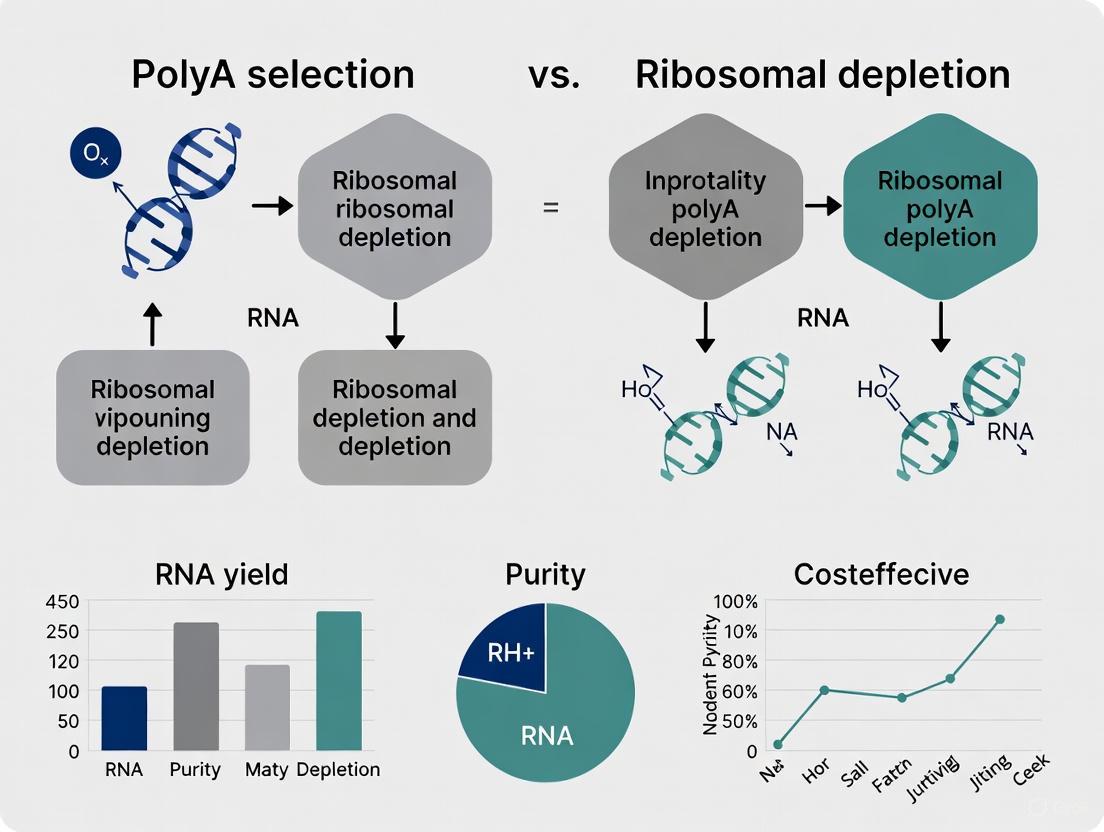
This article provides a comprehensive comparison of the two primary RNA-seq library preparation methods—polyA selection and ribosomal RNA depletion—for researchers and drug development professionals.
PolyA Selection vs. Ribosomal RNA Depletion: The Ultimate Guide for Biomedical Researchers
Abstract
This article provides a comprehensive comparison of the two primary RNA-seq library preparation methods—polyA selection and ribosomal RNA depletion—for researchers and drug development professionals. It covers the foundational mechanisms of each technique, guides method selection based on sample type and research goals, offers troubleshooting and optimization strategies, and presents validated comparative data on performance metrics. By synthesizing recent findings, this guide empowers scientists to design more efficient and accurate transcriptomic studies, from basic research to clinical applications.
Core Principles: How PolyA Selection and rRNA Depletion Work
The Biology of Polyadenylation and Its Role in mRNA Maturation
Eukaryotic messenger RNA (mRNA) maturation requires the essential process of 3' end polyadenylation, which involves the addition of a poly(A) tail that influences mRNA stability, translation, and export. This biological process underpins critical methodological decisions in transcriptomics, particularly the choice between polyA selection and ribosomal RNA (rRNA) depletion for RNA sequencing library preparation. This guide provides an objective comparison of these two predominant approaches, supporting experimental data to inform researchers and drug development professionals about their performance characteristics, optimal applications, and limitations within the context of modern RNA biology research.
In eukaryotes, the poly(A) tail is a fundamental post-transcriptional modification essential for mRNA function. This non-DNA-templated addition of adenosines occurs co-transcriptionally in the nucleus during 3'-end processing via two consecutive enzymatic steps: endonucleolytic RNA cleavage followed by homopolymeric tail synthesis [1]. The cleavage polyadenylation specificity factor (CPSF) complex recognizes the polyadenylation signal (PAS—most frequently an AAUAAA hexamer), while the cleavage stimulation factor (CstF) complex binds a GU-rich downstream element [1]. The poly(A) polymerase (PAP) then catalyzes the addition of the tail [1].
The length of the poly(A) tail is dynamically regulated. Nascent poly(A) tails range from 200-250 nucleotides in length [1]. Nuclear poly(A)-binding protein (PABPN1) acts as a molecular ruler, stimulating PAP activity for elongation but terminating processive polyadenylation once the tail reaches approximately 250 nucleotides [1]. After nuclear export, cytoplasmic deadenylases, including PAN2-PAN3 and CCR4-NOT complexes, progressively shorten the tail, influencing mRNA stability and translational efficiency [1]. Complete deadenylation triggers mRNA decay, making this process the rate-limiting step in mRNA turnover [1].
Alternative polyadenylation (APA) further expands the regulatory potential of this process. APA occurs when a gene contains multiple polyadenylation sites, generating mRNA isoforms with distinct 3' ends [2]. This can produce transcripts with differing 3' untranslated regions (3'UTRs) that alter regulatory element content, or with truncated coding sequences that generate different protein isoforms [2]. Intronic polyadenylation (IPA), a specific APA type, occurs within introns and can produce truncated proteins that lack functional domains, with implications in diseases including cancer [3].
Technical Comparison: PolyA Selection vs. rRNA Depletion
The fundamental biology of polyadenylation directly informs two primary RNA-seq library preparation methods: poly(A) selection and rRNA depletion. Their experimental workflows, detailed in Figure 1, leverage different principles to enrich for coding transcripts.
Figure 1. Workflow comparison of polyA selection and rRNA depletion methods. Path A (blue) shows poly(A) selection where oligo(dT) beads capture polyadenylated RNA. Path B (green) shows rRNA depletion where species-specific probes remove ribosomal RNA [4] [5].
Performance and Experimental Data
Quantitative comparisons reveal significant performance differences between these methods, impacting sequencing efficiency and cost.
Table 1. Quantitative Performance Comparison in Human Tissues [5] [6]
| Performance Metric | Poly(A) Selection | rRNA Depletion |
|---|---|---|
| Usable exonic reads (blood) | 71% | 22% |
| Usable exonic reads (colon tissue) | 70% | 46% |
| Extra reads needed for same exonic coverage | — | +220% (blood), +50% (colon) |
| Sequencing cost per usable read | Lower | Higher |
| 3′–5′ coverage bias | Pronounced 3′ bias | More uniform coverage |
Table 2. Methodological Suitability by Research Application [4] [5]
| Research Application | Recommended Method | Rationale | Experimental Considerations |
|---|---|---|---|
| Eukaryotic RNA, good integrity (RIN >8), coding mRNA focus | Poly(A) Selection | Highest exonic mapping rate; maximizes power for differential gene expression | Coverage skews 3' with RNA degradation; avoid with FFPE/RIN<7 samples [4] |
| Degraded/FFPE samples, non-coding RNA discovery | rRNA Depletion | Does not rely on intact poly(A) tails; captures both polyA+ and non-polyA RNAs | Higher intronic/intergenic reads; confirm rRNA probe species-match [4] [5] |
| Bacterial transcriptomics or host-pathogen studies | rRNA Depletion | Prokaryotic mRNAs largely lack stable poly(A) tails; polyA capture is ineffective | Use species-matched rRNA probes to minimize residual rRNA [4] |
| Isoform or splicing analysis requiring uniform coverage | rRNA Depletion | Provides more even 5'-to-3' transcript coverage | Increased data volume and bioinformatic complexity [5] |
| Low-input or single-cell RNA-seq | Poly(A) Selection | Efficient with limited material; foundation of 10x Genomics, Smart-seq2 | Standard for most commercial single-cell platforms [5] |
Experimental Protocols and Optimization
Optimized Poly(A) Selection Protocol
Recent research with Saccharomyces cerevisiae demonstrates that standard protocols can be significantly improved. A single round of poly(A) selection often leaves rRNA comprising ~50% of the output [7]. Optimization strategies include:
- Enhanced Beads-to-RNA Ratio: Increasing the oligo(dT)25 magnetic beads-to-RNA ratio from 13.3:1 to 50:1 reduces rRNA content to ~20% [7].
- Two-Round Enrichment: Implementing two consecutive rounds of poly(A) selection with adjusted bead ratios reduces rRNA to less than 10%, significantly improving mRNA purity [7].
- Quality Control: Capillary electrophoresis (e.g., TapeStation) effectively quantifies residual 18S and 25S rRNA content to assess enrichment efficacy [7].
Computational Detection of Polyadenylation Events
Bioinformatic tools leverage RNA-seq data to study polyadenylation biology, particularly APA. These methods generally follow a two-step process: identifying poly(A) sites, then quantifying their differential usage [2]. Specialized tools like IPScan detect intronic polyadenylation (IPA) events by integrating RNA-seq read coverage with 3'-end-seq peaks, identifying novel truncation events that may generate alternative protein isoforms [3]. On simulated data with 1,000 synthetic IPA events, IPScan demonstrated 92% detection sensitivity at 50 million reads [3]. Other tools like DaPars and APAlyzer detect differential APA events and calculate indices like the Percentage of Distal PolyA Usage Index (PDUI) to quantify 3'UTR length changes [2].
Research Applications and Case Study
Regulatory Role in Inflammation
Polyadenylation regulation plays critical roles in physiological and pathological processes. A 2024 study demonstrated that the APA regulator Nudt21 is significantly upregulated in inflammatory bowel disease, psoriasis, rheumatoid arthritis, and sepsis [8]. Myeloid-specific Nudt21-deficient mice were protected against colitis and hyperinflammation, showing reduced proinflammatory cytokine production [8]. Mechanistically, Nudt21 regulates mRNA stability of key autophagy-related genes (Map1lc3b and Ulk2) by mediating selective 3'UTR polyadenylation in macrophages [8]. This case illustrates how APA dynamically regulates gene expression in immune responses.
The Researcher's Toolkit
Table 3. Essential Research Reagents and Computational Tools
| Tool Name | Type | Primary Function | Application Context |
|---|---|---|---|
| Oligo(dT)25 Magnetic Beads | Wet-bench reagent | Binds poly(A) tails for mRNA enrichment | Poly(A) selection library prep; optimized at high beads-to-RNA ratios [7] |
| RiboMinus Kit | Wet-bench reagent | Removes rRNA via species-specific DNA probes | rRNA depletion for degraded samples or non-model organisms [7] |
| IPScan | Computational tool | Detects novel intronic polyadenylation events | RNA-seq analysis; identifies truncating isoforms from RNA-seq data [3] |
| DaPars | Computational tool | Identifies differential APA from RNA-seq | Calculates PDUI index for 3'UTR length changes [2] |
| APARENT | Computational tool | Deep learning model for poly(A) site prediction | Predicts poly(A) site strength from DNA sequence [9] |
| PolyA_DB / PolyASite | Database | Annotated poly(A) sites across species | Reference for APA analysis; training data for prediction models [2] |
Polyadenylation represents a crucial biological process in mRNA maturation and a foundational element in transcriptomics methodology. The choice between poly(A) selection and rRNA depletion depends critically on research goals, sample quality, and organism. Poly(A) selection provides superior cost-efficiency for coding transcript quantification from high-quality eukaryotic RNA, while rRNA depletion offers broader transcriptome coverage for degraded samples, non-coding RNA studies, and prokaryotic research. Understanding both the biological principles of polyadenylation and the technical performance of these methods enables researchers to optimize experimental design and accurately interpret resulting data in drug development and basic research.
In RNA sequencing, the pervasive presence of ribosomal RNA (rRNA)—constituting 70-90% of total RNA in eukaryotic cells—poses a significant challenge for efficient transcriptome analysis [7] [10]. PolyA selection, also known as polyA+ enrichment or polyA enrichment, addresses this challenge through a targeted mechanism that specifically captures messenger RNA (mRNA) molecules bearing polyadenylated tails. This methodology forms the backbone of numerous service-grade workflows in genomics and molecular biology, enabling high-quality, reproducible data generation for research ranging from fundamental investigations of gene regulation to pharmaceutical and clinical studies investigating cellular responses at the transcript level [11]. When framed within the broader context of mRNA enrichment strategies, polyA selection represents a positive selection approach that stands in contrast to negative selection methods such as rRNA depletion. Understanding its mechanistic basis, performance characteristics, and optimal applications is essential for researchers, scientists, and drug development professionals designing transcriptomic studies.
The Biological Foundation of Polyadenylation
The poly(A) tail is not merely an inert appendage but a dynamic and potent feature of most mRNA molecules that profoundly affects mRNA fate and translation efficiency [12]. Polyadenylation is a precisely regulated posttranscriptional process that occurs in the nucleus by canonical poly(A) polymerases (PAPs). This process begins with a protein complex called CPSF (cleavage and polyadenylation specificity factor) recognizing the AAUAAA signal in the pre-mRNA, then collaborating with CstF (cleavage stimulation factor) to cleave the mRNA at a specific site [12] [11]. Following cleavage, poly(A) polymerase (PAP) adds approximately 200 adenine nucleotides to the 3' end, while nuclear poly(A)-binding protein (PABPN1 in higher species) binds the growing tail and limits its length [12] [11].
The poly(A) tail serves multiple crucial biological functions throughout the mRNA lifecycle. It protects mRNA from degradation by exonucleases, facilitates mRNA export from the nucleus to the cytoplasm, and enhances translation efficiency through interactions between cytoplasmic poly(A)-binding protein (PABPC) and the 5' cap-binding translation initiation factor eIF4G [12] [11]. This interaction creates a circular structure that stabilizes the mRNA and promotes efficient protein synthesis. Eventually, the tail is shortened by deadenylase complexes (PAN2-PAN3 and CCR4-NOT), and when sufficiently shortened, the mRNA is degraded [11]. The poly(A) tail also serves as a platform for various regulatory proteins and non-canonical poly(A) polymerases (ncPAPs) that can further modify tail length and composition in the cytoplasm, adding layers of post-transcriptional control [12].
Oligo(dT) Capture Mechanism: A Molecular Workflow
The polyA selection method leverages the fundamental principle of complementary base pairing to specifically isolate polyadenylated RNA molecules from total RNA extracts [11]. This process employs oligo(dT) primers or probes—typically 25-50 nucleotides in length—composed of deoxythymidine residues that hybridize specifically to the poly(A) tail. The experimental implementation follows a systematic workflow with critical optimization points at each stage, as detailed below.
Core Workflow Steps
Bead Preparation and RNA Denaturation: Oligo(dT) magnetic beads are resuspended to ensure even distribution. Total RNA (typically 100 ng-5 µg) is mixed with a high-salt binding buffer and heated to 65-70°C to denature secondary structures and expose the poly(A) tails for hybridization [11]. The high-salt environment stabilizes adenosine-thymidine base pairing during subsequent steps.
Annealing and Hybridization: The denatured RNA is combined with oligo(dT) beads and incubated at room temperature for 5-60 minutes to allow hybridization between poly(A) tails and oligo(dT) probes [11]. Efficiency at this stage depends on buffer salt concentration, incubation time, and the beads-to-RNA ratio. Recent optimization studies demonstrate that increasing the beads-to-RNA ratio from 13.3:1 to 50:1 can significantly reduce residual rRNA content from approximately 50% to 20% [7].
Washing and Elution: After hybridization, the bead-mRNA complexes are immobilized using a magnet, and the supernatant containing non-polyadenylated RNA (rRNA, tRNA, etc.) is discarded. Multiple washes with high-salt buffer remove contaminants while preserving mRNA binding. Finally, purified mRNA is eluted using low-salt buffer or nuclease-free water at 60-80°C, which disrupts the A-T bonds while maintaining RNA integrity [11]. Some protocols enable on-bead cDNA synthesis, reducing handling losses and streamlining library preparation [11].
Key Optimization Parameters
Optimizing the polyA selection process requires careful attention to several experimental parameters. The beads-to-RNA ratio significantly impacts yield and purity, with higher ratios (25:1 to 125:1) dramatically reducing rRNA contamination but increasing cost [7]. Hybridization time affects yield, with longer incubations (30-60 minutes) potentially improving capture efficiency, though shorter times (5-10 minutes) may be sufficient due to rapid hybridization kinetics [11]. Wash stringency balances purity and yield, with 2-4 washes typically recommended, where more washes enhance purity at the risk of increased mRNA loss [11]. Finally, elution conditions are critical, with temperatures of 60-80°C for 2 minutes optimally releasing mRNA without causing significant degradation [11].
Performance Comparison: PolyA Selection Versus rRNA Depletion
When evaluating mRNA enrichment strategies for transcriptomic studies, researchers must consider the relative performance of polyA selection against its primary alternative—rRNA depletion. Quantitative comparisons across multiple studies and sample types reveal distinct patterns of efficiency, coverage, and suitability for different research scenarios.
Quantitative Performance Metrics
The following table summarizes key performance differences between polyA selection and rRNA depletion methods based on empirical data from clinical and model system samples:
| Performance Metric | PolyA Selection | rRNA Depletion | Experimental Context |
|---|---|---|---|
| Usable exonic reads (blood) | 71% | 22% | Human blood samples [10] [5] |
| Usable exonic reads (colon) | 70% | 46% | Human colon tissue [10] [5] |
| Extra reads needed for same exonic coverage | Baseline | +220% (blood), +50% (colon) | Comparison of sequencing depth requirements [10] [5] |
| rRNA content after optimization | <10% | ~50% | Yeast total RNA with optimized beads-to-RNA ratio [7] |
| Detection of non-polyadenylated RNAs | Limited | Comprehensive | Evaluation of ncRNA detection [13] [10] |
| Performance with degraded RNA | Significantly reduced | Maintained | FFPE and low RIN samples [4] [14] |
Technical and Biological Implications
The performance differences between these methods have profound implications for experimental design and data interpretation. PolyA selection demonstrates superior sequencing efficiency for exonic regions, making it particularly cost-effective for gene expression studies focusing on protein-coding genes [10] [5]. This method generates a higher fraction of usable reads mapping to exons (70-71% versus 22-46% for rRNA depletion), directly translating to lower sequencing costs per informative read [10].
However, rRNA depletion captures a broader spectrum of transcript types, including both polyadenylated and non-polyadenylated species such as long non-coding RNAs (lncRNAs), histone mRNAs, and premature transcripts [13] [10]. This comprehensive capture comes at the cost of increased intronic and non-coding reads, which reduces the percentage of usable exonic reads and necessitates deeper sequencing to achieve comparable gene quantification [10]. For blood and colon-derived RNAs, 220% and 50% more reads, respectively, must be sequenced with rRNA depletion to achieve the same level of exonic coverage as polyA selection [10] [5].
RNA integrity significantly affects method performance. PolyA selection efficiency declines with RNA degradation as fragmented RNAs may lose their poly(A) tails, resulting in 3' bias and under-representation of longer transcripts [4] [14]. In contrast, rRNA depletion performs more robustly with degraded samples like FFPE tissues because it doesn't rely on intact 3' termini [4] [5].
Experimental Protocols and Optimization Strategies
Standardized PolyA Selection Protocol
A robust, kit-agnostic protocol for polyA selection incorporates both core steps and critical optimization points derived from empirical studies:
Input RNA Requirements: Use 100 ng-5 µg of high-quality total RNA with RNA Integrity Number (RIN) ≥7-8 for optimal results [4]. For degraded samples (RIN <7), consider alternative methods or expect significant 3' bias [4] [14].
Beads-to-RNA Ratio Optimization: Employ higher beads-to-RNA ratios (25:1 to 50:1) than traditionally recommended to dramatically reduce rRNA contamination. Studies demonstrate that increasing this ratio from 13.3:1 to 50:1 reduces residual rRNA from ~50% to 20% in yeast RNA [7]. For clinical samples with potentially lower mRNA content, further optimization may be necessary.
Hybridization Conditions: Conduct hybridization in high-salt buffer at room temperature for 30-60 minutes to maximize yield [11]. While shorter hybridization times (5-10 minutes) may be sufficient due to rapid kinetics, extended incubation can improve capture efficiency for low-abundance transcripts [11].
Wash Stringency and Elution: Perform 2-4 washes with high-salt buffer, balancing purity against potential mRNA loss [11]. Elute with 60-80°C low-salt buffer or nuclease-free water for 2 minutes to efficiently release mRNA without degradation [11]. Consider on-bead cDNA synthesis to minimize handling losses [11].
Advanced Optimization: Two-Round Selection
For applications requiring the highest purity, implementing two rounds of polyA selection significantly enhances enrichment. Research demonstrates that a second round of selection with adjusted beads-to-RNA ratios can reduce rRNA content to less than 10% of the final output [7]. Although this approach decreases yield, it substantially improves purity for demanding applications like full-length cDNA sequencing or single-cell transcriptomics [15].
Research Reagent Solutions: Essential Materials for PolyA Selection
Successful implementation of polyA selection methodologies requires specific reagents and materials optimized for this application. The following table details key components and their functions in the experimental workflow:
| Reagent/Material | Function | Specifications & Optimization Tips |
|---|---|---|
| Oligo(dT) Magnetic Beads | Capture polyadenylated RNA through complementary base pairing | dT25-dT50 length; optimize beads-to-RNA ratio (25:1 to 50:1 for high purity) [11] [7] |
| High-Salt Binding Buffer | Stabilize A-T pairing during hybridization | Typically containing 0.5-1.0 M LiCl or NaCl; critical for hybridization specificity [11] |
| Wash Buffer | Remove non-specifically bound RNA | High-salt (0.15-0.25 M) solutions maintain specific binding while removing contaminants [11] |
| Low-Salt Elution Buffer | Release purified mRNA from beads | Low ionic strength and elevated temperature (60-80°C) disrupt A-T pairing [11] |
| RNA Stabilization Reagents | Preserve RNA integrity pre-processing | Essential for maintaining poly(A) tails; critical for high RIN inputs [4] |
Application Guidance: Strategic Implementation in Research Contexts
Selecting between polyA selection and rRNA depletion requires careful consideration of research objectives, sample characteristics, and practical constraints. The following guidance synthesizes empirical evidence to inform method selection:
Ideal Applications for PolyA Selection
Protein-Coding Gene Expression Studies: When the research focus is primarily on mature, protein-coding transcripts, polyA selection provides superior exonic coverage and quantification accuracy [10] [15]. The method efficiently enriches for functional mRNA, reducing background noise from ribosomal, transfer, and other non-coding RNAs [11].
Cost-Sensitive Projects with High-Quality RNA: For studies with intact RNA (RIN ≥7-8) and budget constraints, polyA selection offers exceptional value by concentrating sequencing power on informative regions [4] [5]. The significantly higher percentage of usable exonic reads directly translates to lower sequencing costs per detected gene.
Low-Input RNA Sequencing: PolyA selection works efficiently with small RNA amounts, making it suitable for limited samples [5]. Many single-cell RNA-seq technologies (Smart-seq2, 10x Genomics) rely on poly(A) priming due to its compatibility with ultra-low input RNA [14] [16].
Full-Length Transcript Analysis: When combined with appropriate library preparation methods, polyA selection improves the accuracy of transcript quantification and detection of alternative splicing events by reducing non-specific genomic DNA amplification [15].
When to Consider Alternative Methods
Degraded or FFPE Samples: With RNA Integrity Numbers (RIN) below 7 or samples from formalin-fixed paraffin-embedded tissues, rRNA depletion typically outperforms polyA selection by not relying on intact 3' termini [4] [14].
Non-Coding RNA Discovery: For comprehensive transcriptome analyses that include long non-coding RNAs, small nucleolar RNAs, histone mRNAs, or other non-polyadenylated species, rRNA depletion provides more complete coverage [13] [10].
Prokaryotic Transcriptomics: PolyA selection is inappropriate for bacterial studies because prokaryotic polyadenylation is sparse and often marks decay rather than stability [4] [5].
Non-Model Organisms: When working with less-characterized species, verify oligo(dT) probe compatibility, as sequence divergence may affect capture efficiency [5].
PolyA selection via oligo(dT) capture remains a foundational methodology in transcriptomics, offering exceptional efficiency and precision for studying polyadenylated transcripts. Its mechanism leverages the evolutionary conserved poly(A) tail to positively select mature mRNA molecules, providing high exonic coverage and accurate gene quantification. When applied to appropriate sample types with adequate RNA integrity, this method delivers cost-effective, high-quality data that powers gene expression studies across biological research and drug development. However, researchers must align method selection with their specific experimental questions, sample characteristics, and resource constraints, recognizing that rRNA depletion may be preferable for degraded samples, non-coding RNA profiling, or prokaryotic studies. As sequencing technologies continue to evolve, the strategic implementation of polyA selection within well-designed experimental frameworks will remain essential for generating biologically meaningful transcriptomic data.
In transcriptomics, the efficient removal of ribosomal RNA (rRNA) is a critical first step for effective RNA sequencing (RNA-seq). rRNA can constitute up to 98% of a total RNA sample, and without its removal, it would consume the vast majority of sequencing reads, making the detection of meaningful biological signals prohibitively expensive and inefficient. [17] Among the primary strategies for rRNA removal is probe-based ribosomal RNA depletion, a method that directly targets and removes rRNA molecules based on their sequence. This guide objectively explores the mechanism of probe-based rRNA depletion, compares its performance to the alternative poly(A) selection method, and provides the experimental data and protocols essential for researchers to make an informed choice.
The Fundamental Mechanism of Probe-Based rRNA Depletion
Probe-based rRNA depletion is a sophisticated molecular technique designed to selectively remove rRNA from a total RNA sample, thereby enriching all other non-ribosomal RNA species. The process can be broken down into several key stages, as illustrated below and described in detail thereafter.
Diagram Title: Probe-Based rRNA Depletion Workflow
The mechanism operates as follows:
Design and Introduction of Probes: Single-stranded, biotinylated DNA probes are designed to be complementary to the rRNA sequences of the target organism (e.g., human, mouse, chicken). [18] [19] These probes are mixed with a denatured total RNA sample to ensure access to highly structured rRNA targets. [17]
Hybridization: The mixture is incubated under controlled conditions that promote specific base-pairing between the DNA probes and their complementary rRNA sequences. This results in the formation of RNA:DNA hybrid duplexes specifically for rRNA molecules. [18] [20]
Capture and Removal: Streptavidin-coated paramagnetic beads are added to the sample. The high-affinity binding between streptavidin and biotin causes the beads to capture the probe-rRNA complexes. A magnet is then applied to separate the bead-bound rRNA from the rest of the solution, which now contains the enriched, rRNA-depleted RNA. [20]
Recovery: The supernatant, now containing the enriched population of non-ribosomal RNAs (including mRNA, lncRNA, and other non-coding RNAs), is recovered and can be concentrated for downstream applications like RNA-seq library preparation. [20]
An alternative enzymatic method uses RNase H to degrade the rRNA in the RNA:DNA hybrid. In this approach, after hybridization with specific DNA probes, the RNase H enzyme is introduced. It specifically cleaves the RNA strand within the duplex, effectively degrading the rRNA. The DNA probes and rRNA fragments are then removed, leaving behind the depleted RNA. [18]
Comparative Performance: rRNA Depletion vs. Poly(A) Selection
To objectively evaluate probe-based rRNA depletion, it must be compared against the dominant alternative for RNA enrichment: poly(A) selection. The table below summarizes the key characteristics and performance metrics of each method.
Table 1: Direct Comparison of rRNA Depletion and Poly(A) Selection
| Feature | rRNA Depletion | Poly(A) Selection |
|---|---|---|
| Mechanism Principle | Negative selection; removes unwanted rRNA via probes [4] [20] | Positive selection; captures desired polyadenylated RNA via oligo(dT) [4] [17] |
| RNA Species Captured | Both poly(A)+ and non-polyadenylated RNA (mRNA, lncRNA, pre-mRNA, histone mRNAs) [4] [17] | Only polyadenylated RNA (mature mRNA, some lncRNAs) [4] [17] |
| Suitability for RNA Integrity | Tolerant of degraded/FFPE RNA; preserves 5' coverage [4] | Requires high-quality RNA (RIN > 7); strong 3' bias with degradation [4] [17] |
| Organism Applicability | Eukaryotes & prokaryotes (with species-specific probes) [4] [19] | Primarily eukaryotes; not suitable for prokaryotes [4] [17] |
| Residual rRNA in Data | ~2-5% with well-matched probes; can be higher if probes are off-target [4] [18] | ~2-5% (mainly from mitochondrial rRNA) [17] |
| Key Advantage | Captures a broader transcriptome; ideal for degraded samples and non-model organisms. [4] [19] | Highly efficient for coding mRNA; cost-effective; simple workflow. [4] [6] |
| Key Disadvantage | Requires species-specific probes; higher cost per sample. [19] | Misses non-polyadenylated RNAs; performance drops with RNA degradation. [4] |
Experimental Data Supporting Performance Claims
The theoretical differences outlined above are borne out in experimental data:
- Coverage of Long Genes: A systematic comparison demonstrated that rRNA depletion outperforms poly(A) selection in detecting large, muscle-specific genes critical in disease mechanisms, such as TTN, NEB, and DMD. These genes, with transcripts over 100 kb in length, were "significantly missed" by poly(A)-based approaches. rRNA depletion provided more uniform transcript coverage and a balanced 5’/3’ coverage ratio. [21]
- Accuracy in Gene Quantification: In a study using human blood and colon tissue, poly(A) selection "outperformed rRNA depletion with higher exonic coverage and better accuracy of gene quantification." The study found that for blood-derived RNAs, 220% more reads would need to be sequenced with rRNA depletion to achieve the same level of exonic coverage as poly(A) selection. [6]
- rRNA Removal Efficiency: Protocol optimizations, such as those for Drosophila melanogaster and avian species, have demonstrated the ability to deplete ~97% of rRNA using custom-designed probes, confirming the method's effectiveness. [18] [19]
Detailed Experimental Protocol for Probe-Based rRNA Depletion
The following protocol, synthesized and adapted from multiple sources, provides a generalized workflow for probe-based rRNA depletion. [18] [20] [19]
Objective: To remove >97% of ribosomal RNA from a total RNA sample using sequence-specific, biotinylated DNA probes and streptavidin-coated magnetic beads.
Starting Material: 100 ng - 1 µg of high-quality total RNA (although the method is tolerant of moderate degradation).
Required Reagents and Materials
- Total RNA sample.
- Biotinylated DNA Probes specifically designed against the cytoplasmic and mitochondrial rRNA of the target species. [20] [19]
- Streptavidin-Coated Paramagnetic Beads. [20]
- Hybridization Buffer (e.g., provided in commercial kits or formulated with SSC, EDTA, SDS).
- Wash Buffers (e.g., low-salt and high-salt buffers to remove non-specifically bound RNA).
- Nuclease-Free Water.
- Magnetic Stand suitable for 1.5 mL or 2 mL microcentrifuge tubes.
- Thermal Cycler or water bath for controlled hybridization.
Step-by-Step Procedure
Probe Hybridization:
- Combine 100 ng - 1 µg of total RNA with a predefined amount of biotinylated probe mix (typically 1-5 µg) in hybridization buffer.
- Denature the mixture at 95°C for 2 minutes to remove secondary structures in the RNA.
- Immediately transfer to a controlled hybridization temperature (e.g., 70°C for 15 minutes) to allow the probes to specifically bind to their rRNA targets. [20] [19]
Capture of rRNA-Probe Complexes:
- Pre-wash the required volume of streptavidin-coated magnetic beads to remove storage solution.
- Add the washed beads to the hybridization reaction and incubate at room temperature for 5-10 minutes with gentle agitation. This allows the biotin on the probes to bind to the streptavidin on the beads. [20]
Magnetic Separation and Wash:
- Place the tube on a magnetic stand and wait until the supernatant is clear.
- Carefully transfer the supernatant (containing the rRNA-depleted RNA) to a new nuclease-free tube. Note: This is your depleted RNA sample.
- To increase purity, the beads can be washed once or twice with wash buffer, and these washes can be pooled with the initial supernatant. [20]
Concentration of Depleted RNA (Optional):
- The depleted RNA in the supernatant can be concentrated using ethanol precipitation or commercial concentration spin columns if the resulting volume is too large for downstream steps. [20]
Quality Control:
- Assess the efficiency of rRNA depletion using an instrument like the Bioanalyzer or TapeStation. A successful depletion will show a significant reduction or complete disappearance of the prominent 18S and 28S rRNA peaks.
- Alternatively, the efficiency can be confirmed post-sequencing by calculating the percentage of reads that map to rRNA. [18]
The Scientist's Toolkit: Essential Reagents for rRNA Depletion
Table 2: Key Research Reagent Solutions for Probe-Based rRNA Depletion
| Reagent / Solution | Function in the Workflow |
|---|---|
| Species-Specific Biotinylated Probes | The core reagent; single-stranded DNA oligonucleotides designed to bind with high specificity to ribosomal RNA sequences, enabling its targeted removal. [18] [19] |
| Streptavidin-Coated Magnetic Beads | A solid-phase capture matrix; the high-affinity interaction between streptavidin and biotin is used to physically separate the probe-rRNA complexes from the solution. [20] |
| Ribonuclease H (RNase H) | An enzymatic alternative; specifically cleaves the RNA strand of an RNA:DNA hybrid, degrading the targeted rRNA without the need for physical capture. [18] |
| Hybridization Buffers | Create optimal conditions for specific probe-target binding (hybridization) while minimizing non-specific interactions that lead to off-target depletion. [17] [20] |
| Duplex-Specific Nuclease (DSN) | A non-probe-based normalization enzyme; can be used to deplete abundant transcripts, including rRNA, by cleaving double-stranded cDNA, but is less specific than probe-based methods. [17] |
The choice between rRNA depletion and poly(A) selection is not a matter of which is universally better, but of which is optimal for a specific research context. Probe-based rRNA depletion is the unequivocal method of choice when the research question involves non-polyadenylated RNAs, degraded clinical samples (like FFPE), or non-model organisms where custom probes can be designed. [4] [19] Its ability to provide a more complete picture of the transcriptome, including intronic reads that can signal nascent transcription, makes it powerful for mechanistic studies. [4]
Conversely, for studies focused exclusively on gene-level differential expression of coding mRNA from high-quality eukaryotic samples, poly(A) selection remains a highly efficient and cost-effective option. [4] [6] By understanding the mechanisms, performance data, and practical protocols behind probe-based rRNA depletion, researchers and drug development professionals can strategically select the right tool to ensure their RNA-seq data is both comprehensive and informative.
In transcriptomics, the choice of RNA enrichment method fundamentally defines the experimental landscape by determining which RNA species are measured and which remain hidden. The two predominant strategies—poly(A) selection and ribosomal RNA (rRNA) depletion—employ distinct principles to enrich for informative transcripts from the overwhelming background of ribosomal RNA, which constitutes 70-85% of total RNA in eukaryotic cells [7]. This guide provides an objective comparison of these methods, detailing their capture capabilities, exclusion limitations, and performance characteristics to inform experimental design in research and drug development.
Core Mechanisms and Molecular Footprints
The two methods achieve transcript enrichment through fundamentally different biochemical principles, leading to distinct transcriptome footprints.
Overview of poly(A) selection and rRNA depletion mechanisms and their capture capabilities.
Poly(A) Selection
This method utilizes oligo(dT) probes attached to magnetic beads that specifically hybridize to the 3' poly(A) tails of transcripts [4]. This mechanism selectively enriches for:
- Mature eukaryotic mRNAs with intact poly(A) tails
- Polyadenylated long non-coding RNAs (lncRNAs)
- Stable non-coding RNAs with poly(A) tails
The method systematically excludes:
- Non-polyadenylated transcripts including replication-dependent histone mRNAs
- Most structural RNAs (rRNAs, tRNAs, sn/snoRNAs)
- Partially degraded mRNAs with damaged poly(A) tails
- Bacterial mRNAs due to different polyadenylation patterns [4]
rRNA Depletion
This approach uses sequence-specific DNA or LNA probes complementary to ribosomal RNA sequences (e.g., 18S and 25S/28S rRNA) that are either physically removed via streptavidin-coated magnetic beads or enzymatically degraded [7] [4]. This strategy:
- Retains both polyadenylated and non-polyadenylated RNA species
- Preserves nascent pre-mRNA and intronic sequences
- Captures non-polyadenylated lncRNAs and histone mRNAs
- Maintains bacterial transcripts when using species-matched probes
The method primarily targets removal of:
- Cytosolic and mitochondrial ribosomal RNAs
- Any transcripts sharing high sequence similarity with probe targets [4]
Performance Comparison and Experimental Data
Direct comparative studies reveal significant differences in enrichment efficiency, output yield, and analytical characteristics between these methods.
Table 1: Quantitative Performance Comparison of mRNA Enrichment Methods
| Parameter | Poly(A) Selection | rRNA Depletion | Measurement Context |
|---|---|---|---|
| rRNA Removal Efficiency | ~50% residual rRNA after single round [7] | ~50% residual rRNA with RiboMinus kit [7] | Yeast total RNA, standard protocol |
| Optimal rRNA Reduction | <10% residual rRNA with optimized two-round protocol [7] | Not reported | Yeast total RNA, enhanced protocol |
| RNA Output Yield | 2-3.9% of input [7] | 2-3.9% of input [7] | Relative to total RNA input |
| Impact of RNA Integrity | High sensitivity to degradation [4] | More resilient to fragmentation [4] | DV200 ≥ 50% recommended for poly(A) |
| 5'-Coverage Preservation | Strong 3' bias with degraded RNA [4] | Maintains better 5' coverage [4] | FFPE RNA samples |
| Sequencing Reads Mapping | High exonic mapping (>80%) [4] | Increased intronic/intergenic mapping [4] | Intact eukaryotic RNA |
Table 2: Applications Guide by Experimental Context
| Experimental Goal | Recommended Method | Rationale | Technical Considerations |
|---|---|---|---|
| Eukaryotic coding mRNA | Poly(A) selection | Concentrates reads on exons; boosts statistical power [4] | Requires RIN ≥7 or DV200 ≥50% |
| Degraded/FFPE samples | rRNA depletion | More tolerant of fragmentation; preserves 5' coverage [4] | Higher intronic fractions require analysis adjustment |
| Non-polyadenylated RNAs | rRNA depletion | Retains both poly(A)+ and non-poly(A) species [4] | Verify probe match to avoid high residual rRNA |
| Prokaryotic transcriptomics | rRNA depletion | Poly(A) capture ineffective for bacterial mRNAs [4] | Use species-matched rRNA probes |
| Nascent transcription analysis | rRNA depletion | Retains pre-mRNA and intronic sequences [4] | Model intronic and exonic reads separately |
| Low-input applications | Protocol-dependent | New ligation-free Ribo-seq methods work with 50-1000 cells [22] | Requires specialized protocols like Ribo-lite |
Optimization Strategies and Enhanced Protocols
Research indicates that standard manufacturer protocols for both methods often leave approximately 50% residual rRNA contamination [7]. Optimization significantly enhances performance:
Poly(A) Selection Enhancement
- Increased beads-to-RNA ratios: Raising the ratio from 13.3:1 to 50:1 reduces rRNA content to ~20% [7]
- Two-round enrichment: Implementing sequential poly(A) selection with adjusted beads-to-RNA ratios reduces rRNA to <10% [7]
- Reduced RNA input: Lower inputs (2-5μg) enable higher effective beads-to-RNA ratios without efficiency loss [7]
rRNA Depletion Considerations
- Species-specific probe design: Effective depletion requires comprehensive coverage of rRNA sequences, including often-overlooked 5S rRNA [7]
- Verification of probe match: Particularly important for non-model organisms to prevent high residual rRNA [4]
Advanced Applications and Specialized Methods
Single-Cell and Low-Input Transcriptomics
Recent innovations address the challenges of applying these methods to limited samples:
- Ligation-free protocols (e.g., Ribo-lite) enable ribosome profiling from as few as 50 cells or single oocytes by skipping rRNA depletion to minimize sample loss [22]
- Single-cell Ribo-seq methods utilize microfluidic isotachophoresis (ITP) for footprint enrichment from individual cells [22]
- Template-switching technologies (e.g., OTTR) allow one-pot reactions that maintain data reproducibility with inputs from ~10³ to 10⁶ cells [22]
Intronic Polyadenylation Analysis
rRNA depletion enables discovery of intronic polyadenylation (IPA) events that generate alternative isoforms with potential pathological significance [23]. Computational tools like InPACT leverage RNA-seq data from rRNA-depleted libraries to identify IPA sites, demonstrating that many IPA transcripts are sufficiently stable to be translated [23].
Ribosome Profiling Integration
Ribosome profiling (Ribo-seq) technologies reveal translational dynamics beyond transcript abundance. Recent advances address longstanding limitations:
- Spike-in controls using orthogonal species lysates or synthetic RNA oligonucleotides enable quantitative comparisons across conditions with global translation changes [22]
- RNase L studies demonstrate how endonuclease-cleaved mRNA fragments are translated, with ribosomes stalling at cleavage sites—a phenomenon detectable through specialized Ribo-seq protocols [24]
The Scientist's Toolkit: Essential Research Reagents
Table 3: Key Research Reagents for Transcriptome Analysis
| Reagent/Kit | Function | Application Notes |
|---|---|---|
| Oligo(dT)25 Magnetic Beads | Poly(A) RNA selection | Beads-to-RNA ratio significantly impacts efficiency; optimizable to 50:1 [7] |
| RiboMinus Transcriptome Isolation Kit | rRNA depletion | Primarily reduces 18S rRNA with weaker 25S reduction in yeast [7] |
| Poly(A)Purist MAG Kit | Poly(A) RNA selection | Demonstrates slightly higher 25S rRNA removal compared to basic beads [7] |
| Terminal Transferase | Adds homopolymer tails | Enables ligation-free library prep for low-input Ribo-seq [22] |
| SHAPE Reagents (e.g., NAI) | RNA structure probing | Compatible with optimized mRNA enrichment protocols [7] |
| Sequence-specific rRNA Probes | Targeted rRNA depletion | Critical for non-model organisms; requires verification of coverage [4] |
Workflow Integration and Decision Framework
Decision framework for selecting between poly(A) selection and rRNA depletion based on experimental context.
The transcriptome footprint captured by any experiment is fundamentally constrained by the initial enrichment method. Poly(A) selection provides focused analysis of mature, polyadenylated transcripts but fails to capture important regulatory RNAs without tails. rRNA depletion offers a broader view of the transcriptome, including nascent and non-polyadenylated species, but requires more sophisticated analysis to interpret the diverse RNA species captured. The optimal choice depends on experimental priorities: poly(A) selection for targeted coding transcript analysis with high-quality samples, versus rRNA depletion for exploratory studies, degraded samples, or when non-polyadenylated transcripts are of interest. Method optimization and appropriate computational tools are essential for maximizing the value of transcriptomic data regardless of the chosen path.
In transcriptomics, the choice between polyA selection and ribosomal RNA (rRNA) depletion is a critical first step that fundamentally shapes all downstream data, from the raw sequencing reads to the final biological interpretation. These two methods employ distinct mechanisms to address a common challenge: the overwhelming abundance of ribosomal RNA, which can constitute 80-98% of total RNA in a cell and would otherwise dominate sequencing reads [17] [25]. While polyA selection positively enriches for messenger RNA (mRNA) by targeting polyadenylated tails, rRNA depletion negatively removes ribosomal RNAs through probe hybridization or enzymatic digestion [11] [26]. This technical comparison guide examines how these divergent approaches impact experimental outcomes across key parameters including gene detection, coverage bias, quantitative accuracy, and applicability to diverse sample types, providing researchers with evidence-based guidance for protocol selection.
How the Methods Work: Fundamental Mechanisms
PolyA Selection: Positive Enrichment of mRNA
PolyA selection employs oligo(dT) sequences attached to magnetic beads to specifically capture RNA molecules bearing polyadenylated tails through complementary base pairing [11] [17]. The process begins with RNA denaturation at 65-70°C to remove secondary structures and expose the poly(A) tails, followed by hybridization with oligo(dT) beads under high-salt conditions that stabilize adenine-thymine bonding [11]. After binding, extensive washing removes non-polyadenylated RNAs, and the purified mRNA is finally eluted using low-salt buffer or nuclease-free water at elevated temperatures (60-80°C) to disrupt the A-T bonds [11]. This method effectively targets mature, protein-coding mRNAs for enrichment while excluding the majority of non-polyadenylated RNAs.
rRNA Depletion: Negative Selection of Ribosomal RNA
rRNA depletion utilizes complementary DNA or RNA probes to specifically target ribosomal RNAs for removal, preserving both polyadenylated and non-polyadenylated transcripts [26] [25]. The two primary implementation strategies are:
Hybridization/Capture Methods: Biotinylated probes hybridize to rRNA sequences at elevated temperatures, followed by removal using streptavidin-coated magnetic beads [26] [25].
Enzymatic Removal (RNase H): DNA probes complementary to rRNA form DNA-RNA hybrids, which are specifically degraded by RNase H endonuclease [25].
This approach maintains a broader RNA profile including non-coding RNAs, histone mRNAs, and immature transcripts that lack polyA tails [26].
Head-to-Head Performance Comparison
Quantitative Metrics from Clinical Samples
Experimental data from human clinical samples reveals significant differences in performance metrics between the two methods. The table below summarizes findings from a systematic evaluation using human blood and colon tissue samples:
Table 1: Performance comparison of polyA selection versus rRNA depletion in clinical samples [10]
| Performance Metric | polyA Selection | rRNA Depletion | Notes |
|---|---|---|---|
| Usable exonic reads | 71% (blood)70% (colon) | 22% (blood)46% (colon) | Higher exonic efficiency with polyA+ |
| Additional reads required | Reference | +220% (blood)+50% (colon) | To achieve same exonic coverage as polyA+ |
| Intronic mapping | Low | 52-78% higher | rRNA depletion captures immature transcripts |
| Gene biotype detection | Primarily protein-coding | Protein-coding + lncRNAs + pseudogenes + small RNAs | Broader diversity with rRNA depletion |
| Expression correlation | High between replicates | High between replicates | Both methods show technical reproducibility |
Impact on Detectable Transcripts
The choice of method significantly influences which transcriptional features are captured and quantifiable:
Table 2: Transcript biotype detection capabilities [26] [10]
| Transcript Biotype | polyA Selection | rRNA Depletion | Biological Significance |
|---|---|---|---|
| Protein-coding mRNA | Excellent | Excellent | Primary target for most studies |
| Long non-coding RNAs (lncRNAs) | Partial (only polyA+) | Comprehensive | Gene regulation, epigenetics |
| Histone mRNAs | No | Yes | Chromatin organization, cell division |
| Small non-coding RNAs | Limited | Yes | miRNA, snoRNA, tRNA regulation |
| Immature/nascent transcripts | No | Yes | Transcriptional dynamics |
| Pseudogenes | Limited | Yes | Potential regulatory roles |
Experimental Protocols and Methodologies
Detailed PolyA Selection Protocol
The standard polyA selection workflow involves these critical steps [11]:
- Bead Preparation: Resuspend oligo(dT) magnetic beads to ensure even distribution.
- RNA Denaturation: Heat total RNA (65-70°C) in high-salt binding buffer to disrupt secondary structures.
- mRNA Binding: Incubate denatured RNA with beads at room temperature for 30-60 minutes for hybridization.
- Washing: Place tube on magnet, discard supernatant, and perform 2-3 washes with high-salt buffer.
- Elution: Add warm elution buffer (60-80°C) to release purified mRNA from beads.
- Quality Control: Assess RNA integrity and purity before downstream applications.
Critical Considerations: The bead-to-RNA ratio must be optimized based on input mass (typically 2μL beads per 5μg RNA). Excessive beads may increase non-specific binding, while insufficient beads reduce yield. Hybridization efficiency depends on salt concentration and incubation time [11].
rRNA Depletion Methodologies
- Probe Hybridization: Mix total RNA with sequence-specific DNA/RNA probes targeting rRNA.
- Incubation: Denature at elevated temperature (68-75°C), then hybridize at optimal temperature.
- rRNA Removal:
- Capture method: Add streptavidin beads to bind biotinylated probes
- Enzymatic method: Add RNase H to digest RNA-DNA hybrids
- Purification: Recover depleted RNA using magnetic separation or column purification.
Recent advances in enzyme-based depletion include customized approaches for specific model organisms:
Drosophila melanogaster Example [25]:
- Design single-stranded DNA probes complementary to Drosophila rRNA sequences
- Hybridize probes with total RNA to form DNA-RNA hybrids
- Treat with RNase H to specifically degrade rRNA
- Achieves ~97% rRNA depletion efficiency
- Effectively enriches non-coding transcriptome
Applications and Suitability Guidelines
Sample-Type Specific Recommendations
Table 3: Method selection based on sample characteristics and research goals [11] [26] [10]
| Sample Condition/Research Goal | Recommended Method | Rationale | Experimental Considerations |
|---|---|---|---|
| High-quality RNA (RIN >8) | Either method | Both perform well with intact RNA | polyA+ more cost-effective for mRNA focus |
| Degraded RNA/FFPE samples | rRNA depletion | Does not rely on intact 3' termini | polyA+ shows strong 3' bias with degradation |
| Prokaryotic transcriptomes | rRNA depletion only | Prokaryotic mRNAs lack polyA tails | polyA+ selection not applicable |
| Non-coding RNA discovery | rRNA depletion | Captures non-polyadenylated ncRNAs | polyA+ would eliminate targets of interest |
| Clinical gene quantification | polyA selection | Higher exonic coverage, fewer reads needed | 50-220% more reads needed with rRNA depletion |
| Blood transcriptomics | polyA+ (with globin depletion) | Reduces globin mRNA interference | Globin depletion essential for blood samples |
| Single-cell RNA-seq | polyA selection | Integrated with droplet-based platforms | Compatible with UMI-based quantification |
Impact on Biological Interpretation
The methodological choice directly influences biological conclusions in several key areas:
Alternative Splicing Analysis: rRNA depletion captures more immature transcripts and intronic sequences, which can complicate splicing quantification but provides insight into transcriptional dynamics [10].
Non-Coding RNA Biology: Studies of long non-coding RNAs, histone genes, and other non-polyadenylated transcripts require rRNA depletion, as these RNAs are systematically excluded by polyA selection [26] [17].
Quantitative Accuracy: polyA selection demonstrates superior accuracy for protein-coding gene quantification with lower sequencing costs, making it preferable for differential expression studies focused on annotated exons [10].
Pathway Analysis: The broader transcriptome coverage of rRNA depletion may reveal regulatory networks involving non-coding elements, while polyA selection provides more focused protein-coding pathway analysis.
The Scientist's Toolkit: Essential Research Reagents
Table 4: Key reagents and kits for polyA selection and rRNA depletion [11] [25] [27]
| Reagent/Kit Name | Method | Primary Applications | Key Features |
|---|---|---|---|
| Oligo(dT) Magnetic Beads | polyA selection | mRNA enrichment, cDNA synthesis | Solid-phase support for hybridization |
| RiboCop rRNA Depletion Kit | rRNA depletion | Total RNA-seq, degraded samples | Probe-based, minimal enzymatic steps |
| QIAseq FastSelect-rRNA Kit | rRNA depletion | Species-specific rRNA removal | Optimized for various organisms |
| Ribo-Zero/Ribo-Zero Gold | rRNA depletion | Human/mouse/rat rRNA removal | Broadly used, but being discontinued |
| riboPOOL kits | rRNA depletion | Specific organism panels | Biotinylated probes, bead capture |
| NEBNext rRNA Depletion Kit | rRNA depletion | RNase H-based depletion | Enzyme-mediated, consistent performance |
| Duplex-Specific Nuclease (DSN) | Abundant RNA removal | Normalization of transcriptome | Treats any abundant sequence, not specific |
The decision between polyA selection and rRNA depletion represents a fundamental trade-off between focused efficiency and comprehensive breadth. polyA selection offers superior cost-effectiveness and exonic coverage for protein-coding gene quantification, particularly in clinical settings where sample integrity is high and research questions center on annotated genes. Conversely, rRNA depletion provides more extensive transcriptome coverage including non-coding RNAs and works reliably with degraded samples, making it essential for prokaryotic studies, non-coding RNA discovery, and archival tissue analysis. The optimal choice depends critically on sample quality, biological questions, and available sequencing resources, with the understanding that this initial methodological decision will propagate through all subsequent data generation and interpretation phases of the transcriptomic study.
Strategic Application: Choosing the Right Method for Your Research
In RNA sequencing (RNA-seq), the initial library preparation method is a pivotal decision that fundamentally shapes all downstream results. The two primary strategies—polyadenylated (polyA) RNA selection and ribosomal RNA (rRNA) depletion—capture distinct fractions of the transcriptome and are suited to different experimental conditions [28] [5]. PolyA selection enriches for mature, protein-coding messenger RNAs (mRNAs) by using oligo(dT) primers to target the polyA tail [5] [4]. In contrast, rRNA depletion removes abundant ribosomal RNAs, which constitute up to 80-90% of total RNA, thereby allowing sequencing of both polyadenylated and non-polyadenylated transcripts [25] [5]. The choice between these methods is not a matter of superiority but of alignment with specific research objectives, sample type, and RNA quality [4]. This guide provides a data-driven comparison to inform this critical decision, leveraging experimental data from clinical and model organism studies.
Quantitative Performance Comparison
Direct comparisons of polyA selection and rRNA depletion reveal significant differences in efficiency, coverage, and cost. A benchmark study evaluating both methods on human blood and colon tissue samples provided the following key metrics [29] [5]:
Table 1: Comparative Performance of RNA-seq Methods in Human Tissues
| Performance Metric | PolyA Selection | rRNA Depletion |
|---|---|---|
| Usable Exonic Reads (Blood) | 71% | 22% |
| Usable Exonic Reads (Colon) | 70% | 46% |
| Extra Reads Needed for Same Exonic Coverage | — | 220% more (Blood), 50% more (Colon) |
| Primary Transcript Targets | Mature, coding mRNAs | Coding + non-coding RNAs (lncRNAs, snoRNAs, pre-mRNA) |
| 3'-5' Coverage Uniformity | Pronounced 3' bias | More uniform coverage |
The data shows that polyA selection yields a much higher fraction of usable exonic reads. Consequently, rRNA depletion requires 220% more reads for blood and 50% more reads for colon tissue to achieve the same level of exonic coverage as polyA selection [29] [5]. This has a direct and substantial impact on sequencing costs.
Experimental Protocols and Methodologies
Core Workflow for PolyA Selection
The polyA selection protocol is designed for efficiency in capturing mature mRNAs.
Protocol Details:
- Input: Total RNA [5].
- Core Principle: Oligo(dT) primers attached to magnetic beads hybridize to the polyA tail of mature mRNAs [5] [4].
- Capture and Wash: The bead-bound polyA+ RNA is immobilized, and extensive washing removes non-polyadenylated RNAs, including rRNA, tRNA, and non-polyadenylated non-coding RNAs [5] [4].
- Elution and Library Construction: The purified polyA+ RNA is eluted and then processed into a sequencing library, typically involving reverse transcription into cDNA, fragmentation, and adapter ligation [5].
- Key Consideration: This method is highly dependent on RNA integrity. If the RNA is degraded and the polyA tail is lost, the transcript cannot be captured [28] [4].
Core Workflow for rRNA Depletion
The rRNA depletion protocol takes a different approach by removing the most abundant unwanted RNAs.
Protocol Details:
- Input: Total RNA [25] [5].
- Core Principle: Single-stranded DNA (ssDNA) probes complementary to the species-specific rRNA sequences are hybridized to the total RNA [25].
- rRNA Removal (Two Common Methods):
- Library Construction: The remaining RNA, which includes both polyA+ and polyA- transcripts, is then used for library preparation [25] [5].
- Key Consideration: The efficiency of depletion is highly dependent on the specificity of the probes to the rRNA of the target organism [25] [30]. Kits designed for one species (e.g., human) may not work efficiently for others (e.g., Drosophila) due to sequence divergence [25].
The Scientist's Toolkit: Essential Research Reagents
Successful RNA-seq experiments rely on key reagents for RNA handling and library preparation.
Table 2: Key Research Reagent Solutions for RNA-seq
| Reagent / Kit | Primary Function | Application Notes |
|---|---|---|
| PAXgene / Tempus Blood Tubes | RNA stabilization at sample collection | Critically prevents degradation by RNases in blood; essential for accurate gene expression profiles [31]. |
| DNase I | Genomic DNA removal | Highly recommended for blood RNA preps due to high DNA content; prevents quantification biases [31]. |
| Oligo(dT) Magnetic Beads | PolyA+ RNA selection | Core component of polyA selection kits; efficiency depends on intact polyA tails [5] [4]. |
| Species-Specific rRNA Depletion Kits | Removal of ribosomal RNA | Probes must be matched to the organism (e.g., Human/Mouse/Rat, Fly-specific) for optimal efficiency [25] [30]. |
| Globin mRNA Depletion Reagents | Removal of globin transcripts | Crucial for whole-blood RNA-seq; globin mRNA can comprise 30-80% of mRNA, vastly improving gene detection rates when removed [31]. |
| Stranded Library Prep Kits | Preservation of transcript origin | Preferred for determining the DNA strand of origin, crucial for identifying novel RNAs and overlapping transcripts [28]. |
Decision Matrix for Method Selection
The following decision matrix synthesizes experimental data to guide the choice between polyA selection and rRNA depletion based on common research scenarios.
Table 3: Decision Matrix for RNA-seq Method Selection
| Experimental Scenario | Recommended Method | Rationale and Supporting Evidence |
|---|---|---|
| High-Quality RNA (RIN ≥8)Protein-coding gene expression | PolyA Selection | Maximizes exonic reads and cost-efficiency. PolyA selection yields ~70% usable exonic reads vs. 22-46% for rRNA depletion [29] [5]. |
| Degraded or FFPE RNALow input quality | rRNA Depletion | Does not rely on an intact 3' polyA tail. More resilient to fragmentation and crosslinks, preserving better 5' coverage [28] [4]. |
| Non-coding RNA Discovery(lncRNAs, snoRNAs) | rRNA Depletion | Captures both polyadenylated and non-polyadenylated RNAs. An equine study found rRNA depletion enriched for snoRNAs, while polyA selection captured more lncRNAs overall [32]. |
| Prokaryotic Transcriptomics | rRNA Depletion | Prokaryotic mRNAs lack stable polyA tails; polyA selection is not appropriate. Depletion is the standard method [4]. |
| Splicing and Isoform Analysis | Context-Dependent | rRNA depletion gives more uniform 5'-to-3' coverage, reducing the 3' bias inherent in polyA selection of fragmented RNA [5] [4]. |
| Whole Blood Transcriptomics | Combine with Globin Depletion | Globin mRNA constitutes 30-80% of blood mRNA. Depleting globin (and often rRNA) is essential for high gene detection rates [31]. |
The decision between polyA selection and rRNA depletion is a foundational step in designing a robust RNA-seq study. As the data shows, polyA selection is the more efficient and cost-effective path for standard mRNA quantification from high-quality eukaryotic RNA [29] [5]. Conversely, rRNA depletion is a more versatile tool for challenging samples, such as degraded FFPE tissues, or for projects aiming to characterize the broader transcriptome, including non-polyadenylated non-coding RNAs [28] [32].
There is no one-size-fits-all answer. The optimal choice is dictated by a clear understanding of the biological question, the nature of the starting material, and the trade-offs between sequencing depth, cost, and analytical complexity. By applying the decision matrix and principles outlined in this guide, researchers can align their RNA-seq library preparation strategy with their specific experimental objectives to ensure successful and informative outcomes.
Optimal Use Cases for PolyA Selection in Eukaryotic Gene Expression Studies
In eukaryotic gene expression studies, the initial step of library preparation is a decisive factor that shapes all subsequent data and conclusions. Among the available strategies, polyA selection stands as a widely used method for enriching messenger RNA (mRNA) prior to sequencing. This technique operates on a fundamental biological principle: the vast majority of mature, protein-coding mRNAs in eukaryotic cells possess a polyadenylated tail, a stretch of 50-250 adenine nucleotides added to the 3' end during post-transcriptional processing [11]. PolyA selection strategically exploits this nearly universal feature to isolate mRNA from the total RNA pool, which is dominated by ribosomal RNA (rRNA) that can constitute over 80% of all cellular RNA [33].
The core mechanism involves oligo(dT) probes—short chains of deoxythymine nucleotides—that are immobilized on magnetic beads or other solid supports. When total RNA is incubated with these probes under appropriate buffer conditions, the oligo(dT) sequences specifically base-pair with the polyA tails of mature mRNAs. Through a series of washing steps, non-polyadenylated RNA species (primarily rRNA and transfer RNA) are removed, resulting in an enriched population of protein-coding transcripts [11]. This targeted enrichment makes polyA selection particularly valuable for researchers focused specifically on the protein-coding transcriptome, as it efficiently removes non-informative reads that would otherwise consume sequencing resources.
The alternative approach, rRNA depletion (often called "ribo-minus"), employs a different strategy by using probes to selectively remove ribosomal RNAs while retaining both polyadenylated and non-polyadenylated transcripts [4]. Each method possesses distinct advantages and limitations that must be carefully considered within the experimental context. As transcriptomics has advanced into more complex applications—including single-cell sequencing, biomarker discovery, and clinical diagnostics—understanding the optimal implementation of polyA selection has become increasingly crucial for generating biologically meaningful data with maximal efficiency and reliability [34].
Biological Foundations and Technical Mechanisms
The Biology of Polyadenylation
The molecular basis for polyA selection lies in the eukaryotic mRNA maturation process. Following transcription, precursor mRNA undergoes 3' end cleavage followed by the addition of a polyA tail, a process mediated by a multi-protein complex that recognizes the polyadenylation signal (AAUAAA) and adjacent elements [11]. This polyA tail serves critical functions in mRNA metabolism: it protects the transcript from rapid degradation, facilitates nuclear export, and enhances translation efficiency by interacting with polyA-binding proteins that promote ribosome recruitment [11]. From a technical perspective, this conserved structural feature presents an ideal handle for molecular capture.
The polyA tail is not a permanent feature throughout an mRNA's lifespan. It gradually shortens through the activity of deadenylase enzymes, and when it becomes sufficiently short, the mRNA is targeted for degradation [11]. This natural biological process has important implications for polyA selection efficiency, as transcripts in advanced states of decay may be poorly captured. Furthermore, not all functional RNAs possess polyA tails; replication-dependent histone mRNAs, certain long non-coding RNAs (lncRNAs), and many bacterial transcripts lack this modification [4] [35]. These limitations define the biological boundaries within which polyA selection operates effectively.
Technical Implementation: The Oligo(dT) Capture Workflow
The standard polyA selection protocol follows a series of optimized steps designed to maximize yield and specificity. First, total RNA is denatured by heating to 65-70°C in a high-salt binding buffer, which disrupts secondary structures that might obscure the polyA tail and prevent efficient hybridization [11]. The denatured RNA is then cooled and incubated with oligo(dT) magnetic beads for a period typically ranging from 5-60 minutes, during which the polyA tails base-pair with the complementary oligo(dT) sequences [11].
Following hybridization, a magnet is used to immobilize the beads while the supernatant containing non-polyadenylated RNA is discarded. The bead-bound RNA undergoes multiple washing steps with high-salt buffers to remove non-specifically bound contaminants while maintaining the specific polyA-oligo(dT) hybrids [11]. Finally, the purified polyA+ RNA is eluted using low-salt buffer or nuclease-free water at elevated temperature (typically 60-80°C), which destabilizes the A-T base pairing and releases the enriched mRNA into solution [11]. Some modern protocols omit this elution step entirely, proceeding directly to on-bead cDNA synthesis to minimize sample loss and handling time, particularly valuable when working with limited input material [11].
Key Technical Considerations for Optimization
Several technical factors significantly influence the success of polyA selection. The bead-to-RNA ratio must be carefully calibrated—insufficient beads reduce yield, while excess may increase non-specific binding [11]. Incubation time represents a balance between yield and practicality; while longer incubations (30-60 minutes) may improve capture efficiency, shorter periods (5-10 minutes) often prove sufficient due to rapid hybridization kinetics [11]. The stringency of wash conditions determines the trade-off between purity and recovery; additional washes enhance purity by removing more contaminants but marginally decrease yield through incidental mRNA loss [11].
The quality of input RNA profoundly affects polyA selection outcomes. RNA Integrity Number (RIN) values ≥7-8 are generally recommended, as degradation compromises polyA tail integrity and results in 3' bias [4]. The input RNA quantity can range from 100 ng to 5 μg for most standard protocols, with specialized methods available for lower inputs [11]. For challenging samples such as formalin-fixed paraffin-embedded (FFPE) tissues, where RNA is fragmented and cross-linked, the efficiency of polyA selection diminishes significantly, making rRNA depletion generally more appropriate [4].
Performance Comparison: PolyA Selection Versus rRNA Depletion
Quantitative Performance Metrics
Direct comparative studies reveal fundamental differences in the data generated by polyA selection and rRNA depletion methods. A comprehensive evaluation using human blood and colon tissue samples demonstrated that polyA selection provides significantly higher exonic read yield—approximately 70-71% of reads mapping to exonic regions compared to 22-46% with rRNA depletion [29] [6]. This enhanced efficiency translates directly to sequencing cost savings; to achieve equivalent exonic coverage, rRNA depletion required 220% more sequencing reads for blood-derived RNA and 50% more for colon tissue [29] [6].
The two methods also differ markedly in their breadth of transcriptome coverage. While polyA selection efficiently captures polyadenylated protein-coding transcripts, rRNA depletion retains a wider diversity of RNA species, including non-polyadenylated long non-coding RNAs (lncRNAs), small nucleolar RNAs (snoRNAs), pre-mRNAs, and histone mRNAs [4] [5]. This expanded coverage comes at the cost of increased sequencing depth requirements and more complex downstream bioinformatic analysis due to the higher proportion of intronic and intergenic reads [4].
Table 1: Comparative Performance of RNA Selection Methods in Human Tissues
| Performance Metric | PolyA Selection | rRNA Depletion |
|---|---|---|
| Usable Exonic Reads (Blood) | 71% | 22% |
| Usable Exonic Reads (Colon) | 70% | 46% |
| Additional Reads Required for Equivalent Coverage | Baseline | +220% (blood), +50% (colon) |
| Protein-Coding Gene Detection Accuracy | High | Moderate |
| Non-Polyadenylated RNA Capture | Minimal | Comprehensive |
| Typical RNA Integrity Requirement (RIN) | ≥7-8 | ≥5 |
Coverage Characteristics and Bias Profiles
The enrichment strategy profoundly influences sequence coverage distribution along transcripts. PolyA selection exhibits pronounced 3' bias, particularly with partially degraded RNA, because successful capture requires an intact polyA tail [4]. This bias manifests as progressively decreasing read density from the 3' toward the 5' end of transcripts. While this characteristic can complicate isoform-level analysis, it provides an advantage for 3' end-focused single-cell RNA sequencing technologies, many of which leverage this inherent bias [36] [37].
In contrast, rRNA depletion typically yields more uniform coverage across transcript bodies because it doesn't depend on a specific RNA feature at the 3' terminus [5]. This uniform coverage proves particularly valuable for applications requiring complete transcript characterization, such as alternative splicing analysis, variant detection, and full-length isoform quantification [4]. The preservation of pre-mRNA in rRNA-depleted libraries also provides insight into transcriptional activity, as intronic reads can indicate nascent transcription before processing is complete [4].
Table 2: Technical Characteristics and Application Fit
| Characteristic | PolyA Selection | rRNA Depletion |
|---|---|---|
| Primary Target | Mature, polyadenylated mRNA | Both polyA+ and polyA- RNA species |
| Coverage Uniformity | 3' bias, especially with degraded RNA | More uniform 5'-to-3' coverage |
| Performance with Degraded/FFPE RNA | Poor due to polyA tail loss | More resilient |
| Sequencing Cost Efficiency | High for mRNA profiling | Lower due to required depth |
| Bioinformatic Complexity | Lower (primarily exonic reads) | Higher (includes intronic/non-coding) |
| Ideal Application Scope | Gene-level expression, coding transcriptome | Comprehensive transcriptome, non-coding RNA |
Experimental Design and Protocol Implementation
Standardized PolyA Selection Protocol
A robust polyA selection protocol requires careful attention to several critical steps. Begin by resuspending oligo(dT) magnetic beads thoroughly to ensure a homogeneous suspension. For typical reactions using 1-5 μg of total RNA, 20-50 μL of bead suspension is generally sufficient, though optimal ratios should be determined empirically for specific sample types [11]. Denature the RNA by incubating with high-salt binding buffer at 65-70°C for 2-5 minutes, then immediately place on ice to prevent secondary structure reformation while preparing for hybridization [11].
Combine the denatured RNA with prepared beads and incubate at room temperature for 15-30 minutes with gentle agitation to maximize hybridization efficiency. Apply the sample to a magnetic stand until the solution clears, then carefully remove the supernatant containing non-polyadenylated RNA. Wash the bead-bound RNA twice with high-salt wash buffer, fully resuspending the beads during each wash to ensure complete removal of contaminants [11]. For final elution, add nuclease-free water or low-salt elution buffer preheated to 70-80°C, mix thoroughly, incubate for 2 minutes at elevated temperature, then immediately separate the eluate containing enriched mRNA from the beads using magnetic separation [11].
Quality Assessment and Troubleshooting
Post-selection quality control is essential for successful downstream applications. Assess RNA concentration using fluorescence-based methods (e.g., Qubit) rather than UV absorbance, which may detect contaminating nucleotides. Evaluate integrity via Bioanalyzer or TapeStation, recognizing that the enriched mRNA may display a different size profile than total RNA. The typical yield from polyA selection ranges from 1-5% of input total RNA, varying by tissue type and RNA quality [11].
Common issues include low yield (often from insufficient beads or inadequate hybridization time), rRNA contamination (typically from insufficient washing or bead overloading), and excessive 3' bias (usually indicating input RNA degradation) [4]. For problematic samples, consider performing two rounds of selection to enhance purity (at the cost of reduced yield), optimizing bead-to-RNA ratios through pilot tests, or implementing RNase H-based methods to specifically digest DNA-RNA hybrids that may form between oligo(dT) and contaminating genomic DNA [11].
Research Reagent Solutions
Table 3: Essential Research Reagents for PolyA Selection Protocols
| Reagent/Consumable | Function | Technical Considerations |
|---|---|---|
| Oligo(dT) Magnetic Beads | Capture polyadenylated RNA via hybridization | Varying binding capacities; magnetic properties affect recovery |
| High-Salt Binding Buffer | Stabilize A-T base pairing during hybridization | Optimal salt concentration critical for specificity |
| High-Salt Wash Buffer | Remove non-specifically bound RNA | Stringency affects purity/yield balance |
| Nuclease-Free Water | Elution of purified polyA+ RNA | Low ionic strength disrupts A-T pairing |
| RNA Stabilization Reagents | Preserve sample integrity before processing | Critical for maintaining polyA tail integrity |
| Magnetic Separation Stand | Immobilize beads during washing/elution | Compatible with tube/strip plate formats |
Application Scenarios and Decision Framework
Optimal Use Cases for PolyA Selection
PolyA selection demonstrates particular strength in eukaryotic gene expression studies focused on protein-coding genes, where its targeted enrichment provides maximal information from sequencing resources [4] [29]. This efficiency makes it ideal for large-scale transcriptional profiling projects, such as those comparing multiple treatment conditions or time points, where cost-effective sequencing is paramount [34]. The method excels with high-quality RNA samples (RIN ≥7-8), such as those from cell cultures or freshly isolated tissues, where intact polyA tails ensure comprehensive capture of the mRNA population [4].
For clinical RNA sequencing with diagnostic or biomarker discovery applications, polyA selection provides superior accuracy for protein-coding gene quantification compared to rRNA depletion [29] [6]. Its compatibility with low-input protocols makes it suitable for precious clinical samples or limited biopsy material [11]. Additionally, most single-cell RNA sequencing platforms rely on polyA-based capture, as the method's efficiency at minute RNA quantities and compatibility with barcoding strategies enable transcriptome profiling at cellular resolution [36] [37].
When to Consider Alternative Methods
While polyA selection excels in many scenarios, rRNA depletion is preferable for several specific applications. When working with compromised RNA samples—including FFPE tissues, degraded clinical specimens, or samples with RIN values below 7—rRNA depletion provides more reliable results because it doesn't depend on intact 3' termini [4] [5]. For studies specifically targeting non-polyadenylated RNAs (e.g., histone mRNAs, many lncRNAs, snoRNAs, or viral RNAs), rRNA depletion is essential as these transcripts would be excluded by polyA selection [4].
In prokaryotic transcriptomics, polyA selection is inappropriate because bacterial mRNA polyadenylation is sparse and often marks transcripts for degradation rather than stability [4]. Research requiring comprehensive transcriptome annotation or discovery of novel transcripts benefits from rRNA depletion's broader capture profile [35] [33]. Similarly, studies of nascent transcription or transcriptional regulation leverage the pre-mRNA retention characteristic of rRNA depletion to distinguish transcriptional from post-transcriptional control mechanisms [4].
Integrated Decision Framework
The choice between polyA selection and rRNA depletion should be guided by a systematic assessment of experimental goals and sample characteristics. The following decision matrix provides a practical framework for method selection:
Table 4: Decision Matrix for RNA Selection Methods
| Experimental Factor | PolyA Selection Recommendation | rRNA Depletion Recommendation |
|---|---|---|
| RNA Quality (RIN) | ≥7-8: Ideal | Any quality: Suitable <7: Preferred |
| Target Transcripts | Protein-coding mRNA only | Both coding and non-coding RNAs |
| Sample Type | Eukaryotic, fresh/frozen | Prokaryotic, FFPE, degraded |
| Sequencing Budget | Limited: More efficient | Flexible: Requires deeper sequencing |
| Analysis Expertise | Standard bioinformatics | Advanced for non-coding features |
| Project Scale | Large cohorts: Cost-effective | Targeted studies with sample diversity |
PolyA selection remains the method of choice for focused eukaryotic gene expression studies targeting protein-coding transcripts. Its exceptional efficiency in generating high-value exonic reads, cost-effectiveness for large-scale projects, and compatibility with high-quality RNA samples establish its continued relevance in modern transcriptomics [4] [29]. The method's limitations—particularly its dependence on RNA integrity and inability to capture non-polyadenylated transcripts—define clear boundaries for its optimal application [4] [35].
As RNA sequencing technologies evolve toward increasingly specialized applications, understanding these method-specific strengths enables researchers to match experimental design with biological questions [34]. For drug development professionals and clinical researchers, this strategic alignment ensures that transcriptomic studies generate maximally informative data for decision-making [29] [6]. While emerging methodologies continue to expand the technical toolbox, the fundamental principles governing polyA selection maintain its position as a cornerstone approach for eukaryotic gene expression analysis when applied within its demonstrated optimal use cases.
In the field of transcriptomics, the choice between polyA selection and ribosomal RNA (rRNA) depletion is a critical first step that determines the scope and quality of all downstream data. While polyA selection has been a traditional mainstay for eukaryotic mRNA sequencing, rRNA depletion has emerged as an indispensable alternative for specific, yet common, research scenarios. This method selectively removes abundant ribosomal RNAs, which can constitute up to 80% of total RNA, to enable the study of both coding and non-coding transcripts that lack polyadenylation [20] [25]. This guide objectively examines the experimental evidence supporting rRNA depletion, detailing its optimal applications in degraded samples, non-coding RNA studies, and prokaryotic research.
rRNA depletion employs sequence-specific probes to target and remove ribosomal RNA, allowing comprehensive capture of the transcriptome.
Core Principles and Workflow
rRNA depletion methods utilize biotinylated probe oligonucleotides or single-stranded DNA probes complementary to rRNA sequences. These probes hybridize to rRNA molecules in the total RNA sample, forming DNA-RNA hybrids. The hybrids are then removed through one of two primary mechanisms: (1) capture using streptavidin-coated paramagnetic beads in affinity-based methods, or (2) enzymatic degradation using RNase H, which specifically cleaves the RNA strand in RNA-DNA duplexes [20] [38] [18]. The remaining RNA, enriched for non-ribosomal species, is then available for library construction and sequencing.
The following diagram illustrates the fundamental workflow of a probe-based rRNA depletion method:
Efficiency Considerations
The efficiency of rRNA depletion directly impacts sequencing quality. In eukaryotic cells, ribosomal RNA typically represents about 90% of total RNA, meaning that without depletion, the majority of sequencing reads would be wasted on uninformative rRNA [20]. Experimental data shows that achieving 97% depletion efficiency increases relevant transcript reads to approximately 80% of the total sequencing library, while 99% depletion efficiency pushes this value to about 90% [20]. These efficiency gains translate directly into more cost-effective sequencing and improved detection of low-abundance transcripts.
Key Applications: When rRNA Depletion Is Preferred
Degraded and FFPE Samples
Formalin-Fixed Paraffin-Embedded (FFPE) and other degraded RNA samples present significant challenges for polyA selection due to fragmentation that separates the 3' polyA tail from the mRNA body. rRNA depletion demonstrates superior performance with these suboptimal samples because it targets internal rRNA sequences rather than the 3' terminus [4] [25]. Comparative studies have shown that rRNA depletion maintains better 5' coverage and preserves more biological information from degraded samples compared to polyA selection, which exhibits strong 3' bias and under-represents long transcripts when RNA integrity is compromised [4]. This resilience makes depletion particularly valuable for clinical cohorts with variable RNA quality or archival samples where RNA integrity numbers (RIN) may fall below 7.
Comprehensive Non-Coding RNA Analysis
The non-coding transcriptome represents a rapidly expanding area of research, with long non-coding RNAs (lncRNAs) and other non-polyadenylated transcripts playing crucial regulatory roles. While polyA selection captures mature eukaryotic mRNA and many polyadenylated lncRNAs, it systematically excludes replication-dependent histone mRNAs, many primary lncRNA transcripts, and other non-polyadenylated regulatory RNAs [39] [4]. rRNA depletion retains both polyadenylated and non-polyadenylated species in a single assay, providing a more comprehensive view of the transcriptome [20].
Recent research has identified 778 essential lncRNAs through transcriptome-wide CRISPR-Cas13 screens, many of which show differential expression in cancer and significant association with patient survival [39]. Capturing these transcripts requires rRNA depletion, as many lack polyA tails or are processed differently from canonical mRNAs. Studies specifically recommend depletion when investigating lncRNAs, small RNAs, and other non-coding species that constitute a substantial fraction of reads in rRNA-depleted libraries [6] [39].
Prokaryotic Transcriptomics
rRNA depletion is the standard method for prokaryotic transcriptomics because bacterial mRNA processing differs fundamentally from eukaryotic systems. Prokaryotic polyadenylation is sparse and often marks transcripts for degradation rather than stability, making polyA selection unsuitable for bacterial mRNA enrichment [4]. Additionally, prokaryotic operon structures and the absence of consensus polyadenylation signals necessitate alternative enrichment strategies.
Statistical design of experiments (DOE) approaches have been successfully applied to optimize rRNA depletion protocols for prokaryotes, identifying critical factor interactions that maximize rRNA removal while minimizing costs [40]. These optimized protocols have significantly improved mRNA sequencing coverage in bacterial species where commercial kits may be unavailable or prohibitively expensive.
Performance Comparison and Experimental Data
Direct Method Comparisons
Head-to-head comparisons of rRNA depletion and polyA selection reveal distinct performance characteristics across sample types. A comprehensive evaluation using human blood and colon tissue samples found that while rRNA depletion captured more unique transcriptome features, polyA selection achieved higher exonic coverage and better accuracy for gene quantification [6]. The researchers calculated that for blood-derived RNAs, 220% more reads would be required with rRNA depletion to achieve the same level of exonic coverage as polyA selection, while colon tissues required 50% more reads [6].
The table below summarizes key comparative metrics from experimental studies:
Table 1: Performance Comparison of rRNA Depletion vs. PolyA Selection
| Metric | rRNA Depletion | polyA Selection | Experimental Context |
|---|---|---|---|
| Exonic Coverage | Lower (requires 50-220% more reads for equivalent coverage) | Higher | Human blood and colon tissues [6] |
| Unique Transcript Features | Higher | Lower | Clinical RNA sequencing [6] |
| Performance on Degraded RNA | Superior, maintains 5' coverage | Strong 3' bias, under-represents long transcripts | FFPE and low-quality RNA samples [4] |
| Non-PolyA RNA Capture | Comprehensive including lncRNAs, histone mRNAs | Limited to polyadenylated species | Non-coding RNA studies [39] [20] |
| Prokaryotic Applicability | Standard method | Not appropriate | Bacterial transcriptomics [4] |
| Residual rRNA in Library | 2-20% with optimized protocols | Typically <1% | Various eukaryotic samples [20] [18] |
Decision Framework for Method Selection
The choice between rRNA depletion and polyA selection depends on multiple factors including organism, RNA quality, and research objectives. The following decision diagram outlines key considerations:
Experimental Protocols and Optimization
Custom rRNA Depletion Methods
For non-model organisms or budget-constrained laboratories, custom rRNA depletion protocols offer a cost-effective alternative to commercial kits. These methods typically involve designing species-specific antisense DNA oligos complementary to conserved rRNA regions, followed by hybridization and RNase H treatment [38] [18]. The protocol developed for chickens, for instance, successfully depleted both cytosolic and mitochondrial rRNAs by designing oligos targeting 18S, 28S, 5.8S, 5S, 12S, and 16S rRNA sequences [38].
Similar approaches have been optimized for Drosophila melanogaster, where commercial kits developed for vertebrates often prove inefficient due to unique insect rRNA processing pathways. The 28S rRNA in insects undergoes fragmentation into α and β fragments during processing, requiring specifically tailored depletion probes [25]. The optimized Drosophila protocol achieved approximately 97% rRNA depletion efficiency using single-stranded DNA probes and RNase H treatment [18] [25].
Critical Optimization Parameters
Statistical design of experiments (DOE) approaches have identified key factors that significantly impact depletion efficiency:
- Probe-to-RNA Ratio: Optimal ratios vary by species and must be empirically determined [40]
- Hybridization Conditions: Temperature and duration affect specificity and completeness of hybridization [38]
- RNase H Concentration and Incubation: Brand and amount of RNase H influence degradation efficiency [38]
- Bead Binding Efficiency: In affinity-based methods, bead quantity and binding conditions impact rRNA removal [40]
Protocol optimization using DOE frameworks has demonstrated that interactions between these factors can be significant, necessitating multivariate approaches rather than one-factor-at-a-time optimization [40].
Research Reagent Solutions
The following table details essential reagents and their functions for implementing rRNA depletion protocols:
Table 2: Key Research Reagents for rRNA Depletion Protocols
| Reagent/Category | Function | Examples/Notes |
|---|---|---|
| Species-Specific rRNA Probes | Hybridize to complementary rRNA sequences for targeted removal | Custom-designed oligos (50-100nt) against conserved rRNA regions; must be validated for off-target effects [38] [25] |
| RNase H Enzyme | Degrades RNA strand in RNA-DNA hybrids | Critical for enzymatic depletion methods; brand and concentration require optimization [38] [18] |
| Streptavidin-Coated Magnetic Beads | Capture biotinylated probe-rRNA complexes | Used in affinity-based depletion methods; binding efficiency varies by manufacturer [20] [40] |
| Total RNA Isolation Kits | Prepare high-quality input RNA | Essential starting material; any standard method acceptable but quality impacts results [20] [38] |
| Commercial Depletion Kits | Pre-optimized reagent systems | RiboMinus, Ribo-Zero, QIAseq FastSelect; efficiency varies by species compatibility [20] [25] |
rRNA depletion represents a powerful alternative to polyA selection for specific research applications where comprehensive transcriptome coverage is essential. The experimental evidence consistently supports its superiority for degraded samples, non-coding RNA investigations, and prokaryotic studies. While the method may require higher sequencing depth to achieve exonic coverage comparable to polyA selection for coding genes, it provides access to transcriptional elements completely inaccessible to polyA-based approaches. As transcriptomic research continues to expand beyond canonical coding genes to encompass the full complexity of regulatory RNAs, rRNA depletion methodologies will play an increasingly vital role in advancing our understanding of gene expression across diverse biological contexts.
Integrating Method Choice with Single-Cell and Low-Input RNA-seq Platforms
The foundation of any successful RNA sequencing (RNA-seq) experiment lies in a critical initial choice: the method used to enrich for biologically relevant RNA transcripts prior to library construction. This decision determines which RNA molecules are captured for sequencing, influences tolerance to sample degradation, and ultimately defines the biological questions that can be answered. The two principal strategies are poly(A) selection, which captures polyadenylated transcripts, and ribosomal RNA (rRNA) depletion, which removes abundant ribosomal RNAs [4]. While this choice is fundamental to all RNA-seq applications, it carries particular weight in the contexts of single-cell and low-input RNA-seq, where sample material is precious and technical variations are magnified. This guide objectively compares the performance of these methods when integrated with modern sequencing platforms, providing a framework for researchers to align their upstream biochemistry with their downstream analytical goals.
Core Mechanism and Molecular Targets
The fundamental difference between these methods lies in their molecular targets, which directly dictates transcriptome coverage.
Poly(A) Selection
This method uses oligo(dT) probes that hybridize to the poly(A) tails present on the 3' end of most mature eukaryotic messenger RNAs (mRNAs) and many long non-coding RNAs (lncRNAs) [4]. It is a positive selection process that directly enriches for these tailed transcripts.
- Targets: Mature mRNA, polyadenylated lncRNAs.
- Excludes: rRNA, transfer RNA (tRNA), small nuclear RNA (snRNA), small nucleolar RNA (snoRNA), and non-polyadenylated transcripts such as replication-dependent histone mRNAs [4].
rRNA Depletion (Ribo-Depletion)
This method employs sequence-specific DNA probes that hybridize to cytosolic and mitochondrial rRNA sequences. The RNA:DNA hybrids are then removed, typically via RNase H digestion or affinity capture [4]. It is a negative selection process that depletes unwanted rRNA.
- Targets: The remaining pool includes both poly(A)+ and non-polyadenylated RNAs [4].
- Retains: Pre-mRNA, many lncRNAs, histone mRNAs, and some viral RNAs [4].
The workflow below illustrates the key procedural differences and outcomes of these two methods.
Performance Comparison and Experimental Data
The choice between these methods has measurable effects on key data quality metrics, including mapping statistics, coverage, and gene detection.
Impact on Sequencing Data and Gene Quantification
A comparative analysis using human blood and colon tissue samples revealed trade-offs between the two approaches [6].
Table 1: Experimental Data Comparison from Clinical Samples
| Metric | Poly(A) Selection | rRNA Depletion | Experimental Context |
|---|---|---|---|
| Exonic Coverage & Gene Quantification Accuracy | Higher exonic coverage and better accuracy [6] | Lower exonic coverage | Human blood and colon tissue [6] |
| Reads Required for Same Exonic Coverage | Baseline | 220% (blood) and 50% (colon) more reads required [6] | Human blood and colon tissue [6] |
| Unique Transcriptome Features Captured | Fewer | More (e.g., non-polyA transcripts) [6] | Human blood and colon tissue [6] |
| Intronic/Intergenic Reads | Low | High; can be informative for nascent transcription [4] | General observation from workflow data [4] |
| 3' Bias in Coverage | Can be strong, especially with degraded RNA [4] | More uniform 5' to 3' coverage, even on compromised RNA [4] | General observation from workflow data [4] |
Guidelines for Method Selection
The optimal method depends on a combination of sample type, RNA integrity, and research objectives.
Table 2: Method Selection Guide
| Situation | Recommended Method | Rationale | Potential Drawbacks |
|---|---|---|---|
| Eukaryotic, intact RNA (RIN ≥7) focusing on coding mRNA | Poly(A) Selection | Concentrates reads on exons, boosting power for gene-level differential expression [4]. | Coverage skews to 3' end as RNA integrity falls [4]. |
| Degraded or FFPE RNA | rRNA Depletion | More tolerant of fragmentation and crosslinks; preserves 5' coverage better [4]. | Intronic and intergenic fractions rise; requires species-matched probes [4]. |
| Need for non-polyadenylated RNAs (e.g., histone mRNAs, many lncRNAs, pre-mRNA) | rRNA Depletion | Retains both poly(A)+ and non-poly(A) species in a single assay [4]. | Residual rRNA can be high if probes are off-target [4]. |
| Prokaryotic transcriptomics | rRNA Depletion | Poly(A) capture is not appropriate as prokaryotic mRNA is largely non-polyadenylated [4]. | Requires species-matched rRNA probes for effective depletion [4]. |
Integration with Single-Cell and Low-Input RNA-seq Platforms
In single-cell and low-input genomics, the upstream RNA enrichment method is often part of an integrated commercial platform. The choice of platform and method must be considered together.
Table 3: Single-Cell RNA-seq Platform Comparison
| Platform | Core Technology | Key Strengths and Compatibility |
|---|---|---|
| 10x Genomics Chromium | Droplet-based | High-throughput, high cell recovery, strong reproducibility; broadly compatible with fresh/frozen cells [41]. |
| 10x Genomics FLEX | Droplet-based | Unlocks FFPE and PFA-fixed samples; high multiplexing capability for large studies [41]. |
| BD Rhapsody | Microwell-based | Tolerant of lower-viability cells (~65%); excellent for combined RNA and surface protein (CITE-seq) profiling [41]. |
| MobiDrop | Droplet-based | Cost-effective and flexible throughput; streamlined automated workflow [41]. |
Most high-throughput single-cell RNA-seq platforms, including 10x Genomics Chromium, primarily use poly(A) selection at the core of their chemistry, leveraging oligo(dT) primers on barcoded beads for in-situ cDNA synthesis. However, the context of the sample can dictate the choice of platform, which in turn locks in the enrichment method. For example, while standard Chromium is ideal for fresh, intact cells, the FLEX platform is engineered to make this poly(A) capture compatible with fixed and FFPE-derived RNA [41].
Technical Considerations for Low-Input Workflows
Low-input and single-cell RNA-seq protocols are almost universally amplification-based to generate sufficient material for sequencing. This amplification step can introduce technical artifacts that must be considered alongside the enrichment method.
- Amplification Bias: Studies have shown that with reduced mRNA levels, amplification-based methods like Smart-seq and CEL-seq can lead to inefficient amplification of low-to-moderately expressed transcripts [42]. Noise from primer hybridization or enzyme incorporation is magnified, distorting fold-change measurements [42].
- Impact on Detection: These technical variations mean that differential expression analysis in low-input settings is often dominated by highly expressed genes or those with large fold changes, potentially masking subtle biological differences [42].
The Scientist's Toolkit: Essential Reagents and Materials
Successful execution of an integrated RNA-seq experiment requires careful selection of reagents and tools.
Table 4: Key Research Reagent Solutions
| Item / Reagent | Function | Considerations for Single-Cell/Low-Input |
|---|---|---|
| Oligo(dT) Probes/Magnetic Beads | For poly(A)+ RNA capture and barcoding in droplet-based platforms. | The backbone of 10x Chromium and similar workflows; efficiency is critical for cell-specific barcoding. |
| Species-Specific rRNA Depletion Probes | For hybridizing and removing ribosomal RNA from total RNA. | Essential for non-model organisms; probe mismatch is a major failure mode, leading to high residual rRNA [4]. |
| Spike-In RNAs (e.g., ERCC, SIRV) | External RNA controls for normalization and quality control. | Crucial for low-input studies to distinguish technical noise from true biological variation [43]. |
| Viability Stain (e.g., DAPI, Propidium Iodide) | To assess cell viability prior to loading on a platform. | Critical for BD Rhapsody, which tolerates ~65% viability, and recommended for all platforms to ensure data quality [41]. |
| Cell Hashing Antibodies | For sample multiplexing, allowing multiple samples to be pooled in one run. | Enables cost-saving and reduces batch effects; compatible with platforms like BD Rhapsody and 10x FLEX [41]. |
| Single-Cell Barcoding Kit | Platform-specific reagents for labeling all cDNA from a single cell with a unique barcode. | Platform-locked (e.g., 10x Barcoded Gel Beads, BD Rhapsody Magnetic Beads). |
The following decision diagram synthesizes the key factors for choosing the right combination of RNA enrichment method and platform, guiding researchers from their sample status to a robust experimental design.
In summary, the integration of method choice with sequencing platforms is non-trivial. Poly(A) selection is the default for high-quality eukaryotic samples and is embedded in most high-throughput single-cell platforms, offering superior exonic coverage for gene expression studies. In contrast, rRNA depletion provides the necessary flexibility for challenging samples, including degraded FFPE material, prokaryotic RNA, and experiments where the biology of interest extends beyond polyadenylated mRNA. For single-cell and low-input studies, researchers must be acutely aware of the amplification biases that can compound the inherent limitations of either method. By carefully considering sample type, RNA quality, and biological objectives as outlined in this guide, scientists can make an informed decision that ensures their upstream RNA enrichment strategy and platform choice are perfectly aligned with their research goals.
Economic and Sequencing Depth Considerations for Project Planning
In RNA sequencing (RNA-seq) project planning, the choice between poly(A) selection and ribosomal RNA (rRNA) depletion is a critical initial decision with profound implications for experimental costs, sequencing depth requirements, and data quality. These two principal methods for enriching the transcriptome prior to sequencing target fundamentally different RNA populations, leading to distinct trade-offs in data output, required sequencing depth, and overall project economics. With RNA-seq applications expanding in clinical research and drug development, understanding these economic considerations is essential for optimizing resource allocation while ensuring scientific objectives are met. This guide provides a detailed comparison of these methodologies, focusing on their economic and sequencing efficiency implications for research planning.
How Poly(A) Selection and rRNA Depletion Work
Poly(A) Selection Methodology
Poly(A) selection operates through oligo-dT hybridization to capture RNAs with poly(A) tails, selectively enriching mature eukaryotic mRNA and many polyadenylated long non-coding RNAs (lncRNAs) [4]. This method effectively excludes most ribosomal RNA (rRNA), transfer RNA (tRNA), small nuclear RNA (snRNA), small nucleolar RNA (snoRNA), and tail-less transcripts such as replication-dependent histone mRNAs [4]. The process typically involves incubating total RNA with oligo(dT) matrices where the poly(A) tails of mRNAs bind, followed by washing steps to remove unbound non-polyadenylated RNA, and finally elution of the purified mRNA fraction.
rRNA Depletion Methodology
rRNA depletion employs sequence-specific DNA probes that hybridize to cytosolic and mitochondrial rRNA sequences, after which the RNA-DNA hybrids are removed through RNase H digestion or affinity capture [4] [25]. Enzymatic approaches for post-cDNA synthesis also exist. Because this method targets rRNA sequences rather than relying on a specific tail structure, the remaining pool includes both poly(A)+ and non-polyadenylated RNA species, such as pre-mRNA, many lncRNAs, histone mRNAs, and some viral RNAs [4]. This technique is particularly valuable for prokaryotic transcriptomics, as poly(A) capture does not effectively recover bacterial mRNAs due to their sparse and functionally distinct polyadenylation patterns [4].
The diagram below illustrates the fundamental procedural differences between these two enrichment approaches:
Direct Performance and Economic Comparison
The choice between poly(A) selection and rRNA depletion significantly impacts sequencing efficiency and project costs, primarily due to differences in the proportion of usable reads mapping to target transcripts.
Sequencing Depth and Efficiency Requirements
Research comparing these methods demonstrates substantial differences in sequencing efficiency. A study utilizing human blood and colon tissue samples found that rRNA depletion required 220% and 50% more reads for blood and colon samples, respectively, to achieve the same level of exonic coverage as poly(A) selection [6]. This efficiency gap translates directly to higher sequencing costs per sample for rRNA depletion protocols.
Data Output and Quality Comparisons
The table below summarizes key performance characteristics with economic implications:
Table 1: Performance and Economic Comparison of RNA-seq Enrichment Methods
| Parameter | Poly(A) Selection | rRNA Depletion |
|---|---|---|
| Target RNA Population | Mature polyadenylated mRNA and lncRNAs [4] | Both polyadenylated and non-polyadenylated RNAs [4] |
| Effective Input RNA Integrity | Requires high-quality RNA (RIN ≥7 or DV200 ≥50%) [4] | Tolerates degraded/FFPE RNA [4] |
| Residual rRNA Content | Very low [4] | Variable; depends on probe specificity [4] [25] |
| Exonic Mapping Rate | High [4] [6] | Lower due to intronic/intergenic reads [4] |
| 3' Bias in Coverage | Yes, especially with degraded RNA [4] | More uniform 5' and 3' coverage [4] |
| Required Sequencing Depth | Lower for equivalent exon coverage [6] | 50-220% higher for equivalent exon coverage [6] |
Cost-Per-Sample Implications
The economic impact extends beyond sequencing costs to include reagent requirements and sample quality assessment:
- Reagent Costs: rRNA depletion kits typically involve more expensive components, including species-specific probes and specialized enzymes for hybrid removal [25].
- Sample QC Costs: Poly(A) selection may require more rigorous RNA quality assessment and quality control measures to ensure input integrity [4].
- Library Preparation Efficiency: Poly(A) selection workflows often integrate more seamlessly with standard library preparation kits, potentially reducing hands-on time [44].
Sample-Type Specific Economic Considerations
RNA Integrity and Quality
RNA quality dramatically affects method performance and cost efficiency. For high-quality RNA samples (RIN ≥7), poly(A) selection provides superior economic value through higher exonic mapping rates and lower sequencing requirements [4]. However, for degraded or FFPE samples, the economics shift toward rRNA depletion, which demonstrates greater resilience to fragmentation and preserves better 5' coverage [4] [45]. The additional sequencing depth required for rRNA depletion may still be more cost-effective than repeating experiments failed due to using poly(A) selection on compromised RNA.
Organism-Specific Considerations
The target organism significantly influences method selection and associated costs:
- Eukaryotic Models: For standard eukaryotic models with good RNA quality, poly(A) selection generally offers the most cost-effective approach [4].
- Prokaryotic Samples: rRNA depletion is essential for bacterial transcriptomics, as prokaryotic mRNAs lack stable poly(A) tails [4].
- Non-model Organisms: rRNA depletion requires species-matched probes for efficiency [25]. Probe mismatch can result in high residual rRNA, wasting sequencing resources and increasing costs [4] [25].
Experimental Design and Protocol Selection
Decision Framework for Method Selection
The following decision tree provides a systematic approach for selecting the most economically appropriate method based on project parameters:
Alternative Approaches and Emerging Technologies
Beyond these two primary methods, alternative approaches offer different economic and performance characteristics:
- 3' mRNA-Seq: Methods like QuantSeq provide a cost-effective alternative for large-scale gene expression studies, generating one fragment per transcript localized to the 3' end and requiring only 1-5 million reads per sample [44]. These approaches are particularly suitable for degraded samples like FFPE material and can significantly reduce sequencing costs for expression quantification studies [44].
- Total RNA Sequencing: Emerging total RNA approaches combine globin and rRNA depletion with unique molecular identifiers (UMIs) to provide comprehensive transcriptome coverage while maintaining cost efficiency through improved transcript detection capabilities [46].
- Specialized Kits for Challenging Samples: Methods like SMART-Seq with rRNA depletion have demonstrated advantages for both low-input and degraded RNA, potentially reducing sample preparation failures and associated costs [45].
The Scientist's Toolkit: Key Research Reagents
Table 2: Essential Reagents for RNA-seq Enrichment Methods
| Reagent/Tool | Function | Considerations |
|---|---|---|
| Oligo(dT) Magnetic Beads | Captures polyadenylated RNA through complementary binding [4] | Core component of poly(A) selection kits; efficiency depends on RNA integrity |
| Sequence-Specific DNA Probes | Hybridizes to rRNA sequences for depletion [4] [25] | Requires species-matched design; critical for depletion efficiency |
| RNase H Enzyme | Degrades RNA in RNA-DNA hybrids during rRNA depletion [25] | Allows enzymatic removal of rRNA after probe hybridization |
| Biotinylated Oligos & Streptavidin Beads | Captures and removes probe-rRNA hybrids in pulldown approaches [25] | Alternative physical removal method for rRNA |
| RNA Integrity Assessment Kits | Evaluates RNA quality (e.g., RIN, DV200) [4] | Critical for determining appropriate enrichment method |
| Unique Molecular Identifiers (UMIs) | Labels individual molecules to correct PCR biases [46] | Improves quantification accuracy; added cost but better data quality |
| rRNA Depletion Kits (Species-Specific) | Complete systems for rRNA removal [25] | Quality varies by organism; essential for non-model systems |
The economic planning of RNA-seq projects requires careful consideration of the trade-offs between poly(A) selection and rRNA depletion methods. Poly(A) selection generally provides superior sequencing efficiency and lower per-sample costs for projects focusing on gene-level differential expression in eukaryotic systems with high-quality RNA. In contrast, rRNA depletion, while requiring greater sequencing depth, offers better value for degraded samples, prokaryotic studies, and investigations requiring detection of non-polyadenylated RNAs. The optimal economic strategy depends on specific project goals, sample characteristics, and organism systems, with emerging methodologies providing additional options for cost-effective experimental design. By aligning method selection with project requirements and accounting for all cost components—from library preparation to sequencing depth—researchers can optimize resource allocation while ensuring robust, publication-quality results.
Solving Common Challenges and Enhancing Protocol Efficiency
Addressing High rRNA Contamination and Probe Mismatch Issues
In RNA sequencing, the pervasive presence of ribosomal RNA (rRNA) can dominate sequencing libraries, consuming the majority of reads and reducing the efficiency and quality of transcriptomic data. Effectively managing this rRNA contamination is a critical step in library preparation. This guide compares the two primary strategies—poly(A) selection and ribosomal RNA (rRNA) depletion—focusing on their performance in avoiding rRNA contamination and addressing the common challenge of probe mismatch.
Mechanisms of rRNA Removal: A Technical Comparison
The core difference between the two methods lies in their fundamental approach: poly(A) selection is a positive selection for desired transcripts, while rRNA depletion is a negative selection against unwanted RNA.
Poly(A) Selection: This method uses oligo(dT) primers attached to magnetic beads to hybridize and capture RNA molecules with poly(A) tails. This enriches for mature eukaryotic messenger RNAs (mRNAs) and many long non-coding RNAs (lncRNAs) while excluding the vast majority of rRNA, transfer RNA (tRNA), and other non-polyadenylated transcripts [4] [27]. Its efficiency is inherently linked to the integrity of the RNA's poly(A) tail.
rRNA Depletion (Ribo-Depletion): This technique starts from total RNA and uses sequence-specific probes (DNA or LNA oligonucleotides) that are complementary to rRNA sequences. The hybrids are then removed from the sample, typically through magnetic bead-based capture or enzymatic digestion with RNase H. This process retains both polyadenylated and non-polyadenylated RNAs, including pre-mRNA, many lncRNAs, and histone mRNAs [4] [25].
The following workflow outlines the key steps and critical decision points in each method, highlighting where issues like rRNA contamination and probe mismatch arise.
Performance and Experimental Data Comparison
The choice between poly(A) selection and rRNA depletion significantly impacts key sequencing metrics, including the fraction of usable reads, coverage uniformity, and resilience to sample quality.
Table 1: Comparative Performance of Poly(A) Selection vs. rRNA Depletion
| Performance Metric | Poly(A) Selection | rRNA Depletion | Supporting Evidence |
|---|---|---|---|
| Effective rRNA Removal | High (>90% for intact eukaryotic RNA) [4] | Variable; can achieve >97% with optimized probes [25] | Comparative studies show depletion is more resilient on fragmented RNA [4] |
| Usable Exonic Reads | ~70% (blood & colon tissue) [5] | 22–46% (blood & colon tissue) [5] | Poly(A) selection concentrates reads on exons [4] |
| Extra Reads Required | Baseline | +50% to +220% to match poly(A) exonic coverage [6] [5] | rRNA depletion retains intronic and non-coding reads [4] |
| Coverage Uniformity | Strong 3' bias, especially in degraded RNA [4] | More uniform 5'/3' coverage [4] [21] | Crucial for long gene detection (e.g., TTN, NEB) [21] |
| Tolerance to Degraded/FFPE RNA | Poor (requires RIN ≥7) [4] | Good [4] | Does not rely on an intact 3' poly(A) tail [4] |
| Detection of Non-polyA Transcripts | No (e.g., histone mRNAs, many lncRNAs) [4] | Yes [4] | Retains both poly(A)+ and non-poly(A) species [4] |
Table 2: Suitability for Different Organisms and Sample Types
| Situation | Recommended Method | Rationale | What to Watch Out For |
|---|---|---|---|
| Eukaryotic RNA, good integrity | Poly(A) Selection | Concentrates reads & boosts power for gene-level differential expression [4] | Coverage skews to 3' end as RNA integrity falls [4] |
| Degraded or FFPE RNA | rRNA Depletion | More tolerant of fragmentation and cross-links [4] | Intronic and intergenic fractions rise [4] |
| Need for non-polyadenylated RNAs | rRNA Depletion | Retains both poly(A)+ and non-poly(A) species (e.g., histone mRNAs, lncRNAs) [4] | Residual rRNA increases if probes are off-target [4] |
| Prokaryotic transcriptomics | rRNA Depletion | Poly(A) capture is not appropriate for bacteria [4] | Use species-matched rRNA probes [47] |
| Long transcript detection(e.g., muscle disease genes) | rRNA Depletion | Provides uniform coverage; polyA selection significantly misses long isoforms (e.g., TTN) [21] | - |
The Scientist's Toolkit: Research Reagent Solutions
Selecting the right reagents is fundamental to success. The following table details key solutions for implementing either RNA enrichment strategy.
Table 3: Key Reagent Solutions for RNA Enrichment
| Reagent / Kit | Function / Principle | Key Considerations |
|---|---|---|
| Oligo(dT) Magnetic Beads | Binds poly(A) tails for positive selection of mRNA [7] | Bead-to-RNA ratio is critical for efficiency; two rounds of enrichment can drastically reduce rRNA background [7]. |
| Pan-Prokaryotic Ribo-Depletion Kits(e.g., riboPOOLs) | Uses biotinylated DNA probes for bead-based removal of rRNA from diverse bacterial species [47] [26] | A suitable replacement for the discontinued RiboZero; shows high efficiency in E. coli [47]. |
| Species-Specific Ribo-Depletion Kits(e.g., for Drosophila) | Probes designed for unique rRNA sequences of non-model organisms [25] | Essential for organisms with atypical rRNA processing (e.g., fragmented 28S rRNA in insects); custom probes can achieve ~97% depletion [25]. |
| RNase H-based Depletion Kits | Uses DNA probes and RNase H enzyme to degrade RNA in DNA-RNA hybrids [25] | Protocol is simple and cost-effective. However, potential for off-target activity if hybridization is not stringent [47]. |
| Biotinylated Probes (Custom) | Custom-designed probes for magnetic bead capture; follow principles of US 2011/0040081 A1 [47] | Allows for highly specific, species-tailored depletion, including tRNA or other abundant RNAs. Requires in-house design and validation [47]. |
Troubleshooting rRNA Contamination and Probe Mismatch
Addressing High Residual rRNA in Depletion Workflows
The dominant failure mode in rRNA depletion workflows is probe mismatch, which leaves high residual rRNA and wastes sequencing reads [4]. This occurs when the depletion probes do not perfectly complement the rRNA sequences in the sample.
- Problem: Probes are often designed for model organisms. Using a kit developed for humans/mice/rat on a distantly related species (e.g., Drosophila) leads to inefficient hybridization and poor rRNA removal. For instance, the 28S rRNA in insects undergoes unique fragmentation, making standard vertebrate probes ineffective [25].
- Solution:
- Validate Probe Specificity: Before scaling up, pilot a few samples and check the percentage of rRNA reads in the sequencing output [4].
- Use Species-Specific Kits: Opt for kits specifically validated for your organism (e.g., QIAseq FastSelect–rRNA Fly Kit, siTOOLs riboPOOLs for flies) [25].
- Develop Custom Probes: For non-model organisms, design biotinylated probes targeting the full-length rRNA sequences of your specific species, following established protocols [47]. This approach was shown to be an adequate replacement for the highly efficient but discontinued RiboZero kit [47].
Mitigating 3' Bias and Low Yield in Poly(A) Selection
- Problem: Running poly(A) selection on heavily fragmented or FFPE RNA produces strong 3' bias and under-representation of long transcripts because the capture depends on an intact poly(A) tail [4] [21].
- Solution:
- Assess RNA Integrity: Use metrics like RIN (RNA Integrity Number) or DV200. For poly(A) selection, a RIN ≥ 7 or DV200 ≥ 50% is recommended [4].
- Switch to Depletion: If the input sample is degraded, switch to rRNA depletion rather than increasing sequencing depth [4]. rRNA depletion preserves 5' coverage better on compromised RNA [4].
- Optimize Bead Ratio: For yeast, increasing the oligo(dT) beads-to-RNA ratio from 13.3:1 to 50:1 reduced rRNA content from ~54% to ~20% [7]. A second round of enrichment can further reduce rRNA to below 10% [7].
The following decision tree synthesizes these troubleshooting strategies into a clear, actionable pathway for researchers.
The choice between poly(A) selection and rRNA depletion is fundamental, as it defines the transcriptome you will measure. This decision should be guided by a clear understanding of your sample's integrity, the organism you are studying, and your specific biological questions.
- For intact eukaryotic RNA where the primary goal is accurate and cost-effective quantification of coding mRNA, poly(A) selection is the superior choice, providing high exonic coverage and statistical power [4] [6].
- For challenging samples—including degraded/FFPE RNA, prokaryotes, or any study requiring the detection of non-polyadenylated RNAs—rRNA depletion is the necessary and recommended approach. Its robustness and broader transcriptome coverage come at the cost of higher sequencing depth but are essential for these applications [4] [21] [5].
To mitigate the risk of rRNA contamination and probe mismatch, researchers must validate their chosen method with pilot studies, especially for non-model organisms, and select enrichment strategies or kits that are specifically tailored to their experimental context.
Mitigating 3' Bias and Long-Transcript Undercounting in PolyA Selection
In transcriptomics, the choice of library preparation method fundamentally shapes the quality and interpretation of the resulting data. Poly(A) selection, which uses oligo(dT) primers to enrich for polyadenylated RNA, is a mainstream method for focusing sequencing efforts on mature messenger RNA (mRNA). However, this method introduces two significant and correlated technical artifacts: a strong 3' bias in transcript coverage and the undercounting of long transcripts [4] [48]. These biases arise because the method's efficiency is intrinsically linked to the integrity of the RNA molecule and the length of its poly(A) tail [49]. When RNA is fragmented—either deliberately during library prep or due to sample degradation—the oligo(dT) primers can only bind to fragments that retain the 3' end containing the poly(A) tail. This results in a sequencing library where coverage is heavily skewed toward the 3' end of transcripts [4]. Furthermore, longer transcripts present a larger target for fragmentation, making it statistically less likely that their 3' end remains intact, which leads to their systematic under-representation in the final data [4] [50]. This guide objectively compares the performance of poly(A) selection and its primary alternative, rRNA depletion, in mitigating these specific challenges, providing researchers with the data needed to select the optimal protocol.
How the Methods Work: A Mechanistic Comparison
Poly(A) Selection Workflow
Poly(A) selection is a positive enrichment strategy. It relies on the hybridization of oligo(dT)-coated magnetic beads to the poly(A) tail of mature eukaryotic mRNAs. After binding, the beads are magnetically separated, washing away non-polyadenylated RNAs (including rRNA, tRNA, and non-polyadenylated non-coding RNAs). The purified poly(A)+ RNA, comprising mostly mRNA and some long non-coding RNAs (lncRNAs), is then used for library construction [4] [5]. The critical point of failure in this workflow is its absolute dependence on an intact 3' terminus.
rRNA Depletion Workflow
Ribosomal RNA (rRNA) depletion is a negative selection strategy. It uses sequence-specific DNA or DNA-RNA probes that are complementary to the rRNA sequences (e.g., 28S, 18S, 5.8S, and 5S). These probes hybridize to the rRNAs in a total RNA sample. The rRNA-probe hybrids are then removed, either enzymatically (e.g., using RNase H which cleaves the RNA in an RNA-DNA hybrid) or via affinity capture (e.g., using biotinylated probes and streptavidin beads) [4] [25]. The remaining RNA, which includes both poly(A)+ and non-polyadenylated RNA species, constitutes the sequencing library.
The following diagram illustrates the core procedural differences between these two methods and their direct consequences.
Performance Data: A Quantitative Comparison
The theoretical weaknesses of poly(A) selection manifest clearly in empirical data. The following tables summarize key performance metrics, highlighting the trade-offs between target specificity and coverage uniformity.
Table 1: Comparative Performance of RNA Enrichment Methods [4] [6] [5]
| Performance Metric | Poly(A) Selection | rRNA Depletion | Experimental Context |
|---|---|---|---|
| Usable Exonic Reads (Blood) | ~71% | ~22% | Human clinical samples (Zhao et al., 2018) |
| Usable Exonic Reads (Colon) | ~70% | ~46% | Human clinical samples (Zhao et al., 2018) |
| Extra Reads Needed for Same Exonic Coverage | — | +220% (blood), +50% (colon) | Human clinical samples (Zhao et al., 2018) |
| 3' Bias | Pronounced, increases with fragmentation | More uniform 5' to 3' coverage | Observed in fragmented/FFPE samples [4] [48] |
| Long Transcript Quantification | Undercounted as integrity decreases | Preserved, independent of 3' end integrity | Coverage bias for transcripts >5kb [4] [50] |
| Performance with FFPE/Degraded RNA | Poor, strong 3' bias and low yield | Robust and recommended | RIN <7 or DV200 <50% [4] [5] |
Table 2: Method Selection Guide Based on Experimental Conditions [4] [5] [44]
| Experimental Situation | Recommended Method | Rationale | What to Watch Out For |
|---|---|---|---|
| Eukaryotic RNA, high integrity (RIN ≥8), coding mRNA focus | Poly(A) Selection | Concentrates reads on exons, boosts power for gene-level differential expression at lower cost. | Coverage skews to 3' as integrity falls; long transcripts are undercounted. |
| Degraded or FFPE RNA | rRNA Depletion | More tolerant of fragmentation, preserves 5' coverage better, does not rely on intact poly(A) tail. | Intronic and intergenic fractions rise; confirm probe match to avoid high residual rRNA. |
| Need for non-polyadenylated RNAs (e.g., histone mRNAs, many lncRNAs) | rRNA Depletion | Retains both poly(A)+ and non-poly(A) species in a single assay. | Residual rRNA can increase if probes are off-target. |
| Prokaryotic transcriptomics | rRNA Depletion | Poly(A) capture is not appropriate as bacterial mRNA lacks stable poly(A) tails. | Use species-matched rRNA probes for efficient depletion. |
Experimental Protocols in Practice
A Standard Poly(A) Selection Protocol
The following is a generalized protocol for mRNA enrichment using poly(A) selection, as utilized in many commercial kits and studies [4] [49]:
- RNA Quality Control: Determine RNA Integrity Number (RIN) using an Agilent Bioanalyzer. Proceed only if RIN is ≥7-8 for reliable results.
- Hybridization: Incubate 10 ng–1 μg of total RNA with oligo(dT) magnetic beads in a high-salt binding buffer. This promotes base pairing between the oligo(dT) and the mRNA poly(A) tail.
- Capture and Wash: Place the tube on a magnetic separator to capture the bead-bound poly(A)+ RNA. Carefully remove the supernatant, which contains non-polyadenylated RNA (rRNA, tRNA, etc.). Wash the beads multiple times with a wash buffer to remove any residual non-specifically bound RNA.
- Elution: Elute the purified poly(A)+ mRNA from the beads using nuclease-free water or a low-salt elution buffer by heating. The eluate is now ready for downstream library construction.
A Standard rRNA Depletion Protocol
This generalized protocol is based on enzyme-based depletion methods, such as those using RNase H [25] [51]:
- Probe Hybridization: Incubate 100 ng–1 μg of total RNA with a pool of single-stranded DNA probes that are complementary to the species-specific rRNA sequences (e.g., for human, mouse, rat, or custom-designed for non-model organisms like Drosophila).
- RNase H Digestion: Add RNase H enzyme to the hybridization mix. The enzyme specifically cleaves the RNA strand in RNA-DNA hybrids, fragmenting the targeted rRNA molecules.
- rRNA Removal: Clean up the reaction using RNA purification beads or columns. The fragmented rRNA, along with the probes, is removed in the flow-through or supernatant. The purified, rRNA-depleted RNA is recovered in the eluate.
- Quality Check: Assess depletion efficiency using a Bioanalyzer or by quantifying residual rRNA levels after sequencing.
The Scientist's Toolkit: Key Research Reagent Solutions
Table 3: Essential Reagents for RNA Enrichment Protocols
| Reagent / Kit | Function | Key Consideration |
|---|---|---|
| Oligo(dT) Magnetic Beads | Captures polyadenylated RNA via complementary base pairing with the poly(A) tail. | Core component of all poly(A) selection kits. Efficiency drops with degraded RNA. |
| Species-Specific rRNA Depletion Probes | Single-stranded DNA or DNA-RNA probes that hybridize to ribosomal RNA for targeted removal. | Specificity is critical; off-target binding can lead to loss of desired transcripts. Must be matched to the organism (e.g., Human/Mouse/Rat vs. Fly-specific kits) [25]. |
| RNase H Enzyme | An endoribonuclease that specifically degrades the RNA strand in RNA-DNA hybrids. | Used in enzyme-based depletion protocols to digest rRNA after probe hybridization [25]. |
| Biotinylated rRNA Probes & Streptavidin Beads | An affinity-based depletion method. Biotinylated probes bind rRNA and are pulled down with streptavidin beads. | An alternative to enzymatic depletion. The bead-rRNA complex is physically removed from the sample [25]. |
| RNA Clean-up Beads/Columns | Purifies the RNA after the enrichment/depletion step to remove enzymes, salts, and degraded RNA fragments. | Essential for preparing clean input for the subsequent library preparation steps. |
The choice between poly(A) selection and rRNA depletion is not a matter of identifying a universally superior technique, but rather of aligning the method with the specific biological question and sample characteristics. Poly(A) selection offers a cost-effective and highly focused path for quantifying mature mRNA from high-quality eukaryotic samples. However, its susceptibility to 3' bias and long-transcript undercounting presents a significant limitation for studies of alternative splicing, non-polyadenylated RNAs, or those utilizing degraded archival samples. rRNA depletion emerges as the definitive solution for mitigating these specific biases, providing more uniform transcript coverage and resilient performance on compromised samples, albeit at a higher required sequencing depth. By understanding the mechanistic origins of these biases and leveraging the quantitative data presented, researchers can make an informed, strategic decision that ensures the integrity and biological relevance of their transcriptomic data.
Optimizing Bead-to-RNA Ratios and Hybridization Conditions
In transcriptomics, the choice between polyadenylated (polyA) selection and ribosomal RNA (rRNA) depletion is a critical first step that fundamentally shapes all downstream analyses [4]. This decision dictates which RNA molecules are captured for sequencing and is especially crucial for challenging sample types, such as those that are degraded or derived from formalin-fixed paraffin-embedded (FFPE) tissues [4]. Both methods rely on distinct hybridization mechanisms—polyA selection uses oligo(dT) probes to target the polyA tail of mature mRNAs, while rRNA depletion uses DNA or LNA probes complementary to ribosomal RNA sequences [4] [52]. The efficiency of these hybridization reactions is highly dependent on precise reaction conditions, particularly the bead-to-RNA ratio and the stringency of hybridization [52]. Optimizing these parameters is not merely a technical detail but a essential requirement for ensuring the cost-effectiveness and scientific accuracy of RNA-sequencing experiments. This guide provides a detailed, data-driven comparison of these two dominant strategies, focusing on the optimization of bead-based protocols to achieve maximal target enrichment and coverage uniformity.
Methodological Principles and Comparison
Core Mechanisms and Molecular Targets
The two methods operate on fundamentally different principles for enriching the transcriptome:
- PolyA Selection: This positive selection method uses oligo(dT) probes immobilized on magnetic beads to hybridize and capture RNA molecules possessing a polyA tail [4] [52]. It primarily enriches for mature eukaryotic messenger RNAs (mRNAs) and many long non-coding RNAs (lncRNAs) with polyA tails [4]. A significant limitation is its systematic exclusion of non-polyadenylated RNAs, such as replication-dependent histone mRNAs, a subset of lncRNAs, and many bacterial mRNAs [4].
- rRNA Depletion: This negative selection method employs sequence-specific DNA or Locked Nucleic Acid (LNA) probes that are complementary to ribosomal RNA sequences (e.g., 18S and 25S in yeast) [52]. Following hybridization, the rRNA-probe hybrids are removed from the total RNA pool, typically through RNase H digestion or magnetic bead capture, leaving behind both polyA+ and polyA- transcripts [4] [52]. This method retains non-coding RNAs, pre-mRNAs, and bacterial transcripts, providing a broader view of the transcriptome [4].
Comparative Workflow and Reagent Requirements
The experimental workflows and key reagents for each method differ significantly, influencing protocol duration, cost, and required expertise.
Table 1: Key Reagent Solutions for RNA Enrichment Methods
| Item | Function | PolyA Selection | rRNA Depletion |
|---|---|---|---|
| Magnetic Beads | Solid-phase support for capture | Oligo(dT)-coated | Streptavidin-coated (for biotinylated probes) |
| Capture Probes | Hybridization to target RNA | Oligo(dT) sequences | Species-specific DNA/LNA probes vs. rRNA |
| Binding/Wash Buffer | Controls hybridization stringency | High-Salt Buffer | Proprietary Buffer Formulations |
| Elution Buffer | Releases captured RNA | Low-Salt Buffer or Nuclease-free Water | Not applicable (supernatant is retained) |
| RNase H | Enzymatic degradation of rRNA | Not used | Commonly used in some protocols |
Figure 1: A decision flow and workflow comparison between polyA selection and rRNA depletion methods. The fundamental difference lies in whether the desired RNA is positively captured (polyA) or whether unwanted RNA is removed (rRNA depletion).
Performance and Experimental Data
Quantitative Comparison of Method Performance
A direct comparison of these methods reveals trade-offs in efficiency, coverage, and suitability for different sample types. The following table synthesizes key performance metrics from comparative studies.
Table 2: Experimental Performance Comparison of PolyA Selection vs. rRNA Depletion
| Performance Metric | PolyA Selection | rRNA Depletion | Supporting Data |
|---|---|---|---|
| Typical Residual rRNA | Very Low (<5%) | Variable; 2-50%+ (probe-dependent) | ~50% with one round, <10% optimized [52] |
| Exonic Mapping Rate | High (>90% common) | Moderate to High | Higher accuracy for gene quantification [6] |
| Intronic/Intergenic Signal | Low | High | Retains pre-mRNA & ncRNAs [4] |
| Coverage Uniformity | Prone to 3' bias with fragmentation | More uniform 5'/3' coverage | Better for long transcripts [21] |
| Required RNA Integrity | High (RIN ≥7) | Tolerant of degradation | Recommended for FFPE/degraded [4] |
| Detection of Long Genes | Often misses long transcripts (e.g., TTN, NEB) | Superior for long, disease-relevant genes | Critical for muscle disease research [21] |
| Sequencing Depth for Equivalent Exonic Coverage | Baseline (Reference) | 50-220% more reads required | Tissue-dependent (Blood: 220%, Colon: 50%) [6] |
| Suitability for Prokaryotes | Not appropriate | Standard method | Bacterial polyA sparse, marks decay [4] |
Key Optimization Data: Bead-to-RNA Ratios
Optimization is critical for success. A 2025 study on Saccharomyces cerevisiae demonstrated that following manufacturer-recommended protocols for a single round of enrichment often leaves ~50% of rRNA contamination, regardless of the method [52]. This highlights the necessity for protocol optimization.
Table 3: Optimization of Bead-to-RNA Ratios in PolyA Selection
| Condition/Bead Type | Recommended Ratio (Beads:RNA) | Input RNA | Efficiency (rRNA Remaining) | Cost per 10µg RNA (USD) |
|---|---|---|---|---|
| Poly(A)Purist MAG Kit | 1:1 (Manufacturer) | 75 µg | ~50% | $1.15 |
| Oligo (dT)₂₅ Beads (NEB) | 13.3:1 (Literature) | 75 µg | ~50% | $1.90 |
| Oligo (dT)₂₅ Beads (NEB) | 1:1 (Optimized) | 75 µg | <10% (with 2 rounds) | $0.14 |
The data shows that simply increasing the bead-to-RNA ratio from 1:1 to 13.3:1 was less effective than the optimized strategy of using a 1:1 ratio followed by a second round of purification [52]. This two-round approach using a cost-effective 1:1 ratio successfully reduced rRNA content to below 10% and represented the most time- and cost-effective option [52].
Detailed Experimental Protocols
Optimized Protocol for PolyA Selection with Oligo(dT)₂₅ Beads
This protocol is adapted for high efficiency and cost-effectiveness, based on the optimization work by [52].
Key Principle: Achieve high purity through two sequential rounds of binding with an optimized bead-to-RNA ratio, rather than excessive bead volume in a single round.
Reagents & Equipment:
- Oligo(dT)₂₅ Magnetic Beads
- Binding Buffer: 20 mM Tris-HCl (pH 7.5), 1.0 M LiCl, 2 mM EDTA
- Wash Buffer B: 20 mM Tris-HCl (pH 7.5), 0.15 M LiCl, 2 mM EDTA
- Low-Salt Elution Buffer: 10 mM Tris-HCl (pH 7.5), 0.05% Tween-20
- Nuclease-free Water
- Magnetic Separation Rack
- Thermo-shaker (set to 65°C and room temperature)
Procedure:
- Prepare Beads: Resuspend Oligo(dT)₂₅ Magnetic Beads thoroughly.
- First Binding: For a 1:1 beads-to-RNA ratio, use 75 µg of beads for 75 µg of total RNA. Combine RNA, beads, and Binding Buffer in a nuclease-free tube. Mix thoroughly and incubate for 5 minutes at room temperature.
- First Wash: Place on a magnetic rack. After solution clears, discard the supernatant. Wash the bead-bound RNA twice with 200 µL of Wash Buffer B.
- First Elution: Elute the polyA+ RNA with 20 µL of Low-Salt Elution Buffer by incubating at 65°C for 2 minutes, then immediately transferring to the magnetic rack. Collect the supernatant containing the eluted RNA.
- Second Binding: Transfer the eluted RNA to a fresh tube containing a new aliquot of beads (another 75 µg). Add an equal volume of 2X Binding Buffer. Repeat the binding and wash steps (Steps 2-3).
- Final Elution: Perform a final elution in 15 µL of Nuclease-free Water. The resulting RNA is highly enriched for polyA+ transcripts and suitable for library preparation.
Key Protocol for rRNA Depletion
This protocol outlines the general workflow for probe-based rRNA depletion, highlighting critical optimization points.
Key Principle: Efficient removal of rRNA relies on complete hybridization between target rRNA and species-specific depletion probes.
Reagents & Equipment:
- rRNA Depletion Kit with species-specific probes (e.g., RiboMinus)
- Biotinylated DNA/LNA Probe Mix
- Streptavidin Magnetic Beads
- RNase H (if part of the chosen protocol)
- Hybridization Buffer
- Magnetic Separation Rack
- Thermo-shaker (for controlled hybridization temperatures)
Procedure:
- Hybridization: Combine total RNA (2-10 µg) with biotinylated DNA/LNA probes specific to the rRNAs of your organism (e.g., 18S and 25S for yeast) in hybridization buffer [52]. Incubate at a defined temperature (e.g., 70°C for 5 minutes, then 37°C for 15 minutes) to allow probes to hybridize to their rRNA targets.
- Removal of Hybrids:
- Bead Capture Method: Add streptavidin magnetic beads to the hybridization mix. Incubate to allow the bead-streptavidin to bind the biotin on the probe-rRNA hybrids. Place the tube on a magnetic rack and transfer the rRNA-depleted supernatant to a new tube.
- RNase H Method: After hybridization, add RNase H to specifically cleave the RNA in RNA-DNA hybrid duplexes. This degrades the targeted rRNA, leaving other RNAs intact.
- Clean-up: Purify the rRNA-depleted RNA using a standard RNA clean-up protocol, such as ethanol precipitation or a silica membrane column. The resulting RNA is enriched for non-rRNA species.
Figure 2: A general optimization workflow for determining the correct bead-to-RNA ratio. The critical step is quantifying residual rRNA after an initial test run. If contamination is high, iterative testing of different ratios or a second round of selection is necessary before scaling up.
In transcriptome analysis, the choice between poly(A) selection and ribosomal RNA (rRNA) depletion for library preparation becomes critically important when working with challenging sample types, such as formalin-fixed paraffin-embedded (FFPE) tissues and other sources of low-quality RNA. While poly(A) enrichment has been the traditional approach for gene expression studies, its reliance on intact RNA molecules limits its utility for degraded samples. rRNA depletion methods have emerged as a powerful alternative that can handle fragmented RNA, enabling researchers to extract valuable biological information from precious clinical archives and low-integrity samples. This guide provides an objective comparison of these competing approaches, supported by experimental data, to inform researchers and drug development professionals seeking to optimize RNA sequencing protocols for demanding applications.
Fundamental Mechanisms: How the Methods Work
poly(A) Selection
The poly(A) selection method operates on a positive selection principle, specifically targeting messenger RNA (mRNA) molecules that contain polyadenylated tails. This process uses oligo(dT) primers attached to magnetic beads to capture and enrich for mature, polyadenylated transcripts while excluding ribosomal and other non-polyadenylated RNA species. This approach efficiently focuses sequencing resources on protein-coding regions but depends entirely on the presence of intact poly(A) tails, which is its primary limitation when working with degraded samples [5] [26].
rRNA Depletion
In contrast, rRNA depletion employs a negative selection strategy that removes abundant ribosomal RNA sequences from total RNA. This is typically achieved using sequence-specific DNA probes that hybridize to rRNA molecules, followed by their removal through either RNase H digestion or magnetic bead-based capture. The remaining RNA, which includes both polyadenylated and non-polyadenylated transcripts, is then used for library construction. This method preserves a broader spectrum of RNA biotypes and does not rely on the integrity of the 3' end of transcripts, making it particularly suitable for fragmented RNA [5] [26] [4].
Performance Comparison on Challenging Samples
Quantitative Metrics for FFPE and Low-Quality RNA
Multiple studies have systematically evaluated how these methods perform with compromised RNA samples. The data reveal consistent patterns that should guide method selection.
Table 1: Performance Comparison for FFPE and Degraded RNA Samples
| Performance Metric | poly(A) Selection | rRNA Depletion | Supporting Evidence |
|---|---|---|---|
| Usable Exonic Reads | Signally reduced (e.g., strong 3' bias) | Maintained, though lower than poly(A) on intact RNA | Zhao et al. (2018) - Sci. Rep. [10] |
| Intronic/Intergenic Reads | Low (~31%) | High (≥60%) | Zhao et al. (2014) - BMC Genomics [53] |
| Coverage Uniformity | Strong 3' bias | More uniform across transcript length | Chen et al. (2019) - BMC Genomics [54] |
| Sequencing Depth Required | Lower for intact RNA | 50-220% more to match poly(A) exonic coverage | Zhao et al. (2018) - Sci. Rep. [5] [10] |
| Detection of Non-polyA Transcripts | Minimal | Comprehensive (lncRNAs, pre-mRNAs, etc.) | Zhao et al. (2018) - Sci. Rep. [10] |
| Performance with FFPE RNA | Not recommended | Robust, high concordance with matched FF samples | Chen et al. (2019) - BMC Genomics [54] |
Impact of RNA Integrity on Method Performance
RNA Integrity Number (RIN) or DV200 values serve as crucial determinants for method selection. poly(A) selection requires high-quality RNA (RIN ≥7 or DV200 ≥50%) for optimal performance, while rRNA depletion maintains reliability even with significantly degraded material [4]. A comprehensive evaluation of rRNA depletion for FFPE samples demonstrated high concordance in transcript quantification between matched FF and FFPE samples (R = 0.96-0.98 across different kits), confirming its robustness for degraded material [54].
For FFPE samples, rRNA depletion protocols consistently demonstrate superior performance by capturing fragmented transcripts that poly(A) selection misses. One study found that while poly(A) selection generated 69% transcriptome-mapped reads in fresh-frozen samples, rRNA depletion methods (Ribo-Zero-Seq and DSN-Seq) contained only 20-30% of reads mapping to the transcriptome, with most reads mapping to intronic regions—indicating capture of pre-mRNAs and immature transcripts that remain in degraded samples [53].
Experimental Protocols and Methodologies
Key Experimental Designs in Cited Studies
Zhao et al. (2018) - Clinical Sample Evaluation This pivotal study compared poly(A) selection and rRNA depletion using human blood and colon tissue samples, with four technical replicates per condition. Libraries were prepared using Ribo-Zero Gold (colon) and Globin-Zero (blood) kits for rRNA depletion, followed by sequencing with 50 million reads randomly sampled from each replicate. Data processing utilized an in-house QuickRNASeq pipeline with alignment to GRCh38 and annotation using Gencode Release 25 [10].
Chen et al. (2019) - FFPE-Compatible Kit Comparison This methodology compared four commercial rRNA depletion kits (KAPA, TaKaRa, QIAGEN, and Vazyme) using RNA from GM12878 FF and FFPE samples. Each kit was used according to manufacturer recommendations, with inputs ranging from 10ng to 100ng of total RNA. After sequencing, raw data were down-sampled to 18GB for equitable comparison, with assessments focusing on library yield, GC content, rRNA depletion efficiency, and alignment metrics [54].
Recent FFPE Protocol Advancements (2025) A 2025 study directly compared two modern FFPE-compatible kits: TaKaRa SMARTer Stranded Total RNA-Seq Kit v2 (Kit A) and Illumina Stranded Total RNA Prep Ligation with Ribo-Zero Plus (Kit B). This evaluation used RNA isolated from melanoma FFPE samples with DV200 values ranging from 37% to 70%, reflecting moderate degradation. The study particularly noted that Kit A achieved comparable gene expression quantification to Kit B while requiring 20-fold less input RNA—a significant advantage for limited clinical samples [55].
Specialized Applications and Considerations
Detection of Long Transcripts rRNA depletion demonstrates particular advantage for capturing long transcripts often missed by poly(A) selection. Research presented in 2025 showed that rRNA depletion outperforms poly(A) selection in detecting large muscle-specific genes like NEB, DMD, and TTN (containing 363 exons with >100kb transcript length), which are frequently overlooked by polyA-based approaches. This makes rRNA depletion particularly valuable for diagnosing titinopathies and other muscle diseases [21].
Low-Input Applications For samples with limited RNA, such as sorted cells, a 2021 study compared SMARTSeq V4 (polyA-based) with SoLo Ovation (rRNA depletion with custom probes) for C. elegans neurons. The rRNA depletion approach demonstrated advantages including expanded detection of noncoding RNAs, reduced noise in lowly expressed genes, and more accurate counting of long genes—all critical considerations for single-cell or limited input studies [13].
Research Reagent Solutions
Table 2: Essential Reagents for RNA-seq of Challenging Samples
| Reagent/Kits | Function | Application Notes |
|---|---|---|
| Ribo-Zero Plus (Illumina) | Removes rRNA via hybridization capture | Used in 2025 study; effective for FFPE samples [55] |
| SMARTer Stranded Total RNA-Seq Kit (TaKaRa) | rRNA depletion with low input requirement | Works with 10ng FFPE RNA; higher rRNA residue but good gene detection [54] [55] |
| Ovation SoLo RNA-Seq System (Tecan) | rRNA depletion with custom species-specific probes | Effective for non-model organisms; demonstrated in C. elegans [13] |
| KAPA RNA HyperPrep Kit | rRNA removal via RNase H treatment | Compatible with degraded samples; used in multi-kit comparisons [54] |
| Species-Specific rRNA Probes | Target ribosomal RNAs for depletion | Critical for efficiency; custom designs needed for non-model organisms [13] |
| DNase I Treatment | Removes genomic DNA contamination | Essential for accurate RNA quantification in degraded samples [13] |
Strategic Recommendations
The choice between poly(A) selection and rRNA depletion for challenging samples involves careful consideration of research objectives, sample quality, and resource constraints. For degraded FFPE samples or when seeking comprehensive transcriptome coverage including non-coding RNAs, rRNA depletion is unequivocally superior. However, this advantage comes with the cost of requiring significantly greater sequencing depth to achieve comparable exonic coverage for protein-coding genes.
For clinical and translational research utilizing archival tissues, rRNA depletion enables robust gene expression profiling that would be impossible with poly(A) selection alone. The method's ability to handle degraded material while providing uniform transcript coverage and detecting long disease-relevant genes makes it indispensable for modern personalized medicine approaches. As protocol efficiency continues to improve—with newer kits requiring less input RNA while maintaining performance—rRNA depletion is likely to become increasingly prominent in studies working with challenging sample types.
In RNA sequencing (RNA-seq), the choice of how to enrich for informative transcripts is a critical, upfront decision that permanently shapes all downstream data. For years, the scientific community has relied on two principal strategies: poly(A) selection and ribosomal RNA (rRNA) depletion. Poly(A) selection uses oligo(dT) primers to capture RNA molecules with polyadenylated tails, effectively enriching for mature messenger RNA (mRNA). In contrast, rRNA depletion uses custom DNA probes to hybridize and remove abundant ribosomal RNAs, preserving both polyadenylated and non-polyadenylated transcripts from the total RNA pool [4]. While well-established, these methods have inherent limitations in sensitivity, specificity, and applicability to challenging sample types.
This guide explores a transformative third approach: CRISPR/Cas9-based depletion. This emerging technique uses sequence-specific guide RNAs (sgRNAs) to direct Cas9 nuclease to cleave and remove unwanted, abundant transcripts from already-prepared sequencing libraries. We objectively compare this novel method against traditional enrichment techniques, providing experimental data and protocols to help researchers, scientists, and drug development professionals select the optimal tool for their transcriptomic studies.
Method Comparison: Performance and Applications
The table below provides a direct, data-driven comparison of the three main RNA enrichment methods, highlighting their key characteristics, performance metrics, and optimal use cases.
Table 1: Comprehensive Comparison of RNA Enrichment Techniques for RNA-seq
| Feature | Poly(A) Selection | Probe-Based rRNA Depletion | CRISPR/Cas9-Based Depletion (e.g., DASH) |
|---|---|---|---|
| Core Principle | Oligo(dT) hybridization to poly(A) tails of mature mRNA [4] | DNA or DNA-RNA probe hybridization to rRNAs, removed by RNase H or affinity [4] | Cas9 nuclease cleavage of cDNA from unwanted transcripts guided by sgRNAs [56] [57] |
| Typical rRNA Removal Efficiency | High for cytosolic rRNA, but mitochondrial rRNAs (e.g., 16S) can escape (5-74% of reads) [56] | High, though dependent on probe specificity and organism [4] | Very High (>90% depletion of targeted transcripts, e.g., mitochondrial 16S rRNA) [56] |
| Transcripts Captured | Polyadenylated species (mRNA, many lncRNAs) [4] | Both polyadenylated and non-polyadenylated species (total RNA) [4] [21] | Customizable; defined by sgRNA design. Can target any abundant contaminant [56] |
| Impact on Library Complexity | Can be reduced by overwhelming mitochondrial transcripts [56] | Good, retains non-polyA transcripts [21] | Substantially Increased; genes detected per cell increased after 16S rRNA depletion [56] |
| Ideal for Degraded/FFPE RNA | Poor (strong 3' bias) [4] | Good (more resilient to fragmentation) [4] | Expected to be good (acts on cDNA, post-amplification) |
| Optimal Use Cases | Intact eukaryotic RNA; gene-level differential expression of mRNA [4] | Degraded/FFPE samples, prokaryotes, non-polyA RNAs (e.g., histone genes), full-length transcript coverage [4] [21] | ScRNA-seq, enhancing detection of rare transcripts, custom depletion of any abundant contaminant [56] |
Experimental Evidence and Protocol Deep Dive
Key Findings from CRISPR/DASH Studies
The performance advantages of CRISPR-based depletion are demonstrated by rigorous experiments. In planarian scRNA-seq, a single mitochondrial 16S rRNA was found to constitute between 5% and 74% of sequencing reads across various library preparation methods, severely limiting the detection of informative mRNAs. To address this, researchers designed 30 single-guide RNAs (sgRNAs) spanning the entire 16S rRNA transcript and integrated the DASH protocol into the 10X Chromium workflow [56].
The results were striking. DASH treatment achieved virtually complete loss of the 16S RNA, leading to a substantial increase in the number of genes detected per cell and improved library complexity. A direct comparison with computational (in silico) removal of the 16S reads showed that physical CRISPR-based depletion was superior, as it reduced dropout rates, retrieved more cell clusters, and revealed more differentially expressed genes [56]. This demonstrates that physical removal of contaminants before sequencing provides a more powerful dataset than digital subtraction afterward.
Similarly, another study adapting DASH for single-cell total RNA-seq (scDASH) effectively depleted cytoplasmic rRNAs from human cell lines. This depletion significantly enriched the library for informative RNA species, improving the quality of total RNA-seq data from single cells [57].
Detailed Experimental Protocol: CRISPR/DASH for scRNA-seq
For researchers seeking to implement this technique, the following workflow details the key steps for integrating CRISPR-based depletion into a standard single-cell RNA-seq protocol, as described in [56].
- cDNA Synthesis and Preliminary Amplification: Generate the single-cell sequencing library according to the standard platform protocol (e.g., 10X Chromium). Following cDNA conversion, perform a limited number of PCR cycles (e.g., 10 cycles). This is a critical optimization point, as library complexity increases with a limited number of pre-DASH PCR cycles.
- CRISPR/Cas9 Complex Assembly: Design a pool of ~30 non-overlapping sgRNAs tiling the entire length of the unwanted transcript (e.g., mitochondrial 16S rRNA). Complex the pooled sgRNAs with the Cas9 nuclease to form the ribonucleoprotein (RNP) complex.
- Digestion Reaction: Incubate the pre-amplified cDNA library with the assembled Cas9-sgRNA complex. The Cas9 nuclease will induce double-strand breaks in the cDNA fragments derived from the targeted transcript.
- Post-Depletion Amplification and Library Completion: Amplify the DASH-treated cDNA with additional PCR cycles (e.g., 10 more cycles) to enrich the remaining, non-cleaved fragments. Proceed with the standard end-repair, adapter ligation, and indexing steps to generate the final sequencing-ready library.
The logical flow and key outcomes of this protocol are summarized in the diagram below.
Diagram 1: CRISPR DASH workflow for scRNA-seq.
The Scientist's Toolkit: Essential Reagents for CRISPR-based Depletion
Table 2: Key Research Reagent Solutions for Implementing CRISPR-Based Depletion
| Reagent / Solution | Critical Function | Implementation Example |
|---|---|---|
| sgRNA Library | Provides sequence specificity for targeting unwanted transcripts. | A pool of 30 sgRNAs tiling the planarian 16S rRNA [56]. For human cytoplasmic rRNA, sgRNAs designed against the reference 45S rDNA sequence [57]. |
| Cas9 Nuclease | The effector enzyme that creates double-strand breaks in the targeted cDNA. | Streptococcus pyogenes Cas9 (SpCas9) is commonly used, requiring a 5'-NGG-3' PAM site adjacent to the target sequence [57]. |
| Targeted Sequencing Library Prep Kit | Provides the foundation for cDNA synthesis, barcoding, and amplification. | The method can be integrated into common platforms, such as the 10X Chromium 3' scRNA-seq protocol [56] or the MATQ-seq total RNA protocol [57]. |
| High-Sensitivity DNA Assay Kits | For accurate quantification of cDNA libraries before and after DASH treatment. | Used in scDASH protocol to quantify cDNA with a Qubit fluorometer and assess library size distribution with a Fragment Analyzer [57]. |
The data clearly demonstrates that CRISPR/Cas9-based depletion is not merely an alternative but a significant advancement in specific genomic applications. Its key advantage is customizability; by simply redesigning the sgRNA library, researchers can deplete any abundant contaminant—whether it's a specific mitochondrial rRNA, host RNA in pathogen studies, or pre-defined ambient RNA in single-cell assays [56]. This flexibility is unmatched by traditional, fixed-panel methods.
However, the choice of method remains context-dependent. For standard differential expression analysis of mRNA from intact eukaryotic samples, poly(A) selection remains a robust and cost-effective choice [4]. When working with degraded samples, prokaryotic transcripts, or when the biological question requires analysis of non-polyadenylated RNAs, probe-based rRNA depletion is the established and recommended method [4] [21].
Conclusion: CRISPR/Cas9-based depletion establishes a new paradigm for library enrichment, moving from generic filtration to programmable, precision removal of unwanted sequences. It is particularly powerful for enhancing the sensitivity of single-cell transcriptomics and other challenging applications where maximizing the sequencing power for rare or informative transcripts is paramount. As the toolset for CRISPR nucleases and delivery methods expands, the scope and efficiency of this depletion strategy are poised to grow, solidifying its role in the next generation of transcriptomic research.
Data-Driven Comparison: Performance Metrics and Validation
In RNA sequencing (RNA-seq) library preparation, the method chosen to remove abundant ribosomal RNA (rRNA) is a critical strategic decision that directly influences data quality, depth of coverage, and analytical outcomes. The two predominant strategies—poly(A) enrichment and ribosomal RNA (rRNA) depletion—employ fundamentally different principles to enrich for meaningful transcriptional signals, leading to significant differences in exonic read yield and overall sequencing efficiency. This guide provides a objective, data-driven comparison of these methods, focusing on their performance in gene quantification for research and drug development applications.
Principles of RNA-seq Library Preparation
Poly(A) Enrichment
Poly(A) enrichment is a targeted positive selection method that captures RNA molecules containing polyadenylated (poly(A)+) tails. This process utilizes oligo(dT) primers attached to magnetic beads to selectively bind mature messenger RNAs (mRNAs) that have undergone polyadenylation, a hallmark of eukaryotic mRNA processing [5]. The method effectively focuses sequencing efforts on functional, protein-coding RNA, which constitutes only about 1-5% of total RNA in a typical cell, while simultaneously reducing background noise from rRNA and pre-mRNA [5]. This approach is particularly efficient with high-quality RNA samples and requires relatively low input amounts, making it compatible with many single-cell RNA-seq technologies such as Smart-seq2 and 10x Genomics Chromium [5].
Ribosomal RNA (rRNA) Depletion
rRNA depletion, also known as ribodepletion, operates through a negative selection principle. This method uses species-specific DNA or RNA probes complementary to rRNA sequences (both cytoplasmic and mitochondrial) to hybridize and subsequently remove these abundant RNAs through magnetic bead separation or enzymatic digestion [5] [13]. Unlike poly(A) enrichment, rRNA depletion does not rely on the presence of poly(A) tails and therefore captures a broader spectrum of RNA species, including both polyadenylated and non-polyadenylated transcripts [5]. This characteristic makes it particularly valuable for studying non-coding RNAs, partially degraded samples, and prokaryotic transcriptomes where poly(A) tails are generally absent [5] [13].
Quantitative Performance Comparison
Multiple controlled studies have systematically compared the performance of poly(A) enrichment and rRNA depletion methods across different sample types. The table below summarizes key efficiency metrics derived from these comparative analyses.
Table 1: Quantitative Comparison of Exonic Read Yield and Efficiency
| Performance Metric | Poly(A) Enrichment | rRNA Depletion | Data Source |
|---|---|---|---|
| Usable Exonic Reads (Blood) | 71% | 22% | Zhao et al., 2018 [10] |
| Usable Exonic Reads (Colon Tissue) | 70% | 46% | Zhao et al., 2018 [10] |
| Extra Reads Needed for Equivalent Exonic Coverage | Baseline | +220% (blood), +50% (colon) | Zhao et al., 2018 [5] [10] |
| Percentage of Reads Mapping to Transcriptome | ~69% | 20-30% | Guo et al., 2014 [53] |
| Typical rRNA Residue (Relative to mRNA-Seq) | 1% (Reference) | ~5% (Ribo-Zero) | Guo et al., 2014 [53] |
| 3' Bias | Pronounced | More uniform coverage | CD-Genomics Resource [5] |
The data reveal a consistent pattern: poly(A) enrichment provides substantially higher efficiency for capturing exonic sequences, with approximately 70% of reads mapping to exonic regions compared to 22-46% for rRNA depletion [10]. This efficiency differential translates directly to sequencing costs, as rRNA depletion requires 50-220% more sequencing reads to achieve comparable exonic coverage depending on tissue type [5].
Table 2: Technical Characteristics and Applications
| Characteristic | Poly(A) Enrichment | rRNA Depletion |
|---|---|---|
| Target Transcripts | Mature, polyadenylated mRNAs | Both coding and non-coding RNAs |
| Compatibility with Degraded Samples | Poor (requires intact poly(A) tails) | Good (works with FFPE/low RIN samples) |
| Coverage Uniformity | 3' bias due to oligo-dT priming | More uniform across transcript length |
| Organism Compatibility | Eukaryotes only | Eukaryotes and prokaryotes |
| Best Applications | Gene expression quantification, cost-sensitive studies | Non-coding RNA discovery, degraded samples, pathogen studies |
Experimental Protocols and Methodologies
Standardized Poly(A) Enrichment Protocol
The TruSeq RNA Library Preparation Kit (Illumina) represents a widely adopted poly(A) enrichment methodology [33]. The typical workflow involves: (1) RNA fragmentation to appropriate size distributions (approximately 200-300 nucleotides), (2) first-strand cDNA synthesis using oligo(dT) primers, (3) second-strand synthesis, (4) adapter ligation, and (5) limited-cycle PCR amplification [33]. Critical quality control metrics include RNA Integrity Number (RIN) >8 for optimal performance, with efficiency significantly reduced in partially degraded samples where poly(A) tails may be compromised [5].
rRNA Depletion Methodologies
The TruSeq Stranded Total RNA Kit with Ribo-Zero Gold (Illumina) provides a representative protocol for rRNA depletion [33] [53]. Key steps include: (1) ribosomal RNA hybridization with species-specific probes, (2) removal of rRNA-probe complexes through magnetic bead capture, (3) purification of remaining RNA, followed by standard library preparation steps [53]. For non-model organisms, custom probe sets designed against target rRNA sequences (e.g., 200 probes for C. elegans rRNA sequences) have been successfully employed to improve depletion efficiency [13]. Performance validation should include measurement of post-depletion rRNA residue, typically 5-10% relative to poly(A) selection methods [53].
The Scientist's Toolkit: Essential Research Reagents
Table 3: Key Research Reagents and Their Applications
| Reagent/Kit | Function | Method | Considerations |
|---|---|---|---|
| TruSeq RNA Library Prep Kit v2 | Poly(A)+ mRNA selection and library prep | Poly(A) enrichment | Standard for high-quality eukaryotic RNA |
| TruSeq Stranded Total RNA with Ribo-Zero | rRNA depletion and library prep | rRNA depletion | Compatible with degraded and FFPE samples |
| SMARTSeq V4 | Ultra-low input RNA amplification | Poly(A) enrichment | Suitable for single-cell and limited samples |
| SoLo Ovation System | Low-input rRNA depletion | rRNA depletion | Requires species-specific depletion probes |
| Custom AnyDeplete Probes | Species-specific rRNA depletion | rRNA depletion | Essential for non-model organisms |
Discussion and Strategic Implementation
The choice between poly(A) enrichment and rRNA depletion fundamentally represents a trade-off between sequencing efficiency and transcriptome comprehensiveness. Evidence consistently demonstrates that poly(A) enrichment provides superior exonic read yield and cost-efficiency for standard gene expression quantification studies [5] [10]. The higher usable read percentage (70% vs 22-46%) directly translates to lower sequencing costs and simplified bioinformatics analysis, as fewer non-informative reads must be processed and stored [5].
Conversely, rRNA depletion offers distinct advantages when research objectives extend beyond protein-coding gene quantification. The method's ability to capture non-polyadenylated transcripts—including long non-coding RNAs (lncRNAs), small nucleolar RNAs (snoRNAs), and histone mRNAs—makes it invaluable for comprehensive transcriptome characterization [5] [33]. Additionally, its robustness with degraded RNA samples (e.g., FFPE tissues) and compatibility with prokaryotic RNA further expand its application space [5] [53].
For drug development professionals, this decision matrix should align with specific project goals: poly(A) selection for high-throughput gene expression screening in well-characterized model systems, and rRNA depletion for exploratory biomarker discovery, non-coding RNA biomarker identification, or studies utilizing archival clinical samples where RNA integrity may be compromised.
In the field of muscle research, accurately capturing the full spectrum of disease-relevant genes is paramount for diagnosis and understanding disease mechanisms. This case study directly compares two primary RNA sequencing library preparation methods—polyA+ selection and ribosomal RNA (rRNA) depletion—for their effectiveness in detecting long, structurally complex genes crucial in muscle diseases. While polyA+ selection has been the traditional approach for gene expression quantification, emerging evidence demonstrates that rRNA depletion offers superior performance for capturing massive muscle-specific genes such as TTN (Titin), NEB (Nebulin), and DMD (Dystrophin). The following analysis, supported by experimental data, reveals that the choice of library preparation method profoundly impacts transcriptome coverage, detection of pathogenic splice variants, and ultimately, diagnostic outcomes in muscle research.
RNA sequencing (RNA-seq) has revolutionized transcriptome analysis, but the initial library preparation step fundamentally shapes all downstream results. In eukaryotic cells, ribosomal RNA (rRNA) constitutes 80-90% of total RNA, necessitating its removal to efficiently sequence the remaining transcriptome [33] [5]. The two predominant strategies for achieving this are:
- PolyA+ Selection: This positive selection method uses oligo(dT) primers to enrich for polyadenylated (polyA+) RNA, primarily capturing mature messenger RNAs (mRNAs) while excluding rRNAs and non-polyadenylated transcripts [5] [10].
- rRNA Depletion (Ribo-Depletion): This negative selection method uses probes complementary to rRNA sequences to remove them from total RNA, preserving both polyadenylated and non-polyadenylated RNA species [33] [5].
Each method possesses distinct advantages and limitations that become particularly consequential when studying muscle diseases, where the relevant genes are often exceptionally long and complex. The massive size of key muscle genes (e.g., TTN at ~100 kb with 363 exons) presents unique challenges for complete transcript capture and accurate quantification [21].
Experimental Design and Methodologies
Comparative Study Designs
Recent investigations have systematically compared these two RNA-seq approaches using well-controlled experimental designs:
Human Muscle Tissue Analysis: A targeted comparison study specifically evaluated the detection of long muscle genes using both polyA+ selection and rRNA depletion. This research focused on quantifying coverage of 26 long transcripts listed in the Muscle Gene Table, including titin (TTN), nebulin (NEB), and dystrophin (DMD) [21].
Protocol for rRNA-Depleted Libraries: The TruSeq Stranded Total RNA Kit with Ribo-Zero Gold (Illumina) was utilized for rRNA depletion according to manufacturer protocols. This method involves hybridization of rRNA-specific probes followed by magnetic bead-based removal of rRNA-probe complexes [33] [10].
Protocol for PolyA-Selected Libraries: The TruSeq RNA Library Preparation Kit v2 (Illumina) was employed for polyA+ selection. This approach uses oligo(dT) beads to selectively bind polyadenylated RNA molecules [33] [10].
Sequencing and Analysis: Libraries from both methods were sequenced on Illumina platforms (typically 100-150 bp paired-end reads). The resulting reads were aligned to reference genomes using aligners such as STAR or HISAT2, followed by gene expression quantification with tools like HTSeq or featureCounts [33].
Experimental Workflow
The diagram below illustrates the key procedural differences between the two RNA-seq methods compared in this case study:
Key Comparative Findings in Muscle Research
Detection of Long Muscle Disease Genes
The most significant finding from recent comparative studies specifically concerns the detection of long, disease-relevant muscle genes:
rRNA Depletion Uncovers Critical Long Genes: Research demonstrates that "rRNA depletion outperforms polyA+ selection in detecting large muscle-specific genes like NEB, DMD, TTN (363 exons, >100 kb transcript length), which are significantly missed by polyA-based approaches" [21]. This enhanced detection capability is crucial for diagnosing titinopathies and other muscle disorders caused by pathogenic splice variants in these massive genes.
Superior Coverage Uniformity: rRNA depletion provides "more uniform transcript coverage and a balanced 5'/3' coverage ratio for over 26 long transcripts" listed in the muscle gene database [21]. This balanced coverage is essential for accurate splice variant analysis across the entire gene length, unlike polyA+ selection which often exhibits 3' bias [5].
Quantitative Performance Metrics
The table below summarizes key quantitative differences between the two methods observed across multiple studies:
Table 1: Performance Comparison of RNA-seq Methods
| Performance Metric | PolyA+ Selection | rRNA Depletion |
|---|---|---|
| Usable Exonic Reads (Blood) | 71% [10] | 22% [10] |
| Usable Exonic Reads (Colon) | 70% [10] | 46% [10] |
| Extra Reads Needed for Same Exonic Coverage | Baseline | +220% (blood), +50% (colon) [10] |
| Long Gene Detection (e.g., TTN, NEB) | Limited [21] | Superior [21] |
| Coverage Uniformity | 3' Bias [5] | Balanced 5'/3' [21] |
| Non-Coding RNA Capture | Limited to polyA+ lncRNAs [10] | Comprehensive [10] |
Applications to Specific Muscle Diseases
The methodological differences have direct implications for researching specific muscle disorders:
Titinopathies: Diseases caused by TTN mutations require complete gene coverage for accurate diagnosis. rRNA depletion's ability to provide uniform coverage across this massive gene makes it "superior for muscle research, when dealing with long, disease-relevant isoforms that polyA selection fails to capture" [21].
Duchenne Muscular Dystrophy (DMD): Comprehensive DMD transcript analysis benefits from rRNA depletion's balanced coverage, enabling better detection of pathogenic splice variants and deep intronic mutations [21].
Inherited Myopathies: The growing number of genetic myopathies linked to short tandem repeat (STR) expansions necessitates methods that can capture non-polyadenylated transcripts and provide uniform gene coverage [58].
Technical and Practical Considerations
RNA Quality Requirements
PolyA+ Selection Dependency: The effectiveness of polyA+ selection "requires the RNA input to be largely free from degradation" as it depends on intact polyA tails [13]. This method shows "reduced efficiency" with degraded RNA samples such as those from formalin-fixed, paraffin-embedded (FFPE) tissues [5].
rRNA Depletion Flexibility: In contrast, rRNA depletion "is better suited for low-quality samples, as random primer amplification is more likely to capture fragmented RNAs" [13]. This method "performs well even with degraded or FFPE samples" because it doesn't rely on intact polyA tails [5].
Transcriptomic Comprehensiveness
Non-Coding RNA Capture: rRNA depletion "captures both polyA+ and polyA− transcripts," including various non-coding RNAs (lncRNAs, snoRNAs) and pre-mRNAs [5] [10]. Studies show that "rRNA depletion captured more unique transcriptome features" beyond protein-coding genes [10].
Immature Transcript Detection: A notable finding is that rRNA depletion captures "many immature and/or nascent RNA transcripts," evidenced by "a very high portion of reads (more than half in blood and one third in colon) mapped to intronic regions" [10]. This can be advantageous for studying transcriptional regulation but may complicate mature mRNA quantification.
Cost and Efficiency Implications
Sequencing Depth Requirements: The lower exonic read yield of rRNA depletion means "about 50% and 220% more reads would need to be sequenced using rRNA depletion RNA-seq compared with polyA+ selection RNA-seq" for colon and blood samples, respectively, to achieve equivalent exonic coverage [10].
Bioinformatic Complexity: rRNA depletion generates data with "more intronic and non-coding reads," which "increases data volume and analytical complexity, potentially requiring additional filtering steps" [5].
The Researcher's Toolkit
Table 2: Essential Research Reagents and Solutions
| Reagent/Solution | Function | Application Notes |
|---|---|---|
| TruSeq Stranded Total RNA Kit with Ribo-Zero Gold (Illumina) | rRNA depletion for human samples | Optimal for preserving both coding and non-coding RNA species [33] |
| TruSeq RNA Library Preparation Kit v2 (Illumina) | PolyA+ selection | Standard for mRNA-focused studies; requires high-quality RNA [33] |
| Ovation SoLo RNA-Seq System with Custom AnyDeplete (Tecan) | Species-specific rRNA depletion | Essential for non-model organisms; custom probes needed for specific species [13] |
| SMARTSeq V4 (Takara) | PolyA+ selection for low-input samples | Suitable for limited RNA quantities; maintains 3' bias [13] |
| RNA Clean and Concentrator Kit (Zymo Research) | RNA purification and concentration | Critical for maintaining RNA integrity pre-library preparation [13] |
| EasySep Human Naive CD4+ T Cell Enrichment Kit | Cell population isolation | Ensures sample purity; used in validation studies [33] |
Based on the comparative evidence presented in this case study, the following recommendations emerge for muscle research applications:
For Comprehensive Long Gene Detection: rRNA depletion is unequivocally superior when researching conditions involving massive muscle genes like TTN, NEB, and DMD. Its balanced coverage and ability to capture complete transcript structures make it indispensable for diagnosing titinopathies and related disorders [21].
For Standard Gene Expression Studies: PolyA+ selection remains more efficient and cost-effective for focused mRNA quantification when targeting shorter genes or when RNA quality is high [10].
For Degraded Samples or Non-Coding RNA Discovery: rRNA depletion offers significant advantages for FFPE samples, non-polyadenylated RNA detection, and comprehensive transcriptome annotation [13] [5].
The decision between these methods should be guided by the specific research objectives, target gene characteristics, and sample quality. For most contemporary muscle research applications involving long disease-relevant genes, rRNA depletion provides the necessary comprehensiveness to detect critical pathogenic variants that would otherwise be missed by traditional polyA+ selection approaches.
The choice of library preparation method is a critical, upfront decision in RNA sequencing (RNA-seq) that fundamentally shapes all downstream results. This guide provides an objective comparison of the two predominant strategies—poly(A) selection and rRNA depletion—focusing on their accuracy in gene quantification and differential expression analysis. The decision between these methods is not one-size-fits-all; it depends on a interplay of factors including sample integrity, organism, and the specific biological questions being asked [4]. We synthesize recent findings and experimental data to help researchers and drug development professionals select the optimal protocol for their specific context, ensuring that conclusions drawn from transcriptomic data are both reliable and biologically meaningful.
Core Methodologies and Their Impact on Data
Poly(A) Selection: Targeted Capture of Mature mRNA
Poly(A) selection employs oligo(dT) primers attached to magnetic beads to selectively capture RNA molecules with polyadenylated tails. This method directly enriches for mature, protein-coding messenger RNAs (mRNAs) and many long non-coding RNAs (lncRNAs) that possess a poly(A) tail [4] [5].
The experimental workflow begins with total RNA extraction. The sample is then incubated with oligo(dT) beads under optimized buffer conditions, where the beads hybridize to the poly(A) tails. Through magnetic separation and washing steps, non-polyadenylated RNAs (including the vast majority of ribosomal RNA (rRNA), transfer RNA (tRNA), and other non-coding RNAs) are removed. The captured poly(A)+ RNA is then eluted and serves as the input for standard library preparation [5] [7]. A key consideration is the beads-to-RNA ratio; studies have shown that increasing this ratio or performing two consecutive rounds of enrichment can drastically reduce residual rRNA contamination from ~50% to below 10% [7].
Ribosomal RNA Depletion: Broad Capture of the Transcriptome
rRNA depletion takes an alternative approach by using sequence-specific DNA or LNA (Locked Nucleic Acid) probes that are complementary to cytoplasmic and mitochondrial rRNA sequences. These hybrids are subsequently removed from the total RNA pool through RNase H digestion or affinity capture, leaving behind a diverse population of both polyadenylated and non-polyadenylated RNAs [4].
The protocol starts with total RNA, which is hybridized with probes targeting the abundant rRNA species. Following hybridization, the RNA-probe duplexes are removed. In enzymatic methods, RNase H is added to specifically cleave the RNA within these duplexes, after which the probes and rRNA fragments are separated. In affinity-based methods, the probes are biotinylated, allowing for capture and removal via streptavidin-coated magnetic beads [4] [5]. A critical factor for success is the use of species-matched probes, as off-target probes can lead to high levels of residual rRNA, wasting sequencing depth [4].
Visualizing the Methodological Divide
The following diagram illustrates the fundamental differences in the molecules captured by each method, which directly accounts for their distinct performance in gene quantification.
Quantitative Comparison of Performance Metrics
Direct comparisons of poly(A) selection and rRNA depletion reveal significant differences in data quality, composition, and cost-efficiency, which are critical for planning gene quantification studies.
Table 1: Performance Metrics for Gene Quantification (Human Clinical Samples)
| Metric | Poly(A) Selection | rRNA Depletion | Source & Context |
|---|---|---|---|
| Usable Exonic Reads | 70-71% | 22% (blood) to 46% (colon) | Zhao et al., 2018 [6] [5] |
| Extra Reads for Same Coverage | Baseline | +220% (blood), +50% (colon) | Zhao et al., 2018 [6] [5] |
| 3' Bias | Pronounced, increases with degradation | More uniform 5'/3' coverage | Revvity Blog, 2025 [4] |
| Detection of Long Genes | Underrepresented (e.g., TTN, NEB) | Superior, more complete coverage | Sciencedirect, 2025 [21] |
| Typical Read Depth | Lower (e.g., 13.5M reads for microarray-like detection) | Higher (35-65M reads for similar detection) | CD Genomics Blog [5] |
A key finding from a Pfizer study on human clinical samples is that rRNA depletion requires 50% to 220% more sequencing reads than poly(A) selection to achieve the same level of exonic coverage, directly impacting project costs and data handling requirements [6] [5]. This is because rRNA depletion captures a larger fraction of intronic and non-coding reads, which are typically not the focus of standard gene expression studies.
Furthermore, the two methods show distinct biases in transcript coverage. Poly(A) selection is susceptible to 3' bias, especially when RNA integrity is compromised (e.g., RIN < 7), as the method relies on an intact poly(A) tail for capture [4]. In contrast, rRNA depletion provides more uniform coverage across the entire transcript length, which is particularly advantageous for detecting exons located far from the 3' end and for analyzing long genes. Research in muscle biology has demonstrated that rRNA depletion outperforms poly(A) selection in capturing massive disease-relevant genes like TTN, NEB, and DMD, which are frequently missed by poly(A)-based approaches [21].
Experimental Protocols for Method Evaluation
To ensure reliable and reproducible gene quantification, researchers must follow robust and well-documented experimental and computational protocols. The following workflows are synthesized from comparative studies.
A Standardized Wet-Lab Protocol for Comparison
A rigorous comparison between library prep methods should control for all other variables.
- 1. Sample Preparation & Quality Control: Isolate total RNA from matched samples (e.g., human blood or colon tissue). Precisely quantify RNA using a fluorometric method (e.g., Qubit) and assess integrity using the RNA Integrity Number (RIN) from a Bioanalyzer or TapeStation system. Only samples with high and comparable RIN values should be used for a controlled comparison [6] [59].
- 2. Library Preparation (Split-Sample Design): For each biological replicate, split the total RNA into two aliquots.
- Poly(A) Selection Arm: Use a kit such as the Illumina Stranded mRNA Prep. Enrich polyadenylated RNA directly from total RNA using oligo(dT) magnetic beads. Follow manufacturer protocols, but note that optimization (e.g., increased beads-to-RNA ratio or a second round of selection) may be necessary for maximum rRNA removal [59] [7].
- rRNA Depletion Arm: Use a kit such as the RiboMinus Transcriptome Isolation Kit. Hybridize total RNA with species-specific rRNA probes, followed by removal of rRNA via RNase H digestion or affinity capture [7].
- 3. Library QC and Sequencing: Convert the enriched RNA from both methods into sequencing libraries. Pool libraries in an equimolar ratio and sequence on the same Illumina flow cell platform (e.g., NovaSeq) using a paired-end strategy to a sufficient depth (e.g., 30-50 million reads per library) to allow for comparative power analysis [6].
Computational Analysis for Accuracy Assessment
The data analysis pipeline must be robust to handle data from both methods.
- Preprocessing & Quality Control: Use FastQC for initial quality assessment of raw sequencing reads. Trim low-quality bases and adapter sequences with Trimmomatic [60].
- Alignment & Quantification: Align cleaned reads to the appropriate reference genome (e.g., GRCh38 for human) using a splice-aware aligner like STAR. Alternatively, for faster processing, use a quasi-mapper like Salmon for transcript-level quantification; if using Salmon, ensure the decoy-aware index is built for optimal accuracy [60].
- Gene-Level Analysis: Import transcript-level counts to R/Bioconductor and summarize to gene-level using the tximport package. Perform differential expression analysis with a established tool like DESeq2 or edgeR, which model count data using a negative binomial distribution and incorporate normalization procedures specific to each method's expected count distribution [61] [60].
- Performance Evaluation:
- Mapping Statistics: Calculate the percentage of reads mapping to exons, introns, and intergenic regions. Expect a significantly higher exonic mapping rate from poly(A) selection [4] [5].
- Coverage Uniformity: Compute the 5'/3' coverage ratio for a set of long housekeeping genes (e.g., GAPDH, ACTB). rRNA depletion will show a more balanced ratio close to 1:1 [21].
- Concordance: Assess the correlation of gene expression values (e.g., TPM or normalized counts) and the overlap of differentially expressed genes (DEGs) identified by both methods [6].
Decision Framework and Research Toolkit
Guidance for Method Selection
The choice between poly(A) selection and rRNA depletion is governed by the sample type, RNA quality, and research objectives. The following decision matrix provides a clear framework.
Table 2: Decision Matrix for Selecting an RNA-seq Method
| Situation | Recommended Method | Rationale | Potential Pitfalls |
|---|---|---|---|
| Eukaryotic RNA, High Integrity (RIN ≥8), mRNA Focus | Poly(A) Selection | Maximizes exonic reads, cost-effective for gene-level differential expression. | Strong 3' bias and under-representation of long transcripts if RNA is degraded. [4] [5] |
| Degraded/FFPE RNA, or Variable Quality | rRNA Depletion | Does not rely on an intact poly(A) tail; more resilient to fragmentation. | Higher intronic/intergenic reads increase required sequencing depth. [4] |
| Need for Non-Polyadenylated RNAs | rRNA Depletion | Retains histone mRNAs, many lncRNAs, nascent pre-mRNA, and some viral RNAs. | Residual rRNA if probes are mismatched, particularly for non-model organisms. [4] |
| Prokaryotic Transcriptomics | rRNA Depletion | Poly(A) capture is inappropriate as bacterial mRNA lacks stable poly(A) tails. | Must use species-matched rRNA probes. [4] [5] |
| Studying Long Transcripts / Splicing | rRNA Depletion | Provides more uniform transcript coverage, essential for analyzing long genes (e.g., TTN) and splice variants. | Higher bioinformatic complexity due to pre-mRNA signal. [21] |
Success in RNA-seq relies on a combination of trusted laboratory reagents and bioinformatic tools.
Table 3: Research Reagent and Resource Toolkit
| Item | Function | Example Products / Tools |
|---|---|---|
| Oligo(dT) Magnetic Beads | For poly(A) selection; captures RNA via poly(A) tail hybridization. | NEB Oligo(dT)25 Beads, Invitrogen Poly(A)Purist MAG Kit [7] |
| rRNA Depletion Probes | Species-specific probes for hybridization and removal of rRNA. | Invitrogen RiboMinus Kit, Illumina Ribo-Zero Plus [7] |
| Stranded Library Prep Kit | Creates sequencing libraries while preserving strand-of-origin information. | Illumina Stranded mRNA Prep (for polyA), Illumina Stranded Total RNA Prep (for depletion) [59] |
| RNA QC Instrument | Assesses RNA concentration and integrity (RIN). | Agilent Bioanalyzer/TapeStation, Thermo Fisher Qubit [59] [7] |
| Differential Expression Tool | Statistical software for identifying differentially expressed genes. | DESeq2, edgeR, limma-voom [61] [60] |
| Visualization & Analysis R Package | Integrated tool for gene expression and variant analysis. | exvar R package (includes visualization Shiny apps) [61] |
In the critical pursuit of accurate gene quantification and differential expression analysis, the choice between poly(A) selection and rRNA depletion is foundational. Evidence consistently shows that poly(A) selection is the more efficient and accurate method for standard gene expression studies involving high-quality eukaryotic RNA, as it delivers a higher fraction of usable exonic reads at a lower cost [6] [5]. However, rRNA depletion is unequivocally more robust and informative for applications involving degraded samples (FFPE), the detection of non-polyadenylated RNAs, prokaryotic studies, and the analysis of long genes where uniform coverage is paramount [4] [21].
There is no single "best" method; rather, the optimal choice is dictated by a careful consideration of the biological system, sample quality, and specific research goals. By applying the decision framework and experimental protocols outlined in this guide, researchers can make an informed selection, ensuring their RNA-seq data provides a reliable and insightful foundation for scientific discovery and drug development.
Within the context of comparing polyA selection and ribosomal RNA (rRNA) depletion, the analysis of coverage uniformity is paramount. A key challenge in RNA sequencing (RNA-seq) is that the sample preparation process can skew the representation of original transcripts, introducing biases that distort the true biological signal [62]. These biases manifest primarily as 3'/5' bias across the transcript body and transcript length effects, both of which are profoundly influenced by the choice of upstream RNA enrichment method.
This guide objectively compares the performance of polyA selection and rRNA depletion in mitigating these technical artifacts. We summarize quantitative data on coverage bias, provide detailed methodologies for its measurement, and outline the essential reagents required for such analyses, providing researchers and drug development professionals with a clear framework for evaluating these critical techniques.
Core Mechanisms: How Enrichment Method Dictates Coverage Profile
The choice between polyA selection and rRNA depletion defines the landscape of transcripts you can measure and fundamentally determines their coverage profile.
PolyA Selection uses oligo-dT hybridization to capture RNAs with polyadenylated tails, enriching for mature eukaryotic mRNA and many long non-coding RNAs (lncRNAs) [4]. A critical vulnerability of this method is its dependence on an intact 3' poly-A tail. If the input RNA is fragmented or degraded, the oligo-dT primers can only bind to the 3' fragments that retain the tail, leading to a strong 3' bias where sequencing coverage is heavily skewed toward the 3' end of transcripts [4]. Furthermore, long transcripts are underrepresented because the probability of their 5' ends being degraded is higher, introducing a transcript length-dependent bias [62].
rRNA Depletion employs sequence-specific DNA probes to hybridize to and remove ribosomal RNAs (rRNA) from total RNA. This method retains both polyadenylated and non-polyadenylated RNAs, including pre-mRNA, many lncRNAs, and replication-dependent histone mRNAs [4]. Because it does not rely on a 3' tail for capture, it is far more resilient when working with fragmented or low-quality RNA, such as that from FFPE (Formalin-Fixed Paraffin-Embedded) samples, and preserves 5' coverage more effectively than polyA selection [4]. The resulting sequencing library includes intronic reads, which can be leveraged to model transcriptional activity alongside mature mRNA levels [4].
The following table summarizes the performance of each method against key metrics.
Table 1: Performance Comparison of PolyA Selection vs. rRNA Depletion
| Metric | PolyA Selection | rRNA Depletion |
|---|---|---|
| Primary Mechanism | Oligo-dT hybridization to poly-A tail [4] | DNA probe hybridization to rRNA sequences [4] |
| Ideal RNA Integrity | High (RIN ≥ 7 or DV200 ≥ 50%) [4] | Tolerant of degraded/FFPE RNA [4] |
| 3'/5' Bias | Strong 3' bias, worsens with degradation [4] | More uniform coverage; preserves 5' signal [4] |
| Transcript Length Effect | Under-represents long transcripts [62] [4] | Less dependent on transcript length [62] |
| RNA Species Captured | Mature poly(A)+ mRNA, poly(A)+ lncRNAs [4] | Poly(A)+ & non-poly(A) RNA (pre-mRNA, lncRNAs, histone mRNAs) [4] |
| Intronic Read Capture | Low | High [4] |
| Suitability for Prokaryotes | Not appropriate [4] | Standard method [4] |
Quantitative Data and Metrics for Assessing Bias
To objectively compare the coverage uniformity between protocols, specific bioinformatics metrics are employed. The Transcript Integrity Number (TIN) is a powerful metric developed to measure RNA degradation directly from RNA-seq data at the transcript level [63]. TIN scores show a strong positive correlation with RNA fragment sizes and effectively capture the evenness of coverage along the transcript. The median TIN (medTIN) across all transcripts provides a reliable sample-level integrity measurement, often outperforming traditional RNA Integrity Number (RIN) metrics, especially for severely degraded samples [63].
Specialized tools like the CollectRnaSeqMetrics program from the GATK package provide direct measurements of 3' and 5' bias [64]. These include:
- MEDIAN3PRIMEBIAS: The median ratio of the mean coverage of the 3'-most bases to the mean coverage of the whole transcript for the 1,000 most highly expressed transcripts.
- MEDIAN5PRIMEBIAS: The equivalent median ratio for the 5'-most bases.
- MEDIAN5PRIMETO3PRIMEBIAS: The overall ratio of 5' to 3' coverage [64].
An ideal, unbiased library would have values close to 1.0 for all these metrics. PolyA-selected libraries from degraded RNA show a low 5' to 3' bias ratio and a high MEDIAN3PRIMEBIAS.
Table 2: Key Metrics for Quantifying Coverage Bias
| Metric | Description | Ideal Value | Interpretation in Degraded RNA with PolyA Selection |
|---|---|---|---|
| TIN (Transcript Integrity Number) | Measures evenness of coverage for individual transcripts [63] | 100 (perfect integrity) | Score decreases with increasing degradation |
| medTIN (median TIN) | Sample-level median of all transcript TIN scores [63] | High, sample-dependent | Strong positive correlation with average RNA fragment size [63] |
| MEDIAN5PRIMETO3PRIMEBIAS | Ratio of 5' end coverage to 3' end coverage [64] | ~1.0 | Significantly < 1.0 |
| MEDIAN3PRIMEBIAS | Ratio of 3' end coverage to whole-transcript coverage [64] | ~1.0 | Significantly > 1.0 |
| PCTINTRONICBASES | Fraction of aligned bases in intronic regions [64] | Low for PolyA, Higher for Depletion | Low, as PolyA loses intronic signal |
Experimental Protocols for Measuring Coverage Bias
Protocol 1: Calculating 3'/5' Bias Metrics with RnaSeqMetrics
This protocol outlines the steps for generating standardized metrics, including 3' and 5' bias, from an aligned RNA-seq SAM/BAM file.
Workflow:
- Input: Provide an aligned RNA-seq file (BAM format) and the corresponding reference annotation (GTF/GFF format).
- Tool Execution: Run the
CollectRnaSeqMetricstool from the Picard Toolkit (or GATK) [64]. - Parameter Setting: Specify the
REF_FLATfile for gene models and set theSTRANDspecificity (e.g.,NONE,FIRST_READ_TRANSCRIPTION_STRAND) according to the library preparation kit used. - Output Analysis: The tool generates a
.rna_metricsfile containing theMEDIAN_5PRIME_BIAS,MEDIAN_3PRIME_BIAS, andMEDIAN_5PRIME_TO_3PRIME_BIAS[64]. Compare these values across samples processed with polyA selection versus rRNA depletion.
Protocol 2: Evaluating Transcript Integrity Number (TIN)
The TIN metric offers a transcript-level view of RNA integrity, providing a sensitive measure of coverage uniformity.
Workflow:
- Input: Use a gene-level read coverage file (e.g., from
bedtools genomecov) and a transcript annotation file (BED format). - Calculation: The TIN algorithm divides each transcript into 100 bins and calculates the coverage in each bin. The TIN score is the minimum coverage value among these 100 bins, representing the "weakest link" in the transcript's coverage [63].
- Analysis: The median TIN (medTIN) across all transcripts provides a robust sample-level integrity score that correlates strongly with RNA fragment size, even in severely degraded samples where RIN fails [63]. This can be used to compare the overall integrity of libraries prepared with different methods.
The Scientist's Toolkit: Essential Research Reagents and Tools
Successful evaluation of coverage bias requires a combination of wet-lab reagents and computational tools.
Table 3: Essential Reagents and Tools for Coverage Bias Analysis
| Item | Function | Application in Bias Analysis |
|---|---|---|
| PolyA Selection Kit (e.g., NEBNext Poly(A)) | Enriches polyadenylated RNA via oligo-dT beads [65] | Serves as one of the two primary methods for comparative analysis of 3' bias. |
| rRNA Depletion Kit (e.g., Illumina Ribo-Zero) | Removes ribosomal RNA using sequence-specific probes [4] | Serves as the comparative method for assessing coverage uniformity, especially on degraded RNA. |
| RNA Integrity Analyzer (e.g., Agilent Bioanalyzer) | Assesses RNA quality via RIN and DV200 metrics [4] [63] | Provides initial RNA quality assessment; RIN can be compared to computed medTIN. |
| STAR Aligner | Aligns RNA-seq reads to a reference genome [66] | Generates the aligned BAM file required for downstream metrics calculation. |
Picard Tools CollectRnaSeqMetrics |
Computes a suite of RNA-specific metrics from a BAM file [64] | Directly outputs key quantitative data on 3' and 5' bias. |
| TIN Algorithm Script | Calculates Transcript Integrity Number from coverage data [63] | Provides a sensitive, transcript-level measure of RNA integrity and coverage evenness. |
The choice between polyA selection and rRNA depletion is a fundamental one that directly and predictably impacts the uniformity of RNA-seq coverage. PolyA selection is highly specific for mature mRNA but introduces significant 3' bias and length-dependent under-sampling when RNA integrity is compromised. In contrast, rRNA depletion offers superior resilience to degradation, providing more uniform coverage and capturing a broader array of transcript types, including non-polyadenylated and nascent RNA species.
For studies focusing on coding mRNA expression from high-quality eukaryotic RNA, polyA selection remains a powerful and efficient choice. However, for applications involving degraded clinical samples (e.g., FFPE), prokaryotic transcriptomics, or any investigation requiring a comprehensive view of the transcriptome—including non-polyadenylated RNAs and intronic regions—rRNA depletion is the objectively superior method for mitigating coverage bias and ensuring accurate biological interpretation.
The choice between polyA selection and rRNA depletion for RNA sequencing library preparation represents a critical fork in the road for transcriptomic studies. This decision, made at the very beginning of an experiment, irrevocably shapes all subsequent analytical possibilities and limitations [4]. While polyA selection has long been the standard approach for profiling messenger RNA, rRNA depletion has emerged as a powerful alternative that expands the detectable transcriptome, particularly for non-polyadenylated species and degraded samples [67]. This guide provides an objective comparison of how these two fundamental methods impact three crucial downstream analyses: splicing analysis, isoform detection, and novel transcript discovery. By synthesizing experimental data from multiple studies, we aim to equip researchers, scientists, and drug development professionals with the evidence needed to select the optimal protocol for their specific research questions.
Fundamental Mechanisms and Transcriptomic Coverage
PolyA Selection: Mechanism and Capture
PolyA selection operates through oligo-dT hybridization that specifically targets the polyadenylated tails present on mature eukaryotic mRNAs. This method effectively enriches for protein-coding mRNAs and many polyadenylated long non-coding RNAs (lncRNAs) while excluding the vast majority of ribosomal RNA (rRNA), transfer RNA (tRNA), small nuclear RNA (snRNA), small nucleolar RNA (snoRNA), and replication-dependent histone mRNAs that lack polyA tails [4]. The fundamental requirement for an intact polyA tail makes this approach particularly suitable for high-quality RNA samples but also introduces specific biases.
The technique's dependence on the 3' polyA tail has profound implications for coverage uniformity. When RNA is fragmented, either intentionally during library preparation or due to natural degradation, coverage progressively tilts toward the 3' end of transcripts [4]. This 3' bias becomes more pronounced with increasing RNA fragmentation and leads to systematic under-representation of long transcripts, as the probability of capturing any given molecule depends on the integrity of its tail [4]. Consequently, quantitative comparisons across samples with varying RNA integrity can be problematic with polyA selection.
rRNA Depletion: Mechanism and Capture
rRNA depletion takes an alternative approach by using sequence-specific DNA probes that hybridize to cytosolic and mitochondrial rRNA species. The rRNA-probe hybrids are subsequently removed from the total RNA pool through RNase H digestion or affinity capture, leaving behind both polyadenylated and non-polyadenylated RNA species [4]. This methodology preserves a broader spectrum of the transcriptome, including pre-mRNA (with intact intronic regions), many lncRNAs, histone mRNAs, and certain viral RNAs that would be excluded by polyA selection [4].
Because rRNA depletion does not depend on the presence of a 3' polyA tail for transcript capture, it demonstrates superior resilience when working with compromised RNA samples such as formalin-fixed paraffin-embedded (FFPE) tissues or other degraded specimens [4] [67]. The coverage across transcripts is generally more uniform compared to polyA selection on degraded RNA, with better preservation of 5' regions [4]. This technique is particularly valuable for prokaryotic transcriptomics, as bacterial polyadenylation is sparse and often marks transcripts for decay rather than stability, making polyA selection inappropriate for bacterial studies [4].
Table 1: Fundamental Characteristics of polyA Selection and rRNA Depletion
| Characteristic | polyA Selection | rRNA Depletion |
|---|---|---|
| Mechanism | Oligo-dT hybridization to polyA tails | Sequence-specific probes remove rRNA |
| Primary Targets | Mature mRNA, polyadenylated lncRNAs | Both polyA+ and polyA- transcripts |
| Excluded RNAs | rRNA, tRNA, sn/snoRNA, tail-less histories | Primarily rRNA only |
| RNA Integrity Requirement | High (RIN ≥7 or DV200 ≥50%) | Tolerant of degradation |
| Coverage Bias | 3' bias with fragmentation | More uniform coverage |
| Suitable Organisms | Eukaryotes | Eukaryotes and prokaryotes |
Experimental Evidence and Performance Comparison
Impact on Splicing Analysis and Junction Detection
The choice between polyA selection and rRNA depletion significantly influences splicing analysis due to their fundamentally different capture of pre-mRNA and intronic sequences. rRNA depletion protocols consistently yield a higher proportion of intronic reads because they capture nascent, unprocessed transcripts [4] [10]. This "extra" signal provides valuable information for tracking transcriptional changes and distinguishing them from post-transcriptional regulation [4].
Experimental comparisons demonstrate stark contrasts in genomic mapping distributions. In clinical samples from human blood and colon tissue, rRNA depletion libraries showed dramatically higher intronic mapping rates (approximately 50% in blood and 33% in colon) compared to polyA selection libraries [10]. This intronic signal enables the detection of nascent transcription activity but simultaneously reduces the usable read depth for exonic quantification, potentially compromising splicing junction detection efficiency due to lower coverage of exon-exon boundaries [10].
For canonical splicing analysis focused on mature mRNA, polyA selection typically provides superior performance due to its higher concentration on exonic regions. A comparative study found that polyA selection detected fewer genes overall but with higher alignment rates (over 90% versus 75% for a rRNA depletion-like protocol) and better base-level coverage uniformity [68] [69]. However, for detecting non-canonical splicing events or splicing regulation involving intronic sequences, rRNA depletion offers unique advantages by preserving the natural context of splicing regulation, including intronic splicing enhancers and silencers [70].
Performance in Isoform Detection and Long Transcript Coverage
The ability to comprehensively detect and quantify full-length isoforms is heavily influenced by library preparation method, with each approach exhibiting distinct strengths and limitations. rRNA depletion demonstrates superior performance for detecting long transcripts that are frequently underrepresented in polyA selection libraries [21]. This is particularly relevant in disease contexts involving large genes; for example, in muscle research, rRNA depletion outperformed polyA selection in detecting critical disease-associated genes like NEB, DMD, and TTN (which contains 363 exons and spans >100 kb) [21]. These "giant" genes are significantly undercounted by polyA-based approaches, potentially missing pathogenic isoforms crucial for diagnosing conditions like titinopathies [21].
The more uniform transcript coverage provided by rRNA depletion across the entire length of transcripts results in a balanced 5'/3' coverage ratio, enabling more accurate isoform quantification [21]. This advantage is particularly pronounced for long isoforms, where polyA selection often fails to represent the 5' regions adequately, especially in partially degraded samples [4].
For isoform detection tools that leverage long-read sequencing technologies, studies have benchmarked various computational methods. IsoQuant, Bambu, and StringTie2 have demonstrated strong performance in isoform detection from long-read RNA-seq data [71]. However, the input library preparation method fundamentally constrains what isoforms can be detected; rRNA depletion provides the opportunity to identify both polyadenylated and non-polyadenylated isoforms, while polyA selection restricts analysis to polyA-tailed transcripts [4] [71].
Table 2: Experimental Performance Comparison Across Analysis Types
| Analysis Type | polyA Selection Advantages | rRNA Depletion Advantages |
|---|---|---|
| Gene-level DE | Higher exonic coverage, better accuracy [10] | Detects non-polyadenylated genes [4] |
| Splicing/Junction | Higher junction coverage per sequenced read [10] | Captures nascent transcripts with introns [4] |
| Long Isoforms | Under-represents long transcripts [4] | Superior for long genes (>100 kb) [21] |
| Novel Transcripts | Limited to polyadenylated novel transcripts | Discovers both polyA+ and polyA- novel transcripts |
| SNV Detection | Lower false-positive rate in exonic regions [68] | Higher SNV count (5-6×), but includes intronic [68] |
| Non-coding RNA | Limited capture | Comprehensive lncRNA, snoRNA detection [4] |
Capabilities for Novel Transcript Discovery
The expansion of transcriptomic horizons through novel transcript discovery is an area where rRNA depletion offers distinct advantages due to its more inclusive capture strategy. By retaining both polyadenylated and non-polyadenylated RNA species, rRNA depletion enables the identification of novel non-coding RNAs, non-polyadenylated transcripts, and unannotated exonic regions that would be systematically excluded by polyA selection [4] [10].
Experimental evidence demonstrates that rRNA depletion detects a wider diversity of unique transcriptome features. In clinical samples from human blood and colon tissue, many more genes were detected exclusively by rRNA depletion than by polyA selection, particularly in the categories of long non-coding RNAs, pseudogenes, and small RNAs [10]. This expanded detection capability comes with the analytical challenge of distinguishing genuine novel transcripts from immature pre-mRNA fragments, as the higher intronic content in rRNA depletion datasets can complicate annotation [10].
For comprehensive transcriptome annotation projects aimed at generating complete catalogs of expressed features, rRNA depletion provides more inclusive sequencing data. However, this benefit must be balanced against the significantly higher sequencing depth required to achieve comparable coverage of protein-coding genes; one study estimated that 50-220% more reads are needed with rRNA depletion to match the exonic coverage of polyA selection, depending on the sample type [10]. This has important implications for project cost and design when novel transcript discovery is a secondary goal.
Practical Implementation and Protocol Selection
Method Selection Guide
Choosing between polyA selection and rRNA depletion requires careful consideration of experimental goals, sample characteristics, and analytical priorities. The following decision framework synthesizes evidence from comparative studies to guide researchers toward the optimal choice for their specific context:
Choose polyA selection when: Working with eukaryotic samples demonstrating good RNA integrity (RIN ≥7 or DV200 ≥50%) and the primary endpoint is gene-level changes in coding mRNA expression [4]. This method is also preferred when studying canonical splicing patterns in mature mRNA, when working with limited sequencing budget (due to higher efficiency for exonic capture), and when focusing on well-annotated protein-coding genes [10].
Choose rRNA depletion when: Working with degraded or FFPE samples, when the research question requires detection of non-polyadenylated RNAs (e.g., histone mRNAs, many lncRNAs, some viral RNAs, nascent pre-mRNA), or when studying prokaryotic transcriptomes [4]. This method is also superior for analyzing long genes (>100 kb) [21], detecting novel non-coding transcripts, and when studying samples with variable RNA integrity that necessitates a more robust protocol [4].
Special considerations for splicing and isoform analyses: For alternative splicing studies focused on mature mRNA, polyA selection typically provides more cost-effective detection. However, for understanding transcriptional regulation that involves nascent transcript dynamics or for detecting splicing events in non-polyadenylated RNAs, rRNA depletion is essential [4] [70]. Long-read sequencing technologies combined with rRNA depletion offer the most comprehensive approach for full-length isoform characterization [71].
Experimental Protocols and Methodologies
Implementing either method requires attention to protocol-specific details that significantly impact downstream results. For polyA selection, standard protocols typically use 0.1-1 μg of high-quality total RNA, with oligo(dT) magnetic beads capturing polyadenylated transcripts. The efficiency of polyA selection can be improved by optimizing the beads-to-RNA ratio; research demonstrates that increasing this ratio significantly enhances mRNA enrichment efficiency [7]. For challenging samples or when pursuing comprehensive transcriptome coverage, two rounds of polyA selection can reduce rRNA content to less than 10% [7].
For rRNA depletion, most commercial kits utilize either probe-hybridization with magnetic bead capture or RNase H digestion of rRNA hybrids. Cross-site comparisons of various depletion kits have shown that while all major kits can perform significant ribosomal depletion (reducing rRNA to below 20% with intact RNA), there are important differences in their robustness, particularly with degraded RNA samples [67]. The Illumina RiboZero Gold kit demonstrated consistent performance across sites (~5% rRNA with intact RNA), while some other kits showed site-specific failures, especially with degraded RNA [67]. The selection of species-matched probes is critical for effective rRNA depletion, as probe mismatches in non-model organisms can leave high residual rRNA levels, wasting sequencing resources [4].
Research Reagent Solutions
The following table summarizes key commercial solutions mentioned in the experimental literature, providing researchers with a starting point for method selection:
Table 3: Key Research Reagent Solutions for RNA Enrichment
| Product Name | Vendor | Method | Key Applications | Considerations |
|---|---|---|---|---|
| mRNA-Seq Sample Prep | Illumina | polyA selection | Standard mRNA sequencing | Requires high-quality RNA |
| Ovation RNA-Seq System | NuGEN | cDNA amplification followed by sequencing | Low-input and degraded RNA | Higher intronic background [68] |
| RiboZero Gold | Illumina | rRNA depletion (bead capture) | Intact and degraded RNA | Consistent cross-site performance [67] |
| NEBNext rRNA Depletion | New England Biolabs | rRNA depletion (RNase H) | Protein coding and non-coding RNA | Effective rRNA removal [67] |
| RiboGone | Takara/Clontech | rRNA depletion (RNase H) | Mammalian transcripts | Low rRNA fractions reported [67] |
| RiboCop | Lexogen | rRNA depletion (bead capture) | Standard RNA samples | Reduced performance with degraded RNA [67] |
| GeneRead rRNA Depletion | Qiagen | rRNA depletion (bead capture) | Standard RNA samples | Site variability observed [67] |
| Oligo(dT)25 Magnetic Beads | New England Biolabs | polyA selection | Flexible mRNA isolation | Efficiency depends on beads:RNA ratio [7] |
Workflow Diagrams
Figure 1: Comparative Workflows of polyA Selection and rRNA Depletion Methods
Figure 2: Decision Framework for Method Selection Based on Research Goals
The choice between polyA selection and rRNA depletion fundamentally shapes the analytical landscape of RNA-seq experiments, with significant implications for splicing analysis, isoform detection, and novel transcript discovery. PolyA selection remains the superior choice for focused studies of protein-coding gene expression and canonical splicing in high-quality eukaryotic RNA, offering higher exonic coverage and more cost-effective sequencing [10]. Conversely, rRNA depletion provides a more comprehensive view of the transcriptome, enabling detection of non-polyadenylated RNAs, better preservation of long transcript coverage, and greater resilience with suboptimal RNA samples [4] [21].
For researchers focusing specifically on splicing and isoform detection, the decision hinges on the biological context: polyA selection excels for analyzing mature mRNA splicing patterns, while rRNA depletion is indispensable for studying nascent transcription, non-polyadenylated isoforms, and long genes that are frequently missed by polyA-based approaches [4] [21]. As long-read sequencing technologies continue to mature, combining these platforms with rRNA depletion offers particularly powerful opportunities for comprehensive isoform characterization [71].
Ultimately, there is no universally superior method—the optimal choice depends on the specific research questions, sample characteristics, and analytical priorities. By aligning the strengths of each approach with experimental goals, researchers can design transcriptomic studies that maximize insights while efficiently utilizing resources.
Conclusion
The choice between polyA selection and rRNA depletion is a foundational decision that fundamentally shapes RNA-seq outcomes. PolyA selection offers superior exonic coverage and cost-efficiency for intact eukaryotic samples focused on protein-coding genes, while rRNA depletion provides a broader transcriptome view, resilience with degraded samples, and is essential for non-polyadenylated RNAs and prokaryotic studies. Future directions include refining depletion probes for non-model organisms, integrating CRISPR-based methods for enhanced specificity, and developing hybrid approaches that maximize both coverage and efficiency for clinical and biomedical research applications.
References
- 1. Poly(A) tail regulation in stem cells and early development [https://pmc.ncbi.nlm.nih.gov/articles/PMC12647427/]
- 2. Computational methods for alternative polyadenylation and ... [https://www.nature.com/articles/s12276-025-01496-z]
- 3. Detecting novel intronic PolyAdenylation events with RNA-seq ... [https://journals.plos.org/ploscompbiol/article?id=10.1371/journal.pcbi.1013668]
- 4. Choosing Poly(A) Selection or rRNA Depletion for RNA-seq [https://www.revvity.com/blog/polya-selection-vs-rrna-depletion-guide-picking-right-upstream-method]
- 5. Poly(A) Enrichment vs. rRNA Depletion Strategy [https://rna.cd-genomics.com/resource/choose-polya-vs-rrna-depletion.html]
- 6. polyA+ selection versus rRNA depletion [https://www.rna-seqblog.com/evaluation-of-two-main-rna-seq-approaches-for-gene-quantification-in-clinical-rna-sequencing-polya-selection-versus-rrna-depletion/]
- 7. A comparative analysis of mRNA enrichment strategies ... [https://www.nature.com/articles/s41598-025-02082-z]
- 8. Alternative mRNA polyadenylation regulates macrophage ... [https://www.nature.com/articles/s41423-024-01237-8]
- 9. The Advances in Deep Learning Modeling of ... [https://pmc.ncbi.nlm.nih.gov/articles/PMC12138237/]
- 10. Evaluation of two main RNA-seq approaches for gene ... [https://www.nature.com/articles/s41598-018-23226-4]
- 11. Understanding Poly(A) Selection: Mechanism, Protocols ... [https://rna.cd-genomics.com/resource/polya-selection-method.html]
- 12. Measuring the tail: Methods for poly(A) tail profiling - PMC [https://pmc.ncbi.nlm.nih.gov/articles/PMC10078590/]
- 13. A head-to-head comparison of ribodepletion and polyA ... [https://pmc.ncbi.nlm.nih.gov/articles/PMC8495925/]
- 14. Comparison of RNA-Sequencing Methods for Degraded RNA [https://pubmed.ncbi.nlm.nih.gov/38892331/]
- 15. Poly(A) capture full length cDNA sequencing improves the ... [https://www.nature.com/articles/s41598-022-14902-7]
- 16. A comparison of RNA-sequencing methods for degraded ... [https://www.rna-seqblog.com/a-comparison-of-rna-sequencing-methods-for-degraded-rna/]
- 17. RNA Pretreatment: Enrichment or Depletion? | RNA Lexicon [https://www.lexogen.com/blog/rna-lexicon-rna-pretreatment-enrichment-or-depletion/]
- 18. EFFICIENT RIBOSOMAL RNA DEPLETION FROM ... [https://pubmed.ncbi.nlm.nih.gov/40454261/]
- 19. Novel rRNA-depletion methods for total RNA sequencing ... [https://www.sciencedirect.com/science/article/pii/S0032579121003552]
- 20. Ribosomal RNA Depletion [https://www.thermofisher.com/us/en/home/life-science/dna-rna-purification-analysis/rna-extraction/rna-applications/ribosomal-rna-depletion.html]
- 21. rRNA depletion uncovers long disease genes that polyA ... [https://www.sciencedirect.com/science/article/abs/pii/S0960896625004912]
- 22. Advances in ribosome profiling technologies - PMC [https://pmc.ncbi.nlm.nih.gov/articles/PMC12224887/]
- 23. InPACT: a computational method for accurate ... [https://www.nature.com/articles/s41467-024-46875-8]
- 24. Stalled translation on transcripts cleaved by RNase L ... [https://pmc.ncbi.nlm.nih.gov/articles/PMC12190479/]
- 25. EFFICIENT RIBOSOMAL RNA DEPLETION FROM ... [https://pmc.ncbi.nlm.nih.gov/articles/PMC12123297/]
- 26. Which ribosomal RNA depletion method works best? [https://www.rna-seqblog.com/ribo-depletion-in-rna-seq-which-ribosomal-rna-depletion-method-works-best/]
- 27. rRNA depletion and Poly A Selection by Lexogen [https://www.lexogen.com/blog/rrna-depletion-and-poly-a-selection-by-lexogen/]
- 28. Commentary: a review of technical considerations for ... [https://pmc.ncbi.nlm.nih.gov/articles/PMC12522984/]
- 29. Evaluation of two main RNA-seq approaches for gene quantification in clinical RNA sequencing: polyA+ selection versus rRNA depletion - PubMed [https://pubmed.ncbi.nlm.nih.gov/29556074/]
- 30. The efficacy and accuracy of ribosomal RNA depletion methods [https://sciety-labs.elifesciences.org/articles/by?article_doi=10.1101/2025.07.23.666324]
- 31. Whole Blood RNA-Seq: Best Practice [https://www.lexogen.com/blog/whole-blood-rna-seq-best-practice/]
- 32. Comparison of Poly-A+ Selection and rRNA Depletion in Detection of lncRNA in Two Equine Tissues Using RNA-seq - PMC [https://pmc.ncbi.nlm.nih.gov/articles/PMC7549351/]
- 33. Paired rRNA-depleted and polyA-selected RNA ... [https://www.nature.com/articles/s41597-020-00719-4]
- 34. RNA Seq Library Prep Kits Planning for the Future: Key Trends ... [https://www.datainsightsmarket.com/reports/rna-seq-library-prep-kits-1741887]
- 35. Integration of quantitated expression estimates from polyA ... [https://pmc.ncbi.nlm.nih.gov/articles/PMC5470212/]
- 36. Identification of experimentally-supported poly(A) sites in ... [https://pmc.ncbi.nlm.nih.gov/articles/PMC10495540/]
- 37. Publication trends of single cell RNA sequencing research [https://www.rna-seqblog.com/publication-trends-of-single-cell-rna-sequencing-research/]
- 38. Novel rRNA-depletion methods for total RNA sequencing ... [https://pmc.ncbi.nlm.nih.gov/articles/PMC8322463/]
- 39. The Non-Coding RNA Journal Club: Highlights on Recent ... [https://pmc.ncbi.nlm.nih.gov/articles/PMC12641628/]
- 40. Improving an rRNA depletion protocol with statistical ... [https://www.sciencedirect.com/science/article/pii/S2472630322051767]
- 41. Comparing Single-Cell Sequencing Platforms [https://www.omicsempower.com/blog/single-cell-sequencing-platforms-comparison/]
- 42. Significant Technical Variations in Low-Input RNA-seq ... [https://www.rna-seqblog.com/significant-technical-variations-in-low-input-rna-seq-methodologies/]
- 43. A systematic benchmark of Nanopore long-read RNA ... [https://www.nature.com/articles/s41592-025-02623-4]
- 44. Whole Transcriptome vs 3' mRNA-Seq: How to Choose ... [https://www.lexogen.com/blog/choosing-between-whole-transcriptome-total-rna-seq-and-3-mrna-seq/]
- 45. Comparison of RNA-Sequencing Methods for Degraded RNA [https://www.mdpi.com/1422-0067/25/11/6143]
- 46. Total RNA Sequencing Breakthroughs Transform ... [https://broadclinicallabs.org/total-rna-sequencing-breakthroughs-transform-research-accessibility/]
- 47. Comparison of rRNA depletion methods for efficient ... [https://www.nature.com/articles/s41598-022-09710-y]
- 48. Bias in RNA-seq Library Preparation: Current Challenges ... [https://pmc.ncbi.nlm.nih.gov/articles/PMC8079181/]
- 49. Poly(a) selection introduces bias and undue noise in direct ... [https://pmc.ncbi.nlm.nih.gov/articles/PMC9306060/]
- 50. Transcript coverage 3' bias. Is it really that determining? [https://www.biostars.org/p/9606741/]
- 51. Enhancing RNA-seq bias mitigation with the Gaussian self ... [https://bmcgenomics.biomedcentral.com/articles/10.1186/s12864-024-10814-0]
- 52. A comparative analysis of mRNA enrichment strategies ... [https://pmc.ncbi.nlm.nih.gov/articles/PMC12102362/]
- 53. Comparison of RNA-Seq by poly (A) capture, ribosomal RNA ... [https://pmc.ncbi.nlm.nih.gov/articles/PMC4070569/]
- 54. A comparative analysis of RNA sequencing methods with ... [https://bmcgenomics.biomedcentral.com/articles/10.1186/s12864-019-6166-3]
- 55. Comparative analysis of library preparation approaches for ... [https://www.nature.com/articles/s41598-025-12992-7]
- 56. CRISPR/Cas9-based depletion of 16S ribosomal RNA ... [https://pmc.ncbi.nlm.nih.gov/articles/PMC10246003/]
- 57. Effective ribosomal RNA depletion for single-cell total ... [https://peerj.com/articles/10717/]
- 58. Long-read sequencing for diagnosis of genetic myopathies [https://pmc.ncbi.nlm.nih.gov/articles/PMC12067802/]
- 59. An updated comparison of microarray and RNA-seq for ... [https://bmcgenomics.biomedcentral.com/articles/10.1186/s12864-025-11548-3]
- 60. A robust pipeline for RNA-seq data and a benchmark ... [https://www.sciencedirect.com/science/article/pii/S2950433325002034]
- 61. Efficient and easy gene expression and genetic variation ... [https://www.nature.com/articles/s41598-025-93067-5]
- 62. Anti-bias training for (sc)RNA-seq - PubMed Central - NIH [https://pmc.ncbi.nlm.nih.gov/articles/PMC8574610/]
- 63. Measure transcript integrity using RNA-seq data [https://bmcbioinformatics.biomedcentral.com/articles/10.1186/s12859-016-0922-z]
- 64. RnaSeqMetrics - GATK [https://gatk.broadinstitute.org/hc/en-us/articles/21904972745371-RnaSeqMetrics]
- 65. A Beginner's Guide to Analysis of RNA Sequencing Data [https://pmc.ncbi.nlm.nih.gov/articles/PMC6096346/]
- 66. Bulk RNAseq Methodology and Analysis Guide [https://www.cores.emory.edu/eicc/_includes/documents/sections/resources/RNAseq_Methodology.html]
- 67. Cross-site comparison of ribosomal depletion kits for Illumina ... [https://pmc.ncbi.nlm.nih.gov/articles/PMC6389247/]
- 68. comparison between Illumina PolyA and NuGEN Ovation ... [https://pubmed.ncbi.nlm.nih.gov/23977132/]
- 69. Comparison between Illumina PolyA and NuGEN Ovation ... [https://journals.plos.org/plosone/article?id=10.1371/journal.pone.0071745]
- 70. Comparison of Alternative Splicing Junction Detection ... [https://pmc.ncbi.nlm.nih.gov/articles/PMC5476949/]
- 71. Comprehensive assessment of mRNA isoform detection ... [https://www.nature.com/articles/s41467-024-48117-3]