Template-Based Protein Modeling Accuracy: A Researcher's Guide to Principles, Methods, and Validation
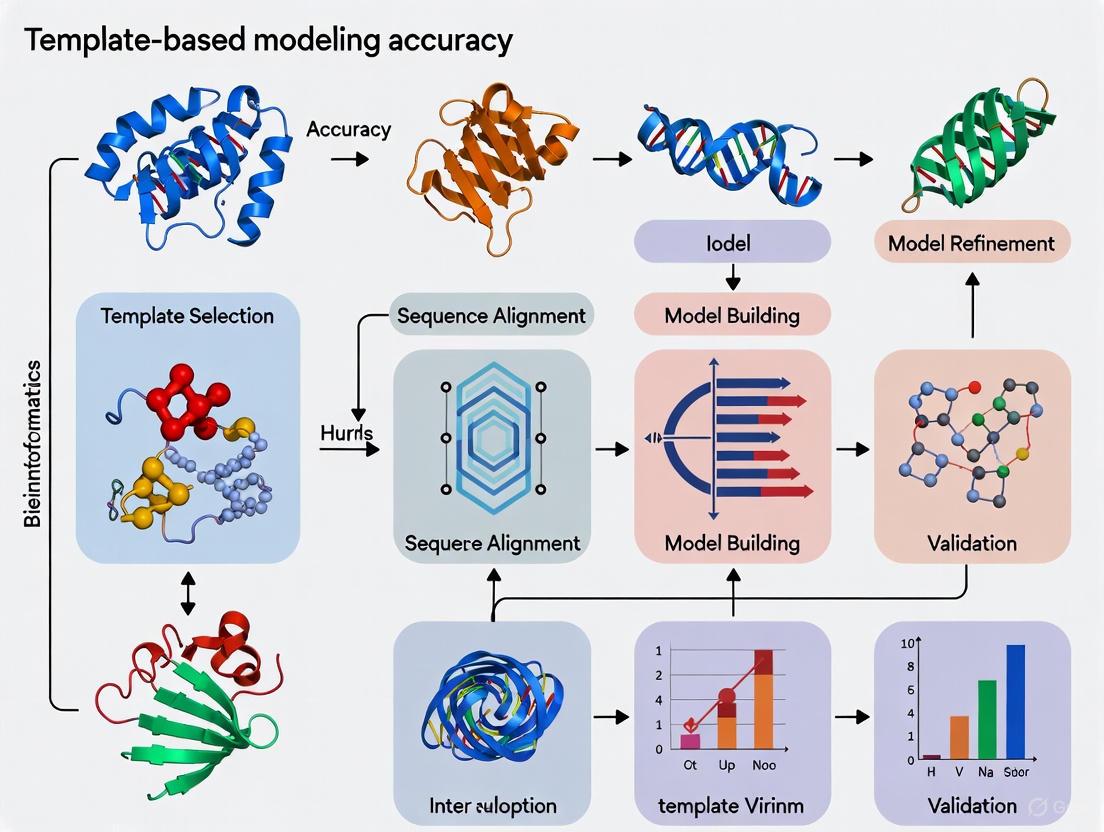
This article provides a comprehensive overview of template-based modeling (TBM) for protein structure prediction, detailing how its accuracy is achieved, measured, and optimized.
Template-Based Protein Modeling Accuracy: A Researcher's Guide to Principles, Methods, and Validation
Abstract
This article provides a comprehensive overview of template-based modeling (TBM) for protein structure prediction, detailing how its accuracy is achieved, measured, and optimized. Aimed at researchers and drug development professionals, it covers foundational principles, modern methodologies integrating deep learning, common challenges with troubleshooting strategies, and rigorous validation techniques. The content synthesizes the latest advancements, including the use of AlphaFold models as templates and novel approaches for complex structures, offering a practical guide for applying high-accuracy computational models in biomedical research.
The Core Principles: How Sequence and Structure Relationships Define Template-Based Modeling Accuracy
The fundamental hypothesis of template-based protein structure modeling (TBM), also known as homology modeling, posits that significant sequence similarity implies significant structural similarity [1]. This principle is rooted in the theory of evolution, which observes that protein structure is more conserved than amino acid sequence over time [1]. Consequently, if a detectable sequence relationship exists between a target protein of unknown structure and a template protein of known structure, the known structure can serve as a blueprint for modeling the target. Template-based modeling remains a cornerstone of structural bioinformatics, essential for functional characterization of proteins in basic research and drug development, particularly since experimentally determined structures are available for less than 1% of known protein sequences [1].
The Template-Based Modeling Paradigm
The Core Principle and Its Evolutionary Basis
The efficacy of TBM stems from the observation that the number of unique protein folds in nature is finite, and proteins from the same family share a common architectural framework [1]. A small change in the protein sequence typically results in a correspondingly small change in its three-dimensional structure [1]. This structural conservation enables the prediction of protein structures through comparative analysis, bridging the vast gap between the number of known sequences and experimentally determined structures. Currently, approximately 70% of all known protein sequences have at least one domain that is detectably related to a protein of known structure, making TBM a widely applicable technique [1].
The Standard Comparative Modeling Pipeline
The process of comparative modeling, a primary TBM method, consists of five sequential and critical steps [1]:
- Fold Recognition and Template Search: Identifying proteins with known 3D structures (in the Protein Data Bank, PDB) that are related to the target sequence.
- Template Selection: Choosing the most appropriate template structure(s) from the candidates identified.
- Target-Template Alignment: Precisely aligning the target sequence with the sequence of the selected template structure(s).
- Model Building: Constructing a 3D model for the target sequence based on its alignment with the template structure(s).
- Model Evaluation: Assessing the quality of the predicted model using various computational criteria.
While automated servers exist for this process, expert knowledge is often required for complex decisions, such as selecting biologically relevant templates, combining information from multiple templates, and refining alignments in difficult cases [1].
Methodologies and Experimental Protocols
This section details the core methodologies that operationalize the fundamental hypothesis, from initial sequence analysis to final model construction.
Template Search and Alignment Generation
The initial and often most critical step involves detecting remote homologs and generating accurate sequence-template alignments. Sensitivity in detecting remote homology has been greatly enhanced by moving beyond simple pairwise sequence comparison to methods that incorporate evolutionary information.
Table 1: Key Methods for Template Search and Fold Identification
| Method Category | Key Features | Example Tools |
|---|---|---|
| Profile-Based Methods | Constructs a position-specific scoring matrix (PSSM) from multiple sequence alignments to find conserved motifs. | PSI-BLAST [1] |
| Profile-Profile Alignment | Compares a pre-calculated profile of the target against a library of profiles for template structures. | COACH [1], FFAS03 [1] |
| Hidden Markov Models (HMM) | Uses probabilistic models to locate universally conserved motifs; often integrated with predicted secondary structure. | HMMER-based methods [1] |
| Machine Learning-Based Alignment | Employs deep learning models to learn complex relationships between sequence features and optimal structural alignments. | DRNF [2], NDThreader [2] |
Recent advances utilize deep learning to generate more accurate alignments. For instance, the DRNF (Deep Convolutional Residual Neural Fields) method integrates deep ResNet (Residual Neural Networks) with CRF (Conditional Random Fields) to capture context-specific information from sequential features like PSSM and predicted secondary structure, without initially using distance information [2]. The workflow for a machine-learning enhanced protocol can be visualized as follows:
Figure 1: Workflow for a machine learning-based sequence alignment protocol, illustrating the integration of training data and predictive models [3].
Model Building from Alignments
Once a target-template alignment is obtained, a 3D model of the target is built. This can be achieved through several approaches:
- Direct Modeling from Templates: Programs like MODELLER [1] satisfaction of spatial restraints derived from the template structure(s) to build the target model.
- Integrating Coevolution and Template Information: Advanced methods feed the sequence-template alignment along with sequence coevolution information into a deep ResNet to predict inter-residue distance distributions. This combined potential is then minimized using systems like PyRosetta to construct a 3D model that is not overly reliant on the template's exact coordinates [2].
Key Research Reagents and Software Toolkit
The experimental workflow in TBM relies on a suite of software tools and databases, which function as essential "research reagents" for computational structural biologists.
Table 2: Essential Research Reagents for Template-Based Modeling
| Reagent / Tool Name | Type | Primary Function in TBM |
|---|---|---|
| PSI-BLAST [3] [1] | Algorithm/Software | Generates a PSSM from the target sequence for sensitive homology detection. |
| TM-align [3] | Algorithm/Software | Generates structural alignments of protein domains to create training data or evaluate structural similarity. |
| SCOP40 Database [3] | Curated Database | Provides a non-redundant set of protein domains for training and benchmarking machine learning models. |
| UniRef90 Database [3] | Curated Database | A comprehensive sequence database used for building PSSMs during the profile generation step. |
| Phyre2.2 [4] | Web Portal | Identifies suitable templates from a library that includes AlphaFold models and builds 3D models for the target. |
| NDThreader [2] | Algorithm/Software | A deep-learning threader that uses DRNF and distance potentials for improved remote homology detection and alignment. |
| PyRosetta [2] | Software Suite | A Python-based interface to the Rosetta molecular modeling suite, used for energy minimization and 3D model construction. |
Quantitative Assessment of Method Accuracy
The accuracy of TBM is highly dependent on the quality of the target-template alignment, typically measured by sequence identity and alignment tools' performance.
The Impact of Sequence Identity
Model accuracy is correlated with the sequence identity between the target and template. While high sequence identity (>50%) often yields highly accurate models, the challenge lies in the "twilight zone" of low sequence identity (<30%), where detecting homology and generating correct alignments becomes difficult [1].
Performance of Advanced Machine Learning Methods
Recent deep learning methods have significantly improved alignment accuracy and template selection, especially for remote homologs. Quantitative evaluations demonstrate this progress.
Table 3: Alignment Accuracy of Deep Learning Methods vs. Established Tools [2]
| Method | Alignment Recall (0.45-0.55 TM-score) | Alignment Precision (0.45-0.55 TM-score) | Overall Performance |
|---|---|---|---|
| HHpred (local) | 0.382 | 0.386 | Baseline |
| CNFpred | 0.412 | 0.415 | Moderate improvement over HHpred |
| DRNF (Viterbi) | 0.459 | 0.462 | Significant improvement over baseline |
| DRNF (MaxAcc) | 0.481 | 0.484 | Best performance without distance information |
The relationship between different modeling components and their integration in a state-of-the-art deep TBM method can be summarized as:
Figure 2: Architecture of a deep template-based protein structure prediction method (e.g., NDThreader), showing the integration of sequential features and distance information [2].
Blind testing in the Critical Assessment of Protein Structure Prediction (CASP) experiments provides the gold standard for evaluating performance. In CASP14, the NDThreader method, which leverages deep learning for both alignment and model building, achieved the best average GDT score (a measure of model quality) among all participating servers on the 58 TBM targets, confirming the effectiveness of these advanced methodologies [2].
The fundamental hypothesis that sequence similarity implies structural conformation remains a powerful and validated principle in structural biology. The accuracy of template-based modeling is not a single factor but a chain of dependent components, beginning with sensitive remote homology detection and culminating in the construction of physically plausible models. The field is being transformed by machine learning, which enhances every step of the TBM pipeline. From using deep residual neural fields to generate superior alignments to integrating coevolutionary signals and template information for model building, these advances are pushing the boundaries of accuracy, particularly for proteins with only distant structural homologs. As these methodologies mature and are integrated into community resources like Phyre2.2, they will continue to expand the structural universe available to researchers, thereby accelerating discovery in basic science and rational drug design.
The accurate evaluation of protein structure models is a cornerstone of computational structural biology, directly impacting the development of prediction methods and their practical application in biomedical research. This whitepaper provides an in-depth technical examination of the key metrics—including RMSD, TM-score, and GDT—used to quantify the discrepancy between predicted and native structures. Framed within the context of template-based modeling (TBM) accuracy research, we synthesize findings from large-scale comparative studies to guide researchers and drug development professionals in selecting and interpreting these metrics. The analysis covers the fundamental principles, relative strengths, and weaknesses of each score, supported by quantitative data from community-wide assessments. Furthermore, we detail standard experimental protocols for benchmarking model accuracy and visualize the core concepts and workflows. As the field progresses towards predicting more complex structures like protein complexes, understanding these evaluation fundamentals remains critical for driving method innovation and ensuring the reliable application of models in downstream tasks.
The dramatic expansion of protein sequence databases, coupled with breakthroughs in deep learning-based structure prediction, has made accurate computational models more accessible than ever [5]. In template-based modeling (TBM), the reliability of a predicted 3D structure hinges on the quality of the target-to-template sequence alignment and the accuracy of the subsequent model building process [6]. Consequently, robust and standardized metrics for evaluating model quality are indispensable. These metrics serve two primary functions: first, they allow for the benchmarking and development of improved prediction methods during community-wide experiments like CASP (Critical Assessment of protein Structure Prediction); and second, they provide confidence estimates that guide biological interpretation and experimental design in fields like drug development [7] [8].
The problem of quantifying model quality is inherently multi-faceted. A single score cannot capture all nuances of a protein model's accuracy, as different metrics emphasize different structural aspects. Some focus on global fold correctness, while others probe the fidelity of local atomic interactions or specific stereochemical properties [7]. Therefore, a well-rounded assessment typically requires a combination of conceptually different measures. The choice of metric can influence the perceived performance of a modeling method and even guide its optimization trajectory. This review focuses on the core set of metrics most widely used for evaluating protein monomer and complex structures, explaining their theoretical basis, practical interpretation, and role in advancing the field of template-based modeling.
Core Accuracy Metrics: Definitions and Mathematical Foundations
Root-Mean-Square Deviation (RMSD)
Root-Mean-Square Deviation (RMSD) is one of the most traditional and widely recognized measures for comparing two protein structures. It is calculated as the root-mean-square of the distances between corresponding atoms (typically Cα atoms) after an optimal superposition of the two structures [7]. The formula for RMSD is:
[ \text{RMSD} = \sqrt{\frac{1}{N} \sum{i=1}^{N} \deltai^2} ]
Here, (N) is the number of equivalent atoms, and (\delta_i) is the distance between the (i)-th pair of atoms after superposition. A lower RMSD value indicates greater similarity, with 0 Å representing identical structures. However, RMSD lacks a fixed upper bound, making absolute interpretation difficult. Its value is also highly sensitive to large errors in a small number of residues and can be dominated by the worst-matched regions [7]. To facilitate comparison with other scores on a (0, 1] scale, RMSD is sometimes transformed using the equation: (\text{tRMSD} = 1/(1+(\text{RMSD}/10)^2)) [7].
Template Modeling Score (TM-score)
The Template Modeling Score (TM-score) was developed to address several limitations of RMSD, particularly its sensitivity to local errors and dependence on protein length [7]. TM-score is a superposition-based metric that measures the mean distance between corresponding Cα atoms, scaled by a length-dependent parameter. It is defined as:
[ \text{TM-score} = \max \left[ \frac{1}{L{\text{native}}} \sum{i}^{L{\text{align}}} \frac{1}{1 + \left( \frac{di}{d0(L{\text{native}})} \right)^2} \right] ]
In this equation, (L{\text{native}}) is the length of the native structure, (L{\text{align}}) is the number of aligned residues, (di) is the distance between the (i)-th pair of Cα atoms after superposition, and (d0) is a scale factor that normalizes the distance for a protein of that length [7]. Unlike RMSD, TM-score values fall within a (0, 1] range, where 1 signifies a perfect match. Empirically, a TM-score > 0.5 suggests a model with the correct global fold, while a TM-score < 0.17 indicates a random similarity [7]. Its length normalization makes it more suitable for comparing model quality across proteins of different sizes.
Global Distance Test (GDT) Score
The Global Distance Test (GDT) score is another superposition-based metric, widely used in CASP assessments. It measures the average percentage of Cα atoms in the model that can be superimposed under a series of distance thresholds [7]. The most common variants are:
- GDT-TS (Total Score): Uses thresholds of 1, 2, 4, and 8 Å.
- GDT-HA (High Accuracy): Uses more stringent thresholds of 0.5, 1, 2, and 4 Å.
The final score is the average of the percentages at these four thresholds. Formally, for a set of thresholds (d1, d2, ..., d_k):
[ \text{GDT} = \frac{1}{k} \sum{i=1}^{k} \max \left[ \frac{\text{Number of Cα atoms within } di \text{ Å}}{L_{\text{native}}} \right] ]
GDT-TS scores range from 0 to 100, with higher scores indicating better models. GDT-HA provides a more discriminating measure for high-accuracy models by focusing on tighter distance cutoffs [7].
Local Distance Difference Test (lDDT)
The Local Distance Difference Test (lDDT) is a superposition-free metric that evaluates the local consistency of a model. It is calculated by comparing all heavy-atom distances within a certain cutoff in the model to the corresponding distances in the native structure [7]. The score reports the fraction of conserved distances under multiple tolerance thresholds (typically 0.5, 1, 2, and 4 Å). Because lDDT does not require global superposition, it is more robust in assessing local accuracy, especially for models with domain movements or significant topological errors. AlphaFold2 popularized its predicted variant, pLDDT, as a highly reliable per-residue estimate of model confidence [5].
Table 1: Core Properties of Major Protein Structure Evaluation Metrics
| Metric | Score Range | What is Measured | Superposition Required? | Scope | Key Interpretation |
|---|---|---|---|---|---|
| RMSD | 0 to ∞ | Mean distance between corresponding atoms after superposition [7] | Yes [7] | Global [7] | Lower is better; 0 = perfect match. Sensitive to outliers. |
| TM-score | 0 to 1 | Mean distance between Cα atoms, scaled by protein length [7] | Yes [7] | Global [7] | >0.5 = correct fold; <0.17 = random similarity [7]. |
| GDT-TS | 0 to 100 | Average percentage of Cα atoms within four distance thresholds (1,2,4,8Å) [7] | Yes [7] | Global [7] | Higher is better. Robust to local errors. |
| lDDT | 0 to 1 | Fraction of conserved all-atom distances within a local environment [7] | No [7] | Local [7] | High values indicate good local geometry. |
Comparative Analysis and Benchmarking of Metrics
Relative Strengths, Weaknesses, and Score Distributions
Large-scale comparative analyses on diverse model sets from CASP experiments reveal that different metrics have distinct properties and are sensitive to different aspects of model quality. The empirical distribution of scores for a large set of models highlights these differences. For instance, RMSD (and its transformed version, tRMSD) often exhibits a bimodal distribution, separating clearly into populations of good and poor models. In contrast, the distribution of GDT-TS, TM-score, and to some extent lDDT, only hints at bimodality, while other scores like CAD-aa show a bell-shaped distribution in a narrow value range [7]. These inherent distribution differences preclude the direct comparison of raw values from different metrics. A common solution is to convert raw scores into Z-scores (normalized per target), which produces similarly distributed values that can be directly compared or combined [7].
The correspondence between scores is highly heterogeneous. Scatter plots of different score pairs show that while some metrics correlate well overall, their relationship can be non-linear and vary significantly across different quality regimes [7]. This underscores the importance of selecting a metric aligned with the specific assessment goal. A key desirable property of a metric is its ability to reward models with a higher fraction of accurately modeled residues without excessively penalizing for inaccurate regions, thus encouraging the construction of complete models [7]. TM-score and GDT generally exhibit this property better than RMSD.
Performance on Specific Structural Properties
The behavior of evaluation metrics varies when analyzing different structural aspects of models:
- Stereochemistry and Hydrogen Bonds: While most global metrics like TM-score and GDT are not designed to assess stereochemical quality, tools like MolProbity can be used alongside them for a comprehensive evaluation [7].
- Multidomain Proteins and Flexibility: A significant weakness of global superposition-based metrics like RMSD and TM-score is their poor performance on multidomain proteins with flexible linkers or domain movements. In such cases, a global superposition may force one domain to be well-aligned at the expense of others, unfairly penalizing the model. Local, superposition-free metrics like lDDT or domain-based evaluations are more appropriate for these scenarios [7].
- Protein Length and Secondary Structure: TM-score and GDT are explicitly designed to be independent of protein length. However, the performance of all metrics can be influenced by secondary structure content, with some being more sensitive to errors in helical regions versus strand regions [7].
Table 2: Metric Suitability for Different Assessment Goals in Template-Based Modeling
| Assessment Goal | Recommended Primary Metric(s) | Supporting Metric(s) | Rationale |
|---|---|---|---|
| Overall Global Fold Correctness | TM-score, GDT-TS [7] | lDDT | TM-score/GDT are length-normalized and robust to local errors; provide a clear fold cutoff. |
| High-Accuracy Model Discrimination | GDT-HA, lDDT [7] | CAD-score | Stringent distance thresholds and local accuracy measures highlight subtle differences. |
| Local Geometry & Residue Confidence | lDDT, pLDDT [5] | SphereGrinder [7] | Superposition-free, evaluates the local chemical environment and side-chain packing. |
| Models of Multidomain Proteins | lDDT (global and per-domain) [7] | Per-domain TM-score/GDT | Avoids errors introduced by forced global superposition on flexible systems. |
| Protein Complex (Dimer) Evaluation | Interface-specific scores (ipTM) [9] | DockQ [9] | Global scores can be misleading; interface-focused metrics better capture binding accuracy. |
The Evolution of Assessment for Protein Complexes
With the increasing focus on predicting protein-protein interactions and complexes, new challenges in assessment have emerged. For complexes, global monomeric scores like TM-score can be inadequate, as a good global score might mask critical errors at the binding interface [9]. Research shows that interface-specific scores are more reliable for evaluating protein complex predictions compared to their global counterparts [9]. For AlphaFold2/3-derived multimer models, the interface predicted TM-score (ipTM) is a key metric, often combined with the standard pTM (predicted TM-score) into a composite score. Benchmarking studies indicate that ipTM and model confidence achieve the best discrimination between correct and incorrect complex predictions [9]. This has led to the development of combined scores like C2Qscore, which integrates multiple signals to improve model quality assessment for complexes [9].
Experimental Protocols for Metric Benchmarking
Standardized Benchmarking Workflow
A rigorous protocol for benchmarking the performance of different accuracy metrics is essential for their validation and for guiding methodological improvements in TBM. The following workflow, derived from large-scale comparative studies, outlines the key steps:
- Dataset Curation: Assemble a large and diverse set of protein targets and corresponding models. A typical approach is to use data from multiple CASP experiments (e.g., CASP10-12), which includes single-domain targets, intact multidomain targets, and thousands of submitted models [7]. To focus on "predictable" targets, a subset of models scoring above a quality threshold (e.g., GDT-TS > 40) can be used.
- Metric Calculation: Compute all accuracy metrics (RMSD, TM-score, GDT-TS/HA, lDDT, etc.) for every model against its native reference structure. Ensure consistent parameters, such as using Cα atoms for all superposition-based metrics [7].
- Score Transformation and Normalization: Transform scores to a common scale if needed (e.g., converting RMSD to tRMSD) [7]. Calculate Z-scores for each metric on a per-target basis to enable fair cross-metric comparisons: ( Z = (X - μ)/σ ), where (X) is the raw score, and (μ) and (σ) are the mean and standard deviation of that score for all models of a specific target [7].
- Distribution and Correspondence Analysis: Analyze the empirical distributions of each score using histograms. Study the pairwise correspondence between scores using scatter plots to identify non-linear relationships and local densities [7].
- Correlation and Ranking Analysis: Calculate rank correlation coefficients (e.g., Spearman) between the ordered lists of models produced by different metrics. Check for agreement in selecting the "best" model for a given target [7].
- Structural Feature-Specific Analysis: Evaluate metric performance in the context of specific structural properties by:
This workflow ensures a comprehensive and unbiased comparison, revealing the relative strengths and weaknesses of each metric for different applications.
Visualization of the Metric Calculation Workflow
The following diagram illustrates the core process of calculating and analyzing key protein structure accuracy metrics.
Figure 1: Workflow for Calculating Key Protein Structure Accuracy Metrics. The process begins with a predicted model and a native reference structure. Metrics are calculated via two main branches: superposition-based (e.g., RMSD, TM-score, GDT) and superposition-free (e.g., lDDT). The results are compiled for final comparative analysis and model ranking.
Hierarchical Classification of Assessment Metrics
The landscape of protein structure assessment metrics can be categorized based on their underlying methodology and scope, as shown in the classification diagram below.
Figure 2: Hierarchical Classification of Protein Structure Assessment Metrics. Metrics are first divided by their requirement for structural superposition. Each branch is further classified by scope (global vs. local), indicating whether they evaluate the entire structure or specific regions.
Table 3: Key Software Tools and Resources for Protein Structure Evaluation
| Tool / Resource | Type | Primary Function | Relevance to TBM Accuracy |
|---|---|---|---|
| MolProbity [7] | Software Suite | Evaluates stereochemical quality (clashes, rotamers, Ramachandran) [7] | Validates the physical realism of a predicted model beyond global metrics. |
| HBplus [7] | Utility | Identifies hydrogen bonds in protein structures [7] | Assesses the accuracy of local polar interactions in a model. |
| DockQ [9] | Metric | Quality measure for protein-protein docking models [9] | Benchmarks the accuracy of predicted protein complex interfaces. |
| C2Qscore [9] | Composite Metric | Weighted combined score for complex quality [9] | Improves model quality assessment for protein complexes under realistic conditions. |
| Z-score [7] | Statistical Method | Normalizes a raw score relative to the distribution for a target [7] | Enables fair comparison of metric values across different protein targets. |
| Multi-Dimensional Scaling (MDS) [7] | Analysis Method | Visualizes dissimilarities between metric behaviors [7] | Reveals underlying relationships and groupings among different assessment scores. |
The accurate assessment of protein structure models is as critical as their prediction. This review has detailed the core metrics—RMSD, TM-score, GDT, and lDDT—that form the foundation of model evaluation in template-based modeling. Each metric offers a unique lens: RMSD provides a simple geometric measure, TM-score and GDT give length-normalized global assessments, and lDDT enables robust local accuracy evaluation. The choice of metric should be deliberate, guided by the specific assessment goal, whether it is determining global fold correctness, discriminating between high-accuracy models, or evaluating local interface quality in complexes.
Future directions in the field point towards several key areas. First, the development of integrated metrics and machine learning-based quality assessment methods that intelligently combine multiple signals will provide more reliable confidence estimates, especially for non-specialists. Second, as the prediction of protein complexes and assemblies becomes mainstream, specialized interface-focused metrics like ipTM and DockQ will see increased refinement and usage. Finally, bridging the gap between static structural accuracy and functional relevance remains a long-term challenge. As structural models become more integrated into drug discovery pipelines, the development of metrics that can predict the functional implications of subtle structural differences will be of immense value to researchers and drug development professionals.
The Critical Role of Multiple Sequence Alignments (MSA) in Detecting Remote Homologs
The accurate detection of remote homologs—proteins that are evolutionarily related but have diverged significantly in their amino acid sequences—represents a central challenge in computational biology. For decades, multiple sequence alignments (MSAs) have served as the foundational tool for this task, enabling researchers to infer evolutionary relationships that are invisible to simple pairwise sequence comparison methods. Within the framework of template-based modeling, the accuracy of the final predicted protein structure is critically dependent on the initial, sensitive detection of a suitable structural template through remote homology detection. When sequence identity falls below the "twilight zone" of 25-30%, traditional methods like BLAST fail, but the evolutionary information embedded within MSAs, particularly co-evolutionary signals, can still reveal deep homologies. This guide details the mechanisms by which MSAs enable the detection of these distant relationships, surveys the cutting-edge methods that leverage them, and provides a technical toolkit for researchers applying these techniques in drug development and functional annotation.
The Theoretical Foundation: How MSAs Uncover Remote Homology
From Sequence Conservation to Co-evolution
An MSA is a collection of protein sequences that are evolutionarily related to a target query sequence. The power of an MSA extends beyond merely identifying conserved residues. It captures patterns of co-evolution, where mutations at one position in a sequence are compensated by mutations at another position to maintain structural integrity or function. These correlated mutations, often measured by statistical methods, provide strong evidence for residues being in spatial proximity in the folded protein, a signature that persists long after the overall sequence similarity has faded.
The Link to Template-Based Modeling Accuracy
In template-based modeling (also known as homology modeling), the accuracy of the predicted 3D structure for a target protein is directly contingent on the identification of a suitable template—a protein with a known structure that is a true homolog. The process can be broken down into a logical dependency chain, illustrated in the diagram below.
As shown, the entire modeling pipeline rests on the sensitive initial steps of MSA construction and profile-based search. A failure in remote homology detection at this stage will propagate forward, leading to an incorrect or low-quality structural model.
Quantitative Benchmarks: Comparing Remote Homology Detection Methods
The performance of various methods is typically benchmarked on curated datasets like SCOP and CATH, which classify protein domains based on evolutionary and structural relationships.
Table 1: Performance Comparison of Remote Homology Detection Methods
| Method | Core Principle | Key Metric & Performance | Strength | Primary Application |
|---|---|---|---|---|
| Jumping Alignments [10] | Aligns candidate sequence to different sequences within a family MSA, allowing "jumps" between references. | Higher number of successful searches at moderate false-positive rates compared to early profiles and HMMs [10]. | Better balanced use of horizontal (sequence) and vertical (column) MSA information. | Early detection of remote homologs. |
| PSI-BLAST [1] | Iterative search building a position-specific scoring matrix (PSSM) from an MSA. | Sensitive detection of homologs with sequence identity <25% [1]. | Fast, widely available, and a significant improvement over BLAST. | Building sequence profiles for fold detection. |
| Profile HMMs [1] | Statistical models of the MSA that capture position-specific probabilities of amino acids and indels. | More sensitive detection of conserved motifs and remote homologs than simple profiles [1]. | Robust handling of insertions and deletions. | Protein family classification and remote homology detection. |
| TM-Vec [11] | Deep learning (twin neural network) trained to predict structural TM-scores directly from sequence pairs. | Strong correlation (r=0.97) with TM-align scores; effective even at <0.1% sequence identity [11]. | Ultra-fast, scalable search for structural similarity without 3D structure prediction. | Large-scale structural similarity search in sequence databases. |
Table 2: Advanced Deep Learning Methods Integrating MSAs and Structural Prediction
| Method | Core Innovation | Quantified Improvement | Key Advantage |
|---|---|---|---|
| DeepSCFold [12] | Uses sequence-derived structural similarity (pSS-score) and interaction probability (pIA-score) to build paired MSAs for complexes. | 11.6% and 10.3% TM-score improvement on CASP15 multimers vs. AlphaFold-Multimer & AlphaFold3 [12]. | Captures structural complementarity for complexes lacking clear co-evolution. |
| AFcluster-Multimer [13] | Applies MSA clustering to guide AF-Multimer in predicting multiple conformational states of proteins and complexes. | Accurately predicts active/inactive states of GPCRs (e.g., CXCR4) and oligomeric states of metamorphic proteins [13]. | Reveals conformational landscapes and ligand-binding effects. |
Experimental Protocols: Methodologies for Modern Remote Homology Detection
Protocol 1: Building a Deep Learning Model for Structure-Aware Search (TM-Vec)
This protocol outlines the steps for training a model like TM-Vec to predict structural similarity from sequences alone [11].
- Data Curation: Assemble a large training set of pairs of protein sequences with known 3D structures. Sources include the PDB, SWISS-MODEL, and CATH.
- Ground Truth Calculation: For each protein pair in the training set, compute the true TM-score using a structural alignment tool like TM-align. The TM-score is a measure of structural similarity, where 1.0 indicates perfect match and scores >0.5 suggest generally the same fold.
- Model Architecture: Implement a twin neural network architecture. This consists of two identical sub-networks (often based on protein language models like ESM) that each process one of the input sequences.
- Training Objective: Train the network to minimize the difference between its predicted TM-score and the true TM-score calculated in Step 2. The model learns to produce vector embeddings for individual proteins such that the cosine distance between two protein vectors approximates their structural TM-score.
- Database Creation and Querying:
- Encoding: Process a large database of protein sequences (e.g., from metagenomics) using the trained TM-Vec model to generate a database of structure-aware vector embeddings.
- Indexing: Create a search index (e.g., using k-nearest neighbors or hierarchical navigable small world graphs) for the vector database to enable efficient sublinear time searching.
- Query: For a new query sequence, encode it with TM-Vec and rapidly retrieve its nearest neighbors from the indexed database as candidate structural homologs.
Protocol 2: Enhancing Complex Prediction with Structure-Complementary MSAs (DeepSCFold)
This protocol describes how DeepSCFold improves protein complex structure prediction by constructing better paired MSAs [12].
- Input and Monomeric MSA Generation: Start with the sequences of the protein complex subunits. Individually, generate deep monomeric MSAs for each subunit by searching large sequence databases (UniRef30, UniRef90, BFD, MGnify, etc.) using tools like MMseqs2 or Jackhmmer.
- Structural Similarity and Interaction Scoring:
- pSS-score Prediction: For each sequence in a monomeric MSA, use a deep learning model to predict a protein-protein structural similarity score (pSS-score) against the original subunit query. This provides a structure-aware metric beyond simple sequence identity for ranking homologs.
- pIA-score Prediction: For every possible pair of sequences taken from the MSAs of two different subunits, use another deep learning model to predict an interaction probability score (pIA-score) based solely on their sequence features.
- Paired MSA (pMSA) Construction:
- Use the pSS-scores to select high-quality, structurally relevant homologs from each monomeric MSA.
- Use the pIA-scores as a primary guide to systematically concatenate these selected monomeric sequences into paired sequences, creating a deep paired MSA. Supplement this with pairing based on multi-source biological information (species, UniProt accessions).
- Complex Structure Prediction: Feed the resulting series of high-quality pMSAs into a complex structure prediction system like AlphaFold-Multimer to generate quaternary structure models.
- Model Selection and Refinement: Employ a quality assessment method (e.g., DeepUMQA-X in DeepSCFold) to select the top model. This model can be used as an input template for a final iteration of prediction to generate the refined output structure.
Table 3: Key Resources for MSA Construction and Remote Homology Detection
| Resource Name | Type | Primary Function in Remote Homology |
|---|---|---|
| UniRef90/UniRef30 [12] | Sequence Database | Clustered sets of protein sequences used to generate deep, non-redundant MSAs. |
| BFD / Metaclust [12] | Sequence Database | Large metagenomics databases providing a vast source of diverse sequences for MSA construction. |
| MMseqs2 [13] | Software Tool | Fast and sensitive profile-based sequence search tool for constructing MSAs and profiling. |
| Jackhmmer [1] | Software Tool | Iterative profile HMM search tool for building sensitive MSAs from sequence databases. |
| HH-suite [1] | Software Tool | Suite for HMM-HMM comparison, a highly sensitive method for detecting remote homology. |
| PDB (Protein Data Bank) [1] | Structure Database | Repository of experimentally determined protein structures; the source of templates for modeling. |
| SCOP / CATH [11] | Structure Database | Curated databases that classify protein domains by evolutionary and structural relationships; used for benchmarking. |
| AlphaFold-Multimer [12] | Software Tool | Deep learning system for predicting protein complex structures from sequences and (paired) MSAs. |
| ColabFold [13] | Software Tool | Accessible and efficient implementation of AlphaFold2 and AlphaFold-Multimer, integrating MSA generation. |
The role of Multiple Sequence Alignments in detecting remote homologs has evolved from a simple tool for identifying conserved residues to a sophisticated source of evolutionary and structural information for deep learning models. As the field progresses, the integration of MSAs with protein language models and geometric learning systems is pushing the boundaries of what is predictable. The ability to accurately detect remote homology directly enables the high-accuracy template-based modeling that is crucial for inferring protein function in drug discovery and for interpreting the vast amount of data generated by modern genomics and metagenomics. The continued development of methods that extract ever more subtle signals from MSAs, or that learn the implicit information they contain, promises to further close the gap between known protein sequences and their structural and functional annotations.
The accuracy of template-based modeling (TBM) is fundamentally tied to the completeness and quality of the underlying template libraries. For decades, experimental structures from the Protein Data Bank (PDB) served as the sole source of structural templates, with researchers demonstrating that the folding problem could essentially be solved for single-domain proteins by identifying suitable PDB representatives [14]. The paradigm shifted with the introduction of AlphaFold 2 (AF2) in 2020, an artificial intelligence (AI) system that predicts protein structures with accuracy comparable to experimental methods [15]. The subsequent release of a database containing over 200 million AF2 predictions effectively provided a universal template library, revolutionizing the field of structural biology and drug discovery [15] [16]. This whitepaper delineates the core components of these libraries, details experimental methodologies for their evaluation, and visualizes the integrated workflows that define modern TBM.
Core Components of a Template Library
Traditional PDB-Based Template Libraries
The classical approach to TBM relies on a curated set of experimental structures from the PDB. The foundational principle is that the natural repertoire of protein folds is finite, and thus, a sufficiently diverse set of known structures can serve as templates for modeling most new sequences [14].
Key Quantitative Findings from PDB-Based TBM: A 2005 study systematically evaluated the coverage of the PDB library for medium-sized, single-domain proteins. The key results are summarized in the table below.
Table 1: Benchmarking the Completeness of the PDB Template Library (2005) [14]
| Metric | Average Performance | Context and Implications |
|---|---|---|
| Template Identification | Similar folds found for all targets (1,489 protein benchmark set) | Templates identified via structure alignment, excluding homologous proteins. |
| Average RMSD to Native | 2.5 Å | Measured on aligned regions, indicating high structural similarity. |
| Alignment Coverage | ~82% | Proportion of the target sequence that could be aligned to the template. |
| Full-Length Model RMSD | 2.25 Å (average); < 6 Å for 99.9% of targets | After using the TASSER algorithm for fragment assembly and refinement. |
| Aligned Region Improvement | Improved from 2.5 Å to 1.88 Å | Demonstrated the value of refinement protocols post-template identification. |
The AI Revolution: AlphaFold-Generated Template Libraries
AlphaFold 2 transformed the concept of a template library from a curated set of experimental data to a virtually complete, predictive compendium.
Key Characteristics of the AlphaFold Library:
- Scale: The AlphaFold Protein Database (AFDB) contains predictions for over 200 million proteins, covering nearly the entire known protein universe [15] [16].
- Accessibility: As of 2025, the database has been accessed by over 3.3 million researchers in more than 190 countries, dramatically lowering the barrier to entry for structural biology [15] [16].
- Impact on Research: Use of AlphaFold is associated with a ~50% increase in the submission of novel experimental structures to the PDB. Research incorporating AlphaFold is twice as likely to be cited in clinical articles and patents [16].
Experimental Protocols for Benchmarking Template Libraries and TBM Accuracy
Rigorous benchmarking is essential to quantify the accuracy and limitations of any TBM approach. The following protocols are adapted from established methodologies in the field.
Protocol 1: Benchmarking Template Library Completeness
This protocol assesses whether a template library contains structurally similar representatives for a given set of target proteins.
- Curate a Benchmark Set: Assemble a diverse set of protein structures with known native conformations. The set should cover the structural space of interest (e.g., single-domain, multi-domain, membrane proteins) and should exclude proteins with high sequence similarity to prevent bias [14].
- Identify Templates: For each target, perform a structure-based alignment (e.g., using TM-score) against every protein in the template library. The goal is to find the best structural match, independent of sequence homology.
- Quantify Performance: For the top-matched template for each target, calculate:
- Root Mean Square Deviation (RMSD): Measures the average distance between corresponding atoms in the superimposed structures. An RMSD < 2 Å is generally considered a successful prediction [17].
- Template Modeling Score (TM-score): A more robust metric that is less sensitive to local errors than RMSD. A TM-score > 0.5 indicates a model of correct topology.
- Alignment Coverage: The percentage of the target sequence that can be aligned to the template structure.
Protocol 2: Evaluating Full-Length Model Accuracy
This protocol tests the end-to-end performance of a TBM pipeline, from sequence to final 3D model.
- Template Selection and Alignment: For a given target sequence, identify the best template(s) from the library using sequence- and/or structure-based search methods. Generate a sequence-structure alignment.
- Model Construction: Build a 3D model based on the alignment. This can involve simple copy-and-paste of conserved regions or more sophisticated fragment assembly methods under the guidance of a force field, as done by the TASSER algorithm [14].
- Model Refinement: Apply energy minimization or molecular dynamics to correct steric clashes and improve local geometry.
- Final Model Validation: Calculate the RMSD and TM-score between the final full-length model and the experimentally determined native structure.
Protocol 3: Virtual Screening for Drug Discovery
TBM is critical for structure-based drug design when experimental structures are unavailable. This protocol benchmarks the utility of predicted models in virtual screening.
- Prepare Protein Targets: Use AI-predicted or experimental structures of the target protein (e.g., COX-1 and COX-2 enzymes) [17].
- Prepare Ligand Libraries: Curate a database of known active compounds and decoy molecules (inactive but physically similar compounds).
- Perform Molecular Docking: Use docking programs (e.g., Glide, AutoDock, GOLD) to predict the binding pose and affinity of every ligand in the library against the protein target.
- Evaluate Performance via ROC Analysis:
- Calculate the Enrichment Factor: The rate at which active compounds are found early in the ranked list compared to a random selection.
- Generate a Receiver Operating Characteristic (ROC) curve: A plot of the True Positive Rate (sensitivity) against the False Positive Rate (1-specificity) across all ranking thresholds.
- Calculate the Area Under the Curve (AUC): A value of 1.0 represents perfect separation of actives from decoys, while 0.5 represents no enrichment. A study on COX enzymes found AUCs ranging from 0.61 to 0.92 for different docking programs, with Glide showing superior performance [17].
Visualization of Workflows and Analysis
The following diagrams, generated using Graphviz DOT language, illustrate the core workflows for traditional and AI-enhanced template-based modeling.
Workflow for Traditional PDB-Based Modeling
Workflow for AI Model Analysis and Selection
With the advent of AI predictors, the workflow has shifted from template search to multi-model analysis and selection, as facilitated by tools like the FoldScript web server [18].
The Scientist's Toolkit: Essential Research Reagents and Solutions
This section details key computational tools and databases that constitute the modern toolkit for working with structural template libraries.
Table 2: Key Resources for Template-Based Modeling Research
| Resource Name | Type | Primary Function | Relevance to TBM |
|---|---|---|---|
| Protein Data Bank (PDB) | Database | Repository for experimentally determined 3D structures of proteins and nucleic acids. | The original source of high-quality structural templates for classical TBM. |
| AlphaFold Protein Database | Database | Open-access database of over 200 million protein structure predictions generated by AlphaFold [15] [16]. | Serves as a near-universal template library; provides a reliable starting model for most proteins. |
| FoldScript | Web Server | Automated analysis and comparison of multiple AI-generated 3D protein models [18]. | A decision-support tool for selecting the most accurate model from a set of AI predictions, crucial for reliable TBM. |
| Glide | Software Module | Molecular docking program for predicting ligand binding modes and affinities. | Used in virtual screening protocols to validate the utility of a template structure for drug discovery [17]. |
| TASSER | Algorithm | Protein structure prediction method that assembles models from continuous fragments excised from templates [14]. | Exemplifies a sophisticated TBM method that goes beyond simple copying to improve model accuracy (e.g., refining aligned regions from 2.5 Å to 1.88 Å). |
| TM-score | Metric | Metric for assessing the topological similarity of two protein structures. | More reliable than RMSD for assessing global fold correctness, especially for proteins with conformational flexibility. |
The definition of a template library has expanded from a curated set of PDB representatives to a comprehensive, AI-generated structural map of the protein world. The accuracy of template-based modeling is no longer limited by template availability but by the sophisticated selection, integration, and refinement of these predictive models. As evidenced by the dramatic acceleration in biological discovery and drug design, the combination of universal template libraries like the AFDB and powerful analysis tools like FoldScript has firmly established TBM as a cornerstone of modern computational biology. Future advances will likely focus on improving the modeling of complexes and interactions, further closing the gap between prediction and experimental reality.
Modern TBM Workflows: From Template Selection to High-Accuracy Model Building
The accurate prediction of protein three-dimensional (3D) structure from amino acid sequence has been a central challenge in computational biology for decades. Traditional approaches have largely relied on template-based modeling (TBM), also known as homology modeling, which operates on the principle that proteins with similar sequences adopt similar structures. This methodology requires identifying a known structure (template) with significant sequence similarity to the query protein and using it as a scaffold for building a structural model. For years, servers like Phyre2 and SWISS-MODEL have been community cornerstones, providing reliable protein structure predictions based on this principle. However, the revolutionary emergence of AlphaFold and subsequent deep learning systems has fundamentally transformed the field, shifting the paradigm from template-based modeling to template-free modeling (TFM) powered by artificial intelligence. These AI-driven systems now demonstrate accuracy competitive with experimental methods in many cases, creating a new ecosystem where traditional and modern tools converge [5] [19].
This transition is particularly evident in the evolution of portals like Phyre2.2, which now integrate AlphaFold database predictions as potential templates, effectively bridging historical and contemporary approaches. The core thesis of this evolution centers on how template-based modeling accuracy has been redefined—from depending on identifiable sequence homology to leveraging deep learning models trained on the entire corpus of known protein structures. This technical guide examines the core methodologies, accuracy benchmarks, and practical protocols that define this transition, providing researchers and drug development professionals with a comprehensive framework for navigating the modern structural prediction landscape.
Fundamental Methodologies and Evolutionary Pathways
Traditional Template-Based Modeling (TBM) Servers
Traditional TBM approaches operate on a well-established pipeline that leverages evolutionary relationships between proteins.
SWISS-MODEL employs a rigorous workflow beginning with template identification through sequence similarity searches against the Protein Data Bank (PDB). Following template selection, target-template alignment builds the foundation for model construction, where the query sequence is mapped onto the template's 3D coordinates. The final stage involves model quality assessment using scoring functions like QMEANDisCo, which evaluates the geometric plausibility of the predicted structure. SWISS-MODEL is particularly effective when high-quality templates with sequence identity above 30% are available, but its performance diminishes significantly for distant homologs or novel folds [20] [19].
Phyre2 (Protein Homology/analogY Recognition Engine) utilizes advanced profile-based methods and hidden Markov models to detect distant homologs that might be missed by simple sequence searches. Its intensive mode can force modeling of complete proteins through multiple template modeling, using several model structures based on local sequence homologies when a single suitable template is not available. A key innovation in Phyre2.2 is its expanded template library, which now includes a representative structure for every protein sequence in the PDB, including distinct apo and holo forms when available. Crucially, Phyre2.2 can now identify and utilize AlphaFold model predictions as templates, creating a direct bridge between traditional homology modeling and AI-based approaches [21] [22].
AI-Driven Template-Free Modeling (TFM) Systems
AlphaFold2 represented a watershed moment in protein structure prediction through its novel end-to-end deep learning architecture. The system integrates two key components: the Evoformer module and the structure module. The Evoformer employs a novel neural network block to process multiple sequence alignments (MSAs) and generate a pair representation that encapsulates evolutionary coupled residues. The structure module then translates these representations into precise 3D atomic coordinates through an SE(3)-equivariant transformer that explicitly reasons about geometric constraints and physical interactions. A critical innovation is the recycling mechanism, where outputs are recursively fed back into the network for iterative refinement, significantly enhancing accuracy [5].
AlphaFold-Multimer extended this capability to protein complexes, addressing the additional challenge of accurately modeling inter-chain interactions. While building on the AlphaFold2 architecture, it introduced specialized training on protein complex structures and modified MSA pairing strategies to capture interface interactions. Despite these advances, accurately predicting transient or flexible complexes remains challenging [12].
AlphaFold3 represents the latest evolution, expanding predictive capability beyond proteins to include nucleic acids, ligands, and modified residues. This generalizes the structural biology prediction problem to encompass the full molecular complexity of cellular machinery [23].
The Integration Pathway: Hybrid Approaches
The distinction between TBM and TFM has blurred with the emergence of integrated approaches. Phyre2.2 exemplifies this transition by incorporating AlphaFold database predictions into its template selection process, effectively using AI-generated structures as homology templates. This hybrid approach leverages the strengths of both methodologies: the rapid template-based modeling framework and the comprehensive coverage of AI-predicted structures [21] [22].
Advanced systems like DeepSCFold further demonstrate this integration by using sequence-based deep learning to predict protein-protein structural complementarity and interaction probability, which then informs the construction of deep paired multiple sequence alignments for complex structure prediction. This approach has demonstrated significant improvements, achieving 11.6% and 10.3% improvement in TM-score compared to AlphaFold-Multimer and AlphaFold3, respectively, on CASP15 multimer targets [12].
Quantitative Accuracy Assessment and Benchmarking
Performance Metrics and Comparative Analysis
The accuracy of protein structure prediction tools is quantitatively assessed using standardized metrics that evaluate different aspects of structural similarity. The Global Distance Test (GDT_TS) measures overall fold similarity, while the Template Modeling Score (TM-score) provides a more holistic measure of global topology. For local quality assessment, the local Distance Difference Test (lDDT) and predicted lDDT (pLDDT) evaluate local geometric plausibility without requiring global superposition. In protein complex prediction, the Interface Contact Score (ICS or F1) specifically quantifies accuracy at binding interfaces [12] [24].
Table 1: Comparative Accuracy of Protein Monomer Prediction Tools
| Tool | Methodology | Average GDT_TS | Ideal Use Case | Limitations |
|---|---|---|---|---|
| SWISS-MODEL | Traditional TBM | >80 (with good template) | High-homology modeling | Fails without clear templates |
| Phyre2.2 | Enhanced TBM | Variable (template-dependent) | Distant homology detection | Inconsistent for full-length models |
| AlphaFold2 | Deep Learning TFM | >90 (2/3 of cases) | Novel folds, high accuracy | Computationally intensive |
| AlphaFold3 | Expanded TFM | High (proteins, DNA, ligands) | Complex molecular assemblies | Server access only |
Data from CASP assessments demonstrates that AlphaFold2 regularly predicts protein structures with atomic accuracy, achieving a median backbone accuracy of 0.96 Å RMSD₉₅ in CASP14, vastly outperforming other contemporary methods which had median accuracy of 2.8 Å RMSD₉₅ [5] [24]. This accuracy extends to side-chain modeling, with all-atom accuracy of 1.5 Å RMSD₉₅ compared to 3.5 Å RMSD₉₅ for the next best method.
Table 2: Performance on Protein Complex Prediction (CASP15 Benchmark)
| Method | TM-score Improvement | Interface Contact Score (F1) | Key Innovation |
|---|---|---|---|
| AlphaFold-Multimer | Baseline | 0.712 | Specialized training on complexes |
| AlphaFold3 | +10.3% | 0.784 | Expanded biomolecular scope |
| DeepSCFold | +11.6% | 0.829 | Sequence-derived structure complementarity |
| Yang-Multimer | +8.7% | 0.761 | Enhanced MSA construction |
For challenging targets like antibody-antigen complexes from the SAbDab database, DeepSCFold demonstrates particularly strong performance, enhancing the prediction success rate for binding interfaces by 24.7% and 12.4% over AlphaFold-Multimer and AlphaFold3, respectively [12].
Case Study: HTLV-1 Tax Protein
A revealing case study comes from attempts to predict the structure of the HTLV-1 Tax protein, a viral oncoprotein with significant therapeutic interest but no experimentally determined full-length structure. When subjected to various prediction methods, the results highlight the current limitations and strengths of different approaches:
- SWISS-MODEL produced only a partial model (41 residues) with low confidence (QMEANDisCo = 0.31)
- Phyre2 in default mode modeled 60 residues (QMEANDisCo = 0.35), while intensive mode generated a full-length but low-confidence model (QMEANDisCo = 0.27)
- I-TASSER produced a complete model but with mediocre confidence (QMEANDisCo = 0.35)
- AlphaFold2 generated a complete model with higher overall confidence but with variable pLDDT scores across different domains [20]
This case illustrates that despite dramatic advances, challenging targets with unique sequence features or flexible regions still present difficulties for all prediction methods, and consensus approaches with careful quality assessment remain essential.
Experimental Protocols and Workflows
Protocol for Template-Based Modeling with Phyre2.2
Sequence Submission: Input the target protein sequence via the Phyre2.2 web portal. Sequences can be provided as raw amino acid sequences, in FASTA format, or via UniProt accession numbers.
Template Selection Strategy: Phyre2.2 searches its comprehensive template library, which includes both experimental structures from the PDB and AlphaFold database predictions. The system employs a new ranking algorithm that highlights models for different domains within the query sequence.
Model Building: The server aligns the target sequence with selected templates and builds a 3D model through spatial restraint satisfaction and energy minimization.
Quality Assessment: Evaluate model quality using built-in metrics and the QMEANDisCo score. Models with scores above 0.7 are generally considered reliable, while those below 0.5 should be interpreted with caution [21] [20].
Protocol for Deep Learning-Based Prediction with AlphaFold
Input Preparation: Collect the amino acid sequence(s) of the target protein or complex. For multimeric predictions, specify chain boundaries and stoichiometry.
Multiple Sequence Alignment Generation: Search large sequence databases (UniRef, MGnify, BFD) to generate deep multiple sequence alignments that capture evolutionary constraints.
Structure Prediction: Execute the AlphaFold neural network, which processes the MSAs through the Evoformer to generate pair representations, then through the structure module to produce 3D coordinates.
Model Selection and Validation: Review the predicted pLDDT confidence scores for each residue. Blue regions (pLDDT > 90) indicate high confidence, while orange/red regions (pLDDT < 70) suggest lower reliability and potentially disordered regions [5] [23].
Protocol for Complex Structure Prediction with DeepSCFold
Monomeric MSA Construction: Generate individual MSAs for each subunit from multiple sequence databases (UniRef30, UniRef90, UniProt, Metaclust, BFD, MGnify, ColabFold DB).
Structure Complementarity Assessment: Use deep learning models to predict protein-protein structural similarity (pSS-score) and interaction probability (pIA-score) purely from sequence information.
Paired MSA Construction: Systematically concatenate monomeric homologs using predicted interaction probabilities and multi-source biological information (species annotations, UniProt accessions, experimental complexes).
Iterative Structure Prediction: Feed paired MSAs through AlphaFold-Multimer, select the top model using quality assessment methods like DeepUMQA-X, and use this as an input template for a final prediction iteration [12].
Workflow for Modern Integrated Structure Prediction
Table 3: Key Research Reagent Solutions for Protein Structure Prediction
| Resource | Type | Function | Access |
|---|---|---|---|
| AlphaFold DB | Database | >200 million pre-computed structures | Public |
| PDB | Database | Experimental protein structures | Public |
| UniProt | Database | Protein sequence and functional information | Public |
| ColabFold | Server | Automated MSA generation and AF2 prediction | Public |
| DeepSCFold | Algorithm | Protein complex prediction via structure complementarity | Research |
| pLDDT | Metric | Per-residue confidence estimate for predictions | Calculation |
| QMEANDisCo | Metric | Global and local model quality assessment | Calculation |
| AlphaFill | Tool | Ligand and cofactor transplantation into AF models | Public |
The evolution from Phyre2.2 and SWISS-MODEL to AlphaFold-integrated portals represents a fundamental transformation in how researchers approach protein structure prediction. While template-based modeling remains valuable for its speed and interpretability, the integration of AI-generated structures has dramatically expanded the scope and accuracy of computational structural biology. The key advancement in template-based modeling accuracy research has been the recognition that "templates" need not be limited to experimentally solved structures but can include AI-predicted models with demonstrated high accuracy.
Future developments will likely focus on several key areas: improved prediction of flexible and disordered regions, more accurate modeling of protein-ligand interactions for drug discovery, enhanced capabilities for large complexes and cellular machinery, and real-time dynamic simulation of structural transitions. As these tools become more sophisticated and accessible, they will continue to transform biological research and therapeutic development, bringing us closer to a comprehensive understanding of the relationship between protein sequence, structure, and function.
Evolutionary Timeline of Protein Structure Prediction Tools
In template-based modeling (TBM), the accuracy of a predicted protein structure is fundamentally constrained by the identification of a suitable structural template. This process hinges on two pivotal and often competing parameters: sequence identity and template coverage. Sequence identity provides a primary measure of evolutionary relatedness, while coverage ensures that a sufficient portion of the target protein can be modeled. Striking an optimal balance between these factors is a non-trivial task, particularly in the "twilight zone" of sequence similarity (10%-30% identity), where sequence signals are weak but structural relationships may still persist [25]. This guide examines the core principles and modern methodologies for template identification, framing them within the broader thesis of how strategic template selection directly dictates the upper bounds of modeling accuracy in structural biology and drug development.
The Foundational Relationship Between Sequence Identity, Coverage, and Model Accuracy
Quantitative Benchmarks in the Twilight Zone
Extensive benchmarking has quantified the complex relationship between sequence identity, structural similarity, and the success rates of detection algorithms. The data reveal that in the 10%-30% sequence identity range, the percentage of structurally similar protein pairs—true positives—varies significantly based on the search algorithm and E-value threshold used [25].
Table 1: Detection of Structurally Related Proteins in the 10%-30% Sequence Identity Range
| Search Algorithm | E-value | Number of Pairs | Structurally Similar (%) | Structurally Dissimilar (%) | Average Identity Rate (%) |
|---|---|---|---|---|---|
| BLAST | 10 | 765 | 93.6% | 6.4% | 23.9% |
| BLAST | 1000 | 1316 | 66.0% | 34.0% | 22.4% |
| FASTA | 10 | 852 | 58.1% | 41.9% | 22.1% |
| FASTA | 100 | 2634 | 25.1% | 74.9% | 20.3% |
| SSEARCH | 10 | 1115 | 53.5% | 46.5% | 21.5% |
| SSEARCH | 100 | 4097 | 20.1% | 79.9% | 19.8% |
As shown in Table 1, BLAST with a stringent E-value of 10 maintains a high success rate (93.6%) in this identity range, but at the cost of sensitivity, as it retrieves far fewer total pairs. Relaxing the E-value to 1000 increases the number of potential templates by ~72%, but more than a third (34%) are structurally dissimilar, highlighting the risk of incorporating false positives [25].
Secondary Structure Similarity as a Discriminatory Metric
When sequence identity falls below 30%, comparing protein secondary structures provides a more reliable indicator of structural relatedness because protein folds are evolutionarily more conserved than their sequences [25]. The Structural Overlap (Sov) parameter is used to measure the agreement between secondary structure elements.
A Sov value threshold of >50% can effectively distinguish between related and unrelated protein sequences, achieving a recognition rate of up to 93% for true positives even when sequence identity is below 20% [25]. This approach allows researchers to "rescue" potential templates identified by BLAST, FASTA, or SSEARCH in the noisy region with high E-values, thereby expanding the pool of usable templates for distant homologs.
The Critical Role of Template Coverage
Template coverage—the proportion of the target protein's residues that can be aligned to a template—is a direct determinant of model completeness. A template with high sequence identity but low coverage will yield an incomplete model, leaving structurally uncharacterized regions. Modern TBM systems therefore employ sophisticated template weighting schemes to select and combine multiple complementary templates [26].
Table 2: A Multi-Parameter Template Weighting Scheme
| Weighting Parameter | Description | Impact on Modeling |
|---|---|---|
| Average TM-score | Structural consistency of a template with other selected templates. | Reduces structural noise; high scores indicate a consensus fold. |
| Template Coverage | Ratio of target residues covered by the template. | Maximizes the number of modeled residues; improves model completeness. |
| Sequence Identity | Ratio of identical residues in the target-template alignment. | Higher identity correlates with higher local coordinate accuracy. |
| Sequence Similarity | Biochemical similarity of aligned residues (e.g., using BLOSUM62). | Accounts for conservative substitutions that preserve structure. |
| E- e-value | Significance of the sequence alignment score. | Prioritizes templates with statistically significant homology. |
The final template weight is the sum of these five normalized terms. The template with the highest weight is selected first, and additional templates are chosen if they cover at least 10 continuous, uncovered target residues or are structurally consistent (TM-score > 0.7) with the top template [26]. This strategy effectively increases coverage while minimizing structural variance.
Modern Methodologies and Experimental Protocols
Structure-Based Template Detection: Full vs. Interface Alignment
For modeling protein complexes (comparative docking), template detection can be performed via two primary structure alignment protocols:
- Full-Structure Alignment: The entire structure of the target monomer is aligned to the full structure of a template complex.
- Interface Alignment: The target monomer is aligned only to the interface region of a template complex.
Benchmarking on 223 protein complexes revealed that both protocols perform similarly, with a top-1 docking success rate of 26% for bound structures. However, interface-based docking produces models with marginally better quality at the interface [27]. This method is particularly advantageous when predicting significant conformational changes upon binding, such as domain rearrangements in multidomain proteins. If the same template is selected as the top hit by both full and interface alignment, the docking success rate doubles, providing a robust consensus for template selection [27].
Integrating Deep Learning and Sequence-Derived Structural Features
The latest advancements move beyond pure sequence or co-evolutionary signals. Tools like DeepSCFold leverage deep learning to predict protein-protein structural similarity (pSS-score) and interaction probability (pIA-score) directly from monomeric sequences [12].
These predicted scores are used to rank homologs in multiple sequence alignments (MSAs) and construct deep paired MSAs (pMSAs) for complex structure prediction. This approach captures intrinsic structural complementarity, proving especially powerful for modeling challenging interactions like antibody-antigen complexes, which often lack clear inter-chain co-evolutionary signals. On CASP15 multimer targets, this strategy achieved an 11.6% and 10.3% improvement in TM-score over AlphaFold-Multimer and AlphaFold3, respectively [12].
Protocol: Leveraging Secondary Structure Likeness
The following experimental protocol is adapted from studies that successfully identified related proteins with weak sequence identity [25]:
- Initial Sequence Search: Perform a sequence search against a structure database (e.g., PDB) using a sensitive algorithm like SSEARCH or BLAST with a relaxed E-value threshold (e.g., 100 or 1000) to collect a broad set of potential template hits with 10%-30% sequence identity.
- Calculate Secondary Structure Likeness: For each potential target-template pair, calculate the Sov parameter using either:
- Observed secondary structures derived from experimental templates (e.g., via DSSP).
- Predicted secondary structures for the target sequence (using tools like PSIPRED) and the observed structures of the templates.
- Apply Sov Threshold: Filter the template list by applying a Sov threshold of >50%. This step will discriminate true positives from false positives with high reliability (~93%).
- Proceed with Modeling: The resulting shortlist of structurally related templates, confirmed by their secondary structure likeness, can then be used for robust homology modeling.
Protocol: Template Weighting and Combination
This protocol details the steps for preprocessing, weighting, and combining multiple templates to build a complete model [26]:
- Preprocessing:
- Remove residues from the template structures that do not cover the target protein based on the sequence alignment.
- Re-index the remaining residues and atoms according to their alignment with the target sequence.
- Weight Calculation: For each template, calculate a composite weight as the sum of the five terms detailed in Table 2: Average TM-score, Template Coverage, Sequence Identity, Sequence Similarity, and E- e-value.
- Template Selection:
- Select the template with the highest weight first.
- Iteratively check all other candidate templates. Select a candidate if:
- It covers at least 10 continuous target residues not covered by any already-selected template, or
- Its pairwise TM-score with the top-weighted template is >0.7.
- Template Superposition:
- Superpose all selected templates using a structural alignment program like TM-score.
- Use the template with the highest weight as the central reference.
- Superpose other templates onto the central template if they share common residues. If a template does not share residues with the central template, superpose it with an already-superposed template that shares the most residues with it.
- Model Generation: Use the superposed template structures (containing only Cα coordinates) to generate average coordinates and point clouds for the target residues in the subsequent model building stage.
Table 3: Key Resources for Template Identification and Modeling
| Resource Name | Type | Primary Function |
|---|---|---|
| BLAST/PSI-BLAST | Algorithm | Performs initial sequence similarity searches to identify potential homologs [25]. |
| HH-suite (HHblits/HHsearch) | Algorithm/Software | Detects remote homologies using Hidden Markov Models (HMMs) for sensitive template identification [27]. |
| TM-align | Algorithm/Software | Measures structural similarity using TM-score, used for template weighting and superposition [27] [26]. |
| DSSP | Algorithm/Software | Calculates secondary structure from 3D coordinates (e.g., Sov parameter) [25]. |
| Phyre2.2 | Web Portal | Template-based modeling portal that searches an extensive library, including AlphaFold models, for suitable templates [4]. |
| DeepSCFold | Pipeline | Uses deep learning to predict structural similarity and interaction probability from sequence to build paired MSAs for complex prediction [12]. |
| DOCKGROUND | Database | Provides curated benchmark sets and template libraries for protein docking [27]. |
| FSSP | Database | Database of structurally aligned proteins, used as a reference for defining "true positive" structural relationships [25]. |
| PDB | Database | Primary repository of experimentally determined protein structures, the source of all structural templates. |
| SWISS-MODEL | Web Portal | Automated protein structure homology modeling server [4]. |
Workflow and Signaling Pathways
The following diagram illustrates the logical workflow for a comprehensive, multi-faceted template identification strategy that integrates the concepts discussed above.
Template Identification Strategy Workflow
The accuracy of template-based modeling is a direct function of the strategic identification and selection of templates. Relying solely on sequence identity is insufficient, especially for the biologically critical and prevalent distantly related proteins. A modern, robust TBM pipeline must integrate multiple complementary strategies: using secondary structure similarity to validate weak sequence hits, employing sophisticated multi-parameter weighting to balance identity and coverage, leveraging interface-specific alignments for complexes, and harnessing deep learning-predicted structural features to guide the construction of informative paired MSAs. By systematically applying these strategies, researchers can push the boundaries of template-based modeling, yielding more accurate and complete structural insights that drive forward scientific discovery and rational drug design.
Template-based modeling (TBM) remains one of the most practical and accurate methods for predicting protein tertiary structures, especially when suitable template structures are available [28]. The accuracy of any TBM-derived structure is fundamentally constrained by the quality of the sequence alignment generated between the target protein and its template [28]. While traditional homology detection methods have improved significantly, they often produce alignments of insufficient quality for accurate structure prediction, particularly for remote homologs with sequence identities below the "twilight zone" of 35% [29]. This alignment quality problem represents a critical bottleneck in the structure prediction pipeline.
Machine learning (ML) is revolutionizing this domain by learning the complex relationship between sequence information and optimal structural alignment. Unlike traditional methods that rely on fixed substitution matrices or profile comparisons, ML-based approaches can capture subtle, context-dependent patterns that indicate structural compatibility [28]. This technical guide explores how advanced ML methods for alignment generation are enhancing remote homology detection and improving the accuracy of template-based modeling, thereby facilitating applications in drug design and functional annotation.
Machine Learning Paradigms for Alignment Generation
Substitution Score Prediction with k-NN (ExMachina Protocol)
The ExMachina protocol represents a novel ML approach that treats alignment generation as a dynamic classification problem [28]. Instead of using fixed substitution matrices, it employs a k-Nearest Neighbor (k-NN) model to predict context-aware substitution scores during the alignment process.
Table 1: Research Reagent Solutions for the ExMachina Protocol
| Research Reagent | Function in the Protocol | Specifications |
|---|---|---|
| PSI-BLAST | Generates Position-Specific Scoring Matrices (PSSMs) that capture evolutionary information for input sequences. | Version >2.9; 3 iterations against UniRef90 database [28]. |
| TM-align | Generates structural alignments of known homologs to create training data for the machine learning model. | Version >20190822 [28]. |
| SCOP40 Database | Provides a curated, non-redundant set of protein domains for training and testing. | Sequence identity < 40% to prevent overfitting [28]. |
| FLANN Library | Provides a fast, optimized implementation of the k-Nearest Neighbor algorithm for real-time score prediction. | Used for efficient similarity search in high-dimensional space [28]. |
The core innovation lies in its training phase, where the model learns from structural alignments of homologous pairs with TM-scores ≥ 0.5. For each residue pair in these alignments, a feature vector is created using a sliding window (e.g., of size 5) that incorporates the PSSM data of the surrounding residues. The k-NN model learns to classify which aligned residue pairs are structurally correct. During prediction for a new target-template pair, the process involves generating PSSMs, predicting a substitution score for every possible residue pair using the trained k-NN model, and finally generating the optimal local sequence alignment using the Smith-Waterman algorithm with the predicted scores [28].
Figure 1: The ExMachina ML-based alignment workflow, showing distinct training and prediction phases.
Deep Learning for Structural Similarity and Alignment
More recent deep learning methods have taken a transformative approach by directly predicting structural similarity and alignments from sequence information alone. Tools like TM-Vec and DeepBLAST leverage large-scale training on protein structures to bypass traditional alignment algorithms entirely [11].
TM-Vec utilizes a twin neural network architecture trained to approximate the TM-score (a metric of structural similarity) between two protein sequences directly, without generating intermediate structures. The model produces a vector embedding for each protein sequence, and the cosine distance between these vectors correlates strongly with their structural TM-score. This enables rapid, scalable structural similarity searches in large sequence databases by simply finding nearest neighbors in the embedding space [11].
DeepBLAST goes a step further by predicting the actual structural alignments between proteins using only their sequence information. It builds on protein language models and a differentiable Needleman-Wunsch algorithm to learn the alignment patterns that would be generated by structure-based alignment tools like TM-align [11].
Quantitative Performance and Benchmarking
Performance Metrics for Alignment and Modeling Accuracy
The effectiveness of ML-generated alignments is ultimately measured by their performance in downstream applications, primarily the accuracy of the 3D models produced by TBM. The Critical Assessment of protein Structure Prediction (CASP) experiments have established rigorous metrics for this purpose [30]:
- GDT_HA: Global Distance Test - High Accuracy, assessing overall fold precision.
- lDDT: local Distance Difference Test, evaluating local all-atom distance maps.
- CADaa: Contact Area Difference score, comparing residue contact surface areas.
- TM-score: Metric quantifying structural similarity, with scores >0.5 indicating generally the same fold.
Furthermore, the utility of predicted models for solving experimental structures via Molecular Replacement in X-ray crystallography has emerged as a stringent, real-world metric of model quality [30].
Comparative Performance of ML-Based Methods
Table 2: Quantitative Performance of Advanced Alignment and Detection Methods
| Method | Core Approach | Reported Performance | Key Advantage |
|---|---|---|---|
| ExMachina [28] | k-NN-based substitution score prediction. | Generated alignments produced more accurate structural models, especially for remote homologs. | Context-aware residue pairing; does not rely on fixed matrices. |
| TM-Vec [11] | Twin neural network predicting TM-scores from sequences. | Strong correlation (r=0.97) with TM-align scores; accurate even at <0.1% sequence identity (median error=0.026). | Enables ultra-fast structural similarity search in massive sequence databases. |
| DeepBLAST [11] | Differentiable dynamic programming for structural alignment. | Outperforms traditional sequence alignment methods, performing similarly to structure-based aligners. | Produces structural alignments without needing solved structures. |
| SVM-Ensemble [29] | Ensemble classifier combining multiple feature spaces. | Average ROC score of 0.945 on a remote homology detection benchmark. | Integrates sequence composition, evolutionary, and physicochemical information. |
Machine learning methods demonstrate a particular advantage in the "twilight zone" of low sequence similarity, where traditional sequence alignment methods often fail. For instance, TM-Vec maintains a low prediction error (0.026) for TM-scores even for sequence pairs with less than 0.1% sequence identity, a regime where conventional methods lose all sensitivity [11]. This capability directly addresses the core challenge of remote homology detection.
Experimental Protocol: Implementing ML-Based Alignment
This section provides a detailed methodology for reproducing the core ExMachina experiment, which demonstrates the application of machine learning to alignment generation for homology modeling [28].
Materials and Software Requirements
- Hardware: A computer with >128 GiB RAM and >150 GiB free storage is recommended for handling large databases and feature sets.
- Software Dependencies: Linux environment (>3.10), PSI-BLAST, TM-align, Python 3.6 with Biopython, and the FLANN library for optimized k-NN searches.
- Biological Databases: The SCOP40 database (to avoid overfitting) and the UniRef90 database for generating PSSMs via PSI-BLAST.
Step-by-Step Procedure
Phase 1: Model Training
- Download and Prepare Data: Obtain the SCOP40 database, which contains protein domains with less than 40% sequence identity.
- Generate Structural Alignments: Use TM-align to generate structural alignments for every domain pair within the same superfamily.
- Filter High-Quality Pairs: Select only pairs with a TM-score ≥ 0.5, ensuring the training data consists of structurally similar homologs.
- Generate Evolutionary Profiles: Run PSI-BLAST for three iterations against the UniRef90 database to generate a PSSM for each domain.
- Create Training Data: For each aligned residue pair in the filtered structural alignments, create a feature vector using a sliding window (e.g., size 5) around the focal residue from the PSSM data. The label indicates a positive (aligned) match.
- Train the k-NN Model: Due to the large size of the initial dataset, reduce it by random sampling (e.g., to 1/10th) to manage computational load. Save the final dataset and labels in a format compatible with the FLANN library.
Phase 2: Score Prediction and Alignment Generation
- Prepare Input Sequences: Provide the target and template amino acid sequences. If the proteins have multiple domains, split them into individual domains first.
- Generate PSSMs: Run PSI-BLAST for three iterations against UniRef90 to generate PSSMs for both the target and template sequences.
- Predict Substitution Scores: For every possible residue pair between the target and template, create a query vector (using the same window size as training). Use the trained k-NN model (with k=1000 neighbors) to predict a substitution score based on the similarity to the training instances.
- Generate Alignment: Execute the Smith-Waterman local alignment algorithm using the predicted substitution scores for the dynamic programming step, rather than scores from a standard matrix.
Figure 2: The core prediction loop for generating an alignment with machine learning-predicted scores.
Integration with the Broader TBM and Structure Prediction Pipeline
The advancement in alignment generation cannot be viewed in isolation. It is a critical component within a larger pipeline that has been revolutionized by deep learning. The exceptional performance of AlphaFold2 in CASP14 demonstrated the power of end-to-end deep learning models that integrate multiple sequence alignments and evolutionary information directly into 3D coordinate prediction [5]. While AlphaFold2 represents a different paradigm, the quality of input alignments (MSAs) remains crucial for its performance.
ML-based alignment methods like those discussed herein are highly complementary to these new folding engines. They can provide more accurate and sensitive homology detection, which in turn enriches the MSA, leading to better final models. Furthermore, tools like TM-Vec offer a rapid pre-filtering step to identify potential structural homologs from massive sequence databases before running more computationally expensive structure prediction tools [11]. This integrated approach—using sensitive ML-based search and alignment generation to feed high-quality information to advanced TBM or de novo folding algorithms—represents the state of the art in computational protein structure prediction.
Machine learning has fundamentally reshaped the problem of sequence alignment for remote homology detection. By learning directly from structural data, methods like ExMachina, TM-Vec, and DeepBLAST move beyond the limitations of handcrafted substitution matrices and fixed profiles. They provide demonstrably more accurate alignments, especially in the critical low-sequence-identity regime, which directly translates into more accurate protein structure models through template-based modeling. As these ML techniques continue to mature and integrate with end-to-end structure prediction systems, they will further accelerate the pace of structural bioinformatics, with profound implications for drug discovery, protein design, and functional annotation across the biomedical sciences.
In the landscape of computational structural biology, template-based modeling (TBM) remains a cornerstone for predicting protein structures, especially when high-quality templates are available. [21] [19] While deep learning methods like AlphaFold have revolutionized the field, the accuracy of TBM is intrinsically linked to the precise handling of two critical elements: variable loops and amino acid side chains. These components often deviate from the template structure and require sophisticated refinement techniques to achieve atomic-level accuracy, a process vital for applications in drug discovery and functional analysis. [31] [19] This guide details the contemporary methodologies and protocols for addressing these challenges within the context of modern TBM research.
The Foundation: Template-Based Modeling (TBM) Workflow
Template-based modeling operates on the principle that proteins with similar sequences fold into similar three-dimensional structures. [21] [19] The standard TBM pipeline involves identifying a structural template, aligning the target sequence to it, and then building a model, which serves as the initial framework for subsequent refinement.
The following diagram illustrates the core TBM workflow and the critical, iterative refinement processes for loops and side chains:
Core TBM Protocol
- Template Identification: Search the target protein sequence against databases of known structures (e.g., Protein Data Bank (PDB), AlphaFold Database) using tools like HHblits or Jackhmmer to find homologous structures. A sequence identity of >30% to the template is generally considered reliable for modeling. [19]
- Sequence Alignment and Model Construction: Perform a sequence-structure alignment to map the target amino acids onto the template's backbone. The initial model is built by copying the coordinates of the aligned regions from the template. [19]
- Initial Quality Assessment: The initial model is evaluated for structural integrity, including checks for steric clashes and geometric plausibility. This identifies regions requiring refinement, particularly unaligned loops and sterically conflicting side chains. [19]
Advanced Handling of Loops and Side Chains
The initial TBM model is a rough draft. Loops (regions of insertions or deletions relative to the template) and side-chain conformations are major sources of inaccuracy and require targeted refinement.
Loop Modeling Methodologies
Loops are often located on the protein surface and can be critical for function and ligand binding. Their conformational flexibility makes them challenging to model.
- Ab Initio Sampling: This method involves generating a large ensemble of possible loop conformations by sampling possible phi (φ) and psi (ψ) backbone dihedral angles. The generated conformations are then scored using a knowledge-based or physics-based energy function, and the lowest-energy conformation is selected. [19]
- Database Searching: This approach searches structural databases for fragments that match the sequence and geometric constraints of the loop ends (the stem regions). The best-matching fragment is then grafted onto the model. [19]
- Deep Learning-Assisted Prediction: Advanced deep learning architectures, such as the invariant point attention (IPA) modules used in AlphaFold2, can directly predict the local structure of loops by integrating information from multiple sequence alignments (MSAs) and the surrounding structural context. [31]
Side-Chain Packing (SCP) Protocols
The protein side-chain packing (PSCP) problem involves predicting the side-chain conformations (rotamers) given a fixed protein backbone. [31] Accurate SCP is essential for modeling protein-protein interactions, enzyme active sites, and protein-ligand interfaces.
- Rotamer Library-Based Methods: These methods utilize backbone-dependent rotamer libraries, which are statistical compilations of preferred side-chain torsion angles (χ angles) for each amino acid type. The optimization is typically formulated as a combinatorial search problem to find the set of rotamers that minimizes the global energy of the system, often accounting for van der Waals interactions and hydrogen bonding. [32] [31]
- Deep Learning and Generative Models: State-of-the-art methods now directly predict side-chain coordinates or χ-angle distributions using deep neural networks. For example:
- AttnPacker: An SE(3)-equivariant deep graph transformer that directly predicts side-chain coordinates. [31]
- DiffPack: A torsional diffusion model that performs autoregressive side-chain packing by progressively denoising χ angles. [31]
- FlowPacker: Uses torsional flow matching, a continuous normalizing flow (CNF) model, to generate physically realistic side-chain conformations. [31]
The following workflow illustrates a confidence-aware integrative approach for repacking side-chains on an AlphaFold-predicted backbone, a common scenario in the post-AlphaFold era:
Quantitative Performance Benchmarking
Empirical benchmarking on standardized datasets like those from the Critical Assessment of Protein Structure Prediction (CASP) experiments is crucial for evaluating the performance of refinement methods. [31] [24]
Performance of Complex Modeling and Side-Chain Packing
Table 1: Benchmarking of Protein Complex Modeling Tools on CASP15 Targets
| Method | Key Improvement | Performance Metric |
|---|---|---|
| DeepSCFold [12] | Uses sequence-derived structural complementarity for paired MSA construction. | 11.6% higher TM-score than AlphaFold-Multimer. |
| AlphaFold3 [12] | General-purpose complex prediction. | Baseline for comparison on CASP15. |
| AlphaFold-Multimer [12] | Extension of AF2 for multimers. | Baseline for comparison on CASP15. |
Table 2: Performance of Side-Chain Packing (PSCP) Methods on Native vs. AF2 Backbones [31]
| PSCP Method | Category | Native Backbone (Avg. χ-angle Accuracy) | AlphaFold2 Backbone (Avg. χ-angle Accuracy) |
|---|---|---|---|
| SCWRL4 | Rotamer-based | High | Moderate decrease |
| Rosetta Packer | Rotamer-based (Energy Min.) | High | Moderate decrease |
| AttnPacker | Deep Learning (Transformer) | State-of-the-Art | Moderate decrease |
| DiffPack | Deep Generative (Diffusion) | State-of-the-Art | Moderate decrease |
| FlowPacker | Deep Generative (Flow Matching) | State-of-the-Art | Moderate decrease |
Table 3: Antibody-Antigen Interface Prediction Success Rate (SAbDab Database) [12]
| Method | Success Rate |
|---|---|
| DeepSCFold | 24.7% higher than AlphaFold-Multimer; 12.4% higher than AlphaFold3. |
| AlphaFold-Multimer | Baseline for comparison. |
| AlphaFold3 | Baseline for comparison. |
The Scientist's Toolkit: Essential Research Reagents & Software
This table catalogs key software tools and resources essential for conducting research in protein model building and refinement.
Table 4: Key Research Reagents and Software Solutions
| Tool / Resource Name | Type/Function | Primary Use in Modeling |
|---|---|---|
| AlphaFold Database [21] | Database of pre-computed structures | Source of high-quality template structures and initial models for refinement. |
| Phyre2.2 [21] | Web Portal | Identifies suitable templates (including AlphaFold models) and performs TBM. |
| Rosetta/PyRosetta [31] | Software Suite | Provides the Packer protocol for side-chain optimization and energy-based refinement of loops and backbone. |
| SCWRL4 [31] | Command-Line Tool | Fast, graph-based algorithm for side-chain packing using a rotamer library. |
| AttnPacker [31] | Deep Learning Tool | End-to-end prediction of side-chain coordinates using a graph transformer architecture. |
| DiffPack & FlowPacker [31] | Deep Generative Models | State-of-the-art side-chain packing using diffusion and flow matching models, respectively. |
| plDDT Score [31] | Confidence Metric | Residue/atom-level confidence score from AlphaFold; used to guide refinement efforts. |
Experimental Protocol: A Confidence-Aware Refinement Pipeline
This detailed protocol is adapted from recent benchmarking studies and describes a robust method for refining protein structures, particularly those generated by AlphaFold. [31]
Objective: To improve the side-chain accuracy of an AlphaFold-generated protein structure by integrating predictions from multiple PSCP tools, guided by AlphaFold's self-assessed confidence scores.
Inputs:
- Protein structure in PDB format (e.g., from AlphaFold Server).
- Corresponding predicted Local Distance Difference Test (plDDT) scores from AlphaFold.
- At least two installed PSCP tools (e.g., SCWRL4, Rosetta Packer, AttnPacker).
Procedure:
- Initialization: Load the AlphaFold structure and its per-residue plDDT scores. Initialize the current working structure as the AlphaFold output.
- Generate Variants: Repack the side-chains of the current structure using each of the selected PSCP tools. This generates a set of alternative structural models (variants).
- Greedy Energy Minimization:
- Use the 2015 Rosetta Energy Function (REF2015) as the objective scoring function.
- For each residue i in the protein:
- For each PSCP tool k:
- Let χcurrent be the χ angles of residue i in the current structure.
- Let χtoolk be the χ angles of residue i in the variant predicted by tool k.
- Propose a new χ angle: χproposed = (w * χcurrent) + ((1-w) * χtoolk), where weight w is the normalized plDDT score for residue i (e.g., plDDT/100). This biases the update towards the original conformation for high-confidence residues.
- Calculate the REF2015 energy for the current structure and the structure with the proposed χ angle.
- If the energy of the proposed structure is lower, update the current structure's χ angles to χproposed.
- For each PSCP tool k:
- Iteration: Repeat Step 3 for a fixed number of cycles (e.g., 5-10) or until convergence (i.e., no further energy reduction is achieved).
- Output: The final, energy-minimized structure is the refined model.
This protocol leverages the strengths of multiple PSCP methods while using the plDDT score to anchor the refinement process, preventing over-correction of already-confident predictions.
The accurate computational determination of protein complex structures represents a pivotal challenge and opportunity in structural biology. Within the broader thesis on how template-based modeling accuracy works, this guide examines the specialized domain of predicting multimeric assemblies, with a particular focus on antibody-antigen interactions. The remarkable success of deep learning in predicting monomeric protein structures has shifted the research frontier to the more complex problem of modeling quaternary structures, which is essential for understanding cellular mechanisms and accelerating therapeutic development [12] [33]. Protein complexes, or multimers, perform most essential biological functions through specific interactions between multiple polypeptide chains. However, their computational prediction introduces unique challenges beyond monomeric folding, including accurate modeling of inter-chain interaction interfaces, conformational flexibility, and the frequent absence of clear co-evolutionary signals between partners [12] [33]. This in-depth technical guide explores state-of-the-art methodologies, benchmarking resources, and experimental protocols that are advancing the accuracy and reliability of protein complex modeling, with direct implications for drug discovery and biomedical research.
Current Challenges and State of the Field
Key Challenges in Protein Complex Modeling
Predicting the structures of protein complexes presents distinct challenges that are not encountered in monomer prediction. These complexities arise from both data limitations and intrinsic biophysical properties.
- Data Scarcity and Diversity: While sequencing databases contain hundreds of millions of protein sequences, the Protein Data Bank (PDB) contains only approximately 115,000 resolved multimeric structures. This creates a significant data gap for training and validating computational models [33].
- Interface Prediction Accuracy: Accurately capturing inter-chain residue-residue interactions remains a formidable challenge. Methods relying solely on sequence-level co-evolutionary signals often fail for complexes where such signals are weak or absent, such as in virus-host or antibody-antigen systems [12].
- Conformational Flexibility and Dynamics: Protein complexes often exhibit functional flexibility, with subunits undergoing conformational changes upon binding. This dynamic behavior is particularly pronounced in antibody Complementarity Determining Regions (CDRs), especially the CDR H3 loop, which is critical for antigen recognition [34] [35].
- Stoichiometric Complexity: Predicting the correct count and arrangement of each unique chain in a complex (stoichiometry) is essential for accurate modeling, especially for large assemblies with multiple subunits [36].
The Shift from Monomer to Complex Prediction
The field has evolved from a focus on monomeric folding to an integrated approach for complex assembly. AlphaFold2 revolutionized monomer prediction, but its initial application to complexes required significant adaptations. Subsequent developments like AlphaFold-Multimer and the more recent AlphaFold3 have specifically targeted multimeric assemblies, incorporating inter-chain geometric and co-evolutionary information [33]. However, as of CASP15 (2022), the accuracy of multimer prediction still lags behind that of monomer prediction, driving ongoing methodological innovations [12].
Performance Benchmarks of State-of-the-Art Methods
Quantitative benchmarking against standardized datasets is crucial for evaluating methodological progress. The performance metrics below highlight the capabilities and limitations of current computational approaches.
Table 1: Global Complex Structure Prediction Accuracy on CASP15 Targets
| Method | TM-score Improvement | Key Innovation |
|---|---|---|
| DeepSCFold | +11.6% vs. AlphaFold-Multimer+10.3% vs. AlphaFold3 | Sequence-derived structure complementarity and interaction probability [12] |
| AlphaFold3 | Baseline (as of 2024) | End-to-end diffusion model for complexes [12] |
| AlphaFold-Multimer | Baseline (as of 2022) | Adaptation of AlphaFold2 architecture for multiple chains [12] |
Table 2: Antibody-Antigen Docking Success Rates (Bound Benchmark)
| Method | High-Accuracy Success (DockQ ≥0.80) | Overall Success (DockQ >0.23) |
|---|---|---|
| AlphaFold3 (Single Seed) | 10.2% (Antibody)13.3% (Nanobody) | 34.7% (Antibody)31.6% (Nanobody) [34] |
| AlphaFold2.3-Multimer | 2.4% | 23.4% [34] |
| Boltz-1 | 4.1% (Antibody)5.0% (Nanobody) | 20.4% (Antibody)23.3% (Nanobody) [34] |
| Chai-1 | 0% (Antibody)3.3% (Nanobody) | 20.4% (Antibody)15.0% (Nanobody) [34] |
Table 3: Characteristics of the PSBench Model Quality Assessment Benchmark
| Feature | Description |
|---|---|
| Scope | Over 1 million structural models [36] |
| Source | CASP15 (2022) and CASP16 (2024) competition targets [36] |
| Model Generators | Primarily AlphaFold2-Multimer and AlphaFold3 [36] |
| Target Diversity | 79 complexes, 25 stoichiometries, 96 to 8,460 residues [36] |
| Annotation | 10 quality scores per model (global, local, interface) [36] |
The data reveals several key insights. First, specialized methods like DeepSCFold can yield significant improvements over even the most advanced general-purpose models like AlphaFold3, underscoring the value of tailored approaches [12]. Second, the docking success rates for antibody-antigen complexes, while improving, remain relatively low, with AF3 failing on approximately 65% of targets with single-seed sampling [34]. This highlights a critical area for future development. Finally, the emergence of large-scale benchmarks like PSBench provides the necessary infrastructure for rigorous training and evaluation of model quality assessment (EMA) methods, which are essential for selecting the most accurate predicted structures from a pool of candidates [36].
Detailed Experimental Protocols
The DeepSCFold Protocol for High-Accuracy Complex Modeling
DeepSCFold enhances prediction by constructing superior paired Multiple Sequence Alignments (pMSAs) using structural complementarity and interaction probability inferred directly from sequence.
Workflow of the DeepSCFold Protocol
The protocol involves these critical steps:
- Input and Monomeric MSA Generation: Starting with the amino acid sequences of the complex subunits, generate individual monomeric Multiple Sequence Alignments (MSAs) from diverse sequence databases including UniRef30/90, UniProt, Metaclust, BFD, and the ColabFold DB [12].
- Structural Similarity Assessment (pSS-score): A deep learning model predicts the protein-protein structural similarity (pSS-score) between the input query sequence and its homologs within the monomeric MSAs. This score provides a structure-aware metric that complements traditional sequence similarity for ranking and selecting homologs [12].
- Interaction Probability Prediction (pIA-score): A second deep learning model predicts the interaction probability (pIA-score) for potential pairs of sequence homologs derived from the distinct subunit MSAs. This identifies pairs that are likely to interact [12].
- Paired MSA Construction: The ranked monomeric homologs are systematically concatenated based on their predicted pIA-scores to construct paired MSAs. This step is further enriched by integrating multi-source biological information such as species annotations and known complex data from the PDB [12].
- Structure Prediction and Iterative Refinement: The series of constructed pMSAs are used by AlphaFold-Multimer to generate an ensemble of complex structural models. The top-ranked model, selected by the in-house quality assessment tool DeepUMQA-X, is then used as an input template for a final iteration of AlphaFold-Multimer to produce the output structure [12].
Benchmarking Antibody-Antigen Docking Accuracy
To rigorously evaluate docking performance, a standardized benchmark must be established and executed.
Workflow for Antibody-Antigen Docking Benchmark
The detailed methodology is as follows:
- Dataset Curation: Extract antibody-antigen and nanobody-antigen complex structures from the Structural Antibody Database (SAbDab). This initial set must be rigorously filtered.
- Temporal Filtering: Remove all structures with a release date after the training cutoff of the models being evaluated (e.g., September 30, 2021, for AlphaFold3) to ensure a fair, temporally blind test [34].
- Quality and Redundancy Filtering: Apply resolution and quality criteria. Then, remove sequence and structural redundancies to create a non-redundant benchmark set. The final benchmark in a recent study included 49 bound antibodies, 13 unbound antibodies, 60 bound nanobodies, and 10 unbound nanobodies [34].
- Model Prediction and Sampling: Run each predictor (e.g., AF3, Boltz-1) on the benchmark sequences using multiple random seeds (typically 3-20) to account for stochasticity in the diffusion or sampling process. The number of recycles (e.g., 3, 4, 10) should be documented as it impacts performance [34].
- Docking Accuracy Quantification:
- Calculate the DockQ score for each predicted complex against the experimental ground truth. DockQ is a continuous metric that combines interface residue-residue contacts, interface RMSD, and ligand RMSD into a single score [34].
- Based on DockQ, assign predictions to CAPRI quality categories: Incorrect (DockQ < 0.23), Acceptable (0.23 ≤ DockQ < 0.49), Medium (0.49 ≤ DockQ < 0.80), and High (DockQ ≥ 0.80) [34].
- CDR H3 Analysis: Separately calculate the Root-Mean-Square Deviation (RMSD) of the unbound CDR H3 loop backbone to assess the model's ability to predict this critical and highly flexible region [34].
Integrating Flexibility for Improved Antibody-Antigen Interaction Prediction
This protocol uses pLDDT, a confidence score from structure prediction tools, as a proxy for residue flexibility to enhance interaction site prediction.
- Structure and pLDDT Prediction: Generate a 3D structural model of the antibody Fv region (variable domains of heavy and light chains) using a deep learning tool like ESMFold or AlphaFold2. ESMFold is advantageous for its speed and lack of MSA dependency. Extract the pLDDT score for every residue in the structure [35].
- Flexibility Profiling: Analyze the pLDDT distribution across the antibody. Confirm that the CDR loops, particularly the CDR H3, exhibit lower mean pLDDT scores compared to the framework regions. Lower pLDDT correlates with higher predicted flexibility/uncertainty, which is a known biophysical property of CDRs [35].
- Feature Integration with dMaSIF: Use the dMaSIF framework, which converts atomic coordinates into molecular surface fingerprints. Integrate the per-residue pLDDT values as an additional input feature alongside geometric and chemical features. This informs the model which surface regions are more flexible [35].
- Interaction Site Prediction: Train or use a pre-trained dMaSIF model (dMaSIF-site) to predict interaction patches on the antibody (paratope) and antigen (epitope) surfaces. The model uses the combined geometric, chemical, and flexibility features to identify complementary interaction sites [35].
- Validation: Benchmark the prediction performance by calculating the Area Under the Receiver Operating Characteristic Curve (AUC-ROC) for paratope and epitope residue classification. This integration has been shown to improve the predictive AUC-ROC by 4%, achieving a state-of-the-art 92% [35].
The Scientist's Toolkit: Research Reagent Solutions
Table 4: Essential Databases and Software for Protein Complex Modeling
| Resource Name | Type | Primary Function in Research |
|---|---|---|
| UniProt [12] | Database | Comprehensive repository of protein sequences and functional information for MSA construction. |
| Protein Data Bank (PDB) [12] [33] | Database | Archive of experimentally determined 3D structures of proteins and complexes, used for templates and training. |
| SAbDab [12] [34] | Database | Structural Antibody Database; a curated resource for antibody and nanobody structures, essential for benchmarking. |
| ColabFold DB [12] | Database | Pre-computed MSAs and structures, enabling fast and accessible structure prediction via Google Colab. |
| AlphaFold-Multimer [12] | Software | A version of AlphaFold2 specialized for predicting structures of protein complexes with multiple chains. |
| AlphaFold3 [12] [34] | Software | End-to-end deep learning model for predicting structures of protein complexes, including antibodies with antigens. |
| dMaSIF [35] | Software | A fingerprint-based deep learning method for predicting protein interaction sites and binding partners. |
| PSBench [36] | Benchmark | A large-scale benchmark suite for developing and testing Model Quality Assessment (EMA) methods. |
| DeepUMQA-X [12] | Software | An in-house model quality assessment method for selecting the most accurate predicted complex structure. |
The field of protein complex structure prediction is advancing rapidly, moving beyond the initial architecture of AlphaFold2 to address the specific challenges of quaternary structure modeling. Methods like DeepSCFold, which leverage sequence-derived structural complementarity, demonstrate that significant accuracy gains are possible beyond current state-of-the-art models. For the critical application of antibody-antigen modeling, rigorous benchmarking reveals promising but imperfect performance, underscoring the need to explicitly account for flexibility, as achieved by integrating pLDDT into fingerprint-based predictors. The development of large-scale, standardized resources like PSBench is crucial for fostering innovation in model quality assessment, which is often the final bottleneck in delivering reliable structural models. As these tools and protocols continue to mature, they will profoundly enhance our ability to map the interactome, understand disease mechanisms, and accelerate the rational design of therapeutics targeting protein complexes.
Overcoming Accuracy Challenges: Optimization Strategies for Reliable Predictions
In computational structural biology, the "remote homology problem" refers to the significant challenge of detecting evolutionary relationships and predicting the three-dimensional structure of proteins when their sequence identity falls below the so-called "twilight zone" of 20-30% [37]. In these regimes, sequences have diverged to such an extent that traditional sequence alignment methods often fail to identify meaningful biological relationships, despite the potential retention of similar structural folds and functions [11] [38]. This problem is particularly acute for template-based modeling (TBM), which relies on identifying suitable structural templates from databases of known structures to model a query protein.
The core thesis of this whitepaper is that recent methodological advances, particularly in deep learning and structure-aware search algorithms, are dramatically transforming our approach to the remote homology problem. These innovations are extending the applicability of template-based modeling to previously intractable targets, with profound implications for basic research and drug discovery. For drug development professionals, successfully addressing remote homology opens structure-based approaches to a wider array of targets, including many with therapeutic potential but no close experimental structures [39].
The Fundamental Challenge: Sequence vs. Structure Divergence
Protein structures are generally more conserved than their corresponding sequences over evolutionary timescales [11]. This fundamental observation underpins all remote homology detection efforts. While sequences can diverge beyond recognition, the core structural folds often remain recognizably similar, preserving functional mechanisms.
The relationship between sequence identity and structural similarity in membrane proteins illustrates this principle. Research indicates that acceptable homology models (with Cα-RMSD values ≤ 2 Å in transmembrane regions) can be obtained even at template sequence identities of 30% or higher, provided an accurate sequence alignment can be constructed [40]. This relationship is similarly observed in water-soluble proteins, suggesting the broad applicability of homology modeling across protein classes when the remote homology problem can be adequately addressed.
Table 1: Key Differences Between Traditional and Remote Homology Detection
| Aspect | Traditional Homology Detection | Remote Homology Detection |
|---|---|---|
| Sequence Identity | >30% | <30% |
| Primary Method | Sequence-based alignment (BLAST, MMseqs2) | Structure-aware, profile-based, or deep learning methods |
| Evolutionary Distance | Recent divergence | Ancient divergence |
| Structural Conservation | High overall similarity | Possible conservation of core fold only |
| Functional Inference | Generally reliable | Requires additional validation |
Methodological Approaches: From Profiles to Deep Learning
Profile-Based and Coevolutionary Methods
Traditional approaches to remote homology detection have relied on extracting more evolutionary information than simple pairwise sequence comparisons can provide. These methods include:
- Profile-Profile Alignment: Methods like HHsearch and HHblits construct hidden Markov models (HMMs) from multiple sequence alignments (MSAs) of the query and template proteins, then align these profiles to detect subtle similarity patterns [38]. These approaches significantly outperform sequence-to-sequence methods in low-identity regimes.
- Structure-Based Profiles: Advanced methods like HMAP incorporate both sequence profiles and structural information, such as secondary structure and solvent accessibility, to create more informative scoring functions for alignment [40].
- Paired MSAs for Complexes: For protein complexes, methods like DeepSCFold construct paired multiple sequence alignments that capture inter-chain co-evolutionary signals, enabling more accurate modeling of quaternary structures even with low sequence similarity to known complexes [12].
The Deep Learning Revolution
Recent advances in deep learning have produced a paradigm shift in remote homology detection:
- Protein Language Models (PLMs): Models like ESM and ProtTrans, trained on millions of protein sequences, learn fundamental principles of protein structure and function. PLMSearch leverages these representations to enable sensitive homology detection that captures structural similarity without explicit structure input [38].
- End-to-End Structure Prediction: AlphaFold2 and related methods have demonstrated an unprecedented ability to predict protein structures, often with accuracy rivaling experimental methods [41]. While not strictly homology detection tools, their internal representations are informed by evolutionary relationships captured in MSAs.
- Specialized Deep Learning Architectures: Tools like TM-Vec use twin neural networks to predict TM-scores (a metric of structural similarity) directly from sequence pairs, enabling rapid structural similarity search across massive databases [11]. Similarly, DeepBLAST performs structural alignments using only sequence information through a differentiable Needleman-Wunsch algorithm [11].
Quantitative Performance Comparison of State-of-the-Art Methods
Recent benchmarking studies provide clear evidence of the progress in addressing remote homology. The following tables summarize the performance of various methods across different difficulty levels.
Table 2: Template Recognition Accuracy (TM-score) on SCOPe Benchmark (551 proteins)
| Method | Average TM-score | Improvement over HHsearch |
|---|---|---|
| HHsearch | 0.612 (baseline) | - |
| LOMETS3 | 0.647 | 5.7% |
| PAthreader | 0.687 | 12.2% |
Data adapted from PAthreader evaluation on remote homologs (sequence identity <30%) [37].
Table 3: Search Sensitivity (AUROC) on SCOPe40-test Benchmark
| Method | Family Level | Superfamily Level | Fold Level |
|---|---|---|---|
| MMseqs2 | 0.318 | 0.050 | 0.002 |
| PLMSearch | 0.928 | 0.826 | 0.438 |
| Improvement | 3.0x | 16.5x | 219x |
AUROC (Area Under Receiver Operating Characteristic) measures the ability to correctly rank homologous pairs above non-homologous pairs. Higher values indicate better performance. Data compiled from PLMSearch benchmarks [38].
These quantitative comparisons demonstrate that modern methods, particularly those leveraging deep learning, offer substantial improvements in remote homology detection. PLMSearch's dramatic improvement at the fold level (219x MMseqs2) is especially significant, as this represents the most challenging detection scenario where evolutionary relationships are most distant.
Experimental Protocols for Remote Homology Detection
Protocol 1: PLMSearch for Large-Scale Homology Search
PLMSearch provides a workflow for sensitive homology detection that scales to large databases [38]:
- Input Preparation: Prepare query protein sequence(s) in FASTA format.
- PfamClan Filtering: Scan query sequences against Pfam database to identify domain families and clans. This step filters out protein pairs that share the same Pfam clan domain.
- Embedding Generation: Process query and target sequences through a protein language model (ESM-2 650M parameters) to generate sequence embeddings that capture structural information.
- Similarity Prediction: Use the SS-predictor (Structural Similarity predictor) component to predict TM-scores between query-target pairs using their embeddings.
- Result Ranking: Sort candidate hits by predicted similarity and output top matches.
- Alignment (Optional): For top hits, use PLMAlign to generate detailed sequence alignments based on structural homology.
This protocol typically requires seconds to minutes per query when searching against large databases like Swiss-Prot, making it practical for proteome-scale analyses [38].
Protocol 2: PAthreader for Template-Based Modeling
PAthreader focuses on identifying high-quality remote templates for structure modeling [37]:
- Input: Query protein sequence.
- Distance Profile Prediction: Use DeepMDisPre to generate multi-peak distance profiles that capture multiple possible distances for flexible regions.
- Structure Profile Database: Extract structure profiles from PAcluster80, a custom database clustering PDB and AlphaFold DB structures at 80% structural similarity.
- Three-Track Alignment:
- Perform residue pair alignment
- Conduct profile alignment
- Execute structure-based alignment
- Feature Extraction: Extract physical and geometric features from alignment structures.
- Template Scoring: Use convolutional network with self-attention to predict DMScore, combined with alignment score for final template ranking.
- Model Building: Feed top templates to structure prediction methods like AlphaFold2 or MODELLER.
PAthreader templates have been shown to improve AlphaFold2 performance, particularly for targets with low native confidence [37].
Diagram 1: Template-Based Modeling Workflow for Remote Homology. This workflow illustrates the key steps in template-based modeling when sequence identity is low, highlighting both traditional and deep learning-enhanced approaches.
Table 4: Key Resources for Remote Homology Detection and Modeling
| Resource | Type | Function | Access |
|---|---|---|---|
| PLMSearch | Software Tool | Remote homology search using protein language models | https://dmiip.sjtu.edu.cn/PLMSearch |
| PAthreader | Software Tool | Remote template recognition for structure prediction | Not specified |
| TM-Vec | Software Tool | Structural similarity search in sequence databases | Not specified |
| DeepBLAST | Software Tool | Structural alignment from sequence information | Not specified |
| AlphaFold DB | Database | Predicted structures for widespread protein sequences | https://alphafold.ebi.ac.uk/ |
| PDB | Database | Experimentally determined protein structures | https://www.rcsb.org/ |
| Pfam | Database | Protein family and domain annotations | https://pfam.xfam.org/ |
| HH-suite | Software Suite | Remote homology detection with HMM-HMM alignment | https://github.com/soedinglab/hh-suite |
| Phyre2.2 | Web Portal | Template-based structure modeling | https://www.sbg.bio.ic.ac.uk/phyre2/ |
Applications in Drug Discovery: Opportunities and Limitations
The ability to accurately model protein structures from remote homologs has significant implications for drug discovery:
- Expanding Structural Coverage: For many therapeutic targets, particularly those from pathogen genomes or orphan GPCRs, remote homology modeling may provide the only structural information available for drug design [41] [39].
- GPCR Applications: Studies show that AlphaFold2 models of GPCRs capture binding pocket structures much more accurately than traditional homology models, with RMSD errors approaching the differences between experimental structures of the same protein with different ligands bound [41].
- Critical Limitations: Despite high overall accuracy, ligand-binding poses predicted using AF2 models are not significantly more accurate than those from traditional models, highlighting the importance of binding site refinement for drug discovery applications [41].
Diagram 2: Drug Discovery Workflow Using Remote Homology Models. This workflow shows how remote homology models can be integrated into structure-based drug discovery, with particular attention to assessing and refining binding site accuracy.
The field of remote homology detection continues to evolve rapidly, with several promising research directions:
- Integration of Multiple Information Sources: Methods that combine co-evolutionary signals, physicochemical properties, and deep learning representations show particular promise for pushing detection boundaries further [42].
- Hierarchical Classification Frameworks: Approaches like HiPHD, which integrate sequential and structural information in hierarchical classification schemes, may provide more biologically meaningful homology assignments [42].
- Specialized Methods for Complexes: As evidenced by DeepSCFold, developing methods specifically tailored to protein complexes will be crucial for understanding cellular function [12].
- Folding Pathway Prediction: Emerging evidence suggests that remote homologous structures may contain implicit information about protein folding pathways, opening new research directions [37].
In conclusion, while the remote homology problem remains challenging, recent methodological advances have substantially improved our ability to detect distant evolutionary relationships and build accurate structural models. For researchers and drug development professionals, these advances are gradually transforming remote homology from an intractable problem to a manageable challenge with increasingly sophisticated solutions. As methods continue to mature, template-based modeling accuracy will continue to improve, further expanding the structural universe accessible to computational approaches.
The accurate prediction of protein structures from amino acid sequences has been revolutionized by deep learning methods such as AlphaFold2 and AlphaFold3, which leverage evolutionary information captured in multiple sequence alignments (MSAs) to identify co-evolving residue pairs that signal spatial proximity [43]. However, these groundbreaking methods face significant limitations when applied to non-natural protein constructs, particularly chimeric proteins created by fusing distinct protein domains or peptide tags [43]. Such engineered fusion proteins are indispensable tools in experimental biology, enabling applications ranging from visualization (e.g., GFP fusions) and solubility enhancement (e.g., SUMO fusions) to affinity purification (e.g., GST, MBP fusions) [43].
The fundamental challenge arises because contemporary protein structure prediction methods consistently mispredict the experimentally determined structure of small, folded peptide targets when presented as N- or C-terminal fusions with common scaffold proteins [43]. This accuracy deterioration occurs despite accurate predictions for both the target peptide and scaffold protein when presented as individual sequences [43]. These pervasive errors point to a broader limitation in the ability of current models to inductively generalize beyond their training sets, which predominantly consist of natural protein sequences [43].
Within the broader context of template-based modeling accuracy research, this limitation highlights a critical gap: the inability of state-of-the-art methods to effectively handle engineered protein constructs that lack substantial evolutionary histories. The Windowed MSA approach addresses this gap by reengineering the input data to restore the evolutionary signals that power accurate structure prediction.
The MSA Problem in Chimeric Protein Prediction
The Critical Role of MSAs in Modern Structure Prediction
Multiple sequence alignments provide the evolutionary foundation for modern protein structure prediction. The detection of co-evolving residue pairs through MSAs provides the spatial proximity signals that enable AlphaFold and similar methods to achieve remarkable accuracy [43]. For naturally occurring proteins, these co-evolutionary signals are extracted from large numbers of homologous sequences, allowing the model to infer which residues must maintain physical proximity across evolutionary time.
The construction of paired MSAs becomes particularly crucial for predicting protein complex structures, where accurately capturing inter-chain interaction signals remains challenging [12]. Methods like DeepSCFold have demonstrated that enhancing paired MSA construction can significantly improve complex structure prediction by better capturing inter-chain co-evolutionary signals [12]. However, these advances still rely on the existence of natural evolutionary relationships between interaction partners.
Why Chimeric Proteins Break Standard MSA Approaches
Standard MSA construction approaches fail for chimeric proteins because these artificial constructs do not exist in nature and therefore lack joint evolutionary histories. When attempting to generate an MSA for a chimeric sequence, search tools like MMseqs2 struggle to find homologous sequences that span the entire fusion construct [43]. The resulting MSAs are often shallow or noisy, containing insufficient co-evolutionary information for accurate structure prediction.
Research has demonstrated that for peptide targets and scaffold proteins predicted with high accuracy when presented individually, prediction accuracy deteriorates significantly when they are presented as fusion sequences [43]. This accuracy loss is particularly pronounced for peptide targets attached to the N-terminus compared to C-terminal attachments [43]. Investigations into these inaccuracies identified the construction of the MSA as the primary source of error, specifically the loss of structural signals for the target protein in the fused sequence form when using default MSA parameters [43].
The Windowed MSA Methodology
Core Conceptual Framework
The Windowed MSA approach addresses the fundamental limitation of standard MSA construction for chimeric proteins by independently computing MSAs for the target and scaffold components, then strategically merging them into a single alignment for structure prediction [43]. This methodology avoids the artifacts introduced by attempting to align the entire chimeric sequence at once while preserving essential evolutionary information for both protein components.
The approach is conceptually distinct from methods that enhance prediction through extensive sampling or ensemble approaches [44] [45]. Instead of generating multiple structural models, Windowed MSA focuses on optimizing the input data to enable more accurate single predictions. This makes it particularly valuable for researchers seeking to model specific chimeric constructs without requiring massive computational resources for extensive sampling.
Step-by-Step Technical Implementation
The Windowed MSA protocol can be broken down into four key stages:
Independent MSA Generation: For both the scaffold and tag regions, generate separate MSAs using standard tools such as the MMseqs2 server via the ColabFold API, searching against standard databases like UniRef30 [43]. The scaffold sub-alignment should include homologs spanning the scaffold sequence and explicitly incorporate any inter-domain linkers, while the peptide sub-alignment should be built exclusively from peptide homologs [43].
Sub-alignment Processing: Ensure that each MSA covers only its specific region—scaffold-derived sequences should not include the peptide region, and peptide-derived sequences should not include the scaffold region.
MSA Merging with Gap Insertion: Merge the sub-alignments by concatenating scaffold and peptide MSAs with gap characters (-) inserted to fill non-homologous positions [43]. Specifically, peptide-derived sequences carry gaps across the scaffold region, and scaffold-derived sequences carry gaps across the peptide region [43].
Final Alignment Construction: Preserve the original alignment lengths and prevent spurious residue pairing by maintaining the gap structure throughout the finalized windowed MSAs, which are then used as inputs to structure prediction tools like AlphaFold2 and AlphaFold3 [43].
Table 1: Key Research Reagents and Computational Tools for Windowed MSA Implementation
| Resource Name | Type | Primary Function | Implementation Role |
|---|---|---|---|
| MMseqs2 [43] | Software Tool | Rapid sequence search and alignment | Generating initial individual MSAs for scaffold and target components |
| UniRef30 [43] | Sequence Database | Curated non-redundant protein sequence database | Providing homologous sequences for MSA construction |
| ColabFold API [43] | Computational Infrastructure | MSA generation and structure prediction | Accessing MMseqs2 and generating initial alignments |
| AlphaFold2/3 [43] | Structure Prediction | Protein 3D structure prediction | Generating final structural models from windowed MSAs |
| Gly-Ser Linker [43] | Molecular Biology | Flexible peptide spacer | Reducing steric constraints in concatenated sequences (optional) |
Diagram 1: Windowed MSA Workflow - This diagram illustrates the key steps in the Windowed MSA approach, from sequence splitting through independent MSA generation to final structure prediction.
Implementation Considerations
Successful implementation of the Windowed MSA approach requires attention to several technical details. The approach has been validated with both AlphaFold2 and AlphaFold3, showing compatibility with both systems [43]. Linker length between domains does not significantly affect prediction accuracy of the target peptide, nor does the addition of peptide tags to both termini of the scaffold [43]. The method is available through AFChimera, an implementation that facilitates accurate structure prediction of chimeric proteins [46].
Experimental Validation and Performance Metrics
Benchmarking Methodology
The Windowed MSA approach was rigorously validated on a comprehensive dataset of 408 unique chimeric sequences created by fusing 51 structured peptide targets to four common scaffold proteins (SUMO2, GST, GFP, and MBP) at both N and C terminal [43]. The peptide targets were selected from a benchmark assessing AlphaFold performance on peptide structure prediction and all had NMR-determined structures, preventing bias as these models were not trained on NMR structures [43].
To ensure statistical robustness, the original set of 593 peptide sequences was clustered using a 50% sequence similarity threshold and an 80% bidirectional coverage threshold, reducing the set to 394 non-redundant sequences [43]. From this set, only peptides predicted with high accuracy (overall RMSD <1 Å between prediction and experimental structure) and having at least 2 MSA hits were selected, resulting in 51 peptide targets for in silico fusion [43]. Chimeric proteins were created with a small flexible Gly-Ser linker inserted between protein parts to alleviate potential steric constraints [43].
Molecular dynamics simulations provided additional validation, confirming that the overall conformation of target peptides does not change significantly over the course of 50ns simulations, supporting the assumption that free and fused conformations should be similar [43].
Quantitative Performance Assessment
Empirical validation of the windowed MSA procedure demonstrated marked improvement in predictive accuracy compared to standard approaches [43]. The performance was quantified using Root Mean Square Deviation (RMSD) between predicted and experimentally determined structures.
Table 2: Performance Comparison of Windowed MSA vs Standard MSA on Chimeric Proteins
| Prediction Method | Improvement Cases | Performance Metric | Comparison Baseline | Key Finding |
|---|---|---|---|---|
| Windowed MSA [43] | 65% of 408 cases | Strictly lower RMSD | Standard MSA | Significant accuracy improvement |
| Windowed MSA [43] | Remaining 35% of cases | Marginal RMSD increase | Standard MSA | No visually worse structural model |
| Standard MSA [43] | N-terminal attachment | Higher RMSD | C-terminal attachment | Greater accuracy loss at N-terminus |
| Windowed MSA [43] | N vs C-terminal attachment | Comparable RMSD | Self-comparison | Eliminates terminal-dependent accuracy difference |
The data show that windowed MSA produces strictly lower RMSD values than standard MSA in 65% of cases without compromising the scaffold's structural integrity [43]. In the remaining cases, any increase in RMSD values is marginal and does not result in a visibly worse structural model, underscoring the robustness of the windowed MSA approach for chimeric protein modeling [43].
Notably, windowed MSA eliminated the accuracy disparity between N and C terminal attachments, producing comparable prediction accuracy for both attachment types [43]. This addresses a significant limitation of standard approaches, which showed worse prediction accuracy for peptide targets attached to the N terminus compared to C terminus attachment [43].
Integration with Broader Protein Modeling Advances
The Windowed MSA approach represents one of several recent strategies addressing limitations in AlphaFold and related methods. Other advances include MSA engineering techniques in systems like MULTICOM4, which uses diverse MSA generation, large-scale model sampling, and ensemble model quality assessment to improve predictions for difficult targets with shallow or noisy MSAs [45]. In the CASP16 assessment, MULTICOM4 ranked among the top predictors, outperforming standard AlphaFold3 by employing multiple sequence databases, different alignment tools, and domain-based alignments [45].
For modeling conformational diversity, methods like FiveFold combine predictions from five complementary algorithms (AlphaFold2, RoseTTAFold, OmegaFold, ESMFold, and EMBER3D) to generate ensemble representations of protein conformational landscapes [44]. This approach addresses the limitation of single static conformation prediction, which misses the dynamic nature of biological systems [44].
In protein complex prediction, DeepSCFold uses sequence-based deep learning to predict protein-protein structural similarity and interaction probability, constructing deep paired MSAs that enhance complex structure prediction [12]. On CASP15 multimer targets, DeepSCFold achieved an 11.6% and 10.3% improvement in TM-score compared to AlphaFold-Multimer and AlphaFold3, respectively [12].
The Windowed MSA approach complements these advances by specifically addressing the challenge of engineered fusion proteins, expanding the applicability of deep learning structure prediction to protein designs that lack evolutionary histories but are crucial for experimental biology and therapeutic development.
Implications for Drug Discovery and Therapeutic Development
Accurate prediction of chimeric protein structures has significant implications for drug discovery and therapeutic development. The ability to reliably model fusion proteins can accelerate the design of novel biologics, including antibody-drug conjugates, fusion receptors, and engineered signaling molecules. As the pharmaceutical industry increasingly targets protein-protein interactions and complex biological pathways, reliable computational models for designed protein constructs become essential.
The Windowed MSA approach particularly benefits programs involving:
- Targeted therapeutics requiring precise fusion of binding domains
- Biosensor development relying on fusion proteins with reporter elements
- Vaccine design utilizing antigen-scaffold fusions
- Enzyme engineering involving domain swapping and fusion
Recent advances in generalized molecular design systems, such as Boltz-2, which can predict protein structure and binding affinity in seconds, highlight the growing integration of AI methods in drug discovery pipelines [47]. The Windowed MSA approach complements these developments by enabling accurate modeling of customized protein constructs that increasingly form the basis of next-generation therapeutics.
The Windowed MSA approach represents a significant methodological advance for predicting the structures of chimeric and fused proteins. By addressing the fundamental limitation of standard MSA construction for artificial protein constructs, this technique expands the applicability of state-of-the-art structure prediction tools to engineered proteins that play crucial roles in basic research and therapeutic development. The method's robust experimental validation across hundreds of diverse chimeric sequences demonstrates its practical utility for researchers working with fusion proteins.
As the field of protein design continues to advance, integrating Windowed MSA with complementary approaches like ensemble prediction, MSA engineering, and advanced quality assessment will further enhance our ability to model complex protein systems. This integration represents a promising direction for extending the remarkable success of deep learning in protein structure prediction to the ever-expanding universe of engineered proteins designed to address fundamental biological questions and therapeutic needs.
Optimizing Paired MSAs for Protein Complexes to Capture Inter-Chain Interactions
In the broader context of research on template-based modeling accuracy, the generation of high-quality paired multiple sequence alignments (pMSAs) has emerged as a critical frontier for advancing protein complex structure prediction. Whereas AlphaFold2 has revolutionized monomeric protein structure prediction, accurately capturing inter-chain interaction signals remains a formidable challenge in quaternary structure modeling [48]. The core hypothesis driving recent methodological innovations is that the quality of pMSAs directly determines the accuracy of predicted interfacial contacts, thereby serving as a fundamental constraint on the achievable accuracy of template-based modeling approaches. This technical guide synthesizes current methodologies that optimize pMSAs to better capture evolutionary and structural signatures of protein-protein interactions, with particular emphasis on techniques that address limitations in conventional co-evolutionary analysis.
The Critical Role of Paired MSAs in Complex Structure Prediction
Protein complexes perform pivotal roles in cellular processes by forming functional multi-protein complexes essential for biological processes such as signal transduction, transport, and metabolism [48]. Determining the structures of these complexes is crucial for understanding these functions, yet remains challenging for experimental methods. Computational prediction of complex structures is significantly more challenging than monomer prediction as it requires accurate modeling of both intra-chain and inter-chain residue-residue interactions [48].
The construction of accurate pMSAs addresses a fundamental limitation in traditional monomeric MSA approaches: the inability to capture inter-chain co-evolutionary signals between interacting protein partners. Popular sequence search tools such as HHblits, Jackhammer, and MMseqs are primarily designed for constructing monomeric MSAs and cannot be directly applied to pMSA construction [48]. This limitation compromises prediction accuracy particularly for tightly intertwined complexes or highly flexible interactions such as antibody-antigen systems [48].
Table 1: Key Challenges in Protein Complex Structure Prediction
| Challenge Category | Specific Limitations | Impact on Prediction Accuracy |
|---|---|---|
| MSA Construction | Traditional tools designed for monomers | Failure to capture inter-chain co-evolution |
| Biological Systems | Antibody-antigen, virus-host complexes | Lack of species overlap for co-evolution |
| Methodological | Reliance on sequence-level signals only | Inadequate for interfaces with weak sequence signals |
| Computational | High memory requirements for large complexes | Limits practical application to large complexes |
Methodological Approaches for pMSA Optimization
DeepSCFold: Leveraging Structure-Aware Information
The DeepSCFold pipeline represents a paradigm shift by incorporating sequence-derived structure-aware information rather than relying solely on sequence-level co-evolutionary signals [48]. This approach addresses a key limitation of conventional methods when applied to complexes lacking clear co-evolutionary signals at the sequence level.
Experimental Protocol:
- Input Processing: Starting from input protein complex sequences, DeepSCFold first generates monomeric multiple sequence alignments from multiple sequence databases (UniRef30, UniRef90, UniProt, Metaclust, BFD, MGnify, and the ColabFold DB) [48].
- Structural Similarity Prediction: A deep learning model predicts protein-protein structural similarity (pSS-score) purely from sequence information, providing a complementary metric to traditional sequence similarity for ranking and selecting monomeric MSAs [48].
- Interaction Probability Estimation: A second deep learning model estimates interaction probability (pIA-score) based solely on sequence-level features for potential pairs of sequence homologs from distinct subunit MSAs [48].
- Biological Integration: Multi-source biological information including species annotations, UniProt accession numbers, and experimentally determined complexes from PDB are integrated to construct additional paired MSAs with enhanced biological relevance [48].
- Structure Prediction: The series of constructed pMSAs are used for complex structure prediction through AlphaFold-Multimer, with model selection via quality assessment methods [48].
DeepSCFold pMSA Construction Workflow
DeepMSA2: Hierarchical Metagenomic Integration
DeepMSA2 employs a hierarchical approach to MSA construction that leverages huge metagenomics data, containing a total of 40 billion sequences, and introduces a deep learning-driven MSA scoring strategy for optimal MSA selection [49]. For multimeric MSA construction, DeepMSA2 creates multiple composite sequences by linking monomeric sequences from different component chains that have the same orthologous origins [49].
Experimental Protocol:
- Monomeric MSA Construction: Three parallel blocks (dMSA, qMSA, and mMSA) built on different searching strategies obtain raw MSAs from diverse databases assembled from whole-genome and metagenome sequence libraries [49].
- Iterative Searching: If sufficient effective sequences are not achieved, iterative searches into larger databases are attempted [49].
- MSA Selection: Up to ten raw MSAs gathered from the three blocks are ranked through a rapid deep learning-guided prediction process to select the optimal MSA [49].
- Multimeric MSA Construction: M top-ranked monomeric MSAs from each chain are paired with those of other chains, resulting in M^N hybrid multimeric MSAs (where N is the number of distinct monomer chains) [49].
- Optimal Selection: The optimal multimer MSAs are selected based on a combined score of MSA depth and folding score (pLDDT) of the monomer chains [49].
Table 2: Quantitative Performance Comparison of pMSA Methods
| Method | Benchmark Dataset | Key Performance Metrics | Improvement Over Baseline |
|---|---|---|---|
| DeepSCFold | CASP15 multimer targets | TM-score improvement | 11.6% over AlphaFold-Multimer, 10.3% over AlphaFold3 [48] |
| DeepSCFold | SAbDab antibody-antigen | Interface success rate | 24.7% over AlphaFold-Multimer, 12.4% over AlphaFold3 [48] |
| DeepMSA2 | CASP13-15 FM targets | Average TM-score | 5% increase over AlphaFold2 (0.821 vs. 0.781) [49] |
| DeepMSA2 | Difficult CASP domains | TM-score on challenging targets | 0.626 vs. 0.517 for AlphaFold2 [49] |
| DeepAssembly | 219 multi-domain proteins | Average TM-score | 0.922 vs. 0.900 for AlphaFold2 [50] |
DeepAssembly: Domain-Centric Interaction Learning
DeepAssembly employs a fundamentally different approach by focusing on inter-domain interactions learned from intra-protein domain arrangements, which can be applied to both multi-domain proteins and protein complexes [50]. This method is based on the physical principle that intra-protein domain-domain interactions are not fundamentally different from inter-protein interactions.
Experimental Protocol:
- Domain Segmentation: The input sequence is split into single-domain sequences by a domain boundary predictor [50].
- Single-Domain Modeling: Structure for each domain is generated by a single-domain structure predictor (remote template-enhanced AlphaFold2) [50].
- Feature Extraction: Features extracted from MSAs, templates, and domain boundary information are fed into a deep neural network (AffineNet) with self-attention to predict inter-domain interactions [50].
- Population-Based Optimization: DeepAssembly performs creation of initial full-length structure using single-domain structures, followed by iterative population-based rotation angle optimization [50].
- Quality Assessment: The domain assembly simulation is driven by atomic coordinate deviation potential transformed from predicted inter-domain interactions, with the best model selected by quality assessment methods [50].
DeepAssembly Domain-Centric Workflow
The Scientist's Toolkit: Research Reagent Solutions
Table 3: Essential Computational Tools and Databases for pMSA Optimization
| Resource Name | Type | Primary Function | Application Context |
|---|---|---|---|
| UniRef30/90 | Sequence Database | Provides clustered sets of sequences | MSA construction in DeepSCFold [48] |
| Metaclust | Metagenomic Database | Source of diverse microbial sequences | Enhancing MSA diversity [48] |
| BFD | Sequence Database | Big Fantastic Database for homology | Broad coverage sequence searches [48] |
| MGnify | Metagenomic Database | EBI's metagenomics analysis resource | Adding metagenomic sequences [48] |
| ColabFold DB | Integrated Database | Combined MSA and template databases | Streamlined MSA construction [48] |
| TaraDB | Metagenomic Database | Ocean metagenome sequences | Specialized environmental sequences [49] |
| MetaSourceDB | Metagenomic Database | Curated metagenomic sequences | Enhancing MSA depth [49] |
| JGIclust | Genomic Database | JGI genome-derived sequences | Genomic sequence coverage [49] |
| AlphaFold-Multimer | Structure Prediction | Protein complex structure modeling | Final structure generation [48] |
| HHblits/MMseqs2 | Search Tools | Homology detection | Initial MSA construction [49] |
Quantitative Performance Benchmarks
Rigorous evaluation of these pMSA optimization methods reveals significant improvements in prediction accuracy across diverse protein complex categories:
Performance on Standardized Benchmarks
For multimer targets from CASP15, DeepSCFold achieves an improvement of 11.6% and 10.3% in TM-score compared to AlphaFold-Multimer and AlphaFold3, respectively [48]. Furthermore, when applied to antibody-antigen complexes from the SAbDab database, DeepSCFold enhances the prediction success rate for antibody-antigen binding interfaces by 24.7% and 12.4% over AlphaFold-Multimer and AlphaFold3, respectively [48].
DeepMSA2 demonstrates particularly strong performance on difficult targets. For the 46 CASP13-15 domains where at least one method performed poorly, the difference in TM-score is dramatic (0.626 for DeepMSA2 versus 0.517 for AlphaFold2) [49]. This suggests that pMSA optimization provides the greatest benefits for challenging targets with limited evolutionary information.
Domain Assembly Performance
DeepAssembly shows notable success on multi-domain proteins, achieving an average TM-score of 0.922 and RMSD of 2.91 Å, compared to 0.900 and 3.58 Å for AlphaFold2 on a test set of 219 non-redundant multi-domain proteins [50]. DeepAssembly achieves a higher TM-score than AlphaFold2 on 66% of test cases and lower RMSD on 67% of cases [50]. This demonstrates that domain-centric approaches can successfully capture inter-domain orientations that challenge end-to-end methods.
The optimization of paired MSAs for capturing inter-chain interactions represents a crucial advancement in protein complex structure prediction within the broader context of template-based modeling accuracy research. Methods such as DeepSCFold, DeepMSA2, and DeepAssembly demonstrate that moving beyond traditional sequence-based co-evolutionary analysis to incorporate structural similarity predictions, massive metagenomic data, and domain-centric approaches significantly enhances our ability to model challenging complexes, including antibody-antigen systems and flexible multi-domain proteins. As the field progresses, the integration of these pMSA optimization strategies with emerging protein language models and advanced structural assessment methods will likely further close the gap between computational predictions and experimentally determined structures, with profound implications for basic biological research and structure-based drug design.
Managing Orphan Proteins and Fold-Switching Regions
The accuracy of template-based modeling (TBM) has reached impressive levels for proteins with clear evolutionary relationships to experimentally solved structures. However, two significant categories of proteins continue to present substantial challenges: orphan proteins and fold-switching regions. Orphan proteins, which lack detectable sequence homologs in databases, comprise approximately 20% of all metagenomic protein sequences and 11% of eukaryotic and viral protein sequences [51]. Fold-switching proteins, which remodel their secondary and tertiary structures in response to cellular stimuli, represent an emerging class with estimates suggesting up to 4-5% of proteins may exhibit this behavior [52] [53]. These proteins defy the classical "one sequence–one structure" paradigm that has underpinned protein structure prediction for decades, necessitating specialized approaches for accurate modeling.
The biological significance of these protein classes is substantial. Fold-switching proteins regulate critical biological processes across all kingdoms of life, including suppressing human innate immunity during SARS-CoV-2 infection, controlling bacterial virulence gene expression, and maintaining cyanobacterial circadian rhythms [54] [53]. Orphan proteins, often originating from poorly characterized genomes or metagenomic studies, may represent untapped functional diversity with potential biomedical and biotechnological applications. Understanding and accurately modeling these proteins is thus essential for both basic science and applied research.
Fundamental Concepts and Definitions
Orphan Proteins: Characteristics and Challenges
Orphan proteins are defined by their lack of sequence similarity to proteins of known structure, making them inaccessible to conventional TBM approaches that rely on multiple sequence alignments (MSAs). The primary challenge stems from the reliance of methods like AlphaFold2 and RoseTTAFold on coevolutionary signals derived from MSAs [55] [51]. These correlations in amino acid occurrences between positions in MSAs provide strong indicators of spatial proximity in folded proteins. Without sufficient evolutionary information, these methods struggle to generate accurate structural models.
The "dark proteome" – consisting of these orphan sequences – presents a significant gap in our structural knowledge. Traditional coevolution-based methods fail for these proteins because they cannot generate the deep MSAs required to detect residue-residue contacts. This limitation has driven the development of alternative approaches that do not depend on evolutionary information.
Fold-Switching Proteins: Beyond the Single-Fold Paradigm
Fold-switching proteins (also termed metamorphic proteins) challenge fundamental assumptions in structural biology by adopting distinct well-defined structures with different secondary and tertiary arrangements under varying cellular conditions [52] [53]. Unlike typical allosteric proteins that undergo relatively minor conformational changes, fold-switchers remodel their secondary structures and overall architecture.
These proteins exhibit several distinctive biophysical properties. Their energy landscapes feature multiple minima corresponding to different native-like conformations, in contrast to single-fold proteins with one deep energy well or intrinsically disordered proteins with broad shallow basins [52]. This multi-stability often comes at an energetic cost, with fold-switchers typically exhibiting marginal thermodynamic stability (folding free energies sometimes greater than -3 kcal/mol) compared to most globular proteins (-15 to -5 kcal/mol range) [52]. This reduced stability facilitates structural interconversion but complicates experimental characterization and computational prediction.
Table 1: Characteristics of Fold-Switching Versus Single-Fold Proteins
| Property | Single-Fold Proteins | Fold-Switching Proteins |
|---|---|---|
| Energy Landscape | Single deep energy well | Multiple minima |
| Thermodynamic Stability | High (ΔGfold -15 to -5 kcal/mol) | Marginal (ΔGfold often > -3 kcal/mol) |
| Structural Heterogeneity | Low | Moderate |
| Evolutionary Rate | Typically conserved | Variable, sometimes accelerated |
| Response to Stimuli | Local conformational changes | Global structural remodeling |
Notable examples of fold-switching proteins include:
- RfaH: A bacterial transcription factor whose C-terminal domain switches from an α-helical hairpin to a β-roll fold upon binding RNA polymerase and specific DNA sequences [52]
- XCL1: A human chemokine that reversibly interconverts between a monomeric chemokine fold and a dimeric alternative fold with different biological functions [53]
- KaiB: An essential component of the cyanobacterial circadian clock that exchanges between a ground state fold and a thioredoxin-like fold [54]
Computational Approaches and Methodologies
Advanced Methods for Orphan Protein Structure Prediction
Language Model-Based Approaches
Recent advances in protein language models have enabled significant progress in orphan protein structure prediction. Unlike MSA-dependent methods, these approaches learn structural constraints from the statistical patterns in entire sequence databases rather than from explicit evolutionary couplings.
RGN2 (Recurrent Geometric Network 2) represents a breakthrough in alignment-free structure prediction. This method employs a protein language model based on the transformer architecture, trained on the entire UniProt database to predict masked amino acids in sequences [51]. The key innovation is its use of protein language modeling to learn representations that capture not only pairwise interactions but also higher-order relationships between residues. RGN2 combines this with a geometric module that directly generates backbone structures using mathematically rigorous Frenet-Serret formulas, ensuring translational and rotational invariance in the output structures.
trRosettaX-Single provides another specialized approach for orphan proteins. This method utilizes a pretrained language model (s-ESM-1b) to encode sequences as embedding vectors, which are then processed by a multiscale residual network to predict inter-residue geometry, including distances and orientations [55]. Finally, energy minimization converts the predicted 2D geometry into 3D structures. The incorporation of training strategies like sequence mask prediction and knowledge distillation enhances its performance on orphan sequences.
Performance Comparison
When evaluated on orphan and de novo designed proteins, RGN2 outperforms AlphaFold2 and RoseTTAFold while requiring orders-of-magnitude less computing time [51]. However, for proteins with available MSAs, the language model-based approaches generally do not surpass coevolution-based methods, highlighting the complementary strengths of these different methodologies.
Table 2: Computational Methods for Challenging Protein Classes
| Method | Approach | Applicability | Key Features | Limitations |
|---|---|---|---|---|
| RGN2 | Language model | Orphan proteins | Alignment-free; Fast computation | Lower accuracy on proteins with available MSAs |
| trRosettaX-Single | Language model + geometric prediction | Orphan proteins | Uses s-ESM-1b embeddings; Multiscale residual network | Requires energy minimization step |
| ACE (Alternative Contact Enhancement) | Coevolution analysis | Fold-switching proteins | Identifies dual-fold coevolution; Uses nested MSAs | Requires sufficiently deep MSAs |
| NDThreader | Deep learning + TBM | Template-based modeling | DRNF module; Integrates distance potentials | Complex workflow with multiple steps |
Tackling Fold-Switching Proteins with Specialized Algorithms
The Coevolutionary Challenge in Fold Switching
State-of-the-art structure prediction algorithms systematically fail to predict fold-switching behavior. AlphaFold2 predicts only one conformation for 92% of known dual-folding proteins, and 30% of these predictions likely do not represent the lowest energy state [54]. This failure occurs because these methods typically identify only the evolutionarily dominant fold, missing contacts unique to alternative conformations.
The ACE (Alternative Contact Enhancement) methodology addresses this limitation by specifically searching for coevolutionary signals of both conformations [54]. ACE employs a nested MSA approach, creating successively shallower alignments with sequences increasingly identical to the query. This strategy progressively unmasks coevolutionary couplings from alternative conformations that are obscured in deep superfamily MSAs. The method combines contact predictions from GREMLIN (Generative Regularized ModeLs of proteINs) and MSA Transformer, then filters them using density-based scanning to reduce noise.
Template-Based Modeling Advances
For conventional TBM challenges, NDThreader represents a significant advancement through its deep learning framework [2]. The method employs DRNF (Deep Convolutional Residual Neural Fields), which integrates deep ResNet and conditional random fields to generate improved sequence-template alignments without initial distance information. A key innovation is the subsequent refinement of these alignments using predicted distance potentials through ADMM (alternating direction method of multipliers). Finally, NDThreader builds 3D models by combining sequence-template alignments with coevolution information to predict inter-atom distance distributions, which are then converted to physical models using PyRosetta.
In blind tests during CASP14, NDThreader achieved the best average GDT score among all servers on the 58 TBM targets, demonstrating its effectiveness for challenging template-based modeling scenarios where highly similar templates are unavailable [2].
Experimental Characterization and Validation
Biochemical and Biophysical Methods
Experimental validation of computational predictions for orphan proteins and fold-switching regions requires specialized approaches that capture their unique properties.
NMR spectroscopy is particularly valuable for characterizing fold-switching proteins due to its ability to detect multiple conformational states in solution and monitor structural changes in real-time. For the designed fold-switching network connecting the 3α, β-grasp, and α/β-plait folds, researchers used NMR to determine structures of proteins at high-sequence-identity intersections in mutational pathways [56]. Chemical shift assignments and NOE (Nuclear Overhauser Effect) data provided constraints for calculating 3D structures with CS-Rosetta, revealing how single amino acid substitutions can trigger fold switching.
Circular Dichroism (CD) spectroscopy offers insights into secondary structure changes associated with fold switching. In studies of engineered proteins connecting different folds, CD spectra confirmed structural integrity while revealing differences between alternative conformations [56]. Thermal denaturation experiments monitored by CD can also provide information about the relative stability of different folds.
Functional assays are crucial for establishing the biological relevance of predicted structures. For engineered variants in the fold-switching network between S6 ribosomal protein and subtilisin protease inhibitors, researchers measured inhibition constants (K~i~) using competitive inhibition assays with engineered RAS-specific subtilisin protease and fluorescent peptide substrates [56]. These functional measurements confirmed that structural transformations preserved or altered biological activity appropriately.
Design Strategies for Fold-Switching Proteins
Rational engineering of fold-switching proteins involves several key steps [56]:
- Threading target sequences through alternative folds to identify compatible structural frameworks
- Identifying alignments that minimize catastrophic interactions between the sequence and either fold
- Computational design of mutations to resolve unfavorable interactions using tools like RosettaRelax
- Stability optimization through iterative mutation and energy minimization
- Conservation of original amino acids whenever possible to reduce uncertainty
This approach has successfully created functional switches between ribosomal proteins and protease inhibitors, demonstrating how minor modifications can enable dramatic structural transformations while maintaining or altering function.
Research Reagent Solutions
Table 3: Essential Research Reagents and Tools for Studying Challenging Protein Classes
| Reagent/Tool | Function | Application Context |
|---|---|---|
| RosettaRelax | Structure prediction and design | Resolving unfavorable interactions in fold-switching protein design [56] |
| GREMLIN | Coevolutionary contact prediction | Identifying alternative fold contacts in ACE pipeline [54] |
| PyRosetta | Python-based molecular modeling | 3D model construction from distance distributions [2] |
| CS-Rosetta | Chemical shift-based structure calculation | NMR structure determination of fold-switching proteins [56] |
| Competitive inhibition assays | Functional characterization | Measuring binding constants for fold-switching variants [56] |
| Protease columns | Affinity purification | Purification of engineered protease inhibitors [56] |
Workflow Visualization
The challenges presented by orphan proteins and fold-switching regions have driven the development of specialized computational and experimental methodologies that expand the capabilities of structural biology. Language model-based approaches like RGN2 and trRosettaX-Single have demonstrated that meaningful structural constraints can be extracted from single sequences without evolutionary information, providing powerful tools for exploring the "dark proteome" [55] [51]. For fold-switching proteins, methods like ACE have revealed that dual-fold coevolution is widespread, indicating that this phenomenon has been evolutionarily selected and represents a functional feature rather than a random aberration [54].
These advances have important implications for the broader field of template-based modeling accuracy research. They demonstrate that integration of complementary approaches – language models with coevolution-based methods, computational prediction with experimental validation, and template-based with template-free modeling – will be essential for addressing the remaining challenges in protein structure prediction. As these methods mature and become more accessible, they will enable researchers to tackle increasingly difficult structural questions, from engineered proteins with novel functions to natural proteins that defy conventional structural rules.
The continuing discovery and characterization of fold-switching proteins suggests that structural ambiguity in the protein folding code may be more common than previously appreciated. Rather than representing rare exceptions, these proteins demonstrate the inherent plasticity of polypeptide chains and their capacity to encode multiple functional states. Understanding this plasticity will be crucial for advancing both fundamental knowledge and practical applications in protein engineering and drug discovery.
Balancing Exploration and Reliability in Protein Sequence Design
Protein sequence design stands as a formidable challenge at the intersection of computational biology and biophysical chemistry, requiring a delicate balance between exploring novel sequences for desired functions and ensuring these sequences reliably fold into stable, functional structures. This challenge is framed within the broader context of template-based modeling accuracy research, which provides the foundational framework for assessing design reliability. The astronomical scale of possible protein sequences for even a modest 100-residue protein—approximately 20^100 possibilities—renders exhaustive experimental screening profoundly inefficient and economically unfeasible [57]. This combinatorial explosion necessitates computational strategies that can intelligently navigate the sequence space while avoiding non-functional regions where proteins misfold, aggregate, or fail to express.
The relationship between template-based modeling and protein design is inherently symbiotic. Accurate structural templates provide the architectural blueprints upon which reliable designs can be constructed, while advances in sequence design expand the repertoire of templates available for future modeling efforts. This whitepaper examines the core principles, methodologies, and practical implementations for achieving the critical balance between exploration and reliability in protein sequence design, with particular emphasis on computational frameworks that integrate template-based validation alongside innovative exploration strategies for researchers and drug development professionals.
Theoretical Foundation: The Exploration-Reliability Trade-off
The Design Stability Paradigm: Positive versus Negative Design
Protein stability design embodies two complementary strategies with distinct mathematical formulations and biological implications. Positive design refers to the stabilization of the native functional state through the introduction of favorable interactions between residues that are in contact in the target conformation. Conversely, negative design destabilizes competing non-native states by introducing unfavorable interactions in alternative conformations [58]. The mathematical representation of this balance reveals the fundamental trade-off: stability (ΔG) equals the energy difference between the native state (Enative) and the ensemble of non-native states (Enonnative), where ΔG = Enative - Enonnative.
The choice between these strategies is largely determined by a protein's average contact-frequency—the fraction of states in a sequence's conformational ensemble where a given residue pair is in contact. Proteins with low average contact-frequency (where native interactions are rare in non-native states) benefit more from positive design, while those with high contact-frequency (where native-like interactions commonly appear in non-native states) require substantial negative design to avoid misfolding [58]. This principle explains why certain protein classes, such as disordered proteins or those dependent on chaperonins for folding, employ more negative design strategies—their structural properties lead to higher contact-frequencies in non-native ensembles.
The Out-of-Distribution Problem in Computational Design
The out-of-distribution (OOD) problem represents a significant challenge in computational protein optimization. When proxy models trained on limited data encounter sequences far from the training distribution, they often produce unrealistically optimistic predictions—a phenomenon known as "pathological behavior" in model-based optimization [59]. This occurs because standard supervised learning assumes test samples originate from the same distribution as training data, an assumption frequently violated during exploratory sequence design.
Table 1: Core Challenges in Protein Sequence Design
| Challenge | Mathematical Description | Practical Consequence |
|---|---|---|
| Combinatorial Explosion | 20^100 possible sequences for 100-residue protein | Experimental screening becomes impossible |
| OOD Problem | Proxy model f(x) yields f(x) >> E[f(x)] for x ∉ training distribution | Optimized sequences fail to express or function |
| Positive-Negative Design Trade-off | ΔG = Enative - Enon_native with contact-frequency constraints | Design strategy must match protein fold characteristics |
| Marginal Stability | ΔG ≈ 5-15 kcal/mol for many natural proteins | Designed mutations often destabilize native state |
Computational Frameworks for Balanced Design
Mean Deviation Tree-Structured Parzen Estimator (MD-TPE)
The Mean Deviation Tree-Structured Parzen Estimator (MD-TPE) represents a significant advancement in safe model-based optimization for protein sequence design. This approach directly addresses the OOD problem by incorporating uncertainty quantification into the optimization objective [59]. The framework modifies the standard optimization problem:
Original formulation: x* := argmax f(x)
MD-TPE formulation: x* := argmax ρμ(x) - σ(x)
Where μ(x) is the predictive mean of a Gaussian process proxy model, σ(x) is the predictive deviation (uncertainty), and ρ is a risk tolerance parameter that balances exploration against reliability [59]. This mathematical formulation explicitly penalizes sequences in uncertain regions of the design space, guiding the optimization toward regions where the proxy model provides reliable predictions.
The Tree-Structured Parzen Estimator component naturally handles categorical variables (the 20 amino acids) by constructing probability distributions for high-performing versus low-performing sequences based on historical trials. By maximizing the ratio between these distributions, MD-TPE preferentially samples amino acid combinations that appear more frequently in successful protein variants while avoiding uncertain regions of sequence space [59].
Evolution-Guided Atomistic Design
Evolution-guided atomistic design represents a complementary approach that integrates evolutionary information with physical modeling. This methodology uses natural sequence diversity to define a restricted design space, effectively implementing negative design by eliminating sequence choices that are evolutionarily rare and likely to cause misfolding or aggregation [60]. Subsequent atomistic calculations within this constrained space then perform positive design by stabilizing the target native state.
This hybrid approach substantially improves reliability because evolutionary filters implicitly encapsulate billions of years of negative design experimentation—natural selection has already eliminated many sequences prone to misfolding or aggregation [60]. The resulting reduction in sequence space by many orders of magnitude makes comprehensive atomistic evaluation computationally tractable while maintaining sufficient diversity for functional exploration.
Experimental Protocols and Validation Methodologies
MD-TPE Implementation for GFP Brightness Optimization
A practical implementation of MD-TPE was validated through green fluorescent protein (GFP) brightness optimization [59]. The experimental protocol provides a template for balanced sequence design:
Training Data Curation: Collect a dataset of GFP variants with two or fewer residue substitutions from the parent avGFP sequence, ensuring the training data represents a localized region of sequence space.
Sequence Embedding: Convert protein sequences to numerical representations using a protein language model (e.g., ESM-2), capturing evolutionary and structural constraints.
Proxy Model Training: Train a Gaussian process regression model to predict protein function (e.g., fluorescence intensity) from the embedded sequence representations.
MD-TPE Optimization: Implement the Tree-Structured Parzen Estimator with the mean deviation objective (ρμ(x) - σ(x)), using a risk tolerance parameter ρ < 1 to prioritize reliable regions.
Experimental Validation: Express and characterize top candidate sequences to validate predictions and identify functional variants.
In the GFP case study, MD-TPE successfully explored sequence space with lower uncertainty than conventional TPE, resulting in identified mutants with higher brightness while maintaining reliable expression and folding [59].
DeepSCFold for Protein Complex Structure Prediction
For protein complexes, the DeepSCFold pipeline demonstrates how structural complementarity can guide reliable exploration of interaction space. The methodology integrates:
Monomeric MSA Construction: Generate multiple sequence alignments for individual subunits from diverse databases (UniRef30, UniRef90, MGnify, ColabFold DB).
Structure-Aware Pairing: Use deep learning models to predict protein-protein structural similarity (pSS-score) and interaction probability (pIA-score) from sequence information alone.
Paired MSA Construction: Systematically concatenate monomeric homologs using interaction probabilities and multi-source biological information.
Complex Structure Prediction: Employ AlphaFold-Multimer with the constructed paired MSAs to generate complex models.
Benchmark results demonstrate that DeepSCFold significantly increases accuracy, achieving 11.6% and 10.3% improvement in TM-score compared to AlphaFold-Multimer and AlphaFold3 on CASP15 targets, respectively [12]. For antibody-antigen complexes, it enhanced success rates for binding interfaces by 24.7% and 12.4% over the same benchmarks [12].
Table 2: Performance Benchmarks of Advanced Protein Design Methods
| Method | Application Domain | Key Metric | Performance Improvement | Validation Set |
|---|---|---|---|---|
| MD-TPE | GFP Brightness Optimization | Brightness Intensity | Higher than conventional TPE | Experimental Validation |
| DeepSCFold | Protein Complex Prediction | TM-score | +11.6% vs AlphaFold-Multimer, +10.3% vs AlphaFold3 | CASP15 Targets |
| DeepSCFold | Antibody-Antigen Complexes | Interface Success Rate | +24.7% vs AlphaFold-Multimer, +12.4% vs AlphaFold3 | SAbDab Database |
| Evolution-Guided Design | Stability Optimization | Heterologous Expression | Dramatic improvements for challenging proteins | Multiple Protein Families |
Essential Research Reagents and Computational Tools
Table 3: Research Reagent Solutions for Protein Sequence Design
| Resource Category | Specific Tool/Database | Primary Function | Relevance to Exploration-Reliability Balance |
|---|---|---|---|
| Structure Prediction | AlphaFold-Multimer, AlphaFold3 | Protein complex structure prediction | Validates designed sequences and interactions |
| Template-Based Modeling | Phyre2.2 | Homology modeling with AlphaFold integration | Provides reliable structural templates for design |
| Sequence Databases | UniRef30, UniRef90, MGnify | Multiple sequence alignment construction | Enables evolutionary-guided negative design |
| Protein Language Models | ESM-2, ESM-MSA-1b | Sequence embedding and representation | Captures evolutionary constraints for reliable design |
| Specialized Benchmarks | AgentBench, WebArena, GAIA | Evaluation of AI-based design agents | Standardized assessment of design reliability |
| Optimization Frameworks | MD-TPE Implementation | Safe model-based optimization | Balances exploration with predictive reliability |
Limitations and Future Directions
Despite significant advances, current protein design methodologies face persistent challenges in balancing exploration and reliability. De novo design remains largely restricted to α-helix bundles, limiting its application to sophisticated enzymes and diverse binders [60]. This structural limitation reflects the difficulty of reliably exploring beyond well-characterized fold spaces. Additionally, methods that excel at stability optimization often struggle with multi-property optimization, where sequences must simultaneously satisfy stability, activity, specificity, and expressibility constraints.
The integration of template-based modeling with generative AI represents a promising future direction. As structural databases expand with AlphaFold-predicted models, the coverage of reliable templates increases, enabling more confident exploration of sequence spaces adjacent to these templates. Phyre2.2 exemplifies this trend by incorporating AlphaFold models as templates for homology modeling, effectively bridging template-based and template-free approaches [21].
The most successful future frameworks will likely combine physical modeling with learned statistical preferences, evolutionary information with de novo generation, and exploration strategies with reliability constraints. As the field progresses, the careful balance between these competing priorities will determine our ability to reliably access novel regions of the protein functional universe for therapeutic, catalytic, and synthetic biology applications.
Benchmarking Performance: How TBM Compares and Integrates with Modern AI Methods
The advent of deep learning systems like AlphaFold has fundamentally transformed the field of protein structure prediction, marking a paradigm shift in the capabilities of Template-Based Modeling (TBM). Within the Critical Assessment of Protein Structure Prediction (CASP) experiments, this revolution is quantitatively evident through dramatic improvements in global and local accuracy metrics. However, the performance of TBM in the post-AlphaFold era is nuanced, exhibiting continued dominance in single-chain predictions while facing persistent challenges in multimeric complex modeling. This whitepaper analyzes the current state of TBM accuracy through the lens of CASP results, providing researchers with actionable methodologies and frameworks to leverage these advancements for drug discovery and basic research.
The CASP competition, running since 1994, serves as the gold standard for blind assessment of protein structure prediction methods [24]. Traditionally, TBM approaches relied on identifying templates with detectable sequence similarity to known structures in the Protein Data Bank (PDB). The revolutionary performance of AlphaFold2 in CASP14 (2020) demonstrated that deep learning models could achieve accuracy competitive with experimental methods, fundamentally reset expectations for TBM [24]. Subsequent iterations, including AlphaFold-Multimer, AlphaFold3, and alternative approaches like D-I-TASSER and DeepSCFold, have further expanded the boundaries of what's achievable, particularly for challenging targets such as multidomain proteins and protein complexes [12] [61].
This analysis examines the quantitative performance of these methods through recent CASP experiments, detailing the methodologies that drive state-of-the-art TBM and providing a toolkit for research scientists to effectively implement these advances.
Quantitative Performance Analysis in CASP
Monomeric and Multidomain Protein Prediction
Benchmark evaluations demonstrate significant advances in single-domain and multidomain protein structure prediction. On a set of 500 nonredundant 'Hard' targets, the hybrid approach D-I-TASSER achieved an average TM-score of 0.870, outperforming AlphaFold2 (TM-score = 0.829) and AlphaFold3 (TM-score = 0.849) [61]. The performance advantage was particularly pronounced on difficult targets, where D-I-TASSER showed a TM-score of 0.707 compared to 0.598 for AlphaFold2 on the 148 most challenging domains [61].
Table 1: Monomeric Protein Prediction Performance on "Hard" Targets
| Method | Average TM-score | Targets with TM-score >0.5 | Performance on 148 Difficult Targets |
|---|---|---|---|
| D-I-TASSER | 0.870 | 480/500 (96%) | 0.707 |
| AlphaFold2.3 | 0.829 | 458/500 (92%) | 0.598 |
| AlphaFold3 | 0.849 | 469/500 (94%) | 0.634 |
| C-I-TASSER | 0.569 | 329/500 (66%) | - |
| I-TASSER | 0.419 | 145/500 (29%) | - |
For temporal validation, on a subset of 176 targets whose structures were released after the training cut-off dates for all AlphaFold versions, D-I-TASSER (TM-score = 0.810) maintained a significant advantage over AlphaFold3 (TM-score = 0.766) [61].
Protein Complex Structure Prediction
The prediction of protein complexes remains more challenging than single-chain prediction. In CASP15, methods showed dramatic improvement over previous years, with the accuracy of models almost doubling in terms of the Interface Contact Score (ICS) and increasing by approximately one-third in terms of the overall fold similarity score (LDDTo) [24].
DeepSCFold demonstrated particularly strong performance on CASP15 multimer targets, achieving an improvement of 11.6% and 10.3% in TM-score compared to AlphaFold-Multimer and AlphaFold3, respectively [12]. For antibody-antigen complexes from the SAbDab database, it enhanced the prediction success rate for binding interfaces by 24.7% and 12.4% over AlphaFold-Multimer and AlphaFold3 [12].
Table 2: Protein Complex Prediction Performance
| Method | TM-score Improvement vs. AF-Multimer | TM-score Improvement vs. AF3 | Antibody-Antigen Interface Success Rate |
|---|---|---|---|
| DeepSCFold | +11.6% | +10.3% | +24.7% vs. AF-M, +12.4% vs. AF3 |
| AlphaFold-Multimer | Baseline | - | Baseline |
| AlphaFold3 | - | Baseline | - |
Methodological Advances in Modern TBM
DeepSCFold: Sequence-Derived Structure Complementarity
DeepSCFold addresses a key limitation in protein complex prediction: the frequent absence of clear co-evolutionary signals between interacting chains, particularly in systems like antibody-antigen or virus-host interactions [12]. Rather than relying solely on sequence-level co-evolution, it leverages structural complementarity information derived from sequences.
DeepSCFold Workflow: Integrating structural and interaction predictions.
The DeepSCFold protocol incorporates these key innovations:
- pSS-score Prediction: A deep learning model that predicts protein-protein structural similarity purely from sequence information, enhancing the ranking and selection of monomeric MSAs beyond traditional sequence similarity [12].
- pIA-score Prediction: A second deep learning model that estimates interaction probability between sequences from distinct subunit MSAs, enabling systematic concatenation of monomeric homologs [12].
- Multi-source Biological Integration: Incorporates species annotations, UniProt accession numbers, and experimentally determined complexes from PDB to construct biologically relevant paired MSAs [12].
- Iterative Refinement: Uses top-ranked models as input templates for a second AlphaFold-Multimer run to generate final output structures [12].
D-I-TASSER: Hybrid Deep Learning and Physics-Based Simulation
D-I-TASSER (deep-learning-based iterative threading assembly refinement) represents a distinct approach that integrates deep learning with physical force fields, particularly beneficial for multidomain proteins [61].
D-I-TASSER Hybrid Approach: Combines deep learning with physics-based simulation.
Key components of the D-I-TASSER methodology:
- Multisource Spatial Restraints: Integrates predictions from DeepPotential, AttentionPotential, and AlphaFold2 to generate comprehensive spatial restraints [61].
- Replica-Exchange Monte Carlo Simulations: Assembles template fragments from LOMETS3 threading alignments using optimized deep learning and knowledge-based force fields [61].
- Domain Partition and Assembly Module: Specifically addresses multidomain proteins through iterative domain-level MSA generation, threading, and spatial restraint creation, with final assembly guided by hybrid domain-level and interdomain restraints [61].
- Physical Force Field Integration: Unlike purely neural network approaches, maintains the ability to implement full-version physics-based force fields for structural optimization [61].
Table 3: Key Research Resources for Modern TBM
| Resource | Type | Primary Function | Access |
|---|---|---|---|
| AlphaFold DB | Database | Provides over 200 million pre-computed protein structure predictions | Open access [62] |
| Phyre2.2 | Web Server | Template-based modeling with enhanced template library including AlphaFold DB models | Freely available [21] |
| DeepSCFold | Pipeline | Protein complex structure prediction using sequence-derived structure complementarity | Research implementation [12] |
| D-I-TASSER | Hybrid Pipeline | Integrates deep learning with physics-based simulations for single/multidomain proteins | Freely available [61] |
| UniProt | Database | Comprehensive protein sequence and functional information | Open access |
| Protein Data Bank | Database | Experimentally determined protein structures for template identification | Open access |
The CASP experiments document a remarkable evolution in TBM accuracy, driven by deep learning methodologies. While AlphaFold-based approaches have set new standards, the continuing competition and development of methods like DeepSCFold and D-I-TASSER demonstrate that significant challenges remain, particularly for protein complexes and multidomain proteins. The performance metrics from CASP15 indicate that hybrid approaches combining deep learning with physics-based simulations, and methods leveraging structural complementarity beyond co-evolutionary signals, represent promising directions for advancing TBM accuracy further.
For research scientists and drug development professionals, these advances translate to increasingly reliable protein structure models for structure-based drug design, functional analysis, and understanding disease mechanisms. The availability of open resources like the AlphaFold Database and Phyre2.2 makes these state-of-the-art predictions accessible to the broader research community, accelerating discovery across biological domains.
The prediction of three-dimensional protein structures from amino acid sequences stands as a fundamental challenge in computational biology. For decades, template-based modeling (TBM) has served as the cornerstone of reliable protein structure prediction, operating on the principle that evolutionarily related proteins share similar structural folds [63] [64]. The emergence of deep learning systems, most notably AlphaFold2, has revolutionized the field by demonstrating accuracy competitive with experimental methods in the 14th Critical Assessment of Protein Structure Prediction (CASP14) [63] [24]. Subsequent developments, including AlphaFold3 and alignment-free methods like ESMFold, have further expanded the toolkit available to structural biologists. This whitepaper provides a comparative analysis of these methodologies, evaluating their performance, underlying mechanisms, and applicability in pharmaceutical and basic research contexts. The analysis is framed within a broader thesis on how TBM accuracy principles have been transformed—but not entirely supplanted—by the deep learning revolution in structural bioinformatics.
Methodological Foundations
Template-Based Modeling (TBM)
TBM relies on the existence of experimentally solved protein structures (templates) in the Protein Data Bank (PDB) to model the structure of a target sequence. The methodology is predicated on the observation that protein structure is more conserved than amino acid sequence [63] [64].
- Homology Modeling: Used when a template with significant sequence similarity (typically >30% identity) is available. The process involves sequence alignment, template selection, model building, and refinement [64].
- Threading/Fold Recognition: Employed when sequence similarity is low but structural similarity may exist. This method aligns the target sequence to structural templates using scoring functions that incorporate pairwise potential, secondary structure comparison, and solvent properties [63] [64].
Tools such as SWISS-MODEL and Phyre2.2 automate the TBM workflow, making it accessible to non-specialists [63] [21]. Phyre2.2 has evolved to incorporate AlphaFold database models as potential templates, blending classical and modern approaches [21].
AlphaFold2 and AlphaFold3
AlphaFold2 represents a paradigm shift through its end-to-end deep learning architecture. It combines neural networks with homology information, using Multiple Sequence Alignments (MSAs) to infer evolutionary constraints and predict atomic coordinates directly [63]. Its key innovation lies in the structure module, which iteratively refines a structural representation.
AlphaFold3 extends this framework to predict the structures of protein complexes and multimers, capturing inter-chain interactions which remain a formidable challenge [12]. However, its accuracy for multimers still lags behind AlphaFold2's performance on single chains [12] [33].
ESMFold and MSA-Free Predictors
ESMFold belongs to a newer class of predictors based on protein language models (PLMs). These models are trained on millions of protein sequences to learn evolutionary patterns directly from single sequences, bypassing the computationally expensive MSA generation step [63] [19]. While faster, they generally do not reach the accuracy of MSA-dependent methods like AlphaFold2, particularly for orphan sequences with few homologs [49].
The diagram below illustrates the core architectural differences between these three approaches.
Performance Benchmarking on Standard Datasets
Accuracy Metrics and CASP Evaluation
The Critical Assessment of Protein Structure Prediction (CASP) experiments provide the gold standard for independent, blind evaluation of prediction methods [24]. Key metrics include:
- Global Distance Test (GDT_TS): Measures the overall fold similarity, with a score of 100 indicating perfect agreement [24].
- TM-score: A scale-independent metric for measuring structural similarity, where >0.5 indicates the same fold and >0.8 indicates high accuracy [12].
- Interface Contact Score (ICS/F1): Specifically for complexes, it evaluates the accuracy of inter-chain residue contacts [24].
- Predicted Local Distance Difference Test (pLDDT): AlphaFold's internal confidence score per residue [65].
Quantitative Comparison of Monomer Prediction
The table below summarizes the performance of different methods on monomeric protein structure prediction, based on CASP assessments and independent benchmarking studies.
Table 1: Monomer Structure Prediction Performance Benchmarking
| Method | Core Methodology | Median TM-score (CASP14) | Median RMSD (Å) | Typical Execution Time | Key Strengths |
|---|---|---|---|---|---|
| TBM (e.g., Phyre2.2) | Template-based homology modeling | Varies with template availability | Varies with template availability | Minutes | High accuracy when good templates exist; resource-efficient [21] |
| AlphaFold2 | End-to-end deep learning with MSA | 0.96 [66] | 1.30 [66] | Hours (includes MSA time) | Highest accuracy; experimental-grade models for most targets [63] [24] |
| ESMFold | Protein language model (MSA-free) | 0.95 [66] | 1.74 [66] | Minutes (10-30x faster than AF2) | Extreme speed; good for high-throughput screening of sequences [66] [65] |
| OmegaFold | Protein language model (MSA-free) | 0.93 [66] | 1.98 [66] | Minutes | Balanced speed and accuracy; efficient on short sequences [65] |
Performance on Protein Complexes (Multimers)
Predicting the quaternary structure of protein complexes remains significantly more challenging than monomer prediction. The table below highlights the performance of different methods on multimer targets from CASP15.
Table 2: Protein Complex (Multimer) Structure Prediction Performance (CASP15 Benchmark)
| Method | Core Methodology | Average Interface Contact Score (ICS) | Key Strengths and Limitations |
|---|---|---|---|
| AlphaFold-Multimer | Extension of AF2 for multimers | Baseline (Reference) | Improved over docking for many complexes, but accuracy lower than AF2 for monomers [12] [33] |
| AlphaFold3 | End-to-end complex prediction | 10.3% lower than DeepSCFold [12] | Generalist model for biomolecular complexes, but struggles with certain interfaces like antibody-antigen [12] |
| DeepSCFold | Sequence-derived structure complementarity | 11.6% higher than AF-Multimer [12] | Excels in capturing interaction patterns, even without strong co-evolution signals [12] |
| ESMFold/OmegaFold | MSA-free folding | Poor on targets with few homologs [49] | Not designed for complexes; requires pairing of single-chain predictions |
Experimental Protocols for Method Evaluation
Standard Benchmarking Workflow
To ensure fair and reproducible comparisons, the community relies on standardized evaluation protocols, primarily driven by CASP. The following diagram and protocol detail this process.
Protocol: CASP-style Blind Assessment
- Target Selection (Pre-release): The CASP organizers select protein sequences whose experimental structures have been recently solved but not yet published. Targets are categorized by difficulty (Template-Based Modeling vs. Free Modeling) [24].
- Sequence Release: The amino acid sequences of these targets are made publicly available to predictor groups. For multimer targets, sequences of all constituent chains are provided [24].
- Blind Prediction Period: Participating research groups submit their predicted 3D models for the targets within a specified deadline. They are forbidden from using the unpublished experimental structures [24].
- Experimental Structure Release: After the prediction deadline, the solved experimental structures (the "answers") are released and serve as the ground truth for evaluation [24].
- Centralized Assessment: Independent assessors evaluate all submitted models using standardized metrics like GDT_TS, TM-score, and ICS, without knowledge of the method used to generate each model [24].
- Results Publication: The comprehensive results and analyses are published, providing a transparent and objective comparison of the state-of-the-art [24].
Protocol for Evaluating MSA Quality (DeepMSA2)
The quality of the input MSA is a critical determinant of success for AlphaFold2. The DeepMSA2 protocol demonstrates a method for enhancing MSA construction to improve prediction accuracy [49].
- Raw MSA Generation: Execute three parallel MSA generation blocks (
dMSA,qMSA,mMSA) against huge genomic and metagenomic sequence databases (e.g., UniRef30, BFD, MGnify), totaling over 40 billion sequences [49]. - Iterative Search: If an initial search does not yield a sufficient number of effective sequences (
Neff), perform iterative searches against larger databases to deepen the MSA [49]. - MSA Selection and Ranking: Generate up to ten raw MSAs from the three blocks. Rank them using a rapid deep learning-guided prediction process that estimates the potential model quality (e.g., via pLDDT) each MSA would produce [49].
- Complex MSA Construction (for multimers): For multimeric targets, create composite sequences by linking monomeric sequences from different chains that share orthologous origins. Pair the top M ranked monomeric MSAs from each chain to create M^N hybrid multimeric MSAs (where N is the number of chains) [49].
- Folding with Enhanced MSA: Use the optimally selected MSA(s) as input to AlphaFold2 or AlphaFold-Multimer to generate the final 3D structure model [49].
The Scientist's Toolkit: Essential Research Reagents
The following table catalogs key databases, software tools, and metrics that constitute the essential "reagents" for modern protein structure prediction research.
Table 3: Essential Research Reagents for Protein Structure Prediction
| Reagent Name | Type | Function and Application |
|---|---|---|
| Protein Data Bank (PDB) | Database | Primary repository of experimentally solved protein structures; used for templates in TBM and as training data for deep learning methods [33] [64]. |
| UniProt Knowledgebase | Database | Comprehensive repository of protein sequence and functional information; source for query sequences and MSA construction [63] [64]. |
| AlphaFold Protein Structure Database | Database | Repository of over 200 million predicted structures generated by AlphaFold; provides instant access to models for the human proteome and other organisms [64]. |
| ColabFold | Software | Accelerated and user-friendly implementation of AlphaFold2 that uses MMseqs2 for fast MSA generation, making high-end prediction more accessible [49]. |
| DeepMSA2 | Software/Pipeline | Hierarchical approach for constructing high-quality single-chain and multichain MSAs from huge metagenomics data, significantly boosting prediction accuracy [49]. |
| pLDDT | Metric | Per-residue confidence score (0-100) output by AlphaFold; indicates the reliability of the local structure prediction [65]. |
| TM-score | Metric | Metric for measuring structural similarity between two models, normalized to be independent of protein length; values >0.5 indicate correct fold [12]. |
| Interface Contact Score (ICS/F1) | Metric | Standard metric for evaluating the accuracy of predicted interfaces in protein complexes, considering precision and recall of inter-residue contacts [24]. |
The revolutionary accuracy of deep learning systems like AlphaFold2 has irrevocably changed the landscape of protein structure prediction. For the first time, computational models for a vast number of proteins can be treated as equivalent to experimental structures for many applications. However, this analysis demonstrates that TBM has not been rendered obsolete. Instead, its principles persist within modern tools—Phyre2.2 now uses the AlphaFold database as a template source, and the MSA, which is the digital embodiment of evolutionary template information, remains the lifeblood of AlphaFold2's accuracy [21] [49].
The choice between TBM, AlphaFold2/3, and ESMFold is not a simple question of which is "best," but rather which is most appropriate for the specific research context. AlphaFold2 remains the gold standard for accuracy in monomer prediction and should be the default for critical applications like drug docking and detailed mechanistic studies. AlphaFold3 and specialized pipelines like DeepSCFold and DeepMSA2 are pushing the boundaries of complex prediction, though this remains a challenging frontier. ESMFold and other PLM-based methods offer an unparalleled speed advantage for high-throughput applications, such as scanning entire metagenomic databases, albeit with a slight trade-off in accuracy [12] [66] [49].
Future research will likely focus on overcoming current limitations, particularly in predicting the conformational dynamics of proteins, modeling protein-ligand interactions with high fidelity, and accurately assembling large, transient complexes. The integration of physical principles with deep learning, and the continued growth of both sequence and experimental structure databases, will drive the next wave of advancements. For researchers in drug development and basic science, a hybrid, pragmatic approach—leveraging the strengths of each method—will be the most powerful strategy for unlocking the secrets held within protein sequences.
In computational sciences, particularly in fields critical to drug development such as structural biology and engineering simulation, the credibility of models is paramount. Validation serves as the critical process for determining how accurately a computational model represents the real-world phenomena it intends to simulate [67]. This practice moves beyond qualitative graphical comparisons to the application of quantitative validation metrics that sharpen the assessment of computational accuracy [68]. Within the specific context of template-based modeling, where the accuracy of predictions is inherently tied to the similarity between template and target structures [69], robust validation is not merely beneficial but essential for reliable outcomes in research and development.
This guide provides an in-depth technical framework for implementing validation practices, bridging theoretical metrics with experimental verification. It is structured to equip researchers and scientists with actionable methodologies to enhance the credibility of their computational models, thereby supporting risk-informed decision-making in high-stakes environments like drug discovery.
Core Concepts: Verification, Validation, and Uncertainty Quantification (VVUQ)
The credibility of computational models is built upon a foundation often abbreviated as VVUQ. These three distinct but interconnected processes ensure that models are not only mathematically sound but also physically accurate and reliable for prediction.
- Verification addresses the question, "Was the model solved correctly?" It is the process of ensuring that the computational simulation accurately represents the underlying mathematical model and its solution. This includes code verification (checking for errors in the software implementation) and solution verification (estimating the numerical errors in a specific calculation, such as discretization errors) [68] [70] [67].
- Validation addresses the question, "Was the correct model built?" It is the process of determining the degree to which a model is an accurate representation of the real world from the perspective of the intended uses of the model [67]. This is achieved by comparing computational results with experimental data [68].
- Uncertainty Quantification (UQ) is the process of characterizing and propagating all relevant uncertainties—whether from numerical methods, model parameters, or physical inputs—to assess their impact on the model's predictions [70] [67].
The following workflow illustrates the interconnected nature of these processes in a typical simulation lifecycle, culminating in a credibility assessment for decision-makers.
Quantitative Validation Metrics
A core component of modern validation is the shift from qualitative, graphical comparisons to quantitative, computable measures known as validation metrics [68]. These metrics provide a sharp, unambiguous assessment of how well computational results agree with experimental data over a range of input conditions.
Confidence Interval-Based Metrics
One robust approach is the use of statistical confidence intervals to construct validation metrics [68]. This method accounts for experimental uncertainty, treating experimental data points not as fixed values but as random variables following a probability distribution (e.g., a t-distribution). The metric quantifies the difference between the computational result and the experimental mean, scaled by the experimental uncertainty. A smaller metric value indicates better agreement. This approach can be extended to handle data over a range of inputs using either interpolation or regression of the experimental data [68].
Application in Template-Based Modeling
In template-based modeling for protein structure prediction, the most direct validation metric is the root-mean-square deviation (RMSD) between the computationally predicted model's atomic coordinates and the coordinates of a subsequently determined experimental structure (the "native" structure). The accuracy is dominantly controlled by the similarity between the template and target structures, with a strong correlation (approximately 0.9) observed between the RMSD of the templates and the RMSD of the final models [69].
Advanced methods like DeepSCFold demonstrate the evolution of validation metrics. For protein complexes, metrics such as TM-score (for global topology) and interface accuracy are used. DeepSCFold showed an 11.6% and 10.3% improvement in TM-score over state-of-the-art methods like AlphaFold-Multimer and AlphaFold3, respectively, on CASP15 targets [12]. Furthermore, for antibody-antigen complexes, it enhanced the prediction success rate for binding interfaces by 24.7% and 12.4% over the same benchmarks [12].
Table 1: Key Validation Metrics Across Disciplines
| Field | Metric | Description | Interpretation |
|---|---|---|---|
| General Engineering | Confidence Interval Metric [68] | Measures difference between computational result and experimental mean, scaled by experimental uncertainty. | A smaller value indicates better agreement; accounts for experimental uncertainty. |
| Protein Structure Prediction | Root-Mean-Square Deviation (RMSD) [69] | Measures the average distance between atoms in a predicted model and the experimental (native) structure. | Lower values (closer to 0 Å) indicate higher atomic-level accuracy. |
| Protein Complex Prediction | TM-score [12] | Measures the topological similarity between predicted and experimental protein structures, with a focus on global fold. | Scores range from 0-1; a score >0.5 indicates generally correct topology. A higher score is better. |
| Protein Complex Prediction | Interface Success Rate [12] | Measures the accuracy of predicting residue-residue interactions at the binding interface between protein chains. | A higher percentage indicates a more accurate model of the protein-protein interaction. |
Validation in Template-Based Modeling: A Case Study in Protein Science
Template-based modeling is a cornerstone of computational biology, heavily relied upon in drug development for predicting the 3D structure of proteins. Its validation framework offers a powerful paradigm for assessing model accuracy.
Workflow and Experimental Verification
The following diagram outlines a robust validation pipeline for template-based modeling, integrating multiple computational strategies and validation checkpoints against experimental data.
Detailed Methodologies for Key Experiments
1. Protocol for Template-Based Structure Assembly (e.g., I-TASSER)
- Objective: To predict a protein's tertiary structure by identifying structural templates from the PDB and assembling continuous fragments.
- Procedure:
- Threading: The target sequence is threaded through a library of known protein structures (e.g., PDB) using algorithms like LOMETS to identify potential templates.
- Fragment Assembly: Continuous fragments from the highest-scoring threading alignments are excised and used as building blocks.
- Replica Exchange Monte Carlo Simulation: These fragments are assembled into a full-length model through simulations that explore conformational space.
- Clustering and Refinement: Generated decoy structures are clustered, and the cluster centroids are selected and iteratively refined to remove atomic clashes and optimize hydrogen bonding.
- Model Selection: The final model is typically the one with the lowest free energy or the highest confidence score from the clustering analysis [69].
2. Protocol for Modeling Alternative Conformational States (e.g., for SLC Transporters)
- Objective: To model multiple functional states (e.g., inward-open, outward-open) of a protein, which is a known challenge for AI systems that may suffer from memorization bias [71].
- Procedure:
- Initial Model Generation: Use a tool like ESMFold to generate a preliminary model from the target sequence.
- Virtual Template Creation: Exploit the internal pseudo-symmetry of many proteins (like SLC transporters). Create a "flipped" virtual sequence by swapping the N-terminal and C-terminal pseudo-repeat sequences.
- Alternative State Modeling: Use this virtual sequence as a template for modeling the alternative conformational state. If standard tools like AlphaFold2/3 are biased by memorization, use template-based modeling software like MODELLER with the virtual template [71].
- Validation via Evolutionary Covariance (EC): Validate the resulting multi-state models by comparing them against sequence-based evolutionary covariance (EC) data. EC data encodes information about residue-residue contacts present in various conformational states, providing an independent check on model quality [71].
3. Protocol for Protein Complex Modeling with DeepSCFold
- Objective: To achieve high-accuracy prediction of protein complex (multimer) structures by leveraging sequence-derived structure complementarity.
- Procedure:
- Monomeric MSA Construction: Generate individual multiple sequence alignments (MSAs) for each protein chain in the complex from multiple sequence databases (UniRef30, UniRef90, ColabFold DB, etc.).
- Sequence-Based Filtering: Apply deep learning models to predict protein-protein structural similarity (pSS-score) and interaction probability (pIA-score) purely from sequence information. These scores are used to rank and select homologs from the monomeric MSAs.
- Paired MSA Construction: Systematically concatenate sequence homologs from different subunit MSAs based on their predicted interaction probabilities (pIA-scores), creating deep paired MSAs that capture inter-chain interaction signals.
- Complex Structure Prediction: Feed the series of constructed paired MSAs into a structure prediction engine like AlphaFold-Multimer to generate quaternary structure models.
- Model Quality Assessment and Iteration: Select the top model using a quality assessment method (e.g., DeepUMQA-X), then use this model as an input template for a final iteration of AlphaFold-Multimer to produce the output structure [12].
The Scientist's Toolkit: Essential Research Reagents and Materials
Table 2: Key Resources for Computational Validation in Drug Development
| Item / Resource | Function / Purpose |
|---|---|
| Protein Data Bank (PDB) | A worldwide repository of experimentally determined 3D structures of proteins, nucleic acids, and complexes. Serves as the primary source of templates for template-based modeling and experimental data for validation [69]. |
| Multiple Sequence Alignment (MSA) Databases (e.g., UniRef, BFD, MGnify) | Collections of related protein sequences used to build MSAs. MSAs provide the evolutionary information that is critical for modern deep learning-based structure prediction methods like AlphaFold and DeepSCFold [12]. |
| AlphaFold-Multimer & AlphaFold3 | Deep learning systems specifically designed for predicting the 3D structures of protein complexes (multimers). Often used as the core prediction engine or as a benchmark for new methods [12]. |
| ESMFold | A protein structure prediction tool based on a large language model that can generate models from a single sequence, useful for rapid prototyping and specific tasks like generating templates for alternative conformations [71]. |
| MODELLER | A computational tool for comparative or homology modeling of protein 3D structures. It is particularly useful when a custom template (e.g., a "flipped" virtual template) needs to be enforced [71]. |
| ColabFold | A popular and accessible platform that combines fast homology search with AlphaFold2 or RoseTTAFold for protein structure prediction, often used in iterative modeling and sampling strategies [12]. |
| Confidence Interval & Statistical Metrics | Computable measures, as defined in validation methodology, used to quantitatively assess the agreement between computational results and experimental data, providing a rigorous, non-qualitative measure of accuracy [68]. |
| Evolutionary Covariance (EC) Data | Information derived from statistical analysis of MSAs that identifies co-evolving residue pairs. Used to validate predicted residue-residue contacts in protein models, especially for alternative conformational states [71]. |
The path from computational prediction to scientifically sound and therapeutically relevant knowledge is paved with rigorous validation. As computational models, particularly in template-based structural biology, become increasingly integral to drug development, the frameworks and metrics discussed herein provide a roadmap for establishing credibility. The integration of quantitative validation metrics, sophisticated multi-state modeling protocols, and independent experimental verification creates a powerful feedback loop that continuously improves model accuracy. By adopting these disciplined practices, researchers and drug development professionals can enhance the reliability of their computational work, thereby de-risking the pipeline from initial discovery to clinical application. The ongoing development of standards by organizations like ASME and the innovative methodologies emerging from academic research promise to further strengthen the foundational role of validation in computational science.
Assessing Binding Interface Accuracy in Protein-Protein Interactions
The accurate determination of protein-protein interaction (PPI) interfaces is a cornerstone of structural biology, with profound implications for understanding cellular processes and rational drug design. Within the framework of template-based modeling research, assessing this accuracy is paramount, as the quality of a predicted protein complex structure is ultimately defined by the fidelity of its binding interfaces. Proteins rarely function in isolation; they form intricate complexes to execute biological functions, and characterizing their interfaces is essential for elucidating mechanisms of action and identifying potential therapeutic targets [72] [73].
Template-based modeling relies on the fundamental principle that proteins with similar sequences or structures interact in similar ways. The core challenge lies in transferring interaction information from a known template complex to an unknown target complex with high precision. This process is complicated by factors such as evolutionary divergence, conformational flexibility, and the often transient nature of PPIs. Consequently, a rigorous and multi-faceted assessment strategy is required to evaluate the success of interface modeling, incorporating both global and local accuracy metrics, and leveraging a suite of computational and experimental validation tools [74].
This guide provides an in-depth technical overview of the methodologies and metrics used to assess binding interface accuracy. It is structured to equip researchers with the knowledge to critically evaluate their template-based models, interpret key performance indicators, and implement robust validation protocols. The subsequent sections will detail the standard metrics for quantification, benchmark the performance of state-of-the-art prediction tools, outline experimental validation methodologies, and present integrated computational workflows.
Core Metrics for Quantifying Interface Accuracy
The assessment of a predicted binding interface necessitates quantitative metrics that compare the model against a experimentally determined reference structure. These metrics can be broadly categorized into those evaluating local atomic-level precision and those describing the overall interface geometry.
Table 1: Key Metrics for Assessing Binding Interface Accuracy
| Metric | Description | Calculation | Interpretation |
|---|---|---|---|
| Ligand RMSD | Root Mean Square Deviation of ligand (partner) atoms after aligning the receptor (target) structures. | $\sqrt{\frac{1}{N}\sum{i=1}^{N} \lVert \mathbf{x}{i,pred} - \mathbf{x}_{i,ref} \rVert^2}$ | Lower values indicate better accuracy. <2 Å is considered high quality for docking [75]. |
| pLDDT | Predicted Local Distance Difference Test. A per-residue confidence score. | Model-predicted estimate of the local accuracy, based on the deviation of atomic distances. | Ranges 0-100. Scores >90 indicate high confidence, <50 indicate low confidence [75]. |
| Interface RMSD (iRMSD) | RMSD calculated specifically over the Cα atoms of the interface residues. | RMSD calculated after superposition based on the interface residues of one chain. | Measures the local fit of the interface. Lower values are better. |
| TM-score | Template Modeling Score. A global structure similarity measure. | $\underset{}{\text{max}} \left[ \frac{1}{L{target}} \sum{i}^{L{ali}} \frac{1}{1 + \left(\frac{di}{d0(L{target})}\right)^2} \right]$ | Scale of 0-1. A score >0.5 indicates a correct topology. Used for global complex assessment [12]. |
| Predicted Aligned Error (PAE) | A model-predicted matrix of the expected positional error for each residue pair after alignment. | Predicts the expected distance error in Ångströms between residues after the optimal superposition. | Low PAE across an interface suggests a confident and stable interaction prediction [75]. |
A critical concept is that the accuracy requirement for the binding site is often less stringent than for the entire protein. Studies have shown that models with a binding site Cα RMSD of up to 5-6 Å can still be suitable for low-resolution, template-free docking, as the general location and orientation of the binding site may be preserved even if the local atomic details are imperfect [74]. This is because the docking process is more sensitive to the overall shape and chemical complementarity of the interface than to the precise position of every atom. In template-based modeling, it has been observed that even alignments with low overall sequence identity (<30%) and sequence coverage (as low as 40%) can still yield full interface coverage (FIC), where all target interface residues are aligned to the template, enabling meaningful complex prediction [74].
Benchmarking Modern Prediction Tools
The advent of deep learning has revolutionized the field of protein complex structure prediction. Tools like AlphaFold have set new standards, but specialized methods continue to emerge, pushing the boundaries of accuracy, particularly for challenging targets.
Table 2: Performance Benchmark of State-of-the-Art Protein Complex Prediction Methods
| Method | Key Approach | Reported Performance | Best For |
|---|---|---|---|
| AlphaFold3 (AF3) | Unified deep-learning framework using a diffusion-based architecture for general biomolecular complexes. | Outperforms specialized tools in many categories; high antibody-antigen accuracy [75]. | Generalist predictions (proteins, nucleic acids, ligands). |
| AlphaFold-Multimer | AlphaFold2 architecture retrained specifically for multimeric protein complexes. | Baseline for protein complex prediction; lower accuracy than AF3 on antibodies [12] [75]. | Standard protein-protein complexes. |
| DeepSCFold | Uses sequence-derived structural complementarity and interaction probability to build paired MSAs. | 11.6% and 10.3% higher TM-score than AlphaFold-Multimer & AF3 on CASP15; 24.7% higher success rate on antibody-antigen interfaces [12]. | Challenging targets like antibody-antigen complexes lacking co-evolution. |
| HI-PPI | Hyperbolic graph convolutional network integrating hierarchical PPI network info for interaction prediction. | Outperforms state-of-the-art in PPI prediction (Micro-F1 score); offers hierarchical interpretability [76]. | Predicting interaction probability, not 3D structure. |
The benchmarking data reveals a trend towards specialization. While generalist models like AlphaFold3 demonstrate remarkable breadth and accuracy, methods like DeepSCFold show that incorporating additional biological insights, such as sequence-derived structural complementarity, can provide significant gains on specific challenges. This is particularly evident for interactions like antibody-antigen complexes, which often lack clear co-evolutionary signals in their sequences, making traditional MSA-based methods less effective [12]. DeepSCFold's performance highlights that leveraging structural conservation patterns can compensate for the absence of sequence-level co-evolution.
Experimental Methods for Validation
Computational predictions require experimental validation to confirm their biological relevance. A spectrum of biophysical methods is available to characterize PPIs, each with unique strengths and sample requirements.
Table 3: Key Experimental Methods for Validating Protein-Protein Interactions
| Method | Principle | Advantages | Disadvantages | Information on Interface |
|---|---|---|---|---|
| Surface Plasmon Resonance (SPR) | Measures binding kinetics in real-time by detecting mass change on a sensor surface. | Label-free; provides kinetic constants (kon, koff) and KD. | Requires immobilization, which may affect activity. | Indirect, via mutagenesis. |
| Fluorescence Polarization (FP) | Measures change in molecular rotation of a fluorescent ligand upon binding to a larger protein. | Homogeneous, high-throughput capability. | Requires a small, fluorescently labeled ligand. | Competition assays can map epitopes. |
| Isothermal Titration Calorimetry (ITC) | Directly measures heat released or absorbed during a binding event. | Label-free; provides full thermodynamic profile (KD, ΔH, ΔS, stoichiometry). | High protein consumption; low throughput. | Indirect, via mutagenesis. |
| Nuclear Magnetic Resonance (NMR) | Detects chemical shift perturbations upon binding. | Provides atomic-resolution data in solution. | High sample requirement; limited to smaller proteins/complexes. | Direct, can identify specific residues. |
| X-ray Crystallography | Determines the atomic structure of a crystallized complex. | Gold standard for high-resolution 3D structure. | Difficulties with crystallization and dynamic complexes. | Direct, full atomic detail of the interface. |
| Cryo-Electron Microscopy (Cryo-EM) | Determines structure by imaging frozen-hydrated samples. | Tolerates more flexibility and larger complexes than crystallography. | Lower resolution than crystallography is common. | Direct, can visualize large complex interfaces. |
To map the precise binding interface, experimental data must often be combined with computational models. For instance, SPR or ITC can be used to measure the binding affinity of wild-type and mutant proteins, where mutations are designed in silico to target putative interface residues identified by a template-based model. A significant drop in affinity upon mutation provides strong evidence for that residue's role in the interaction, thereby validating the predicted interface [72].
Integrated Computational Workflow for Assessment
A robust assessment protocol for binding interface accuracy integrates template selection, model generation, and multi-faceted validation. The following workflow diagram outlines the key stages from initial input to final model evaluation.
Workflow Diagram 1: From Sequence to Validated Model
The assessment of the generated models relies on a hierarchy of computational metrics, which evaluate different aspects of interface quality. The relationships between these metrics and the final confidence judgment are summarized below.
Workflow Diagram 2: Hierarchical Model Assessment
Successful template-based modeling and validation depend on a suite of computational tools and experimental reagents.
Table 4: Essential Research Reagents and Resources
| Category / Name | Type | Function in Assessment |
|---|---|---|
| AlphaFold3 Server | Software | Generalist 3D structure prediction for complexes containing proteins, nucleic acids, and more [75]. |
| DeepSCFold | Software | High-accuracy protein complex modeling, especially for targets like antibody-antigen with low co-evolution [12]. |
| HI-PPI | Software | Predicts the probability of a protein-protein interaction, informing if a complex is likely to form [76]. |
| Protein Data Bank (PDB) | Database | Primary repository of experimentally determined 3D structures; source for templates and reference data [74]. |
| BioGRID / IntAct / MINT | Database | Public repositories of curated protein-protein interaction data from experimental studies [73]. |
| CM5 Sensor Chip | Lab Reagent | Gold surface for immobilizing bait proteins in Surface Plasmon Resonance (SPR) experiments [72]. |
| Fluorescein Isothiocyanate (FITC) | Lab Reagent | Fluorescent dye for labeling peptides or small proteins for Fluorescence Polarization (FP) assays [72]. |
| Site-Directed Mutagenesis Kit | Lab Reagent | For creating point mutations in putative interface residues to validate their role via binding assays [72]. |
The accurate assessment of binding interfaces in template-based models is a multi-dimensional problem that requires a combination of sophisticated computational metrics and, where possible, experimental corroboration. The field is being rapidly transformed by deep learning methods like AlphaFold3 and DeepSCFold, which have dramatically raised the ceiling of prediction accuracy. However, the fundamental assessment principles remain critical: a strong model is characterized by high global scores (TM-score), low local interface deviations (iRMSD/Ligand RMSD), and high self-reported confidence (pLDDT, PAE). For the practicing researcher, the integrated workflow of template selection, model generation, hierarchical computational assessment, and experimental validation provides a robust pathway for achieving and verifying high-accuracy models of protein-protein interactions, thereby enabling deeper biological insights and accelerating therapeutic development.
The field of protein structure prediction has been transformed by the advent of deep learning. For decades, template-based modeling (TBM), also known as homology modeling, served as the primary computational approach for predicting protein structures. This method relies on detectable similarity between a target sequence and at least one known structure, leveraging the evolutionary principle that protein structure is more conserved than amino acid sequence [1]. However, traditional TBM faces significant limitations when sequence identity drops below 25%, creating a coverage gap that left many proteins without reliable structural models [1].
The recent revolution in deep learning approaches, epitomized by AlphaFold2, has demonstrated remarkable accuracy in predicting protein structures, often achieving results comparable to experimental methods [12]. Despite these advances, template-based methods retain crucial advantages, particularly in capturing evolutionarily conserved interaction patterns and providing physically plausible models [21]. This whitepaper examines the emerging paradigm that integrates template-based modeling with deep learning, creating hybrid approaches that leverage the strengths of both methodologies to achieve unprecedented accuracy in protein structure prediction, with profound implications for basic research and drug development.
Methodology Comparison and Performance Metrics
Traditional Template-Based Modeling Limitations
Traditional template-based modeling operates through a five-step pipeline: (1) searching for structures related to the target sequence, (2) selecting templates, (3) aligning target sequence with templates, (4) building the model, and (5) evaluating model quality [1]. The effectiveness of this approach depends heavily on the availability of high-quality templates and accurate sequence-structure alignments. When templates share high sequence similarity with the target, comparative modeling can produce high-quality models comparable to low-resolution X-ray structures [1]. However, this method struggles with remote homology detection and accurately modeling insertions and deletions that create structural variations between target and template.
Deep Learning Advancements and Persistent Challenges
Deep learning approaches like AlphaFold2 represent a fundamental shift from template-based methods. These systems leverage multiple sequence alignments (MSAs) and attention-based neural networks to predict spatial relationships between amino acids, effectively learning the principles of protein folding from known structures [12]. The recently released AlphaFold3 extends this capability to protein complexes, but still faces challenges in accurately capturing inter-chain interaction signals, particularly for antibody-antigen systems and other complexes lacking clear co-evolutionary signals [12].
Quantitative Performance Comparison
Table 1: Performance Comparison of Protein Structure Prediction Methods
| Method | Approach Type | TM-score Improvement | Interface Success Rate | Key Limitations |
|---|---|---|---|---|
| DeepSCFold | Hybrid | 11.6% over AlphaFold-Multimer; 10.3% over AlphaFold3 [12] | 24.7% over AlphaFold-Multimer; 12.4% over AlphaFold3 [12] | Computational intensity |
| AlphaFold-Multimer | Deep Learning | Baseline | Baseline | Limited inter-chain interaction signals [12] |
| AlphaFold3 | Deep Learning | Reference | Reference | Challenges with antibody-antigen interfaces [12] |
| Phyre2.2 | Template-Based | Highly accurate with good templates [21] | Dependent on template availability [21] | Limited by template library coverage [21] |
| Traditional TBM | Template-Based | High with >30% sequence identity [1] | Variable | Fails with remote homology [1] |
Hybrid Methodologies: Experimental Protocols and Workflows
DeepSCFold Protocol for Protein Complex Prediction
DeepSCFold represents a cutting-edge hybrid approach that integrates sequence-based deep learning with template-based principles. The system employs two specialized deep learning models: one predicts protein-protein structural similarity (pSS-score) from sequence information alone, while the other estimates interaction probability (pIA-score) based solely on sequence-level features [12]. These predictions enable the inference of structural and interaction properties without relying on prior structural knowledge.
The experimental workflow begins with input protein complex sequences, from which DeepSCFold generates monomeric multiple sequence alignments from diverse databases including UniRef30, UniRef90, UniProt, Metaclust, BFD, MGnify, and the ColabFold DB [12]. The predicted pSS-score serves as a complementary metric to traditional sequence similarity, enhancing the ranking and selection process of monomeric MSAs. Subsequently, the pIA-scores predict interaction probabilities for potential pairs of sequence homologs from distinct subunit MSAs [12]. These probabilities systematically concatenate monomeric homologs to construct paired MSAs, identifying biologically relevant interaction patterns.
Table 2: Research Reagent Solutions for Hybrid Protein Structure Prediction
| Resource Type | Specific Tools/Databases | Function in Hybrid Workflow |
|---|---|---|
| Sequence Databases | UniRef30/90, UniProt, Metaclust, BFD, MGnify, ColabFold DB [12] | Provide evolutionary information for multiple sequence alignments |
| Template Libraries | Protein Data Bank (PDB), AlphaFold Database [21] | Source of structural templates for comparative modeling |
| Modeling Software | AlphaFold-Multimer, MODELLER, Phyre2.2, I-TASSER [1] | Core structure prediction engines |
| Quality Assessment | DeepUMQA-X, PROCHECK, Verify3D [12] [1] | Model validation and selection |
| Specialized Algorithms | DeepSCFold's pSS-score and pIA-score predictors [12] | Predict structural similarity and interaction probability from sequence |
Phyre2.2 Integration with Deep Learning Databases
Phyre2.2 exemplifies another hybrid approach by incorporating AlphaFold models into its template library while maintaining traditional homology modeling strengths. The system now includes a representative structure for every protein sequence in the PDB, with separate representatives for apo and holo structures when available [21]. This enhanced template library allows users to submit sequences which Phyre2.2 then matches with the most suitable AlphaFold model as a template, combining the evolutionary insights of template-based modeling with the extensive coverage of deep learning approaches [21].
tFold-TR Enhanced Hybrid Potential Energy
The tFold-TR system addresses two critical problems in template-based modeling: missing regions in template-query sequence alignment and variable accuracy of distance pairs from different template regions [77]. This approach introduces neural network models to predict distance information for missing regions and the accuracy of distance pairs in different template regions [77]. The predicted distances and residue pairwise-specific deviations incorporate into a potential energy function for structural optimization, significantly improving original template modeling decoys.
Results and Analysis
Enhanced Accuracy in Protein Complex Prediction
Benchmark evaluations on the CASP15 protein complex dataset demonstrate that hybrid approaches significantly outperform standalone methods. DeepSCFold achieves an 11.6% improvement in TM-score compared to AlphaFold-Multimer and a 10.3% improvement over AlphaFold3 [12]. These improvements stem from the method's ability to capture intrinsic and conserved protein-protein interaction patterns through sequence-derived structure-aware information, rather than relying solely on sequence-level co-evolutionary signals [12].
Superior Performance in Challenging Cases
The advantage of hybrid approaches becomes particularly evident in challenging cases such as antibody-antigen complexes, which often lack clear co-evolutionary signals. When applied to antibody-antigen complexes from the SAbDab database, DeepSCFold enhances the prediction success rate for binding interfaces by 24.7% over AlphaFold-Multimer and 12.4% over AlphaFold3 [12]. This demonstrates that structural complementarity-based paired MSAs can effectively compensate for the absence of co-evolutionary information by providing reliable inter-chain interaction signals.
Expanded Coverage through Template Enhancement
Hybrid methods address fundamental limitations in both approaches. For template-based modeling, integration with deep learning expands coverage to proteins without clear homologs in the PDB. For deep learning methods, incorporation of template-derived information provides physical constraints that improve model quality, particularly for complex assemblies. Phyre2.2 exemplifies this synergy by enabling users to leverage AlphaFold models as templates while maintaining the evolutionary insights of traditional homology modeling [21].
Future Directions and Implementation Recommendations
Emerging Research Priorities
The successful integration of template-based and deep learning approaches points to several promising research directions. First, developing universal potential functions that combine statistical energies from co-evolutionary data with physics-based terms could yield more accurate and physically plausible models. Second, creating specialized systems for different protein classes (e.g., membrane proteins, disordered regions, large complexes) would address domain-specific challenges. Third, establishing standardized benchmarking protocols specifically designed for hybrid methods would accelerate methodological improvements.
Practical Implementation Framework
For research groups and drug development professionals seeking to implement these hybrid approaches, we recommend a staged adoption strategy:
Template Identification Enhancement: Augment existing template-based modeling workflows with deep learning-expanded template libraries, such as those implemented in Phyre2.2 [21].
Specialized Complex Prediction: For protein-protein interactions and complexes, employ interaction-focused methods like DeepSCFold that leverage structural complementarity predictions [12].
Iterative Refinement: Implement hybrid refinement protocols similar to tFold-TR that use deep learning to address specific template modeling limitations [77].
Quality Assessment Integration: Incorporate multiple quality assessment tools, including DeepUMQA-X and traditional metrics, for model selection and validation [12].
The integration of template-based modeling with deep learning represents more than a temporary trend—it constitutes a fundamental advancement in computational structural biology. By leveraging the evolutionary insights of template-based approaches alongside the pattern recognition capabilities of deep learning, these hybrid systems enable more accurate, reliable, and comprehensive protein structure prediction. This paradigm continues to close the gap between computational models and experimental structures, providing researchers and drug developers with powerful tools to understand biological function and accelerate therapeutic discovery.
Conclusion
Template-based modeling remains a cornerstone of protein structure prediction, with its accuracy continually enhanced by integration with deep learning methods like AlphaFold. The key to high-accuracy models lies in robust template identification, sophisticated alignment strategies, and rigorous validation. Future directions include improved modeling of dynamic complexes, orphan proteins, and designed chimeric proteins. For biomedical research, these advancements enable more reliable structure-based drug design and functional annotation, accelerating the translation of genomic data into therapeutic insights. As TBM evolves, it will continue to be an indispensable tool, complementing rather than being replaced by, fully AI-driven approaches.
References
- 1. Template-Based Protein Structure Modeling - PMC [https://pmc.ncbi.nlm.nih.gov/articles/PMC4108304/]
- 2. Deep template-based protein structure prediction [https://journals.plos.org/ploscompbiol/article?id=10.1371/journal.pcbi.1008954]
- 3. Sequence Alignment Using Machine Learning for Accurate ... [https://bio-protocol.org/en/bpdetail?id=3600&type=0]
- 4. Phyre2.2: A Community Resource for Template - based Protein... [https://pubmed.ncbi.nlm.nih.gov/40133783/]
- 5. Highly accurate protein structure prediction with AlphaFold [https://www.nature.com/articles/s41586-021-03819-2]
- 6. A comparative assessment and analysis of 20 ... [https://www.nature.com/articles/srep02619]
- 7. Comparative analysis of methods for evaluation of protein ... [https://pmc.ncbi.nlm.nih.gov/articles/PMC6419896/]
- 8. Evaluation Metrics and Quality Assessment Methods for ... [https://www.sciopen.com/article/10.26599/TST.2025.9010068]
- 9. Assessing scoring metrics for AlphaFold2 and AlphaFold3 ... [https://pubmed.ncbi.nlm.nih.gov/41081541/]
- 10. A novel approach to remote homology detection [https://pubmed.ncbi.nlm.nih.gov/12487762/]
- 11. Protein remote homology detection and structural ... [https://www.nature.com/articles/s41587-023-01917-2]
- 12. High-accuracy protein complex structure modeling based ... [https://www.nature.com/articles/s41467-025-65090-7]
- 13. MSA clustering enhances AF-Multimer's ability to predict ... [https://pmc.ncbi.nlm.nih.gov/articles/PMC11671036/]
- 14. The protein structure prediction problem could be solved using the current PDB library - PubMed [https://pubmed.ncbi.nlm.nih.gov/15653774/]
- 15. AlphaFold: Five Years of Impact [https://deepmind.google/blog/alphafold-five-years-of-impact/]
- 16. AlphaFold is five years old — these charts show how it ... [https://www.nature.com/articles/d41586-025-03886-9]
- 17. Benchmarking different docking protocols for predicting the ... [https://pmc.ncbi.nlm.nih.gov/articles/PMC10945300/]
- 18. FoldScript: a web server for the efficient analysis of AI-generated 3D protein models - PMC [https://pmc.ncbi.nlm.nih.gov/articles/PMC12230654/]
- 19. Protein structure prediction via deep learning: an in-depth ... [https://www.frontiersin.org/journals/pharmacology/articles/10.3389/fphar.2025.1498662/full]
- 20. “It's Only a Model”: When Protein Structure Predictions Need ... [https://pmc.ncbi.nlm.nih.gov/articles/PMC10976231/]
- 21. Phyre2.2: A Community Resource for Template-based ... [https://www.sciencedirect.com/science/article/pii/S0022283625000269]
- 22. PHYRE2 Protein Fold Recognition Server [https://www.sbg.bio.ic.ac.uk/phyre2/]
- 23. How to predict structures with AlphaFold [https://proteopedia.org/wiki/index.php/How_to_predict_structures_with_AlphaFold]
- 24. Home - Prediction Center [https://predictioncenter.org/]
- 25. Identification of related proteins with weak sequence ... [https://pmc.ncbi.nlm.nih.gov/articles/PMC2373959/]
- 26. Template weighting and combination [https://bio-protocol.org/exchange/minidetail?id=332466&type=30]
- 27. How to choose templates for modeling of protein complexes [https://pmc.ncbi.nlm.nih.gov/articles/PMC7375009/]
- 28. Sequence Alignment Using Machine Learning for Accurate ... [https://en.bio-protocol.org/en/bpdetail?id=3600&type=0]
- 29. Protein Remote Homology Detection Based on an Ensemble ... [https://pmc.ncbi.nlm.nih.gov/articles/PMC4875977/]
- 30. Evaluation of template‐based modeling in CASP13 - PMC [https://pmc.ncbi.nlm.nih.gov/articles/PMC6851432/]
- 31. revisiting protein side-chain packing in the post-AlphaFold era [https://pmc.ncbi.nlm.nih.gov/articles/PMC11888329/]
- 32. Quantum Algorithm for Protein Side-Chain Optimisation [https://arxiv.org/html/2507.19383v1]
- 33. Multimeric protein interaction and complex prediction [https://pmc.ncbi.nlm.nih.gov/articles/PMC12149419/]
- 34. What does AlphaFold3 learn about antibody and nanobody ... [https://pmc.ncbi.nlm.nih.gov/articles/PMC12360200/]
- 35. Enhancing antibody-antigen interaction prediction with atomic ... [https://pmc.ncbi.nlm.nih.gov/articles/PMC12530544/]
- 36. PSBench: a large-scale benchmark for estimating the ... [https://arxiv.org/html/2505.22674v1]
- 37. Protein structure and folding pathway prediction based on ... [https://pmc.ncbi.nlm.nih.gov/articles/PMC9985440/]
- 38. PLMSearch: Protein language model powers accurate and ... [https://www.nature.com/articles/s41467-024-46808-5]
- 39. Enabling structure-based drug discovery utilizing predicted ... [https://www.sciencedirect.com/science/article/pii/S0092867423014447]
- 40. On the Accuracy of Homology Modeling and Sequence ... [https://pmc.ncbi.nlm.nih.gov/articles/PMC1483079/]
- 41. How accurately can one predict drug binding modes using ... [https://elifesciences.org/articles/89386]
- 42. HiPHD: Hierarchical Classification for Protein Remote ... [https://pubmed.ncbi.nlm.nih.gov/40889305/]
- 43. Improving prediction accuracy in chimeric proteins with ... [https://pmc.ncbi.nlm.nih.gov/articles/PMC12328686/]
- 44. A comprehensive application of FiveFold for conformation ... [https://www.nature.com/articles/s41598-025-17022-0]
- 45. Boosting AlphaFold protein tertiary structure prediction ... - PMC [https://pmc.ncbi.nlm.nih.gov/articles/PMC12623963/]
- 46. Accurate structure prediction of chimeric proteins [https://github.com/sankethvedula/AFChimera]
- 47. MIT Researchers Unveil Boltz-2: AI Model Predicts Protein ... [https://www.bio-itworld.com/news/2025/06/06/mit-researchers-unveil-boltz-2-ai-model-predicts-protein-structure-binding-affinity-in-seconds]
- 48. High-accuracy protein complex structure modeling based ... [https://pmc.ncbi.nlm.nih.gov/articles/PMC12630834/]
- 49. Improving deep learning protein monomer and complex ... [https://www.nature.com/articles/s41592-023-02130-4]
- 50. Multi-domain and complex protein structure prediction ... [https://www.nature.com/articles/s42003-023-05610-7]
- 51. A language model beats alphafold2 on orphans - PMC [https://pmc.ncbi.nlm.nih.gov/articles/PMC9669189/]
- 52. Fold-switching proteins - PMC [https://pmc.ncbi.nlm.nih.gov/articles/PMC12629603/]
- 53. Distinguishing features of fold‐switching proteins - PMC [https://pmc.ncbi.nlm.nih.gov/articles/PMC9951197/]
- 54. Evolutionary selection of proteins with two folds [https://www.nature.com/articles/s41467-023-41237-2]
- 55. Structure prediction for orphan proteins | Nature Methods [https://www.nature.com/articles/s41592-023-01795-1]
- 56. Design and characterization of a protein fold switching ... [https://www.nature.com/articles/s41467-023-36065-3]
- 57. The Role of AI-Driven De Novo Protein Design in the ... [https://pmc.ncbi.nlm.nih.gov/articles/PMC12467925/]
- 58. Trade-off between Positive and Negative Design of Protein ... [https://journals.plos.org/ploscompbiol/article?id=10.1371/journal.pcbi.1000592]
- 59. Safe model based optimization balancing exploration and ... [https://www.nature.com/articles/s41598-025-12568-5]
- 60. Opportunities and challenges in design and optimization of ... [https://pmc.ncbi.nlm.nih.gov/articles/PMC7616297/]
- 61. Deep-learning-based single-domain and multidomain ... [https://www.nature.com/articles/s41587-025-02654-4]
- 62. AlphaFold Protein Structure Database [https://alphafold.ebi.ac.uk/]
- 63. Before and after AlphaFold2: An overview of protein ... [https://www.frontiersin.org/journals/bioinformatics/articles/10.3389/fbinf.2023.1120370/full]
- 64. Recent Progress of Protein Tertiary Structure Prediction [https://www.mdpi.com/1420-3049/29/4/832]
- 65. Benchmarking Machine Learning Methods for Protein ... [https://310.ai/blog/benchmarking-machine-learning-methods-for-protein-folding-a-comparative-study-of-esmfold-omegafold-and-alphafold]
- 66. A Comparison of AlphaFold2, ESMFold, and OmegaFold [https://openreview.net/forum?id=eRE68eRo7t]
- 67. Verification, Validation and Uncertainty Quantification ... [https://www.asme.org/codes-standards/publications-information/verification-validation-uncertainty]
- 68. Measures of agreement between computation and ... [https://www.sciencedirect.com/science/article/abs/pii/S0021999106001860]
- 69. Template-based modeling and free modeling by I-TASSER in CASP7 - PubMed [https://pubmed.ncbi.nlm.nih.gov/17894355/]
- 70. Verification, Validation, Uncertainty Quantification in ... [https://www.nafems.org/events/nafems/2025/verification-and-validation-in-engineering-simulation-online-01/?srsltid=AfmBOop3rNm0uzBYZKbZGDEYnM39W8rd2QGpzxzL_duT9z2dQjtW0Vao]
- 71. Memorization bias impacts modeling of alternative ... [https://pmc.ncbi.nlm.nih.gov/articles/PMC12551959/]
- 72. Current Experimental Methods for Characterizing Protein ... [https://pmc.ncbi.nlm.nih.gov/articles/PMC7162211/]
- 73. Protein-protein interaction databases: keeping up with ... [https://pmc.ncbi.nlm.nih.gov/articles/PMC3500230/]
- 74. Accuracy of Protein-Protein Binding Sites in High-Throughput ... [https://journals.plos.org/ploscompbiol/article?id=10.1371/journal.pcbi.1000727]
- 75. Accurate structure prediction of biomolecular interactions ... [https://www.nature.com/articles/s41586-024-07487-w]
- 76. Prediction of protein–protein interaction based ... - BMC Biology [https://bmcbiol.biomedcentral.com/articles/10.1186/s12915-025-02359-9]
- 77. [2105.04350] tFold-TR: Combining Deep Learning ... [https://arxiv.org/abs/2105.04350]